Sunday, December 06, 2009

I Can't, But...

[This was shared during worship with the people of Saint Matthew Lutheran Church in Logan, Ohio, earlier today.]

Luke 3:1-6
Genelle Guzman-McMillan was the second of thirteen children and grew up on the Carribean Island of Trinidad. Genelle’s mother was a devoted Christian. But Genelle didn’t like church, thinking it was a waste of time. In fact, she thought that anything that cramped her style was a waste of time.

At age nineteen, expecting her first child, she moved in with her boyfriend. Six years later, the two of them split up and Genelle felt free to hit the club and party scene for which she’d always hankered. Somehow, in spite of now having two children, she made it through college, still managing to party most of the time.

Genelle seemed to have broken free from the old restrictions of her life and, depending on herself and her own wits. She was, as it’s said, “living large.”

In 1998, she moved to New York City where family and friends told her, she would find greater opportunity. She decided to leave her kids in Trinidad until she got settled in. After she came to New York, her ex-boyfriend informed Genelle that he was unwilling to let their kids come to America with her. That was okay with Genelle; by now, she was enjoying the party scene in the Big Apple. She quickly accepted being able to do more of it without having her children around.

By then, Genelle was living with another man, Roger McMillan. Like Genelle, he loved to spend his spare time partying. They were on top of the world until, Genelle says, there came “a remarkable turn."

Genelle worked in the Tunnels, Bridges, and Terminals Department of the Port Authority of New York, her office on the 64th. floor of the North Tower at the World Trade Center. It was early on September 11. 2001 and she was making small talk with a co-worker, when she felt the building shake.


At first, she and the others in her office had no idea that an American Airlines passenger jet had just slammed into their building. After a time of indecision and panic, Genelle and the others with her on the 64th. floor, heard a roaring noise, not knowing that it was the sound of the South Tower collapsing.

But that sound was sufficiently terrifying to convince them all that they needed to get out of there. They made their way down the stairs, counting each flight aloud. Firefighters were ascending the stairs as they descended, assuring them that if they kept going down, they would be fine.

By the time the group reached the thirteenth floor, Genelle’s leather-heeled shoes were killing her. As she leaned over to take them off, everything around her seemed to explode in a massive boom!

All Genelle could see was blackness. She felt something hit her chest and then, she was pinned to the ground. As she put it, “One hundred ten floors were coming down around us. I knew I was being buried alive. The noise was deafening.”
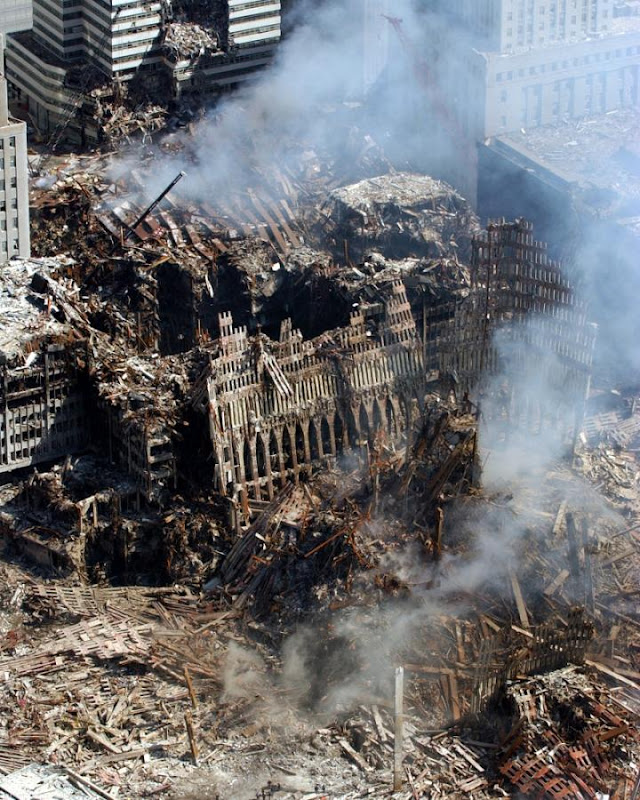
Then, things became quiet and Genelle couldn’t believe that she was still alive. Listen to what Genelle says happened next: “I knew then I was going to die. Nobody was going to find me under all the steel and concrete. I started calling out for [my friend] Rosa, but there was no response. Then I heard a man saying, ‘Help, help, help.’ His voice grew fainter, and then there was nothing.

“There in the dark, my mind started racing. I thought of my children, my family, and my fiancĂ©, Roger...More than anything I worried about what would happen to me after I died. I didn’t know how to ask for forgiveness. I was sure I was going to hell.”

Beneath the steel and concrete, Genelle begged for a second chance at life, a second chance to live life God’s way. She floated in and out of consciousness for hour after hour, each time she came to praying for forgiveness and a miracle to help her to deal with the pain.

The next day, still under the rubble of the North Tower, Genelle heard the beeping sound of a truck backing up. She called out and a rescue worker heard her. But even though they shone a light all around and Genelle waved one hand, the only part of her that was free, no one saw her.

Then, Genelle faded from consciousness again. When she awoke, she heard rescue workers somewhere overhead and she prayed, “Please help me now!” She yelled at the workers. Nobody heard her. She desperately waved her hand again and now, somebody grabbed it.

“Genelle,” she heard, “I’ve got you! You’re going to be all right. My name is Paul. I won’t let go of your hand until they get you out.”

Soon, two rescue workers pulled Genelle out and Paul let go of her hand. Genelle was the last survivor to be pulled from the World Trade Center.

She spent five weeks in Bellevue Hospital, amazing the staff with her serenity. More than two years later, when I first read her story, Genelle still hadn’t had a nightmare about those horrible events.

One thing that bothered her though was that she never got the chance to thank Paul for taking her hand and reassuring her there in the rubble. She learned that there was no Paul among the rescue workers who went to Genelle that day. Not one of the crew who took her from the rubble knew of a Paul. Genelle is convinced that God sent an angel at just the right time.

September 11, 2001 began a new life for Genelle. As she puts it, “My life was very different than it had been before. I was amazed by how much God loved me.” She saw herself as a child of God. For the first time in her life, she felt truly free to be the person God designed her to be, the kind of person each and every one of us is designed to be.

Not only had Genelle been rescued; more amazingly still, this young woman who had been totally caught up with herself, with doing things her way, turned from sin and turned to the God we know through Jesus Christ...and got a new life!


Our Gospel lesson for this morning tells us about the proclamation of John the Baptist. John described himself simply as a voice. His voice called people to repentance. To repent means to change our minds about who’s in charge of our lives, to change our minds about our priorities. It really means to change our minds about who our God is.

Genelle had gone through her life before September 11, 2001, with many gods. She had worshiped at the altars of pleasure, good times, and herself, among others.

Under the debris of the World Trade Center, she came face to face with the reality that these things could not bring life nor save her life nor give her life purpose or meaning.

Fortunately for all of us, God long ago sent a rescuer Whose life, death, and resurrection can bring new life and second chances (and third and, if you’re like me, three-hundred thousandth chances) to all who follow Him.

On the first Christmas day, God sent Jesus Christ. Anytime we take His hand and let Him be in control, whether our days bring us trials, triumphs, tedium, tragedies, crosses, or crowns, we have new life.

Many people have the mistaken notion that Christianity is about morality. People tell me, “I like to send my kid to church because he learns the right way to live.”

But the right way to live is no big mystery! Anybody who takes the time to look it up will find that every major religious system in the world says pretty much the same things about morality. They say that loving and living at peace with our neighbor is a good thing, that we shouldn’t steal or take our neighbor’s spouse, and so on.

The problem isn’t that we all don’t know the right way to live. The problem is that we don’t know how to do it.

The sin in our bones keeps us from doing the good we know we should do and that deep down, we want to do.

Jesus Christ came to earth and lived the perfect sinless life, offering Himself as the sacrifice for our sin so that you and I can have his power to do what we cannot do in our own power: Turn from sin and live with God in our lives today and always.

I’ve mentioned it before and I probably will again: Alcoholics Anonymous is one of the most powerful and important movements in our world today. AA and other movements patterned after it, uses a twelve-step process to help people get delivered from their addiction. The first step to freedom for the alcoholic or any other addicted person is the admission that he or she is powerless over the addiction.

Whether she had been rescued from the World Trade Center or not, Genelle Guzman-McMillan took her first step toward freedom when in a desperate and cataclysmic time, she finally told God that she knew she needed Him.

The acknowledgment of our helplessness and our desperate need of the God we meet in Jesus Christ can free us all for really living!

Jesus came into our world not as a great moral teacher, though He was a great moral teacher. Instead, Jesus came to be our God and Savior, the One to Whom we surrender even when we don’t understand, even when we would rather do anything but that which He calls us to do.

Jesus came to save us not only from future death, but also from the dead-end road of self-reliance.

That is a lonely road, something I have to keep learning all the time.

Once a few years ago, I was bellyaching about something to Ann. After listening to this for a while, she finally said, "Mark, ask someone to help you!"

Whether it's asking God for something or asking the people God brings into our lives to help us do the things we can't do on our own, we need to get over self-reliance and learn God-reliance!

When we follow Jesus, we not only walk with God, we also walk with that wonderful group of recovering sinners known as the Church, where God can provide us with the help we so often need in our lives and where we can be the means by which God helps not only other church members, but the whole desperate world.

In the days left until Christmas, as we deal with life’s stresses and the temptation to think that we’ve got to have everything in life under control, every t crossed, every I dotted, every package wrapped, I want to recommend a simple formula for repentance—a formula for turning things around in our lives in a positive way. It comes from Baptist pastor Gerald Mann, but it’s so good he could be a Lutheran. (Just joking!) Here it is:
I can’t. God can. I’ll let Him.
Indulge me and say those three simple phrases with me, won’t you?
I can’t. God can. I’ll let Him.
Jesus came to be our Savior. As we sing the carols and share our gifts this Christmas time, let’s remember, “We can’t. God can. We will let God—and no one and nothing else--be our God!”

[The true story of Genelle Guzman-McMillan is told in Jim Cymbala's book, Breakthrough Prayer.]

Saturday, December 05, 2009

About Those Google Ads

Readers of Better Living will notice that Google ads appear both near the top and at the bottom of each page to which you go here.

Some of the ads promote what I consider fairly "fringie" expressions of Christianity--speculators about the times and particulars of the apocalypse (something Jesus says we have no business doing), pseudo-theologians offering their own unbiblical theories on how Jesus saves us from sin and death, and so on.

I just wanted you to know that I have nothing to do with the advertisers that appear here and their appearance on this blog doesn't denote endorsement.

The ads appear as a result of my participation in the Google AdSense program. Through it, bloggers "earn" a few cents every time readers click on an advertiser's link appearing on their page. So far, as of November last year, after six years of blogging, I'd received $105.78 for the ad traffic generated from this blog. And I don't expect any more income to be generated here until about 2033. (Google only cuts checks once the clicking adds up to $100.)

Admittedly, this is the poor side of the Internet. That's OK.

But remember that just because someone's ad appears here doesn't mean I endorse what they're promoting.

Get Well, Evan Turner!

Here.

Buckeyes, without Turner, face Butler next Saturday. They barely lost to Clemson today.

Help Tim Vogel Climb Carew Tower

My friend and former parishioner, Tim Vogel, is climbing Carew Tower in Cincinnati once more this year to raise money for the Lung Association. Please pledge for Tim's climb for this important cause. Thanks!

God, Help Me to Desire YOU More Than Anything This Christmas

Good words from Julie Ackerman Link.

In reading Link's devotional piece, some will undoubtedly say--as I was inclined to say as I read it, "Hey, I'm not a kid. I don't want presents and candy for Christmas."

We might say, "I just want a safe gathering with my family." Or, "I want everybody to get along." Or, "I want the kids to have nice Christmases." (The latter sentiment often accompanied by the old saw, "After all, Christmas is for kids.")

But if our goals for this Christmas are safe, happy gatherings of family, conviviality, or happy children, we're aiming way too low!

(And if we think that "Christmas is for kids," we really don't get it at all.)

Christmas, that humanly created blip on the calendar, is meant to be a reminder of the thing we should most desire, not just at Christmas, but always. That's God.

On the first Christmas, whatever time of the year it actually happened, God entered into our world to give Himself to us. Jesus is not just truly human, but truly God. We Christians are remembered to how He gave Himself to us and for us every time we receive His body and blood in Holy Communion. ("This is My body, given for you...This is My blood, shed for you.")

We're called to desire the presence of God in our lives--in every part of our lives--not because God is some egomaniac. It's because without God, we are incomplete. It's because without God, we don't have God's life in us. It's because without God, we don't have the capacity to become the people God designed us to be and our relationships can't be powered by His self-giving love.

For Christmas this year, and for every day of my life, I'm asking God to help me to desire one thing above all else--more than comfort, ease, freedom from difficulties, or anything else. I want to be a person who desires God above all else.

Work in my desires, Lord Jesus, to make You and Your glory the object of all my desires. Amen

Wednesday, December 02, 2009

Mary, the Faithful Disciple

[This was shared during tonight's Midweek Advent Worship at Saint Matthew Lutheran Church in Logan, Ohio.]

Luke 1:26-38
Mary might well have wondered if she’d lost her mind. After all, how many times have you seen an angel? And how many virgins have babies?

She could be excused maybe, for writing off her entire experience with the angel Gabriel as a figment of her imagination. Or, to have treated the angel’s message with the kind of skepticism with which Zechariah, the husband of Mary’s relative, Elizabeth, treated Gabriel’s message to him that he and Elizabeth would have a son. Yet Mary believed.

She might also be excused for being more than a bit resentful. A young woman—a girl, really—who had not consummated her arranged marriage to Joseph, the Nazareth fix-it man, Mary knew that once her pregnancy became known, she would probably be dragged outside her small town and stoned to death. Yet Mary believed.


We know that Mary was not always the perfect disciple. As Jesus grew older, she allowed herself to forget that Jesus did not belong to her. No child really does belong to a parent, of course. Parents must grow to accept that. But for Mary, such acceptance must have been especially difficult. When he was twelve, Jesus became separated from the family during a trip to Jerusalem. Mary was frantic. But when she finally caught sight of Jesus in the temple and asked Him why He had so troubled Joseph and her, Jesus replied simply, “Didn’t you know that I would be here in my Father’s house?”

And later, when people were following Jesus, many of them whispering threats and calling Him blasphemous, Mary, in spite of what she knew about Jesus, tried to tell folks not to listen to Him. Jesus had lost His mind, Mary and her children told the crowd in a bid to spring Jesus loose and to bring Him back to safety in Nazareth. But Jesus said that His real family was anyone who believes in Him as God and Lord.

Of course, Mary knew that. And I have to say that for me personally, it’s Mary’s lapses in faith that make her so compelling, such a role model. I have lapses in faith, too, times when I say and do things that run contrary to the Lord I believe in, contrary to the life of faith He has called me to live.

But by God's grace, I'm thankful that God gives more credence to my faith than to my many lapses. Mary helps me to know that's true.

And it should be said that incidents like the ones I named from Mary's life were only lapses in her faith. From the moment she learned from Gabriel about the role she was to play in God’s plans for the world’s salvation, through witnessing her son’s death on a cross and His resurrection, despite the lapses, she remained faithful. Through joy and heartache, doubt and glorious affirmation, Mary was a faithful disciple.

The Eastern Orthodox and Eastern Catholic Christian traditions have a title for Mary. They call her theotokos, a Greek compound word that means literally, Bearer of God. Mary bore Jesus more than just in her womb for nine months.

She bore Him, the mark of Him, in some way her entire life. In this too, she is a model for each of us. We who, as baptized Christians have been sealed by the Holy Spirit and marked with the cross of Christ forever, bear the Name of Jesus. We carry Him into our everyday lives and relationships. That isn’t always an easy load, something Jesus recognizes when He tells us that we must take up our crosses and follow Him. But the Lord we carry with us also carries us, a far heavier burden that began when He went to the cross and bore all our sins. And those who dare to take Christ with them through their life’s journeys also receive guidance, peace, and an eternity of hope that nothing can destroy. Bearing Christ lightens the loads of life!

Whatever God may call you and me to be or do, I pray that we will be found as faithful as that young Judean girl was when met by the angel Gabriel. May we willingly say, “Here am I; the servant of the Lord; let it be with me according to your word.” Amen

The Evil One Cannot Overpower Us

The Christian can walk and live in the certainty that Christ is beside us and the Holy Spirit fills us with power to resist temptation and self-destruction. Every time I sin, it represents a failure on my part to place some aspect of my life under Christ's Lordship. Every time I resist temptation, it represents a triumph of Jesus Christ over all that would do me everlasting harm. This is why a commitment to living in "daily repentance and renewal" is central to the life of a Christian.

You might be interested...

if you're a member of the Evangelical Lutheran Church in America (ELCA) like me, in the online town hall that presiding bishop Mark Hanson has scheduled for December 6. It will be interesting to hear the questions raised by people from throughout the church body.

Tuesday, December 01, 2009

Right or Wrong, This is to Be Admired About Policy Obama Announces Tonight


In the epilogue to his book, Presidential Courage, Michael Beschloss recalls that five years before being elected President, John Kennedy lamented that US politics had become "so expensive, so mechanized and so dominated by professional politicians and public relations men...[And further, because of] the tremendous power of mass communications, any unpopular or unorthodox course [aroused] a storm of protest." These conditions, Kennedy suggested, put a higher price on political courage than at any time in our country's history, with the prospects of political annihilation for those who showed a willingness to stake out different points of view becoming almost prohibitively high.

Some would argue that Kennedy may have believed more in political courage than he practiced it, especially when it came to civil rights, a cause about which he was either indifferent or tepid through most of his political career. But the forces Kennedy saw diminishing a political actor's willingness to chart a course irrespective of what opinion polls, focus groups, radio call-in audiences, special interests, or political operatives may tell them have not diminished in power or influence in the past fifty-four years. (The Internet and cable news, among other things were not part of the stew identified by Kennedy. But they have made his insight even more acute.)

Truth be told, the US electorate has a schizophrenic attitude about political courage. We want, so we say, for our political leaders to have backbone and to not make decisions based on the latest public opinion surveys, but on what's "right." These are the kinds of things ordinary voters say all the time.

Yet we also seem to want our leaders to be milquetoasts or automatons who mechanistically reflect our opinions, well-informed and otherwise.

This leads to 1984-style characterizations of popular pols as courageous, although their actions rarely buck popular opinion, and of politicians who dare to do what they think right as being weak, vacillating, or indecisive. You can supply your own examples for each category and if you're fair, I think you'll concede that examples of both inaccurate assessments run the political gamut. Our schizophrenia is reliably non-partisan.

No wonder political courage is so rare. And its rarity is part of what makes President Barack Obama's speech on Afghanistan tonight so important.

Whatever one's take on the strategy he will unveil this evening--I offer no opinion on that, he is displaying remarkable political courage.


That may not ring true to some at first. After all, the strategy the President will unveil tonight is consistent with what he said he would do during last year's presidential campaign, a campaign he won resoundingly. Obama said he would wind things down in Iraq. The real fight against al-Qaeda, he also said, was on the border between Afghanistan and Pakistan, where the fight would need to be ramped up. With those pledges as part of his platform, Obama was given the presidency.

But in the intervening time, a core constituency of the President's own party, liberal Democrats, have become disenchanted with any US presence in Afghanistan. And the American people have grown more restless to leave the Afghans (and the Pakistanis) to fend for themselves.

Some Republicans have claimed that Obama has been "dithering" on Afghan policy and some in the opposition party have said that Obama should not cut down on General Stanley McCrystal's troop level request.

Tonight, Barack Obama is going to tell a nation weary of war that we must undertake an increased burden in a nation where US personnel have been fighting and dying for eight years.

Give the President his due. This isn't just a hard speech to make; it was preceded by a tough decision made in spite of a clear understanding that, because nothing is a given in this life, the war could turn out badly. And, less significantly, it could make Obama a one-term president. The policy Obama announces tonight could scuttle all his lofty aims.

Yet, in the face of the opposition and the odds, Barack Obama, based on his discussions with military and civilian advisers, is forging ahead with his proposed escalation of the war in Afghanistan.

Whether Obama's decision turns out to be right or wrong, a success or a failure, he is exhibiting political courage.

How history will remember Obama's courage depends on how things turn out. The second line in Beschloss' book hints at that:
...throughout our history, at times of crisis and urgent national need, it has been important for Presidents to summon the courage to dismiss what is merely popular--and the wisdom to do that for causes that later Americans will come to admire.

The only political courage subsequent generations will admire, Beschloss seems to say, is that which results in what is perceived as success. No points are given for being courageously wrong. I want to disagree with that; courage should be counted as courage irrespective of outcomes.

Yet this is the high stakes game which Barack Obama is knowingly playing. The politician submits her or his life not only to the judgment of contemporary electorates, but of history. My personal experience is that most politicians like--sometimes love, sometime crave--being liked, affirmed, appreciated, cheered.

Courage for politicians happens when they risk losing votes and the adulation of history to do what they think is right.*

The President has little to gain and much to lose from the policy he announces tonight. Right or wrong, that takes courage.

*Actually, this is true for any leader. After twenty-five years as a pastor, I can tell you that it takes more courage to take a stand you know some will repudiate than to do anything that gains universal applause. But I also can say that, for all the turmoil taking a stand may cause, there is more inner peace and clarity of action when you go the courageous route. I have to also say that, for me, courage is something I draw from God and not any intestinal fortitude I may (or may not) possess.