Showing posts with label Luke 3:1-6. Show all posts

Sunday, December 09, 2012

The Repentance Road

Luke 3:1-6
Sometimes, when I’m driving or riding with Ann on the Route 33 bypass around Lancaster, I think about all that was involved in building that piece of highway. There were hills that had to be blasted through and dug out, low areas to be filled in by dirt and gravel. And all of it was done in order to give us straighter, clearer paths to the places we want to go. We owe a lot to the the road builders who clear the way for us.

Our Gospel lesson for this morning tells us about a road-builder we call John the Baptist. According to Luke, the writer of the book from which our lesson is taken, John fulfilled the prophecy of Isaiah, written at least five hundred years before the birth of Jesus. Luke cites Isaiah 40:3-5; they make up verses 4-6 of our Gospel lesson. John the Baptist, Luke tells us, is “the voice of one crying in the wilderness: ‘Prepare the way of the Lord; Make His paths straight. Every valley shall be filled and every mountain and hill brought low; The crooked places shall be made straight and the rough ways smooth; and all flesh shall see the salvation of God.’”

Long before John was born, God had defined his mission in life. He was to be a road builder who would create a clear pathway for “all flesh” to “see the salvation of God.” John’s job then, was to clear the way for people to see Jesus, the only one Who can save us from death, futility, and sin.

How did John do this? And what does it have to do with us?

Please turn to our Gospel lesson, Luke 3:1-6. Luke writes: “Now in the fifteenth year of the reign of Tiberius Caesar, Pontius Pilate being governor of Judea, Herod being tetrarch of Iturea and the region of Trachonitis, and Lysanias tetrarch of Abilene, while Annas and Caiaphas were high priests...”

When Luke first wrote his gospel account of Jesus’ life, death, and resurrection, there was no single agreed-upon calendar. So, if you were trying to record an orderly account of events, you couldn’t say, “Back in such and such a year...” You said things like, “When So and So was king.” From what Luke tells us with this list of kings and priests, scholars believe that John the Baptist’s ministry began in 28 or 29 AD.

But Luke wants us to know more than just when John the Baptist began his ministry. He wants us to know why John began his ministry. Take a look at Luke 1:52. Mary, the virgin God chose to be the mother of Jesus, tells Elizabeth, then in the sixth month of her pregnancy for John that “[God] has put down the mighty from their thrones and exalted the lowly. He has filled the hungry with good things and the rich He has sent away empty.”

The world kowtows to the Ceasars, the kings, the wealthy, and the powerful, but people who believe in the God revealed to all the world through Jesus Christ know Who’s really in charge.

They know too that God is at work even when most people think that God has disappeared.

Even when despots and superstars are “getting away with murder,” God is still moving the world and all who trust in Him toward a certain destiny, ensuring that at a time both the Old and New Testaments call “the day of the Lord,” all will be made right.

Despots will get their comeuppance and those who trust in the Lord will step into the joy of their inheritance from God.

Now, please go back to our Gospel lesson, starting in the middle of verse 2: “the word of God came to John the son of Zecharias [or, Zechariah] in the wilderness.”

These words are a clear signal of what kind of person John is. You see, a scan of the Old Testament prophets’ books shows us:
  • For example, the prophet Hosea’s book begins, “The word of the Lord that came to Hosea the son of Beeri, in the days of...the kings of Judah...” 
  • Joel’s book starts, “The word of the Lord that came to Joel the son of Pethuel...” 
  • Even the book of the reluctant prophet Jonah starts out, “Now the word of the Lord came to Jonah the son of Amittai...” 
The Old Testament prophets were people to whom a special word from God came, just as a special word from God came to John.

The word the prophets were expected to spread was often a message that people didn't want to hear, but needed to hear if they were going to have right relationships with God.

The lives of the prophets were, as a result, often difficult. Many prophets were killed, just as John the Baptist would be, not because God had abandoned them, but because they were being faithful to the word God gave to them.

And people then, no less than today, didn’t want a God Who told them what to do.

No one should ever want to be a prophet.  But if God calls you to be a prophet, you dare not turn your back on God or on the word God has given to you. As Jonah learned when he tried to avoid preaching God’s Word to the people of Nineveh, even when you book a Mediterranean cruise in the opposite direction from where God tells you to go, God will find you and send you where He wants you to go.

For anyone, prophet or ordinary person like you and me, who wants God in their life, surrender to the will of God is the only viable option. That’s why Jesus teaches us to pray that most dangerous of all prayer petitions:  “Thy will be done...”

In Luke 3:3, we read, “And [John] went into all the region around the Jordan, preaching a baptism of repentance for the remission [or the forgiveness] of sins.”

Out in the wilderness where God had once spent forty years preparing His people to enter the promised land, John preaches the message that he’s been given by God. It’s simple: “Repent.”

This is how John the Road Builder did his job of creating a pathway by which people could see God’s  salvation given in Christ.

Repentance, to this day, remains the only roadway by which we can find salvation from sin and death, the only roadway by which we can have peace with God and peace within ourselves.

The Bible teaches that all of us are born in sin. That’s why God sent Jesus into the world. He took our sin on His own shoulders on the cross. He rose from the dead to tear down the walls of sin and death for us and to allow us to enjoy peace and intimacy with God.

But sin can set people down pathways so far from Jesus that even if they’ve been churchgoers all their lives, they can’t really see Jesus any more.

To see Jesus, the arrogant must be laid low and the lowly must be lifted up.

We need a straight, clear path to the salvation God wants to give to all people through Christ. John pointed people (he points us still today) to the pathway of repentance as the way to salvation through Jesus.

To many people today, repentance is a dirty word. I saw a bumper sticker the other day. It said, “I was born right the first time.” No being born again for the driver of that truck, thank you very much; no acknowledgement of any need of renewal because of the wall of sin between God and us.

For others though, repentance is a great word, a joyful word! That’s because true repentance is made up of two elements. First: It means to be sorry for my sin. Second: It means to trust that when I lay my sins at the foot of Jesus Christ and His cross, He will forgive me and I will be at peace with God. The believer in the God we know in Jesus is filled with the assurance voiced by King David in Psalm 103: “...as far as the east is from the west, so far he removes our transgressions from us!”

Imagine two people, each headed for the same destination. One takes a mountain path, following ever upward through switchbacks and hairpin curves, sure that she’s headed in the right direction, only to find herself at the pinnacle of a mountain, nowhere close to where she intended to go.

The other person, with the same destination, descends into a deep valley, slogging around and through swamps and streams, equally certain that he’s going right, only to find himself mired in mud, his destination nowhere in sight.

These two people illustrate the lives of people who have lost their ways in life, far from the God we know in Christ.

The only way off the mountain paths of egomania that lead us away from Christ is through repentance. The egomaniac must say, “You’re right, Lord. I’m not in charge. I’m not God. I’m not entitled. Forgive me and let me be Your child.”

Similarly, the only way off the lowly paths of self-condemnation is through repentance. The lowly person says, “You’re right, Lord. I’ve been expecting too little of my character, I’ve thought too little of myself, and so, given myself a pass for engaging in sin that dehumanizes me. I thought that who I am and what I’ve done I didn’t matter. But You died and rose for me; I know that I matter! Forgive me for denying the truth about myself and lift me up to live as Your child.”

And then the repentant person, lowly or arrogant, trusts Jesus to be as good as His promise to give life, peace, hope, and the power to live with purpose to those who believe in Him.

Romans 8:1 says: “There is therefore now no condemnation for those who are in Christ Jesus.” Those who repent--tell God that they are sorry for their sins and trust Christ to forgive them--know what that passage is saying. Though we are sinners who deserve condemnation, Christ sets the repentant free to live as the human beings we were all meant to be!

Chances are that if you’re like other Christians (including me), you follow Jesus well sometimes. But sometimes, you lose your way. You sin and maybe you find, as I find, that the more I sin, the easier it becomes to sin again and the harder it can become to really worship God or to have peace with God, even with ourselves.

This is why repentance is so important. It clears away the blindness of our sin, helping us to see how deadly our sin is. It helps us to see the God we know through Jesus, the love He has for us, and the life He gives to those who turn their backs on sin and follow Him.

It was while repenting that David wrote in the psalms in the Old Testament, “Search me, O God, and know my heart; test me and know my thoughts. See if there is any wicked way in me, and lead me in the way everlasting.”

John the Baptist was a road-builder. But the road to life with God and the second chances of God is open even today to all. We travel the road of repentance when we turn from sin and trust in Christ alone for life. May this be the road we travel each day.

[This was prepared to be shared during the 10:15 worship service at Saint Matthew Lutheran Church in Logan, Ohio, today. Thanks to Jim for sharing it with the congregation as I fight the creeping crud!]

Sunday, December 06, 2009

I Can't, But...

[This was shared during worship with the people of Saint Matthew Lutheran Church in Logan, Ohio, earlier today.]

Luke 3:1-6
Genelle Guzman-McMillan was the second of thirteen children and grew up on the Carribean Island of Trinidad. Genelle’s mother was a devoted Christian. But Genelle didn’t like church, thinking it was a waste of time. In fact, she thought that anything that cramped her style was a waste of time.

At age nineteen, expecting her first child, she moved in with her boyfriend. Six years later, the two of them split up and Genelle felt free to hit the club and party scene for which she’d always hankered. Somehow, in spite of now having two children, she made it through college, still managing to party most of the time.

Genelle seemed to have broken free from the old restrictions of her life and, depending on herself and her own wits. She was, as it’s said, “living large.”

In 1998, she moved to New York City where family and friends told her, she would find greater opportunity. She decided to leave her kids in Trinidad until she got settled in. After she came to New York, her ex-boyfriend informed Genelle that he was unwilling to let their kids come to America with her. That was okay with Genelle; by now, she was enjoying the party scene in the Big Apple. She quickly accepted being able to do more of it without having her children around.

By then, Genelle was living with another man, Roger McMillan. Like Genelle, he loved to spend his spare time partying. They were on top of the world until, Genelle says, there came “a remarkable turn."

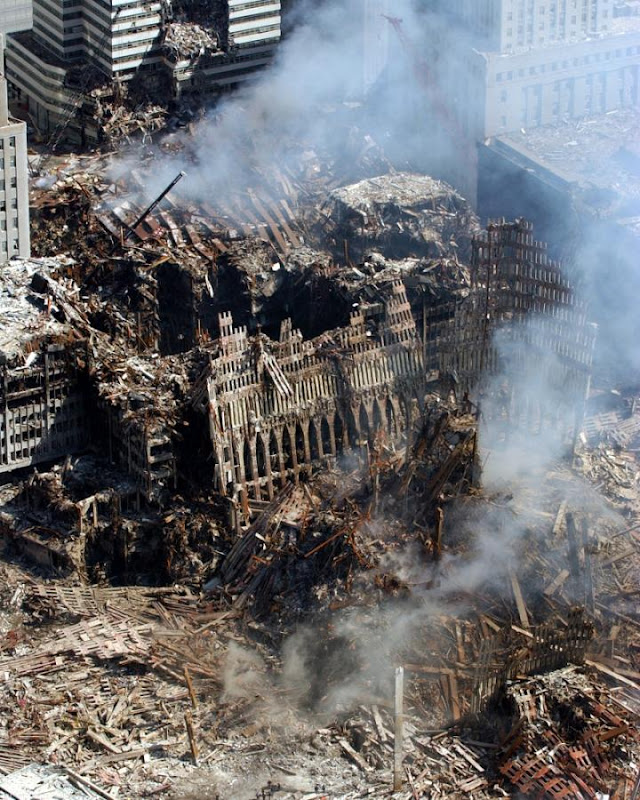
Genelle worked in the Tunnels, Bridges, and Terminals Department of the Port Authority of New York, her office on the 64th. floor of the North Tower at the World Trade Center. It was early on September 11. 2001 and she was making small talk with a co-worker, when she felt the building shake.


At first, she and the others in her office had no idea that an American Airlines passenger jet had just slammed into their building. After a time of indecision and panic, Genelle and the others with her on the 64th. floor, heard a roaring noise, not knowing that it was the sound of the South Tower collapsing.

But that sound was sufficiently terrifying to convince them all that they needed to get out of there. They made their way down the stairs, counting each flight aloud. Firefighters were ascending the stairs as they descended, assuring them that if they kept going down, they would be fine.

By the time the group reached the thirteenth floor, Genelle’s leather-heeled shoes were killing her. As she leaned over to take them off, everything around her seemed to explode in a massive boom!

All Genelle could see was blackness. She felt something hit her chest and then, she was pinned to the ground. As she put it, “One hundred ten floors were coming down around us. I knew I was being buried alive. The noise was deafening.”

Then, things became quiet and Genelle couldn’t believe that she was still alive. Listen to what Genelle says happened next: “I knew then I was going to die. Nobody was going to find me under all the steel and concrete. I started calling out for [my friend] Rosa, but there was no response. Then I heard a man saying, ‘Help, help, help.’ His voice grew fainter, and then there was nothing.

“There in the dark, my mind started racing. I thought of my children, my family, and my fiancĂ©, Roger...More than anything I worried about what would happen to me after I died. I didn’t know how to ask for forgiveness. I was sure I was going to hell.”

Beneath the steel and concrete, Genelle begged for a second chance at life, a second chance to live life God’s way. She floated in and out of consciousness for hour after hour, each time she came to praying for forgiveness and a miracle to help her to deal with the pain.

The next day, still under the rubble of the North Tower, Genelle heard the beeping sound of a truck backing up. She called out and a rescue worker heard her. But even though they shone a light all around and Genelle waved one hand, the only part of her that was free, no one saw her.

Then, Genelle faded from consciousness again. When she awoke, she heard rescue workers somewhere overhead and she prayed, “Please help me now!” She yelled at the workers. Nobody heard her. She desperately waved her hand again and now, somebody grabbed it.

“Genelle,” she heard, “I’ve got you! You’re going to be all right. My name is Paul. I won’t let go of your hand until they get you out.”

Soon, two rescue workers pulled Genelle out and Paul let go of her hand. Genelle was the last survivor to be pulled from the World Trade Center.

She spent five weeks in Bellevue Hospital, amazing the staff with her serenity. More than two years later, when I first read her story, Genelle still hadn’t had a nightmare about those horrible events.

One thing that bothered her though was that she never got the chance to thank Paul for taking her hand and reassuring her there in the rubble. She learned that there was no Paul among the rescue workers who went to Genelle that day. Not one of the crew who took her from the rubble knew of a Paul. Genelle is convinced that God sent an angel at just the right time.

September 11, 2001 began a new life for Genelle. As she puts it, “My life was very different than it had been before. I was amazed by how much God loved me.” She saw herself as a child of God. For the first time in her life, she felt truly free to be the person God designed her to be, the kind of person each and every one of us is designed to be.

Not only had Genelle been rescued; more amazingly still, this young woman who had been totally caught up with herself, with doing things her way, turned from sin and turned to the God we know through Jesus Christ...and got a new life!


Our Gospel lesson for this morning tells us about the proclamation of John the Baptist. John described himself simply as a voice. His voice called people to repentance. To repent means to change our minds about who’s in charge of our lives, to change our minds about our priorities. It really means to change our minds about who our God is.

Genelle had gone through her life before September 11, 2001, with many gods. She had worshiped at the altars of pleasure, good times, and herself, among others.

Under the debris of the World Trade Center, she came face to face with the reality that these things could not bring life nor save her life nor give her life purpose or meaning.

Fortunately for all of us, God long ago sent a rescuer Whose life, death, and resurrection can bring new life and second chances (and third and, if you’re like me, three-hundred thousandth chances) to all who follow Him.

On the first Christmas day, God sent Jesus Christ. Anytime we take His hand and let Him be in control, whether our days bring us trials, triumphs, tedium, tragedies, crosses, or crowns, we have new life.

Many people have the mistaken notion that Christianity is about morality. People tell me, “I like to send my kid to church because he learns the right way to live.”

But the right way to live is no big mystery! Anybody who takes the time to look it up will find that every major religious system in the world says pretty much the same things about morality. They say that loving and living at peace with our neighbor is a good thing, that we shouldn’t steal or take our neighbor’s spouse, and so on.

The problem isn’t that we all don’t know the right way to live. The problem is that we don’t know how to do it.

The sin in our bones keeps us from doing the good we know we should do and that deep down, we want to do.

Jesus Christ came to earth and lived the perfect sinless life, offering Himself as the sacrifice for our sin so that you and I can have his power to do what we cannot do in our own power: Turn from sin and live with God in our lives today and always.

I’ve mentioned it before and I probably will again: Alcoholics Anonymous is one of the most powerful and important movements in our world today. AA and other movements patterned after it, uses a twelve-step process to help people get delivered from their addiction. The first step to freedom for the alcoholic or any other addicted person is the admission that he or she is powerless over the addiction.

Whether she had been rescued from the World Trade Center or not, Genelle Guzman-McMillan took her first step toward freedom when in a desperate and cataclysmic time, she finally told God that she knew she needed Him.

The acknowledgment of our helplessness and our desperate need of the God we meet in Jesus Christ can free us all for really living!

Jesus came into our world not as a great moral teacher, though He was a great moral teacher. Instead, Jesus came to be our God and Savior, the One to Whom we surrender even when we don’t understand, even when we would rather do anything but that which He calls us to do.

Jesus came to save us not only from future death, but also from the dead-end road of self-reliance.

That is a lonely road, something I have to keep learning all the time.

Once a few years ago, I was bellyaching about something to Ann. After listening to this for a while, she finally said, "Mark, ask someone to help you!"

Whether it's asking God for something or asking the people God brings into our lives to help us do the things we can't do on our own, we need to get over self-reliance and learn God-reliance!

When we follow Jesus, we not only walk with God, we also walk with that wonderful group of recovering sinners known as the Church, where God can provide us with the help we so often need in our lives and where we can be the means by which God helps not only other church members, but the whole desperate world.

In the days left until Christmas, as we deal with life’s stresses and the temptation to think that we’ve got to have everything in life under control, every t crossed, every I dotted, every package wrapped, I want to recommend a simple formula for repentance—a formula for turning things around in our lives in a positive way. It comes from Baptist pastor Gerald Mann, but it’s so good he could be a Lutheran. (Just joking!) Here it is:
I can’t. God can. I’ll let Him.
Indulge me and say those three simple phrases with me, won’t you?
I can’t. God can. I’ll let Him.
Jesus came to be our Savior. As we sing the carols and share our gifts this Christmas time, let’s remember, “We can’t. God can. We will let God—and no one and nothing else--be our God!”

[The true story of Genelle Guzman-McMillan is told in Jim Cymbala's book, Breakthrough Prayer.]