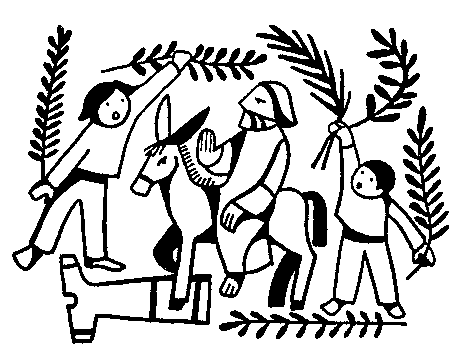
Today, Christians around the world celebrate Palm Sunday, also commemorated as the Sunday of the Passion. (Passion describes a love so great that the one who loves is willing to die for the loved one. In Christ's Passion, He sacrificed Himself on the cross so that we can live with God, now and forever.)
Below is today's online worship from Living Water Lutheran Church in Centerville, Ohio. After that, you'll find the prepared text of the message for the day.
God bless you!
Matthew 21:1-11
A friend of ours was dying. She’d had a long battle with cancer and as I visited her in the hospital ICU, she said nothing most of the time. I thought for a while that she was unconscious. But it became clear that she knew I was there and that the morphine was doing little to ease her pain. At one point, she reacted to what was clearly a brutal stab of pain. “What can I do?” I asked her. “It just hurts so much,” was all she could say.
Within twenty-four hours, she had passed from this life and, knowing her faith in Christ, into the Savior’s loving arms.
But, as often happens in the face of such tragedy, everyone who knew my friend--her family, her co-workers, her friends--were left with questions.
What about all the prayers offered for her healing in Jesus’ name?
What about her friendship, virtues, talents, and wisdom now lost to us?
Had God abandoned her?
Had God abandoned us?
Was God impotent in the face of life’s deadly realities?
We ask questions like these often, especially today when, in the words of the old hymn, “despair engulfs earth’s frame.” Because of the coronavirus, many are more conscious today than they ever have been of the ongoing, daily primal battle between life and death, darkness and light, despair and hope.
In one form or another, the cry of the whole human race, shouted out to God by those who know Him through Jesus and by others who have no faith at all, is the same: “Save us! Help us! Deliver us from this evil! ”
We come today to Palm Sunday, also known as the Sunday of the Passion. The day commemorates both Jesus’ entry into Jerusalem days before His crucifixion and His passion when He would offer His sinless life as the atoning sacrifice for our sins.
On that first Palm Sunday, the crowds in Jerusalem, unaware that by this time, Jesus has already predicted three times that He would be arrested, beaten, crucified, die, and rise from the dead, do know of the reports that Jesus has performed miracles and given people the hope that, at long last, this is the Messiah, the Christ, God’s anointed King, Who would set all things right, and meet their deepest needs.
As Jesus arrives, the crowds set branches down in His path, creating an ad hoc roadway of welcome. And, in a day when most people owned only one cloak, they lay their cloaks down before Him.
Jesus enters the city in the way that Zechariah had prophesied the Messiah would arrive in Jerusalem six centuries earlier: “See, your king comes to you, righteous and victorious, lowly and riding on a donkey, on a colt, the foal of a donkey.” (Zechariah 9:9)
God’s people had suffered much.
And much of their suffering was self-inflicted, just as ours can be.
They had worshiped false gods like worldly success and power.
They had treated others unjustly, ignoring God’s command that they treat the immigrants among them with hospitality and love, developing ferocious prejudices against Samaritans and all Gentiles.
They exhibited religious snobbery, forgetting that they were not chosen by God to be His people as a light to the nations because they were better than anyone else, but simply because of God’s His grace, His charity.
But they had also suffered at the hands of other peoples and nations. They still were suffering at the hands of other peoples and nations.
They had been enslaved, conquered, forced to become refugees.
They had been robbed, exploited, pushed around, misused.
No wonder then, that as they see Jesus on what we now call Palm Sunday, they shout, “Hosanna [meaning, “Save us! Deliver us!”] to the Son of David! Blessed is he who comes in the name of the Lord! Hosanna in the highest heaven!”
Here, at last, the people think, is the Messiah. Now, we needn’t suffer anymore. Now, the Romans can be sent packing. Now, God will use this Messiah to punch all our enemies in the nose and give us all that we want. Their despair, they believe, will at long last give way to hope.
But they are, of course, about to be disappointed, the way that you and I can be disappointed by God when He doesn’t do what we think He should.
Jesus hasn’t come to Jerusalem to conquer what the people see as their biggest problems.
Had Jesus done as the Palm Sunday crowds wanted, they all would have been free of the Romans, free of the dominion of other peoples, able to live in the land that God had given them.
But had Jesus chosen that course, they (and we) still would be slaves without hope: Slaves to sin. Slaves to death. Slaves to the darkness of eternal separation from God.
The crowd, like us much of the time, is playing a short game. They want benefits that, at best, can only last a lifetime. They want money, independence, good health, and times of ease now and they don’t want to change anything about themselves or submit to a Messiah Who they view as a kind of cosmic ATM, to get what they want.
They don’t want the Messiah to be their Lord, a Messiah who insists that the way to healing and wholeness is for us to die to ourselves and our sins so that we can embrace the life that only God can give to us, the life that God only offers us through this Messiah Jesus.
Jesus, by contrast, is playing the long game. He wants to bring us into the kingdom of God forever.
The Kingdom of God is the realm in which believers in Jesus Christ live even in this imperfect world.
It's the kingdom He gives to believers, in which we know that we are forgiven of our sin and that we are right with God for our faith in Jesus.
It's a kingdom that will only be brought to perfection when we, like Him, are raised by God the Father from the dead.
Friends, I have seen the kingdom of God, the hope of life with God most in places that most people might deem unlikely: in hospital ICUs, in funeral homes, in jails and prisons where men rightly paying society for their crimes nonetheless were filled with the light of eternity because of their repentance and their belief in Jesus.
In desperate moments, those who latch onto Jesus know what they really need.
Not money.
Not ease.
Not power.
They know they need what we need: Jesus.
Just Jesus.
Our real enemies are sin, death, and darkness. It’s these things Jesus goes to Jerusalem to conquer by His crucifixion and resurrection. And He does it for you and me!
The crowds in Jerusalem are largely uninterested in what Jesus offers to us: new life set free from ourselves, freedom to live with God forever.
This same disinterest exists today, even among some Christians.
As the gospel writer John says of Jesus and the reaction of the human race that He, God the Son, made: “He came to his own, and his own people did not receive him. But to all who did receive him, who believed in his name, he gave the right to become children of God…” (John 1:11-12)
The good news of Palm Sunday is that Jesus refuses to cave in to the expectations of the world.
He does the will of God the Father.
He pays the price for our sin.
He invites us into the kingdom of God for eternity.
In this kingdom, Christians live even when our lives aren’t comfortable.
Even when things don’t go as we hope.
Even when we have to walk away from sins we so desperately want to commit.
Even when our prayers aren’t answered as we want.
Even when we walk through the valley of the shadow of coronavirus and death.
What Jesus goes on to do on Good Friday and Easter Sunday is our assurance that, no matter what happens to us in this life, God will meet the greatest needs we all have in Jesus.
He will forgive our sins.
He will give us the resurrection.
He will turn our despair into hope.
He will turn our mourning into laughter that never ends.
Amen
[I'm the pastor of Living Water Lutheran Church in Centerville, Ohio.]
A sinner saved by the grace of God given to those with faith in the crucified and risen Jesus Christ. Period.
Showing posts with label Matthew 21:1-11. Show all posts
Sunday, April 05, 2020
Sunday, April 13, 2014
Not the King We Want...the King We Need
[This was shared during worship with the people and friends of Living Water Lutheran Church in Springboro, Ohio, this morning.]
Palm Sunday
Matthew 21:1-11
I once preached at a church in Germany. I delivered my sermon in English and it was translated for me. But the hardest part of the service came when, at the insistence of the host pastor, I helped lead the congregation in reading the Psalm responsively. I somehow got through the service and afterward, several of the German congregants asked me, since I spoke German so fluently, why I hadn’t given the sermon in German too. I had to explain that I’d spoken the Psalm phonetically and hadn’t really understood many of the words.
It’s possible to know the words we say without knowing what we’re saying. How often do we, on Sunday mornings recite the Apostles’ Creed or the Lord’s Prayer with little thought as to what we’re confessing or praying? More often than we might want to admit, I’ll bet.
The crowd that welcomed Jesus into Jerusalem on the first Palm Sunday said words that came from Psalm 118. “Hosanna [a word that means Save, please] Hosanna to the Son of David! Blessed is He Who comes in the Name of the Lord! Hosanna in the highest heaven!”
They were the right words to use in welcoming the King of kings. But they clearly didn’t really understand what it means for God to save us or to answer our prayers: A few days later, this crowd would turn on Jesus, along with the rest of the world, and cry for Him to be executed on a cross. In the end, Jesus wasn’t what the crowd was looking for. I wonder sometimes if Jesus--the real Jesus--is what you and I are looking for.
The crowd that welcomed Jesus to Jerusalem on the first Palm Sunday saw Jesus as a means to their ends. They wanted Jesus to lead a rebellion against their Roman conquerors. They wanted some of the money that the extortionist tax collectors were constantly taking from them. They wanted Jesus to be their king, so long as that meant He took orders from them. But it’s doubtful, at that moment, that many of them wanted Jesus to go to a cross. After all, they would have reasoned, what good would Jesus’ dying do them?
Yet, Jesus’ reason for coming into the world had always been plain.
It had been clear to the wise men who came to visit the infant Jesus in Bethlehem. One of their gifts had been myrrh, a resin used to anoint the dead.
And Jesus sought to make His reason for entering the world clear to His disciples. He told them that He was going to Jerusalem to be rejected by the world, killed on a cross, and then raised from the dead. And when Peter tried to correct Jesus on this point, Jesus told him that Peter’s ideas were from Satan, not from God.
Jesus, although He was sinless, had come into our world to take the punishment for sin we all deserve. He came to die. He came to be the Lord of all because He loves all people and wants to bring forgiveness to all people. And He will become the King of any who dare to repent for their sin and believe in Him as their Lord.
That’s good news. But it also can be hard to accept because it entails things we don't like: surrender, obedience, submission. It also means accepting that, just like everybody else, we're sinners in need of a Savior.
A few days after Jesus arrived in Jerusalem, the crowds noticed that He hadn’t led an armed rebellion. He hadn’t taken over the government. He hadn’t done their bidding. Instead, He spent His time throwing moneychangers out of the temple, talking about prayer, arguing with the religious authorities, telling stories (or parables) about the kingdom of heaven, talking about love of God and neighbor as the greatest commandment, teaching of the need to be ready for Him to return after He’d died and risen, and, most strangely of all maybe, He prayed, sometimes for hours at a time. This wasn’t the king they'd been looking for. And so, by the Thursday after the first Palm Sunday, the crowd was crying for Jesus’ execution.
Jesus may not be the king we are looking for. But Jesus is the Savior we need. I’m convinced of that, first of all, because of the road Jesus took on Palm Sunday. It demonstrates that Jesus is committed to walking through the hardest places in this life with us.
As our Gospel lesson from Matthew begins, Jesus is walking on the road from Jericho to Jerusalem. This is the same road, different direction, on which Jesus set His fictional parable of the Good Samaritan. It was a road on which people were often subjected to violence and robbery. Thugs hid in the rocks and crags of the road. Jesus walked that road. But, as you know, that wasn’t the hardest road Jesus traveled with us and for us.
The hardest road was Jesus’ entire life on this earth, when the Creator of the universe took the form of a servant, aiming all the while to die for us. That’s the point of some of Paul’s words in our second lesson today. “Your attitude should be the same as that of Christ Jesus,” Paul writes, saying that though Jesus was “in very nature God, did not consider equality with God something to be grasped, but made himself nothing, taking the very nature of a servant, being made in human likeness. And being found in appearance as a man, he humbled himself and became obedient to death-- even death on a cross!”
“I don’t understand all of this,” a woman whose husband had left her once told me, “but I sure wouldn’t want to go through it without God.” A king like the one the crowd wanted--and that we may sometimes want: a king who skated above us, untouched by our failings and our difficulties, a king who gave us all we wanted without reshaping our characters into being more loving and more human, couldn’t help us when we’re confused or lost or lonely or grieving. But Jesus can! Like that woman, we learn that, in Jesus, the God of all creation can reach down into our everyday lives, even when we go through tough times. He can do that because every experience we may have as human beings, He has experienced. And every sin you and I have ever committed, He bore in His own body on the cross.
On Palm Sunday, Jesus also proved that He was the Savior we need by Who He chose to rely on. When I was in high school, I played hooky to see a President deliver a speech down at the State House. He was surrounded by a phalanx of Secret Service security, necessary to be sure. He also had Air Force One and his presidential limo and cars filled with assistants and the latest communication technology. Back on Air Force One, he had access to every comfort he could want. Wherever presidents go, they look like rulers of the world.
When Jesus arrived in Jerusalem on the first Palm Sunday, He didn’t look like a ruler of the world. According to Matthew, Jesus rode a donkey, trailed by the colt of the donkey. In ancient times, the donkey was a symbol of humble domestic pursuits. Jesus had come into Jerusalem not with a sword, or a political program, or a retinue of public relations people, or a bevy of yes people. Jesus’ power didn’t and doesn’t depend on the dying stuff of this world. Jesus relied simply and completely on God the Father.
Every king, president, great athlete, and pop star, no matter how exalted dies. Even Elvis has left the building, folks! Only one king has ever defeated death. It was Jesus and there's only one reason for His victory over death. Even when He hung on the cross, the taunts of the fickle crowds ringing in His ear, the agonies of His wounds besetting Him, the horror of feeling abandoned by all haunting Him, Jesus depended only on God the Father. And here’s the point: Jesus’ resurrection is confirmation that surrender to God is the only path to new life.
Having committed Himself to walking through life’s hardest parts with us and having refused to depend on anything or anyone but the Father, Jesus rose from the dead. But more than that, Paul tells us in the second portion of our New Testament lesson from Philippians, “God exalted him to the highest place and gave him the name that is above every name, that at the name of Jesus every knee should bow, in heaven and on earth and under the earth, and every tongue confess that Jesus Christ is Lord, to the glory of God the Father.”
Pastor Joanna Adams says that sometime before World War One, “Germany's last kaiser, Wilhelm II” visited Jerusalem. “His entourage,” she writes, “was so grand that he had to have the Jaffe Gate in the old city widened so that his over-sized carriage could pass through. After the parade had ended, someone climbed up and attached a large sign to the gate. The sign read, ‘A better man than Wilhelm came through this city's gate. He rode on a donkey.’"
On the first Palm Sunday, the most that the crowds would say about Jesus was that He was a prophet from Nazareth in Galilee. But those who paid heed to how He voluntarily walked our hardest roads with us and how He relied completely on God the Father, ignoring the acclaim of the crowd, could see that Jesus was much more than a prophet.
In one week, His resurrection would prove that His is the Name above every name.
When Jesus calls us to repent for sin, to put God higher than anything, and to love our neighbor as we love ourselves, He may not be the King we want. But when we remember His cross and empty tomb, we realize that, no matter what happens, Jesus is always the King we need.
He is the Way, the Truth, and the Life, the One Who reconciles us to God, the One Who erases the power of sin and death over our lives, the One Who makes us whole.
May our faith be more than words we say. By our dependence on Jesus, may it be seen too in the lives we lead. Amen
Palm Sunday
Matthew 21:1-11
I once preached at a church in Germany. I delivered my sermon in English and it was translated for me. But the hardest part of the service came when, at the insistence of the host pastor, I helped lead the congregation in reading the Psalm responsively. I somehow got through the service and afterward, several of the German congregants asked me, since I spoke German so fluently, why I hadn’t given the sermon in German too. I had to explain that I’d spoken the Psalm phonetically and hadn’t really understood many of the words.
It’s possible to know the words we say without knowing what we’re saying. How often do we, on Sunday mornings recite the Apostles’ Creed or the Lord’s Prayer with little thought as to what we’re confessing or praying? More often than we might want to admit, I’ll bet.
The crowd that welcomed Jesus into Jerusalem on the first Palm Sunday said words that came from Psalm 118. “Hosanna [a word that means Save, please] Hosanna to the Son of David! Blessed is He Who comes in the Name of the Lord! Hosanna in the highest heaven!”
They were the right words to use in welcoming the King of kings. But they clearly didn’t really understand what it means for God to save us or to answer our prayers: A few days later, this crowd would turn on Jesus, along with the rest of the world, and cry for Him to be executed on a cross. In the end, Jesus wasn’t what the crowd was looking for. I wonder sometimes if Jesus--the real Jesus--is what you and I are looking for.
The crowd that welcomed Jesus to Jerusalem on the first Palm Sunday saw Jesus as a means to their ends. They wanted Jesus to lead a rebellion against their Roman conquerors. They wanted some of the money that the extortionist tax collectors were constantly taking from them. They wanted Jesus to be their king, so long as that meant He took orders from them. But it’s doubtful, at that moment, that many of them wanted Jesus to go to a cross. After all, they would have reasoned, what good would Jesus’ dying do them?
Yet, Jesus’ reason for coming into the world had always been plain.
It had been clear to the wise men who came to visit the infant Jesus in Bethlehem. One of their gifts had been myrrh, a resin used to anoint the dead.
And Jesus sought to make His reason for entering the world clear to His disciples. He told them that He was going to Jerusalem to be rejected by the world, killed on a cross, and then raised from the dead. And when Peter tried to correct Jesus on this point, Jesus told him that Peter’s ideas were from Satan, not from God.
Jesus, although He was sinless, had come into our world to take the punishment for sin we all deserve. He came to die. He came to be the Lord of all because He loves all people and wants to bring forgiveness to all people. And He will become the King of any who dare to repent for their sin and believe in Him as their Lord.
That’s good news. But it also can be hard to accept because it entails things we don't like: surrender, obedience, submission. It also means accepting that, just like everybody else, we're sinners in need of a Savior.
A few days after Jesus arrived in Jerusalem, the crowds noticed that He hadn’t led an armed rebellion. He hadn’t taken over the government. He hadn’t done their bidding. Instead, He spent His time throwing moneychangers out of the temple, talking about prayer, arguing with the religious authorities, telling stories (or parables) about the kingdom of heaven, talking about love of God and neighbor as the greatest commandment, teaching of the need to be ready for Him to return after He’d died and risen, and, most strangely of all maybe, He prayed, sometimes for hours at a time. This wasn’t the king they'd been looking for. And so, by the Thursday after the first Palm Sunday, the crowd was crying for Jesus’ execution.
Jesus may not be the king we are looking for. But Jesus is the Savior we need. I’m convinced of that, first of all, because of the road Jesus took on Palm Sunday. It demonstrates that Jesus is committed to walking through the hardest places in this life with us.
As our Gospel lesson from Matthew begins, Jesus is walking on the road from Jericho to Jerusalem. This is the same road, different direction, on which Jesus set His fictional parable of the Good Samaritan. It was a road on which people were often subjected to violence and robbery. Thugs hid in the rocks and crags of the road. Jesus walked that road. But, as you know, that wasn’t the hardest road Jesus traveled with us and for us.
The hardest road was Jesus’ entire life on this earth, when the Creator of the universe took the form of a servant, aiming all the while to die for us. That’s the point of some of Paul’s words in our second lesson today. “Your attitude should be the same as that of Christ Jesus,” Paul writes, saying that though Jesus was “in very nature God, did not consider equality with God something to be grasped, but made himself nothing, taking the very nature of a servant, being made in human likeness. And being found in appearance as a man, he humbled himself and became obedient to death-- even death on a cross!”
“I don’t understand all of this,” a woman whose husband had left her once told me, “but I sure wouldn’t want to go through it without God.” A king like the one the crowd wanted--and that we may sometimes want: a king who skated above us, untouched by our failings and our difficulties, a king who gave us all we wanted without reshaping our characters into being more loving and more human, couldn’t help us when we’re confused or lost or lonely or grieving. But Jesus can! Like that woman, we learn that, in Jesus, the God of all creation can reach down into our everyday lives, even when we go through tough times. He can do that because every experience we may have as human beings, He has experienced. And every sin you and I have ever committed, He bore in His own body on the cross.
On Palm Sunday, Jesus also proved that He was the Savior we need by Who He chose to rely on. When I was in high school, I played hooky to see a President deliver a speech down at the State House. He was surrounded by a phalanx of Secret Service security, necessary to be sure. He also had Air Force One and his presidential limo and cars filled with assistants and the latest communication technology. Back on Air Force One, he had access to every comfort he could want. Wherever presidents go, they look like rulers of the world.
When Jesus arrived in Jerusalem on the first Palm Sunday, He didn’t look like a ruler of the world. According to Matthew, Jesus rode a donkey, trailed by the colt of the donkey. In ancient times, the donkey was a symbol of humble domestic pursuits. Jesus had come into Jerusalem not with a sword, or a political program, or a retinue of public relations people, or a bevy of yes people. Jesus’ power didn’t and doesn’t depend on the dying stuff of this world. Jesus relied simply and completely on God the Father.
Every king, president, great athlete, and pop star, no matter how exalted dies. Even Elvis has left the building, folks! Only one king has ever defeated death. It was Jesus and there's only one reason for His victory over death. Even when He hung on the cross, the taunts of the fickle crowds ringing in His ear, the agonies of His wounds besetting Him, the horror of feeling abandoned by all haunting Him, Jesus depended only on God the Father. And here’s the point: Jesus’ resurrection is confirmation that surrender to God is the only path to new life.
Having committed Himself to walking through life’s hardest parts with us and having refused to depend on anything or anyone but the Father, Jesus rose from the dead. But more than that, Paul tells us in the second portion of our New Testament lesson from Philippians, “God exalted him to the highest place and gave him the name that is above every name, that at the name of Jesus every knee should bow, in heaven and on earth and under the earth, and every tongue confess that Jesus Christ is Lord, to the glory of God the Father.”
Pastor Joanna Adams says that sometime before World War One, “Germany's last kaiser, Wilhelm II” visited Jerusalem. “His entourage,” she writes, “was so grand that he had to have the Jaffe Gate in the old city widened so that his over-sized carriage could pass through. After the parade had ended, someone climbed up and attached a large sign to the gate. The sign read, ‘A better man than Wilhelm came through this city's gate. He rode on a donkey.’"
On the first Palm Sunday, the most that the crowds would say about Jesus was that He was a prophet from Nazareth in Galilee. But those who paid heed to how He voluntarily walked our hardest roads with us and how He relied completely on God the Father, ignoring the acclaim of the crowd, could see that Jesus was much more than a prophet.
In one week, His resurrection would prove that His is the Name above every name.
When Jesus calls us to repent for sin, to put God higher than anything, and to love our neighbor as we love ourselves, He may not be the King we want. But when we remember His cross and empty tomb, we realize that, no matter what happens, Jesus is always the King we need.
He is the Way, the Truth, and the Life, the One Who reconciles us to God, the One Who erases the power of sin and death over our lives, the One Who makes us whole.
May our faith be more than words we say. By our dependence on Jesus, may it be seen too in the lives we lead. Amen
Sunday, April 17, 2011
Palm Sunday: Jesus' Call to Humility
[This was shared during worship with the people of Saint Matthew Lutheran Church earlier today.]
Philippians 2:5-11
Matthew 21:1-11
Today, as we celebrate Palm Sunday, I want to talk with you about humility. Both our Gospel lesson from Matthew and our second lesson, written by the apostle Paul to the Christian church in the Greek city of Philippi, underscore that Jesus accomplished His mission of saving all who believe in Him from sin and death through His humble submission to the will of God the Father.
In recounting Jesus’ entry into Jerusalem on the first Palm Sunday when crowds hailed Jesus as a conquering king, our Gospel lesson remembers the Old Testament prophecy of Zechariah:
The people didn’t expect Jesus to be a humble Savior Who submitted to death on a cross as the ultimate and only atoning sacrifice for sin. They wanted Jesus to be a conquering king who fulfilled their expectations of Him, destroying their Roman conquerors, lining their pockets with money, and making their lives easy.
You can imagine why, within a few days’ time, disappointed and angry that Jesus wasn’t the king they wanted Him to be, many in this same crowd who hailed Jesus as king would, by Thursday, call for His execution.
They wanted Jesus to exhibit humility, alright: a humble submission to their wants and whims and not to God the Father Whose intention it was (and is) to offer us much more than ease in this world.
He offers instead, an eternity of life with Him. And that eternity with God begins in this life, where God refashions us, sometimes in ways that bring us pain and humiliation, into the people God wills us to be, the people we were made to be.
Jesus was humble before the Father and so not only fulfilled His mission of dying and rising for us, but also reclaimed His rightful place as King of all creation, as your King and my King.
Look at the hymn to Jesus Paul quotes in our second lesson. You can find it on our Celebrate insert. Paul writes:
That entails submission to Jesus Christ and His Word, the Bible, as the final authority over our lives.
It also means confessing our sins and humbly seeking and accepting His forgiveness.
And it means submitting to the death of the arrogant presumption we all inherited from Adam and Eve, that we can turn our backs on God's will and “be like God.”
The apostle Peter, who knew a thing or two about repenting for his sins and swallowing his pride, writes in 1 Peter 5:6, “Humble yourselves therefore under the mighty hand of God, so that He may exalt you in due time.”
Jesus’ plan for those who follow Him is that, with Him, we will rule over creation for all eternity. But that will only happen when we humble ourselves, surrendering to Christ and Christ alone.
Now, please look at the very first verse of our processional Gospel, Matthew 21:1-11. That verse establishes this theme of humility. Look at what it says:
The other day while preparing for this sermon, I noticed something in that first verse that I’d never seen before: The two disciples Jesus sent aren’t named.
Think about that! These two disciples are sent on one of the most important missions in human history and Matthew doesn’t see fit to give us their names. They aren't given any credit.
You already know why: Because who Jesus sent wasn’t important; Who sent them—Jesus—was everything.
Paul once quoted a Greek poet who said that in God "we live and move and have our being.” Those who simply walk in the good actions God has prepared for them beforehand to be their way of life don’t need credit.
All the credit and the glory go to God. Those who humbly trust in Christ have the simple and awesome privilege of living as God made human beings to live, imperfectly now and fully in eternity! “Have this mind you that was in Christ Jesus,” Paul writes. Be humble as your King is humble.
The question which all this talk of humble submission to Christ lays before me anyway, is, “How humble am I willing to be for Christ?” How low am I willing to go in order to place myself completely under Jesus' Lordship?
Two weeks ago, I recounted the true story of Pastor Jim Cymbala’s encounter with a homeless man after worship on an Easter Sunday and how Cymbala’s revulsion melted and he was able to share the Savior Jesus with this man who desperately wanted Him.
During worship, right after I delivered that sermon, I prayed silently, telling God, “I try to share Jesus with people in my ministry all the time. But unlike the other people in this sanctuary, who don't have credentials, titles, or clerical collars standing as walls between them and other people, I don’t always have the opportunity to share Jesus personally with others. Please give me that privilege, Lord.”
As I told the church council this past Tuesday, "Be careful what you pray for." Within minutes of my offering that prayer, a member of this congregation told me about someone who needed to hear about Jesus. On the following Monday, I got a call from a member telling me about someone else who needed the same thing. I went to both of those people, in absolute awe of the ways in which God answers our humble prayers. Later that week, I was able to share the Good News of Jesus with the family and friends of that second person when I was asked to preside at her funeral.
In the face of these answered prayers, all I could do was thank God and express my awe of His greatness and of His willingness to allow an imperfect sinner like me to play some small role in bringing Jesus to others. It was amazing!
Be in awe of God. But, please, do not be impressed with me! You see, this past week, I fell off the humility wagon.
Another phone call. Another person from outside of the congregation in need. But this time, like the priest and levite in Jesus’ parable of the Good Samaritan, I was preoccupied with my own agenda, bothered by this inconvenient interruption. I was curt with the person who made the request for help. “I can’t do everything,” I said. But, of course, God hadn’t asked me to do everything. He asked me to do just one thing…and that one thing was something I had actually asked Him to send my way!
Now, I can be thick-skulled. It can take me awhile to figure things out…or as Ann might put it, it takes some time before God’s two-by-four penetrates my consciousness. But yesterday, as I kneeled by my bed for my daily devotional and prayer time, I found it hard to pray. I sensed God telling me, “Don’t even think of praying right now. You have business to attend to.”
I remembered Jesus’ words in Matthew 5:23-24: “So when you are offering your gift at the altar, if you remember that your brother or sister has something against you, leave your gift there before the altar and go; first be reconciled to your brother or sister, and then come and offer your gift.“ I realized that I couldn’t offer my praise (or my requests) to God until I had done what I could to set things right with this person I had wronged.
So, I rummaged through my trash (that's humbling) until I found the discarded paper on which was written the telephone number of the person with whom I felt I’d been so short. I called. There was no answer. But thankfully, there was an answering machine on the other end of the line. I mentioned who I was and apologized for my wrong.
I don’t know if they’ve gotten the message yet. But I can tell you that I sensed a wall between God and me had been torn down. I was actually able to pray. I was able to come into God’s presence with joy once again. Remember what Peter wrote: “Humble yourselves therefore under the mighty hand of God, so that He may exalt you in due time.”
We can’t manufacture humility. We can’t resolve to be humble. Humility is a gift we may not always want, but which truly is a gift. God will give us humility only as we submit to Jesus Christ, asking the Father and the Holy Spirit to give us the same humble spirit that caused Jesus to willingly ride a donkey into Jerusalem, knowing full well what horrors lay ahead of Him in the next few days.
As we prepare for Holy Week and Easter, pray that God will fill you with the humble spirit of Jesus.
If you pray that prayer, there will be times, I suspect, when you too will fall off the humility wagon.
But it is the humble, those who willingly lay their whole lives under the authority of the God made known in Jesus Christ, who experience oneness with God.
They know the exhilaration of being part of God’s holy plans and work in the world.
They have the privilege of seeing what happens as they fulfill the great commandment to love God and neighbor and the great commission to make disciples in their neighborhood and in the world.
And it’s those who humbly surrender to Jesus Christ, believing in Him, who can look forward to a day when they will be exalted and hear those words of Jesus, which, as I’ve told you before, I long to hear more than any others: “Well done, good and trustworthy slave…enter into the joy of your master.”
Philippians 2:5-11
Matthew 21:1-11
Today, as we celebrate Palm Sunday, I want to talk with you about humility. Both our Gospel lesson from Matthew and our second lesson, written by the apostle Paul to the Christian church in the Greek city of Philippi, underscore that Jesus accomplished His mission of saving all who believe in Him from sin and death through His humble submission to the will of God the Father.
In recounting Jesus’ entry into Jerusalem on the first Palm Sunday when crowds hailed Jesus as a conquering king, our Gospel lesson remembers the Old Testament prophecy of Zechariah:
Tell the daughter of Zion, "Look, your king is coming to you, humble, and mounted on a donkey…Prophetic fulfillment or not, it may have been at this moment of seeming triumph that some in the crowd began to suspect that Jesus hadn’t come to be the sort of king for whom they were looking.
The people didn’t expect Jesus to be a humble Savior Who submitted to death on a cross as the ultimate and only atoning sacrifice for sin. They wanted Jesus to be a conquering king who fulfilled their expectations of Him, destroying their Roman conquerors, lining their pockets with money, and making their lives easy.
You can imagine why, within a few days’ time, disappointed and angry that Jesus wasn’t the king they wanted Him to be, many in this same crowd who hailed Jesus as king would, by Thursday, call for His execution.
They wanted Jesus to exhibit humility, alright: a humble submission to their wants and whims and not to God the Father Whose intention it was (and is) to offer us much more than ease in this world.
He offers instead, an eternity of life with Him. And that eternity with God begins in this life, where God refashions us, sometimes in ways that bring us pain and humiliation, into the people God wills us to be, the people we were made to be.
Jesus was humble before the Father and so not only fulfilled His mission of dying and rising for us, but also reclaimed His rightful place as King of all creation, as your King and my King.
Look at the hymn to Jesus Paul quotes in our second lesson. You can find it on our Celebrate insert. Paul writes:
Let the same mind be in you that was in Christ Jesus, who, though he was in the form of God, did not regard equality with God as something to be exploited, but emptied himself, taking the form of a slave, being born in human likeness. And being found in human form, he humbled himself and became obedient to the point of death— even death on a cross. Therefore God also highly exalted him and gave him the name that is above every name, so that at the name of Jesus every knee should bend, in heaven and on earth and under the earth, and every tongue should confess that Jesus Christ is Lord, to the glory of God the Father.Just as Jesus, Who never knew sin, had to humbly submit to the will of the Father in order to claim new, everlasting life for all who believe in Him, we who are sinners must humbly submit to God so that our old sinful selves can be crucified day by day and God can give us the life Christ has won for us.
That entails submission to Jesus Christ and His Word, the Bible, as the final authority over our lives.
It also means confessing our sins and humbly seeking and accepting His forgiveness.
And it means submitting to the death of the arrogant presumption we all inherited from Adam and Eve, that we can turn our backs on God's will and “be like God.”
The apostle Peter, who knew a thing or two about repenting for his sins and swallowing his pride, writes in 1 Peter 5:6, “Humble yourselves therefore under the mighty hand of God, so that He may exalt you in due time.”
Jesus’ plan for those who follow Him is that, with Him, we will rule over creation for all eternity. But that will only happen when we humble ourselves, surrendering to Christ and Christ alone.
Now, please look at the very first verse of our processional Gospel, Matthew 21:1-11. That verse establishes this theme of humility. Look at what it says:
When they [that is, Jesus and His disciples] had come near Jerusalem and had reached Bethphage [a town close to Jerusalem], at the Mount of Olives, Jesus sent two disciples…Then Jesus gives instructions on how they’re to prepare for their celebration of the Passover.
The other day while preparing for this sermon, I noticed something in that first verse that I’d never seen before: The two disciples Jesus sent aren’t named.
Think about that! These two disciples are sent on one of the most important missions in human history and Matthew doesn’t see fit to give us their names. They aren't given any credit.
You already know why: Because who Jesus sent wasn’t important; Who sent them—Jesus—was everything.
Paul once quoted a Greek poet who said that in God "we live and move and have our being.” Those who simply walk in the good actions God has prepared for them beforehand to be their way of life don’t need credit.
All the credit and the glory go to God. Those who humbly trust in Christ have the simple and awesome privilege of living as God made human beings to live, imperfectly now and fully in eternity! “Have this mind you that was in Christ Jesus,” Paul writes. Be humble as your King is humble.
The question which all this talk of humble submission to Christ lays before me anyway, is, “How humble am I willing to be for Christ?” How low am I willing to go in order to place myself completely under Jesus' Lordship?
Two weeks ago, I recounted the true story of Pastor Jim Cymbala’s encounter with a homeless man after worship on an Easter Sunday and how Cymbala’s revulsion melted and he was able to share the Savior Jesus with this man who desperately wanted Him.
During worship, right after I delivered that sermon, I prayed silently, telling God, “I try to share Jesus with people in my ministry all the time. But unlike the other people in this sanctuary, who don't have credentials, titles, or clerical collars standing as walls between them and other people, I don’t always have the opportunity to share Jesus personally with others. Please give me that privilege, Lord.”
As I told the church council this past Tuesday, "Be careful what you pray for." Within minutes of my offering that prayer, a member of this congregation told me about someone who needed to hear about Jesus. On the following Monday, I got a call from a member telling me about someone else who needed the same thing. I went to both of those people, in absolute awe of the ways in which God answers our humble prayers. Later that week, I was able to share the Good News of Jesus with the family and friends of that second person when I was asked to preside at her funeral.
In the face of these answered prayers, all I could do was thank God and express my awe of His greatness and of His willingness to allow an imperfect sinner like me to play some small role in bringing Jesus to others. It was amazing!
Be in awe of God. But, please, do not be impressed with me! You see, this past week, I fell off the humility wagon.
Another phone call. Another person from outside of the congregation in need. But this time, like the priest and levite in Jesus’ parable of the Good Samaritan, I was preoccupied with my own agenda, bothered by this inconvenient interruption. I was curt with the person who made the request for help. “I can’t do everything,” I said. But, of course, God hadn’t asked me to do everything. He asked me to do just one thing…and that one thing was something I had actually asked Him to send my way!
Now, I can be thick-skulled. It can take me awhile to figure things out…or as Ann might put it, it takes some time before God’s two-by-four penetrates my consciousness. But yesterday, as I kneeled by my bed for my daily devotional and prayer time, I found it hard to pray. I sensed God telling me, “Don’t even think of praying right now. You have business to attend to.”
I remembered Jesus’ words in Matthew 5:23-24: “So when you are offering your gift at the altar, if you remember that your brother or sister has something against you, leave your gift there before the altar and go; first be reconciled to your brother or sister, and then come and offer your gift.“ I realized that I couldn’t offer my praise (or my requests) to God until I had done what I could to set things right with this person I had wronged.
So, I rummaged through my trash (that's humbling) until I found the discarded paper on which was written the telephone number of the person with whom I felt I’d been so short. I called. There was no answer. But thankfully, there was an answering machine on the other end of the line. I mentioned who I was and apologized for my wrong.
I don’t know if they’ve gotten the message yet. But I can tell you that I sensed a wall between God and me had been torn down. I was actually able to pray. I was able to come into God’s presence with joy once again. Remember what Peter wrote: “Humble yourselves therefore under the mighty hand of God, so that He may exalt you in due time.”
We can’t manufacture humility. We can’t resolve to be humble. Humility is a gift we may not always want, but which truly is a gift. God will give us humility only as we submit to Jesus Christ, asking the Father and the Holy Spirit to give us the same humble spirit that caused Jesus to willingly ride a donkey into Jerusalem, knowing full well what horrors lay ahead of Him in the next few days.
As we prepare for Holy Week and Easter, pray that God will fill you with the humble spirit of Jesus.
If you pray that prayer, there will be times, I suspect, when you too will fall off the humility wagon.
But it is the humble, those who willingly lay their whole lives under the authority of the God made known in Jesus Christ, who experience oneness with God.
They know the exhilaration of being part of God’s holy plans and work in the world.
They have the privilege of seeing what happens as they fulfill the great commandment to love God and neighbor and the great commission to make disciples in their neighborhood and in the world.
And it’s those who humbly surrender to Jesus Christ, believing in Him, who can look forward to a day when they will be exalted and hear those words of Jesus, which, as I’ve told you before, I long to hear more than any others: “Well done, good and trustworthy slave…enter into the joy of your master.”
Sunday, March 16, 2008
Seeing Our King on Palm Sunday
[This sermon was shared during worship with the people of Saint Matthew Lutheran Church in Logan, Ohio this morning.]
Matthew 21:1-11
I once preached at a church in Germany. I delivered my sermon in English and it was translated for me. But the hardest part of the service came when, at the insistence of
the host pastor, I helped lead the congregation in reading the Psalm responsively. I somehow got through the service and afterward, several of the German congregants asked me, since I spoke German so fluently, why I hadn’t given the sermon in German too. I had to explain that I’d spoken the Psalm phonetically and hadn’t really understood many of the words.
It’s possible to know the words we say without knowing what we’re saying. The crowd that welcomed Jesus into Jerusalem on the first Palm Sunday said words that came from Psalm 118. “Hosanna [a word that means Save, please] Hosanna to the Son of David! Blessed is the One Who comes in the Name of the Lord! Hosanna in the highest!” They were the right words to use in welcoming the King of kings. But a few days later, this crowd would turn on Jesus, along with the rest of the world, and cry for Him to be executed on a cross.
In the end, Jesus wasn’t what the crowd was looking for. I wonder sometimes if Jesus is what we’re looking for.
The crowd that welcomed Jesus to Jerusalem on the first Palm Sunday saw Jesus as a means to their ends. They wanted Jesus to lead a rebellion against their Roman conquerors. They wanted some of the money that the extortionist tax collectors were constantly taking from them. They wanted Jesus to be their king, so long as that meant He took orders from them.
But it’s doubtful, at that moment, that many of them wanted Jesus to go to a cross. After all, they would have reasoned, what good would Jesus’ dying do them?
Yet, Jesus’ reason for coming into the world had always been plain. It had been clear to the wise men who came to visit the infant Jesus in Bethlehem. One of their gifts had been myrrh, a resin used to anoint the dead. And Jesus sought to make His reason for entering the world clear to His disciples. The first time He told them that He was going to Jerusalem to be rejected by the world, killed on a cross, and then raised from the dead, Peter rebuked Jesus, saying that this would never happen to Jesus. Jesus hadn’t been very charitable to Peter at that moment. “Get behind Me, Satan,” Jesus had yelled at Peter. “Your ideas aren’t from God.”
Jesus, although He was sinless, had come into our world to take the punishment for sin we all deserve. He came to die. He came to be the Lord of all because He loves all people and wants to bring forgiveness to all people. And He will become the King of any who dare to repent for their sin and believe in Him as their Lord.
That’s good news.
But it also can be hard to accept because it entails things we don't like: surrender, obedience, submission.
It also means accepting that, just like everybody else, we're sinners in need of a Savior.
A few days after Jesus arrived in Jerusalem, the crowds noticed that He hadn’t led an armed rebellion.
He hadn’t taken over the government.
He hadn’t done their bidding.
Instead, He spent His time throwing moneychangers out of the temple, talking about prayer, arguing with the religious authorities, telling stories, talking about love of God and neighbor as the greatest commandment, teaching of the need to be ready for Him to return after He’d died and risen, and, most strangely of all maybe, He prayed, sometimes for hours at a time.
This wasn’t the king they'd been looking for. No wonder then, that by the Thursday after the first Palm Sunday, the crowd was crying for Jesus’ execution.
If we’re honest, Jesus may not be the king we’re looking for. But Palm Sunday convinces me that Jesus is the Savior we need.
I’m convinced of that, first of all, because of the road Jesus took on Palm Sunday. It demonstrates that Jesus is committed to walking through the hardest places with us.
As our Gospel lesson from Matthew begins, Jesus is walking on the road from Jericho to Jerusalem. This is the same road, different direction, on which Jesus set His fictional parable of the Good Samaritan. It was a road on which people were often subjected to violence and robbery. Thugs hid in the rocks and crags of the road. Jesus walked that road.
But, as you know, that wasn’t the hardest road Jesus traveled with us and for us. In fact, as we've said, Jesus’ entire reason for coming to earth was to travel with us the road that each of us must take—the road from birth to death.
That really is the point of some of Paul’s words in our second lesson today. “Let the same mind be in you that was in Christ Jesus,” Paul writes, saying that though Jesus was “in the form of God, [He] did not regard equality with God as something to be exploited, but emptied himself, taking the form of a slave, being born in human likeness. And being found in human form, he humbled himself and became obedient to the point of death— even death on a cross.”
“I don’t understand all of this,” a woman whose husband had left her once told me, “but I sure wouldn’t want to go through it without God.”
A king like the one the crowd wanted--and that we may sometimes want: a king who skated above us, untouched by our failings and our difficulties, a king who gave us all we wanted without reshaping our characters into being more loving and more human, couldn’t help us when we’re confused or lost or lonely or grieving. But Jesus can! Like that woman, we learn that, in Jesus, the God of all creation can reach down into our everyday lives, even when we go through tough times.
On Palm Sunday, Jesus also proved that He was the Savior we need by Who He chose to rely on.
When I was in high school, I played hooky to see a President deliver a speech down at the State House. (It was Richard Nixon.) He was surrounded by a phalanx of Secret Service security, necessary to be sure. He also had Air Force One and his presidential limo and cars filled with assistants and the latest communication technology. Back on Air Force One, he had access to every comfort he could want. Wherever presidents go, they look like rulers of the world.

When Jesus arrived in Jerusalem on the first Palm Sunday, He didn’t look like a ruler. According to Matthew, Jesus rode a donkey, trailed by the colt of the donkey. In ancient times, the donkey was a symbol of humble domestic pursuits. Jesus had come into Jerusalem not with a sword, or a fourteen point Contract with Judea, or a retinue of public relations people, or a bevy of yes men. Jesus’ power didn’t and doesn’t depend on the dying stuff of this world. Jesus relied simply and completely on God the Father.
Every king, president, great athlete, and pop star, no matter how exalted dies. Even Elvis has left the building, folks!
Only one king has ever defeated death. It was Jesus and there's only one reason for His victory over death. Even when He hung on the cross, the taunts of the fickle crowds ringing in His ear, the agonies of His wounds besetting Him, the horror of feeling abandoned by all haunting Him, Jesus depended only on God the Father. His resurrection is confirmation that surrender to God is the only path to new life.
Having committed Himself to walking through life’s hardest parts with us and having refused to depend on anything or anyone but the Father, Jesus rose from the dead. But more than that, Paul tells us in the second portion of our New Testament lesson from Philippians, “God also highly exalted him and gave him the name that is above every name, so that at the name of Jesus every knee should bend, in heaven and on earth and under the earth, and every tongue should confess that Jesus Christ is Lord, to the glory of God the Father.”
Pastor Joanna Adams says that sometime before World War One, “Germany's last kaiser, Wilhelm II” visited Jerusalem. “His entourage,” she writes, “was so grand that he had to have the Jaffe Gate in the old city widened so that his over-sized carriage could pass through. After the parade had ended, someone climbed up and attached a large sign to the gate. The sign read, ‘A better man than Wilhelm came through this city's gate. He rode on a donkey.’"
On the first Palm Sunday, the most that the crowds would say about Jesus was that He was a prophet from Nazareth in Galilee. But those who paid heed to how He voluntarily walked our hardest roads with us and how He relied completely on God the Father, ignoring the acclaim of the crowd, could see that Jesus was much more than a prophet.
In one week, His resurrection would prove that His is the Name above every name.
When Jesus calls us to repent for sin, to put God higher than anything, and to love our neighbor as we love ourselves, He may not be the King we want. But when we remember His cross and empty tomb, we realize that, no matter what happens, Jesus is always the King we need.
He is the Way, the Truth, and the Life, the One Who reconciles us to God, the One Who erases the power of sin and death over our lives, the One Who makes us whole.
May our faith be more than words we say. By our dependence on Jesus, may it be seen in the lives we lead. Amen
Matthew 21:1-11
I once preached at a church in Germany. I delivered my sermon in English and it was translated for me. But the hardest part of the service came when, at the insistence of
It’s possible to know the words we say without knowing what we’re saying. The crowd that welcomed Jesus into Jerusalem on the first Palm Sunday said words that came from Psalm 118. “Hosanna [a word that means Save, please] Hosanna to the Son of David! Blessed is the One Who comes in the Name of the Lord! Hosanna in the highest!” They were the right words to use in welcoming the King of kings. But a few days later, this crowd would turn on Jesus, along with the rest of the world, and cry for Him to be executed on a cross.In the end, Jesus wasn’t what the crowd was looking for. I wonder sometimes if Jesus is what we’re looking for.
The crowd that welcomed Jesus to Jerusalem on the first Palm Sunday saw Jesus as a means to their ends. They wanted Jesus to lead a rebellion against their Roman conquerors. They wanted some of the money that the extortionist tax collectors were constantly taking from them. They wanted Jesus to be their king, so long as that meant He took orders from them.
But it’s doubtful, at that moment, that many of them wanted Jesus to go to a cross. After all, they would have reasoned, what good would Jesus’ dying do them?
Yet, Jesus’ reason for coming into the world had always been plain. It had been clear to the wise men who came to visit the infant Jesus in Bethlehem. One of their gifts had been myrrh, a resin used to anoint the dead. And Jesus sought to make His reason for entering the world clear to His disciples. The first time He told them that He was going to Jerusalem to be rejected by the world, killed on a cross, and then raised from the dead, Peter rebuked Jesus, saying that this would never happen to Jesus. Jesus hadn’t been very charitable to Peter at that moment. “Get behind Me, Satan,” Jesus had yelled at Peter. “Your ideas aren’t from God.”
Jesus, although He was sinless, had come into our world to take the punishment for sin we all deserve. He came to die. He came to be the Lord of all because He loves all people and wants to bring forgiveness to all people. And He will become the King of any who dare to repent for their sin and believe in Him as their Lord.
That’s good news.
But it also can be hard to accept because it entails things we don't like: surrender, obedience, submission.
It also means accepting that, just like everybody else, we're sinners in need of a Savior.
A few days after Jesus arrived in Jerusalem, the crowds noticed that He hadn’t led an armed rebellion.
He hadn’t taken over the government.
He hadn’t done their bidding.
Instead, He spent His time throwing moneychangers out of the temple, talking about prayer, arguing with the religious authorities, telling stories, talking about love of God and neighbor as the greatest commandment, teaching of the need to be ready for Him to return after He’d died and risen, and, most strangely of all maybe, He prayed, sometimes for hours at a time.
This wasn’t the king they'd been looking for. No wonder then, that by the Thursday after the first Palm Sunday, the crowd was crying for Jesus’ execution.
If we’re honest, Jesus may not be the king we’re looking for. But Palm Sunday convinces me that Jesus is the Savior we need.
I’m convinced of that, first of all, because of the road Jesus took on Palm Sunday. It demonstrates that Jesus is committed to walking through the hardest places with us.
As our Gospel lesson from Matthew begins, Jesus is walking on the road from Jericho to Jerusalem. This is the same road, different direction, on which Jesus set His fictional parable of the Good Samaritan. It was a road on which people were often subjected to violence and robbery. Thugs hid in the rocks and crags of the road. Jesus walked that road.
But, as you know, that wasn’t the hardest road Jesus traveled with us and for us. In fact, as we've said, Jesus’ entire reason for coming to earth was to travel with us the road that each of us must take—the road from birth to death.
That really is the point of some of Paul’s words in our second lesson today. “Let the same mind be in you that was in Christ Jesus,” Paul writes, saying that though Jesus was “in the form of God, [He] did not regard equality with God as something to be exploited, but emptied himself, taking the form of a slave, being born in human likeness. And being found in human form, he humbled himself and became obedient to the point of death— even death on a cross.”
“I don’t understand all of this,” a woman whose husband had left her once told me, “but I sure wouldn’t want to go through it without God.”
A king like the one the crowd wanted--and that we may sometimes want: a king who skated above us, untouched by our failings and our difficulties, a king who gave us all we wanted without reshaping our characters into being more loving and more human, couldn’t help us when we’re confused or lost or lonely or grieving. But Jesus can! Like that woman, we learn that, in Jesus, the God of all creation can reach down into our everyday lives, even when we go through tough times.On Palm Sunday, Jesus also proved that He was the Savior we need by Who He chose to rely on.
When I was in high school, I played hooky to see a President deliver a speech down at the State House. (It was Richard Nixon.) He was surrounded by a phalanx of Secret Service security, necessary to be sure. He also had Air Force One and his presidential limo and cars filled with assistants and the latest communication technology. Back on Air Force One, he had access to every comfort he could want. Wherever presidents go, they look like rulers of the world.

When Jesus arrived in Jerusalem on the first Palm Sunday, He didn’t look like a ruler. According to Matthew, Jesus rode a donkey, trailed by the colt of the donkey. In ancient times, the donkey was a symbol of humble domestic pursuits. Jesus had come into Jerusalem not with a sword, or a fourteen point Contract with Judea, or a retinue of public relations people, or a bevy of yes men. Jesus’ power didn’t and doesn’t depend on the dying stuff of this world. Jesus relied simply and completely on God the Father.
Every king, president, great athlete, and pop star, no matter how exalted dies. Even Elvis has left the building, folks!
Only one king has ever defeated death. It was Jesus and there's only one reason for His victory over death. Even when He hung on the cross, the taunts of the fickle crowds ringing in His ear, the agonies of His wounds besetting Him, the horror of feeling abandoned by all haunting Him, Jesus depended only on God the Father. His resurrection is confirmation that surrender to God is the only path to new life.
Having committed Himself to walking through life’s hardest parts with us and having refused to depend on anything or anyone but the Father, Jesus rose from the dead. But more than that, Paul tells us in the second portion of our New Testament lesson from Philippians, “God also highly exalted him and gave him the name that is above every name, so that at the name of Jesus every knee should bend, in heaven and on earth and under the earth, and every tongue should confess that Jesus Christ is Lord, to the glory of God the Father.”
Pastor Joanna Adams says that sometime before World War One, “Germany's last kaiser, Wilhelm II” visited Jerusalem. “His entourage,” she writes, “was so grand that he had to have the Jaffe Gate in the old city widened so that his over-sized carriage could pass through. After the parade had ended, someone climbed up and attached a large sign to the gate. The sign read, ‘A better man than Wilhelm came through this city's gate. He rode on a donkey.’"
On the first Palm Sunday, the most that the crowds would say about Jesus was that He was a prophet from Nazareth in Galilee. But those who paid heed to how He voluntarily walked our hardest roads with us and how He relied completely on God the Father, ignoring the acclaim of the crowd, could see that Jesus was much more than a prophet.
In one week, His resurrection would prove that His is the Name above every name.
When Jesus calls us to repent for sin, to put God higher than anything, and to love our neighbor as we love ourselves, He may not be the King we want. But when we remember His cross and empty tomb, we realize that, no matter what happens, Jesus is always the King we need.
He is the Way, the Truth, and the Life, the One Who reconciles us to God, the One Who erases the power of sin and death over our lives, the One Who makes us whole.
May our faith be more than words we say. By our dependence on Jesus, may it be seen in the lives we lead. Amen
Friday, March 14, 2008
One and Only Pass at This Sunday's Bible Lessons (March 16, 2008)
[In these passes, I hope to help the members of the congregation I serve as pastor, Saint Matthew Lutheran Church in Logan, Ohio, to prepare for worship. But because the Bible lessons we use are the ones appointed by the Revised Common Lectionary, used in one form or another by Christians everywhere. I also hope others will find them useful.]
The Bible Lessons:
Isaiah 50:4-9a
Psalm 31:9-16
Philippians 2:5-11
2. Matthew 21:1-11
General Comments:
1. We'll be celebrating this coming Sunday as Palm Sunday, rather than as the Sunday of the Passion. We'll remember the Passion in its entirety on Good Friday, when we'll consider John's account of Jesus' Passion (His suffering and death).
2. Still, there is more than a few hints that Jesus will suffer and die in the events of Palm Sunday. The biggest hint is found in the welcome Jesus was given when He entered Jerusalem on the Sunday before His arrest. He was treated like a conquering military hero, something that totally ignored all that He had said about Himself. For people who wanted a political and military messiah who would throw out the Romans and rid them of their tax burdens, Jesus was bound to disappoint. Jesus wanted the people to come to terms with the fact that our biggest problems in life aren't "those people," but them...their sin, their selfishness, their impotence, their rebellion against the God they needed. No wonder they killed Jesus. To this day, we face every day, the same choice confronted by the crowd on the first Palm Sunday...whether to receive Him as the God over our lives or to kill Him.
Comments on Each of the Lessons
1. Isaiah 50:4-9a: A little background on Isaiah, from a pass I presented here in late November:
I also love the realistic wrestling that people of faith engage in on the pages of the Bible. Job lashes out at God for his string of tragic misfortune. Moses doubts God during the wilderness wanderings. Abraham, not once but twice, palms his wife off as his sister, making her the concubine of kings, fearful that if the kings learned he was Sarah's husband, God would stand idly by as he was executed. Peter sticks his foot in his mouth...repeatedly
In the Psalms, we have songs of worship like the one from which our lesson is drawn. Here, the psalmist cries out for help in fearful circumstances. It isn't easy to follow God. But here, the psalmist declares confidence in God's help even in the face of hard times.
5. Philippians 2:5-11: Philippians is one of the most extraordiary books of the New Testament. It's a letter written by the apostle Paul to the church in the Greek city of Philippi. Paul founded the church, with the help of his traveling companions, during his second missionary journey, recorded in Acts 16:11-40. The letter was written in about 61AD in Rome, where Paul was a prisoner for his faith in Jesus Christ.
In spite of Paul's grim circumstances, the letter is filled with joy. That joy is rooted in Jesus Christ, Paul says.
6. In our lesson, Paul urged the Philippians to interact with one another with humility. Humility is a repudiation of selfishness and conceit, an embrace of mutual encouragement and servanthood. "Do nothing from selfish ambition or conceit," Paul writes in the verses just before those of our lesson appear, "but in humility regard others as better than yourselves. Let each of you look not to your own interests, but to the interests of others."
This is subversive stuff. We all recoil at the selfishness we see in others. Yet we tend to rationalize that our selfishness is okay. But if everybody always looks out for number 1, chaos ensues, as we see in an American society that puts a high premium on indivdualism.
The call to follow Jesus is a call to think less of me, to think of God and others.
7. And as our lesson demonstrates, in calling us to love God supremely and to love our neighbor as we love ourselves, God isn't calling us to do any more than He Himself has done in Jesus Christ.
8. The words of our lesson probably were the lyrics of a song the early Church sang when it worshiped together.
9. Matthew 21:1-11: It's interesting to note that this lesson begins on the road from Jericho to Jerusalem, the very road on which Jesus set His fictional parable of the Good Samaritan. In that story, Jesus told about what happened to a man who was traveling in the opposite direction. The road was filled with rocky crags and hiding places and thieves often used it to terrorize travelers. It was an ominous place and may suggest, in a literary sense, the "ambush" that awaits Jesus in Jerusalem.
10. Each of the accounts of Jesus' entry into Jerusalem on what we call Palm Sunday differs. For example, only John mentions palms. (Mark does speak of "leafy branches" as well as cloaks. Luke talks only about people's cloaks. Matthew speaks of cloaks and "cut branches.") Irrespective of the Gospels' differences however, Jesus is welcomed like a conquering hero.
11. However, Jesus' mode of transportation should have indicated something of His intentions. If Jesus had martial intentions, He would have entered the city on a steed. Instead, Jesus chose to ride into the holy city on a donkey, a symbol of peace, of the homely pursuits of everyday life untouched by military power plays.
12. The disciples and the crowd hail Jesus as the rightful heir of David. "Hosanna" is a Hebrew word meaning, "Save now." The word was customarily used in the liturgy for the Feast of Tabernacles, the Jewish festival of the harvest. (This is the word found in Psalm 118:25, quoted here by the crowd.)
13. The last verse of the Gospel lesson sets us up for what follows. Despite their acclamations, the crowd still doesn't "get" Jesus. The most they can say of Him as that He is a prophet. They have little notion that He has come to do battle with their sins. They only see Him as the instrument of their selfish, self-centered desires. Their disappointment with Jesus will lead the crowds, in just a few days, to call for His blood.
The Bible Lessons:
Isaiah 50:4-9a
Psalm 31:9-16
Philippians 2:5-11
2. Matthew 21:1-11
General Comments:
1. We'll be celebrating this coming Sunday as Palm Sunday, rather than as the Sunday of the Passion. We'll remember the Passion in its entirety on Good Friday, when we'll consider John's account of Jesus' Passion (His suffering and death).
2. Still, there is more than a few hints that Jesus will suffer and die in the events of Palm Sunday. The biggest hint is found in the welcome Jesus was given when He entered Jerusalem on the Sunday before His arrest. He was treated like a conquering military hero, something that totally ignored all that He had said about Himself. For people who wanted a political and military messiah who would throw out the Romans and rid them of their tax burdens, Jesus was bound to disappoint. Jesus wanted the people to come to terms with the fact that our biggest problems in life aren't "those people," but them...their sin, their selfishness, their impotence, their rebellion against the God they needed. No wonder they killed Jesus. To this day, we face every day, the same choice confronted by the crowd on the first Palm Sunday...whether to receive Him as the God over our lives or to kill Him.
Comments on Each of the Lessons
1. Isaiah 50:4-9a: A little background on Isaiah, from a pass I presented here in late November:
Isaiah was a prophet who lived in Judah (or Judea) during the eighth century BC. (For background information on Judah, the "southern kingdom," go here.)2. Chris Haslam, who, it should be noted, takes the three-author theory of Isaiah as the truth, has some interesting thoughts on this passage:
The Archaeological Study Bible says:Isaiah's primary ministry was to the people of Judah, who were failing to live according to the requirements of God's law. But he prophesied judgment not only upon Judah but also upon Israel [the Northern Kingdom, whose worship life centered on the city of Samaria] and the surrounding nations. On the other hand, Isaiah delivered a stirring message of repentance and salvation for any who would turn to God.The authorship of Isaiah is debated by Biblical scholars. Traditionally, the entire book was attributed to Isaiah.
By contrast, some scholars think that Isaiah had very little to do with it, that the writings were produced by a group of prophets who operated in the original Isaiah's "school of thoughts."
A third group of scholars believe that chapters 1 to 39 were written by Isaiah, son of Amoz. They attribute chapters 40-55 to a second Isaian prophet they refer to as "Deutero-Isaiah" and chapters 56-66 to a third author, who they call "Trito-Isaiah." Whatever the truth about authorship, two things should be kept in mind:
- Under the inspiration of the Holy Spirit, Christians and Jews have always seen in Isaiah the Word of God.
- Those in the ancient Near East didn't share our views regarding authorship. It was considered perfectly legitimate for an author operating within the tradition established by a prophet or a rabbi to write in the name and the voice of that person.
The part of Isaiah written in exile (Chapters 40-55) contains four servant songs, sections that interrupt the flow of the book but have a unity within themselves. The first (42:1-7) begins “Here is my servant, whom I uphold, my chosen ...”; in the second (49:1-7) the servant, abused and humiliated, is commissioned anew; in the third (our passage) he is disciplined and strengthened by suffering; and in the fourth (52:17-53:12) even the Gentiles are in awesome contemplation before the suffering and rejected servant. In late Judaism, he was seen as the perfect Israelite, one of supreme holiness, a messiah. In the gospels, Jesus identifies himself as the servant (or slave), the one who frees all people.3. As I've indicated before, one good way to get the gist of a passage is to paraphrase it, put it in our own words. Here's how I've paraphrased our lesson from Isaiah this week:
In vv. 4-6, God has “opened my ear”; he has commissioned the servant as one who is taught, i.e. like a disciple. God has made him a “teacher” (a prophet) of the “word” of God, to bring God’s comfort to “the weary”, his fellow Israelites – who reject God. He has accepted this command: he is not “rebellious”. They have tortured him (v. 6), as they did prophets before him, but he has accepted their “insult and spitting”. In vv. 7-9a, in courtroom language, the servant says that, because God helps him, he is not disgraced; he confidently accepts the suffering (“set my face like flint”), and will not be put to shame. God will prove him right (“vindicates”, v. 8). He is willing to face his “adversaries”, his accusers – for the godly to “stand up together” with him against the ungodly. He is confident that, with God’s help, none will declare him guilty.
Every day, God wakes me up. "Get up," God says, "There are things you must have down cold so that you can teach others." I listen, so that with a single word from God, I can encourage those with flagging faith and weak wills.4. Psalm 31:9-16: One of the things that won me over from atheism to Jesus Christ some three decades ago was the Bible's realism. The Bible's men and women of faith--people like Abraham and Sarah, Moses, Naomi, David, and others--weren't perfect. They had crises of faith and they did wrong. Their stories are told without being sanitized.
When God wakes me, I don't bury my head on the pillow or wallow in the everyday concerns of life. And I don't yell at God like rebellious children refusing to get up when their parents call them to the breakfast table.
Instead, I became a real rebel, a rebel against the world's ways of doing things. I didn't strike back when the world struck me; I just turned the other way. When people pulled my beard on one side of my face, I gave them the other side. I didn't cover myself when they insulted me or spat on me.
God helps me and so I can incur such dishonor. God helps me and I am intent on doing God's will! God helps me and relying on Him alone for my honor is never a shameful thing!
One day, God will affirm that the course I've followed--the course that the world has scorned and insulted--is the One God set for me, set for all.
Who will adopt this way of life? Walk with me!
Who will stand against me? Let's have it out right now!
No matter what the world says or does, God is my helper! Who will dare to call, "Guilty!" those the Lord calls, "Guiltless!"?
I also love the realistic wrestling that people of faith engage in on the pages of the Bible. Job lashes out at God for his string of tragic misfortune. Moses doubts God during the wilderness wanderings. Abraham, not once but twice, palms his wife off as his sister, making her the concubine of kings, fearful that if the kings learned he was Sarah's husband, God would stand idly by as he was executed. Peter sticks his foot in his mouth...repeatedly
In the Psalms, we have songs of worship like the one from which our lesson is drawn. Here, the psalmist cries out for help in fearful circumstances. It isn't easy to follow God. But here, the psalmist declares confidence in God's help even in the face of hard times.
5. Philippians 2:5-11: Philippians is one of the most extraordiary books of the New Testament. It's a letter written by the apostle Paul to the church in the Greek city of Philippi. Paul founded the church, with the help of his traveling companions, during his second missionary journey, recorded in Acts 16:11-40. The letter was written in about 61AD in Rome, where Paul was a prisoner for his faith in Jesus Christ.
In spite of Paul's grim circumstances, the letter is filled with joy. That joy is rooted in Jesus Christ, Paul says.
6. In our lesson, Paul urged the Philippians to interact with one another with humility. Humility is a repudiation of selfishness and conceit, an embrace of mutual encouragement and servanthood. "Do nothing from selfish ambition or conceit," Paul writes in the verses just before those of our lesson appear, "but in humility regard others as better than yourselves. Let each of you look not to your own interests, but to the interests of others."
This is subversive stuff. We all recoil at the selfishness we see in others. Yet we tend to rationalize that our selfishness is okay. But if everybody always looks out for number 1, chaos ensues, as we see in an American society that puts a high premium on indivdualism.
The call to follow Jesus is a call to think less of me, to think of God and others.
7. And as our lesson demonstrates, in calling us to love God supremely and to love our neighbor as we love ourselves, God isn't calling us to do any more than He Himself has done in Jesus Christ.
8. The words of our lesson probably were the lyrics of a song the early Church sang when it worshiped together.
9. Matthew 21:1-11: It's interesting to note that this lesson begins on the road from Jericho to Jerusalem, the very road on which Jesus set His fictional parable of the Good Samaritan. In that story, Jesus told about what happened to a man who was traveling in the opposite direction. The road was filled with rocky crags and hiding places and thieves often used it to terrorize travelers. It was an ominous place and may suggest, in a literary sense, the "ambush" that awaits Jesus in Jerusalem.
10. Each of the accounts of Jesus' entry into Jerusalem on what we call Palm Sunday differs. For example, only John mentions palms. (Mark does speak of "leafy branches" as well as cloaks. Luke talks only about people's cloaks. Matthew speaks of cloaks and "cut branches.") Irrespective of the Gospels' differences however, Jesus is welcomed like a conquering hero.
11. However, Jesus' mode of transportation should have indicated something of His intentions. If Jesus had martial intentions, He would have entered the city on a steed. Instead, Jesus chose to ride into the holy city on a donkey, a symbol of peace, of the homely pursuits of everyday life untouched by military power plays.
12. The disciples and the crowd hail Jesus as the rightful heir of David. "Hosanna" is a Hebrew word meaning, "Save now." The word was customarily used in the liturgy for the Feast of Tabernacles, the Jewish festival of the harvest. (This is the word found in Psalm 118:25, quoted here by the crowd.)
13. The last verse of the Gospel lesson sets us up for what follows. Despite their acclamations, the crowd still doesn't "get" Jesus. The most they can say of Him as that He is a prophet. They have little notion that He has come to do battle with their sins. They only see Him as the instrument of their selfish, self-centered desires. Their disappointment with Jesus will lead the crowds, in just a few days, to call for His blood.
Subscribe to:
Posts (Atom)