Showing posts with label Matthew 3:1-12. Show all posts

Tuesday, December 06, 2022

Truth at the Jordan: The Message of John the Baptist

[Below is the message from this past Sunday's worship with the people and friends of Living Water Lutheran Church in Centerville, Ohio.]

Matthew 3:1-12
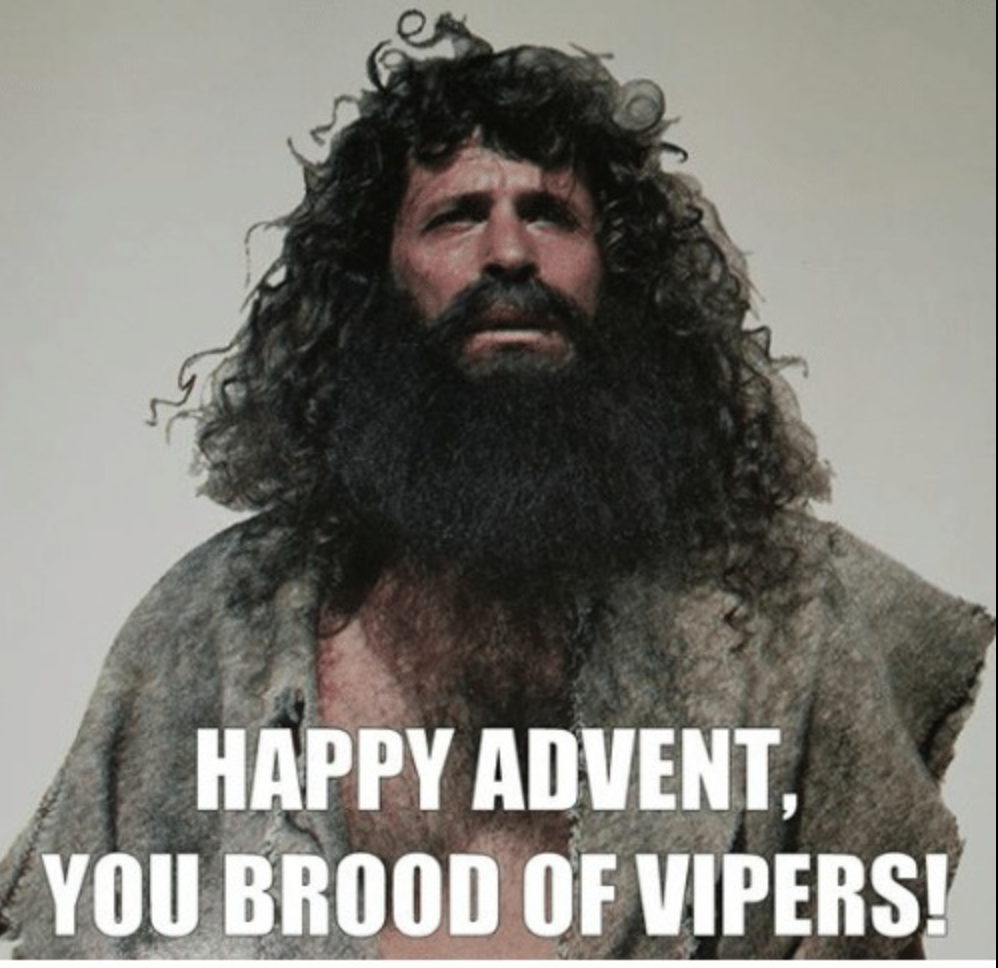
This past week, a colleague of mine posted a picture on Facebook that probably expresses what we all secretly think on hearing about John the Baptist as we get ready for Christmas. Here it is:


Now, it’s true that we can call John the Baptist the last of the Old Testament prophets. We can also say that he called those who made a show of repenting for their sins and did other religious acts “a brood of vipers.”

But John also proclaimed the Gospel, the good news about God acting in the crucified and risen Jesus to save us from sin and from death and to give us life with God.

John proclaims both God’s Law, God’s commands that we love God and love neighbor, and God’s Gospel, the good news that God makes innocent any sinner who, by the power of God’s Word, trusts in Jesus as Lord and God!

We see how John proclaims these two elements of God’s message to all people especially in two verses of today’s Gospel lesson, verses 2 and 12. Let’s unpack each verse to see how John the Baptist shouldn’t be seen as the party pooper of our Advent and Christmas gatherings and, more importantly, how in his words, he gives us the Gospel, and in fact, gives us Christ Himself.

In  verse 2, John says, “Repent, for the kingdom of heaven has come near.” The word translated here as repent is, in the Greek in which Matthew writes his gospel, metanoiete. It literally means change of mind. But even that doesn’t fully convey what repentance is.

Looking at the Bible’s teaching on this subject, our Lutheran confessions tell us that, “repentance consists of two parts. One part is contrition, that is [listen to this] terrors striking the conscience through the knowledge of sin. [This isn’t terror at the propspect of being punished for our sin, but terror at the thought of being separated from God, the giver of every good and perfect blessing. The confessions go on to say that…] The other part [of repentance] is faith, which is born of the Gospel…[this faith] believes that for Christ’s sake, sins are forgiven. [Repentance then] comforts the conscience and delivers it from terror.” (Augsburg Confession, Part XII)

Repentance then is both sorrow for sin and, by faith, reconciliation with God Who, through Jesus, saves us from the eternal consequences of our sin!

So, in verse 2 of our lesson, John is telling us that, in Jesus Christ, God’s kingdom, His reign, the enveloping grace of God has come to us. We don’t have to do anything or be anything for this to be so. Before we ever gave God a thought, God decided to act and then acted decisively in Christ to come to us and save us from ourselves.

This word of good news from God tells us that we can turn from our self-absorbed, self-involved ways–turn from sin–and live under God’s loving reign now and always: forgiven, free, filled with hope!

Repentance assures those who confess their sin and their need of Jesus that we will be changed from God’s enemies to God’s friends, now and eternally!

In verse 12, John says of Jesus, “His winnowing fork is in his hand, and he will clear his threshing floor, gathering his wheat into the barn and burning up the chaff with unquenchable fire.”

At His second coming, His second advent, Jesus will “judge the living and the dead.”

Those who have harbored the fantasy that no God created the universe in which we live and those who have entertained the equally false fantasy hat they are good enough on their own to earn being part of the kingdom of heaven, will all be eternally condemned. Jesus says His angels will throw those who have refused to believe in Him “into the blazing furnace, where there will be weeping and gnashing of teeth.” (Matthew 13:42)

This is not what God desires. Otherwise He wouldn’t have bothered coming to be our Savior. The Bible tells us that God “wants all people to be saved and to come to a knowledge of the truth…” (1 Timothy 2:4)

But, just as you can’t blame the death of the man who decided to keep sitting on the roof of his house on the helicopter pilot who lowered a rope to save him from the flood, we can’t blame God when people who have refused Jesus’ offer of forgiveness and new life are condemned.

As Jesus says elsewhere: “Whoever believes in the Son has eternal life, but whoever rejects the Son will not see life, for God’s wrath [God’s condemnation of the sin into which we all were born]  remains on them.” (John 3:36)

But to those who have had their minds changed and their thinking clarified by God’s Word and have so, trusted in Christ instead of themselves, “Come, you who are blessed by my Father; take your inheritance, the kingdom prepared for you since the creation of the world.” (Matthew 25:34)

John the Baptist was sent by God in these last days of this universe’s life to tell us to turn to Jesus with our sins and regrets.

We can do that because Jesus Christ, crucified and risen, has already turned to us with His forgiveness and grace, working to not only change our minds, but our whole lives, to make us God’s people, to usher us into God’s kingdom.

The promise is true: “...if anyone is in Christ, the new creation has come: The old has gone, the new is here!” (2 Corinthians 5:17)

Friends: Because Jesus has already come near to you and comes to you again today, you can turn in daily repentance and faith to Christ and know you belong to God forever. Amen
Monday, December 16, 2019

Seeing Beyond 'Dissonance and Doubt'

[This message was shared yesterday morning during worship with the members and friends of Living Water Lutheran Church in Centerville, Ohio.]

Matthew 11:2-15


One of the stories my brothers-in-law like to tell is of the holiday years ago for which Ann decided to bake something special. 

She asked me to pick up the ingredients while I was at the grocery store for other items. I picked up everything that Ann needed, arrived home, and, as Ann did things in the kitchen, pulled them out. 

Imagine my surprise when Ann gasped as she pointed to the coconut I’d just bought. “You got a coconut?” “Yeah,” I told her, “It was on the list.” “No,” she said, “I’m baking. I needed coconut flakes. Not a whole coconut!” I’m sure that Ann had said “coconut flakes” when I jotted down “coconut.” But all I could see was the main staple of the diets of the castaways on Gilligan’s Island.

That little embarrassing incident illustrates dissonance, which the Merriam-Webster dictionary defines as the difference “between the truth and what people want to believe.” When I saw coconut flakes on my list, despite what Ann had told me I was looking for, I started looking for the fruit. I was in the dark, living in dissonance from the truth.

Our gospel lesson for this morning, Matthew 11:2-15, finds John the Baptizer living in dissonance from the truth. 
The man who had faithfully prepared the way for the Messiah to be revealed was now in prison. 

When John pictured the Messiah, the Christ, God’s anointed King, in his mind, he saw a king who would take an ax to the tree, that is the person, not bearing the fruits of repentance. He saw a king who would baptize with the Holy Spirit and fire and pull out his winnowing fork to separate the wheat and the weeds. He saw the Messiah taking control of God’s fallen creation, bringing judgment to those who walked away from God and new life who turned God the Father and to the Messiah. John was fed up with the sin of the human race and longed for the Messiah to make things right.

The picture in his mind that John saw of what the Messiah would bring about wasn’t wrong, any more than my picture of what a coconut looks like was wrong. 


The problem was that John wasn’t seeing the whole picture. What he saw was incomplete. He was forgetting what else the Old Testament prophets meant when, under the inspiration of God’s Holy Spirit, they spoke of the coming of the Messiah. 

For example, in our first lesson for today, the prophet Isaiah says of Messiah: “...the eyes of the blind [will] be opened and the ears of the deaf unstopped. Then will the lame leap like a deer, and the mute tongue shout for joy.” (Isaiah 35:5-6) The King of kings would also, Isaiah and the other prophets tell us elsewhere, suffer, die, and rise before bringing judgment and before God’s new, eternal kingdom would fully come into being.

From his place of dissonance and uncertainty, John the Baptizer sends some of his disciples to ask Jesus, “Are you the one who is to come, or should we expect someone else?” (Matthew 11:3) 


Jesus tells John’s disciples to be witnesses of all that they hear and see for John: “The blind receive sight, the lame walk, those who have leprosy are cleansed, the deaf hear, the dead are raised, and the good news is proclaimed to the poor.” (Matthew 11:5). These are the things that the prophets said the Messiah would do. 

And then Jesus says, “Blessed is anyone who does not stumble on account of me.” (Matthew 11:6) John, Jesus is saying, don’t stumble in your faith. Don’t get tripped up by the incomplete picture you have of God in your mind when the whole picture is there to be seen, there to be believed for everlasting life. Don’t wallow in darkness when the Light of the world has come to be the Way, the truth, and the life.

What pictures of God do we keep tucked in our minds that keep us from fully living in the light of Who God really is?

Do we see God as an angry Judge, just waiting for us to stumble so that He can pounce on us and dispatch us to hell? 


God’s Word tells us that “there is now no condemnation for those who are in Christ Jesus,” who trust their sins and themselves to Jesus. (Romans 8:1)

Do we see God as removed from our struggles and griefs? 


Jesus says, “Come to me, all you who are weary and burdened, and I will give you rest.” (Matthew 11:28)

Do we see God as being tardy in bringing His kingdom fully into being with Jesus’ return? 


God’s Word says, “The Lord is not slow in keeping his promise, as some understand slowness. Instead, he is patient with you, not wanting anyone to perish, but everyone to come to repentance.” (2 Peter 3:9) Jesus hasn’t yet returned to the earth do that all will have the time to turn to Him and to invite others to do the same.

Do we see the God we know in Jesus as belonging especially to our race, our country, our denomination, our family? 


Jesus says that God so loved the world that He gave His only Son so that whoever believes in Him--whoever turns from sin and trusts in Him as God and Messiah--will have everlasting life with God. (John 3:16)

Do we see the mess our world is in and wonder when and if Jesus is going to act? 


Jesus tells us in one place not to worry about the times or seasons and then says to we Christian disciples, “I am with you always, to the very end of the age.” (Matthew 28:20)

Of John, Jesus says in our gospel lesson, “among those born of women there has not risen anyone greater than John the Baptist.” 


But then he says, “...yet whoever is least in the kingdom of heaven is greater than he.” (Matthew 11:11) 

That’s you Jesus is talking about. 

You: the baptized believer in Jesus Christ. 

You: the One Who is being saved and daily transformed by the living Word, Jesus Himself. 

Unlike John when he sat in prison, you know that Jesus died on a cross for your sins. 

Unlike John, you know that Jesus rose to tear open eternity and a personal, eternal relationship with God for you and the whole Church. 

Unlike John, you received the Holy Spirit when you were baptized. 

Unlike John, as a believer, Jesus has taken up residence in your life to protect you from temptation and sin and to empower you to live in the peace of God that passes all human understanding. John could only look ahead in anticipation of what the Messiah would do. 

You and I live in the certainty of what He has already done and know that our lives, our futures, our eternity can rest in a no more certain place of love, life, and forgiveness than the hands of Jesus. 

You are greater than John because, as you receive God’s Word and the sacraments, God is tearing down what the poet and Anglican priest Malcolm Guite calls our “dissonance and doubt.” Jesus has already made you part of His kingdom! (The Six Days World Transposing in an Hour)

This Advent season, as we prepare for Christmas and for the day when Jesus will return to this world, once more listen closely to His Gospel Word, humbly receiving it each day and as we worship together where we hear, taste, and see it. Dissonance, darkness, and doubt will flee when you allow yourself to hear and see what Jesus has done at manger, cross, and tomb. You will see Him again for Who He is: the Messiah, our Savior, our King, our Lord, our God. 


And in the seeing, you will know to Whom you belong no matter what. Amen


[I'm the pastor of Living Water Lutheran Church in Centerville, Ohio.]

Monday, December 09, 2019

Turn and Live

[This message was shared with the people and friends of Living Water Lutheran Church in Centerville, Ohio during worship yesterday, the Second Sunday of Advent.]

Matthew 3:1-12
Once, in the days before cell phones, GPSes, or even Mapquest and Google Maps, I missed the biggest part of a farewell party--thrown for Ann and me--after driving past (and continuing to drive past) the house where it was happening. The party came at the end of my pastoral internship in Michigan.

Ann had gone separately because I needed to make a run to Traverse City before going to the farewell. By the time I finally made it, the whole thing was nearly over. All because I hadn’t asked for directions...and because once I was lost, I didn’t turn back when I should have. When we go wrong, the most sensible thing is to turn around. But I didn't do the sensible thing.

For a long time, as I was going wrong that day on the backroads of Benzie County, Michigan, I was too proud to turn back, too proud to admit that I was going wrong, too proud to find a payphone and call someone who could help me, too proud to confess that maybe Ann had been right about my need of her written directions offered earlier in the day.

Have you ever gone wrong in life, set out in the wrong direction and gotten lost? 


I’m not just talking about the places you drive but also being wrong about
  • the things you’ve thought, 
  • the decisions you’ve made, 
  • the relationships you’ve harmed, 
  • the untruths you’ve told, 
  • the walls you’ve built between God and yourself? 
It’s so easy to lose our sense of direction and end up doing the wrong thing, the hurtful thing, the destructive thing, isn’t it? 

That’s because we’re born with our moral compasses that are askew. 

We actually like to sin. 

We like to play God and travel the lost roads that go away from God. 

We’re so messed up that we sin even when we don’t want to. The apostle Paul talks about this in Romans 7: "I do not do the good I want, but the evil I do not want is what I keep on doing." (Romans 7:19)

Like King David, we can confess, “Surely I was sinful at birth, sinful from the time my mother conceived me.” (Psalm 51:5)

In today’s gospel lesson, on this Second Sunday of Advent, we meet John the Baptizer,
we meet John the Baptizer, whose message is as much for us today--when we look either to the return of Jesus to this world or the day when, just beyond our deaths, we meet Jesus face to face--as it was when John spoke them to prepare His fellow Jews to meet Jesus in the flesh for the first time. 


Take a look at what John says near the beginning of the lesson, Matthew 3:1-12: “Repent, for the kingdom of heaven has come near.” (v.2) 

“Turn around,” John is saying. “You’re going in the wrong direction. Turn back toward the promised Savior and King because He’s bringing His Kingdom soon and you want to be ready!” 

Are you ready to meet Jesus? 

He died on a cross and rose from His tomb and is now ascended into heaven. He is Lord of heaven and earth. So, you will meet Him someday. Are you ready for that?

We may say, “Sure, I’m ready. I try to do the right thing.” God’s Word says, “all our righteous acts are like filthy rags.” (Isaiah 64:6) 


We may say, “I’m better than most people,” hoping that Jesus will judge us on a curve. But God’s Word says, “all have sinned and fall short of the glory of God.” (Romans 3:23) 

We may say, “God is gracious and loving. I don’t have anything to fear.” But in God’s Word, Jesus, God in the flesh, says, “Whoever acknowledges me before others, I will also acknowledge before my Father in heaven. But whoever disowns me before others, I will disown before my Father in heaven.” (Matthew 10:32-33) 

We may say, “I’m a member of Living Water Lutheran Church.” But Jesus says that He will let the wheat and the weeds live side-by-side in His Church until the day of His return. If mere membership in the club were all that it took to be part of God’s Kingdom, John the Baptizer wouldn’t have told his fellow Jews, the Sadducees and Pharisees, “I tell you that out of these stones God can raise up children for Abraham” (Matthew 3:9). There’s nothing that we can do to make ourselves ready to meet Jesus.

But there is good news! 
Even within the harsh words of John the Baptist in our lesson today. 

After warning that the coming Messiah Jesus had ax in hand to take down all those whose lives don’t bear the fruit of repentance--the fruit of habitual turning back to God--John says (starting at verse 11): “I baptize you with water for repentance. But after me comes one who is more powerful than I, whose sandals I am not worthy to carry. He will baptize you with the Holy Spirit and fire. His winnowing fork is in his hand, and he will clear his threshing floor, gathering his wheat into the barn and burning up the chaff with unquenchable fire.”

Did you hear the good news--the gospel--there? 


John is saying, “Look, my baptism here on the Jordan River is nothing but you saying that you’re turning to God.” 

That’s great, of course. But if our being right with God depends on our good intentions, we still end up a long way from God. 
  • I intend to work out every day but don’t always. 
  • I intend to get enough sleep at night but often don’t. 
  • I intend to write the great American novel but I haven’t yet. 
John’s baptism of repentance was meant to prepare his fellow Jews for Jesus’ Baptism--God’s Baptism--that brings us forgiveness and new life with God. 

It’s this Baptism, Jesus’ Baptism, that changes us, that brings God the Father, Son, and Holy Spirit into our lives, that daily goes to work to kill off our old sinful selves, and that calls the ever-new, ever-righteous child of God to repent--to turn back--to Jesus. 

It’s this Baptism that helps us to hear God’s call to us to turn to Jesus whenever we get lost and to trust that He has done everything (and is still doing everything) needed to make us right with God--to make us righteous, to trust that He will lead us in the right direction.

John’s imagery is interesting. He says that Jesus will institute a Baptism in “the Holy Spirit and fire.” Later, he says that those who turn from God will burn in “unquenchable fire.” 


Fire is judgment. 

The Holy Spirit is the One Who brings life into being. 

Holy Baptism as instituted by Jesus first brings judgment on we who are born in sin, then gives new life from the Holy Spirit. 

Our call from the moment we’re baptized is to keep turning to Christ, whatever our circumstances, even when we’re lost or afraid or conscious of our sin or overwhelmed. 

We who have been baptized with the Holy Spirit and fire know that as we turn to Christ, our old selves are being drowned or burned away to make way for the new person God is retrofitting us to be, today and for all eternity. 

In Jesus’ Baptism, we die with Jesus and we are raised to be with Him. Saint Paul puts it like this: “We were therefore buried with [Jesus] through baptism into death in order that, just as Christ was raised from the dead through the glory of the Father, we too may live a new life.” (Romans 6:4)

You and I have a penchant for going in the wrong direction. But the life-giving Word of God, the gospel of Jesus, has entered into our lives in Holy Baptism and comes to us again and again in the Word proclaimed and read and heard, and in the body and blood of Jesus given in Holy Communion to turn us back to Him and to the life that only He can give. 


If you remember nothing else from this message, remember this: Turn to Him as He calls you and live in His Kingdom, today and eternally. Amen

[I'm the pastor of Living Water Lutheran Church in Centerville, Ohio.]

Sunday, December 08, 2013

The Unwanted Guest?

[This was prepared for sharing with the people and guests of Living Water Lutheran Church in Springboro, Ohio, for this morning's worship services.]

Matthew 3:1-12
If you were to make a list of all the Biblical people of faith you wouldn’t want to invite over to the house for an evening of holiday revelry, John the Baptist might be at the top. On the face of it, John seems like such a downer! 

But I think, we need to revise our estimation of John the Baptist a bit.

Like you and me, John was a believer in Jesus. Even in his mother’s womb, Luke’s Gospel tells us, the Holy Spirit prompted John to recognize Mary, who had come to visit John’s parents in the Judean hill country, as the mother of the Lord Jesus. And when, after Jesus had spent many years in Nazareth then presented Himself for John’s baptism, John demurred. “I need to be baptized by You, and do you come to me?” In the fourth gospel, we're told that John the Baptist, pointed Jesus out and said, "Behold, the Lamb of God, Who takes away the sin of the world."

But sometimes, John's faith vied with his doubts. As we’ll  be reminded in next Sunday’s Gospel lesson, John was far from perfect. There, we'll be reminded that though he believed in Jesus, Jesus didn't seem to be quite the King that John had expected. He would send people to ask Jesus, "Are You the One. Or is there going to be someone else?" Like you and me sometimes maybe, he doubted the Savior in Whom he believed.

But John kept believing in Jesus, however imperfectly.

There's a comfort to be derived in that. God only uses imperfect people to be His hands and feet in the world.

Despite his imperfections though, John was God’s choice for a ministry that had two basic elements:
  • to call people to repentance;
  • to announce the coming of the kingdom of heaven through the Christ, the Messiah, God’s anointed King.
John’s message is only a downer to those who have no desire to repent or be part of God’s Kingdom. For others, those willing to follow Jesus and to give up on calling the shots in the universe, John’s message brings, “comfort and joy”! (Even when that message makes us squirm.)

Please turn to the Gospel lesson for today, Matthew 3:1-12 (page 676 in the pew Bibles). Matthew begins our lesson with words like those often used by Old Testament prophets to describe moments of decisive action by God: “In those days John the Baptist came, preaching in the Desert of Judea...”

The prophets often used phrases like "in those days." They signaled a moment when God had or, the prophets said, He would act.

The New Testament has two main words it uses for time. There's chronos, chronological time. Then there's kairos, God's time.

God acts on His own timetable. It's because we want God to bow to our chronological timetables that we're inclined to cry to heaven, "How long, Lord? How long do I have to wait?"

God acts at precisely the right moments for His purposes and for our good. At the kairos moment, God prompted John, "Now John. Now is the time for you to start preaching the message I give to you."

And God tells John to do this important ministry in the strangest of venues. In the wilderness by the banks of the Lower Jordan River. If John had gone to a business or church growth consultant, the wilderness is not the place they would have told him to set up shop. That wilderness area is composed partly of desert, but mostly of rocky terrain that contains sparse pastureland that can't stand much grazing. It's a good for nothing place where nobody lives unless they have to. Few would have lived there. Few would have gone there.

Yet, as we'll see, many flocked to hear John preach. The takeaway is simple: If God's hand is in a ministry, God will connect people to it. If God's hand isn't in a ministry, a crowd might be attracted, but it's doubtful that anyone will get connected to God.

Verse two: [John said:] “Repent, for the kingdom of heaven is near." John is bleak, isn’t he? Or is he?

Turn, please to Matthew 4:17 (page 677). “From that time on Jesus began to preach, ‘Repent, for the kingdom of heaven is near.’"

John the Baptist was the last of the prophets who pointed, as a future event, to the kingdom of heaven that Jesus died and rose to bring to those who follow Him. We have a stereotype of prophets and of the Old Testament as being surly, demanding, vindictive, while we see Jesus and the New Testament as jolly, passive pushovers.

Yet, here we see that John preached the precise message as Jesus.

That message has two parts. It’s really the message of Advent, the message of Christian faith.

First, repent. We mentioned last Sunday that the word usually translated as repent in our English translations is metanoia, literally meaning I change my mind.

But to repent means a lot more than changing one’s mind. It's not like saying, "Blue used to be my favorite color. Now it's red."

In fact, in repentance, we own the fact that we are incapable of changing our own minds.

We may want to see things God’s way, but we can’t.

We may want to stop sinning, but we’re too into it to conquer it in our own power.

In repentance, we ask God to give us a new mind, new eyes, and a new way of living.

We ask that God will impose a new direction on our lives, His direction.

To shift us from following what our sinful impulses tell us to do--to do what I want to do whoever might get hurt; to follow my thoughts, emotions, or wills irrespective of what God says a “still more excellent way.” And, instead, we ask God to help us follow where He leads.

The Bible teaches us that it isn’t even we who author our desire to be in sync with God. That too, is a gift, tendered to us through the Holy Spirit.

In repentance, we yield to the desire for forgiveness and to the One Who gave that desire to us!

But what’s clear from John’s words--and from Jesus’ words--is that repentance is not a one-time proposition. The word for repent here is uttered in the present tense: Metanoieite. And in Greek that means John was saying: “Keep repenting!” “Keep turning back to God!”

You see, God understands us. He really does, better than we understand ourselves!

Repentance is more than sorrow for sin.

It’s also the willingness to keep coming back to God for guidance and forgiveness and grace.

Some people offer what they call repentance and say, “From here on in, I will be a good person. I will do good deeds. I will avoid sin.”

But true repentance says, “I can’t be a good person or do good deeds or avoid sin on my own, Lord. Kill my sinful self again today and help me to walk with you.” 

That is not a downer message from John the Baptist.

It’s a message that urges us to keep following the God we know in Jesus Christ, even when we mess up.

Repent every day, live a life of repentance, of turning back to God, because God wants to live beside us now and in perfection in eternity. That should be an uplifting message!

The second part of John’s message was, “the kingdom of heaven is near.”

However crazy or indecipherable our lives can be, we can be sure that God is never far from from us.

That was true even before God took on human flesh in Jesus Christ and died and rose to set all who believe in Him free from sin and death.

It’s even more true now.

The risen Jesus promises to always be with us!

Verse 3: “This is he who was spoken of through the prophet Isaiah: ‘A voice of one calling in the desert, ‘Prepare the way for the Lord, make straight paths for him.”’"

The words are from Isaiah 40:3. These were originally words to God’s people Israel when they were exiled. A voice would proclaim that the time was near when God would come and lead His people back home.

Matthew sees that John is like Isaiah’s voice. He came to prepare for God Himself--Jesus--to come into this world and lead us from the wilderness of sin and death into the kingdom of heaven.

In his proclamation that people repent and believe that God’s kingdom was close, John was preparing people to meet Jesus.

It’s how we prepare to meet Jesus too.

We turn from sin, asking God’s help to live as He wills, and we trust that in Jesus, God is with us always!

Verse 4: “John's clothes were made of camel's hair, and he had a leather belt around his waist. His food was locusts and wild honey.” They wouldn’t like John’s attire on those TV fashion shows.

In Malachi 4, in the Old Testament, God promised that before the day of judgment, He would send the prophet Elijah and he would turn people’s hearts back toward the ways of God. Later in Matthew’s Gospel, Jesus makes clear that, at the least, John the Baptist played that prophetic role because Jesus’ ministry, as we saw last week, is the prerequisite for the judgment and the final fulfillment of His kingdom.

In 2 Kings 1:8, we’re told that Elijah was as much of a fashionista as John: “He had a garment of hair and had a leather belt around his waist.”

When John started preaching in his attire, when he only ate food that could be gathered, just as had been true of the ancient Israelites during their wilderness journey before crossing the Jordan into God’s promised land, people gave John their attention.

Verses 5 and 6: “People went out to him from Jerusalem and all Judea and the whole region of the Jordan. Confessing their sins, they were baptized by him in the Jordan River.” We prepare the way for Christ to enter our lives with power and grace when we clear away the obstructions. When we clear away our sin by confessing them to God.

Verses 7-10: “But when he saw many of the Pharisees and Sadducees coming to where he was baptizing, he said to them: 'You brood of vipers! Who warned you to flee from the coming wrath? Produce fruit in keeping with repentance. And do not think you can say to yourselves, "We have Abraham as our father." I tell you that out of these stones God can raise up children for Abraham. The ax is already at the root of the trees, and every tree that does not produce good fruit will be cut down and thrown into the fire."”

We know the Pharisees and Saducees. Good religious folks. Pillars of the faith community. But also smug. Certain that because they were genetic descendants of Abraham, they were on solid ground. There’s no indication that they came to be baptized. Only to check things out. John calls them for being just good church members.

But God doesn’t want church members; God wants disciples!

God wants disciples who make other disciples.

He wants people who, like John the Baptist, follow the Lord, however imperfectly; not people who think that once they’re in the club, they might volunteer for this or that, but never attempt aligning themselves with Christ’s call to follow Him!

In Verses 11 and 12, John says: “‘I baptize you with water for repentance. But after me will come one who is more powerful than I, whose sandals I am not fit to carry. He will baptize you with the Holy Spirit and with fire. His winnowing fork is in his hand, and he will clear his threshing floor, gathering his wheat into the barn and burning up the chaff with unquenchable fire.’"

Before John, there were baptisms in Judea. They were self-administered. New converts to Judaism washed the sin of being Gentiles away before embracing the purity of the Jewish people. Some Jewish sects asked people to baptize themselves as a sign of renewed commitment to God. John was the first person ever to administer a baptism to other people.

But as John makes clear, his baptism was very different from the one that Jesus would administer, the one that Christians undergo at baptismal fonts like ours.

John’s baptism was only symbolic, the washing of water symbolizing the washing that true repentance brings to our lives.

But the Baptism that Jesus commands, the Sacrament, brings life from the Holy Spirit and the fire of God, burning away impurity and lighting our way through this life to eternity. That is good news. “All who believe and are baptized shall be saved,” Jesus says. John points us to eternal salvation in Christ!

Finally, John, talks about Jesus as judge of all humanity.

But in truth, what we learn from John the Baptist is that, in an ultimate sense, Jesus judges no human being. We are the ones who decide the judgment of eternity over our lives.

We pass sentence on ourselves by the choices we make each day.

The choice we are called to make is not to be perfect or good or religious.

The choice we’re called to make is to live each day in repentance, acknowledging our sins and imperfections, our need of daily reconstruction by Christ, our need of the crucified and risen Christ Himself.

When, by faith, we let Christ and His forgiveness into our lives, we’re walking toward God and His promises for time and eternity and we experience the truth that the Kingdom of heaven is truly near!

We might think that John would be an uncomfortable Christmastime guest in our homes.

But for all his rough edges, all of his incomplete knowledge, and the difficulty of his message, if we truly listen to him, we can hear a man who pointed us to trust in Jesus.

We can hear the Gospel about Jesus, which is good news of great joy for all people. I like to think that a guy like John would have a place at my table any time. Amen!

Friday, December 03, 2010

Jesus Brings Comfort AND the Demand for Allegiance to Him

In studying the text for this coming Sunday's sermon, Matthew 3:1-12, just read this from New Testament scholar, N.T. "Tom" Wright:
Jesus'...mission was quite different from what people sometimes imagine; the comfort and healing of his kingdom-message was balanced by the stern and solemn warning that when God comes back he demands absolute allegiance.
Many people, including many pastors and theologians, seem to want the Jesus of comfort and healing, but not the Jesus Who demands are absolute allegiance. Truth is, like the rest of the human race, I'd rather that Jesus didn't demand my allegiance. I would rather that He not demand my utter acquiescence to His Lordship and His will.

It reminds me of a joke I heard Mel Brooks tell once on The Tonight Show. According to Brooks, God originally gave fifteen, not ten, commandments to Moses on Mount Sinai. When the Israelites saw that, they immediately claimed that was too many commandments. So, Moses went back to the top of the mountain to renegotiate with God. When Moses came back, the Israelites asked, "Well?" "I've got some good news and some bad news for you," Moses told them. "The good news is, I got God down to ten commandments. The bad news is that the no-adultery one is still in there."*

Jesus has come, as the New Testament reminds us, to free us from the condemnation of God's Law, as embodied in the Ten Commandments. None of us is capable of keeping God's commands and, if it weren't for Jesus, we would all stand condemned and bound for hell. "The wages of sin is death," is how the apostle Paul puts it in the New Testament book of Romans. But Jesus, God in the flesh, took the punishment for our sins. He calls us to repent and believe in Him and so be spared the punishment we deserve.

Yet Jesus also insists God's commandments are not to be ignored:
“Do not think that I have come to abolish the law or the prophets; I have come not to abolish but to fulfill. For truly I tell you, until heaven and earth pass away, not one letter, not one stroke of a letter, will pass from the law until all is accomplished. Therefore, whoever breaks one of the least of these commandments, and teaches others to do the same, will be called least in the kingdom of heaven; but whoever does them and teaches them will be called great in the kingdom of heaven. (Matthew 5:17-19)
The good news is that Jesus, the perfectly obedient representative of the human race, destroyed the power of God's law to condemn all who trust in Him. The bad news--or at least, what we may see as bad news if we choose to hold onto some sins that God commands us to turn away from--is that, in response to this enormous gift, we're not just to give our total allegiance to Jesus. We also are, out of our gratitude, to seek to live obedient lives. (God gives the Holy Spirit to help us in this quest. But that's another story.)

The problem for those of us who want some of Jesus, but not all of Jesus, is that Jesus can't be divided. I can't let His comfort, healing or grace into my life without letting that other part of Him--the God in the flesh Who commands me to follow Him alone and obey the commands of God--into my life as well.

The forgiveness, life, and blessings that come as free gifts--examples of what the New Testament, in its original Greek, calls charitas, grace--are absolutely free. We can do nothing to earn them.

But if we want to take them from Christ's hand, it will entail laying aside every other allegiance we have, whether to ourselves, our families, our jobs, our possessions, our countries, or anything else.

Each of these things will have their places in our personal priorities, their importance often changing depending on circumstances. But Jesus says that, if we're to have His comfort and life, none of them may take first place.

Consider this speech where Jesus' insistence on "absolute allegiance" to Him is given in "stern and solemn" tones:
Now large crowds were traveling with him; and he turned and said to them, “Whoever comes to me and does not hate father and mother, wife and children, brothers and sisters, yes, and even life itself, cannot be my disciple. Whoever does not carry the cross and follow me cannot be my disciple. For which of you, intending to build a tower, does not first sit down and estimate the cost, to see whether he has enough to complete it? Otherwise, when he has laid a foundation and is not able to finish, all who see it will begin to ridicule him, saying, ‘This fellow began to build and was not able to finish.’ Or what king, going out to wage war against another king, will not sit down first and consider whether he is able with ten thousand to oppose the one who comes against him with twenty thousand? If he cannot, then, while the other is still far away, he sends a delegation and asks for the terms of peace. So therefore, none of you can become my disciple if you do not give up all your possessions. (Luke 14:25-33)
Jesus is not here commending the emotion of hatred. In Semitic languages like Aramaic, which Jesus spoke in everyday conversation, hate was a comparative word, a priority word. He is saying, "Unless you love Me more than you love your mother and father, husband or wife, etc., you can't be part of My kingdom." Those words are "stern and solemn" enough. But He is not commanding us to hate our relatives! (Or anybody else, for that matter.)

Some will wonder whether Jesus isn't exhibiting some kind of megalomania here, demanding allegiance to Him. Jesus once said, "I am the way, and the truth, and the life. No one comes to the Father except through Me" (John 14:6). If Jesus is the only means through which the power of sin and death over our lives can be destroyed, it's hardly an act of arrogance on Jesus' part to insist on our allegiance to Him alone. If the only way for a drowning man to get to shore is to hold onto the lifeguard, you would hardly call the lifeguard arrogant for saying so to the thrashing victim.

Our problem, of course, is that we're control freaks. We want the Jesus Who will love us as we are, but we're not as keen to have the Jesus Who sets out to make changes in the lives of those He saves. But Jesus leaves us no choice in the matter: We will either have all of Jesus or we will have none of Jesus.

May God give me the grace, faith, and courage to choose all of Jesus every day. And if life with God is what you want, may God give you these things, too!

*You can read the real story of God giving the Ten Commandments and other commands to Moses in Exodus, chapters 19 to 24. Brooks later incorporated something of this joke into his movie, The History of the World, Part 3. Only there, his Moses held three tablets, one fell from his arms, and Moses announced that God had given "these fifteen...[one tablet falls] Oy! Ten commandments for all to obey!"