Showing posts with label Revelation 21:10 and 22-22:5. Show all posts

Sunday, May 13, 2007

How God Comes to Us

[This message was shared during worship with the people of Friendship Lutheran Church on May 13, 2007. If you live or are ever visiting in the Cincinnati area, you are always invited to worship with us!]

Revelation 21:10, 22-22:5
A reporter spent time with a young man who was a bit of an anomaly: An honors student in an inner city school. The young man was anomalous because in many ways, his life was a sad inner city cliche. Poverty stricken. African-American. He and his mother abandoned by his father when he was small. Living in ramshackle government housing surrounded by a kids his own age getting involved with drink and drugs and crime. Most of his classmates regarded doing well in school as a waste of time.

Yet this kid continued to do well in school and kept out of trouble in the evenings, even though his mother worked two full time jobs and he, like many of his peers, had way too much time on his hands. The reporter wondered why. So, he trailed this young man for a week. The reporter didn't have an answer until one Wednesday night when he followed the young man to his church. There, in the balcony, this teen, often tempted to depart from the straight and narrow, joined several hundred others in singing praises to God. The reporter watched as this young man threw himself heart and soul into worshiping God. He perceived a change come over the young man. A weight seemed to be lifted from his shoulders. He had abandoned all his fears to take the hand of God.

It isn’t just teens trying to rise above the low expectations, the grave temptations, and the grim prospects of the ghetto who need to know that God...
  • doesn’t want to be separated from us,
  • wants to be with us forever, and
  • if we want it, God will come to us in every time of need.
Maybe the apostle John, exiled to the island of Patmos back around 90 AD, needed to be assured of these things as he lived and slaved each day in shackles.

And maybe for John, as was true for that inner city teen, it was easier to believe that God was with him when he worshiped.

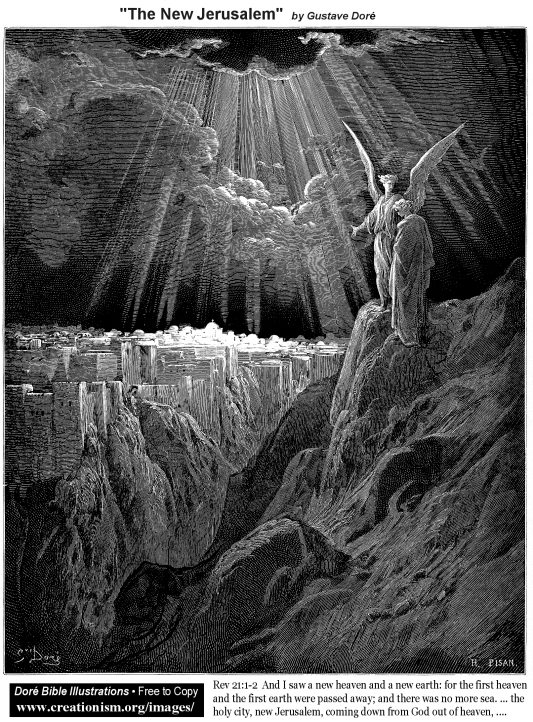
Scholars tell us that whenever the phrase in the spirit is used in this book of Revelation, it signals a time when John was worshiping God. Our lesson starts out with John telling us: “And in the spirit [I was] carried...away to a great, high mountain and [I saw] the holy city Jerusalem coming down out of heaven from God.”

As John “turned his eyes upon Jesus,” God was able to come to him with a consoling vision. And it was an incredible vision! Consider what John saw:

First: He saw what he calls “the new Jerusalem” come down from heaven. God came to him. To me, this vision is about the past, the present, and the future.
  • Two-thousand years ago, Jesus came to our world where He died and rose for us. But He didn’t leave us orphaned.
  • Today, we have the presence of His Holy Spirit and the encouragement of our church with us.
  • And in the future, He will come to us bodily, too. We’ll see Him as surely as the first disciples saw Him risen from the dead on the first Easter Sunday.
Second: John describes this new Jerusalem. The old Jerusalem, you know, is a city that still exists in modern Israel. Long ago, it was the site of the Temple where pious Jews would come to worship. It was a place they had to go to if they were going to really worship, they thought. But John says that one day, at the end of the histories of the old heaven, the old earth, and the old Jerusalem, when the new Jerusalem comes to us, there will be no temple. John explains that, “its temple is the Lord God the Almighty and the Lamb.” In the new Jerusalem, believers in Jesus will have direct access to God. But even today, though we can’t see God, Jesus tells us that if we will pray in His Name, God will hear us! Many of you here today have seen the power of prayer in Jesus’ Name too many times to have any doubts about its reality!

Next: John tells us that the new Jerusalem will be a place in which the blazing light of God will illumine us. There will be no night, no fear. And, he says, the tree of life will fill us with the goodness and power and life of God forever.

John presents us with staggering images of a heavenly future. When life lays us low or death stares us in the face, these images may be difficult to see. But even in the most dire circumstances, many followers of Christ have been sustained and encouraged by the promise of the new Jerusalem we have in Christ. A few examples...

George Friedric Handel was already writing cantatas when he was nine years old. Not long after that, he presented his music to the king of Prussia. But then, things took a turn for the worse. His father died. His music, to use more modern nomenclature, was no longer at the top of the charts. Bankrupt and hopeless, Handel locked himself away for twenty-four hours and in the end, emerged with his oratorio, Messiah, based partly on John’s visions as recorded in the book of Revelation.

I learned a few weeks ago that something like 15% of all adult Americans living today have sung the Messiah at some point in their lives. Obviously countless millions have also heard it. This past Christmastime, my family and I attended something called The Candlelight Processional at Disney World. Actor Mario Lopez narrated. A mass choir, partly composed of high school and college groups from throughout Florida, flanked him. He asked all in the audience who had ever sung the Messiah before to stand and join in. Hundreds rose. Our two adult children, my wife, and I also stood, my wife sandwiched between our "kids." As my wife heard the kids sing Handel's words at the tops of their lungs, tears streamed down her face. Think of that: A work of art composed at what was a low point in Handel’s life has lifted millions of people into an experience of God!

When asked how he was able to compose Messiah, Handel said, “I did see the heavens opened and the great God himself seated on his throne.” Handel worshiped God and God came to him.

One of my favorite Christian heroes of more recent vintage is a man named Frank Laubach. Laubach was a missionary concerned with the grinding poverty in which most of the people of the world still live. He wanted to do something about it, but had no idea what it might be. So, this man of prayer turned his eyes on Jesus, asking for guidance. It was while praying that God gave Laubach a vision. Teach adults to read, God seemed tell him, and they could learn...about agricultural methods, about the importance of clean drinking water and hygiene, about the God Who loved them and could help them pursue love and justice in their everyday lives. Laubach began what became a worldwide literacy movement, one active right here in Clermont County. Laubach worshiped God and God came to him.

In the sports pages of today’s Cincinnati Enquirer, you can read the story of Katie and Josh Hamilton. Josh is the player having a tremendous rookie season for the Cincinnati Reds. Drafted first overall in baseball’s draft back in 2002, Hamilton’s skills drew comparisons to Mickey Mantle, among other greats. But Hamilton’s life went into a self-destructive tailspin when he got involved with drugs. The Reds’ senior management were considered courageous this year when they decided to sign the discarded Hamilton. But Hamilton has been clean and sober for a while now and he speaks openly about how his faith in Christ sustains him in the daily battle to stay away from drugs.

This morning’s article describes a turning point in the renewal of Josh Hamilton. His wife, Katie, disgusted by Josh’s relapse into drug use, went to stay with her home. There, she spoke with her pastor and his wife. After that, the article says, “Katie prayed God might help her and halt the misery of seeing a husband ‘completely throwing his life away.’” That prayer gave her the toughness, the emotional distance, and the commitment to push her husband to recovery and to God. Katie Hamilton worshiped God and God came to her.

Are you detecting a pattern?

I must tell you that in recent months, I’ve been praying a lot more than I had been for a time. This congregation and my extended family have been subjects of intense concern and prayer. I realized that I needed to get my brain off of myself and focus more on God in worship and on others in live. So, I’ve thrown myself in more devoted daily worship and striven to make sure that when you and I worship together on the weekends, I’m not just leading worship, I really am putting God first.

In recent weeks, in many different ways, God has been assuring me that He’s close at hand and doing wonderful things. He’s enlightened me with new visions of Friendship as a congregation fervently committed to sharing Christ with others and growing in our dependence on God, as well as in the numbers who are part of our fellowship. I’ve learned again how utterly dependent God is! When I worship God, I find that God always comes to me!

Do you need assurance that God won’t turn you away, now or in eternity?

Do you have a problem you’re trying to figure out?

Is there some need in your family, our community, or our church you’d like to address, but you’re uncertain how?

Worship, give yourself over to the praise of God. Give God the opportunity to descend to you the way He did in the new Jerusalem to John. You’ll be strengthened in the knowledge that God really is with you. You’ll know that all believers in Christ belong to God forever. And when things seem dark, God will lighten your way.

Besides, one day in the new Jerusalem, we will be constantly worshiping and enjoying God's fellowship. So, we may as well start practicing right now!

Friday, May 11, 2007

Second Pass at This Weekend's Bible Lesson: Revelation 21:10, 22-22:5

To see an explanation of what this "pass" is about, go to the first pass here.]

Verse-by-Verse Comments:
10And in the spirit he carried me away to a great, high mountain and showed me the holy city Jerusalem coming down out of heaven from God.
(1) Most commentators say that the phrase "in the spirit," which is used frequently by John in this book, isn't a trance-like state. Instead, it refers to worship. While in worship, maybe with other believers exiled to the island of Patmos, John saw the visions revealed to him by the risen, ascended Jesus.

(2) Mountains were always places of worship in the Near East. Of course, it was on a mountain that God revealed his glory during the prophet Elijah's contest with the prophets of the false deity, Baal. It was on a mountain that God revealed the Ten Commandments to Moses. On a mountain, three of Jesus' disciples saw His deity revealed in the Transfiguration.

(3) This passage continues a theme of last week's lesson, which says that the new reality that belongs to all who have followed--worshiped--God and the Lamb supplants the first creation, the first heaven and earth and the first Jerusalem. Here we see the fulfillment of Isaiah's words, written seven centuries before Jesus' birth:
I am about to do a new thing; now it springs forth, do you not perceive it? I will make a way in the wilderness and rivers in the desert. (Isaiah 43:19)
Paul says that followers of Christ begin to experience this new reality even in this world:
So if anyone is in Christ, there is a new creation: everything old has passed away; see, everything has become new! (2 Corinthians 5:17)
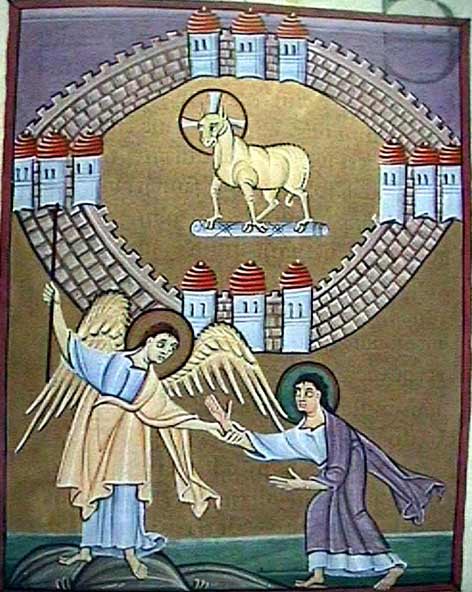
22I saw no temple in the city, for its temple is the Lord God the Almighty and the Lamb.
(1) The New Interpreter's Bible notes:
"If a temple marks a discrete place of divine presence in the midst of a world, here the divine is immediately present and all-pervasive..."
23And the city has no need of sun or moon to shine on it, for the glory of God is its light, and its lamp is the Lamb.
(1) The notion of God's radiance fills the Old Testament. His bright holiness was deemed so great that no one could hope to look at Him face-to-face in His full deity and live. The reason for this is that God is, as theologians put it, "wholly other," completely perfect and infinitely holy. Although God wants fellowship with us, the fact is that we are completely unworthy to be in His presence. (See here.)

24The nations will walk by its light, and the kings of the earth will bring their glory into it.
(1) Up to this point in Revelation, the world's kings have been under the spell of the beast (17:2; 18:3) Here though, they surrender any claim to personal glory and yield it to the true King.

25Its gates will never be shut by day—and there will be no night there.
(1) With only the limited light provided by torches, sundown brought danger and fear to the ancient world in which John lived. Cities were the safest places to be, bound as they were by walls and hemmed in by gates that were shut when the sun went down. The gates were shut in times of particular danger, when armies threatened attack. But the new Jerusalem is here described as a place of safety in which fear has been banished and all live in the bright, protective light of God.

26People will bring into it the glory and the honor of the nations.
(1) Just like the kings, now the people of nations will bring the glory and honor of nations. Here, we see Babel reversed. You remember Babel. It was the ancient city that decided to build a tower they believed would make them greater than God. To save themselves from their own hubris, God caused the residents to speak many different languages. Misunderstanding and quarreling ensued, making completion of the project impossible. At that, the people dispersed, settling in many different places, each with their own languages and customs...and very quickly, their own brands of hubris.

In the new Jerusalem, all speak the same language and each are united by one thing: their adoration of and submission to God. They do so because they know that in Him is life. (See here.)

27But nothing unclean will enter it, nor anyone who practices abomination or falsehood, but only those who are written in the Lamb’s book of life.
(1) The new Jerusalem is pure. Throughout history, various well-meaning, but misinformed, Bible-readers have tried to establish new Jerusalems here. There's certainly nothing wrong with trying to create positive communities. But two things need to be pointed out:
a. The new Jerusalem in Revelation comes at God's instigation.
b. It's God's will that as long as the first earth, heaven, and Jerusalem exist, the possibility of evil exists. The new Jerusalem will only come when God is ready to bring down the curtain on the first things. Until then, we followers of Chrst are on a mission to be His witnesses, telling others the Good News that they too can live with God forever.
22:1Then the angel showed me the river of the water of life, bright as crystal, flowing from the throne of God and of the Lamb 2through the middle of the street of the city. On either side of the river is the tree of life with its twelve kinds of fruit, producing its fruit each month; and the leaves of the tree are for the healing of the nations.
(1) Jesus is the living water. (John 4)

(2) This is a really productive tree! And I believe that it's the same tree found in Genesis, the tree which Adam and Eve were prevented from getting near, for fear that in their rebellious state, they would eat its fruit and be lost to God forever.

3Nothing accursed will be found there any more. But the throne of God and of the Lamb will be in it, and his servants will worship him; 4they will see his face, and his name will be on their foreheads. 5And there will be no more night; they need no light of lamp or sun, for the Lord God will be their light, and they will reign forever and ever.
(1) Based on what's written above, the meaning of these verses should be clear.

Tuesday, May 08, 2007

First Pass at This Weekend's Bible Lesson: Revelation 21:10, 22-22:5


[Most weeks, I present as many updates on my reflections and study of the Biblical texts on which our weekend worship celebrations will be built as I can. The purpose is to help the people of the congregation I serve as pastor, Friendship Lutheran Church of Amelia, Ohio, get ready for worship. Hopefully, it's helpful to others as well, since our Bible lesson is usually one from the weekly lectionary, variations of which are used in most of the churches of the world.]

The Bible Lesson: Revelation 21:10, 22-22:5
10And in the spirit he carried me away to a great, high mountain and showed me the holy city Jerusalem coming down out of heaven from God...22I saw no temple in the city, for its temple is the Lord God the Almighty and the Lamb. 23And the city has no need of sun or moon to shine on it, for the glory of God is its light, and its lamp is the Lamb. 24The nations will walk by its light, and the kings of the earth will bring their glory into it. 25Its gates will never be shut by day—and there will be no night there. 26People will bring into it the glory and the honor of the nations. 27But nothing unclean will enter it, nor anyone who practices abomination or falsehood, but only those who are written in the Lamb’s book of life.

22Then the angel showed me the river of the water of life, bright as crystal, flowing from the throne of God and of the Lamb 2through the middle of the street of the city. On either side of the river is the tree of life with its twelve kinds of fruit, producing its fruit each month; and the leaves of the tree are for the healing of the nations. 3Nothing accursed will be found there any more. But the throne of God and of the Lamb will be in it, and his servants will worship him; 4they will see his face, and his name will be on their foreheads. 5And there will be no more night; they need no light of lamp or sun, for the Lord God will be their light, and they will reign forever and ever.

General Comments
1. In last week's lesson, we saw the first heaven and the first earth supplanted by a new heaven and a new earth which came down to the first. Here, the new Jerusalem is described.

2. C.S. Lewis does a wonderful job of explaining what Revelation is getting at in describing the new heaven, earth, and Jerusalem in the seventh book of The Chronicles of Narnia. It's called The Last Battle. There, the main characters of the book which I regard as the most sublime in all of English literature, witness the end of Narnia, the world they so loved. Its end is wrought by Aslan, the Christ figure of Lewis' novels.

They find themselves in a beautiful place: Narnia, but not exactly the Narnia where they'd once lived. It's a new Narnia. As Lucy Pevensie, the girl from our world who became a queen in that world she once reached through a wardrobe, explains it:
"I see...This is still Narnia and more real and more beautiful than the Narnia down below..."
Lewis helps us to see that everything we love about this life and every good thing for which we naturally yearn as creatures made in the image of God will exist in the new Jerusalem and according to the vision given to John in the book of Revelation, all who have believed in Christ--whose names are written in the Book of the Lamb--will live in that new city.

3. Jerusalem was not only the capital city of Israel (later Judea) or the focal point of its worship life. Jerusalem, because it housed the Temple was also thought to be the place where the very presence of God dwelt. It was in the Holy of Holies, once the repository of the tablets on which God inscribed the Ten Commandments on Mount Sinai.

4. What's stunning is that in this "new Jerusalem," there is no Temple. God--the Father and the Son (the Lamb)--dwell among the people with no structure concealing or containining God's presence, although God is still worshiped, still higher, still greater. Accessibility doesn't lessen God's glory. But, contrary to some religious teachings, the Bible reveals that human beings will never be on the same level as God. Even in eternity, God will be the Creator and we will be God's creatures. God will always be divine and we will worship God.

5. As throughout the book of Revelation, Jesus is described as "the Lamb," the One Who, like the sacrifical lambs once offered in the Temple, gave His life for all who turn from sin and believe in Him to live.

Verse-by-verse comments on the lesson tomorrow, I hope.