...and ends as a political statement, this time one against war as a general proposition: Calico Skies by Paul McCartney.
"May we never be called to handle
"All the weapons of war we despise..."
Showing posts with label war. Show all posts
Showing posts with label war. Show all posts
Monday, January 01, 2018

Sunday, October 02, 2016
2016: Year of Shocking Referenda Results
2016 is likely to be remembered as the year of shocking results for national referenda.
One hundred days ago, voters in the UK decided to leave the European Union (EU) in what's come to be called the Brexit referendum. (The vote for withdrawal was a slim majority, 51.9% of the vote.)
Now, voters in Colombia--also my a slim majority, 50.2%--have voted to reject a peace deal with the rebel Revolutionary Armed Forces of Colombia (FARC). The deal would have ended the last remaining war in the Western Hemisphere. One article says that in those areas of the country where the casualties have been highest, the vote for peace was over 90%. The referenda has been defeated nonetheless.
[Blogger Mark Daniels is pastor of Living Water Lutheran Church in Centerville, Ohio.]
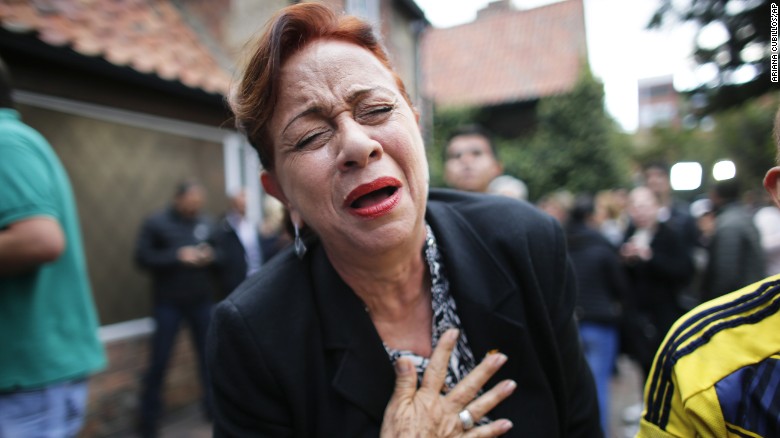
[The picture is from the cited CNN article. If this attribution is inadequate and posting it violates copyright law, I will pull it down. But I think it well evokes the emotions associated with the Colombian vote. The woman pictured opposed the peace deal and was reacting positively to its defeat.]
One hundred days ago, voters in the UK decided to leave the European Union (EU) in what's come to be called the Brexit referendum. (The vote for withdrawal was a slim majority, 51.9% of the vote.)
Now, voters in Colombia--also my a slim majority, 50.2%--have voted to reject a peace deal with the rebel Revolutionary Armed Forces of Colombia (FARC). The deal would have ended the last remaining war in the Western Hemisphere. One article says that in those areas of the country where the casualties have been highest, the vote for peace was over 90%. The referenda has been defeated nonetheless.
[Blogger Mark Daniels is pastor of Living Water Lutheran Church in Centerville, Ohio.]
[The picture is from the cited CNN article. If this attribution is inadequate and posting it violates copyright law, I will pull it down. But I think it well evokes the emotions associated with the Colombian vote. The woman pictured opposed the peace deal and was reacting positively to its defeat.]
Tuesday, November 11, 2014
Veterans Day Thanks: A Few Thoughts

A picture of my dad, who was in the United States Air Force from 1950 to 1954.
Today is Veterans Day. I remember when my grandparents called it Armistice Day. And that's what November 11 was, originally. The armistice ending World War One went into effect at 11:00 on 11/11/1918.
When the war, certainly one of the most unnecessary exercises of human blood-letting in history, ended, there was a horror at the prospect of ever fighting another armed conflict. The death and destruction had been enormous. War was unthinkable.
The League of Nations, the brainchild of U.S. President Woodrow Wilson, meant to help countries deal with their disputes peacefully, was established after the war. But, of course, the United States, sick of its one-year immersion in "power politics" (what Americans called foreign affairs in those days), wanted "normalcy," meaning the country desired to remain isolated from the world. Absent the involvement of the US, the League of Nations may have been doomed from the beginning. (World War One, for the other combatants, by the way, had lasted four years.)
In 1928, a treaty called the Kellogg-Briand Pact was promulgated. In it, nations promised to resolve their differences without going to war. A number of countries, including the United States, ratified the treaty. (The vote in the U.S. Senate was 85-1.)
But within five years, Hitler would be in power in Germany. His chancellorship ended any idealistic notions that human beings, by force of law, could prevent war. Given the aggression of Nazi Germany, Fascist Italy, and Imperial Japan, it's hard to see how World War Two could have been avoided. For the United States, any thought of remaining isolated from the war begun by those "Axis Powers" (or from tough, coercive peace-making efforts, for that matter) ended with the Japanese attack on Pearl Harbor on December 7, 1941.
I've talked in other places about the Lutheran understanding of the Bible's teaching on "the two kingdoms." It holds that God rules the world in two ways. Over His Church, He rules by grace. This is "the kingdom of the right," whose constituents have voluntarily surrendered to the Lordship of Jesus. They aren't perfect. But through "daily repentance and renewal," they seek to live in accordance with Jesus' great commandment: to love God and to love neighbor. They do so not through some coercion, but out of simple gratitude for having been saved by God's grace through faith in Christ.
But because not all people voluntarily live under God's gracious hand and seek instead, to be their own gods, God also rules through "the kingdom of the left." This is the kingdom of laws and armies and coercive power, the kingdom of wars.*
Absent this mode of rule, the world would be a far more inhospitable place than it is. God establishes governmental authority and power to do two things: (1) To keep human selfishness and sin in check; (2) To clear a place of sufficient calm that will allow people to hear His gospel of grace.
Human beings, being human though, will, of course, often give vent to their sinful human nature, turning their backs on the authority of God over their lives, whether they consider themselves citizens of the kingdom of the right or the kingdom of the left. Sin, death, and darkness remain in this world--and in each of us--until the day Jesus returns, the dead in Christ rise, and He fully establishes the new heaven and the new earth.
This means that while peace always remains a worthy goal, we will not always be successful in obtaining it.
Jesus once was describing the signs of the end of this world that He will bring about when He returns. He said that all of the signs of His return had already taken place and that we all should be prepared for the end. And He said: "When you hear of wars and rumors of wars, do not be alarmed. Such things must happen, but the end is still to come."
Wars are inevitable because we human beings are sinners.
But on this Veterans Day, as I consider all the warring that my country has engaged in just in my lifetime and all the wars around the world that have happened in that same period, it makes me heartsick. The Korean War had ended about five months before I was born. Since then, America's military has been asked to fight or face hostile fire, most notably, in Vietnam (and Laos and Cambodia), Iraq (twice), and Afghanistan.
Whether all these wars were unavoidable or necessary is a political question. And I have no intention of addressing that here.
What I am saying is that, as a Christian, I'm no peacenik. I don't think that Christians are necessarily called to be pacifists. According to the New Testament, unless a government asks us to act unjustly, we are duty bound to God to serve our government, as though serving God. And that includes assisting in the execution of those wars that the government deems necessary.
But, as I thank the veterans of the military, like my dad and my nephews, for their service to America, today, I also pray that our leaders and the leaders of other nations will be given the wisdom to avoid the use of war in disputes.
No one should be asked to spend their lives in wars that have no good purpose.
Just a few thoughts.
[*The "kingdom of the left" and the "kingdom of the right" have nothing to do with more modern terms for political philosophies. To speak today of people being on the left or the right is to borrow from terminology that originally came from nineteenth century France.]
Tuesday, December 01, 2009
Right or Wrong, This is to Be Admired About Policy Obama Announces Tonight

In the epilogue to his book, Presidential Courage, Michael Beschloss recalls that five years before being elected President, John Kennedy lamented that US politics had become "so expensive, so mechanized and so dominated by professional politicians and public relations men...[And further, because of] the tremendous power of mass communications, any unpopular or unorthodox course [aroused] a storm of protest." These conditions, Kennedy suggested, put a higher price on political courage than at any time in our country's history, with the prospects of political annihilation for those who showed a willingness to stake out different points of view becoming almost prohibitively high.
Some would argue that Kennedy may have believed more in political courage than he practiced it, especially when it came to civil rights, a cause about which he was either indifferent or tepid through most of his political career. But the forces Kennedy saw diminishing a political actor's willingness to chart a course irrespective of what opinion polls, focus groups, radio call-in audiences, special interests, or political operatives may tell them have not diminished in power or influence in the past fifty-four years. (The Internet and cable news, among other things were not part of the stew identified by Kennedy. But they have made his insight even more acute.)
Truth be told, the US electorate has a schizophrenic attitude about political courage. We want, so we say, for our political leaders to have backbone and to not make decisions based on the latest public opinion surveys, but on what's "right." These are the kinds of things ordinary voters say all the time.
Yet we also seem to want our leaders to be milquetoasts or automatons who mechanistically reflect our opinions, well-informed and otherwise.
This leads to 1984-style characterizations of popular pols as courageous, although their actions rarely buck popular opinion, and of politicians who dare to do what they think right as being weak, vacillating, or indecisive. You can supply your own examples for each category and if you're fair, I think you'll concede that examples of both inaccurate assessments run the political gamut. Our schizophrenia is reliably non-partisan.
No wonder political courage is so rare. And its rarity is part of what makes President Barack Obama's speech on Afghanistan tonight so important.
Whatever one's take on the strategy he will unveil this evening--I offer no opinion on that, he is displaying remarkable political courage.

That may not ring true to some at first. After all, the strategy the President will unveil tonight is consistent with what he said he would do during last year's presidential campaign, a campaign he won resoundingly. Obama said he would wind things down in Iraq. The real fight against al-Qaeda, he also said, was on the border between Afghanistan and Pakistan, where the fight would need to be ramped up. With those pledges as part of his platform, Obama was given the presidency.
But in the intervening time, a core constituency of the President's own party, liberal Democrats, have become disenchanted with any US presence in Afghanistan. And the American people have grown more restless to leave the Afghans (and the Pakistanis) to fend for themselves.
Some Republicans have claimed that Obama has been "dithering" on Afghan policy and some in the opposition party have said that Obama should not cut down on General Stanley McCrystal's troop level request.
Tonight, Barack Obama is going to tell a nation weary of war that we must undertake an increased burden in a nation where US personnel have been fighting and dying for eight years.
Give the President his due. This isn't just a hard speech to make; it was preceded by a tough decision made in spite of a clear understanding that, because nothing is a given in this life, the war could turn out badly. And, less significantly, it could make Obama a one-term president. The policy Obama announces tonight could scuttle all his lofty aims.
Yet, in the face of the opposition and the odds, Barack Obama, based on his discussions with military and civilian advisers, is forging ahead with his proposed escalation of the war in Afghanistan.
Whether Obama's decision turns out to be right or wrong, a success or a failure, he is exhibiting political courage.
How history will remember Obama's courage depends on how things turn out. The second line in Beschloss' book hints at that:
...throughout our history, at times of crisis and urgent national need, it has been important for Presidents to summon the courage to dismiss what is merely popular--and the wisdom to do that for causes that later Americans will come to admire.
The only political courage subsequent generations will admire, Beschloss seems to say, is that which results in what is perceived as success. No points are given for being courageously wrong. I want to disagree with that; courage should be counted as courage irrespective of outcomes.
Yet this is the high stakes game which Barack Obama is knowingly playing. The politician submits her or his life not only to the judgment of contemporary electorates, but of history. My personal experience is that most politicians like--sometimes love, sometime crave--being liked, affirmed, appreciated, cheered.
Courage for politicians happens when they risk losing votes and the adulation of history to do what they think is right.*
The President has little to gain and much to lose from the policy he announces tonight. Right or wrong, that takes courage.
*Actually, this is true for any leader. After twenty-five years as a pastor, I can tell you that it takes more courage to take a stand you know some will repudiate than to do anything that gains universal applause. But I also can say that, for all the turmoil taking a stand may cause, there is more inner peace and clarity of action when you go the courageous route. I have to also say that, for me, courage is something I draw from God and not any intestinal fortitude I may (or may not) possess.
Subscribe to:
Posts (Atom)