Saturday, September 13, 2008

Save Lori's House

A friend of mine, writer and one-time parishioner D.C. Stanfa just informed me of an effort being spearheaded by freelance writers and journalists from around the country to help Traverse City freelancer Lori Hall Steele with her mortgage payments and medical bills. They're taking online contributions via PayPal to help this single mom, currently totally bed-ridden, the victim of both Lou Gehrig's Disease and Lyme Disease.

To learn more and, if you choose, to make a donation, go here. (You'll also find lots of links to more information about Hall Steele's situation there.)

Whatever else you do, please pray for Lori. Pray for her health. Pray for her child.

Please pray too, that doctors will be guided in finding treatments and cures not only for the diseases afflicting her, but other fatal diseases as well.

Also, take some time to inform yourself on the positions of all candidates in the 2008 elections for President, the U.S. House of Representatives, and, if a seat is up for grabs this year in your state, the U.S. Senate. It seems to me that there is a growing national consensus on health care, at the very least a common emerging belief that the issue needs addressing. Here is The New York Times' excellent summary of the two presidential candidates' positions and proposals on health.

Friday, September 12, 2008

Praying...

for all in the path of Hurricane Ike.

Wednesday, September 10, 2008

'True Blood' and Thoughts on Eternity

Alan Ball, creator of True Blood, the new vampire series on HBO, was interviewed today by Terry Gross, host of NPR’s Fresh Air. One thing he said interested me. Vampires, you know, supposedly have eternal life. Ball said, and I hope that I’m quoting him accurately: “If you have eternal life, each day becomes less important. Everything you have, you lose.”

Maybe Ball has identified part of why people don’t follow Jesus Christ. Christ promises eternal life, a state of timelessness lived in the presence of God, to all who follow Him. But in a timebound world, which inevitably limits our imaginations, we may not want to take Him up on the offer. That's because it’s easier to keep score, to quantify friends, relationships, possessions, income in a realm limited by time. In a timebound world, we have things we don’t want to lose.

Eternity renders those things irrelevant. It pushes us and our desperate attempts to conquer, to manage, to be in control away from the centers of our perceptions and daily life. Everything you have, you lose.

But in losing all the things that we use to describe "really living," at least by the lights of this world, we gain everything. We are no longer defined or controlled by the things we have, own, control, or label. In taking Christ’s offer of eternity, we are made simply ourselves, children of God, created in God's image, free to live in the now moments of this world and in the eternal now as the people God, our designer and redeemer, made us to be.

That’s scary. It entails ceding control and leaving behind our usual means of measuring the value of our lives, whether it's others or we ourselves do the measuring.

It’s also liberating. An unquantified and unquantifiable life is a blank slate on which we are free to live as fully human beings in the place where our deepest, purest desires and God’s design, both of the universe and of ourselves individually, meet.

This is what Jesus Christ offers us when He tells us to believe in Him and follow. He makes each day of this life more important, not less so, because through Christ, we gain the confidence that no risk we take is ultimately fatal and we learn that in us, eternity with all its patience and assurance, not only invades today, but also has its start today.

This isn't easy. Every day, I come face to face with ways in which I don't believe, the ways in which I allow my horizons to be limited by a time-and-space-trapped world. But in those moments when I put down my dukes and let eternity slip past my defenses, there is joy and hope. And I feel sorry for and pray for people like Alan Ball.

Politics Doesn't Belong in the Pulpit

[This is a piece I just submitted to The Logan Daily News, the local paper in the community I serve as pastor.]

Several weeks before the war in Iraq began, I heard from two different pastors who had differing views of the impending conflict. One argued that followers of Jesus couldn’t possibly support the war. The other claimed that it was the moral duty of followers of Jesus to do just that.

Both of these pastors were sincere followers of Christ. But their conflicting opinions show the difficulties that arise when members of the clergy decide they know how Jesus wants us (or our members of Congress) to vote.

“Christianity,” C.S. Lewis once wrote, “has not, and does not profess to have, a detailed political [program] for [application at every] particular moment.”

Christians, I believe, should be interested in politics. And I hope that committed Christians run for political office. But no pastor or church can claim to know God’s partisan or political preferences, if in fact, God has any. Instead, preachers and churches should focus on other things.

Jesus once said, “…when I am lifted up from the earth, [I] will draw all people to Myself” (John 12:32). Jesus wasn’t only talking about His being lifted up on a cross here. He was also saying that when followers of Jesus lift Him up for the whole world to see, in our words and in our lives, others will follow Him. That, in turn, will affect how they live their lives as citizens and politicians. If God wants to guide them in their voting, God will do so without the meddling of preachers or Christian organizations.

Preachers and churches are to keep sharing Jesus Christ. We’re to trust that as we lift Jesus up, at least some in the world will come to see Jesus in our lives and believe in Him.

Except in the face of horrific evil, like slavery, racism, or prejudice, social issues that must be addressed politically as well as in other ways, politics has no place in the pulpit.

Tuesday, September 09, 2008

'The Shack'

I'm reading The Shack, the best-selling novel by William P. Young. I've gotten about one-third of the way through. There have been times in these opening pages when Young's writing has been tediously descriptive.

But I've just finished the fifth chapter, the last pages of which found me chilling, something I initially thought was only my imagination, until I looked to see the hairs on my arms standing on end. (Those of you who have read it already likely know exactly where I mean.)

I was going to go to bed soon, but now I need to learn more about what happens to Mack Phillips, Young's protagonist, in the shack.

My recommendation so far? Read this book.

Monday, September 08, 2008

The Cross: God's Wisdom and God's Power (Looking at the Bible Lessons for Sunday, September 14, 2008)

[Most weeks, I try to publish at least one post dealing with the appointed Bible lessons for the upcoming Sunday. My hope is that I can at least help the people of the parish I serve as pastor, Saint Matthew Lutheran Church in Logan, Ohio, to prepare for worship. Others may find these explorations helpful because we use the same Bible lessons used by most other North American Christians each Sunday. For information on the Church Year and the plan of lessons called the lectionary, see here.]

The Bible Lessons:
Numbers 21:4b-9

Psalm 98:1-4

1 Corinthians 1:18-24

John 3:13-17


The Prayer of the Day:
Almighty God, your Son Jesus Christ was lifted high upon the cross so that he might draw the whole world to himself. To those who look upon the cross, grant your wisdom, healing, and eternal life, through Jesus Christ, our Savior and Lord, who lives and reigns with you and the Holy Spirit, one God, now and forever. Amen
Comments:
1. We take a detour from the Bible lessons we would ordinarily use this coming Sunday--the Eighteenth Sunday after Pentecost in Year A of the three year lectionary cycle--in order to commemorate Holy Cross Day. Holy Cross Day is one of the Lesser Festivals of the Church Year. When such a festival falls on a Sunday, the appointed texts are frequently set aside.

2. Holy Cross Day happens on September 14 of each year and can be traced back to that same date in 355AD. It was then that the Basilica of the Resurrection in Jerusalem was dedicated. It was constructed under the direction of Saint Helena, mother of the Roman emperor, Constantine the Great. Helena found what was thought to be the true cross near the site shortly thereafter.

In the ensuing centuries, Holy Cross Day has been a day on which, in contrast to Good Friday, which emphasizes the sacrificial elements of Christ's crucifixion, other aspects of Christ's cross are featured. The Bible lessons emphasize the cross as the way to salvation for all who look to Christ in faith and the cross, as the ultimate disclosure of the power and wisdom of God, marshaled in our favor. Whereas the mood of Good Friday is somber and penitential, the mood of Holy Cross Day is celebratory and joyful.

There is only one set of lessons appointed for the day, the same ones designated for use each year.

For Holy Cross Day, as for other lesser festivals of the Church Year, as well as for Pentecost Sunday and for the ordination of pastors, the color is red.

3. Numbers 21:4b-9: God's people, the Hebrews, have been in the wilderness for about forty years when we meet them in our first lesson. God sends poisonous serpents to bite and take the lives of His people who have "murmured" over their limited diets and their nostalgia for the food they had--along with the enslavement from which God set them free--back in Egypt.

This isn't the first time while they were in the wilderness that the people complained about how God was performing His job as God. Earlier, their complaining resulted in water, quail, and manna. But this time, God reacts very differently. God punishes them. What accounts for the difference?

Very simply, those other incidents happened before God gave the commandments and made His covenant with the people at Mount Sinai. God has revealed His will and character, along with His commitment, to the people. They are called to trust and obey. Instead, though they should know better, they become whiny.

4. Moses intercedes for the people, who come to regret their ingratitude. (You would too, probably, if you and your neighbors were getting bitten by poisonous snakes, right and left.) God tells Moses to create a bronze serpent and to put it on a pole. Those bitten by the poisonous snakes will look at it and be healed.

This, of course, can seem read like a story of superstition. But it isn't.

God could have chosen any means to bring about the healing of the people. Why a bronze serpent?

Here's what I think. The serpent on the pole symbolized the means by which God was punishing His people. In their bodies, they bore the consequences of their sin, consequences which followed from their rejection of and separation from God, the source of life.

But, in the midst of this "cross experience," God called His people to own the reality of their rebellion--the bronze serpent reminded them of this--and look to Him for restoration and healing. It was as though at that moment God was saying, "Meet me in the bronze serpent. Look to Me and be restored."

In a similar way, centuries later, the New Testament says of Jesus on the cross, "For our sake [God] made [Jesus Christ] to be sin who knew no sin, so that in him we might become the righteousness of God" (2 Corinthians 5:21). God makes it possible for all people to be restored to relationship with God and life forever when they turn to Christ. (You can find more information on this passage here.)

5. Psalm 98:1-4: There are two elements of this brief passage from the Old Testament song book I want to mention: (1) The reality of God and God's goodness aren't apprehended by analysis or intellect. God reveals Himself. God does this, vindicating Himself--and the faith of those who believe--by acting in accordance with the steadfast love He bears for those who trust in Him. God's actions are discerned not by those who demand that God prove Himself and aren't seen by those who expect God to do our selfish bidding, but by those who humbly trust and look to God. God is seen by those who are willing to see God on God's terms, not their own. (2) The "right hand" refers to God's power. God uses His power on our behalf.

6. 1 Corinthians 1:18-24: The cross was probably the worst form of execution ever devised. Yet, Paul says that God, Who has always shown a penchant for doing the unexpected, used the cross of Jesus as a way of displaying His wisdom and power. Paul's fellow Jews demanded signs of Jesus' Lordship and Greeks (Gentiles...non-Jews) wanted Jesus to earn His Lordship on debating points. Instead, God established Jesus' cross as the sign of His love to which we, like the Hebrews in the wilderness, must turn to acknowledge our sin and receive the restoration that comes to all who trust in Christ.

7. John 3:13-17: Christ goes to the cross and bears the burden which He, the sinless Savior of humanity, doesn't deserve. He does so that we can turn to Him and live. Jesus underscores this in the last verse of our lesson:
“Indeed, God did not send the Son into the world to condemn the world, but in order that the world might be saved through him."
Not a part of our lesson is the next verse, also words said by Jesus to Nicodemus:
"Those who believe in him are not condemned; but those who do not believe are condemned already, because they have not believed in the name of the only Son of God."
Thank God for Christ's cross!

Sunday, September 07, 2008

When Other Christians Sin Against Us

[This was shared during worship with the people of Saint Matthew Lutheran Church in Logan, Ohio, this morning.]

Matthew 18:15-20
John was a member of my first parish. Whenever there was a congregational meeting, no matter what the issue being voted on, John voted, “No!” If someone had proposed a resolution that read, “Resolved: Grass is green,” he would have voted, “No.” Finally, one day, several years before I was the pastor there, some members of the congregation, purely out of curiosity, asked, “John, why do you always vote against everything?” He looked at them as though they were from another planet. “Because if I didn’t,” he said, convinced of the flawlessness of his logic, “the vote would be unanimous.”

Psychologist and pastor Alan Loy McGinnis says that in all healthy relationships, we must be willing to allow one another our little insanities. Because the people of that church were so spiritually and emotionally healthy, they could accept John’s contrariness even as they shook their heads over it. We all need to be charitable toward one another and to recognize that even when we get exasperated with each other, we’re still called to love and live in fellowship together.

But what happens when a fellow church member moves beyond simple contrariness and sins against us in some way?

In today’s Gospel lesson, Jesus says that when one member of the Church sins against another, we have the means of resolving things because He--the crucified, once-dead, now-risen, and living Lord of the universe--is with us. Jesus promises to be among us.

For some, the very notion that Christians might sin against each other doesn’t compute. Many believe that if Christians ever hurt each other, it’s proof that they’re not Christians.

But the Church is a support group for recovering sinners, a haven for the imperfect. Lutheran theology, taking its cue from the Bible, realistically looks at baptized believers and says that we are “saints and sinners simultaneously,” just as was true of the disciple Peter who, in one breath, Jesus called the Rock on whose confession of faith he would build the Church, and in the next Jesus described as, “Satan,” someone who was standing in Christ’s way.

My friend Virgil Meyer likes to remind people, “If there weren’t any sinners in the church, it would be empty.” We Christians aren’t called to live in the Kingdom of Nice, but in the Kingdom of God with other real-life, feeling, thinking human beings. And this side of heaven, though we’re forgiven and recovering sinners, we are still nonetheless, sinners capable of doing wrong and of wronging others. It happens.

So, why bother being part of the Church if other members will maybe sin against us? Why not live in isolation and have a “Jesus and me” sort of faith?

Because the Bible repeatedly affirms that to be Christians, we need the imperfect fellowship of the Church. Paul, for example, says that the Church is the body of Christ in the world and just as an eye, or a leg, or a brain can’t function without the whole body, our faith will die if we don’t remain in vital fellowship with the church.

Part of growing up as followers of Jesus Christ is recognizing that we won’t always agree on everything. We’ll have disputes. And ninety-nine percent of the time, those disputes we have with other Christians are insignificant. But sometimes, they’re the result of someone having sinned against us or our belief that they've sinned against us.

Jesus says that the way for Christians to handle these latter situations isn’t to simply ignore them.

Or to sue the other person’s socks off.

Or to gossip about or ignore the other person.

As followers of Jesus, we can dare to take a more difficult approach. Jesus outlines it in the Gospel lesson this morning.

First, Jesus says, we go to the person we feel has sinned against us. The congregation I formerly served in northwestern Ohio was in a rural setting in which we had to burn all our trash. Once, during a drought season, the burn barrel fairly full, the fire I started fell out of the barrel and onto the ground. Ann and I had to work quickly to put it out. When we finally did, three-quarters of the softball infield, next to which the burn barrel stood, was blackened from the fire. The next day, a bunch of kids were playing ball there and asked me what had happened. I told them about my fire. That evening, I got a call from a church member asking why I’d told everybody that he had started the fire. “I didn’t,” I told him. “I told everybody I started the fire and what a dolt I'd been to have done so.”

The point: That man didn’t bother gossiping to anybody else, complaining about how I’d pinned a bad reputation on him. He came directly to me and in short order, our conflict over my perceived sin against him was resolved.

Jesus says that when another Christian sins against us, we’re to go to them privately. We may learn that they didn’t really sin against us and our fellowship will be restored. Or, if they did sin against us, they may apologize and fellowship will be restored.

But, Jesus says, if the other person turns out to be unwilling to hear you out, you’re to enlist two or three other Christians to listen to both of you and guide you toward restoration. Lutheran pastor Mike Foss once told the true story of a time when he and a man in his congregation and the man's three sons formed an intervention group to confront a wife and mother for her gambling addiction, something that was having a devastating effect on the family.

At the beginning of this session, for twenty minutes, the husband laid out all the reasons for his concern for his wife and what her addiction was doing to all of them. Then, weeping, he told her how much he loved her.

Writes Foss: “She looked at her three boys, took a long look at her husband, and then looked at me. What came out of her mouth next was probably the fiercest barrage of venom I’d ever heard from anyone...ever. With her three sons sitting close by, she called her husband names that made my skin crawl...”

That’s the sort of thing that can happen when we confront other believers for their sins against us. But if our motives are to help the other person and not get some sort of revenge, we can do this knowing that Christ is with us.

Jesus goes on to tell us that if the person refuses to listen or repent after we’ve enlisted two other members of the church, we’re to get the whole church involved. Probably in our case, the involvement of the church would happen through our Church Council.

A colleague of mine in northwest Ohio once told us about an incident that happened in the congregation he served. One member learned that another member of the congregation, a guy he didn’t like, had cancer. So, after worship one day, this fellow walked up to the cancer victim. “Joe,” he said, “I understand you have cancer.” “Yes,” Joe replied. “Well,” the first man said, “I guess you get what you deserve.” When my colleague got wind of this remark, he followed the process Jesus outlines in today’s lesson. The man refused to repent and ultimately, the Church Council decided that he was no longer a member of the congregation and could not receive Holy Communion.

The whole point in the process Jesus gives is not for us to spiritually look down on others, but to facilitate the restoration of relationships. It’s designed to act as a megaphone so that those who sin against us can hear and heed the Holy Spirit again and so, repent and be at peace with God and their Christian family.

My colleague’s church excommunicated its member not to punish him, but in hopes that he would see the gravity of his guilt and be restored to the body of Christ.

Had they not taken the action they took his unrepented sin against a fellow church member would have been another sort of cancer, one on the body of Christ that blocked God’s forgiveness not just from one unrepentant person, but from the whole congregation.

The process that Jesus outlines requires courage and truthfulness and humility and a commitment to living in the fellowship of a church to which Christ calls all believers. It requires us to think less about me, more about we.

For all the risks, the results of pursuing this process can be wonderful! Years ago, I became aware of a fellow Christian saying some things about me to others that were completely untrue, things which I felt at the time, if left unchallenged, would severely damage my reputation and hamper my ability to do ministry.

I stewed about what to do for a while. Then, praying desperately, hands shaking, I picked up the telephone and confronted the guy.

He immediately confessed that he had repeatedly said the things I’d heard attributed to him, apologized, and promised to tell everyone to whom he had previously spoken that his statements were untrue.

“I’m sorry, Pastor,” he told me, “I know that everything I said was wrong, but sometimes I’m a gossip.”

That man died a few months later and I presided over his funeral. I felt a special twinge of sadness because not long before, our confrontation and the restoration that resulted had given us a good friendship. We genuinely appreciated and loved one another. And the funny thing is, as I was preparing the sermon for today, Ann and I tried to remember what the man had been saying about me and though we racked our brains to remember, we both have completely forgotten. We can’t always forget, of course. But, with Christ’s help, we can forgive.

Are there are any Christians—here or in other congregations--you feel have sinned against you? Then, resolve today to strengthen your relationship with God and the life of Saint Matthew by taking the steps Jesus outlines today. You will be glad you did.

Be reconciled to those who have wronged you. Forgiveness among us is a salve that heals our souls and strengthens Christ’s Church.

Saturday, September 06, 2008

Dumb Commercials

Dumb


Even dumber


Both ran several times during this afternoon's Ohio State-Ohio University football game. They're both mute-the-sound moments.

The first is absurdly juvenile. Both make zero sense. Think about this when you go back to work: People actually get paid for to write this stuff. And supposedly intelligent people, including Bill Gates and Jerry Seinfeld, appear in them.

Friday, September 05, 2008

Putting Things in Buckeye Perspective

This editorial cartoon from The Columbus Dispatch puts things in perspective, the woman in it asking the question that all Ohio State football fans have been wondering about all week long: Will Beanie Wells be able to play in tomorrow's game?

The answer is, "No." But hopefully, he'll be ready for next week's showdown with USC.


Go, Buckeyes!

Thursday, September 04, 2008

Where Do We Go When We Die?

Twice in the past two days I've been asked, “What happens to the follower of Jesus who dies? Do we go into some sort of sleepy holding pattern or do we go immediately to heaven with God?”

First, it should be said that people who entrust their lives to Jesus Christ can face death and what lies beyond with confidence.

The first-century preacher Paul writes in the New Testament portion of the Bible: “...we know that if the earthly tent we live in [our bodies] is destroyed, we have a building from God...eternal in the heavens.” [Second Corinthians 5:1]

From Jesus Himself, we have the assurance that all who believe in Him won’t forever be erased or go to hell, but live with God forever, something He tells us in the Bible’s most famous passage, John 3:16.

Jesus-Followers know that whatever lies ahead, they belong to Jesus Christ. period.

But the Bible seems to say two different things about what happens to followers of Christ when they die.

There are numerous passages that intimate believers fall asleep, awaiting what the Bible calls “the day of the Lord,” when Jesus returns and brings them back to life again.

In the Old Testament, for example, the book of Daniel says, “Multitudes who sleep in the dust of the earth will awake; some to everlasting life, others to shame and everlasting contempt.” [Daniel 12:2]

In a New Testament account of Jesus’ life, death, and resurrection, we’re told that Jesus knows that his friend, Lazarus, has died and says of it that Lazarus has “fallen asleep.” [John 11:11]

Paul, in another place in the New Testament, spoke of the more than 500 believers who had seen the risen Jesus, and then noted that while most were still living, some had “fallen asleep.” [First Corinthians 15:6]

On the other hand, there are passages of the Bible which intimate that the Christian’s transfer to heaven follows death immediately.

For example, there are the words Jesus spoke to one of the criminals executed on a cross at the same time as He was. The criminal turns from sin and pleads with Jesus, Who hardly had the look of a king at this point, “Jesus, remember me when you come into Your kingdom.” Jesus replies, “Truly, I tell you, today you will be with me in Pardise.” [Luke 23:39-43]

So, what are we to make of these seemingly conflicting teachings? An important principle to apply in understanding the Bible is this: When confronted with such apparent conflicts, we should avoid the easy-outs of harmonizing or of choosing one teaching over another.

Christians believe that the entire Bible was inspired by God. [Second Timothy 3:16] Nothing is there accidentally.

Beyond that, particularly as it relates to the New Testament’s witness for Jesus, the Bible is a far more historically-reliable document, written closer to the events it describes, than almost any other historical writings we have from the ancient world. The whole Bible deserves a fair hearing from fair-minded people.

So, I would say that these seemingly conflicting perspectives on what happens to the Christian who dies are both true.

I believe that these two teachings--death as sleep, on the one hand, and immediate transfer to eternity with the God we know in Christ, on the other--are really two perspectives of the same experience, two sides of a single coin.

From the earthly perspective, the believer has fallen asleep. They’ll remain that way, dead, as Jesus’ dead body remained from Good Friday through the first Easter Sunday morning, until Jesus returns and rouses them to life again.

But from the perspective of eternity, which is a state of timelessness, what C.S. Lewis called “the eternal now,” believers who have died already are in heaven, already in God’s presence.

This is what I believe. I could be wrong. But no matter the actual facts, believers in Jesus know, as Paul writes, that “whether we live or whether we die, we are the Lord’s.” [Romans 14:8

Wednesday, September 03, 2008

'When Tragedy Hits the Innocent'

Earlier today, at our church I had a discussion with our congregational Women of the Evangelical Lutheran Church in America, on the question of why God allows human suffering. I drew in part on a four-part series I wrote four years ago called, When Tragedy Hits the Innocent. Below are links to all four installments. I hope that you find them helpful.

Part One
Part Two
Part Three
Part Four

Lutheran Disaster Relief Needs Donations for Hurricane Gustav Recovery

[From the Southern Ohio Synod, Evangelical Lutheran Church in America, comes the following press release.]

LDR [Lutheran Disaster Relief] Ohio is coordinating resources to assist over 2 million people who were evacuated when Hurricane Gustav struck the Gulf Shore states on September 1, 2008.

Funds are needed to transport the Disaster Response Shower Trailer to the Gulfport, Mississippi area. Additionally, donations of building supplies, furniture, and appliances are being accepted to fill the Disaster Response semi-truck. Funds are needed to cover transportation costs.

In the coming weeks, volunteers will be needed to start home repairs and rebuilds. Information for volunteer reception centers will be made available as the centers are established. Monetary donations will be used to assist families with special needs that are not addressed by government services.

To donate items for the semi-truck and for other information, please contact Mary Woodward, LDR Ohio Disaster Coordinator, at 740-732-6700. To make monetary donations, please forward donations to LDR Ohio, 810 Main St., Caldwell, Ohio 43724 or to donate online go to the Lutheran Disaster Response Hurricane Response website.

Sunday, August 31, 2008

The Cross: The Only Way to Life

[I shared this during worship with the people of Saint Matthew Lutheran Church in Logan, Ohio this morning.]

Matthew 16:21-28
As if it hasn’t lasted long enough already, we now have about nine weeks left in the US presidential election. Throughout this period, the candidates of both parties will tell us a lot of things, much of it things we want to hear designed to win us over.

Today’s Gospel lesson shows us that Jesus never took the advice of political “handlers.” Otherwise, He wouldn’t have said any of what He says to us today.

Let’s set the scene. Our lesson is a continuation of an incident that made up last Sunday’s Gospel lesson. In it, Jesus applauds the confession of one of his disciples. The man whose parents named him Simon confessed that Jesus was the Messiah, the Savior King for whom the Jews had been waiting for centuries. Jesus applauded the disciple’s confession, noting that the man had reached this conclusion about Jesus not through intellectual analysis or his emotions, but as a result of that truth being revealed by God to Simon’s open mind. And then, Jesus gave Simon a new name: Peter, a word meaning rock. On the rock of Simon’s confession, Jesus would build his church. Not even death would destroy His Church, Jesus says.

Immediately after this, Jesus tells Simon and the other disciples what would happen to Him as the Messiah: “I’m going to Jerusalem to be spurned by the leaders of our people, to suffer at their hands, to be executed at their prompting, and on the third day following my death, rise again.”

This isn’t what Simon the Rock of faith or the other disciples had in mind at all.

And it isn’t the sort of thing designed to win people over.

Nobody wants a Savor King, a Christ, Who suffers and dies, even if death is followed by resurrection.

Whether from love and loyalty for Jesus, or from fear that his dreams for peace and prosperity are being threatened, or from a combination of both fears, Peter's reaction to Jesus is immediate and forceful.

“God forbid, Lord” Peter tells Jesus, “this will never happen to you!” Then Jesus gives Simon a new name. Thundering with anger, Jesus says, “Get behind me, Satan.” Jesus goes on: “You are a stumbling block to me; for you are setting your mind not on divine things, but on human things.”

Jesus was saying that the problem with the man who he’d just designated as the stand-in for the whole Church--for you and me--was being satanic, opposing the plans of God, because he spent too much time thinking like everybody else. Jesus drives His point home when He says, “If any want to become my followers, let them deny themselves and take up their cross and follow me. For those who want to save their life will lose it, and those who lose their life for my sake will find it.”

What exactly did Jesus have in mind when He told us to take up our crosses and follow Him?

Father Andrew Greeley tells the fictional story of a family packing up to return home after a long summer vacation. The family’s oldest child is to be a senior in high school and the parents are dreading going back. They wish somehow they could freeze time and have their lives remain as they are. They feel so in control and so happy. But the high school senior finally talks sense to his parents. “We have to move on. We can’t live in the past without taking away the present and the future.” Wise words!

They remind me of the lyrics from the bridge of a song by the late Christian music pioneer Larry Norman: “It all comes down to who you crucify/You either kiss the future or the past goodbye.”

The cross that Jesus was calling Simon Peter and the other disciples to bear represented their very human dreams of comfort and ease, of vindication and revenge, of prosperity and power. They were the dreams that we all entertain.

Understandably, Peter and the overwhelming majority of those in first-century Judea held onto stubborn dreams that their country would be freed of the Romans when the Messiah came and that the Messiah would bring them endless prosperity. They would be control. That’s really what all of we earth-bound thinkers want when we’re completely honest.

But Jesus points out that’s faulty thinking. What good is it to have all the money and all the power we want in this life if their our real and most basic needs aren’t met? Or, as Jesus put it: “For what will it profit them if they gain the whole world but forfeit their life?”

The real problem of Simon and his people, is our sin. That's our real problem too, our inborn alienation from God that causes us to turn away from God and that gives rise to all the stupid, tragic, horrible things we do to ourselves and to each other.

Taking up the cross means renouncing short-term gain in favor of living under the reign of the God we know in Jesus Christ.

The way of the cross isn’t the path we would choose if we were looking for self-preservation as the world sees self-preservation. But it’s the only way to the future that God wants to give to us, to eternity with God.

I’m terrified of water. It’s irrational, but because of my fear, I’ve never learned to swim. That’s why I could identify with the person I read about who was learning to swim.* He wanted to keep his foot on the bottom of the pool. But the instructor pointed out that there are no half measures in learning to swim. “If you keep yourself anchored there, you’ll never get the hang of it,” he said. In just the same way, if you and I are going to get the new life that Jesus wants to give us, we have to let go of the old life that’s pulling us down.

This call of Jesus to take up our cross and follow Him causes people to do strange things.

A couple I once knew joined a congregation that was struggling and had little to offer their family. Why had they done that when there were larger congregations with lots of programs and plenty of money just down the street? “Because,” the woman said, “we were looking for a place where we could serve. This congregation needed us more.” It was a strange thing to do, but that couple took up their cross to follow Jesus.

The pastor of a wealthy suburban church once shocked us by taking a call to a congregation that was in an impoverished area. “Why did you do that?” a colleague had asked. “Well,” he said, “this was the last place on earth we would have chosen to go. We figured that when God called us here, it was where we were supposed to be.” That pastor and his family bore the cross and followed Jesus.

A few weeks ago, Ann was visiting with old friends from Cincinnati when one of them made a racist joke about Senator Obama. Now, it doesn’t matter what your opinion of Obama or whether you intend to vote for him or not, racial prejudice is sin. Ann turned to her friend and said, “Vicky, I love you. But that isn’t funny.” Ann bore the cross, risking tearing up the moorings of acceptance from a friend, to follow Jesus in loving God and loving neighbor. I don’t know whether I would have chosen Christ or to protect myself at that moment. But I am proud and inspired by the choice Ann made!**

A man had been a quiet drunk for years. Although he made it to work each day and even rose within his company, his addiction to alcohol had frozen him emotionally and spiritually. At home, he had few real connections with his family. He drank because he couldn’t or didn’t want to deal with the messiness of life. He walled himself off beneath a veneer of booze and false optimism. It was too painful to him. One day though, he confided to a doctor friend that he had a problem. From then, he began a detox program and started the painful work of rebuilding his life. Why had he done that? He could have gone on and nobody would have been the wiser. He did it, he said, because he’d come to believe that exposing himself to the realities of life sober was better than anesthetizing himself from them with drink. He bore his cross. He committed himself to living life, to loving God and neighbor, no matter what pain and difficulty it might bring. The old self began to die so the new self, the self turned to God, could live.

And what about you? Are you protecting yourself from life, looking out for number one and so denying yourself the life with God that belongs to those who follow Jesus Christ?

It’s a life filled with challenges, to be sure. It’s not an easy way. But it is the way to eternity, the way to peace with God and peace with ourselves. The only way.

I pray that you—and I—will let God give us the faith and the courage to follow Jesus and so become the people and the church God calls us to be.

Take some time this week to do an inventory of your life. Is there anything in your life to which you’re clinging, even otherwise innocent things, that are preventing you from following Jesus. They may be as innocuous as spending too much time watching TV or as serious as withholding forgiveness or being abusive toward a family member. Whatever prevents you from following Jesus, take up the cross. Admit the problem to God. Enlist the help you need. And commit yourself to following Christ in every facet of your life. Amen

*This represents my own slight reworking of an illustration used by N.T. Wright in explaining this passage of the Bible.

**In the coming weeks of this campaign, you and I may face many such calls to carry the cross and follow Jesus when we're subjected to other bigoted jokes about senior citizens directed at John McCain and women directed at Sarah Palin. Those bigoted jokes will also be expressions of sin and as Christians, we can't allow ourselves to be party to them!

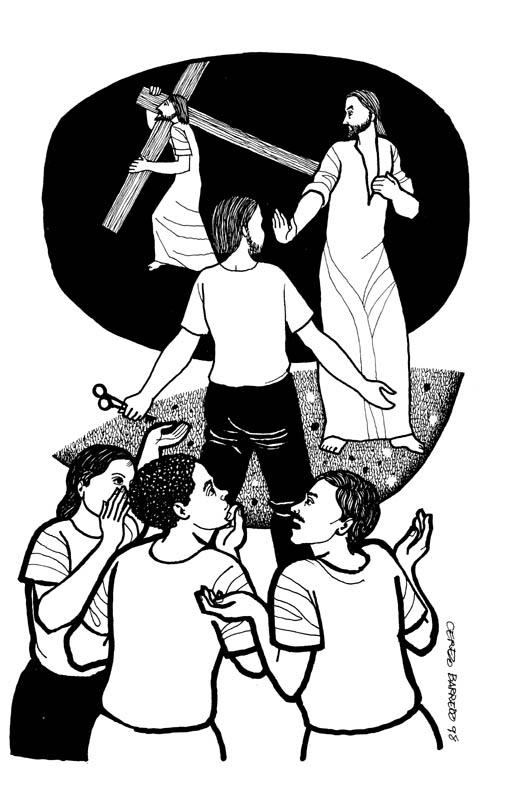
ABOUT THE ILLUSTRATION: I love the pen and ink representation of this passage created by Cerezo Barredo. Notice that Peter holds keys in his hands. Peter, the stand-in for the Church, holds the keys to the kingdom which Jesus entrusts to the Church: the power to declare or withhold the forgiveness of God, to repentant or unrepentant sinners, respectively. This is a great way of conveying the truth that the Church, composed of finite, sinful human beings, is both divine and human. Similarly, individual Christians are saints and sinners.

[This is an unadorned acoustic version of 'The Weight of the World' performed by the song's composer, the late Larry Norman. Throughout his life, Norman wrestled with his demons, but seemed always to come back to Christ. The performance here was originally part of a medley that cuts off the song abruptly. But it's a great song that has been covered by such diverse artists as Lost and Found and Ringo Starr.]

[You can donate to this site. See here for more information.]

Friday, August 29, 2008

Saints and Sinners at the Same Time (A Look at the Gospel Lesson for Sunday, August 31)

[Most weeks, I try to publish at least one post dealing with the appointed Bible lessons for the upcoming Sunday. My hope is that I can at least help the people of the parish I serve as pastor, Saint Matthew Lutheran Church in Logan, Ohio, to prepare for worship. Others may find these explorations helpful because we use the same Bible lessons used by most other North American Christians each Sunday. For information on the Church Year and the plan of lessons called the lectionary, see here.]

The Bible Lessons for This Sunday (The Sixteenth Sunday after Pentecost):
Jeremiah 15:15-21
Psalm 26:1-8
Romans 12:9-21
Matthew 16:21-28

Prayer of the Day:
O God, we thank you for your Son, who chose the path of suffering for the sake of the world. Humble us by his example, point us to the path of obedience, and give us strength to follow your commands, through Jesus Christ, our Savior and Lord.

Comments:
1. This Sunday, I plan to preach on the demanding Gospel lesson from Matthew. I'll only be commenting here on that text.

2. As I've mentioned several times on the blog in the past week (see here and here), last week's Gospel lesson, Matthew 16: 13-20 was the climax and culmination of a section of Matthew's Gospel, starting at Matthew 11:2-6, in which the prime issue was the identity of Jesus. Who is Jesus? Is He the long-promised Messiah? And, an ancillary question the section asks is, can Jesus, Who, as John the Baptist noted, didn't fit the usual profile of Messiah as a military conqueror who would bring economic prosperity, be God's Messiah? These are the questions dealt with in that portion of Matthew's narrative.

Peter, in last week's Gospel lesson, confessed Jesus as Messiah and, saying that such a confession could only have come from God, commends Peter for his confession. (Paul talks about how God goes about creating faith within us here.)

Actually, as you probably know, Peter wasn't the apostle's real name. He was Simon and Jesus gave him the designation of Peter, meaning Rock, as a sort of reminding memorial, telling him and us that it's the confession of Jesus as Messiah that is the foundation stone of Christ's Church. In making his confession, Peter was acting as a stand-in for all of us who confess faith in Jesus Christ. All who confess Jesus as Messiah are Petros, Peter. Appreciating this context is essential for understanding this Sunday's Bible lesson, which falls immediately after the incident in which Jesus gives Simon his new name.

3. At the very end of the Gospel lesson from last week, Matthew says, that Jesus "sternly ordered the disciples not to tell anyone that he was the Messiah."

The beginning of our text gives a hint as to why Jesus was so emphatic on this point. "From that time on," v. 21 says, "Jesus began to show his disciples that he must go to Jerusalem and undergo great suffering at the hands of the elders and chief priests and scribes, and be killed, and on the third day be raised."

As mentioned, the widespread assumption of Jesus' day was that the Messiah would be a military commander, a forceful king who would kill and exact vengeance from the enemies of God's people, a leader who would bring back the days of wealth, power, and ease that Israel experienced under Solomon.

Now, implicitly picking up on prophecies of a Messiah who would be a suffering servant, mentioned in a large section of Isaiah, Jesus said that He was going to suffer and die in Jerusalem, turning conventional expectations on their head.

Peter's reaction shows why Jesus gave the orders he earlier gave. Until we understand that the Messiah hasn't come with promises of giving us ease, power, wealth, or convenience in this world, we will be following Jesus for the wrong reasons.

Until we understand that Jesus hasn't come to exact revenge on our enemies, but calls us to love and be reconciled with them, we will be following Jesus for the wrong reasons.

Since Peter and the disciples (or anybody else) could not have possibly understood this until after the events Jesus says will unfold in Jerusalem, people who try following Him before He goes to His cross will get the wrong ideas about Jesus. (This is exactly the problem with the Palm Sunday crowd, who hailed Jesus as King, not knowing what kind of king Jesus meant to be.)

4. In our Gospel lesson, Peter demonstrates that he doesn't "get it." He's appalled by Jesus saying that He's going to Jerusalem to suffer and die. (It's interesting that Peter seems not to have heard Jesus say that He's also going to rise.)

Whether Peter's reaction comes from love and loyalty for Jesus, from fear that his dreams for his people are threatened by Jesus' prediction, or a combination of both, Peter's reaction is immediate and forceful. In v.22, Peter says, "God forbid it, Lord! This will never happen to you."

Peter thinks that he's being supportive and encouraging to Jesus. He claims to see a different future for Jesus, one born of wishful thinking, it should be said. In this, Peter is guilty of that false optimism which the world often mistakenly takes for the real thing. What passes for optimism in our world often is offered up as a way of being supportive and encouraging to people. But optimism that isn't rooted in reality isn't helpful or truthful and, according to Jesus, is downright evil.

That's why the guy Jesus has just named Peter, the Rock, gets a new nickname from Jesus: Satan!

The name Satan means, variously, accuser and wanderer. Satan, the devil roams the earth like a ravenous lion, Peter says in a letter written decades after this encounter with Jesus, seeking who he will devour. The Bible often portrays Satan or the devil as one who sows confusion, in contrast to the order and peace that belongs to those who follow God.

In using this less-than-complimentary name for Peter, Jesus is accusing Peter of setting his mind on human things--short-term gain--and not divine things, things that last for eternity.

5. Rock Peter, commended for his God-wrought confession of Jesus as Messiah, and Satan, wanting to prevent the Messiah from fulfilling His mission? Can Peter be both?

Yes, all who confess Jesus are both. We live in a lifelong battle to live up to the good name--child of God--Christ gives us at our Baptism. We are "saint and sinner simultaneously," as Luther famously said.

6. Vv. 24-26 show us another reason that Jesus ordered the disciples not to tell anyone he was the Messiah back in v. 20. The cross, which he bore for our sins, will demonstrate to all who pay attention that following Jesus will not be easy. Grace, forgiveness, joy, and eternal life come as free gifts to all who repent and follow Jesus. The cross demonstrates that we have sins and that we are sinners. It was our sin that put the sinless Jesus on His cross. Taking up our cross must mean, in part, wrestling with the reality of our sin.

For example, for the alcoholic and drug addict, it will mean giving up their addiction and throwing themselves in God's hands every day.

For the adulterer, the sex addict, or the person who misuses the gift of sexuality in other ways, it will mean turning away from their behaviors and seeking God's help to live God's way each day.

For the perpetrator of injustice or the greedy or all we other sinners, it too will mean renunciation and surrender.

The old self must die in daily repentance and renewal.

7. I personally believe that vv.27-28 refer to the Transfiguration, which happens in Matthew 17:1-8. There, as Jesus foretold, Peter, James, and John saw Jesus coming in His kingdom.

Tuesday, August 26, 2008

What's with the 'Donate' Button?

There's a new item over on the sidebar that you may have noticed.

No, I haven't decided to become a blogging version of the televangelists.

And I can't promise you that if you click that PayPal "Donate" button, you'll pay off your mortgage, get a new car, or score front row seats for a U2 concert.

But I can promise this:
  • 25% of all donations will support the ministries of my current parish, Saint Matthew Lutheran Church in Logan, Ohio
  • 25% of all donations will support the ministries of my previous parish, Friendship Lutheran Church in Amelia, Ohio
  • 25% of all donations will support the work of the Boys and Girls Clubs of Clermont County, Ohio
There's a lot of content on Better Living. Some of it has been cited in The New York Times, The Chicago Tribune, Slate, and RealClearPolitics.com, among other places.

I've gotten notes from English and Social Studies teachers who have used some of the essays found here to teach composition, history, and critical thinking.

Recovering alcoholics have told me that they've been given inspiration by some of what they've read here.

Agnostics and atheists, as well as adherents of various religions, have communicated with me to say that while they aren't Christians, they appreciate having a reasonable advocate of Christian faith with whom they can have a civil conversation.

Of course, whatever is good about this blog is a gift from God and whatever is bad about it is me getting in the way. But I hope and pray that the good posts outnumber the bad and that all of it, in some way, glorifies the God Whose love and forgiveness are free gifts of grace through Jesus Christ. Even the stuff that isn't religious can glorify God, I hope, if it informs, inspires, elucidates, creates laughter, or engenders civil conversation among us.

If you value Better Living, please consider clicking the button to the right and making a donation. (But not you Friendship or Saint Matthew people. Your tithes and offerings should be made through the congregations themselves. I'm not asking you to give more than your normal tithes or offerings.)

When you donate, you won't just compensate me for slaving long hours over a hot keyboard, you'll also be helping two wonderful congregations and a great youth services organization, all of which are changing lives for the better every single day!

Thanks in advance for your help!


Wrong Reason Religion?

Early this morning, I read a piece by Martin Luther in which he reflected on something Jesus said to a makeshift armada of people who followed Him across the Sea of Galilee after he had miraculously fed at least 5000 with some fish and a few scraps of bread. Jesus told the greedy crowd, "You've come looking for me not because you saw God in my actions but because I fed you, filled your stomachs—and for free" (John 6:26, The Message translation).

Sometimes, Luther says, people followed Jesus for the wrong reasons. Rather than seeing Jesus' ministry as a sign that Jesus was the long-awaited Savior of the world, they saw Jesus as a means to getting what they wanted: a good meal, a chicken in every pot, and a Maserati in every garage. (Or the first-century Judean equivalent of a Maserati, anyway.)

There's nothing wrong with a full belly, of course. Or with peaceful neighborhoods and nations. Or with health. Or a Maserati. Or any other good and happy thing that may bless us physically or psychologically.

But none of these things last forever, which is why Jesus goes on to tell the crowd, "Don't waste your energy striving for perishable food like that. Work for the food that sticks with you, food that nourishes your lasting life, food the Son of Man provides. He and what he does are guaranteed by God the Father to last" (John 6:27). (Jesus often referred to Himself in the third person like this.)

Luther reflects:
Even today, the gospel attracts people who think it will fill their bellies, satisfy their desires, and help them here in this life...

...they come only for personal gain. However, the gospel wasn't sent from heaven in order to allow people to...take whatever they want...and do whatever they please. Christ didn't shed his blood for this purpose.

The gospel proclaims God's glory and teaches us how to praise the Lord. God wants us to praise him. If we make God's honor and kingdom our first priority, then not only will he give us life and everything we need in this world, but he will give us eternal life as well.
When I first read Luther's words, I thought of those televangelists with their ritzy lifestyles and their prosperity "gospels," lying to people by telling them that if they follow Jesus, they'll become wealthy, powerful, and beautiful.

God does provide for all the world's physical needs. There is enough food, sunshine, and water for all the people who populate the planet. But human beings also have the capacity to horde God's gifts and to decimate the earth God has given to us for our common benefit.

God provides for all of our material needs then, but God doesn't promise us success. God doesn't promise that, if we follow Jesus, we'll get whatever we want.

We follow Jesus to have a reconciled relationship with God, to submit to the reclamation project to which all followers of Jesus must surrender, the object of which is to turn us into truly human beings who live as truly human beings were meant to live, in love for God and love for neighbor.

As I thought of those televangelists who seem to follow Jesus for the wrong reasons and who commend their wrong reason religion to others, I felt a decided sense of superiority. "I'm glad I'm not like them," I thought.

But then, some other thoughts crossed my mind.

Did I always follow Jesus for the right reasons?

Didn't I sometimes treat Jesus like a cosmic rabbit's foot, a spiritual afterthought whose name I invoked after I'd already decided what I wanted to do?

And how often, in my preaching, teaching, leading, serving, and writing, have I fed my own ego and my craving for the affirmation of others rather than doing these things simply to help others know and follow Christ? In those circumstances, I followed Jesus for small-time, death-bound trophies, not as Luther puts it, proclaim God's glory or praise the Lord.

Me and the televangelists in the same category?

Yes, it's true. I don't want a private jet. But I do sometimes engage in wrong reason religion.

Thank God for grace that, through Jesus Christ, accepts me as I am.

Thank God too, that God is committed to making me new, even when it entails God wailing away on my ego to point out, "You and that televangelist may not be as different as you suppose, Mark."

Sometimes freedom begins with an, "Ouch!"

Monday, August 25, 2008

The Five "Books" of Matthew?

Last week, in my preview of this past Sunday's Bible lessons and again yesterday during the adult gathering that happens before worship at Saint Matthew Lutheran Church in Logan every Sunday, I mentioned a theory first expounded in the 1930s. I've been asked to write a bit more about that here.

The theory held that the Gospel of Matthew, written for a first century Jewish Christian community, is organized around five major sermons or speeches by Jesus, each forming the core of five "books" that comprise the Gospel. That there are five major discourses by Jesus in Matthew's Gospel is undisputed. But what not all Biblical scholars accept is that these discourses are the centerpieces of the five "books."

While I think that it's silly to argue that writers like Matthew, Luke, and John were confined to just one organizing principle for their narrative, it does seem fairly obvious to me that there are five main speeches by Jesus recorded by Matthew and it seems that they do form the core of narrative sections that each deal with particular issues.

For example, it's held by some that yesterday's Gospel lesson, Matthew 16:13-20, comes at the end of a section that begins at Matthew 11:2-6. In the latter passage, a confused and imprisoned John the Baptist, perhaps expecting the Messiah to be a fire-and-brimstone bringer of vengeance, sends his disciples to Jesus to ask if Jesus really is the Messiah everyone was waiting for or if they should expect someone else. The section ends with Peter confessing what he clearly doesn't fully understand, that Jesus is the Messiah.

Advocates of the five book theory go too far in several ways, I think. First, the first scholar to widely promote the theory, B.W. Bacon, claimed that Matthew, a convert from Judaism, produced his Gospel as a condemnation of the Jews. In fact, Bacon called his book, The Five Books of Matthew Against the Jews. A fair-minded reading of Matthew cannot sustain this view, I feel.

Second, Bacon and others felt that Matthew had written a book designed to supplant the Old Testament covenant and set out to use the words of Jesus to create a new Pentateuch superceding the original. The Pentateuch, the first five books of the Old Testament, referred to as the Torah was regarded as foundational for Old Testament faith. The problem with notions that Jesus sought to supercede Old Testament law is that He claimed to have come not to destroy or abolish the Old Testament law, but to fulfill it. And Matthew quotes Jesus in saying just that.

Authorship of the Pentateuch was traditionally attributed to Moses. Bacon et al also have claimed that Matthew attemtped to portray Jesus as, in some sense, the new Moses, God-enfleshed Who brought a new covenant to the world. But that doesn't seem to square with a fair-minded reading of Matthew either. Matthew portrays Jesus as not wanting to throw out the law at all.

But I do see something in the notion that there are five major sections built around Jesus' sayings in Matthew.

The five discourses around which the supposed books were built are:
  • The Sermon on the Mount (chs. 5-7)
  • Missionary Discourse (ch. 10)
  • Parables (ch. 13)
  • Community Instructions (ch. 18)
  • The Future and Judgment (ch.23-25)
These are sandwiched between accounts of Jesus' genealogy, birth, and infancy at the beginning of the Gospel and narratives of Jesus' crucifixion and resurrection at the end, interspersed with narrative in between discourses.

I don't believe that Matthew used the five-book structure as a polemic against the Old Testament, but as a way of sending a message to his fellow Jesus. "Jesus," Matthew was telling them, "is the Messiah we've been looking for all these centuries."