Saturday, December 25, 2010

The Real King


[This was shared during worship with the people of Saint Matthew Lutheran Church in Logan, Ohio, on Christmas Eve.]

Luke 2:1-20
 On this holy night, I want to ask you to do something really revolutionary. In the racks in front of you, there’s a power plant with more energy in it—and certainly more truth and more life--than can be found in the whole physical universe combined. It’s called the Bible. I ask you to grab a Bible and turn to page 588. Go to Luke, chapter 2, verses 1 to 20. The translators who produced this edition of the Bible have titled the first seven of these verses, “Christ Born of Mary” and verses 8 through 20, “Glory to God in the Highest.” That little block of print is Luke’s entire God-inspired account of the first Christmas.

Isn’t that stunning? In those twenty verses, Luke tells the whole story of Christmas! I think that’s especially striking when you think of all the embellishments we’ve added to the true Christmas story. There are no drummer boys. No midwives. No oxen. No donkeys. And no grandmas run over by a reindeer.

There are a lot of details we might like included that Luke has left out. That could frustrate us. Instead of being frustrated, though, I want to suggest that, as we gather to celebrate the birth of God among us, we look at what the Luke does tell us about the first Christmas. Look again at what Luke writes:
And it came to pass in those days that a decree went out from Caesar Augustus that all the world should be registered. This census first took place while Quirinius was governing Syria. So all went to be registered, everyone to his own city. Joseph also went up from Galilee, out of the city of Nazareth, into Judea, to the city of David, which is called Bethlehem, because he was of the house and lineage of David, to be registered with Mary, his betrothed wife,[a who was with child. So it was, that while they were there, the days were completed for her to be delivered. And she brought forth her firstborn Son, and wrapped Him in swaddling cloths, and laid Him in a manger, because there was no room for them in the inn.
Caesar Augustus was the adopted son of Julius Caesar. He had fought a long civil war to take control of Rome and turned it from a republic, in which at least some of its residents voted, to an empire in which he was the undisputed despot. Like many dictators, Augustus strengthened his rule with propaganda that touted his greatness. He declared his adopted father a god, which, of course, made Augustus, in his telling, the son of a god. He also claimed to have brought eternal peace to the earth. He commissioned elaborate tales about his birth, including signs and wonders pointing to his greatness.

When this undisputed ruler of an enormous empire ordered a census, his kingdom hopped-to. In Judea, the land into which Jesus was to be born, thousands of people were forced to return to their ancestral homes in order to be counted.

All this movement of people at the command of one man might very well make you think that that one man, Augustus, was extremely important and powerful. But what Luke wants you to see in the story of the first Christmas is a clash of kingdoms. There is the visible kingdom of Augustus with his armies, his navies, his power to tax, his power to push people around like so many pieces on a Checker board. Power like that today is wielded, you and I can see, not just by governments, but by media conglomerates, corporations, cartels, the inheritors of wealth, superstar celebrities, and others.

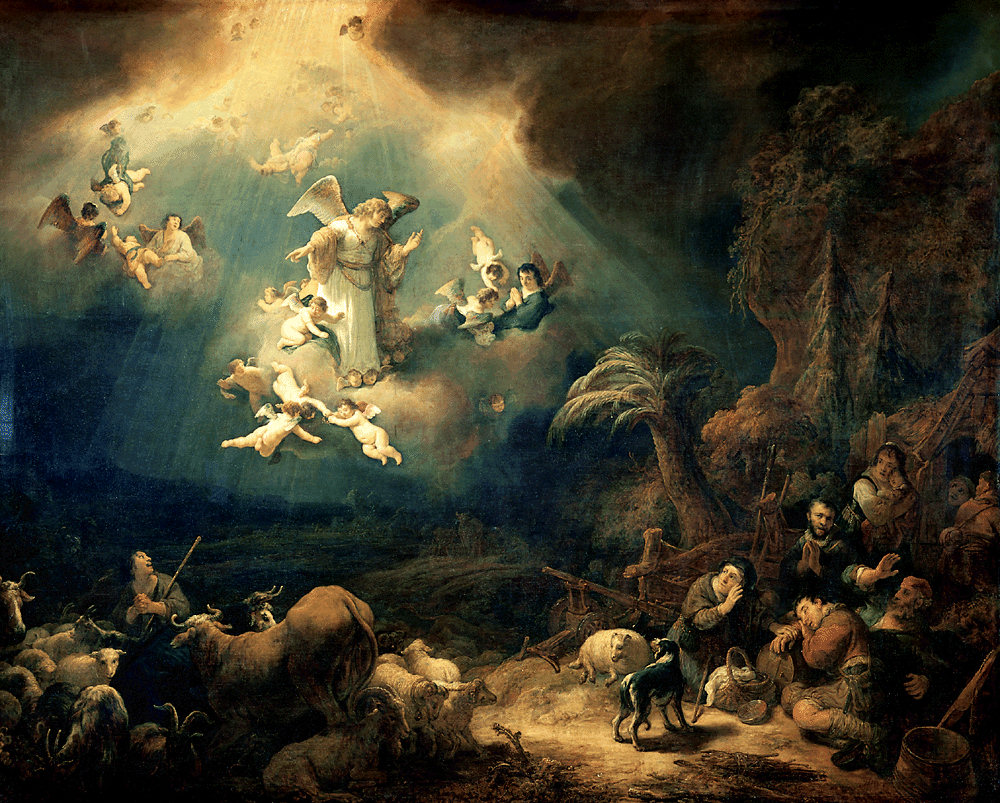
But Luke wants us to understand that there is another, more powerful, kingdom at play in our world. It’s the invisible kingdom of God. Unlike the birth mythologies associated with the Roman emperor Augustus, when the kingdom of God entered our world, it was known only by a simple virgin girl, her carpenter husband, angels sent from heaven, and a few shepherds. Everybody else missed out!

Through Luke’s simple narrative, God wants you to see that while God is the indisputable Creator and King of the universe, He doesn’t use the usual tools of the powerful to leverage your allegiance to Him, your belief in Him. God doesn’t push you into welcoming Him into your life.

Instead, God gently woos those who are willing to lay down their trust in the visible things of this world, even in things like their own abilities, and instead, embrace faith in the one and only way to peace, joy, and life with God: Jesus Christ! The Christmas hymn has it exactly right when it says, “How silently, how silently, the wondrous gift is giv’n.” 

And the almost laugh-at-loud funny part of all this is that while Augustus ordered the census that put Mary and Joseph in Bethlehem in time for Jesus’ birth, it was God so silently, so silently, orchestrating events to cause Augustus to give those orders. It had to be that the Son of God would also be an earthly descendant of David, born in David’s home city of Bethlehem. It’s like I always tell my Catechism students, “Either God gets His way or God gets His way.”

There is something to be learned from this by all of us tonight. If you look only at the visible things of this life—the kingdoms of this world—things like salaries and pensions, guns, tanks, and armies, hobbies and friendships, good health and success—to give you the peace announced to the shepherds by the angels, you will miss God and His kingdom. You’ll miss Jesus. Many of the thing visible things we see each day have their places. God made many of them and, as the old saying reminded us, God doesn’t make junk. (And that includes you!) But none of the things you and I can see, not even the beautiful things we may see in this sanctuary tonight, can bring us the life, peace, and hope that only Jesus brings to those who dare to pay heed to Him, who dare to follow Him!

Luke tells us that on the night of Jesus’ birth, the only people willing to trust in Christ were some shepherds and two young people from a tiny town called Nazareth. To them, God’s kingdom and God’s Son were real. It’s to people like them—people willing to see and welcome Jesus—that faith still comes.

In his book, Finding God in Unexpected Places, journalist Philip Yancey, tells the true story of an incident that happened at the inner-city Chicago church to which he, his wife, and several other well-off suburban professionals belonged. The church’s pastor had left, attendance was down, and a community outreach program was in jeopardy. The lay leaders suggested an all-night prayer vigil.

There were questions, though. Would an all-night prayer vigil in one of Chicago’s roughest neighborhoods be safe? Would they have to hire armed escorts? And what would happen if nobody turned out? There were questions about just how practical a prayer vigil was in the face of a multiple real-life crises.

But the night of prayer was scheduled anyway. Yancey says that it was the poorest members of the congregation, senior citizens who lived in a housing project, who were most enthusiastic about the prayer vigil. “I could not help wondering,” Yancey writes, “how many of their prayers had gone unanswered over the years—they lived in the projects, after all, amid crime, poverty, and suffering—yet still they showed a childlike trust” in what God would do through their praying.

Along with other congregational leaders, Yancey asked these people how long they wanted to stay for the vigil, an hour or two, maybe? “Oh, we’ll stay all night,” they said. “One black woman in her nineties, who walk[ed] with a cane and [could] barely see,” Yancey says, “explained to a staff member why she wanted to spend the night sitting on the hard pews of a church in an unsafe neighborhood. ‘You see [she told them], there’s lots of things we can’t do in this church. We ain’t so educated, and we ain’t got as much energy as some of you younger folks. But we can pray. We got time, and we got faith. Some of us don’t sleep much anyway. We can pray all night if needs be.”

“And so they did,” Yancey concludes. “Meanwhile a bunch of [well-off professional people] learned anew a lesson of faith from the Gospels: Faith appears where least expected and falters where it should be thriving.”

As we celebrate the birth of Jesus this year, I pray that you are ready to see Jesus and His kingdom in a world that fools itself into believing in only what it can see, control, or manipulate. May your faith be strong! May you look at Christmas without the embellishments the world tries to add to it, instead simply seeing Jesus, the true Son of God and King of kings, and through Him, be filled with His peace.

Merry Christmas, everybody! God bless you!

Friday, December 24, 2010

Jesus is Peace, Not a Teacher of Peace

As regular readers of this blog know, I read Our Daily Bread as part of my daily devotion time. Most days, really great things appear there and I often share its insights here.

But I have to take major exception to today's piece written by Pastor Joe Stowell. He refers to the "peace on earth" proclaimed by the shepherds on the night of Jesus' birth (Luke 2:8-14) and concludes that, in His teaching, Jesus gave us the tools to make peace.

This, it seems to me, misses a big part of the New Testament's message. Ephesians 2:14 says of Jesus, "He is our peace." Jesus is the peace proclaimed by the angels that night. Nothing we add to the presence of Jesus in our lives will bring peace. Jesus is all we need for peace--with ourselves, with others, and most importantly, with the God Who made us.

All who, in the power of the Holy Spirit, dare to repent of sin and believe in Jesus are filled with God's peace. They are reconciled to God and to others and are called from that time forward to do the admittedly hard work of living in that peace.

Peace comes as a gift from God to all who believe in Jesus. Earlier in Ephesians, we're told, "For by grace you have been saved through faith, and this is not your own doing; it is the gift of God--not the result of works, so that no one may boast. For we are what He has made us, created in Christ Jesus for good works, which God prepared beforehand to be our way of life (Ephesians 2:9-10).

Peace on earth has come to us in Jesus. We don't manufacture it with the tools Jesus gives, as though Jesus were just another teacher of religion, guru of morality, or a pop psychologist or motivational speaker selling the latest metaphysical wares.

Jesus is the Savior, the King of all kings, and God in the flesh. He brings peace. The call of believers in Jesus is simply to walk in the peace God has already created to be our way of life!

May our walk with Jesus be filled with His peace, irrespective of the conflicts which may roil this world, and may God use us to bring the peace that comes from believing in and belonging to Jesus to all we meet!

Thursday, December 23, 2010

Did God Promise a Savior in Genesis 3:15?

Readers of today's Our Daily Bread devotional piece may have been confused by a Scriptural reference it included. Writer C.P. Hia claimed that Genesis 3:15, contains God's promise to Adam and Eve that He would send a Savior. In Genesis 3:15, God tells the serpent after he had tempted the pair into their disobedience of God:
I will put My enmity between you and the woman, and between your offspring and hers; he will strike your head, and you will strike his heel.
What, some folks might have wondered, was Hia talking about? Where is the promise of a Savior?

It turns out that Hia is not alone in his understanding of this passage. It has been a traditional teaching among Christians of all theological stripes for centuries.

The eminent nineteenth century preacher, C.H. Spurgeon has been among many evangelical Christians to find this promise in Genesis 3:15. On November 26, 1876, in a sermon titled, Christ, the Conqueror of Satan, based on this single verse, Spurgeon explains:
These words were not directly spoken to Adam and Eve, but they were directed distinctly to the serpent himself, and that by way of punishment to him for what he had done. It was a day of cruel triumph to him such joy as his dark mind is capable of had filled him, for had he indulged his malice, and gratified his spite. He had in the worst sense destroyed a part of God's works, he had introduce sin into the new world, he had stamped the human race with his own image, and gained new forces to promote rebellion and to multiply transgression, and therefore he felt that sort of gladness which a fiend can know who bears a hell within him. 

But now God comes in, takes up the quarrel personally, and causes him to be disgraced on the very battle-field upon which he had gained a temporary success. He tells the dragon that he will undertake to deal with him; this quarrel shall not be between the serpent and man, but between God and the serpent. God saith, in solemn words, "I will put enmity between thee and the woman, between thy seed and her seed," and he promised that there shall rise in fulness of time a champion, who, though he suffer, shall smite in a vital part the power of evil, and bruise the serpent's head. 

This was the more, it seems to me, a comfortable message of mercy to Adam and Eve, because they would feel sure that the tempter would be punished, and as that punishment would involve blessing for them, the vengeance due to the serpent would be the guarantee of mercy to themselves. Perhaps, however, by thus obliquely giving the promise, the Lord meant to say, "Not for your sakes do I this, O fallen man and woman, nor for the sake of your descendants; but for my own name and honour's sake, that it be not profaned and blasphemed amongst the fallen spirits. I undertake to repair the mischief which has been caused by the tempter, that my name and my glory may not be diminished among the immortal spirits who look down upon the scene." 

All this would be very humbling but yet consolatory to our parents if they thought of it, seeing that mercy given for God's sake is always to our troubled apprehension more sure than any favour which could be promised to us for our own sake. The divine sovereignty and glory afford us a stronger foundation of hope than merit, even if merit can be supposed to exist...

Nor, brethren, must you think it a slender revelation, for, if you attentively consider, it is wonderfully full of meaning. If it had been on my heart to handle it doctrinally this morning, I think I could have shown you that it contains all the gospel. There lie within it, as an oak lies within an acorn, all the great truths which make up the gospel of Christ. 

Observe that here is the grand mystery of incarnation. Christ is that seed of the woman who is here spoken of; and there is a hint not darkly given as to how that Incarnation would be effected. Jesus was not shadowed of the Holy Ghost, and "the holy thing" which was born of her was as to his humanity the seed of the woman only; as it is written, "Behold a virgin shall conceive and bear a son, and they shall call his name Immanuel." 

The promise plainly teaches that the deliverer would be born of a woman, and carefully viewed, it also foreshadows the divine method of the Redeemer's conception and birth. So also is the doctrine of the two seeds plainly taught here—"I will put enmity between thee and the woman, between thy seed and her seed." There was evidently to be in the world a seed of the woman on God's side against the serpent, and a seed of the serpent that should always be upon the evil side even as it is unto this day...We see an Abel and a Cain, an Isaac and an Ishmael, a Jacob and an Esau; those that are born after the flesh, being the children of their father the devil, for his works they do, but those that are born again—being born after the Spirit, after the power of the life of Christ, are thus in Christ Jesus the seed of the woman, and contend earnestly against the dragon and his seed. 

Here, too, the great fact of the sufferings of Christ is clearly foretold—"Thou shalt bruise his heel." Within the compass of those words we find the whole story of our Lord's sorrows from Bethlehem to Calvary. 

"It shall bruise thy head": there is the breaking of Satan's regal power, there is the clearing away of sin, there is the destruction of death by resurrection, there is the leading of captivity captive in the ascension, there is the victory of truth in the world through the descent of the Spirit, and there is the latter-day glory in which Satan shall be bound, and there is, lastly, the casting of the evil one and all his followers into the lake of fire. 

The conflict and the conquest are both in the compass of these few fruitful words. They may not have been fully understood by those who first heard them, but to us they are now full of light. The text at first looks like a flint, hard and cold; but sparks fly from it plentifully, for hidden fires of infinite love and grace lie concealed within. Over this promise of a gracious God we ought to rejoice exceedingly.
     
We do not know what our first parents understood by it, but we may be certain that they gathered a great amount of comfort from it They must have understood that they were not then and there to be destroyed, because the Lord had spoken of a "seed." They would argue that it must be needful that Eve should live if there should be a seed from her. They understood, too, that if that seed was to overcome the serpent and bruise his head, it must auger good to themselves: they could not fail to see that there was some great, some mysterious benefit to be conferred upon them by the victory which their seed would achieve over the instigator of their ruin. They went on in faith upon this, and were comforted in travail and in toil, and I doubt not both Adam and his wife in the faith thereof entered into everlasting rest.
Spurgeon, as I say, isn't alone in seeing the promise of a Savior in Genesis 3:15. The Orthodox Study Bible, produced by Biblical scholars from the Greek Orthodox Church, contains this note about the passage:
The woman's seed is first Christ, and second His Church (Gal 3:16, 26). The serpent's seed are those who reject Christ and follow the devil (1 Jn 3:8-10). Christ destroyed the devil through the cross (bruise your head). [Be sure to read the linked passages here.]
That last paragraph cited from Spurgeon's sermon, I think, is something that even post-modern believers in the Bible can agree on, whether they see the promise of a Savior in these words of God or not. God is, and always has been, a comforter to sinners like you and me. God has always offered what I call "in spite of" love and provision. God would not force a relationship with Him on Adam and Eve, but He would make it available in spite of their rebellion. In Christ, God offers this same blessing to the whole human race. We simply need to repent and believe in Christ. (Though, given our inborn sin, that isn't nearly as simple to live as it is to say!)

By the way, the cited paragraphs above are just a fraction of Spurgeon's sermon. People expected long sermons in the nineteenth century and, in Spurgeon's case, liked them that way. 

If you want to read his entire sermon on Genesis 3:15, go here. The transcribers of the sermon have made something of a mess of Spurgeon's grammar and spelling, but, as one of our contemporary eminent Lutheran preachers, Ed Markquart noted in his book, Quest for Better Preaching, reading Spurgeon is always worthwhile. 

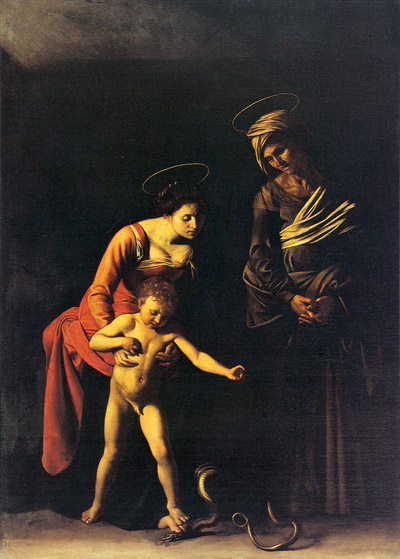
[This is a painting by Michelangelo Merisi da Caravaggio. It shows Christ crushing a serpent beneath his heel, as His mother, Mary, sits behind him. The woman on the right portrays Anna, the name in Christian legend given to Mary's mother, about whom there is no Biblical or other evidence at all.]

Sad Day for Ohio State Football

Finishing lunch, during which I watched the press conference with Ohio State athletic director Gene Smith and head football coach Jim Tressel. Five Ohio State players have been suspended from playing the first five games of next season by the NCAA. Smith indicated that Ohio State will appeal the penalties. (Another player has been suspended for one game of the 2011 season.)

As an Ohio State alum and fan, I hope that Smith will reconsider that move. The rules are clear: Players are not to exchange goods of any kind, including awards for athletic achievement, team garb, or signed memorabilia, for goods, services, or money. They're to be amateur athletes until, if they're good enough, the NFL drafts them or they're signed to play professional football elsewhere.

The suspensions meted out by the NCAA are light penalties, considering that such egregious violations could be seen as warranting revocations of the players' athletic scholarships.

One of the notions I've nurtured is that, with his emphasis on character development in his players, Jim Tressel is unique among big-time college coaches. I still think that's true, although like the rest of we members of the human race, he isn't perfect. And he certainly can't be expected to know what happens every moment of every day in the lives of his players.

But an appeal of the charitable penalties meted out by the NCAA runs counter to the tone I think Tressel has always worked to foster in the Buckeye football program.

I hope that Ohio State will refuse to compound the sadness of this day by appealing. I would expect such a move by USC, Auburn, and other schools, but not by Ohio State.

Having said all of that, I hope that these players will learn a lesson and be stronger, better people for the experience. (That's my daily project as I cope with the realities of my own sins and deficiencies. God help us all! And I mean that literally.)

Tuesday, December 21, 2010

Two Digital Age Re-Tellings of the Christmas Story

Fun!

A Social Network Christmas (Thanks to Barb)


The Digital Story of the Nativity (Thanks to Lori)

"Christmas...hints at the struggle involved when the Lord of both worlds descends to live by the rules of the one."

"What Jesus went on to accomplish on planet Earth made it possible for God someday to resolve all disharmonies in both worlds." Read the whole thing.

Monday, December 20, 2010

The "Shiver of Fear" That Should Come With the Glad Tidings

“We have become so accustomed to the idea of divine love and of God’s coming at Christmas that we no longer feel the shiver of fear that God’s coming should arouse in us. We are indifferent to the message, taking only the pleasant and agreeable out of it and forgetting the serious aspect, that the God of the world draws near to the people of our little earth and lays claim to us. The coming of God is truly not only glad tidings, but first of all frightening news for everyone who has a conscience.” (Dietrich Bonhoeffer, Lutheran Christian pastor martyred for his opposition to the Third Reich in Germany)

Wednesday, December 15, 2010

A Tough, But Liberating Word

Today's installment of Our Daily Bread is based on James 4:1-10:
Those conflicts and disputes among you, where do they come from? Do they not come from your cravings that are at war within you? You want something and do not have it; so you commit murder. And you covet something and cannot obtain it; so you engage in disputes and conflicts. You do not have, because you do not ask. You ask and do not receive, because you ask wrongly, in order to spend what you get on your pleasures. Adulterers! Do you not know that friendship with the world is enmity with God? Therefore whoever wishes to be a friend of the world becomes an enemy of God. Or do you suppose that it is for nothing that the scripture says,
 “God yearns jealously for the spirit that he has made to dwell in us”?
But he gives all the more grace; therefore it says, “God opposes the proud, but gives grace to the humble.” Submit yourselves therefore to God. Resist the devil, and he will flee from you. Draw near to God, and he will draw near to you. Cleanse your hands, you sinners, and purify your hearts, you double-minded. Lament and mourn and weep. Let your laughter be turned into mourning and your joy into dejection. Humble yourselves before the Lord, and he will exalt you.   
"Adulterers," I take to be addressed not only to those engaged in adultery, but in all activities that put the world, the self, and other pursuits or relationships ahead of God. Through the prophets in Old Testament times, God described Himself as husband to Israel, condemning His people's penchant for playing the adulteress by worshiping other gods.

The New Testament describes the Church as the bride of Christ. So, any time we Christians allow other things to take God's place of absolute ruler over our lives, we are engaging in idolatry--idol worship, or as the Old Testament puts it, adultery.

The passage from James ends with a tremendous promise: "Humble yourselves before the Lord, and he will exalt you." This is nothing other than a call to wake up and acknowledge reality:
  • God is bigger than you are. 
  • Only God can give you life. 
  • And unlike all the other things you might submit to in life, God will help you and love you even when you fall or fail. 
In Philippians 2:5-11, the apostle Paul gets at much the same message when he cites what most scholars agree must have been a hymn of the early church that reminds us that in calling us to submit to the will of God the Father, we're not being asked to do anything more than Christ did.

God "opposes the proud," not because God is an egotist, but because God wants us to live. As I mentioned in another post recently, if the only way for a drowning man to get to shore is to hold onto the lifeguard, you would hardly call the lifeguard arrogant for saying so to the thrashing victim. The God we know in Jesus Christ is that lifeguard. Take it from one willful thrasher to another: Submit to the Lifeguard and you will have real life!

Read the Our Daily Bread piece by Anne Cetas.

Tuesday, December 14, 2010

The Differences and Similarities Between the US of the Great Depression and the US of the Great Recession

In 1936-37, Americans were in more dire straits financially and for a longer period than Americans of 2008 to present, but they were also more optimistic about the future and, generally, supportive of more federal government intervention in the economy, not less. Both the similarities and differences in Americans' views of government and the economy, as shown in this article from the Pew Research Center, are interesting.

Monday, December 13, 2010

The Perfect Old Testament Book to Read in Advent

My son, Philip, on his blog, is doing a series of devotional comments on the Old Testament book of Isaiah for this Advent season. Here are links to the first three installments:
Reading Isaiah in Advent: An Introduction
Isaiah 1-3
Isaiah 4-6

Three Simple Equations

No time spent with Jesus=A no-impact life
Some time spent with Jesus=A moderate-impact life
Much time spent with Jesus=Greater impact life

What impact do we want our lives to have on others and on eternity?

See here.

See also here.

Sunday, December 12, 2010

When God Doesn't Meet Our Expectations

[This was shared during worship with the people of Saint Matthew Lutheran Church in Logan, Ohio, this morning.]

Matthew 11:2-11
If this morning’s Gospel lesson has given you a bad case of spiritual whiplash, it’s understandable.

Last week, on the Second Sunday of Advent, we heard John the Baptist’s confident proclamation of the impending appearance of God’s promised Anointed King—what the Hebrew of the Old Testament calls the Messiah and the Greek of the New Testament calls the Christ. In the coming Christ, John told the crowds who heard him preach in the wilderness, God was getting ready to re-establish His reign over a sinful, rebellious world.

When Jesus later showed up to be baptized by John, in a passage not a part of last Sunday’s lesson, John must have felt that all his preaching had been vindicated. Jesus was the Messiah for whom he had been waiting!

When we fast forward to the Gospel lesson for this Third Sunday of Advent, we come to a very different scene.

Now, if John was like most of the Jews of his day, his expectations would have been that the Messiah, the King of kings, was going to push the bloodthirsty, corrupt Judean kings—the Herodian line—off of their thrones, would save the people from their foreign overlords, the Romans, and would take away the power and prominence the vain and faithless rulers of Judea’s religious life—the priests and teachers of the law. John probably expected a clean sweep of what we would call church and state. And the Messiah, he undoubtedly thought, would make everything in society right.

Instead, since John's encounter with Jesus at the Jordan River, Jesus had undertaken a ministry of preaching, teaching, healing, and miracle working. Great stuff, but not exactly what John had expected! Herod, the Romans, the Sadducees, and the Pharisees were still in charge and, as we meet up with John the Baptist today, he’s in prison, wrestling with disappointment and doubt. With a probable death sentence hanging over him and with the reign of God—the kingdom of God—seeming no nearer than it had been when he first began his ministry, John sent some of his disciples to ask Jesus, “Are you the One Who is to come, or are we to wait for another?”

John wanted to hope in Jesus, but this King in Whom he had reposed so much hope didn’t seem to be meeting John’s expectations. John wondered, “Is Jesus the Savior?”

Have you ever been there?

Have the promises of Jesus to hear and answer your prayers sometimes mocked your faith?

Have your life circumstances cast your faith in a sovereign, loving God in doubt?

Have questions pressed on you as you’ve watched loved ones suffer or die, or you’ve struggled with health issues, financial issues, or when your sense of purpose in life has disappeared?

Have you played by God’s rules and watched people who ignore them seem to skate through life as you face troubles and difficulties?

The truth, if we’re honest I think, is that we have all been there in the prison of doubt and uncertainty John experienced in that prison cell.

And so, John did what millions of people have done through the centuries when wrestling with their questions and doubts. He turned to Jesus. He asked Jesus, in effect, “Are You the One in Whom I can place the full measure of my trust and hope? Or do I need to look elsewhere for hope?” (People do that, you know. God disappoints them or turns out to be different from what they expect and they turn from God, never to return. They turn to false gospels that promise them wealth or health or a free pass to perpetrate their favorite sins with the full favor of God.)

Jesus’ response to John’s question in today’s Gospel lesson is not just for John the Baptist, it’s for all of us who have ever doubted, who have wrestled to understand God’s plans in the midst of unbearable pain or indecipherable situations.

Please pull out the Celebrate insert and look at Matthew 11, verses 4 to 6, to see what Jesus said:
Go and tell John what you hear and see: the blind receive their sight, the lame walk, the lepers are cleansed, the deaf hear, the dead are raised, and the poor have good news brought to them. And blessed is anyone who takes no offense at me. 
Jesus didn’t deny that He was the King Who would bring judgment on the unbelieving world. And He would confirm His role as judge of the world many times. In answer to John’s question though, Jesus simply pointed John to all the signs that showed Him to be not just the Messiah, but the Lord of all creation, Who can speak a word and create life where there was death, wholeness where there was brokenness.

To John’s doubt and disappointment, Jesus says, “Consider the evidence. I’m doing the things that God told the prophets He would do when His kingdom came into this fallen world.”

There’s another message in Jesus’ words, though. It’s this: Change your expectations of the Messiah. Change your expectations of God.

I’m not for a moment suggesting that there is any limit to God’s power or to God’s willingness to hear prayers offered in Jesus’ Name. In Jesus, we meet the sovereign, almighty God of the universe Who made us, Who can violate the natural laws He Himself created by performing miracles (and does), Who is committed to bringing injustice to an end, Who will allow those who refuse to trust in Him to go their own ways for eternity, and Who, by His cross and resurrection, has destroyed the power of sin and death for all eternity for those who believe in Christ!

Everything that Jesus did, including His sinless life, His sacrificial death, and His rising from the dead, show us Who Jesus is and the good plans God has for those who repent and believe in Jesus.

But Jesus’ kingdom hasn’t come in its fullness yet.

Right now, you and l live in a world in which bad things happen to faithful people. It can cause us to question, just as it did John the Baptist.

The week before she died, Karen, a member of our former parish and a friend of Ann’s and mine, wrestling with her suffering, holding onto Jesus in the midst of it all, confided to me, “I keep wondering what it is God wants me to learn from all of this.” Though deeply faithful—I would say because she was so faithful, because she so believed in Jesus—Karen wondered, as John the Baptist had wondered, when Jesus was going to act decisively. When would God finally act to bring about the promise given by God through the prophet Isaiah and repeated in the New Testament book of Revelation: “He will wipe away every tear from their eyes. Death will be no more; mourning and crying and pain will be no more…”?

That promise will come to pass. The God Who has never broken a promise will make it happen. The God Who was born in a stable, lived among us, died for us, and rose to give us life can be counted on to make things right.

Until then, He gives us, He gives the Church, and He gives the world this current life in which, as Jesus says, God “makes his sun rise on the evil and on the good, and sends rain on the righteous and on the unrighteous.”

This life, with all its troubles, is God’s gift to us. But we know that God gives new life. So, why doesn’t God set things perfectly, totally, completely right for us now? Please turn to page 707 in the Bibles that are in the pew racks. There, you’ll find Second Peter, chapter 3, verse 9. Read that verse aloud with me, if you would,
The Lord is not slack concerning His promise, as some count slackness, but is longsuffering toward us, not willing that any should perish but that all should come to repentance. 
Every day we live in this world is an opportunity to do exactly what Jesus invited John to do: To look to Jesus; to see what He has done and understand the compassionate, powerful God Who has done incredible things for His people…Who is still doing them.

If we’re inclined to see Jesus as a hedge against the nasty realities of life, a cosmic Santa Claus who makes life just go away, we need to change our expectations. As was true for Jesus, before our resurrections, there will be challenges to face, hurdles to overcome, crosses to bear.

But God doesn’t let us have pain, hardship, or uncertainty because God is slow in acting or because God lacks the power to act. God is giving us the gift of time:
  • Time for us to repent and surrender to Him; 
  • Time for us to share the good news of the baby born in a manger who went to a cross and rose from the dead for all sinners; 
  • Time for us to serve others in Jesus’ Name; 
  • Time for us to grow as believers who are fit for eternity with God
Today, Jesus invites you and me to seize the days we have, one by one, and to live this life fully: to turn from sin, to live for Jesus, and, just like Jesus, to spread His love by what we do and who we are. And when, like John the Baptist, we wrestle with our questions, Jesus calls us to focus our hopes on Him, and not anyone or anything else.

Ann’s and my friend, Karen, who I mentioned earlier and of whom I’ve spoken before, left a note for me to read after her death. (She had written notes for many people to read after she died.) She said, in part, “Please help everyone to know that just because I have died doesn’t mean that their prayers did not ‘work.’ Healing is so much more than having a whole and perfect body…I’ll be seeing you again—then we can forget all of this sadness…”

While we await the return of the Messiah Who came to our world on the first Christmas, we can live in this uncertain and sometimes sad world with the absolute certainty that Jesus will make all His promises good for all who trust in Him. When we let that certainty fill us, we can face everything with joy and peace, the very blessings of which the angels sang on the night of Jesus’ birth.

May we join their song every day we live and on into eternity with God! Amen
*************************************************************************************
Here's a video featuring the incomparable Carolyn Arends, singing her song, 'Seize the Day.' Arends' music was important to Karen, the woman mentioned in the sermon. We played Arends' song, 'All is Well,' during Karen's funeral in 1999.

Saturday, December 11, 2010

Just This One Time in My Life

I'll say something I never thought I would say: Go, Blue! A great story from the school up north and the courageous journey of a young man from Wauseon, Ohio, just a few miles from where my family and I lived for six years. You will not regret watching this feature from the Big Ten Network.


You may also want to read this. (Go, Buckeyes, too!)

By the way, did you notice the passage of Scripture on the back of one of Brock's t-shirts?

Friday, December 10, 2010

"God is Love"

"God is love." God revealed this central truth about Himself in both Old and New Testament times. It's why 1 John 4:8 says, "Whoever does not love does not know God, for God is love."

So, would a loving God ever describe His human children with names like wicked, fools, or stupid?

As Dave Branon points out in this piece, the loving God of the universe Who ultimately disclosed Himself in the crucified and risen Jesus, has used these names for some people.

I hope that you'll read Branon's piece, especially if your notions about what the Bible means in saying that "God is love," has created a false image of God as an indulgent grandparent who doesn't care how we defile ourselves, hurt others, or dishonor Him.

Take it from someone who has done lots of wicked, stupid, and foolish things, for which God still calls me out each day, if God didn't love you, He wouldn't call you out for sins or willful ignorance of His will.

It's when God calls us out and we dare to hear what His Word tells us about His will for human beings, that we can exercise the gift of repentance and experience a fuller relationship with Christ.

Two other passages of Scripture come to mind as I think about the tough and tender love of God that loves you just as you are, but loves you too much to leave you there.

One comes from King David, the adulterer and murderer who the Bible describes as a "man after God's own heart." David knew all about having his deeds exposed for being wicked, foolish, and stupid. Remember that David had an affair with another man's wife and then arranged to have that man murdered. For two years, David went on merrily with his life before being confronted for his sins by the prophet Nathan. David repented. Psalm 51 is his song of repentance. But, here's something he wrote for the benefit of his fellow sinners who may be less than inclined to accept God's judgment of them for wickedness, foolishness, or stupidity:
Do not be like a horse or mule, without understanding, whose temper must be curbed with bit and bridle, else it will not stay near you.
And then there are these words, from the same New Testament book which reminds us that, "God is love." (Some of what's said in 1 John 1:8-10, will be familiar to most Lutherans, who hear words drawn from this section of Scripture regularly in our liturgy):
If we say we have no sin, we deceive ourselves and the truth is not in us. If we confess our sins, he who is faithful and just will forgive us our sins and cleanse us from all unrighteousness. If we say we have not sinned, we make him a liar, and his word is not in us.
God's enduring will for the human race is laid out clearly for us in what scholars call the Mosaic Law, the Ten Commandments, here. Unlike Old Testament ritual and civil laws, the Ten Commandments are valid for all time.

They're well interpreted for us in 1 Timothy 1:8-10.

It's wicked, foolish, and stupid for us to willfully flout the law of God because doing so separates us from Him and His desire to be with us forever.

But when we confess our sins--when we acknowledge that God is right in calling us out for our sin--and seek and accept the forgiveness God freely offers in Jesus Christ, God not only forgives us, God also gives us the power of the Holy Spirit to resist our inborn inclinations to sin.

God is love!

Wednesday, December 08, 2010

That's Why Luther Said Christians Are Saints and Sinners at the Same Time

"In every saint there is something reprehensible." (John Calvin)

Thank God that sinners are saved not by what they do, because we could never do enough to merit forgiveness or new life from God. We're saved only by what God has done for us in Christ and our God-created trust in Christ.

Iranian Pastor Sentenced to Death

The charge, apostasy, is not even a crime under the Iranian penal code. Pray that he will be set free.

For more information, go to the story of Pastor Nadarkhani on the site of the International Campaign for Human Rights in Iran.

Go here to contact the Iranian delegation to the United Nations in order to ask the Iranian government to encourage confidence in Iranian justice by releasing a man sentenced to death for something that isn't even illegal in Iran.