[This was shared during worship with the people of Saint Matthew Lutheran Church in Logan, Ohio, earlier today.]
Matthew 13:31-33, 44-52
There was a Coast Guard station in the community on Lake Michigan where I did my seminary internship. One day, the commander of the station stopped by the church office and we chatted. He was excited because in a matter of weeks, he would be retiring. “Are you staying here or moving elsewhere?” I asked. “I would never live here or anywhere in the North,” he told me. He went on: “If you drew a line across the continental United States, you’d have to say that everything North is a moral cesspool, a mission field where God can’t be found.”
Apparently not interested in being a missionary to we heathen Northerners, he was intent on heading south, where he was convinced, all the Christians lived.
The five parables Jesus tells in today’s Gospel lesson are a warning to anyone who thinks they’ve figured out who’s right with God and who isn’t, who’s decent and who’s not, where God is and where He can't be found.
To understand these parables, you have to go to the last verse of our lesson, where Jesus says, “Therefore every scribe who has been trained for the kingdom of heaven is like the master of a household who brings out of his treasure what is new and what is old.”
The parables in this lesson are all designed to show us that, whatever people may think—be they opponents of Christianity or, like that Coast Guard captain, snobby, self-righteous Christians--the kingdom of heaven is active and growing in places where many people can’t (or won’t) see it.
In these parables, Jesus, the master of His household—the Church—brings out of His treasure old images, familiar things and places, to show us the new things God is up to…even in the lives of people the world might dismiss or ignore.
Jesus here affirms the power of ordinary lives like yours and mine in which Jesus and His kingdom are present and growing.
In the first parable in our lesson, in verses 31 and 32, Jesus says that the kingdom of heaven is like a mustard seed that grows into “the greatest of shrubs and becomes a tree” in which birds make their nests.
The people of Jesus’ day were familiar with mustard plants. They saw them as useless weeds, as welcome in their fields as crabgrass or poison ivy are in our lawns today.
On top of that, every one of Jesus’ original listeners would have known that a mustard plant can never grow into a tree.
Most people would have scratched their heads at Jesus comparing a weed to the kingdom of heaven. But for believers in Jesus, the image brings inspiration.
In the days after Jesus told this parable, He was arrested and executed. His followers scattered for fear that they would be killed for their allegiance to Jesus. The unbelieving world—Jew and non-Jew alike—believed that in crucifying Jesus, the weed of faith in Him as the Savior of the world had been destroyed, that there was no need to repent and believe in Jesus or to acknowledge Him as God. Life could follow its same old path of sin, death, and dog-eat-dog ethics.
But believers know better!
They know that Jesus changed everything when He conquered death on the first Easter. They know that the kingdom has come to all who believe.
They know—we know—that Jesus is in the process, day by day, of transforming us from weeds, sure to be rounded up, into mighty Redwoods rooted in Christ’s love, grace, and power.
As we pray, worship, receive forgiveness for our sins and the Lord’s Supper, and serve in Jesus’ Name, we grow together in Christ’s family, the Church, in ways we sometimes can’t even see ourselves. God is at work in our lives and we know it, even though we can't always articulate it.
We’re like the backwoods Christian I’ve mentioned before who said, “I ain’t what I wanna be and I ain’t what I’m gonna be. But through Jesus, thank God, I ain’t what I was!”
In verse 33, Jesus says the kingdom of heaven is like yeast a woman mixed in with three measures of flour until all was leavened.
In those days, leaven was seen as a symbol of moral corruption which like leaven mixed in with flour, could infect families, communities, and nations.
Adding further scandal to Jesus' parable was the fact that the person adding the yeast of God's kingdom was a woman. In the patriarchal societies of Jesus' day, men were seen as pure and women as impure.
Yet, here was Jesus saying that God’s kingdom is like leaven mixed into flour by a woman!
Jesus was saying that even in the midst of what we may think is rotten or small or worthless or inconsequential, His kingdom can be present.
In my life—and I’m not kidding when I say this—I have never been able to see a thing through a microscope. Not in junior or senior high school nor during college nor at any time since. But I take it on faith that there is an almost infinite variety of life in this world too small to be detected by the naked eye (or by a clueless preacher looking through a microscope). The kingdom of heaven is like those tiny life forms: alive even when the world doesn’t see it, or is too incompetent to see it, or doesn’t want to see it!
In 1886, the first Lutheran missionaries went to Papua New Guinea. Over the next thirteen years, numbers of missionaries, each sharing Christ by words and deeds were sent to work in different parts of Papua. But it wasn’t until 1899, thirteen years after the first Lutheran missionaries arrived, that the first two Papua New Guineans were baptized.
Some looking at what seemed thirteen years of futility on the part of those missionaries might conclude that nothing had been going on, that the missionaries were lazy or unpersuasive or ineffective, that God had been absent.
But it would be wrong to sneer, because in those first thirteen years God was at work, mixing the leaven of his kingdom into the flour of Papua New Guinea’s life. And that would be true even if the Lutheran Church there didn’t today include 900,000 believers in Jesus Christ!
The next two verses of our Gospel lesson—44 and 45—underscore just how precious the kingdom of heaven is for those who see it.
It’s like treasure found by someone in a field, Jesus says. He’s so excited to have the treasure that he sells everything he has in order to buy the field.
The kingdom of heaven is also like fine pearls found by a merchant. He too, will sell everything he has to buy the pearl.
You and I know that citizenship in the kingdom of heaven is a free gift from God. It can’t be bought. Jesus died as the perfect sacrifice for our sins so that all who repent and believer in Him will gain a share in what He won when He rose from the dead, eternity with God.
But we can’t grasp Jesus’ offer of forgiveness and new life for those who repent and believe in Him if with the rest of our lives, we’re trusting in other things to see us through.
You know, it's been my observation that most of the things people value in life can be compared to illegal drugs. We might trust in real estate or ice cream, antiques or computers, music or books (my weaknesses), cars or clothes, sex or power, our families or human potential, prestige or money.
There’s nothing wrong with any of those things. But when we start to depend on them to measure our own worth and value as human beings, we’re in trouble.
We develop needs for them, the way an addict needs heroine.
We give up everything to taste, touch, or keep our obsessions of choice.
They give us a buzz that’s here today and gone tomorrow.
And then these things—none of which can give us life—leave us dead.
Jesus is the only obsession that can give us forgiveness, life, purpose, or joy.
Jesus says that His kingdom is so great that, if we’re wise, we’ll be willing to part with all the temporary pleasures of this dying world in order to grab His offer of eternity.
People will think we’re crazy for putting our whole lives at the disposal of Jesus, to bet our whole eternity on Him.
They’re right! “We are fools for Christ,” the apostle Paul once boasted of his ministry team and himself.
The men in Jesus' parables who gave up everything for the treasures they found would have been seen by Jesus' first listeners as foolish. Financial advisors today tell us how foolish it is to forgo diversified investment portfolios by betting everything on one single investment.
But believers in Christ know it’s foolish to invest one’s whole life in anything but a relationship with the Lord of heaven and earth! At another point in Jesus' ministry when many were beginning to desert Him, Jesus turned to the twelve apostles and asked if they wanted to leave, too. Peter, still figuring things out about Jesus and in the same fog I confess myself to be in many times, said that wasn't an option. "Lord, to whom can we go? You have the words of eternal life. We have come to believe and know that You are the holy One of God." If we want a life with God here in the challenges of life and a life with God beyond the grave, investing our lives in Jesus is the only choice that makes sense!
One of the best questions we Christians can ask ourselves from time to time is this: “What really foolish thing have I done for Jesus Christ lately?” “What tangible thing that the world values—that we value—are we willing to lay aside in order to grasp more tightly and dependently on Jesus?”
Ask those questions and you might end up doing something really foolish—and find yourself enveloped by the joy of God’s kingdom!
Drawing from another old familiar scene from daily life, Jesus tells a fifth parable. It reminds me of the parable of the wheat and the tares we looked at last Sunday.
The kingdom of heaven, Jesus says, is like a net thrown into the sea. Fish of every kind were caught. But once on shore, the fishermen sorted the good catch from the bad, putting the good in a basket, throwing out the bad.
Just so, Jesus says, God will one day deputize His angels to separate the righteous, those made clean by Christ and their faith in Christ, from the evil. The latter will be thrown into the furnace of fire--hell, Jesus says, where there will be weeping and gnashing of teeth—eternal regret for having spurned the new life that comes to those who repent and believe in Jesus. You can bet that Jesus’ first listeners would never again look at old fishing nets in the same way.
For all who confess Jesus as God and Savior, the implications of this last parable should be clear. Jesus calls and commands His Church to be “fishers of people” or, "fishers of men." We’re to push out into our daily lives and strive to bring all into the gracious embrace of Jesus, to invite them to be with us in worship to hear the call to repentance and the good news of new life for all who surrender all to follow Jesus.
Jesus has welcomed us into the kingdom of heaven and now sends us out to bring more to Him, one person, one friend, one family member, one classmate, or one co-worker at a time.
It’s not glamorous. It’s not flashy. It won’t grab headlines.
The world may not notice it, may even disdain it.
They won’t see how God’s kingdom is, right now, right here, making old things new in and through people like us.
But this is how the kingdom of heaven comes to us all: through parents and family members and friends who care enough to share the most precious thing anyone could ever own, citizenship in the kingdom of heaven.
And, long after all the new things we human beings have devised have died and been forgotten, the kingdom of heaven and all who follow Jesus will be ever alive, ever rejoicing, ever new!
In the meantime, allow yourself every day, to live as a citizen of God's kingdom and celebrate the fact that Jesus’ kingdom has come to you, that by His grace, you belong to Him now and forever! Amen
Showing posts with label Matthew 13:31-52. Show all posts
Showing posts with label Matthew 13:31-52. Show all posts
Sunday, July 24, 2011

Friday, July 25, 2008
Everybody's Called to Be a Scribe in the Kingdom of Heaven (To Help You Prepare for This Sunday's Worship)
[Most weeks, I try to publish at least one post dealing with the appointed Bible lessons for the upcoming Sunday. My hope is that I can at least help the people of the parish I serve as pastor, Saint Matthew Lutheran Church in Logan, Ohio, to prepare for worship. Others may find these explorations helpful because we use the same Bible lessons used by most other North American Christians each Sunday.]
The Bible Lessons:
1 Kings 3:5-12
Psalm 119:129-136
Romans 8:26-39
Matthew 13:31-33, 44-52
The Prayer of the Day:
Beloved and sovereign God, through the death and resurrection of your Son you bring us into your kingdom of justice and mercy. By your Spirit, give us your wisdom, that we may treasure the life that comes from Jesus Christ, our Savior and Lord.
A Few Thoughts:
1. My intention is to preach on the text from Romans, which incorporates my absolute favorite passages in the Bible. Here, though, I want to speak a little bit about the Gospel lesson from Matthew.
2. The lesson from Matthew has the conclusion of an extensive section from Matthew's Gospel, Matthew 13, in which Jesus tells parables.
As you know, the New Testament was written during the first century and was written in Greek, the world's second language in those days, occupying a place like that of English today. The word parabola, from which we have the transliterated word parable, is a compound made up of the Greek preposition para, meaning alongside, and bola, based on the word for throw. In His parables, Jesus told a story alongside of which were other meanings.
Parables were a common way of teaching in Jesus' day and before. When you think about it, they still are. In fact, I have a theory that parables and metaphors are the most common and inevitable ways of teaching. Stories have a way of lodging themselves in your memory and teaching you something. Metaphors, like the best parables, use things we already know and through the use of analogy, convey new information. Parables and metaphors are related, especially with Jesus. In fact, some of the mini-parables He tells here create metaphors.
3. Jesus tells six parables in our Gospel lesson. But I believe that there is a single prism through which all six should be viewed, Jesus' words at the end of the lesson:
The religious scribes of Jesus' day were among His most ardent opponents. They were so mired in the Old Testament Scriptures as a document of the past that they were unable to live with God in the present. They didn't allow themselves to see that the Old Testament Scripture they rightly valued and respected, also pointed to a God Who would send a Savior and do new things.
But Jesus said that being a scribe doesn't have to be a bad thing. After excoriating "blind guides" like the scribes (Matthew 23:24), Jesus tells His own followers, "Therefore I send you prophets, sages, and scribes..." (Matthew 23:34).
4. My professor and mentor, Pastor Bruce Schein, used to talk about this passage, referring to it as one of the keys by which one can understand the particular themes of the entire Gospel of Matthew. He said that all Christians are called to be scribes of the kingdom of heaven, steeped in God's Word, through it not constrained to traditions that may or may not have outlives their usefulness, but free to operate in God's kingdom. God's people have a firm and inviolable foundation in Jesus Christ, but they are flexible in their practice.
Let me give a practical examples of what that might mean.
A woman is committed to her marriage. She knows that Jesus hates divorce. In fact, she hates divorce, too. But her husband, a basically decent guy caught in the clutches of alcohol and drug abuse, physically and mentally abuses her and their children. He's squandered all of their savings on drugs and alcohol. He can't keep a job. He refuses to seek help. For her own health and safety, for the health and safety of her children, and in order to give her husband a wake-up call that might bring positive change, that woman has no choice to get out of the house or get her husband out of the house and, barring the husband's enrollment in a program of detoxification and counseling, to begin the first steps toward divorce. This is precisely the kind of advice I have given to several women (and men) in the past twenty-four years of pastoral ministry. Several times, it has resulted in marriages being saved. In all instances, the harmed parties emerged healed and able to live.
A scribe of the kingdom must take the old, inviolable Word of God and apply it to the imperfect world in which we presently live. This application is not and cannot be done arbitrarily, it cannot be done based on one's feelings or personal thoughts, but based on what we know about God from God's Word.
In the case of this woman, we must know that besides hating divorce, God also hates to see the powerful abuse the less powerful. We must know that God cares about what happens to and in every person. We must know that God cares about children. We must know that God hates idolatry, which is what all addictions are, because all addictions destroy bodies, minds, and relationships. We must also know that there are times when fellowship must be severed in order for it to have a chance of being healthfully restored (Matthew 18).
A scribe steeped in God's Word--and every believer in Jesus Christ should strive to be a scribe--must not be a "johnny-one-note" in their theology. God has revealed many things about His character and will. God is still revealing things about His character and will.*
The Scriptures are the treasure of the Church. They are also the canon against which we measure our current actions. They aren't a straitjacket, but a life preserver and a rocket ship propelling us into the future, empowering us to faithfully and flexibly negotiate through the present.
4. The parables of Matthew 13 then, are prisms through which scribes steeped in Christ and His Word are enabled to negotiate the business of living, not just in giving advice, but in living their own day-to-day lives.
5. Eugene Peterson renders Matthew 13:52 in this way (note that Peterson renders the grammateus as student...not bad. That word connects to the word disciple, mathetes in the original Greek of the New Testament, a word meaning student or follower):
*But never, it should be pointed out, do the new things we "learn" about God violate what God has already revealed about Himself. God, for example, is not going to reveal to people that it's now okay to steal our neighbor's belongings or engage in sex outside of marriage. God may expand our knowledge of His character and will. And God can certainly forgive the repentant who violate God's will. But, God never changes His character and will. All that changes is our understanding of God. Such changes in understanding come to those who are scribes steeped in God's Word, committed to living the Christian life, and who are practitioners of prayer. This is important to remember the next time someone claims that God told them you should give them all their money or whatever the evil imbecility might be.
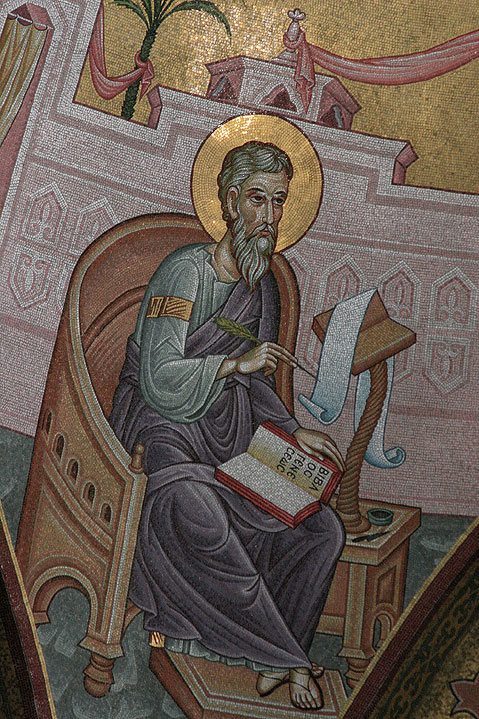
[This is an icon of Saint Matthew the Evangelist. It's in the Church of the Holy Sepulcher in Jerusalem. Click to enlarge.]
The Bible Lessons:
1 Kings 3:5-12
Psalm 119:129-136
Romans 8:26-39
Matthew 13:31-33, 44-52
The Prayer of the Day:
Beloved and sovereign God, through the death and resurrection of your Son you bring us into your kingdom of justice and mercy. By your Spirit, give us your wisdom, that we may treasure the life that comes from Jesus Christ, our Savior and Lord.
A Few Thoughts:
1. My intention is to preach on the text from Romans, which incorporates my absolute favorite passages in the Bible. Here, though, I want to speak a little bit about the Gospel lesson from Matthew.
2. The lesson from Matthew has the conclusion of an extensive section from Matthew's Gospel, Matthew 13, in which Jesus tells parables.
As you know, the New Testament was written during the first century and was written in Greek, the world's second language in those days, occupying a place like that of English today. The word parabola, from which we have the transliterated word parable, is a compound made up of the Greek preposition para, meaning alongside, and bola, based on the word for throw. In His parables, Jesus told a story alongside of which were other meanings.
Parables were a common way of teaching in Jesus' day and before. When you think about it, they still are. In fact, I have a theory that parables and metaphors are the most common and inevitable ways of teaching. Stories have a way of lodging themselves in your memory and teaching you something. Metaphors, like the best parables, use things we already know and through the use of analogy, convey new information. Parables and metaphors are related, especially with Jesus. In fact, some of the mini-parables He tells here create metaphors.
3. Jesus tells six parables in our Gospel lesson. But I believe that there is a single prism through which all six should be viewed, Jesus' words at the end of the lesson:
And he said to them, “Therefore every scribe who has been trained for the kingdom of heaven is like the master of a household who brings out of his treasure what is new and what is old.” (Matthew 13:52)Through much of the gospels of Matthew and the other three evangelists (Mark, Luke, and John), scribes get a somewhat bad name. A scribe was anyone who had mastered the writings of a discipline. (The word in the original Greek is grammateus. From our English word, grammar, you can see that a scribe is an expert on words or writings.)
The religious scribes of Jesus' day were among His most ardent opponents. They were so mired in the Old Testament Scriptures as a document of the past that they were unable to live with God in the present. They didn't allow themselves to see that the Old Testament Scripture they rightly valued and respected, also pointed to a God Who would send a Savior and do new things.
But Jesus said that being a scribe doesn't have to be a bad thing. After excoriating "blind guides" like the scribes (Matthew 23:24), Jesus tells His own followers, "Therefore I send you prophets, sages, and scribes..." (Matthew 23:34).
4. My professor and mentor, Pastor Bruce Schein, used to talk about this passage, referring to it as one of the keys by which one can understand the particular themes of the entire Gospel of Matthew. He said that all Christians are called to be scribes of the kingdom of heaven, steeped in God's Word, through it not constrained to traditions that may or may not have outlives their usefulness, but free to operate in God's kingdom. God's people have a firm and inviolable foundation in Jesus Christ, but they are flexible in their practice.
Let me give a practical examples of what that might mean.
A woman is committed to her marriage. She knows that Jesus hates divorce. In fact, she hates divorce, too. But her husband, a basically decent guy caught in the clutches of alcohol and drug abuse, physically and mentally abuses her and their children. He's squandered all of their savings on drugs and alcohol. He can't keep a job. He refuses to seek help. For her own health and safety, for the health and safety of her children, and in order to give her husband a wake-up call that might bring positive change, that woman has no choice to get out of the house or get her husband out of the house and, barring the husband's enrollment in a program of detoxification and counseling, to begin the first steps toward divorce. This is precisely the kind of advice I have given to several women (and men) in the past twenty-four years of pastoral ministry. Several times, it has resulted in marriages being saved. In all instances, the harmed parties emerged healed and able to live.
A scribe of the kingdom must take the old, inviolable Word of God and apply it to the imperfect world in which we presently live. This application is not and cannot be done arbitrarily, it cannot be done based on one's feelings or personal thoughts, but based on what we know about God from God's Word.
In the case of this woman, we must know that besides hating divorce, God also hates to see the powerful abuse the less powerful. We must know that God cares about what happens to and in every person. We must know that God cares about children. We must know that God hates idolatry, which is what all addictions are, because all addictions destroy bodies, minds, and relationships. We must also know that there are times when fellowship must be severed in order for it to have a chance of being healthfully restored (Matthew 18).
A scribe steeped in God's Word--and every believer in Jesus Christ should strive to be a scribe--must not be a "johnny-one-note" in their theology. God has revealed many things about His character and will. God is still revealing things about His character and will.*
The Scriptures are the treasure of the Church. They are also the canon against which we measure our current actions. They aren't a straitjacket, but a life preserver and a rocket ship propelling us into the future, empowering us to faithfully and flexibly negotiate through the present.
4. The parables of Matthew 13 then, are prisms through which scribes steeped in Christ and His Word are enabled to negotiate the business of living, not just in giving advice, but in living their own day-to-day lives.
5. Eugene Peterson renders Matthew 13:52 in this way (note that Peterson renders the grammateus as student...not bad. That word connects to the word disciple, mathetes in the original Greek of the New Testament, a word meaning student or follower):
[Jesus] said, "Then you see how every student well-trained in God's kingdom is like the owner of a general store who can put his hands on anything you need, old or new, exactly when you need it."Jesus does not intend for Christians to be paralyzed by a religious hierarchy based on human rules. As followers of Christ, members of Christ's Church, we have accountability to God and to one another, for sure. But, through God's Word, the Sacraments, the preaching of God's Word, and the fellowship of the Church, we have direct access to God. Those well-trained in God's kingdom know precisely where to go as they move through the maze of life's challenges, excitement, and uncertainties...to the God we meet in Christ alone!
*But never, it should be pointed out, do the new things we "learn" about God violate what God has already revealed about Himself. God, for example, is not going to reveal to people that it's now okay to steal our neighbor's belongings or engage in sex outside of marriage. God may expand our knowledge of His character and will. And God can certainly forgive the repentant who violate God's will. But, God never changes His character and will. All that changes is our understanding of God. Such changes in understanding come to those who are scribes steeped in God's Word, committed to living the Christian life, and who are practitioners of prayer. This is important to remember the next time someone claims that God told them you should give them all their money or whatever the evil imbecility might be.
[This is an icon of Saint Matthew the Evangelist. It's in the Church of the Holy Sepulcher in Jerusalem. Click to enlarge.]
Subscribe to:
Posts (Atom)