Showing posts with label Romans 8:26-39. Show all posts

Sunday, July 27, 2008

Three Important Truths

[This sermon was shared during worship with the people of Saint Matthew Lutheran Church in Logan, Ohio, earlier today.]

Romans 8:26-39
The last nine verses of today’s second lesson, Romans 8:26-39, are the ones I’ve told Ann must be read at my funeral. If they’re not, as I’ve told many people, I’m popping out of the box and reading them myself!

From this chapter, the most magnificent in all the Bible, I think, I want to hold up to you three truths, THREE THINGS WHICH IF WE KNOW THEM in our minds, hearts, and wills, will transform our lives for all eternity!

Truth #1. One summer day three years ago, I had just finished mowing my lawn when I saw a car pull hurriedly into my driveway. The driver was a woman from our congregation. “Mark,” she said, “I tried to get you on your cell phone while you were mowing. The son of a neighbor was just killed in an accident and we can’t get in touch with the family priest. Could you come over?”

I ran into the house for my keys and drove to that woman’s neighbor's house. I didn’t know the family and wasn’t sure what to say or do. I just kept praying, “Please, God, help this family. Help them and help me to help them, too. Help, God.” It took me two minutes to get to their place and I probably prayed that prayer, parrot-like, twenty times. I simply couldn’t think of anything else to pray!

When I arrived, I gave the mother a hug and put my hand on the shoulder of the father. I stood there a lot in silence. What do you say to a couple whose whole world has fallen out from under them? I prayed with them and a short time later, I left.

I didn’t feel as though I’d done much. Later though, the young man’s father asked his neighbor, on two different occasions, to convey to me how much it had meant to him that I had been there.

I filed the incident in my mind as yet another example of God’s mysterious ways. In particular, to me it exemplified how God answers even inarticulate and sometimes wordless prayers when the words don’t come to us.

Further confirmation of how God answers such prayers came soon thereafter. For months, my former congregation kept an eight year old boy on its prayer list. When his name was first given to me, he was about to undergo a delicate surgical procedure designed to help him have some hearing, something he’d never experienced before. His mom, Carol, wrote to me several times to thank the congregation for their prayers. She said it was particularly comforting to her because all she could think to pray while Jacob was undergoing surgery was, “Please, God…Please, God.”

Carol dismissed her two-word prayers as nothing more than “a mother’s nerves.” But that’s not how God heard them! In our second Bible lesson for this morning, the New Testament preacher and evangelist Paul says, “…we do not know how to pray as we ought, but…[God’s] Spirit intercedes with sighs too deep for words.”

When we approach the God we know through Jesus Christ with trusting faith and authentic helplessness, the helplessness of those who know they need God and cannot rely on themselves or their own resources or on anything else, the Spirit turns our inarticulate craving for God into prayer. And it’s prayer like that which touches the heart and the will of God because in our helpless surrender, we’ve let the Holy Spirit turn our prayer into a simple plea: “In this place, in this circumstance, Lord, we don’t know what to ask for. Your will be done!”

In an effort to understand some of what is going on in our world recently, I’ve done some reading about the Muslim religion and about their holy book, the Qu’ran. I’ve read about what Muslims say about being Muslim.

In the Qu’ran, Muslims are told that the prayers offered in response to the five daily calls to prayer (adhans) are only acceptable to God if they recite the correct words with precision from the Koran and then, only if they do so in Arabic. Some Christians have similar mistaken notions about the necessity for perfection in their prayer.

Through Jesus though, we know the God Who is big enough and compassionate enough to reach out to us and to hear us even when our words and our minds are jumbled. Paul reminds us today that through Jesus Christ, we know that the Spirit is making sense of our prayers even when, as was true of me the day I was called to be with the grieving partns and as was true of Carol when she prayed for her son Jacob, we don’t know how to pray. That's the first great truth I want to highlight today.

We know something else. “We know,” Paul writes in our lesson, “that all things work together for good for those who love God, who are called according to His purpose.”

On December 26, 2004, a massive tsunami hit much of this planet. Most of its victims were Muslims and Hindus. More than 160,000 people died or went missing and more than 500,000 homes were destroyed. The estimated cost of rebuilding that housing stock is $5-billion.

As Lutheran Pastor Paul Gauche once wrote, God surely didn’t cause this tragedy. But God stirred the hearts of Christians and others around the world to respond compassionately to the needs of faraway neighbors with whom they did not share faith, nationality, and often, skin color. In the case of Christians, the began helping others in the Name of Jesus Christ, because of the prompting of God's Spirit.

A similar thing happened among Christians and others after Hurricane Katrina. Thousands of Christians, including my nephew who, from his pre-adolescent days, has known how to do plumbing and electrical work and do drywall, went to help Gulf Coast people rebuild their lives.

Even in a world sometimes gone crazy, we know that the Holy Spirit makes sense of our jumbled prayers and uses Jesus Followers to bring good out of even the worst of circumstances.

We know something else, too. Paul puts it this way: “If God is for us, who is against us? He Who did not withhold His own Son, but gave Him up for us all, will He not with Him also give us everything else?”

The God Who came into our worlds in the Person of Jesus Christ and sacrificed Himself on a cross and promised that He would be with us always in the Holy Spirit, isn’t going to be skimpy about sharing His love and His presence with us. Nothing, absolutely nothing, will ever change that!

I learned this from a man named Charlie in Ann’s and my home church in Columbus.

By the time I got to know Charlie, he was an elderly man who still occasionally did house painting. But most of his time was spent caring for his wife. He was deeply devoted to her. She was bed-ridden and in need of care for many years. After a long illness, Charlie’s wife died.

On the day of her funeral, we had a luncheon at the church. As that was ending, a friend of mine, a fellow who was in seminary, and I became concerned when we noticed that Charlie had been gone for awhile. We found him upstairs in the sanctuary. He was saying goodbye to some people who had come to the funeral.

When Charlie spied the two of us, he thanked us for our concern. Then he told us, “Mark and Whitie, you know something? God has been awfully good to me. And I’m so glad that He’s with me right now.”

Charlie had just begun to go through the most horrible grief anyone can suffer and it had come at the end of long years of selfless service to the woman he adored. Yet, because of the Savior he followed, Charlie could affirm God’s goodness and presence. It’s a testimony of God’s faithfulness I will carry with me my whole life!

Charlie knew what I hope that you know: God is for you.

In remembering that, folks, we are at the very core of what we believe as Lutheran Christians. We are, according to the great Reformed Biblical scholar, Joachim Jeremias, looking at the central message of the New Testament and I would add, of the whole Bible.

Through Jesus Christ, you can know of a certainty that God is for you and for every human being who has ever sinned, for everyone who has ever confronted pain or suffering or grief, for any human being who has ever drawn a breath. And there is nothing in heaven or on earth that can ever or will ever alter that simple fact! Jesus' cross and empty tomb stand as testament to it. God is for you!

So, this morning, I ask you to ask God to help you grow in the awareness of three major truths Paul talks about in today’s second Bible lesson. Because of Jesus Christ, know that…
  • the Spirit can make something of our prayers even when we don’t know how to pray;
  • God can make good things come from even the worst of circumstances; and
  • absolutely nothing can ever separate the believer in Jesus Christ from God’s love or care.
If those three truths don’t make a difference in your life, nothing ever will.

[The three truths identified in this sermon were first pointed out to me in a sermon found here. (Membership required for access.)]

Friday, July 25, 2008

Everybody's Called to Be a Scribe in the Kingdom of Heaven (To Help You Prepare for This Sunday's Worship)

[Most weeks, I try to publish at least one post dealing with the appointed Bible lessons for the upcoming Sunday. My hope is that I can at least help the people of the parish I serve as pastor, Saint Matthew Lutheran Church in Logan, Ohio, to prepare for worship. Others may find these explorations helpful because we use the same Bible lessons used by most other North American Christians each Sunday.]

The Bible Lessons:
1 Kings 3:5-12
Psalm 119:129-136
Romans 8:26-39
Matthew 13:31-33, 44-52

The Prayer of the Day:
Beloved and sovereign God, through the death and resurrection of your Son you bring us into your kingdom of justice and mercy. By your Spirit, give us your wisdom, that we may treasure the life that comes from Jesus Christ, our Savior and Lord.

A Few Thoughts:
1. My intention is to preach on the text from Romans, which incorporates my absolute favorite passages in the Bible. Here, though, I want to speak a little bit about the Gospel lesson from Matthew.

2. The lesson from Matthew has the conclusion of an extensive section from Matthew's Gospel, Matthew 13, in which Jesus tells parables.

As you know, the New Testament was written during the first century and was written in Greek, the world's second language in those days, occupying a place like that of English today. The word parabola, from which we have the transliterated word parable, is a compound made up of the Greek preposition para, meaning alongside, and bola, based on the word for throw. In His parables, Jesus told a story alongside of which were other meanings.

Parables were a common way of teaching in Jesus' day and before. When you think about it, they still are. In fact, I have a theory that parables and metaphors are the most common and inevitable ways of teaching. Stories have a way of lodging themselves in your memory and teaching you something. Metaphors, like the best parables, use things we already know and through the use of analogy, convey new information. Parables and metaphors are related, especially with Jesus. In fact, some of the mini-parables He tells here create metaphors.

3. Jesus tells six parables in our Gospel lesson. But I believe that there is a single prism through which all six should be viewed, Jesus' words at the end of the lesson:
And he said to them, “Therefore every scribe who has been trained for the kingdom of heaven is like the master of a household who brings out of his treasure what is new and what is old.” (Matthew 13:52)
Through much of the gospels of Matthew and the other three evangelists (Mark, Luke, and John), scribes get a somewhat bad name. A scribe was anyone who had mastered the writings of a discipline. (The word in the original Greek is grammateus. From our English word, grammar, you can see that a scribe is an expert on words or writings.)

The religious scribes of Jesus' day were among His most ardent opponents. They were so mired in the Old Testament Scriptures as a document of the past that they were unable to live with God in the present. They didn't allow themselves to see that the Old Testament Scripture they rightly valued and respected, also pointed to a God Who would send a Savior and do new things.

But Jesus said that being a scribe doesn't have to be a bad thing. After excoriating "blind guides" like the scribes (Matthew 23:24), Jesus tells His own followers, "Therefore I send you prophets, sages, and scribes..." (Matthew 23:34).

4. My professor and mentor, Pastor Bruce Schein, used to talk about this passage, referring to it as one of the keys by which one can understand the particular themes of the entire Gospel of Matthew. He said that all Christians are called to be scribes of the kingdom of heaven, steeped in God's Word, through it not constrained to traditions that may or may not have outlives their usefulness, but free to operate in God's kingdom. God's people have a firm and inviolable foundation in Jesus Christ, but they are flexible in their practice.

Let me give a practical examples of what that might mean.

A woman is committed to her marriage. She knows that Jesus hates divorce. In fact, she hates divorce, too. But her husband, a basically decent guy caught in the clutches of alcohol and drug abuse, physically and mentally abuses her and their children. He's squandered all of their savings on drugs and alcohol. He can't keep a job. He refuses to seek help. For her own health and safety, for the health and safety of her children, and in order to give her husband a wake-up call that might bring positive change, that woman has no choice to get out of the house or get her husband out of the house and, barring the husband's enrollment in a program of detoxification and counseling, to begin the first steps toward divorce. This is precisely the kind of advice I have given to several women (and men) in the past twenty-four years of pastoral ministry. Several times, it has resulted in marriages being saved. In all instances, the harmed parties emerged healed and able to live.

A scribe of the kingdom must take the old, inviolable Word of God and apply it to the imperfect world in which we presently live. This application is not and cannot be done arbitrarily, it cannot be done based on one's feelings or personal thoughts, but based on what we know about God from God's Word.

In the case of this woman, we must know that besides hating divorce, God also hates to see the powerful abuse the less powerful. We must know that God cares about what happens to and in every person. We must know that God cares about children. We must know that God hates idolatry, which is what all addictions are, because all addictions destroy bodies, minds, and relationships. We must also know that there are times when fellowship must be severed in order for it to have a chance of being healthfully restored (Matthew 18).

A scribe steeped in God's Word--and every believer in Jesus Christ should strive to be a scribe--must not be a "johnny-one-note" in their theology. God has revealed many things about His character and will. God is still revealing things about His character and will.*

The Scriptures are the treasure of the Church. They are also the canon against which we measure our current actions. They aren't a straitjacket, but a life preserver and a rocket ship propelling us into the future, empowering us to faithfully and flexibly negotiate through the present.

4. The parables of Matthew 13 then, are prisms through which scribes steeped in Christ and His Word are enabled to negotiate the business of living, not just in giving advice, but in living their own day-to-day lives.

5. Eugene Peterson renders Matthew 13:52 in this way (note that Peterson renders the grammateus as student...not bad. That word connects to the word disciple, mathetes in the original Greek of the New Testament, a word meaning student or follower):
[Jesus] said, "Then you see how every student well-trained in God's kingdom is like the owner of a general store who can put his hands on anything you need, old or new, exactly when you need it."
Jesus does not intend for Christians to be paralyzed by a religious hierarchy based on human rules. As followers of Christ, members of Christ's Church, we have accountability to God and to one another, for sure. But, through God's Word, the Sacraments, the preaching of God's Word, and the fellowship of the Church, we have direct access to God. Those well-trained in God's kingdom know precisely where to go as they move through the maze of life's challenges, excitement, and uncertainties...to the God we meet in Christ alone!

*But never, it should be pointed out, do the new things we "learn" about God violate what God has already revealed about Himself. God, for example, is not going to reveal to people that it's now okay to steal our neighbor's belongings or engage in sex outside of marriage. God may expand our knowledge of His character and will. And God can certainly forgive the repentant who violate God's will. But, God never changes His character and will. All that changes is our understanding of God. Such changes in understanding come to those who are scribes steeped in God's Word, committed to living the Christian life, and who are practitioners of prayer. This is important to remember the next time someone claims that God told them you should give them all their money or whatever the evil imbecility might be.


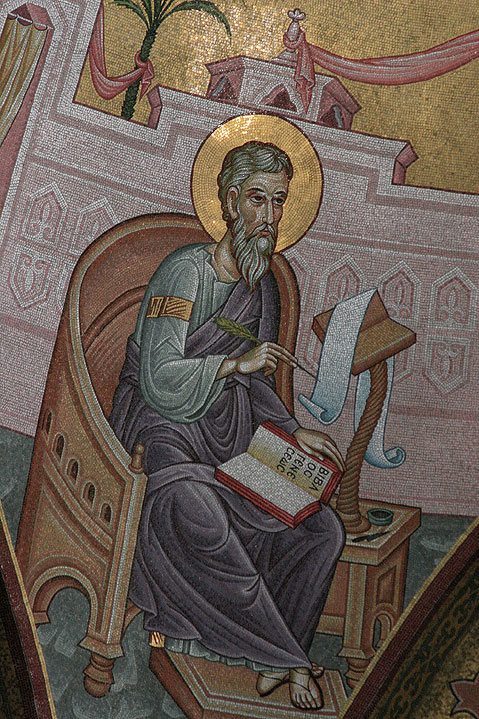
[This is an icon of Saint Matthew the Evangelist. It's in the Church of the Holy Sepulcher in Jerusalem. Click to enlarge.]

Wednesday, January 23, 2008

What is Love?

My son tackles that important topic in a post over on his blog. A sampling:
When we love someone we are now faced with the truly terrifying fact that we are performing the very act that God Himself performed at the beginning of the age and then at the turning point of history. It was from love that God acted out and created His joy. And when we are allowed to love, we feel like a child who is being allowed to drive His father's car for the first time; intimidated but exhilarated at the same time. It is this and a hundred more things that make love worthwhile. That is what love truly is.
Read the whole thing!