Showing posts with label Matthew 14:22-33. Show all posts

Sunday, August 13, 2023

The Word That Saves You

[Below, you'll find both live stream video of today's single worship service with the people and friends of Living Water Lutheran Church and the text of the message shared today. Have a good and blessed week!]


Matthew 14:22-33
One of the joys of being a parish pastor, a joy that the Bible tells us can be shared by any Christian willing to be Christ’s hands and feet in the world, is in what’s called the Office of the Keys.

We exercise the Office of the Keys whenever someone, in the name and under the lordship of Jesus, confesses their sins, turns from them, seeks the assurance of God’s forgiveness from us, and we are able to proclaim God’s forgiveness of all their sins to them.

Jesus has given this office to the Church and, while all members of the Church can exercise it, the Church has given particular responsibility to pastors to do so.

Jesus does this, for example, in John 20:23, when He tells the Church: “If you forgive anyone’s sins, their sins are forgiven; if you do not forgive them, they are not forgiven.”

And Jesus also says in Matthew 18:18: “Truly I tell you, whatever you bind on earth will be bound in heaven, and whatever you loose on earth will be loosed in heaven.”

God, it turns out, is not against us sinners.

God is for sinners, like you and me.

He wants to free all sinners from the bondage to sin from which we cannot free ourselves.

That’s why Jesus, God the Son, came into our world and, enfleshed as the Man without sin, took our sins, all of our sins, into Himself, absorbing the death and condemnation we deserve, on His cross so that we could have His righteousness and life forever.

When penitent sinners are told, “Because of Jesus Christ, all your sins are forgiven,” they are hearing the Word from Jesus Christ Himself. They can believe that their sins are forgiven.

Nothing more needs to be said.

No questions need to be asked.

Through Jesus, we are free of sin, condemnation, and death.

“If the Son sets you free,” Jesus says of Himself, “you will be free indeed.” (John 8:36)

But I’ve noticed something that sometimes happens to sinners when God’s Word of forgiveness, His Word of absolution, comes to us.

A woman came to see me, mostly to confess a sin for which she felt guilty, a sin that had happened decades before.

I told her that her guilt for the sin was appropriate, but that, as she turned to Jesus Christ, she could be assured of God’s forgiveness.

I reminded her of biblical promises like, “Christ Jesus came into the world to save sinners…” (1 Timothy 1:15)

“In Christ,” I told her, “all your sins are forgiven.” Her guilt, I assured her, was erased by the grace of God extended to us through Christ!

The woman wept for a few moments and then said, “I wish that I could believe that.”

There was little more I could say to her now. I’d given her Christ’s Word that she was forgiven, that Jesus, God the Son, had taken her sin away. But here she was taking it  back again!

At the end of our second lesson for today, the apostle Paul tells us, “...faith comes from hearing the message, and the message is heard through the word about Christ.” (Romans 10:17) That woman ignored the Word about Christ and so could not and would not believe that she was saved from sin and death and forgiven through Him. She insisted on believing the words of the devil, the world, and her sinful self that told her that forgiveness couldn’t possibly be that simple, that she needed to do more, that she needed to be more for her to be out from under condemnation and death. Jesus was offering her forgiveness and new life with God as a gift and she wanted to earn it.

That woman isn’t alone. Years ago, a man told me that he liked reading a particular Christian author. Why? “Because,” he said, “he always makes me feel guilty. And after I get guilty, I can get busy working on my salvation and holy living.”

The Bible tells us that Jesus, by going to the cross and rising from the tomb, has already secured our salvation, our justification, and our holy lives, our sanctification. Our call is to simply attend to His Word, given to us in the Bible and the Sacraments…to keep receiving these gifts, because it is by these gifts, that God gives us the gift of faith and strengthens that faith. (This is why regular worship with the Church is essential to being a follower of Jesus. There’s no such thing as a solo Christian.) Hebrews 10:10 says, “we have been made holy through the sacrifice of the body of Jesus Christ once for all.” You don’t have to do anything to make that happen.

We see a person like this woman and this man in the apostle Peter in today’s Gospel lesson.

After feeding the 5000-plus, Jesus sends the disciples away by boat, dismisses the crowd, and goes to a mountain to pray alone. Deep into the night, toward dawn, the disciples are still in their boat on the sea during a raging storm. Don’t confuse this with an earlier incident in which Jesus slept through a storm that terrified the disciples. Matthew tells us about that incident too. This time though, we have no indication that the disciples were afraid of the storm. They seem to feel they have everything under control. They’re competent, have it together, and they know exactly what they’re doing. Jesus is about to show them differently.

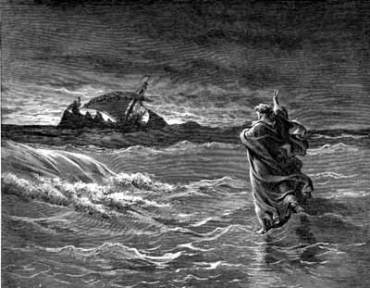
“Shortly before dawn,” Matthew says, “Jesus went out to them, walking on the lake.” When the disciples catch sight of this, they’re terrified!

A lot of people think they would have liked to lived back when Jesus walked on the earth. They think they would see Him and see His kind, sweet visage.

But, listen, friends: unrepentant sinners, like the disciples who had so recently suggested that, rather than helping the needy crowd around them, Jesus should send them away so they could buy their own food, never find it pleasant to be in the presence of the perfect, holy, righteous Son of God. That’s why they were terrified. But the New Testament says that, “It is a dreadful thing to fall into the hands of the living God.” (Hebrews 10:31)

Those who refuse to live in daily repentance and faith in Christ stand naked in their sins, unprotected from God’s wrath and condemnation. When the disciples see Jesus, they think He’s a ghost. They cry out in fear.

But then, Jesus tells them, literally, in verse 27: “Take courage. I AM. Do not fear.” “Take courage. Yahweh. Do not be afraid.”

Friends, although He is God and we are sinful human beings, Jesus speaks a Word that conquers our sin, sets us free from death, and gives us peace.

The disciples are right to initially feel terrified in coming face to face with Jesus. He is God. He is, as the theologian of the last century, Paul Tillich said, “wholly Other”: completely different from us, completely holy, completely righteous, completely perfect.

The disciples are seeing the Messiah Who will one day judge the living and the dead.

They see Jesus in His raw deity.

They recognize the distance between Him, in His righteousness and purity, and them, in their unrepentant, proud, arrogant, self-sufficient sinfulness.

But the God we know in Jesus has no desire to damn them–or us–for sin, no desire to see us die, separated from God, consumed by wrath from which He otherwise protects us.

So, Jesus speaks a comforting Gospel Word to you and me even now: “Do not fear. I take the wrath you deserve into myself. Your sins are forgiven.”

So, to the first disciples, terrified in the boat, Jesus speaks His Gospel Word of promise. That should be enough to calm the fears of all.

But, there in the boat is one who still isn’t sure: Peter, out stand-in.

Even after Jesus’ Word of absolution, Peter is unbelieving. Peter doesn’t trust Jesus or His Word. Like the man who told me he liked the author who left him feeling guilty, Peter wants Jesus to give him a program by which he, not Jesus, can overcome his guilt, sin, and fear. He wants Jesus to prove He’s the Messiah Peter wants and he wants to prove what a righteous person he is even without the Messiah, Jesus.

And, so he says, “Lord, if it’s you,...tell me to come to you on the water.” (Matthew 14:28)

“Come,” Jesus tells Peter.

Jesus, in effect, is saying, “OK, Peter, you won’t believe that My Word is enough to save you? You need proof that My Word can even save an unrepentant sinner like you? Come out here and take a walk on the water.”

Of course, as soon as Peter turns his attention to the wind, he’s back to feeling terrified again and begins to sink. Jesus catches Peter and upbraids Him: “You of little faith,...why did you doubt?”

Friends, do not doubt!

You were saved from sin and death at Holy Baptism, when Jesus fished you from the water and claimed you as His own.

Your salvation is confirmed every time you are able, by the power of the Holy Spirit, working in God’s Word, to confess that Jesus is your Lord.

The Word has come to you again and again during sermons, family devotion times, Bible studies, and Holy Communion.

This Word has spoken through God’s Law to show you your sin and through Christ’s Gospel to give you the gifts of repentance, saving faith, forgiveness, and new life.

Jesus tells us, “...my Father’s will is that everyone who looks to the Son and believes in him shall have eternal life, and I will raise them up at the last day.” (John 6:40)

Friends, this morning it is again my joy to exercise the Office of the Keys and tell you who repent and turn to Jesus, “Do not be afraid. You are not condemned. Christ died and rose for you. In Him, you are forgiven!” Amen

Sunday, August 10, 2014

Jesus Walking on the Water...More Than a Neat Trick

[This was shared during worship with the people and guests of Living Water Lutheran Church in Springboro, Ohio, this morning.]

Matthew 14:22-33
The incident recounted in today’s gospel lesson, in which Jesus walks on water, is well known to Christians and non-Christians alike. Something about thinking of Jesus treading across the waves captures people’s imaginations. And in this lesson, we also identify with Jesus’ disciple, Peter, whose name, meaning Rock, never seemed more appropriate than the moment we read that, after taking a few steps on the water, he sank like a stone and had to be fished out by Jesus.

But as was true of last week’s gospel lesson, when we considered how Jesus fed more than 5000 people with a few fish and scraps of bread, as we read this lesson, we need to move beyond the superficial and seek some answers to some basic questions:

Jesus walking on the water is a neat trick, but what exactly does it mean for us today?

What truths for our lives can we garner from this incident?

There are, I think, at least four things to remember from today’s lesson that will help us today and beyond.

Take a look at the gospel lesson, Matthew 14:22-33, please.

It begins: “Immediately Jesus made the disciples get into the boat and go on ahead of him to the other side, while he dismissed the crowd.”

This happened right after the miraculous feeding. You’ll remember that that incident came about after Jesus had gone off to be by Himself to pray following the execution of His cousin, John the Baptist. Jesus had made Himself available to bring healing to those in need of it and, towards nightfall, to feed the hungry people.

But now, it seems, Jesus has completed His work for the day. He needs to spend time with His Father. Doing so will help Him to continue on the course He had come into the world to run, the course that would take Him, sinless God and man, to die on a cross, to bear our punishment for sin, then on to the resurrection so that all who turn from sin and believe in Him as their only God may have ever new, eternal life with God.

Matthew says that Jesus "made" the disciples get on a boat and go. The word translated as made is literally compelled. To be compelled is to be forced, as when my dad compelled me to go to bed at night. When one more powerful than you compels you to do something, there is no second guessing. There are no courts of appeals.

Just as forcefully, Jesus dismissed the crowd. Jesus has healed them. He has fed them. Now, even though the night is blacker than ink, it’s time for the crowd to go and for Jesus to face the next phase on His journey to cross and empty tomb.

So, from the beginning of the lesson, we see Jesus, the One Who by the touch of His hand was able to reverse the disease and death and deterioration that comes to us all in the fallen world and was able to spread a table for hungry thousands, as being totally in charge. That’s the first thing to remember in today’s lesson: Jesus is totally in charge. Even today, this moment.

Now, you might expect that this reality--the reality of Jesus being in charge in spite of all the grim and harsh challenges of this world--would have been permanently engraved on the consciousness of the disciples after they’d seen Jesus heal and feed all those people. But it turns out that those disciples are as thick-headed and unwilling to trust in God as I know I sometimes can be...and that you sometimes may be.

Take a look, please, at verses 23 and 24: “After he had dismissed them, he went up on a mountainside by himself to pray. Later that night, he was there alone, and the boat was already a considerable distance from land, buffeted by the waves because the wind was against it.”

Two scenes, one tranquil, one chaotic. Jesus praying alone to His Father. The disciples out riding the waves through a storm. And despite their expertise as fishermen who had plied these waters many times, they appear to be helpless before the buffeting wind.

A few weeks ago, I mentioned that in Matthew’s gospel, the word house often stands as a symbol for the Church. In this image, the Church is the household of God gathered for worship, gathered to receive God’s healing Word, and gathered to be fed on the body and blood of our Lord. The life of the gathered Church is sort of like what happened when Jesus gathered those thousands together to feed them on His grace and love and power.


But you should also know that Matthew often uses the term boat to symbolize the Church--ordinary believers like you and me--moving out into the world. The disciples riding in the boat with fear and trepidation are just like you when you're facing tough choices on Monday mornings, struggling to keep your lives and your finances together, struggling to maintain relationships, fighting almost to simply get through day to day life. It can be a stormy, rough ride out there outside the safe confines of the household of faith.

And, these two scenes--Jesus praying, the disciples struggling--serve as a good picture of how we may sometimes forget that even when we struggle, all who trust in Jesus Christ as their God and King have Someone Who, though we cannot see Him, is praying for us to His Father. That’s part of what it means for us to pray in Jesus‘ Name. We earnestly invoke the help of the One Who died and rose to set us free from sin and death. When we pray in Jesus' Name, He takes our case the Father and puts in a good word for us. Jesus had not forgotten the disciples and He never forgets you. That’s the second thing to remember from today’s lesson: Jesus will never forget you, no matter how rough the ride may get. 

Look again at our lesson, starting at verse 25: “Shortly before dawn Jesus went out to them, walking on the lake. When the disciples saw him walking on the lake, they were terrified. ‘It’s a ghost,’ they said, and cried out in fear. But Jesus immediately said to them: ‘Take courage! It is I [literally, in the Greek in which the New Testament is written, Jesus says, “Ego eimi,” not “It is I,” but “I AM,” identifying Himself with the same name by which God identified Himself to Moses in the Old Testament, “Yahweh” in the Hebrew, “I AM.” “It is I.”] Don’t be afraid.’”

Now, what so interests me here is that Jesus didn’t stop the wind and the waves. Instead, He told the disciples not to be afraid of them. I often pray that the storms of my life will go away. And there’s nothing wrong with that. But some of the storms that come to us--and I said only some--are allowed to enter our lives by God. Other storms are the inevitable outcroppings of a planet writhing in sin and death. But whatever the source of my life's storms, maybe I ought to learn to pray not only that God will take away the storms, but also that God will give me strength to go through them.

On the night before His arrest, Jesus prayed that He wouldn’t have to go through suffering and death on the cross. An understandable prayer. Jesus didn't want to go through the storm! But Jesus also prayed, “Nonetheless, not My will, but Your will be done.” It was only through the storm of His cross that Jesus could fulfill His mission of bringing life to people like you and me who would otherwise stand naked in our sins on judgment day and be eternally separated from God.

God loved and appreciated a man named Job, whose story is told in the Old Testament. Yet God allowed Job to undergo a ferocious storm of grief and loss that is almost painful to read about. But from his storm, Job emerged with a stronger faith.

In a world groaning under the power of sin and death, storms are inevitable in this life. But--and this is the third big lesson I draw from this incident--Jesus, I AM, God enfleshed, can give us peace in the midst of the storms.

With Psalm 46:2-3, we can say that the God we know in Jesus Christ is our ever-present refuge,  “...we will not fear, though the earth give way and the mountains fall into the heart of the sea, though its waters roar and foam and the mountains quake with their surging.”

Please look at what comes next, starting at verse 28: “Lord, if it’s you,’ Peter replied, ‘tell me to come to you on the water.’  ‘Come,’ he said. Then Peter got down out of the boat, walked on the water and came toward Jesus. But when he saw the wind, he was afraid and, beginning to sink, cried out, ‘Lord, save me!’ Immediately Jesus reached out his hand and caught him. ‘You of little faith,” he said, ‘why did you doubt?’”

I hope that we can be charitable to Peter. He sees Jesus walking on the water and He really believes that Jesus can empower him to do the same. He trusts. But His trust is weak. My guess is that many of us here this morning can say the same thing: "We trust; our trust is weak." 

But, if in his falling into the water, Peter is a representative of us and our faulty faith, in what happens after he falls, Peter is a model for us and our faith. He cries out, “Lord, saves me.” Peter’s faith, like ours, may have been of the stumbling, imperfect variety. But he could say with another of the Old Testament songs of worship, Psalm 121:1-2: “I lift up my eyes to the mountains—where does my help come from? My help comes from the Lord, the Maker of heaven and earth.”

When we realize that our situation is hopeless--that we confront situations we can’t conquer or comprehend that our sins threaten to condemn us to hell and to separate us from God forever, we can cry out simply to God.

This was a lesson that Peter was to learn well. Fifty days after Jesus rose from the dead, Peter spoke to a crowd of thousands who realized that they had been trying to live their lives--in effect, trying to walk on water--without God, without the saving help that God the Father sent Jesus, God the Son, to bring to us.

They were drowning in sin and hopelessness.

But Peter tells the crowd in Acts 2:21: “Everyone who calls on the Name of the Lord will be saved.”

And that is the fourth major thing I want to hold up today. Whether it’s from eternal separation from God, a lifetime of purposelessness, or a gnawing sense of insecurity that keeps you feeling less than the child of God you are, you (and I) need to do the same thing: Call on the Lord and we will be saved.

No matter the storms that confront us in this life, Jesus is totally in charge.

Jesus will never forget you.

Jesus--and only Jesus--can give you peace even in the midst of storms.

And when we call out to Jesus, we are saved.

It’s these truths that might well cause us after Jesus has brought us through another storm to, like the first disciples, worship Jesus and say with them, “Truly, You are the Son of God.” Amen


Sunday, August 07, 2011

Does God Still Speak to His People?

[This was shared during worship with the people of Saint Matthew Lutheran Church in Logan, Ohio, earlier today.]

1 Kings 19:9-18
In his fantastic book, The Power of a Whisper, Pastor Bill Hybels, tells what happened to him one day after he prayed this prayer: “God, if there is something you would like me to do…then please say so. It doesn’t matter what it is; I’ll do it.”

He had no idea how God might answer that prayer. But in a few days, Hybels and his wife Lynne were leaving the funeral of his aunt and getting into their car when he “spotted a frail, elderly woman pulling into [a] nearby apartment complex.” He saw the woman park her car, then “slowly and laboriously pull grocery bags out of her trunk.” Hybels sensed God’s Holy Spirit telling him, “How about helping that woman with her groceries?”

Initially, Hybels says, he tried to brush past this holy whisper. It seemed so mundane. But he remembered his prayer.

He approached the elderly woman, asking if he could help her. Relieved, she said, “Oh, yes! Thank you!”

As Hybels tells it: “The driveway leading back to her apartment recently had been seal-coated and was roped off, meaning residents had to walk a few hundred yards just to get from their cars to their homes.” Hybels knew he was helping to fill a real need, especially when the woman handed him a thirty-pound bag of peaches even he found a little hard to handle.

As Hybels tells it, the woman led him “through backyards that had become swamps due to recent rains…” She was “extremely arthritic and slow-moving.” It took thirty minutes for them just to make their way to the woman’s apartment!

After he had helped her to empty the sacks, she reached her hand out to Hybels and said, “I will believe to my dying day that God sent you to help me just now.” As inglorious as it all seemed, Hybels was sure she was right.

Our first Bible lesson for today recounts a conversation between God and the prophet Elijah. It raises an important question: Does God still speak to believers in 2011, the way He spoke to his prophet in the ninth-century BC or was Hybels’ direct message from God a figment of an overly spiritual imagination? What does the Bible say?

Pull out the pew Bibles for a moment, please, and turn to 1 Samuel 3:1, on page 158. The verse tells about when God called a young boy named Samuel to be a priest, judge, and prophet. It says: “Now the boy Samuel ministered to the LORD before Eli. [And this is the part to which I want to call particular attention:] And the word of the LORD was rare in those days; there was no widespread revelation.” That last sentence has always interested me because of is its unspoken assumption that, throughout much of ancient Israel’s history, God commonly spoke to His especially called people, like prophets. The era before Samuel’s call apparently, was a rare time when the connection between God and His people grew spotty.

Centuries after Samuel, after God came into the world in the person of Jesus and after Jesus died and rose and sent the Holy Spirit to believers in the Church, it wasn’t just to prophets and priests that God spoke. It was to all believers. In the pew Bibles, take a look at Acts, chapter 2, starting at verse 17, on page 627. On Pentecost, Peter is explaining how ordinary people who believed in Jesus were telling others about God’s mighty works. He explained how such a thing was possible by remembering the ancient words of the prophet Joel: “And it shall come to pass in the last days, says God, That I will pour out My Spirit on all flesh…”

In fact, throughout the book of Acts, which tells the story of the early Church, we’re told how God’s people prayed and God directed them. The Bible assumes that it’s normal for God to speak to believers who are dialed into God.

But how does God speak to us?

Please pull out the Celebrate inserts and look at the first lesson, 2 Kings 19:9-18.

Let’s set the stage: It’s the ninth century BC. About fifty years earlier, the nation of Israel had split in two. The southern kingdom, known as Judah, retained its worship life in Jerusalem and struggled to retain its faith in the God of the Bible, Who they knew as Yahweh, the LORD. The northern kingdom, with its capital of Samaria, called itself Israel.

According to the Bible, the northern kingdom never had a king who was faithful to Yahweh or just in his actions. The worst of its rulers was Ahab, who worshiped Baal, a false deity of rain, fertility, and agriculture.

Despite the LORD’s first commandment that no other god should be worshiped, Ahab and his wife Jezebel encouraged the people to turn their back on God.

God made Elijah a prophet in order to call the king and the nation to repent for their sins and to trust in God alone.

A contest was held at Mount Carmel involving Elijah on one side and 400 prophets of Baal on the other. No matter what the prophets of Baal did, they couldn't cause their idol to do anything to prove its existence. (In fact, one of the funniest passages in Scripture is part of this incident. As the Baal worshipers went through their conniptions, Elijah taunted them, at one point suggesting that Baal has wandered away. But actually, that dainty translation in most of our English versions of the Bible don't get it right. Elijah literally told them that maybe Baal had to take a pit stop to go to the bath room!)

At Mount Carmel, God was shown to be faithful and powerful, while Baal was shown to be a man-made fiction.

Right after this contest, it seemed that the northern kingdom would return to God. King Ahab got rid of the prophets of Baal as God, through Elijah, directed him.

Later though, Ahab told his wife Jezebel about all that happened and she sent a message to Elijah, telling him that within a day’s time, she would see that Elijah was a dead man. First Kings, chapter 19, verse 3, says that when Elijah received that message, “he was afraid” and he ran. Like Peter, in our Gospel lesson, Elijah allowed his fears to veto his faith in God. He panicked.

Our lesson finds Elijah at Mount Horeb, also known as Mount Sinai, the place where, six centuries before Elijah’s time, God gave the Ten Commandments to Moses. Twice in our lesson, God asks Elijah why he has run. Twice, Elijah says, as he does in verse 10, you see: “I have been very zealous for the LORD, the God of hosts; for the Israelites have forsaken Your covenant [the covenant God had made with Israel on that very mountain], thrown down Your altars, and killed Your prophets with the sword. I alone am left, and they are seeking my life, to take it away.”

Have you ever known fear like that, a fear that leaves you feeling alone and without hope? The doctor tells you about a poor prognosis or a loved one dies and you wonder how you can possibly function. The stock market moves further into negative territory and you fear that you’ll have no retirement income.

It’s at times like these that God wants to tell us, in the words of Psalm 46:10: “Be still and know that I am God.”

God wants to tell all who believe in Jesus Christ, as 1 John 4:4 puts it: “Little children…the one who is in you [the Bible teaches that Christ lives in His people] is greater than the one who is in the world.”

God is bigger than anything we may fear and, as Romans 8 reminds us, those who turn from sin and believe in Jesus Christ, live in the certainty that nothing can separate us from the love of God given to us through Christ!

Sometimes though, we may need special guidance or assurance. Elijah did.

Look at verse 11 of our first lesson. God told Elijah to stand on the mountain, “for the LORD is about to pass by.” Then, we’re told, “Now there was a great wind, so strong that it was splitting mountains and breaking rocks in pieces before the LORD, but the LORD was not in the wind; and after the wind, an earthquake, but the LORD was not in the earthquake; and after the earthquake a fire, but the LORD was not in the fire, and after the fire the sound of sheer silence.”

It was there in the silence, that somewhere in his own spirit, Elijah heard God speak to him. (The older translations says that God spoke to Elijah in “a still, small voice,” but even that may suggest something too noisy.)

God then ordered Elijah to move past his fears, giving him three specific tasks.

Listen! When you’re afraid or lonely or need guidance or you simply want to offer yourself to the God Who offered Himself for you on the cross, you can hear from God.

The most reliable place to hear God is on the pages of the Bible. That’s where God’s Word can always be found.

I got to know a Pentecostal pastor named Howard back in Cincinnati. Loved that man! We were having a heart to heart one night when he said, “You know, so many Pentecostals want to hear ‘a special word from God.’ But all they really need to do is look at the Bible to find God’s Word for their lives.” I smiled and said, "Howard, you sound like a Lutheran!"

Howard was right! We’ve all read about people who have done horrible things because, they claimed, some voice had told them to do so. If you feel prompted to do something, look in the Book. Find out what God’s Word says. Talk to a trusted Christian friend who knows God’s Book. God will never tell us to do anything that runs contrary to His revealed will in the Bible. Never.

But when, in the silence of your soul, you sense God prompting you, go for it!

Jim and Sheila, from our congregation, went to Bob Evans for lunch on Friday. Across the way from them sat an older man eating by himself. Sheila observed his conversation with the waitress, indicating he might be a “regular” there. She thought she heard him use the word, “radiation.”

That’s when I think God spoke to Sheila. “I felt,” she wrote to me in an email on Friday, “like I wanted to make this man’s day.”

In order to not be heard by the man, she wrote a note asking the waitress to bring the man’s check to Jim and her. She handed one of our “The Meal’s on Us!” cards to the waitress to give to the man. Later, the waitress brought a box to the man as he’d requested and told him that his meal had been taken care of. “Who?” he asked. The waitress shrugged. The man teared up, read the card twice, then tucked it into his pocket. Sheila says, “My heart felt warm all over.”

[The front of one of our "This meal's on us!" card.]

[The back side of our "This meal's on us!" card.]

Does God still speak to His people today? Yes, most reliably in His Word, the Bible.

But there are also times when God may speak to us in the silence of our hearts and minds, when God will order our steps directly. God will teach us, as He taught Elijah (and as he taught Peter in our Gospel lesson), to live "by faith and not by sight.”

And when we live by faith in Christ, then we are  truly living!

Wednesday, August 06, 2008

Where Did God Go? (Getting Ready for Worship, August 10, 2008)

[Most weeks, I try to publish at least one post dealing with the appointed Bible lessons for the upcoming Sunday. My hope is that I can at least help the people of the parish I serve as pastor, Saint Matthew Lutheran Church in Logan, Ohio, to prepare for worship. Others may find these explorations helpful because we use the same Bible lessons used by most other North American Christians each Sunday.]

This Week's Bible Lessons:
1 Kings 19:9-18
Psalm 85:8-13
Romans 10:5-15
Matthew 14:22-33

The Prayer of the Day:
O God our defender, storms rage around and within us and cause us to be afraid. Rescue your people from despair, deliver your sons and daughters from fear, and preserve us in the faith of your Son, Jesus Christ, our Savior and Lord. Amen

A Few Thoughts:
1. All of the lessons for this week talk about the importance of listening to God amid the din of competing voices. Those competitors may include an idol-worshiping and bloodthirsty queen, as in the text from 1 Kings; performance-based religiosity as discussed by Paul in the Romans text; or fears the laws of nature will trump God's power as in the lesson from Matthew. Listening to God brings life, peace, and hope. Failing to do so leads to death, chaos, and fear.

2. It's easy to identify with Elijah, whose story is told in the lesson from 1 Kings, and Peter, whose faltering faith is recounted in the Matthew lesson.

Each have legitimate reasons for their fear. Elijah has been threatened with death by Jezebel, the foreign wife of Israel's king, Ahab. She was a promoter of the false god, Baal, encouraging idol-worship and the adulteration of Israel's dependence on Yahweh, the only God of the universe. She wanted Elijah dead and had sent messengers to him to say so.

When Peter sees Jesus walking on the stormy Sea of Galilee, he asks Jesus to help him do the same. Jesus calls him to climb out of the boat; Peter does so. He begins to walk on the water toward Jesus. But then it dawns on Peter: He can't walk on water.

Facts, as John Adams once said, are stubborn things. Both Elijah and Peter are confronting stubborn facts: a murderous royal and the basics of physics. The challenge for both of them is to trust a deeper truth: The sovereignty of God and God's willingness to help believers to do what they cannot do. (Of course, Peter walking on the water could be dismissed as a mere parlor trick if it weren't for the fact that Jesus' dominion over a chaotic sea, evocative of Genesis 1, points to the fact that He is the same God as the One Who first created the universe.)

Elijah's and Peter's fears may be as understandable as the fears with which you and I wrestle. But I anyway, can identify with them at another level. It's this: Their fears prove to be as ill-founded as all the things that make me afraid.

We tend to laugh at both of these guys for their frequent flights of sanctimony interspersed with turn-tail-and-run fearfulness. We wonder why, given their experiences with God, they find it so hard to trust.

But I have every reason to ask the same thing about myself. Given all that God has done and is doing for me, why do I worry about what's going to happen tomorrow? Why do I concern myself with what others may say about or do to me?

Given all the forgiveness with which God has covered my sins, why do I sometimes worry that God will throw me away?

The answer, of course, is that I allow the din of my sin and the danger and fiat lurking in a world held captive by sin to drown out "the sheer silence" of God. The words of the psalmist were written for all the Elijahs and Peters of the world, including me: "Be still, and know that I am God."

Verse-by-Verse Comments: 1 Kings 19:9-18:
I'm fairly certain that I'll be preaching on the Old Testament lesson this week. Before giving verse-by-verse comments, a little background.

1. 1 and 2 Kings: These two books of the Old Testament tell the story of what happened over a 400-plus year period when ancient Israel and its divided successor nations, Judah (or Judea), with its religious and civil life centered in Jerusalem, and Israel, centered in Samaria, had their own kings.

The story of Israel's kings begins in the book of 1 Samuel in which God reluctantly agrees to allow Israel to have their own kings, like the other nations of the world. Up to that point, the life of Israel was under the direct dominion of God. Occasionally, God would send judges, who would adjudicate disputes and lead the nation in battle.

But, wanting to be more like the nations that surrounded them, Israel insisted that God give them a king. The first king, anointed by Samuel, was Saul. Saul started out well, but his reign ended disastrously, destroyed by Saul's hubris and his forgetfulness of God. Saul also anointed David. David was Israel's greatest king and "a man after God's heart." But he was also a murderer and adulterer, who's God-given success led first to complacency and then to sin. Two other kings stand out in this whole five-century story. As Eugene Peterson notes, "Human beings, no matter how well intentioned or gifted, don't seem to be able to represent God's rule anywhere close to satisfactory."

Most of the kings described in 1 and 2 Kings are, after a few descriptive paragraphs, dismissed as people who walked away from God. One theme to be derived from the two books is unless God rules over our lives, they cannot be all they're intended to be, even if the world considers us successful.

2. Elijah: Elijah is considered Israel's greatest prophet. He raised the dead, among other things. He lived in the 9th-century BC and was active during the reign of Ahab in Israel, the Northern Kingdom.

Ahab married Jezebel of Tyre, in a marriage probably motivated by the desire to forge an alliance and secure wealth. Ahab's reign was marked by material prosperity and power akin to Solomon's from a century before.

It may be because things were "going good" that Israel not only countenanced, but went along with, Jezebel's importation of Baal-worship. This represented a perversion of Israel's covenant with Yahweh, who centuries before had revealed Himself to not only be Israel's God, but the God of all creation.

Some in his country engaged in "syncretism," the synthesizing of religious practices surrounding Yahweh and of those surrounding Baal.

This is exactly the kind of thing to which people enjoying material well-being are tempted. When things are "going good," it's easy to delude oneself with the notion that one's spiritual life is akin to material aspects of one's life. "If I can choose between Coke and Pepsi, paper and plastic, I can choose God or Baal. I can even mix them up in way that makes sense to me." By thinking in this way, Israel was ignoring God's covenant with them and His first commandment:
I am the Lord your God, who brought you out of the land of Egypt, out of the house of slavery; you shall have no other gods before me. (Exodus 20:1-3)
Elijah railed against Jezebel and her sponsorship of the prophets of Baal as well as the construction of altars, and even a temple, devoted to Baal-worship. He also condemns Ahab for going along with it all. Israel seemed oblivious to the message from God that Elijah was delivering.

Finally, Elijah challenged the prophets of Baal to a contest on Mount Carmel. Actually, it was a contest between Yahweh and Baal. You can read about it in 1 Kings 18:17-46.

It was a triumph for Yahweh and for the faith of Elijah. But Jezebel was displeased. 1 Kings 19:2 says:
Jezebel sent a messenger to Elijah, saying, "So may the gods do to me, and more also, if I do not make your life like the life of one of them by this time tomorrow."
(Jezebel's use of the term "gods" underscores a characteristic of Baal worship. It was syncretistic by nature. It revolved pick-and-choose, any-rabbit's-foot-will-do religiosity.) In spite of having seen God do amazing things, Elijah is terrified. He undergoes a crisis of faith. He wonders where God is and whether God cares about him.

Under God's direction, Elijah gets something to eat and travels for forty days. This is where our lesson begins.

9At that place he came to a cave, and spent the night there. Then the word of the Lord came to him, saying, “What are you doing here, Elijah?”
(1) Elijah ends up in a cave at Mount Horeb. Deuteronomy identifies it as the place where God gave Moses the Ten Commandments many centuries before. Nobody today knows where Mount Horeb was. Some think that Horeb and Sinai are just two names for a single place. (Exodus says that God gave Moses the commandments at Mount Sinai.) Interestingly, Horeb means glowing heat, perhaps a name for the sun. Sinai, on the other hand, is derived from the semitic word sin, which is a name given by some Mideastern peoples to a sun god. If Horeb and Sinai are the same place, as I suspect, God's gift of the commandments, with its implicit claim to being the one and only deity of the universe, is a gauntlet thrown down at the location of idol-worship.

(2) Elijah's decision (or God's decision for him) to go to Horeb is interesting. It was as if he was going back to the basics of God's covenant with His people.

(3) Caves are usually mentioned in just a few ways in the Bible: (a) As places to hide. David and his followers, for example, hid in the cave at Adullam when King Saul was trying to kill him and destroy his army. (b) As places of burial. Abraham and Sarah were buried in a cave. Jesus was also buried in a cave. This part of the world is filled with caves.

(4) One thing that really interests me is that, in the midst of his fear and, as we'll see, his certainty that he is "God's man"--and the only one to be in God's corner, at that, Elijah doesn't call out to God. God seeks out Elijah ("the word of the Lord came to him"). Sometimes, overwhelmed by the rush of events, we can forget to call out to God. At least, I know that I can.

10He answered, “I have been very zealous for the Lord, the God of hosts; for the Israelites have forsaken your covenant, thrown down your altars, and killed your prophets with the sword. I alone am left, and they are seeking my life, to take it away.”
(1) Legitimate though his fear is, Elijah couches them in self-righteousness. "I'm the only one," he says. Wah-wah!

11He said, “Go out and stand on the mountain before the Lord, for the Lord is about to pass by.” Now there was a great wind, so strong that it was splitting mountains and breaking rocks in pieces before the Lord, but the Lord was not in the wind; and after the wind an earthquake, but the Lord was not in the earthquake; 12and after the earthquake a fire, but the Lord was not in the fire; and after the fire a sound of sheer silence.
(1) Several commentators have pointed out that Elijah had been involved in several theophanies, displays of God's presence, that involved earthquakes, wind, and fire. Maybe Elijah expected God to do those sorts of things again. Instead, God meets him in the silence. In this, God was reminding Elijah of who really calls the tune. God will meet us, but we cannot set the terms. If faithful Elijah needed to know that, I need to know it even more!

13When Elijah heard it, he wrapped his face in his mantle and went out and stood at the entrance of the cave. Then there came a voice to him that said, “What are you doing here, Elijah?” 14He answered, “I have been very zealous for the Lord, the God of hosts; for the Israelites have forsaken your covenant, thrown down your altars, and killed your prophets with the sword. I alone am left, and they are seeking my life, to take it away.”
(1) Elijah, the prophet frustrated by a nation oblivious to God's message and will for them, is equally oblivious at this point. God has come to him in the silence to comfort him.

Elijah has traveled to this point, apparently thinking that God was going to give him special protection or some "success" as a prophet. But these aren't the reasons God has called Elijah to Horeb. Instead, God wants to prepare Elijah for what comes next. God does that by assuring Elijah of his presence and giving him his next assignment. Elijah wants to wallow a bit. God will have none of it!

(2) This reminds me of times in my own life when God has allowed me to be part of God's actions in the world--someone surrendering to Christ in my living room, seeing God help my former parish erect a church building when no one seemed to think it could be done, watching my own children evidence being people of faith in spite of my severe limitations as a father. When I see these kinds of things, for which I can take no credit, I want to sit back and gaze at my gold medals for awhile.

That's a spiritually dangerous impulse! Centuries before Elijah, King David was used by God to do wonderful things. But David wanted to look at his gold medals. One spring, instead of doing his duty by leading his soldiers in battle against those who wanted to destroy God's people, David stayed behind to enjoy himself. That's when he saw a beautiful woman and using his "influence" as king, invited her over to his place. One thing led to another and that beautiful woman, Bathsheba, the wife of one of David's valiant soldiers, became pregnant. David concocted a plot whereby Bathsheba's husband was killed in battle. All of this happened because, instead of appreciating God for past triumphs, or glorifying God, or taking God's next assignment, David decided to "take a little me time."

God wants us to rest and recharge. That's why God created the sabbath. But care must be taken that our resting and recharging doesn't turn into "me time" that makes us self-righteous or filled with a sense of entitlement.

15Then the Lord said to him, “Go, return on your way to the wilderness of Damascus; when you arrive, you shall anoint Hazael as king over Aram. 16Also you shall anoint Jehu son of Nimshi as king over Israel; and you shall anoint Elisha son of Shaphat of Abel-meholah as prophet in your place. 17Whoever escapes from the sword of Hazael, Jehu shall kill; and whoever escapes from the sword of Jehu, Elisha shall kill.
(1) God isn't interested in Elijah's pity party. God has allowed Elijah to vent. God has comforted Elijah. If Elijah won't accept God's comfort, it isn't God's fault. God simply gives Elijah his next assignment. God practices tough love and demonstrates that at times, the antidote to our worries is getting busy doing God's business. No believer in God has the luxury of the sort of self-inflicted depression of which Elijah is guilty.

(2) The two kings were known for their violence. Though tyrants whose reigns and methods certainly fall under the judgment of God, they also were instruments by which God called His people to repentance and renewal. The reign of God in history is a complicated thing.

Elisha also continued Elijah's prophetic ministry of calling Israel to worship God alone.

18Yet I will leave seven thousand in Israel, all the knees that have not bowed to Baal, and every mouth that has not kissed him.”
(1) God delivers a none-too-subtle rejoinder to Elijah's claim of being the only faithful one left around. There are, in fact, seven thousand people who remain faithful in worshiping and living for God alone in Israel. "So, knock off the pity party!" God seems to be saying.

(2) Several commentators have indicated that kissing statuary representations of the Baal gods seemed to be part of that worship.