[This message was prepared to be shared during worship on Sunday, September 30, 2018, with the people and friends of Living Water Lutheran Church in Centerville, Ohio. I felt moved to share a different message. That other message will be shared too. But this scrapped sermon is the sixth installment of our series on the Biblical themes raised by the book, I Am a Church Member, by Thom Rainer.]
1 Corinthians 12:27
Revelation 21:2
John 3:29
Lucy Van Pelt, the creepy little kid in the old Peanuts comic strip who always pulled the football away just as Charlie Brown was about to kick it, said, “I love humanity. It’s the people I can’t stand.”
Some people in the Church have an equivalent attitude about all local congregations. “I love Christ’s Church,” they seem to say, “It’s the people in individual congregations that I have no use for.”
But, as Thom Rainer rightly points out in the sixth and final chapter of his book, I Am a Church Member, people who try to make such distinctions aren’t really paying attention to the witness of the New Testament. Rainer writes that “...the universal church and the local church are not mutually exclusive...The Bible is clear that we are to be connected to a specific church in a specific context.”
This insight comes from reading Paul’s letters to New Testament congregations. Each letter was written to individual, local congregations, each committed to living out their faith in partnership with and accountability to one another.
Essential to being a member of Christ’s church universal or church catholic then, is to be a member of a local church. The holy catholic Church is in every local congregation where Christ’s gospel is rightly proclaimed and the sacraments are rightly administered. And every member of every local congregation where those conditions are met is also part of the whole Church in heaven and on earth. We who make up local congregations like Living Water are part of Christ’s body, His eternal fellowship. This is why the apostle Paul says to we disciples of Jesus, “Now you are the body of Christ, and each one of you is a part of it.” (1 Corinthians 12:27)
But church life can be difficult. Like families or workplaces, we can disagree, argue, and not see eye to eye. Why then does God give us the gift of salvation only through the life, ministry, and proclamation of Christ’s Church? And why does He consider the Church such a gift for its members anyway?
Members of my extended biological family experienced a major blow-up with their local church and its pastor. They tell me that they now have “church” at home, inviting companionable friends over for Bible studies that they lead.
Now, I’m an advocate of small groups. They are essential for our growth as disciples. But the problem with these family members’ approach to church, of course, is that people who treat a small group as their “church” are more likely to take a wrong turn in their faith.
When you’re only around the companionable people with whom you feel comfortable, you’re ripe for heresy that can pull you far away from God and the truth of His Word. It’s only when “iron sharpens iron” (Proverbs 27:17), when we’re in a church in which we can disagree with Christ’s love, that we grow, that we really learn what it means to love each other as Christ loves us. The approach taken by my family members also leaves them at risk of forgetting all about the entire mission of Christ’s Church, to make disciples, instead, being satisfied to just read Scripture and pray with people who will never challenge them for self-satisfaction or spiritual smugness.
So, one reason that God considers the Church His gift to us is that it helps keep us faithful. I mentioned Hebrews 10:25 in the first installment of this series a few weeks ago. There, we’re told not to give up “meeting together, as some are in the habit of doing, but encouraging one another—and all the more as you see the Day approaching.” So, as the day of Christ’s return grows ever closer, we need the people of our local churches even more. We need to gather around the Word and Sacrament, we need to be challenged and afflicted by God’s Word, as well as comforted and empowered by it. That’s part of what Christ’s Church, part of what this church, does!
Another reason God says we should regard the Church as His gift is that it shows contempt for God to see it in any other way. In Revelation, chapters 18 to 22, we find an idea developed that comes from Jesus: The Church is the bride of Christ. This is rooted in the very language that Jesus used about Himself during His earthly ministry. In John 3:29, Jesus says, “The bride belongs to the bridegroom. The friend who attends the bridegroom [the best man, John the Baptist] waits and listens for him, and is full of joy when he hears the bridegroom's voice. That joy is mine, and it is now complete.”
Jesus here speaks of His joy of being one with His bride, the Church. The marriage of Christ and His Church is consummated in Holy Baptism and strengthened in Holy Communion. And one day, the groom will come to take His bride into His home for all eternity.
John saw this in one of the visions he had while on the island of Patmos, where he records, “I saw the Holy City, the new Jerusalem, coming down out of heaven from God, prepared as a bride beautifully dressed for her husband.” (Revelation 21:2)
The Church then, including Living Water Lutheran Church, is a big deal, an eternal fellowship. That’s why Rainer writes, “Church membership is a gift. A gift must be treasured. It should not be taken for granted or considered lightly. Because it is a gift, we must always be thankful for it. And when we are thankful for something, we have less time and energy to be negative.”
The Church ultimately is the fellowship of believers in Jesus in which we learn that Christian faith is not about me, it’s about us as a community of believers submissive to Christ whose only mission is to invite and welcome “outsiders” into that same community so that, believing in Jesus, they too will have life with God.
That’s a truth that we cannot and will not learn apart from the fellowship of the Church Jesus established through His apostles and their successors.
The crucified and risen Jesus tells His Church, “Whoever believes and is baptized will be saved, but whoever does not believe will be condemned.” (Mark 16:16)
The Church then is a gift because through it, we learn and build our lives around the truth of the gospel that God gives new and everlasting life to all who daily turn from sin and daily follow Jesus...and then, by His Holy Spirit, empowers us to grow each day in the likeness of the Lord Who died and rose for sinners like us.
When you have the gift of Christ and the Church that can never be taken from those who believe, you then can keep giving those gifts away--Christ and the Church. And as that happens, not only will more people be given the chance to know Christ, follow Christ, and share Christ with others, those same people--new believers in Jesus--will join us in sharing our free gifts of life with Christ and His Church with others.
The apostle Peter was one of the first to be sent out to invite others to receive the gifts of Christ and Church. One day at the temple, Peter encountered a lame man begging for money and told the man, “Silver or gold I do not have, but what I do have I give you. In the name of Jesus Christ of Nazareth, walk.” (Acts 3:6) Peter claimed that he could offer prayer and new life in Jesus’ name and Jesus underscored the validity of Peter’s words by also giving the man the ability to walk and jump once again. That was because Peter was part of Christ’s Church. And you can bet that that formerly lame man was anxious to hear all about Peter’s church after that.
Are we treasuring Christ’s Church enough to respect those with whom we disagree in our congregation?
Or, do we speak of them and treat them like the refuse that some politicians claim their opponents to be?
Are we Lucy Van Pelt Christians?
Or do we love our sisters and brothers in Christ in this church? Do we pray for them, speak well of them, encourage them?
Treasure your church; after all, if we’re saved by grace through faith in Christ, all of the people in every local church of which you may be a part, are people with whom you’re going to spend eternity! Better to learn to love them now than wait until Jesus returns.
And if we don’t learn to love them now, it may be too late to learn after Jesus comes back and time has run out for us to repent for our half-hearted discipleship. “Now you are the body of Christ, and each one of you is a part of it.” Let’s live out that truth with gratitude and love for one another. Amen
[I'm the pastor of Living Water Lutheran Church in Centerville, Ohio.]
Showing posts with label Revelation 21:2. Show all posts
Showing posts with label Revelation 21:2. Show all posts
Monday, October 01, 2018

Sunday, March 19, 2017
So, what's stopping us?
John 4:5-42
The fourth chapter of the gospel of John, with its account of Jesus’ encounter with a Samaritan woman and what results from it, is among my favorite places in Scripture.
I've taught on this passage many times. But, so far as I can remember, I’ve never preached about it. A thirty-eight verse lesson is a big bite to chew for preacher and congregation. Yet, the whole passage goes together as a cohesive unit and, in it, there are important things God has to tell us. So, this morning, let’s supersize, and listen to what God says to us in this meeting between Jesus--God the Son, the Word made flesh--and a woman who’d spent her entire life deep in the sins of human flesh.

Jesus has left Judea accompanied by His disciples, with whom He’s headed to their common home region of Galilee.
They have to cut through a sliver of Samaria to get there.
Now, the Samaritans could trace their lineage back to Abraham and Sarah, the ancestors of all Jews, and lived in what had once been the northern portion of Israel. They were then, partly, Hebrews or Jews by heritage. But they had formed their own separate kingdom, the northern kingdom, with its own earthly ruler and their own center of worship. This happened after the death of Solomon in Old Testament times.
The Samaritans endured the scorn of the people of Judah to the south because they had intermingled the worship of Yahweh, I AM, with the worship of other gods; had removed themselves from Jerusalem as the place they offered sacrifices; had intermarried with unbelievers; and mixed the falsehoods of other religions with the revealed truth of God. And do you know what you get when you mix the revealed truth of God and the falsehoods of other religions? Nothing but falsehood that leaves you far from God.
Samaritans were hated by the Judeans, which is one reason why Jesus’ parable of the Good Samaritan scandalized them; they regarded the Samaritans as low-lives.*
When Jesus and the disciples got to the outskirts of the Samaritan village of Sychar, Jesus sat down at the well because He was exhausted, and the disciples went into the village to see if they could buy some food.
Take a look at what happens next, starting in John 4:7. “When a Samaritan woman came to draw water, Jesus said to her, ‘Will you give me a drink?’”
Then verse 9: “The Samaritan woman said to him, ‘You are a Jew and I am a Samaritan woman. How can you ask me for a drink?’ (For Jews do not associate with Samaritans.) Jesus answered her, ‘If you knew the gift of God and who it is that asks you for a drink, you would have asked him and he would have given you living water.’ ‘Sir,’ the woman said, ‘you have nothing to draw with and the well is deep. Where can you get this living water? Are you greater than our father Jacob, who gave us the well and drank from it himself, as did also his sons and his livestock?’ Jesus answered, ‘Everyone who drinks this water will be thirsty again, but whoever drinks the water I give them will never thirst. Indeed, the water I give them will become in them a spring of water welling up to eternal life.’ The woman said to him, ‘Sir, give me this water so that I won’t get thirsty and have to keep coming here to draw water.’”
Jesus starts out His conversation with this woman not by looking down on her. Jesus gives her dignity. He makes her feel that she has something to give to Him, even though His people demean Samaritans; even though He’s a man and she’s a woman living in an age in which women were to be seen but not heard; even though you and I know that He’s God in the flesh.
Sometimes, we Christians are guilty of looking down on people we think are less than us. If we reach out to them, we can be patronizing, our attitudes and words signaling the message, “Look at me being nice to you, even though you don’t deserve it.”
Jesus asked the woman if she would do something for Him. Sometimes the best act of loving service we can do for others is to let them serve us. When we do this, we give them respect.
A few weeks ago, my dad handed me a covered bowl of green beans and boiled potatoes, to take home. I could have said, “Dad, you don’t have to do that. You made that for mom and you and if I take any of it, there will be less for you.” But I thanked dad and took the green beans and boiled potatoes home with me.
I heated them up and, I have to tell you, they were delicious. I phoned my dad to tell him so. I genuinely appreciated this touch of home that I remember from my childhood at those times when dad sometimes fixed our meals.
But, I think it also made my dad feel good being able to do something for me...again.
That’s how the Samaritan woman felt.
But she was also stunned! She couldn’t believe a Jewish man was speaking to her.
Then, she gets practical: Jesus had nothing in which to hold water. And Jesus tells her that if she asked, He would give her water that would last forever.
This appealed to her because the Samaritan woman was likely even hated by her fellow Samaritans.
This is why she was at the well at the sixth hour, noon. As we’ll see, the woman was of less than sterling morals and had she gone to the well at the times when all the other women of the village were there--in the morning or at dusk--she would have been subjected to shunning or insults.
No wonder she jumped at the prospect of getting a never-ending supply of water!
How many people do we Christians alienate because we think that their morals don’t measure up?
How many people fail to drink Christ’s living water because we Christians refuse to dole it out to people whose sins we deem more odious than our own?
We can be guilty of making these kinds of judgments even though we know, to name a few examples:
Verse 16: “He told her, ‘Go, call your husband and come back.’ ‘I have no husband,’ she replied. Jesus said to her, ‘You are right when you say you have no husband. The fact is, you have had five husbands, and the man you now have is not your husband. What you have just said is quite true.’”
By treating this woman with respect, Jesus has now earned the right to be honest with her.
We earn the right to share God’s Word and God’s sometimes uncomfortable truth with our neighbors when we treat them with respect.
Jesus knows that this woman has had five husbands and that now she’s shacking up with another man without the benefit of marriage, the rite instituted by God to be the exclusive place of intimacy between a man and a woman.
But Jesus is calling attention to more than just the woman’s adultery and fornication.
In the Old Testament, God referred to Himself as the husband of His people Israel (Isaiah 54:5-6) and He compared the idol worship that characterized life in Samaria as adultery (Jeremiah 3:20).
We commit adultery against God whenever we let anything--our jobs, our families, our country, our security--anything take the place in our lives that belongs exclusively to God.
In the New Testament, Jesus is called the Bridegroom to His bride, the Church (Revelation 21:2; Revelation 19:7; Mark 2:19).
Jesus is confronting this woman for the adultery she was daily committing both with the man with whom she lived and with the false gods she worshiped along with her people.
Now, this woman understands that Jesus is more than just a Jewish man at a Samaritan well. She tells Jesus that He must be a prophet. And then, she does something secular people often do when they meet someone who professes faith: She started talking religion.
I have this happen to me all the time. I'll be on a plane having a conversation with the passenger next to me. The conversation may go on for a time when they ask me what work I do. When I tell them that I'm a pastor, suddenly they start talking religion. Often they'll come up with the weirdest combination of religious ideas you can imagine. A woman once told me, "I believe in Jesus and stuff. But I also believe in reincarnation." Oy! We had quite a little talk after that.
People do this with me all the time. When they learn that I’m a pastor, they feel the need to start talking about their own religious beliefs, trying to prove to me how righteous they are.
But you know what? My opinion of people’s righteousness is totally unimportant. The only One Whose opinion matters is God. And God says that we are only righteous when we stop trying to justify ourselves and instead, humbly surrender to Him and trust in Jesus Christ for life. When we believe in Jesus, God covers us in Jesus' righteousness, the only brand of righteousness that impresses God or gains us entrance into God's kingdom.
Jesus refuses to accept any of this woman’s religious talk. Verse 21: “...a time is coming when you will worship the Father neither on this mountain nor in Jerusalem,” He says. Then in verse 23, He tells her: “...a time is coming and has now come when the true worshipers will worship the Father in the Spirit and in truth, for they are the kind of worshipers the Father seeks.”
At this, the woman shifts gears and starts talking about the Messiah. And it's here Jesus confronts her with the most amazing thing she will ever hear in her life. Verse 26, Jesus tells the woman:
“I, the one speaking to you—I am (Yahweh) he.”
What happens next is truly stunning.
This woman, who has been avoiding contact with anyone, runs back to the village to tell everyone: “Come, see a man who told me everything I ever did. Could this be the Messiah?”
If you remember nothing else from today’s message, remember this: The time to tell others about Jesus is now!
This woman doesn’t wait to go to seminary or attend a class or become familiar with all sixty-six books of the Bible. She has met Jesus. Now she's telling people about Jesus.
We make all sorts of excuses for not telling others about Jesus. Things like: “I’m not well enough informed.” “What if they ask me a question I can’t answer?”
The Samaritan woman was too excited about encountering Jesus to keep it to herself.
How excited are you about Jesus, our Living Water?
If you and I believe in Jesus, we have no excuses for not telling others about Him. Or, for failing to get to know Him better each day ourselves.
The woman got over herself to tell others about Jesus. We need to get over ourselves too!
In verse 39, the Samaritan woman tells the people of Sychar: “He told me everything I did.” “He knows all my sins,” she’s saying, “and He offered me the living water of forgiven sin and resurrection life through faith in Him anyway!”
The villagers come running to Jesus and say in verse 42: “We no longer believe just because of what you said; now we have heard for ourselves, and we know that this man really is the Savior of the world.”
Who could you establish a relationship with so that you could, like the woman at the well, earn the right to invite others to come and see Jesus?
Begin praying about that this week, please.
There’s a world of people like her--people running from their sins, running from others, running from life, running from God--who would come running to God if only you and I would tell them about Jesus, the living water.
So, what’s stopping us?
*Notice that after Jesus has told the parable of the Good Samaritan, the man who identified which of the three men who had encountered the wounded man on the road from Jerusalem to Jericho couldn't even bring himself to say that it was the Samaritan who had fulfilled God's law of love. The Judeans were loathe to ascribe anything positive to a Samaritan, even a fictional one. This is how bigotry can cloud the human heart.
[Blogger Mark Daniels is pastor of Living Water Lutheran Church in Centerville, Ohio. This was the message for worship this morning.]
The fourth chapter of the gospel of John, with its account of Jesus’ encounter with a Samaritan woman and what results from it, is among my favorite places in Scripture.
I've taught on this passage many times. But, so far as I can remember, I’ve never preached about it. A thirty-eight verse lesson is a big bite to chew for preacher and congregation. Yet, the whole passage goes together as a cohesive unit and, in it, there are important things God has to tell us. So, this morning, let’s supersize, and listen to what God says to us in this meeting between Jesus--God the Son, the Word made flesh--and a woman who’d spent her entire life deep in the sins of human flesh.
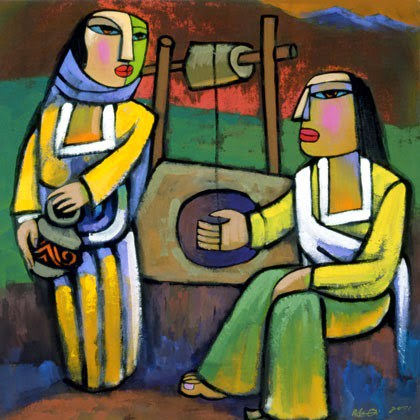
[Samaritan Woman at the Well by He Qi]
Jesus has left Judea accompanied by His disciples, with whom He’s headed to their common home region of Galilee.
They have to cut through a sliver of Samaria to get there.
Now, the Samaritans could trace their lineage back to Abraham and Sarah, the ancestors of all Jews, and lived in what had once been the northern portion of Israel. They were then, partly, Hebrews or Jews by heritage. But they had formed their own separate kingdom, the northern kingdom, with its own earthly ruler and their own center of worship. This happened after the death of Solomon in Old Testament times.
The Samaritans endured the scorn of the people of Judah to the south because they had intermingled the worship of Yahweh, I AM, with the worship of other gods; had removed themselves from Jerusalem as the place they offered sacrifices; had intermarried with unbelievers; and mixed the falsehoods of other religions with the revealed truth of God. And do you know what you get when you mix the revealed truth of God and the falsehoods of other religions? Nothing but falsehood that leaves you far from God.
Samaritans were hated by the Judeans, which is one reason why Jesus’ parable of the Good Samaritan scandalized them; they regarded the Samaritans as low-lives.*
When Jesus and the disciples got to the outskirts of the Samaritan village of Sychar, Jesus sat down at the well because He was exhausted, and the disciples went into the village to see if they could buy some food.
Take a look at what happens next, starting in John 4:7. “When a Samaritan woman came to draw water, Jesus said to her, ‘Will you give me a drink?’”
Then verse 9: “The Samaritan woman said to him, ‘You are a Jew and I am a Samaritan woman. How can you ask me for a drink?’ (For Jews do not associate with Samaritans.) Jesus answered her, ‘If you knew the gift of God and who it is that asks you for a drink, you would have asked him and he would have given you living water.’ ‘Sir,’ the woman said, ‘you have nothing to draw with and the well is deep. Where can you get this living water? Are you greater than our father Jacob, who gave us the well and drank from it himself, as did also his sons and his livestock?’ Jesus answered, ‘Everyone who drinks this water will be thirsty again, but whoever drinks the water I give them will never thirst. Indeed, the water I give them will become in them a spring of water welling up to eternal life.’ The woman said to him, ‘Sir, give me this water so that I won’t get thirsty and have to keep coming here to draw water.’”
Jesus starts out His conversation with this woman not by looking down on her. Jesus gives her dignity. He makes her feel that she has something to give to Him, even though His people demean Samaritans; even though He’s a man and she’s a woman living in an age in which women were to be seen but not heard; even though you and I know that He’s God in the flesh.
Sometimes, we Christians are guilty of looking down on people we think are less than us. If we reach out to them, we can be patronizing, our attitudes and words signaling the message, “Look at me being nice to you, even though you don’t deserve it.”
Jesus asked the woman if she would do something for Him. Sometimes the best act of loving service we can do for others is to let them serve us. When we do this, we give them respect.
A few weeks ago, my dad handed me a covered bowl of green beans and boiled potatoes, to take home. I could have said, “Dad, you don’t have to do that. You made that for mom and you and if I take any of it, there will be less for you.” But I thanked dad and took the green beans and boiled potatoes home with me.
I heated them up and, I have to tell you, they were delicious. I phoned my dad to tell him so. I genuinely appreciated this touch of home that I remember from my childhood at those times when dad sometimes fixed our meals.
But, I think it also made my dad feel good being able to do something for me...again.
That’s how the Samaritan woman felt.
But she was also stunned! She couldn’t believe a Jewish man was speaking to her.
Then, she gets practical: Jesus had nothing in which to hold water. And Jesus tells her that if she asked, He would give her water that would last forever.
This appealed to her because the Samaritan woman was likely even hated by her fellow Samaritans.
This is why she was at the well at the sixth hour, noon. As we’ll see, the woman was of less than sterling morals and had she gone to the well at the times when all the other women of the village were there--in the morning or at dusk--she would have been subjected to shunning or insults.
No wonder she jumped at the prospect of getting a never-ending supply of water!
How many people do we Christians alienate because we think that their morals don’t measure up?
How many people fail to drink Christ’s living water because we Christians refuse to dole it out to people whose sins we deem more odious than our own?
We can be guilty of making these kinds of judgments even though we know, to name a few examples:
- that homosexuality is no worse a sin than pride,
- that murder is no worse a sin than failing to love our neighbor,
- that adultery is no worse than taking God’s name in vain.
Verse 16: “He told her, ‘Go, call your husband and come back.’ ‘I have no husband,’ she replied. Jesus said to her, ‘You are right when you say you have no husband. The fact is, you have had five husbands, and the man you now have is not your husband. What you have just said is quite true.’”
By treating this woman with respect, Jesus has now earned the right to be honest with her.
We earn the right to share God’s Word and God’s sometimes uncomfortable truth with our neighbors when we treat them with respect.
Jesus knows that this woman has had five husbands and that now she’s shacking up with another man without the benefit of marriage, the rite instituted by God to be the exclusive place of intimacy between a man and a woman.
But Jesus is calling attention to more than just the woman’s adultery and fornication.
In the Old Testament, God referred to Himself as the husband of His people Israel (Isaiah 54:5-6) and He compared the idol worship that characterized life in Samaria as adultery (Jeremiah 3:20).
We commit adultery against God whenever we let anything--our jobs, our families, our country, our security--anything take the place in our lives that belongs exclusively to God.
In the New Testament, Jesus is called the Bridegroom to His bride, the Church (Revelation 21:2; Revelation 19:7; Mark 2:19).
Jesus is confronting this woman for the adultery she was daily committing both with the man with whom she lived and with the false gods she worshiped along with her people.
Now, this woman understands that Jesus is more than just a Jewish man at a Samaritan well. She tells Jesus that He must be a prophet. And then, she does something secular people often do when they meet someone who professes faith: She started talking religion.
I have this happen to me all the time. I'll be on a plane having a conversation with the passenger next to me. The conversation may go on for a time when they ask me what work I do. When I tell them that I'm a pastor, suddenly they start talking religion. Often they'll come up with the weirdest combination of religious ideas you can imagine. A woman once told me, "I believe in Jesus and stuff. But I also believe in reincarnation." Oy! We had quite a little talk after that.
People do this with me all the time. When they learn that I’m a pastor, they feel the need to start talking about their own religious beliefs, trying to prove to me how righteous they are.
But you know what? My opinion of people’s righteousness is totally unimportant. The only One Whose opinion matters is God. And God says that we are only righteous when we stop trying to justify ourselves and instead, humbly surrender to Him and trust in Jesus Christ for life. When we believe in Jesus, God covers us in Jesus' righteousness, the only brand of righteousness that impresses God or gains us entrance into God's kingdom.
Jesus refuses to accept any of this woman’s religious talk. Verse 21: “...a time is coming when you will worship the Father neither on this mountain nor in Jerusalem,” He says. Then in verse 23, He tells her: “...a time is coming and has now come when the true worshipers will worship the Father in the Spirit and in truth, for they are the kind of worshipers the Father seeks.”
At this, the woman shifts gears and starts talking about the Messiah. And it's here Jesus confronts her with the most amazing thing she will ever hear in her life. Verse 26, Jesus tells the woman:
“I, the one speaking to you—I am (Yahweh) he.”
What happens next is truly stunning.
This woman, who has been avoiding contact with anyone, runs back to the village to tell everyone: “Come, see a man who told me everything I ever did. Could this be the Messiah?”
If you remember nothing else from today’s message, remember this: The time to tell others about Jesus is now!
This woman doesn’t wait to go to seminary or attend a class or become familiar with all sixty-six books of the Bible. She has met Jesus. Now she's telling people about Jesus.
We make all sorts of excuses for not telling others about Jesus. Things like: “I’m not well enough informed.” “What if they ask me a question I can’t answer?”
The Samaritan woman was too excited about encountering Jesus to keep it to herself.
How excited are you about Jesus, our Living Water?
If you and I believe in Jesus, we have no excuses for not telling others about Him. Or, for failing to get to know Him better each day ourselves.
The woman got over herself to tell others about Jesus. We need to get over ourselves too!
In verse 39, the Samaritan woman tells the people of Sychar: “He told me everything I did.” “He knows all my sins,” she’s saying, “and He offered me the living water of forgiven sin and resurrection life through faith in Him anyway!”
The villagers come running to Jesus and say in verse 42: “We no longer believe just because of what you said; now we have heard for ourselves, and we know that this man really is the Savior of the world.”
Who could you establish a relationship with so that you could, like the woman at the well, earn the right to invite others to come and see Jesus?
Begin praying about that this week, please.
There’s a world of people like her--people running from their sins, running from others, running from life, running from God--who would come running to God if only you and I would tell them about Jesus, the living water.
So, what’s stopping us?
*Notice that after Jesus has told the parable of the Good Samaritan, the man who identified which of the three men who had encountered the wounded man on the road from Jerusalem to Jericho couldn't even bring himself to say that it was the Samaritan who had fulfilled God's law of love. The Judeans were loathe to ascribe anything positive to a Samaritan, even a fictional one. This is how bigotry can cloud the human heart.
[Blogger Mark Daniels is pastor of Living Water Lutheran Church in Centerville, Ohio. This was the message for worship this morning.]
Subscribe to:
Posts (Atom)