Showing posts with label John 4:5-42. Show all posts

Tuesday, March 14, 2023

When Worship Happens

[Below you'll find live stream video of worship with the people and friends of Living Water Lutheran Church that took place this past Sunday as well the message shared during both services.]

John 4:5-30, 39-42
A man came to visit me once. He was deeply troubled by something he had done years earlier. His wife became pregnant and he insisted that she have an abortion.

The man was overcome with grief and guilt, first of all, because of the little life that had been snuffed out and secondly, because, by his insistence, he laid deep guilt and regret on his wife while driving a wedge between him and his wife that had never diminished. He wondered what he could do to take both his and his wife’s guilt away.

Over the centuries, all of the religions of the world but one have tried to deal with this problem of human guilt and God’s expectation that we should be righteous by various forms of works righteousness, that is deeds or gestures the religions tell us we can do to overcome our sin.

These religions have been obsessive about creating systems of sacrifice. Through these systems, human beings, conscious of their sin, have made offerings of sacrifices to get out from under the guilt they know they bear.

In olden times, people offered up animals, plants, gold and silver, and even other human beings to try to make themselves right with God.

Today, people give up swearing for Lent, trumpet their contributions to good causes, and so on as a way of assuring themselves and the world and, sometimes, God, that they’re good, righteous people.

Even Old Testament Judaism had a system of sacrifices that saw the offering of sheep, pigeons, and grain, although King David reminded God’s people: “The sacrifices of God are a broken spirit; a broken and contrite heart, O God, you will not despise.” (Psalm 51:17, English Standard Version] God, David was saying, didn’t want our stuff or our showy deeds, he wanted hearts and lives turned to Him. He still does.

There are two big problems with sacrificial religions.

The first is that as soon as you offer up a sacrifice like putting a bit more in the offering plate or standing up for someone who’s being gossiped about, making you feel all clean and righteous based on your own behavior, you commit another sin. You take God’s name in vain. You entertain a lustful thought. You lose patience with your spouse or child.

The second problem with sacrificial religion is that you can never be sure you’ve sacrificed enough. And if a  sacrifice isn’t enough to cover a person’s sin, eternal separation from God is the consequence.

In today’s Gospel lesson, Jesus encounters a woman who confronts her sin and her sinful nature all the time.

She’s the woman at the well outside the Samaritan village of Sychar.

Married five times, now living with another man to whom she isn’t married, she goes to the well at noon each day, despite the scorching heat, to avoid condemnation and shunning from the other villagers.

From what she says to Jesus, the only hope she has for forgiveness or righteousness is in the sacrifices she and all Samaritans make at Mount Gerizim.

Under the sacrificial system, the woman at the well could only hope that her sacrifices could earn God’s forgiveness for her. But she could never be sure.

That’s why Samaritans and Jews kept offering sacrifices for their sins year after year, over and over again.

Now the woman meets Jesus.

Jesus asks her for a drink. She’s shocked because Jews won’t talk to Samaritans and Jewish men aren’t supposed to talk with women to whom they’re unrelated in public.

Then Jesus tells her that if she would ask Him, He could give her “a spring of water welling up to eternal life.” (John 4:14) Jesus is offering her a free gift that she thought she could only earn, a life with God that never ends.

The woman is dumbfounded with disbelief and fear.

Could Jesus be greater than Jacob, the Jewish patriarch who had dug this well for God’s people?

She would love to be out from under the condemnation of God, freed of her debt of sin, assured of life with God. “Sir,” she says, “give me this water so that I won’t get thirsty and have to keep coming here to draw water.” (John 4:15)

Knowing this woman and loving her the way God loves all of us sinners, Jesus now confronts the woman in her sin. God’s grace comes as new life to those who understand that they are otherwise dead in sin. That’s why Jesus tells us elsewhere, “Whoever wants to be my disciple must deny themselves and take up their cross daily and follow me.” (Luke 9:23)

Jesus now tells the Samaritan woman to bring her guilt to Him, the guilt from which she’s tried to run and for which she’s offered endless sacrifices. “Go,” Jesus says, “call your husband and come back.” (John 4:16)

Jesus has already offered the woman eternal life, the Gospel. But here, He surfaces the very set of sins–her serialized and continuing adulteries–to show her that even when the world’s religions of sacrifice and good works fail to give us peace with God or peace with ourselves,

Jesus gives us that peace as a free gift.

He gives us forgiveness.

He gives us life.

At the beginning of Jesus’ ministry, Mark tells us that He preached, “The kingdom of God has come near. Repent and believe the good news!” (Mark 1:15) By the well at Sychar, Jesus is proclaiming the same message to this woman who spent a lifetime in sin, regret, and shame. Turn from death and turn to Me, Jesus is telling her.

In the offer of living water, the woman had heard the Word of God’s grace. In Jesus’ request that she fetch her husband, she heard the Word of God’s Law condemning sin.

To her credit, she doesn’t try to dodge Jesus’ call to confession and repentance. She admits that she’s breaking the sixth commandment at that very moment and had many times before with other men.

When you and I gather for worship on Sunday mornings, the first thing we do is hear Jesus’ call to repentance. We turn to Jesus so that we can once more live in the freedom of forgiven sin and the grace of God by which we sinners are declared saints, NOT by sacrifices or religious works. NONE of that stuff can make us righteous or acceptable to God. Religious law cannot save us. It can only tell us, as it told the woman who had been trudging day-in, day-out to the village well burdened by guilt, unsure of God’s forgiveness, that we are sinners whose impulses, thoughts, attitudes, and actions merit condemnation.

In Romans 10:4, the apostle Paul writes that, “Christ is the culmination [or the fulfillment or the end] of the law so that there may be righteousness for everyone who believes.”

We are made righteous before God not because of sacrifices or works, but by grace through faith in Jesus alone.

Jesus tells the Samaritan woman that true worship isn’t about making sacrifices to God nor about the places where sacrifices are made, whether at Jerusalem. “A time is coming and has now come,” Jesus tells her, “when the true worshipers will worship the Father in the Spirit and in truth, for they are the kind of worshipers the Father seeks.” (John 4:23)

Listen, friends, to what Jesus is telling us: True worship isn’t about what we do for God or give to God.

Worship happens when needy sinners like you and me enter into the presence of God the Father, Son, and Holy Spirit and Jesus the Messiah explains everything to us, everything we need to have faith, to be righteous, to be assured that we are free of all condemnation by God!

Worship happens when, by the power of the Holy Spirit, we hear and believe the truth of the Gospel, as expressed by Paul in our second lesson today: “God demonstrates his own love for us in this: While we were still sinners, Christ died for us.” (Romans 5:8)

Worship is about what God gives to us in the Word and the Sacraments, not about what we think we do for or give to Him!

Each time we worship, Jesus Christ, sent to us by God the Father, presents Himself to us crucified and risen, and tells us, “The work of God is this: to believe in the one he has sent.” (John 6:29)

Each time we worship, He gives us the Word that the Holy Spirit uses to give us saving faith.

And each time we worship, Christ gives us His body and blood by which we are filled with His forgiveness and new life!
,
When the woman in our Gospel lesson hears Jesus identify Himself as the very Messiah Who could save her (and you and me), without our sacrifices but simply by grace through faith, she leaves her buckets behind and runs back into Sychar!

Head held high in the freedom of God’s forgiving Gospel, she tells the very people from whom she’s been hiding all about Jesus: “He told me everything I ever did!”

God wants you to hold your head high in His forgiving grace too, friends! He knows everything you ever did and loves you and died for you and rose for you anyway!

Nothing you ever do will ever make God love you any more than He already does.

Nothing you ever do–no sacrifice or good work–will ever make you more righteous than you are through Jesus Christ.

Jesus has already done everything needed to give you life with God!

It’s when we hear and receive this message, this gospel, that we worship in spirit and truth!

As Jesus says later in John’s Gospel: “Whoever hears my word and believes [the Father] who sent me has eternal life and will not be judged but has crossed over from death to life.” (John 5:24)

When you hear and believe Jesus’ word of life, your sin is not held against you and you are alive in God’s grace forever.

Friends, you can trust in that promise. Amen


Sunday, March 19, 2017

So, what's stopping us?

John 4:5-42
The fourth chapter of the gospel of John, with its account of Jesus’ encounter with a Samaritan woman and what results from it, is among my favorite places in Scripture.

I've taught on this passage many times. But, so far as I can remember, I’ve never preached about it. A thirty-eight verse lesson is a big bite to chew for preacher and congregation. Yet, the whole passage goes together as a cohesive unit and, in it, there are important things God has to tell us. So, this morning, let’s supersize, and listen to what God says to us in this meeting between Jesus--God the Son, the Word made flesh--and a woman who’d spent her entire life deep in the sins of human flesh.


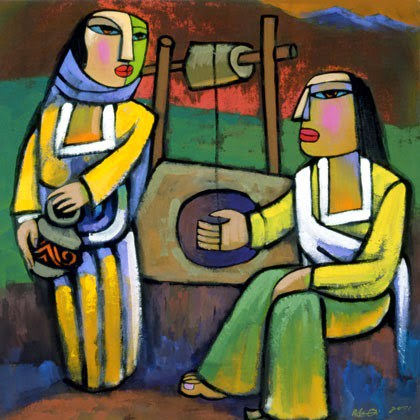
[Samaritan Woman at the Well by He Qi]

Jesus has left Judea accompanied by His disciples, with whom He’s headed to their common home region of Galilee.

They have to cut through a sliver of Samaria to get there.

Now, the Samaritans could trace their lineage back to Abraham and Sarah, the ancestors of all Jews, and lived in what had once been the northern portion of Israel. They were then, partly, Hebrews or Jews by heritage. But they had formed their own separate kingdom, the northern kingdom, with its own earthly ruler and their own center of worship. This happened after the death of Solomon in Old Testament times.

The Samaritans endured the scorn of the people of Judah to the south because they had intermingled the worship of Yahweh, I AM, with the worship of other gods; had removed themselves from Jerusalem as the place they offered sacrifices; had intermarried with unbelievers; and mixed the falsehoods of other religions with the revealed truth of God. And do you know what you get when you mix the revealed truth of God and the falsehoods of other religions? Nothing but falsehood that leaves you far from God.

Samaritans were hated by the Judeans, which is one reason why Jesus’ parable of the Good Samaritan scandalized them; they regarded the Samaritans as low-lives.*

When Jesus and the disciples got to the outskirts of the Samaritan village of Sychar, Jesus sat down at the well because He was exhausted, and the disciples went into the village to see if they could buy some food.

Take a look at what happens next, starting in John 4:7. “When a Samaritan woman came to draw water, Jesus said to her, ‘Will you give me a drink?’”

Then verse 9: “The Samaritan woman said to him, ‘You are a Jew and I am a Samaritan woman. How can you ask me for a drink?’ (For Jews do not associate with Samaritans.) Jesus answered her, ‘If you knew the gift of God and who it is that asks you for a drink, you would have asked him and he would have given you living water.’ ‘Sir,’ the woman said, ‘you have nothing to draw with and the well is deep. Where can you get this living water? Are you greater than our father Jacob, who gave us the well and drank from it himself, as did also his sons and his livestock?’ Jesus answered, ‘Everyone who drinks this water will be thirsty again, but whoever drinks the water I give them will never thirst. Indeed, the water I give them will become in them a spring of water welling up to eternal life.’ The woman said to him, ‘Sir, give me this water so that I won’t get thirsty and have to keep coming here to draw water.’”

Jesus starts out His conversation with this woman not by looking down on her. Jesus gives her dignity. He makes her feel that she has something to give to Him, even though His people demean Samaritans; even though He’s a man and she’s a woman living in an age in which women were to be seen but not heard; even though you and I know that He’s God in the flesh.

Sometimes, we Christians are guilty of looking down on people we think are less than us. If we reach out to them, we can be patronizing, our attitudes and words signaling the message, “Look at me being nice to you, even though you don’t deserve it.”

Jesus asked the woman if she would do something for Him. Sometimes the best act of loving service we can do for others is to let them serve us. When we do this, we give them respect.

A few weeks ago, my dad handed me a covered bowl of green beans and boiled potatoes, to take home. I could have said, “Dad, you don’t have to do that. You made that for mom and you and if I take any of it, there will be less for you.” But I thanked dad and took the green beans and boiled potatoes home with me.

I heated them up and, I have to tell you, they were delicious. I phoned my dad to tell him so. I genuinely appreciated this touch of home that I remember from my childhood at those times when dad sometimes fixed our meals.

But, I think it also made my dad feel good being able to do something for me...again.

That’s how the Samaritan woman felt.

But she was also stunned! She couldn’t believe a Jewish man was speaking to her.

Then, she gets practical: Jesus had nothing in which to hold water. And Jesus tells her that if she asked, He would give her water that would last forever.

This appealed to her because the Samaritan woman was likely even hated by her fellow Samaritans.

This is why she was at the well at the sixth hour, noon. As we’ll see, the woman was of less than sterling morals and had she gone to the well at the times when all the other women of the village were there--in the morning or at dusk--she would have been subjected to shunning or insults.

No wonder she jumped at the prospect of getting a never-ending supply of water!

How many people do we Christians alienate because we think that their morals don’t measure up?

How many people fail to drink Christ’s living water because we Christians refuse to dole it out to people whose sins we deem more odious than our own?

We can be guilty of making these kinds of judgments even though we know, to name a few examples:
  • that homosexuality is no worse a sin than pride,
  • that murder is no worse a sin than failing to love our neighbor,
  • that adultery is no worse than taking God’s name in vain.
The woman has given Jesus an opening for sharing more than a bucket of water. He, in turn, wants to give her the eternal life available to all who entrust their past and present sins, along with their whole lives, to Him in faith.

Verse 16: “He told her, ‘Go, call your husband and come back.’ ‘I have no husband,’ she replied. Jesus said to her, ‘You are right when you say you have no husband. The fact is, you have had five husbands, and the man you now have is not your husband. What you have just said is quite true.’”

By treating this woman with respect, Jesus has now earned the right to be honest with her.

We
earn the right to share God’s Word and God’s sometimes uncomfortable truth with our neighbors when we treat them with respect.

Jesus knows that this woman has had five husbands and that now she’s shacking up with another man without the benefit of marriage, the rite instituted by God to be the exclusive place of intimacy between a man and a woman.

But Jesus is calling attention to more than just the woman’s adultery and fornication.

In the Old Testament, God referred to Himself as the husband of His people Israel (Isaiah 54:5-6) and He compared the idol worship that characterized life in Samaria as adultery (Jeremiah 3:20).

We commit adultery against God whenever we let anything--our jobs, our families, our country, our security--anything take the place in our lives that belongs exclusively to God.

In the New Testament, Jesus is called the Bridegroom to His bride, the Church (Revelation 21:2; Revelation 19:7; Mark 2:19).

Jesus is confronting this woman for the adultery she was daily committing both with the man with whom she lived and with the false gods she worshiped along with her people.

Now, this woman understands that Jesus is more than just a Jewish man at a Samaritan well. She tells Jesus that He must be a prophet. And then, she does something secular people often do when they meet someone who professes faith: She started talking religion.

I have this happen to me all the time. I'll be on a plane having a conversation with the passenger next to me. The conversation may go on for a time when they ask me what work I do. When I tell them that I'm a pastor, suddenly they start talking religion. Often they'll come up with the weirdest combination of religious ideas you can imagine. A woman once told me, "I believe in Jesus and stuff. But I also believe in reincarnation." Oy! We had quite a little talk after that.

People do this with me all the time. When they learn that I’m a pastor, they feel the need to start talking about their own religious beliefs, trying to prove to me how righteous they are.

But you know what? My opinion of people’s righteousness is totally unimportant. The only One Whose opinion matters is God. And God says that we are only righteous when we stop trying to justify ourselves and instead, humbly surrender to Him and trust in Jesus Christ for life. When we believe in Jesus, God covers us in Jesus' righteousness, the only brand of righteousness that impresses God or gains us entrance into God's kingdom.

Jesus refuses to accept any of this woman’s religious talk. Verse 21: “...a time is coming when you will worship the Father neither on this mountain nor in Jerusalem,” He says. Then in verse 23, He tells her: “...a time is coming and has now come when the true worshipers will worship the Father in the Spirit and in truth, for they are the kind of worshipers the Father seeks.”

At this, the woman shifts gears and starts talking about the Messiah. And it's here Jesus confronts her with the most amazing thing she will ever hear in her life. Verse 26, Jesus tells the woman:

“I, the one speaking to you—I am (Yahweh) he.”

What happens next is truly stunning.

This woman, who has been avoiding contact with anyone, runs back to the village to tell everyone: “Come, see a man who told me everything I ever did. Could this be the Messiah?”

If you remember nothing else from today’s message, remember this: The time to tell others about Jesus is now!

This woman doesn’t wait to go to seminary or attend a class or become familiar with all sixty-six books of the Bible. She has met Jesus. Now she's telling people about Jesus.

We make all sorts of excuses for not telling others about Jesus. Things like: “I’m not well enough informed.” “What if they ask me a question I can’t answer?”

The Samaritan woman was too excited about encountering Jesus to keep it to herself.

How excited are you about Jesus, our Living Water?

If you and I believe in Jesus, we have no excuses for not telling others about Him. Or, for failing to get to know Him better each day ourselves.

The woman got over herself to tell others about Jesus. We need to get over ourselves too!

In verse 39, the Samaritan woman tells the people of Sychar: “He told me everything I did.” “He knows all my sins,” she’s saying, “and He offered me the living water of forgiven sin and resurrection life through faith in Him anyway!”

The villagers come running to Jesus and say in verse 42: “We no longer believe just because of what you said; now we have heard for ourselves, and we know that this man really is the Savior of the world.”

Who could you establish a relationship with so that you could, like the woman at the well, earn the right to invite others to come and see Jesus?

Begin praying about that this week, please.

There’s a world of people like her--people running from their sins, running from others, running from life, running from God--who would come running to God if only you and I would tell them about Jesus, the living water.

So, what’s stopping us?

*Notice that after Jesus has told the parable of the Good Samaritan, the man who identified which of the three men who had encountered the wounded man on the road from Jerusalem to Jericho couldn't even bring himself to say that it was the Samaritan who had fulfilled God's law of love. The Judeans were loathe to ascribe anything positive to a Samaritan, even a fictional one. This is how bigotry can cloud the human heart.

[Blogger Mark Daniels is pastor of Living Water Lutheran Church in Centerville, Ohio. This was the message for worship this morning.]


Sunday, March 27, 2011

Called to Obedience...Even When It's Inconvenient

[This was shared during worship with the people of Saint Matthew Lutheran Church in Logan, Ohio, earlier today.]

Exodus 17:1-7
True story about a woman we’ll call Jill.

It all started after Jill’s marriage ended. There she was, a single mom with a mortgage. Shortly thereafter, she lost her business.

Fortunately, she was able to get another job. But it was100% commission and she wondered how she was going to make it as she built up clientele and referrals.

In the midst of this turmoil, it struck Jill that it had been awhile since she had given God much thought. She went to a worship service one Sunday and heard the preacher challenge the congregation to consider tithing. The Bible speaks of believers giving 10% from the tops of their paychecks. That’s a tithe.

The pastor challenged the congregation with God’s words to the people of Israel in the Old Testament book of Malachi: “Bring the full tithe into the storehouse, so that there may be food in my house, and thus put me to the test, says the Lord of hosts; see if I will not open the windows of heaven for you and pour down for you an overflowing blessing.”

Jill had no idea what sorts of blessings God might have in mind for her and her child, but as she prayerfully considered those words, she decided that this was as good a time as any to put God first.

She realized that the Christian isn’t required to give a specified amount in offering to God. Jesus wants our whole lives, not just 10%, after all. But Jill felt that her tithe would be one way she would keep the first commandment, “You shall have no other gods before me” and the first part of Jesus’ Great Commandment, “You shall love the Lord your God with your heart, and with all your soul, and with all your mind.”

Jill remembered God’s past blessings and above all, the blessing of new life that belongs to all who turn from sin and believe in Jesus Christ as God, Savior, and Lord over their lives. Jill felt that these past blessings were good reason to trust God now. The following Friday, Jill received her paycheck. It was next to nothing. But on Saturday, she wrote a check equaling 10% of her skimpy pay for her offering.

“The funny thing is,” Ann and I have heard her say, “after that I always had what I needed. God took care of 100% of our needs on 90% of my income.”

Over time, Jill’s financial situation improved. Eventually, she joined our former congregation. On the first Sunday that she visited with us, Jill heard me say during the service, “If you are a first-time visitor, you’re not expected to make an offering; it’s our privilege to worship with you today.” When Jill heard that, she later told us, she thought, “There is no way you can keep me from giving my tithe, buddy!” Jill remembered God’s past faithfulness, even in a hard time, and, determined to obey His call in her life, her relationship with God was strengthened and deepened.

This is not a sermon about money. It’s about something else.

We Lutherans believe that justification by grace through faith—the salvation of sinners from sin and death through what Christ has done for us and through our faith in Christ—is the central doctrine of Biblical faith. But we also believe that it’s not the only doctrine of our faith.

We also confess that all who believe in Jesus are called to obedience to the will of God the Father, Son, and Holy Spirit. That also is a doctrine of Biblical faith. Martin Luther wrote: “When our Lord Jesus Christ said, Repent!, he meant for the whole life of the believer to be one of repentance.”

Repentance, you know, is more than mere sorrow for sin, it’s a constant turning to God in faith and in obedience to God’s will. We are to always hold our lives up for examination in the light of the Ten Commandments and seek forgiveness and the amendment of our lives through Christ. Obedience to God, however imperfectly rendered by we human beings, is the proper response to a life transformed by the grace and goodness of God, given to us through Jesus Christ...even when it’s inconvenient.

The same God Who claims us in Holy Baptism had saved His ancient people, the Hebrews or Israelites, when He led them through the waters of the sea and sent those same waters to drown the armies of Egypt, their one-time captor nation. Our first lesson, from Exodus, finds the Hebrews in the midst of their forty-year journey through the wilderness, heading to the land God had promised to their ancestor Abraham.

God’s people often found their forty-year trek an inconvenient time to be obedient to God. But God expected them to be obedient nonetheless.

Please pull out the Celebrate insert and look at the first lesson. Read verse 1 with me silently, please:
From the wilderness of Sin the whole congregation of the Israelites journeyed by stages, as the Lord commanded. They camped at Rephidim, but there was no water for the people to drink.
Now, the wilderness of Sin has nothing to do with sinfulness. “Sin” here is just a word related to “Sinai, S-i-n-a-i,” a name for the entire region through which the Hebrews were traveling.

We’re told that the people were moving by stages, in the orderly fashion commanded by God. The place God commanded them to go had no drinking water.

Had they stopped and thought, they might have remembered...
But, like all of us sometimes facing life’s wilderness experiences, the Hebrews forgot God and His past help.

I once heard a speaker ask a group of us, “What was the thing you were most worried about one year ago? Five years ago? Ten years ago?” All of us were hard pressed to remember the answers to any of those questions. The point: The God Who has helped you through past difficulties is capable of doing the same thing for you in today’s wilderness. God is still in the blessing business; we shouldn’t allow panic, worry, or challenges cause us to forget that!

Read verse 2, please.
The people quarreled with Moses, and said, "Give us water to drink." Moses said to them, "Why do you quarrel with me? Why do you test the Lord?” 
The Hebrews seemed to operate under the assumption that God would only allow easy times to accompany them through the wilderness. They couldn't imagine now that God had delivered them from Egypt He would ever allow any bad or difficult times come to them.

We can entertain similar thoughts. But that’s “magical thinking,” not real life faith. If God the Father didn’t insulate God the Son from the cross, what makes us think that any of us will be insulated from the realities of life—from the wilderness—in a fallen world?

The good news though, is that the God Who has conquered sin and death through the cross and Christ’s empty tomb gives all who trust in Him strength for our journeys through life and the certain hope of eternity with God!

Read verses 3 and 4 silently, please.
But the people thirsted there for water; and the people complained against Moses and said, "Why did you bring us out of Egypt, to kill us and our children and livestock with thirst?" So Moses cried out to the Lord, "What shall I do with this people? They are almost ready to stone me.” 
Look at Moses’ prayer and see how self-absorbed it is: “What shall I do…?” “They are almost ready to stone me.”

Moses here seems to forget that it’s God Who has freed and provided for His people in the wilderness, not him.  God is the shepherd; Moses is only God's imperfect human underling.

Moses suffers from the common workaholic tendency to think that the fate of the entire universe depends on him. (Believe me, I know what I’m talking about!)

Moses forgot that God is God and that he wasn’t. This is why our psalm for today says that Moses and his generation weren’t allowed to enter the promised land. Disobedience has its consequences even when we are repentant and God forgives us our sins. (I know about this, too. Even though I know God loves me and in Christ my sins are forgiven, I suffered a heart attack last summer, caused by my making the same mistake that Moses made, forgetting that God is God and I'm not! Even forgiven sinners must sometimes wrestle with the consequences of their sin.)

Read verses 5 and 6 please:
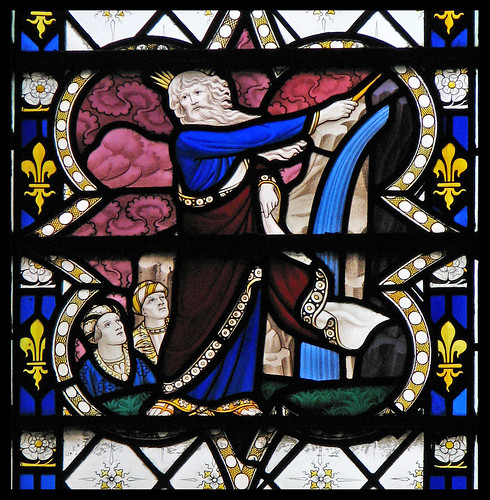
The Lord said to Moses, "Go on ahead of the people, and take some of the elders of Israel with you; take in your hand the staff with which you struck the Nile, and go. I will be standing there in front of you on the rock at Horeb. Strike the rock, and water will come out of it, so that the people may drink." 
The message God gave by telling Moses to use his staff could not have been clearer. This was the same staff that God told Moses to use to turn the waters of Egypt blood red and undrinkable in one of the plagues God used to force Egypt’s king, the Pharaoh, to let His people go.

God was reminding Moses and the people of Israel that, no matter the crisis, His power was undiminished. He could provide for His people.

Water is still known to run through lime deposits in the Sinai Peninsula today. But in bringing water from this rock in Sinai, the Creator of the universe bent creation itself to His purposes for His people. The God Who raised His Son from the dead to give life to all who believe in Christ can do similar things for those who trust and obey Him today.

Read verse 7, please:
[Moses] called the place Massah and Meribah, because the Israelites quarreled and tested the Lord, saying, "Is the Lord among us or not?” 
Moses gave two names to the place. Massah means test. God had tested the Hebrews faith and the Hebrews had, contrary to God’s commandment, put God to the test. Meribah is translated as quarrel. But it has a more specific meaning; it’s the word used when a plaintiff sues someone else in court. The people thought they were bringing suit against Moses, but really their beef had been with God. Their question was, “Is the Lord among us or not?”

We may be tempted to ask that same question at times. I'll never forget a Saturday afternoon in my first parish when I was called to a hospital in Toledo, where a member of the congregation had been life-flighted. While using a torch to cut a barrel in half for some neighbor boys, the barrel had exploded and crashed into his skull. When I arrived at the ER, he looked like someone who had been through a battle. The doctors said that his prognosis was hopeless. His mother, a wonderfully faithful woman who had endured the deaths of her husband and a grown child already, kept asking of this calamity that had befallen this son, the father of small children, "How could God have let this happen?" Where had God been? she wondered. We've all been in that wilderness!*

But, as our Gospel lesson reminds us, the God Who caused water to spring from a rock in the wilderness has come in Jesus Christ, the Word made flesh, to be the living water from heaven!

Jesus refreshes and makes new the thirsty souls of all who trust in Him and live lives of repentance and obedience to Him.

May we turn each day to Jesus, even in the inconvenient wilderness times of our lives, and live! Amen

*I'm happy to report that the man in question not only survived, thanks to the prayers of many, but is strong and well to this day!

Friday, February 22, 2008

Third Pass at This Sunday's Bible Lessons (February 24, 2008)

[You might want to look at the first two passes for this week. The first, here, also explains what the passes are about. Here is the second pass.]

Because the Gospel lesson for this coming Sunday, John 4:5-42, is so long, I'm not going to do verse-by-verse comments. Instead, a few general comments.

1. In 930 BC, the kingdom of Israel split into two nations. The south, with worship and civic life centered in Jerusalem, came to be called Judah or Judea. Jesus was raised in the hinterlands of Galilee, in the northern reaches of the southern kingdom.

The breakaway nation of Israel, with its worship and civic life centered on the city of Samaria, was the so-called northern kingdom. Israel, also called Samaria for its primary city, fell in 722 BC. (Judah was later conquered in 586 BC.)

But long after the northern kingdom was conquered, the enmity between the two peoples who had been part of God's people, the Judeans and the Samaritans, remained.

The Judeans, with some justification, regarded the Samaritans as faithless perverters of the faith. They looked down their noses on the Samaritans. Contact with Samaritans of any kind was something that Judeans avoided. This is why Jesus' conversation with the woman at the well in the Samaritan village of Sychar is so remarkable. It's the longest conversation of Jesus recorded in the Gospels.

For more on Samaria, see here.

2. Jesus, a Jew, speaking to a Samaritan, as happens in this narrative, isn't the only convention he flouts here. Men were also not supposed to speak to women in public. But Jesus not only speaks with this woman, He initiates the conversation.

3. Typically, scholars and preachers (including this preacher) have seen this woman as a person of loose morals, married five times and now living with another man without a marital commitment. The fact that she treks to the village well at the hottest part of the day also is suspicious, indirect evidence that her loose morals had earned her the shunning of the other women of the village, who would have gone to the well before or after the heat of the day.

But Fred Craddock, writing in his commentary on John, isn't so sure that this typical understanding of the Samaritan woman is right:
To be sure, Jesus knows she has been married five times and now "has" a man who is not her husband, but what are the particulars? Deaths? Divorces? Legal tangles? Or is it promiscuity? We do not know. All we know is that Jesus, as is his custom in [John's Gospel], reveals special knowledge of the individuals he encounters and alerts them that in meeting him they encounter the transcendent. Jesus does not urge the woman to repent or change her behavior.
So, we'll leave questions about the woman's virtue aside for now. This isn't of central importance to the text anyway.

4. My seminary mentor, the late Bruce Schein, writing in his commentary on John, saw a deeper significance to the woman's five husbands. It's based on the fact that the common Aramaic word for husband, baal and its plural, baalim, is the same name used of the false idols many in Samaria worshiped, either exclusively or with other deities. Hosea, a prophet from the northern kingdom, who lived in the seventh-century BC upbraided his fellow Samaritans for being faithless brides who, rather than keeping the First Commandment, had chased after other gods. Hosea had equated idolatry to adultery.

Writes Schein:
The talk of marriage and husbands, baalim, evokes thoughts of the prophet's language and naturally directs attention to the top of the mountain that overshadows them. There is the holy place which Judeans claim has been covered with temples to baalim borrowed from five pagan countries. Here the present worshipers do not truly acknowledge God as their only husband.
Understanding that Jesus isn't really talking about her husbands, but the idols which she and her fellow Samaritans venerate while still trying to be in relationship with God, makes sense of her next comment to Jesus: “Sir, I see that you are a prophet."

5. The theme of "living water" picks up on the Old Testament incident. Water is essential for life. And Jesus can be the source of water that, to those who receive, "will become...a spring of water gushing up to eternal life.”

6. I like what Craddock says in summarizing the significance of this encounter:
If any wish to be fascinated by this woman, let them be so [at what she does and says in verses 28 and 29]. She is a witness, but not a likely witness and not even a thorough witness. "A man told me all that I ever did" is not exactly a recitation of the Apostles' Creed. She is not even a convinced witness: "Can this be a the Christ?" is literally "This cannot be the Christ, can it?" Even so, her witness is enough: it is invitational (come and see), not judgmental; it is within the range permitted by her experience; it is honest with its own uncertainty; it is for everyone who will hear...
This woman, in fact, with her tentative recognition of Jesus, is a great model for all Christians to follow for sharing Jesus Christ. We don't have to have all the answers. (In fact, the person who claims to have all the answers is a terrible witness for Christ!) We just say, "This is what I personally know of Jesus. But come and see for yourself."

Monday, February 18, 2008

First Pass at This Sunday's Bible Lessons (February 24, 2008)

[Every week, I try to post a these explorations of the Bible lessons around which worship will be built on the following Sunday. The idea is to help the people of Saint Matthew Lutheran Church in Logan, Ohio, to prepare for worship. Others may be helped, too, since our lessons are those appointed to be used by what's called the Revised Common Lectionary. That's explained here.]

The Bible Lessons:
Exodus 17:1-7
Psalm 95
Romans 5:1-11
John 4:5-42

The Prayer of the Day:
Merciful God, the fountain of living water, you quench our thirst and wash away our sin. Give us this water always. Bring us to drink from the well that flows with the beauty of your truth
through Jesus Christ, our Savior and Lord, who lives and reigns with you and the Holy Spirit,
one God, now and forever. Amen

General Comments:
1. Each of these lessons are unique and have their own important themes. But a single motif runs through all of them and a single theme unites them.

The motif is water.

In the Old Testament lesson, there is a crisis of faith experienced by Moses and the people of Israel when, during their forty years in the wilderness, they run out of water and see no ready supply at hand. They doubt that God will provide it for them.

The Psalm recalls this incident, calling a later generation of Israelites to trust in God.

In Romans, the apostle Paul uses the image of water to speak of how God's love is "poured into" the hearts of believers through Jesus Christ.

Finally, in the Gospel lesson, Jesus' encounter with a woman at a well is the occasion for Him to describe Himself as "living water."

Water, of course, is fundamental to life. According to Wikipedia. com, "To function properly, the body requires between one and seven liters of water per day to avoid dehydration..." Scientists tell us that while human beings can live for long periods of time ingesting only water. And, of course, water is essential for agriculture. Wars have been fought over water.

So, you can see the point of all this water imagery: God is as essential to life as water AND it's a gift.

2. The theme is one that extends from last week: Faith or, more accurately, trust.

The Israelites, who had seen so many of God's miraculous signs, didn't trust that God would help them in the wilderness.

In Romans, Paul demonstrates to those who think his faith is bunk because his life was so marked by pain and adversity, that a Christian's faith is not based on God making things easier for us in this life. We know that our faith is authentic when, as we trust God, we experience peace with God. Peace isn't, he says, the absence of difficulty, pain, or tragedy, but reconciliation with God through Christ.

At the end of the Gospel lesson, the people of Samaria, enemies of God's people, believed in Jesus as the long-promised Messiah. Faith in Christ can transform anybody from an enemy to a friend of God.

3. Exodus 17:1-7: This incident is recounted in more detailed form in Numbers 20:1-13.

4. The Wilderness of Sin was a place lying between Elim and Mount Sinai. "Sin" doesn't refer to sinfulness. It's thought that the word has to do with a moon-deity worshiped by some Semitic peoples there. It would also appear to be the word Sinai.

5. This incident, in many ways, echoes incidents recounted in Exodus 16. Those involved the desire of the one-time slaves, recently freed from their captivity in Egypt, for bread and meat. Now, they want water.

6. Chris Haslam interestingly points out that earlier in Exodus, God gradually gained freedom for His people through the performance of ten signs, which He did through Moses. Now, in the wilderness, God undertakes ten tests, each designed to demonstrate the faith--or lack of it--of His people. The question is: Do the people believe in God as their provider? As Howard Wallace notes:
The people appear not to have developed much trust in God’s providence from the provision of the manna, for here again, they begin by complaining to Moses that he has brought them out of Egypt only to kill them, this time by thirst rather than hunger.
The upshot is that the people of Israel and their leader, Moses, fail their tests. God is with them. But the generation God sprang from captivity in Israel--with the exception of Joshua and Caleb, who always trusted in God--won't get into the Promised Land. It's their children who will make it.

Their experience and that of Moses point out that even when we repent for our sins and have our relationship with God restored, there are consequences to our faithlessness. Moses, as is confirmed in his appearance with Jesus at the mount of Transfiguration many centuries later, was and is part of God's kingdom. But by his rebellion, his life here was less than God had in mind for him.

7. The staff God commands Moses to use at Horeb is the same staff Moses had used to strike the Nile River (when God turned the water of Egypt into blood) and which he held up when God caused the waters of the sea to part for the escaping Hebrew slaves.

The staff had no magical powers. It was simply what God used at particular moments and at particular times, a means by which Moses was signaling God's presence and power. The act that God performs when Moses strikes the stone with the staff addresses the key issue behind the quarreling and questioning of the people: "Is the Lord among us or not?" (v. 7)

The same issue is addressed, in a different way, in the next incident recounted in Exodus. There, God's people face enemies who want to prevent their advance, the Amalekites. Moses puts Joshua in charge of recruiting and leading a group of Israelites in battle. In the meantime, Moses goes to the top of a hill and holds his staff aloft to God.

Again, the staff isn't magical. By lifting the staff to God, Moses was seeking the help of God. It was a confession that the battle to do God's will--which entering a promised land was--could not be done unless God accomplished it.

The staff may be easier to understand for those believers of a more sacramental bent of mind. When it comes to the bread and wine of Holy Communion or the water of Holy Baptism, we Lutherans, for example, believe that something really happens in these sacraments. The presence of God comes down to earth. The Spirit really does move in the water of Baptism to claim the baptized as a child of God. Jesus really is mysteriously present, body and blood, in the bread and the wine. But these elements remain, at the same time, what they were: water, bread, wine. As Martin Luther responds, in The Small Catechism, to the question about Baptism, "How can water do such great things?":
It is not the water indeed that does them, but the word of God which is in and with the water, and faith, which trusts such word of God in the water. For without the word of God the water is simple water and no baptism. But with the word of God it is a baptism, that is, a gracious water of life and a washing of regeneration in the Holy Ghost...
Luther writes in similar terms in answering two questions about Holy Communion:
How can bodily eating and drinking do such great things?

It is not the eating and drinking, indeed, that does them, but the words which stand here, namely: Given, and shed for you, for the remission of sins. Which words are, beside the bodily eating and drinking, as the chief thing in the Sacrament; and he that believes these words has what they say and express, namely, the forgiveness of sins.

Who, then, receives such Sacrament worthily?

Fasting and bodily preparation is, indeed, a fine outward training; but he is truly worthy and well prepared who has faith in these words: Given, and shed for you, for the remission of sins.

But he that does not believe these words, or doubts, is unworthy and unfit; for the words For you require altogether believing hearts.
Like the bread, wine, and water of the two Sacraments, Moses' staff in itself wasn't special. But what God did with it for one who faithfully used it in accordance with God's command was special.

8. I find it so interesting here that God shows such patience with the people--and with Moses--in spite of their whininess. Remember, this incident is a test from God. Like many of the tests of faith we go through in life, there will be no Technicolor sign posts saying, "This is a test of your faith." Often, it's only after we've gone through--and failed--a test of faith that we see it for what it was.

The time to prepare for a test is before it comes. We're prepared when, in the good and easier times of life, we rely on God, seek Him out in prayer, read His Word, attend to worship, and seek to do His will. God is close at hand all the time.

[More tomorrow, I hope.]