[This is the journal entry from my quiet time with God today. I use the stop, look, listen, and respond format for my quiet time. I stop to confess sins, pray for people and concerns, and then ask God to show me the truth in His Word that He wants me to see and apply that day. Then I read at a chapter of Scripture. This year, I'm following a plan for reading the New Testament created by the Navigators. In this process, I look for the specific verse or verses in which God seems to be most communicating with me in the reading. I then spend time listening, seeking to discern what I believe God is telling me in that passage that has caught my attention. Then, I respond to the truth that I've prayerfully discerned in some way. Today, I looked at 1 John, chapter 1.]
Look: “If we claim that we have fellowship with Him and are walking in the darkness, we are lying and not doing the truth. But if we are walking in the light as He is in the light, we have fellowship with one another and the blood of Jesus His Son cleanses us from all sin.” (1 John 1:6-7, Disciples Literal New Testament translation)
Darkness is that place that is outside of fellowship with the God we meet in Jesus. In the prologue to his gospel, John says of Jesus, God the Son Who came to share our human lives: “In him was life, and that life was the light of all mankind. The light shines in the darkness, and the darkness has not overcome it.” (John 1:4-5, NIV)
Because we’re born in sin, born with an impulse to get our own ways, to “be like God” as Genesis puts it, we’re born in darkness. I may know the difference between right and wrong because God’s Law is written on my heart. But I still like darkness for several reasons, I think:
1. I don’t want to see my sinful impulse or the sins I commit because of it. I’d rather go on living in the blissful delusion that I’m a good guy, righteous, right with God.
2. I don’t want others to see that I’m not as good a person as I portray myself to the world as being. All too often, I value my appearance over my character. I can be one of those whitewashed tombs Jesus talks about.
3. I don’t want God, when I get around to thinking of Him, to see my sin. Like Adam and Eve, I want to hide from God. But of course, that’s impossible.
In the wilderness, when God’s Old Testament people saw the bright reflection of God in Moses, they begged not to be made to see God face to face. In the perfect presence of God, my imperfections become painfully clear. But when God came into our world in the person of Jesus, the Light invaded this dark planet and today, by the power of the Holy Spirit, the crucified and risen Jesus confronts me. He commands me to repent and to believe in Him so that I can be part of God’s eternal kingdom. In essence, He wants me to:
1. Own the dark places in which I like to live and the dark acts I’ve committed that I try to hide from Him. US Supreme Court Justice Louis Brandeis said famously about public wrongs, “Sunlight is said to be the best of disinfectants; electric light the most efficient policeman.” It’s equally true of what Jesus, the Light of the world, does for me when I come into His presence. I can see how desperately I need the forgiveness of God that is available through Jesus. I also can see the clearly-illuminated path to life with God, Jesus Himself.
2. See the perfection of God and thereby see my need to worship Him, not myself, not my desires, not my family, not my country. I’m to worship the God Who made the universe, revealed definitively in Jesus, alone. When Jesus uncupped His hand allowing three of His disciples to see Jesus in His divine perfection, the disciples did the only sensible thing there was to do, they bowed down and worshiped Jesus. In Jesus, I see the ever-new life that He offers to me each day as I follow Him. (Also here.)
According to John in the Bible verse that has my attention today, when I willingly come to the Light of Jesus, God gives me fellowship with all the other confessed sinners who make up Christ’s Church and Jesus’ blood, shed on the cross, washes me clean of my sin, of my preference for and addiction to the darkness.
Listen: Today, God is calling me to absolute honesty in my dealings with Him. He isn’t calling me to a moral perfection of which I am incapable. He’s calling me to own what I try to conceal from Him, to bring it into His Light so that He can set me free from the darkness, the sin, that will otherwise be an ever-bigger wall between Him and me.
John carries this idea forward in the next three verses of his letter: “If we claim to be without sin, we deceive ourselves and the truth is not in us. If we confess our sins, he is faithful and just and will forgive us our sins and purify us from all unrighteousness. If we claim we have not sinned, we make him out to be a liar and his word is not in us.” (1 John 1:8-10)
I need to run to the Light, not away from Him!
Respond: Today, Lord, not as an exercise in self-abasement or self-recrimination, but from a desire to be renewed in You and Your grace, help me to bring all my darkness into Your presence. Help me to see the sin that clings to me. For the sake of Jesus and what He has done for me and the whole world, forgive me. Help me not to be afraid to walk in Your Light. Help me to see and live in the awesome love revealed in Jesus, a love that cares about me and calls me to live in Your bright kingdom now and always.
“Search me, God, and know my heart; test me and know my anxious thoughts.See if there is any offensive way in me, and lead me in the way everlasting…” (Psalm 139:23-24)
In Jesus’ name I pray. Amen
Showing posts with label Exodus 20:3. Show all posts
Showing posts with label Exodus 20:3. Show all posts
Friday, September 27, 2019

Friday, June 03, 2011
Christ or Culture?
Will we surrender to God or go along with the culture?
The daily need to answer that question has emerged as one of the major themes as we at Saint Matthew Lutheran Church in Logan, Ohio, spend a year reading the Bible together.*
In Exodus, God commanded His people to have no other gods but Him. Compassion, not egotism, is behind this command. Only God can give life, after all. To follow any other god, literally spells everlasting death. To spare ancient Israel, God's people, from such a fate, God called them to be "holy," a word that means set apart for God.
The ongoing challenge (and demand) God issued to His people is voiced by Joshua, the leader of the Israelites who succeeded Moses, when Joshua says:
But the Old Testament honestly reports that the lure of surrounding cultures repeatedly proved overpowering for Israel.
God called Israel into being to bring the possibility of new life from Him to all the world. Eventually, Christians believe, Israel gave birth to the Savior Jesus, God-in-the-flesh.
In Jesus, God issues the same command to all the world that He once issued to Israel. Before His death and resurrection, Jesus said:
But, as was true of the ancient Israelites, the lure of culture can sometimes prove overpowering. It's easier to follow the little gods you can see than it is to follow the God you can't see at the moment.
Besides, you're likely to find it easier going to go along with the culture than you will if you march to the rhythm of a different drum, especially if it's being played by God.
The contemporary American church isn't immune to going along to get along with the culture.
The conservative version of Christianity upheld by the "Christian Right" is a hyper American nationalism that uses the Bible to justify the rampant materialism and arrogance that non-Christians like Donald Trump readily endorse.
The liberal version of Christianity in vogue in "liberal Protestantism" attempts to put God's stamp of approval on cheap grace (that is, God's forgiveness without our repentance and salvation without trusting surrender to Jesus Christ) and, notably, the legitimization of sexual intimacy outside of marriage between a woman and a man.**
Whether done out of a well-meaning, but unintended, disregard for God's revealed will in Scripture or from an attempt to make their version of Christianity acceptable to a mass audience, both of these caricatures of Christianity are faithless.
They each are guilty of choosing favored cultural mores, rather than choosing to follow the God Who demands our acquiescence to His sometimes inconvenient truth. *
To be a "holy people," a people devoted to God, doesn't imply moral perfection. Christians are imperfect. We sin every day. As I've said elsewhere, we are recovering hypocrites who bring our lives before God each day in repentance, so that God not only can forgive us, but also perform reconstructive surgery on our souls.
To be a holy people, then, is to keep turning to God. It's to acknowledge the deep wisdom underlying Proverbs 3:5: "Trust in the Lord with all your heart, and do not rely on your own insight."
Believers in the God of the Bible are called to be subversives who run counter to the culture. "Choose this day..."
The God revealed in Christ or the gods of the prevailing cultures? "As for me and my house..."
*We started on March 9. We read about three chapters a day. Today's reading is 1 Samuel 28-31.
**This is the route chosen by my own denominational body. I pray regularly that it will reverse course.
The daily need to answer that question has emerged as one of the major themes as we at Saint Matthew Lutheran Church in Logan, Ohio, spend a year reading the Bible together.*
In Exodus, God commanded His people to have no other gods but Him. Compassion, not egotism, is behind this command. Only God can give life, after all. To follow any other god, literally spells everlasting death. To spare ancient Israel, God's people, from such a fate, God called them to be "holy," a word that means set apart for God.
The ongoing challenge (and demand) God issued to His people is voiced by Joshua, the leader of the Israelites who succeeded Moses, when Joshua says:
Now therefore revere the Lord, and serve him in sincerity and in faithfulness; put away the gods that your ancestors served beyond the River and in Egypt, and serve the Lord.
15
Now if you are unwilling to serve the Lord, choose this day whom you will serve, whether the gods your ancestors served in the region beyond the River or the gods of the Amorites in whose land you are living; but as for me and my household, we will serve the Lord.”
But the Old Testament honestly reports that the lure of surrounding cultures repeatedly proved overpowering for Israel.
God called Israel into being to bring the possibility of new life from Him to all the world. Eventually, Christians believe, Israel gave birth to the Savior Jesus, God-in-the-flesh.
In Jesus, God issues the same command to all the world that He once issued to Israel. Before His death and resurrection, Jesus said:
32“Everyone therefore who acknowledges me before others, I also will acknowledge before my Father in heaven; 33but whoever denies me before others, I also will deny before my Father in heaven." (Matthew 10:32-33)Again, God commands trust and obedience out of compassion, not egotism. Life only comes through the God made clear to the world in Jesus of Nazareth.
But, as was true of the ancient Israelites, the lure of culture can sometimes prove overpowering. It's easier to follow the little gods you can see than it is to follow the God you can't see at the moment.
Besides, you're likely to find it easier going to go along with the culture than you will if you march to the rhythm of a different drum, especially if it's being played by God.
The contemporary American church isn't immune to going along to get along with the culture.
The conservative version of Christianity upheld by the "Christian Right" is a hyper American nationalism that uses the Bible to justify the rampant materialism and arrogance that non-Christians like Donald Trump readily endorse.
The liberal version of Christianity in vogue in "liberal Protestantism" attempts to put God's stamp of approval on cheap grace (that is, God's forgiveness without our repentance and salvation without trusting surrender to Jesus Christ) and, notably, the legitimization of sexual intimacy outside of marriage between a woman and a man.**
Whether done out of a well-meaning, but unintended, disregard for God's revealed will in Scripture or from an attempt to make their version of Christianity acceptable to a mass audience, both of these caricatures of Christianity are faithless.
They each are guilty of choosing favored cultural mores, rather than choosing to follow the God Who demands our acquiescence to His sometimes inconvenient truth. *
To be a "holy people," a people devoted to God, doesn't imply moral perfection. Christians are imperfect. We sin every day. As I've said elsewhere, we are recovering hypocrites who bring our lives before God each day in repentance, so that God not only can forgive us, but also perform reconstructive surgery on our souls.
To be a holy people, then, is to keep turning to God. It's to acknowledge the deep wisdom underlying Proverbs 3:5: "Trust in the Lord with all your heart,
*We started on March 9. We read about three chapters a day. Today's reading is 1 Samuel 28-31.
**This is the route chosen by my own denominational body. I pray regularly that it will reverse course.
Sunday, May 15, 2011
The Only Way to God
[This was shared during worship with the people of Saint Matthew Lutheran Church in Logan, Ohio, earlier today.]
John 10:1-10
There’s a common belief held by many in our culture these days. You hear it all the time, whether in barber shops, on TV talk shows, or at church meetings. It’s the belief that all religious convictions are equal in their ability to lead people to God. You don’t need to give your sins or your life to Jesus exclusively, some people assert. They say, “All religions are headed to the same place.” Is that true?
Not according to Jesus! And in today’s Gospel lesson, Jesus uses two illustrations to point us to Who He is and to the relationship with God that you and I…and every person on the planet…can have only through Him.
But before considering what Jesus has to tell us today, we should set the scene. How is it that Jesus came to speak the words we find in John 10:1-10?
It all started when Jesus gave sight to a blind man in John 9. That caused a controversy because Jesus dared to do this loving deed on a Sabbath day. Jesus’ action made some of Jesus' fellow Jews--the Pharisees--so angry that when the blind man He healed said that Jesus must be from God, they threw the man out of the temple, no longer considering him a faithful Jew.
Of course, at one level, the Pharisees were nothing like people today who claim that all religious beliefs lead to God. The Pharisees believed that only by abiding by their extensive lists of religious rules could one be right with God. But, based on what God has revealed of Himself in both the Old and New Testaments, both the advocates of anything-goes spirituality in the twenty-first century and the Pharisees of the first century have one big thing in common: They are equally wrong. Accepting the assertions of either group will lead us away from God and the life God offers only in Jesus Christ.
Over the centuries, starting with a people to whom God gave a land and a promise, God has revealed Himself and His plan for the human race. From the beginning, the plan for a right relationship with God and for a life with Him that lasts forever has been the same. We are to give our lives back to the Giver of our lives and give our lives only to Him.
Genesis says that Abraham, the patriarch of Biblical faith, believed in God and God’s promises and that God “reckoned it to him as righteousness.” Abraham was right with God because he entrusted his life to God. He believed in God.
The New Testament book of Hebrews tells us that through the centuries, God revealed Himself through the prophets of Israel, but in these last days, God has revealed Himself definitively in Jesus. If we want to live with God, we need to listen Jesus.
All who turn from sin and believe in Jesus, God the Son, have the same blessings enjoyed by Abraham: rightness with God and life with God.
It isn’t because God is an egomaniac or because God wants to establish an exclusive club that the first commandment is, “You shall have no other gods” or that God commands exclusive fidelity to Jesus Christ.
It’s that God wants to give us life and only He can give it. Indeed, He will only give us life and, as Jesus puts it in today's Gospel lesson, life "abundantly," through Jesus Christ and our faith in Him.
All other roads are dead ends, literally dead ends.
So, in today's lesson, Jesus says that He is the shepherd of God’s sheep. Only Jesus can lead us into God’s sheepfold. People who try to get into the kingdom of God by other means are—whether through good works, other religious beliefs, or all manner of cosmic niceness—are, Jesus says, thieves and bandits. Look at verses 2 to 5 of the Gospel lesson printed on the Celebrate insert:
For just a second, think of God’s kingdom as a show everybody (including you and me) wants to see. The problem is that the gatekeeper—God the Father—will issue tickets to only one kind of customer: People who are absolutely clean and clear of sin.
That would leave us all on the outside, pining for a relationship with God because, as the Bible says, “all have sinned and fall short of the glory of God.”
Standing there in our sins, we would be without hope except for one thing: Jesus, the shepherd of the sheep, tells the gatekeeper, “It’s OK. She’s with me. He’s mine. You can let them in. I paid for their sins on the cross, the sacrifice of a sinless human being who didn’t deserve death on behalf of all other sinful human beings who deserved death.”
All who repent and believe in Christ are ushered into God’s eternal kingdom—long before their lives on this earth have ended, if they dare. Even now--even today--if you dare to trust in Him, you are living in Christ's eternal kingdom. As our second lesson from Peter reminds us, until we rise again, we live in a fallen world where suffering and challenges happen. But if suffering is a reality that can and does come to any of us, it's better to go through this life with Jesus leading us than to try to go it alone.
Those who heed Jesus’ voice live each day knowing that whatever our sins, deficiencies, and shortcomings, we belong to God forever! He is our ticket into eternity!
Like sheep attuned to the shepherd’s voice, when you dial into God through a relationship with Christ, you begin to know His voice. It brings incredible comfort, hope, and energy, straight from God, into your life!
Sometimes that voice will come with direction we'd rather not hear or will call us to do things we'd rather not do. I was the first person in my seminary class to interview for a call. It was for an associate pastor's position. There was another candidate who would be interviewing. Her candidacy made mine a long-shot because she had done her internship at that congregation. But my interview went well and, before Ann and I headed back to Columbus, the senior pastor told me he would be in touch in a few days. Days turned into weeks and weeks turned into a month, and still no word from the senior pastor or the congregation.
More than a month after the interview, I was scheduled to be at the district convention, where, along with all the recently graduated seminarians, I would be trotted onstage to be introduced. In the evening, a service of Holy Communion was held in a college auditorium. We had just finished confessing our sins when I looked to see that senior pastor. "Mark," he said, "God wouldn't let me take Holy Communion until I came to apologize to you. I'm so sorry I never contacted you to let you know that the other candidate received the call. I didn't want to tell you that, so I kept putting off contacting you. Would you please forgive me?"
You see, that senior pastor was known by the Shepherd of the sheep, Jesus. And he knew Jesus. So, when Jesus called on him to make things right, that's exactly what he did.
The Shepherd speaks to His children in other ways too.
A member of this congregation recently told me that after her husband died, she was sobbing in her bed one night, seeking comfort, when she sensed a hand on her shoulder. So real was the touch she felt, that she reached around to feel for the unseen hand. No hand was felt, but the touch was no less real. In that quiet exchange, one of Christ’s sheep heard His voice of comfort and healing. She was comforted because she is one of Jesus’ sheep. Jesus knows His own and His own know Him!
A friend of mine has pastored a Lutheran congregation for decades. In spite of his faithfulness and innovative leadership, the congregation hasn’t grown. It’s actually declined in membership, attendance, giving, and activity. Day after day, year after year, he has prayed and worked faithfully, sharing Christ, leading people to deeper levels of faithfulness. But things have only gotten worse.
Then one day last year, after a long time in prayer, he sensed God asking him, “You pray for this renewal to happen, for new people to come to faith in Christ. But have you prayed that all the evil in the world that conspires against that happening be kept from this church, kept from its people, kept from the places where worship and education and planning happen?” No, my friend told God, he hadn’t done that in prayer. “Do it now!” God seemed to tell him forcefully.
And so, my friend went all through the church facility, praying in every room, asking God to take control of all that happened there, to displace Satan and all evil from every inch, and to fill the building and the people of the church with the Father, Son, and Holy Spirit, with the power and truth of the Word of God!
Things haven’t yet changed in that congregation. But my friend now knows they will change. That’s because after he had prayerfully surrendered himself and his congregation and prayed that God would prevail over all evil that assailed them, the good shepherd assured him that all he had prayed for would come to pass.
God gave him a vision of a sanctuary filled with joyful people excited to be in God’s presence, excited to give themselves in worship to God on Sunday morning in anticipation of using their whole lives to worship God through the week. The voice of the shepherd spoke to my friend and he was filled with comfort, renewed hope, and holy energy!
But Jesus uses another image in our lesson to describe Who He is; He says that He is also the gate to eternity.
Years ago, Ann and I went to a party and realized after we got back home that we’d locked ourselves out of the house. Long story short, with Ann’s help I was able to push myself through a first-floor window that we had left partially opened. I was halfway into the house by this route, my arms and torso inside, my legs still hanging outside, when a thought crossed my mind: How would I explain this to a policeman? After all, if you belong somewhere, you don’t have to break in. You go through the front door.
Jesus is the front door, the only door—the only gate—to life with God, to the abundant, everlasting life that God wants to give to all people. You can't get into God's kingdom in any other way! “No one comes to the Father except through Me,” Jesus says elsewhere. “If you know Me, you will know the Father also. From now on, you do know Him and have seen Him.”
The real quest of the Christian life is to get to know the God revealed in Jesus Christ. This “quest” isn’t an onerous task. It’s a joy like falling in love.
That’s why I hope that every member of Saint Matthew will not only regularly worship and receive the Body and Blood of our Lord, but also join us, even belatedly, in reading the Bible in a year.
I hope that every member will be in Sunday School. (Yes, every member.)
I hope that we’ll all make prayer a daily habit.
I hope that you’ll help us share Christ in a very practical way when we collect those filled grocery sacks next Saturday during our PPSST! Food Drive.
These are all ways to follow the voice of Jesus, ways to enter more deeply into a relationship with God that only comes through Jesus.
This past week, at the graveside of our friend Betty, we heard her confirmation verses. Betty chose them sixty years ago when she was confirmed at the age of 23. They're words of Jesus from Matthew 10:32-33:
Let yourself get to know Him better.
Trust in Him and in His Word alone.
As you do, you’ll hear His voice over the din of an often-confusing world and He will lead you to a life prepared for you, a life that here will sometimes bring inexplicable challenges, but also a life that never ends, a life filled with the presence of God, today and always.
The Shepherd is calling you today. Follow Him…and live!
John 10:1-10
There’s a common belief held by many in our culture these days. You hear it all the time, whether in barber shops, on TV talk shows, or at church meetings. It’s the belief that all religious convictions are equal in their ability to lead people to God. You don’t need to give your sins or your life to Jesus exclusively, some people assert. They say, “All religions are headed to the same place.” Is that true?
Not according to Jesus! And in today’s Gospel lesson, Jesus uses two illustrations to point us to Who He is and to the relationship with God that you and I…and every person on the planet…can have only through Him.
But before considering what Jesus has to tell us today, we should set the scene. How is it that Jesus came to speak the words we find in John 10:1-10?
It all started when Jesus gave sight to a blind man in John 9. That caused a controversy because Jesus dared to do this loving deed on a Sabbath day. Jesus’ action made some of Jesus' fellow Jews--the Pharisees--so angry that when the blind man He healed said that Jesus must be from God, they threw the man out of the temple, no longer considering him a faithful Jew.
Of course, at one level, the Pharisees were nothing like people today who claim that all religious beliefs lead to God. The Pharisees believed that only by abiding by their extensive lists of religious rules could one be right with God. But, based on what God has revealed of Himself in both the Old and New Testaments, both the advocates of anything-goes spirituality in the twenty-first century and the Pharisees of the first century have one big thing in common: They are equally wrong. Accepting the assertions of either group will lead us away from God and the life God offers only in Jesus Christ.
Over the centuries, starting with a people to whom God gave a land and a promise, God has revealed Himself and His plan for the human race. From the beginning, the plan for a right relationship with God and for a life with Him that lasts forever has been the same. We are to give our lives back to the Giver of our lives and give our lives only to Him.
Genesis says that Abraham, the patriarch of Biblical faith, believed in God and God’s promises and that God “reckoned it to him as righteousness.” Abraham was right with God because he entrusted his life to God. He believed in God.
The New Testament book of Hebrews tells us that through the centuries, God revealed Himself through the prophets of Israel, but in these last days, God has revealed Himself definitively in Jesus. If we want to live with God, we need to listen Jesus.
All who turn from sin and believe in Jesus, God the Son, have the same blessings enjoyed by Abraham: rightness with God and life with God.
It isn’t because God is an egomaniac or because God wants to establish an exclusive club that the first commandment is, “You shall have no other gods” or that God commands exclusive fidelity to Jesus Christ.
It’s that God wants to give us life and only He can give it. Indeed, He will only give us life and, as Jesus puts it in today's Gospel lesson, life "abundantly," through Jesus Christ and our faith in Him.
All other roads are dead ends, literally dead ends.
So, in today's lesson, Jesus says that He is the shepherd of God’s sheep. Only Jesus can lead us into God’s sheepfold. People who try to get into the kingdom of God by other means are—whether through good works, other religious beliefs, or all manner of cosmic niceness—are, Jesus says, thieves and bandits. Look at verses 2 to 5 of the Gospel lesson printed on the Celebrate insert:
The one who enters by the gate is the shepherd of the sheep. The gatekeeper opens the gate for him, and the sheep hear his voice. He calls his own sheep by name and leads them out. When he has brought out all his own, he goes ahead of them, and the sheep follow him because they know his voice. They will not follow a stranger, but they will run from him because they do not know the voice of strangers.In this illustration, Jesus is the shepherd. God the Father is the gatekeeper.
For just a second, think of God’s kingdom as a show everybody (including you and me) wants to see. The problem is that the gatekeeper—God the Father—will issue tickets to only one kind of customer: People who are absolutely clean and clear of sin.
That would leave us all on the outside, pining for a relationship with God because, as the Bible says, “all have sinned and fall short of the glory of God.”
Standing there in our sins, we would be without hope except for one thing: Jesus, the shepherd of the sheep, tells the gatekeeper, “It’s OK. She’s with me. He’s mine. You can let them in. I paid for their sins on the cross, the sacrifice of a sinless human being who didn’t deserve death on behalf of all other sinful human beings who deserved death.”
All who repent and believe in Christ are ushered into God’s eternal kingdom—long before their lives on this earth have ended, if they dare. Even now--even today--if you dare to trust in Him, you are living in Christ's eternal kingdom. As our second lesson from Peter reminds us, until we rise again, we live in a fallen world where suffering and challenges happen. But if suffering is a reality that can and does come to any of us, it's better to go through this life with Jesus leading us than to try to go it alone.
Those who heed Jesus’ voice live each day knowing that whatever our sins, deficiencies, and shortcomings, we belong to God forever! He is our ticket into eternity!
Like sheep attuned to the shepherd’s voice, when you dial into God through a relationship with Christ, you begin to know His voice. It brings incredible comfort, hope, and energy, straight from God, into your life!
Sometimes that voice will come with direction we'd rather not hear or will call us to do things we'd rather not do. I was the first person in my seminary class to interview for a call. It was for an associate pastor's position. There was another candidate who would be interviewing. Her candidacy made mine a long-shot because she had done her internship at that congregation. But my interview went well and, before Ann and I headed back to Columbus, the senior pastor told me he would be in touch in a few days. Days turned into weeks and weeks turned into a month, and still no word from the senior pastor or the congregation.
More than a month after the interview, I was scheduled to be at the district convention, where, along with all the recently graduated seminarians, I would be trotted onstage to be introduced. In the evening, a service of Holy Communion was held in a college auditorium. We had just finished confessing our sins when I looked to see that senior pastor. "Mark," he said, "God wouldn't let me take Holy Communion until I came to apologize to you. I'm so sorry I never contacted you to let you know that the other candidate received the call. I didn't want to tell you that, so I kept putting off contacting you. Would you please forgive me?"
You see, that senior pastor was known by the Shepherd of the sheep, Jesus. And he knew Jesus. So, when Jesus called on him to make things right, that's exactly what he did.
The Shepherd speaks to His children in other ways too.
A member of this congregation recently told me that after her husband died, she was sobbing in her bed one night, seeking comfort, when she sensed a hand on her shoulder. So real was the touch she felt, that she reached around to feel for the unseen hand. No hand was felt, but the touch was no less real. In that quiet exchange, one of Christ’s sheep heard His voice of comfort and healing. She was comforted because she is one of Jesus’ sheep. Jesus knows His own and His own know Him!
A friend of mine has pastored a Lutheran congregation for decades. In spite of his faithfulness and innovative leadership, the congregation hasn’t grown. It’s actually declined in membership, attendance, giving, and activity. Day after day, year after year, he has prayed and worked faithfully, sharing Christ, leading people to deeper levels of faithfulness. But things have only gotten worse.
Then one day last year, after a long time in prayer, he sensed God asking him, “You pray for this renewal to happen, for new people to come to faith in Christ. But have you prayed that all the evil in the world that conspires against that happening be kept from this church, kept from its people, kept from the places where worship and education and planning happen?” No, my friend told God, he hadn’t done that in prayer. “Do it now!” God seemed to tell him forcefully.
And so, my friend went all through the church facility, praying in every room, asking God to take control of all that happened there, to displace Satan and all evil from every inch, and to fill the building and the people of the church with the Father, Son, and Holy Spirit, with the power and truth of the Word of God!
Things haven’t yet changed in that congregation. But my friend now knows they will change. That’s because after he had prayerfully surrendered himself and his congregation and prayed that God would prevail over all evil that assailed them, the good shepherd assured him that all he had prayed for would come to pass.
God gave him a vision of a sanctuary filled with joyful people excited to be in God’s presence, excited to give themselves in worship to God on Sunday morning in anticipation of using their whole lives to worship God through the week. The voice of the shepherd spoke to my friend and he was filled with comfort, renewed hope, and holy energy!
But Jesus uses another image in our lesson to describe Who He is; He says that He is also the gate to eternity.
Years ago, Ann and I went to a party and realized after we got back home that we’d locked ourselves out of the house. Long story short, with Ann’s help I was able to push myself through a first-floor window that we had left partially opened. I was halfway into the house by this route, my arms and torso inside, my legs still hanging outside, when a thought crossed my mind: How would I explain this to a policeman? After all, if you belong somewhere, you don’t have to break in. You go through the front door.
Jesus is the front door, the only door—the only gate—to life with God, to the abundant, everlasting life that God wants to give to all people. You can't get into God's kingdom in any other way! “No one comes to the Father except through Me,” Jesus says elsewhere. “If you know Me, you will know the Father also. From now on, you do know Him and have seen Him.”
The real quest of the Christian life is to get to know the God revealed in Jesus Christ. This “quest” isn’t an onerous task. It’s a joy like falling in love.
That’s why I hope that every member of Saint Matthew will not only regularly worship and receive the Body and Blood of our Lord, but also join us, even belatedly, in reading the Bible in a year.
I hope that every member will be in Sunday School. (Yes, every member.)
I hope that we’ll all make prayer a daily habit.
I hope that you’ll help us share Christ in a very practical way when we collect those filled grocery sacks next Saturday during our PPSST! Food Drive.
These are all ways to follow the voice of Jesus, ways to enter more deeply into a relationship with God that only comes through Jesus.
This past week, at the graveside of our friend Betty, we heard her confirmation verses. Betty chose them sixty years ago when she was confirmed at the age of 23. They're words of Jesus from Matthew 10:32-33:
"Everyone therefore who acknowledges me before others, I also will acknowledge before my Father in heaven; but whoever denies me before others, I also will deny before my Father in heaven.”Freedom from sin comes only to those who turn away from the dead-end ways of the world and trust the only One Who can give us forgiveness and new life, Jesus, the good shepherd and the gate—the front door—to eternity.
Let yourself get to know Him better.
Trust in Him and in His Word alone.
As you do, you’ll hear His voice over the din of an often-confusing world and He will lead you to a life prepared for you, a life that here will sometimes bring inexplicable challenges, but also a life that never ends, a life filled with the presence of God, today and always.
The Shepherd is calling you today. Follow Him…and live!
Sunday, March 27, 2011
Called to Obedience...Even When It's Inconvenient
[This was shared during worship with the people of Saint Matthew Lutheran Church in Logan, Ohio, earlier today.]
Exodus 17:1-7
True story about a woman we’ll call Jill.
It all started after Jill’s marriage ended. There she was, a single mom with a mortgage. Shortly thereafter, she lost her business.
Fortunately, she was able to get another job. But it was100% commission and she wondered how she was going to make it as she built up clientele and referrals.
In the midst of this turmoil, it struck Jill that it had been awhile since she had given God much thought. She went to a worship service one Sunday and heard the preacher challenge the congregation to consider tithing. The Bible speaks of believers giving 10% from the tops of their paychecks. That’s a tithe.
The pastor challenged the congregation with God’s words to the people of Israel in the Old Testament book of Malachi: “Bring the full tithe into the storehouse, so that there may be food in my house, and thus put me to the test, says the Lord of hosts; see if I will not open the windows of heaven for you and pour down for you an overflowing blessing.”
Jill had no idea what sorts of blessings God might have in mind for her and her child, but as she prayerfully considered those words, she decided that this was as good a time as any to put God first.
She realized that the Christian isn’t required to give a specified amount in offering to God. Jesus wants our whole lives, not just 10%, after all. But Jill felt that her tithe would be one way she would keep the first commandment, “You shall have no other gods before me” and the first part of Jesus’ Great Commandment, “You shall love the Lord your God with your heart, and with all your soul, and with all your mind.”
Jill remembered God’s past blessings and above all, the blessing of new life that belongs to all who turn from sin and believe in Jesus Christ as God, Savior, and Lord over their lives. Jill felt that these past blessings were good reason to trust God now. The following Friday, Jill received her paycheck. It was next to nothing. But on Saturday, she wrote a check equaling 10% of her skimpy pay for her offering.
“The funny thing is,” Ann and I have heard her say, “after that I always had what I needed. God took care of 100% of our needs on 90% of my income.”
Over time, Jill’s financial situation improved. Eventually, she joined our former congregation. On the first Sunday that she visited with us, Jill heard me say during the service, “If you are a first-time visitor, you’re not expected to make an offering; it’s our privilege to worship with you today.” When Jill heard that, she later told us, she thought, “There is no way you can keep me from giving my tithe, buddy!” Jill remembered God’s past faithfulness, even in a hard time, and, determined to obey His call in her life, her relationship with God was strengthened and deepened.
This is not a sermon about money. It’s about something else.
We Lutherans believe that justification by grace through faith—the salvation of sinners from sin and death through what Christ has done for us and through our faith in Christ—is the central doctrine of Biblical faith. But we also believe that it’s not the only doctrine of our faith.
We also confess that all who believe in Jesus are called to obedience to the will of God the Father, Son, and Holy Spirit. That also is a doctrine of Biblical faith. Martin Luther wrote: “When our Lord Jesus Christ said, Repent!, he meant for the whole life of the believer to be one of repentance.”
Repentance, you know, is more than mere sorrow for sin, it’s a constant turning to God in faith and in obedience to God’s will. We are to always hold our lives up for examination in the light of the Ten Commandments and seek forgiveness and the amendment of our lives through Christ. Obedience to God, however imperfectly rendered by we human beings, is the proper response to a life transformed by the grace and goodness of God, given to us through Jesus Christ...even when it’s inconvenient.
The same God Who claims us in Holy Baptism had saved His ancient people, the Hebrews or Israelites, when He led them through the waters of the sea and sent those same waters to drown the armies of Egypt, their one-time captor nation. Our first lesson, from Exodus, finds the Hebrews in the midst of their forty-year journey through the wilderness, heading to the land God had promised to their ancestor Abraham.
God’s people often found their forty-year trek an inconvenient time to be obedient to God. But God expected them to be obedient nonetheless.
Please pull out the Celebrate insert and look at the first lesson. Read verse 1 with me silently, please:
We’re told that the people were moving by stages, in the orderly fashion commanded by God. The place God commanded them to go had no drinking water.
Had they stopped and thought, they might have remembered...
I once heard a speaker ask a group of us, “What was the thing you were most worried about one year ago? Five years ago? Ten years ago?” All of us were hard pressed to remember the answers to any of those questions. The point: The God Who has helped you through past difficulties is capable of doing the same thing for you in today’s wilderness. God is still in the blessing business; we shouldn’t allow panic, worry, or challenges cause us to forget that!
Read verse 2, please.
We can entertain similar thoughts. But that’s “magical thinking,” not real life faith. If God the Father didn’t insulate God the Son from the cross, what makes us think that any of us will be insulated from the realities of life—from the wilderness—in a fallen world?
The good news though, is that the God Who has conquered sin and death through the cross and Christ’s empty tomb gives all who trust in Him strength for our journeys through life and the certain hope of eternity with God!
Read verses 3 and 4 silently, please.
Moses here seems to forget that it’s God Who has freed and provided for His people in the wilderness, not him. God is the shepherd; Moses is only God's imperfect human underling.
Moses suffers from the common workaholic tendency to think that the fate of the entire universe depends on him. (Believe me, I know what I’m talking about!)
Moses forgot that God is God and that he wasn’t. This is why our psalm for today says that Moses and his generation weren’t allowed to enter the promised land. Disobedience has its consequences even when we are repentant and God forgives us our sins. (I know about this, too. Even though I know God loves me and in Christ my sins are forgiven, I suffered a heart attack last summer, caused by my making the same mistake that Moses made, forgetting that God is God and I'm not! Even forgiven sinners must sometimes wrestle with the consequences of their sin.)
Read verses 5 and 6 please:
God was reminding Moses and the people of Israel that, no matter the crisis, His power was undiminished. He could provide for His people.
Water is still known to run through lime deposits in the Sinai Peninsula today. But in bringing water from this rock in Sinai, the Creator of the universe bent creation itself to His purposes for His people. The God Who raised His Son from the dead to give life to all who believe in Christ can do similar things for those who trust and obey Him today.
Read verse 7, please:
We may be tempted to ask that same question at times. I'll never forget a Saturday afternoon in my first parish when I was called to a hospital in Toledo, where a member of the congregation had been life-flighted. While using a torch to cut a barrel in half for some neighbor boys, the barrel had exploded and crashed into his skull. When I arrived at the ER, he looked like someone who had been through a battle. The doctors said that his prognosis was hopeless. His mother, a wonderfully faithful woman who had endured the deaths of her husband and a grown child already, kept asking of this calamity that had befallen this son, the father of small children, "How could God have let this happen?" Where had God been? she wondered. We've all been in that wilderness!*
But, as our Gospel lesson reminds us, the God Who caused water to spring from a rock in the wilderness has come in Jesus Christ, the Word made flesh, to be the living water from heaven!
Jesus refreshes and makes new the thirsty souls of all who trust in Him and live lives of repentance and obedience to Him.
May we turn each day to Jesus, even in the inconvenient wilderness times of our lives, and live! Amen
*I'm happy to report that the man in question not only survived, thanks to the prayers of many, but is strong and well to this day!
Exodus 17:1-7
True story about a woman we’ll call Jill.
It all started after Jill’s marriage ended. There she was, a single mom with a mortgage. Shortly thereafter, she lost her business.
Fortunately, she was able to get another job. But it was100% commission and she wondered how she was going to make it as she built up clientele and referrals.
In the midst of this turmoil, it struck Jill that it had been awhile since she had given God much thought. She went to a worship service one Sunday and heard the preacher challenge the congregation to consider tithing. The Bible speaks of believers giving 10% from the tops of their paychecks. That’s a tithe.
The pastor challenged the congregation with God’s words to the people of Israel in the Old Testament book of Malachi: “Bring the full tithe into the storehouse, so that there may be food in my house, and thus put me to the test, says the Lord of hosts; see if I will not open the windows of heaven for you and pour down for you an overflowing blessing.”
Jill had no idea what sorts of blessings God might have in mind for her and her child, but as she prayerfully considered those words, she decided that this was as good a time as any to put God first.
She realized that the Christian isn’t required to give a specified amount in offering to God. Jesus wants our whole lives, not just 10%, after all. But Jill felt that her tithe would be one way she would keep the first commandment, “You shall have no other gods before me” and the first part of Jesus’ Great Commandment, “You shall love the Lord your God with your heart, and with all your soul, and with all your mind.”
Jill remembered God’s past blessings and above all, the blessing of new life that belongs to all who turn from sin and believe in Jesus Christ as God, Savior, and Lord over their lives. Jill felt that these past blessings were good reason to trust God now. The following Friday, Jill received her paycheck. It was next to nothing. But on Saturday, she wrote a check equaling 10% of her skimpy pay for her offering.
“The funny thing is,” Ann and I have heard her say, “after that I always had what I needed. God took care of 100% of our needs on 90% of my income.”
Over time, Jill’s financial situation improved. Eventually, she joined our former congregation. On the first Sunday that she visited with us, Jill heard me say during the service, “If you are a first-time visitor, you’re not expected to make an offering; it’s our privilege to worship with you today.” When Jill heard that, she later told us, she thought, “There is no way you can keep me from giving my tithe, buddy!” Jill remembered God’s past faithfulness, even in a hard time, and, determined to obey His call in her life, her relationship with God was strengthened and deepened.
This is not a sermon about money. It’s about something else.
We Lutherans believe that justification by grace through faith—the salvation of sinners from sin and death through what Christ has done for us and through our faith in Christ—is the central doctrine of Biblical faith. But we also believe that it’s not the only doctrine of our faith.
We also confess that all who believe in Jesus are called to obedience to the will of God the Father, Son, and Holy Spirit. That also is a doctrine of Biblical faith. Martin Luther wrote: “When our Lord Jesus Christ said, Repent!, he meant for the whole life of the believer to be one of repentance.”
Repentance, you know, is more than mere sorrow for sin, it’s a constant turning to God in faith and in obedience to God’s will. We are to always hold our lives up for examination in the light of the Ten Commandments and seek forgiveness and the amendment of our lives through Christ. Obedience to God, however imperfectly rendered by we human beings, is the proper response to a life transformed by the grace and goodness of God, given to us through Jesus Christ...even when it’s inconvenient.
The same God Who claims us in Holy Baptism had saved His ancient people, the Hebrews or Israelites, when He led them through the waters of the sea and sent those same waters to drown the armies of Egypt, their one-time captor nation. Our first lesson, from Exodus, finds the Hebrews in the midst of their forty-year journey through the wilderness, heading to the land God had promised to their ancestor Abraham.
God’s people often found their forty-year trek an inconvenient time to be obedient to God. But God expected them to be obedient nonetheless.
Please pull out the Celebrate insert and look at the first lesson. Read verse 1 with me silently, please:
From the wilderness of Sin the whole congregation of the Israelites journeyed by stages, as the Lord commanded. They camped at Rephidim, but there was no water for the people to drink.Now, the wilderness of Sin has nothing to do with sinfulness. “Sin” here is just a word related to “Sinai, S-i-n-a-i,” a name for the entire region through which the Hebrews were traveling.
We’re told that the people were moving by stages, in the orderly fashion commanded by God. The place God commanded them to go had no drinking water.
Had they stopped and thought, they might have remembered...
- the ten plagues that God performed in Egypt to spring them loose from slavery; or
- God parting the sea to get the Egyptian army off their tails; or
- that just a short time before this, when also facing thirst, God had turned bitter water sweet and drinkable for them; or
- that only recently, God had provided them with meat and manna when they were hungry.
I once heard a speaker ask a group of us, “What was the thing you were most worried about one year ago? Five years ago? Ten years ago?” All of us were hard pressed to remember the answers to any of those questions. The point: The God Who has helped you through past difficulties is capable of doing the same thing for you in today’s wilderness. God is still in the blessing business; we shouldn’t allow panic, worry, or challenges cause us to forget that!
Read verse 2, please.
The people quarreled with Moses, and said, "Give us water to drink." Moses said to them, "Why do you quarrel with me? Why do you test the Lord?”The Hebrews seemed to operate under the assumption that God would only allow easy times to accompany them through the wilderness. They couldn't imagine now that God had delivered them from Egypt He would ever allow any bad or difficult times come to them.
We can entertain similar thoughts. But that’s “magical thinking,” not real life faith. If God the Father didn’t insulate God the Son from the cross, what makes us think that any of us will be insulated from the realities of life—from the wilderness—in a fallen world?
The good news though, is that the God Who has conquered sin and death through the cross and Christ’s empty tomb gives all who trust in Him strength for our journeys through life and the certain hope of eternity with God!
Read verses 3 and 4 silently, please.
But the people thirsted there for water; and the people complained against Moses and said, "Why did you bring us out of Egypt, to kill us and our children and livestock with thirst?" So Moses cried out to the Lord, "What shall I do with this people? They are almost ready to stone me.”Look at Moses’ prayer and see how self-absorbed it is: “What shall I do…?” “They are almost ready to stone me.”
Moses here seems to forget that it’s God Who has freed and provided for His people in the wilderness, not him. God is the shepherd; Moses is only God's imperfect human underling.
Moses suffers from the common workaholic tendency to think that the fate of the entire universe depends on him. (Believe me, I know what I’m talking about!)
Moses forgot that God is God and that he wasn’t. This is why our psalm for today says that Moses and his generation weren’t allowed to enter the promised land. Disobedience has its consequences even when we are repentant and God forgives us our sins. (I know about this, too. Even though I know God loves me and in Christ my sins are forgiven, I suffered a heart attack last summer, caused by my making the same mistake that Moses made, forgetting that God is God and I'm not! Even forgiven sinners must sometimes wrestle with the consequences of their sin.)
Read verses 5 and 6 please:
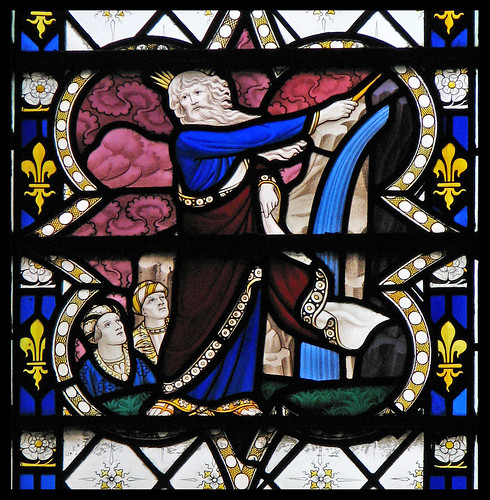
The Lord said to Moses, "Go on ahead of the people, and take some of the elders of Israel with you; take in your hand the staff with which you struck the Nile, and go. I will be standing there in front of you on the rock at Horeb. Strike the rock, and water will come out of it, so that the people may drink."The message God gave by telling Moses to use his staff could not have been clearer. This was the same staff that God told Moses to use to turn the waters of Egypt blood red and undrinkable in one of the plagues God used to force Egypt’s king, the Pharaoh, to let His people go.
God was reminding Moses and the people of Israel that, no matter the crisis, His power was undiminished. He could provide for His people.
Water is still known to run through lime deposits in the Sinai Peninsula today. But in bringing water from this rock in Sinai, the Creator of the universe bent creation itself to His purposes for His people. The God Who raised His Son from the dead to give life to all who believe in Christ can do similar things for those who trust and obey Him today.
Read verse 7, please:
[Moses] called the place Massah and Meribah, because the Israelites quarreled and tested the Lord, saying, "Is the Lord among us or not?”Moses gave two names to the place. Massah means test. God had tested the Hebrews faith and the Hebrews had, contrary to God’s commandment, put God to the test. Meribah is translated as quarrel. But it has a more specific meaning; it’s the word used when a plaintiff sues someone else in court. The people thought they were bringing suit against Moses, but really their beef had been with God. Their question was, “Is the Lord among us or not?”
We may be tempted to ask that same question at times. I'll never forget a Saturday afternoon in my first parish when I was called to a hospital in Toledo, where a member of the congregation had been life-flighted. While using a torch to cut a barrel in half for some neighbor boys, the barrel had exploded and crashed into his skull. When I arrived at the ER, he looked like someone who had been through a battle. The doctors said that his prognosis was hopeless. His mother, a wonderfully faithful woman who had endured the deaths of her husband and a grown child already, kept asking of this calamity that had befallen this son, the father of small children, "How could God have let this happen?" Where had God been? she wondered. We've all been in that wilderness!*
But, as our Gospel lesson reminds us, the God Who caused water to spring from a rock in the wilderness has come in Jesus Christ, the Word made flesh, to be the living water from heaven!
Jesus refreshes and makes new the thirsty souls of all who trust in Him and live lives of repentance and obedience to Him.
May we turn each day to Jesus, even in the inconvenient wilderness times of our lives, and live! Amen
*I'm happy to report that the man in question not only survived, thanks to the prayers of many, but is strong and well to this day!
Subscribe to:
Posts (Atom)