Showing posts with label Matthew 22:37. Show all posts

Sunday, May 14, 2023

When We Love

[Below you'll find the message shared during worship with the people and friends of Living Water Lutheran Church, Centerville, Ohio, earlier today, as well as video of both worship services.] 

Do Jesus’ words at the beginning of today’s Gospel lesson make you uncomfortable? He says “If you love me, keep my commands.” (John 14:15) 


Does Jesus seem to be contradicting Himself and the rest of the Bible?

Elsewhere, He famously says, for example, “For God so loved the world that he gave his one and only Son, that whoever believes in him shall not perish but have eternal life.” (John 3:16)

And also: “The work of God is this: to believe in the one he has sent.” (John 6:29)

The apostle Paul summarizes all this teaching from Jesus by saying, “For we maintain that a person is justified [that is, declared innocent of their sins] by faith [in Christ] apart from the works of the law.” (Romans 3:28)

The distillation of these passages of Scripture and many more is that we who are born sinners cannot and are not saved from death, the condemnation for our sin, by anything we do; we are saved solely by Christ Who died and rose for all sinners through the faith in Christ we receive through the Gospel Word about Jesus.

So, what is up with Jesus’ words at the beginning of today’s Gospel lesson: “If you love me, keep my commands”? It sounds as if Jesus is saying that our relationship with Him and our eternal salvation from Him depend on how much we love Him and on our obedience to His commands.

There are schools of thought within Christianity that teach this is exactly what Jesus is saying here. They think their salvation depends on what they do and the depths of their love for Jesus. People taught this way are constantly turned in on themselves, trying to police themselves of doubt or sin.

But, friends, this kind of thinking can only lead us to one of two endpoints: Either false pride when we think that we really are obeying and loving Jesus perfectly or despair, even unbelief, at the realization that we cannot obey or love Jesus perfectly.

Jesus and the whole Bible are clear though that we won’t find life with God by diving more deeply into our personal sewers of sin and self-obsession.

Freedom from sin and death only come from outside ourselves through Jesus Christ!

So, what is Jesus telling us in the first verse of our Gospel lesson? There are two words in the verse that say much more than we might realize and will help us understand what Jesus is saying.


The first word is if, “If you love Me,” Jesus says.

The word in the Greek in which John wrote his gospel is ἐάν, a conjunction that usually means if. But there is an irregular use of the word and almost every time it appears in John’s writings, this irregular use is meant. Let me give you a few examples of this use.

In John 12:32, Jesus says, “And I, when [that’s our word, ean] I am lifted up from the earth, will draw all people to myself.”

Another example, 1 John 2:28 : “And now, dear children, continue in him, so that when [there’s our word again] he appears we may be confident and unashamed before him at his coming.” (1 John 2:28)

One more, 1 John 3:2: “...we know that when Christ appears, we shall be like him, for we shall see him as he is.”

So, Jesus isn’t telling us, “If you get yourself convinced that you love Me.” He’s saying, “When, by the power of my Word, given in Scripture, preaching, teaching, and the Sacraments, that all your sins are forgiven and that you have been justified by grace through faith in Me…”

Jesus is assuring you: “When you have been told, ‘I therefore declare to you the entire forgiveness of all your sins, in the name of the Father, Son, and Holy Spirit,’ you will love Jesus.”

That’s the power of His forgiving, loving Word; it incites love for Him within us.

“This is love,” the apostle John writes elsewhere, “not that we loved God, but that he loved us and sent his Son as an atoning sacrifice for our sins.” (1 John 4:10)

We love Jesus when His Gospel Word allows us to experience the love He has given to us from the cross. It was this very love that the disciples who betrayed Jesus would experience after His resurrection: forgiveness and love despite their sin.

The second word is keep. “If you love me,” Jesus says, “keep my commands.” The word here in the original Greek is τηρέω. It means to watch over, to guard, to observe. To keep the commands of Jesus, of God, is to acknowledge their authority over us. It doesn’t mean perfect obedience to God’s Law, which God’s Word tells us no sinful human being can muster.

Jesus, you’ll remember, used words from the Old Testament to summarize God’s commandments for the human race.

He summarized commandments one through three–that we have no other gods, that we not take His name in vain, that we hold His Word at the center of our lives–by telling us to “Love the Lord your God with all your heart and with all your soul and with all your mind.” (Deuteronomy 6:5; Matthew 22:37).

He summarized commandments four through ten–that we honor our parents, not murder, not commit adultery, not steal, not bear false witness, and not covet–by commanding us, “Love your neighbor as yourself.” (Leviticus 19:18; Matthew 22:39)

Honesty compels each of us to acknowledge that we do not obey God’s law of love. We are worthy of condemnation.


But, friends, we keep these commands of Jesus every time we come to Him and acknowledge, formally or informally, together or on our own, “We have not loved you with our whole heart; we have not loved our neighbors as ourselves.” We keep His commands whenever we respond to His Word and take up our crosses daily and follow Him. (Luke 9:23)

We love Jesus and we keep His commands, acknowledging His grace and authority, whenever He comes to us with His Word assuring us that through Him, all our sins are forgiven. This is what Jesus explains to us in the rest of today’s gospel lesson. Jesus sends His Holy Spirit Who comes to us in the word of forgiveness and rebirth we receive at Holy Baptism, in the preaching of His Gospel Word, and in the forgiveness and power for living we receive in Holy Communion.

When Jesus tells us today, “If you love me, keep my commands,” Jesus isn’t turning us in on ourselves to engage in a morbid inventory of our sinful selves. He’s freeing us from both the sewers of self-congratulation and self-condemnation.

He calls us to look to Him, the One Who died and rose to set us free from sin and death.

It’s good and right for us to confess our sins to God. But when Jesus’ words of forgiveness come to us, our old sinful self is crucified and, with the words of absolution, we rise to newness of life!

Pastor David Schmitt talks about a friend who, as she puts on a coat to go outside, says with a smile of her deceased dad, “My father always told me to wear a coat.” These are the words of a woman who knew how deeply her earthly father loved her, that his “command” wasn’t arbitrary but came from love, and so, even now, out of his immediate presence–even when she forgets to put on her coat, she “keeps” her father’s “command.”

When the Holy Spirit–the Spirit of truth–turns our attention to Jesus and we know that He has already paid the price for our sin and already given eternal life to all who believe in Him, we are filled with the love of children who know they are deeply loved by God and, from love, reverence, and respect, will always gladly acknowledge His authority over us.

Receive the forgiving love of Jesus and you will love.

That is Jesus’ Word for us today.

Amen


Sunday, January 04, 2015

Lost and Found

[This was shared during both worship services at Living Water Lutheran Church in Springboro, Ohio,  today.]

Luke 2:40-52
Today, our Gospel lesson revolves around an incident that happened when Jesus was twelve years old. This is the only incident from Jesus’ childhood beyond Matthew’s and Luke’s birth and infancy accounts that we have. As Luke tells it, the incident is recounted just after his account of what happened in the temple in Jerusalem eight days after Jesus was born.

In fact, looking at that earlier incident can help to explain much of what is going on in today’s Gospel lesson. 

You remember that back then, the holy family was met by two elderly Jewish believers, Simeon and Anna. Each of them had been waiting and praying for the coming of the Messiah promised by God hundreds of years earlier.

Simeon, you’ll recall, rejoiced when he saw Jesus. But there was a grim follow up to His rejoicing. Please open a sanctuary Bible to Luke 2:34-35 (page 716) to see it: “...Simeon blessed them and said to Mary, his mother: ‘This child is destined to cause the falling and rising of many in Israel, and to be a sign that will be spoken against, so that the thoughts of many hearts will be revealed. And a sword will pierce your own soul too.’” 

Just in case Mary entertained any illusions that the child conceived in her womb by the Holy Spirit to Whom she had given birth would be a normal son, Simeon was evidently sent by God to remind her that this was not the case. As God-in-the-flesh, Jesus would inevitably arouse the hostility of a world of people--including you and me--intent on being their own gods and lords, their own kings and counselors. 

Simeon thus foreshadows Jesus‘ cross for Mary and Joseph. The freedom of human beings from slavery to sin, death, and futility can only come through the sacrifice of the perfect representative of the human race. It was to offer Himself in this way that Jesus came into our world.

Any parent can imagine how Mary and Joseph must have reacted to Simeon’s prediction. When bad things happen to or are predicted for our kids, when doctors give frightening diagnoses and even more frightening prognoses for them, our first reaction as parents is denial. The second may be anger. In any case, we want to block the unpleasant prospects from our thoughts and shield our kids from them. And, under such circumstances, there’s one thing we crave more than anything else: normalcy, routine, an ordinary life. (Whatever that may be.) That was what Mary and Joseph craved, normalcy, ordinariness. 

So, Mary and Joseph raised Jesus in their hometown. 

The ordinariness of the lives they established there may have lulled the parents into thinking that, as special as Jesus was to them, maybe Simeon was wrong. Maybe the cross could be avoided. Maybe a sword would never pierce Mary’s soul. 

But today’s lesson shows us that neither cross nor sword could be averted. 

Look at our lesson, Luke 2:41-52 (page 716 also). At the outset, we’re told: “Every year Jesus’ parents went to Jerusalem for the Festival of the Passover. When he was twelve years old, they went up to the festival, according to the custom. After the festival was over, while his parents were returning home, the boy Jesus stayed behind in Jerusalem, but they were unaware of it.” 

Mary and Joseph assumed that their twelve year old was with some of their family members or neighbors from Nazareth. It took them a day to realize that Jesus was missing. Verse 46 says: “After three days they found him in the temple courts...” We’ll come back to “three days” shortly. But, to me, what Luke says here surprises me. It would have taken the two a day to get back to Jerusalem. But they evidently spent a whole day searching in the city before going to the temple. The question is why didn’t they look for Jesus at the temple first? It was the most prominent place in Jerusalem and even before this, Mary and Joseph could see that Jesus, in Luke’s words, “was filled with wisdom...the grace of God was upon Him.”

Maybe the reason they didn't go to the temple immediately was that it served as a harsh reminder to them of Simeon’s prophecy. This may be why they spent a day looking for Jesus in all the wrong places. 

And, I must admit that I too, often look for Jesus in the wrong places. 

I look for Jesus to be where I want Him to be, rather than submitting to the death of my favorite sins or going where He sends me. 

I try to get Him to do my will, rather than surrendering to His. 

Yet the hard fact is that God did not take on flesh in the person of Jesus Christ to make us comfortable in our sin, self-will, and life lived on our own terms rather than God’s terms. 

Jesus came to invite us to crucify our old selves in repentance and experience new and everlasting life by believing in and surrendering to Him. 

Even Mary and Joseph, we see from today’s lesson, needed to repent of their sin of wanting Jesus on their own terms and to, instead, believe in Jesus with total surrender. 

Verses 46 and 47 go on to tell us that Jesus was “sitting among the teachers, listening to them and asking them questions. Everyone who heard him was amazed at his understanding and his answers.” Then in verse 48, we’re told: “When his parents saw him, they were astonished.” 

We might wonder: How could they have been astonished? 

Had Mary forgotten her conversation with the angel Gabriel who told her that despite never having been with a man, she would give birth to the Savior of the world? 

Had Joseph forgotten the dream in which he was told not to be afraid to take Mary as his wife because this child was the Son of God? 

Had they forgotten the shepherds or the wise men or Simeon or Anna? 

Had Mary forgotten that her kinswoman Elizabeth reported that the child within her, John the Baptist, had leapt for joy when he heard the voice of the Savior's mother?

How often have we ourselves had some close encounter with God--an answered prayer, unexpected provision, a word of guidance, comfort, or needed reproach from God’s Word--only to move on as if the encounter never happened, as if God were some distant stranger and not the Lord of our every moment? How often do we take comfort in ordinary certainties rather than remembering our encounters with God and following Him into the unseen and unknown?

Mired in the commonplace realities of this finite world, Mary and Joseph seem to have forgotten their encounters with God.

In her forgetfulness, Mary reproaches Jesus (verse 48): “Son, why have you treated us like this? Your father and I have been anxiously searching for you.” 

Spoken just life the parent of a tween or teen! Can't you just hear her plaintiveness? 

Mary has sunken so deeply into routine, it seems, that she has forgotten Who Jesus‘ real Father is and where Jesus‘ real home is. 

Then Jesus says words that must have seemed like a sword piercing her soul, reminding her that her firstborn Son could never be hers alone: “Why were you searching for me?” [Jesus asks]. “Didn’t you know I had to be in my Father’s house?” 

Jesus would honor His earthly parents always. But His earthly family would never be His highest priority. As Jesus would later say in Luke 8:21, "My mother and brothers [My family] are those who hear God's word and put it into practice."

Folks: What Jesus says of Himself is no less true for those of we who confess Him to be our Lord and God. 

We may love and cherish our families, we may honor our parents, but when we come to faith in Christ, God becomes our Father. God in Christ is our highest priority. 

And this present world, shrouded in sin and death, is not our home. 

In Jesus Christ, we know that we have a better homeland, with God in eternity. 

And, like Jesus, out of gratitude for His forgiveness and love, no matter what our jobs, we are called to be about our Father’s business: loving God, loving neighbors, making disciples for Christ.  


In verse 50, we’re told that Mary and Joseph didn’t understand what Jesus was telling them. And this is where the “three days” comes in. 

Three days after Jesus’ crucifixion, you’ll remember, two unnamed disciples ran into Him, risen from the dead, on the road to Emmaus. Their minds, it seems, were so fogged by the normal expectations of life--you know, like the normal expectation that dead people stay dead--that they couldn’t believe the reports they’d heard of Jesus’ resurrection. Because of that fog, they didn’t recognize the risen Jesus as He walked beside them on the road! 

But just as the twelve year old Jesus pierced Mary's and Joseph's worldly fog to reveal Himself as the Son of God three days after the two worried parents began a frenzied search for the One they’d come to see as their son, the risen Jesus would reveal Himself as the conqueror of sin and death to those confused followers of Jesus on the first Easter. It wasn't the first time that Jesus had been so revealed to them. I guess that, like us, even Joseph and Mary needed constant refresher courses to keep in mind Who Jesus really was and is.

It’s easy to lose track of Jesus and Who He is. If it happened to Mary and Joseph and to the disciples who had watched Jesus perform miracles and heard His teaching, it can also be true for you and me. 

But it’s not as if Jesus has gone to heaven without leaving us a forwarding address. He wants to be with us now and in eternity.

Like Joseph and Mary, we simply need to know where we can find Him. And so, Jesus gives us reliable means by which we can be in His company twenty-four hours a day, seven days a week. 

We can go to His Word, in the Bible, and His Word proclaimed in personal conversations, Sunday School lessons and Bible studies, and from pulpits. 

We can go to the Sacraments--Holy Baptism and Holy Communion--by which He comes to us and fills us with God's forgiveness, new life, and the Holy Spirit. 

We can go to the fellowship of Christian believers who pray with and for one another, encourage one another, hold one another accountable to the truth revealed on the pages of the Bible, and support one another in good and bad times. 

We can go to prayer in Jesus‘ Name.  

We can go to service done for others as though they were Jesus themselves. 


As we begin a new year, it’s good to remember that it is no mystery about where Jesus can be found: in Word and Sacrament and the fellowship of other Christian disciples. 

You don’t have to undertake a frenzied search for Him. Through the eyes of faith, Jesus can be found in these places where He promises to meet us, and, when we do, we realize that it's never Jesus Who is lost, it's us. We simply need to let Him find us. When we do, His grace and love and His power will find us too. Amen 


Sunday, March 27, 2011

Called to Obedience...Even When It's Inconvenient

[This was shared during worship with the people of Saint Matthew Lutheran Church in Logan, Ohio, earlier today.]

Exodus 17:1-7
True story about a woman we’ll call Jill.

It all started after Jill’s marriage ended. There she was, a single mom with a mortgage. Shortly thereafter, she lost her business.

Fortunately, she was able to get another job. But it was100% commission and she wondered how she was going to make it as she built up clientele and referrals.

In the midst of this turmoil, it struck Jill that it had been awhile since she had given God much thought. She went to a worship service one Sunday and heard the preacher challenge the congregation to consider tithing. The Bible speaks of believers giving 10% from the tops of their paychecks. That’s a tithe.

The pastor challenged the congregation with God’s words to the people of Israel in the Old Testament book of Malachi: “Bring the full tithe into the storehouse, so that there may be food in my house, and thus put me to the test, says the Lord of hosts; see if I will not open the windows of heaven for you and pour down for you an overflowing blessing.”

Jill had no idea what sorts of blessings God might have in mind for her and her child, but as she prayerfully considered those words, she decided that this was as good a time as any to put God first.

She realized that the Christian isn’t required to give a specified amount in offering to God. Jesus wants our whole lives, not just 10%, after all. But Jill felt that her tithe would be one way she would keep the first commandment, “You shall have no other gods before me” and the first part of Jesus’ Great Commandment, “You shall love the Lord your God with your heart, and with all your soul, and with all your mind.”

Jill remembered God’s past blessings and above all, the blessing of new life that belongs to all who turn from sin and believe in Jesus Christ as God, Savior, and Lord over their lives. Jill felt that these past blessings were good reason to trust God now. The following Friday, Jill received her paycheck. It was next to nothing. But on Saturday, she wrote a check equaling 10% of her skimpy pay for her offering.

“The funny thing is,” Ann and I have heard her say, “after that I always had what I needed. God took care of 100% of our needs on 90% of my income.”

Over time, Jill’s financial situation improved. Eventually, she joined our former congregation. On the first Sunday that she visited with us, Jill heard me say during the service, “If you are a first-time visitor, you’re not expected to make an offering; it’s our privilege to worship with you today.” When Jill heard that, she later told us, she thought, “There is no way you can keep me from giving my tithe, buddy!” Jill remembered God’s past faithfulness, even in a hard time, and, determined to obey His call in her life, her relationship with God was strengthened and deepened.

This is not a sermon about money. It’s about something else.

We Lutherans believe that justification by grace through faith—the salvation of sinners from sin and death through what Christ has done for us and through our faith in Christ—is the central doctrine of Biblical faith. But we also believe that it’s not the only doctrine of our faith.

We also confess that all who believe in Jesus are called to obedience to the will of God the Father, Son, and Holy Spirit. That also is a doctrine of Biblical faith. Martin Luther wrote: “When our Lord Jesus Christ said, Repent!, he meant for the whole life of the believer to be one of repentance.”

Repentance, you know, is more than mere sorrow for sin, it’s a constant turning to God in faith and in obedience to God’s will. We are to always hold our lives up for examination in the light of the Ten Commandments and seek forgiveness and the amendment of our lives through Christ. Obedience to God, however imperfectly rendered by we human beings, is the proper response to a life transformed by the grace and goodness of God, given to us through Jesus Christ...even when it’s inconvenient.

The same God Who claims us in Holy Baptism had saved His ancient people, the Hebrews or Israelites, when He led them through the waters of the sea and sent those same waters to drown the armies of Egypt, their one-time captor nation. Our first lesson, from Exodus, finds the Hebrews in the midst of their forty-year journey through the wilderness, heading to the land God had promised to their ancestor Abraham.

God’s people often found their forty-year trek an inconvenient time to be obedient to God. But God expected them to be obedient nonetheless.

Please pull out the Celebrate insert and look at the first lesson. Read verse 1 with me silently, please:
From the wilderness of Sin the whole congregation of the Israelites journeyed by stages, as the Lord commanded. They camped at Rephidim, but there was no water for the people to drink.
Now, the wilderness of Sin has nothing to do with sinfulness. “Sin” here is just a word related to “Sinai, S-i-n-a-i,” a name for the entire region through which the Hebrews were traveling.

We’re told that the people were moving by stages, in the orderly fashion commanded by God. The place God commanded them to go had no drinking water.

Had they stopped and thought, they might have remembered...
But, like all of us sometimes facing life’s wilderness experiences, the Hebrews forgot God and His past help.

I once heard a speaker ask a group of us, “What was the thing you were most worried about one year ago? Five years ago? Ten years ago?” All of us were hard pressed to remember the answers to any of those questions. The point: The God Who has helped you through past difficulties is capable of doing the same thing for you in today’s wilderness. God is still in the blessing business; we shouldn’t allow panic, worry, or challenges cause us to forget that!

Read verse 2, please.
The people quarreled with Moses, and said, "Give us water to drink." Moses said to them, "Why do you quarrel with me? Why do you test the Lord?” 
The Hebrews seemed to operate under the assumption that God would only allow easy times to accompany them through the wilderness. They couldn't imagine now that God had delivered them from Egypt He would ever allow any bad or difficult times come to them.

We can entertain similar thoughts. But that’s “magical thinking,” not real life faith. If God the Father didn’t insulate God the Son from the cross, what makes us think that any of us will be insulated from the realities of life—from the wilderness—in a fallen world?

The good news though, is that the God Who has conquered sin and death through the cross and Christ’s empty tomb gives all who trust in Him strength for our journeys through life and the certain hope of eternity with God!

Read verses 3 and 4 silently, please.
But the people thirsted there for water; and the people complained against Moses and said, "Why did you bring us out of Egypt, to kill us and our children and livestock with thirst?" So Moses cried out to the Lord, "What shall I do with this people? They are almost ready to stone me.” 
Look at Moses’ prayer and see how self-absorbed it is: “What shall I do…?” “They are almost ready to stone me.”

Moses here seems to forget that it’s God Who has freed and provided for His people in the wilderness, not him.  God is the shepherd; Moses is only God's imperfect human underling.

Moses suffers from the common workaholic tendency to think that the fate of the entire universe depends on him. (Believe me, I know what I’m talking about!)

Moses forgot that God is God and that he wasn’t. This is why our psalm for today says that Moses and his generation weren’t allowed to enter the promised land. Disobedience has its consequences even when we are repentant and God forgives us our sins. (I know about this, too. Even though I know God loves me and in Christ my sins are forgiven, I suffered a heart attack last summer, caused by my making the same mistake that Moses made, forgetting that God is God and I'm not! Even forgiven sinners must sometimes wrestle with the consequences of their sin.)

Read verses 5 and 6 please:
The Lord said to Moses, "Go on ahead of the people, and take some of the elders of Israel with you; take in your hand the staff with which you struck the Nile, and go. I will be standing there in front of you on the rock at Horeb. Strike the rock, and water will come out of it, so that the people may drink." 
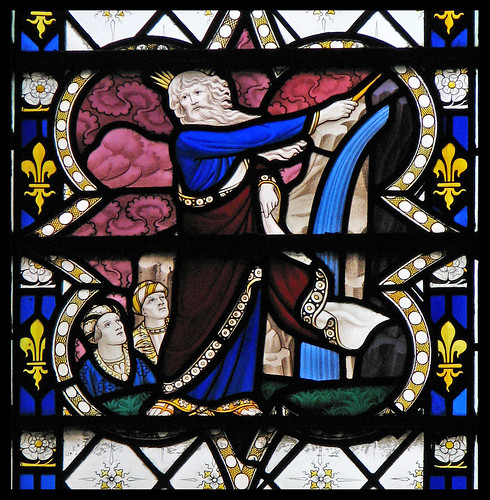
The message God gave by telling Moses to use his staff could not have been clearer. This was the same staff that God told Moses to use to turn the waters of Egypt blood red and undrinkable in one of the plagues God used to force Egypt’s king, the Pharaoh, to let His people go.

God was reminding Moses and the people of Israel that, no matter the crisis, His power was undiminished. He could provide for His people.

Water is still known to run through lime deposits in the Sinai Peninsula today. But in bringing water from this rock in Sinai, the Creator of the universe bent creation itself to His purposes for His people. The God Who raised His Son from the dead to give life to all who believe in Christ can do similar things for those who trust and obey Him today.

Read verse 7, please:
[Moses] called the place Massah and Meribah, because the Israelites quarreled and tested the Lord, saying, "Is the Lord among us or not?” 
Moses gave two names to the place. Massah means test. God had tested the Hebrews faith and the Hebrews had, contrary to God’s commandment, put God to the test. Meribah is translated as quarrel. But it has a more specific meaning; it’s the word used when a plaintiff sues someone else in court. The people thought they were bringing suit against Moses, but really their beef had been with God. Their question was, “Is the Lord among us or not?”

We may be tempted to ask that same question at times. I'll never forget a Saturday afternoon in my first parish when I was called to a hospital in Toledo, where a member of the congregation had been life-flighted. While using a torch to cut a barrel in half for some neighbor boys, the barrel had exploded and crashed into his skull. When I arrived at the ER, he looked like someone who had been through a battle. The doctors said that his prognosis was hopeless. His mother, a wonderfully faithful woman who had endured the deaths of her husband and a grown child already, kept asking of this calamity that had befallen this son, the father of small children, "How could God have let this happen?" Where had God been? she wondered. We've all been in that wilderness!*

But, as our Gospel lesson reminds us, the God Who caused water to spring from a rock in the wilderness has come in Jesus Christ, the Word made flesh, to be the living water from heaven!

Jesus refreshes and makes new the thirsty souls of all who trust in Him and live lives of repentance and obedience to Him.

May we turn each day to Jesus, even in the inconvenient wilderness times of our lives, and live! Amen

*I'm happy to report that the man in question not only survived, thanks to the prayers of many, but is strong and well to this day!