Showing posts with label writing. Show all posts

Thursday, February 09, 2017

Washing Your Sheets, Productive Writers, and Jitney Linches

Some miscellaneous stuff I've read in recent weeks.

If there was ever any doubt about it, why you need to wash your sheets at least once a week.

+++

Stephen King considers whether a novelist can ever be too productive:
THERE are many unspoken postulates in literary criticism, one being that the more one writes, the less remarkable one’s work is apt to be... 
Mostly, it seems to be true. Certainly no one is going to induct the mystery novelist John Creasey, author of 564 novels under 21 different pseudonyms, into the Literary Hall of Heroes; both he and his creations (the Toff, Inspector Roger West, Sexton Blake, etc.) have largely been forgotten... 
Yet some prolific writers have made a deep impression on the public consciousness. Consider Agatha Christie, arguably the most popular writer of the 20th century, whose entire oeuvre remains in print. She wrote 91 books, 82 under her own name and nine under a nom de plume — Mary Westmacott — or her married name, Agatha Christie Mallowan 
Those novels may not be literary, but they are far above the porridge turned out by John Creasey, and some of them are strikingly good. Christie gave us two characters — Miss Marple and Hercule Poirot — who have achieved a kind of immortality. Add to this the stylistic and thematic unity of Christie’s novels (the cozy warmth of the settings and the British stereotypes, placed within the context of her surprisingly cold appraisal of human nature), and one must view those many books in a different light... 

[David Suchet, who portrayed the definitive Hercule Poirot. Suchet also was a wonderful Aslan in the Focus on the Family Radio Theater production of C.S. Lewis' Chronicles of Narnia.]


[Joan Hickson, who was my favorite Miss Marple. When she was a young actress, Hickson met Marple creator Agatha Christie, who declared that Hickson would be a great Marple, but that she would have to age into the part. She did, many years after Christie had died.] 
No one in his or her right mind would argue that quantity guarantees quality, but to suggest that quantity never produces quality strikes me as snobbish, inane and demonstrably untrue.
As with many alleged truisms, King's essay on writing productivity suggests that this one may not always be true.

There's something to be said for taking one's time, whatever the task. But I also think that there's something to be said for keeping at one's work, taking into account the assessments of your work by people whose judgment you trust, then forging ahead.

It's possible to produce both quantity and quality. Church historian and writer Martin Marty was once asked the secret of his remarkable productivity. He said the answer was simple, "Deadlines."

At the height of his career as host of The Tonight Show, Johnny Carson was asked whether he ever considered doing a weekly show and if doing so would allow him to up the quality of his production. No, Carson said, quality grows to fit its space.

We can all name people who have churned out garbage because they were operating on a tight timeline and trying to do too much. (We can even claim that for ourselves if we're honest.) But I buy into the idea of what Hans Selye called eustress, an optimal stress level: significant enough to challenge us, not so great as to overwhelm us. The right eustress level probably varies from person to person. That may be one reason why Joyce Carol Oates has been a prolific and, many critics believe, a good one; other writers might not be capable of such a pace.

Read all of King's piece.

+++

Back when I was in elementary school, only a few kids stayed at school for lunch. The school day began at 8:30 and ended at 3:30. In the middle of it was an hour-long lunch from noon to 1, time enough for a leisurely walk from school to home and back and a good homemade lunch.


[The Dana Avenue entrance to the elementary school I attended from kindergarten through third grade.]

At the first school I attended, Dana Avenue Elementary, a big annual treat was the Jitney Lunch. When it came along, we actually got to stay at school with all of our classmates for a homemade meal. (Like the one we got at home each day, of course. But it was the change of routine that made it special.)

The anticipation of the Jitney Lunch began when our teachers handed out 6"-x-9" envelopes that had been run through the school mimeograph machine. On the fronts of the envelopes were menu choices that we checked. Our parents tucked money for the lunch inside the envelopes and we returned them to school. The lunch was a fund-raiser for the PTA.

I was reminiscing about all of this a few weeks ago with my mom and dad when a question struck me. What exactly does jitney mean anyway. No one knew.

Of course, I pulled out my smart phone and consulted with that repository of all knowledge, real and fake, the Internet. This is what the folks at Grammarphobia plausibly say:
...in 2016, the language scholar Stephen Goranson of the Duke University Libraries managed to confirm what had previously been only conjecture: The source of “jitney” was jetnée, an African-American word, via the French or Creole spoken in Louisiana, for jeton, French for “token.” 
Goranson cites a ditty described in a 1915 issue of the Literary Digest as “a little catch popular with the Louisianian French-Speaking Negro”:

“Mettons jetnée danz il trou / Et parcourons sur la rue— / Mettons jetnée—si non vous / Vous promenez à pied nou! This may be freely translated: Put a jitney in the slot / And over the street you ride; / Put a jitney—for if not / You’ll foot it on your hide.”

The 1915 article suggests that jetnée/“jitney” was coined by Southern blacks to mean a nickel, and was influenced by French jeton or jetton.

Now for the news. As Goranson says, “The following newly reported discovery appears to confirm such an origin by giving—in an African-American newspaper in 1898—a transitional form.”

Here he cites an article, published in January 1898 in the Illinois Record, headlined “Spingfield South-End Happenings”:

“What little jetney coachman on S. 6th street has such a big head he cant put on the coachman’s hat he only wears the coat with brass buttons?”

Goranson adds: “Note association with coach as well as (presumably) coin (or token), of little worth.”
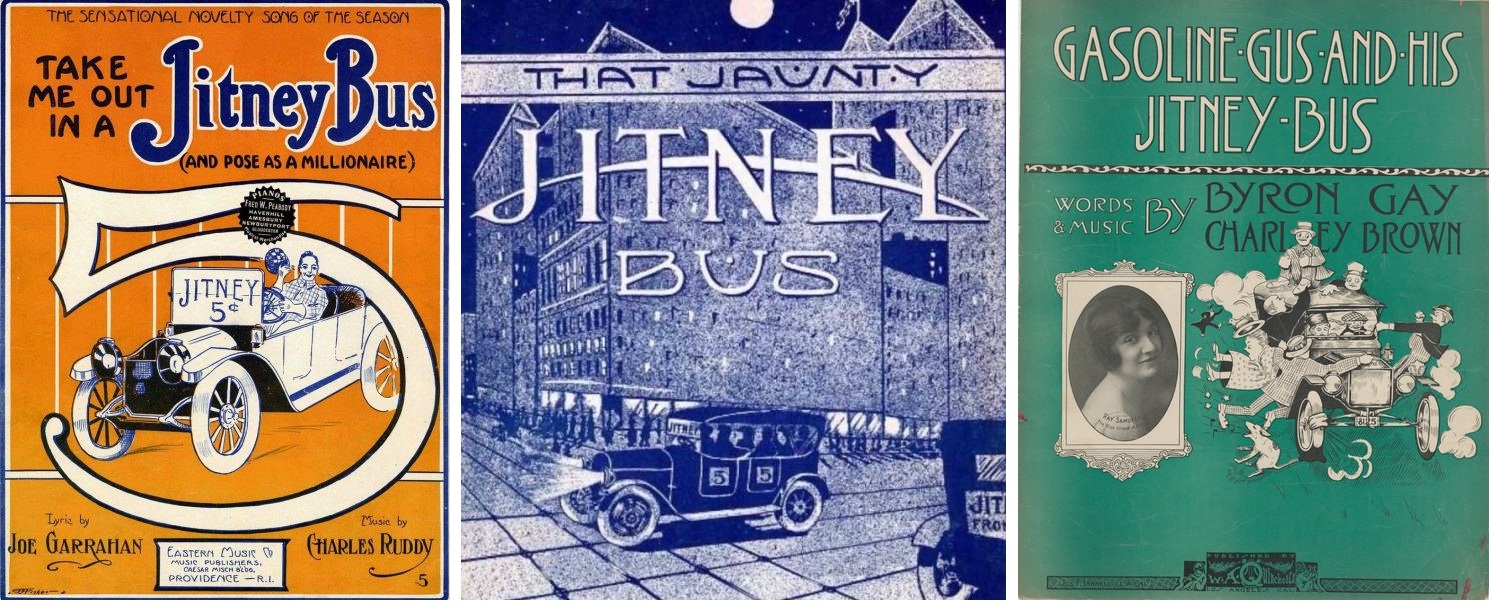

[Old sheet music covers.] 
Slang dictionaries say that at the turn of the century, “jitney” (sometimes spelled “gitney”) meant either five cents or a nickel, the fare to ride minibuses at the time.
All of this made sense to me. Both my grandmother and mother attended the same school when they were kids. The jitney lunches were established in my mom's time and I'd remembered her telling me that the lunches cost a nickel when she was a student.

The Grammarphobia folks continue:
...by the early 20th century, the term was being used adjectivally to refer to the minibuses themselves... 
...the next step in the evolution of “jitney”—as a noun used attributively (that is, adjectivally) to mean cheap or shoddy or inferior. 
The site's article on jitney lunches came in response to a reader who wondered how lunches at his wife's country school had acquired that name. Grammarphobia concludes:
As for those hot dogs served at your wife’s country school once a month, we imagine the meal was referred to as a “jitney lunch” either because it was cheap or uninspiring or because it was delivered by a jitney.
Dana was a city school. But I loved those cheap meals...and now I know why they were called Jitney Lunches.


[Blogger Mark Daniels is pastor of Living Water Lutheran Church in Centerville, Ohio.]


Monday, July 04, 2016

"In any art you’re allowed to steal anything if you can make it better, but the tendency should always be upward instead of down. And don’t ever imitate anybody. All style is, is the awkwardness of a writer in stating a fact. If you have a way of your own, you are fortunate, but if you try to write like somebody else, you’ll have the awkwardness of the other writer as well as your own."

That's Ernest Hemingway on writing, the quote excerpted in Brain Pickings from a book, With Hemingway: A Year in Key West and Cuba.

Some other pieces of advice on writing from Hemingway:
When you first start to write you get all the kick and the reader gets none, but after you learn to work it’s your object to convey everything to the reader so that he remembers it not as a story he had read but something that happened to himself. That’s the true test of writing. When you can do that, the reader gets the kick and you don’t get any. You just get hard work and the better you write the harder it is because every story has to be better than the last one. It’s the hardest work there is. I like to do and can do many things better than I can write, but when I don’t write I feel like s..t. I’ve got the talent and I feel that I’m wasting it.
These observations interest me for several reasons. The biggest one is that it runs counter to what you think might happen in the mind of an artist who becomes successful. Hemingway is saying, in essence, that when he first started writing, he did it for himself, to give himself a "kick." After he gained success, he wrote to give the reader a kick.

I'm sure that not all artists operate in this way. In the two-hour CBS News documentary on Paul McCartney done in 1989, the musician told reporter Bernard Goldberg that in the early days, the songs he and John Lennon wrote were for the fans. But success, he said--I'm paraphrasing here--had given them license to write in order to please themselves.

Hemingway was saying that for him anyway, it worked the other way around. His discipline as time went on was to write for the reader and not himself.

The other thing that strikes me about what he said in that block quote above is that, though he felt he could do a better job at things other than writing, he had to write.

This may seem indecipherable to some. But to me, in talking about writing, Hemingway was describing a life's calling.  He wrote because that was what he was called to do, even if he may have been a better fisherman, boxer, or accountant.

I once read or heard about a fellow who was contemplating going to seminary with an eye to becoming a pastor. He decided to get the counsel of his own pastor, who told him, "If you can do anything other than being a pastor, do it."

This pastor wasn't telling the younger guy that being a pastor was bad. He was saying one should be a pastor only if the idea of becoming a pastor won't go away.

I often describe how it felt before I "caved in" and went to seminary: It was as if God grabbed me by the lapels and wouldn't let me go until I applied for admission. This happened precisely at the point when I had gotten my toe in the door of the profession I'd always dreamed of being part of, politics.  It also happened when I was on the most solid financial footing of my life. But I could not not be a pastor. It was one of my callings in life.

We all have to put food on the table and care for family members, of course. And we all are likely to have other practical responsibilities. So, there will be times when we have to take jobs we don't like and don't feel passionate about. I once calculated that I'd worked at twenty-eight different jobs before my calling became clear Most of the jobs were part-time and I took all of them mostly to pay the bills or to feed my ambitions, and certainly, with no sense of calling.

But I think that Hemingway's revelation of his compulsion to write and that old pastor's advice to the prospective seminarian probably convey something to us about the work we should undertake in our lives--whether in our full time jobs or in the avocations we pursue:
What good, useful, God-honoring, people-helping thing do you find yourself incapable of avoiding? 
Whatever it is, do that.

[Blogger Mark Daniels is the pastor of Living Water Lutheran Church, Centerville, Ohio.]


Monday, September 01, 2014

Landscape as a Character in Fiction

One of the things that struck me when first reading the Sherlock Holmes stories by Arthur Conan Doyle is how nineteenth century London served as a character in most of them. The city, its traditions and sights, its size and its underbelly of criminality all loomed large.

The TV series rebooting the old stories, Sherlock, successfully duplicates that.

And the Law and Order TV franchise sees New York City appear as a "character" in each episode.

Landscape and locale are anchors that make works of fiction come alive.

In his latest Writerly Witterings video, crime fiction writer Michael Jecks talks about what he does to ensure that the fourteenth century Dartmoor landscapes of his novels are part of the story. Most of us aren't blessed with the many talents Jecks possesses--things like sketching and painting, which he uses to help him create the settings for his fiction. But it's interesting to learn about some of the work that goes into his writing.


Jecks' point about not getting too specific in the description of landscapes or other "props" is interesting, as most "how to" pieces about writing fiction seem to include the command to "be specific." Don't say that it was a hot day, the fiction gurus says, give the temperature and note its effect on people. Don't say it was evening, but give a sense of the darkness of it.

But Jecks, it seems to me, is onto something.

Best-selling crime novelist Agatha Christie was and still is often panned for what is seen as a lax and superficial approach to character development. But I've often found that Christie's refusal to dig too deeply into the characters that populate her stories allows me to imagine much more, like the radio shows Jecks refers to in the video. As her stories unfold, the reader becomes a collaborator with Christie in what Hunter S. Thompson, speaking of Bob Dylan's lyrics, once called "democratic art."

Anyway, enjoy Jecks's video.

[By the way, I love the way Brits say, "ennathing."]


Friday, March 22, 2013

Neither...Nor

I was writing something earlier today and wondered about the proper use of the words, neither and nor in the same sentence. Grammar Girl helped me out.

By the way, Oxford says that both the words, neither and either, can be pronounced with long e's or with long i's in their first syllables. So, neither you with your long e, nor I with my long i are grammatically incorrect. No need to call the whole blog off.

Thursday, February 28, 2013

Proofreading Lessons

I do a fair amount of writing. In addition to sermons, there are occasional articles for local newspapers, emails and notes to parishioners and others, those 140-character epistles on Twitter (known as Tweets), and the posts that appear here.

But, true confession: I don't think that I've ever been satisfied with anything I've ever written. Ever.

In fact, if, for whatever reason, I run across old blog posts, after I cringe at finding grammatical errors or unclear writing in the pieces, I will edit them. I do it even if they're more than a decade old and unlikely to ever be read again.

This piece from PBS' Mediashift, gives ten lessons aimed at people who self-publish e-books. But they're good rules for anyone who writes things they hope others will be able to understand.

To me, #10 is the most sensible lesson of all.

Saturday, January 12, 2013

Seinfeld Was Wrong; I Was Interested

Despite his prediction at the beginning, I was interested in this interview Jerry Seinfeld gave to The New York Times. I've always found his bits funny, but confession time: I've never watched a single episode of the Seinfeld sitcom.

Despite his prediction at the beginning, I was interested in this interview Jerry Seinfeld gave to The New York Times. I've always found his bits funny, but confession time: I've never watched a single episode of the Seinfeld sitcom.

He's right about how intimidating a computer cursor is. The cursor taunts any writer: "Whaddya gonna say now, Big Shot?" "Hey. Mr. or Ms. Communicator, there's a deadline approaching!"

That's a feeling I get every week when, after studying and praying desperately, I start to write a sermon.

In fact, I sometimes wonder if the term "cursor" isn't a non-sexual double entendre invented by the IT department to taunt right brain creative types. The cursor says, "Curse you, Mr. Smarty Pants!"

But writers felt the fear of emptiness where words should be long before computers or cursors. Ernest Hemingway, a writer known for his physically adventurous life style, was once asked the most frightening thing he'd ever come up against. He said, "A blank piece of paper."

Exactly how I felt back when I wrote my sermons out long hand. Cursors!

[Kudos to Michael Hyatt for linking to this video!]

Wednesday, February 25, 2009

So, tell me, what books haven't you written?

My son sent this link to an August 2, 2004, article on the BBC web site. It's about two librarians, inspired by a novel by Richard Brautigan, who went around England asking people if they'd ever thought of writing a book and if so, what would the book be. Their research resulted in the Library of Unwritten Books.

No, really, they wrote these book ideas out and published at least some of them as booklets "distributed to libraries, pubs, community centres and doctor's waiting rooms."

You can read some of the unwritten books--in this case, that's not an oxymoron--here.

I have mixed reactions to this.

On the one hand, lots of people have one book in them, I suppose. On the other, most people should keep their book ideas in them. You know, save a tree. And even if a book is published in electronic form, an unwritten and unpublished book that someone decided not to present in condensed form may save other things, like our brain cells. There are books I've read during my lifetime that, I'm sure, actually depleted my brain power and, in the case of some assigned college reading, temporarily decreased my will to live.

Oddly enough, I woke up yesterday with an idea for a book, a novel. In that place between sleep and wakefulness, I worked the whole thing out in my mind: cast of characters, pacing, dialogue, denouement, and who I'd want to star in the movie adaptation. But then I woke up. I realized that here was a book that not only would remain unwritten, but deserved that fate.

Of course, five years from now, when I get wind of a bestseller about to be turned into a movie starring Brad Pitt (not my choice for the star, by the way), I'll have a sensation mixing vindication and regret. I'll tell my wife, kids, and friends, "I had an idea for a book just like that back in 2009." And my wife, kids, and friends will say patronizingly, "I'm sure you did."

Sigh.

What books haven't you written?