Sunday, January 20, 2008

Come and See

[This was shared during worship at Saint Matthew Lutheran Church in Logan, Ohio this morning.]

John 1:29-42
I made a discovery about myself this morning. I was shaving and when I came to my neck, I noticed that as I looked into the mirror, I was squinting. Why was I squinting? It wasn't because my eyesight is that bad. Then, I realized what it was.

When I was a little boy, I sometimes watched my father as he shaved and sometimes, as he did so, he also smoked. (He quit smoking years ago, by the way.) But often, when he came to shaving his neck, dad squinted.

The things we see can have a powerful impact on us.

For example, all my life I heard people talk about how beautiful Colorado is. “You’ve got to go to Colorado,” they’d tell me. “You can’t express how gorgeous and breathtaking it is.” I wrote their words off as hyperbole. Then, about six years ago, friends of ours offered us the use of a house they’d built on top of a mountain outside of Durango. We drove out and guess what? You’ve got to go to Colorado. Even though I really love Ohio, Colorado is gorgeous and breathtaking. But until we went and saw Colorado for ourselves five years ago, I couldn’t have said that.

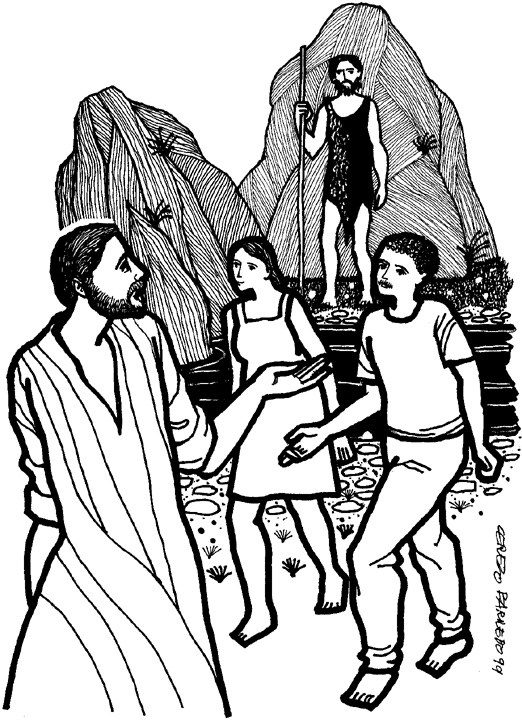
In today’s Gospel lesson, John the Baptist, gives witness to who Jesus is twice. He points his own disciples and whoever else will listen to Jesus and says, “Look! The Lamb of God Who takes away the sin of the world!”

Two of John’s disciples were curious enough to approach Jesus, Who asks them, “What are you looking for?” The response of John’s disciples to that question is, on first blush, strange. “Rabbi, where are you living?” The word we translate as living, in the original Greek of the New Testament can also be translated as, remaining, abiding, sticking with. "Teacher," these two curious men were saying, "give us the time to see that you’re not just some fly-by-night Savior, but that you’ve really come to be our Savior."

Now, if Jesus were a candidate as in the current presidential campaign, He might have spent some minutes trying to persuade the questioning disciples that He was really the Savior, that they really could entrust their lives to Him, that He really could bring forgiveness of sin and so, everlasting life, by transforming them from enemies of God to God’s friends. The Jesus campaign would release His answer on YouTube and CNN would have run the interchange time and again. But Jesus’ response is direct, almost curt. “Come and see,” He tells them. Hardly a worthy sound bite!

But we come to faith in Christ and come to deeper faith in Christ not through the compilation of evidence, though there is ample evidence that Jesus really is God and that He really did rise from the dead to bring everlasting life to sinners who repent and believe in Him.

Nor will our faith necessarily be strengthened through logical argument, though one can argue rationally for Jesus and His Lordship.

What really convinces us to follow and to keep following Jesus is when we experience Jesus. That’s why He told the disciples of John to “Come and see.”

There may be some here this morning who long for a real experience of Jesus, who want their faith to be more than just a habit. There may be some of our neighbors and friends who want to believe in Christ, but either find it difficult to believe in a Savior so wonderful and to believe that a Savior so wonderful could love or forgive them. What we all need to do is “come and see” Jesus. We need to experience Him and His goodness. Faith will take hold and faith will grow when we do.

But how do we see a Savior Who ascended into heaven two thousand years ago?

I used to love to play baseball and later, softball. I sometimes played in the outfield. There’s nothing that an outfielder can do about where a ball is hit. That really depends on the pitch selection and what the hitter does with the bat. But the fielder can get in a position to catch flies or cut off grounders. Similarly, we have no control over the God we meet in Jesus Christ. But we can position ourselves to meet Him, to see Him operating in our lives.

Several weeks ago, I mentioned a book on prayer written by Lutheran bishop Ole Hallesby that had a huge impact on my life. Rebutting a book by a prominent atheist, Hallesby wrote another book called, Why I Am a Christian. In it, he identifies five ways those who want to see Jesus Christ can do so.

First, we can read the New Testament. This past week, one of our shut-ins told me that years ago, she’d heard a TV preacher challenge his viewers to read a chapter of the Bible every day. “You know,” this Saint Matthew member told me, “that makes all the difference in my days.”

When we read the New Testament, especially the Gospels—Matthew, Mark, Luke, and John—we encounter Jesus Himself. As we submit to meeting Jesus in the New Testament, we find ourselves moving from doubt to faith.

Next, to see Jesus, we can pray. Even those who aren’t sure that they believe or whether they believe that God listens to prayers should start praying. A few weeks ago, I mentioned my own journey from atheism to faith. One of the things that helped me in this journey was my willingness, despite my unbelief, to begin praying. At first, to tell you the truth, I felt ridiculous talking to a God I wasn’t even certain was there. But as South Korean pastor Paul Yonggi Cho has observed, God is a gentleman. He will not go anywhere uninvited. In prayer, we invite the God we meet in Christ into our lives.

When we pray, we learn that God doesn’t expect perfection in our praying or in us. He takes our willingness to pray as affirmation that we want to “Come and see” Jesus.

One of my favorite incidents in the Bible involved the man who came imploring Jesus to heal his child. “If you can help, Lord, please do,” he prayed. Jesus said, “What do you mean ‘if’? If you have prayer as tiny as a mustard seed, you could move a mountain.” The man replied, “I do believe, Lord. Help my unbelief.” That man’s prayer was answered affirmatively. He believed to the extent that he could. He trusted as much as he could. Even doubters who want to believe in Jesus will, eventually, experience His presence and know that He is their Savior.

Another way for us to see Jesus is to take a good look at ourselves, asking God to show us ways in which we’ve failed to love God or love others. Sin can obscure our vision of God and sometimes, we fail to see our sin.

A young man came to see me years ago at my office in my first parish. He was frustrated because his wife, in spite of repeated promises, wouldn’t attend church with him. “Have I done anything particularly terrible recently?” she asked him. When he said, “No,” she said that she guessed she didn’t need God that week.

When we voluntarily ask God to show us the ways in which we’ve not loved Him or others, we remind ourselves both of our need of Him and of His willingness to forgive and be with us twenty-four hours a day. We invite Him into every part of our lives.

Another way to see Jesus is to receive the Sacrament of Holy Communion every time it’s offered. You know, we Lutherans are sometimes accused of fudging things when it comes to the witness of the Bible. But we have always taken Jesus' words about the bread and wine of Holy Communion completely literally. Jesus said, "This is My body...This is My blood." We believe Him. And we believe Him too, when He says that He gives us this Sacrament for the forgiveness of sin.

In the bread and the wine, Christ comes to us. Father Richard Farar Capon calls Communion, “the hat on the invisible man.” The “immortal, invisible, God only wise” of Whom we sing in one of our hymns becomes visible and touchable in the Sacrament.

Another way we can see Jesus is to spend time in the fellowship of people we believe are authentic followers of Jesus. Thirty-some years ago, a woman named Martha Schneider, then in her sixties, took me under her wing to teach me about what it means to have Jesus Christ in my life. Martha died this past summer, deep into her nineties.

As she fostered my growth as a Christian, Martha asked me if I would help her with a Good Friday prayer vigil, in which members of the congregation would come to pray for half-hour stints overnight. (Ann said that Martha is the only woman she'd ever let me stay out all night with.)

Speaking from personal experience, it was people like Martha--people who lived wholeheartedly with Christ--who finally tilted me from doubt to faith. They were ordinary, humble people who lived with the same daily struggles, hopes, challenges, and joys that are the common lot of the human race, who were nonetheless empowered to cope and hope because of their relationship with Jesus Christ, made me willing to let Jesus into my life. They also encouraged and supported me as I posed my questions, owned my struggles, and invited Jesus to be my God and Savior.

Most of you here this morning and maybe many listening on the radio today know that these are five good ways to come and see Jesus. You may even have found it good to be reminded of these ways that you can see Jesus. I hope so.

But, there’s another reason I talked about them with you this morning. Just a few verses beyond our lesson from the Gospel of John this morning, a follower of Jesus—Philip—seeks out a friend of his—Natahnael—and says, “We’ve found the Messiah: Jesus, from Nazaraeth.” “Nazareth,” Nathanael says, “Can anything good come from there?” Philip doesn’t argue the point with Nathanael. He just tells him, “Come and see.”

When I saw Colorado for myself, I knew that what people said about its beauty was true. Your friends, neighbors, and others may wonder why you bother going to church. They may wonder why you take the time for Sunday School, women’s group, Lenten services, or giving food to CHAP. You could tell them that it’s because of Jesus. You could tell them that Jesus is your Savior. And I hope that at the right moments, you will tell them just that.

But the best thing you can tell them is what Jesus told those curious disciples of John the Baptist and what Philip told Nathanael. Come and see!

Come and see Jesus in the New Testament, in time spent in prayer, in letting Christ convict us of sin and reveal His forgiveness, in the Sacrament of Holy Communion, and in the fellowship of Christians.

If our spiritually disconnected friends will only come and see Jesus in these places, they will see a new and everlasting way of life. They will believe. And their lives will be changed forever!


How to Build a Marriage

[This message was shared during the wedding of Natalie and Andrew held in the chapel of Ashland University, Ashland, Ohio, on January 19. The groom was, as a boy, a member of the first parish I served as pastor.]

Psalm 100
1 John 4:7-12
Natalie, Andrew: I’m honored to be here with you today.

As we stand here together, I’m reminded that back when I was Andrew’s pastor, he was shorter than me. I suppose that’s another way of saying what I’m sure you’ve heard many old people say and which I’ll say again: Life goes by fast.

All of which leads me to the only piece of advice I’m going to give you today. It’s this: Build your lives and build your marriage on Jesus Christ.

I could bore you with the details of statistics showing that marriages in which the couples make it a point to pray regularly and to worship together regularly three-hundred times more likely to be happily and enduringly married, but I prefer to focus on my personal experience.

Ann and I have been married for thirty-three years now, a monument to her patience and love. But where did that patience and love come from? The key can be found in one of the verses of today’s reading from First John. It says, “In this is love, not that we loved God but that He loved us and sent His Son to be the atoning sacrifice for our sins.”

The glow from a wedding day and the excitement from a honeymoon have caused many a couple to forget that their capacity to love one another and more importantly, their capacity to forgive one another, doesn’t come from inside of themselves. The feelings from this period of your lives, no matter how wonderful, cannot sustain you or your marriage through the inevitable and unknown challenges of the years ahead. You will have to import the tough love you need to have the beautiful marriage everyone here foresees for the two of you today. If I could summarize Saint John’s advice for you today, it would be this: Love one another and tap into the One Whose supply of love is never ending.

Give your lives and your marriage to God we know in Jesus Christ. Irrespective of the passage of time, the affirmation from our first lesson will always be true: “For the Lord is good; His steadfast love endures forever, and His faithfulness to all generations”!

To the Garden of Victory

[This sermon was shared during the funeral on January 19, of a 94-year-old member of the parish I serve as pastor, Saint Matthew Lutheran Church in Logan, Ohio.]

Psalm 104:1, 10-19
John 6:35-40
This week, after Merl’s death, I visited another member of our parish. “I never realized what a knowledgeable man Merl was,” she told me.

He was knowledgeable, as evidenced by his degrees and the esteem in which he was held by fellow teachers at both the high school and collegiate levels.

But Merl didn’t care much about his degrees. On my first visit with him on November 20, he told me about the Ph. D. he never received. While on the faculty at Ohio University’s Lancaster campus, it was decided that Merl would go to Ohio State to receive his doctorate. He did all the necessary prerequisite courses, wrote a dissertation, and went before a faculty committee to defend his work. All went well until the end of the meeting, when the chair informed Merl that he would have to turn his handwritten dissertation into a typed one. Merl felt that he had already done the work and suggested that someone at the university could type it out. The committee told Merl that they couldn’t do that. “Fine,” he told the committee and simply walked out. When he went back to OU, he was told that they didn’t care; he was a full professor anyway.

I suppose most academicians, after having gone through the full doctoral process, would have gotten the dissertation typed. But Merl was, from what I can tell, more than anything a gardener. That's what he cared about. He was fascinated with the functioning of God’s natural order that can be observed in a garden. His nephews, I’m told, always enjoyed seeing the things Merl had grafted together on his farm, resulting in single trees that produced apples and peaches. And the last year he harvested grapes from his arbors, he had a bumper crop. This love of nature also incited Merl and his late wife, Margie, to donate the land for the nature center for Capital University, "in perpetuity," as he would say.

You know, God planted the original garden. Merl, I think, would have enjoyed Eden very much! Maybe only people like farmers and gardeners can fully share the sort of appreciation of nature that Merl had. It almost had to be someone familiar with farming or gardening who composed the words from our first lesson, found in Psalm 104: “You cause the grass to grow for the cattle,
and plants for people to use,
to bring forth food from the earth, and wine to gladden the human heart,
oil to make the face shine,
 and bread to strengthen the human heart. The trees of the Lord are watered abundantly,
 the cedars of Lebanon that he planted.”

But to the discerning, a garden can be a reminder of another garden, one through which we all must go. In the Garden at Gethsemane, In the garden, Jesus wrestled with the reality of His own impending death. He also invited the disciples to pray with Him there, no doubt to remind them that they faced death, too, and that, like Him, they dare not face death without the eternal God of all creation beside them, acting as their Advocate and Friend. At Gethsemane, Jesus offered His prayer, “My Father, if it is possible, let this cup pass from me; yet not what I want but what you want.”

This is similar to the prayers which the famiy and friends of Merl and I have shared with and for Merl in recent weeks. We prayed with Jesus that God’s will be done.

Merl was entirely sanguine about death, if that was God’s will. I was with him on December 15, when the surgeon explained the dangers associated both with having surgery and with not having surgery. “You could die,” he told Merl. “Well,” Merl said, winking at me as he responded to the doctor, “that’s the way it is for everybody, isn’t it?” The gardener in Merl knew that all living things on Earth, even we human beings, die.

But Merl could enter his own Gethsemane fortified by another certainty, one which his beloved Margie wanted underscored at her own funeral and which we underscore today. It’s summarized in the words of Jesus, from John 6: “This is indeed the will of my Father, that all who see the Son and believe in him may have eternal life; and I will raise them up on the last day.”

All who pass through Eden and Gethsemane trusting in Jesus Christ will, in the end and for all eternity, go to what one of our Lutheran bishops once called, “the garden of victory,” heaven itself. Of heaven, the book of Revelation says, “Blessed are those who wash their robes, so that they will have the right to the tree of life and may enter the city by the gates.”

We all must pass through Eden and Gethsemane. But thanks be to God that through Jesus Christ, that needn’t be the end of our journey. As Jesus told Nicodemus, the old teacher of religion, “For God so loved the world that he gave his only Son, so that everyone who believes in him may not perish but may have eternal life.” That’s as true today as it was on the days that Merl was baptized, taught in a classroom, or harvested his last grapes. The final destination for all who turn from sin and follow Jesus Christ is that garden of victory. May we all follow Jesus so that it will be the final destination of us all! Amen

[The garden themes in this sermon were suggested by a sermon written by my first bishop, Reginald Holle. It's found in Planning a Christian Funeral.]

Thursday, January 17, 2008

Most Recent Posts at 'The Moderate Voice'

I've been speculating about who would be Senator Obama's and Senator Clinton's vice presidential running mates.

See here and here.

My most important posts on the 2008 presidential election appeared last year. The series, How Christians Might Think About the 2008 Presidential Election is linked in its entirety here.

My One and Only Pass at This Sunday's Bible Lessons (January 20, 2008)

[Each week, I try to preview the Bible lessons for the upcoming Sunday's worship celebration. I do this to help the people of Saint Matthew Lutheran Church in Logan, Ohio, where I'm the pastor, to prepare for worship. But because we use the lectionary texts for the Church Year, I hope that most Christians will find the passes helpful.]

The Bible Lessons:
Isaiah 49:1-7

Psalm 40:1-11

1 Corinthians 1:1-9

John 1:29-42


General Comments:

1. Epiphany is a rough season for we Lutherans. That's because historically, Lutherans have been good about doing acts of mercy and kindness, but reticent about verbally sharing their faith with others or inviting folks to worship. The Epiphany season of the Church Year, with its focus on the ways in which the identity of God has been revealed in Jesus Christ, also is a call to followers of Christ to share their faith in Christ, to be witnesses.

The lessons for this coming Sunday contain strong affirmations of the universal Lordship of the God first revealed to Israel and ultimately disclosed in the person of Jesus, along with calls to share that God with the whole world.

2. Isaiah 49:1-7: This passage presents us with the second "servant song" from the Old Testament book of Isaiah. The first one was our first lesson last Sunday.

3. In any book of Old Testament prophecy, texts usually deal with both immediate contexts and secondarily, more distant ones.

Some scholars claim that this passage deals most immediately with the Babylonian king, Darius, who God chose to help the Israelite exiles to rebuild their temple in Jerusalem. (Thanks to my colleague, Chris Adams, for pointing this out.)

4. Be that as it may, the passage is more significantly, a call to God's servant--Israel and ultimately, Jesus--to be "a light to the nations." What's striking is the counterintuitive call issued by God to His servants in verse 6. It basically says, "Because you failed to win My own people back, I'm now going to send you with a message of salvation to the whole world."

This is similar to the counterintuitive call Jesus issues to His disciples in Matthew 28:19-20. In it, He essentially says, "You scattered to the four winds when I was arrested and crucified. The only one who came close to being dependable was Peter. He stayed close to me...then denied me three times. Now that you've failed at that, I want you to go to all the world, making disciples of all nations."

In spite of their failings and with the empowerment of the Holy Spirit, Jesus' first witnesses fulfilled that mission. It remains the Christian mission today in spite of our failings.

5. Psalm 40:1-11: This is an exuberant affirmation of one who has given witness of the greatness and grace of God.

6. 1 Corinthians 1:1-9: Paul here opens his letter to the first century Greek church of Corinth. Some wonder if, given the overt sinning of the Corinthian church, Paul is being disingenuous in his opening affirmation of the congregation. He tells people who, in just a few verses, he will scorn for their selfishness, sexual immorality, and spiritual pride, "I give thanks to my God always for you because of the grace of God that has been given to you in Christ Jesus, for in every way you have been enriched in him..."

Is Paul just buttering up the Corinthian congregation? I don't think so. Two points...

(1) The Bible teaches that, so long as we live on this earth, believers in Jesus are simultaneously "saints and sinners." A saint is one who imperfectly turns from sin and believes in Jesus Christ as Lord and God. Although I'm a saint, I'm also a sinner. This was true of the members of the Corinthian church, as much as it is of me...and all believers.

(2) Notice that Paul doesn't laud the Corinthians here for any great works of love or faith. He's thankful that the grace of God, the force which turns sinners into sinners, has been given to them. Paul might like the church members that C.S. Lewis mentions in The Screwtape Letters--the fanatical bridge player, the vain person with the ridiculous hat, people whose sinful habits haven't gone away although they are believers in Jesus Christ. The Holy Spirit won't exorcise the last vestiges of sin from us on this side of the grave. The "old Adam" and the "old Eve" don't give up easily. But it's a testimony to God's grace--His charitable acceptance of repentant sinners--that even people like fanatical bridge players, vain egomaniacs, recovering alcoholics and junkies, and other sinners like me are nonetheless part of His kingdom. No doubt this is why Paul's expression of thankfulness for the grace that's come to the Corinthian Christians is genuine.

7. John 1:29-42: Twice in our lesson, John identifies Jesus as "the Lamb of God."

Those familiar with Old Testament sacrificial law will know that each year on Yom Kippur--the Day of Atonement--a pure, unblemished lamb was sacrificed at the temple in Jerusalem. That lamb bore the sins committed by God's people Israel in the preceding year.

But in Jesus, John identifies the Lamb Whose death on a cross will atone for the sins of the entire world. Jesus underscores the universality of His mission in John 3:16, of course. The New Testament book of Hebrews, written, or more accurately, preached, by a Jewish Christian to other Jewish Christians, asserts that Jesus' sacrificial death wiped out the power of sin and death over believers in Christ "once and for all."

8. Two mega-themes suggest themselves as one reads our Gospel lesson, each encapsulated in a word. The words are: abide or live (meno in the original Greek) and witness (martureo in the original Greek). (An allied word to the second is semeia, meaning sign. More on that momentarily.)

John is obsessed with the incarnation, the enfleshment of God in the person of Jesus. His prologue, for example, speaks of the Word made flesh who dwelt among us (John 1:14). Jesus is the active, life-giving Word of God. Once, in a particular place and time, He lived, remained, or dwelt among us. The word meno is used repeatedly in John's Gospel. It can be translated as lived, dwelt, abided, or remained. Jesus uses this verb repeatedly, for example, when He speaks of how He abides in the Father and we are to abide in Him (John 15).

In this Sunday's Gospel lesson, the question posed by John's disciples to Jesus is to be taken both literally and figuratively, I suppose. They want to know where Jesus is staying or living.

But, at another level, they want to know if Jesus is with them. Is He with the human race? Or is He just one more promising savior who lets us down in the end? We human beings, in spite of pretending to be world weary or cynical, are constantly looking for saviors, be they politicians, entertainment personalities, psychologists, financial gurus, generals, or preachers. All will disappoint, especially if they spend their time trying to prove themselves to us. Jesus has nothing to prove. He tells us, as He did John the Baptist's disciples, "Come and see."

9. John's Gospel is often referred to as "a book of signs." In John 20, the evangelist gives a mission statement for his Gospel:
Now Jesus did many other signs in the presence of his disciples, which are not written in this book. But these are written so that you may come to believe that Jesus is the Messiah, the Son of God, and that through believing you may have life in his name. (John 20:30-31)
The Gospel of John is designed to be a witness--or a sign--that points others to Jesus Christ as "the way, the truth, and the life" (John 14:6).

Throughout the Gospel, Jesus performs signs and a premium is put on witnessing. (The word for witness in the original Greek of the New Testament is martureo, from which our word, martyr comes. Witnesses don't always meet with happy endings here on earth, which may partly explain why we are sometimes hesitant to share our faith with others. I'm not throwing stones; I'm as hesitant as the next person.)

As Brian Stoffregen points out, Jesus Himself is a sign of a sort in John's Gospel. Here, He's called "the Word," a message from God pointing us to salvation and new life.

Monday, January 14, 2008

Be Ready for Anything

Last week, a reporter for the Cincinnati Enquirer called me regarding an article she was writing on the recent tragedies that have stricken the West Clermont Local School District in which I was somewhat involved during our seventeen years in the area. Among other things, I chaired a levy renewal effort in the district back in the mid-1990s.

During the course of the last several years, a graduate of one of the district's high schools--the same school from which our two children graduated--was kidnapped by sectarians in Iraq and has been missing ever since; a middle school vice principal left her child in an SUV on a hot summer day, killing the child; and a beloved elementary principal inexplicably took her own life.

Although the West Clermont district is the nineteenth largest of Ohio's 600-plus school districts, the suburban Cincinnati area retains its rural sensibilities. These tragedies have had an impact on more than the households of district's 9100 students or the staff of its thirteen schools and its main office.

"I've seen you at numerous school functions and you preached at the community memorial service for Eileen Murphy [the principal who took her own life]," the reporter, Cindy Kranz, told me as we spoke by phone last week. "I wondered what you thought about how the district handled these tragedies." I told Kranz that I thought that the district's administration, under the leadership of Superintendent Gary Brooks had done a fantastic job in dealing with all of them, striking the proper balance between compassionate engagement and sufficient distance to allow the district to move on in the face of each tragedy.

Then, Kranz asked me, "I've always heard that God never gives you more than you can handle. But all of this seems like an awful lot for Dr. Brooks and the district to handle. What do you think?"

I told Kranz that I've never subscribed to the notion that God metes out tragedies for us to handle.

In fact, I don't believe that tragedies come from God. Those come from three sources, identified in The Small Catechism, the classic statement of faith which generations of Lutherans have studied, as "the devil, the world, and our sinful selves."

In fact, it's been my observation that the severest tests in life come to those who are closest to God. Because misery loves company, I believe that the devil and the world strive to tear us from God's hands. Because accepting God's forgiveness and new life entail surrender to Jesus Christ, I know that our sinful natures rebel at the thought and seek to do things to keep us from following God. Severe tests and tragedies often result from these realities.

One of the notable aspects of life in the West Clermont Local School District was its openness to the religious community. They afforded that community no special treatment. They accorded non-Christian persons respect and they would have been loathe to force Christianity down people's throats. (Several of its leaders, in fact, were members of religious groups not recognized by most Christians as being part of the universal Church.) But the district recognized the desire of Christian people to help the district, in part because of Jesus' command that Christians love their neighbor. The administration would turn to the clergy, for example, just as it turned to other professionals in the community, seeking support and advice. For several years while I was there, the district welcomed an annual prayer gathering to which everyone in the community was invited and where we asked God to keep students, teachers, administrators, and staffers inspired and safe through the school year. (In fact, I note with sadness that all these tragedies befell the district after we clergy, not the administration, dropped the ball and stopped holding these annual events.)

My point?

When you hear of a tragedy, don't be quick to judge the victim. People close to God and people open to God may be the likeliest victims of tragedy.

Jesus once encountered a group of people certain that those who had fallen victim to sudden tragedy were somehow spiritually deficient. But Jesus would have none of such notions:
At that very time there were some present who told him about the Galileans whose blood Pilate had mingled with their sacrifices. He asked them, “Do you think that because these Galileans suffered in this way they were worse sinners than all other Galileans? No, I tell you; but unless you repent, you will all perish as they did. Or those eighteen who were killed when the tower of Siloam fell on them—do you think that they were worse offenders than all the others living in Jerusalem? No, I tell you; but unless you repent, you will all perish just as they did.” (Luke 13:1-5)
"Life comes at you fast," the current ad campaign for an insurance company says. So does death. So does misfortune. Tragedy comes because we live in an imperfect world.

The question in the face of such events isn't so much, "Why?" No one I've met is smart enough to answer that.

The real question is, "Are we ready?" Are we ready for tragedy? Are we ready for death?

The only people truly prepared for such events are those who turn from sin and receive Jesus Christ as Lord over their lives.

I don't believe that God sends us tragedy. But I do believe that He can help us cope with tragedy. And I believe that He can give us hope beyond any tragedy we may encounter.

Turn to Christ and you will be ready for anything!

Sunday, January 13, 2008

Why Jesus Was Baptized

[This was shared during worship at Saint Matthew Lutheran Church in Logan, Ohio, this morning.]

Matthew 3:13-17
As I was studying our Gospel lesson this week, I thought of an old joke. A woman was expecting twins and wanted the children to be polite. During a regular check-up, she told her doctor about this worry. The doctor said, “I tell you what. Every night before you go to bed, gently rub your belly and say, ‘Be polite. Be polite.’”

The woman followed the doctor’s instructions. Years passed and, oddly enough, she never delivered her twins. What happened was a mystery only solved when doctors did an autopsy and found two little old men in the woman’s womb. They were telling each other, “After you,” “No, after you.”

A similar bit of dialog happens between John the Baptist and Jesus in today’s Gospel lesson. Jesus shows up to undergo John’s baptism. But John says, in effect, “Me baptize you? It should be the other way around. After you.”

Now, when you think about it, John’s objections make sense. John’s baptism was all about repentance. It was for sinners who wanted to renounce their sin. But, unlike the rest of us, Jesus was sinless. He had nothing for which to be repentant. If you and I had been in John’s place, we might have objected to Jesus’ intention of undergoing a baptism of repentance as much as he did. If for no other reason, we might have objected just to be polite.

But here’s something that should be said about Jesus: Whenever people stood between Him and doing the will of God, He wasn’t polite. He was insistent. He would do the will of the Father no matter what.

Once, you remember, Jesus told the disciples—His followers—that He, the Son of Man, would go to Jerusalem, be rejected by the heads of the government and of Judean religious life, not to mention, the people and then by arrested, tortured, crucified, and then, rise from the dead. That was the will of the Father for His life, Jesus said. But Peter was horrified by all these predictions. He politely, if firmly, rebuked Jesus, telling Him, “Lord, this will never happen to you.” Jesus would have none of Peter’s dissent. “Get behind Me. Satan,” Jesus told His key disciple. “What you’re saying doesn’t come from God!” [See here.]

And we all remember what Jesus did in the temple in Jerusalem when money changers were using faith in God as a means of extorting poor people of their cash. [See here.]

So, when John the Baptist politely objects to baptizing Jesus, Jesus is insistent. He tells John, “Let it be so now; for it is proper for us in this way to fulfill all righteousness.” “Baptize me,” Jesus tells John, “It’s the right thing to do.”

But why is Jesus undergoing a baptism of repentance the right thing exactly?

When Jesus underwent a baptism of repentance He didn’t need, He was declaring His passion for us. He was cementing His connection to us. It’s no coincidence that immediately after He was baptized, Jesus went into the wilderness to be tempted by the devil. The New Testament book of Hebrews underscores the importance of God becoming one of us when it says that in Jesus, “we do not have a high priest who is unable to sympathize with our weaknesses, but we have one who in every respect has been tested as we are, yet without sin.”

We can take great comfort from the fact that in Jesus Christ, we belong to a God Who understands what it’s like both to be tempted by sin and tested by adversity.

A woman in my first parish suffered from a rare form of cancer. They took her to the University of Michigan Hospital where she underwent experimental treatments. She was a faithful believer in Christ for whom we prayed. Yet, she nonetheless experienced a great deal of pain. One day, I drove to Ann Arbor for one of our visits and, since it was just the two of us, I asked her, “Do you ever get mad at God.” “I was very mad at God for awhile,” she told me. “But then I remembered that Jesus went to a cross. I know that He’s suffering with me and that one day, I’m going to be with Him forever in a place without pain. That’s what gets me through.”

I was teaching a class on prayer in my former parish. After class one night, a man who had sat in silence most of the evening approached me. “I have a problem with prayer,” he told me. “What is it?” I asked. “I just don’t feel that I should bother God,” he said. “I mean, I feel okay about thanking God for things. But I don’t feel that I have the right to ask God to help my family and me with our finances. Or to help my kids in school. Or even to heal people.”

We all know, of course, that when God answers our prayers, we may not always like or understand His answers. In addition to telling us Yes, God can also tell us Maybe, Wait, and even No.

But God wants to be invited into our lives. I’m here to tell you this morning, that no matter what test you’re facing in your life today, no matter what sin tempts you, you have an advocate and a friend in the God Who went to the Jordan River to be baptized and then to a cross to take all your burdens on His strong shoulders. Whatever your burden, Jesus Christ can bear it with you. He can even bear it for you.

The good news of Jesus impolitely insisting that John baptize Him that day on the Jordan is summarized well by Pastor John Jewell: “He came down to lift you up! He took your place so you could take his place! He lost his life so you could find your life! He came to be with you so you could be with him!”

And Jesus, it turns out is totally impolite and utterly tenacious in reaching out to us. He's willing to overrule...
prophets like John the Baptist,
apostles like Peter,
rulers like Pilate and Herod, and
religious leaders like the high priests in Israel,
to come into our lives and call us to receive forgiveness and eternal life through faith in Him.

Jesus refuses to allow our objections—polite or otherwise—to stand in the way of Him and us.

That’s good news! That’s our good news through Jesus Christ. And only you can keep Jesus out of your life. But, I hope that instead, you’ll take your cue from John the Baptist in today's Gospel lesson. After Jesus set John straight, he trusted that Jesus knew what He was doing.

Believe that whatever you face in life today or tomorrow, God will get you through…all the way to heaven. That's exactly what Jesus wanted you and me to know when He went to the Jordan to be baptized by John.

Thursday, January 10, 2008

First Pass at This Sunday's Bible Lessons (January 13, 2008)

[Each week, I try to publish a few looks at the appointed lessons for the following Sunday. They're written, mostly, to help the people of Saint Matthew Lutheran Church in Logan, Ohio, where I serve as pastor, to prepare for worship. But since we follow the lectionary associated with the Church Year, like most Christians around the world, others may find it helpful too.]

The Bible Lessons:
Isaiah 42:1-9
Psalm 29
Acts 10:34-43
Matthew 3:13-17

General Comments:
1. January 6, Epiphany Day, kicks off the season of the Church Year called Epiphany. As pointed out before, the word epiphany literally means to shine upon. It has the idea of making something clear.

The theme of the Gospel lessons appointed for the Epiphany season is the many ways in which Jesus was revealed to be not only fully human, but also fully God. The other lessons, including those drawn from the Old Testament, also help us more fully see Christ as "the Word made flesh."

2. Light is often associated with the Epiphany season. This is related to more than the star which led the magi to the baby Jesus. It also relates to how Jesus reveals the nature, character, will, presence, and intent of God, among other things. In Jesus, we see God.

3. Another theme of the Epiphany season is the call to be witnesses who point to Jesus as God, Lord, and Savior. This is precisely what Peter, a devout Jew who comes to see that through Christ, God is reaching out the entire world, does in our second lesson. Followers of Jesus are called to reveal the truth about Jesus, so that the whole world can come to be His followers and so, live with God forever.

4. This Sunday's Gospel lesson, as is always the case on this Sunday of the Church Year, is about the Baptism of the Lord. Unlike the birth of Jesus or even the Last Supper, the baptism of Jesus is recounted in all four Gospels (Matthew, Mark, Luke, and John). This underscores its importance. We'll talk about that a bit more in the next pass at these lessons.

5. Isaiah 42:1-9: As we've pointed out before, Isaiah may have been written by three different authors in three different eras of Old Testament history. (This shouldn't be bothersome to us, as it was legitimate in ancient Israel and even in the first and second-century AD world for persons who considered themselves students of great teachers or adherents to those teachers schools of thought to write in the teacher's name.) Many scholars believe that chapters 1 to 39 were written by the original prophet sometime between 740 and 687 BC; that chapters 40 to 60, so-called Second or Deutero-Isaiah were written about 537 BC; and that chapters 61 to 66 were written by Third or Trito-Isaiah. The first set of chapters, it's thought, were written in an era when the Assyrian Empire was on the rise and God's people felt menaced. The second set of chapters, some scholars believe, were written while anticipating the return of Judah's exiles from captivity in Babylon. The last group of chapters, these scholars believe, were written after the return from exile, when hope in and devotion to God were waning.

6. Chris Haslam's comments on this passage are helpful and to the point:
In 41:1, God speaks to Israelites scattered around the Mediterranean (“coastlands”, also in 42:4) in courtroom language, calling them together “for judgement”. God has “roused a victor from the east” (41:2, Cyrus) to serve him by conquering nations. God has acted in the past (“first”, 41:4) and will prophesy a coming revelation of himself (“last”). Other nations, and the gods they choose, are powerless, for they seek “courage” in what humans make (41:5-7). God demands: “set forth your case” (41:21): prove that you can foretell the future based on the past (“former things”, 41:22)! They cannot, but God can.

42:1-4 is one of four Servant Songs, poems about God’s special agent who will fulfill his purpose for the faithful community; though innocent, he will suffer for his people. People of other nations choose their gods, but God will select his “servant”, his “chosen”; he has anointed this person (or Israel) with his “spirit”. When the agent comes, he will be unobtrusive and quiet (42:2, unlike Cyrus), gentle, respectful of others, and patient (v. 3). He will “bring forth justice”, i.e. take legal decisions ratifying and executing God’s will. He will not fail (“faint”, 42:4) nor be discouraged (“crushed”) until he has achieved God’s purposes; he will win over people to God’s ways (“teaching”). He will continue to do what God did in the past (42:5): he, the creator, is the source of life for his people (as he was in Adam); he will give his “spirit” to those who follow him. God called Israel as his people, led and “kept” (42:6, Revised English Bible: “formed”, as he formed Adam) them, and swore a pact with them. They are to bring enlightenment to others (“a light to the nations”, 42:6), to set them free. 42:8-9 returns to the courtroom: God’s name is Yahweh (“the L ORD”); he alone is God. Having seen his integrity in his acts in the past, his people can be sure that the “new things” he announces will indeed happen. He will bring his integrity to all (42:1).
7. Psalm 29: I enjoy Sarah Hinlicky Wilson's comments on this psalm:
The voice of the Lord is heard seven times in Psalm 29: it is over d the waters, powerful and full of majesty; it breaks the cedars; flashes forth flames of fire; shakes the wilder-ness; makes the hinds to calve (or shakes the oaks – the Hebrew is ambiguous) and strips the forests bare. The glory of God thunders. The Lord makes Lebanon to skip like a calf and Sirion (Mt. Hermon) like a young wild ox, or, as the King James Version more charmingly puts it, "like a young unicorn." Is this really the God you want to encounter on the Appalachian Trail?

The cedars stand as warning enough on their own. The famous cedars of Lebanon were Solomon’s choice for building the first temple, and were selected specially by King Hiram of Tyre. They can grow over 100 feet tall, their circumference exceeding 50 feet, with wood that is perfumed, resinous evergreen and both rot- and knot-free. Such was their grip on the Israelite imagination that these trees are mentioned everywhere, from levitical codes of purification to prophetic analogies in Isaiah and Ezekiel. The latter compare the once-mighty, soon-to-fall Assyria with a cedar so splendid that "all the trees of Eden envied it."

But like sinful humans, these fabulous cedars are not permitted to remain in their pride. They are paired with lowly hyssop, a small and straggling foil to the cedars’ magnitude. In the Torah, cedar and hyssop work together to cleanse from leprosy. Solomon speaks of cedar and hyssop in one breath. Midrashic commentator Rabbi Isaac bar Tanlai chastises a former great: "You were proud like the cedar … but the Holy One humbled you like the hyssop that is crushed by everyone." In the end, it is hyssop that quenches the thirst of the dying Messiah. Lowliness serves the lowly, but when might matches might, the voice of the Lord triumphs, breaking the cedars.

And all this is to say nothing of the Lord over the waters. This God has proved himself before in the aqueous arena. There God’s Spirit was hovering and brooding, preparing to speak the first word that would bring something out of nothing. When that something turned to evil, and the one remaining righteous man built a little boat out of gopher wood, the waters came again to speak the Lord’s word of judgment against his people. Much later, the waters split in half to pave an escape route for enslaved Israelites, and folded shut to swallow up the pursuing Egyptians. And once a storm was conjured just to grip the attention of runaway Jonah out at sea, terrifying untold numbers of sailors in its wake.

The God who commands the waters commands everything else. So this psalm isn’t just an utterance of awe at the power wielded in and over nature. It’s also a polemic directed against confused pagans (and probably not a few confused Israelites) who mistakenly gave credit to idols. It’s no accident that Psalm 29 sounds so much like its Canaanite predecessors, observes scholar Peter C. Craigie. If anything, it’s deliberate, co-opting "the general storm image of battle . . . into a tauntlike psalm; the praise of the Lord, by virtue of being expressed in language and imagery associated with the Canaanite weather-god, Baal, taunts the weak deity of the defeated foes, namely the Canaanites." Anything the heathen thought belonged to Baal really belongs to the Lord, and there’s no better way to show it than by stealing the adjectives of one "god" and applying them to the other.

But still: even if this God is the creator and righteous judge, not the pseudo-divinity and pretender Baal, would you really want to meet him without a sturdy raincoat, a pair of galoshes and a friend with an SUV who could pick you up and bail you out? It is an act of extraordinary faith on the psalmist’s part to conclude with the encouraging words, "May the Lord give strength to his people! May the Lord bless his people with peace!" For whatever the voice of the Lord is saying under the circumstances detailed in the psalm, no one can hear it and live. If this is the voice that produced the succession of devastating hurricanes in the Gulf last fall, the only sensible solution is not to worship, but to evacuate. You can’t ride this storm. You must, as Luther said, "flee from God to God," from the God who drives you out to the same God who welcomes you home.

This God, who is over many waters and sits enthroned over the flood, has himself been swept overboard, immersed and engulfed in the river Jordan. Baptism with water is not enough, for God also flashes forth flames of fire: he baptizes with fire and the Holy Spirit. Water and fire on their own are words of God that are encoded and indecipherable. To worship God in unmediated nature is to risk ruination. But to drown in the waters of baptism in which the Lord himself was drowned, to receive the pentecostal fire of the Spirit which the Lord himself sent -- in this way we creatures of nature can worship our God in nature, and live.
[More tomorrow, I hope.]

"Let us lie down again, Deep in anonymous humility and God, May find us worthy material for His hand"

A fantastic poem worthy of long contemplation from Patrick Kavanaugh, as cited by Patrick Oden.

Prayer That Changes Things...

...begins (and sometimes ends) by changing us.

Wednesday, January 09, 2008

Who Could You Pray with Today?

[This piece is an adaptation of a post presented here several weeks ago. The Logan Daily News, the paper that serves the community where I've come to be pastor of Saint Matthew Lutheran Church, features regular columns from area pastors. The columns are to be about 250-words in length. I'm next in the rotation.]

Not long ago, Vicki, the barber I went to for seventeen years in my former community asked me, “Why didn't you and I ever pray together?"

Feeling a bit flummoxed by her question, I suppose, I stammered around an answer. Vicki smiled at my discomfort and explained that after her mother suffered from a recent stroke, she got a call from a client. "How's your mother?" he asked. After she gave him a report, he suggested, "Let's pray for her." He then prayed while on the telephone.

"I thought that was so cool!" Vicki enthused.

Vicki’s reaction may be typical. Few people mind it when a caring person offers to pray with them. I know that I never have.

In 1996, my family and I bought a new car. When we prepared to drive it off the lot, the salesman asked, "Could we pray?" We were surprised, but agreed.

"Lord," he said, "please grant that as long as the Daniels family owns this vehicle, that it will give them quality service. Keep them safe as they drive in it. In Jesus' Name I pray. Amen."

The car, now owned by our daughter, who lives in Florida, still runs like a top. Our daughter isn’t surprised. "After all, Dad," she tells me, "it's been prayed for!"

If done sensitively and respectfully, offering to pray with someone pats double dividends. First, we invite God to intervene in our friends’ lives. Second, we extend loving encouragement to our friends.

Who could you pray with today?

Clinton Wins in New Hampshire: Egg on My Face (for Now)

I thought that Barack Obama would beat Hillary Clinton in New Hampshire today...and handily. That wasn't to be. Why?

Apparently, female voters went for Clinton in a big way today. But the reason for that isn't manifestly obvious to me. Most of the Baby Boomer, college-educated women I know have said that, while they want to vote for a Democrat for president this year, they will never vote for Clinton. They don't trust her.200

Perhaps that mistrust of Clinton exists even among many of the women who voted for her in New Hampshire yesterday. But things happened over the weekend. One was the appearance that Obama and former Senator John Edwards ganged up on her during the debate on Saturday night. The other was her response to the question of a New Hampshire questioner who wondered how she was able to keep going on.

I have no doubt that response was genuine and perhaps, it caused many women to feel that they needed to stand with Clinton as she faced off against opponents they perceived to be bullying her. (If that's the case, then New Hampshire women rallied around Clinton the way that New York women rallied to her side in the face of apparent bullying by her Republican opponent in her 2000 Senate race.)

I still believe that Obama will be the Democratic nominee this year. But New Hampshire has given the Clinton campaign a reprieve for now.

Tears in New Hampshire: Edmund Muskie and Hillary Clinton

Going into the 1972 campaign to become the Democratic Party's nominee for president, the acknowledeged Dem frontrunner was Maine's senator, Edmund Muskie. Muskie had wowed the country four years before as Hubert Humphrey's vice presidential running mate with his soft-spoken eloquence.

But a Muskie nomination wasn't to be. First, came defeat for Muskie in the Iowa caucuses. Anti-Vietnam War senator George McGovern, piggybacking off of his chairmanship of the Democratic party committee that had reformed the presidential nominating process and building from his former chairmanship of the state Democratic apparatus in nearby South Dakota, beat Muskie, setting up a big battle in New Hampshire's primary, several weeks later.

The Nixon White House and many in the Republican Party regarded Muskie as the most formidable Democratic nominee. That's no doubt why a major New Hampshire newspaper, then read by a huge percentage of Granite State residents and ardently conservative both in its news coverage and editorial page content, went after Muskie full throttle.

First, it claimed that Muskie had made an insulting joke about French-Canadian Americans. This, at least in 1972, was a significant constituency in New Hampshire. Muskie was fending off these allegations when different ones appeared. These alleged that Muskie's wife told off-color jokes and was guilty of drunkenness.

The latter allegations were particularly hurtful to Muskie. He and his wife were extraordinarily close, their relationship cemented by their daily prayer, Scripture reading, and devotions.

An angry Muskie decided to challenge the newspaper publisher, William Loeb, with a rally in front of the paper's offices in Manchester. But emotion took hold of the Maine senator. He choked up and some claimed they saw tears fall as Muskie defended the woman he loved and faced the prospect that his once seemingly invincible campaign would fall apart.

When McGovern won the New Hampshire primary that year, many felt that his victory was at least in part attributable to Ed Muskie crying. Presidents, conventional wisdom said, can't cry.

Zoom forward to 2008. The once seemingly invincible campaign of the junior senator from New York, Hillary Clinton, has hit a major wall in Iowa. His name is Barack Obama. Iowa caucus-goers told the Democratic elites, "Not so fast" and gave the junior senator from Illinois an impressive victory.

Going into New Hampshire, Clinton, who has given as good as she's gotten when it comes to political attacks, was the clear target of her opponents' rhetoric. Undoubtedly, both Barack Obama and former North Carolina senator John Edwards saw New Hampshire as the place where Clinton's candidacy could become permanently derailed.

Then, just days before the primary, a sympathetic voter asked Clinton how she was able to keep going in the face of opposition. Clinton did not cry. But she was obviously choked with emotion. Clinton claimed that she churned on, in effect, because the country needed her. That may be and Clinton may actually believe that it's true.

Be that as it may, the incident may have been nothing more than a campaign footnote had it not been for the reaction of Edwards. Harking back to the conventional wisdom of 1972, he claimed that Clinton's show of emotion demonstrated that she wasn't fit to be president, evidently too soft to handle adversity.

The voters of New Hampshire, particularly many female voters, registered their disagreement with Edwards and gave Clinton an impressive victory there yesterday.

Leaving questions of gender aside for the moment, the experiences of Muskie in 1972 and Clinton in 2008, show us how different the United States is today. Americans not only more readily accept expressions of emotion in their candidates than they once did, they almost crave them.

This, in my estimation, is both good and bad. On the one hand, it can lead to an acceptance of emotions in their candidates as authentic expressions of their humanity. People want authenticity in their political leaders.

On the other hand, our culture has come to accept a kind of attenuated Freudianism, the unhealthy notion that for everybody's mental health, we all should spill each and every emotion we feel. But that's not authenticity. For example, the anger I may briefly feel today is best not expressed when tomorrow, I may feel something entirely different. Authenticity then, demands that I seek to find equilibrium, a fealty to who I am and seek to be over the long haul of life, rather than seeing myself as a teapot that must blow any time life disconcerts me.

Neither Muskie or Clinton should have been penalized for their choked up frustration on the verge of the New Hampshire primary in 1972 and 2008, respectively. Nor should we have thought less of President Bush for choking up in that famous Oval Office encounter with reporters after the attacks of September 11, 2001.

(I myself have been known to choke up on occasion when I preach or, as has happened a few weeks ago, I accepted the recognition of valued colleagues with whom I served on the corporate board of the Boys and Girls Clubs of Clermont County.)

For several generations of Democratic candidates steeped in the cool passion of their patron saint, John Kennedy, learning to be more open about their emotions will be unnatural. No doubt, John Kerry was hurt in 2004, because he so kept his emotions in Kennedyesque check. You see Kennedy's cool eloquence in Obama, who also uses the Gospel-train rhertoric of Martin Luther King, Jr. And, Senator Clinton, buffeted by the life-as-a-therapy session politics of her husband, has particularly taken refuge in the coolness of a Kennedy-like public persona.

Now though, candidates, who will do anything to connect with voters, may overlearn the lesson of Clinton's New Hampshire win. They may clamor for time with Dr. Phil and Barbara Walters to demonstrate their "authenticity." The temptation may be especially great for Clinton who led her victory speech last night with expressions of how full her heart was and told the crowd that in the crucible of the campaign there she had found her voice.

If candidates manufacture moments when they can leak a few tears or get choked up, the strategy is likely to backfire on them. The desire for authenticity is real this year. But the desire for self-control in those who lead them remains. A momentary, authentic tear or thickness of the throat is okay. But if candidates now try to give us a steady diet of it, they'd be well-advised to leave politics and get their own talk shows.

Monday, January 07, 2008

New Hampshire: Clarity for the Dems, Two Frontrunners for the GOP

New Hampshire's Republican primary was always a must-win for Massachusetts governor Mitt Romney. Now that it's clear that Romney is going to finish a distant second behind Arizona's senator, John McCain, Romney's campaign is all but over. But McCain's win in the Granite State will say the same thing that Mike Huckabee's win in Iowa four days ago said: Republican voters either want more choices (which they won't get) or they want more chances to choose (which are coming).

Iowa was always the ballgame for the Democratic nomination. Desperate to retake the White House, Democrats were bound to get in line behind the Iowa winner in order to focus on the general election. After Illinois' senator Barack Obama won in Iowa, his support in New Hampshire ballooned.

Following Iowa, Obama's win of the nomination was never in doubt. But a 10% margin of victory for the Illinois senator will make the continued campaigning of New York's senator Hillary Clinton and former North Carolina senator John Edwards untenable. Party leaders and contributors will send them the message to back off so that Dems can save their powder for the fight with the Republican nominee.

As of Wednesday morning, the big political story will be the Republican nomination fight. A New Hampshire win for McCain will give him a big boost in subsequent primaries. Party leaders, in the party that usually rewards its nomination to the next person in succession, may swallow their dislike of the Arizona hero in order to prevent Huckabee, this year's maverick Republican, from having a shot at the nomination.

The implosions of the Romney and Clinton candidacies are as analogous to each other as the successes of the Huckabee, McCain, and Obama campaigns have been to each other. Both the former Massachusetts governor and New York senator were favored by old hands in their parties who believed that with the amalgamation of enough money and consultant firepower, the deficiencies of their candidates--the negative reputation of Clinton and the cynical flip-flopping of Romney, among others--could be masked or overcome and the myth of inevitability be turned into a self-fulfilling prophecy. Clinton obviously had the backing of her husbands's political machine. Romney has enjoyed a lot of help from the Bush family and its allies, which has won the presidency in three of the past five national elections. Voters in the two parties, it turns out, have had something to say about the wisdom of the Clinton and Bush machines. Their message: "Nothing is inevitable. We'll be the ones to decide who gets to be president. (At least this year.)"

Meanwhile, voters in Iowa and New Hampshire, no doubt reflecting the views of the country, in their votes for Obama, McCain, and Huckabee, have said they want civility, fresh thinking, and, dare I say it, change.

[See here.]

[This was cross-posted at The Moderate Voice.]

Sunday, January 06, 2008


Go, Buckeyes!
Regular readers of Better Living know that I thought that my beloved Buckeyes could easily have lost three or four games this season. Everybody in Buckeye Nation thought that the 2007 season was a rebuilding year, a period of marking time in preparation for the 2008 season, when it seemed likely that Ohio State might realistically vie for the Big Ten and national championships. But the Buckeyes have proven to be big-time overachievers. The national title game tomorrow night is icing on Scarlet and Grey cake. The LSU Tigers will be the toughest opponents the Buckeyes will take on this season.

Go, Buckeyes!
See here.

Saudi Imprisoned without Charges (for Blogging)

Fouad Ahmad Alfarhan is a Saudi Arabian business manager, educated in the United States, who has run afoul of the government of his country for producing a blog in which he has called for things like freedom of speech and due process in the Saudi justice system.

He's been jailed since December 10 and so far, no word from Saudi authorities regarding the charges, if any, against him.

To learn more about Fouad Ahmad Alfarhan, go here, here, and here. At the latter site, you're invited to sign a petition seeking his immediate release. You can edit the message being sent to Saudi authorities to suit yourself.

If you have freedom, please, use it by seeking the freedom of one jailed for being a voice for freedom in his own country.

[HT: Rambling Hal]

You've Got to See This

My brother posted this on his ShoutLife blog not long ago. It's cute...and wonderful!

Called to Be Stars

[This was shared with the people of Saint Matthew Lutheran Church in Logan, Ohio, during worship earlier today.]

Matthew 2:1-12
Once, the pastor of Ann’s and my home church in Columbus told us the story of how he became a follower of Jesus Christ. You see, he came from a non-churchgoing family. He’d never been in a church building until, when he was a small boy, he heard that there was going to be a magic show in the fellowship hall of the local Lutheran congregation. Curious, he went. He came for the magic. But he stayed for the Savior.

I thought of our home pastor’s experience as I prepared for this morning. We call the visitors who brought gifts to the baby Jesus in our Gospel lesson wise men. We also sometimes call them kings. And while there’s nothing terrible about those designations, they’re really not accurate. The original Greek of the New Testament calls them magi. We get our word magic from the term.

The magi were, to put it bluntly, first century versions of palm readers or fortune tellers. They enjoyed a high status in places the New Testament called “the East”—they probably were from countries that set in what is modern day Iran or Iraq. They served as the powerful advisers to kings.

But God’s people, the Jews, took a dim view of people like the magi. God was clear in His Word that things like horoscopes and consulting with fortunetellers was wrong. God’s people were (and are) to rely on God and His Word alone.

The magi though, thought that events in the heavens bore a relationship to events on earth. In the year 7 BC, probably about one year before Jesus’ birth, the planets Jupiter and Saturn were in conjunction, emitting a large and noteworthy light. Jupiter was always thought to be the planet of royalty and many thought that Saturn was the planet of the Jews. The magi who observed the conjoining of the two planets might very well have thought that a new king of the Jews had been born. Although we can’t know it for certain, the conjunction of the two planets may be what led the magi to Jerusalem.

You know the story of what happened there. Probably unschooled in the prophecies of a Savior Who would be more than the king of the Jews, but also the Savior of the whole human race, they went to Herod. In 40BC, Herod the Great had been declared to be King of the Jews by the Roman Empire. The magi may have figured that a baby had been born into his household.

Instead, Herod’s household and servants were thrown into an uproar, something they tried to conceal from the visitors from the East. Scholars and theologians were consulted and magi were told that the Old Testament prophets had said that a king of the Jews, the Messiah, was to be born in a tiny village about five miles from Jerusalem, the hometown of Israel’s first king, David. The place was called Bethlehem.

That’s all the magi needed to know. They left the king and found the baby living in a house in Bethlehem. There, we’re told, they “paid… homage” to Jesus. The original verb as Matthew wrote it was proskuneo, meaning worship. The Magi worshiped Jesus as God and King.

You see, like Ann’s and my home pastor who had been attracted by a magic show and instead found the Lord of his life, the Magi had been attracted by what they thought was a portent of a birth in the Judean equivalent of Buckingham Palace. Instead, in a humble home in a tiny town, they found the God of all creation, come to save the world from sin and death!

You never can tell what might attract people who have never had anything to do with God before to come and worship Him! The unlikeliest people can be attracted to follow the Savior.

And magic shows and stars aren’t the only things that can attract people to Christ. Sometimes other people, even husbands and wives can do it.

Although raised in a Christian home, as he went through his high school and college years, he considered himself an atheist. He was, he thought, too smart for that God stuff. Even if there were a God, he could fend for himself. But as far as he was concerned, if you couldn’t see God, he wasn’t there.

He fell in love and he married. His wife was a person who went to worship each Sunday. She often found him after she’d returned from worship and the fellowship hour, still laying in bed, worshiping at Saint Mattress of the Springs. Just to get her off his back, he started going to church with her. The liturgy of the worship service mystified him at first. He couldn’t figure out what was going on as the people shuffled from one section of their hymnal to another, from one paper to another, and as they stood and sat and kneeled and stood again.

And yet, as he spent time with these people, as he saw the earnestness with which they worshiped, as he observed their good humor and experienced their warm welcomes, as he saw that they weren’t holier-than-thou religious prudes, but really followed a real Savior in Whom they really believed, he found his attitudes about God—and about Jesus—being changed.

Eventually, the pastor who had come to faith in Jesus because he’d wanted to see a magic show went to serve at the church that the atheist was attending with his wife. The pastor offered a class called, Life with God. The atheist, still skeptical, still wondering if there was anything to this Christian stuff, decided to attend the class. He resolved that he would do all the readings and participate in all the classes. He wanted to know for sure for himself whether there was a God he could worship.

Sometime in the ten weeks of that class, the atheist became a believer in Jesus. I am that atheist who became a believer. And it all began when I fell in love with Ann.

Now, here’s my point. This is Epiphany Day. The word epiphany is what’s called a transliteration of a Greek word, epiphaneo. It literally means shine upon. But it carries the meaning of making something clear, of manifesting something.

On the first Epiphany, a bright star, maybe the conjunction of Jupiter and Saturn, shone upon the magi. But having received clarification from the Word of God in Jerusalem, they understood that they were doing more than following a star. The Savior of the world, the One Who gives the gift of new and everlasting life to all who repent, or turn from their sin, and believe in Jesus Christ, was made clear to them.

Some three decades after the Magi visited the baby Jesus, after Jesus died and rose from the dead and spent forty days instructing His disciples, it was time for Him to ascend to heaven. But before He did, Jesus gave one last bit of instruction to His followers, including me and you. “As you go through your lives,” Jesus said, “make disciples of all peoples, baptizing them in the Name of the Father, Son, and Holy Spirit, and teaching them to observe all that I have commanded you.” This is often called the Great Commission.

You and I are called to be stars who shine the light of Christ’s Gospel into the lives of others.

You and I are called to make Gospel clear to others, so that they can see the goodness and the greatness of the Lord Who was born among us, died for us, and rose for us to give us life with God forever. In short, God has called us to be something that is a bad word to some people: witnesses.


We’re to invite our friends to worship with us. We’re to invite them to Sunday School with us. We’re to invite them to activities of the Church so that people see that those Christians aren’t a bunch lemon-sucking fun-haters, but people filled with the life and joy that comes from following Jesus.

I know how hard being a witness can be. So hard, in fact, that most of us Lutherans get laryngitis when it comes to sharing our faith with others.

But, as your pastor, I want to help you with that. On Monday, March 23, the Monday after Easter, I’m going to offer a five week class called Witnesses for Christ.

It’s designed to help us all get over our laryngitis and to become the epiphany light that helps others see that Jesus is the Way, the Truth, and the Life.

My goal is that for the first five-week offering of this class, we’ll have eighteen people involved, roughly five per cent of our total baptized membership.

And, if people are listening on the radio who are members of other congregations, I want you to know that you’re invited. I have the feeling that Lutherans aren’t the only ones hesitant to shine the light of Jesus in their daily lives, among their friends, co-workers, and fellow students.

Please prayerfully consider being part of Witnesses for Christ. Please arrange your schedule so that you can make all five sessions.

It’s my observation that the world doesn’t need more religion. It needs Jesus. Witnesses for Christ may give you the tools you need to share your faith without being preachy, obnoxious, or religious. You may be the very person that Jesus wants to use to bring people to faith in Him. Please be part of Witnesses for Christ starting on March 23 and find out how!

Saturday, January 05, 2008

"We’re having the wrong discussion about foreign policy"

New York Times columnist Paul Krugman began his piece yesterday by pointing out that on both Wednesday and Thursday, the price of oil briefly hit $100 a barrel.

What are the implications of that, beyond the effect that having that price stick might have?

Krugman says, that among other things, as this 2008 presidential campaign is unfolding, "we’re having the wrong discussion about foreign policy."

As he puts it:
Almost all the foreign policy talk in this presidential campaign has been motivated, one way or another, by 9/11 and the war in Iraq. Yet it’s a very good bet that the biggest foreign policy issues for the next president will involve the Far East rather than the Middle East. In particular, the crucial questions are likely to involve the consequences of China’s economic growth.

Turn to any of several major concerns now facing America, and in each case it’s startling how large a role China plays.

Start with the soaring price of oil. Unlike the oil crises that followed the Yom Kippur War and the overthrow of the shah of Iran, this crisis wasn’t caused by events in the Middle East that disrupted world oil supply. Instead, it had its roots in Asia.

It’s true that the global supply of oil has been growing sluggishly, mainly because the world is, bit by bit, running out of the stuff: big oil discoveries have become rare, and when oil is found, it’s harder to get at. But the reason oil supply hasn’t been able to keep up with demand is surging oil consumption in newly industrializing economies — above all, in China.

Even now, China accounts for about only 9 percent of the world’s demand for oil. But because China’s oil demand has been rising along with its economy, in recent years China has been responsible for about a third of the growth in world oil consumption.

As a result, oil at $100 a barrel is, in large part, a made-in-China phenomenon.
Krugman's argument is, I believe, right on target. We have to have a rational discussion about how we deal with China's economic growth, which finds the nation absorbing increasing amounts of global resources, all the while its government represses millions and menaces others.

For some time, I have been arguing that over the long haul, China is a greater threat to the peace and security of the United States--and of the world, particularly of Asia--than the radical jihadists. The jihadists, like all violent fringe groups will, eventually, burn themselves out, wear out their welcomes, or be co-opted. This doesn't mean that the US and the rest of the civilized world shouldn't deal with these thugs. But their movement simply doesn't have historical "legs." China--or, more accurately, the government of China--poses a more long term and a much bigger threat than the jihadists.

This is true even if the intentions of the government in Beijing are as benign as Krugman apparently believes them to be, that their only interest is in economic growth.

Krugman apparently ascribes no malevolence to the regime there. To take such a view means, I believe, overlooking the alarming growth of the Chinese military, the continued commitment of the government to repressing any movement toward democracy, and the continued menacing rhetoric regarding Taiwan. The Beijing government, I believe, is trying to use the country's remarkable economic growth to buy off a nation starved for the stuff of Western prosperity, gaining the population's acceptance of repression in exchange for HDTVs and cars.

Whatever Beijing's intentions, the country's growth, often at the expense of the environment, the safety of its products, and the economy of countries like the United States, poses a huge threat to this nation's economic and military security.

It deserves to be discussed in the presidential campaign.

But will it be?

[Of course, the US itself uses a disproportionate amount of the world's resources and needs to find ways to beat its addiction to oil. That too, is a topic worthy of more discussion in this presidential campaign.]

For more on the Chinese government's threat to the peace and security of the US and the world, go here, here, here, here, here, here, here, here, and here.

You GET to Love

[This message was shared at the funeral for Edith, a ninety-one year old member of Saint Matthew Lutheran Church in Logan, Ohio.]

Matthew 22:36-40
1 John 4:10
During my first visit with Edith about a month-and-a-half ago at the Logan Health Care center, I asked her, as I often ask nursing home residents, how she liked living there. Her answer came in an instant. She liked it very much, she told me.

Now, I have to tell you that I don’t always get an answer like that. Moving into a nursing home after a lifetime of independence is a bitter pill to swallow for anyone. Rare is the person who can look past those feelings to accept the necessity of their new living situation. But Edie did accept it.

Why is that?

I got a few clues as our visit proceeded. For example, immediately after telling me that she liked being at Logan Health Care, she said, “We’re one big family here.”

As if to confirm that, a short time later, as I was preparing to share Holy Communion with her, Edith said, “There’s a man in the next room who likes to take Communion when I do. Would that be okay?” That was more than okay with me. So, Hubert came to Edie’s room and received Holy Communion at the same time.

Part of the reason that Edith adjusted so well to life in a nursing home, then, is that she was willing to do the work necessary to create a kind of family with the other residents and the staff at Logan Health Care.

This is remarkable, when you think about it. Edith after all, was already part of a family. And, boy, did she love that family! During that first visit I had with her and almost every time I visited with her in the hospital, Edie spoke with me about her sons, Chuck and Robert and their wives, Eva and Kay. She never failed to mention that she loved them and was proud of them.

In the time since that first visit, I’ve learned more about Edie and her sense of family. The other day, Mr. Brown, the local funeral director, told me about his long association with Chuck and through him, with Edith. He talked about the cards he often received from her. Often, she signed them, “Mom Eaton.”

What this tells me is not only that her family was important to Edith, but also that her family included more than just those related to her.

I get this same sense about Edith when I talk with people at Saint Matthew. And I can tell you that to them, Edie was more than just a name on the church roster. She was a beloved member of our Christian family!

In short, Edith seemed to know how to love, to make people feel valued and included. That is a special gift, one which, by all accounts, she exhibited with good humor. This gift, in fact, cuts to the very heart of what it means to be a follower of Jesus Christ.

Jesus, you remember, was once asked what the greatest commandment from God is. Jesus, summarizing all the laws found in the Old Testament, said, “'You shall love the Lord your God with all your heart, and with all your soul, and with all your mind'...And a second is like it: ‘You shall love your neighbor as yourself.’"

All of God’s laws and the words of all the prophets, Jesus goes on to say, are built on these two commands.

God our Father wants His family, the entire human race, to be held together by the strong bonds of love made available to us through Jesus Christ.

But, let’s face it, it’s not often that you and I see people who exhibit the capacity to love in this way, to treat so many as though they are part of “one big family,” the way Edith did.

If she could be with us right now, I suspect that Edith would tell us the source of her capacity to live so differently, to love so expansively didn't come from inside of her.

She might point to words from the apostle John, who writes in the New Testament, “In this is love, not that we loved God but that he loved us and sent his Son to be the atoning sacrifice for our sins.”

God loved us before we were even born. He died on a cross for us and rose from the dead for us before were ever knew that we needed a Savior. Edith believed in this Savior, she trusted Him with her life. It was Jesus Christ Who gave her her remarkable capacity to love!

Years ago, an eminent Methodist bishop spoke to a gathering of Church leaders and admitted, “For forty years, I’ve gotten it wrong. I’ve been telling people, ‘You’ve got to love. You’ve got to love.’ But what I should have been saying is, ‘You get to love.’”

Deep inside of us all, we want to love others as God first loved us through Jesus Christ. We want others to get a sense of the love that changed our lives forever when God sent His only Son so that whoever believes in Him will never perish, but have everlasting life.

Edie, it seems to me from meeting her and talking with those who knew her, went beyond wanting to live like that to actually, very often, living like that.

As you grieve your loss, dear family and friends, the greatest memorial you can erect in Edith's honor is to follow the Savior she followed and to remember that through Jesus Christ, Who loved you from a cross and an empty tomb, you get to love. You get to treat others as though they were part of one big family.

I think that Edith would like it if you lived like that!

Friday, January 04, 2008

Two on the Iowa Caucuses

Several months ago, at the invitation of founder Joe Gandelman, I began blogging at The Moderate Voice. I've done some cross-posting between this blog and that one. But here are links to two Iowa caucus-related posts I wrote last night:

And the Winner in Iowa is...Change
Fearless Predictions

Come to Logan's Town Center This Weekend!


On the first weekend of every month, Logan Town Center, the organization working to revitalize Logan, Ohio's historic downtown business district, sponsors special weekend activities. This weekend, the Ice Extravaganza is happening. If you're going to be anywhere southeastern Ohio this weekend, come and spend time in downtown Logan.

Click on the image above to see the complete schedule.

Follow the Good Shepherd

[This sermon was shared on Thursday at the funeral of Arthur, a ninety-five year old member of the congregation I serve as pastor, Saint Matthew Lutheran Church in Logan, Ohio.]

Psalm 23
John 10:11-15
From my brief acquaintance with Arthur, I’ve learned that he knew a thing or two about what it meant to be a good shepherd. In fact, I’m told that that was at least one person’s nickname for him. Of course, that moniker was given to him more for the kind of man he was than the sort of shepherd he was, though I have no doubt that he did his work well.

I met Arthur on November 21, little more than a month ago. But in the short time since, I’ve learned that he was a gentleman, in the fullest sense of that term. He was also a person who loved his family. Before I left his house that day in November, he had his daughter-in-law Sheila take me into his living room, so that he could show pictures of his family to me. Like the good shepherd in Jesus’ parable in Luke 15, Arthur cared about and counted all his sheep. Each member of his family was irreplaceably important to him!

Arthur was also a fun man, with a quick smile and a sense of humor that was with him until the end. He enjoyed cards. He liked to dance. He relished having get-togethers with family and friends. And, of course, he loved the farm life.

But there was something besides all this that made Arthur both memorable and special. My son met Arthur once. After he did so, I asked him, “What did you think?” “I don’t know how to put this, Dad,” he told me. “But the only thing I could think when I met him was, ‘Here is a man who surely is going to heaven.’”

Arthur, I’m told, was not the sort of man to talk much about his faith. But if anyone was heaven-bound, it was Arthur. And, I’m sure that he would tell you, it wasn’t because he was better than others. It was because Arthur knew and followed the Shepherd, the Good Shepherd, Jesus Christ.

There was an earnestness in Arthur’s praying, in the way he received the Sacrament, and in the warmth with which he thanked you for prayers or for the Bread and Wine that told you who his Good Shepherd was.

As he endured the pain and trials of his final illness, you could see that here was a man who was depending on the God we know in Jesus Christ to be the shepherd who would lead him through the darkest valleys of life and death, on to the everlasting light of life with God!

Arthur was ninety-five years old, just two months shy of ninety-six. You members of his family know that this is an extraordinary age and that the past two years, in particular, have been a gift. But it would be unnatural for you not to grieve. And you will grieve. Death, at least as it relates to our lives on earth, breaks ties of love and cherished habits. The longer a loved one has been in our lives, the stronger the love and the habits are. So, don’t feel that your grief is on a clock or that it’s illegitimate. Your grief is understandable.

But I know that Arthur would tell you that the way through your grief and beyond is Jesus Christ. Jesus describes Himself as the Good Shepherd and tells us, “The sheep hear his voice. He calls his own sheep by name and leads them out.” That was what the Lord Jesus did with Arthur on Saturday. He called and led Arthur through death to everlasting life with God. Arthur, I believe, is in green pastures with all who have trusted in Jesus as their Lord.

But, as Psalm 23 points out, Jesus isn’t just the shepherd of the ends of our days. He can be our shepherd now. I used to think that when the Psalm spoke of “the darkest valley” or, in older translations of “the valley of the shadow of death,” it was only speaking of death itself. Or, of our encounters with death at the ends of our days.

Yet, in many ways, death shadows us all through our entire lives. But no matter what valley we walk through, our Shepherd, the One Who died and rose for us, is with us, giving us strength and hope and the courage and joy to live each day to the full, knowing that we are among His sheep for all eternity!

We’ve just celebrated Christmas, the day when the Light of the world crashed through our darkness to give us a hope that never dies. The Bible says of Jesus that “the Light shines in the darkness and the darkness has not overcome it.” As you face your earthly futures without the gentle presence of Arthur in your lives, keep following the Good Shepherd. He will light your way and fill you with the same strength you saw in Arthur. And the same future with our loving God he’s enjoying now.

Amen

Tuesday, January 01, 2008

"Gentlemen, God bless you."

I don't know what Emmanuel Mwambulukutu's religion is, but the Tanzanian government's representative is a profile in courage, grace under fire. An update on his condition is here.

Happy New Year!

God grant to all readers of Better Living a good new year!

And may the Buckeyes win a national championship in football!