This Sunday's Bible Lessons:
Isaiah 49:8-16a
Psalm 131
1 Corinthians 4:1-5
Matthew 6:24-34
The Prayer of the Day:
God of tender care, like a mother, like a father, you never forget your children, and you know already what we need. In all our anxiety give us trusting and faithful hearts, that in confidence we may embody the peace and justice of your Son, Jesus Christ, our Savior and Lord.
Some Comments:
1. This is the Second Sunday after Pentecost, effectively beginning the longest season of the Church Year. The Pentecost season runs until we begin a new Church Year with the Advent Season which, this year, will fall on November 30.
2. Falling after the three great festivals of the Church--Christmas, Easter, and Pentecost--have been celebrated, the themes of Bible lessons appointed for the Pentecost season, are basically, living each day with Christ and growing in our faith in Christ. The latter theme is why the color of the season is green. Like plants that grow green and strong the more they depend on the water, soil, sun, and nutrients, we grow in our faith the more we depend on the God we know in Jesus Christ. Those who grow green in their faith grow in all of the eternal blessings of God, blessings like hope, joy, peace, and assurance of God's grace. Those who grow green in their faith also more readily and, with less self-concern and self-absorption, pass on God's blessings to others, blessings like forgiveness, compassion, and loving counsel.
3. Last Sunday, Holy Trinity Sunday, is always celebrated on the first Sunday after Pentecost. It still has the hint of a festival about it. But this Sunday, we get down to the business of living faith in the "in between times" in which we live, the times between the ascension of the risen Jesus and His return one day, when He will fully establish His Kingdom.
4. We certainly get down to brass tacks in the lessons for this Sunday. They address, first of all, what have been for centuries and remain for today, the primary impediments to faith taking root in us and growing: (1) The difficulty we have with trusting the God, a difficulty reflected in our penchant for worrying. (2) The difficulty we have with trusting that God will provide for our material needs, a difficulty reflected in our penchant for worrying about whether we will have "enough" of food, clothing, shelter, and the like. These issues inhere in all of the lessons, though they are most overtly addressed in Jesus' words in the Gospel lesson from Matthew.
5. Another theme, of course, is trust in God. Trust in God is the opposite of worry. When we allow the Holy Spirit to build our trust (faith) in God, we are freed from worry. We know that God is our God for all eternity. We know that God, in the three Persons of the Trinity, is intimately aware of our daily needs: The Father knows from having designed us. The Son knows from having been one of us. The Spirit knows from living with us day-in and day-out.
A bit about each of the lessons...
6. Isaiah 49:8-16a was originally addressed to the Judeans who, following the conquest of their country, had been exiled to Babylon. Many others had fled the country and were living in other places, members of what we still call the Jewish diaspora (dispersion). Through Isaiah, the prophet, God is promising that He will gather His people together again. God can be trusted.
The imagery of v. 15 is interesting. God is compared to a mother who never forgets the children once issued from her womb or nursed at her breast. This certainly conveys both the tenderness and the resilience of God's love for us.
Syene was a region of southern Egypt.
7. Psalm 131 is, as the superscription at the beginning indicates, a "psalm of ascent." It was sung by religious pilgrims come to Jerusalem for one of the great Jewish festivals as they ascended Mount Zion, the site of the temple.
Verse 1 says that the worshiper understands that God is higher than they. Here, we see genuine humility exhibited. Humility isn't having a low opinion of one's self, but a right opinion. A humble person understands that they have eternal value, value conferred upon them by the God Who made them, redeemed them, and lives with them.
Verse 2 has something of the same imagery as the Isaiah passage. The worshiper sees himself or herself as "a weaned child," able to make decisions and function, yet still dependent on God.
The bottom line: Hope (trust, have faith) in the Lord!
8. 1 Corinthians 4:1-5 may, at first, not seem to fit in with the other lessons. The apostle Paul is addressing the dysfunctional church in the Greek city of Corinth. Among the many issues in this congregation was the penchant of its members to identify themselves as followers either of Apollos, a Christian preacher; Paul; or Jesus. Paul points out that neither he nor Apollos are worthy of "following," only Jesus, God-in-the-flesh. He says that he and Apollos are only "servants of Christ and stewards of God's mysteries." Trust in the God revealed in Jesus Christ, nothing else.
9. Matthew 6:24-34 contain words of Jesus from His Sermon on the Mount. It would be wrong to conclude that Jesus is condemning money or work. The birds, in His illustration, work to gather in their food. But they're not paralyzed with worry over whether there will be food. If God cares about inferior creatures like birds, think how much more God can be trusted to provide for your real needs. (More on this in my sermon on Sunday, I'm sure.)
Instead, we should make seeking or striving for God's Kingdom the focal point of our daily living. God can be relied upon. God can be trusted.
Jesus says we must choose who our master will be. Will it be money and possessions? Will it be God? Whatever has our highest allegiance is our master and our God. Money and possessions can get us through this life and a certain amount of it constitutes "our daily bread," which God wills for each of us to have. But only God can give life, today and in eternity.
[Each week, I present some thoughts on the Bible lessons for the succeeding Sunday. In doing so, I hope to help the people of the congregation I serve, Saint Matthew Lutheran Church in Logan, to prepare for worship. And because, we will almost always use the appointed lessons for the Church Year, I also hope that these thoughts can help others prepare for worship too.]
Friday, May 23, 2008

Please Join Us in Thanking God!
The congregation I serve as pastor, Saint Matthew Lutheran Church in Logan, Ohio, is deeply thankful to God for the progress made by one of our members, seventeen year old Sarah, in her fight with leukemia. On Wednesday, it was learned that a biopsy conducted while a Broviac catheter was removed, showed no traces of leukemia.
I'd appreciate it if you'd join us in thanking God for this.
Please also pray for Sarah's continued healing and thank you very much!
I'd appreciate it if you'd join us in thanking God for this.
Please also pray for Sarah's continued healing and thank you very much!
Please Pray...
for Steven Curtis and Mary Beth Chapman and family. Steven Curtis Chapman is a Christian contemporary musician with a long list of hits to his credit. Yesterday, in a terrible tragedy, the couple lost their five year old daughter when an SUV driven by a son accidentally hit the child. Their multiple agonies in this one event are almost incomprehensible.
Please ask God to give comfort and assurance to this family, along with the hope that comes to all with faith in the resurrected Jesus.
Please ask God to give comfort and assurance to this family, along with the hope that comes to all with faith in the resurrected Jesus.
Monday, May 19, 2008
Luther and the Reformation
[This presentation about Martin Luther and the Reformation is something which I've written and taken through multiple rewrites and updates since I became a pastor in 1984. I shared it with a class at Saint Matthew Lutheran in Logan, Ohio, where I serve as pastor, that began meeting tonight. The class is using James Nestingen's wonderful study, Roots of Our Faith, as its basis.]
He was born in November, 1483, in the German principality of Saxony. His father was a one-time coal miner who, through hard work, had risen to middle class status, the owner of several mines. His mother, who would exert so much influence over the boy was, in the custom of those times, a full-time housewife and mother.
His name was Martin Luther. From an early age, he exhibited great intelligence and many talents. As time passed, he would become an extraordiary preacher, theologian, and musician. These pursuits were far from his father’s intentions for young Martin. Hans Luther wanted Martin to become a lawyer in order to care for him and his wife in their old age.
That, in fact, was the trajectory on which Martin’s life was moving when a shattering experience intervened.
He was heading back to the university he attended, when a ferocious thunderstorm arose. A lightning bolt knocked Luther to the ground. Understandably terrified, Martin cried out to the patron saint of miners. “Saint Ann,” he said, “save me; I will become a monk.”
I once told this story to Father Seavey Joyce, who served Saint Ann's parish in the same small town (Frankfort, Michigan) where I did my seminary internship. Seavey listened and wearing an impish smile, said, "I guess that goes to prove that even saints make mistakes." (He was kidding because Seavy told me once, he was sure that one day the Roman Catholic Church would name Luther one of its saints.)
But of course, it wasn't Saint Ann who’d made a mistake. It was Martin Luther. In fact, in his moment of terror in the thunderstorm, he made several mistakes. Mistake one: Calling for supernatural help from anyone other than the God we know in Jesus Christ. Mistake two: Making a deal in the hopes of placating what Luther thought was an angry God. God doesn’t make deals.
But Luther became part of a long tradition of people who have done the right things for the wrong reasons.
 In the Old Testament book of Genesis, for example, we find the true story of a young dreamer named Joseph. His father, Jacob, doted on the boy while virtually ignoring his ten other sons. Resentful, Joseph's brothers sold him into slavery and then took the coat their father had given to him and spattered it with blood. They showed it to Jacob. He concluded that Joseph had been killed by a wild animal.
The brothers had done the wrong thing. But it turned out that, unbeknownst to them, they played into God's plans for Joseph. Joseph was set down a difficult road that ultimately led him to become, in effect, the prime minister of Egypt, second in command after the Pharaoh. In that position, Joseph oversaw the storing of crops during seven bumper years in anticipation of seven years of famine, a famine that affected the entire Middle East.
Ultimately, Joseph was able to use the stored crops to save the lives of his very own family members and many others. Later, he was able to tell his brothers that when they sold him into slavery, "You meant it for evil. But God meant it for good so that many might be saved." Joseph's brothers had somehow done the right thing for the wrong reasons.
 In the New Testament book of Matthew, we find the story of people who came to see the Christ Child. We call them "wise men." But they were really little more than astologers, people who made horoscopes and superstitiously believed that stars foretold occurrences on this planet. It's the sort of the practice that the Bible condemns completely. We're to depend on God and on nothing and nobody else. Yet, these wise men who followed the stars for the wrong reasons, at the end of their journey, came to the right conclusion: This baby was the Savior of the world.
 Martin Luther’s entry into the monastery for the wrong reason turned out to be very right, indeed! I don’t think that his father ever forgave the young Luther for taking the vows of a monk and "abandoning" his family. When, several years later, Luther also was ordained a priest, his father, Hans, expressed the belief that Martin’s call might not have come from God, but from the devil.
Martin Luther, it turns out, was a deeply disturbed young man, probably neurotic. He felt himself utterly and completely guilty of sin. He couldn’t imagine that a morally perfect God could or would forgive him. At times, Luther hated God. He believed that God was playing a vicious game with the human race: Demanding moral perfection and when we were unable to attain it, gleefully sending us to hell.
Noting how disturbed Luther was, believing that a fully occupied life would crowd out his worries and fears, and recognizing how intelligent Luther was, his superiors decided that he would study to become a doctor of theology. He would teach at a new university scheduled to be started in the Saxon town of Wittenberg.
At first, a new regimen of work, which included administering fourteen monasteries, pastoring a local church, and teaching at the new university, did nothing to assuage Luther’s loathing of God and of himself.
But then, something happened to change Luther’s life and world history. (And, over time, through the Reformation Luther began, my history.) Like most seminarians and priests of his day, Luther had never studied Scripture. He did so now, as he prepared for the classes he was teaching.
In the Bible, Luther found a different God than the one often preached in the Church of his day. He saw a God of grace and love Who reaches out to His children, Who charitably understands their fallen humanity, Who forgives and empowers right living, and promises eternity to all with faith in Him. He saw a God Who hates sin while loving sinners, Who calls all to repent for their sin and believe in His Son, Jesus.
He began to see this picture of God as he studied the book of Genesis in preparation for lectures to his students at Wittenberg. He met this God again in the Psalms. And, perhaps most clearly of all, Luther saw this God in the majestic New Testament book of Romans.
A key passage for him was Romans 1:16-17:
Up until this point in his life, Luther, like most of the people of his time, labored under the mistaken notion that righteousness was a state of moral perfection, a status God commanded of us, although none of us could ever attain it. Such a view made God a kind of contemptuous cat toying with human mice until they died.
 Now, Luther saw that righteousness is having a right relationship with God and that it can’t be secured by anything we do. He saw that while God does demand moral purity from us and that our sin earns us everlasting condemnation, God Himself took on flesh in the Person of Jesus Christ so that He could die in our place on the cross and all with faith in Jesus won't be condemned. Instead, God gives all with faith in Jesus forgiveness and everlasting life. That's what Romans means when it talks about salvation and salvation as God's gift to believers in Christ. Period.
Realizing all of this now, Luther, who studied in the tower of the monastery at Wittenberg had what was later called his “tower experience.” While studying God’s Word, Luther had an overpowering sense of the depths of God’s love for all of us--including himself. Coming to know that rigteousness is God’s gift which we can access when we turn from sin and entrust our lives to Christ, Luther said, was like having the gates of heaven thrown open to him! The faithful person would try to respond to the love of God given through Jesus Christ, of course. But, Luther knew, we can’t earn God’s love. It’s a gift called grace.
The once-neurotically ashamed Martin Luther now became a joyful champion of the new life that God gives to all with faith in Christ. As he grew in the confidence he had in Christ and in God’s love for him, Luther grew bolder in sharing what he had learned about God from the Bible.
 On October 31, 1517, he posted 95 theses--or propositions--for debate on the church door in Wittenberg. In those days, a scholar who wished to engage in discussion about important issues posted points on the doors of churches. Church doors were the Power Points, bulletin boards, or blogs of that time.
Luther’s theses were prompted by a common practice in the Roman Catholic Church of his day. The Church then taught that there was a place called “purgatory,” a sort of holding room that the dead supposedly went to between death and eternity. Purgatory was supposed to be a place where people were purified for entry into heaven. To raise money, the Church often authorized the mass sale of pieces of paper known as indulgences. These indulgences allowed people to buy hundreds or thousands of years out of purgatory for loved ones or even themselves.
Luther, now certain that eternity was a free gift, was deeply offended by this practice. He would later say that if there were such a place as purgatory and the Pope, as head of the Church, had the capacity to free people from the place, he should do so out of simple Christian compassion and not accept a penny for doing so.
 When Luther’s preaching against indulgences began to impact the bottom line on their sale, the Church went after him. At a gathering in the German city of Wurms, before the emperor, Luther was ordered to recant, or repudiate, all of his writings. He refused.
Ultimately, he came under what was known as an “imperial ban.” That meant that both the Church and the powerful Holy Roman Empire, a confederation of principalities and nations, agreed that if any one saw Martin Luther, he was to be killed on sight. Luther was labeled a heretic, a perverter of the Christian faith.
For the balance of his life, Martin Luther remained steadfast in proclaiming the God we see in Jesus Christ, the God of grace and God of glory. Among Luther’s last words were, “We are all beggars,” an acknowledgement that none of us is better or more important than others in God's eyes and that all with faith in Christ are the recipients of God’s charitable gifts: forgiveness and new life. We cannot earn them, but thank God, He loves to give them to those humble enough to surrender to Christ! Luther died in 1546.
We celebrate October 31 each year as Reformation Day because on All Saints Eve, Hallowed Evening or, as we call it, Halloween, in 1517, Luther’s 95 Theses began a major reformation of the Church. That reform movement goes on to this day.
Martin Luther had learned from God’s Word that our relationship with God and our freedom from sin and death don’t come from our works or from doing proscribed acts of ritual, religious or otherwise. These things come to us freely from a God Who, in Christ, shows us that He isn’t our enemy, but our very best friend.
He was born in November, 1483, in the German principality of Saxony. His father was a one-time coal miner who, through hard work, had risen to middle class status, the owner of several mines. His mother, who would exert so much influence over the boy was, in the custom of those times, a full-time housewife and mother.
His name was Martin Luther. From an early age, he exhibited great intelligence and many talents. As time passed, he would become an extraordiary preacher, theologian, and musician. These pursuits were far from his father’s intentions for young Martin. Hans Luther wanted Martin to become a lawyer in order to care for him and his wife in their old age.
That, in fact, was the trajectory on which Martin’s life was moving when a shattering experience intervened.
He was heading back to the university he attended, when a ferocious thunderstorm arose. A lightning bolt knocked Luther to the ground. Understandably terrified, Martin cried out to the patron saint of miners. “Saint Ann,” he said, “save me; I will become a monk.”
I once told this story to Father Seavey Joyce, who served Saint Ann's parish in the same small town (Frankfort, Michigan) where I did my seminary internship. Seavey listened and wearing an impish smile, said, "I guess that goes to prove that even saints make mistakes." (He was kidding because Seavy told me once, he was sure that one day the Roman Catholic Church would name Luther one of its saints.)
But of course, it wasn't Saint Ann who’d made a mistake. It was Martin Luther. In fact, in his moment of terror in the thunderstorm, he made several mistakes. Mistake one: Calling for supernatural help from anyone other than the God we know in Jesus Christ. Mistake two: Making a deal in the hopes of placating what Luther thought was an angry God. God doesn’t make deals.
But Luther became part of a long tradition of people who have done the right things for the wrong reasons.
In the Old Testament book of Genesis, for example, we find the true story of a young dreamer named Joseph. His father, Jacob, doted on the boy while virtually ignoring his ten other sons. Resentful, Joseph's brothers sold him into slavery and then took the coat their father had given to him and spattered it with blood. They showed it to Jacob. He concluded that Joseph had been killed by a wild animal.The brothers had done the wrong thing. But it turned out that, unbeknownst to them, they played into God's plans for Joseph. Joseph was set down a difficult road that ultimately led him to become, in effect, the prime minister of Egypt, second in command after the Pharaoh. In that position, Joseph oversaw the storing of crops during seven bumper years in anticipation of seven years of famine, a famine that affected the entire Middle East.
Ultimately, Joseph was able to use the stored crops to save the lives of his very own family members and many others. Later, he was able to tell his brothers that when they sold him into slavery, "You meant it for evil. But God meant it for good so that many might be saved." Joseph's brothers had somehow done the right thing for the wrong reasons.
In the New Testament book of Matthew, we find the story of people who came to see the Christ Child. We call them "wise men." But they were really little more than astologers, people who made horoscopes and superstitiously believed that stars foretold occurrences on this planet. It's the sort of the practice that the Bible condemns completely. We're to depend on God and on nothing and nobody else. Yet, these wise men who followed the stars for the wrong reasons, at the end of their journey, came to the right conclusion: This baby was the Savior of the world.Martin Luther’s entry into the monastery for the wrong reason turned out to be very right, indeed! I don’t think that his father ever forgave the young Luther for taking the vows of a monk and "abandoning" his family. When, several years later, Luther also was ordained a priest, his father, Hans, expressed the belief that Martin’s call might not have come from God, but from the devil.Martin Luther, it turns out, was a deeply disturbed young man, probably neurotic. He felt himself utterly and completely guilty of sin. He couldn’t imagine that a morally perfect God could or would forgive him. At times, Luther hated God. He believed that God was playing a vicious game with the human race: Demanding moral perfection and when we were unable to attain it, gleefully sending us to hell.
Noting how disturbed Luther was, believing that a fully occupied life would crowd out his worries and fears, and recognizing how intelligent Luther was, his superiors decided that he would study to become a doctor of theology. He would teach at a new university scheduled to be started in the Saxon town of Wittenberg.
At first, a new regimen of work, which included administering fourteen monasteries, pastoring a local church, and teaching at the new university, did nothing to assuage Luther’s loathing of God and of himself.
But then, something happened to change Luther’s life and world history. (And, over time, through the Reformation Luther began, my history.) Like most seminarians and priests of his day, Luther had never studied Scripture. He did so now, as he prepared for the classes he was teaching.
In the Bible, Luther found a different God than the one often preached in the Church of his day. He saw a God of grace and love Who reaches out to His children, Who charitably understands their fallen humanity, Who forgives and empowers right living, and promises eternity to all with faith in Him. He saw a God Who hates sin while loving sinners, Who calls all to repent for their sin and believe in His Son, Jesus.
He began to see this picture of God as he studied the book of Genesis in preparation for lectures to his students at Wittenberg. He met this God again in the Psalms. And, perhaps most clearly of all, Luther saw this God in the majestic New Testament book of Romans.
A key passage for him was Romans 1:16-17:
“For I am not ashamed of the gospel; it is the power of God for salvation to everyone who has faith, to the Jew first and also to the Greek. For in it the righteousness of God is revealed through faith for faith; as it is written, “The one who is righteous will live by faith.”With his deepening knowledge of the Scriptures and the original Hebrew and Greek in which the Old and New Testaments, respectively, had been written, Luther’s understanding of God blossomed.
Up until this point in his life, Luther, like most of the people of his time, labored under the mistaken notion that righteousness was a state of moral perfection, a status God commanded of us, although none of us could ever attain it. Such a view made God a kind of contemptuous cat toying with human mice until they died.
Now, Luther saw that righteousness is having a right relationship with God and that it can’t be secured by anything we do. He saw that while God does demand moral purity from us and that our sin earns us everlasting condemnation, God Himself took on flesh in the Person of Jesus Christ so that He could die in our place on the cross and all with faith in Jesus won't be condemned. Instead, God gives all with faith in Jesus forgiveness and everlasting life. That's what Romans means when it talks about salvation and salvation as God's gift to believers in Christ. Period.Realizing all of this now, Luther, who studied in the tower of the monastery at Wittenberg had what was later called his “tower experience.” While studying God’s Word, Luther had an overpowering sense of the depths of God’s love for all of us--including himself. Coming to know that rigteousness is God’s gift which we can access when we turn from sin and entrust our lives to Christ, Luther said, was like having the gates of heaven thrown open to him! The faithful person would try to respond to the love of God given through Jesus Christ, of course. But, Luther knew, we can’t earn God’s love. It’s a gift called grace.
The once-neurotically ashamed Martin Luther now became a joyful champion of the new life that God gives to all with faith in Christ. As he grew in the confidence he had in Christ and in God’s love for him, Luther grew bolder in sharing what he had learned about God from the Bible.
On October 31, 1517, he posted 95 theses--or propositions--for debate on the church door in Wittenberg. In those days, a scholar who wished to engage in discussion about important issues posted points on the doors of churches. Church doors were the Power Points, bulletin boards, or blogs of that time.Luther’s theses were prompted by a common practice in the Roman Catholic Church of his day. The Church then taught that there was a place called “purgatory,” a sort of holding room that the dead supposedly went to between death and eternity. Purgatory was supposed to be a place where people were purified for entry into heaven. To raise money, the Church often authorized the mass sale of pieces of paper known as indulgences. These indulgences allowed people to buy hundreds or thousands of years out of purgatory for loved ones or even themselves.
Luther, now certain that eternity was a free gift, was deeply offended by this practice. He would later say that if there were such a place as purgatory and the Pope, as head of the Church, had the capacity to free people from the place, he should do so out of simple Christian compassion and not accept a penny for doing so.
When Luther’s preaching against indulgences began to impact the bottom line on their sale, the Church went after him. At a gathering in the German city of Wurms, before the emperor, Luther was ordered to recant, or repudiate, all of his writings. He refused.Ultimately, he came under what was known as an “imperial ban.” That meant that both the Church and the powerful Holy Roman Empire, a confederation of principalities and nations, agreed that if any one saw Martin Luther, he was to be killed on sight. Luther was labeled a heretic, a perverter of the Christian faith.
For the balance of his life, Martin Luther remained steadfast in proclaiming the God we see in Jesus Christ, the God of grace and God of glory. Among Luther’s last words were, “We are all beggars,” an acknowledgement that none of us is better or more important than others in God's eyes and that all with faith in Christ are the recipients of God’s charitable gifts: forgiveness and new life. We cannot earn them, but thank God, He loves to give them to those humble enough to surrender to Christ! Luther died in 1546.
We celebrate October 31 each year as Reformation Day because on All Saints Eve, Hallowed Evening or, as we call it, Halloween, in 1517, Luther’s 95 Theses began a major reformation of the Church. That reform movement goes on to this day.
Martin Luther had learned from God’s Word that our relationship with God and our freedom from sin and death don’t come from our works or from doing proscribed acts of ritual, religious or otherwise. These things come to us freely from a God Who, in Christ, shows us that He isn’t our enemy, but our very best friend.
Sunday, May 18, 2008
So, There's a Holy Trinity...What's That Got to Do with My Life? (Holy Trinity Sunday)
 [This sermon was shared during worship with the people of Saint Matthew Lutheran Church in Logan, Ohio, this morning.]
Genesis 1:1-2:4a
2 Corinthians 13:11-13
Matthew 28:16-20
I was about eight years old and I had a question. The first person to whom I posed it was my Mom. When I asked, she stammered. She probably hadn’t expected me to ask the question I asked at such a young age. And so, she told me that I should take my question elsewhere, not to my Dad, but to our pastor at the time, Reverend Blackburn.
I did. I walked up to him the next Sunday after worship and asked: “Reverend Blackburn, can you explain the Trinity to me?”
“Mark,” he told, “I think of the Trinity in this way. Water comes in three different forms: liquid; ice, a solid; and steam, a gas. But though it shows itself in different ways, it’s always water. In the same way, God shows Himself as three different personalities—Father, Son, and Holy Spirit. But God is always one God.”
That’s a pretty good explanation and it’s one I’ve used myself when inquisitive children ask me about the Trinity. But on this Holy Trinity Sunday, we may have other questions. First among them may be, “I lead a busy, often demanding, life. What does the Trinity have to do with the life I live? What’s the Trinity got to do with me?”
I hope to answer that question. But before I do, I should explain a little about the Trinity. The word “Trinity” is never used in the Bible. But repeatedly, by inference in the Old Testament and in plain words in the New Testament, the Bible affirms that three persons—Father, Son, and Holy Spirit—are co-equal, co-eternal personalities of the one and only God the universe.
We see the footprints of what the theologians call God’s “triune nature" in three of our Bible lessons for today.
Our first lesson, which is the first of two creation accounts from the book of Genesis, we’re told that a “wind” moved over chaos when God created. The passage might as readily have been translated to tell us that the “spirit” moved over the waters because, as I mentioned last Sunday, the Old Testament Hebrew word ruach can be translated as wind, breath, or spirit. So, at the very beginning, we see God the Father and God the Holy Spirit. And when I read Genesis 1:26, I picture God talking to Himself—Father, Son, and Holy Spirit—when God says, “Let us make…”
In our second lesson, which is from 2 Corinthians, the apostle Paul tells the squabbling Christians in the Greek city of Corinth to live out a commitment to what’s best for one another. Live in peace, he tells them, and then he invokes the three Persons of the one God when He says, “The grace of the Lord Jesus Christ, the love of God, and the communion of the Holy Spirit be with all of you.” In this phrase, Paul puts the three persons of the Trinity on a par with one another, all one God, three persons.
Then, there’s our Gospel lesson, from Matthew. It recounts how Jesus gave the eleven apostles what we call “the Great Commission." Jesus told them and us to teach the whole world about Him and the new life He brings to repentant sinners who believe in Him. Then, Jesus says, we are to baptize, “in the Name of the Father, and of the Son, and of the Holy Spirit,” putting both Himself and the Holy Spirit Who on an equal footing with the Father.
“Fine, Pastor,” you might be saying, “I accept the Trinity, although I don’t quite understand it. But what difference does God being one God in three Persons make in my life?”
Let me suggest, coincidentally, three ways it may make a difference to you and me as we go through our daily lives.
Ann and I had been married about five-and-a-half years when my father offered the only piece of advice I remember him ever giving to me. Dad and I were alone when he asked me, "Are you and Ann ever going to have children?" I gave an intelligent reply: "I uh...We uh..." Dad said, "If you're waiting for the perfect time to have kids, the time will never come. You'll never be able to afford them." Then, this man who's the father of five gave his closing argument by saying, "Mark, there are no good reasons for having kids."
Now, Dad was right, of course. When they're babies, your kids burp on you and keep you awake when they soil themselves or get hungry. When they get older, they create other problems for you. Even when they're grown up, you stew about them. But, Dad told me, "Have kids anyway."
There are lots of things we do that aren't really necessary. Having children is among them. So are creating art or music. So are starting a business or building a better mousetrap. There are so many things we do that we don't have to do. But the desire to express ourselves or to give our love away is so powerful that we feel compelled to do the most extravagantly unnecessary things. This fact about we human beings, I think, is one way in which we reflect the presence of the image of God in us.
The Trinity makes a difference in our daily lives, first of all, because in the Three-in-One-God, we see overflowing extravagance of God's love! God gives us His love at least three times over!
God didn't have to create the universe or give us life.
God didn’t have to take on human flesh to die and rise for us.
God doesn’t have to reach out to us as He does today through His Holy Spirit, Who creates and nurtures the Church, inspired the Scriptures, and is still inspiring believers today.
God enjoyed completeness without us. But the Three-in-One-God, Who surely inspired that phrase “the fullness of God,” wants us, wants us today, wants us for all eternity!
The Holy Trinity, this big, full God, cares about you. He’s invested Himself in all His fullness, in you and in your future. God does that over and over again. In the Trinity, God demonstrates, underscores, and underlines that you, your every moment, your every decision matters to God! He looks at you and He says to Himself, as He did when He looked at His creation on the seventh day and says, “Very good!” That’s the first way in which knowing the Three-in-One-God makes a difference in our lives.
Here’s another way. Since the Middle Ages, artists have crafted paintings and sculptures for churches called Gnadenstuhl. In these works of art, Jesus is on the cross, lifeless following His execution. His arms or the crossbeam of the cross are held aloft by the Father, Who is behind Jesus. And from the two of them, a dove, symbolizing the Holy Spirit, descends.*
We often think of the agony Jesus experienced on the cross, especially as He cries out, “My God, My God, why have You forsaken Me?” But we don't often consider the agonies of the Father and the Spirit as they watched the Son bear the sins of the world.
If you’ve ever been a parent who listened to a child cry over homework that seemed too hard, homework it would be easier for you to do for them, but which you know they must do themselves, you know the Father felt agony as Jesus completed His earthly mission on the cross.
If you’ve ever been a parent or a sibling or a relative of someone addicted to drugs and alcohol, knowing that their agony would go away for a moment if you slipped them the money they needed to buy the dope or if you gave them a drink, but for their good, you refused, then you know how the Spirit felt as He groaned in sighs too deep for words at the sight of Jesus in His death throes on the cross.
If you've ever spent days or weeks with loved ones as they lay suspended between life and death, you know what both the Father and the Spirit went through as Jesus hung on the cross.
These agonies the Trinity endured for you and me. And when the Spirit comes to us in Baptism, He brings God's compassion for us in all that comes to us in life. The Spirit comes to fiercely protect us from a life alone, compassionately placing us in the community of the Church, a spiritual family that allows us to experience something like the connectedness enjoyed by the Father, Son, and Spirit.
In the Trinity, God stands with us in our joys and in our sorrows, in everything that we go through. We know this because the Trinity was there together on the cross, sharing our life so that we can share life with God forever.
So the Trinity makes a difference by assuring us that we matter to God and that God stands by us always: Jesus says this is so to the close of the age. Now, here’s a third way the Trinity makes a difference in our everyday lives: He draws us into community with Him.
C.S. Lewis, in his book Mere Christianity, describes how the Three-in-One-God does this when, for example, we pray. “What I mean is this” he writes. “An ordinary simple Christian kneels down to say his prayers. He is trying to get into touch with God [God the Father]. But if he is a Christian he knows that what is prompting him to pray is also God: God so to speak, inside him [God the Spirit]. But he also knows that all real knowledge of God comes through Christ, the Man who was God — that Christ is standing beside him, helping him to pray, praying for him. You see what is happening. God is the thing to which he is praying — the goal he is trying to reach. God is also the thing inside him which is pushing him on — the motive power. God is also the road or bridge along which he is being pushed to that goal. The whole threefold life of the three-personal Being is actually going on in that ordinary act of prayer.”
God in His fullness, Who cares about us even though He doesn’t have to, Who is able to stand with us in every experience, also makes it possible for us to experience fellowship, community, with Him and with His family, the Church.
Pastor Mary Anderson says that at the age of three, she had her first experience of how something could be three and one at the same time. “I was watching my grandmother sleep during her afternoon nap,” she writes. “As I contemplated her existence, I thought wisely, ‘That's Grandmamma, Mamma, and Odelle.’ She smiled…as I called her by the names used for her by her grandchildren, her daughter and her husband. Three names, three relationships -- and yet the same person.”
The Holy Trinity—God in three Persons—is a mystery and that’s as it should be. As I often tell my Catechism students, if you could explain everything about God, then you would be God and you're not. But when we think about all the different ways in which people see us from day to day—friend, employee, boss, parent, child--then the Trinity isn’t so farfetched. And it matters to our daily lives that God is Three-in-One. In the fullness of the Trinity...
- God assures us that our every moment matters,
- that He stands with us always, and
- that He wants us to live in constant relationship with Him.
*The great German theologian of hope, Jürgen Moltmann, discusses these tradtional images, in a wonderful essay here.
Here are some examples of Gnadenstuhl, mostly taken from German churches:


In his essay, Moltmann also mentions a Russian icon into which I've been bumping a lot lately. Icons, a word from the Greek for image, are works of religious art designed to inspire or strengthen faith. The greatest Russian iconographer was Andrei Rublev, who lived from in the late fourteenth and early fifteenth centuries.
 Perhaps Rublev's most famous icon shows the three persons of the Trinity, each nearly identical in appearance, except for their clothing, at table together. They share a single cup.
What's so intriguing about this piece is that it was inspired by an incident not in the New Testament, but the Old Testament. Like the ancient church father, Augustine, Rublev believed that the three men who visited Abraham and Sarah under the oaks of Mamre in Genesis 18, weren't God the Father and two angels, but Father, Son, and Holy Spirit. So important are these three persons to Rublev that Abraham and Sarah don't even appear in the painting.
Personally, I can't help feeling that the cup they share is symbolic of the cup Jesus asked might pass from His lips when He prayed in the Garden of Gethsemane. This was the "cup" of His suffering and sacrificial death for us all. As the Gnadenstuhl artwork attempts to show us, this cup of agony didn't belong to Jesus alone, but to the Father and the Holy Spirit as well.
It's easy to understand how both Augustine and Rublev might have drawn this conclusion about the three men who visit Abraham and Sarah. Often, when the Old Testament speaks of an "angel of the Lord," it references God. This may reflect traditional Jewish reticence about giving too direct expression of the presence or the Name of God. My Jewish friends will often, for example, respond to my benedictions by responding, "G_d bless you, too." (To see examples of references to God Himself as "angel of the Lord," see Genesis 22:11 and Exodus 3:2
Friday, May 16, 2008
Eustace, Aslan, and Becoming Better People
Regular readers of this blog know that I'm a fan of Our Daily Bread, the daily devotional produced by Radio Bible Class. I often will link to the web version of readings I've found particularly meaningful on a given day. But I must confess that I found today's reading a bit disconcerting.
Writer Dennis Fisher begins by recalling an incident from one book in C.S. Lewis' Chronicles of Narnia series, The Voyage of the Dawn Treader. It's an incident I myself have used to illustrate what happens to people when they submit to Christ's authority over our lives. As Fisher explains it:
Aslan, it should be pointed out, is a figure of Christ in Lewis' novels. The process that Edmund undergoes then, is a bit like the process of "daily repentance and renewal" that Martin Luther discusses in The Small Catechism. It comes as part of Luther's discussion of Baptism, which he says should be daily affirmed. "What does Baptism mean for daily living?" Luther asks, using the question-and-answer form. He answers:
It's with this reality that Paul wrestles in Romans:
That's why Fisher's summary sentence about Eustace's encounter with Aslan so rubbed me the wrong way. "Grateful for his deliverance, Eustace chooses to become a better boy." Aaaarrrggghhh!
This reflects a fairly common line of thinking among Christians these days. Several years ago, I read a book by a prominent evangelical pastor. I found the book helpful until I ran into a sentence that said something like, "Our salvation depends solely on God's grace. But after we're saved, everything depends on our works."
Wrong! Paul's words, the confession of a man who by the time he wrote his letter to the first-century Roman church had been a Christian for several decades, indicate that we never stop depending on God's grace. I cannot decide to be a better person. I can only, like Eustace did with Aslan, submit to the authority of God the Holy Spirit, Who, as Luther puts it elsewhere in The Small Catechism, "In this Christian church day after day [God the Holy Spirit] forgives my sins and the sins of all believers. On the last day he will raise me and all the dead and give me and all believers in Christ eternal life. This is most certainly true."
The most I can do to be saved from sin and death is let God the Son, Jesus Christ, save me.
The most I can do to maintain my relationship with God and to grow in faith and holiness is to let God the Holy Spirit have His way in my life.
Our will is an imperfect thing. We can want to be better people. But only the God to Whom Jesus teaches us to pray, "Your will be done," can make us better people. And even the most devoted of Jesus' followers will only, in this lifetime, see through a mirror dimly. But one day, by God's grace and God's grace alone, we will see God face to face.
Maybe it was unintentional. But today's Our Daily Bread devotional made it seem that we can resolve to do what only God can accomplish.
Writer Dennis Fisher begins by recalling an incident from one book in C.S. Lewis' Chronicles of Narnia series, The Voyage of the Dawn Treader. It's an incident I myself have used to illustrate what happens to people when they submit to Christ's authority over our lives. As Fisher explains it:
In...The Voyage of the Dawn Treader, Edmund, Lucy, and their spoiled cousin Eustace are summoned to help on a quest in the Eastern Sea. Along the way, Eustace is tempted by enchanted treasure and turned into a dragon. The desperate dragon accepts the help of the great lion Aslan, king of Narnia. But Eustace can only be freed by allowing Aslan’s claws to painfully tear off the dragon’s flesh.So far, so good. Eustace submits to painful reconstruction of his life, beginning with the destruction of the being he had become, so that the new Eustace could emerge.
Aslan, it should be pointed out, is a figure of Christ in Lewis' novels. The process that Edmund undergoes then, is a bit like the process of "daily repentance and renewal" that Martin Luther discusses in The Small Catechism. It comes as part of Luther's discussion of Baptism, which he says should be daily affirmed. "What does Baptism mean for daily living?" Luther asks, using the question-and-answer form. He answers:
It means that our sinful self, with all its evil deeds and desires, should be drowned through daily repentance [repentance is a word which, in the Hebrew means to turn back to God and in Greek means to change one's mind]; and that day after day a new self should arise to live with God in righteousness and purity forever.The point? We can submit to the God we meet in Jesus Christ. But only God can make us new. We cannot decide to be better people or better Christians. The Christian life is about God's grace--God's charitable acceptance of sinners who turn from sin and trust in Jesus Christ as Lord of their lives--from beginning to end and beyond.
It's with this reality that Paul wrestles in Romans:
I do not do the good I want, but the evil I do not want is what I do. For I delight in the law of God in my inmost self, but I see in my members another law at war with the law of my mind, making me captive to the law of sin that dwells in my members. Wretched man that I am! Who will rescue me from this body of death? Thanks be to God through Jesus Christ our Lord! So then, with my mind I am a slave to the law of God, but with my flesh I am a slave to the law of sin. (Romans 7:19, 22-25)In Lewis' parallel universe of Narnia, Eustace was "saved" by Aslan. And each day, given his obvious natural inclinations toward being selfish, he could only be "saved" by Aslan, no matter how good his intentions.
That's why Fisher's summary sentence about Eustace's encounter with Aslan so rubbed me the wrong way. "Grateful for his deliverance, Eustace chooses to become a better boy." Aaaarrrggghhh!
This reflects a fairly common line of thinking among Christians these days. Several years ago, I read a book by a prominent evangelical pastor. I found the book helpful until I ran into a sentence that said something like, "Our salvation depends solely on God's grace. But after we're saved, everything depends on our works."
Wrong! Paul's words, the confession of a man who by the time he wrote his letter to the first-century Roman church had been a Christian for several decades, indicate that we never stop depending on God's grace. I cannot decide to be a better person. I can only, like Eustace did with Aslan, submit to the authority of God the Holy Spirit, Who, as Luther puts it elsewhere in The Small Catechism, "In this Christian church day after day [God the Holy Spirit] forgives my sins and the sins of all believers. On the last day he will raise me and all the dead and give me and all believers in Christ eternal life. This is most certainly true."
The most I can do to be saved from sin and death is let God the Son, Jesus Christ, save me.
The most I can do to maintain my relationship with God and to grow in faith and holiness is to let God the Holy Spirit have His way in my life.
Our will is an imperfect thing. We can want to be better people. But only the God to Whom Jesus teaches us to pray, "Your will be done," can make us better people. And even the most devoted of Jesus' followers will only, in this lifetime, see through a mirror dimly. But one day, by God's grace and God's grace alone, we will see God face to face.
Maybe it was unintentional. But today's Our Daily Bread devotional made it seem that we can resolve to do what only God can accomplish.
"We are Christians too"
That's the title of this post by a Jordanian Christian. I think that his surmise that most of us in the US automatically equate Arab and Muslim is accurate.
Stereotyping is a handy way to turn other human beings into cardboard cutouts, debasing their humanity. It also lets us avoid the pesky demands of actually thinking. In any case, stereotyping people is a clear violation of Jesus' command that we love our neighbors as we love ourselves. (Read here to see the command in its context.) As Christians, that's our call whether our neighbors are Muslims, Jews, atheists, Buddhists, or Christians.
But to dismiss the commitment of others who confess Jesus Christ as Lord of their lives because they belong to a different ethnic group or because many members of that ethnic group profess a different religion is at the least, misinformed. Sometimes, it's hateful, certainly a sorrow to Christ.
Now, in fact, I must confess that I too have made the same automatic connection between Arab and Muslim, for which I ask God and my Arab sisters and brothers to grant me forgiveness.
Stereotyping is a handy way to turn other human beings into cardboard cutouts, debasing their humanity. It also lets us avoid the pesky demands of actually thinking. In any case, stereotyping people is a clear violation of Jesus' command that we love our neighbors as we love ourselves. (Read here to see the command in its context.) As Christians, that's our call whether our neighbors are Muslims, Jews, atheists, Buddhists, or Christians.
But to dismiss the commitment of others who confess Jesus Christ as Lord of their lives because they belong to a different ethnic group or because many members of that ethnic group profess a different religion is at the least, misinformed. Sometimes, it's hateful, certainly a sorrow to Christ.
Now, in fact, I must confess that I too have made the same automatic connection between Arab and Muslim, for which I ask God and my Arab sisters and brothers to grant me forgiveness.
Wednesday, May 14, 2008
Please Pray for Pastor Jeff's Mother
Fun!
Carol McGonagle, a member of Saint Matthew, posted this video of daughter Katie, who solos, and the rest of an Ohio University a cappella ensemble, the Tempo Tantrums. It appeared on Carol's blog, which I recommend highly. Katie has a beautiful voice!
A Look at This Sunday's Bible Lessons (May 18, 2008)
 This Sunday's Bible Lessons:
Genesis 1:1-2:4a
Psalm 8
2 Corinthians 13:11-13
Matthew 28:16-20
The Prayer of the Day:
Almighty Creator and ever-living God: we worship your glory, eternal Three-in-One, and we praise your power, majestic One-in-Three. Keep us steadfast in this faith, defend us in all adversity, and bring us at last into your presence, where you live in endless joy and love, Father, Son, and Holy Spirit, one God, now and forever.
A Few Comments:
1. The First Sunday after Pentecost is always Holy Trinity Sunday on the Church calendar. It comes one week after the Festival of the Holy Spirit, the third great festival of the Church Year, which is what Pentecost, celebrated last Sunday, is. (The other two great festivals are Christmas and Easter.)
2. Of all the doctrines of the faith, that of the Trinity, the belief that there is one God of all the universe Who has revealed Himself as three Persons, is maybe the most difficult teaching of the Church. But, while the term "trinity" is never used in the Old or New Testaments, I believe that the reality of the Three-in-One God is affirmed repeatedly on its pages. See here.
3. Of course, one unifying theme of the Bible lessons for this week is the Trinity. But another is how God imposes order on chaos to create peace. The first lesson is the first account of creation found in Genesis. There, a wind from God, the word wind being ruach, which also means breath or spirit, moves over a storm to bring life into being. (For more on ruach and its New Testament equivalent, pneuma, see here and here.) (By the way, the prologue to the Gospel of John affirms that the Son, second member of the Trinity, was present not just at the beginning, but before the beginning.)
The second lesson is from Paul's second letter to the rancorous church in the Greek city of Corinth, a congregation that tried his patience and whose un-Christian behavior might cause outside observers--in those days or today--to doubt whether the Gospel of Jesus Christ was just a bunch of hooey. The members of the Corinthian church, with their acceptance of incest, spiritual pride, and material selfishness certainly didn't look like the new creation Paul claimed thet were by virtue of their baptisms and their confessions of Christ.
Yet, Paul knew that life with Christ is a journey. No Christian is perfect. All struggle with their own temptations and sins. All fall short of the glory of God. All are saved not by their capacity for moral performance, but by what Christ did for them on the cross and from the empty tomb and by their faith in Him.
Paul is praying here that the God Who imposed order on primordial chaos in Genesis 1, will impose order on the Corinthian Christians, so that the chaos unleashed by their sins, often against one another, will be conquered and they can live in the peace of God.
Notice that the order in which Paul names the members of the Trinity. He starts with the grace of God the Son, Jesus. We Lutherans are sometimes called "Second Person Unitarians," a good-humored reproach for our focus on Jesus, often at the expense of the Father and the Holy Spirit. There's some validity to the criticism and yet, Paul's formulation of the Trinity here shows us that the key to understanding the nature and will of God is to see Him revealed in Jesus Christ.
The psalm is, as my son Philip described it aptly yesterday during a weekly lectionary study we attend with ELCA clergy, "a reverie." I like this designation even better than scholar Klaus Westermann's apt description of it as a "creation psalm," a category he seems to have invented largely for this psalm, although he claims to find other examples of the genre within other psalms.
Be that as it may, it's difficult, as my colleague, Pastor Rick Hinger noted during that same study, to theologize on the basis of this psalm. It's an expression of wonder and awe at the work of the Creator Who deigns to reach out to His children.
Psalm 8 then, is maybe the perfect psalm for Holy Trinity Sunday. At least, it strikes the right tone, acknowledging that, while we aren't expected to check our brains in the baptismal font and while there is much we can question and know about God and reality, God, the great big God revealed as Father, Son, and Holy Spirit, is mystery more to be savored than explained.
The Gospel lesson contains what is called the Great Commission, the orders of the risen and soon-to-ascend Jesus Christ for His followers. They're to make disciples--literally students of Christ--of all nations, teach them to observe His commands, and baptize in the Name of the Triune (Three-in-One) God.
4. N.T. Wright shows how this oft-quoted passage from the Gospel of Matthew also hits on the theme of God as the bringer of peace and order to our chaotic lives:
Despite what many people today suppose, it is basic to the most elementary New Testament faith that Jesus is already ruling the whole world. That is one of the most important results of his resurrection; it is part of the meaning of messiahship, which his new life after the crucifixion has made plain.5. The most intriguing commentary on this passage I've read is from Brian Stoffregen. See it here. Pay special attention to his comments on the co-existence of worship and doubt.
People get very puzzled by the claim that Jesus is already ruling the world, until they see what is in fact being said. The claim is not that the world is already completely as Jesus intends it to be. The claim is that he is working to take from where it was--under the rule not only of death but of corruption, greed, and every kind of wickedness--to bring it, by slow means and quick, under the rule of his life-giving love. And how is he doing this? Here is the shock: through us, his followers. The project only goes forward insofar as Jesus' agents, the people he has commissioned, are taking it forward.
All Christians wrestle with doubt, at least about some things and at some points in their lives. But it is our willingness to believe in the Triune God, not some internal capacity for certainty, that God can turn into faith.
[Each week, I present some thoughts on the Bible lessons for the succeeding Sunday. In doing so, I hope to help the people of the congregation I serve, Saint Matthew Lutheran Church in Logan, to prepare for worship. And because, we will almost always use the appointed lessons for the Church Year, I also hope that these thoughts can help others prepare for worship too.]
No Politics from the Pulpit...or From Preachers
Two really intelligent people I've gotten to know over on Facebook, supporters of Senator Hillary Clinton, have assumed that because of some of what I've written about Clinton's fading prospects for the presidency that I'm a supporter of Senator Barack Obama.
The fact is that while I am intensely interested in politics, I've come to believe it's morally wrong for pastors to get involved in partisan politicking.
As I've said many times, God is not a Republican, God is not a Democrat, and God is not an American.
It's impossible to draw a straight line between one's faith and a political party or a political candidate. Attempts to do so, it seems to me, result in putting God in a box and making idols of ideologies or political figures. God is bigger than all of politics and preachers who get involved in politics--something I did four years ago when, concerned about the funding of public education in Ohio, I ran for the state House of Representatives, an effort I now regret--risk sending the wrong signals about God and the message of the Gospel.
Politics is an abiding interest of mine, as is history. I majored in Social Studies at Ohio State, worked as volunteer coordinator for a 1976 congressional campaign, and worked for the Ohio House of Representatives. As an avocation, as one always interested in history, current events, and the political process, I do write about politics from those vantage points.
But unless the voice of Scripture is, to my satisfaction, unambiguous, I never advocate policy positions here. And certainly never do so from the pulpit. I never endorse candidates. And so long as I am under call as a pastor of Christ's Church, I never will.
By the way, it's my view that pastors who get into endorsing political candidates or policy positions from the pulpit are doing a great disservice to our Lord. We all sin and are imperfect, of course. But I hope that, absent the kinds of clear Scriptural imperatives I've mentioned, all pastors will refrain from political activism.
Here are links to a few past discussions of these and related matters...
The fact is that while I am intensely interested in politics, I've come to believe it's morally wrong for pastors to get involved in partisan politicking.
As I've said many times, God is not a Republican, God is not a Democrat, and God is not an American.
It's impossible to draw a straight line between one's faith and a political party or a political candidate. Attempts to do so, it seems to me, result in putting God in a box and making idols of ideologies or political figures. God is bigger than all of politics and preachers who get involved in politics--something I did four years ago when, concerned about the funding of public education in Ohio, I ran for the state House of Representatives, an effort I now regret--risk sending the wrong signals about God and the message of the Gospel.
Politics is an abiding interest of mine, as is history. I majored in Social Studies at Ohio State, worked as volunteer coordinator for a 1976 congressional campaign, and worked for the Ohio House of Representatives. As an avocation, as one always interested in history, current events, and the political process, I do write about politics from those vantage points.
But unless the voice of Scripture is, to my satisfaction, unambiguous, I never advocate policy positions here. And certainly never do so from the pulpit. I never endorse candidates. And so long as I am under call as a pastor of Christ's Church, I never will.
By the way, it's my view that pastors who get into endorsing political candidates or policy positions from the pulpit are doing a great disservice to our Lord. We all sin and are imperfect, of course. But I hope that, absent the kinds of clear Scriptural imperatives I've mentioned, all pastors will refrain from political activism.
Here are links to a few past discussions of these and related matters...
A Pledge I Wish Every Christian Leader Would Make
Jesus is Not a Republican. Jesus is Also Not a Democrat.
Who is the 'Values Voter'?
"Do religious ideas undermine democratic discourse?"
Dr. Dobson, Stop Playing This Dangerous Game!
Politics Endorsed by a Church? I Don't Think So!
Why Separation of Church and State is Best for the Church and Its Cause
Iraq, the Church, and 'Christian' Political Commentary
Sunday, May 11, 2008
What Does the Holy Spirit Do for Us?
 [This was shared during worship with the people of Saint Matthew Lutheran Church earlier today.]
Acts 2:1-21
Today brings us to the third great festival of the Church Year. There’s Christmas, then Easter, and now Pentecost. Of course, Christmas and Easter get all the attention. Churches are filled for celebrations of Jesus’ birth and His resurrection from the dead. But unless young people are being confirmed on Pentecost, something that’s scheduled to happen both next year and the year after here at Saint Matthew, attendance is rarely higher on Pentecost Sunday than it is on most other Sundays of the year.
In the secular media, magazines and cable channels seem to always use Christmas and Easter as occasions for specials claiming that they’ve found “the real Jesus.” There’ll be no special Pentecost programming on CNN or the Discovery Channel tonight.
Maybe that’s because the Holy Spirit, the One Whose coming fifty days after Jesus rose from the dead Pentecost celebrates, doesn’t really call attention to Himself. He’s been called the “shy member of the Trinity,” the the third Person of the Three-in-One God—Father, Son, and Holy Spirit—Who seems always to be in the background. Cartoonists may show God the Father as a white-bearded old man. And Jesus has been the focal point of endless artistic renderings for the past two-thousand years. But the Spirit has always been tough to portray.
Though the Scriptures insist that the Spirit has a personality—Jesus calls Him a Counselor, a Comforter, an Advocate, for example, it’s been hard for artists to find ways to portray Him.
The Holy Spirit is sometimes shown as a dove. That’s because Luke’s Gospel, for example, tells us that when Jesus was baptized, the Spirit came to Him in the bodily form of a dove, a bird that the ancient Jews thought was pure, without bile.
Sometimes the Spirit is shown as fire. This is appropriate not only because in our first lesson for today, the Holy Spirit rested on 120 praying followers of Jesus like tongues of fire, but also because of some properties that fire shares with the Holy Spirit. Fire enlightens, destroys, and purifies. So does the Spirit of God, depending on our needs at the time.
And sometimes, the Spirit is seen as wind. This too, is appropriate. The word translated as spirit from the Old Testament Hebrew is ruach, a word that also means wind or breath. It’s God’s ruach—wind or spirit—that moves over the waters in Genesis to create the world. It’s also God’s ruach that God breathes into dust to make the first human being. In the Greek of the New Testament, the word pneuma has the same multiple meanings as ruach. Pneuma can also mean wind, breath, or spirit. But the problem with trying to picture something like wind or breath is that, as Jesus told Nicodemus, you may hear the sound of it—and on the first Pentecost, the Spirit must have sounded like a freight train filling the house where the first disciples had been praying--but you can’t really see it. You can only see the evidence of it.
Maybe the Spirit’s shyness and His insusceptibility to being pictured are why we attach so little importance to Pentecost.
Maybe too, it’s easier to understand what Jesus does for us than it is to understand what the Spirit does for us. At Christmas, we easily understand that Jesus, God the Son, took on the burden of being human. At Easter, we understand that after dying on a cross for us, Christ rose to give life to all who turn from sin and follow Him. But what exactly does the Holy Spirit do for us?
A lot of things, really, if we will let Him do them for us. I want to talk about two things the Spirit does for us today, as seen in our first lesson, which comes from Acts 2.
First, the Holy Spirit gives us the courage to live past our fears. Before the events recounted in our lesson, 120 followers of Jesus had gathered in room to, just as Jesus had ordered them to do, wait and pray for the power of God to come upon them. When the Spirit came upon them “like the rush of a violent wind,” they did something they probably couldn’t have imagined doing moments before: They hit the hostile streets of Jerusalem, moving out among some of the very crowds who, just a few weeks before, had cried for Jesus’ death. They told anyone who would about God's mighty deeds and conveying the message that all who call on the Name of the Lord will be saved.
The Spirit gives courage to people who pray. Years ago, Ann and I knew a woman who was the mother of three children. Once, there had been four. The oldest child died at the age of two. After that tragic death, the woman had taken solace in two things: being a super-mom to her second child, another girl, and in using God as a lucky charm.
When she wasn’t doting on her daughter, watching her like a hawk, she was immersed in church activities, intent on warding off anything bad that might happen to the child. One day, the woman turned her head for an instant and when she turned back, the little girl was gone. The mother looked everywhere. When she finally found her, the little one was at the bottom of their pool. She had been there for some time.
Terrified, the woman, who had gone to a waiting area once her child had been transported to a hospital emergency room, screamed out to God. Then, panting between her shrieks of terror, she heard, in her mind, a message that must have come from the Holy Spirit: “You shall have no other gods before Me.”
From the Holy Spirit, Who, Jesus says, convicts us of our sin and convinces us that Christ can forgive our sin and lead us down better paths, this woman learned that her “faith” had really been superstition, a ploy to be in control of a world not in our control. She had been worshiping her child. She needed to let go, letting God be God and letting both her daughter and her to be children of God.
Miraculously, the child survived and grew up to be a brilliant young woman back when Ann and I knew her. But, whether the daughter has survived or not, from the Holy Spirit, the mother knew that God had given her the courage to live past her fears. The Holy Spirit does that for us.
The Holy Spirit also gives us a reason for living. Often, elderly people will ask me, “Why hasn’t God taken me yet? What am I still doing here?”
Sadly, these questions often come from people who have been hard workers their entire lives but who are no longer able to do the things they formerly could. I try to remind these elderly Christians that they (and all of us) are human beings, not human doings.
They (and we) have value not because of what we do, but because of who we are. When we stand before the judgment seat of God in eternity, God won’t ask us, “How many pies did you bake? How much money did you make? How often did you clean your house, stay late at the plant or the office?” Instead, God will ask, “Were you a believer in the Lord Jesus? Were you a repentant sinner? Were you a grateful disciple?” All baptized Christians are given the gift of the Holy Spirit Who reminds us that by grace, God accepts us we are and by that grace, God gives us a reason for living no matter what our abilities.
The first followers of Christ must have wondered after Jesus ascended into heaven why they were still around. In Jesus, they’d glimpsed eternity and they wanted to be with Him. But here they were, stuck on a planet filled with people who would rather worship themselves, or possessions, or power, or prominence, rather than the God Who made them and died and rose for them. They were stuck living a life in which they would have to struggle and possibly suffer. But when the Holy Spirit came, He gave Jesus’ praying followers a reason for living this as fully as they could. In short, the Holy Spirit game them a vocation.
All followers of Jesus have the same vocation, whatever jobs they do, even if they can no longer do a scrap of work. A village in southern Italy learned this in the waning days of World War 2. The German soldiers who had occupied their community after re-installing Benito Mussolini as the Fascist dictator of Italy, retreated in the face of the Allied military forces. But as the Germans fell back, their artillery shattered a statue of Christ that had once stood in the village square. The local priest told the men of the village to search for the arms, legs, and head of the statue of Christ. In the meantime, the women would prepare a village feast. At dusk, in despair, the men approached the priest. “Padre,” one of them said, “we have tried to put the statue back together. But there are no hands for Jesus. They are in pieces.” “Children,” the priest replied, “don’t you realize? You are His hands?”
You are the hands of Christ. That is your vocation. That is your reason for living. And, as was true of the first followers of Christ, the Spirit will give you the capacity to fulfill your vocation, to be Christ’s hands, whether you’re two or one-hundred, whether you're strong enough to run a marathon or on your death bed.
Some of you have heard me speak before of our friends Sig and Chris. They came to this country from Germany in the early-1960s. Sig was an engineer and Christ was a pediatric intensive care nurse. But above all, they were ambassadors for Christ! When Sig died several years ago, he was a patient at a hospital in Cincinnati. His room was a holy place, bathed in prayer, filled with the presence of the Holy Spirit. When Sig would occasionally regain some semblance of consciousness, he would ask that Scripture or writings by his favorite writer, Dietrich Bonhoeffer, be read to him. People who weren't even believers wanted to be in that room, so palpable was the presence of God. Even as he lay dying, you see, Sig had a reason for living. He had a vocation.
The Holy Spirit doesn’t get a lot of attention. Maybe in some ways, He doesn’t want it. He’s like the quiet saint content with a ministry of praying for others, or of giving an anonymous offering so that a child can go to church camp, or of being the choir member who never sings a solo, or of carting the food offerings to the local food bank. The Spirit takes a backseat in the Trinity, content with supporting Jesus as He speaks to us, content with supporting us as we call out to Jesus, follow Him, and share Him with others. The Spirit never calls attention to Himself. But He showers us with gifts, including the courage to live past our fears and a reason for living, a vocation of pointing others to Christ, serving them in Jesus’ Name and inviting others to follow Christ, a vocation that lasts our whole lives.
Today, I not only wish all of our moms a happy Mother’s Day, but I wish to all of you, a very happy Pentecost! May you keep in prayerful contact with the Holy Spirit so that you will have the courage to live past your fears and a reason for living life every day you remain on this earth. Amen
Saturday, May 10, 2008
'Lonesome Town'-Paul McCartney with David Gilmour
I've always loved Paul McCartney's cover of Ricky Nelson's Lonesome Town, featuring David Gilmour on guitar and harmony vocal. It appeared on Macca's Run, Devil, Run, an LP composed of rock and skiffle tunes from the 1950s and 60s plus McCartney compositions in the same vein.
Here's a sound check performance bringing McCartney and Gilmour back together again.
Here's a sound check performance bringing McCartney and Gilmour back together again.
A Good Read
 Yesterday on his blog, my brother, comedian Marty Daniels, recommended a free e-book published by the publishing arm of the Bruderhof, an international group of small Christian communities. In between prayers and visits during an overnight Prayer Vigil in the sanctuary of Saint Matthew Lutheran Church, the congregation of which I'm pastor, I was able to read Freedom from Sinful Thoughts by J. Heinrich Arnold.
While I have quibbles with bits and pieces of Arnold's book (and can't quite figure out where the thoughts he attributes to the apostle Paul on page 22 can be found in the New Testament), I recommend downloading this book.
I have found this often to be the case in books that come from Bruderhof: I have minor quibbles, but on the whole deeply appreciate the profound insights into the God of the Bible and how to live with Him at the center of our lives each day.
Our thought life is a powerful thing. While Arnold affirms, with the Bible, that there is another dimension of life, that of angels and demons in which a cosmic battle not only for our eternal souls, but for the life of the universe, is being waged and from this spiritual realm, the devil seeks to hurt God by enticing us to walk away from God for eternity, that doesn't negate our responsibility as rebels against God. God's words to the resentful and self-absorbed son of Adam and Eve, Cain, are words for us as well, "Sin is lurking at the door; its desire is for you, but you must master it" (Genesis 4:7). Such mastery entails holding all of our thoughts captive to God aware, as James writes in the New Testament, "one is tempted by one’s own desire, being lured and enticed by it; then, when that desire has conceived, it gives birth to sin, and that sin, when it is fully grown, gives birth to death."
As Arnold, who died in 1982, says early on in this practical, moving book, "Many Christians do not believe in the reality of this fight [against temptation and their own sin], let alone in the reality of evil. This book will be of no use to them. Rather, it is intended for those who have known sin, who earnestly seek to be freed of its weight, and who long for purity of heart."
Don't waste your time by reading this book if you deny the existence of right and wrong and the need for us to surrender our lives completely to the crucified and risen Jesus Christ.
But if you want to surrender and you want to experience the power of reconciliation with God that belongs to those who trust Christ, by all means read Freedom from Sinful Thoughts.
Thursday, May 08, 2008
Tuesday, May 06, 2008
Looking at Acts 2:1-21, This Sunday's Bible Lesson (May 11, 2008)
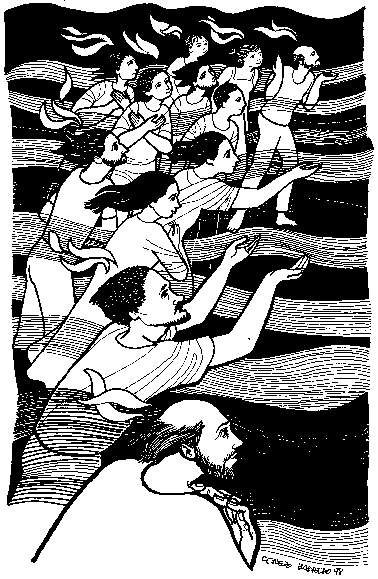 [Each week, I present some thoughts on the Bible lessons for the succeeding Sunday. In doing so, I hope to help the people of the congregation I serve, Saint Matthew Lutheran Church in Logan, to prepare for worship. And because, we will almost always use the appointed lessons for the Church Year, I also hope that these thoughts can help others prepare for worship too.
The Bible Lessons: Acts 2:1-21 or Numbers 11:24-30
Psalm 104:24-35
1 Corinthians 12:3b-13 or Acts 2:1-21
John 20:19-23 or John 7:37-39
[We have many different optional Bible lessons for this coming Sunday, Pentecost Day. I'm going to focus solely on Acts 2:1-21, which gives the account of first Christian Pentecost.]
The Prayer of the Day:
O God, on this day you open the hearts of your faithful people by sending into us your Holy Spirit. Direct us by the light of that Spirit, that we may have a right judgment in all things and rejoice at all times in your peace, through Jesus Christ, your Son and our Lord, who lives and reigns with you and the Holy Spirit, one God, now and forever.
General Comments:
1. Pentecost already was a festival on calendar of pious Jews. It was a harvest festival, falling fifty days after the Sabbath of Passover week. For more, see here. On the Christian calendar, Pentecost is one of the three great festivals of the Church Year, along with Christmas and Easter. The first Christian Pentecost happened fifty days after the first Easter and ten days after the risen Jesus ascended to heaven.
2. The they mentioned in verse 1 are presumably the group of 120 Christ-Followers mentioned in 1:15.
3. The events of Pentecost fulfill the promise Jesus made in 1:8, that He would send the Holy Spirit, Who would make it possible for them to boldly witness for God in spite of their fears. The gift of the Spirit would also fulfill Old Testament prophecy, Peter points out. We'll discuss that more in the verse-by-verse comments.
4. The events of Pentecost also, in a way, reverse the conclusion of the Old Testament story of the Tower of Babel. There, filled with arrogance, the people of a city called Babel, decided to build a tower which, they thought, would make them as great as God. To save from themselves, God confused them by causing them to speak different languages. Their inability to communicate made working together impossible and soon, worked stopped and the people moved in every direction, establishing their own countries and customs. (For more, see here.)
Through the events of the first Christian Pentecost, the Holy Spirit made it possible for followers of Jesus Christ to communicate in ways that were understandable to the varied representatives of the Jewish disaspora gathered in Jerusalem for the festival. Instead of using their communication skills to glorify themselves, the first believers went around, "speaking about God’s deeds of power.”
5. The first Christian Pentecost introduces what might be called "the era of the Holy Spirit." The Spirit is the third Person of the Trinity and has always been present from eternity. But in the era in which we live now, it's the Holy Spirit who makes faith possible and who gave birth to the community through which God speaks to the world today, the Church. (For more see here and here.)
Verse-by-Verse Comments:
1When the day of Pentecost had come, they were all together in one place.
(1) Were these first Christians afraid? Probably. Were they praying? No doubt. But they were also doing what the risen Jesus told them to do just before He ascended to heaven: waiting for the promised Holy Spirit. Faith often involves patient waiting.
2And suddenly from heaven there came a sound like the rush of a violent wind, and it filled the entire house where they were sitting.
(1) In Old Testament Hebrew, there is a word (ruach) which can be translated as wind, breath, or spirit. A similar word exists in New Testament Greek, pneuma. It's God's ruach that bears down upon the watery chaos in Genesis 1 and brings life into being. God also breathes ruach into Adam to give the first man life. Here, the very life-giving breath of God breathes His Church, the fellowship of believers committed to Christ's mission for it, into being.
(2) Luke, the writer of Acts, is at pains to point out that this wasn't some gentle little breeze. The Holy Spirit came into the place where the first Jesus-Followers were gathered "like the rush of a violent wind." The Spirit filled the entire house...there was no escaping God for the believers who were there!
3Divided tongues, as of fire, appeared among them, and a tongue rested on each of them. 4All of them were filled with the Holy Spirit and began to speak in other languages, as the Spirit gave them ability.
(1) This is different from the gift of tongues which the New Testament talks about elsewhere. As Paul makes clear in 1 Corinthians 14, that's a worship language which God gives to some Christians as a means of building up the church internally. The Holy Spirit is given to every believer in Christ. It's the Spirit Who makes it possible for once-fearful followers of Christ like Peter to share the good news of new life for all with faith in Jesus with boldness and humility.
(2) The Holy Spirit has been referred to as the "shy member of the Trinity." (The Trinity describes one of God's many mysterious attributes: God is one and yet is three persons, Father, Son, and Holy Spirit.) And yet the Spirit's appearance on Pentecost was an occasion for sensory overload. First, He filled the house where the disciples were sitting with a roar. Then, He appeared visually in some way. Finally, He sent the disciples out onto the streets of Jerusalem, each telling the story of God's mighty deeds in various languages for all to hear.
5Now there were devout Jews from every nation under heaven living in Jerusalem.
(1) They were in Jerusalem, the center of worship for God's ancient people, as explained here.
6And at this sound the crowd gathered and was bewildered, because each one heard them speaking in the native language of each.
(1) The crowds didn't hear a strange language, as would have been the case if the first Christians were speaking "in tongues." They heard intelligible accounts of God's mighty acts in their own native languages, the ones they spoke in their dispersed homelands.
7Amazed and astonished, they asked, “Are not all these who are speaking Galileans? 8And how is it that we hear, each of us, in our own native language? 9Parthians, Medes, Elamites, and residents of Mesopotamia, Judea and Cappadocia, Pontus and Asia, 10Phrygia and Pamphylia, Egypt and the parts of Libya belonging to Cyrene, and visitors from Rome, both Jews and proselytes, 11Cretans and Arabs—in our own languages we hear them speaking about God’s deeds of power.”
(1) How is it possible, the crowd wonders, for these Galileans to speak in their languages? This really is the miracle of Pentecost: God empowers the first Christians to share the Good News in accessible ways!
(2) Notice that the disciples weren't apparently confined to speaking of Jesus' death and resurrection. They were recalling for this international gathering of their fellow Jews "God's deeds of power."
This underscores Luke's emphasis, evidenced both in his Gospel and in Acts, on the unity and consistency between the God revealed in Old Testament times and the God seen in Jesus and now, in the Holy Spirit.
This, according to Luke, is exactly what the resurrected Jesus emphasized when He met the two disciples on the road to Emmaus back on the first Easter. Recalling the Law and the Prophets from the Old Testament, He demonstrated how His death and resurrection had been the plan for the Lord's Messiah always and that the means of salvation--trust or belief in the God ultimately revealed in Jesus--has always been the same.
We Christians tell the story of God's mighty deeds, especially Jesus' death and resurrection, the central event of human history, so that people will call upon the Lord and so, be saved from sin and death. As with the first Christians, it is the Holy Spirit Who gives us the ability to do this.
12All were amazed and perplexed, saying to one another, “What does this mean?” 13But others sneered and said, “They are filled with new wine.”
(1) People always try to explain away the miraculous intervention of God in human life, including Jesus' resurrection. Even religious folks do that. In Old Testament times, a devout woman begged God for a child. Overcome with emotion, the priest thought she was drunk. But she wasn't drunk and God gave her a child destined to be one of the great figures in Israel's history, Samuel. (See here.)
14But Peter, standing with the eleven, raised his voice and addressed them, “Men of Judea and all who live in Jerusalem, let this be known to you, and listen to what I say.
(1) This demonstrates the power of the Holy Spirit. Just seven-plus weeks before, Peter denied even knowing Jesus. Now, in spite of the implicit danger of being associated with Jesus, Who was executed, Peter stands up to give witness to his faith in Christ.
15Indeed, these are not drunk, as you suppose, for it is only nine o”clock in the morning.
(1) Peter evidences having done the very first thing any witness for Christ must do. He listened. His words come in response to the questions and accusations of the crowd in Jerusalem.
(2) Peter is arguing that it's way too early for all these people to be drunk; the taverns aren't even open yet!
(3) These people aren't under the influence of spirits, but of the Spirit.
16No, this is what was spoken through the prophet Joel: 17‘In the last days it will be, God declares, that I will pour out my Spirit upon all flesh, and your sons and your daughters shall prophesy, and your young men shall see visions, and your old men shall dream dreams. 18Even upon my slaves, both men and women, in those days I will pour out my Spirit; and they shall prophesy. 19And I will show portents in the heaven above and signs on the earth below, blood, and fire, and smoky mist. 20The sun shall be turned to darkness and the moon to blood, before the coming of the Lord’s great and glorious day.
(1) Another thing a witness for Christ must do is connect God's story with my story and your story. By knowing the Bible, Peter knows God's story.
(2) Peter is saying that there is a different explanation for this strange phenomenon. Simply, God's Holy Spirit has come to Jesus' believers, empowering them to witness for Christ.
(3) To prophesy, in Biblical terms, is to share God's truth.
21Then everyone who calls on the name of the Lord shall be saved.’
(1) In its way, this passage, lifted from the Old Testament prophet Joel, is "the Gospel in a nutshell." Gospel is the Old English translation of the New Testament Greek term, evangel, meaning good news. Christians have good news to share: God is for the human race. All who seek help and forgiveness from the God we meet in Jesus Christ will be saved from sin and death and have fellowship with God forever.
Another Gem...
from Pastor Glen VanderKloot's daily emailed inspirations:
Thought for the DayFor information on how you can receive Pastor VanderKloot's daily emails, go here.
"God will speak only when you stop.
"Only when I silence my heart can I seek God with any
hope of understanding what he is trying to reveal to me."
(Erik Reese)
Scripture
Psalm 37:7 NLT:
"Be still in the presence of the Lord,
and wait patiently for him to act."
Prayer
Lord, help me to quiet my heart so that I can hear
and understand what you are saying to me. Amen
Monday, May 05, 2008

Sunday, May 04, 2008
Tools for the Journey
 [This sermon was shared during worship with the people of Saint Matthew Lutheran Church in Logan, Ohio, this morning.]
Acts 1:6-14
We were on our way to the Southern Ohio Synod Bible Bowl a few weeks ago, when I had to nip a problem in the bud. You see, two of our young people—whose initials are Jacob and Steven—were about to sing a rousing rendition of Ninety-Nine Bottles of Beer on the Wall. “No,” I said, “we aren’t going to sing that.” It isn’t that I object to singing about beer. It’s just that that particular song makes me nuts, all ninety-nine verses of it. It was for the safety of all my passengers that I stopped the song before we got anywhere close to that ninety-eighth bottle of beer on the wall.
Of course, the purpose of traveling songs is to help make the time pass more quickly. Parents and elders have been devising songs, games, and conversation-starters to entertain children during long trips for centuries. No parent wants to hear the most dreaded words of any journey: “Are we there yet?”
In a way, that’s the question asked of Jesus by the disciples at the beginning of our first lesson for today, from the book of Acts. Let’s set the scene. It’s forty days after Jesus rose from the dead on the first Easter. The disciples probably figured that by then, they and all the people of God had already been on a long journey with God.
They had a point.
Sometime around 2000AD, God had called a wealthy couple named Abram and Sarai, who lived in what is modern-day Iraq, to go to a land that God would show them and, in spite of their advanced years, to become the father and mother of God’s people, the Hebrews.
Through the ensuing centuries, through slavery and exile, triumph and humble faithfulness, God would give His people a land and a promise that one day, the Savior of the whole world would be born among them. Through Israel, the light of the world, God the Son, would come to offer new life and eternity with God to all who repent of their sin and entrust their lives to Him. The Son would establish God’s kingdom and destroy the power of sin and death forever.
When that Son—Jesus of Nazareth—showed up and revealed the will, the heart, and the identify of God, few people believed in Him. Not even God’s own people believed in Him. But, fitfully, imperfectly, several hundred people became followers—disciples—of Jesus. When He died on a cross, they mourned. When He rose from the dead, they exalted, then spent forty days as He taught them and prepared them for the future.
They thought that the long-sought future had arrived. That was the moment, they were sure, when Jesus would finally, fully establish the kingdom of God. He would throw out the Romans, get rid of the gas tax, and put a chicken in every pot and a Maserati in every garage. Sin and death would be no more, too. Those made righteous by faith in God would be in charge and the bad guys, who they were sure was everybody not like them, would be their slaves.
So, they ask Jesus, “Are we there yet?” Actually, our lesson tells us that they asked, “Lord, is this the time when you will restore the kingdom of Israel?”
They may have been disappointed with Jesus’ answer. He tells them not to worry about when He will put things right for all eternity. “It is not for you,” He tells them, “to know the times or periods that the Father has set by His own authority.” In other words, “Don't worry about how God will fully establish His kingdom. Instead, be about your mission until He does!"
But what is the mission that Jesus wants you and me to do as His Church?
That's an important question.
We’re on a journey, each of us. Followers of Jesus, like the rest of the human race, live on this planet for a length of time known only to God. How does Christ want us to use that time? Jesus could have taught us songs or games to pass the time. But Jesus makes clear in today’s lesson that He wants Christians, He wants His Church, He wants the people of Saint Matthew to do more than pass the time we have on this earth. Our mission is to share the Good News of new life for all who believe in Christ. In a wonderful sermon on this same text, Pastor John Jewell identifies three tools that Jesus gives us to pursue that mission.
First: Jesus gives us power. “You will receive power when the Holy Spirit comes upon you; and you will be my witnesses…” When you and I were baptized, we received God’s Holy Spirit, the very power of God for living. And throughout our lives, we can receive fresh supplies of God’s Spirit. God gives us His Spirit so that we can be about God’s business of sharing Christ with the world for as long as we live.
Some of you may have heard of Jim Cymbala. In one of his books, Cymbala recounts the struggle through which he and his wife went to keep that church alive. Some Sundays, he says, they were lucky to have twenty people. It was a challenge to his faith. No matter what Cymbala tried—and he tried all the newest church growth gimmicks, nothing changed. The Brooklyn Tabernacle was still the small, financially-strapped, conflict-ridden congregation it had always been.
In the midst of this, Cymbala became sick with a cough that wouldn’t go away. Two members of the struggling church, concerned for his health, sent him to Florida to spend a week at a condo they owned. While there, he went on an evening fishing expedition. But his heart heavy with worry about what would become of his church and him, Cymbala went to the back of the boat, away from the others who had lines thrown into the water. He sobbed and within his mind, he asked God what He should do.
“Pray. Just pray,” was the answer he sensed God gave to him. “Pray and I will give you a power that you don’t have yourself. Pray and I will send more people than you can contain in any building.”
When Cymbala first returned to Brookliyn, nothing had really changed much. He coughed less. But there were the same bills. The same twenty people. The same dilapidated building. But as he and those twenty people prayed, God sent them the power to keep going. Today, thousands of people worship each week at the Brooklyn Tabernacle. I don't agree with all aspects of Cymbala's theology, but I do agree that through God's Spirit, we're given a power to do and be more than we could ever ask or imagine.
In 2 Corinthians 12, Paul writes, “whenever I am weak, then I am strong.” We are never so powerful as we are when we come to the ends of ourselves and admit, “I can’t fight my temptations, I can’t face my troubles, I can’t fulfill your mission for me, Lord, on my own. I need Your power.” Jesus promises to fill our weaknesses with His power when we're humble enough to admit our need of Him!
Jesus gives a second tool for us to do our mission as His people: His promise. After Jesus ascended to heaven, the angels told the first Christians, “Jesus is coming back.” We still believe that today and as you scan all the promises God has made in Scripture and consider how many of them have already come to pass, you have a confidence that this one will come true too. The Lord Who died and rose will make good on His promise. We shouldn’t worry about the fact that 2000 years have passed since Jesus ascended to heaven. As Peter writes in another place in the New Testament, “The Lord is not slow about His promise…but is patient…not wanting any to perish, but all come to repentance.” We have this time to turn from our sin and follow Christ. We have it too, to invite others to follow Jesus with us.
The third tool Jesus gives us for fulfilling His mission for us is prayer. After Jesus ascended, His followers devoted themselves to prayer. On the first Pentecost, ten days later, they learned that through prayer, we gain access to the power Jesus promises His people!
E. Stanley Jones was a Methodist missionary to India in the middle part of the twentieth century and a good friend of Mohandas Gandhi. Once, at the end of one gathering at which he spoke, an obviously well-to-do woman approached Jones.
Jones writes: “As we shook hands, [she] said, “If I had what you have, I wouldn’t be in the mess I’m in.” [Later] she laid bare her tragedy: Her home was going to be broken up after Christmas--they would hold together till Christmas so as not to break the children’s hearts. We prayed and I asked her to pray when she got home. But she said afterward: “I belonged to the country club cocktail-gambling set and didn’t know how to pray. So I wrote God a letter: ‘Dear God, life has dealt me a very bad hand and I don’t know which card to lead. Please show me which card I am to lead.’ And I signed it.”
Reports Jones, “God heard that prayer expressed in the only language she knew.” Somehow, that woman and her husband were able to stay together and become reconciled. Jones says that the woman was able to hold her home together “by her changed spirit.”
One day, Jesus will return, finally establishing His eternal kingdom. Until then, He gives us a mission to make disciples of all nations and He gives us the tools with which to do it—His power, His promise, and prayer.
My prayer is that you and I at Saint Matthew will make full use of these tools.
That’s why I hope that every member will participate in this week’s prayer vigil, not as an end, but as a new beginning.
Let’s be the church most known in this community for its reliance on the three gifts Jesus gives in our lesson from Acts. Jesus’ power, His promise, and prayer are a lot less annoying that Ninety Nine Bottles of Beer on the Wall and when we use them we’ll be doing more than passing the time. We’ll be changing lives, ours and the lives of all we touch!
Subscribe to:
Posts (Atom)