Back in the day, all our Nixon impressions were really impressions of Frye imitating Nixon. He suffered the same fate as that previously dealt to Kennedy impersonator Vaughn Meader, whose comedy career largely went away when JFK was assassinated.
Following Nixon's resignation, Frye was seldom seen or heard again. Imitation may be the highest form of flattery, but as a source of income, it usually has pronounced ups and downs.
Showing posts with label John F. Kennedy. Show all posts
Showing posts with label John F. Kennedy. Show all posts
Saturday, January 29, 2011

Thursday, December 04, 2008
LP Cover Parodies and Self-Deprecation
I was in a Virgin Records Store earlier this week. (It's a place through which I sometimes peruse, although I can't remember ever buying anything there.) As I looked around, this CD cover caught my eye:
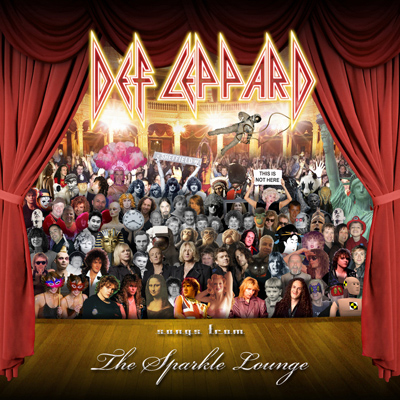
Imitation is, of course, if not the highest, one of the highest forms of flattery and obviously, this LP cover art from Def Leppard, a band I have managed to totally avoid through the years, pays homage to the Beatles. The Sparkle Lounge, I've since learned, was released in April of this year.
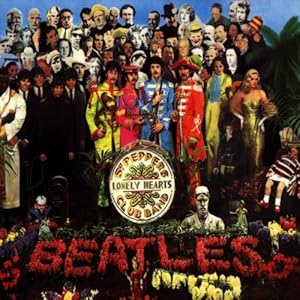
In case you don't know which Beatles LP it mimics (How have you managed to avoid the Beatles all these years and why would you want to?), here's the cover for their 1967 release, Sergeant Pepper's Lonely Hearts Club Band:
One of my favorite knock-offs of this landmark LP's cover was on the 1973 release by Beatle Ringo Starr. It looks like this:
 The Beatles always had a healthy sense of humor, concealing pride in their musical legacy beneath a willingness--most of the time--to deprecate and parody themselves. This was true of them from the beginning of their careers, when the Four Moptops appeared on a British variety show mocking their own then-signature, "Wooh!" while singing Moonlight Bay:
In later years, George Harrison appeared in the Eric Idle-created mockumentary, The Rutles.
But when it comes to LP covers, one of my favorite Beatles send-ups came from Beatle Paul McCartney. It mimics the cover that may be even more famous than that of Sergeant Pepper's: Abbey Road. Again, for those who've been living under large geological formations for all or parts of the last forty-five years, the original looks like this:
 And here's Macca's send-up, a concert LP released in 1993, called Paul is Live:

The Paul is Live cover manages also to allude to at least two tidbits of Beatles lore. First, it hearkens back to the resilient rumor, which started in 1966 and was still going strong in some circles as late as 1970, that said that McCartney was dead. The Abbey Road cover was introduced as evidence for this assertion. (One probably believed by the same folks who think that UFOs are here from other planets, the Cubans or the Mafia killed Kennedy, and Milli Vanilli were talented.) The four Beatles crossing the street by the EMI studios where they'd recorded from the beginnings of their careers, were said to be forming an Indian funeral procession with Lennon as priest and Starr as undertaker. The bodies of the dead in India, we were told ominously, were always left shoeless in such processions. Note: Paul is barefooted! Harrison, in his jeans, was also said to represent lower-caste mourners for the departed. No, in fact, Macca was saying in 1993, "Paul is [a]live and performing live." (As he told Chris Farley in one of those wonderful faux talk shows Farley used to do on Saturday Night Live, "I wasn't really dead.")
On the 1993 cover, McCartney is being pulled along by an English sheep dog like the one he owned in the 1960s, a dog named Martha. Martha gave its name to the Beatles' 1968 tune, Martha My Dear.
Self-parody is the best way for celebs to inoculate themselves against others' putdowns and from the usually-plausible charge of taking themselves too seriously. (This was something George Harrison tried, to no avail, to teach Madonna and Sean Penn when he produced a movie in which the then-married couple starred for him.) JFK was a master of self-deprecating humor and the Beatles, who conquered America five months after Kennedy's assassination and who were not short on ego, have been as well.
Here and here are sites that display LP covers imitating Sergeant Pepper's and Abbey Road.
I suppose that the real question about these and other parodies or all artistic imitation, for that matter, is why it happens. There are probably several reasons. One is that some works of art, whatever the idiom, are touchstones. They grab us by the lapels--assuming we have lapels--and won't let go. Musically, Sergeant Pepper's and Abbey Road did that, as did their cover art. Both were celebrated and are viewed as iconic.
Secondly, not everybody is as creative as the Beatles or the LP cover artists with whom they closely worked once Beatlemania hit. The Beatles' monstrous success allowed them to roam like kids in the candy shop through the entire musical process--production, arrangements, packaging. Before Beatles LPs like Revolver or Rubber Soul, album covers were fairly boring and predictable. The Beatles changed that.
But, of course, few can match the Beatles for creativity or the freedom accorded them by the suits. For four-and-a-half decades now the Fab Four have been imitated and parodied, but never matched.
[Also see here.]
[UPDATE: Go here to see something totally unnecessary: a live webcam transmission from the Abbey Road studios, now seventy-seven years old and still a site that attracts artists from around the world.]
Imitation is, of course, if not the highest, one of the highest forms of flattery and obviously, this LP cover art from Def Leppard, a band I have managed to totally avoid through the years, pays homage to the Beatles. The Sparkle Lounge, I've since learned, was released in April of this year.
In case you don't know which Beatles LP it mimics (How have you managed to avoid the Beatles all these years and why would you want to?), here's the cover for their 1967 release, Sergeant Pepper's Lonely Hearts Club Band:
One of my favorite knock-offs of this landmark LP's cover was on the 1973 release by Beatle Ringo Starr. It looks like this:

In later years, George Harrison appeared in the Eric Idle-created mockumentary, The Rutles.
But when it comes to LP covers, one of my favorite Beatles send-ups came from Beatle Paul McCartney. It mimics the cover that may be even more famous than that of Sergeant Pepper's: Abbey Road. Again, for those who've been living under large geological formations for all or parts of the last forty-five years, the original looks like this:
The Paul is Live cover manages also to allude to at least two tidbits of Beatles lore. First, it hearkens back to the resilient rumor, which started in 1966 and was still going strong in some circles as late as 1970, that said that McCartney was dead. The Abbey Road cover was introduced as evidence for this assertion. (One probably believed by the same folks who think that UFOs are here from other planets, the Cubans or the Mafia killed Kennedy, and Milli Vanilli were talented.) The four Beatles crossing the street by the EMI studios where they'd recorded from the beginnings of their careers, were said to be forming an Indian funeral procession with Lennon as priest and Starr as undertaker. The bodies of the dead in India, we were told ominously, were always left shoeless in such processions. Note: Paul is barefooted! Harrison, in his jeans, was also said to represent lower-caste mourners for the departed. No, in fact, Macca was saying in 1993, "Paul is [a]live and performing live." (As he told Chris Farley in one of those wonderful faux talk shows Farley used to do on Saturday Night Live, "I wasn't really dead.")
On the 1993 cover, McCartney is being pulled along by an English sheep dog like the one he owned in the 1960s, a dog named Martha. Martha gave its name to the Beatles' 1968 tune, Martha My Dear.
Self-parody is the best way for celebs to inoculate themselves against others' putdowns and from the usually-plausible charge of taking themselves too seriously. (This was something George Harrison tried, to no avail, to teach Madonna and Sean Penn when he produced a movie in which the then-married couple starred for him.) JFK was a master of self-deprecating humor and the Beatles, who conquered America five months after Kennedy's assassination and who were not short on ego, have been as well.
Here and here are sites that display LP covers imitating Sergeant Pepper's and Abbey Road.
I suppose that the real question about these and other parodies or all artistic imitation, for that matter, is why it happens. There are probably several reasons. One is that some works of art, whatever the idiom, are touchstones. They grab us by the lapels--assuming we have lapels--and won't let go. Musically, Sergeant Pepper's and Abbey Road did that, as did their cover art. Both were celebrated and are viewed as iconic.
Secondly, not everybody is as creative as the Beatles or the LP cover artists with whom they closely worked once Beatlemania hit. The Beatles' monstrous success allowed them to roam like kids in the candy shop through the entire musical process--production, arrangements, packaging. Before Beatles LPs like Revolver or Rubber Soul, album covers were fairly boring and predictable. The Beatles changed that.
But, of course, few can match the Beatles for creativity or the freedom accorded them by the suits. For four-and-a-half decades now the Fab Four have been imitated and parodied, but never matched.
[Also see here.]
[UPDATE: Go here to see something totally unnecessary: a live webcam transmission from the Abbey Road studios, now seventy-seven years old and still a site that attracts artists from around the world.]
Tuesday, November 22, 2005
Reflections on JFK's Assassination, the Unthinkable, and the Reliable
Some tragic events are of such magnitude for us that their details chisel themselves into our memories, collective and individual.
The attack on Pearl Harbor on December 7, 1941, were that for my parents and grandparents.
More recently, the terrorist attacks of September 11, 2001 have brought such memories to all of us alive on that day.
But today is the anniversary of another such event, the assassination of President John Kennedy in Dallas on November 22, 1963.
I remember that it was a pleasant, uncommonly warm November day in my hometown of Columbus. I was in the fifth grade at Westgate Elementary School. Our regular teacher, Mrs. Cleo Goldsberry, was not with us that day. Her substitute, Mrs. Shrum, the grandmother of one of my classmates, Cindy Smith, was a retired teacher and the class, as was obligatory with substitutes, gave her a hard time all day long.
Like most of my classmates, I walked home for lunch each day and returned for the afternoon session. I did that day too, and then tried to pay attention as I digested my food and looked out the window at the sunny day.
At about two o'clock that afternoon, the familiar voice of Dr. Harold Eibling, the superintendent of the Columbus Public Schools, broke in on the school P.A. system, carrying the signal of WCBE, the school system's radio station. He announced that President Kennedy had just been assassinated, that it was a sad day for our country, and that our classes would be dismissed.
I'll never forget the look of horror that crossed Mrs. Shrum's face. Her reaction was emblematic of the sentiments of many pundits and ordinary Americans in the days following the assassination. Of course, there had been several U.S. presidents assassinated in our history, the last being William McKinley sixty-two years earlier.
More recently, the divisive and megalomaniacal Senator and Governor Huey Long had been gunned down in Louisiana in the 1930s. There had been an attempt on the life of Franklin Roosevelt just prior to his inauguaration in 1933 and Puerto Rican separatists had been foiled in their plot to kill Harry Truman in the 1940s.
But we had the notion that in the modern, sophisticated 1960s, America had become too civilized for such things, too advanced. Something like this, we thought, was foreign to America.
Tragically, Kennedy's death seemed to be the opening act in a long killing season. Within a few years, Black Muslim leader Malcolm X, Rev. Martin Luther King, Jr., and Senator Robert Kennedy would all be felled by assassins' bullets. Alabama Governor George Wallace, running for the Democratic nomination for President in 1972, would be shot by a would-be assassin; Wallace remained paralyzed the rest of his life.
Many people say that America lost its innocence on November 22, 1963. I don't know if we did or not. But I can say that for the first time in my young life, what had previously seemed unthinkable no longer seemed so. Illusions about the certainties in this life were shown to be naive.
I'm sure that Kennedy's assassination, along with the flood of violence in the 1960s, the turmoil of the War in Vietnam, the struggle for civil rights, the riots in our cities, and the supposed certainties of science, with its unintended appeal to my adolescent ego, all had a role in my becoming an atheist in the early-1970s. No doubt this was born of the naivete that the reliability of God was somehow tied to the reliability of human beings or the functioning of a natural world burdened by the effects of human sin.
But I'm also certain that all these cataclysmic events played a part in my coming back to faith in the God made plain in Jesus Christ, the solid center, the Rock on Whom we can rely even in the midst of uncertainty and chaos.
Jesus has said that heaven and earth will pass away, but His Word, the same Word uttered to create the cosmos and that He later spoke to declare repentant sinners free and call dead men back to life, will never pass away.
"Thy Word is our great heritage," Martin Luther declares in one of his great hymns.
"Thy Word is a lamp unto my feet and a light unto my path," one of the Old Testament psalms says.
A short time after the September 11 attacks, a woman told me that they had driven the last vestiges of faith from her. I told her that for me, they had driven me closer to God. More certain than ever that while we human beings have our parts to play in fighting evil, we can't face life's uncertainties without God's help, I had called out to God and felt His consoling presence in His Word, in my times of prayer, and in the fellowship of others seeking to follow Him.
If the cataclysmic events of today cause us to lose our confidence in the human race or in the clockwork-like functioning of nature, that's a good thing. It's only when we divest ourselves of the illusions of self-sufficiency or of the ultimate reliability of leaders, systems, or nature, that we become open to calling out to the God we know in Christ. The Bible promises that all who do so, will have Him in their lives...for good and forever.
ALSO: Charlie Lehardy had similar reflections on the assassination of President Kennedy.
[Blogger Mark Daniels is pastor of Living Water Lutheran Church in Centerville, Ohio.]
The attack on Pearl Harbor on December 7, 1941, were that for my parents and grandparents.
More recently, the terrorist attacks of September 11, 2001 have brought such memories to all of us alive on that day.
But today is the anniversary of another such event, the assassination of President John Kennedy in Dallas on November 22, 1963.
I remember that it was a pleasant, uncommonly warm November day in my hometown of Columbus. I was in the fifth grade at Westgate Elementary School. Our regular teacher, Mrs. Cleo Goldsberry, was not with us that day. Her substitute, Mrs. Shrum, the grandmother of one of my classmates, Cindy Smith, was a retired teacher and the class, as was obligatory with substitutes, gave her a hard time all day long.
Like most of my classmates, I walked home for lunch each day and returned for the afternoon session. I did that day too, and then tried to pay attention as I digested my food and looked out the window at the sunny day.
At about two o'clock that afternoon, the familiar voice of Dr. Harold Eibling, the superintendent of the Columbus Public Schools, broke in on the school P.A. system, carrying the signal of WCBE, the school system's radio station. He announced that President Kennedy had just been assassinated, that it was a sad day for our country, and that our classes would be dismissed.
I'll never forget the look of horror that crossed Mrs. Shrum's face. Her reaction was emblematic of the sentiments of many pundits and ordinary Americans in the days following the assassination. Of course, there had been several U.S. presidents assassinated in our history, the last being William McKinley sixty-two years earlier.
More recently, the divisive and megalomaniacal Senator and Governor Huey Long had been gunned down in Louisiana in the 1930s. There had been an attempt on the life of Franklin Roosevelt just prior to his inauguaration in 1933 and Puerto Rican separatists had been foiled in their plot to kill Harry Truman in the 1940s.
But we had the notion that in the modern, sophisticated 1960s, America had become too civilized for such things, too advanced. Something like this, we thought, was foreign to America.
Tragically, Kennedy's death seemed to be the opening act in a long killing season. Within a few years, Black Muslim leader Malcolm X, Rev. Martin Luther King, Jr., and Senator Robert Kennedy would all be felled by assassins' bullets. Alabama Governor George Wallace, running for the Democratic nomination for President in 1972, would be shot by a would-be assassin; Wallace remained paralyzed the rest of his life.
Many people say that America lost its innocence on November 22, 1963. I don't know if we did or not. But I can say that for the first time in my young life, what had previously seemed unthinkable no longer seemed so. Illusions about the certainties in this life were shown to be naive.
I'm sure that Kennedy's assassination, along with the flood of violence in the 1960s, the turmoil of the War in Vietnam, the struggle for civil rights, the riots in our cities, and the supposed certainties of science, with its unintended appeal to my adolescent ego, all had a role in my becoming an atheist in the early-1970s. No doubt this was born of the naivete that the reliability of God was somehow tied to the reliability of human beings or the functioning of a natural world burdened by the effects of human sin.
But I'm also certain that all these cataclysmic events played a part in my coming back to faith in the God made plain in Jesus Christ, the solid center, the Rock on Whom we can rely even in the midst of uncertainty and chaos.
Jesus has said that heaven and earth will pass away, but His Word, the same Word uttered to create the cosmos and that He later spoke to declare repentant sinners free and call dead men back to life, will never pass away.
"Thy Word is our great heritage," Martin Luther declares in one of his great hymns.
"Thy Word is a lamp unto my feet and a light unto my path," one of the Old Testament psalms says.
A short time after the September 11 attacks, a woman told me that they had driven the last vestiges of faith from her. I told her that for me, they had driven me closer to God. More certain than ever that while we human beings have our parts to play in fighting evil, we can't face life's uncertainties without God's help, I had called out to God and felt His consoling presence in His Word, in my times of prayer, and in the fellowship of others seeking to follow Him.
If the cataclysmic events of today cause us to lose our confidence in the human race or in the clockwork-like functioning of nature, that's a good thing. It's only when we divest ourselves of the illusions of self-sufficiency or of the ultimate reliability of leaders, systems, or nature, that we become open to calling out to the God we know in Christ. The Bible promises that all who do so, will have Him in their lives...for good and forever.
ALSO: Charlie Lehardy had similar reflections on the assassination of President Kennedy.
[Blogger Mark Daniels is pastor of Living Water Lutheran Church in Centerville, Ohio.]
Subscribe to:
Posts (Atom)