More than seven years ago, I wrote about the sadness with which I'd watched Martin Scorcese's documentary biography of George Harrison. I saw part of it again recently. I'd forgotten this story told by Tom Petty about the day Harrison came to give him unsolicited ukulele lessons and then, opened the trunk of his car. It made me smile.
Showing posts with label George Harrison. Show all posts
Showing posts with label George Harrison. Show all posts
Wednesday, January 17, 2018

Monday, August 14, 2017
Today's 11:11, August 14, 2017
This is isolated on George Harrison's lead vocal, with Paul McCartney's harmony, on I Need You. Harrison composed the song and it was included in the Beatles' second feature film, Help.
[Blogger Mark Daniels is pastor of Living Water Lutheran Church in Centerville, Ohio.]
[Blogger Mark Daniels is pastor of Living Water Lutheran Church in Centerville, Ohio.]
Wednesday, September 14, 2016
Handle with Care by The Traveling Wilburys
Just before reading The Economist's piece on George Frideric Handel (mentioned in the previous post), I read about another musician called George from across the pond and a trip he took to America before he became famous. That other George was George Harrison.
Harrison visited his sister Louise in Benton, Illinois, along with his brother Peter, a few months before the US was infected with Beatlemania. I was sent down the rabbit hole of reading about Harrison in Illinois by the announcement from a high school classmate, Peter Conrad, that a song of his is included in the soundtrack of a film about Harrison's visit to Benton.
Harrison wrote Handle with Care as a B-side and thought it would be fun to get some others involved in its recording, namely, Jeff Lynne (who was producing the LP on which the A-side of the single was to appear), Tom Petty, Bob Dylan, and Roy Orbison. After the recording proved to be satisfying and fun, the five musicians decided to do more tracks, resulting in the LP, The Traveling Wilburys.
Handel was unavailable to record with other five musicians at the time, though his name (sort of) appears in the title of this track.
Friday, July 22, 2016
Something by Paul McCartney, Jeff Lynne, Eric Clapton, & a Cast of Thousands
At the Concert for George, George Harrison's friends and collaborators sing one of his contributions to the Beatles' catalog.
Friday, October 30, 2015
'Why Does Love Got to Be So Sad?' by Eric Clapton
This is one of a number of songs written by Eric Clapton for his former wife (and George Harrison's former wife), Patti Boyd. Other Clapton tunes inspired by Boyd are Layla and Wonderful Tonight. Harrison's most famous paean to Boyd is Something.
Why Does Love Got to Be So Sad? exemplifies a genre of tunes I call sad longing songs. Despite that, the song manages to somehow be jubilant, if a bit overlong. I suppose that's true to the experiences attested to by sad longing song: There's jubilation in love, sadness when it can't flower or be expressed. That makes this song a kind of resigned, wondering, and yet, jubilant celebration of love's entry into one's life, even love that can't be. Unrequited love can be exhilarating and shattering at the same time, though it makes no sense that that should be the case. At least that's what this song seems to say.
Clapton originally recorded Why Does Love Got to Be So Sad? in 1970, while he was a member of Derek and the Dominos.
This is a live version recorded by him in 2009.
Sunday, August 10, 2014
Friday, November 30, 2012
On the Tenth Anniversary of His Death: George Harrison Posts
Yesterday was the tenth anniversary of the death of George Harrison. Below are links to some past posts on this blog in which Harrison was mentioned or played an important part:
Why Are We So Litigious?
Anniversary of John Lennon's Death: The Dream is Over
How to Keep Our Mouths Under Control (or, Getting Free of Being a Gossip)
He Wanted to Be Successful without Being Famous
Isn't It a Pity?
Why Are We So Litigious?
Anniversary of John Lennon's Death: The Dream is Over
How to Keep Our Mouths Under Control (or, Getting Free of Being a Gossip)
He Wanted to Be Successful without Being Famous
Isn't It a Pity?
Isn't It a Pity?

My wife and I watched the second part of Martin Scorcese's documentary about George Harrison, Living in the Material World, last night. It left me feeling sad and empty.
Not just because of the tragic last years of Harrison's life, which included cancer, remission, an attack by a would-be murderer that nearly killed him, and the re-appearance of the cancer that did kill him.
And not just because of the loss of a talented musician, still in his 50s, whose music helped comprise, as some have said, "the soundtrack of my life."
What saddened me was the source of Harrison's well-known spiritual quest. Harrison was more aware than most of us are of the basic human need to know God. But in the church of his upbringing (in this case, a Roman Catholic church), he didn't get to know God.
As a Christian, that saddens, chastens, and angers me. To know that there are people who, usually without being aware of it, come to our churches hungry for God, but never get fed is, to me unspeakably sad.
And tragic!
The great thing about the Church is that it's composed of human beings. Imperfect though each Christian is, she or he is empowered by God to let others know, see, and experience God.
Faith isn't something we attain through recited prayers and creeds, mantras, or beads, though any number of human practices can support us in our faith journeys.
But faith, actual knowledge of, friendship with, and trust in, God is a gift ordinary Christians can give when, by word and deed, they tell others about God-enfleshed, Jesus Christ. God's Holy Spirit works faith in the person who hears the Gospel, the good news about the new life that comes to all who trust what Christ has done for us through His death and resurrection.
Philipp Melancthon writes in Article V of The Augsburg Confession, a basic statement of faith for we Lutheran Christians:
...through the Word [about Christ] and administering the sacraments [Holy Baptism and Holy Communion], as through instruments, the Holy Spirit is given and the Holy Spirit produces faith, where and when it pleases God, in those who hear the Gospel. That is to say, it is not on account of our own merits but on account of Christ that justifies [makes right with Himself] those who believe that they are received into favor for Christ's sake... [italics added for emphasis]In other words, there's nothing we can do to find God. And we don't have to perform any task to know God. We don't even have to do any work--like chanting a mantra--to know God. God makes Himself known in Jesus Christ.
Christ commissions the Church to let others know God through Himself.
The Holy Spirit takes the witness of ordinary Christians--dishwashers, plumbers, teachers, hairdressers, computer programmers, even preachers--and creates faith in those who hear the good news about Jesus.
Earlier I said, "The great thing about the Church is that it's composed of human beings."
Do you know what the horrible thing about the Church?
It's composed of human beings.
Knowledge of God, relationship with God, and trust in God are all free gifts God grants through Christ and spreads around through Christians operating in the power of His Holy Spirit.
But because sin still lives in Christians and will until the day we die, we Christians sometimes hide God's free gifts beneath the veils and thick brick walls of religiosity, pomposity, and authoritarianism.
That, I think, is what victimized George Harrison. It's why he never got to know Jesus Christ, the One Who makes God known. (One passage in Scripture, the witness of one who had known Jesus before His crucifixion and resurrection, says: "No one has ever seen God. It is God the only Son [Jesus Christ], Who is close to the Father's heart, Who has made Him known" [John 1:18].)
George Harrison grew up in a church that appeared to him so bent on maintaining its rites and its status that he couldn't see God.
The irony is that in his quest for God through Indian spirituality, he took up rites of religiosity to go looking for God.
Jesus is the One Whose coming into the world we celebrate during Advent and Christmas and Whose return one day to bring His eternal kingdom in its final form that we excitedly anticipate. Jesus is God revealed to all the world. "The Father and I are one," Jesus once said (John 10:30).
It saddens me to realize that churches around the world obscure the views others need to have of God. They bury Christ beneath the rubble of religion and in some cases, legalism ("You've got to do this or that to know God.") and in others, spiritual libertarianism ("Do whatever you want; God just wants you to be happy, no matter how monstrous you may act.").
But when Christians and churches allow themselves to simply and humbly tell others about Christ, serve in His Name, and share the Sacraments Christ instituted, one vulnerable human being in need of God to another, that's when people can see God, know God, and believe in God.
I'm sorry that, for whatever reason, whether because the church of his youth obscured the Gospel about Jesus from his view or because his ears, mind, heart, and will were closed, George Harrison never got to know Jesus.
Not some Life of Brian straw man version of Jesus, easy to dismiss or tear down.
Not the means for clergy or churches to exercise power over fearful or disbelieving people.
But the real Jesus, full of grace and truth. The One Who bore the burden of our sin, death, and futility on the cross. The One Who, by His resurrection, opened the gates of eternity for all who believe in Him.
George Harrison wanted to know God so much. I wish someone had shown him the God revealed definitively to the whole human race in Jesus Christ.
Isn't it a pity that someone didn't do that?
UPDATE, evening, 11/30/12: We didn't know last evening when we watched Scorcese's documentary about Harrison that it was the tenth anniversary of George Harrison's death.
Sunday, September 13, 2009
How to Keep Our Mouths Under Control (Or, Getting Free of Being a Gossip)
[This was shared during worship with the people of Saint Matthew Lutheran Church in Logan, Ohio, earlier today.]
James 3:1-12
A true story, one told by a pastor, Rick Eshbaugh. One evening, he was alone with his kids, while his wife was out crafting porcelain dolls at a doll-making class. While he chatted with a neighbor on his front porch, the telephone rang. Eshbaugh’s son, Craig, then five years old, answered. “I was proud to hear Craig answer the phone promptly and politely,” he says. “[But] My pride [turned into embarrassment] as I heard my son’s response to the caller’s request to speak to my wife: ‘No [Craig said], my mom’s not here. She’s out making a baby. But my dad is here if you want to talk to him.’”
Over the past several weeks, our second Bible lessons have been drawn from the New Testament book of James. James is a book that challenges us to consider how we live out our faith in Jesus Christ, particularly within God’s only eternal family, the Church.
In today’s second lesson, James addresses a very practical issue for Christians and the Church: How we use the gift of communication and speech. Or, how we use our tongues, as James would put it.
James was appalled at how Christians could use their mouths to praise God in worship one moment, pray to God for blessings the next, and then use those same mouths to run down other people who, just like us, are made in the image of God and for whom, also just like us, Jesus died and rose.
James isn’t concerned with the innocent mistakes made by people like little Craig Eshbaugh when he told a caller that his mom was making babies nor was he talking about the things we say that emanate from innocent ignorance.
Instead, James is talking about the deliberate use we make of speech that rips people down, that passes on gossip, that lifts us up at the expense of others, or that hurts the fellowship of the Church in which Jesus commands us to love one another as He has loved us. In short, James addresses speech that dishonors God.
He minces no words about the destruction wrought by our words or where their destructive power comes from.
And he says that without personal surrender to Jesus Christ, the use of our speech will always be more reflective of hell than of heaven. Listen to some of what James says, as his words are rendered in the translation of the Bible known as, The Message:
The monk told her to go through the village and bag all the goose feathers she could find. Then, she should lay a feather at the doorstep of every person about whom she had gossiped. After that, she should return to the monk.
The woman dutifully did what the monk directed her to do and returned to him. The monk said, "That's great. Now go back to each of those doorsteps and collect the goose feathers you left behind. Then, come back here." When the woman returned for yet another visit to the monk, she reported that all the feathers had been blown away by the wind.
"That’s the point, of course," the monk told her. "We can be forgiven the sin of gossiping about others. If you repent for it, God surely will forgive you. Those you have violated may do the same. But no matter whether you are forgiven or not, the damage will have been done. Gossip spreads as though carried aloft by the wind and you can't bring it back. So, be careful about what you say."
When I look at my life, I find that almost every problem I’ve ever experienced has been caused by my unwise speech, words used that denigrated or damaged others, words that told half-truths, words that conveyed hurtful speculation about the character or motives of others. I’ve repented for those things. But I realize that the damage done, like a bell that can’t be unrung, can never be reversed.
In his explanation of God’s Eighth Commandment, “You shall not bear false witness against your neighbor,” Martin Luther writes in The Small Catechism, “We are to fear and love God so that we do not betray, slander, or lie about our neighbor, but defend him, speak well of him, and explain his actions in the kindest way.” Not only are we not to lie about others, we’re to put the most positive spin on their actions and motives that we can. (And that includes what we say about politicians in Washington you and I will never meet!) If we love the God Who loved us all the way to the cross, we’ll take the call to the right use of our words seriously.
But how do we do that? Here are a few thoughts from one recovering mis-user of speech to another.
First: We surrender our brains and our mouths to God, along with the rest of us. A good prayer to offer each day might be the one in Psalm 119:14: “Let the words of my mouth and the meditation of my heart be acceptable to you, O Lord, my rock and my redeemer.”
Second: Before we open our mouths to share something critical of another, we should ask ourselves, “Does this help anything?” In the book of Ephesians, we read these words: “Let no evil talk come out of your mouths, but only what is useful for building up, as there is need, so that your words may give grace to those who hear.” (Ephesians 4:29)
Third: We ask ourselves another question: Would we say these words to Jesus Christ? In a very real way, whether our words build others up or tear them down, Christ hears every one of them. As Jesus once said, “There is nothing concealed that will not be disclosed, or hidden that will not be made known.” Jesus has said that when we encounter others, we really meet Him. Do we think that Jesus wants to hear our gossip?
Finally, I want to say a word to all of you who, like me, have already scattered too many goose feathers to the wind. It can be appropriate for you to apologize to the people who have been hurt by your intemperate words. Although I must say, I don't feel fanatical about this. In my former parish, a woman told me that just the week before, she'd gotten a call from a man she'd dated forty years earlier. He wanted to apologize for something she had long forgotten from that period. But what’s most appropriate when we misuse the gift of speech to run others down is to ask God for His forgiveness and for the power to keep our tongues under His control in the future.
Proverbs 22:1 says, “A good name is to be chosen rather than great riches, and favor is better than silver or gold.” Those of us who are saved in the Name of Jesus Christ choose each day whether we will honor Christ’s Name or not by deciding whether we’ll care about the names and the reputations of others as though they bore our own names and reputations.
May we live in such dependence on Christ that we choose Christ’s way by letting Him control our mouths along with the rest of our lives.
[During this morning's adult Sunday School class, as we looked at the text from James, I mentioned the George Harrison song, Devil's Radio. Below is a video of a live performance of the song by Harrison, played during his 1991-1992 tour of Japan with Eric Clapton and band. The video image is slightly out of sync with the sound, but it's a good performance. You can find the lyrics here.]
James 3:1-12
A true story, one told by a pastor, Rick Eshbaugh. One evening, he was alone with his kids, while his wife was out crafting porcelain dolls at a doll-making class. While he chatted with a neighbor on his front porch, the telephone rang. Eshbaugh’s son, Craig, then five years old, answered. “I was proud to hear Craig answer the phone promptly and politely,” he says. “[But] My pride [turned into embarrassment] as I heard my son’s response to the caller’s request to speak to my wife: ‘No [Craig said], my mom’s not here. She’s out making a baby. But my dad is here if you want to talk to him.’”
Over the past several weeks, our second Bible lessons have been drawn from the New Testament book of James. James is a book that challenges us to consider how we live out our faith in Jesus Christ, particularly within God’s only eternal family, the Church.
In today’s second lesson, James addresses a very practical issue for Christians and the Church: How we use the gift of communication and speech. Or, how we use our tongues, as James would put it.
James was appalled at how Christians could use their mouths to praise God in worship one moment, pray to God for blessings the next, and then use those same mouths to run down other people who, just like us, are made in the image of God and for whom, also just like us, Jesus died and rose.
James isn’t concerned with the innocent mistakes made by people like little Craig Eshbaugh when he told a caller that his mom was making babies nor was he talking about the things we say that emanate from innocent ignorance.
Instead, James is talking about the deliberate use we make of speech that rips people down, that passes on gossip, that lifts us up at the expense of others, or that hurts the fellowship of the Church in which Jesus commands us to love one another as He has loved us. In short, James addresses speech that dishonors God.
He minces no words about the destruction wrought by our words or where their destructive power comes from.
And he says that without personal surrender to Jesus Christ, the use of our speech will always be more reflective of hell than of heaven. Listen to some of what James says, as his words are rendered in the translation of the Bible known as, The Message:
We get it wrong nearly every time we open our mouths. [I certainly can identify with that!] If you could find someone whose speech was perfectly true, you'd have a perfect person, in perfect control of life.In Medieval times, a woman visited a monk. He was a man admired for giving holy, sensible advice. The woman realized, she said, that she had become a terrible gossip, the purveyor of hurtful words. She wondered what she should do.
A bit in the mouth of a horse controls the whole horse. A small rudder on a huge ship in the hands of a skilled captain sets a course in the face of the strongest winds. A word out of your mouth may seem of no account, but it can accomplish nearly anything—or destroy it!
It only takes a spark, remember, to set off a forest fire. A careless or wrongly placed word out of your mouth can do that. By our speech we can ruin the world, turn harmony to chaos, throw mud on a reputation, send the whole world up in smoke and go up in smoke with it, smoke right from the pit of hell.
This is scary: You can tame a tiger, but you can't tame a tongue—it's never been done. The tongue runs wild, a wanton killer. With our tongues we bless God our Father; with the same tongues we curse the very men and women he made in his image. Curses and blessings out of the same mouth! My friends, this can't go on.
The monk told her to go through the village and bag all the goose feathers she could find. Then, she should lay a feather at the doorstep of every person about whom she had gossiped. After that, she should return to the monk.
The woman dutifully did what the monk directed her to do and returned to him. The monk said, "That's great. Now go back to each of those doorsteps and collect the goose feathers you left behind. Then, come back here." When the woman returned for yet another visit to the monk, she reported that all the feathers had been blown away by the wind.
"That’s the point, of course," the monk told her. "We can be forgiven the sin of gossiping about others. If you repent for it, God surely will forgive you. Those you have violated may do the same. But no matter whether you are forgiven or not, the damage will have been done. Gossip spreads as though carried aloft by the wind and you can't bring it back. So, be careful about what you say."
When I look at my life, I find that almost every problem I’ve ever experienced has been caused by my unwise speech, words used that denigrated or damaged others, words that told half-truths, words that conveyed hurtful speculation about the character or motives of others. I’ve repented for those things. But I realize that the damage done, like a bell that can’t be unrung, can never be reversed.
In his explanation of God’s Eighth Commandment, “You shall not bear false witness against your neighbor,” Martin Luther writes in The Small Catechism, “We are to fear and love God so that we do not betray, slander, or lie about our neighbor, but defend him, speak well of him, and explain his actions in the kindest way.” Not only are we not to lie about others, we’re to put the most positive spin on their actions and motives that we can. (And that includes what we say about politicians in Washington you and I will never meet!) If we love the God Who loved us all the way to the cross, we’ll take the call to the right use of our words seriously.
But how do we do that? Here are a few thoughts from one recovering mis-user of speech to another.
First: We surrender our brains and our mouths to God, along with the rest of us. A good prayer to offer each day might be the one in Psalm 119:14: “Let the words of my mouth and the meditation of my heart be acceptable to you, O Lord, my rock and my redeemer.”
Second: Before we open our mouths to share something critical of another, we should ask ourselves, “Does this help anything?” In the book of Ephesians, we read these words: “Let no evil talk come out of your mouths, but only what is useful for building up, as there is need, so that your words may give grace to those who hear.” (Ephesians 4:29)
Third: We ask ourselves another question: Would we say these words to Jesus Christ? In a very real way, whether our words build others up or tear them down, Christ hears every one of them. As Jesus once said, “There is nothing concealed that will not be disclosed, or hidden that will not be made known.” Jesus has said that when we encounter others, we really meet Him. Do we think that Jesus wants to hear our gossip?
Finally, I want to say a word to all of you who, like me, have already scattered too many goose feathers to the wind. It can be appropriate for you to apologize to the people who have been hurt by your intemperate words. Although I must say, I don't feel fanatical about this. In my former parish, a woman told me that just the week before, she'd gotten a call from a man she'd dated forty years earlier. He wanted to apologize for something she had long forgotten from that period. But what’s most appropriate when we misuse the gift of speech to run others down is to ask God for His forgiveness and for the power to keep our tongues under His control in the future.
Proverbs 22:1 says, “A good name is to be chosen rather than great riches, and favor is better than silver or gold.” Those of us who are saved in the Name of Jesus Christ choose each day whether we will honor Christ’s Name or not by deciding whether we’ll care about the names and the reputations of others as though they bore our own names and reputations.
May we live in such dependence on Christ that we choose Christ’s way by letting Him control our mouths along with the rest of our lives.
[During this morning's adult Sunday School class, as we looked at the text from James, I mentioned the George Harrison song, Devil's Radio. Below is a video of a live performance of the song by Harrison, played during his 1991-1992 tour of Japan with Eric Clapton and band. The video image is slightly out of sync with the sound, but it's a good performance. You can find the lyrics here.]
Thursday, December 04, 2008
LP Cover Parodies and Self-Deprecation
I was in a Virgin Records Store earlier this week. (It's a place through which I sometimes peruse, although I can't remember ever buying anything there.) As I looked around, this CD cover caught my eye:
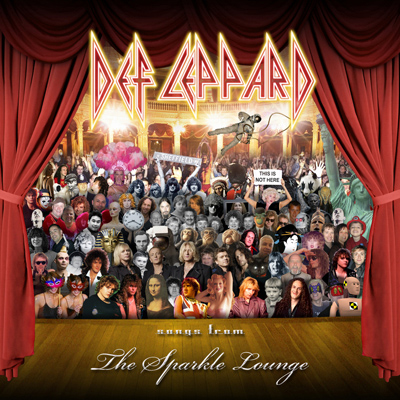
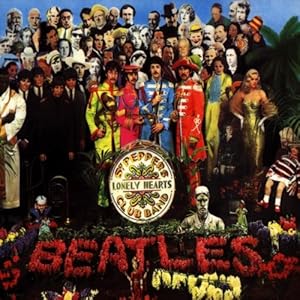
Imitation is, of course, if not the highest, one of the highest forms of flattery and obviously, this LP cover art from Def Leppard, a band I have managed to totally avoid through the years, pays homage to the Beatles. The Sparkle Lounge, I've since learned, was released in April of this year.
In case you don't know which Beatles LP it mimics (How have you managed to avoid the Beatles all these years and why would you want to?), here's the cover for their 1967 release, Sergeant Pepper's Lonely Hearts Club Band:
One of my favorite knock-offs of this landmark LP's cover was on the 1973 release by Beatle Ringo Starr. It looks like this:
 The Beatles always had a healthy sense of humor, concealing pride in their musical legacy beneath a willingness--most of the time--to deprecate and parody themselves. This was true of them from the beginning of their careers, when the Four Moptops appeared on a British variety show mocking their own then-signature, "Wooh!" while singing Moonlight Bay:
In later years, George Harrison appeared in the Eric Idle-created mockumentary, The Rutles.
But when it comes to LP covers, one of my favorite Beatles send-ups came from Beatle Paul McCartney. It mimics the cover that may be even more famous than that of Sergeant Pepper's: Abbey Road. Again, for those who've been living under large geological formations for all or parts of the last forty-five years, the original looks like this:
 And here's Macca's send-up, a concert LP released in 1993, called Paul is Live:

The Paul is Live cover manages also to allude to at least two tidbits of Beatles lore. First, it hearkens back to the resilient rumor, which started in 1966 and was still going strong in some circles as late as 1970, that said that McCartney was dead. The Abbey Road cover was introduced as evidence for this assertion. (One probably believed by the same folks who think that UFOs are here from other planets, the Cubans or the Mafia killed Kennedy, and Milli Vanilli were talented.) The four Beatles crossing the street by the EMI studios where they'd recorded from the beginnings of their careers, were said to be forming an Indian funeral procession with Lennon as priest and Starr as undertaker. The bodies of the dead in India, we were told ominously, were always left shoeless in such processions. Note: Paul is barefooted! Harrison, in his jeans, was also said to represent lower-caste mourners for the departed. No, in fact, Macca was saying in 1993, "Paul is [a]live and performing live." (As he told Chris Farley in one of those wonderful faux talk shows Farley used to do on Saturday Night Live, "I wasn't really dead.")
On the 1993 cover, McCartney is being pulled along by an English sheep dog like the one he owned in the 1960s, a dog named Martha. Martha gave its name to the Beatles' 1968 tune, Martha My Dear.
Self-parody is the best way for celebs to inoculate themselves against others' putdowns and from the usually-plausible charge of taking themselves too seriously. (This was something George Harrison tried, to no avail, to teach Madonna and Sean Penn when he produced a movie in which the then-married couple starred for him.) JFK was a master of self-deprecating humor and the Beatles, who conquered America five months after Kennedy's assassination and who were not short on ego, have been as well.
Here and here are sites that display LP covers imitating Sergeant Pepper's and Abbey Road.
I suppose that the real question about these and other parodies or all artistic imitation, for that matter, is why it happens. There are probably several reasons. One is that some works of art, whatever the idiom, are touchstones. They grab us by the lapels--assuming we have lapels--and won't let go. Musically, Sergeant Pepper's and Abbey Road did that, as did their cover art. Both were celebrated and are viewed as iconic.
Secondly, not everybody is as creative as the Beatles or the LP cover artists with whom they closely worked once Beatlemania hit. The Beatles' monstrous success allowed them to roam like kids in the candy shop through the entire musical process--production, arrangements, packaging. Before Beatles LPs like Revolver or Rubber Soul, album covers were fairly boring and predictable. The Beatles changed that.
But, of course, few can match the Beatles for creativity or the freedom accorded them by the suits. For four-and-a-half decades now the Fab Four have been imitated and parodied, but never matched.
[Also see here.]
[UPDATE: Go here to see something totally unnecessary: a live webcam transmission from the Abbey Road studios, now seventy-seven years old and still a site that attracts artists from around the world.]
Imitation is, of course, if not the highest, one of the highest forms of flattery and obviously, this LP cover art from Def Leppard, a band I have managed to totally avoid through the years, pays homage to the Beatles. The Sparkle Lounge, I've since learned, was released in April of this year.
In case you don't know which Beatles LP it mimics (How have you managed to avoid the Beatles all these years and why would you want to?), here's the cover for their 1967 release, Sergeant Pepper's Lonely Hearts Club Band:
One of my favorite knock-offs of this landmark LP's cover was on the 1973 release by Beatle Ringo Starr. It looks like this:

In later years, George Harrison appeared in the Eric Idle-created mockumentary, The Rutles.
But when it comes to LP covers, one of my favorite Beatles send-ups came from Beatle Paul McCartney. It mimics the cover that may be even more famous than that of Sergeant Pepper's: Abbey Road. Again, for those who've been living under large geological formations for all or parts of the last forty-five years, the original looks like this:
The Paul is Live cover manages also to allude to at least two tidbits of Beatles lore. First, it hearkens back to the resilient rumor, which started in 1966 and was still going strong in some circles as late as 1970, that said that McCartney was dead. The Abbey Road cover was introduced as evidence for this assertion. (One probably believed by the same folks who think that UFOs are here from other planets, the Cubans or the Mafia killed Kennedy, and Milli Vanilli were talented.) The four Beatles crossing the street by the EMI studios where they'd recorded from the beginnings of their careers, were said to be forming an Indian funeral procession with Lennon as priest and Starr as undertaker. The bodies of the dead in India, we were told ominously, were always left shoeless in such processions. Note: Paul is barefooted! Harrison, in his jeans, was also said to represent lower-caste mourners for the departed. No, in fact, Macca was saying in 1993, "Paul is [a]live and performing live." (As he told Chris Farley in one of those wonderful faux talk shows Farley used to do on Saturday Night Live, "I wasn't really dead.")
On the 1993 cover, McCartney is being pulled along by an English sheep dog like the one he owned in the 1960s, a dog named Martha. Martha gave its name to the Beatles' 1968 tune, Martha My Dear.
Self-parody is the best way for celebs to inoculate themselves against others' putdowns and from the usually-plausible charge of taking themselves too seriously. (This was something George Harrison tried, to no avail, to teach Madonna and Sean Penn when he produced a movie in which the then-married couple starred for him.) JFK was a master of self-deprecating humor and the Beatles, who conquered America five months after Kennedy's assassination and who were not short on ego, have been as well.
Here and here are sites that display LP covers imitating Sergeant Pepper's and Abbey Road.
I suppose that the real question about these and other parodies or all artistic imitation, for that matter, is why it happens. There are probably several reasons. One is that some works of art, whatever the idiom, are touchstones. They grab us by the lapels--assuming we have lapels--and won't let go. Musically, Sergeant Pepper's and Abbey Road did that, as did their cover art. Both were celebrated and are viewed as iconic.
Secondly, not everybody is as creative as the Beatles or the LP cover artists with whom they closely worked once Beatlemania hit. The Beatles' monstrous success allowed them to roam like kids in the candy shop through the entire musical process--production, arrangements, packaging. Before Beatles LPs like Revolver or Rubber Soul, album covers were fairly boring and predictable. The Beatles changed that.
But, of course, few can match the Beatles for creativity or the freedom accorded them by the suits. For four-and-a-half decades now the Fab Four have been imitated and parodied, but never matched.
[Also see here.]
[UPDATE: Go here to see something totally unnecessary: a live webcam transmission from the Abbey Road studios, now seventy-seven years old and still a site that attracts artists from around the world.]
Saturday, September 16, 2006
Sippican Quotes Me
I'm honored.
He's right that George Martin, the Beatles' producer, admits to having been beastly to George Harrison in the early years. The youngest member of The Beatles, very much in the shadow of Paul McCartney and John Lennon, Harrison's early songs weren't stellar, most of them never recorded.
But Harrison became a more than competent songwriter, of course. Frank Sinatra called Something the greatest love song ever written and the Chairman of the Board knew something about love songs. (The rhymes on Harrison's last LP, posthumously released, are often stunning, though overall, I found the release so unsatisfying that I couldn't justify buying it.)
What was frustrating about Harrison as a solo artist to me is that he produced LPs that were either altogether wonderful or almost completely crap, those in the latter category occasionally containing only a salvageable tune or two. 33-1/3 and Extra Texture were particularly horrible, Dark Horse only marginally and sporadically better. All Things Must Pass, though far too long (the same complaint that Harrison made to McCartney of the latter's concert appearances, by the way), is an undeniable classic, and Cloud Nine, produced by ELO's Jeff Lynne, is a fun listen. Of course, Harrison's first Traveling Wilbury project with Bob Dylan, Roy Orbison, Tom Petty, and Lynne was simultaneously fresh and thick with nostalgia. Harrison's compositions on the first release were outstanding. (The second release was mediocre.)
To his credit, after the breakup of the Beatles, instead of returning comfortably to form, Harrison developed his own signature guitar style. Think high-pitched whole notes. That's the post-Beatles Harrison way of playing guitar. I never particularly cared for that sound, but it was his, an important statement from a proud man insistent that he wasn't George Beatle.
The Wilburys projects point out an important fact about Harrison: Although he was a curmudgeonly personality who, as McCartney said, "didn't suffer fools," he also was someone who loved to collaborate with others. It was he, sickened by the egomania he saw especially in McCartney, who invited Billy Preston to sit in on the often contentious Let It Be sessions. It was he too, who asked Eric Clapton to add that haunting solo to While My Guitar Gently Weeps.
Harrison was also an innovator in the Beatles days. He brought a sitar into the studio with the Fab Four for the first time and he was the one who suggested the use of synthesizers on Abbey Road.
Harrison was usually contemptuous of the Beatles, claiming that he'd worked with much better musicians than his old bandmates ever were. (He probably did. But he never worked with any set of musicians who were more impressive complete packages: performers, composers, arrangers, personalities.) When he wrote his autobiography, Harrison was feuding with Lennon and so, that Beatles bandmate was largely overlooked in his book, an unaccountable oversight. That's always stunned me and demonstrated how hateful Harrison could be when he wanted to be. (This isn't to argue that Lennon was any less so. In fact, I suspect that the only one of the four I might like as a person is Ringo Starr.)
For all of Harrison's acidic dismissals of "the Four Moptops" though, he relished the airing of the massive video history on the Beatles. Before its release, he boasted that it would show mere mortals like U2 what real musical success was like.
Sippi may be right that It Don't Come Easy, the 45 which triggered this whole discussion, is mostly a Harrison tune, though recorded and co-composed by Ringo Starr. But another great rock ditty, Back Off Boogaloo, based on a buzz word of Mark Bolen's, is pure Ringo.
Sunday, July 16, 2006
Macca's 'No Other Baby' Video
It wasn't until a few months ago, during a trip through Half Price Books, that I picked up Paul McCartney's Run, Devil, Run. That 2002 release initially didn't attract me because it was made up of oldies the young Macca enjoyed during his musically formative years in the 1950s along with faux-50s tunes of his own composition.
That is the project's make-up. But it works fantastically. McCartney loves the 50s music and pours the sort of passion into their performance here often thought lacking in his own original material through the years. This music is his first love and it shows.
Joined on a number of tracks by one of his favorite lead guitarists, David Gilmour of Pink Floyd fame, and a sterling band, virtually every track is a gem.
Surprisingly though, one of the two tracks I enjoy most is an old skiffle tune, 'No Other Baby.' In the liner notes, we're told:
A funny thing about this video is that it seems to confirm McCartney's love of being photographed or filmed shaving. You see him doing this in pics that appear in the largely-forgettable Red Rose Speedway (1973). He shaves in the Say, Say, Say video with Michael Jackson. He shaves here.
Maybe Macca sees shaving as a decidedly masculine thing to do. Or, maybe he secretly wishes that he and not George Harrison, had been given the shaving seen in A Hard Day's Night.
Anyway, tell me what you think of the song.
That is the project's make-up. But it works fantastically. McCartney loves the 50s music and pours the sort of passion into their performance here often thought lacking in his own original material through the years. This music is his first love and it shows.
Joined on a number of tracks by one of his favorite lead guitarists, David Gilmour of Pink Floyd fame, and a sterling band, virtually every track is a gem.
Surprisingly though, one of the two tracks I enjoy most is an old skiffle tune, 'No Other Baby.' In the liner notes, we're told:
The most obscure song on the album. It was released as a single in 1958 by a British skiffle group The Vipers. "I've no idea how this one got so embedded in my memory..." [McCartney says] "I never had the record, still haven't.Here's the video. See if you don't find the tune as infectious as I do.
A funny thing about this video is that it seems to confirm McCartney's love of being photographed or filmed shaving. You see him doing this in pics that appear in the largely-forgettable Red Rose Speedway (1973). He shaves in the Say, Say, Say video with Michael Jackson. He shaves here.
Maybe Macca sees shaving as a decidedly masculine thing to do. Or, maybe he secretly wishes that he and not George Harrison, had been given the shaving seen in A Hard Day's Night.
Anyway, tell me what you think of the song.
Friday, June 09, 2006
WOW!
Go, take a listen. (Thanks to Tamar for linking to this beautiful piece of musicianship.) Interestingly, George Harrison often composed songs on his ukulele.
Tuesday, January 31, 2006
"He wanted to be successful without being famous"
That's what someone said of the late George Harrison after his untimely death from cancer. It was the singer-songwriter's second bout with the disease, the interregnum between them punctuated by a middle-of-the-night assault by a knife-wielding man that nearly ended Harrison's life. Pop music was too central to popular consciousness for Harrison to be able to realize his desire for success without fame.
For forty-six years, Harper Lee, author of To Kill a Mockingbird, has been able to be successful without the uncomfortable accoutrements of fame. But now, at age 79, portrayed in an Oscar-nominated movie and about to be portrayed in another film by Sandra Bullock, one wonders if Lee can continue to live in relative obscurity.
Human beings, no matter if they're religious or not, universally display an impulse to worship something or someone. To refer to cults of personality, the way we do, as "idol worship" is more than just idle talk. I take a very little interpretation of the phrase. We put the famous on pedestals, preferring the gods we can see--and ultimately knock off their pedestals, if we so choose--to worshiping the one God beyond our physical sight and beyond our control.
It's the presumption of control that makes celebrity idol worship so dangerous. The worshiper--the fan--begins to believe that they control the object of their worship. The famous chafe under such treatment and then are dismissed as being surly, temperamental, or difficult.
For the particularly insecure celebrity, the worshiping fans really can come to call the shots. One tragic example of this is Elvis Presley. Instead of growing as an artist the way his one-time Sun Record-mate Johnny Cash did, Presley, in spite of enormous talent and huge potential, followed a formulaic route that led not only to his artistic demise, but perhaps his personal fall as well. He was a prisoner of his fan base.
The pressure on Lee to write another Mockingbird must have been intense at times over the past four-and-a-half decades. But she seems to have opted for the solid success of a classic book rather than a profusion of bestsellers. One wonders what might have happened had her Alabama friend, Truman Capote, remained at home as Lee has. Lee can rightly be considered a great writer although she's published only one book in her lifetime.
She's been successful while shying away from fame. Just some lunchtime musings.
[Read today's New York Times profile of Lee here.]
Thursday, December 08, 2005
Anniversary of John Lennon's Death: The Dream is Over
Like most people my age, I suppose, I remember precisely what I was doing on December 8, 1980, when I received word that John Lennon had been killed.
Just eleven months before, I had started seminary, after graduating from Ohio State five years earlier.
That evening, a classmate spent part of the afternoon and the early evening with my wife and me. We lived off campus and I think that he enjoyed escaping to the "real world" that we inhabited for a while. I had taken him back to his apartment, returned to our house, and mindlessly turned on the Monday Night Football game when I heard Howard Cosell say that John Lennon was dead.
At first, I was sure that there must be some mistake and flipped through the channels on our Warner Qube cable box to learn more. But nothing I did could change the fact that Lennon really was gone.
Throughout my teens and into my twenties, there were really only two musical choices to be made. One either listened to the Beatles or other people. The Beatles were in a category all their own. Their sound and their words got to me in ways nobody else ever had. Almost everybody else sounded like Muzak.
This feeling continued even as I listened to their sometimes unexceptional solo work. The imprints of their personhood, or at least hints of their personhood--or perhaps, their adopted public personas--were in their music. Unlike the dehumanized warbling of homogenized pop (or of compromised rock), you had the sense that there were real human beings on the other sides of those Abbey Road microphones.
That sense went way beyond the eerie countdown and cough at the beginning of George Harrison's Taxman or Ringo Starr's weary protest of "I've got blisters on my fingers!" at the end of McCartney's Helter Skelter. In spite of the screaming girls who made them almost inaudible, when I saw the Beatles perform on The Ed Sullivan Show on that February Sunday in 1964, they looked and sounded like real people. Real people with extraordinary talent.
It was no doubt in part to recover his personhood that Lennon grew tired of the Beatles and at first, didn't lament the band's passing. "The dream is over," he sang in a song called God on his first post-Beatles LP. (By the way, U2 later produced a composition called God, Part 3, in response to Lennon's song.)
When I listen to God today, its litany of things in which Lennon claimed not to believe--a list that included Jesus, Buddha, Zimmerman, Elvis, and Beatles--sounds like the defiant confession of a man being deprogrammed after time spent in the clutches of a cult. Talk to anyone who has been held hostage by some legalistic religion, even legalistic Christian belief--though in any genuine expression of Christianity, that's an oxymoron--and you hear an unwillingness to believe or trust in almost anything. Recovering cultsters don't want to get burned again and so they tend, initially at least, to dismiss all belief, all faith, all trust. In the song, Lennon moves from nihilism to narcissism. "I just believe in me, Yoko and me, and that's reality," he says.
Lennon had been doused in the flames of Beatlemania, something which he himself had rightly seen as being akin to religion back when he had proclaimed in 1966 that the Beatles were more popular than Jesus. He probably was right at that singular moment in time. But more to the point, the adulation the band received then was very much like religious worship. In God, Lennon was saying that he was having none of it. (Although he was now worshiping himself and Yoko, surely as tenuous as objects of worship as the Beatles had been. That's another story.)
But once you willingly take on the mantle of deity and once you seem to show your true self to the world, it isn't easy to run away. People keep insisting on putting you back on their altars and placing you in tabernacles of their choosing.
Even after five years as a househusband, an ordinary guy who took his baby on stroller rides through Central Park, Lennon couldn't escape others' expectations of him. There's a scene in Imagine, in which an obviously disturbed young man shows up on Lennon's doorstep, convinced that on an old Beatles cut, Lennon had sent a personal message to him. "How could I?" Lennon asks him, seeming to attempt to both kindly and firmly give the kid a bracing slap of reality, "I don't even know you."
We probably all thought we did, though. Mark David Chapman, Lennon's killer, apparently thought he knew Lennon. Psychologists have said that Chapman had come to so identify with Lennon that he thought he was Lennon. The real Lennon's existence therefore, became an unacceptable reality, which he eliminated on that December night a quarter of a century ago. (I've always thought that the chilling link song on McCartney's first LP after Lennon's death was about Chapman: "The one you wanted to be, is now the one you see.")
Even in people unlike Chapman, people who aren't mentally or emotionally disturbed, there is a subtle and disrespectful objectification that happens to those we choose to worship. When they don't act or say the things we want from them, we can become angry or disillusioned.
Several years before Lennon died, I had transferred out of the First Church of Beatlemania and surrendered to a different deity. The God revealed in Jesus Christ turns out for me to be the only God worthy of worship or able to bear the weight of glory. Today, I can enjoy the extraordinary body of work of Lennon, McCartney, Harrison, and Starkey as great human achievements, no matter who they may have been as people.
Since his death, Lennon has been eulogized and beatified with rock and roll sainthood. Though he would have loved the attention, he would have ultimately felt imprisoned by the worship, especially that offered by the rock and roll intelligentsia.
The dream is over, folks. Lennon would like us all to know that. But if you're looking for a different deity, I know One Who, even after he was murdered, wouldn't stay dead...and He promises to be with us always.
Subscribe to:
Posts (Atom)