Showing posts with label Ringo Starr. Show all posts
Showing posts with label Ringo Starr. Show all posts
Friday, July 22, 2016
Something by Paul McCartney, Jeff Lynne, Eric Clapton, & a Cast of Thousands
At the Concert for George, George Harrison's friends and collaborators sing one of his contributions to the Beatles' catalog.

Thursday, July 23, 2015
Some thoughts from a few days ago (and the Weight of the World)
Shared this on the congregational Facebook site:
I know of at least two cover versions.
One is by the duo Lost and Found.
The other is by Ringo Starr, who eliminates the reference to God in it. I guess my reaction to that deletion is that if Starr couldn't sing about the God revealed to the world in Christ with any conviction, it's just as well that he didn't reference God when he recorded the tune. He also probably should have not recorded it altogether, because turning to the God revealed in Christ is the whole point of Norman's song.
I wish that the person who presented this on Youtube had edited out the beginning of the next song in Norman's apparent medley. It would have been easy enough to do, I guess. But I put this on here because there are so few samples of Norman's performances around. The power of his songs wasn't in his voice or his instrumental virtuosity, but the way he funneled his experiences and quirkiness into songs that honored God and touched people.
Maybe your father or mother didn't love you as they should have, but through Jesus Christ, we can know a Father Who loves us enough to affirm our value with the sacrifice of His only Son, discipline and refashion us in His image, redeem us from the grave, and promise to hear us whenever we call on Him, trusting in Christ. Let Him heal your hurts, guide your steps, and be your God and King.The late, great (and often troubled) Larry Norman, the pioneer of what became contemporary Christian music, hit on this point, a tough one to remember, in his song, The Weight of the World.
I know of at least two cover versions.
One is by the duo Lost and Found.
The other is by Ringo Starr, who eliminates the reference to God in it. I guess my reaction to that deletion is that if Starr couldn't sing about the God revealed to the world in Christ with any conviction, it's just as well that he didn't reference God when he recorded the tune. He also probably should have not recorded it altogether, because turning to the God revealed in Christ is the whole point of Norman's song.
I wish that the person who presented this on Youtube had edited out the beginning of the next song in Norman's apparent medley. It would have been easy enough to do, I guess. But I put this on here because there are so few samples of Norman's performances around. The power of his songs wasn't in his voice or his instrumental virtuosity, but the way he funneled his experiences and quirkiness into songs that honored God and touched people.
Friday, August 03, 2012
Peaches: Yummy!

Took a break from sermon preparation today to enjoy some of these fresh-from-the-farm peaches that my wife had peeled and sliced. They were wonderful! She bought them from an orchard store (where they also have delicious apples!) in Laurelville, Ohio.
Every time I have peaches, I can't keep from doing my best Ringo impression: "Well, if you don't want my peaches, honey, please don't shake my tree." (The song is Matchbox. Of course, it was originally written and recorded by Carl Perkins, but I love the Beatles' version.)
Sunday, July 11, 2010
All You Need is Love...All You Need is Jesus
[This was shared during worship with the people of Saint Matthew Lutheran Church in Logan, Ohio, this morning.]
Colossians 1:1-14
This past week brought the seventieth birthday of Ringo Starr, drummer of the Beatles. Several days before his big day, an interviewer asked him what he might like people to do to celebrate. At noon on that day, Ringo said, he wanted everybody to hold up their hands in peace signs and say, three times, “Peace and love.”
It’s absolutely silly, of course. Humanity has known for centuries that “all you need is love,” but having that knowledge and even engaging in gestures like Ringo Starr suggested in order to remind us of it will do nothing to make us all the loving people who, in our heart of hearts, we really want to be and who we often pretend to be to the outside world.
There’s a lot of hatred in the world, much of it done in the name of God, some of it done specifically in the name of Jesus Christ. That’s not only tragic and sad, it’s sinful and demonic.
When I speak of hatred, I don’t have in mind just the sort of hostility we may harbor for someone we feel has betrayed our trust or hurt us. Those Cleveland Cavaliers fans who now say, as one was quoted as saying in the Columbus Dispatch this past week, that they’ll hate LeBron James forever, harbor a deep passion (I would say a way too deep passion) about LeBron, the NBA, and sports, in general. You see, at some level, those now professing their hatred for LeBron James once passionately loved him, his sport, and the promise of a championship that he seemed to carry away with him to the South Beach of Florida.
That kind of hatred is born of love and disappointment. We see it all the time. A jilted lover can harbor a deep hatred for her or his ex, precisely because of the love they felt for that person. An assembly line worker who has thirty years on the job who suddenly finds his work shipped elsewhere or eliminated altogether, can feel hatred toward the company precisely because he loved his job, its income, its routine, and all that it brought into his life.
But there is another kind of hatred, one that is far more widespread than the hatred of overt hostility born of love and disappointment. It’s the hatred of indifference, of looking out for number one without regard to others. It isn’t hostile, mind you. It simply doesn’t consider others.
This kind of hatred was seen in the Garden of Eden when Eve tried to beat the rap by blaming the serpent and Adam did the same by blaming Eve.
It's seen in two fictional characters created by Jesus, the priest and the levite who passed by the wounded man on the road in the parable Jesus tells in today’s Gospel lesson. These characters felt no hostility toward the wounded man; they didn’t know him or even try to know him. They were simply so absorbed in their own agendas that they didn’t ake him or his wounds into account.
We’re rightly outraged and mystified by what we might call “passive hatred” we see, hear, and experience in our real-life world. And yet I personally have to admit my own culpability for this very sin.
A few weeks ago, Ann and I were walking across the parking lot of a Starbucks when a woman pushing a child in a stroller approached us. She said that her baby’s father was being released from jail the next day and she needed money to move to a different place where he couldn’t find her. Was she telling the truth? I don’t know. But I didn’t give her a chance to repeat her story. I dehumanized her by simply refusing her request and moving on. The image of that woman and her child has haunted me since.
This is an example of the hatred of indifference and I confess it to you, really, with shame. I should know better.
But it pleases me that I recognize it for what it is: a sin, a violation of the great commandment that we love God totally and love our neighbors—all our neighbors—as we love ourselves.
The reason it pleases me that I recognize this indifference as sin is that it shows that, despite my imperfections and flaws, a powerful seed has been planted within me. It’s the seed of the gospel—the good news of new and everlasting life that belongs to all who turn from sin and believe in Jesus Christ. The messiah Jesus brings those who trust in Him forgiveness of sins and ushers us into His kingdom here and now. I don’t think that I would recognize the subtle hatred of indifference as a sin of mine if Jesus weren’t working within me, working in spite of my faults and frailties to make me part of His new creation.
Today we begin a short sermon series on the New Testament book of Colossians. Colossians is a letter written jointly by the apostle Paul and his assistant, the young pastor Timothy, to a church in western Asia Minor, what is today western Turkey, in the town of Colossae. Paul was imprisoned, probably under house arrest, at the time of the letter’s writing. Some think that he was imprisoned in Rome; others say he was held in the nearby town of Ephesus. Whatever the case, the letter was probably written in the early-60sAD, several years before Colossae was destroyed by an earthquake.
By the time Paul and Timothy sent this letter, Colossae had fallen on hard economic times. Its major industry, the production of dark red dyed wool, had nearly died out. Colossae sat in the Lycus Valley, near the Meander River, and was largely forgotten by the greater Roman Empire beyond it.
But Colossae and the Lycus Valley weren’t forgotten by God! (Anymore than any of us are ever forgotten by God. God is never more than a prayer away, something I have learned again beyond all doubt in recent weeks.) Paul had sent a member of his ministry team, a Colossian named Epaphras to start a congregation in Colossae. There, under the daily pastoral leadership of Epaphras, a congregation composed of Jews and non-Jews (Gentiles, like us) had taken root and grown. But it wasn’t just an organization that had taken root and grown. Paul says that the very word of God’s truth, the gospel, had born fruit in them and was displaying itself in their love: in love among believers, in love of the believers toward others.
In the original Greek in which Colossians, like the rest of the New Testament, was written, the word that Paul and Timothy use for love is agape. In secular Greek writing, the word agape for love was rarely used until the second and third centuries. When the early Christians used it, they had a very specific understanding of love in mind.
But Jesus is more than an example of agape love. Seeing representations of His death on a cross—while it may build up our faith—won’t necessarily have any more power to turn us from the hatred of indifference to agape love than will holding up peace signs and saying, “Peace and love” three times.
It’s only when we trust—when we have faith--in Jesus and give Him access to our hearts, minds, and wills each day that He can plant the seeds of His love in us and make us and every part of the world we touch different, better, more human, more divine.
In the opening verses of Colossians, our second lesson for today, Paul exults and thanks God that Jesus’ word is growing in the Colossian Christians and showing in their lives of tough agape love! That's what happens when the Good News of Jesus takes hold in people's lives.
A few years back in our former community, a strip joint opened. Some churches got together and demonstrated, protesting the existence of the place. They were concerned that it would breed prostitution, drug and alcohol abuse. But they did more than demonstrate. Demonstrators befriended the dancers, found out about their lives, and set up schedules so that while the women were working at night, volunteers from the churches babysat their kids. Why? Christ’s agape love lived within those Christians. They refused to be indifferent or hostile to people who, just like them, needed Jesus Christ living within them.
And this is no isolated incident. Tony Campolo is a Baptist pastor and a sociologist. I tease that he's so cool, he could be a Lutheran and Campolo, in fact, often speaks at our Lutheran gatherings. One evening before a presentation in Hawaii, he and a colleague walked into a diner that turned out to be the gathering place of prostitutes before and after they went out onto the streets. Campolo struck up a conversation with these women. When it was clear that he wasn’t interested in buying what they were selling, they asked questions about him and his work. He explained that he was a Christian and a pastor.
As they talked, Campolo learned that it was the birthday of one of the prostitutes. No one would send her a card or give her a cake and she would spend the evening in her humiliating trade. Campolo found out that this woman and the other prostitutes all would return to the diner at 3:00 in the morning. So, he and his friend went to a bakery to buy a cake. They bought streamers and hung them in the diner. When the prostitutes returned, they were stunned, especially the one whose birthday it was. "What kind of God do you believe in?" she asked. Campolo answered: “The kind of God Who throws birthday parties for prostitutes at 3:00 in the morning.” The God we know in Jesus Christ is the One Who fills us with His tough, self-giving, in-spite-of agape love to share with the world!
I thank God for the strong agape love I see and experience in the people of Saint Matthew Lutheran Church.
I thank God that I am privileged to be your pastor.
I thank God that I'm given a front row seat on the kingdom of Jesus I see growing in you each day.
And, I thank God that He has made me a grateful beneficiary of your agape love for me, imperfections and all.
My message for you today is as simple and as direct as the one we find Paul sharing with the Colossians in our lesson this morning: Keep trusting in Jesus and keep allowing Him to grow His self-giving, in-spite-of love for all, not just in your sentiments and attitudes, but in everything you do, in every decision you make, and in every word you speak.
All the world needs is love. And that love is found only in Christ Jesus. Amen!
Colossians 1:1-14
This past week brought the seventieth birthday of Ringo Starr, drummer of the Beatles. Several days before his big day, an interviewer asked him what he might like people to do to celebrate. At noon on that day, Ringo said, he wanted everybody to hold up their hands in peace signs and say, three times, “Peace and love.”
It’s absolutely silly, of course. Humanity has known for centuries that “all you need is love,” but having that knowledge and even engaging in gestures like Ringo Starr suggested in order to remind us of it will do nothing to make us all the loving people who, in our heart of hearts, we really want to be and who we often pretend to be to the outside world.
There’s a lot of hatred in the world, much of it done in the name of God, some of it done specifically in the name of Jesus Christ. That’s not only tragic and sad, it’s sinful and demonic.
When I speak of hatred, I don’t have in mind just the sort of hostility we may harbor for someone we feel has betrayed our trust or hurt us. Those Cleveland Cavaliers fans who now say, as one was quoted as saying in the Columbus Dispatch this past week, that they’ll hate LeBron James forever, harbor a deep passion (I would say a way too deep passion) about LeBron, the NBA, and sports, in general. You see, at some level, those now professing their hatred for LeBron James once passionately loved him, his sport, and the promise of a championship that he seemed to carry away with him to the South Beach of Florida.
That kind of hatred is born of love and disappointment. We see it all the time. A jilted lover can harbor a deep hatred for her or his ex, precisely because of the love they felt for that person. An assembly line worker who has thirty years on the job who suddenly finds his work shipped elsewhere or eliminated altogether, can feel hatred toward the company precisely because he loved his job, its income, its routine, and all that it brought into his life.
But there is another kind of hatred, one that is far more widespread than the hatred of overt hostility born of love and disappointment. It’s the hatred of indifference, of looking out for number one without regard to others. It isn’t hostile, mind you. It simply doesn’t consider others.
This kind of hatred was seen in the Garden of Eden when Eve tried to beat the rap by blaming the serpent and Adam did the same by blaming Eve.
It's seen in two fictional characters created by Jesus, the priest and the levite who passed by the wounded man on the road in the parable Jesus tells in today’s Gospel lesson. These characters felt no hostility toward the wounded man; they didn’t know him or even try to know him. They were simply so absorbed in their own agendas that they didn’t ake him or his wounds into account.
We’re rightly outraged and mystified by what we might call “passive hatred” we see, hear, and experience in our real-life world. And yet I personally have to admit my own culpability for this very sin.
A few weeks ago, Ann and I were walking across the parking lot of a Starbucks when a woman pushing a child in a stroller approached us. She said that her baby’s father was being released from jail the next day and she needed money to move to a different place where he couldn’t find her. Was she telling the truth? I don’t know. But I didn’t give her a chance to repeat her story. I dehumanized her by simply refusing her request and moving on. The image of that woman and her child has haunted me since.
This is an example of the hatred of indifference and I confess it to you, really, with shame. I should know better.
But it pleases me that I recognize it for what it is: a sin, a violation of the great commandment that we love God totally and love our neighbors—all our neighbors—as we love ourselves.
The reason it pleases me that I recognize this indifference as sin is that it shows that, despite my imperfections and flaws, a powerful seed has been planted within me. It’s the seed of the gospel—the good news of new and everlasting life that belongs to all who turn from sin and believe in Jesus Christ. The messiah Jesus brings those who trust in Him forgiveness of sins and ushers us into His kingdom here and now. I don’t think that I would recognize the subtle hatred of indifference as a sin of mine if Jesus weren’t working within me, working in spite of my faults and frailties to make me part of His new creation.
Today we begin a short sermon series on the New Testament book of Colossians. Colossians is a letter written jointly by the apostle Paul and his assistant, the young pastor Timothy, to a church in western Asia Minor, what is today western Turkey, in the town of Colossae. Paul was imprisoned, probably under house arrest, at the time of the letter’s writing. Some think that he was imprisoned in Rome; others say he was held in the nearby town of Ephesus. Whatever the case, the letter was probably written in the early-60sAD, several years before Colossae was destroyed by an earthquake.
By the time Paul and Timothy sent this letter, Colossae had fallen on hard economic times. Its major industry, the production of dark red dyed wool, had nearly died out. Colossae sat in the Lycus Valley, near the Meander River, and was largely forgotten by the greater Roman Empire beyond it.
But Colossae and the Lycus Valley weren’t forgotten by God! (Anymore than any of us are ever forgotten by God. God is never more than a prayer away, something I have learned again beyond all doubt in recent weeks.) Paul had sent a member of his ministry team, a Colossian named Epaphras to start a congregation in Colossae. There, under the daily pastoral leadership of Epaphras, a congregation composed of Jews and non-Jews (Gentiles, like us) had taken root and grown. But it wasn’t just an organization that had taken root and grown. Paul says that the very word of God’s truth, the gospel, had born fruit in them and was displaying itself in their love: in love among believers, in love of the believers toward others.
In the original Greek in which Colossians, like the rest of the New Testament, was written, the word that Paul and Timothy use for love is agape. In secular Greek writing, the word agape for love was rarely used until the second and third centuries. When the early Christians used it, they had a very specific understanding of love in mind.
- Agape love is self-giving love.
- Agape love is also in-spite-of love, given and acted upon in spite of how one may feel about the person to whom they’re loving at the time.
- Agape love is about actively looking out for others, even when you don’t know them or when you don't approve of their behavior or know that God doesn't approve of their behavior.
But Jesus is more than an example of agape love. Seeing representations of His death on a cross—while it may build up our faith—won’t necessarily have any more power to turn us from the hatred of indifference to agape love than will holding up peace signs and saying, “Peace and love” three times.
It’s only when we trust—when we have faith--in Jesus and give Him access to our hearts, minds, and wills each day that He can plant the seeds of His love in us and make us and every part of the world we touch different, better, more human, more divine.
In the opening verses of Colossians, our second lesson for today, Paul exults and thanks God that Jesus’ word is growing in the Colossian Christians and showing in their lives of tough agape love! That's what happens when the Good News of Jesus takes hold in people's lives.
A few years back in our former community, a strip joint opened. Some churches got together and demonstrated, protesting the existence of the place. They were concerned that it would breed prostitution, drug and alcohol abuse. But they did more than demonstrate. Demonstrators befriended the dancers, found out about their lives, and set up schedules so that while the women were working at night, volunteers from the churches babysat their kids. Why? Christ’s agape love lived within those Christians. They refused to be indifferent or hostile to people who, just like them, needed Jesus Christ living within them.
And this is no isolated incident. Tony Campolo is a Baptist pastor and a sociologist. I tease that he's so cool, he could be a Lutheran and Campolo, in fact, often speaks at our Lutheran gatherings. One evening before a presentation in Hawaii, he and a colleague walked into a diner that turned out to be the gathering place of prostitutes before and after they went out onto the streets. Campolo struck up a conversation with these women. When it was clear that he wasn’t interested in buying what they were selling, they asked questions about him and his work. He explained that he was a Christian and a pastor.
As they talked, Campolo learned that it was the birthday of one of the prostitutes. No one would send her a card or give her a cake and she would spend the evening in her humiliating trade. Campolo found out that this woman and the other prostitutes all would return to the diner at 3:00 in the morning. So, he and his friend went to a bakery to buy a cake. They bought streamers and hung them in the diner. When the prostitutes returned, they were stunned, especially the one whose birthday it was. "What kind of God do you believe in?" she asked. Campolo answered: “The kind of God Who throws birthday parties for prostitutes at 3:00 in the morning.” The God we know in Jesus Christ is the One Who fills us with His tough, self-giving, in-spite-of agape love to share with the world!
I thank God for the strong agape love I see and experience in the people of Saint Matthew Lutheran Church.
I thank God that I am privileged to be your pastor.
I thank God that I'm given a front row seat on the kingdom of Jesus I see growing in you each day.
And, I thank God that He has made me a grateful beneficiary of your agape love for me, imperfections and all.
My message for you today is as simple and as direct as the one we find Paul sharing with the Colossians in our lesson this morning: Keep trusting in Jesus and keep allowing Him to grow His self-giving, in-spite-of love for all, not just in your sentiments and attitudes, but in everything you do, in every decision you make, and in every word you speak.
All the world needs is love. And that love is found only in Christ Jesus. Amen!
Thursday, December 04, 2008
LP Cover Parodies and Self-Deprecation
I was in a Virgin Records Store earlier this week. (It's a place through which I sometimes peruse, although I can't remember ever buying anything there.) As I looked around, this CD cover caught my eye:
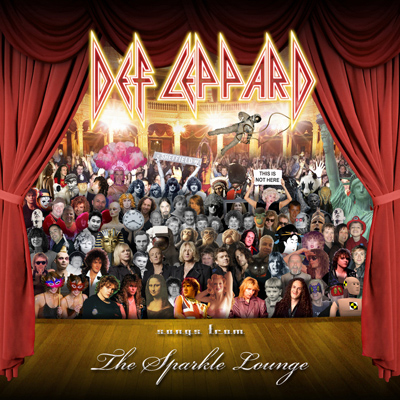
Imitation is, of course, if not the highest, one of the highest forms of flattery and obviously, this LP cover art from Def Leppard, a band I have managed to totally avoid through the years, pays homage to the Beatles. The Sparkle Lounge, I've since learned, was released in April of this year.
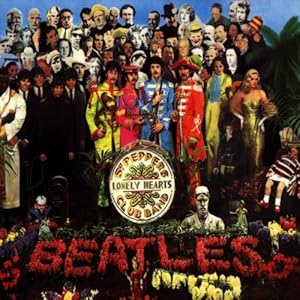
In case you don't know which Beatles LP it mimics (How have you managed to avoid the Beatles all these years and why would you want to?), here's the cover for their 1967 release, Sergeant Pepper's Lonely Hearts Club Band:
One of my favorite knock-offs of this landmark LP's cover was on the 1973 release by Beatle Ringo Starr. It looks like this:
 The Beatles always had a healthy sense of humor, concealing pride in their musical legacy beneath a willingness--most of the time--to deprecate and parody themselves. This was true of them from the beginning of their careers, when the Four Moptops appeared on a British variety show mocking their own then-signature, "Wooh!" while singing Moonlight Bay:
In later years, George Harrison appeared in the Eric Idle-created mockumentary, The Rutles.
But when it comes to LP covers, one of my favorite Beatles send-ups came from Beatle Paul McCartney. It mimics the cover that may be even more famous than that of Sergeant Pepper's: Abbey Road. Again, for those who've been living under large geological formations for all or parts of the last forty-five years, the original looks like this:
 And here's Macca's send-up, a concert LP released in 1993, called Paul is Live:

The Paul is Live cover manages also to allude to at least two tidbits of Beatles lore. First, it hearkens back to the resilient rumor, which started in 1966 and was still going strong in some circles as late as 1970, that said that McCartney was dead. The Abbey Road cover was introduced as evidence for this assertion. (One probably believed by the same folks who think that UFOs are here from other planets, the Cubans or the Mafia killed Kennedy, and Milli Vanilli were talented.) The four Beatles crossing the street by the EMI studios where they'd recorded from the beginnings of their careers, were said to be forming an Indian funeral procession with Lennon as priest and Starr as undertaker. The bodies of the dead in India, we were told ominously, were always left shoeless in such processions. Note: Paul is barefooted! Harrison, in his jeans, was also said to represent lower-caste mourners for the departed. No, in fact, Macca was saying in 1993, "Paul is [a]live and performing live." (As he told Chris Farley in one of those wonderful faux talk shows Farley used to do on Saturday Night Live, "I wasn't really dead.")
On the 1993 cover, McCartney is being pulled along by an English sheep dog like the one he owned in the 1960s, a dog named Martha. Martha gave its name to the Beatles' 1968 tune, Martha My Dear.
Self-parody is the best way for celebs to inoculate themselves against others' putdowns and from the usually-plausible charge of taking themselves too seriously. (This was something George Harrison tried, to no avail, to teach Madonna and Sean Penn when he produced a movie in which the then-married couple starred for him.) JFK was a master of self-deprecating humor and the Beatles, who conquered America five months after Kennedy's assassination and who were not short on ego, have been as well.
Here and here are sites that display LP covers imitating Sergeant Pepper's and Abbey Road.
I suppose that the real question about these and other parodies or all artistic imitation, for that matter, is why it happens. There are probably several reasons. One is that some works of art, whatever the idiom, are touchstones. They grab us by the lapels--assuming we have lapels--and won't let go. Musically, Sergeant Pepper's and Abbey Road did that, as did their cover art. Both were celebrated and are viewed as iconic.
Secondly, not everybody is as creative as the Beatles or the LP cover artists with whom they closely worked once Beatlemania hit. The Beatles' monstrous success allowed them to roam like kids in the candy shop through the entire musical process--production, arrangements, packaging. Before Beatles LPs like Revolver or Rubber Soul, album covers were fairly boring and predictable. The Beatles changed that.
But, of course, few can match the Beatles for creativity or the freedom accorded them by the suits. For four-and-a-half decades now the Fab Four have been imitated and parodied, but never matched.
[Also see here.]
[UPDATE: Go here to see something totally unnecessary: a live webcam transmission from the Abbey Road studios, now seventy-seven years old and still a site that attracts artists from around the world.]
Imitation is, of course, if not the highest, one of the highest forms of flattery and obviously, this LP cover art from Def Leppard, a band I have managed to totally avoid through the years, pays homage to the Beatles. The Sparkle Lounge, I've since learned, was released in April of this year.
In case you don't know which Beatles LP it mimics (How have you managed to avoid the Beatles all these years and why would you want to?), here's the cover for their 1967 release, Sergeant Pepper's Lonely Hearts Club Band:
One of my favorite knock-offs of this landmark LP's cover was on the 1973 release by Beatle Ringo Starr. It looks like this:

In later years, George Harrison appeared in the Eric Idle-created mockumentary, The Rutles.
But when it comes to LP covers, one of my favorite Beatles send-ups came from Beatle Paul McCartney. It mimics the cover that may be even more famous than that of Sergeant Pepper's: Abbey Road. Again, for those who've been living under large geological formations for all or parts of the last forty-five years, the original looks like this:
The Paul is Live cover manages also to allude to at least two tidbits of Beatles lore. First, it hearkens back to the resilient rumor, which started in 1966 and was still going strong in some circles as late as 1970, that said that McCartney was dead. The Abbey Road cover was introduced as evidence for this assertion. (One probably believed by the same folks who think that UFOs are here from other planets, the Cubans or the Mafia killed Kennedy, and Milli Vanilli were talented.) The four Beatles crossing the street by the EMI studios where they'd recorded from the beginnings of their careers, were said to be forming an Indian funeral procession with Lennon as priest and Starr as undertaker. The bodies of the dead in India, we were told ominously, were always left shoeless in such processions. Note: Paul is barefooted! Harrison, in his jeans, was also said to represent lower-caste mourners for the departed. No, in fact, Macca was saying in 1993, "Paul is [a]live and performing live." (As he told Chris Farley in one of those wonderful faux talk shows Farley used to do on Saturday Night Live, "I wasn't really dead.")
On the 1993 cover, McCartney is being pulled along by an English sheep dog like the one he owned in the 1960s, a dog named Martha. Martha gave its name to the Beatles' 1968 tune, Martha My Dear.
Self-parody is the best way for celebs to inoculate themselves against others' putdowns and from the usually-plausible charge of taking themselves too seriously. (This was something George Harrison tried, to no avail, to teach Madonna and Sean Penn when he produced a movie in which the then-married couple starred for him.) JFK was a master of self-deprecating humor and the Beatles, who conquered America five months after Kennedy's assassination and who were not short on ego, have been as well.
Here and here are sites that display LP covers imitating Sergeant Pepper's and Abbey Road.
I suppose that the real question about these and other parodies or all artistic imitation, for that matter, is why it happens. There are probably several reasons. One is that some works of art, whatever the idiom, are touchstones. They grab us by the lapels--assuming we have lapels--and won't let go. Musically, Sergeant Pepper's and Abbey Road did that, as did their cover art. Both were celebrated and are viewed as iconic.
Secondly, not everybody is as creative as the Beatles or the LP cover artists with whom they closely worked once Beatlemania hit. The Beatles' monstrous success allowed them to roam like kids in the candy shop through the entire musical process--production, arrangements, packaging. Before Beatles LPs like Revolver or Rubber Soul, album covers were fairly boring and predictable. The Beatles changed that.
But, of course, few can match the Beatles for creativity or the freedom accorded them by the suits. For four-and-a-half decades now the Fab Four have been imitated and parodied, but never matched.
[Also see here.]
[UPDATE: Go here to see something totally unnecessary: a live webcam transmission from the Abbey Road studios, now seventy-seven years old and still a site that attracts artists from around the world.]
Saturday, July 19, 2008
Ringo's LP is Okay, But He Should Think Again About Jesus
 Ringo Starr is no Bob Dylan. He has a below-average voice. His songs are mostly hokie. But he's a great drummer and, as the three members of the Beatles who invited him to replace Pete Best as they began their recording career knew, a tremendous personality. The Beatle-y spirit of fun lives on in the music he continues to produce.
In January, Starr released Liverpool 8, timed to coincide with his concert in Liverpool, part of that city's degination as "culture capital" of Europe for the year.
The title track, co-written with Eurythmc Dave Stewart, is a fun remembrance of his hometown and the Beatles years. Overall, it's a nice little LP, although Starr's collaboration with Mark Hudson--who, along with longtime Ringo sidemen, the Roundheads, is co-composer and producer of all but one of the LP's tracks--is growing a bit tiresome and predictable.
I also enjoy the rather offbeat and evocative tribute to his late buddy, Harry Nilsson, Harry's Song.
Two of the tracks could be omitted: Pasodobles, a Spanish-tinged song that wouldn't be good even if Starr could sing it and R U Ready?
The latter song reflects Starr's apparently growing, if superficial, interest in spiritual things and in his own mortality. In it, he equates Jesus, Buddha, and Krishna. He sings at one point, "Jesus was a wise man and everyone's a Saint/Are you ready to cross over, are you ready?"
I'm glad that Ringo thinks that Jesus was a wise man. But if he thinks that makes him ready to face death and eternity, Jesus would ask him to think again.
Jesus made bigger claims for himself than being wise. "The Father and I are one," He says, equating Himself God. And He says, "“I am the way, and the truth, and the life. No one comes to the Father except through me."
Starr's lyrics reflect one of the commonest ways of dodging Jesus' call to turn from sin and believe in the message that His death and resurrection are the way to life with God forever. People call Him a nice man, a good teacher, or one of many ways to God, but not the one and only Lord and God Jesus claims to be. These dodges are attempts to have it both ways, to have Jesus without following Him.
Jesus won't have any of it, though! When confronting Jesus' message about Himself, that He is God and the only way to eternity with God, we have, as C.S. Lewis pointed out, three alternatives: We can (1) call him a liar; (2) call him a madman; or (3) fall down before him as the Lord and God he claims to be.
If Jesus is lying about Himself, He can't be the wise man that Ringo and, it seems increasingly, many, dismissively call Him.
The problem with these common statements about Jesus is that they overlook what's been revealed about Him and chronicled in the very books--the New Testament gospels--that anyone would have to call upon to label Jesus as wise.
Ringo Starr is no Bob Dylan. And though I like him, he's no theologian. And clearly, logic isn't his strong suit either.
Thursday, July 03, 2008
On Their Way from Amazon...


Liverpool 8 and Photograph: The Very Best, both from Ringo Starr. I'm stoked!
Check out the video for the title track of Liverpool 8, which Ringo co-wrote for former Eurythmic Dave Stewart, here.
Saturday, February 03, 2007
Little Willow
This beautiful song, Little Willow, was written by Paul McCartney for the children of Ringo Starr and his first wife, Maureen, after Maureen succumbed to cancer. It's a poignant song and the video matches that mood perfectly. The latter, in fact, mirrors the experiences of McCartney, first in the death of his mother and then of his first wife, Linda. Both were victims of breast cancer.
I was drawn to this song today in light of this event.
Of course, as a Christian, important as the support of friends and family is in times of grief, my ultimate hope is in Jesus Christ, Who has unequivocally conquered death for all who believe in Him. But it's also true that the loving encouragement of others can be the very medicine for our souls that God wants to provide to us to remind us of hope beyond the grave. I believe that we wouldn't find death so difficult accept were it not for the fact that deep in our DNA, we know that we have been made for more. Thank God that in Christ, our hope for eternity isn't in vain!
I was drawn to this song today in light of this event.
Of course, as a Christian, important as the support of friends and family is in times of grief, my ultimate hope is in Jesus Christ, Who has unequivocally conquered death for all who believe in Him. But it's also true that the loving encouragement of others can be the very medicine for our souls that God wants to provide to us to remind us of hope beyond the grave. I believe that we wouldn't find death so difficult accept were it not for the fact that deep in our DNA, we know that we have been made for more. Thank God that in Christ, our hope for eternity isn't in vain!
Saturday, September 16, 2006
Sippican Quotes Me
I'm honored.
He's right that George Martin, the Beatles' producer, admits to having been beastly to George Harrison in the early years. The youngest member of The Beatles, very much in the shadow of Paul McCartney and John Lennon, Harrison's early songs weren't stellar, most of them never recorded.
But Harrison became a more than competent songwriter, of course. Frank Sinatra called Something the greatest love song ever written and the Chairman of the Board knew something about love songs. (The rhymes on Harrison's last LP, posthumously released, are often stunning, though overall, I found the release so unsatisfying that I couldn't justify buying it.)
What was frustrating about Harrison as a solo artist to me is that he produced LPs that were either altogether wonderful or almost completely crap, those in the latter category occasionally containing only a salvageable tune or two. 33-1/3 and Extra Texture were particularly horrible, Dark Horse only marginally and sporadically better. All Things Must Pass, though far too long (the same complaint that Harrison made to McCartney of the latter's concert appearances, by the way), is an undeniable classic, and Cloud Nine, produced by ELO's Jeff Lynne, is a fun listen. Of course, Harrison's first Traveling Wilbury project with Bob Dylan, Roy Orbison, Tom Petty, and Lynne was simultaneously fresh and thick with nostalgia. Harrison's compositions on the first release were outstanding. (The second release was mediocre.)
To his credit, after the breakup of the Beatles, instead of returning comfortably to form, Harrison developed his own signature guitar style. Think high-pitched whole notes. That's the post-Beatles Harrison way of playing guitar. I never particularly cared for that sound, but it was his, an important statement from a proud man insistent that he wasn't George Beatle.
The Wilburys projects point out an important fact about Harrison: Although he was a curmudgeonly personality who, as McCartney said, "didn't suffer fools," he also was someone who loved to collaborate with others. It was he, sickened by the egomania he saw especially in McCartney, who invited Billy Preston to sit in on the often contentious Let It Be sessions. It was he too, who asked Eric Clapton to add that haunting solo to While My Guitar Gently Weeps.
Harrison was also an innovator in the Beatles days. He brought a sitar into the studio with the Fab Four for the first time and he was the one who suggested the use of synthesizers on Abbey Road.
Harrison was usually contemptuous of the Beatles, claiming that he'd worked with much better musicians than his old bandmates ever were. (He probably did. But he never worked with any set of musicians who were more impressive complete packages: performers, composers, arrangers, personalities.) When he wrote his autobiography, Harrison was feuding with Lennon and so, that Beatles bandmate was largely overlooked in his book, an unaccountable oversight. That's always stunned me and demonstrated how hateful Harrison could be when he wanted to be. (This isn't to argue that Lennon was any less so. In fact, I suspect that the only one of the four I might like as a person is Ringo Starr.)
For all of Harrison's acidic dismissals of "the Four Moptops" though, he relished the airing of the massive video history on the Beatles. Before its release, he boasted that it would show mere mortals like U2 what real musical success was like.
Sippi may be right that It Don't Come Easy, the 45 which triggered this whole discussion, is mostly a Harrison tune, though recorded and co-composed by Ringo Starr. But another great rock ditty, Back Off Boogaloo, based on a buzz word of Mark Bolen's, is pure Ringo.
He's right that George Martin, the Beatles' producer, admits to having been beastly to George Harrison in the early years. The youngest member of The Beatles, very much in the shadow of Paul McCartney and John Lennon, Harrison's early songs weren't stellar, most of them never recorded.
But Harrison became a more than competent songwriter, of course. Frank Sinatra called Something the greatest love song ever written and the Chairman of the Board knew something about love songs. (The rhymes on Harrison's last LP, posthumously released, are often stunning, though overall, I found the release so unsatisfying that I couldn't justify buying it.)
What was frustrating about Harrison as a solo artist to me is that he produced LPs that were either altogether wonderful or almost completely crap, those in the latter category occasionally containing only a salvageable tune or two. 33-1/3 and Extra Texture were particularly horrible, Dark Horse only marginally and sporadically better. All Things Must Pass, though far too long (the same complaint that Harrison made to McCartney of the latter's concert appearances, by the way), is an undeniable classic, and Cloud Nine, produced by ELO's Jeff Lynne, is a fun listen. Of course, Harrison's first Traveling Wilbury project with Bob Dylan, Roy Orbison, Tom Petty, and Lynne was simultaneously fresh and thick with nostalgia. Harrison's compositions on the first release were outstanding. (The second release was mediocre.)
To his credit, after the breakup of the Beatles, instead of returning comfortably to form, Harrison developed his own signature guitar style. Think high-pitched whole notes. That's the post-Beatles Harrison way of playing guitar. I never particularly cared for that sound, but it was his, an important statement from a proud man insistent that he wasn't George Beatle.
The Wilburys projects point out an important fact about Harrison: Although he was a curmudgeonly personality who, as McCartney said, "didn't suffer fools," he also was someone who loved to collaborate with others. It was he, sickened by the egomania he saw especially in McCartney, who invited Billy Preston to sit in on the often contentious Let It Be sessions. It was he too, who asked Eric Clapton to add that haunting solo to While My Guitar Gently Weeps.
Harrison was also an innovator in the Beatles days. He brought a sitar into the studio with the Fab Four for the first time and he was the one who suggested the use of synthesizers on Abbey Road.
Harrison was usually contemptuous of the Beatles, claiming that he'd worked with much better musicians than his old bandmates ever were. (He probably did. But he never worked with any set of musicians who were more impressive complete packages: performers, composers, arrangers, personalities.) When he wrote his autobiography, Harrison was feuding with Lennon and so, that Beatles bandmate was largely overlooked in his book, an unaccountable oversight. That's always stunned me and demonstrated how hateful Harrison could be when he wanted to be. (This isn't to argue that Lennon was any less so. In fact, I suspect that the only one of the four I might like as a person is Ringo Starr.)
For all of Harrison's acidic dismissals of "the Four Moptops" though, he relished the airing of the massive video history on the Beatles. Before its release, he boasted that it would show mere mortals like U2 what real musical success was like.
Sippi may be right that It Don't Come Easy, the 45 which triggered this whole discussion, is mostly a Harrison tune, though recorded and co-composed by Ringo Starr. But another great rock ditty, Back Off Boogaloo, based on a buzz word of Mark Bolen's, is pure Ringo.
Thursday, December 08, 2005
Anniversary of John Lennon's Death: The Dream is Over
Like most people my age, I suppose, I remember precisely what I was doing on December 8, 1980, when I received word that John Lennon had been killed.
Just eleven months before, I had started seminary, after graduating from Ohio State five years earlier.
That evening, a classmate spent part of the afternoon and the early evening with my wife and me. We lived off campus and I think that he enjoyed escaping to the "real world" that we inhabited for a while. I had taken him back to his apartment, returned to our house, and mindlessly turned on the Monday Night Football game when I heard Howard Cosell say that John Lennon was dead.
At first, I was sure that there must be some mistake and flipped through the channels on our Warner Qube cable box to learn more. But nothing I did could change the fact that Lennon really was gone.
Throughout my teens and into my twenties, there were really only two musical choices to be made. One either listened to the Beatles or other people. The Beatles were in a category all their own. Their sound and their words got to me in ways nobody else ever had. Almost everybody else sounded like Muzak.
This feeling continued even as I listened to their sometimes unexceptional solo work. The imprints of their personhood, or at least hints of their personhood--or perhaps, their adopted public personas--were in their music. Unlike the dehumanized warbling of homogenized pop (or of compromised rock), you had the sense that there were real human beings on the other sides of those Abbey Road microphones.
That sense went way beyond the eerie countdown and cough at the beginning of George Harrison's Taxman or Ringo Starr's weary protest of "I've got blisters on my fingers!" at the end of McCartney's Helter Skelter. In spite of the screaming girls who made them almost inaudible, when I saw the Beatles perform on The Ed Sullivan Show on that February Sunday in 1964, they looked and sounded like real people. Real people with extraordinary talent.
It was no doubt in part to recover his personhood that Lennon grew tired of the Beatles and at first, didn't lament the band's passing. "The dream is over," he sang in a song called God on his first post-Beatles LP. (By the way, U2 later produced a composition called God, Part 3, in response to Lennon's song.)
When I listen to God today, its litany of things in which Lennon claimed not to believe--a list that included Jesus, Buddha, Zimmerman, Elvis, and Beatles--sounds like the defiant confession of a man being deprogrammed after time spent in the clutches of a cult. Talk to anyone who has been held hostage by some legalistic religion, even legalistic Christian belief--though in any genuine expression of Christianity, that's an oxymoron--and you hear an unwillingness to believe or trust in almost anything. Recovering cultsters don't want to get burned again and so they tend, initially at least, to dismiss all belief, all faith, all trust. In the song, Lennon moves from nihilism to narcissism. "I just believe in me, Yoko and me, and that's reality," he says.
Lennon had been doused in the flames of Beatlemania, something which he himself had rightly seen as being akin to religion back when he had proclaimed in 1966 that the Beatles were more popular than Jesus. He probably was right at that singular moment in time. But more to the point, the adulation the band received then was very much like religious worship. In God, Lennon was saying that he was having none of it. (Although he was now worshiping himself and Yoko, surely as tenuous as objects of worship as the Beatles had been. That's another story.)
But once you willingly take on the mantle of deity and once you seem to show your true self to the world, it isn't easy to run away. People keep insisting on putting you back on their altars and placing you in tabernacles of their choosing.
Even after five years as a househusband, an ordinary guy who took his baby on stroller rides through Central Park, Lennon couldn't escape others' expectations of him. There's a scene in Imagine, in which an obviously disturbed young man shows up on Lennon's doorstep, convinced that on an old Beatles cut, Lennon had sent a personal message to him. "How could I?" Lennon asks him, seeming to attempt to both kindly and firmly give the kid a bracing slap of reality, "I don't even know you."
We probably all thought we did, though. Mark David Chapman, Lennon's killer, apparently thought he knew Lennon. Psychologists have said that Chapman had come to so identify with Lennon that he thought he was Lennon. The real Lennon's existence therefore, became an unacceptable reality, which he eliminated on that December night a quarter of a century ago. (I've always thought that the chilling link song on McCartney's first LP after Lennon's death was about Chapman: "The one you wanted to be, is now the one you see.")
Even in people unlike Chapman, people who aren't mentally or emotionally disturbed, there is a subtle and disrespectful objectification that happens to those we choose to worship. When they don't act or say the things we want from them, we can become angry or disillusioned.
Several years before Lennon died, I had transferred out of the First Church of Beatlemania and surrendered to a different deity. The God revealed in Jesus Christ turns out for me to be the only God worthy of worship or able to bear the weight of glory. Today, I can enjoy the extraordinary body of work of Lennon, McCartney, Harrison, and Starkey as great human achievements, no matter who they may have been as people.
Since his death, Lennon has been eulogized and beatified with rock and roll sainthood. Though he would have loved the attention, he would have ultimately felt imprisoned by the worship, especially that offered by the rock and roll intelligentsia.
The dream is over, folks. Lennon would like us all to know that. But if you're looking for a different deity, I know One Who, even after he was murdered, wouldn't stay dead...and He promises to be with us always.
Just eleven months before, I had started seminary, after graduating from Ohio State five years earlier.
That evening, a classmate spent part of the afternoon and the early evening with my wife and me. We lived off campus and I think that he enjoyed escaping to the "real world" that we inhabited for a while. I had taken him back to his apartment, returned to our house, and mindlessly turned on the Monday Night Football game when I heard Howard Cosell say that John Lennon was dead.
At first, I was sure that there must be some mistake and flipped through the channels on our Warner Qube cable box to learn more. But nothing I did could change the fact that Lennon really was gone.
Throughout my teens and into my twenties, there were really only two musical choices to be made. One either listened to the Beatles or other people. The Beatles were in a category all their own. Their sound and their words got to me in ways nobody else ever had. Almost everybody else sounded like Muzak.
This feeling continued even as I listened to their sometimes unexceptional solo work. The imprints of their personhood, or at least hints of their personhood--or perhaps, their adopted public personas--were in their music. Unlike the dehumanized warbling of homogenized pop (or of compromised rock), you had the sense that there were real human beings on the other sides of those Abbey Road microphones.
That sense went way beyond the eerie countdown and cough at the beginning of George Harrison's Taxman or Ringo Starr's weary protest of "I've got blisters on my fingers!" at the end of McCartney's Helter Skelter. In spite of the screaming girls who made them almost inaudible, when I saw the Beatles perform on The Ed Sullivan Show on that February Sunday in 1964, they looked and sounded like real people. Real people with extraordinary talent.
It was no doubt in part to recover his personhood that Lennon grew tired of the Beatles and at first, didn't lament the band's passing. "The dream is over," he sang in a song called God on his first post-Beatles LP. (By the way, U2 later produced a composition called God, Part 3, in response to Lennon's song.)
When I listen to God today, its litany of things in which Lennon claimed not to believe--a list that included Jesus, Buddha, Zimmerman, Elvis, and Beatles--sounds like the defiant confession of a man being deprogrammed after time spent in the clutches of a cult. Talk to anyone who has been held hostage by some legalistic religion, even legalistic Christian belief--though in any genuine expression of Christianity, that's an oxymoron--and you hear an unwillingness to believe or trust in almost anything. Recovering cultsters don't want to get burned again and so they tend, initially at least, to dismiss all belief, all faith, all trust. In the song, Lennon moves from nihilism to narcissism. "I just believe in me, Yoko and me, and that's reality," he says.
Lennon had been doused in the flames of Beatlemania, something which he himself had rightly seen as being akin to religion back when he had proclaimed in 1966 that the Beatles were more popular than Jesus. He probably was right at that singular moment in time. But more to the point, the adulation the band received then was very much like religious worship. In God, Lennon was saying that he was having none of it. (Although he was now worshiping himself and Yoko, surely as tenuous as objects of worship as the Beatles had been. That's another story.)
But once you willingly take on the mantle of deity and once you seem to show your true self to the world, it isn't easy to run away. People keep insisting on putting you back on their altars and placing you in tabernacles of their choosing.
Even after five years as a househusband, an ordinary guy who took his baby on stroller rides through Central Park, Lennon couldn't escape others' expectations of him. There's a scene in Imagine, in which an obviously disturbed young man shows up on Lennon's doorstep, convinced that on an old Beatles cut, Lennon had sent a personal message to him. "How could I?" Lennon asks him, seeming to attempt to both kindly and firmly give the kid a bracing slap of reality, "I don't even know you."
We probably all thought we did, though. Mark David Chapman, Lennon's killer, apparently thought he knew Lennon. Psychologists have said that Chapman had come to so identify with Lennon that he thought he was Lennon. The real Lennon's existence therefore, became an unacceptable reality, which he eliminated on that December night a quarter of a century ago. (I've always thought that the chilling link song on McCartney's first LP after Lennon's death was about Chapman: "The one you wanted to be, is now the one you see.")
Even in people unlike Chapman, people who aren't mentally or emotionally disturbed, there is a subtle and disrespectful objectification that happens to those we choose to worship. When they don't act or say the things we want from them, we can become angry or disillusioned.
Several years before Lennon died, I had transferred out of the First Church of Beatlemania and surrendered to a different deity. The God revealed in Jesus Christ turns out for me to be the only God worthy of worship or able to bear the weight of glory. Today, I can enjoy the extraordinary body of work of Lennon, McCartney, Harrison, and Starkey as great human achievements, no matter who they may have been as people.
Since his death, Lennon has been eulogized and beatified with rock and roll sainthood. Though he would have loved the attention, he would have ultimately felt imprisoned by the worship, especially that offered by the rock and roll intelligentsia.
The dream is over, folks. Lennon would like us all to know that. But if you're looking for a different deity, I know One Who, even after he was murdered, wouldn't stay dead...and He promises to be with us always.
Friday, July 01, 2005
Choose Love!

I was stunned a few years ago when, in a televised interview, Beatles record producer George Martin gave an unexpected answer to this question: Did any one of the Beatles exercise veto power over what the band recorded or how songs were arranged?
Yes, Martin answered without hesitation, "If Ringo didn't like it, they didn't do it."
It's not that Ringo Starr was the leader of the Beatles, of course. Nor was it because he was a creative power house. He was neither of these things.
But he was an accomplished player on the Liverpool music scene before the rest of the Beatles were. They respected him for that. His standards were also such that, unlike his bandmates who seemed so smitten with their unprecedented success that they couldn't see deficiencies in their robotic performances before screaming audiences, Starr became convinced of the need for the band to get off the road for a time just to ensure quality. (Unfortunately, the move spelled the end of the Beatles as a road band.)
Starr was also, by all accounts, the most good-natured of the group, the least egotistical. His affability no doubt added to his credibility with his bandmates.
So, Martin's revelation is understandable.
Amazingly, in the first several years after the break-up of the Beatles, Starr was the best selling solo artist of the bunch. This is probably attributable to his not taking himself too seriously, his wise collaborations with everyone from Harry Nillson to producer Richard Perry, and the composition and selection of material that suited his limited vocal range. But even those caveats indicate that the judgment ascribed to him by Martin and the other Beatles served him well as he sailed out into the Beatles-less night.
While Starr projects since the 80s have not been top-sellers and have largely escaped notice by the public and critics alike, I've enjoyed his releases through the years.
They're not great art, of course. And Ringo isn't Bono or, for that matter, Phil Collins, to name another drummer, as a front man.
But his releases have been reliably fun. And there's something to be said for that.
Something else: Through the years, Starr's songs, irrespective of his collaborators, show a maturing man, becoming more comfortable in his skin and willing, in lyrics that are less than eloquent, yet true, to convey some of the hard-won truths he's discovered about life, himself, relationships, and even fame.
He's got a new CD out, a double-sided affair called, Choose Love. (Yes, Starr has refused to give up on the notion that All You Need is Love. One senses that it's more than a marketing ploy for him, that he really believes it.) One side of Choose Love is a conventional CD. The flip side has a short "documentary" on the creation of the collection and a few other features.
The sound is a little more stripped-down than on past Ringo LPs, not as elaborately produced. Usually, the cuts are just your standard drums, guitar, bass, rhythm guitar, and occasionally, organs and pianos, along with background vocals.
In addition, it seems that producer Mark Hudson is more willing this time out--he's been Starr's collaborator, co-producer, and musical director for several years now--to let Starr's vocals stand on their own. In the past, the ploy has often been to "compensate for" or "cover up" Starr's admittedly limited vocal ability. Frankly, even with the additional burden of carrying the songs with this new approach, he turns in his best vocal performance ever.
In addition, Starr is the only drummer and percussionist throughout the whole collection. On previous projects, talented studio side man Jim Keltner or others have been brought in to "fatten" the drums on Starr releases. But, it seems, the judgment has been made that Starr's drumming is more than sufficient. I think that's a good choice. He remains my favorite drummer because Ringo Starr has always understood that the drum is not meant to be a solo instrument. He knows that providing the back beat is a big job. And nobody does it better than he does!
The songs are mostly rockers, with some terrific riffs and guitar solos along the way.
No Ringo CD would be complete without allusions to "that band I used to be in," and Choose Love is no exception, although it doesn't overwhelm you with them. Lyrically, my favorite Beatles allusion is composed of a fragment where Starr sings, "The long and winding road is more than a song/Tomorrow never knows what goes one." Three Beatles titles in two little lines!
On the song, 'Choose Love,' he also recycles lines from 'It Don't Come Easy': "Got to pay our dues, if you want to sing the blues."
In Hudson, Starr seems to have found the perfect collaborator. The Beatles-nut who gained fame in the 1970s when he and his brothers, sounding like less-talented clones of the Fab Four, had a few hits and a forgettable variety show, understands Ringo's persona, is a talented musician and arranger, and seems able to bring out the best in Starr and their band. On past Starr-Hudson efforts, I felt that Mark Hudson shone a bit too brightly. But things seem to be in their proper order here and Starr comes through strong, happy, attractive, and fun!
Billy Preston and Chrissie Hynde make guest appearances here. Preston is impressive. And I love Hynde so much that I wish they'd made greater use of her than they did. But that's quibbling.
So, here's my recommendation: Before you have your next party, Choose Love. It'll be the perfect soundtrack for that...or for your commute to work and back home again.
Subscribe to:
Posts (Atom)