Showing posts with label Lutheranism. Show all posts

Friday, March 10, 2017

John Ylvisaker: An Appreciation

John Ylvisaker has died. He composed such wonderful worship music as I Was There to Hear Borning Cry, Sweet Release, Amigos de Cristo, Rejoice, several liturgies, and other great tunes.

John's project as a musician was to compose church music that had an immediate familiarity and accessibility for worshipers. In the bargain, he managed to compose some classics that will stand the test of time.

John and I were not friends. I spoke by phone with him several times and on occasion through the years, we exchanged hurried notes. Most of what I knew of John personally came through our mutual acquaintance, the theologian and wonderful preacher, Dick Jensen.

But I did spend several memorable days with John back in the 1980s.

In fact, the most frightening car ride of my life came with John at the wheel. We were heading from Bowling Green, Ohio to the parsonage of Bethlehem Lutheran Church in Okolona, Ohio, where I then served as pastor. John was joining us to lead a singalong on Saturday night and then, our music the next morning for worship.

We traveled through a driving rainstorm and, during most of the trip, as John's mind was occupied with our conversation about music, I didn't know if we were going to stay on the road.

At one point, we found ourselves on a bumpy country lane. John kept hearing honking noises. He repeatedly looked around, making the car swerve with every turn of his head, as he tried to find the source of the honking horn. He thought that some impatient driver was telling him to get a move on or to get out of the way. It took John a while to realize that he was the one producing the honks by the loose way he held the wildly vibrating steering wheel on that piece of road. "Oh, it's me," he said and continued to talk.

I've often thought since that drive that the phrase "traveling mercies" had special meaning for John, who traveled to share his music with people across the country and elsewhere; surely, God was merciful to this musician He had called and that we all needed.

We made it to the parsonage in one piece that Saturday afternoon, for which I thanked God. That night, we had the singalong at the church and a rehearsal for church musicians who wanted to play for worship the next morning. The singalong was fantastic and our musicians were well prepared to play the special accompaniment John created on the spot once he saw what instruments and musicians he had to work with. (We had no blank musical staff paper around. So, John took the blank copy paper I handed him, graphed out the bars on the page, and created an arrangement for each musician as I watched.)

John stayed with us at the parsonage that night. He and I talked mostly music and musicians until three in the morning. He also told me some of his theories about composing music for the Church. We talked theology, our faith, the life of the Church, and mutual friends. But we always came back to music.

When, during our marathon conversation, I mentioned Canadian rocker Bruce Cockburn, I found in John someone as mesmerized by Cockburn's talent as I was. "He's got one line," I said. And with just that slim cue, John knew which line I was talking about. We ended up saying it in unison: "Got to kick at the darkness till it bleeds daylight." Then John said, "I would kill to write a line like that!"

The fact is that John wrote many great lines and many wonderful melodies that helped God's people sing praises to God, all in ways to which they could relate AND that were also faithful to Scripture. There was a theological depth and emotional honesty to John's songs that are often missing in today's "praise and worship" music. He was an incredible gift of God to the Church and to the world. We need more of John's ilk in Christ's Church today!

On the Sunday morning that followed that wee-hours conversation, we used not only Ylvisaker songs but Ylvisaker liturgy for our worship. John led us. The congregation was familiar with three of the pieces; there were nine more that they didn't know until that very morning...when John introduced them. Yet no one complained about the lack of familiar music.

In fact, at the end of the service, 300 people stood largely silent and still. It felt to me like the Transfiguration: Nobody wanted to leave this moment behind; John had ushered us into the presence of God with songs the people loved singing. One man told me afterward, "I kept hoping that we could stay a little longer." That was the power of John's music for God!

One of my favorite Ylvisaker pieces is Sweet Release. The title is rooted in the most common word for forgive in Greek, the language in which the New Testament was written by the apostles and evangelists, aphiemi. It's a word that literally means release, as in "When I am forgiven by God through Christ, I'm released from my slavery to sin." The lyrics are Biblically sound and the melody resonates of American folk music, the kind of tune that generations of Americans, no matter what their race, have sung together.

In published versions, the song is made up of three verses. But John also occasionally recorded his songs to introduce them to people. In the recorded version of Sweet Release, he sang a simple bridge he'd composed. I loved Ylvisaker's bass voice singing those reassuring words meant as a prayer to God:
When I feel afraid, I know just where You'll be
Your love is such a tender mystery
Those lines bring tears to my eyes as I remember and sing them now, serving still as a reminder of the grace, forgiveness, and life that God makes available to us through Christ.

You didn't need a verse or a line as great as Cockburn's, John. In those two lines, focused not on our efforts to bring light to the world, but on God's provision of light and love given by His grace through faith in Christ that we cannot earn, you surpassed Cockburn. You really did.

I look forward to seeing you one day again with all the saints as we exuberantly enjoy eternal life in the presence of God. You can lead us in praising our Savior and King. I know that you'll help us all, even we non-musicians, to keep up.


[My daughter, who was very young when John Ylvisaker stayed with us at the parsonage at Okolona, just reminded me that John liked to put orange juice on his corn flakes. She has a fabulous memory and is right about that, although I'd forgotten it.]

[Blogger Mark Daniels is pastor of Living Water Lutheran Church in Centerville, Ohio.]

Saturday, July 11, 2015

We need new Haugeans


Parishioners over the years have heard me speak of the Haugeans. We need their ilk today.

Here is an article about the painting and the movement that inspired it. The article is by Thomas E. Jacobson. Thanks to Eric Swensson for putting me onto it.

Thursday, April 11, 2013

What Does It Mean to Be a Lutheran Christian? The Augsburg Confession Series So Far

What does it mean to be a Lutheran Christian?

It's all about faith in Christ, trusting in His grace rather than in my performance as a human being or my conformity to religious or social norms.

That is the pervasive theme of the series of sermons inspired by The Augsburg Confession, a basic statement of the Lutheran understanding of Biblical, Christian faith, in which we've been involved over the past few weeks at Saint Matthew Lutheran Church.

Below are links to all of the sermons in the series so far, grammatical errors, missing words (usually infinitives or articles), and all. There are a few installments to go. But if you're new to the blog, you might want to check things out. I hope that you find them helpful. God bless!

The Three-in-One God
What is 'Original Sin'?
The Son of God
What is 'Justification'?
The Ministry of the Church
What About Good Works?
What Makes a Church a Church?
Holy Baptism
Holy Communion
Confession of Sin
Repentance
Are Governments Necessary?


Friday, August 26, 2011

Good Advice vs. Good News

Lutheran Christians have always taught that understanding the Biblical categories of Law and Gospel and the distinction between the two is central to getting what God is all about in His dealings with us.

My colleague, Pastor Dave Mann, who is on the pastoral staff of a congregation here in Ohio, but is deployed in Haiti, recently wrote this on his Facebook page:
During a vacation Sunday this month, I attended a non-Lutheran congregation and heard one of the best sermons rooted in Lutheran theology I've ever heard. Here was one of the points the preacher made.

What's the difference between Good Advice and Good News? Good Advice is advice about what you should do in the future. It may be wise counsel, something you really ought to do, but the burden is then on you to put it into action. News, on the other hand, is an announcement about what has already taken place. It does not depend upon you to make it happen; it's already part of history -- you simply respond. Good News is what Jesus Christ brings to you.

Without ever dropping the name of Luther, Lutheranism, or theology, this preacher made a very clear distinction between Law and Gospel.
Jesus once said that nothing from God's law had been eliminated. The Law--embodied in the Ten Commandments--give expression to God's will for human beings. But we all know that none us can go a single day without violating one or all of the commandments. (In my case, I can't go a day without repeatedly violating the commandments.) The Law is good advice.

The Gospel--the good news that Jesus Christ died and rose to give new life to all who repent and trust in Him--is something that comes to us. All we need to do is respond to it with trust. As Jesus puts it, "For God so loved the world that He gave His only Son, so that everyone who believes [trusts] in Him may not perish but may have eternal life" (John 3:16).

The Law points us to our need of someone to save us from ourselves.

The Gospel points us to the Savior Who does just that.

Thursday, March 24, 2011

More on "the Law"

"The law always accuses, but it does not only accuse, nor does it only accuse and restrain. It instructs. If that is not Lutheran, then Lutheranism is not biblical." (Michael Root)

Sunday, February 14, 2010

How this whole Lutheran thing got started


I think the video is self-explanatory. But I should point out there may be some slight inaccuracies. One I know I made was when, some time later in the presentation I referred to the Germans as "the Lutherans." I think that you'll pick up on it.

NOTE: Abraham believed and God counted his belief as "righteousness" in Genesis 15:6, and not in Genesis 12, as I erroneously say in the video.

Wednesday, January 06, 2010

God's Word Never Changes

I fully expect to witness the convergence of Venus, Jupiter, and our moon on November 18, 2052. I'll be 99 years old on that date, my birthday. Be that as it may, the reliability of God's physical universe and our certainty about when this convergence will next happen, reminds us of the complete reliability of God and of His Word, which does not change, says Dave Branon. I agree.

The psalmist applauded God's law and how it guides us through life and leads us to repentance and renewal: "Your Word is a lamp to my feet and a light to my path" (Psalm 119:105).

In August of last year, the denomination of which I am a part, the Evangelical Lutheran Church in America (ELCA), voted to depart from God's Word and to follow a different path. The Churchwide Assembly voted to allow congregations to ordain gays and lesbians involved in committed relationships and to provide congregational legitimization of such relationships among the laity.

This action, seen by its advocates as an act of love and justice, is, in truth, a deeply hateful act.

It pours contempt first of all, on God. God's will when it comes to sexual intimacy is clear. When God created Adam and Eve, God's intentions could be seen. The genders, each equally created in the image of God, were also created to complement one another. To prevent the man from being alone and to offer him the intimacy which God enjoys within the Trinity, God made the woman. It is deeply instructive that there is no "Adam and Adam" story.

Among the cultures by which it was surrounded, ancient Israel, God's people, were alone in seeing homosexual behavior as wrong. Homosexuality was widely practiced throughout the ancient world and seen as acceptable. But Israel's God said this shouldn't be so. Much of the Old Testament book of Leviticus details laws relating to sacrifices, laws supplanted by the once and for all sacrifice of Jesus on the cross. But a section of Leviticus is an explication of the Ten Commandments, valid for all time, including today. There, sandwiched between proscriptions against incest and bestiality, an expansion on the Sixth Commandment, "You shall not commit adultery," God says to the men of Israel, "You shall not lie with a male as with a woman; it is an abomination" (Leviticus 18:22).

Jesus affirms heterosexuality expressed within marriage as a lifelong commitment in his discussion of marriage and divorce in Matthew 19. In spite of the prevalence of homosexuality in the Greco-Roman culture that was so omnipresent in first century Judea that the New Testament was written in Greek, Jesus never once utters a word indicating that homosexual behavior is an option for human beings. (By the way, there are those who say that because the Church is so accepting of divorce these days and so willingly looks the other way when it comes to fornication, sexual intimacy on the part of unmarried heterosexuals, it's perfectly OK for the Church to change its teaching on homosexuality. Although the Church has been lax in addressing divorce and fornication, the Church has never officially said that congregations that want to legitimize such behaviors may do so if their consciences tell them it's OK, which is what the ELCA did when it comes to homosexuality last August.)

Jesus assumes that sexual intimacy may only happen between heterosexual partners in a lifelong marriage relationship.

In Romans 1, Paul says that the orientation to homosexual behavior, along with a catalog of other human sins, is a consequence of our inborn human alienation from God, something we all inherited from Adam and Eve, who fell into the condition of sin because they wanted "to be like God."

I was born with a penchant toward egomania. It is my orientation. God didn't make me that way; I was born that way. It is a manifestation of my fallenness as a member of the human family. Woe to me if I seek to legitimize my penchant to egomania by pretending that it's OK. It's not OK! Jesus calls me to acknowledge my sin and seek His help in acting in accordance not with my sinful orientations, but in accordance with God's Word and will.

God's will is clear. We do not act lovingly toward those engaged in homosexual behavior if we lie to them and tell them that, while God hasn't changed His mind about His Word or will when it comes to any other sin, He's willing to fudge on this one.

How dare the Church show that kind of contempt for people who may want a relationship with Christ, but who are encouraged to continue doing things that will, if engaged in unrepentantly, destroy that relationship, denying the unrepentant a place with God for eternity?

There are those who say that my position on this issue--the position historically taken by God, the Bible, and the Church--is unloving. But, let me ask you to imagine a scenario for a second. If you see a woman saunter out into the middle of a busy highway, heedless of the cars that speed by and threaten her life, what is the more loving act: Affirming her right to be in the road or reminding her of the consequences of such behavior and urging her, even helping her, to safety?

The Church has been commissioned by its Savior to present the truth about sin and death, as well as the truth about forgiveness, the power for holy living, and eternal hope that comes only through Jesus. We are to help people to the safety and life that comes from a faith connection with Jesus Christ.

The Church should welcome all people to wrestle with sin and redemption, death and life, grace and faith. The Church is not authorized to, as Pastor Jaynan Clark has put it, "unsin sin."

Nor is it authorized to replace the authority of God's Word with its own reasoning or preferences.

It would be far easier for the Church to acquiesce to the world's current preferences on matters sexual, far pleasanter for we who bear the Name of Christ to simply "go with the flow" of contemporary society. We could be very comfortable, all the while dying by degrees for our disconnection from Christ! Discipleship and faithfulness aren't always easy. At times, we are called to speak "the the truth in love" (Epehsians 4:15).

I favor full civil rights for all people, no exceptions. I favor justice for all people, no exceptions. That is clearly God's will.

But I do not favor the Church editing God's Word to suit its desire for acceptance in a world that wants to follow its own ways and deities.

It's gut check time for the ELCA: Will we follow the Word or the world?

My prayer is that God will guide us all again back onto the path of God's Word. I pray that we ELCA Lutherans will regain our commitment to "Word Alone. Grace Alone. Faith Alone."

God's Word and will do not change. As I've said before, truth doesn't come with an expiration date.

May we turn back to God and trust in God's Word before all our congregations lose their saltiness and become a string of nice religious clubs that do nice things, but are devoid of the life-transforming power of God by which we are called to life styles of daily repentance and renewal and, in growing closer to Christ rather than to the world, are given God's power to draw the world to Christ!

I'm a believer in confessional resistance to the heresy which has taken hold in the Evangelical Lutheran Church in America. I pray each day that the ELCA will reverse and repent. God's Word demands nothing less.

Friday, October 30, 2009

"God Will Not Be Mocked...Especially When Steeples Are Falling"

[The following article was written by Pastor Jaynan Clark after the votes of the Evangelical Lutheran Church in America Churchwide Assembly in August. In two votes, my denomination voted to part with the teaching of Scripture, allowing congregations to bless the monogamous unions of gay and lesbian couples and to call and ordain pastors in such relationships. The vote came after years of heavy lobbying and repeated rejections of similar proposals or ones moving in that direction.

[Two events to which Pastor Clark points are a storm which happened at the Orlando assembly several years ago and a tornado which hit at the site of this year's assembly in Minneapolis. I'm told that meterorologists could not explain how a tornado arose from the weather system that apparently produced it.

[This article was written by Pastor Clark in Minneapolis immediately following the vote.]

Pastor Jaynan Clark
President, Word Alone Network
a Pastor of the ELCA

Some things are not up for a vote.
Some things we as creatures do not have the right to even think we can change.
We as creatures have forgotten our place. Instead of prostrating ourselves face down on the ground before God, Our Father and Our Creator, in humble obedience and prayer, the Evangelical Lutheran Church in America—as a shrinking “sideline” denomination—decided to continue its in-your-face unfaithful and disrespectful conduct toward God, Our Maker, ignoring all interventions, warnings and signs.
The ELCA put God’s Word and all of its teachings on the natural order, marriage and family up for a vote and the result was a resounding 66.67 percent approval for changing them.
How many times has the WordAlone Network called foul? How many speeches, articles, news releases have we put out trying to be clear but not angry—pointing out that the natural order is not up for a vote.
God is God, and He will not be mocked.
Yet, year after year the agenda gets pushed, assembly after assembly it gets more in our faces until this year, in this assembly, here in the city of the headquarters of one of the predecessor bodies, the old ALC (American Lutheran Church), things were different.
One could hear it, feel it, and just simply know it . . . this was the year that the ELCA was going to actually cross the line as an institution and make clear to those with ears to hear that it is not an orthodox Lutheran Christian church. The ELCA is a misguided, unfaithful, social institution giving birth to a new religion that only gives lip service to Jesus and His Word.
It is difficult to express to all of you the happenings of the past few days as things began to build up and fall down (go ahead and envision the Tower of Babel).
As a former missionary who served in Tanzania, East Africa, I prayed, watched and hoped that the visible nature of God as I had experienced Him there among the faithful Lutherans in Tanzania would be revealed this week.
In East Africa they have not yet gotten sucked in by this post-modern era to believe that being enlightened means being smarter than God; who still regard that as a First Commandment violation; who know that spiritual warfare is a reality and that Satan is not only real, as the Bible is so very clear on, but targets those whose witness will damage his kingdom. These faithful live, pray and worship differently.
The African Christians knew that I firmly believed that the storm that shook the convention center in Orlando back in 2005 and flickered the lights as the ELCA furthered its agenda to put God’s Word, the created order and its entire teaching about what is to be blessed and ordained up for a vote, came from the hand of God. The ELCA pushed on, as if there would be no consequences.
This churchwide assembly has thus far been like a freight train out of Hell. In the name of inclusion I’ve never felt so excluded. In the name of love, I’ve never felt so despised. In the name of equality and justice, I’ve never felt so discounted and marginalized.
In addition to being told by more than one speaker that we are guilty of the unforgiveable sin, I listened in disgust to racist comments made against the growing, vibrant Lutheran church in Tanzania. I heard the story of Philip and the Ethiopian eunuch twisted and misused as concerned Ethiopian ELCA members, including a former bishop and Lutheran World Federation vice president, from the very church that the presiding bishop held up in his report as an example because of its multi-cultural nature and fast growth, were escorted from the convention center because “the paying customers were complaining.”
As one volunteer gathered money to buy these faithful witnesses visitors passes so they could continue to tell their story to the voters in the halls and on the sidewalks, hoping that if the voters won’t listen to those of us they have already written off they might, in their great push for inclusivity, listen to those praying and begging that the ELCA not take this fatal step. But ears were stopped up and hearts hardened.
As I told another ELCA Ethiopian pastor on the phone hours before the vote, we are going to make God very angry, and I only hope and pray that in the face of this sinfulness and the work of the Evil One He will act more like He does in Africa. We need another storm like the one in Orlando and maybe this time someone will heed the warning.
Yes, this happened. As speaker after speaker twisted God’s Word to say that we, the judgmental Pharisees, were just fearful people, disregarding WordAlone’s many years of trying to be respectful, loving, loyal opposition. Exclusion was hurled in our faces.
Yes, we are fearful but not of the assembly, not of the votes, not of the leadership. We have to and do fear God, Our Father and Our Lord and Savior, Jesus Christ in the true sense of fear of the Lord and the wisdom that it ushers in.
For years we have prayed for clarity. We have it. According to National Public Radio, the tornado came out of nowhere. On the other side of the street from the Minneapolis Convention Center, the cross on top of Central Lutheran was bent toward the ground and tents and tables were turned over.
The very roof at the other end of the convention center from where the assembly would soon vote was damaged.
At an accelerating pace, the assembly moved forward, cut debate, refused to hear more amendments—especially ones on homosexual behavior or cohabitation—and rejected attempts to speak the Word from the floor of the assembly. The votes were punched into electronic handhelds and the results came up on the screen.
The numbers could not be denied. The statement on human sexuality passed by one vote bringing the percentage to a number not unknown to those who read their Bibles—66.67.
God, Almighty Maker of Heaven and Earth and Father of our one Lord, Jesus Christ, will not be mocked.
The writing has been on the wall for quite some time. WordAlone hears the call to witness obediently that God is not doing a new thing with sexuality, not trading the natural for the unnatural, not directing his church to act against His created order nor un-sinning sin or blessing it.
God is doing a new thing in this enlightened, post-modern, rational scientific culture that has denied his power for much too long, forgotten the reality of God’s wrath and usurped His authority. We could learn from the Ethiopians and other African Christians, and Christians from other parts of the world, where they haven’t decided to regard God as mere divine spark, impotent and unable to intervene.
But many still do not revere or regard the signs and wonders.
I humbly thank God for His intervention and His witness to His power that has given great assurance to those of us fighting the good fight. It isn’t about us and our agenda; we are only called to tell the story and obey.
My response yesterday was to quote the hymn, “Built on a rock the church shall stand even when steeples are falling.” The rock of the church is God’s Word, not a social statement on sexuality.
I am so glad that I am the president of the WordAlone Network and not the presiding bishop of the ELCA and the president of the Lutheran World Federation, for there are consequences for our actions and they will be global.


[The steeple of Central Lutheran Church in Minneapolis after the storm which hit just as voting members of the ELCA Churchwide Assembly were voting on two proposals which, effectively, officially repudiated the Bible as the authoritative Word of God in our denomination.]

[Pictured above left is Pastor Clark.]


Tuesday, October 27, 2009

On Reading the Bible

This post from yesterday--actually the text of my Sunday morning sermon--warrants a little further explanation.

In the sermon, I talked about three truths that Lutheran Christians have always seen as foundational: Grace Alone, Faith Alone, Word Alone. The last truth is what I want to address here.

As soon as you say, as Lutherans always have, that the Bible is the authoritative truth source for all Christian proclamation, practice, and belief, it raises a big question.

"Are you saying that we need to take the Bible literally?" people wonder.

The Bible is composed of sixty-six different books, written over many centuries, and representing different literary genres. Of this library of books Pastor David Glesne points out:
...while we [Christians] take the Bible in its literal sense, not everything in the Bible is to be read literalistically. Because not all language is literal! We recognize different literary forms--poetry, parables, didactic portions, historical narrative. We do not read the Bible without regard to the ordinary rules of literature. There are different types of literature and different idioms of speech. When you tell your wife that you "bumped into Nancy at the mall today," you don't meant (or usually you don't mean!) you actually had physical contact with Nancy. You mean you met her at the mall. Similarly, we talk about the sun rising in the east and setting in the west. We are not talking literally here.
There is a similar varied use of language in the Bible.

Psalm 19:4, for example, says that, "In the heavens [God] has set a tent for the sun, which comes out like a bridegroom from his wedding canopy, and like a strong man runs its course with joy." That passage isn't saying that God literally places the sun in a tent by night, releasing it in the morning to run across the sky. The Bible, here, is interested in truth more than facts. The truth to which this passage points, through poetic imagery, is that all of creation is from God.

The New Testament records parables--stories--and metaphors that Jesus used. They too are to be read in their literal sense, but not literalistically.

Jesus never claims, for example, that there really was a prodigal son, except that all of us can be prodigals who wander far from the love of God for us and far from loving of God and loving neighbor in response to God's love; except that God waits for all of us to turn away from sin and back to God.

In another place, Jesus says:
If your hand causes you to stumble, cut it off; it is better for you to enter life maimed than to have two hands and to go to hell, to the unquenchable fire. And if your foot causes you to stumble, cut it off; it is better for you to enter life lame than to have two feet and to be thrown into hell. And if your eye causes you to stumble, tear it out; it is better for you to enter the kingdom of God with one eye than to have two eyes and to be thrown into hell...(Mark 9:43-47)
We shouldn't abandon common sense when looking for what Martin Luther called "the plain sense" of a passage of Scripture. Jesus is not telling us either that our hands, feet, or eyes can literally cause us to "stumble," that is, to fall into sin. And He's clearly not telling us to lacerate ourselves. He is saying that we should rid ourselves of whatever habits, obsessions, or temptations may lure us into behavior displeasing to God.


Scripture isn't to be read casually or flippantly. But there are many places in the Bible with humor--Jesus calling the overanxious James and John "sons of thunder;" Peter, stripped down, heading to shore after a futile night of fishing, throwing his clothes back on, to jump into the water; or Elijah being carried into heaven alive after praying that God would allow him to die, are all examples of Biblical humor. At times, the Bible will make laugh out loud, even though I respect it as the most unique, wonderful, and holy book, inspired by God.

To take the Biblical writings in their literal sense without being literalistic is, as is often true in everyday conversation when we say things like, "I couldn't take another step," or, "I bet I ate 25 doughnuts that day," or, "I haven't seen you for a month of Sundays, to see the plain meaning of Scripture beneath the imagery.

Of course, there are passages of Scripture that are direct, as is true of other things we say and things we read. "You shall have no other gods." "The Son of Man came to seek and save the lost." “For God so loved the world that he gave his only Son, so that everyone who believes in him may not perish but may have eternal life." "For I am convinced that neither death, nor life, nor angels, nor rulers, nor things present, nor things to come, nor powers, nor height, nor depth, nor anything else in all creation, will be able to separate us from the love of God in Christ Jesus our Lord."

There are books of the Bible that present historical accounts, which can be read more as you would a history textbook or the daily paper, though admittedly with a faith agenda.

Other books present prophecy, poetry, hymns, or apocalyptic imagery, each of which will be read differently, just as we read different genres of other literature differently.

The Bible is simple; it can be understood at some level by the youngest of readers.

But the Bible is not simplistic. The complexity of life is seen on all of its pages. You will never grow up so much that the Bible won't be calling you to grow still more.

One of the things that took me from atheism to faith in Christ is the Bible's unflinching realism about human beings. The people of Biblical faith are, without exception, flawed in different ways.
Yet God used, spoke through, loved, and helped these and countless other Biblical figures.

It's for finite, imperfect, sinful people like these--people who look a lot like me--that God took on flesh in the person of Jesus Christ, became a human being, died on a cross, rose from the dead, ascended into heaven, and sent the Holy Spirit to help us believe and sustain us in a new, never-ending life with God.

If the Bible told the story of perfect automatons of faith, people who never doubted, never sinned, never worried, and always stayed on the straight and narrow, I would find it utterly unbelievable.

But when I look back on those nights in the mid-1970s, when, as an atheist intrigued but skeptical about the Bible and Christianity, I dared to be involved in a class offered at my home church in Columbus--one built around a book called, Life with God by Herman C. Theiss--and delved into the Bible for the first time, writing passages out in long-hand mentioned in the Theiss book, I became convinced that through these flawed sinners, God was speaking to me. God was saying, "I made you. I died and rose for you. I want to give you new life."

In the end, what often gets said about the Bible is true. It is God's love letter to the whole human race. If you haven't done so yet, isn't it time you started opening your mail every day?

Saturday, October 24, 2009

What is Reformation Sunday, Anyway?

[Tomorrow is Reformation Sunday. Below is a little essay about Martin Luther and the Reformation, which I've written and rewritten, sometimes presented as a sermon, other times as a bulletin insert, and more recently, as a blog post, for a total of about twenty-five years now. I hope you find it helpful.]

He was born in November, 1483, in the German principality of Saxony. His father was a one-time coal miner who, through hard work, had risen to middle class status, the owner of several mines. His mother, who would exert so much influence over the boy was, in the custom of those times, a full-time housewife and mother.

His name was Martin Luther. From an early age, he exhibited great intelligence and many talents. As time passed, he would become an extraordinary preacher, theologian, and musician. These pursuits were far from his father’s intentions for young Martin. Hans Luther wanted the boy to become a lawyer in order to care for him and his wife in their old age.

That, in fact, was the trajectory on which Martin’s life was moving when a shattering experience intervened.

He was heading back to the university he attended when a ferocious thunderstorm arose. A lightning bolt knocked Luther to the ground. Understandably terrified, Martin cried out to the patron saint of miners. “Saint Ann,” he said, “save me; I will become a monk.”

I once told this story to Father Seavey Joyce, who served Saint Ann's parish in the same small town (Frankfort, Michigan) where I did my seminary internship. Seavey listened and wearing an impish smile, said, "I guess that goes to prove that even saints make mistakes." (He was kidding because Seavy also told me once that he was sure that one day the Roman Catholic Church would name Luther a saint.)

But of course, it wasn't Saint Ann who’d made a mistake. It was Martin Luther. In fact, in his moment of terror in the thunderstorm, he made several mistakes. Mistake one: Calling for supernatural help from anyone other than the God we know in Jesus Christ. Mistake two: Making a deal in the hopes of placating what Luther thought was an angry God. God doesn’t make deals.

But Luther became part of a long tradition of people who have done the right things for the wrong reasons.

In the Old Testament book of Genesis, for example, we find the true story of a young dreamer named Joseph. His father, Jacob, doted on the boy while virtually ignoring his ten other sons. Resentful, Joseph's brothers sold him into slavery and then took the coat their father had given to him and spattered it with blood. They showed it to Jacob. He concluded that Joseph had been killed by a wild animal.

The brothers had done the wrong thing. But it turned out that, unbeknownst to them, they played into God's plans for Joseph. Joseph was set down a difficult road that ultimately led him to become, in effect, the prime minister of Egypt, second in command after the Pharaoh. In that position, Joseph oversaw the storing of crops during seven bumper years in anticipation of seven years of famine, a famine that affected the entire Middle East.

Ultimately, Joseph was able to use the stored crops to save the lives of his very own family members and many others. Later, he was able to tell his brothers that when they sold him into slavery, "You meant it for evil. But God meant it for good so that many might be saved." Joseph's brothers had somehow done the right thing for the wrong reasons.

In the New Testament book of Matthew, we find the story of people who came to see the Christ Child. We call them "wise men." But they were really little more than astologers, people who made horoscopes and superstitiously believed that stars foretold occurrences on this planet. It's the sort of the practice that the Bible condemns completely. We're to depend on God and on nothing and nobody else. Yet, these wise men who followed the stars for the wrong reasons, at the end of their journey, came to the right conclusion: This baby was the Savior of the world.

Martin Luther’s entry into the monastery for the wrong reason turned out to be very right, indeed! I don’t think that his father ever forgave the young Luther for taking the vows of a monk and "abandoning" his family. When, several years later, Luther also was ordained a priest, his father, Hans, expressed the belief that Martin’s call might not have come from God, but from the devil.

Martin Luther, in fact, was a deeply disturbed young man, probably neurotic. He felt himself utterly and completely guilty of sin. He couldn’t imagine that a morally perfect God could or would forgive him. At times, Luther hated God. He believed that God was playing a vicious game with the human race: Demanding moral perfection and when none of our race were unable to attain it, gleefully sending us to hell.

Noting how disturbed Luther was, believing that a fully occupied life would crowd out his worries and fears, and recognizing how intelligent Luther was, his superiors decided that he would study to become a doctor of theology. He would teach at a new university being started in the Saxon town of Wittenberg.

At first, a new regimen of work, which included administering fourteen monasteries, pastoring a local church, and teaching at the new university, did nothing to assuage Luther’s loathing of God and of himself.

But then, something happened to change Luther’s life and world history. (And, over time, through the Reformation Luther began, my history.) Like most seminarians and priests of his day, Luther had never studied Scripture. He did so now, as he prepared for the classes he was teaching.

In the Bible, Luther found a God different from the one often preached in the Church of his day. He saw a God of grace and love Who reaches out to His children, Who charitably understands their fallen humanity, Who forgives and empowers right living, and promises eternity to all with faith in Him. He saw a God Who hates sin while loving sinners, Who calls all to repent for their sin and believe in His Son, Jesus.

He began to see this picture of God as he studied the book of Genesis in preparation for lectures to his students at Wittenberg. He met this God again in the Psalms. And, perhaps most clearly of all, Luther saw this God in the majestic New Testament book of Romans.

A key passage for him was Romans 1:16-17:
“For I am not ashamed of the gospel; it is the power of God for salvation to everyone who has faith, to the Jew first and also to the Greek. For in it the righteousness of God is revealed through faith for faith; as it is written, “The one who is righteous will live by faith.”
With his deepening knowledge of the Scriptures and the original Hebrew and Greek in which the Old and New Testaments, respectively, had been written, Luther’s understanding of God blossomed.

Up until this point in his life, Luther, like most of the people of his time, labored under the mistaken notion that righteousness was a state of moral perfection, a status God commanded of us, although none of us could ever attain it.


Now, Luther saw that righteousness is having a right relationship with God and that it can’t be secured by anything we do. He saw that while God does demand moral purity from us and that our sin earns us everlasting condemnation, God Himself took on flesh in the Person of Jesus Christ so that He could die in our place on the cross and all with faith in Jesus won't be condemned. Instead, God gives all with faith in Jesus forgiveness and everlasting life. That's what Romans means when it talks about salvation and salvation as God's gift to believers in Christ. Period.

Realizing all of this now, Luther, who studied in the tower of the monastery at Wittenberg had what was later called his “tower experience.” While studying God’s Word, Luther had an overpowering sense of the depths of God’s love for all of us--including himself. Coming to know that rigteousness is God’s gift which we can access when we turn from sin and entrust our lives to Christ, Luther said, was like having the gates of heaven thrown open to him! The faithful person would try to respond to the love of God given through Jesus Christ, of course. But, Luther knew, we can’t earn God’s love. It’s a gift called grace.

The once-neurotically ashamed Martin Luther became a joyful champion of the new life that God gives to all with faith in Christ. As he grew in the confidence he had in Christ and in God’s love for him, Luther grew bolder in sharing what he had learned about God from the Bible.

On October 31, 1517, he posted 95 theses--or propositions--for debate on the church door in Wittenberg. In those days, a scholar who wished to engage in discussion about important issues posted points on the doors of churches. Church doors were the Power Points, bulletin boards, or blogs of that time.

Luther’s theses were prompted by a common practice in the Roman Catholic Church of his day. The Church then taught that there was a place called “purgatory,” a sort of holding room that the dead supposedly went to between death and eternity. Purgatory was supposed to be a place where people were purified for entry into heaven. To raise money, the Church often authorized the mass sale of pieces of paper known as indulgences. These indulgences allowed people to buy hundreds or thousands of years out of purgatory for loved ones or even themselves.

Luther, certain that eternity was a free gift, was deeply offended by this practice. He would later say that if there were such a place as purgatory and the Pope, as head of the Church, had the capacity to free people from the place, he should do so out of simple Christian compassion and not accept a penny for doing so.

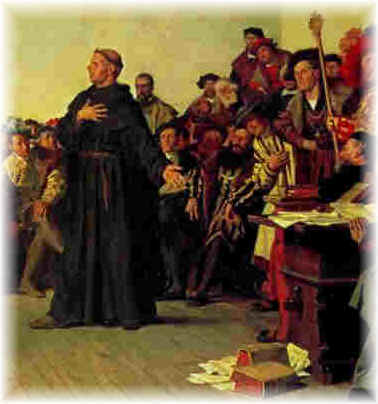
When Luther’s preaching against indulgences began to impact the bottom line on their sale, the Church went after him. At a gathering in the German city of Wurms, before the emperor, Luther was ordered to recant, or repudiate, all of his writings. He refused.

Ultimately, he came under what was known as an “imperial ban.” That meant that both the Church and the powerful Holy Roman Empire, a confederation of principalities and nations, agreed that if any one saw Martin Luther, he was to be killed on sight. Luther was labeled a heretic, a perverter of the Christian faith.

For the balance of his life, Martin Luther remained steadfast in proclaiming the God we see in Jesus Christ, the God of grace and God of glory. Among Luther’s last words were, “We are all beggars,” an acknowledgement that none of us is better or more important than others in God's eyes and that all with faith in Christ are the recipients of God’s charitable gifts: forgiveness and new life. We cannot earn them, but thank God, He loves to give them to those humble enough to surrender to Christ! Luther died in 1546.

We celebrate October 31 each year as Reformation Day because on All Saints Eve, Hallowed Evening or, as we call it, Halloween, in 1517, Luther’s 95 Theses began a major reformation of the Church. That reform movement goes on to this day. We celebrate the Sunday closest to October 31 each year as Reformation Sunday.

Martin Luther learned and then taught from God’s Word that our relationship with God and our freedom from sin and death don’t come from our works or from doing proscribed acts of ritual, religious or otherwise. These things come to us freely from a God Who, in Christ, shows us that He isn’t our enemy, but our very best friend.

Tuesday, June 30, 2009

Fourth of July Thoughts from One Lutheran Pastor

[I just composed this announcement for the Sunday bulletin of Saint Matthew Lutheran Church in Logan, Ohio, the congregation I serve as pastor. It seems to me that Christians should never want to impose their beliefs on others. But I also believe that Christians can be Christians in society without in any way threatening the freedoms of others.]

A Fourth of July Weekend Message from Pastor Mark
On this July 4th weekend, we thank God for a country in which, among other things, we are guaranteed the right to worship God (or even not to worship God) as we see fit. We can be thankful for America's other "greatest generation" for establishing the United States on two principles, each embodied in the two most important documents of our nation's history. In the Declaration of Independence we find the principle of liberty or freedom. In the Constitution is the principle of mutual accountability and responsibility. The Founders and Framers knew that liberty without responsibility is chaos and that responsibility without liberty is tyranny.

The Lutheran Confessions have always seen governments as necessities in a world that has fallen into sin. Without governments, Martin Luther said, Christians walk through the world like lambs among ravenous wolves.

But, in fact, the Christian is always free through Jesus Christ, no matter what rules, just or unjust, the world may impose on them. We are freed from sin, death, and futility. Knowing that we belong to God for all eternity, we are freed to be fully human beings who love God and love neighbor, even putting others' interests above our own. But, out of love for God and neighbor and in order to preserve that order without which there can be no justice, the Christian seeks to obey just governments and laws.

Lutheran heroes like Dietrich Bonhoeffer, who was killed by a Nazi firing squad during World War 2, have shown us that when governments become unjust, as happened in Germany under Hitler, the Christian also has an obligation, out of love for God and neighbor, to stand against tyranny.

On this weekend when we Lutheran Christians express our love for America, we might well embrace a maxim given in the late-1960s by a US admiral, at the height of the Vietnam War: "Not 'My country, wrong or right,' but, 'My country: When right to keep it right; when wrong to make it right."

As Christians, we believe that we can only make America go right when we personally follow Jesus Christ and follow His commands as we participate lovingly and respectfully in a society that, under the wonderful freedom we enjoy in the United States, includes people of many different religious beliefs. For that reason, I hope that your Fourth of July won't only be, "God bless America," but also and more importantly, "America, bless God."

In 2 Chronicles 16:9, we find these words, "For the eyes of the Lord range throughout the entire earth, to strengthen those whose heart is true to him.." As followers of Jesus blessed to live in America, may we be true to the God we know in Jesus Christ. As we pledge allegiance to the flag of the United States of America, may we always remember that our highest allegiance is to our God and King, revealed to all the world in Jesus Christ.

Friday, April 03, 2009

More on Robert E.A. Lee

Lee was the pioneering maker of documentary films whose work with the Lutheran Church--including A Time for Burning, is mentioned here. Lee recently died.

Here is a profile of the filmmaker from the Evangelical Lutheran Church in America (ELCA), which I just ran across.

Saturday, March 21, 2009

'A Time for Burning'

A Time for Burning is a cinema verite documentary that shows us what happened in a white Lutheran church in Omaha when its pastor, William Youngdahl, tried to gain congregational approval to foster racial understanding in 1965. His proposal was that ten families from his church meet with ten families from a black Lutheran congregation whose building was several blocks away.

That may seem utterly innocuous and unobjectionable. But in 1965, it was a bit like throwing a lit match into an oil refinery.

My wife, son, and I watched A Time for Burning this evening. You can see the whole thing here.

It was nominated for an Academy Award in 1966, and is worth the 55-minutes it will take for you to watch it.

The producer of the film, Robert E.A. Lee, recently died. Here is his obituary from The New York Times.

Whether you were alive in those times and can remember being involved in discussions similar to those portrayed in this documentary or you're a young person looking for information or inspiration, A Time for Burning is riveting, important filmmaking you'll enjoy.

Sunday, August 24, 2008

An Adventure Begins

Training for we Lutheran pastors is a four-year program that begins with two years of classwork (and some practical field work in local churches and hospitals), a year of full-time work in a church under the supervision of a seasoned pastor, and a final year of classwork, the idea of which is to help students integrate their personal faith life with their academic knowledge and their experiences with parish life. (All seminarians must already hold a Bachelor's degree, the field of study isn't important.)

Typically, Lutheran seminary careers begin with an intense initiation called Summer Greek. During this class, seminary students are immersed in Koine (or Common) Greek, the somewhat peculiar iteration of Greek in which the New Testament was originally written. When I say intense, I mean it. In the two or three week Summer Greek course, seminarians learn as much of Koine Greek as those who, for whatever reason, choose to take Greek beginning in the fall will get in one academic year. If you miss one day of Summer Greek, you may as well drop the course.

But, given the intensity of the experience, one I remember sharing in the summer of 1980 with forty-five incoming seminary students at Trinity Lutheran Seminary, you do more than learn Greek. You get to know other students, you begin to get a sense of what the seminary experience will be like, and, in most cases, you find confirmation of the sense of call from God you have to ministry. Two of my fellow Summer Greek students remain among Ann's and my best friends.

This little reverie of nostalgia has been incited in my by two posts from Ivy over at Called, Gathered, and Sent, who has begun her seminary career with Summer Greek. Check out two of Ivy's posts dealing with the start of this adventure: here and here.

Ivy: May God bless you and encourage you and all who love you as you heed God's call to ministry. You will do well, I am sure!

By the way, this is an experience our son, Philip, will be having next summer, as he too, begins training to become a pastor of the Evangelical Lutheran Church in America.

So, is all the intensity and hard work worth it? There's nothing to compare with using the gifts, abilities, and passions has given to you in the work that God has given to you. I love it!

[Pictured above, from the school's web site, Trinity Lutheran Seminary, from which I received my training from 1980 to 1984. Students who train for pastoral ministry receive a Master of Divinity degree at the end of the four years there. Other degrees for lay ministry are also offered as well as advanced degrees. Click on the image to enlarge.]

Sunday, June 08, 2008

Book Review: The Grace of It All

[From time to time through the years, I've reviewed books for the journal of my seminary alma mater, Trinity Lutheran Seminary. Here's a review I submitted yesterday.]

The Grace of It All: Reflections on the Art of Ministry. By F. Dean Lueking. Herndon, Virginia: The Alban Institute (www.alban.org), 2006. 152 pp. ISBN-13: 978-1-56699-332-6; ISBN-10: 1-56699-332-6 $17.00 (paperback)

It may be that all pastors have at least one book in them.

In their books would be presented the experiences and lessons derived from years of pastoral ministry.

From them, seminary students would gain valuable “heads up” insights and those already engaged in pastoral work would find encouragement and counsel.

Although he’s written other books, The Grace of It All is F. Dean Lueking’s attempt at such a book of a lifetime. Part memoir, part shirtsleeve pastoral theology, The Grace of It All often has the feel of a conversation with a seasoned and generous mentor. This, as Lueking explains in the Preface, is his intention, believing as he does that such conversations in print are needed. “The need is for pastoral writing that joins sound theology, biblically grounded in the mighty acts of God’s judgment and mercy, with the realities of congregation and community in our world.”

For this, Lueking is as qualified as anyone. A brilliant preacher with an extraordinary ability to make accessible sometimes difficult Biblical truths, as many will already know, he spent forty-four years in one parish, Grace Lutheran Church in River Forest, Illinois, before beginning an international ministry of teaching and mentoring pastors.

The Grace of It All is filled with tales of triumphs and failures, of lessons learned, and, maybe most helpfully, of the everyday experiences that, in the end, bring pastors their greatest sense of satisfaction. We get to see and personally experience the many ways in which the Triune God can grace pastors’ everyday lives and the everyday lives of the people and communities they serve

Lueking veers between memoir and pastoral theology here. Mostly, he manages to maintain a balance between the two, helping us to see the ways in which God sustains pastoral ministry. But at times, like a politician stumping, intent on mentioning as many locals as possible, Lueking strains the reader’s goodwill by going on for pages citing specific members of the Grace Lutheran Church family he so long served. When he does so, it reads not so much as a chronicle of the Biblical “cloud of witnesses” as it does as a series of entries in a seed catalog.

That, coupled with the fact that the last chapter seemed to slog along unnecessarily, made me feel, after reading it, that The Grace of It All would be an even stronger and more helpful book if it were reduced in length by about fifty pages.

In the end, though, I was happy to have read this book. I enjoyed spending time with Lueking if, for no other reason, than that it has encouraged me to listen to the experiences and stories of my fellow clergy, treasure troves of insight, wisdom, and testimonies to the rich grace of God. As Lueking writes, “We need each other’s stories…The disappointments, like the poor, we have always with us. But the good news of Christ’s grace abounds over sin and brings the great gain of godliness with contentment.”

In this book, Lueking manages to show us what contentment and gain come to those who, year in and year out, stick to their calls as ministers of Word and Sacrament in service to the gracious God made known in Christ.

Friday, June 15, 2007

Book Review: "Grace That Frees: The Lutheran Tradition"

[Below is a review I just submitted to Trinity Seminary Review, the journal of Trinity Lutheran Seminary, my Master's Degree alma mater.]

Grace That Frees: The Lutheran Tradition (Traditions of Christian Spirituality Series). By Bradley Hanson. Maryknoll, New York: Orbis Books (www.maryknoll.org), 2004. 159. pp. ISBN 1-57075-570-1 $16.00 (Paperback)

Spirituality is a slippery word, difficult to define. But I like the definition given by Bradley Hanson, author of this helpful look at Lutheran spirituality. “A spirituality,” he asserts, “is a faith with a path.”

But can one really speak of a Lutheran spirituality? One might not think so. As Hanson observes, “...Lutheranism is sometimes regarded by both those outside and inside the tradition to be seriously deficient as spirituality, even opposed to it.”

The reasons for this, according to Hanson, appear to be twofold. First, Lutheranism began as essentially a theological dispute, one in which right doctrine was regarded as central. Stereotypically, spirituality is seen as something that happens in the wifty regions of the heart. Lutheranism, while not disdaining the heart, is intent on right thinking about God as a way of staying true to God’s self-disclosure as recorded in Scripture. Second, traditional notions of spirituality as a set of rigorous disciplines performed by a spiritual seeker is inconsistent with Lutheranism’s radical theocentrism, the belief that everything is initiated by God, not us.

But in a rapid and readable survey of Lutheran faith, life, and practice, Hanson demonstrates the rich, diverse spirituality that has existed--and still exists--among Lutheran Christians.

“When you pray,” a wise Lutheran layperson once told me, “begin by reading God’s Word.” Hanson shows us how thoroughly Lutheran that approach is. Lutheranism--encouraged by such major voices as Luther, Melanchthon, Arndt, and Bonhoeffer--has always held that “we need to learn to pray by having the Word of God shape our prayer.”

Hanson, professor emeritus of religion and director of the Grace Institute for Spiritual Formation at Luther College in Decorah, Iowa, shows how the Lutheran emphasis on grace alone, Christ alone, Word alone, has spawned a rich array of spiritual practices that includes devotional literature both simple and sophisticated; a sacramentalism that reveres God’s mysterious grace; hymns steeped in Scripture; and worship that has historically been diverse, emphasizing the accessibility of God in Christ, among other things.

This book would be a great text in seminary and college courses on Lutheran history, theology, and spiritual practices. Pastors will also find useful points to ponder here. I can even see it as helpful place for some congregational groups hoping to grow deeper in their faith, to go. This is a fine survey.