Wednesday, December 16, 2009

Faith to See The Other World in This World

[This was shared tonight during midweek Advent worship with the people of Saint Matthew Lutheran Church in Logan, Ohio.]


Matthew 1:18-24
The German poet Rainer Maria Rilke wrote, “There is another world, the same as this one.” A Christian ethics professor, Stanley Hauerwas, quotes Rilke and says, “We simply must learn to see the world in which we live as the world that the Father created and redeemed through the Son.”

Often, you know, some Christians get caught up in a sort of other-worldliness, acting as though they're just skimming along this world's surface, too holy to be bothered with the things that mere mortals care about.

They're like the fellow whose boss grew so frustrated with his employee's constant preaching and failure to get his job done that the boss finally had to fire him. He was, the employer said, so heavenly-minded that he was no earthly good.

That happens to people who mistakenly see Christian faith as being all about the sweet by-and-by.

But the call of a Christian is not to bide our time with sweet talk until we die and go to heaven.

Our call is to follow Jesus Christ in the rough and tumble of the here and now, even when it's hard.

We’re called to understand that though this world has fallen into sin, it is still the world God created. And though, because of all that the condition of sin has unleashed—a penchant for personal sin, a susceptibility to illness, a victimization by death--this is still the world to which Jesus came on the first Christmas in order that its people might be saved from eternal separation from God. It’s this world into which Jesus sends us to love and serve others and to make disciples.

Through the eyes of Christian faith, you and I are called to see this world as one worthy of our making the very same sacrifice Jesus Christ made when He went to the cross. Right now, we're called to live in this world. Jesus calls us to see in every person on this planet someone He loves, someone for Whom He died and rose.

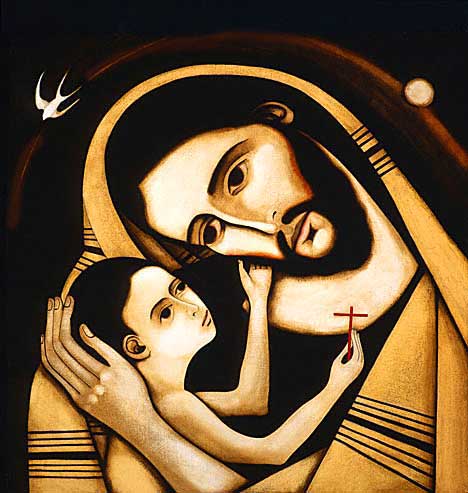
I thought about all of this last night when I once again considered Joseph, the man God chose to be the earthly father for God the Son, Jesus.

In some ways, God asked more of Joseph and of Joseph’s faith in God than God even asked of Mary, about whom we spoke two weeks ago. I’m not belittling what God asked of Mary at all, as you well know. Mary, the Bearer of God, risked all—reputation, marriage, and life itself—when she trustingly accepted the message from the angel and said, “Let it be to me according to your word.”

But, as changes came over Mary’s body, as the baby in her womb began to move and then kick, and as she could know as nobody else could that the baby she bore wasn’t conceived in the usual way, she carried and lived with tangible proof of what she accepted. He body told her day in and day out that she really was carrying God-in-the-flesh within her.

Joseph though, had to believe without such knowing. The New Testament book of Hebrews says, “Now faith is the assurance of things hoped for, the conviction of things not seen” (Hebrews 11:1). In his acceptance of the message God delivered to him in a dream and of the assertions of Mary, Joseph confirmed his belief that there is another world: It's the same as this one, unfolding here and now, but happening at another level from what most people dare to see.

Through the eyes of faith, Joseph was able to see more deeply, more clearly, truer. His wife was pregnant, yes; but she hadn’t been unfaithful. She bore a child, yes; but not just any child.

Today, some will look at Jesus on the cross and see defeat. But we can see victory: God conquering the power of sin and death over our lives.

Some will look at sinners thriving and take it as confirmation that there is no God and that anything goes. But we can see the patience of God with sinners and the time God is giving those of us in the Church to fulfill our mission of sharing the possibility of forgiveness and new life through faith in Christ with others.

Some see death, tragedy, and fatal diseases and blame God or call God impotent. But even amid the ashes and tears of this world, we see that God is making a new world beyond tragedy and tears, a new world where all believers in Christ will one day live with God in, using Luther’s words from The Small Catechism, everlasting “righteous, innocence, and blessedness.”

My family and I attended a memorial service for an old family friend from our home church on Monday night. Bill died down in South Carolina, where he and his wife had made their home over the twenty-six years since his retirement. Pastor Phillips, once the pastor of our home church gave the message and reminded us that after losing a loved one, we may feel orphaned. But he also reminded us of the promise Jesus gave to His heavy-hearted disciples on the night before His arrest. Jesus said that He would soon be leaving them. But then Jesus promised, “I will not leave you orphaned. I am coming to you;. In a little while the world will no longer see Me, but you will see Me.” (John 14:18-19)

Joseph is a model of Christian faith because, by faith, he saw what others couldn't see and what few would have even been willing to see.

He saw the Child in Mary’s womb as the world’s God and Savior.

He saw God working in a world that was often unspeakably hard and unforgiving.

How did Joseph do that?

The Bible reveals no secret formula for having that kind of faith. Joseph’s faith was built just as ours must be built.

Joseph was able to trust in God because Joseph was willing to trust in God. God took that willingness and built a faith out of it.

Just as God builds redwoods from tiny seeds, God builds faith from the seeds of our willingness to follow, even though we only see God’s promises through a glass darkly.

By faith, Joseph came to know that God was not leaving him orphaned.

By faith, Joseph gained the assurance of things hoped for.

By faith, he could see what others couldn’t see.

May this Advent and Christmas season find us willing to trust God.

May God help us to see through the eyes of faith the new world that He is already creating through His Son right now in the midst of this world.

May we see in the Christ Child not just a pleasant story in the midst of a humdrum and difficult world, but the One Who turns this humdrum and difficult our world—and our lives—around for all eternity. Amen

[Painting above: Saint Joseph and the Christ Child by Michael D. O'Brien.]

Tuesday, December 15, 2009

About the Man Who Cried, "Tora! Tora! Tora!"

[I received this on December 7, as one of my colleague Glen VanderKloot's daily emailed inspirations. It tells a story I had never read before. God is still in the business of transforming lives for all eternity!]

The Story of Mitsuo Fuchida
[Mitsuo] Fuchida grew up loving his native Japan and hating the
United States, which treated Asian immigrants harshly in the
first half of the twentieth century. Fuchida attended a military
academy, joined Japan's Naval Air Force, and by 1941, with
10,000 flying hours behind him, had established himself as
the nation's top pilot. When Japanese military leaders needed
someone to command a surprise attack on Pearl Harbor,
they chose Fuchida.


Fuchida's was the voice that sent his aircraft carrier the
message "Tora! Tora! Tora!" (Tiger! Tiger! Tiger!) indicating
the success of the surprise mission. Later, he too was surprised
when he learned that, of the 70 officers who participated in
the raid, he was the only one who returned alive. He had
another close call when he was shot down during the battle
of Midway in 1942, but despite serious injuries, he survived again.

By 1945 he had attained the position of the Imperial Navy's
Air Operations Officer. On August 6 he was eating breakfast
in Nara, Japan, where a new military headquarters was under
construction, when he heard about a bomb dropped on
Hiroshima. He flew to investigate, then sent a grim report
to the Imperial Command.

On the same day, an American POW named Jacob DeShazer
felt moved by the Holy Spirit to pray for peace. DeShazer had
been in captivity since 1942, when, as a member of Doolittle's
Raiders, he dropped bombs near Tokyo and then was forced
to parachute into a Japanese-controlled part of China.

While imprisoned, first in Nanjing and later in Beijing,
DeShazer had become a Christian. He found his heart softened
toward his Japanese captors. After being liberated, DeShazer
wrote a widely distributed essay, "I Was a Prisoner of the
Japanese," detailing his experiences of capture, conversion,
and forgiveness.

Fuchida and DeShazer met in 1950. DeShazer had returned
to Japan in 1948 as a missionary. Fuchida had read DeShazer's
testimony, bought a Bible, and converted from Buddhism to
Christianity. DeShazer had recently finished a 40-day fast for
revival in Japan when Fuchida came to his home and introduced
himself. DeShazer welcomed the new convert and encouraged
him to be baptized. While DeShazer continued to plant churches
throughout Japan, Fuchida became an evangelist, spreading a
message of peace and forgiveness in his native country and
throughout Asian-American communities.


Fuchida died 25 years ago, on May 30, 1976. Like dynamite
inventor Alfred Nobel, who wished his legacy to be one of peace
rather than destruction, Fuchida wanted the message of his
changed heart to supersede the memory of his infamous attack.

He wrote, "That morning [December 7] ... I lifted the curtain
of warfare by dispatching that cursed order, and I put my whole
effort into the war that followed. ... [But] after buying and reading
the Bible, my mind was strongly impressed and captivated.
I think I can say today without hesitation that God's grace has
been set upon me."

Elisha Coffman*


Scripture: James 3:17-18 [NUV]

17But the wisdom that comes from heaven is first of all pure;
then peace-loving, considerate, submissive, full of mercy and
good fruit, impartial and sincere. 18Peacemakers who sow in
peace raise a harvest of righteousness.

Prayer:

Lord, use us to bring your peace and hope to others,
even the most unlikely characters.
Amen

*************************************************

[Photos above, top: Mitsuo Fuchida as a young Japanese Imperial Navy officer; bottom: Fuchida, photographed during his later years, while serving as a Christian evangelist.]

*This piece was written in 2001, on the sixtieth anniversary of the Japanese attack on Pearl Harbor, December 7, 1941.

Joy in the Middle of Sorrow

[This is the text of the sermon for today's funeral for Violet, an 89-year old member of our Saint Matthew family who died this past Thursday.]

Philippians 4:4-8
I sometimes teased Violet, calling her the Energizer Bunny. Back in the 1950s, she was told that she could probably expect to live only five to seven more years. Yet, Violet kept going and going and going.

Even in the two-plus years since I became her pastor, I’ve seen Violet confound expectations, surviving major challenges to her health.

But what was even more remarkable to me than Violet’s physical survival, was the cheerfulness with which she did keep going. Despite complications from her Addison’s Disease, going blind, being confined to a bed or a wheelchair, and finding it increasingly difficult to hear, Violet remained a person on whom her family could rely for a supportive ear, an interested heart, and a cheery welcome. Love and laughter emanated from Violet any time you saw her. She gave of herself unstintingly.

And this wasn’t something she offered just to her family. In the past several days, people from Saint Matthew have commented on how she was always so caring and affirming to others. She got along well with Ruth, her roommate at the Skilled Nursing Center. And whenever I came to visit, she was happy and welcoming. She enjoyed the monthly Holy Communion services I do at the hospital, something that came about as a result of efforts by Shirley and Violet. It has become an important part of my ministry; but it will seem odd when I return there next week and not see Violet.

What exactly was the source of Violet’s capacity for dealing with life’s setbacks? And how can her family and friends, those who mourn her passing, have that same capacity, not just as you deal with the grief you feel today, but also as you face your own challenges in your own lives?

Well, it doesn’t take a Doctor of Psychology to figure out that, in part, Violet was by nature, a person prone to greater cheerfulness. Some people are just like that and they’re huge blessings to the rest of us!

But that wasn’t the only source of Violet’s upbeat tenacity. Our second Bible lesson for worship this past week at Saint Matthew was Philippians 4:4-7. Philippians is a letter written by the apostle Paul to the first century church at the Greek city of Philippi. Paul wrote this letter while he was a prisoner, confined much as Violet must have felt confined in recent years.

Paul was imprisoned by the Roman Empire for being a Christian. Violet was imprisoned by advancing bodily degeneration.

No matter the source of confinement though, confinement isn’t enjoyable. It makes you feel that life is going by and you have no chance to participate in it. Confinement, whether due to injustice or the ravages of age, will almost always breed resentment, bitterness, and anger in those who are confined, and understandably so.

But some rare people show us that it’s possible to be joyous even in the midst of bitter, adverse experiences. And some show us the truth that the last freedom all of us have, even when all other freedoms have been taken from us, is the freedom to choose how to respond to our circumstances.

From his confinement as a prisoner, Paul writes these remarkable words in Philpppians: “Rejoice in the Lord always; again I will say, Rejoice. Let your gentleness be known to everyone. The Lord is near. Do not worry about anything, but in everything by prayer and supplication with thanksgiving let your requests be made known to God. And the peace of God, which surpasses all understanding, will guard your hearts and your minds in Christ Jesus.”

You see, joy is not the same thing as happiness. Happiness happens for a time and is gone. It’s subject to moods and circumstances.

Joy, on the other hand, is a way of life born of constant contact with the Lord Jesus Christ, Who by His death and resurrection, has conquered sin, death, and futile living. Joy is the Baptismal birthright of every Christian.

Joy belongs to those who know that in adverse, sad, or even tragic circumstances, we can leave worry behind. We can turn to God in prayer in Jesus’ Name and let God hear our requests and trust God to do what's best. We can experience a peace from God that goes beyond human understanding. We can know that we are safe in the arms of Christ even when this fleeting life ends.

Knowing that we are in the hands of Jesus also gives us the freedom to take up the lifestyle that Paul commends in the very next verse of his letter to the Philippians: “Finally, beloved, whatever is true, whatever is honorable, whatever is just, whatever is pure, whatever is pleasing, whatever is commendable, if there is any excellence and if there is anything worthy of praise, think about these things.”

Paul’s words aren’t the shallow exhortations of a motivational speaker to “accentuate the positive.”

Just before our lesson, in Philippians, and in his other New Testament letters, Paul acknowledgea that life can be tough. It can be unfair and unspeakable tragedies and challenges may befall us. Paul, as I said, wrote these words from prison. So, he was no pollyanna!

But when you know that Jesus Christ has set you free from sin and death, you know that He can also set you free from the constant anger, self-pity, and self-hatred that confine so many people who, unlike Paul, never have been arrested or who, unlike Violet, never sat in a wheelchair, never went blind, or never fought a chronic disease for more than fifty years.

Christ set Violet free to do live precisely the life Paul commended to the Philippian Christians. She could focus on the honorable, the pure, the pleasing, and the commendable. She took delight in little things. She gave you--she gave all of us--love and laughter.

Violet’s great legacy to you is Jesus Christ.

Jesus Christ is the source of all true joy.

Jesus Christ is the One Who sustained Violet and Jesus Christ is the One Who can sustain you today and in the days to come.

And so, as you deal with the loss of one who loved you much and who you loved much in return, this is my simple message: Trust in Jesus Christ, the One Who conquered sin and death for all who will dare to turn from sin and believe in Him wholeheartedly.

As you surrender each day to Christ, He will give you strength and peace and everlasting life and, as Violet showed you, Jesus will also give you joy that nothing can destroy!

God bless you.

Sunday, December 13, 2009

By Repentant Lives, Showing Ourselves to Be "Kin of God"

[This was shared during worship with the people of Saint Matthew Lutheran Church in Logan, Ohio, this morning.]

Luke 3:7-20
Many years ago, on a cold morning, a newspaper boy in a large city was out on the street, selling his papers. He stood barefoot, warming his feet on a grating that had a bakery below.

A woman came along and, seeing how the boy was shivering, asked him if he owned any shoes. "No," he said. She then asked if the boy would like a pair. "Yes!" he replied enthusiastically.

So, the woman took him to a nearby department store and bought socks and shoes for the boy. At that, the kid excitedly ran out of the store and resumed selling his papers. He didn’t even take the time to say thank you. The woman was a little disappointed by this ingratitude.

But just as she was leaving the store, the boy ran back into the store and asked, “Lady, I wanna ask you a question. Are you God’s wife?”

She stammered, “No, but I am one of His children.”

The boy replied, “Well, I knowed you must be some kin of His.”

People can tell when we have a relationship with the God we meet in Jesus Christ!

In today’s Gospel lesson, Jesus’ cousin, John the Baptist, is doing his special ministry of preparing people for the entry of Jesus into their lives. John calls the people to repent, to turn away from their sin so that their hearts will be emptied of evil and they can be open to the forgiveness that comes to all who receive Jesus as the God and Lord of their lives.

To signify their changed lives, John calls the repentant to be baptized in the Jordan River. Crowds show up in droves to hear John’s preaching and to be baptized.

John should have been pleased. By the standards of the world, he was a great success. He set up shop to preach and lots of people were heading for the desert outside of Jerusalem to hear him. He called people to be baptized and they lined up by the hundreds.

But John was suspicious. He didn’t want to be the latest fad, the spiritual flavor of the month. John wanted people’s lives to be changed as they surrendered themselves and their sins to God.

So, John started chastising the crowds: “You brood of vipers! Who warned you to flee from the wrath to come? Bear fruits that are worthy of repentance. Do not begin to say to yourselves, ‘We have Abraham as our ancestor.’ [It isn’t enough to say, “My mom and dad always went to church.” Or, “I’m a member of Saint Matthew Lutheran Church.” John goes on to say...] for I tell you, God is able from these stones to raise up children to Abraham...”

It’s all very good for us to express sorrow for the ways we’ve hurt God or others, as the crowds who thronged to be baptized by John in the Jordan River. But, John says, unless we change the direction of our lives, our repentance is nothing more than a hollow religious act.

When we truly repent, we become like the woman who bought the shoes for the newspaper boy. By our changed lives, others see that we’re kin to God.

That’s why to one group of people after another in today’s lesson, John says, “Live your repentance. God has planted the seed of love and forgiveness in your life. Now bear fruits of repentance.”

There is nothing odder or more appreciated than the life of a person genuinely changed by the love of God, somebody who is bearing the fruit of genuine repentance.

An acquaintance of mine once told me about a habit she has. These days you know, it seems that young people are so dependent on calculators that many are flustered by having to count out change at retailers’ cash registers. My acquaintance says that often, a young person working at register will give them too much change. This person will say, “Excuse me. I think you’ve made a mistake.” And just as the young clerk is about to get defensive, she’ll explain, “You gave me a dollar too much.” When this happens, the mystified clerk will say something like, “Thank you so much. If I had been off, I wouldn’t have made my bank and been here all night long trying to figure what went wrong.”

And don't be surprised if some people will go out of their ways to test our commitment to the repentant life of a Christian. Walt Kallestad is pastor of Lutheran Community Church of Joy in the Phoenix area. He tells about being on his way to a meeting one day when he decided that he needed to pick up a soft drink at a convenience store. He pulled off, made his purchase, and was barreling down the road when he realized that the clerk had given him too much change. It was a mistake on the clerk's part. Nine people out of ten probably would have just gone on to their meeting and forgotten about the whole thing. But it bothered Kallestad. So, he turned around and went back to the clerk. "You gave me too much change," he said. "I know," said the clerk. "I was at your church last Sunday and heard you talking about the importance of honesty in business dealings. I wanted to know if you were for real."

I really do wish that those of us who follow Jesus would confound and mystify the world like that all the time, defying people's expectations that we Christians will hypocritically be as dishonest and unethical as the rest of the world. I wish that I woulddefy those expectations more!

Can you imagine the positive impact we could have on people if, with any consistency, we did as John the Baptist suggests today: bore the fruit of repentance, living as people grateful for Jesus, the Savior to Whom John pointed?

True story. Little Marty Rayner had returned from a secret mission with an unexpected item, a gift for his friend Kenny. Marty’s mother, Diane, watched her son wrap the gift in bright Christmas paper. Because Kenny’s family was poor but too proud to accept gifts they couldn’t reciprocate, Marty sneaked across the pasture, under an electric fence, and up to Kenny’s front door. He pushed the doorbell and then, ran like the wind.

The two boys were like Tom Sawyer and Huckleberry Finn, always getting into little adventures together. Marty was deaf in one ear, but never complained about it. Kenny never seemed to mind his friend’s problem. Marty had bought a compass for Kenny with his own money and after Diane had explained about Kenny’s mom’s “admirable pride,” Marty decided that nobody ever needed to know who had left a Christmas present on Kenny’s front porch.

Diane was proud as she watched her eight year old son share a gift with no expectation of being rewarded. She thought to herself, “This must be what Christmas is all about!”

But when Marty came back from his errand, he was wobbly, his eyes filled with tears. What was wrong?, Diane wondered. As Marty came into the kitchen, Diane saw it: a bright red welt emerging on his face. In a hurry to escape from Kenny’s house undetected, Marty had run straight into that electric fence. It had knocked him down and stunned him. As Diane hugged her sobbing boy close, she wondered, as I suppose any parent would, how God could have let a boy doing something so wonderful be hurt like this.

Christmas day came. Diane and her family opened their Christmas presents. She could see that happily, the burn on Marty’s face, extending from his mouth to his ear, wasn’t serious. But even then, she wondered how God could allow such a cruel thing to happen to somebody who was so giving.

Later on Christmas morning, Kenny came to visit Marty. Kenny showed off his new compass and Marty just smiled and congratulated his friend. He never did tell Kenny that he’d been the one who gave this Christmas present Kenny so cherished.

“That’s when Diane noticed it. As the boys were talking closely with one another, Marty seemed to be hearing with the ear that was totally deaf. [There had been a Christmas miracle.]...the school nurse confirmed that Marty had full hearing in that formerly deaf ear. The doctor could only guess at what had happened—when Marty hit that electric fence, the doctor surmised that somehow the electric current had shocked that ear into hearing.”

I wish that I could tell you all this morning that if we live our faith the way Marty did, then miracles of healing and provision will come our way.

But that’s not the way things work in this imperfect world.

We bear fruits of repentance—we perpetrate acts of love and kindness and service—not so that we can earn heavenly miracles or get dibs on God’s love. We serve others because of the incredible service God has already done for us.

God isn’t a miserly old coot from whose clenched fists we have to pry love or blessings.

As followers of Jesus Christ, we live our faith because on the first Christmas day 2000 years ago, God already gave us the best Christmas present ever: His love and the possibility of new life through Jesus Christ to all who repent and believe in Him.

Jesus loved us enough to bear a cross for us. He loves us enough to share His victory over death with everyone who will genuinely turn from sin—repent—and follow Him.

Little Marty had no thought of his deaf ear when he gave that compass to Kenny. His eyes and his thoughts were on one thing only. He was thinking of the baby in the manger. He was thinking about Jesus.

This Christmas season, I hope and pray that all of us—including me—will put our focus on Jesus where it belongs.

When that happens, we might find ourselves doing odd and amazing things—like making anonymous gifts to needy neighbors or inviting unchurched friends to worship with us.

But however we respond to Jesus’ love, may this Christmas season find us all moving...
  • from feeling our faith to doing it...
  • from believing to living...
  • from being blessed to being blessings.
Two thousand years ago, God came to us as a servant born in a barn.

By our service in the Name of Jesus, let’s show the world that we really are kin to God…and that by the same grace that saved us, they can be kin to God, too. Amen

[You might want to see this cartoon.]

Our Eternal Hope

[This was shared during a menorial service on Saturday, December 12, for Bob, a member of our congregation who passed away suddenly last Monday.]

John 3:16
Philippians 4:4-9
1 Corinthians 15:19

I promised Bea I would make this brief.

Bob’s sudden passing has come as a terrible shock to Bea, to Bob’s and Bea’s families, to Bob’s friends, and to all of us who are part of the Saint Matthew Lutheran Church family. And there’s particular poignance to Bob’s death coming during the Christmas season, his favorite time of the year.

Just this past Sunday, barely twenty-four hours before we said good- bye to Bob, he was in the sanctuary of Saint Matthew for worship. When Bob shared the peace, he didn’t do it like some stoic old Lutheran, with a limp handshake and maybe eye contact. In fact, this past week, Bob wrapped me with his trademark bear hug, nearly picking me up off of the floor and momentarily taking my breath away. I had been heading back to the altar for the offering when I encountered Bob and he said, “You didn’t think you were going to get away without a hug, did you?” No, and I wouldn’t have wanted to!

On the previous Friday, my daughter and I ran into Bob as we walked to the bank. It was part of a day that saw him and several of you decorate the house-inside and out—for Christmas. He was having fun!

And now, under circumstances we couldn’t have imagined just a week ago, we gather not only to remember an accomplished, loving, compassionate man who meant so much to so many, but also to commend him to the care and keeping of the Lord in Whom he believed, the Lord Whose birth he so enjoyed celebrating.

No words spoken here today can fill the void left in the lives of Bob’s family and friends. You who mourn today have sustained a loss and the grief will never fully subside.

But this is a moment to remember an important truth. This life, with its joys and griefs, laughter and tears, is not our ultimate destination.

The Bible teaches us that when we die, we will stand before God. Those who have trustingly surrendered to the love and grace of God given through Jesus Christ will be with God forever. Jesus puts it this way in a famous conversation He had with a man named Nicodemus: “For God so loved the world that he gave his only Son, so that everyone who believes in him may not perish but may have eternal life.”

When I re-read those words the other day, I couldn’t help thinking that Bob, who so loved Christmas, is now enjoying an eternal Christma with the Savior which none of us can even imagine right now!

Some people, you know, latch onto God because they think God is a good-luck charm who can help them get through times like these. God does want to help us through tough times. But the God revealed to us in Jesus Christ, Who came into our world on the first Christmas two-thousand years ago, wants to be more than a good luck charm and more than a crutch to help us through tough times.

He wants to be our God, King, and Helper, our Lord, Savior, and Friend for all eternity.

In the New Testament, the apostle Paul writes, “If for this life only we have hoped in [the God we know in Jesus] Christ, we are of all [people] most to be pitied.”

Today then, to sustain you through your grief and to give you a hope that never dies, I want to simply remind you to put your full trust in Jesus Christ.

Jesus is God in the flesh, the Christ Child Who came into our world to first, live with us, then to die for us, killing the power of sin and death over the lives of those who believe in Him, and finally, to rise for us, opening eternity to those who believe in Him.

Jesus also established His Church as a place where ordinary believers can share their joys and sorrows, worship and get to know God better, serve others in Jesus’ Name, hear God’s Word of hope and encouragement, and, among other things, share God’s peace with one another, as Bob so enthusiastically did this past Sunday morning.

I know that your grief is great. But God’s love for you and God’s willingness to comfort and help you and to love you for all eternity is even greater.

Today, grasp hold of the strong embrace of Jesus. Even in times like these, He has an endless supply of help and hope to share with you. Amen

Minaret Piece in 'Better Living' Mentioned by Pew Project on Journalism

This piece on Swiss voters' decision to thwart the construction of minarets in their country has been cited as exemplifying a widespread defense of freedom of religion by bloggers.

In my post on the Swiss vote, I said that thwarting the religious freedoms of Muslims was wrong and represented a threat to the freedoms of all people to practice the religions of their choice.

The Pew Center's Project for Excellence in Journalism regularly monitors what is being written by bloggers to see how the concerns receiving the greatest attention among them compare to the stories receiving the greatest focus in mainstream media outlets. The reference to my piece on the Swedish minaret vote came in the PEJ New Media Index for November 30 through December 4.

This explains the mission of the Project for Excellence in Journalism.

Friday, December 11, 2009

The Wonder of Humble People Pointing Beyond Themselves

Deb Grant, the pastor of Faith Lutheran Church in Dickinson, Texas, authors a daily email she calls ELOGOS. Here is today's installment:
Luke 3:15-16
As the people were filled with expectation, and all were questioning in their hearts concerning John, whether he might be the Messiah, John answered all of them by saying, “I baptize you with water; but one who is more powerful than I is coming; I am not worthy to untie the thong of his sandals. He will baptize you with the Holy Spirit and fire.
* * * * * *
It was pop artist Andy Warhol who said that everybody would have 15 minutes of fame - a reference to the explosive and fleeting nature of celebrity. In today's culture, 15 minutes of fame could be pandered by clever marketing people into a fortune. Ordinary people become Youtube icons or action figures. John the Baptist was a retro prophet for a people who hadn't seen or heard from a prophet in hundreds of years. He could have had his own talk show in a heart beat. Instead he waves off the fame and does simply what he was born to do –point to Jesus. As we watch celebrities rise and fall and feel the ebb and flow of our own successes and failures, we are wise to consider the historical wonder of a humble man doing his job with integrity so that the world will be ready to recognize the Savior of the world.
* * * * * *
Lord, when all is said and done, may it be said of me, that I pointed to Jesus.
Amen.
If you would like to subscribe to ELOGOS, send Pastor Grant an email at: revdeb@jazzwater.com. Here is her web site.

Thursday, December 10, 2009

God's Will and Sticking with It

[This was shared during the Midweek Advent Worship with the people of Saint Matthew Lutheran Church in Logan, Ohio, last evening.]

Luke 1:5-23
A prominent pastor once told about meeting an old seminary classmate of his. The classmate had been widely acknowledged by everyone to be the ablest member of their class: a compelling communicator, a great leader, a person who got things done quickly and well, the sort of person others immediately respected and followed. “Joe,” they said, “will be the one who leads the largest church in the biggest city with the most clout in our denomination.”

But when Joe and this classmate met one another for the first time since their graduation, Joe was pastoring a tiny church. He enjoyed his ministry, but he was far from being the superstar everyone had expected him to be.

The two of them had been talking for some time, when the classmate screwed up the courage to ask, “Why? Why hadn’t Joe fulfilled his promise?”

In response, Joe had his own question. “Whose promise are you talking about?” he asked. “God never promised that I would be a superstar. God promised to be my God and Lord if I repented and believed in Jesus. God promised to be with me. God promised me new, eternal life. But God never promised me I would be a superstar. And in response to all of God’s promises, I promised to surrender to Jesus everyday. I promised”—and at this Joe chuckled—“to pray and try to mean it when I prayed, ‘Thy will be done.”

Joe allowed as how his life had turned out differently than he had expected. But he stood solely on the promises of God and then, day in and day out, did his duty as God set it before him.


Our lives don’t always go the ways that we or others think that they will. Everybody here tonight could probably identify at some level or another with Robert Redford's character, Roy Hobbs, in the movie, The Natural.** Years after mysteriously and suddenly dropping from the life of his high school sweetheart, Hobbs and the sweetheart, played by Glenn Close, meet one another again. With wistfulness, Hobbs says, "Things sure turned out different." "What do you mean?" she wondered. "Just different."

But our call is to be faithful to the Lord Who has been ever faithful to us, no matter how different things may be from how we'd imagined they would be. Our call is to be faithful in the midst of what we don’t understand.

Several years ago, I was re-reading this passage from Luke about Zechariah’s encounter with the angel Gabriel. In some ways I read my Bible exactly as I read books, journals, or magazines. Like any good nerd, I set with pen in hand, making underlines and writing comments in the margins as I read. I dialog with God.

As I re-read the story of Zechariah, a line struck me which I hadn’t noticed before. It’s the line that composes the last verse of our lesson: “When his time of service was ended, he went to his home.”

While offering sacrifices at the holiest place in the temple in Jerusalem, Zechariah had encountered the angel Gabriel, the same angel who would visit Mary six months later. It wasn't at all what he'd expected, or probably had dreamed all his life, would happen if he ever had the chance to offer incense offerings at the temple.


Gabriel told Zechariah that he and Elizabeth would have a son, John the Baptizer. Zechariah didn’t believe the angel at first and as a sign that his message was correct, God caused Zechariah to be struck dumb, unable to speak.

Now I ask you: What would you have done if you were Zechariah, if you had encountered an angel and suddenly were unable to speak?

I tell you what I think I would have done. I would have run out of that place with terror, in reaction to the weird, frightening holiness of the moment.

I can’t imagine that a soul in the world would have blamed Zechariah for doing just that.

But Zechariah didn’t run. When the full force of that line--“When his time of service was ended, he went to his home"--hit me as I re-read it several years ago, I wrote in the margin of my Bible, “Amazing! He stayed.”

Zechariah may have stayed before the incense altar, in part, because, with something like 22,000 priests, composed of several divisions, charged with the care of the temple and only those whose names were drawn by lot able to offer sacrifices at the altar as Zechariah was doing at the moment of his encounter, he may not have wanted to let go of this less than once-in-a-lifetime experience. Zecharaiah would have known maybe thousands of priests who never would have been given the privileged duty he was undertaking at the time.

But I suspect that something more was at play in Zechariah’s decision to stay at his post in spite of things not going at all as he had expected.

Martin Luther once observed that Christians often work themselves into a blather over what God’s will for their lives might be. They ask things like, “Shall I marry?” “What career should I pursue?” “Where should I live?”

God cares about those things, of course, because God cares about us.

But, Luther said, we can pursue God’s will married or not, in one career or another, living anywhere. Above all, Luther said, God’s will is that we simply do our duty—love God, love neighbor, make disciples, live justly, repent for sin, believe in Jesus—whatever we do.

By not believing the angel’s message, Zechariah knew he had, for a moment, lapsed in his faith. But, in spite of things not going as he’d expected, he kept at his duty.

This is a lesson Zechariah must have taught his son. In our Gospel lesson for this coming Sunday, several groups of people, in response to John’s preaching of repentance come to him and ask, “What should we do now?” He told all to share their blessings with others. He told tax collectors not to take more from people than they were supposed to take. He told soldiers not to exhort money from the terrified or to falsely accuse people. In other words, John said, God’s will is for us to do our duty, just as Zechariah, his father, did that day in the temple after being visited by Gabriel.

So often, we Christians complicate things. I don't know how to complicate this, folks. God’s will for us is really simple:
  • Trust in Christ no matter what.
  • Repent for sin and receive forgiveness.
  • Love God.
  • Love neighbor.
  • Tell others about the saving good news of Jesus.
  • Treat others as we would be treated.
On our jobs. In our families. At school. At our leisure.

Zechariah did his duty to God and to others. He stood solely on the promises of God and did his duty from moment to moment. May we do the same, whatever life brings to us. Amen***

*Joe wasn't his real name, by the way.

** Based on the novel by Bernard Malamud, the story line from which the film departs significantly.


***By the way, I do not think that it is God's will that people stay with jobs where they are unappreciated, underpaid, or subjected to abuse. Nor do I believe that employees who work under such conditions should do so without making their grievances known.

I also do not believe that people should remain in marriages to spouses who engage unrepentantly in extramarital liaisons or who are physically, emotionally, psychologically, or spiritually abusive.

Nor do children owe obedience to parents who are in any way abusive. Nor do parents need to fear to discipline their children with appropriate self-control and love.

The Bible is very clear that our relationships are not to be built on the rights we demand for ourselves, but in the responsibility, love, and respect each of us owes God and one another.

The Golden Rule--"Do unto others as you would have them do unto you"--should govern all our relationships.

The "household codes" which conclude many of the letters of Paul and Peter, found in the New Testament, all are predicated on this notion of relationships built not on the notion of rights--a non-Biblical concept, but on the belief in our mutual responsibility as human beings...all human beings.

Sunday, December 06, 2009

I Can't, But...

[This was shared during worship with the people of Saint Matthew Lutheran Church in Logan, Ohio, earlier today.]

Luke 3:1-6
Genelle Guzman-McMillan was the second of thirteen children and grew up on the Carribean Island of Trinidad. Genelle’s mother was a devoted Christian. But Genelle didn’t like church, thinking it was a waste of time. In fact, she thought that anything that cramped her style was a waste of time.

At age nineteen, expecting her first child, she moved in with her boyfriend. Six years later, the two of them split up and Genelle felt free to hit the club and party scene for which she’d always hankered. Somehow, in spite of now having two children, she made it through college, still managing to party most of the time.

Genelle seemed to have broken free from the old restrictions of her life and, depending on herself and her own wits. She was, as it’s said, “living large.”

In 1998, she moved to New York City where family and friends told her, she would find greater opportunity. She decided to leave her kids in Trinidad until she got settled in. After she came to New York, her ex-boyfriend informed Genelle that he was unwilling to let their kids come to America with her. That was okay with Genelle; by now, she was enjoying the party scene in the Big Apple. She quickly accepted being able to do more of it without having her children around.

By then, Genelle was living with another man, Roger McMillan. Like Genelle, he loved to spend his spare time partying. They were on top of the world until, Genelle says, there came “a remarkable turn."

Genelle worked in the Tunnels, Bridges, and Terminals Department of the Port Authority of New York, her office on the 64th. floor of the North Tower at the World Trade Center. It was early on September 11. 2001 and she was making small talk with a co-worker, when she felt the building shake.


At first, she and the others in her office had no idea that an American Airlines passenger jet had just slammed into their building. After a time of indecision and panic, Genelle and the others with her on the 64th. floor, heard a roaring noise, not knowing that it was the sound of the South Tower collapsing.

But that sound was sufficiently terrifying to convince them all that they needed to get out of there. They made their way down the stairs, counting each flight aloud. Firefighters were ascending the stairs as they descended, assuring them that if they kept going down, they would be fine.

By the time the group reached the thirteenth floor, Genelle’s leather-heeled shoes were killing her. As she leaned over to take them off, everything around her seemed to explode in a massive boom!

All Genelle could see was blackness. She felt something hit her chest and then, she was pinned to the ground. As she put it, “One hundred ten floors were coming down around us. I knew I was being buried alive. The noise was deafening.”

Then, things became quiet and Genelle couldn’t believe that she was still alive. Listen to what Genelle says happened next: “I knew then I was going to die. Nobody was going to find me under all the steel and concrete. I started calling out for [my friend] Rosa, but there was no response. Then I heard a man saying, ‘Help, help, help.’ His voice grew fainter, and then there was nothing.

“There in the dark, my mind started racing. I thought of my children, my family, and my fiancé, Roger...More than anything I worried about what would happen to me after I died. I didn’t know how to ask for forgiveness. I was sure I was going to hell.”

Beneath the steel and concrete, Genelle begged for a second chance at life, a second chance to live life God’s way. She floated in and out of consciousness for hour after hour, each time she came to praying for forgiveness and a miracle to help her to deal with the pain.

The next day, still under the rubble of the North Tower, Genelle heard the beeping sound of a truck backing up. She called out and a rescue worker heard her. But even though they shone a light all around and Genelle waved one hand, the only part of her that was free, no one saw her.

Then, Genelle faded from consciousness again. When she awoke, she heard rescue workers somewhere overhead and she prayed, “Please help me now!” She yelled at the workers. Nobody heard her. She desperately waved her hand again and now, somebody grabbed it.

“Genelle,” she heard, “I’ve got you! You’re going to be all right. My name is Paul. I won’t let go of your hand until they get you out.”

Soon, two rescue workers pulled Genelle out and Paul let go of her hand. Genelle was the last survivor to be pulled from the World Trade Center.

She spent five weeks in Bellevue Hospital, amazing the staff with her serenity. More than two years later, when I first read her story, Genelle still hadn’t had a nightmare about those horrible events.

One thing that bothered her though was that she never got the chance to thank Paul for taking her hand and reassuring her there in the rubble. She learned that there was no Paul among the rescue workers who went to Genelle that day. Not one of the crew who took her from the rubble knew of a Paul. Genelle is convinced that God sent an angel at just the right time.

September 11, 2001 began a new life for Genelle. As she puts it, “My life was very different than it had been before. I was amazed by how much God loved me.” She saw herself as a child of God. For the first time in her life, she felt truly free to be the person God designed her to be, the kind of person each and every one of us is designed to be.

Not only had Genelle been rescued; more amazingly still, this young woman who had been totally caught up with herself, with doing things her way, turned from sin and turned to the God we know through Jesus Christ...and got a new life!


Our Gospel lesson for this morning tells us about the proclamation of John the Baptist. John described himself simply as a voice. His voice called people to repentance. To repent means to change our minds about who’s in charge of our lives, to change our minds about our priorities. It really means to change our minds about who our God is.

Genelle had gone through her life before September 11, 2001, with many gods. She had worshiped at the altars of pleasure, good times, and herself, among others.

Under the debris of the World Trade Center, she came face to face with the reality that these things could not bring life nor save her life nor give her life purpose or meaning.

Fortunately for all of us, God long ago sent a rescuer Whose life, death, and resurrection can bring new life and second chances (and third and, if you’re like me, three-hundred thousandth chances) to all who follow Him.

On the first Christmas day, God sent Jesus Christ. Anytime we take His hand and let Him be in control, whether our days bring us trials, triumphs, tedium, tragedies, crosses, or crowns, we have new life.

Many people have the mistaken notion that Christianity is about morality. People tell me, “I like to send my kid to church because he learns the right way to live.”

But the right way to live is no big mystery! Anybody who takes the time to look it up will find that every major religious system in the world says pretty much the same things about morality. They say that loving and living at peace with our neighbor is a good thing, that we shouldn’t steal or take our neighbor’s spouse, and so on.

The problem isn’t that we all don’t know the right way to live. The problem is that we don’t know how to do it.

The sin in our bones keeps us from doing the good we know we should do and that deep down, we want to do.

Jesus Christ came to earth and lived the perfect sinless life, offering Himself as the sacrifice for our sin so that you and I can have his power to do what we cannot do in our own power: Turn from sin and live with God in our lives today and always.

I’ve mentioned it before and I probably will again: Alcoholics Anonymous is one of the most powerful and important movements in our world today. AA and other movements patterned after it, uses a twelve-step process to help people get delivered from their addiction. The first step to freedom for the alcoholic or any other addicted person is the admission that he or she is powerless over the addiction.

Whether she had been rescued from the World Trade Center or not, Genelle Guzman-McMillan took her first step toward freedom when in a desperate and cataclysmic time, she finally told God that she knew she needed Him.

The acknowledgment of our helplessness and our desperate need of the God we meet in Jesus Christ can free us all for really living!

Jesus came into our world not as a great moral teacher, though He was a great moral teacher. Instead, Jesus came to be our God and Savior, the One to Whom we surrender even when we don’t understand, even when we would rather do anything but that which He calls us to do.

Jesus came to save us not only from future death, but also from the dead-end road of self-reliance.

That is a lonely road, something I have to keep learning all the time.

Once a few years ago, I was bellyaching about something to Ann. After listening to this for a while, she finally said, "Mark, ask someone to help you!"

Whether it's asking God for something or asking the people God brings into our lives to help us do the things we can't do on our own, we need to get over self-reliance and learn God-reliance!

When we follow Jesus, we not only walk with God, we also walk with that wonderful group of recovering sinners known as the Church, where God can provide us with the help we so often need in our lives and where we can be the means by which God helps not only other church members, but the whole desperate world.

In the days left until Christmas, as we deal with life’s stresses and the temptation to think that we’ve got to have everything in life under control, every t crossed, every I dotted, every package wrapped, I want to recommend a simple formula for repentance—a formula for turning things around in our lives in a positive way. It comes from Baptist pastor Gerald Mann, but it’s so good he could be a Lutheran. (Just joking!) Here it is:
I can’t. God can. I’ll let Him.
Indulge me and say those three simple phrases with me, won’t you?
I can’t. God can. I’ll let Him.
Jesus came to be our Savior. As we sing the carols and share our gifts this Christmas time, let’s remember, “We can’t. God can. We will let God—and no one and nothing else--be our God!”

[The true story of Genelle Guzman-McMillan is told in Jim Cymbala's book, Breakthrough Prayer.]

Saturday, December 05, 2009

About Those Google Ads

Readers of Better Living will notice that Google ads appear both near the top and at the bottom of each page to which you go here.

Some of the ads promote what I consider fairly "fringie" expressions of Christianity--speculators about the times and particulars of the apocalypse (something Jesus says we have no business doing), pseudo-theologians offering their own unbiblical theories on how Jesus saves us from sin and death, and so on.

I just wanted you to know that I have nothing to do with the advertisers that appear here and their appearance on this blog doesn't denote endorsement.

The ads appear as a result of my participation in the Google AdSense program. Through it, bloggers "earn" a few cents every time readers click on an advertiser's link appearing on their page. So far, as of November last year, after six years of blogging, I'd received $105.78 for the ad traffic generated from this blog. And I don't expect any more income to be generated here until about 2033. (Google only cuts checks once the clicking adds up to $100.)

Admittedly, this is the poor side of the Internet. That's OK.

But remember that just because someone's ad appears here doesn't mean I endorse what they're promoting.

Get Well, Evan Turner!

Here.

Buckeyes, without Turner, face Butler next Saturday. They barely lost to Clemson today.

Help Tim Vogel Climb Carew Tower

My friend and former parishioner, Tim Vogel, is climbing Carew Tower in Cincinnati once more this year to raise money for the Lung Association. Please pledge for Tim's climb for this important cause. Thanks!

God, Help Me to Desire YOU More Than Anything This Christmas

Good words from Julie Ackerman Link.

In reading Link's devotional piece, some will undoubtedly say--as I was inclined to say as I read it, "Hey, I'm not a kid. I don't want presents and candy for Christmas."

We might say, "I just want a safe gathering with my family." Or, "I want everybody to get along." Or, "I want the kids to have nice Christmases." (The latter sentiment often accompanied by the old saw, "After all, Christmas is for kids.")

But if our goals for this Christmas are safe, happy gatherings of family, conviviality, or happy children, we're aiming way too low!

(And if we think that "Christmas is for kids," we really don't get it at all.)

Christmas, that humanly created blip on the calendar, is meant to be a reminder of the thing we should most desire, not just at Christmas, but always. That's God.

On the first Christmas, whatever time of the year it actually happened, God entered into our world to give Himself to us. Jesus is not just truly human, but truly God. We Christians are remembered to how He gave Himself to us and for us every time we receive His body and blood in Holy Communion. ("This is My body, given for you...This is My blood, shed for you.")

We're called to desire the presence of God in our lives--in every part of our lives--not because God is some egomaniac. It's because without God, we are incomplete. It's because without God, we don't have God's life in us. It's because without God, we don't have the capacity to become the people God designed us to be and our relationships can't be powered by His self-giving love.

For Christmas this year, and for every day of my life, I'm asking God to help me to desire one thing above all else--more than comfort, ease, freedom from difficulties, or anything else. I want to be a person who desires God above all else.

Work in my desires, Lord Jesus, to make You and Your glory the object of all my desires. Amen

Wednesday, December 02, 2009

Mary, the Faithful Disciple

[This was shared during tonight's Midweek Advent Worship at Saint Matthew Lutheran Church in Logan, Ohio.]

Luke 1:26-38
Mary might well have wondered if she’d lost her mind. After all, how many times have you seen an angel? And how many virgins have babies?

She could be excused maybe, for writing off her entire experience with the angel Gabriel as a figment of her imagination. Or, to have treated the angel’s message with the kind of skepticism with which Zechariah, the husband of Mary’s relative, Elizabeth, treated Gabriel’s message to him that he and Elizabeth would have a son. Yet Mary believed.

She might also be excused for being more than a bit resentful. A young woman—a girl, really—who had not consummated her arranged marriage to Joseph, the Nazareth fix-it man, Mary knew that once her pregnancy became known, she would probably be dragged outside her small town and stoned to death. Yet Mary believed.


We know that Mary was not always the perfect disciple. As Jesus grew older, she allowed herself to forget that Jesus did not belong to her. No child really does belong to a parent, of course. Parents must grow to accept that. But for Mary, such acceptance must have been especially difficult. When he was twelve, Jesus became separated from the family during a trip to Jerusalem. Mary was frantic. But when she finally caught sight of Jesus in the temple and asked Him why He had so troubled Joseph and her, Jesus replied simply, “Didn’t you know that I would be here in my Father’s house?”

And later, when people were following Jesus, many of them whispering threats and calling Him blasphemous, Mary, in spite of what she knew about Jesus, tried to tell folks not to listen to Him. Jesus had lost His mind, Mary and her children told the crowd in a bid to spring Jesus loose and to bring Him back to safety in Nazareth. But Jesus said that His real family was anyone who believes in Him as God and Lord.

Of course, Mary knew that. And I have to say that for me personally, it’s Mary’s lapses in faith that make her so compelling, such a role model. I have lapses in faith, too, times when I say and do things that run contrary to the Lord I believe in, contrary to the life of faith He has called me to live.

But by God's grace, I'm thankful that God gives more credence to my faith than to my many lapses. Mary helps me to know that's true.

And it should be said that incidents like the ones I named from Mary's life were only lapses in her faith. From the moment she learned from Gabriel about the role she was to play in God’s plans for the world’s salvation, through witnessing her son’s death on a cross and His resurrection, despite the lapses, she remained faithful. Through joy and heartache, doubt and glorious affirmation, Mary was a faithful disciple.

The Eastern Orthodox and Eastern Catholic Christian traditions have a title for Mary. They call her theotokos, a Greek compound word that means literally, Bearer of God. Mary bore Jesus more than just in her womb for nine months.

She bore Him, the mark of Him, in some way her entire life. In this too, she is a model for each of us. We who, as baptized Christians have been sealed by the Holy Spirit and marked with the cross of Christ forever, bear the Name of Jesus. We carry Him into our everyday lives and relationships. That isn’t always an easy load, something Jesus recognizes when He tells us that we must take up our crosses and follow Him. But the Lord we carry with us also carries us, a far heavier burden that began when He went to the cross and bore all our sins. And those who dare to take Christ with them through their life’s journeys also receive guidance, peace, and an eternity of hope that nothing can destroy. Bearing Christ lightens the loads of life!

Whatever God may call you and me to be or do, I pray that we will be found as faithful as that young Judean girl was when met by the angel Gabriel. May we willingly say, “Here am I; the servant of the Lord; let it be with me according to your word.” Amen

The Evil One Cannot Overpower Us

The Christian can walk and live in the certainty that Christ is beside us and the Holy Spirit fills us with power to resist temptation and self-destruction. Every time I sin, it represents a failure on my part to place some aspect of my life under Christ's Lordship. Every time I resist temptation, it represents a triumph of Jesus Christ over all that would do me everlasting harm. This is why a commitment to living in "daily repentance and renewal" is central to the life of a Christian.

You might be interested...

if you're a member of the Evangelical Lutheran Church in America (ELCA) like me, in the online town hall that presiding bishop Mark Hanson has scheduled for December 6. It will be interesting to hear the questions raised by people from throughout the church body.