I attended the funeral of my Uncle Bob (not his real name) today. He was the husband of my father's youngest sister, Sue (not her real name). Bob wasn't yet seventy when pancreatic cancer took him. Bob and Sue were high school sweethearts, both a decade-and-a-half older than me.
When they were married, I was there and I vividly remember Bob emerging from a doorway on the side of the church sanctuary to wait for his bride to process down the aisle. The reception was at my grandparents' home. There, I shook Bob's hand numerous times, thinking myself very grown-up for giving him my congratulations. I guess I thought that the more I did it, the more grown-up I was.
My aunt and uncle settled into the small home they purchased just one month before their wedding. After the births of my cousins, they made a modest addition to the place, doubling its size. Later, there would be a garage. But, they've stayed in the same place for nearly fifty years.
In fact, they've lived their whole lives in a small Ohio town. Bob worked for only two employers his entire working life. His passions were few: his wife, his kids, his grandkids, golf, fishing, and mushrooming. He had no enemies and, as the attendance at today's funeral demonstrated, he had lots of friends of all races and creeds.
Some may consider his stability boring. But as I considered it and the impact his life has had on others' lives, another word came to mind: inspiring!
Both he and my aunt have always been unfailingly kind to others, but never in ways that called attention to themselves. Bob's eulogist today commented that whenever snow covered the sidewalks on my uncle's lengthy street, Bob pulled out his snowblowers and proceeded to dig out every one of his neighbors' homes.
And today, after the funeral, when family and friends gathered at the small and wonderfully overcrowded house, Aunt Sue did as she's always done...seen to it that everyone had coffee and food. She made sure that they felt welcomed and she thanked everyone for coming. Just like her mother, my grandmother, who was the chief cook in my grandfather's restaurants, my aunt has a servant's heart.
To tell you the truth, the whole experience chastened me a bit. As a preacher, I talk an awful lot about things like neighborliness, love, and servanthood. But I know few of my neighbors in this development, where I've lived for seventeen years. And I spend entirely too much of my time being concerned about other people's impressions of me, rather than concerning myself with what I might do for others. Worse than that maybe, I've always been concerned with what's over the next horizon, instead of living in the now moments and the here places of my life.
My aunt and uncle have never made that mistake and I'm sure that they've been happy for it. And even today, though I know that the grief will at times be almost unbearable for her, I feel sure that my aunt will be happy once more...living and loving and serving among the same people she's lived with, loved, and served all these years.
I'm too tired and lazy to look it up right now, but I remember that in an interview appearing in Leadership magazine some years ago, Eugene Peterson said that his goal as a pastor had never been to jump from one church to another. Instead, he wanted, he said, to stay in one place and keep loving it and loving its people and learning to love it all more and more.
As I drove across Ohio today, passing two of its largest cities, numerous small towns, farms just sprouting with the new crops of spring, and the state's varied topography, I asked myself if I could ever imagine or ever wanting to live anywhere else? Or, would I want to go to some other community? No was the answer I had to both questions.
As long as God wants me to be here, this is the state where I want to live and the community in which I live is the place I want to stay and keep loving it and loving its people and learning to love it all more and more. This lifestyle of staying in one place worked for my uncle and my aunt. Maybe if I learn to be half the servants they've been all these years, I can be a more useful person. And maybe if I let His love show in my life, I'll let my neighbors see just how much God loves them.
Thursday, May 17, 2007

Wednesday, May 16, 2007
Why Has ABC's Evening Newscast with Charlie Gibson Vaulted to Number One?
In The New York Times' profile of Gibson, we read:
But older viewers of these newscasts quite naturally gravitate to older anchors. That's why after the often shrill and irresponsible Dan Rather left the CBS Evening News, older viewers were attracted to his interim replacement, Bob Schieffer, a solid presence they'd known for years.
When Katie Couric, deliberately chosen by CBS execs for her appeal to a younger demographic, took over the news at the "Tiffany Network," evening news traditionalists, not wed to Brian Williams in spite of GE/NBC's typically careful succession planning, cast about for a different anchor to watch.
When Gibson talks about "stability" as an explanation for his evening newscast's ascendancy then, I think he's right. But not for the reason he cites. The stability of the production's staff is probably irrelevant to the upward sweep of ABC's evening news ratings. Instead, it's the stability that older viewers feel when seeing the face of a newscaster they've known for decades.
Me, I'm in a completely different demographic, I guess. After years of watching half of The NewsHour on PBS and switching over to Tom Brokaw, I've taken to watching the PBS offering for its full sixty minutes.
[THANKS TO: Joe Gandelman of The Moderate Voice and Glenn Reynolds of Instapundit for linking to this post.]
Asked if he knew why ABC was up and NBC was down, Mr. Gibson said: “I don’t have any answer.”To me, the answer to why Gibson's newscast has shot up to number one since January is far simpler than the anchor's answer suggests. It's this: Evening newscasts are, in some ways, dinosaurs, favored by the over-60 crowd. Those in other age categories aren't tied to these traditional news venues. They're going to the Internet, cable news channels, and even late night talk shows for their news and information. In the era of the twenty-four-hour news cycle and long commutes to the suburbs, younger people just aren't as acculturated to the evening newscasts as most were in the era of Cronkite and Huntley and Brinkley.
Pressed to offer some theories, he ticked off several possible reasons. The most important, he said, was “stability.” Specifically he was referring to how he had sought to calm the program’s employees after a turbulent year. Mr. Jennings’s death was followed by the departures of his designated successors (Bob Woodruff and Elizabeth Vargas) last year after Mr. Woodruff suffered injuries in Iraq, and Ms. Vargas then decided to step down because of her pregnancy.
He also suggested that the program had “caught some breaks” in recent months, including Brian Ross’s early reporting on the Congressional page scandal that would claim the career of Representative Mark Foley, a Florida Republican. ABC News also received an extra half-hour in prime time on the night of the midterm elections in November. And finally there was the return of Mr. Woodruff, who reported not only on his recovery but on the treatment of wounded veterans.
But older viewers of these newscasts quite naturally gravitate to older anchors. That's why after the often shrill and irresponsible Dan Rather left the CBS Evening News, older viewers were attracted to his interim replacement, Bob Schieffer, a solid presence they'd known for years.
When Katie Couric, deliberately chosen by CBS execs for her appeal to a younger demographic, took over the news at the "Tiffany Network," evening news traditionalists, not wed to Brian Williams in spite of GE/NBC's typically careful succession planning, cast about for a different anchor to watch.
When Gibson talks about "stability" as an explanation for his evening newscast's ascendancy then, I think he's right. But not for the reason he cites. The stability of the production's staff is probably irrelevant to the upward sweep of ABC's evening news ratings. Instead, it's the stability that older viewers feel when seeing the face of a newscaster they've known for decades.
Me, I'm in a completely different demographic, I guess. After years of watching half of The NewsHour on PBS and switching over to Tom Brokaw, I've taken to watching the PBS offering for its full sixty minutes.
[THANKS TO: Joe Gandelman of The Moderate Voice and Glenn Reynolds of Instapundit for linking to this post.]
Watch Out for ZoomInfo's Inaccuracies!
ZoomInfo apparently collects information about people from the Web to create profiles of them. A blog I read linked to a profile about someone the blogger had just heard about.
For the nuts of it, I typed in my name to see what this profile said about me. Sheesh, is it off...way off!
It accurately lists me as pastor of Friendship Lutheran Church and as a blogger.
But it also says that I'm president of something called Megasports, "a fantasy sports online service," and of the National Association of Firearms Retailers.
NO NO NO NO NO. NOT ME!
So, I decided to contact the ZoomInfo folks to let them know their information is wrong. I mean, I don't mind them collecting public information about me. But this stuff has nothing to do with me.
The ZoomInfo site said it would be easy to change my information. I just had to click on a "This is me" button. But as you progress through the hoops needed to tell the folks at ZoomInfo that their info is whacked, they tell you what Internet Service Provider suffixes they'll accept in order to confirm things with you via email. My ISP wasn't listed...and it's AOL!
They do have an alternative: Give them your credit card number. Are you kidding me? I'm going to give my personal information to some incompetent company that can't get my public information right...and believe them when they say that they won't charge my account? I. DON'T. THINK. SO!
So, now I'm trying to straighten out ZoomInfo's inaccurate portrayal of yours truly by other methods. I've sent an email their way. I'll let you know how things turn out.
You might want to check what they've done to your personal reputation...and see if you can't straighten them out, too.
Let me know what happens. This company deserves to be watched very carefully.
[UPDATE: I just checked. (I've been out of town for my uncle's funeral today. ZoomInfo responded to my email of last night and eliminated the factual errors on my profile. I'm glad of that.]
For the nuts of it, I typed in my name to see what this profile said about me. Sheesh, is it off...way off!
It accurately lists me as pastor of Friendship Lutheran Church and as a blogger.
But it also says that I'm president of something called Megasports, "a fantasy sports online service," and of the National Association of Firearms Retailers.
NO NO NO NO NO. NOT ME!
So, I decided to contact the ZoomInfo folks to let them know their information is wrong. I mean, I don't mind them collecting public information about me. But this stuff has nothing to do with me.
The ZoomInfo site said it would be easy to change my information. I just had to click on a "This is me" button. But as you progress through the hoops needed to tell the folks at ZoomInfo that their info is whacked, they tell you what Internet Service Provider suffixes they'll accept in order to confirm things with you via email. My ISP wasn't listed...and it's AOL!
They do have an alternative: Give them your credit card number. Are you kidding me? I'm going to give my personal information to some incompetent company that can't get my public information right...and believe them when they say that they won't charge my account? I. DON'T. THINK. SO!
So, now I'm trying to straighten out ZoomInfo's inaccurate portrayal of yours truly by other methods. I've sent an email their way. I'll let you know how things turn out.
You might want to check what they've done to your personal reputation...and see if you can't straighten them out, too.
Let me know what happens. This company deserves to be watched very carefully.
[UPDATE: I just checked. (I've been out of town for my uncle's funeral today. ZoomInfo responded to my email of last night and eliminated the factual errors on my profile. I'm glad of that.]
Thanks to...
Reporters without Borders for republishing and linking to my analysis of the Blair years. I enjoyed seeing the translation of the piece in French also posted on their site.
If you go over to the RSF Blog, also look at the reactions to Blair's tenure from a Pakistani living in England, a French blogger, a Yale professor of Literature, a French-speaking Swiss who lives in London, and a Chinese journalist.
The posts linked to by the RSF Blog have varied opinions, but none are particularly enthusiastic about Blair's legacy.
[THANKS TO: Brian of Columbuser.com for his kind words of congratulations for the Reporters without Borders link. If you haven't yet explored Brian's blog, do yourself a huge favor and do so. He does a fantastic job there!]
If you go over to the RSF Blog, also look at the reactions to Blair's tenure from a Pakistani living in England, a French blogger, a Yale professor of Literature, a French-speaking Swiss who lives in London, and a Chinese journalist.
The posts linked to by the RSF Blog have varied opinions, but none are particularly enthusiastic about Blair's legacy.
[THANKS TO: Brian of Columbuser.com for his kind words of congratulations for the Reporters without Borders link. If you haven't yet explored Brian's blog, do yourself a huge favor and do so. He does a fantastic job there!]
Third Pass at This Weekend's Bible Lesson: Revelation 22:12-21
[Verse-by-Verse Comments, continued]
15Outside are the dogs and sorcerers and fornicators and murderers and idolaters, and everyone who loves and practices falsehood.
(1) These are people outside the new Jerusalem. They are there by choice. (See here.) They're people who choose not to repent and choose not to rely on the righteousness of Christ and instead, stand naked in their sins before God.
(2) Dogs was a term used of anyone who was ritually impure. But, more to the point here I think, is that it was used by Judeans of foreigners who stood outside the covenant God made with His people through Abraham.
Jesus playfully uses a related term--the word He uses is actually more aptly translated as puppy--when a foreign woman He has every intention of helping makes a request of Him:
Some Christians who read their horoscopes or play with Ouija boards defend themselves by saying, "It's harmless fun." Not according to God. Even if you think that you're being playful and even if you don't believe in such things as dark powers (though it should be pointed out that Jesus believed that they existed), such playing inherently splinters your allegiance to God. A seed is planted in your brain to rely on what the Tarot cards tell you, rather than on God alone. Your allegiance is fractured. Psalm 146:5 says:
Thank God that through Jesus Christ, all of our sins, including the sin of idol worship, can be forgiven and because of God's forgiving grace, we need not stay outside the new Jerusalem!
(4) Those who love to practice falsehood must be those who have fallen so deeply into sin that they feel no twinge of remorse over lying. It's become so natural to them that they don't even think about it.
16“It is I, Jesus, who sent my angel to you with this testimony for the churches. I am the root and the descendant of David, the bright morning star.”
(1) The churches to whom Jesus gives His testimony are identified in Revelation 2 and 3.
(2) Jesus' identification of Himself as both the root and the descendant of David echoes, in some respects the description of Him as "the Alpha and the Omega." In a famous passage in John's Gospel, Jesus uses bad grammar to make an important point about Who He is, "“Very truly, I tell you, before Abraham was, I am" (John 8:58).
I Am, of course, is a rough translation of the Hebrew word for God's Name, Yahweh, meaning I AM WHO I AM, or I WILL BE WHO I WILL BE. The name denotes God as the "ground of all being."
Here, Jesus says that He--God the Son--designated David to be Israel's second and greatest king. He also says that it was God's will that the King of all kings, the Messiah, should be born into a family that descended from David.
(3) Numbers 24:17 said that "a star shall come out of Jacob, and a scepter shall rise out of Israel." Jacob, of course, was the third of the Old Testament "patriarchs," fathers of the Jewish family of faith. Jesus is the bright morning star, the King Who comes to bring a new day to all who turn from sin and trust in Him.
17The Spirit and the bride say, “Come.” And let everyone who hears say, “Come.” And let everyone who is thirsty come. Let anyone who wishes take the water of life as a gift.
(1) The Spirit is the Holy Spirit, third person of the triune God. (For a basic explanation of the Trinity, one God in three persons, see here.)
The Holy Spirit has always been the third person of what theologians call "the Godhead." Genesis 1 tells us that God's Spirit moved over chaos and brought life into being.
But today, we live in what might be called "the era of the Holy Spirit." After Jesus' death, resurrection, and ascension, He sent the Holy Spirit to His prayerful first followers. That happened on a day called Pentecost. It's marked as the birthday of the Church, the day when God empowered Jesus' followers to fulfill Christ's mission for all who follow Him.
(2) The bride is Christ's Church. This is an extension of imagery used in the Old Testament, imagery in which God portrays Israel as His bride and Himself as the nation's husband. There are several places in the New Testament Gospels where Jesus applies this imagery to Himself as husband and the Church--which is sometimes called "the new Israel"--His bride.
Remember that in ancient Jewish custom, the bride didn't know for certain when the groom would show up for the beginning of the festivities. The bride and her party had to be ready at any time. This is what lay behind Jesus' parable of the wise and foolish bridesmaids.
For some, the return of Christ with the new Jerusalem is a fearful prospect. But for the Christian, whose faith is made possible by the Holy Spirit with whom the Church agrees here, it's a wonderful thing!
(3) For an understanding of the water of life, go here.
(4) Notice that the water of life is a gift. New life in Christ can't be earned. It's a gift from God through Jesus Christ!
18I warn everyone who hears the words of the prophecy of this book: if anyone adds to them, God will add to that person the plagues described in this book; 19if anyone takes away from the words of the book of this prophecy, God will take away that person’s share in the tree of life and in the holy city, which are described in this book.
(1) One of the complaints that Jesus has against the seven churches addressed at the beginning of Revelation is how they mess with the pure Gospel. The Nicolaitans, Gnostics, and the Jezebel operating in one of the churches are all adding layers of legalism or hedonism to the Gospel.
Some say that it doesn't matter what you do; you can't lose your relationship with Christ; so, sin away.
Others say that believers need to have secret knowledge or they must manifest certain gifts or do added good works in order to be accepted by Christ.
Martin Luther pointed out that we are to rely on faith alone in Christ alone based on God's Word alone. Any time people try to make the Gospel out as "faith and....," or "Christ and...," or "God's Word and...," they're perpetrating a lie.
John 3:16 says, "For God so loved the world that he gave his only Son, so that everyone who believes in him may not perish but may have eternal life."
It doesn't say, "everyone who believes in him and eats a particular diet." It doesn't say, "everyone who believes in him and tithes to the church." It doesn't say, "everyone who believes in him and votes Republican." It doesn't say, "everyone who believes in him and speaks in tongues." It doesn't say, "everyone who believes in him and knows some 'secret knowledge.'"
John is saying, "Don't add or subtract a single thing to what Jesus has revealed here." Christians could save themselves a lot of unnecessary grief if they would ignore what agenda-driven preachers say about this and other books of the Bible and remember instead to rely on faith alone in Christ alone as revealed in the Bible alone.
20The one who testifies to these things says, “Surely I am coming soon.” Amen. Come, Lord Jesus!
(1) Jesus promises again that He is coming soon. John responds with Amen, meaning YES! Then, he writes a three-word prayer, which in Aramaic, the language Jesus spoke, would be rendered Maranatha, "Come, O Lord."
As Brian Findlayson says of this passage:
Our burning desire should be for the return of Christ and thus, our union with him.
21The grace of the Lord Jesus be with all the saints. Amen.
(1) For a discussion of what a saint is, see here and here.
15Outside are the dogs and sorcerers and fornicators and murderers and idolaters, and everyone who loves and practices falsehood.
(1) These are people outside the new Jerusalem. They are there by choice. (See here.) They're people who choose not to repent and choose not to rely on the righteousness of Christ and instead, stand naked in their sins before God.
(2) Dogs was a term used of anyone who was ritually impure. But, more to the point here I think, is that it was used by Judeans of foreigners who stood outside the covenant God made with His people through Abraham.
Jesus playfully uses a related term--the word He uses is actually more aptly translated as puppy--when a foreign woman He has every intention of helping makes a request of Him:
Just then a Canaanite woman from that region came out and started shouting, “Have mercy on me, Lord, Son of David; my daughter is tormented by a demon.” But he did not answer her at all. And his disciples came and urged him, saying, “Send her away, for she keeps shouting after us.” He answered, “I was sent only to the lost sheep of the house of Israel.” But she came and knelt before him, saying, “Lord, help me.” He answered, “It is not fair to take the children’s food and throw it to the dogs.” She said, “Yes, Lord, yet even the dogs eat the crumbs that fall from their masters’ table.” Then Jesus answered her, “Woman, great is your faith! Let it be done for you as you wish.” And her daughter was healed instantly. (Matthew 15:22-28)(3) God has always regarded sorcery--and that would include things like Tarot cards, Ouija boards, crystals, and daily horoscopes--as "abominations." "You shall not practice augury or witchcraft," Leviticus 19:26 says. [On augury, see here and here.]
Some Christians who read their horoscopes or play with Ouija boards defend themselves by saying, "It's harmless fun." Not according to God. Even if you think that you're being playful and even if you don't believe in such things as dark powers (though it should be pointed out that Jesus believed that they existed), such playing inherently splinters your allegiance to God. A seed is planted in your brain to rely on what the Tarot cards tell you, rather than on God alone. Your allegiance is fractured. Psalm 146:5 says:
Happy are those whose help is the God of Jacob, whose hope is in the Lord their God...Our "god" is whatever is of highest importance in our lives. Whenever we allow some "oracle" to tell us about our future, rather than relying totally on the God we know in Christ, we engage in idolatry. We violate the first commandment.
Thank God that through Jesus Christ, all of our sins, including the sin of idol worship, can be forgiven and because of God's forgiving grace, we need not stay outside the new Jerusalem!
(4) Those who love to practice falsehood must be those who have fallen so deeply into sin that they feel no twinge of remorse over lying. It's become so natural to them that they don't even think about it.
16“It is I, Jesus, who sent my angel to you with this testimony for the churches. I am the root and the descendant of David, the bright morning star.”
(1) The churches to whom Jesus gives His testimony are identified in Revelation 2 and 3.
(2) Jesus' identification of Himself as both the root and the descendant of David echoes, in some respects the description of Him as "the Alpha and the Omega." In a famous passage in John's Gospel, Jesus uses bad grammar to make an important point about Who He is, "“Very truly, I tell you, before Abraham was, I am" (John 8:58).
I Am, of course, is a rough translation of the Hebrew word for God's Name, Yahweh, meaning I AM WHO I AM, or I WILL BE WHO I WILL BE. The name denotes God as the "ground of all being."
Here, Jesus says that He--God the Son--designated David to be Israel's second and greatest king. He also says that it was God's will that the King of all kings, the Messiah, should be born into a family that descended from David.
(3) Numbers 24:17 said that "a star shall come out of Jacob, and a scepter shall rise out of Israel." Jacob, of course, was the third of the Old Testament "patriarchs," fathers of the Jewish family of faith. Jesus is the bright morning star, the King Who comes to bring a new day to all who turn from sin and trust in Him.
17The Spirit and the bride say, “Come.” And let everyone who hears say, “Come.” And let everyone who is thirsty come. Let anyone who wishes take the water of life as a gift.
(1) The Spirit is the Holy Spirit, third person of the triune God. (For a basic explanation of the Trinity, one God in three persons, see here.)
The Holy Spirit has always been the third person of what theologians call "the Godhead." Genesis 1 tells us that God's Spirit moved over chaos and brought life into being.
But today, we live in what might be called "the era of the Holy Spirit." After Jesus' death, resurrection, and ascension, He sent the Holy Spirit to His prayerful first followers. That happened on a day called Pentecost. It's marked as the birthday of the Church, the day when God empowered Jesus' followers to fulfill Christ's mission for all who follow Him.
(2) The bride is Christ's Church. This is an extension of imagery used in the Old Testament, imagery in which God portrays Israel as His bride and Himself as the nation's husband. There are several places in the New Testament Gospels where Jesus applies this imagery to Himself as husband and the Church--which is sometimes called "the new Israel"--His bride.
Remember that in ancient Jewish custom, the bride didn't know for certain when the groom would show up for the beginning of the festivities. The bride and her party had to be ready at any time. This is what lay behind Jesus' parable of the wise and foolish bridesmaids.
For some, the return of Christ with the new Jerusalem is a fearful prospect. But for the Christian, whose faith is made possible by the Holy Spirit with whom the Church agrees here, it's a wonderful thing!
(3) For an understanding of the water of life, go here.
(4) Notice that the water of life is a gift. New life in Christ can't be earned. It's a gift from God through Jesus Christ!
18I warn everyone who hears the words of the prophecy of this book: if anyone adds to them, God will add to that person the plagues described in this book; 19if anyone takes away from the words of the book of this prophecy, God will take away that person’s share in the tree of life and in the holy city, which are described in this book.
(1) One of the complaints that Jesus has against the seven churches addressed at the beginning of Revelation is how they mess with the pure Gospel. The Nicolaitans, Gnostics, and the Jezebel operating in one of the churches are all adding layers of legalism or hedonism to the Gospel.
Some say that it doesn't matter what you do; you can't lose your relationship with Christ; so, sin away.
Others say that believers need to have secret knowledge or they must manifest certain gifts or do added good works in order to be accepted by Christ.
Martin Luther pointed out that we are to rely on faith alone in Christ alone based on God's Word alone. Any time people try to make the Gospel out as "faith and....," or "Christ and...," or "God's Word and...," they're perpetrating a lie.
John 3:16 says, "For God so loved the world that he gave his only Son, so that everyone who believes in him may not perish but may have eternal life."
It doesn't say, "everyone who believes in him and eats a particular diet." It doesn't say, "everyone who believes in him and tithes to the church." It doesn't say, "everyone who believes in him and votes Republican." It doesn't say, "everyone who believes in him and speaks in tongues." It doesn't say, "everyone who believes in him and knows some 'secret knowledge.'"
John is saying, "Don't add or subtract a single thing to what Jesus has revealed here." Christians could save themselves a lot of unnecessary grief if they would ignore what agenda-driven preachers say about this and other books of the Bible and remember instead to rely on faith alone in Christ alone as revealed in the Bible alone.
20The one who testifies to these things says, “Surely I am coming soon.” Amen. Come, Lord Jesus!
(1) Jesus promises again that He is coming soon. John responds with Amen, meaning YES! Then, he writes a three-word prayer, which in Aramaic, the language Jesus spoke, would be rendered Maranatha, "Come, O Lord."
As Brian Findlayson says of this passage:
Our burning desire should be for the return of Christ and thus, our union with him.
21The grace of the Lord Jesus be with all the saints. Amen.
(1) For a discussion of what a saint is, see here and here.
Tuesday, May 15, 2007
Second Pass at This Weekend's Bible Lesson: Revelation 22:12-21
[Here is the first pass at this weekend's lesson, including an explanation of what this is about.]
Verse-by-Verse Comments
12“See, I am coming soon; my reward is with me, to repay according to everyone’s work.
(1) The person being quoted is Jesus. You have to be careful not to misread this passage. Jesus isn't saying that we need to work to gain a place with Him in eternity. Paul writes in the New Testament book of Ephesians:
In verse 14, John speaks of "those who wash their robes," that is, those who have been cleansed by the blood of Christ, the sacrificial Lamb, on the cross.
The "work" of a Christian is to turn from sin and follow Christ. Bryan Findlayson puts it this way:
(2) Jesus begins this section by saying that He is planning on returning to the earth soon. These words are for us, no less than for John's original readers and hearers. Peter writes:
(1) John uses the very term--the Alpha and the Omega--to describe Jesus in the prologue of this book. It refers to the first and last letters of the Greek alphabet and claims that Jesus is the first, the last, and everything. (For more, see here.)
14Blessed are those who wash their robes, so that they will have the right to the tree of life and may enter the city by the gates.
(1) Revelation 7 talks about those who "have washed their robes and made them white in the blood of the Lamb." These are all who repent of their sins and believe in Jesus Christ, the saints. They've been made clean by Christ's death on their behalf.
(2) This is the tree of life mentioned in Genesis and in last week's Bible lesson.
[More verse-by-verse comments, I hope.]
Verse-by-Verse Comments
12“See, I am coming soon; my reward is with me, to repay according to everyone’s work.
(1) The person being quoted is Jesus. You have to be careful not to misread this passage. Jesus isn't saying that we need to work to gain a place with Him in eternity. Paul writes in the New Testament book of Ephesians:
For by grace you have been saved through faith, and this is not your own doing; it is the gift of God— not the result of works, so that no one may boast. For we are what he has made us, created in Christ Jesus for good works, which God prepared beforehand to be our way of life. (Ephesians 2:8-10)Eternal life with Christ can't be earned. It belongs to those who repent (that is, turn away from sin as a way of life) and entrust their lives to Christ, the giver of eternal life. When we allow Christ into our life, we embrace a new way of living, a way of service that "God prepared beforehand to be our way of life."
In verse 14, John speaks of "those who wash their robes," that is, those who have been cleansed by the blood of Christ, the sacrificial Lamb, on the cross.
The "work" of a Christian is to turn from sin and follow Christ. Bryan Findlayson puts it this way:
The essential command that must be obeyed is the call to faith in Christ.(See here.)
(2) Jesus begins this section by saying that He is planning on returning to the earth soon. These words are for us, no less than for John's original readers and hearers. Peter writes:
...do not ignore this one fact, beloved, that with the Lord one day is like a thousand years, and a thousand years are like one day. (2 Peter 3:8)13I am the Alpha and the Omega, the first and the last, the beginning and the end.”
(1) John uses the very term--the Alpha and the Omega--to describe Jesus in the prologue of this book. It refers to the first and last letters of the Greek alphabet and claims that Jesus is the first, the last, and everything. (For more, see here.)
14Blessed are those who wash their robes, so that they will have the right to the tree of life and may enter the city by the gates.
(1) Revelation 7 talks about those who "have washed their robes and made them white in the blood of the Lamb." These are all who repent of their sins and believe in Jesus Christ, the saints. They've been made clean by Christ's death on their behalf.
(2) This is the tree of life mentioned in Genesis and in last week's Bible lesson.
[More verse-by-verse comments, I hope.]
Jane Fonda Talks About Jesus with 'Rolling Stone'
 You can listen to an extended audio clip of Fonda's comments at Rolling Stone magazine's web site here.
The Week reports on some of Fonda's comments about Jesus:
I am utterly fascinated by this man. I feel what he preached was revolutionary, and it's totally what we need now. The most revolutionary statement anyone could make is, "Love thy neighbor as thyself." Whew, man, if we could live what he taught, everything would change. But it ain't what goes by the name of Christianity right now.Some Christians might quibble with what they will see as the "incompleteness" of Fonda's witness for Christ. But I tell the people of our congregation, "You can only share what you personally know of Christ." To assert as truth what you haven't experienced as truth is dishonest and phony. To be a witness for Christ is to tell how His story has intersected with my story and to help others, after careful listening and heartfelt dialogue, to see how all of that intersects with their stories.
Imagine the courage it takes for someone from Fonda's milieu to say, as she does in the clip at the Rolling Stone site, "I'm a Christian and I'm still figuring out what that means." That's honest and compelling...far more so than the "witness" of rule-makers and bigots who parade as spokespeople for Christ and give Christian faith a bad reputation!
Monday, May 14, 2007
Hamilton Blogging
 PBS' The American Experience aired a fantastic documentary on Alexander Hamilton this evening. If you have the chance to watch it, do so.
Here is a link to some of the Alexander Hamilton blogging that has appeared here through the years.
First Pass at This Weekend's Bible Lesson: Revelation 22:12-21
[Most weeks, I present as many updates on my reflections and study of the Biblical texts on which our weekend worship celebrations will be built as I can. The purpose is to help the people of the congregation I serve as pastor, Friendship Lutheran Church of Amelia, Ohio, get ready for worship. Hopefully, it's helpful to others as well, since our Bible lesson is usually one from the weekly lectionary, variations of which are used in most of the churches of the world.]
This Week's Bible Lesson: Revelation 22:12-21
12“See, I am coming soon; my reward is with me, to repay according to everyone’s work. 13I am the Alpha and the Omega, the first and the last, the beginning and the end.” 14Blessed are those who wash their robes, so that they will have the right to the tree of life and may enter the city by the gates. 15Outside are the dogs and sorcerers and fornicators and murderers and idolaters, and everyone who loves and practices falsehood. 16“It is I, Jesus, who sent my angel to you with this testimony for the churches. I am the root and the descendant of David, the bright morning star.” 17The Spirit and the bride say, “Come.” And let everyone who hears say, “Come.” And let everyone who is thirsty come. Let anyone who wishes take the water of life as a gift. 18I warn everyone who hears the words of the prophecy of this book: if anyone adds to them, God will add to that person the plagues described in this book; 19if anyone takes away from the words of the book of this prophecy, God will take away that person’s share in the tree of life and in the holy city, which are described in this book.
20The one who testifies to these things says, “Surely I am coming soon.” Amen. Come, Lord Jesus! 21The grace of the Lord Jesus be with all the saints. Amen.
General Comments:
1. John, the only Gospel writer to have a prologue and a brief epilogue in his narrative of Jesus Christ's life, death, and resurrection, appears to have the same literary devices in the book of Revelation. Our lesson is part of what most scholars see as the epilogue of Revelation.
Some say that the epilogue is composed of Revelation 22:6-21, while others leave out the last verse as a separate item, a stereotyped closing greeting in early Christian correspondence.
2. Whatever one includes in epilogue, it's clear that John intends for it, along with the prologue, to form what scholars call an inclusio, framing the major themes of Revelation at the book's beginning and end. (For a brief, helpful discussion of the inclusio as a literary device, see the second section here.)
3. Jeske points to common verbal similarities between the prologue, Revelation 1:1-8, and epilogue:
This Week's Bible Lesson: Revelation 22:12-21
12“See, I am coming soon; my reward is with me, to repay according to everyone’s work. 13I am the Alpha and the Omega, the first and the last, the beginning and the end.” 14Blessed are those who wash their robes, so that they will have the right to the tree of life and may enter the city by the gates. 15Outside are the dogs and sorcerers and fornicators and murderers and idolaters, and everyone who loves and practices falsehood. 16“It is I, Jesus, who sent my angel to you with this testimony for the churches. I am the root and the descendant of David, the bright morning star.” 17The Spirit and the bride say, “Come.” And let everyone who hears say, “Come.” And let everyone who is thirsty come. Let anyone who wishes take the water of life as a gift. 18I warn everyone who hears the words of the prophecy of this book: if anyone adds to them, God will add to that person the plagues described in this book; 19if anyone takes away from the words of the book of this prophecy, God will take away that person’s share in the tree of life and in the holy city, which are described in this book.
20The one who testifies to these things says, “Surely I am coming soon.” Amen. Come, Lord Jesus! 21The grace of the Lord Jesus be with all the saints. Amen.
General Comments:
1. John, the only Gospel writer to have a prologue and a brief epilogue in his narrative of Jesus Christ's life, death, and resurrection, appears to have the same literary devices in the book of Revelation. Our lesson is part of what most scholars see as the epilogue of Revelation.
Some say that the epilogue is composed of Revelation 22:6-21, while others leave out the last verse as a separate item, a stereotyped closing greeting in early Christian correspondence.
2. Whatever one includes in epilogue, it's clear that John intends for it, along with the prologue, to form what scholars call an inclusio, framing the major themes of Revelation at the book's beginning and end. (For a brief, helpful discussion of the inclusio as a literary device, see the second section here.)
3. Jeske points to common verbal similarities between the prologue, Revelation 1:1-8, and epilogue:
One can...see that a relationship...between the epilogue and prologue in terms of verbal similarities and subject matter. For instance [in the epilogue], there is a restatement of the theme of reception, that God is the source of the message that John has shared with his audience, mediated to him from Jesus through an angelic messenger (22:6, 16; cf. 1:1). There is also the reference to the entire writing as "the words of prophecy" (22:7, 10, 18-19; cf. 1:3), to be read in the church (22:18; cf. 1:3, 11). Those who keep the words of this prophecy are blessed (22:18; cf. 1:3, 11). Those who keep the words of this prophecy are blessed (22:7; cf. 1:3). There are the Alpha and the Omega theme (22:13; cf. 1:8), beatitudes (22:7, 14; cf. 1:3), a word of grace (22:21; cf. 1:4), and the announcement of Christ's coming soon (22:6-7, 12, 20; cf. 1:1, 7)...4. It isn't surprising, Jeske says, to see certain of the entire book's themes reiterated in the epilogue:
For instance, the warning to John is repeated that he should not confuse the mediating messenger with God, the source of the message...(22:8-9; cf. 19:10). Other repeated themes include: the access of God's people to the tree of life in the new holy city (22:14, 19; cf. 22:2); a list of vices (22:15; cf. 21:8); the testimony to the churches as delivered by the messenger sent by Jesus (22:16; cf. 2:1-3:22).[I hope to have verse-by-verse comments tomorrow.]
Sunday, May 13, 2007
Be There or Be Square!

[Click to enlarge image]
[THANKS TO: Matt Brown of Good Brownie for telling his readers about this event. I love Matt's blog, by the way.]
How God Comes to Us
[This message was shared during worship with the people of Friendship Lutheran Church on May 13, 2007. If you live or are ever visiting in the Cincinnati area, you are always invited to worship with us!]
Revelation 21:10, 22-22:5
A reporter spent time with a young man who was a bit of an anomaly: An honors student in an inner city school. The young man was anomalous because in many ways, his life was a sad inner city cliche. Poverty stricken. African-American. He and his mother abandoned by his father when he was small. Living in ramshackle government housing surrounded by a kids his own age getting involved with drink and drugs and crime. Most of his classmates regarded doing well in school as a waste of time.
Yet this kid continued to do well in school and kept out of trouble in the evenings, even though his mother worked two full time jobs and he, like many of his peers, had way too much time on his hands. The reporter wondered why. So, he trailed this young man for a week. The reporter didn't have an answer until one Wednesday night when he followed the young man to his church. There, in the balcony, this teen, often tempted to depart from the straight and narrow, joined several hundred others in singing praises to God. The reporter watched as this young man threw himself heart and soul into worshiping God. He perceived a change come over the young man. A weight seemed to be lifted from his shoulders. He had abandoned all his fears to take the hand of God.
It isn’t just teens trying to rise above the low expectations, the grave temptations, and the grim prospects of the ghetto who need to know that God...
And maybe for John, as was true for that inner city teen, it was easier to believe that God was with him when he worshiped.
Scholars tell us that whenever the phrase in the spirit is used in this book of Revelation, it signals a time when John was worshiping God. Our lesson starts out with John telling us: “And in the spirit [I was] carried...away to a great, high mountain and [I saw] the holy city Jerusalem coming down out of heaven from God.”
As John “turned his eyes upon Jesus,” God was able to come to him with a consoling vision. And it was an incredible vision! Consider what John saw:
First: He saw what he calls “the new Jerusalem” come down from heaven. God came to him. To me, this vision is about the past, the present, and the future.
Next: John tells us that the new Jerusalem will be a place in which the blazing light of God will illumine us. There will be no night, no fear. And, he says, the tree of life will fill us with the goodness and power and life of God forever.
John presents us with staggering images of a heavenly future. When life lays us low or death stares us in the face, these images may be difficult to see. But even in the most dire circumstances, many followers of Christ have been sustained and encouraged by the promise of the new Jerusalem we have in Christ. A few examples...
George Friedric Handel was already writing cantatas when he was nine years old. Not long after that, he presented his music to the king of Prussia. But then, things took a turn for the worse. His father died. His music, to use more modern nomenclature, was no longer at the top of the charts. Bankrupt and hopeless, Handel locked himself away for twenty-four hours and in the end, emerged with his oratorio, Messiah, based partly on John’s visions as recorded in the book of Revelation.
I learned a few weeks ago that something like 15% of all adult Americans living today have sung the Messiah at some point in their lives. Obviously countless millions have also heard it. This past Christmastime, my family and I attended something called The Candlelight Processional at Disney World. Actor Mario Lopez narrated. A mass choir, partly composed of high school and college groups from throughout Florida, flanked him. He asked all in the audience who had ever sung the Messiah before to stand and join in. Hundreds rose. Our two adult children, my wife, and I also stood, my wife sandwiched between our "kids." As my wife heard the kids sing Handel's words at the tops of their lungs, tears streamed down her face. Think of that: A work of art composed at what was a low point in Handel’s life has lifted millions of people into an experience of God!
When asked how he was able to compose Messiah, Handel said, “I did see the heavens opened and the great God himself seated on his throne.” Handel worshiped God and God came to him.
One of my favorite Christian heroes of more recent vintage is a man named Frank Laubach. Laubach was a missionary concerned with the grinding poverty in which most of the people of the world still live. He wanted to do something about it, but had no idea what it might be. So, this man of prayer turned his eyes on Jesus, asking for guidance. It was while praying that God gave Laubach a vision. Teach adults to read, God seemed tell him, and they could learn...about agricultural methods, about the importance of clean drinking water and hygiene, about the God Who loved them and could help them pursue love and justice in their everyday lives. Laubach began what became a worldwide literacy movement, one active right here in Clermont County. Laubach worshiped God and God came to him.
In the sports pages of today’s Cincinnati Enquirer, you can read the story of Katie and Josh Hamilton. Josh is the player having a tremendous rookie season for the Cincinnati Reds. Drafted first overall in baseball’s draft back in 2002, Hamilton’s skills drew comparisons to Mickey Mantle, among other greats. But Hamilton’s life went into a self-destructive tailspin when he got involved with drugs. The Reds’ senior management were considered courageous this year when they decided to sign the discarded Hamilton. But Hamilton has been clean and sober for a while now and he speaks openly about how his faith in Christ sustains him in the daily battle to stay away from drugs.
This morning’s article describes a turning point in the renewal of Josh Hamilton. His wife, Katie, disgusted by Josh’s relapse into drug use, went to stay with her home. There, she spoke with her pastor and his wife. After that, the article says, “Katie prayed God might help her and halt the misery of seeing a husband ‘completely throwing his life away.’” That prayer gave her the toughness, the emotional distance, and the commitment to push her husband to recovery and to God. Katie Hamilton worshiped God and God came to her.
Are you detecting a pattern?
I must tell you that in recent months, I’ve been praying a lot more than I had been for a time. This congregation and my extended family have been subjects of intense concern and prayer. I realized that I needed to get my brain off of myself and focus more on God in worship and on others in live. So, I’ve thrown myself in more devoted daily worship and striven to make sure that when you and I worship together on the weekends, I’m not just leading worship, I really am putting God first.
In recent weeks, in many different ways, God has been assuring me that He’s close at hand and doing wonderful things. He’s enlightened me with new visions of Friendship as a congregation fervently committed to sharing Christ with others and growing in our dependence on God, as well as in the numbers who are part of our fellowship. I’ve learned again how utterly dependent God is! When I worship God, I find that God always comes to me!
Do you need assurance that God won’t turn you away, now or in eternity?
Do you have a problem you’re trying to figure out?
Is there some need in your family, our community, or our church you’d like to address, but you’re uncertain how?
Worship, give yourself over to the praise of God. Give God the opportunity to descend to you the way He did in the new Jerusalem to John. You’ll be strengthened in the knowledge that God really is with you. You’ll know that all believers in Christ belong to God forever. And when things seem dark, God will lighten your way.
Besides, one day in the new Jerusalem, we will be constantly worshiping and enjoying God's fellowship. So, we may as well start practicing right now!
Revelation 21:10, 22-22:5
A reporter spent time with a young man who was a bit of an anomaly: An honors student in an inner city school. The young man was anomalous because in many ways, his life was a sad inner city cliche. Poverty stricken. African-American. He and his mother abandoned by his father when he was small. Living in ramshackle government housing surrounded by a kids his own age getting involved with drink and drugs and crime. Most of his classmates regarded doing well in school as a waste of time.
Yet this kid continued to do well in school and kept out of trouble in the evenings, even though his mother worked two full time jobs and he, like many of his peers, had way too much time on his hands. The reporter wondered why. So, he trailed this young man for a week. The reporter didn't have an answer until one Wednesday night when he followed the young man to his church. There, in the balcony, this teen, often tempted to depart from the straight and narrow, joined several hundred others in singing praises to God. The reporter watched as this young man threw himself heart and soul into worshiping God. He perceived a change come over the young man. A weight seemed to be lifted from his shoulders. He had abandoned all his fears to take the hand of God.
It isn’t just teens trying to rise above the low expectations, the grave temptations, and the grim prospects of the ghetto who need to know that God...
- doesn’t want to be separated from us,
- wants to be with us forever, and
- if we want it, God will come to us in every time of need.
And maybe for John, as was true for that inner city teen, it was easier to believe that God was with him when he worshiped.
Scholars tell us that whenever the phrase in the spirit is used in this book of Revelation, it signals a time when John was worshiping God. Our lesson starts out with John telling us: “And in the spirit [I was] carried...away to a great, high mountain and [I saw] the holy city Jerusalem coming down out of heaven from God.”
As John “turned his eyes upon Jesus,” God was able to come to him with a consoling vision. And it was an incredible vision! Consider what John saw:
First: He saw what he calls “the new Jerusalem” come down from heaven. God came to him. To me, this vision is about the past, the present, and the future.
- Two-thousand years ago, Jesus came to our world where He died and rose for us. But He didn’t leave us orphaned.
- Today, we have the presence of His Holy Spirit and the encouragement of our church with us.
- And in the future, He will come to us bodily, too. We’ll see Him as surely as the first disciples saw Him risen from the dead on the first Easter Sunday.
Next: John tells us that the new Jerusalem will be a place in which the blazing light of God will illumine us. There will be no night, no fear. And, he says, the tree of life will fill us with the goodness and power and life of God forever.
John presents us with staggering images of a heavenly future. When life lays us low or death stares us in the face, these images may be difficult to see. But even in the most dire circumstances, many followers of Christ have been sustained and encouraged by the promise of the new Jerusalem we have in Christ. A few examples...
George Friedric Handel was already writing cantatas when he was nine years old. Not long after that, he presented his music to the king of Prussia. But then, things took a turn for the worse. His father died. His music, to use more modern nomenclature, was no longer at the top of the charts. Bankrupt and hopeless, Handel locked himself away for twenty-four hours and in the end, emerged with his oratorio, Messiah, based partly on John’s visions as recorded in the book of Revelation.
I learned a few weeks ago that something like 15% of all adult Americans living today have sung the Messiah at some point in their lives. Obviously countless millions have also heard it. This past Christmastime, my family and I attended something called The Candlelight Processional at Disney World. Actor Mario Lopez narrated. A mass choir, partly composed of high school and college groups from throughout Florida, flanked him. He asked all in the audience who had ever sung the Messiah before to stand and join in. Hundreds rose. Our two adult children, my wife, and I also stood, my wife sandwiched between our "kids." As my wife heard the kids sing Handel's words at the tops of their lungs, tears streamed down her face. Think of that: A work of art composed at what was a low point in Handel’s life has lifted millions of people into an experience of God!
When asked how he was able to compose Messiah, Handel said, “I did see the heavens opened and the great God himself seated on his throne.” Handel worshiped God and God came to him.
One of my favorite Christian heroes of more recent vintage is a man named Frank Laubach. Laubach was a missionary concerned with the grinding poverty in which most of the people of the world still live. He wanted to do something about it, but had no idea what it might be. So, this man of prayer turned his eyes on Jesus, asking for guidance. It was while praying that God gave Laubach a vision. Teach adults to read, God seemed tell him, and they could learn...about agricultural methods, about the importance of clean drinking water and hygiene, about the God Who loved them and could help them pursue love and justice in their everyday lives. Laubach began what became a worldwide literacy movement, one active right here in Clermont County. Laubach worshiped God and God came to him.
In the sports pages of today’s Cincinnati Enquirer, you can read the story of Katie and Josh Hamilton. Josh is the player having a tremendous rookie season for the Cincinnati Reds. Drafted first overall in baseball’s draft back in 2002, Hamilton’s skills drew comparisons to Mickey Mantle, among other greats. But Hamilton’s life went into a self-destructive tailspin when he got involved with drugs. The Reds’ senior management were considered courageous this year when they decided to sign the discarded Hamilton. But Hamilton has been clean and sober for a while now and he speaks openly about how his faith in Christ sustains him in the daily battle to stay away from drugs.
This morning’s article describes a turning point in the renewal of Josh Hamilton. His wife, Katie, disgusted by Josh’s relapse into drug use, went to stay with her home. There, she spoke with her pastor and his wife. After that, the article says, “Katie prayed God might help her and halt the misery of seeing a husband ‘completely throwing his life away.’” That prayer gave her the toughness, the emotional distance, and the commitment to push her husband to recovery and to God. Katie Hamilton worshiped God and God came to her.
Are you detecting a pattern?
I must tell you that in recent months, I’ve been praying a lot more than I had been for a time. This congregation and my extended family have been subjects of intense concern and prayer. I realized that I needed to get my brain off of myself and focus more on God in worship and on others in live. So, I’ve thrown myself in more devoted daily worship and striven to make sure that when you and I worship together on the weekends, I’m not just leading worship, I really am putting God first.
In recent weeks, in many different ways, God has been assuring me that He’s close at hand and doing wonderful things. He’s enlightened me with new visions of Friendship as a congregation fervently committed to sharing Christ with others and growing in our dependence on God, as well as in the numbers who are part of our fellowship. I’ve learned again how utterly dependent God is! When I worship God, I find that God always comes to me!
Do you need assurance that God won’t turn you away, now or in eternity?
Do you have a problem you’re trying to figure out?
Is there some need in your family, our community, or our church you’d like to address, but you’re uncertain how?
Worship, give yourself over to the praise of God. Give God the opportunity to descend to you the way He did in the new Jerusalem to John. You’ll be strengthened in the knowledge that God really is with you. You’ll know that all believers in Christ belong to God forever. And when things seem dark, God will lighten your way.
Besides, one day in the new Jerusalem, we will be constantly worshiping and enjoying God's fellowship. So, we may as well start practicing right now!
Saturday, May 12, 2007
'Letters to My Non-Churchgoing Friends': Links to All 11 Installments
Here is a link to all eleven installments of a series I hope that people will find helpful. Each post is written in the form of a letter, each one respectful I hope, to those who, for whatever reason, have chosen not to be part of a church.
Friday, May 11, 2007
Second Pass at This Weekend's Bible Lesson: Revelation 21:10, 22-22:5
 To see an explanation of what this "pass" is about, go to the first pass here.]
Verse-by-Verse Comments:
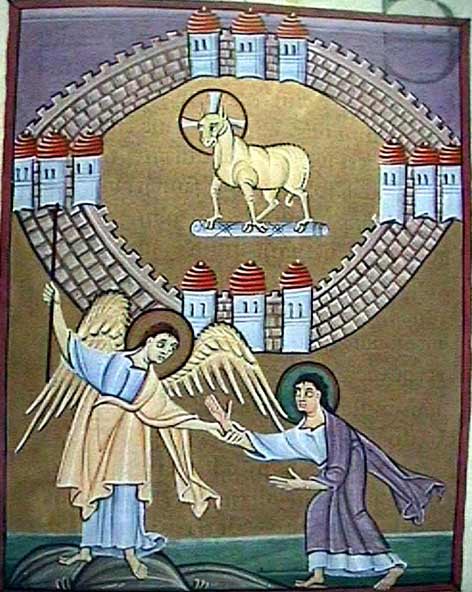
10And in the spirit he carried me away to a great, high mountain and showed me the holy city Jerusalem coming down out of heaven from God.
(1) Most commentators say that the phrase "in the spirit," which is used frequently by John in this book, isn't a trance-like state. Instead, it refers to worship. While in worship, maybe with other believers exiled to the island of Patmos, John saw the visions revealed to him by the risen, ascended Jesus.
(2) Mountains were always places of worship in the Near East. Of course, it was on a mountain that God revealed his glory during the prophet Elijah's contest with the prophets of the false deity, Baal. It was on a mountain that God revealed the Ten Commandments to Moses. On a mountain, three of Jesus' disciples saw His deity revealed in the Transfiguration.
(3) This passage continues a theme of last week's lesson, which says that the new reality that belongs to all who have followed--worshiped--God and the Lamb supplants the first creation, the first heaven and earth and the first Jerusalem. Here we see the fulfillment of Isaiah's words, written seven centuries before Jesus' birth:
I am about to do a new thing; now it springs forth, do you not perceive it? I will make a way in the wilderness and rivers in the desert. (Isaiah 43:19)Paul says that followers of Christ begin to experience this new reality even in this world:
So if anyone is in Christ, there is a new creation: everything old has passed away; see, everything has become new! (2 Corinthians 5:17)22I saw no temple in the city, for its temple is the Lord God the Almighty and the Lamb.
(1) The New Interpreter's Bible notes:
"If a temple marks a discrete place of divine presence in the midst of a world, here the divine is immediately present and all-pervasive..."23And the city has no need of sun or moon to shine on it, for the glory of God is its light, and its lamp is the Lamb.
(1) The notion of God's radiance fills the Old Testament. His bright holiness was deemed so great that no one could hope to look at Him face-to-face in His full deity and live. The reason for this is that God is, as theologians put it, "wholly other," completely perfect and infinitely holy. Although God wants fellowship with us, the fact is that we are completely unworthy to be in His presence. (See here.)
24The nations will walk by its light, and the kings of the earth will bring their glory into it.
(1) Up to this point in Revelation, the world's kings have been under the spell of the beast (17:2; 18:3) Here though, they surrender any claim to personal glory and yield it to the true King.
25Its gates will never be shut by day—and there will be no night there.
(1) With only the limited light provided by torches, sundown brought danger and fear to the ancient world in which John lived. Cities were the safest places to be, bound as they were by walls and hemmed in by gates that were shut when the sun went down. The gates were shut in times of particular danger, when armies threatened attack. But the new Jerusalem is here described as a place of safety in which fear has been banished and all live in the bright, protective light of God.
26People will bring into it the glory and the honor of the nations.
(1) Just like the kings, now the people of nations will bring the glory and honor of nations. Here, we see Babel reversed. You remember Babel. It was the ancient city that decided to build a tower they believed would make them greater than God. To save themselves from their own hubris, God caused the residents to speak many different languages. Misunderstanding and quarreling ensued, making completion of the project impossible. At that, the people dispersed, settling in many different places, each with their own languages and customs...and very quickly, their own brands of hubris.
In the new Jerusalem, all speak the same language and each are united by one thing: their adoration of and submission to God. They do so because they know that in Him is life. (See here.)
27But nothing unclean will enter it, nor anyone who practices abomination or falsehood, but only those who are written in the Lamb’s book of life.
(1) The new Jerusalem is pure. Throughout history, various well-meaning, but misinformed, Bible-readers have tried to establish new Jerusalems here. There's certainly nothing wrong with trying to create positive communities. But two things need to be pointed out:
a. The new Jerusalem in Revelation comes at God's instigation.22:1Then the angel showed me the river of the water of life, bright as crystal, flowing from the throne of God and of the Lamb 2through the middle of the street of the city. On either side of the river is the tree of life with its twelve kinds of fruit, producing its fruit each month; and the leaves of the tree are for the healing of the nations.
b. It's God's will that as long as the first earth, heaven, and Jerusalem exist, the possibility of evil exists. The new Jerusalem will only come when God is ready to bring down the curtain on the first things. Until then, we followers of Chrst are on a mission to be His witnesses, telling others the Good News that they too can live with God forever.
(1) Jesus is the living water. (John 4)
(2) This is a really productive tree! And I believe that it's the same tree found in Genesis, the tree which Adam and Eve were prevented from getting near, for fear that in their rebellious state, they would eat its fruit and be lost to God forever.
3Nothing accursed will be found there any more. But the throne of God and of the Lamb will be in it, and his servants will worship him; 4they will see his face, and his name will be on their foreheads. 5And there will be no more night; they need no light of lamp or sun, for the Lord God will be their light, and they will reign forever and ever.
(1) Based on what's written above, the meaning of these verses should be clear.
Comic Brings Laughter to Amelia Church
 Could you use a good laugh?
The laughs will be in ample supply on Saturday, May 19, starting at 7:00PM, when comedian Marty Daniels brings his wacky worldview to Friendship Lutheran Church, 1300 White Oak Road, near Amelia.
Daniels is currently involved in a major tour, taking him to huge venues in the Midwest and South.
Marty Daniels has been called lethal, outrageous, and quick-witted, among other things. He generates laughs based on humorous observations of the absurdities of life, even those of the church. He also happens to be hilarious!
Daniels spent 15 years working as a popular radio personality in mainstream and Christian radio. Always a visionary, he helped build one of the nation’s top radio stations from the ground up in his hometown of Columbus, Ohio.
Over the past 20 years, Marty has helped plant churches, worked in comedy clubs and on college campuses, and been instrumental in the start-up of several business ventures. His squeaky clean comedy has inspired laughs for everyone from the sick, the homeless, the elderly, and grief stricken to top figures in industry, politics and entertainment. His corporate shows earn rave reviews.
An interesting element of the May 19 performance is that Daniels' first comedy CD will be recorded then.
Daniels also happens to be the brother of Friendship’s pastor, Mark Daniels.
You won’t need a ticket for this evening of fun. A freewill offering will be received. EVERYBODY IS INVITED!
For more information, contact the Friendship Lutheran Church office at 513-752-5265.
To find out more about Marty Daniels' comedy, go here and here.
The Blair Era Ends
 Tony Blair's premiership was wrought ten years ago through clever Clintonian triangulation. Blair told British voters that he represented "new Labour," a left-leaning party no longer wed to a socialist agenda or to the trade unions.
As when Bill Clinton won the presidency here in the States in 1992, also in a three-way race, Tony Blair presented a moderately leftward agenda, one that traditional Labourites could grudgingly accept and that voters who liked the policies of the Tories but hated that party's perceived smarminess after years of Margaret Thatcher and of Thatcher-Lite under John Major, could vote for.
After a decade of Blair in 10 Downing Street, it's tempting to compare him to Churchill or Thatcher. One wants to speak of a Blair Era. But the analogies to historically significant PMs don't work at several levels.
First, Blair's tenure had less to do with public excitement over a proactive new Labour agenda than with the public's reaction to the continuing failure of either the Conservative Party or of the less likely Liberal Democrats to get their acts together. The Tories have been especially pathetic, failing throughout Blair's time in office to offer Britons a credible competing vision. Year in and year out, seeing Blair's contests with the Conservatives was a little like watching a game between the Indianapolis Colts and the local eight-year old peewee football team. His opposition made winning elections easy for Blair and his Labour compatriots.
Second, while Britain has the strongest of the European economies, there are widespread suspicions that this has less to do with Blair than with Britain's central bank and with chancellor Gordon Brown, who kept the PM mostly in the dark about economic and financial policies. But besides all that, there are fears that the current boom is shallow, a house of cards built on inflated real estate valuations, among other things.
Third, as was true of Clinton, the President who, after getting his nose bloodied in the battle for a national health care system, decided to talk about such pressing national issues as school uniforms, there's also a feeling that Tony Blair, for the most part, accomplished very little. He was so busy triangulating, this argument goes, that he did little to improve education or health services, two areas where he promised reform when he came to power.
Of course, there may be a bit of the twenty-first century's penchant for truculence in this criticism. An article in Slate notes:
..in opinion polls...many of the British say—bafflingly on the face of it—that they are worse off, or worse served by the National Health Service, than they were 10 years ago. The statistical evidence shows that this cannot be so...In other words, things are better for the British and Blair has done more for them than the public thinks, but none of it is quite enough. We see that sort of "don't-confuse-me-with-the-facts" whininess by voters in this country, whether our Presidents and Congresses are Democratic or Republican.
There have also been notable achievements during Blair's tenure, among them devolution in Scotland and Wales and the extraordinary power-sharing agreement in Northern Ireland. These often are overlooked.
The fourth and most notable thing beclouding Blair's legacy is his stance on Iraq. In his own country, the PM's decision to push Britain into the war and the troubled peace in Iraq, has made him deeply unpopular, although not so much so as to cause him to be ousted in the most recent elections.
Blair is a likable character--bright, articulate, eloquent, undeniably brilliant. (Republicans in this country who supported the War in Iraq often wished that he were President, feeling that he presented the case for the conflict much more convincingly than George W. Bush.) Blair is also savvy. The Queen, highly fictionalized as it is, made clear just how attuned Blair can be to public sentiment.
But that may be the source of greatest difficulty that people today have and which future historians will have in evaluating the Blair era. Great leaders tune into public sentiment, then figure out how to marshall it to achieve great objectives. Many will say today that all Tony Blair did with his ability to read the public was get elected Prime Minister three times.
Only the passage of time, with the revelation of heretofore undisclosed documentation and the opportunity for sober reflection, will tell us if that assessment is fair or not. But this we do know: Mr. Blair's avuncular successor and longtime Labour rival, Gordon Brown, is unlikely to live at 10 Downing for nearly as long as Tony has.
(For more see here and here.)
(Also go here to see my earlier musings on Blair's departure from government.)
[THANKS TO: Joe Gandelman of The Moderate Voice for linking to this post.]
Thursday, May 10, 2007
'12 Ways to Love Your Wayward Child'
This is great. (TY to Andrew Jackson of SmartChristian for linking to this. By the way, have a safe trip, Andrew!)
NYT: Giuliani Will Favor Abortion Rights
This is surprising?
I agree with Chris Matthews when he says--as he did on his Tuesday evening show--that the idea that pro-life voters are just discovering that Rudy Giuliani is pro-choice is absurd. (I also agree with Matthews that this idea reflects the media elite's disdain of the intelligence of conservatives generally and of pro-lifers specifically.)
These voters have known that Giuliani is pro-choice all along and many have supported him anyway. That's because most of them aren't single issue voters and because there are gradations of opinion within the pro-life camp, just as there are among other categories of voters.
This shouldn't shock anybody: Even Sam Brownback, arguably the most pro-life and the one most connected to the Religious Right in the current GOP presidential field, said last week that he would support a pro-choice Republican nominee for President.
I used to be among those who thought that Giuliani had no chance of securing his party's nomination in 2008. He still may not get it. He may be too liberal on a variety of issues to finally win people over. But Giuliani apparently scores high in the minds of GOP voters on other areas they deem important, such as toughness and leadership.
As opposed to Mitt Romney, who is perceived as a flip-flopper on social issues like abortion and gay marriage, Giuliani gets points from social conservatives who consider him an honest person of principle.
The strange thing to ponder though, is how many conservatives are willing to overlook Giuliani's liberal views on social issues, but can't stomach the Senator with one of the most conservative voting records in recent decades, John McCain. The focus of conservative ire seems to be that McCain voted against the Bush tax cuts and is the co-author of the McCain-Feingold campaign finance laws. Are conservatives--even those from the Religious Right--saying that taxes and campaign finance are bigger deal-breakers than abortion and gay marriage? That's an interesting thought...and I don't think we yet know the answer.
(See Ann Althouse for a discussion.)
[THANK YOU TO: Brian at Columbuser.com for linking to this post.]
[This piece has been cross-posted at RedBlueChristian.com.]
I agree with Chris Matthews when he says--as he did on his Tuesday evening show--that the idea that pro-life voters are just discovering that Rudy Giuliani is pro-choice is absurd. (I also agree with Matthews that this idea reflects the media elite's disdain of the intelligence of conservatives generally and of pro-lifers specifically.)
These voters have known that Giuliani is pro-choice all along and many have supported him anyway. That's because most of them aren't single issue voters and because there are gradations of opinion within the pro-life camp, just as there are among other categories of voters.
This shouldn't shock anybody: Even Sam Brownback, arguably the most pro-life and the one most connected to the Religious Right in the current GOP presidential field, said last week that he would support a pro-choice Republican nominee for President.
I used to be among those who thought that Giuliani had no chance of securing his party's nomination in 2008. He still may not get it. He may be too liberal on a variety of issues to finally win people over. But Giuliani apparently scores high in the minds of GOP voters on other areas they deem important, such as toughness and leadership.
As opposed to Mitt Romney, who is perceived as a flip-flopper on social issues like abortion and gay marriage, Giuliani gets points from social conservatives who consider him an honest person of principle.
The strange thing to ponder though, is how many conservatives are willing to overlook Giuliani's liberal views on social issues, but can't stomach the Senator with one of the most conservative voting records in recent decades, John McCain. The focus of conservative ire seems to be that McCain voted against the Bush tax cuts and is the co-author of the McCain-Feingold campaign finance laws. Are conservatives--even those from the Religious Right--saying that taxes and campaign finance are bigger deal-breakers than abortion and gay marriage? That's an interesting thought...and I don't think we yet know the answer.
(See Ann Althouse for a discussion.)
[THANK YOU TO: Brian at Columbuser.com for linking to this post.]
[This piece has been cross-posted at RedBlueChristian.com.]
Wednesday, May 09, 2007
"...we see life not as it appears..."
 "...but as it is: tied to a hope in a savior who promises us not the fictional white clouds and easy life, but the raw and powerful courage to bind ourselves to the joy for which we were created by the God who loves us with such an intensity that it makes our desire for our complacent lives seem as empty and hollow as a freshly dug grave."
So writes Phil Daniels about the illogical hope that belongs to Christians, a hope that he sees at play in the most recent events in Northern Ireland.
Also:
Christ gave us this awesome world and more importantly he gave us Himself so that we would never be separated from the wonder of the Something that dared to create. And it is hope that forever binds us to this other world.Read the whole thing.
We find that hope permeates who we are. It makes us more than we are. It drives us blindly to a goal "wise men" do not see. Thus I leave you with this benediction, whether you live in Northern Ireland, Cincinnati, or any place in between. Paul says, "May the God of hope fill you with all joy and peace as you trust in him, so that you may overflow with hope by the power of the Holy Spirit." Knowing this hope is enough to make any person smile with honest happiness.
What is Life About?
 In 1982, Paul McCartney released what's commonly acknowledged to be one of his best LPs, Tug of War. It was the former Beatle's first project after the 1980 murder of his onetime bandmate, friend, and composing partner, John Lennon.
Several songs on the album seem to have been inspired by that tragedy, including the title track, which appears to describe the complicated relationship McCartney had with Lennon. There, one line, appearing in the bridge, says:
In years to comeTomorrow, I'll preside at the funeral of a man I got to know three years ago through our mutual community activities. I didn't know him well. But I look at his death at far too early an age, at the widow and two twenty-something children he leaves behind, and at the hole he leaves in the community service organization for which he worked and the rock and roll oldies band of which he was a part and I understand the sense of futility some may feel. We may wonder: What is the "air we breathe and the life we lead" about?
We may discover
What the air we breathe and the life we lead are all about
But it won't be soon enough, soon enough for me
King Solomon, among the wisest people to ever live, writing in the Old Testament, had similar questions. He lamented:
Vanity of vanities, says the Teacher, vanity of vanities! All is vanity. What do people gain from all the toil at which they toil under the sun? (Ecclesiastes 1:2-3)(I love the honesty and forthrightness of the Bible. Imagine the audacity of God, inspiring a Biblical writer to use words of doubt about the meaning of life to lead off a book of faith! God isn't afraid of our doubts and He encourages us to be honest when we have them. Maybe that's because You can only doubt someone or something you believe in. If you didn't believe in God, you couldn't doubt Him; you simply wouldn't believe in Him or give Him a thought.)
Is life futile? The Bible says, "No!"
In spite of the mysteries and questions I can't answer, life, the Bible teaches, has a purpose. The New Testament book of Ephesians says:
It's in Christ that we find out who we are and what we are living for. Long before we first heard of Christ and got our hopes up, he had his eye on us, had designs on us for glorious living, part of the overall purpose he is working out in everything and everyone. (Ephesians 1:11-12, The Message)So, who are we? We're children made in God's image. Though we and our world have fallen away from God, God loves us too much to simply give up on us. That's why He's become one of us in Jesus Christ. And, having lived a sinless life in Christ, He went to a cross, taking our deserved punishment for sin. Having died in our places, He now offers new life to all who will turn from sin and entrust their whole lives--from the womb to eternity--into Christ's hands.
When we do that, God sends His Holy Spirit our ways to guide us, helping us to understand what we are living for. It turns out that we're living to enjoy relationship with God and with others. That's why Jesus says that the greatest commandment is to love God and to love others.
That's it--believe in Christ, love God, love neighbor. That's what human life is meant to be about.
God will show each of us our own unique ways of doing these things. We may do them as rock stars, kings, contractors, police officers, social workers, pastors, poets, writers, housewives, presidents, athletes, restaurant servers, engineers, teachers, gymnasts, accountants, entrepreurs, farmers, nurses, attorneys, doctors, whatever.
But we don't have to wait to discover what the air we breathe or the lives we lead are all about.
- We are children of God who, through faith in Christ, can live with God forever.
- Once we believe in Christ, God will help us to have life as it's meant to be lived: in love for God and love for others.
Tuesday, May 08, 2007
First Pass at This Weekend's Bible Lesson: Revelation 21:10, 22-22:5
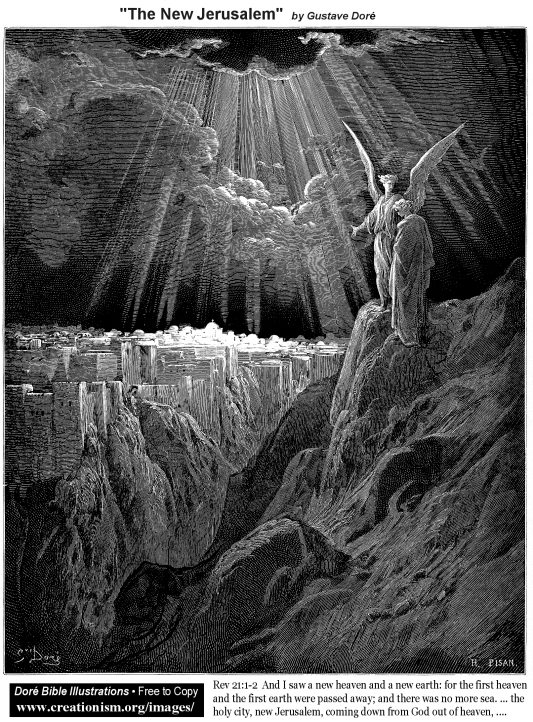
[Most weeks, I present as many updates on my reflections and study of the Biblical texts on which our weekend worship celebrations will be built as I can. The purpose is to help the people of the congregation I serve as pastor, Friendship Lutheran Church of Amelia, Ohio, get ready for worship. Hopefully, it's helpful to others as well, since our Bible lesson is usually one from the weekly lectionary, variations of which are used in most of the churches of the world.]
The Bible Lesson: Revelation 21:10, 22-22:5
10And in the spirit he carried me away to a great, high mountain and showed me the holy city Jerusalem coming down out of heaven from God...22I saw no temple in the city, for its temple is the Lord God the Almighty and the Lamb. 23And the city has no need of sun or moon to shine on it, for the glory of God is its light, and its lamp is the Lamb. 24The nations will walk by its light, and the kings of the earth will bring their glory into it. 25Its gates will never be shut by day—and there will be no night there. 26People will bring into it the glory and the honor of the nations. 27But nothing unclean will enter it, nor anyone who practices abomination or falsehood, but only those who are written in the Lamb’s book of life.
22Then the angel showed me the river of the water of life, bright as crystal, flowing from the throne of God and of the Lamb 2through the middle of the street of the city. On either side of the river is the tree of life with its twelve kinds of fruit, producing its fruit each month; and the leaves of the tree are for the healing of the nations. 3Nothing accursed will be found there any more. But the throne of God and of the Lamb will be in it, and his servants will worship him; 4they will see his face, and his name will be on their foreheads. 5And there will be no more night; they need no light of lamp or sun, for the Lord God will be their light, and they will reign forever and ever.
General Comments
1. In last week's lesson, we saw the first heaven and the first earth supplanted by a new heaven and a new earth which came down to the first. Here, the new Jerusalem is described.
2. C.S. Lewis does a wonderful job of explaining what Revelation is getting at in describing the new heaven, earth, and Jerusalem in the seventh book of The Chronicles of Narnia. It's called The Last Battle. There, the main characters of the book which I regard as the most sublime in all of English literature, witness the end of Narnia, the world they so loved. Its end is wrought by Aslan, the Christ figure of Lewis' novels.
They find themselves in a beautiful place: Narnia, but not exactly the Narnia where they'd once lived. It's a new Narnia. As Lucy Pevensie, the girl from our world who became a queen in that world she once reached through a wardrobe, explains it:
"I see...This is still Narnia and more real and more beautiful than the Narnia down below..."Lewis helps us to see that everything we love about this life and every good thing for which we naturally yearn as creatures made in the image of God will exist in the new Jerusalem and according to the vision given to John in the book of Revelation, all who have believed in Christ--whose names are written in the Book of the Lamb--will live in that new city.
3. Jerusalem was not only the capital city of Israel (later Judea) or the focal point of its worship life. Jerusalem, because it housed the Temple was also thought to be the place where the very presence of God dwelt. It was in the Holy of Holies, once the repository of the tablets on which God inscribed the Ten Commandments on Mount Sinai.
4. What's stunning is that in this "new Jerusalem," there is no Temple. God--the Father and the Son (the Lamb)--dwell among the people with no structure concealing or containining God's presence, although God is still worshiped, still higher, still greater. Accessibility doesn't lessen God's glory. But, contrary to some religious teachings, the Bible reveals that human beings will never be on the same level as God. Even in eternity, God will be the Creator and we will be God's creatures. God will always be divine and we will worship God.
5. As throughout the book of Revelation, Jesus is described as "the Lamb," the One Who, like the sacrifical lambs once offered in the Temple, gave His life for all who turn from sin and believe in Him to live.
Verse-by-verse comments on the lesson tomorrow, I hope.
Monday, May 07, 2007
Injustice
That's the word of the day at Conblogeration and Pastor Jeff provides chilling details of what appears to be systematic injustice.
Mass Murderers and Hell Talk
The discussion about the talk of hell coming from the two Republican frontrunners for President over at Althouse has led to a more general consideration of judgment of our sins and hell itself. One commenter, in relation to Jesus's command that we not judge, lest we be judged, wrote:
Any one of us can safely judge a mass murderer. Go *ahead* and judge me by that same standard -- I'll pass with flying colors!"I wrote:
In a civil and criminal sense, of course we both can and must cast judgments on mass murderers. Even the Bible teaches that God has established civil authority because, in an imperfect world, people will not voluntarily comply with God's Law. Whether speaking of the Ten Commandments or Jesus' discussion of the "Great Commandment," that law can be summarized as love God and love neighbor. Those who haven't voluntarily placed themselves under God's authority will not be complicit with that command apart from coercion. (Biblically speaking, "love" is not a squishy sentimental feeling. Rather, it's a commitment to what is best for others.)
[For a discussion of the differences between "the two kingdoms," God's rule through earthly authorities, on the one hand, and His direct rule over those who voluntarily submit to His authority, go here.]
But Jesus would say that if you want to take your chances and have God judge you by the same standards God applies to mass murderers, you won't like your chances. (I wouldn't like mine either!)
Jesus says in Matthew 5: "“You have heard that it was said to those of ancient times, ‘You shall not murder’; and ‘whoever murders shall be liable to judgment.’ But I say to you that if you are angry with a brother or sister, you will be liable to judgment; and if you insult a brother or sister, you will be liable to the council; and if you say, ‘You fool,’ you will be liable to the hell of fire."
To Jesus, sin has as much to do with intention and even thought as it does with the actions we take. We are as guilty of murder if we physically murder one person as six million. And we are as guilty of murder when we use our words to destroy others' reputations as the killer.
By this standard, I know that I am a murderer. That's where repentance--turning away from sin and turning to God--in Biblical theology comes in. Those who genuinely turn from sin find a welcome from God.
We may not like the "injustice" of that. But I often thank God that He isn't "fair." If he were, I'd be as doomed as your average, run-of-the-mill unrepentant mass murderer.
"It's a turn-around jump shot, it's everybody jump start...
 ...It's every generation throws a hero up the pop charts. [Paul Simon, The Boy in the Bubble]
I think of that line relative to former Senator Fred Thompson today. A fawning media, blogosphere, and core of GOP activists seem to view him as the savior who will soon ride into the 2008 presidential race and make all things right. Discussion of him these days is almost universally positive. He's getting a high toss up the "pop charts."
All of this adulation will likely suck Thompson into the campaign. It's at that moment that we'll see the pop star begin to plunge. It happens to everyone. Voters will learn that they don't agree with him on everything. Bloggers will complain that he isn't really charismatic, whatever that nebulous term means when used by political observers. Reporters will begin to probe and report that Thompson, contrary to the heady expectations being voiced today, is human.
None of this is to say that Fred Thompson won't be nominated. He might be. And, in spite of the fact that 2008 is the Democrats' to lose, given that party's penchant for lemming-like self-destruction at the polls, Thompson might even win. And, more importantly, he may be qualified to be President.
But it is a predictable element of fame in America--and probably the rest of the world--that we love the famous until we decide that it's time to knock them down. It's then that we find some new "saviors," we can boost, then bash.
"There’s talk on the street, it sounds so familiar. Great expectations, everybody’s watching you.
People you meet they all seem to know you, Even your old friends treat you like you’re something new...There’s talk on the street, it’s there to remind you that it doesn’t really matter which side you’re on. You’re walking away and they’re talking behind you. They will never forget you till somebody new comes along." [The Eagles, New Kid in Town]
It's okay to respect those who attain prominence or power. It's also okay to question their decisions, motives, and abilities. But a little bit of realism at either end of the sorry "adulation or savaging" cycle would be a good thing.
For example, the McCain-haters who want Thompson in this race right now would do well to remember that during the two senators' overlapping tenures, their voting records were strikingly similar.
The bottom line is that neither Fred Thompson, the flavor of this month, Barack Obama or Rudy Giuliani, the flavors of last month, or John McCain, the flavor a few years back, are as perfect as the adulation and media coverage accorded them at the tops of their cycles or, most likely, as imperfect or as bad as the reports from the trash cycle indicate.
Of course, this phenomenon is nothing new. Thirty years ago, John Lennon wrote, with more than a little self-pity and a lot of self-aggrandizement, yet insightfully, "All the world's a little town. Everybody wants to bring you down." (John Lennon, Isolation)
Secretly, I think, we all believe that we're more worthy than the people who reach or climb close to the heights of politics, music, literature, movies, academia, or our own fields. Ultimately, it's a personal thing that goes back to human beginnings: We boost one hero and then resent their success because, truth be told, we all want to be the hero. We want to be God.
[Also see here.]
Praying...
for the survivors of what once was Greensburg, Kansas. I pray that God comforts and encourages them and brings healing to those physically injured.
[Also: When Tragedy Hits the Innocent, Part 1
When Tragedy Hits the Innocent, Part 2
When Tragedy Hits the Innocent, Part 3
When Tragedy Hits the Innocent, Part 4
The Light of the World!]
[Also: When Tragedy Hits the Innocent, Part 1
When Tragedy Hits the Innocent, Part 2
When Tragedy Hits the Innocent, Part 3
When Tragedy Hits the Innocent, Part 4
The Light of the World!]
Sunday, May 06, 2007
The New Heaven and the New Earth
[This message was shared this weekend with the people of Friendship Lutheran Church.]
Revelation 21:1-6
The morning my great-grandmother died, when I was eight years old, my mother woke me with the news.
My great-grandmother, as some of you know, was a woman of deep faith in Jesus Christ. Often, when I walked into the living room of her house across the street from the home of my early boyhood, I found her reading her well-worn Bible. She frequently took time to talk with me about God, about Christ’s death and resurrection, and about what life beyond the grave is like for those who turn from sin and trust in Jesus Christ as their King. Knowing that, I could picture it all when my mother said of my great-grandmother that morning, “She’s walking the streets of gold right now, Mark.”
All who follow the risen Jesus Christ live each day with the sure promise that, as Jesus told His friend Martha just before He brought her brother Lazarus back from the dead: “I am the resurrection and the life. Those who believe in me, even though they die, will live, and everyone who lives and believes in me will never die.”
The follower of Christ isn’t exempted from the pains and difficulties of this life. But the hope of eternity with Christ does give us the power to face each day’s challenges.
This same hope also can give us the courage to do the right thing even at great risk. On Saturday, along with other members of the Clermont County OSU Alumni Association, my wife, son, and I went on a tour of local sites associated with the Underground Railroad. That was the pre-Civil War movement that helped slaves escape from bondage in the South and from the threat of being taken back into slavery while traveling in the North under the provisions of the Fugitive Slave Act. The "railroad" helped these escapees then get to freedom in Canada.
The Underground Railroad was founded by committed Christians who believed that slavery was wrong and that even if it meant imprisonment or death for them, the risks were worthwhile. They were undaunted by the prospect of imprisonment or death because the hope of eternity with Christ was strong within them. They no doubt would have agreed with the the first century preacher Paul, who writes in the New Testament, “I consider that the sufferings of this present time are not worth comparing with the glory about to be revealed to us.”
Baptist pastor L. Joseph Rosas says that our Bible lesson for today underscores the Christian’s hope for eternity in three different ways. I want to talk about those three glimpses into our hope for eternity. But first, a little background.
Like all of the lessons we’ve explored this Easter season, today’s comes to us from the New Testament book of Revelation. In it, the apostle John records a series of visions and experiences given to him by the resurrected Jesus.
In the section of Revelation just before our lesson, you can read about a series of stern judgments rendered against what John calls Babylon. John wrote Revelation in about 90AD. Centuries before--centuries before the birth of Jesus--the ancient Israelites were held in captivity by a terrible empire, Babylon. In John’s own time, the Roman Empire, which exiled him to the island of Patmos because of his faith in Christ and which persecuted many other followers of Christ, was seen as a kind of Babylon. But for John, Babylon represents a worldview that ignores God’s command and God’s call to love Him and to love others. It’s a world of selfishness, greed, and violence that opposes God and that God will one day bring to an end.
Now, the three ways in which our Bible lesson for today underscores the Christian’s hope for eternity.
On the heels of describing the judgment of Babylon, John tells his readers that irrespective of all the bad in our world or in our lives, God is up to something new. Using imagery reminiscent of phrasing in the Old Testament book of Isaiah, written some seven-hundred years before the birth of Jesus, God shows John that in Christ, He is doing a new thing. John writes in our lesson: “Then I saw a new heaven and a new earth; for the first heaven and the first earth had passed away, and the sea was no more.”
One day, life on this sin-imprisoned planet will end. But God will replace it with a new heaven and a new earth inhabited by all who have trusted in Jesus Christ.
Sin, with all its devastating effects on our relationships today and the death that it brings, will disappear. That’s represented in our lesson by the disappearance of the sea. To ancient Jews and early Christians, the sea was a frightening, foreboding place, where sea monsters dwelt and chaos prevailed.
We see this picture of the sea in the first of the two creation accounts that begin the book of Genesis. There, we're told that God's Spirit moved over deep waters, a stormy, chaotic, and forebody place. When God moves over the water though, order and peace and a new creation comes about.
Thought of God the Creator loomed in the minds of Jesus' first disciples during one of the most famous Biblical incidents. The disciples were riding on a boat on the Sea of Galilee. A storm suddenly came up and even the seasoned fishermen among them were terrified. Meanwhile, Jesus slept like a baby in a crib. The disciples shook Jesus awake. "Lord," they said, "don't you care if we all drown." Jesus stood up, looked to the sea, and said, literally, "Be muzzled!" "Who is this," the disciples wondered, "that even the wind and the sea obey Him?" It was really, a rhetorical question. Only one Person Who could do that: the One Who did the very same thing at the beginning of time.
In addition to being a place of sin and death in the minds of the ancient Israelites and first Christians, it also divided peoples, putting oceans between them.
No wonder then that in the vision of the new heaven and the new earth that John saw, the sea was no more.
But in the new creation God will give, nothing will separate us from God or each other. And we believe that God is in the process, even now, even today, as we pay heed to His Word and worship Him together, of doing this new thing. God is in the process of making all who believe in Christ part of that new creation!
Next, in our lesson, John writes, “And I saw the holy city, the new Jerusalem, coming down out of heaven from God, prepared as a bride adorned for her husband. And I heard a loud voice from the throne saying, “See, the home of God is among mortals. He will dwell with them as their God; they will be his peoples, and God himself will be with them; he will wipe every tear from their eyes. Death will be no more; mourning and crying and pain will be no more, for the first things have passed away.”
When Jesus was crucified, you remember, He was on a cross between two thieves. One joined the crowds in mocking Jesus. The other though could see that in Jesus, a sinless Savior was giving His life for the world. “Jesus,” he asked, “remember me when you come into your kingdom.” Jesus answered this man, who was demonstrating faith in the most unlikely of circumstances, “Today you will be with me in paradise.” Heaven is a real place, the destination of all who follow Christ. That's the second way our lesson underscores the Christian's hope for eternity.
Then John writes this, at the command of God Himself: “And the one who was seated on the throne said, ‘See, I am making all things new.’ Also he said, ‘Write this, for these words are trustworthy and true.’ Then he said to me, ‘It is done! I am the Alpha and the Omega, the beginning and the end. To the thirsty I will give water as a gift from the spring of the water of life.’”
Pastor Bill Hybels has noted in many places that all of us are born with a longing for “it,” even though we hardly know what “it” is. It’s a void within us that some try to fill with all sorts of things--food, hobbies, money, sex, drugs, alcohol, power, popularity, prestige, fitness. In their place, each of these things can be good. But when we try to use any of them to fill the void within us, we’re still empty.
After trying to find it in a lifetime of dissipate living and partying, Saint Augustine finally found “it” in the God we meet in Jesus Christ. That’s why he once confessed to Christ, “Thou hast made us for thyself, O Lord, and our hearts are restless until they find their rest in thee.”
Jesus Christ is “it,” the One Who fills the God-shaped hole in our lives. In Christ, God and His new creation have already invaded our world. Christians, in fact, live in an “already-not-yet” reality. We already are part of God’s new creation; that new creation isn’t yet fully realized. But we’ve seen what it looks like in Jesus: It’s a kingdom to which all people, no matter what their race, nationality, or gender, or their past sins, are welcome. Christ is a never-ending spring that refreshes us now when times are hard and will fill us with life forever.
Yet it’s sometimes hard to see that new kingdom of God’s, isn’t it? How do we see it? The late Belgian priest Henri Nouwen, who deliberately militated against his own pride and self-absorption by working in Christian communities that served the mentally retarded and toward the end of his life, AIDS victims, wrote a book in which he talked about some friends of his who were trapeze artists, the Flying Roudellas.
They told Nouwen about the special relationship between the flyer and the catcher on the trapeze. The flyer is the artist who lets go. The catcher catches. While the flyer soars above the crowd, there comes a point when he must let go. He arcs through the air, his job being to remain as still as possible and wait for the strong hands of the catcher to grab him midair. One of the Roudellas told Henri Nouwen, “The flyer must never try to catch the catcher.” The flyer has to wait in absolute trust. The catcher will catch him, but until that moment, the flyer must wait.
We see God’s Kingdom whenever we let Christ catch us:
He always will.
Revelation 21:1-6
The morning my great-grandmother died, when I was eight years old, my mother woke me with the news.
My great-grandmother, as some of you know, was a woman of deep faith in Jesus Christ. Often, when I walked into the living room of her house across the street from the home of my early boyhood, I found her reading her well-worn Bible. She frequently took time to talk with me about God, about Christ’s death and resurrection, and about what life beyond the grave is like for those who turn from sin and trust in Jesus Christ as their King. Knowing that, I could picture it all when my mother said of my great-grandmother that morning, “She’s walking the streets of gold right now, Mark.”
All who follow the risen Jesus Christ live each day with the sure promise that, as Jesus told His friend Martha just before He brought her brother Lazarus back from the dead: “I am the resurrection and the life. Those who believe in me, even though they die, will live, and everyone who lives and believes in me will never die.”
The follower of Christ isn’t exempted from the pains and difficulties of this life. But the hope of eternity with Christ does give us the power to face each day’s challenges.
This same hope also can give us the courage to do the right thing even at great risk. On Saturday, along with other members of the Clermont County OSU Alumni Association, my wife, son, and I went on a tour of local sites associated with the Underground Railroad. That was the pre-Civil War movement that helped slaves escape from bondage in the South and from the threat of being taken back into slavery while traveling in the North under the provisions of the Fugitive Slave Act. The "railroad" helped these escapees then get to freedom in Canada.
The Underground Railroad was founded by committed Christians who believed that slavery was wrong and that even if it meant imprisonment or death for them, the risks were worthwhile. They were undaunted by the prospect of imprisonment or death because the hope of eternity with Christ was strong within them. They no doubt would have agreed with the the first century preacher Paul, who writes in the New Testament, “I consider that the sufferings of this present time are not worth comparing with the glory about to be revealed to us.”
Baptist pastor L. Joseph Rosas says that our Bible lesson for today underscores the Christian’s hope for eternity in three different ways. I want to talk about those three glimpses into our hope for eternity. But first, a little background.
Like all of the lessons we’ve explored this Easter season, today’s comes to us from the New Testament book of Revelation. In it, the apostle John records a series of visions and experiences given to him by the resurrected Jesus.
In the section of Revelation just before our lesson, you can read about a series of stern judgments rendered against what John calls Babylon. John wrote Revelation in about 90AD. Centuries before--centuries before the birth of Jesus--the ancient Israelites were held in captivity by a terrible empire, Babylon. In John’s own time, the Roman Empire, which exiled him to the island of Patmos because of his faith in Christ and which persecuted many other followers of Christ, was seen as a kind of Babylon. But for John, Babylon represents a worldview that ignores God’s command and God’s call to love Him and to love others. It’s a world of selfishness, greed, and violence that opposes God and that God will one day bring to an end.
Now, the three ways in which our Bible lesson for today underscores the Christian’s hope for eternity.
On the heels of describing the judgment of Babylon, John tells his readers that irrespective of all the bad in our world or in our lives, God is up to something new. Using imagery reminiscent of phrasing in the Old Testament book of Isaiah, written some seven-hundred years before the birth of Jesus, God shows John that in Christ, He is doing a new thing. John writes in our lesson: “Then I saw a new heaven and a new earth; for the first heaven and the first earth had passed away, and the sea was no more.”
One day, life on this sin-imprisoned planet will end. But God will replace it with a new heaven and a new earth inhabited by all who have trusted in Jesus Christ.
Sin, with all its devastating effects on our relationships today and the death that it brings, will disappear. That’s represented in our lesson by the disappearance of the sea. To ancient Jews and early Christians, the sea was a frightening, foreboding place, where sea monsters dwelt and chaos prevailed.
We see this picture of the sea in the first of the two creation accounts that begin the book of Genesis. There, we're told that God's Spirit moved over deep waters, a stormy, chaotic, and forebody place. When God moves over the water though, order and peace and a new creation comes about.
Thought of God the Creator loomed in the minds of Jesus' first disciples during one of the most famous Biblical incidents. The disciples were riding on a boat on the Sea of Galilee. A storm suddenly came up and even the seasoned fishermen among them were terrified. Meanwhile, Jesus slept like a baby in a crib. The disciples shook Jesus awake. "Lord," they said, "don't you care if we all drown." Jesus stood up, looked to the sea, and said, literally, "Be muzzled!" "Who is this," the disciples wondered, "that even the wind and the sea obey Him?" It was really, a rhetorical question. Only one Person Who could do that: the One Who did the very same thing at the beginning of time.
In addition to being a place of sin and death in the minds of the ancient Israelites and first Christians, it also divided peoples, putting oceans between them.
No wonder then that in the vision of the new heaven and the new earth that John saw, the sea was no more.
But in the new creation God will give, nothing will separate us from God or each other. And we believe that God is in the process, even now, even today, as we pay heed to His Word and worship Him together, of doing this new thing. God is in the process of making all who believe in Christ part of that new creation!
Next, in our lesson, John writes, “And I saw the holy city, the new Jerusalem, coming down out of heaven from God, prepared as a bride adorned for her husband. And I heard a loud voice from the throne saying, “See, the home of God is among mortals. He will dwell with them as their God; they will be his peoples, and God himself will be with them; he will wipe every tear from their eyes. Death will be no more; mourning and crying and pain will be no more, for the first things have passed away.”
When Jesus was crucified, you remember, He was on a cross between two thieves. One joined the crowds in mocking Jesus. The other though could see that in Jesus, a sinless Savior was giving His life for the world. “Jesus,” he asked, “remember me when you come into your kingdom.” Jesus answered this man, who was demonstrating faith in the most unlikely of circumstances, “Today you will be with me in paradise.” Heaven is a real place, the destination of all who follow Christ. That's the second way our lesson underscores the Christian's hope for eternity.
Then John writes this, at the command of God Himself: “And the one who was seated on the throne said, ‘See, I am making all things new.’ Also he said, ‘Write this, for these words are trustworthy and true.’ Then he said to me, ‘It is done! I am the Alpha and the Omega, the beginning and the end. To the thirsty I will give water as a gift from the spring of the water of life.’”
Pastor Bill Hybels has noted in many places that all of us are born with a longing for “it,” even though we hardly know what “it” is. It’s a void within us that some try to fill with all sorts of things--food, hobbies, money, sex, drugs, alcohol, power, popularity, prestige, fitness. In their place, each of these things can be good. But when we try to use any of them to fill the void within us, we’re still empty.
After trying to find it in a lifetime of dissipate living and partying, Saint Augustine finally found “it” in the God we meet in Jesus Christ. That’s why he once confessed to Christ, “Thou hast made us for thyself, O Lord, and our hearts are restless until they find their rest in thee.”
Jesus Christ is “it,” the One Who fills the God-shaped hole in our lives. In Christ, God and His new creation have already invaded our world. Christians, in fact, live in an “already-not-yet” reality. We already are part of God’s new creation; that new creation isn’t yet fully realized. But we’ve seen what it looks like in Jesus: It’s a kingdom to which all people, no matter what their race, nationality, or gender, or their past sins, are welcome. Christ is a never-ending spring that refreshes us now when times are hard and will fill us with life forever.
Yet it’s sometimes hard to see that new kingdom of God’s, isn’t it? How do we see it? The late Belgian priest Henri Nouwen, who deliberately militated against his own pride and self-absorption by working in Christian communities that served the mentally retarded and toward the end of his life, AIDS victims, wrote a book in which he talked about some friends of his who were trapeze artists, the Flying Roudellas.
They told Nouwen about the special relationship between the flyer and the catcher on the trapeze. The flyer is the artist who lets go. The catcher catches. While the flyer soars above the crowd, there comes a point when he must let go. He arcs through the air, his job being to remain as still as possible and wait for the strong hands of the catcher to grab him midair. One of the Roudellas told Henri Nouwen, “The flyer must never try to catch the catcher.” The flyer has to wait in absolute trust. The catcher will catch him, but until that moment, the flyer must wait.
We see God’s Kingdom whenever we let Christ catch us:
- Catch us when we turn from sin and turn to Him.
- Catch us when we reject worshiping ourselves and instead, trust in Him.
- Catch us when life hurts us so badly that there's nothing left to do but let Him love us.
- God is doing a new thing;
- He prepares a place in heaven for us; and
- He makes us new.
He always will.
Subscribe to:
Posts (Atom)