Showing posts with label Alexander Hamilton. Show all posts

Sunday, April 24, 2016

"Among the founders, Hamilton was probably the most passionate advocate of national unity...

...He wanted people to think of themselves as Americans, not as citizens of separate states."

Alexander Hamilton was among the foremost purveyors of New York Values, says Cass Sunstein. I think he's right.

And one part of those values is the very American idea that we need not be trapped by our heritage, that we can be more than an indifferent world or so-called fate would have us be. (An idea that we need to extend to more people if we are to fulfill the promise of America.)

This is precisely the story of Hamilton, the illegitimate son of a man who eventually abandoned him, born in the Caribbean, a immigrant to America, where he graduated from King's College (now Columbia University), became a leader in the Revolutionary War, wrote the lion's share of The Federalist Papers, and, while serving as George Washington's secretary of the treasury, created the American economy.

That economic system has led not only to the nation with the most sustained prosperity in world history, it also was one major factor in fostering American national unity.

That represents another of Hamilton's New York Values. He saw himself more as an American than as a New Yorker. Like Washington, he understood the importance for the nation that fought a revolution for liberty to complete that revolution by a commitment to mutual dependence and accountability, resulting in the US Constitution.

Hamilton's commitment to nationhood and his conception of what it means to be a federalist puts the lie to those who squawk about states' rights as a means of avoiding full participation in American national life (liberty and mutual accountability) and undermining America. As Sunstein writes:
Most politicians who run for national office develop a deep affection for the nation’s diverse states, with all their unique quirks and histories. It’s much worse than bad politics for a candidate to complain about “Vermont values,” “Nebraska values,” “Georgia values,” “Ohio values,” or the values of any of the states. In light of the nation’s hard-won unity, it’s a betrayal of the great motto of the United States, which can also be found on our currency: E pluribus unum (from many, one).
Yep.

Hamilton was in a very real sense not only the quintessential New Yorker, but because of his commitment to New York Values, was, along with the Virginian Washington, one member of a new species that has been around now for more than two centuries. Alexander Hamilton was an American.


Friday, January 15, 2016

I love New York

I don't care about the politics of this exchange...I don't get into endorsing or bashing candidates. But I dislike the dismissal of New York City and its people, implying that anyone who lives in New York isn't patriotic.

New York is the cultural and financial capital of the United States. It's the place where, under George Washington, while he was president and New York served as the nation's political capital, Alexander Hamilton created this country's economic and financial system, the most enduring and strong engine for prosperity in the history of the world. On its streets, the world's greatest sport, baseball, was invented and refined. Baseball is about as American as it gets!

And, it was the patriotism, resilience, and courage of New Yorkers that inspired the rest of America after September 11, 2001.

I'm a lifelong Ohioan. I love New York.


Monday, September 21, 2015

Four books

I mentioned David McCullough's book, The Wright Brothers, in a post last night. I finished reading it a few days ago. It's a great and surprisingly quick read and the first of all the biographies of the Wrights that I have read that have helped this caveman mind appreciate the peculiar insights the brothers had that allowed them to break through to powered, heavier-than-air flight. As I said last evening, like all of McCullough's books, this one is a treat!

Yesterday, I began reading Joseph Ellis' The Quartet: Orchestrating the Second American Revolution: 1783-1789. Ellis looks at the development of the United States Constitution in the period following the end of the Revolution and narrates the key roles played by the "quartet" of George Washington, Alexander Hamilton, John Jay, and James Madison in bringing the governing document into being. Absent their work, the new republic would have been doomed to chaos and susceptible to foreign conquerors as it labored to get out of debt and establish itself under the ineffectual Articles of Confederation. The Constitution was the second American Revolution. Ellis, as always, writes well, clearly, and insightfully. (This fits with a contention I've often made here that the American Revolution was not completed until the Constitution was ratified.)

I'm also now reading Bill Mowry's The Ways of the Alongsider, a helpful guidebook on how Christians can share their faith with others, life to life. Over the past year, Bill has been my coach in deepening my walk with Christ. He's as helpful in print as he is one-on-one.

And, in the wake of the decision to resume referring to the mountain we once called Mount McKinley as Mount Denali, I'm re-reading Kevin Phillips' short biography President William McKinley. Of all the US presidents to come from Ohio, McKinley was by far the best. Phillips argues that the Canton native was a consequential president in two ways.

First, he upended the partisan logjam that had for several decades produced Republican presidents interspersed with Democratic presidents, back and forth, leaving the country with no clear policy direction for more than twenty years. McKinley created what remained a sustained Republican occupation of the White House, with the exception of a narrow victory for Woodrow Wilson--brought about by Theodore Roosevelt's 1912 run for president on the Progressive Party ticket, thus dividing Republicans--from 1896 to 1932, when Democrat Franklin Roosevelt brought basic dominion for his party through 1968.

Second, McKinley, Phillips argues, is not Mount Rushmore-worthy, but safely near the top of the second-tier of effective presidents. He was, it can be argued, the first modern US president in both domestic and foreign policy.

Phillips' discussion of the unique role Ohio played in nineteenth century America alone makes the book worth reading. The state was the country's greatest center of innovation, business risk, and scientific inquiry, playing a part in world history that California's Silicon Valley later played some one-hundred years later.

I recommend all these books. (By the way, I'm indifferent to the change in name for Mount Denali. A more appropriate memorial for William McKinley can certainly be found.)


Saturday, July 04, 2015

The father of US currency should stay on US currency

I'm in favor of putting the images of important women from our history on US currency. 

But I hope that this will never be done at the expense of honoring Alexander Hamilton. 

George Will has rightly said that we honor Jefferson, but we live in Hamilton's country. 

For his indefatigable advocacy of the ratification of the Constitution and his work as the first secretary of the treasury, through which he helped unite the United States of America, no one had more to do with fashioning the nation we live than Hamilton. 

I feel that apart from George Washington, Alexander Hamilton was the greatest of the Revolutionary War-generation.

See here.

Thursday, September 04, 2014

Joanne Freeman on 'Alexander Hamilton and the Idea of Honor'

"A good name is more desirable than great riches; to be esteemed is better than silver or gold." (Proverbs 22:1)

The Bible acknowledges that a good reputation is a good thing, although when God came into the world in the Person of Jesus of Nazareth, He was willing to take on a bad reputation, enduring the form of execution reserved for Rome's worst criminals, in His mission of saving all who repent and believe in Him from eternal separation from God.

For this, Philippians 2:9-11, tells us, Jesus achieved supreme honor, the highest reputation one can have:
...God exalted him to the highest place
    and gave him the name that is above every name,
10 that at the name of Jesus every knee should bow,
    in heaven and on earth and under the earth,
11 and every tongue acknowledge that Jesus Christ is Lord,
    to the glory of God the Father.
Those of us who are only human, and not like Jesus, both human and divine, may attain respect and honor from others, but it won't be any good to us when we face God in eternity.

Then, the only question will be, "Have we emulated Christ and humbled ourselves by trusting in Him and what He achieved for us on the cross and from the empty tomb?"

To look for honor anywhere else but in humble submission to Christ is pointless. "
For whoever wants to save their life will lose it," Jesus says, "but whoever loses their life for me will find it." (Matthew 16:25)

All of which helps explain why I listened to Yale historian Joanne Freeman's lecture on Alexander Hamilton's idea of honor so intently. (That and the fact that Freeman is a terrific historian and lecturer.)


Other than Washington, Hamilton is my favorite figure from the American Revolution. But his idea of "honor," shared by many of his contemporaries, is self-driven, futile, and ends in death...physical as well as eternal.

In the end, we can't earn honor. All of us are ordinary sinful human beings. Honor must be conferred on us. It's only conferred on those who did what Hamilton refused to do on the fateful day when Aaron Burr killed him in a duel, surrender.

But our call isn't to surrender to just anyone or anything...it's to Christ alone.

Alexander Hamilton was a good man, in many ways a great man. But his guiding principle in life led him to a tragic, early, and ultimately, stupid death. Hamilton, always the young man in a hurry. While his achievements had already been enormous, his death at age 47 denied the country he loved his services far too early. It all could have been avoided if he had only looked for honor in the right place.

[Here's a sampling of Alexander Hamilton blogging I've done here.]


Monday, May 14, 2007

Hamilton Blogging

PBS' The American Experience aired a fantastic documentary on Alexander Hamilton this evening. If you have the chance to watch it, do so.

Here is a link to some of the Alexander Hamilton blogging that has appeared here through the years.

Thursday, January 04, 2007

Can't We Do Better Than This?


Several months ago, I reported on the relatively sad condition of the gravesite of one of the most important figures in US history, Alexander Hamilton. Hamilton is buried in the graveyard of Trinity Church in lower Manhattan, New York City.

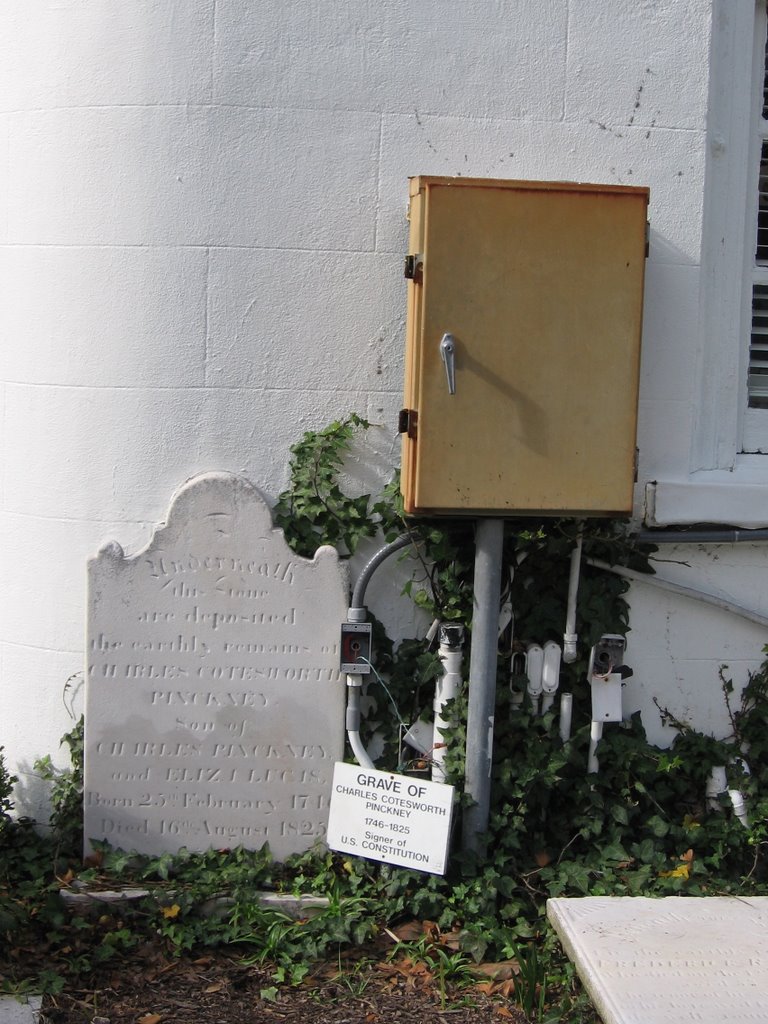
During a recent trip to Charleston, South Carolina, I saw an even more shameful sight: The gravesite of Charles Cotesworth Pinckney, a signer of the US Constitution, in the graveyard of Saint Michael's Episcopal Church.

Saint Michael's seems like an active parish with a commitment to prayer and ministry. I was impressed with the small sampling I got of the congregation's life while I was there. I also was extremely impressed with the generally good condition of the building and grounds. The members are to be commended for doing such a great job and for being so inviting to their community and to visitors like me. They clearly seem to believe that a church isn't a building, it's people who follow Jesus Christ and I think that's awesome!

But I was disappointed by the electrical box dwarfing the marker on Pinckney's grave. Pinckney was important not only as a signer of the Constitution, but as a respected and important figure from our country's early history.

It may be too much to ask churches, with their frequent shortage of funds, to keep up the graves of important historical figures. Across the country, many townships and other localities often take over the management of graveyards when churches can no longer afford the upkeep. (We had a reverse situation in my former parish where, in addition to the large cemetery contiguous to our building facility and grounds, we managed manage a township cemetery. The township indicated they didn't have the resources to take care of it and long before my time in that community, asked our church to take on the responsibility.)

But maybe some modest federal appropriation could be set aside to make sure that the graves of our Founders and Framers and other important figures from our history don't fall into shameful decreptitude.

The United States was the first country to decide itself into being. Thirteen disparate colonies decided to declare their independence and later, as newly independent states, decided to form themselves into what they hoped would be an indissoluble union devoted to the twin principles of American nationhood: freedom and mutual responsibility (or community). Other nations have usually come about through an evolution rooted on language, culture, or religion. Many have come into being by force of arms.

But the United States is rooted in certain principles and ideas to which free people--at first only white men of property--gave their mutual consent. From the time of our founding, we've been in often painful process of becoming the nation the Founders and Framers, partly in spite of themselves, envisioned. (Also see here.)

Because there's nothing inherent about the continued existence of the United States, nothing intrinsic to us as one race, religion, or clan, an awareness of our History is essential. Every generation must know how this country was, building on Lincoln's evocative phrasing, brought forth, dedicated to certain principles which, unless respected and kept, will cause the country to devolve to chaos.

Sadly, it seems that much of what passes for civic education in our schools and universities--and especially in our families--these days, is as decrepit and untended as Pinckney's Charleston gravesite.

Too many take this country for granted, failing to recognize the uniqueness of America and how important it is that we keep remembering what this country is all about. If we don't remember America's past, we are bound to lose its future.

On the brick wall outside Saint Michael's graveyard, there's a plaque noting that within the burial sites of both Pinckney and John Rutledge, another signer of the Constitution, can be found. You see the plaque pictured above. I was glad to see it. But can't we do better in remembering our past?

Pinckney's second cousin, Charles Pinckney, was another signer of the Constitution. He isn't buried at Saint Michael's.

[THANKS TO: John Schroeder of Blogotional for linking to this post.]

Thursday, May 11, 2006

Pic #5 from Our Recent NYC Trip

A fat middle-aged blogger from Ohio whose identity is not being released at this time stands at the grave site of Alexander Hamilton.

Hamilton was only forty-seven years old when he died (some say he was forty-nine), killed in a duel by Aaron Burr, then Vice President of the United States. (Wait! The Vice President shot somebody? It's hard to imagine, isn't it?)

Hamilton is, as I've asserted rhapsodically on this site before, an extraordinary person. If the term genius can be applied to anybody, it most certainly can be to him.

I was a bit disappointed in the relatively poor condition of the monument. This is one of the heroes of American history, a creator of the free enterprise system, an ardent apologist for the passage of the US Constitution, and an insightful theorist and practitioner of democracy. He is certainly more deserving of our attention and accolades than his nemesis, Thomas Jefferson, an able propagandist and a slimy practitioner of the worst political arts.

The tomb sets in the churchyard of Trinity Church. The gravesite next to that of Hamilton and his wife is Robert Fulton's.

By the way, Hamilton's wife was seven years his senior and survived him by fifty years!

[For more on Hamilton, read here and here.]

Pic #2 from Our Recent NYC Trip

Bowling Green, the place where the remarkable Alexander Hamilton, seventeen years old and only in New York from Saint Croix for a short time, delivered a stirring speech advocating independence from Great Britain.

Hamilton, the hustling immigrant, has to qualify as central casting's idea of the prototypical New Yorker...and American.

This park was the site of a large statue of George III, which New Yorkers brought down, Baghdad/Saddam-style, once the Revolution began. They later melted the likeness down and made musket balls. The same thing was apparently done with the little balls that once adorned the tops of the wrought iron fence posts you see here.

Friday, December 17, 2004

Where You're At on States' Rights May Depend on Your Being 'In' or 'Out'

How one begins an enterprise has a tremendous impact on how it develops. That's true of companies and colleges, churches and countries. It can be good or bad. It can even be good and bad.

When the European powers colonized the New World, land grants were made to various corporations and individuals. Those varied lands over time evolved into individual colonies, each with their own institutions. Most on the Atlantic seaboard eventually became the domain of Britain.

Along came the American Revolution which saw the British colonies improbably defeating Britain and winning independence. But independence for whom?

There were two major strains of opinion about that question.

On the one hand there was the view of people like Thomas Jefferson. They adhered to what might be called a republican perspective. (Note the small r.) They believed that thirteen individual states, tied together in a loose and voluntary confederation, each of whose governments were closer to the people, had won the right to be independent and sovereign states.

Given the fears of distant, centralized governments, born of the colonists' experiences with Britain, this republican perspective may have been the prevailing view of citizens in the new United States of America. The majority's republican ideology informed the adoption of the Articles of Confederation. It also explains why there was so much resistance to altering them in spite of their ineffectiveness.

A second view, which, according to Joseph Ellis in his new biography, was the view of George Washington, held that the compelling reasons for the struggle to gain independence had less to do with the philosophical niceties of republicanism than the desire to be an independent power. Washington and like-minded revolutionaries didn't share the republicans' fears of a strong central government that could override the policies and laws of individual states. Writes Ellis:
Washington regarded the American revolution as a movement to establish both American independence and American nationhood; indeed, he did not believe that you could have one without the other. Most of the officers in the Continental army shared this view, because they had also experienced the frustrations of trying to fight and win a war without a federal government empowered to provide resources in the reliable fashion of the British ministry. The fear that haunted Washington was not of excessive federal power reminiscent of Parliament's arbitrary and imperial policies, but rather that of a weak confederation reminiscent of the Continental Congress's woefully inadequate performance during the war.
Washington, Ellis points out, in private correspondence expressed his contempt for the Articles of Confederation, adopted at the behest of the republicans. Washington felt that only a strong central government could help the newly independent states attain financial solvency and fend off destruction by other powers.

Eventually of course, a convention originally brought together for the purpose of strengthening the Articles of Confederation promulgated the United States Constitution. Patrick Henry, that devoted republican, condemned the new document, saying that he "smelt a rat." Thomas Jefferson, then in France, was initially quite cool to the Constitution as well. But eventually, the arguments which Alexander Hamilton and John Jay, dedicated federalists, and James Madison, then a bridge figure between the two major views, made in The Federalist Papers, prevailed.

The fact is that federalism and its concomitants, strong central government and states' rights, didn't necessarily result from a philosophically-driven argument about how the new nation could best govern itself, but from the exigencies of history. This is important to remember when considering the claims of Jonah Goldberg in an otherwise-brilliant recent column in the Manchester Union-Leader. There, Goldberg says:
For years I’ve been ranting that federalism is the greatest system ever conceived to maximize human happiness.
Yes, probably. But it's only an accident of history, the result of our colonial past and the needs of two competing bodies of opinion to work out a compromise to keep an embryonic republic (Washington always referred to the new nation as an "empire") from imploding or being beset by foreign armies.

On becoming the country's first President, George Washington had to be careful not to offend republican sensibilities. While he wanted to establish the new central government as the highest governing authority of the country, he was respectful of the tenuous compromise between those advocating states' rights and those in favor of a strong central government embodied in the Constitution. He also needed to be careful not to show any signs of taking on the perquisites or trappings of royalty. (In spite of the great care Washington did show in this latter area, he was increasingly accused of being a latter-day King George during his second term.)

To say that Washington was reticent about legislative initiatives during his presidency would be an understatement. He tended to stay out of and above the fray of legislative wrangling, instead mostly operating as an other-worldly father figure. What this meant was that Washington's federalist views sometimes prevailed and sometimes didn't, depending entirely on who else was championing them.

When it came to establishing a unified national economy, something in which Washington believed, Secretary of the Treasury Alexander Hamilton was a firm, insightful, innovative, and perseverant advocate. Here, the federalist view defeated that of the republicans.

The Constitution had left the organization of the federal legal system and how it related to the laws of individual states fairly vague. Washington wanted a strong body of unified federal law with little variation, if any, among the legal codes of the states. But he could not and did not push his view. In the absence of any spear-carrier for federalism, the states were given tremendous judicial latitude. So, the doctrine of states' rights was firmly established in legal matters.

For much of the country's history, I think it's fair to say that the notion of states' rights has been a convenient tool for those who may not have had particular passions for the doctrine, but wanted to thwart specific federal policies. Thomas Jefferson, for example, authored legislation passed in two different states, claiming that individual states could prevent the enforcement of federal statutes within their domains. Jefferson's notion of "popular sovereignty" was repudiated. Later, in the struggle for civil rights for African-Americans, some advanced the cause of states' rights as a means of thwarting that struggle.

Beginning in the late 1940s, signaled by Truman's integration of the Armed Forces and Hubert Humphrey's successful fight to include a strong civil rights plank in the 1948 Democratic platform, the Democrats, genetic heirs of the republicans, came to be seen as enemies of states' rights. Increasingly, Democrats favored using the federal government to address a broad array of issues that might once have been considered the exclusive purview of state governments (i.e., education, voters' rights). Democrats were also seen as advocates of using the federal judicial system to do much more than what their opponents claimed that the Constitution envisioned for the federal government.

The 1964 nomination of Barry Goldwater as the Republican presidential candidate, signaled that their party, the genetic heirs of the federalists (the progression was federalists to Whigs to Republicans), were the advocates of states' rights. Unlike their Democratic counterparts, the Republicans advocated a limited federal government that took a hands-off view of what they saw as state perquisites and responsibilities. They also wanted federal judges who took a "strict constructionist" view of the Constitution, refusing to invent law and always taking into account the "original intent" of the document's framers.

Notice that these were the views of the "ins" and the "outs," respectively. While Richard Nixon succesfully won the White House in 1968 and 1972, he always had to deal with Democratic majorities in the Congress and federal judiciary still full of Roosevelt, Truman, Kennedy, and Johnson appointees. (In fact, it wasn't until ten years ago, that the House came under the control of the Republicans.) The Republicans were the congenital "outs" and as Goldberg notes in his column, speaking for persons of his own conservative views:
As conservatives have known for decades, federalism is the defense against an offensive federal government.
But now the worm has turned. A "conservative" administration is pushing policies that are seen by some as intrusive. "Liberals" are trying to combat President Bush by appealing to federalism and the doctrine of states' rights. Some conservatives, like Goldberg are disappointed by what they see as decidedly un-conservative use of power to achieve conservative ends. He writes:

The bad news, alas, is that conservative support for federalism has waned at exactly the moment they could have enshrined the ideal in policy. Just last week, the Bush administration argued against California’s medical marijuana law. Bush is also moving ahead toward a constitutional prohibition on gay marriage. After decades of arguments that Washington should stay out of education, Bush has made it his signature domestic issue.

It’s not that the White House doesn’t have good arguments for its policies. But it is impossible to restore federalism unless you start by allowing states to make decisions you dislike. Otherwise, it’s not federalism, it’s opportunism.

Another example of what Goldberg is talking about may be the current battle over the clean-up of nuclear wastes at the Hanford nuclear reservation in Washington State. The Bush Department of Energy is suing the State of Washington because of a state ballot initiative passed there which, essentially, regulates what the federal government does with the materials there. It's popular sovereignty all over again, it would seem.

What would George Washington, Thomas Jefferson, James Madison, Alexander Hamilton, Harry Truman, Hubert Humphrey, and Barry Goldwater think about all of this? I have no idea. But I do know two things:

(1) People tend to adhere to the doctrine of states' rights most fiercely when the other guy is in power;

(2) Our arguments about states' rights and federal power would probably not be so pronounced if the thirteen colonies that won their freedom from Britain had originally been one colony. Proof again that history matters.

Monday, September 13, 2004

A Bit About Alexander Hamilton

"We honor Jefferson, but live in Hamilton's country." So says columnist George Will, referring to Thomas Jefferson, the oft-quoted American founder whose vision for America was spurned in favor of that espoused by another founder, one we rarely consider, Alexander Hamilton.

Happily, there seems to be a strong impulse toward understanding Hamilton these days. That's all for the good. Understanding Hamilton may help us understand America and thus act as an antidote for our ahistorical political life. In spite of a sometimes-checkered personal life, Hamilton deserves our attention and study.

An article in the latest US News and World Report (in which the Will quote appears) and an exhibit in New York, put together by Hamilton biographer Richard Brookhiser, along with a new biography by Ronald Chernow, are all part of a Hamilton revival.

Hamilton, with Washington, is the founding father of what I would call moderate or progressive conservatism, the wise political philosophy which, over time, has prevailed in America. Its practitioners, in my estimation, have included Henry Clay, Abraham Lincoln, Theodore Roosevelt, and Dwight Eisenhower. Each were conservatives who believed that the federal government could act as a facilitator of national life and an engine for good.

If you get the chance to delve into a Hamilton biography and only have time for one, I heartily recommend Brookhiser's. I haven't yet had the opportunity to read Chernow's more extensive book.

Thursday, June 10, 2004

A Good Hamilton Biography

I personally feel that the best short biography of Alexander Hamilton is that by Richard Brookhiser. Brookhiser is a wonderful writer and both sparingly and thoroughly evokes the personality, character, mind, and work of this complicated American founder.

Thursday, April 10, 2003

Learning About Washington Through Hamilton

Last night, I finished reading Richard Brookhiser's Alexander Hamilton, American. It's not so much a biography as it is a biographical essay about America's first Secretary of the Treasury and the primary author of The Federalist Papers, the series of essays that appeared in American newspapers in the late 1780s to argue that the Constitution should be adopted. Brookhiser has given a good account of Hamilton's life and I highly recommend it.

Interestingly, one of the most affecting passages in the book comes not in discussing Hamilton, but Hamilton's mentor, George Washington. Brookhiser quotes a letter by Congressman Fisher Ames regarding Washington's demeanor as the first president delivered his first Inaugural Address:

"...his aspect grave, almost to sadness; his modesty, actually shaking; his voice deep, a little tremulous, and so low as to call for close attention."

Like all good leaders--and I agree with historian Garry Wills' assessment that Washington was the greatest political leader in human history--Washington was a good actor. But I don't believe that the performance that Ames described was an act. Washington had tasted enough of applause to know how meaningless it ultimately is and how in the end, we are called to do our best no matter what the crowds may think of us. Washington was genuinely humbled by the unprecedented task he was taking on, the presidency of a republic that, if he did his job right and built a strong foundation for the American future, would require him to voluntarily give up absolute political power for the second time in his life.

It isn't easy to walk away from being in control! The despot Saddam Hussein ultimately had power wrested from him. Now, like Washington before them, American leaders must demonstrate that they can walk away from power as our national government prepares to turn Iraq over to a duly-constituted Iraqi government. Negotiating the landmines of foolish self-will and deep resentments of America that exist in the Middle East and throughout the world will require great wisdom (not to mention great selflessness) on the part of American leadership.

Fortunately, there is a place where our leaders--and all of us--can go for wisdom and anything else we may need to do and be our best. "If you don't know what you're doing," the New Testament book of James says, "pray to the Father. He loves to help. You'll get His help, and won't be condescended to when you ask for it. Ask boldly, believingly, without a second thought." (James 1, as translated in The Message by Eugene Peterson.)