Showing posts with label US Constitution. Show all posts

Monday, May 04, 2020

It's Gut-Check Time for American Christians

Small groups of protesters, representing, at most, about 30% of the American people, have been protesting social distancing and sheltering-in-place orders lately, claiming them to be infringements on their personal freedom.

But here's what I think, folks, from my perspective as a Christian and a student of American history.

My freedom ends when it infringes on your freedom.

The Constitution's Framers never believed in unbridled rights or allowing freedom to become license.

Babies and adolescents believe that freedom is being able to do whatever you want to do.

But when you grow up, you understand that, in Justice Holmes' famous example, freedom of speech does not allow you to yell, "Fire!" in a crowded theater.

The vast majority of Americans want a slow, controlled, and, when needed, easily-reversed, return to more normal social distancing. They want government to fulfill its function as pronounced in the Preamble of the Constitution, to form "a more perfect union" by striving to "establish Justice, insure domestic Tranquility, provide for the common defense, promote the general Welfare, and secure the Blessings of Liberty to ourselves and our Posterity..."

Freedom does not, whether from a Christian or a constitutional perspective, give anyone the right to willfully endanger others. The apostle Peter writes in Scripture to Christians, "Live as free people, but do not use your freedom as a cover-up for evil; live as God's slaves." (1 Peter 2:16) To be a slave of the God we know in Jesus Christ means to be set free to live lives of love for God and love for neighbor.

Yes, there are economic implications to continued sheltering-in-place. Our unemployment systems, operating on antiquated software, need to be updated. Government and all of us will probably have to do much more over the next year-and-a-half to help each other through this unprecedented crisis.

But on our currency, we Americans claim as our motto, "In God we trust," not "In money we trust." If we can take sensible, if sometimes unpleasant, actions to get through this crisis together, we will emerge stronger for it. We will preserve the most precious economic assets we have: healthy, living human beings.

It's gut-check time for Christians in America. Will we be full-tilt pro-life? Or will we join the pro-death advocates who say that having a few more bucks in their pockets is more important than the lives of their neighbors?

The answer should be clear. And most people know that.


[Armed protesters in the gallery of the Michigan State Senate chamber in Lansing four days ago.]

Friday, August 04, 2017

Calvin Coolidge, his dad, and the majesty of Constitutional Democracy

While Calvin Coolidge was out of his depth as president, particularly as it relates to understanding the twentieth century's new economic realities, I've always admired him as a person.

The story of his swearing-in has been a favorite since I first read it when I was a boy. It captures the simple majesty of US constitutional democracy and George Washington's great legacy to our country, the peaceful transfer of executive power.

One highlight of a tour of New England several years ago was seeing the room in which Coolidge's father administered the presidential oath of office to his son. I literally got goosebumps.

The tale was recounted again yesterday in a post from the White House Historical Association:
John Coolidge received several telegrams during the early hours of August 3, 1923, all of which bore the same message: President Warren G. Harding was dead.

This meant that John’s son, Vice President Calvin Coolidge, would soon be sworn in as the President of the United States.

The news shocked the Coolidges, who were enjoying a family trip to their home in Plymouth Notch, Vermont. President Harding had also been touring the country during his “Voyage of Understanding.” Coolidge received reports that the president showed signs of recovery from a recent illness; his death was completely unexpected.

Calvin Coolidge sent a telegram expressing his condolences to First Lady Florence Harding shortly after receiving the news. Meanwhile, the family accommodated the crowd gathering outside their home, setting aside one room for reporters as John Coolidge greeted curious neighbors. Despite the commotion, the new president’s youngest son, Calvin, Jr., remained asleep. The family decided to wait until the morning to tell him the news.

The elder Coolidge, a notary public, administered the oath of office. Calvin Coolidge placed his hand on the Bible in a dimly lit room in front of a small audience, becoming the thirtieth president of the United States. His first act as president? Returning to bed.

As President Coolidge slept, a new telephone line was installed, creating a direct line of communication between the farm and the White House.

The next day, President Coolidge returned to the capital in his new role as commander in chief.

[Blogger Mark Daniels is pastor of Living Water Lutheran Church in Centerville, Ohio.]


Monday, September 21, 2015

Four books

I mentioned David McCullough's book, The Wright Brothers, in a post last night. I finished reading it a few days ago. It's a great and surprisingly quick read and the first of all the biographies of the Wrights that I have read that have helped this caveman mind appreciate the peculiar insights the brothers had that allowed them to break through to powered, heavier-than-air flight. As I said last evening, like all of McCullough's books, this one is a treat!

Yesterday, I began reading Joseph Ellis' The Quartet: Orchestrating the Second American Revolution: 1783-1789. Ellis looks at the development of the United States Constitution in the period following the end of the Revolution and narrates the key roles played by the "quartet" of George Washington, Alexander Hamilton, John Jay, and James Madison in bringing the governing document into being. Absent their work, the new republic would have been doomed to chaos and susceptible to foreign conquerors as it labored to get out of debt and establish itself under the ineffectual Articles of Confederation. The Constitution was the second American Revolution. Ellis, as always, writes well, clearly, and insightfully. (This fits with a contention I've often made here that the American Revolution was not completed until the Constitution was ratified.)

I'm also now reading Bill Mowry's The Ways of the Alongsider, a helpful guidebook on how Christians can share their faith with others, life to life. Over the past year, Bill has been my coach in deepening my walk with Christ. He's as helpful in print as he is one-on-one.

And, in the wake of the decision to resume referring to the mountain we once called Mount McKinley as Mount Denali, I'm re-reading Kevin Phillips' short biography President William McKinley. Of all the US presidents to come from Ohio, McKinley was by far the best. Phillips argues that the Canton native was a consequential president in two ways.

First, he upended the partisan logjam that had for several decades produced Republican presidents interspersed with Democratic presidents, back and forth, leaving the country with no clear policy direction for more than twenty years. McKinley created what remained a sustained Republican occupation of the White House, with the exception of a narrow victory for Woodrow Wilson--brought about by Theodore Roosevelt's 1912 run for president on the Progressive Party ticket, thus dividing Republicans--from 1896 to 1932, when Democrat Franklin Roosevelt brought basic dominion for his party through 1968.

Second, McKinley, Phillips argues, is not Mount Rushmore-worthy, but safely near the top of the second-tier of effective presidents. He was, it can be argued, the first modern US president in both domestic and foreign policy.

Phillips' discussion of the unique role Ohio played in nineteenth century America alone makes the book worth reading. The state was the country's greatest center of innovation, business risk, and scientific inquiry, playing a part in world history that California's Silicon Valley later played some one-hundred years later.

I recommend all these books. (By the way, I'm indifferent to the change in name for Mount Denali. A more appropriate memorial for William McKinley can certainly be found.)


Tuesday, July 14, 2009

Questions About Cheney Role in CIA Program

Okay, I have a few non-political, that is non-partisan, questions about an alleged Bush Administration cover-up of a CIA program that, if implemented, would have authorized killing foreign leaders.

My questions go beyond the legality of such a program or about whether it was right for the former administration to conceal it from the Congress.

I hope that those more steeped in constitutional law than I am can answer my questions.

First, this question: How did Vice President Dick Cheney, who reportedly ordered the cover-up, come to exercise such authority? As a practical matter and one of history, I understand, of course, that Cheney, at least for much of George W. Bush's first term, exercised tremendous influence in the White House and in the administration. But so far as I know, except when the President is incapacitated, the Vice President possesses no executive (or operational) authority. If these reports are true though, Vice President Cheney exercised power which, I believe, belongs only to the President. Am I reading the Constitution correctly?

My second question then, is this: If Mr. Cheney exercised executive power, what would that do to his argument that he wasn't required to maintain records of his activities as the law stipulates for members of the executive branch because, he said, the Vice President is not part of the executive? (Cheney's position was rejected by at least one court.) If not a member of the executive branch, by what possible authority could a Vice President claim to be able to exercise executive authority?

As I say, these aren't partisan questions. If Joe Biden, Walter Mondale, Al Gore, Spiro Agnew, or Richard M. Johnson were found to have exercised executive authority, it would lead me to the first question, at least, and had any of them asserted, as Cheney did, that he was not a member of the executive branch, it would also raise the second.

Any ideas?

[UPDATE: The use of the term "foreign leaders" was unintentionally misleading. I apologize.]

Sunday, October 12, 2008

Our Great Philadelphia Adventure (Part 1)


I've been away for a few days. We went to Philadelphia, my first trip there in thirty-nine years. What a great city!

Of course, we went to Independence Hall. It is amazing to be in the room where the Declaration of Independence, the Articles of Confederation, and the Constitution came into being.

But I got goosebumps when we walked into another chamber of what was, in Colonial days, the Pennsylvania state house. I recognized the room instantly from portrayals in books and film. It was where the US House of Representatives met for ten years and was the place in which our second president, John Adams, was inaugurated. As Adams delivered his Inaugural Address on March 4, 1797, Thomas Jefferson, the incoming vice president, was seated to his right, and George Washington, the outgoing president, was two seats away.

This event is important because it represents the first time in world history that the chief executive of a nation voluntarily and peacefully stepped down to allow a duly elected successor to take that same position.

We take this for granted these days. But we shouldn't.

After all, up to that point in human experience, power was taken, wielded, and maintained with violence. It was ceded by force of death or by surrender. Here was a leader who could have, had he chosen, held onto executive power until he died. But Washington happily turned the presidency over to Adams and retired to his Mount Vernon estate.

It's a tribute not only to the honorable characters of Washington and Adams that this peaceful transfer of power happened. It also spoke volumes about the other framers of the US Constitution, ratified just eight years before.

The Declaration of Independence trumpeted people's right to be free. But the Constitution, created to replace the weak, ineffectual, and naive if well-intentioned Articles, understood that even free people must opt for mutual responsibility and accountability.

The basic underlying insight of the Constitution is that free people are people, meaning that they're imperfect. The Constitution, imperfect in itself, reflected the hard-won wisdom of pragmatists who saw that human nature being what it is, you can't allow a nation, dedicated to the proposition that all are created equal--paraphrasing Lincoln--to destroy the promise of equality by leaving everything to chance or to people's good will.

Liberty without accountability and freedom without a government strong enough or active enough to prevent the strong and powerful from running roughshod over the humble or constrained enough to prevent it from running roughshod over everyone, is anarchy. The Framers understood this.

Of course, having a philosophical understanding of an important truth about humanity is one thing. Acting on it is another. The Framers did that.

Fortunately for we Americans and for people from every other country who have taken heart from the example given in 1797, Washington believed in the twin principles of the United States--liberty and mutual accountability--and acted accordingly.

Thursday, November 29, 2007

But Is the Line Item Veto the Right Thing?

"The line-item veto is unconstitutional determined not by John McCain, but by the Supreme Court. And the Supreme Court found that the line-item veto is unconstitutional. If I hadn't challenged that, I would not have been carrying out my fiduciary duties for the people of New York City. That was money that was illegally deprived to the people of my city. I fought for them."

So said former New York City mayor Rudy Giuliani in Wednesday night's Republican presidential debate. Giuliani was responding to a shot fired by Arizona Senator John McCain. McCain was speaking of how readily he would wield a veto pen as President to thwart pork barrel spending, also known by the harmless-sounding euphemism, earmarks.

Said McCain: "...we'll give the president of the United States a line-item veto, which Rudy Giuliani opposed so that he can protect his $250 million worth of pork."

McCain was referring to a lawsuit in which Giuliani, as mayor, successfully prevented former President Bill Clinton from exercising an asserted line item veto over federal spending earmarked for projects in New York City. The US Supreme Court ruled Clinton's assertion unconstitutional, clearing the way for the pork to be sent to New York.

The line item veto, enjoyed by more than thirty US governors, gives chief executives the ability to sign spending bills into law while scratching out specific appropriations they deem exorbitant or unnecessary. Chester Alan Arthur was the first President to support the enactment of such a veto power. Ronald Reagan asked for legislation legitimizing the line item veto.

Giuliani is right in stating that the Supreme Court has ruled the line item veto unconstitutional. No one can dispute that, although McCain did on Wednesday evening. But in stating repeatedly, as he did in both the November 28 and the earlier October 9, debates, that "the line item veto is unconstitutional," he also sort of avoids the issue. In the two debates, first Governor Romney and then Senator McCain, were challenging Giuliani's bona fides as a proponent of fiscal responsibility.

Giuliani's contention that in bringing the suit, he was simply protecting the interests of his city, may have some merit, although it sounds an awful lot like the argument of every sectional and special interest group when it comes to pork barrel spending. Their arguments roughly run like this: "I'm against earmarks, unless they're earmarks that go to my community or to my preferred class of people."

But Giuliani appears to want to drape his lawsuit in the wifty legitimacy of constitutionality. It's a bit of a dodge.

The implicit question in McCain's and Romney's shots at him which Giuliani might more profitably address is, "Leaving aside the merits of the $250-million of New York pork, do you believe in a line item veto? Would you support a line item veto, something which even the Republican you and the other candidates for president invoke as the patron saint of your party, Ronald Reagan, supported? Or, was Mr. Reagan wrong?"

I would be interested in how Mr. Giuliani--and all the other candidates for his party's nomination--would respond to that question. (I'd also like to know how the Democratic candidates stand on the line item veto.)

It was Andrew Jackson who first made energetic use of presidential veto power. He did so to stand up against the interests he thought controlled the Congress. He deemed it a legitimate weapon for the President, who was elected by the whole country, to use in preventing interest groups of various kinds from getting laws passed benefiting the few.

But the presidential veto is usually impotent when it comes to spending measures. Illegitmate pork can easily be folded into legitimate and necessary spending measures, forcing President's hands. The President can choose to veto appropriations bills, which often go to the White House late any way, because they contain objectionable pork spending or simply accept such bills as the best that's likely to be produced by a Congress prone, even when its members are personally incorruptible, to spend money in the ways that constituents, city councils, and important supporters want them to spend it.

While Presidents are human beings and therefore as subject to corruption as the next mortal, it's easier for the President to speak for the whole country, as Andrew Jackson knew, than to push the petty, budget-busting agendas of congressional districts and individual states. The Constitution is a commendable, remarkable document. I have the deepest respect for it as the best thinking of what should be regarded, I think, as America's greatest generation. (The Constitution is, I think, greater than the Declaration of Independence. That document enunciated principles of liberty. But the Constitution was how the generation who secured American liberty decided it would use its liberty effectively and well.) The Constitution was not without its flaws, as its countenancing of slavery attests. The Framers knew too, that the document wasn't perfect and that circumstances would change, meaning that the power to amend it was essential and built into it.

The failure to give the US President the ability to veto specific items of spending within massive appropriations bills appears to me to be a design flaw in the Constitution.

For McCain to say that the line item veto is constitutional, which he did say on Wednesday night, is flat-out wrong. For Giuliani to say--repeatedly--that it's unconstitutional is irrelevant. The question, as I say, is whether advocating an amendment or at least, advocating exploring the possibility of such an amendment, is advisable.

[This is being cross-posted at The Moderate Voice.]

[UPDATE: In the comments here, my friend, Charlie Lehardy, makes a similar point to one I made in the comments on this post over at TMV. You might want to check out that discussion here.]

Friday, September 07, 2007

Lying in State? Or Lying in Repose?


Today's official blog of Ohio's Republican Party announced funeral plans for Representative Paul Gilmor, who died several days ago. Included was an itinerary, which read partly:

Tuesday, September 11, 2007
The Ohio Statehouse
Columbus, Ohio 43215
9:00 a.m. – 11:00 a.m.
Congressman Gillmor lies in state in the Statehouse Rotunda
That term, lying in state, didn't look right to me. I was fairly certain that only the body of a President or that of a deceased person deginated for the honor by the sitting President could truly be said to be said to be lying in state.

This, I believed, had to do with the fact that, in addition to being the head of the government, the President is also the head of state. As head of government, the President's role is like that of prime ministers in other countries. But, as head of state, our Presidents, like Queen Elizabeth in England, are also symbols of our national sovereignty. (Unlike the queen, of course, the President is an elected and temporary symbol of the American state.)

Because of all of this, I thought it better to speak of Mr. Gillmor's body lying in repose.

A Wikipedia article on state funerals seems to buttress my view of things, when it states:
In the United States, state funerals are granted by law to Presidents-elect, sitting and former, and may be granted to other individuals as designated by the sitting president.
The author of this piece could be misinformed, of course. Wikipedia isn't authoritative, after all.

I may or may not have been right in my assumptions about the two terms, lying in state and lying in repose. A 2005 article about the distinctions, appearing in Slate, has both clarified and confused my thinking. Written shortly after the funeral for the late Chief Justice William Rehnquist, the article notes:
Visitors filed past the body of U.S. Chief Justice William Rehnquist in Washington this week.
On Tuesday, both the president and the first lady viewed the casket, which sat atop the Lincoln catafalque in the Great Hall of the Supreme Court. Though some news organizations described Rehnquist as "lying in state," most called it "lying in repose." Is there a difference?

Only in Washington. Funeral directors throughout the country use the phrases interchangeably: A body that's put out for public viewing could be described as lying "in state" or "in repose." When Pope John Paul II passed away in April, the presentation of his body at St. Peter's Basilica was described both ways in the news media. But when you're talking about official U.S. government funerals, "lying in state" has a special meaning: You're only lying in state in the formal sense when your body is in the Rotunda of the Capitol Building in Washington.
But to say that a body is only lying in state if it's in the US Capitol shoots my definition to pieces. The Capitol, after all, is the seat of the legislative branch, not the executive. But even with this definition, one couldn't speak of Representative Gilmor's body reposed at the State House in Columbus as lying in state.

The Slate article goes on to assert:
The distinction between "repose" and "state" got its first widespread attention during the state funeral of Ronald Reagan last year. Reagan's body, like those of many presidents before him, was put out for viewing in multiple places. First, his remains spent two days on display at the Reagan Library in California. Then they were sent across the country to the Capitol Building. (Only 10 presidents have lain in state; many others have lain in repose at the White House.) Those involved with the ceremony made sure the media had the terms right: Reagan was "in repose" on the West Coast and "in state" in Washington.
This came as news to me. Speaking personally, I didn't remember anything having been made of the "in state" and "in repose" distinction during the Reagan funeral. My first memories of being educated on the supposed differences between the two terms goes back to 1963 and to arrangements surrounding the death of President Kennedy.

The long and short of it is that the Slate piece asserts that there really is no difference between the two terms, putting a lot of stock in the fact that funeral directors use them interchangeably. This also came as news to me. As a pastor, I've done many funerals since 1984. Funeral directors and others I know speak of the time when caskets--opened or closed--are on display and people can pay their respects not as lying in state or lying in repose, but as visitation. (Some laypeople still use the increasingly passe, layout, to describe a visitation.)

But, even accepting the Slate piece's assertion that funeral directors are behind what official Washington regards as a misuse of the term, lying in state, should their usage now be deemed authoritative?

My guess is that the widespread adoption of the term "lying in state," applied to pop stars like James Brown and Supreme Court justices like Rehnquist, goes back to my generation's experience of John F. Kennedy's death. For days, a nation with only three television networks simulcasting the memorials, the funeral, and the burial, was riveted by the tragedy. We saw the President's casket lying in state in the Capitol. The term came to refer to the body of any person lying in a casket in a public place where people could pay their respects.

Language and terminology get misused all the time. And, while common usage often gets its way and changes the ways words and phrases are defined by dictionary editors, it doesn't mean that those who insist that some terms are intended to mean specific things are always wrong.

It seems to me that to speak of our late Presidents' bodies lying in state, whether in the Capitol, the White House, or elsewhere, is a way of acknowledging our unique Constitutional system and a great opportunity to provide civics lessons to Americans.


[For more, see here.]

[THANKS TO: Joe Gandelman of The Moderate Voice for linking to this post.]

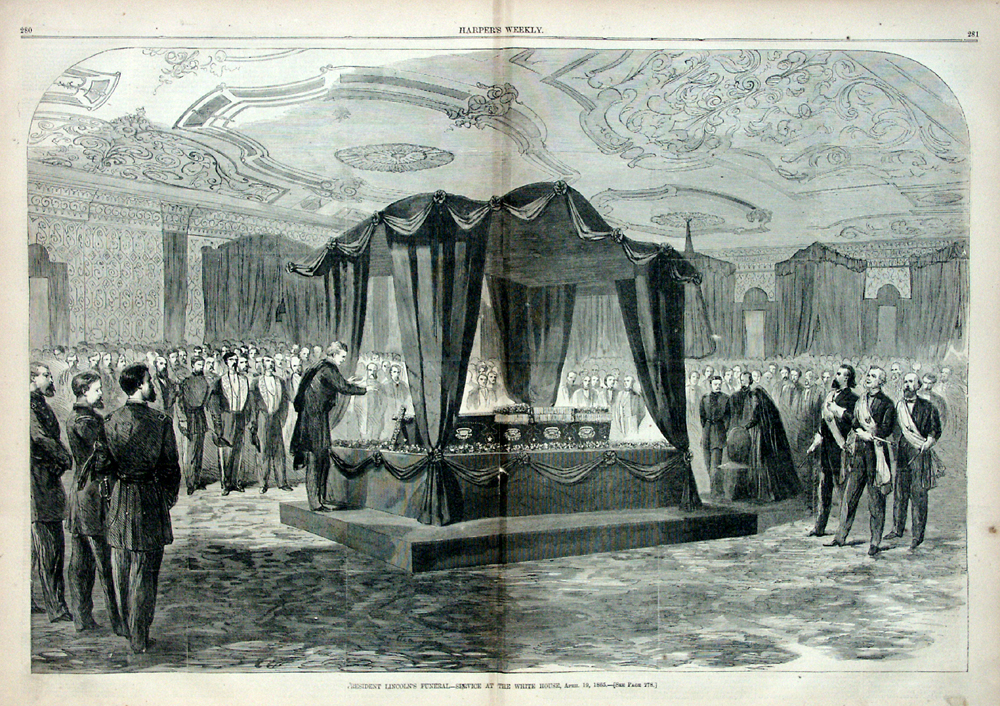
[Top image: A representation of President Abraham Lincoln's body lying in state in the White House Green Room in 1865. Lower image: A photograph of President John F. Kennedy's body lying in state in the White House East Room in 1963. Jacqueline Kennedy, JFK's widow, pored over the records of the Lincoln funeral and saw to it that her husband's funeral followed the precedents established then. You can click on the links to enlarge them.]


Wednesday, March 28, 2007

Legislation to 'Fix' Presidential Voting Process Would Make Things Worse

[Alert: What follows is just my opinion. I don't claim that, because I'm a pastor, any of my political opinions are somehow sanctified, touched by God's imprimatur. My opinions are just that, my opinions.]

Maryland legislators and evidently, its governor, are tired of seeing their state overlooked in presidential election years. They say that their ten electoral votes make them less important in electing Presidents than large states like California and New York or perennial swing states like Ohio and Florida.

But Maryland's legislature and governor appear poised to approve a plan which, in spite of their intentions, will, if adopted by other states, likely give their state even less say in who becomes President than they have now.

The proposal is being pushed nationally by an organization concerned that under the Constitution and its establishment of the electoral college, four presidential elections in all of US history have produced presidents who didn't receive popular vote majorities or pluralities. They want to have a popularly elected President, but daunted by the process involved in amending the Constitution, they've floated a bizarre proposal that's contained on the Maryland legislation.

Here's how The Washington Post explained it today:
The bill, which the [State] Senate approved 29 to 17 yesterday, would award the state's 10 electoral votes to the presidential candidate who wins the most votes nationwide -- not statewide.
It's easy to see a huge problem with this proposal right off the bat. Let's say that in 2008, Maryland voters cast 65% of their ballots for Hillary Clinton, the presumptive Democratic nominee. But assume that the overall national vote total is closer: Rudy Giuliani beats Clinton by a whisker, 50.1% to 49.9%. Wouldn't Maryland voters, who made their sentiments overwhelmingly known, feel disenfranchised when they see their state's electoral votes give the win to Rudy?

But the bigger problem with the proposal was raised by legislative opponents of the proposal. Says The Post story:
Sen. Michael G. Lenett (D-Montgomery) ...said the system proposed could just switch the target for candidates from closely divided states to large cities with many voters -- a scenario that would not necessarily empower Maryland.
Lennett is right. Under the Maryland bill, which wouldn't go into effect until states with a collective majority--270 votes--in the Electoral College adopted the same system, Presidential campaigns would likely be focused on vote-rich metropolitan areas only: New York, Los Angeles, Chicago, Philadelphia, Houston, Atlanta, and a handful of other places. Lost in the shuffle would be rural, small town, and suburban areas of all sorts.

In establishing the Electoral College, the Framers attempted to ensure that powerful larger states--like Virginia, New York, and Pennsylvania--didn't run roughshod over smaller ones. As in so many other places in the Constitution, they sought to prevent majorities from overwhelming minorities. As Christopher Collier and James Lincoln Collier write:
The system was worked out very carefully to strike a balance between the interests of big and small states. In a direct popular election the big states' votes would drown the votes of the small states, a situation the small states could hardly permit; but the big states could not allow the small states to have a disproportionate say in electing the chief executive...
Contrary to causing states like Maryland to have less importance in choosing our Presidents, the Electoral College makes it possible for it and other states more say in the process than they would in a process decided solely on the basis of the popular vote.

Maryland isn't ignored because its Electoral College delegation is paltry. The state's ten votes equal those of Wisconsin, Minnesota, and Arizona. It has more votes than Maine, New Hampshire, Vermont, Connecticut, Rhode Island, Delaware, West Virginia, South Carolina, Alabama, Mississippi, Lousiana, Arkansas, Kentucky, Iowa, Kansas, Oklahoma, Nebraska, North Dakota, South Dakota, Montana, Wyoming, Colorado, New Mexico, Utah, Nevada, Idaho, Oregon, Alaska, Hawaii, and the District of Columbia. Only eighteen states have more electoral votes than Maryland!

The real reason a state like Maryland might get ignored by presidential nominees is its predictability, not the size of its Electoral College delegation! The state's perennial habit of voting for Democrats for President means that Republicans skip the state and Democrats take it for granted.

Lest Marylanders view this assertion skeptically, consider California. Presumably, if the Republicans nominate Giuliani in 2008, that state would be in play for his party for the first time in many a presidential election cycle. In recent years, California has been regarded as being so likely to go for the Democratic candidate that Republicans have made little effort to win over voters there. This, in a state with 55 electoral votes, 20.3% of the total needed to get elected President! Predictability prevents Republicans from pitching their appeals to Californians and causes Democrats to take it for granted. If that's true for California, you can bet it's true for Maryland.

Proposals for converting to the popular election of Presidents may have merit. But since 1789, the Electoral College has been a hedge against disregarding the interests and concerns of smaller states (and communities). Before Maryland and other states throw away the College, they might want to consider what else they might be throwing away!

[Cross-posted at RedBlueChristian.com.]

[THANKS TO: Joe Gandelman of The Moderate Voice for linking to this post.]

Friday, December 17, 2004

Where You're At on States' Rights May Depend on Your Being 'In' or 'Out'

How one begins an enterprise has a tremendous impact on how it develops. That's true of companies and colleges, churches and countries. It can be good or bad. It can even be good and bad.

When the European powers colonized the New World, land grants were made to various corporations and individuals. Those varied lands over time evolved into individual colonies, each with their own institutions. Most on the Atlantic seaboard eventually became the domain of Britain.

Along came the American Revolution which saw the British colonies improbably defeating Britain and winning independence. But independence for whom?

There were two major strains of opinion about that question.

On the one hand there was the view of people like Thomas Jefferson. They adhered to what might be called a republican perspective. (Note the small r.) They believed that thirteen individual states, tied together in a loose and voluntary confederation, each of whose governments were closer to the people, had won the right to be independent and sovereign states.

Given the fears of distant, centralized governments, born of the colonists' experiences with Britain, this republican perspective may have been the prevailing view of citizens in the new United States of America. The majority's republican ideology informed the adoption of the Articles of Confederation. It also explains why there was so much resistance to altering them in spite of their ineffectiveness.

A second view, which, according to Joseph Ellis in his new biography, was the view of George Washington, held that the compelling reasons for the struggle to gain independence had less to do with the philosophical niceties of republicanism than the desire to be an independent power. Washington and like-minded revolutionaries didn't share the republicans' fears of a strong central government that could override the policies and laws of individual states. Writes Ellis:
Washington regarded the American revolution as a movement to establish both American independence and American nationhood; indeed, he did not believe that you could have one without the other. Most of the officers in the Continental army shared this view, because they had also experienced the frustrations of trying to fight and win a war without a federal government empowered to provide resources in the reliable fashion of the British ministry. The fear that haunted Washington was not of excessive federal power reminiscent of Parliament's arbitrary and imperial policies, but rather that of a weak confederation reminiscent of the Continental Congress's woefully inadequate performance during the war.
Washington, Ellis points out, in private correspondence expressed his contempt for the Articles of Confederation, adopted at the behest of the republicans. Washington felt that only a strong central government could help the newly independent states attain financial solvency and fend off destruction by other powers.

Eventually of course, a convention originally brought together for the purpose of strengthening the Articles of Confederation promulgated the United States Constitution. Patrick Henry, that devoted republican, condemned the new document, saying that he "smelt a rat." Thomas Jefferson, then in France, was initially quite cool to the Constitution as well. But eventually, the arguments which Alexander Hamilton and John Jay, dedicated federalists, and James Madison, then a bridge figure between the two major views, made in The Federalist Papers, prevailed.

The fact is that federalism and its concomitants, strong central government and states' rights, didn't necessarily result from a philosophically-driven argument about how the new nation could best govern itself, but from the exigencies of history. This is important to remember when considering the claims of Jonah Goldberg in an otherwise-brilliant recent column in the Manchester Union-Leader. There, Goldberg says:
For years I’ve been ranting that federalism is the greatest system ever conceived to maximize human happiness.
Yes, probably. But it's only an accident of history, the result of our colonial past and the needs of two competing bodies of opinion to work out a compromise to keep an embryonic republic (Washington always referred to the new nation as an "empire") from imploding or being beset by foreign armies.

On becoming the country's first President, George Washington had to be careful not to offend republican sensibilities. While he wanted to establish the new central government as the highest governing authority of the country, he was respectful of the tenuous compromise between those advocating states' rights and those in favor of a strong central government embodied in the Constitution. He also needed to be careful not to show any signs of taking on the perquisites or trappings of royalty. (In spite of the great care Washington did show in this latter area, he was increasingly accused of being a latter-day King George during his second term.)

To say that Washington was reticent about legislative initiatives during his presidency would be an understatement. He tended to stay out of and above the fray of legislative wrangling, instead mostly operating as an other-worldly father figure. What this meant was that Washington's federalist views sometimes prevailed and sometimes didn't, depending entirely on who else was championing them.

When it came to establishing a unified national economy, something in which Washington believed, Secretary of the Treasury Alexander Hamilton was a firm, insightful, innovative, and perseverant advocate. Here, the federalist view defeated that of the republicans.

The Constitution had left the organization of the federal legal system and how it related to the laws of individual states fairly vague. Washington wanted a strong body of unified federal law with little variation, if any, among the legal codes of the states. But he could not and did not push his view. In the absence of any spear-carrier for federalism, the states were given tremendous judicial latitude. So, the doctrine of states' rights was firmly established in legal matters.

For much of the country's history, I think it's fair to say that the notion of states' rights has been a convenient tool for those who may not have had particular passions for the doctrine, but wanted to thwart specific federal policies. Thomas Jefferson, for example, authored legislation passed in two different states, claiming that individual states could prevent the enforcement of federal statutes within their domains. Jefferson's notion of "popular sovereignty" was repudiated. Later, in the struggle for civil rights for African-Americans, some advanced the cause of states' rights as a means of thwarting that struggle.

Beginning in the late 1940s, signaled by Truman's integration of the Armed Forces and Hubert Humphrey's successful fight to include a strong civil rights plank in the 1948 Democratic platform, the Democrats, genetic heirs of the republicans, came to be seen as enemies of states' rights. Increasingly, Democrats favored using the federal government to address a broad array of issues that might once have been considered the exclusive purview of state governments (i.e., education, voters' rights). Democrats were also seen as advocates of using the federal judicial system to do much more than what their opponents claimed that the Constitution envisioned for the federal government.

The 1964 nomination of Barry Goldwater as the Republican presidential candidate, signaled that their party, the genetic heirs of the federalists (the progression was federalists to Whigs to Republicans), were the advocates of states' rights. Unlike their Democratic counterparts, the Republicans advocated a limited federal government that took a hands-off view of what they saw as state perquisites and responsibilities. They also wanted federal judges who took a "strict constructionist" view of the Constitution, refusing to invent law and always taking into account the "original intent" of the document's framers.

Notice that these were the views of the "ins" and the "outs," respectively. While Richard Nixon succesfully won the White House in 1968 and 1972, he always had to deal with Democratic majorities in the Congress and federal judiciary still full of Roosevelt, Truman, Kennedy, and Johnson appointees. (In fact, it wasn't until ten years ago, that the House came under the control of the Republicans.) The Republicans were the congenital "outs" and as Goldberg notes in his column, speaking for persons of his own conservative views:
As conservatives have known for decades, federalism is the defense against an offensive federal government.
But now the worm has turned. A "conservative" administration is pushing policies that are seen by some as intrusive. "Liberals" are trying to combat President Bush by appealing to federalism and the doctrine of states' rights. Some conservatives, like Goldberg are disappointed by what they see as decidedly un-conservative use of power to achieve conservative ends. He writes:

The bad news, alas, is that conservative support for federalism has waned at exactly the moment they could have enshrined the ideal in policy. Just last week, the Bush administration argued against California’s medical marijuana law. Bush is also moving ahead toward a constitutional prohibition on gay marriage. After decades of arguments that Washington should stay out of education, Bush has made it his signature domestic issue.

It’s not that the White House doesn’t have good arguments for its policies. But it is impossible to restore federalism unless you start by allowing states to make decisions you dislike. Otherwise, it’s not federalism, it’s opportunism.

Another example of what Goldberg is talking about may be the current battle over the clean-up of nuclear wastes at the Hanford nuclear reservation in Washington State. The Bush Department of Energy is suing the State of Washington because of a state ballot initiative passed there which, essentially, regulates what the federal government does with the materials there. It's popular sovereignty all over again, it would seem.

What would George Washington, Thomas Jefferson, James Madison, Alexander Hamilton, Harry Truman, Hubert Humphrey, and Barry Goldwater think about all of this? I have no idea. But I do know two things:

(1) People tend to adhere to the doctrine of states' rights most fiercely when the other guy is in power;

(2) Our arguments about states' rights and federal power would probably not be so pronounced if the thirteen colonies that won their freedom from Britain had originally been one colony. Proof again that history matters.