Wednesday, August 13, 2008

Always Nice to See a Picture of King Gambrinus


See here.

Also see here.

Real Church Growth

Riffing off of a series by our mutual friend, Mark Roberts, blogger John Schroeder has some thoughts on what constitutes true church growth.

The Best Rock Guitarists of All Time...

as selected by theologian Ben Witherington. It's totally subjective, but worth a look.

One More Reason Charlie Lehardy is My Favorite Blogger

Period!

Weird (and Wonderful) Public Art

Should all art look like something? That is, should it represent something? I don't think so. Whether it's visual art, music, poetry, or statuary, I think that there's enough room in the world for all kinds of art, from the representational variety to "art for art's sake." (I write a bit about that here. Also see here.)

Triggering these thoughts is a post by Ann Althouse, who published her own photograph of the big--untitled--Picasso statue that adorns--and defines--Daley Plaza in Chicago. It roused these thoughts and memories from me:
I remember the controversy that surrounded the installation of the Picasso sculpture in 1967. I went to Chicago for a visit with my aunt, uncle, and cousins, who lived in nearby DuPage County, just two years later. It was the weirdest and, to my fifteen year old mind, most wonderful piece of public art I'd ever seen.

Nine years after the Picasso was installed in Daley Plaza, we had a similar controversy over a piece of public sculpture in my hometown of Columbus. A group of local patrons made it possible for the Columbus Museum of Art to purchase what I believe was then one of two renderings of Henry Moore's 'Large Oval with Points.' (A perfunctory search of the web indicates that there are a few more of them around today.) The site chosen was a parcel of land, once the location of the old Franklin County Court House, then being developed into a small urban green space.

I remember that everybody seemed to have an opinion of the piece. My wife and I loved it, for example. Friends of ours, people I would have expected to have been enthusiastic about the sculpture, hated it. (But on their honeymoon trip to Paris, they sent us a postcard to say that there they had seen a piece that bore a "pointed" resemblance to something in Columbus.)

Today, the Moore sculpture seems nondescript and invisible. Not so the Picasso piece and not just because it's much larger. It's just a great piece of art. Why, I don't know, except that like all exceptional art, it captures you...
What do you think, does art always have to represent something? Or is it enough that it either reflects an artist's passion or engenders passion in us?

Leave your comments.

(By the way, it may be that those Columbus patrons also had a sense of humor. One of the most identifiable landmarks in the city is the Oval, the central campus green at Ohio State.)

[On passion, see here.]

Just watch this...


It's based on this.

"To be known is to be loved." I love that!

Thanks to Bosco Peters for leading me to this video. Visit his site.

Monday, August 11, 2008

Are You Watching the Olympics?

I'm not.

To tell you the truth, I lost interest in the Olympics back around the time of the first "Dream Team." It was then that the Olympics gave up all pretense of being for "amateurs."

I know that there were paid athletes even then. Still, there was some hint of amateurism. Occasionally, true amateurs would perform well in an Olympic event. And amateurism was helf up as an ideal.

But now everything about the Olympics, from the opening ceremonies to the sponsorships and beyond have been "monetized." I just can't get into it.

My wife has said that she would be watching the Olympics this year were it not for there being in China. She, like me, abhors the Chinese government's abysmal human rights record, among other objectionable things.

Are you watching the Olympics?

Are my wife and I simply being contrarians?

What makes you watch if you do? What stops you from watching if you don't?

I'll be interested in your comments.

Sunday, August 10, 2008

When You're in the Cave

[This sermon was shared during worship with the people of Saint Matthew Lutheran Church in Logan, Ohio, this morning.]

1 Kings 19:9-18
I have a friend we'll call Joe. His dad was a pastor. A kindly man, Joe’s dad ended up serving a congregation filled with people who thought that they, not God, should be in charge of Christ’s Church. To claim their ownership, they often went after Joe’s dad. Joe and his dad had the custom of talking on the phone every Saturday morning. “Do you suppose I’m being too sensitive?” Joe’s dad asked after having detailed the latest assault he’d endured. Joe, who had been in the congregation a time or two and knew the players said, “No, Dad, I don’t think you’re being too sensitive. Remember that just because you’re paranoid, it doesn’t mean that they’re not after you.”

I think of Joe’s dad every time I consider the passage from 1 Kings that makes up our first lesson for this morning.

Elijah was the greatest of all the Old Testament prophets. But when we meet up with Elijah in our first lesson for today, he is terrified and running for his life, concerned that he might be killed at any time. Elijah’s feelings are understandable. He may be paranoid. But there really are people coming after him.

A little background is in order. When we encounter Elijah today, he’s just coming from a gold-medal caliber encounter with the prophets of the false godlets called Baal.

Baal worship had been brought to Israel by Jezebel, the wife of King Ahab. The marriage of Ahab and Jezebel was one of those alliance-forging unions royal families often undertook. It made Israel more powerful and wealthy than it had been in one-hundred years.

But it also made the people of Israel spiritually complacent. When life is tough, you turn to God. But when you’re on easy street, you start to erect little gods you can control and have do your bidding.

Israel was so well off during Ahab’s reign, that the people abandoned God and became enrapt with the fad of Baal worship. Now, the people of Israel, as God reminds Elijah in our lesson, didn’t completely abandon God. But it seems that most tried, as Elijah put it, to limp along with two ways of religious life—one faithful to the God Who had delivered their ancestors from slavery in Egypt, taken them as His people, loved and forgiven them, the other bent on following the pliant gods of convenience favored by the beautiful people.

But that won’t work, Elijah told them. “I the Lord am a jealous God…You shall have no other gods,” God had told His people in His first covenant with them. God hadn’t revoked that covenant. (God still hasn’t revoked it.) In spite of that, Jezebel hired Baal priests, built Baal altars on the highest hills, and even erected a Baal temple. All of this was polluting Israel’s life, the people walking more and more away from God.

God had enough! He told Elijah to invite 450 Baal prophets to Mount Carmel where it could be demonstrated who the real God was. The God of Israel--the God you and I know through Jesus Christ--won. The prophets of Baal were executed. It was a moment of triumph for Elijah.

But Jezebel sent a message to him. "You'll be as dead as the prophets of Baal soon," she warned. Elijah was afraid.

So, Elijah ran! He only stopped long enough to ask God to take his life. “I’m a goner, God,” he said in so many words, “Just take me now.” But God gave Elijah a good meal and told Elijah to be on his way. "You've got a trip ahead of you and you'll need your strength." After Elijah ate, he took a forty-day hike that ended in a cave cleft in Mount Horeb, one of the places where, five-hundred years before, God met Moses.

Now, there are three things I want to point out about the encounter that Elijah had with God in that cave, all of which I hope will help you when, like Elijah you feel life is closing in on you. Your enemy doesn’t have to be a ruler who wants you dead. It may be disease, the loss of a loved one or a job, the encroachment of age, the ordinariness of life, or a fear. Whatever your cave may be, pay heed to Elijah’s experience at Mount Horeb.

Lesson #1: God can meet you in your cave. True story. Dena, a friend of Ann’s and mine, was abandoned by her husband. When that happened, many of her so-called friends abandoned her too. It wasn’t that they agreed with what Dena’s husband did. It was that her sadness was an impediment to their good times.

But, Lisa, another of Dena’s friends, was there for Dena. Dena’s motives were simple. She wanted to extend the love and strength of God that she knew belonged to her as a follower of Christ. Lisa knew that through her, God could meet Dena in her cave.

It’s no accident that in the months after Lisa spent time with her, Dena began going to church. Today, happily remarried for nearly twenty years, Dena is deeply involved in her church, where, among other things, she writes original Sunday School curriculum and participates in mission trips to Latin America. It was true for Elijah. It was true for Dena. God can meet you in your cave, too.

Lesson #2: God wants you to be clear about your purpose. When his wife died at far too young an age, Roger, a man I met years ago, wasn’t sure what to do. Every time you turned around, it seemed, Roger was weekending at some remote place, attending a conference with some new guru, or quickly throwing himself into a new hobby which he dropped just as quickly. Without his wife, Roger felt that his life had no purpose.

For a time Elijah had been clear about his purpose. At least it had been clear to him. He was to promote a contest with the prophets of Baal at Mount Carmel. After God had used him to prove the falsehood of the Baal religion, he would run the Baal worshipers out of the country and God would once more be universally worshiped. The contest went fine. But, contrary to his expectations, Elijah’s efforts weren’t met with unvarnished success. Instead, the queen put a contract out on his life! So, Elijah ran and ran until he came to that cave.

There, God asked Elijah a single question two times: “What are you doing here, Elijah?” God was asking Elijah, “What is your purpose?”

You can almost hear the whine in Elijah’s voice as he totally misses God’s implicit question and responds both times by saying, “I’ve been faithful in following You, God. I’m the only one. And what do I get for being such a great guy? People want to kill me.” You see, Elijah thought his purpose had been taken away from him.

But after each of Elijah’s lame answers, God shows him what Elijah’s real purpose is. It’s our purpose too, whether life is going well or not.

Purpose 1: To experience God’s presence in our lives. That may sometimes occur in stunning ways or it may happen as it did for Elijah in the cave, “in sheer silence.” (More on that in a second.)

Purpose 2: To fulfill the simple duties God gives us to do. In the cave, God gave Elijah three simple tasks. Most of what God calls us to do involves simple tasks. God will entrust few of us with missions like curing cancer, writing the Constitution, or preaching the Gospel in faraway places. (And it should be pointed out, even the people entrusted with such mega-tasks will also be called to daily faithfulness.) Fulfilling God’s purpose for our lives involves doing our duties as children, spouses, parents, friends, employees, and employers. That means loving God and loving neighbor in all of our relationships.

Lesson #3: God wants to find you. God wants to come to you and be with you, wherever you are in your life.

The other night, our family was recalling a memorable Christmas Eve. Phil, now twenty-six, was three years old. My mother-in-law gave a toy fire helmet to him. It had a loud siren and a flashing red light.

Phil strapped it on and went charging around our house before the start of the first Christmas Eve service we would experience at our first parish.

The problem is that the helmet made him top-heavy and not long after getting it, he went sprawling into a coffee table. His forehead hit a corner, leaving a gash that needed stitching. At the hospital ER, the doctors and nurses tried to help Phil. But he was hurt and didn’t want anybody messing with him. When they put him into a Velcro strait-jacket, he got so angry that he pushed his way out of it. (“That’s the first time that’s happened,” a nurse observed.)

How many times are we like that with God? God wants to help us. God wants to assure us that we are loved and cared for. But we’re too busy being busy, or rebellious, or trying to solve our own problems to let God give us that assurance.

In Psalm 46:10, God says, “Be still, and know that I am God.” Similarly, in that cave at Mount Horeb, God told Elijah to go out onto the mountain so that he could experience God coming to him. There came a fierce wind, but Elijah didn’t sense God there. Then there was an earthquake and then fire. But Elijah didn’t sense God in them either. Then, there was sheer silence. In the silence, in the stillness, Elijah sensed God’s presence.

The same can be true for us. We may experience God in thundering ways or quiet, but however we experience God, we must be still long enough to let God come to us.

In the early years of my life, I went to a church where people thought nothing was happening if someone wasn’t talking or singing or making noise. And there’s a time for all of those things. "Make a joyful noise to the Lord!" the Bible tells us.

But this notion of constant noise-making influenced how I prayed even years later. I thought that if I wasn’t yammering, I wasn’t praying.

Then, I ran into the Biblical notion that prayer is just as much about letting God speak to us as it is about our speaking to God. It's why Jesus often would go to private places to be with the Father.

So, I decided to start my prayer times by reading the Bible, God’s Word to us, and allowing for times of silence. At first, it seemed strange to me. I’ll never forget that I’d been praying in this way for several months when, one day, God’s presence became almost palpable to me. As I allowed God's Word to soak into my mind, I sensed that God really was there, saying, “I will never leave you or forsake you.”

I haven’t had that experience often; God is the one who decides when and where He will do such things. But, as was true for Elijah, you can bet that God’s timing will be perfect. God wants to find you.

If you came here this morning hounded by fear or sadness or the reality of your own sins, I invite you to use this sanctuary right now as your cave, a place of refuge where God can meet you, as He met Elijah. The God Who fully disclosed Himself to you and me in Jesus Christ wants Elijah’s lessons and experiences to be ours as well. God can meet you in your cave. God can give you purpose. And whenever you feel lost, God can find you. Let God do these things for you this morning.

Saturday, August 09, 2008

Wednesday, August 06, 2008

Where Did God Go? (Getting Ready for Worship, August 10, 2008)

[Most weeks, I try to publish at least one post dealing with the appointed Bible lessons for the upcoming Sunday. My hope is that I can at least help the people of the parish I serve as pastor, Saint Matthew Lutheran Church in Logan, Ohio, to prepare for worship. Others may find these explorations helpful because we use the same Bible lessons used by most other North American Christians each Sunday.]

This Week's Bible Lessons:
1 Kings 19:9-18
Psalm 85:8-13
Romans 10:5-15
Matthew 14:22-33

The Prayer of the Day:
O God our defender, storms rage around and within us and cause us to be afraid. Rescue your people from despair, deliver your sons and daughters from fear, and preserve us in the faith of your Son, Jesus Christ, our Savior and Lord. Amen

A Few Thoughts:
1. All of the lessons for this week talk about the importance of listening to God amid the din of competing voices. Those competitors may include an idol-worshiping and bloodthirsty queen, as in the text from 1 Kings; performance-based religiosity as discussed by Paul in the Romans text; or fears the laws of nature will trump God's power as in the lesson from Matthew. Listening to God brings life, peace, and hope. Failing to do so leads to death, chaos, and fear.

2. It's easy to identify with Elijah, whose story is told in the lesson from 1 Kings, and Peter, whose faltering faith is recounted in the Matthew lesson.

Each have legitimate reasons for their fear. Elijah has been threatened with death by Jezebel, the foreign wife of Israel's king, Ahab. She was a promoter of the false god, Baal, encouraging idol-worship and the adulteration of Israel's dependence on Yahweh, the only God of the universe. She wanted Elijah dead and had sent messengers to him to say so.

When Peter sees Jesus walking on the stormy Sea of Galilee, he asks Jesus to help him do the same. Jesus calls him to climb out of the boat; Peter does so. He begins to walk on the water toward Jesus. But then it dawns on Peter: He can't walk on water.

Facts, as John Adams once said, are stubborn things. Both Elijah and Peter are confronting stubborn facts: a murderous royal and the basics of physics. The challenge for both of them is to trust a deeper truth: The sovereignty of God and God's willingness to help believers to do what they cannot do. (Of course, Peter walking on the water could be dismissed as a mere parlor trick if it weren't for the fact that Jesus' dominion over a chaotic sea, evocative of Genesis 1, points to the fact that He is the same God as the One Who first created the universe.)

Elijah's and Peter's fears may be as understandable as the fears with which you and I wrestle. But I anyway, can identify with them at another level. It's this: Their fears prove to be as ill-founded as all the things that make me afraid.

We tend to laugh at both of these guys for their frequent flights of sanctimony interspersed with turn-tail-and-run fearfulness. We wonder why, given their experiences with God, they find it so hard to trust.

But I have every reason to ask the same thing about myself. Given all that God has done and is doing for me, why do I worry about what's going to happen tomorrow? Why do I concern myself with what others may say about or do to me?

Given all the forgiveness with which God has covered my sins, why do I sometimes worry that God will throw me away?

The answer, of course, is that I allow the din of my sin and the danger and fiat lurking in a world held captive by sin to drown out "the sheer silence" of God. The words of the psalmist were written for all the Elijahs and Peters of the world, including me: "Be still, and know that I am God."

Verse-by-Verse Comments: 1 Kings 19:9-18:
I'm fairly certain that I'll be preaching on the Old Testament lesson this week. Before giving verse-by-verse comments, a little background.

1. 1 and 2 Kings: These two books of the Old Testament tell the story of what happened over a 400-plus year period when ancient Israel and its divided successor nations, Judah (or Judea), with its religious and civil life centered in Jerusalem, and Israel, centered in Samaria, had their own kings.

The story of Israel's kings begins in the book of 1 Samuel in which God reluctantly agrees to allow Israel to have their own kings, like the other nations of the world. Up to that point, the life of Israel was under the direct dominion of God. Occasionally, God would send judges, who would adjudicate disputes and lead the nation in battle.

But, wanting to be more like the nations that surrounded them, Israel insisted that God give them a king. The first king, anointed by Samuel, was Saul. Saul started out well, but his reign ended disastrously, destroyed by Saul's hubris and his forgetfulness of God. Saul also anointed David. David was Israel's greatest king and "a man after God's heart." But he was also a murderer and adulterer, who's God-given success led first to complacency and then to sin. Two other kings stand out in this whole five-century story. As Eugene Peterson notes, "Human beings, no matter how well intentioned or gifted, don't seem to be able to represent God's rule anywhere close to satisfactory."

Most of the kings described in 1 and 2 Kings are, after a few descriptive paragraphs, dismissed as people who walked away from God. One theme to be derived from the two books is unless God rules over our lives, they cannot be all they're intended to be, even if the world considers us successful.

2. Elijah: Elijah is considered Israel's greatest prophet. He raised the dead, among other things. He lived in the 9th-century BC and was active during the reign of Ahab in Israel, the Northern Kingdom.

Ahab married Jezebel of Tyre, in a marriage probably motivated by the desire to forge an alliance and secure wealth. Ahab's reign was marked by material prosperity and power akin to Solomon's from a century before.

It may be because things were "going good" that Israel not only countenanced, but went along with, Jezebel's importation of Baal-worship. This represented a perversion of Israel's covenant with Yahweh, who centuries before had revealed Himself to not only be Israel's God, but the God of all creation.

Some in his country engaged in "syncretism," the synthesizing of religious practices surrounding Yahweh and of those surrounding Baal.

This is exactly the kind of thing to which people enjoying material well-being are tempted. When things are "going good," it's easy to delude oneself with the notion that one's spiritual life is akin to material aspects of one's life. "If I can choose between Coke and Pepsi, paper and plastic, I can choose God or Baal. I can even mix them up in way that makes sense to me." By thinking in this way, Israel was ignoring God's covenant with them and His first commandment:
I am the Lord your God, who brought you out of the land of Egypt, out of the house of slavery; you shall have no other gods before me. (Exodus 20:1-3)
Elijah railed against Jezebel and her sponsorship of the prophets of Baal as well as the construction of altars, and even a temple, devoted to Baal-worship. He also condemns Ahab for going along with it all. Israel seemed oblivious to the message from God that Elijah was delivering.

Finally, Elijah challenged the prophets of Baal to a contest on Mount Carmel. Actually, it was a contest between Yahweh and Baal. You can read about it in 1 Kings 18:17-46.

It was a triumph for Yahweh and for the faith of Elijah. But Jezebel was displeased. 1 Kings 19:2 says:
Jezebel sent a messenger to Elijah, saying, "So may the gods do to me, and more also, if I do not make your life like the life of one of them by this time tomorrow."
(Jezebel's use of the term "gods" underscores a characteristic of Baal worship. It was syncretistic by nature. It revolved pick-and-choose, any-rabbit's-foot-will-do religiosity.) In spite of having seen God do amazing things, Elijah is terrified. He undergoes a crisis of faith. He wonders where God is and whether God cares about him.

Under God's direction, Elijah gets something to eat and travels for forty days. This is where our lesson begins.

9At that place he came to a cave, and spent the night there. Then the word of the Lord came to him, saying, “What are you doing here, Elijah?”
(1) Elijah ends up in a cave at Mount Horeb. Deuteronomy identifies it as the place where God gave Moses the Ten Commandments many centuries before. Nobody today knows where Mount Horeb was. Some think that Horeb and Sinai are just two names for a single place. (Exodus says that God gave Moses the commandments at Mount Sinai.) Interestingly, Horeb means glowing heat, perhaps a name for the sun. Sinai, on the other hand, is derived from the semitic word sin, which is a name given by some Mideastern peoples to a sun god. If Horeb and Sinai are the same place, as I suspect, God's gift of the commandments, with its implicit claim to being the one and only deity of the universe, is a gauntlet thrown down at the location of idol-worship.

(2) Elijah's decision (or God's decision for him) to go to Horeb is interesting. It was as if he was going back to the basics of God's covenant with His people.

(3) Caves are usually mentioned in just a few ways in the Bible: (a) As places to hide. David and his followers, for example, hid in the cave at Adullam when King Saul was trying to kill him and destroy his army. (b) As places of burial. Abraham and Sarah were buried in a cave. Jesus was also buried in a cave. This part of the world is filled with caves.

(4) One thing that really interests me is that, in the midst of his fear and, as we'll see, his certainty that he is "God's man"--and the only one to be in God's corner, at that, Elijah doesn't call out to God. God seeks out Elijah ("the word of the Lord came to him"). Sometimes, overwhelmed by the rush of events, we can forget to call out to God. At least, I know that I can.

10He answered, “I have been very zealous for the Lord, the God of hosts; for the Israelites have forsaken your covenant, thrown down your altars, and killed your prophets with the sword. I alone am left, and they are seeking my life, to take it away.”
(1) Legitimate though his fear is, Elijah couches them in self-righteousness. "I'm the only one," he says. Wah-wah!

11He said, “Go out and stand on the mountain before the Lord, for the Lord is about to pass by.” Now there was a great wind, so strong that it was splitting mountains and breaking rocks in pieces before the Lord, but the Lord was not in the wind; and after the wind an earthquake, but the Lord was not in the earthquake; 12and after the earthquake a fire, but the Lord was not in the fire; and after the fire a sound of sheer silence.
(1) Several commentators have pointed out that Elijah had been involved in several theophanies, displays of God's presence, that involved earthquakes, wind, and fire. Maybe Elijah expected God to do those sorts of things again. Instead, God meets him in the silence. In this, God was reminding Elijah of who really calls the tune. God will meet us, but we cannot set the terms. If faithful Elijah needed to know that, I need to know it even more!

13When Elijah heard it, he wrapped his face in his mantle and went out and stood at the entrance of the cave. Then there came a voice to him that said, “What are you doing here, Elijah?” 14He answered, “I have been very zealous for the Lord, the God of hosts; for the Israelites have forsaken your covenant, thrown down your altars, and killed your prophets with the sword. I alone am left, and they are seeking my life, to take it away.”
(1) Elijah, the prophet frustrated by a nation oblivious to God's message and will for them, is equally oblivious at this point. God has come to him in the silence to comfort him.

Elijah has traveled to this point, apparently thinking that God was going to give him special protection or some "success" as a prophet. But these aren't the reasons God has called Elijah to Horeb. Instead, God wants to prepare Elijah for what comes next. God does that by assuring Elijah of his presence and giving him his next assignment. Elijah wants to wallow a bit. God will have none of it!

(2) This reminds me of times in my own life when God has allowed me to be part of God's actions in the world--someone surrendering to Christ in my living room, seeing God help my former parish erect a church building when no one seemed to think it could be done, watching my own children evidence being people of faith in spite of my severe limitations as a father. When I see these kinds of things, for which I can take no credit, I want to sit back and gaze at my gold medals for awhile.

That's a spiritually dangerous impulse! Centuries before Elijah, King David was used by God to do wonderful things. But David wanted to look at his gold medals. One spring, instead of doing his duty by leading his soldiers in battle against those who wanted to destroy God's people, David stayed behind to enjoy himself. That's when he saw a beautiful woman and using his "influence" as king, invited her over to his place. One thing led to another and that beautiful woman, Bathsheba, the wife of one of David's valiant soldiers, became pregnant. David concocted a plot whereby Bathsheba's husband was killed in battle. All of this happened because, instead of appreciating God for past triumphs, or glorifying God, or taking God's next assignment, David decided to "take a little me time."

God wants us to rest and recharge. That's why God created the sabbath. But care must be taken that our resting and recharging doesn't turn into "me time" that makes us self-righteous or filled with a sense of entitlement.

15Then the Lord said to him, “Go, return on your way to the wilderness of Damascus; when you arrive, you shall anoint Hazael as king over Aram. 16Also you shall anoint Jehu son of Nimshi as king over Israel; and you shall anoint Elisha son of Shaphat of Abel-meholah as prophet in your place. 17Whoever escapes from the sword of Hazael, Jehu shall kill; and whoever escapes from the sword of Jehu, Elisha shall kill.
(1) God isn't interested in Elijah's pity party. God has allowed Elijah to vent. God has comforted Elijah. If Elijah won't accept God's comfort, it isn't God's fault. God simply gives Elijah his next assignment. God practices tough love and demonstrates that at times, the antidote to our worries is getting busy doing God's business. No believer in God has the luxury of the sort of self-inflicted depression of which Elijah is guilty.

(2) The two kings were known for their violence. Though tyrants whose reigns and methods certainly fall under the judgment of God, they also were instruments by which God called His people to repentance and renewal. The reign of God in history is a complicated thing.

Elisha also continued Elijah's prophetic ministry of calling Israel to worship God alone.

18Yet I will leave seven thousand in Israel, all the knees that have not bowed to Baal, and every mouth that has not kissed him.”
(1) God delivers a none-too-subtle rejoinder to Elijah's claim of being the only faithful one left around. There are, in fact, seven thousand people who remain faithful in worshiping and living for God alone in Israel. "So, knock off the pity party!" God seems to be saying.

(2) Several commentators have indicated that kissing statuary representations of the Baal gods seemed to be part of that worship.

Sunday, August 03, 2008

Sharing What We Value Most

[This sermon was shared during worship with the people of Saint Matthew Lutheran Church in Logan, Ohio, this morning.]

Romans 9:1-5
John Harper was a sort of child prodigy. A Scotsman born in 1872, he came to faith in Jesus Christ at the age of thirteen and within four years, he’d begun getting notice as a convincing preacher with a passion for helping people to know and follow Christ. In 1896, he started a church in London, beginning with a core of 25 people; thirteen years later, when he left to become pastor of a congregation in Chicago, there were 500 members there.

In 1912, Harper and his six year old daughter took a trip on the maiden voyage of the HMS Titanic. When the Titanic hit an iceberg and began to sink, John Harper made sure that his little girl got safely onto a lifeboat and then began running up and down all the decks of the ship, looking for women, children, and those uncertain about where they would spend eternity, hoping to get them all safely onto lifeboats.

“Survivors report that he began...” telling anyone who would listen that eternal life belongs to all who will turn away from their sin and trust Jesus Christ with their lives. “He continued [telling others about Christ] even after he had jumped into the water and was clinging to a piece of wreckage (he’d already given his lifejacket to another man.)”

Four years later, Harper’s final moments were recounted by a Titanic survivor at a large public gathering in Hamilton, Ontario: “When I was drifting alone on a spar that awful night,” said the man, “the tide brought Mr. Harper..., also on a piece of wreck, near me. ‘Man,’ he said, ‘are you saved [from sin and death by Christ]?’ ‘No,’ I said, ‘I am not.’ He replied, ‘Believe [in] the Lord Jesus Christ and [you will] be saved.’

“The waves bore him away, but…brought him back a little later, and he [asked if I had allowed Christ to save me yet]...’No,’ I said, ‘I cannot honestly say...[that I have…].’ He said again, ‘Believe [in…Jesus Christ…’ and shortly after he went down; and there, alone in the night, and with two miles of water under me, I believed...”

That man was one of only six people plucked out of the water by the packed lifeboats. Harper, on the other hand, at age 40, was one of 1522 people who were left to die that horrible night. But at least one of the survivors owed his eternal life to John Harper’s faithful witness.

For Harper, dying was not the most frightening prospect he faced as the Titanic sank; the most frightening prospect was for the thousands who surrounded him to enter eternity without believing in Jesus Christ as the advocate Who covered their sins and charitably gave them a place in God’s kingdom.

Do you and I have that same passion, that same zeal, for those who are living this life apart from the empowering presence of Jesus?

Do we ever give a thought to the thousands of people around us who, day in and day out, try to live life without the lifeboat of Jesus Christ to see them through good and bad times?

Do we really care about all those who haven’t sensed that they can call out to Jesus to save them from their sins, from death, from everlasting separation from God?

Sometimes, I’m afraid, I’m so bent on just getting through my day and I so desire to “get along” with others, that I allow my passion and my love for my neighbors to be forgotten. I don’t tell them about Jesus.

Shame on me for that!

Shame on me for lacking the passion of a John Harper!

This was the passion with which the writer of today’s second Bible lesson dictated the letter to the first-century church at Rome from which it’s taken. Early in that letter, the apostle Paul tells the Romans, “For I am not ashamed of the Gospel [the good news of life forever with God for all who turn from sin and believe in Jesus Christ]; it is the power of God for salvation to everyone who has faith, to the Jew first and also to the Greek [which means everybody else].” (Romans 1:16-17)

Today’s second lesson, from a later chapter in Romans, finds Paul contemplating his fellow Jews who had rejected Jesus. Contemplating is too tame a word to describe what Paul is doing. Agonizing is better. It hurt Paul to think of anyone not knowing Jesus and facing the titanic questions of how to live and what will happen to them when they die without Christ at their sides.

Paul writes, “I am speaking the truth in Christ—I am not lying; my conscience confirms it by the Holy Spirit— I have great sorrow and unceasing anguish in my heart. For I could wish that I myself were accursed and cut off from Christ for the sake of my own people, my kindred according to the flesh. They are Israelites, and to them belong the adoption, the glory, the covenants, the giving of the law, the worship, and the promises; to them belong the patriarchs, and from them, according to the flesh, comes the Messiah, who is over all, God blessed forever. Amen.” (Romans 9:1-5)

In this passionate passage, Paul was pleading with the non-Jews among the Christian believers in Rome to never forget his fellow Jews. It was the Jews, he said, who first bore testimony about the gracious God Who came to earth in the person of Jesus Christ. They shouldn’t be written off or ignored, Paul argues. They too, need Jesus.

As John Harper knew on that fateful night in April,1912, you and I who follow Jesus Christ are called to live with passion for Christ, anxious to find opportunities to present and live the good news about Jesus. But of course, it has to be done with the right motives and the right sensitivity.

Years ago, when I was in my teens, a neighbor called me on a Saturday afternoon. It surprised me because the guy rarely had much, if anything, to do with me. He asked if I were doing anything in the next few hours. Caught by surprise, I said, “No.” Long story short: He invited me to go with him to see a movie. It sounded like a comedy, but turned out to be an evangelistic drama. I might have gone willingly with the guy had his invitation been forthright and honest, even without his subterfuge. But, as it was, I felt like he’d ambushed me.

As I sat there in the Ohio Theater in Columbus that summer’s day, I was seething with resentment. My neighbor’s sneaky invitation turned me against him and helped to turn me, for a long time, against Jesus. My resentment was heightened after my neighbor tried to high-pressure me into surrendering to Christ as we sat in the theater following the film.

When our motive is genuine concern for others though, I have found that people don’t object to our putting in a good word for Christ.

I’ve told a few of you about something that happened in the life of one of my favorite seminary professors, Trygve Skarsten. Tryg was the son of Norwegian immigrants and he grew up in New York City, where as a teen, he was a member of a gang. In his late teens though, no doubt as the result of the patient praying and quiet witness of his parents, Tryg gave his life to Christ and went off to college and then seminary.

After serving as a pastor for a few years, he went back to New York to get a doctorate in New Testament studies at Columbia University. Every day while enrolled there, Tryg took a bus to Columbia’s campus. During these commutes, he struck up a friendship with a rabbi, also a daily rider on the bus. They enjoyed one another’s company. Tryg was coming close to completing his degree requirements when he asked God to give him the courage to tell his rabbi friend how important Jesus was in his life and to invite the rabbi too, to follow Jesus.

On the bus one day, Tryg told his friend that he would feel guilty if at some point in their few remaining daily conversations before he completed his doctoral work, he didn’t tell him about his own relationship with Jesus, and ask his friend to follow Christ, too.

The rabbi smiled at Tryg and replied honestly, “My friend, I can't take you up on your offer. But I am deeply touched; only someone with great love in his heart would share what is most precious to him with his friend.”

Is Jesus the most important Person in our lives? If He is, let’s ask Him to stir up our zeal for the well-being of our neighbors--all our neighbors--so that we too, can share with them what is most important to us: Jesus, the Messiah, God-in-the-flesh, our Savior King. Amen!

[The true story of John Harper is from Perfect Illustrations for Every Topic and Occasion and is reprinted from "Sacrifice at Sea" by Elesha Coffman on christianhistory.net (August 11, 2000) and was adapted from The Titanic's Last Hero (Moody Press, 1997).]

Friday, August 01, 2008

To Help You Prepare for Worship on Sunday, August 3, 2008

[Most weeks, I try to publish at least one post dealing with the appointed Bible lessons for the upcoming Sunday. My hope is that I can at least help the people of the parish I serve as pastor, Saint Matthew Lutheran Church in Logan, Ohio, to prepare for worship. Others may find these explorations helpful because we use the same Bible lessons used by most other North American Christians each Sunday.]

This Sunday's Bible Lessons:
Isaiah 55:1-5
Psalm 145:8-9, 14-21
Romans 9:1-5
Matthew 14:13-21

The Prayer of the Day:
Glorious God, your generosity waters the world with goodness, and you cover creation with abundance. Awaken in us a hunger for the food that satisfies both body and spirit, and with this food fill all the starving world; through your Son, Jesus Christ, our Savior and Lord.

Take a Look at...
(1) The brief comments of Lutheran Old Testament scholar Ralph W. Klein on Isaiah 55:1-5:
  • The opening two verses of this pericope are an invitation by Yahweh to a free divine banquet. As divine king, Yahweh imitates earthly kings at their inaugurations.
  • The passage is filled with irony. Those who are hungry and thirsty are invited to "buy" without money and without price. People spend money and work hard for that which does not benefit them. Christian preachers may wish to refer to the free banquet offered in the Eucharist.
  • Verses 3-5 ring the changes on the old promises to David (cf. 2 Samuel 7). God promises to make with "you," that is, the whole community an everlasting covenant, the sure promises to David. Hence the covenant is democratized. What had formerly been promised to David and his dynasty is now promised to everyone. This is a good example of a hermeneutical application, where the prophet takes "what was once meant" and shows what it might mean in his time. Strictly speaking, there is no messianic hope in Second Isaiah, and the only messiah mentioned is Cyrus the Persian (Isa 45:1).
  • Just as David ruled nations, so the people are promised that the nations will acknowledge them. The guarantor of this promise is Yahweh your God, the Holy One of Israel.
  • The gospel for the day is Matthew 14:13-21, the (free) feeding of the 5,000.
(2) The even briefer comments of Anglican Chris Haslam on Psalm 145, here.

(3) The extensive comments on the Roman text by another Anglican who, unlike Canadian Haslam is from Australia, Bryan Findlayson, can be found here.

(4) Here is a sermon on the Gospel lesson from Matthew by the wonderful Methodist bishop and preacher, William Willimon, whose books and other writing have been inspiring me for more than twenty years.

Thursday, July 31, 2008

On Griffey Trade: What He Said

My brother, Marty Daniels, has the best take I've read on the trade of Ken Griffey, Jr. from the Cincinnati Reds to the Chicago White Sox. For most of the eight years Junior played in Cincinnati, Reds fans didn't deserve him. Junior, we'll miss you...but go win a ring!

See here, here, and here. (Linked sequentially.)


[Picture from The Cincinnati Enquirer. Click to enlarge.]

Burberry of London and the Unnecessary Extravagance of God's Love

[I wrote this piece for the August edition of my monthly pastor's column in the newsletter of Saint Matthew Lutheran Church in Logan, Ohio.] Years ago, my mother-in-law gave me a bottle of cologne. It was Burberry of London. After I began wearing the stuff regularly, my mother-in-law gave it to me for several Christmases in a row. It simplified her shopping each December.


It became such a regular item with me, that without my knowing it, Burberry of London became my olfactory trademark. Especially for our daughter, Sarah. 

Nearly five years ago, as a freshman at Northern Kentucky University, Sarah went to Florida for the Walt Disney World college program. She’d never been away from her family for more than a few hours. Now she was gone for eight months. 

 Like all people who leave the nest for the first time, Sarah sometimes got homesick. One way she dealt with it surprised me: She lingered in the men’s cologne section at the local mall department store and took a deep whiff of Burberry’s of London. “It reminds me of you,” she told me on the phone. 

 I ran out of my supply of Burberry a few months ago and rather than buy any more, I began using up other cologne that’s been given to me and accumulated through the years. But the other day, Ann asked her Mom to go to the Sam’s Club close to her and pick up a bottle of Burberry for me. You see, Sarah, who these days, lives in Florida with her husband, is going to be with us for a weeklong visit in August. “With Sarah coming, you’d better get some Burberry’s,” Ann said. 

I’d been thinking the same thing. For Sarah, her dad wearing Burberry cologne will be part of the homecoming to Ohio. Now, it’s stupid on the face of it. Why make such a fuss over some cologne? The answer is that love does seemingly stupid things. Love doesn't shy away from doing the completely unnecessary. 

Of course, the most extravagant act of love that has ever happened came when God the Father sent Jesus to die and rise for rebellious, death-bound sinners like you and me. 

From God’s standpoint, this was completely unnecessary. 

God didn’t need us. We’ve caused God countless heartaches from the very beginning. 

Yet God has always wanted us to be with Him. God has always wanted to free us from sin and death. 

That’s why Jesus went through the cross, to erase the power of sin over our lives. 

That’s why He rose from the dead, established the Church, and instituted Holy Baptism and Holy Communion, each an extravagant act of love from God to you and me. 

In his letter to Titus, the apostle Paul wrote, “…when the goodness and loving kindness of God our Savior appeared, he saved us, not because of any works of righteousness that we had done, but according to his mercy, through the water of rebirth and renewal by the Holy Spirit. This Spirit he poured out on us richly through Jesus Christ our Savior, so that, having been justified by his grace, we might become heirs according to the hope of eternal life” (Titus 3:4-7). 

You and I are called to respond to God’s extravagant love with the same kind of love for God and neighbor. That’s why Paul also prompts us to “be imitators of God, as beloved children, and live in love, as Christ loved us and gave himself up for us, a fragrant offering and sacrifice to God” (Ephesians 5:1-2). 

The love of God has been extravagantly poured into our lives through Christ. It wasn’t necessary. But I’m glad that God loves us this much. 

May we be extravagant in giving away Christ’s love. 

May it be our trademark.

Wednesday, July 30, 2008

Putting Ourselves in the Hands of God

[This sermon was shared during a funeral service earlier today. Mary Jane was a member of the congregation I serve as pastor, Saint Matthew Lutheran Church in Logan, Ohio.]

Psalm 46
Romans 8:31-39
John 11:21-27
Today, Mary Jane is experiencing the truth of what she always believed. She is in the presence of the One Who, on a certain day in Bethany, told two grieving sisters, “I am the resurrection and the life. Those who believe in Me, even though they die, will live…” If the resurrection which Jesus promises all who repent of sin and believe in Him isn’t true today, it isn’t true. But through the risen Jesus, we know it is true and therein lies our hope, even at this sad time.

But one of the most wonderful things about belonging to the God we know through Jesus Christ is that He not only gives us hope for tomorrow, but strength for today. Mary Jane knew this. She and I were talking one day early in her hospitalization. She mentioned a conversation she’d had with one of her daughters. I imagine that it’s one she’d had with each of you many times. “I learned it a long time ago," she said. "Put things in God’s hands."

It’s a theme to which she often returned in our conversations, some brief, some longer, over the eight-plus months I’ve known her. Life and death are daunting things. In facing their challenges and even their joys, we are all children ill-equipped to deal with them. We get knocked down so easily and the people who rely on themselves alone stay down. It’s only through surrender to the risen Jesus that we have hope of rising again, not just in eternity, but in the midst of life. Mary Jane told me that learning to put herself in God’s hands was the most important lesson of her life, one she was still learning.

All who are gathered here today and all who will be at her gravesite tomorrow know that Mary Jane did not always have an easy life. That’s what makes her firm belief in the importance of placing oneself in God’s hands all the more important to heed.

And makes it ring true! Hers weren’t the shallow sentiments of a greeting card, but the hard-won truth of a disciple who, though an imperfect human being like the rest of us, kept trusting the God we see in Jesus: the God of the cross and the empty tomb, Who promises, even in the toughest passages of this life, to never leave us, and Who promises all who believe in Him that their sin is forgiven and their life with God is an eternal guarantee. This was the God in Whose hands Mary Jane placed herself. It is the God in Whose hands I invite you to place yourselves today.

Over the past several days, because Mary Jane’s life lesson made such an imprint on me, I’ve taken a look at some of the places where the Bible speaks of the hand of God. Nearly all the passages seem evocative of some aspects of what Mary Jane had in mind when she spoke of the centrality of placing ourselves in God’s hands.

In First Samuel, for example, we’re told how enemies of God’s people, were in confusion because the hand of God was “upon them.” This speaks of the power of God, acting on behalf of those who believe in Him.

In Ecclesiastes, the world’s wisest man, Solomon, remarked several times that whatever good human beings do really comes from God’s hand. This speaks of the sovereignty of God. In spite of all human pretense, God in the end, is in control of our destinies.

Placing ourselves in God’s hands means that we are under the protection of the God Who is both powerful and sovereign. But it means something else.

On the first Sunday after Easter each year, we Lutherans and most Christians consider an incident involving the risen Jesus and one of His disciples, Thomas. Often called “Doubting Thomas,” the Gospel of John, in the original Greek, never really says that Thomas doubted. It says that he flat out didn’t believe. And, Thomas is quoted as saying that he refused to believe unless he actually saw Jesus and His wounds and until he touched them. It was then that the risen Jesus appeared in a locked room in which Thomas and the other disciples were gathered. “Put your finger here and see my hands,” Jesus told Thomas. Jesus held out His nail-scarred hands to Thomas and the unbelieving disciple worshiped Jesus as, “My Lord and my God.” Then Jesus said, “Have you believed because you have seen me? Blessed are those who have not seen and yet believe.”

Without a doubt, Mary Jane was among those about whom Jesus spoke that day. She had not seen and yet believed. She believed that those hands of Jesus, once pierced by human sin and placed upon the cross, then alive again and able to touch us with God’s freeing, gracious love, are able to welcome us, comfort us, strengthen us, and in the end, bring us, as a hymn we will sing shortly, “just one more surprise.”

That was the surprise Mary Jane received last Saturday afternoon when she left this life. Although, in truth, it came as no surprise to her. She always believed that at the end of this life, those who place themselves in God’s hands here on earth, encounter the Savior holding out to them the same nail-scarred hands He once held out to Thomas, welcoming them to their eternal home. On Saturday, Mary Jane entered Christ’s embrace in full.

The hands of God are powerful and sovereign. But they are also welcoming and gracious.

As those of you who knew and loved Mary Jane best and most face a future on this earth without her, take comfort in the fact that she is in the hands of God. She will never again suffer loss, pain, tragedy, or setbacks.

You can also draw strength and comfort from the main lesson of her life, the main lesson of all the saints for all time: Put yourselves in the nail-scarred hands of God. Whether here or in eternity, you will be forever blessed.

Sunday, July 27, 2008

Three Important Truths

[This sermon was shared during worship with the people of Saint Matthew Lutheran Church in Logan, Ohio, earlier today.]

Romans 8:26-39
The last nine verses of today’s second lesson, Romans 8:26-39, are the ones I’ve told Ann must be read at my funeral. If they’re not, as I’ve told many people, I’m popping out of the box and reading them myself!

From this chapter, the most magnificent in all the Bible, I think, I want to hold up to you three truths, THREE THINGS WHICH IF WE KNOW THEM in our minds, hearts, and wills, will transform our lives for all eternity!

Truth #1. One summer day three years ago, I had just finished mowing my lawn when I saw a car pull hurriedly into my driveway. The driver was a woman from our congregation. “Mark,” she said, “I tried to get you on your cell phone while you were mowing. The son of a neighbor was just killed in an accident and we can’t get in touch with the family priest. Could you come over?”

I ran into the house for my keys and drove to that woman’s neighbor's house. I didn’t know the family and wasn’t sure what to say or do. I just kept praying, “Please, God, help this family. Help them and help me to help them, too. Help, God.” It took me two minutes to get to their place and I probably prayed that prayer, parrot-like, twenty times. I simply couldn’t think of anything else to pray!

When I arrived, I gave the mother a hug and put my hand on the shoulder of the father. I stood there a lot in silence. What do you say to a couple whose whole world has fallen out from under them? I prayed with them and a short time later, I left.

I didn’t feel as though I’d done much. Later though, the young man’s father asked his neighbor, on two different occasions, to convey to me how much it had meant to him that I had been there.

I filed the incident in my mind as yet another example of God’s mysterious ways. In particular, to me it exemplified how God answers even inarticulate and sometimes wordless prayers when the words don’t come to us.

Further confirmation of how God answers such prayers came soon thereafter. For months, my former congregation kept an eight year old boy on its prayer list. When his name was first given to me, he was about to undergo a delicate surgical procedure designed to help him have some hearing, something he’d never experienced before. His mom, Carol, wrote to me several times to thank the congregation for their prayers. She said it was particularly comforting to her because all she could think to pray while Jacob was undergoing surgery was, “Please, God…Please, God.”

Carol dismissed her two-word prayers as nothing more than “a mother’s nerves.” But that’s not how God heard them! In our second Bible lesson for this morning, the New Testament preacher and evangelist Paul says, “…we do not know how to pray as we ought, but…[God’s] Spirit intercedes with sighs too deep for words.”

When we approach the God we know through Jesus Christ with trusting faith and authentic helplessness, the helplessness of those who know they need God and cannot rely on themselves or their own resources or on anything else, the Spirit turns our inarticulate craving for God into prayer. And it’s prayer like that which touches the heart and the will of God because in our helpless surrender, we’ve let the Holy Spirit turn our prayer into a simple plea: “In this place, in this circumstance, Lord, we don’t know what to ask for. Your will be done!”

In an effort to understand some of what is going on in our world recently, I’ve done some reading about the Muslim religion and about their holy book, the Qu’ran. I’ve read about what Muslims say about being Muslim.

In the Qu’ran, Muslims are told that the prayers offered in response to the five daily calls to prayer (adhans) are only acceptable to God if they recite the correct words with precision from the Koran and then, only if they do so in Arabic. Some Christians have similar mistaken notions about the necessity for perfection in their prayer.

Through Jesus though, we know the God Who is big enough and compassionate enough to reach out to us and to hear us even when our words and our minds are jumbled. Paul reminds us today that through Jesus Christ, we know that the Spirit is making sense of our prayers even when, as was true of me the day I was called to be with the grieving partns and as was true of Carol when she prayed for her son Jacob, we don’t know how to pray. That's the first great truth I want to highlight today.

We know something else. “We know,” Paul writes in our lesson, “that all things work together for good for those who love God, who are called according to His purpose.”

On December 26, 2004, a massive tsunami hit much of this planet. Most of its victims were Muslims and Hindus. More than 160,000 people died or went missing and more than 500,000 homes were destroyed. The estimated cost of rebuilding that housing stock is $5-billion.

As Lutheran Pastor Paul Gauche once wrote, God surely didn’t cause this tragedy. But God stirred the hearts of Christians and others around the world to respond compassionately to the needs of faraway neighbors with whom they did not share faith, nationality, and often, skin color. In the case of Christians, the began helping others in the Name of Jesus Christ, because of the prompting of God's Spirit.

A similar thing happened among Christians and others after Hurricane Katrina. Thousands of Christians, including my nephew who, from his pre-adolescent days, has known how to do plumbing and electrical work and do drywall, went to help Gulf Coast people rebuild their lives.

Even in a world sometimes gone crazy, we know that the Holy Spirit makes sense of our jumbled prayers and uses Jesus Followers to bring good out of even the worst of circumstances.

We know something else, too. Paul puts it this way: “If God is for us, who is against us? He Who did not withhold His own Son, but gave Him up for us all, will He not with Him also give us everything else?”

The God Who came into our worlds in the Person of Jesus Christ and sacrificed Himself on a cross and promised that He would be with us always in the Holy Spirit, isn’t going to be skimpy about sharing His love and His presence with us. Nothing, absolutely nothing, will ever change that!

I learned this from a man named Charlie in Ann’s and my home church in Columbus.

By the time I got to know Charlie, he was an elderly man who still occasionally did house painting. But most of his time was spent caring for his wife. He was deeply devoted to her. She was bed-ridden and in need of care for many years. After a long illness, Charlie’s wife died.

On the day of her funeral, we had a luncheon at the church. As that was ending, a friend of mine, a fellow who was in seminary, and I became concerned when we noticed that Charlie had been gone for awhile. We found him upstairs in the sanctuary. He was saying goodbye to some people who had come to the funeral.

When Charlie spied the two of us, he thanked us for our concern. Then he told us, “Mark and Whitie, you know something? God has been awfully good to me. And I’m so glad that He’s with me right now.”

Charlie had just begun to go through the most horrible grief anyone can suffer and it had come at the end of long years of selfless service to the woman he adored. Yet, because of the Savior he followed, Charlie could affirm God’s goodness and presence. It’s a testimony of God’s faithfulness I will carry with me my whole life!

Charlie knew what I hope that you know: God is for you.

In remembering that, folks, we are at the very core of what we believe as Lutheran Christians. We are, according to the great Reformed Biblical scholar, Joachim Jeremias, looking at the central message of the New Testament and I would add, of the whole Bible.

Through Jesus Christ, you can know of a certainty that God is for you and for every human being who has ever sinned, for everyone who has ever confronted pain or suffering or grief, for any human being who has ever drawn a breath. And there is nothing in heaven or on earth that can ever or will ever alter that simple fact! Jesus' cross and empty tomb stand as testament to it. God is for you!

So, this morning, I ask you to ask God to help you grow in the awareness of three major truths Paul talks about in today’s second Bible lesson. Because of Jesus Christ, know that…
  • the Spirit can make something of our prayers even when we don’t know how to pray;
  • God can make good things come from even the worst of circumstances; and
  • absolutely nothing can ever separate the believer in Jesus Christ from God’s love or care.
If those three truths don’t make a difference in your life, nothing ever will.

[The three truths identified in this sermon were first pointed out to me in a sermon found here. (Membership required for access.)]

Friday, July 25, 2008

Everybody's Called to Be a Scribe in the Kingdom of Heaven (To Help You Prepare for This Sunday's Worship)

[Most weeks, I try to publish at least one post dealing with the appointed Bible lessons for the upcoming Sunday. My hope is that I can at least help the people of the parish I serve as pastor, Saint Matthew Lutheran Church in Logan, Ohio, to prepare for worship. Others may find these explorations helpful because we use the same Bible lessons used by most other North American Christians each Sunday.]

The Bible Lessons:
1 Kings 3:5-12
Psalm 119:129-136
Romans 8:26-39
Matthew 13:31-33, 44-52

The Prayer of the Day:
Beloved and sovereign God, through the death and resurrection of your Son you bring us into your kingdom of justice and mercy. By your Spirit, give us your wisdom, that we may treasure the life that comes from Jesus Christ, our Savior and Lord.

A Few Thoughts:
1. My intention is to preach on the text from Romans, which incorporates my absolute favorite passages in the Bible. Here, though, I want to speak a little bit about the Gospel lesson from Matthew.

2. The lesson from Matthew has the conclusion of an extensive section from Matthew's Gospel, Matthew 13, in which Jesus tells parables.

As you know, the New Testament was written during the first century and was written in Greek, the world's second language in those days, occupying a place like that of English today. The word parabola, from which we have the transliterated word parable, is a compound made up of the Greek preposition para, meaning alongside, and bola, based on the word for throw. In His parables, Jesus told a story alongside of which were other meanings.

Parables were a common way of teaching in Jesus' day and before. When you think about it, they still are. In fact, I have a theory that parables and metaphors are the most common and inevitable ways of teaching. Stories have a way of lodging themselves in your memory and teaching you something. Metaphors, like the best parables, use things we already know and through the use of analogy, convey new information. Parables and metaphors are related, especially with Jesus. In fact, some of the mini-parables He tells here create metaphors.

3. Jesus tells six parables in our Gospel lesson. But I believe that there is a single prism through which all six should be viewed, Jesus' words at the end of the lesson:
And he said to them, “Therefore every scribe who has been trained for the kingdom of heaven is like the master of a household who brings out of his treasure what is new and what is old.” (Matthew 13:52)
Through much of the gospels of Matthew and the other three evangelists (Mark, Luke, and John), scribes get a somewhat bad name. A scribe was anyone who had mastered the writings of a discipline. (The word in the original Greek is grammateus. From our English word, grammar, you can see that a scribe is an expert on words or writings.)

The religious scribes of Jesus' day were among His most ardent opponents. They were so mired in the Old Testament Scriptures as a document of the past that they were unable to live with God in the present. They didn't allow themselves to see that the Old Testament Scripture they rightly valued and respected, also pointed to a God Who would send a Savior and do new things.

But Jesus said that being a scribe doesn't have to be a bad thing. After excoriating "blind guides" like the scribes (Matthew 23:24), Jesus tells His own followers, "Therefore I send you prophets, sages, and scribes..." (Matthew 23:34).

4. My professor and mentor, Pastor Bruce Schein, used to talk about this passage, referring to it as one of the keys by which one can understand the particular themes of the entire Gospel of Matthew. He said that all Christians are called to be scribes of the kingdom of heaven, steeped in God's Word, through it not constrained to traditions that may or may not have outlives their usefulness, but free to operate in God's kingdom. God's people have a firm and inviolable foundation in Jesus Christ, but they are flexible in their practice.

Let me give a practical examples of what that might mean.

A woman is committed to her marriage. She knows that Jesus hates divorce. In fact, she hates divorce, too. But her husband, a basically decent guy caught in the clutches of alcohol and drug abuse, physically and mentally abuses her and their children. He's squandered all of their savings on drugs and alcohol. He can't keep a job. He refuses to seek help. For her own health and safety, for the health and safety of her children, and in order to give her husband a wake-up call that might bring positive change, that woman has no choice to get out of the house or get her husband out of the house and, barring the husband's enrollment in a program of detoxification and counseling, to begin the first steps toward divorce. This is precisely the kind of advice I have given to several women (and men) in the past twenty-four years of pastoral ministry. Several times, it has resulted in marriages being saved. In all instances, the harmed parties emerged healed and able to live.

A scribe of the kingdom must take the old, inviolable Word of God and apply it to the imperfect world in which we presently live. This application is not and cannot be done arbitrarily, it cannot be done based on one's feelings or personal thoughts, but based on what we know about God from God's Word.

In the case of this woman, we must know that besides hating divorce, God also hates to see the powerful abuse the less powerful. We must know that God cares about what happens to and in every person. We must know that God cares about children. We must know that God hates idolatry, which is what all addictions are, because all addictions destroy bodies, minds, and relationships. We must also know that there are times when fellowship must be severed in order for it to have a chance of being healthfully restored (Matthew 18).

A scribe steeped in God's Word--and every believer in Jesus Christ should strive to be a scribe--must not be a "johnny-one-note" in their theology. God has revealed many things about His character and will. God is still revealing things about His character and will.*

The Scriptures are the treasure of the Church. They are also the canon against which we measure our current actions. They aren't a straitjacket, but a life preserver and a rocket ship propelling us into the future, empowering us to faithfully and flexibly negotiate through the present.

4. The parables of Matthew 13 then, are prisms through which scribes steeped in Christ and His Word are enabled to negotiate the business of living, not just in giving advice, but in living their own day-to-day lives.

5. Eugene Peterson renders Matthew 13:52 in this way (note that Peterson renders the grammateus as student...not bad. That word connects to the word disciple, mathetes in the original Greek of the New Testament, a word meaning student or follower):
[Jesus] said, "Then you see how every student well-trained in God's kingdom is like the owner of a general store who can put his hands on anything you need, old or new, exactly when you need it."
Jesus does not intend for Christians to be paralyzed by a religious hierarchy based on human rules. As followers of Christ, members of Christ's Church, we have accountability to God and to one another, for sure. But, through God's Word, the Sacraments, the preaching of God's Word, and the fellowship of the Church, we have direct access to God. Those well-trained in God's kingdom know precisely where to go as they move through the maze of life's challenges, excitement, and uncertainties...to the God we meet in Christ alone!

*But never, it should be pointed out, do the new things we "learn" about God violate what God has already revealed about Himself. God, for example, is not going to reveal to people that it's now okay to steal our neighbor's belongings or engage in sex outside of marriage. God may expand our knowledge of His character and will. And God can certainly forgive the repentant who violate God's will. But, God never changes His character and will. All that changes is our understanding of God. Such changes in understanding come to those who are scribes steeped in God's Word, committed to living the Christian life, and who are practitioners of prayer. This is important to remember the next time someone claims that God told them you should give them all their money or whatever the evil imbecility might be.


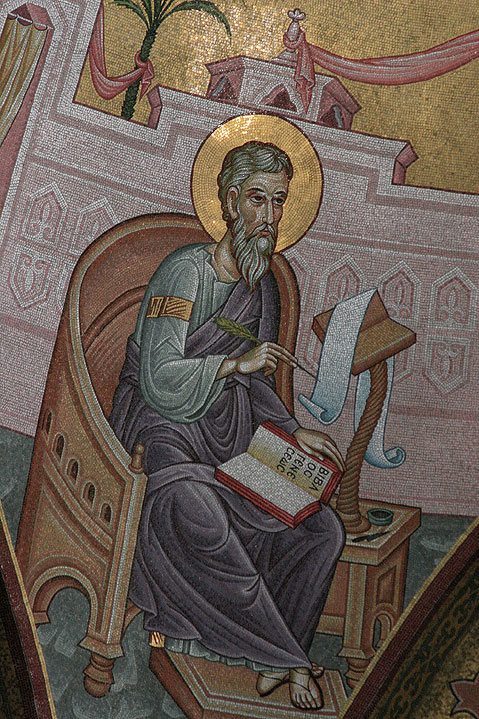
[This is an icon of Saint Matthew the Evangelist. It's in the Church of the Holy Sepulcher in Jerusalem. Click to enlarge.]

"Be Still and Know That I AM God"

[Regular readers of this blog will know about the daily emailed inspirations sent out by my colleague and friend, Pastoro Glen VanderKloot of Springfield, Illinois. In today's edition, Glen shares a quote from Lutheran pastor and author William Vaswig. It contains great advice!]

OnLine with Faith

July 25, 2008 Issue 457e
+ + + + + + + + + + + + + + + + + + + + + + + + + +

WELCOME to the daily issue of ONLINE WITH FAITH.
ONLINE WITH FAITH is a ministry of Faith Lutheran Church,
2313 Whittier Avenue, Springfield, IL, 62704, Glen VanderKloot,
Pastor.

We encourage you to worship and be involved in a local congregation.

If you have any questions, comments, or prayer
requests please be in touch with us at
pastor@faithlutheran.com
+ + + + + + + + + + + + + + +

Thought for the Day

Carl Jung, the psychologist, said that silence or being
still is in itself healing. Jung would insist that
his patients sit wtill alone at home bewtween appointments.
No radios, phonographs, music or people to talk to.
Today we would add televisions and computers and M3P
players. He could tell when his patients returned to
his office a week or two after their appointment
whether or not they had done what he had assigned them.
Those who sat in silence one hour a day were always
improved when he saw them again.

It dawned on me if a well known psychologist like
Carl Jung knew the great healing value of silence,
how much more God knows what silence does for his own
children. When God says...

"Be still and know that I am God" Psalm 46:10

his instruction is given in order that we might be
constantly healed. It turns out that it is one of the
most healthful things you can do.

God wants to speak to us becasue he knows we can't hear
him while we are talking.

The best thing I have learned in my Christian walk is
the importance of being absolutely quiet.

William Vaswig

Bible verse
Psalm 62:1-2

For God alone my soul waits in silence; from him
comes my salvation, my fortress; I shall not be shaken.


Prayer

Lord, help me to regularly dedicate time to wait
in silence and listen for you. Amen

++++++++++++++++++++++++++++++++

[If you'd like to receive Glen's free daily emailed inspirations, send an email to olwf1@gliq.net, putting SUBSCRIBE on the subject line. Believe me, you'll love receiving them.]

Tuesday, July 22, 2008

The Happiness Project, the Happiness Project, and the Happiness Project

Three years ago, I did a series of sermons based on Jesus' Beatitudes found in the Gospel of Matthew. The series was titled The Happiness Project. (You can find links to the entire series here, as well as in the right sidebar of this blog.)

Now, Gretchen Rubin, a wonderful author who has written interestingly on Winston Churchill and John F. Kennedy, is working on a book called The Happiness Project. Along the way, she's blogging on happiness under the same title. I don't always agree with the things Rubin says about happiness, but she's engaged in an interesting project.

Jan Poses Important Questions

See here. There is an awful lot of testosterone in the Christian blogging world and sometimes it's a lot more testosterone than it is Christian, I think.

Rock Drummers are "Top Athletes"

Unless they have the life style of a Keith Moon, of course. (Click on the headline above to see what this is about.)

Sunday, July 20, 2008

Weeds or Wheat? It's God's Call

[This sermon was shared during worship with the people of Saint Matthew Lutheran Church in Logan, Ohio, this morning.]

Matthew 13:24-30, 36-43
A few years ago, a woman approached me with a concern. She told me that her father, by then in his seventies, was suing a woman whose car had brushed his in a mall parking lot, where he sat waiting for his wife. Even though both he and his car were fine, he claimed to have suffered physically. The daughter said to me, “This is the last straw for me! My dad has always gone to church, been on the church council, gone to Sunday School. But he’s also always tried to shaft other people in order to get some advantage. He even pushes people out of the way in order to be first in a check-out line. But I hadn’t realized how horrible he was until he sued this poor young woman who nicked his car. How can he call himself a Christian?” When she asked me that, I remembered an old saying: Just because the mouse lives in the cookie jar doesn’t mean it’s a cookie.

That, in a way, is one of Jesus’ points in today’s Gospel lesson. He’s had another run-in with the Pharisees, those holier-than-thou religionists who may have secretly doubted that God was good enough for them. As you know, the Pharisees didn’t like it that Jesus hung out with notorious sinners or that He said that prostitutes, thieves, extortionists, and even Gentiles could have places in His kingdom when they renounced their sins and followed Him. The Pharisees would have preferred for Jesus to renounce sinners and left it at that.

Instead, Jesus tells a story--a parable or, an allegory, really--to explain His actions and to guide all who follow Him and who might, like the Pharisees, sometimes feel tempted to look down their noses at others. The weeds planted by the farmer’s enemy in Jesus’ story, called darnel, are poisonous plants that look like wheat.

In his explanation of the allegory, Jesus designates what each character or element represents. He is the farmer. The good seeds are those who follow Him. The enemy is the devil. The bad seeds are those who follow evil. The harvest is the end of this world when Jesus will pronounce final judgment on us all and the place where the bundles are burned is hell.

In today’s post-modern world, we may feel squeamish in asserting the reality of hell. Jesus feels no such reticence. Nor does He shy away from speaking of a final judgment, one which all people will face. According to Jesus, those who repent and believe in Him will be with Him in His kingdom. Those who spurn Him will live with the separation from God they daily choose.

But Jesus today reminds us that only He will judge people’s fitness for His kingdom, not you and me.

There may be mice in the cookie jar of Christ’s Church. Those imprisoned by things like selfishness, egotism, materialism, and greed may look no different from those set free by the grace, goodness, and love of Jesus Christ. But until the day of judgment, the God we know in Christ is intent on letting His enemies and His friends live side-by-side, affording each equal opportunities to know and follow the Savior Who died and rose for us.

A man once asked me if the real point of Jesus’ words for us today isn’t, “Live and let live.” But that isn't the way of life to which we're called as Christians.

Jesus, for example, gives explicit instructions on what you and I are to do if we feel that a fellow Christian has sinned against us. Ultimately, if the whole church affirms that we have been sinned against and the one who has harmed us refuses to repent, the Church is obligated to bar such a person from the fellowship of the Church until they do repent.

Live and let live isn’t what Jesus commends. As every Lutheran Catechism student knows, Jesus has given to the Church “the keys of the kingdom.” That the means that the Church has the responsibility to declare Christ’s forgiveness to the repentant and Christ’s condemnation to the unrepentant.

But we are to exercise care in our judgments about others, especially toward those who aren't part of the fellowship of the Church.

Christ didn’t call the Church into being to act as God’s vigilantes, pointing out everyone’s else’ faults. We have different tasks.

Pastor Leith Anderson tells of calling ChemLawn to take care of his suburban lawn, infested with weeds. It was so bad that they rejected working for him. One member of his church said that he would completely remove his old sod and start a new lawn. It was an offer Anderson was almost ready to accept when a one-time farmer offered some advice: Don't worry so much about getting rid of the weeds. Just grow the grass, and the grass will take care of the weeds.
The Andersons took his advice. After a couple of years, the lawn looked just as good as anyone else's in the neighborhood.

As I see it, the Church and we Christians are called by Christ to be about two main tasks: Growing in our own faith in Christ and helping others to experience Christ’s love through our words, actions, and lives.

We grow in our faith when we seek each day to consciously thank Jesus Christ for dying and rising for us by loving and serving in His Name.

We motivate others to want to follow Christ when they see us doing our best to loving and serving in His Name.

A friend of mine once invited some neighbors to attend worship with him. He was excited when, after several invitations, these neighbors, who had never been part of a church, showed up one Sunday morning. He was even more excited when they kept attending. He thought that his heart would pound out of his chest the day the neighbors made public affirmation of their faith, the kids were baptized, and they joined the congregation.

Two of the children were members of my friend’s Sunday School class and he was amazed to see how they took hold of faith in Christ for themselves. The family were part of that church for several years and then, for no apparent reason, left. They weren’t in worship or Sunday School. They stopped being involved in service projects.

My friend never felt that he could discuss things with this family. He would see them in the neighborhood and they would pleasantly say, “Hello.” But that was it.

Then, a few years later, a pastor ran into my friend and said, “The Smith kids have started coming to our church. They both mention what an impact you had on them. You can tell that you imparted a real love for Christ to them!”

Not long ago, my friend received an email from the youngest of his neighbor’s children. He affirmed what that pastor had told him and went on to say, “By the way, I’m starting seminary in the fall. Thank you for introducing my family to Jesus. He is everything to me!”

For years, whenever my friend considered his neighbors, he may have been tempted to feel like a failure and to see his neighbors lost to God forever. But he didn’t have to wait until the judgment day to have Jesus’ message for us today boldly underscored: Keep sharing the Good News of Jesus with others. All those people you see as weeds may, because you prayed for them, served them in Christ’s Name, and shared Christ with them, turn out to be wheat that will be gathered into God’s kingdom for all eternity.

Judge not: Christ can use your faithfulness to turn weeds into wheat and mice into cookies. After all, if God can do that with you and me--especially me, God can do it with anybody! Amen