Thursday, December 17, 2009

Parsley Up to His Old Snake Oil Gig

Central Ohio snake oil salesman and embarrassment to Christianity, Rod Parsley, is pulling an Oral Roberts. One day after the death of the grand-daddy of the heretical "prosperity gospel" movement, Parsley was proving that there's no swindle like an old, proven swindle.


According to this report from The Columbus Dispatch, Parsley has gone to the airwaves, telling those who pay attention to him that his personal ministry empire is in financial trouble. It's the worst attack from the devil he's ever encountered, RodPar says.

Now read what Parsley said next:
"I believe as you sow your seed today in faith, God will reward you, I know he will, in a supernatural harvest in the area you need it most..."
When Rod tells his viewers "sow your seed today in faith," he means "send money to my organization." And the promise? In exchange for that, he says, "God will reward you...in a supernatural harvest in the area you need it most..."

This, folks, is "works righteousness," the opposite of Biblical faith in every way. We cannot earn the blessings of God. They are free gifts from a God Who is gracious. That is what the Bible, in both the Old and New Testaments, teaches. We may block God's blessings from our lives through willful disobedience, careless heedlessness to God, or (are you paying attention, Rod) blasphemy, speaking falsehoods in or misusing God's Name. But we cannot earn God's blessings.

Nor can we give money in order to buy our way out of the hardships and pain that come in life on this planet. Jesus says that God "makes his sun rise on the evil and on the good, and sends rain on the righteous and on the unrighteous" (Matthew 5:45). No one is exempt from the possibility of hardship. But God blesses us with His presence, strength, and promises even in the midst of our hardships.

Christians are to give, of course, and sometimes, sacrificially. But we're to do so not in the expectation of reward. We're to do it in gratitude for what God has already done for us, especially what He has already done for us in Jesus Christ on a cross and from an empty tomb. The New Testament book of Ephesians says:
For by grace you have been saved [from sin, death, and the devil] through faith, and this is not your own doing; it is the gift of God— not the result of works, so that no one may boast. (Ephesians 2:8-9)
As to Parsley's promise that after giving money to him, donors will be blessed in an area they need it most, God has already covered that. Jesus teaches us, you know, to pray for our daily bread, a petition that calls us to acknowledge that, God already gives all of us what we need.* This is why Martin Luther says of the fourth petition of the Lord's Prayer--"Give us this day our daily bread":
God gives daily bread, even without our prayer, to all people, though sinful, but we ask in this prayer that he will help us to realize this and to receive our daily bread with thanks.
Parsley's appeal for money is an old scam, designed to leverage money from the pockets of the desperate who need to remember that while the faithful use of our money, first of all for God's purposes and Christ's mission for His people, is a serious matter, we don't give in order to get something from God. We give because we've already gotten the greatest gift of all: new life as a free gift for all who dare to turn from sin and believe in Jesus Christ.

If you happen to be on Rod Parsley's mailing list and he drops you a line promising you special blessings if you send some money his way, how about doing this? Take whatever insert might be in the mailing and scrawl across it, "Dear Rod: No Deal. God has already blessed me in Jesus Christ. Sincerely, A Christian Believer." Then send the return envelope without any cash, but with a promise to pray both that God will guide Parsley and his ministry and that Parsley and his ministry will actually be open to that guidance.

Many ministries are facing tough financial times these days, as are a lot of people. We're coming out of the worst econcomic crisis since the Great Depression. While I definitely believe that the devil is active in our world, the fact that Parsley's ministry is short on cash doesn't mean it's under demonic attack.

Instead of making false, unbiblical promises in exchange for cold, hard cash, Parsley should pray for God's help, then, simply, explain what needs to be done, and finally, be prepared to maintain what is essential in his ministry--probaby a lot less than he thinks is essential--and to cut what God seems to be saying is unnecessary.

Don't expect Parsley to do any of that any time soon. And don't expect him to drop his heretical "prosperity gospel" talk either. That's how he built his empire.

*There is, of course, a human problem with sharing God's bounties with the world, attributable to sin. The earth produces more than enough for all. It's just that some hoard or use too much and cause others to go hungry, naked, or thirsty. This must change! Read Matthew 25:31-46

Wednesday, December 16, 2009

Faith to See The Other World in This World

[This was shared tonight during midweek Advent worship with the people of Saint Matthew Lutheran Church in Logan, Ohio.]


Matthew 1:18-24
The German poet Rainer Maria Rilke wrote, “There is another world, the same as this one.” A Christian ethics professor, Stanley Hauerwas, quotes Rilke and says, “We simply must learn to see the world in which we live as the world that the Father created and redeemed through the Son.”

Often, you know, some Christians get caught up in a sort of other-worldliness, acting as though they're just skimming along this world's surface, too holy to be bothered with the things that mere mortals care about.

They're like the fellow whose boss grew so frustrated with his employee's constant preaching and failure to get his job done that the boss finally had to fire him. He was, the employer said, so heavenly-minded that he was no earthly good.

That happens to people who mistakenly see Christian faith as being all about the sweet by-and-by.

But the call of a Christian is not to bide our time with sweet talk until we die and go to heaven.

Our call is to follow Jesus Christ in the rough and tumble of the here and now, even when it's hard.

We’re called to understand that though this world has fallen into sin, it is still the world God created. And though, because of all that the condition of sin has unleashed—a penchant for personal sin, a susceptibility to illness, a victimization by death--this is still the world to which Jesus came on the first Christmas in order that its people might be saved from eternal separation from God. It’s this world into which Jesus sends us to love and serve others and to make disciples.

Through the eyes of Christian faith, you and I are called to see this world as one worthy of our making the very same sacrifice Jesus Christ made when He went to the cross. Right now, we're called to live in this world. Jesus calls us to see in every person on this planet someone He loves, someone for Whom He died and rose.

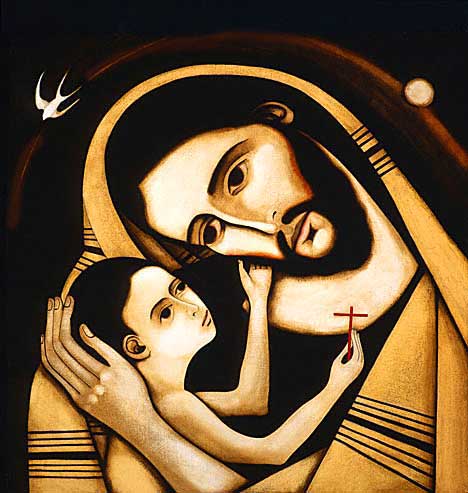
I thought about all of this last night when I once again considered Joseph, the man God chose to be the earthly father for God the Son, Jesus.

In some ways, God asked more of Joseph and of Joseph’s faith in God than God even asked of Mary, about whom we spoke two weeks ago. I’m not belittling what God asked of Mary at all, as you well know. Mary, the Bearer of God, risked all—reputation, marriage, and life itself—when she trustingly accepted the message from the angel and said, “Let it be to me according to your word.”

But, as changes came over Mary’s body, as the baby in her womb began to move and then kick, and as she could know as nobody else could that the baby she bore wasn’t conceived in the usual way, she carried and lived with tangible proof of what she accepted. He body told her day in and day out that she really was carrying God-in-the-flesh within her.

Joseph though, had to believe without such knowing. The New Testament book of Hebrews says, “Now faith is the assurance of things hoped for, the conviction of things not seen” (Hebrews 11:1). In his acceptance of the message God delivered to him in a dream and of the assertions of Mary, Joseph confirmed his belief that there is another world: It's the same as this one, unfolding here and now, but happening at another level from what most people dare to see.

Through the eyes of faith, Joseph was able to see more deeply, more clearly, truer. His wife was pregnant, yes; but she hadn’t been unfaithful. She bore a child, yes; but not just any child.

Today, some will look at Jesus on the cross and see defeat. But we can see victory: God conquering the power of sin and death over our lives.

Some will look at sinners thriving and take it as confirmation that there is no God and that anything goes. But we can see the patience of God with sinners and the time God is giving those of us in the Church to fulfill our mission of sharing the possibility of forgiveness and new life through faith in Christ with others.

Some see death, tragedy, and fatal diseases and blame God or call God impotent. But even amid the ashes and tears of this world, we see that God is making a new world beyond tragedy and tears, a new world where all believers in Christ will one day live with God in, using Luther’s words from The Small Catechism, everlasting “righteous, innocence, and blessedness.”

My family and I attended a memorial service for an old family friend from our home church on Monday night. Bill died down in South Carolina, where he and his wife had made their home over the twenty-six years since his retirement. Pastor Phillips, once the pastor of our home church gave the message and reminded us that after losing a loved one, we may feel orphaned. But he also reminded us of the promise Jesus gave to His heavy-hearted disciples on the night before His arrest. Jesus said that He would soon be leaving them. But then Jesus promised, “I will not leave you orphaned. I am coming to you;. In a little while the world will no longer see Me, but you will see Me.” (John 14:18-19)

Joseph is a model of Christian faith because, by faith, he saw what others couldn't see and what few would have even been willing to see.

He saw the Child in Mary’s womb as the world’s God and Savior.

He saw God working in a world that was often unspeakably hard and unforgiving.

How did Joseph do that?

The Bible reveals no secret formula for having that kind of faith. Joseph’s faith was built just as ours must be built.

Joseph was able to trust in God because Joseph was willing to trust in God. God took that willingness and built a faith out of it.

Just as God builds redwoods from tiny seeds, God builds faith from the seeds of our willingness to follow, even though we only see God’s promises through a glass darkly.

By faith, Joseph came to know that God was not leaving him orphaned.

By faith, Joseph gained the assurance of things hoped for.

By faith, he could see what others couldn’t see.

May this Advent and Christmas season find us willing to trust God.

May God help us to see through the eyes of faith the new world that He is already creating through His Son right now in the midst of this world.

May we see in the Christ Child not just a pleasant story in the midst of a humdrum and difficult world, but the One Who turns this humdrum and difficult our world—and our lives—around for all eternity. Amen

[Painting above: Saint Joseph and the Christ Child by Michael D. O'Brien.]

Tuesday, December 15, 2009

About the Man Who Cried, "Tora! Tora! Tora!"

[I received this on December 7, as one of my colleague Glen VanderKloot's daily emailed inspirations. It tells a story I had never read before. God is still in the business of transforming lives for all eternity!]

The Story of Mitsuo Fuchida
[Mitsuo] Fuchida grew up loving his native Japan and hating the
United States, which treated Asian immigrants harshly in the
first half of the twentieth century. Fuchida attended a military
academy, joined Japan's Naval Air Force, and by 1941, with
10,000 flying hours behind him, had established himself as
the nation's top pilot. When Japanese military leaders needed
someone to command a surprise attack on Pearl Harbor,
they chose Fuchida.


Fuchida's was the voice that sent his aircraft carrier the
message "Tora! Tora! Tora!" (Tiger! Tiger! Tiger!) indicating
the success of the surprise mission. Later, he too was surprised
when he learned that, of the 70 officers who participated in
the raid, he was the only one who returned alive. He had
another close call when he was shot down during the battle
of Midway in 1942, but despite serious injuries, he survived again.

By 1945 he had attained the position of the Imperial Navy's
Air Operations Officer. On August 6 he was eating breakfast
in Nara, Japan, where a new military headquarters was under
construction, when he heard about a bomb dropped on
Hiroshima. He flew to investigate, then sent a grim report
to the Imperial Command.

On the same day, an American POW named Jacob DeShazer
felt moved by the Holy Spirit to pray for peace. DeShazer had
been in captivity since 1942, when, as a member of Doolittle's
Raiders, he dropped bombs near Tokyo and then was forced
to parachute into a Japanese-controlled part of China.

While imprisoned, first in Nanjing and later in Beijing,
DeShazer had become a Christian. He found his heart softened
toward his Japanese captors. After being liberated, DeShazer
wrote a widely distributed essay, "I Was a Prisoner of the
Japanese," detailing his experiences of capture, conversion,
and forgiveness.

Fuchida and DeShazer met in 1950. DeShazer had returned
to Japan in 1948 as a missionary. Fuchida had read DeShazer's
testimony, bought a Bible, and converted from Buddhism to
Christianity. DeShazer had recently finished a 40-day fast for
revival in Japan when Fuchida came to his home and introduced
himself. DeShazer welcomed the new convert and encouraged
him to be baptized. While DeShazer continued to plant churches
throughout Japan, Fuchida became an evangelist, spreading a
message of peace and forgiveness in his native country and
throughout Asian-American communities.


Fuchida died 25 years ago, on May 30, 1976. Like dynamite
inventor Alfred Nobel, who wished his legacy to be one of peace
rather than destruction, Fuchida wanted the message of his
changed heart to supersede the memory of his infamous attack.

He wrote, "That morning [December 7] ... I lifted the curtain
of warfare by dispatching that cursed order, and I put my whole
effort into the war that followed. ... [But] after buying and reading
the Bible, my mind was strongly impressed and captivated.
I think I can say today without hesitation that God's grace has
been set upon me."

Elisha Coffman*


Scripture: James 3:17-18 [NUV]

17But the wisdom that comes from heaven is first of all pure;
then peace-loving, considerate, submissive, full of mercy and
good fruit, impartial and sincere. 18Peacemakers who sow in
peace raise a harvest of righteousness.

Prayer:

Lord, use us to bring your peace and hope to others,
even the most unlikely characters.
Amen

*************************************************

[Photos above, top: Mitsuo Fuchida as a young Japanese Imperial Navy officer; bottom: Fuchida, photographed during his later years, while serving as a Christian evangelist.]

*This piece was written in 2001, on the sixtieth anniversary of the Japanese attack on Pearl Harbor, December 7, 1941.

Joy in the Middle of Sorrow

[This is the text of the sermon for today's funeral for Violet, an 89-year old member of our Saint Matthew family who died this past Thursday.]

Philippians 4:4-8
I sometimes teased Violet, calling her the Energizer Bunny. Back in the 1950s, she was told that she could probably expect to live only five to seven more years. Yet, Violet kept going and going and going.

Even in the two-plus years since I became her pastor, I’ve seen Violet confound expectations, surviving major challenges to her health.

But what was even more remarkable to me than Violet’s physical survival, was the cheerfulness with which she did keep going. Despite complications from her Addison’s Disease, going blind, being confined to a bed or a wheelchair, and finding it increasingly difficult to hear, Violet remained a person on whom her family could rely for a supportive ear, an interested heart, and a cheery welcome. Love and laughter emanated from Violet any time you saw her. She gave of herself unstintingly.

And this wasn’t something she offered just to her family. In the past several days, people from Saint Matthew have commented on how she was always so caring and affirming to others. She got along well with Ruth, her roommate at the Skilled Nursing Center. And whenever I came to visit, she was happy and welcoming. She enjoyed the monthly Holy Communion services I do at the hospital, something that came about as a result of efforts by Shirley and Violet. It has become an important part of my ministry; but it will seem odd when I return there next week and not see Violet.

What exactly was the source of Violet’s capacity for dealing with life’s setbacks? And how can her family and friends, those who mourn her passing, have that same capacity, not just as you deal with the grief you feel today, but also as you face your own challenges in your own lives?

Well, it doesn’t take a Doctor of Psychology to figure out that, in part, Violet was by nature, a person prone to greater cheerfulness. Some people are just like that and they’re huge blessings to the rest of us!

But that wasn’t the only source of Violet’s upbeat tenacity. Our second Bible lesson for worship this past week at Saint Matthew was Philippians 4:4-7. Philippians is a letter written by the apostle Paul to the first century church at the Greek city of Philippi. Paul wrote this letter while he was a prisoner, confined much as Violet must have felt confined in recent years.

Paul was imprisoned by the Roman Empire for being a Christian. Violet was imprisoned by advancing bodily degeneration.

No matter the source of confinement though, confinement isn’t enjoyable. It makes you feel that life is going by and you have no chance to participate in it. Confinement, whether due to injustice or the ravages of age, will almost always breed resentment, bitterness, and anger in those who are confined, and understandably so.

But some rare people show us that it’s possible to be joyous even in the midst of bitter, adverse experiences. And some show us the truth that the last freedom all of us have, even when all other freedoms have been taken from us, is the freedom to choose how to respond to our circumstances.

From his confinement as a prisoner, Paul writes these remarkable words in Philpppians: “Rejoice in the Lord always; again I will say, Rejoice. Let your gentleness be known to everyone. The Lord is near. Do not worry about anything, but in everything by prayer and supplication with thanksgiving let your requests be made known to God. And the peace of God, which surpasses all understanding, will guard your hearts and your minds in Christ Jesus.”

You see, joy is not the same thing as happiness. Happiness happens for a time and is gone. It’s subject to moods and circumstances.

Joy, on the other hand, is a way of life born of constant contact with the Lord Jesus Christ, Who by His death and resurrection, has conquered sin, death, and futile living. Joy is the Baptismal birthright of every Christian.

Joy belongs to those who know that in adverse, sad, or even tragic circumstances, we can leave worry behind. We can turn to God in prayer in Jesus’ Name and let God hear our requests and trust God to do what's best. We can experience a peace from God that goes beyond human understanding. We can know that we are safe in the arms of Christ even when this fleeting life ends.

Knowing that we are in the hands of Jesus also gives us the freedom to take up the lifestyle that Paul commends in the very next verse of his letter to the Philippians: “Finally, beloved, whatever is true, whatever is honorable, whatever is just, whatever is pure, whatever is pleasing, whatever is commendable, if there is any excellence and if there is anything worthy of praise, think about these things.”

Paul’s words aren’t the shallow exhortations of a motivational speaker to “accentuate the positive.”

Just before our lesson, in Philippians, and in his other New Testament letters, Paul acknowledgea that life can be tough. It can be unfair and unspeakable tragedies and challenges may befall us. Paul, as I said, wrote these words from prison. So, he was no pollyanna!

But when you know that Jesus Christ has set you free from sin and death, you know that He can also set you free from the constant anger, self-pity, and self-hatred that confine so many people who, unlike Paul, never have been arrested or who, unlike Violet, never sat in a wheelchair, never went blind, or never fought a chronic disease for more than fifty years.

Christ set Violet free to do live precisely the life Paul commended to the Philippian Christians. She could focus on the honorable, the pure, the pleasing, and the commendable. She took delight in little things. She gave you--she gave all of us--love and laughter.

Violet’s great legacy to you is Jesus Christ.

Jesus Christ is the source of all true joy.

Jesus Christ is the One Who sustained Violet and Jesus Christ is the One Who can sustain you today and in the days to come.

And so, as you deal with the loss of one who loved you much and who you loved much in return, this is my simple message: Trust in Jesus Christ, the One Who conquered sin and death for all who will dare to turn from sin and believe in Him wholeheartedly.

As you surrender each day to Christ, He will give you strength and peace and everlasting life and, as Violet showed you, Jesus will also give you joy that nothing can destroy!

God bless you.

Sunday, December 13, 2009

By Repentant Lives, Showing Ourselves to Be "Kin of God"

[This was shared during worship with the people of Saint Matthew Lutheran Church in Logan, Ohio, this morning.]

Luke 3:7-20
Many years ago, on a cold morning, a newspaper boy in a large city was out on the street, selling his papers. He stood barefoot, warming his feet on a grating that had a bakery below.

A woman came along and, seeing how the boy was shivering, asked him if he owned any shoes. "No," he said. She then asked if the boy would like a pair. "Yes!" he replied enthusiastically.

So, the woman took him to a nearby department store and bought socks and shoes for the boy. At that, the kid excitedly ran out of the store and resumed selling his papers. He didn’t even take the time to say thank you. The woman was a little disappointed by this ingratitude.

But just as she was leaving the store, the boy ran back into the store and asked, “Lady, I wanna ask you a question. Are you God’s wife?”

She stammered, “No, but I am one of His children.”

The boy replied, “Well, I knowed you must be some kin of His.”

People can tell when we have a relationship with the God we meet in Jesus Christ!

In today’s Gospel lesson, Jesus’ cousin, John the Baptist, is doing his special ministry of preparing people for the entry of Jesus into their lives. John calls the people to repent, to turn away from their sin so that their hearts will be emptied of evil and they can be open to the forgiveness that comes to all who receive Jesus as the God and Lord of their lives.

To signify their changed lives, John calls the repentant to be baptized in the Jordan River. Crowds show up in droves to hear John’s preaching and to be baptized.

John should have been pleased. By the standards of the world, he was a great success. He set up shop to preach and lots of people were heading for the desert outside of Jerusalem to hear him. He called people to be baptized and they lined up by the hundreds.

But John was suspicious. He didn’t want to be the latest fad, the spiritual flavor of the month. John wanted people’s lives to be changed as they surrendered themselves and their sins to God.

So, John started chastising the crowds: “You brood of vipers! Who warned you to flee from the wrath to come? Bear fruits that are worthy of repentance. Do not begin to say to yourselves, ‘We have Abraham as our ancestor.’ [It isn’t enough to say, “My mom and dad always went to church.” Or, “I’m a member of Saint Matthew Lutheran Church.” John goes on to say...] for I tell you, God is able from these stones to raise up children to Abraham...”

It’s all very good for us to express sorrow for the ways we’ve hurt God or others, as the crowds who thronged to be baptized by John in the Jordan River. But, John says, unless we change the direction of our lives, our repentance is nothing more than a hollow religious act.

When we truly repent, we become like the woman who bought the shoes for the newspaper boy. By our changed lives, others see that we’re kin to God.

That’s why to one group of people after another in today’s lesson, John says, “Live your repentance. God has planted the seed of love and forgiveness in your life. Now bear fruits of repentance.”

There is nothing odder or more appreciated than the life of a person genuinely changed by the love of God, somebody who is bearing the fruit of genuine repentance.

An acquaintance of mine once told me about a habit she has. These days you know, it seems that young people are so dependent on calculators that many are flustered by having to count out change at retailers’ cash registers. My acquaintance says that often, a young person working at register will give them too much change. This person will say, “Excuse me. I think you’ve made a mistake.” And just as the young clerk is about to get defensive, she’ll explain, “You gave me a dollar too much.” When this happens, the mystified clerk will say something like, “Thank you so much. If I had been off, I wouldn’t have made my bank and been here all night long trying to figure what went wrong.”

And don't be surprised if some people will go out of their ways to test our commitment to the repentant life of a Christian. Walt Kallestad is pastor of Lutheran Community Church of Joy in the Phoenix area. He tells about being on his way to a meeting one day when he decided that he needed to pick up a soft drink at a convenience store. He pulled off, made his purchase, and was barreling down the road when he realized that the clerk had given him too much change. It was a mistake on the clerk's part. Nine people out of ten probably would have just gone on to their meeting and forgotten about the whole thing. But it bothered Kallestad. So, he turned around and went back to the clerk. "You gave me too much change," he said. "I know," said the clerk. "I was at your church last Sunday and heard you talking about the importance of honesty in business dealings. I wanted to know if you were for real."

I really do wish that those of us who follow Jesus would confound and mystify the world like that all the time, defying people's expectations that we Christians will hypocritically be as dishonest and unethical as the rest of the world. I wish that I woulddefy those expectations more!

Can you imagine the positive impact we could have on people if, with any consistency, we did as John the Baptist suggests today: bore the fruit of repentance, living as people grateful for Jesus, the Savior to Whom John pointed?

True story. Little Marty Rayner had returned from a secret mission with an unexpected item, a gift for his friend Kenny. Marty’s mother, Diane, watched her son wrap the gift in bright Christmas paper. Because Kenny’s family was poor but too proud to accept gifts they couldn’t reciprocate, Marty sneaked across the pasture, under an electric fence, and up to Kenny’s front door. He pushed the doorbell and then, ran like the wind.

The two boys were like Tom Sawyer and Huckleberry Finn, always getting into little adventures together. Marty was deaf in one ear, but never complained about it. Kenny never seemed to mind his friend’s problem. Marty had bought a compass for Kenny with his own money and after Diane had explained about Kenny’s mom’s “admirable pride,” Marty decided that nobody ever needed to know who had left a Christmas present on Kenny’s front porch.

Diane was proud as she watched her eight year old son share a gift with no expectation of being rewarded. She thought to herself, “This must be what Christmas is all about!”

But when Marty came back from his errand, he was wobbly, his eyes filled with tears. What was wrong?, Diane wondered. As Marty came into the kitchen, Diane saw it: a bright red welt emerging on his face. In a hurry to escape from Kenny’s house undetected, Marty had run straight into that electric fence. It had knocked him down and stunned him. As Diane hugged her sobbing boy close, she wondered, as I suppose any parent would, how God could have let a boy doing something so wonderful be hurt like this.

Christmas day came. Diane and her family opened their Christmas presents. She could see that happily, the burn on Marty’s face, extending from his mouth to his ear, wasn’t serious. But even then, she wondered how God could allow such a cruel thing to happen to somebody who was so giving.

Later on Christmas morning, Kenny came to visit Marty. Kenny showed off his new compass and Marty just smiled and congratulated his friend. He never did tell Kenny that he’d been the one who gave this Christmas present Kenny so cherished.

“That’s when Diane noticed it. As the boys were talking closely with one another, Marty seemed to be hearing with the ear that was totally deaf. [There had been a Christmas miracle.]...the school nurse confirmed that Marty had full hearing in that formerly deaf ear. The doctor could only guess at what had happened—when Marty hit that electric fence, the doctor surmised that somehow the electric current had shocked that ear into hearing.”

I wish that I could tell you all this morning that if we live our faith the way Marty did, then miracles of healing and provision will come our way.

But that’s not the way things work in this imperfect world.

We bear fruits of repentance—we perpetrate acts of love and kindness and service—not so that we can earn heavenly miracles or get dibs on God’s love. We serve others because of the incredible service God has already done for us.

God isn’t a miserly old coot from whose clenched fists we have to pry love or blessings.

As followers of Jesus Christ, we live our faith because on the first Christmas day 2000 years ago, God already gave us the best Christmas present ever: His love and the possibility of new life through Jesus Christ to all who repent and believe in Him.

Jesus loved us enough to bear a cross for us. He loves us enough to share His victory over death with everyone who will genuinely turn from sin—repent—and follow Him.

Little Marty had no thought of his deaf ear when he gave that compass to Kenny. His eyes and his thoughts were on one thing only. He was thinking of the baby in the manger. He was thinking about Jesus.

This Christmas season, I hope and pray that all of us—including me—will put our focus on Jesus where it belongs.

When that happens, we might find ourselves doing odd and amazing things—like making anonymous gifts to needy neighbors or inviting unchurched friends to worship with us.

But however we respond to Jesus’ love, may this Christmas season find us all moving...
  • from feeling our faith to doing it...
  • from believing to living...
  • from being blessed to being blessings.
Two thousand years ago, God came to us as a servant born in a barn.

By our service in the Name of Jesus, let’s show the world that we really are kin to God…and that by the same grace that saved us, they can be kin to God, too. Amen

[You might want to see this cartoon.]

Our Eternal Hope

[This was shared during a menorial service on Saturday, December 12, for Bob, a member of our congregation who passed away suddenly last Monday.]

John 3:16
Philippians 4:4-9
1 Corinthians 15:19

I promised Bea I would make this brief.

Bob’s sudden passing has come as a terrible shock to Bea, to Bob’s and Bea’s families, to Bob’s friends, and to all of us who are part of the Saint Matthew Lutheran Church family. And there’s particular poignance to Bob’s death coming during the Christmas season, his favorite time of the year.

Just this past Sunday, barely twenty-four hours before we said good- bye to Bob, he was in the sanctuary of Saint Matthew for worship. When Bob shared the peace, he didn’t do it like some stoic old Lutheran, with a limp handshake and maybe eye contact. In fact, this past week, Bob wrapped me with his trademark bear hug, nearly picking me up off of the floor and momentarily taking my breath away. I had been heading back to the altar for the offering when I encountered Bob and he said, “You didn’t think you were going to get away without a hug, did you?” No, and I wouldn’t have wanted to!

On the previous Friday, my daughter and I ran into Bob as we walked to the bank. It was part of a day that saw him and several of you decorate the house-inside and out—for Christmas. He was having fun!

And now, under circumstances we couldn’t have imagined just a week ago, we gather not only to remember an accomplished, loving, compassionate man who meant so much to so many, but also to commend him to the care and keeping of the Lord in Whom he believed, the Lord Whose birth he so enjoyed celebrating.

No words spoken here today can fill the void left in the lives of Bob’s family and friends. You who mourn today have sustained a loss and the grief will never fully subside.

But this is a moment to remember an important truth. This life, with its joys and griefs, laughter and tears, is not our ultimate destination.

The Bible teaches us that when we die, we will stand before God. Those who have trustingly surrendered to the love and grace of God given through Jesus Christ will be with God forever. Jesus puts it this way in a famous conversation He had with a man named Nicodemus: “For God so loved the world that he gave his only Son, so that everyone who believes in him may not perish but may have eternal life.”

When I re-read those words the other day, I couldn’t help thinking that Bob, who so loved Christmas, is now enjoying an eternal Christma with the Savior which none of us can even imagine right now!

Some people, you know, latch onto God because they think God is a good-luck charm who can help them get through times like these. God does want to help us through tough times. But the God revealed to us in Jesus Christ, Who came into our world on the first Christmas two-thousand years ago, wants to be more than a good luck charm and more than a crutch to help us through tough times.

He wants to be our God, King, and Helper, our Lord, Savior, and Friend for all eternity.

In the New Testament, the apostle Paul writes, “If for this life only we have hoped in [the God we know in Jesus] Christ, we are of all [people] most to be pitied.”

Today then, to sustain you through your grief and to give you a hope that never dies, I want to simply remind you to put your full trust in Jesus Christ.

Jesus is God in the flesh, the Christ Child Who came into our world to first, live with us, then to die for us, killing the power of sin and death over the lives of those who believe in Him, and finally, to rise for us, opening eternity to those who believe in Him.

Jesus also established His Church as a place where ordinary believers can share their joys and sorrows, worship and get to know God better, serve others in Jesus’ Name, hear God’s Word of hope and encouragement, and, among other things, share God’s peace with one another, as Bob so enthusiastically did this past Sunday morning.

I know that your grief is great. But God’s love for you and God’s willingness to comfort and help you and to love you for all eternity is even greater.

Today, grasp hold of the strong embrace of Jesus. Even in times like these, He has an endless supply of help and hope to share with you. Amen

Minaret Piece in 'Better Living' Mentioned by Pew Project on Journalism

This piece on Swiss voters' decision to thwart the construction of minarets in their country has been cited as exemplifying a widespread defense of freedom of religion by bloggers.

In my post on the Swiss vote, I said that thwarting the religious freedoms of Muslims was wrong and represented a threat to the freedoms of all people to practice the religions of their choice.

The Pew Center's Project for Excellence in Journalism regularly monitors what is being written by bloggers to see how the concerns receiving the greatest attention among them compare to the stories receiving the greatest focus in mainstream media outlets. The reference to my piece on the Swedish minaret vote came in the PEJ New Media Index for November 30 through December 4.

This explains the mission of the Project for Excellence in Journalism.

Friday, December 11, 2009

The Wonder of Humble People Pointing Beyond Themselves

Deb Grant, the pastor of Faith Lutheran Church in Dickinson, Texas, authors a daily email she calls ELOGOS. Here is today's installment:
Luke 3:15-16
As the people were filled with expectation, and all were questioning in their hearts concerning John, whether he might be the Messiah, John answered all of them by saying, “I baptize you with water; but one who is more powerful than I is coming; I am not worthy to untie the thong of his sandals. He will baptize you with the Holy Spirit and fire.
* * * * * *
It was pop artist Andy Warhol who said that everybody would have 15 minutes of fame - a reference to the explosive and fleeting nature of celebrity. In today's culture, 15 minutes of fame could be pandered by clever marketing people into a fortune. Ordinary people become Youtube icons or action figures. John the Baptist was a retro prophet for a people who hadn't seen or heard from a prophet in hundreds of years. He could have had his own talk show in a heart beat. Instead he waves off the fame and does simply what he was born to do –point to Jesus. As we watch celebrities rise and fall and feel the ebb and flow of our own successes and failures, we are wise to consider the historical wonder of a humble man doing his job with integrity so that the world will be ready to recognize the Savior of the world.
* * * * * *
Lord, when all is said and done, may it be said of me, that I pointed to Jesus.
Amen.
If you would like to subscribe to ELOGOS, send Pastor Grant an email at: revdeb@jazzwater.com. Here is her web site.

Thursday, December 10, 2009

God's Will and Sticking with It

[This was shared during the Midweek Advent Worship with the people of Saint Matthew Lutheran Church in Logan, Ohio, last evening.]

Luke 1:5-23
A prominent pastor once told about meeting an old seminary classmate of his. The classmate had been widely acknowledged by everyone to be the ablest member of their class: a compelling communicator, a great leader, a person who got things done quickly and well, the sort of person others immediately respected and followed. “Joe,” they said, “will be the one who leads the largest church in the biggest city with the most clout in our denomination.”

But when Joe and this classmate met one another for the first time since their graduation, Joe was pastoring a tiny church. He enjoyed his ministry, but he was far from being the superstar everyone had expected him to be.

The two of them had been talking for some time, when the classmate screwed up the courage to ask, “Why? Why hadn’t Joe fulfilled his promise?”

In response, Joe had his own question. “Whose promise are you talking about?” he asked. “God never promised that I would be a superstar. God promised to be my God and Lord if I repented and believed in Jesus. God promised to be with me. God promised me new, eternal life. But God never promised me I would be a superstar. And in response to all of God’s promises, I promised to surrender to Jesus everyday. I promised”—and at this Joe chuckled—“to pray and try to mean it when I prayed, ‘Thy will be done.”

Joe allowed as how his life had turned out differently than he had expected. But he stood solely on the promises of God and then, day in and day out, did his duty as God set it before him.


Our lives don’t always go the ways that we or others think that they will. Everybody here tonight could probably identify at some level or another with Robert Redford's character, Roy Hobbs, in the movie, The Natural.** Years after mysteriously and suddenly dropping from the life of his high school sweetheart, Hobbs and the sweetheart, played by Glenn Close, meet one another again. With wistfulness, Hobbs says, "Things sure turned out different." "What do you mean?" she wondered. "Just different."

But our call is to be faithful to the Lord Who has been ever faithful to us, no matter how different things may be from how we'd imagined they would be. Our call is to be faithful in the midst of what we don’t understand.

Several years ago, I was re-reading this passage from Luke about Zechariah’s encounter with the angel Gabriel. In some ways I read my Bible exactly as I read books, journals, or magazines. Like any good nerd, I set with pen in hand, making underlines and writing comments in the margins as I read. I dialog with God.

As I re-read the story of Zechariah, a line struck me which I hadn’t noticed before. It’s the line that composes the last verse of our lesson: “When his time of service was ended, he went to his home.”

While offering sacrifices at the holiest place in the temple in Jerusalem, Zechariah had encountered the angel Gabriel, the same angel who would visit Mary six months later. It wasn't at all what he'd expected, or probably had dreamed all his life, would happen if he ever had the chance to offer incense offerings at the temple.


Gabriel told Zechariah that he and Elizabeth would have a son, John the Baptizer. Zechariah didn’t believe the angel at first and as a sign that his message was correct, God caused Zechariah to be struck dumb, unable to speak.

Now I ask you: What would you have done if you were Zechariah, if you had encountered an angel and suddenly were unable to speak?

I tell you what I think I would have done. I would have run out of that place with terror, in reaction to the weird, frightening holiness of the moment.

I can’t imagine that a soul in the world would have blamed Zechariah for doing just that.

But Zechariah didn’t run. When the full force of that line--“When his time of service was ended, he went to his home"--hit me as I re-read it several years ago, I wrote in the margin of my Bible, “Amazing! He stayed.”

Zechariah may have stayed before the incense altar, in part, because, with something like 22,000 priests, composed of several divisions, charged with the care of the temple and only those whose names were drawn by lot able to offer sacrifices at the altar as Zechariah was doing at the moment of his encounter, he may not have wanted to let go of this less than once-in-a-lifetime experience. Zecharaiah would have known maybe thousands of priests who never would have been given the privileged duty he was undertaking at the time.

But I suspect that something more was at play in Zechariah’s decision to stay at his post in spite of things not going at all as he had expected.

Martin Luther once observed that Christians often work themselves into a blather over what God’s will for their lives might be. They ask things like, “Shall I marry?” “What career should I pursue?” “Where should I live?”

God cares about those things, of course, because God cares about us.

But, Luther said, we can pursue God’s will married or not, in one career or another, living anywhere. Above all, Luther said, God’s will is that we simply do our duty—love God, love neighbor, make disciples, live justly, repent for sin, believe in Jesus—whatever we do.

By not believing the angel’s message, Zechariah knew he had, for a moment, lapsed in his faith. But, in spite of things not going as he’d expected, he kept at his duty.

This is a lesson Zechariah must have taught his son. In our Gospel lesson for this coming Sunday, several groups of people, in response to John’s preaching of repentance come to him and ask, “What should we do now?” He told all to share their blessings with others. He told tax collectors not to take more from people than they were supposed to take. He told soldiers not to exhort money from the terrified or to falsely accuse people. In other words, John said, God’s will is for us to do our duty, just as Zechariah, his father, did that day in the temple after being visited by Gabriel.

So often, we Christians complicate things. I don't know how to complicate this, folks. God’s will for us is really simple:
  • Trust in Christ no matter what.
  • Repent for sin and receive forgiveness.
  • Love God.
  • Love neighbor.
  • Tell others about the saving good news of Jesus.
  • Treat others as we would be treated.
On our jobs. In our families. At school. At our leisure.

Zechariah did his duty to God and to others. He stood solely on the promises of God and did his duty from moment to moment. May we do the same, whatever life brings to us. Amen***

*Joe wasn't his real name, by the way.

** Based on the novel by Bernard Malamud, the story line from which the film departs significantly.


***By the way, I do not think that it is God's will that people stay with jobs where they are unappreciated, underpaid, or subjected to abuse. Nor do I believe that employees who work under such conditions should do so without making their grievances known.

I also do not believe that people should remain in marriages to spouses who engage unrepentantly in extramarital liaisons or who are physically, emotionally, psychologically, or spiritually abusive.

Nor do children owe obedience to parents who are in any way abusive. Nor do parents need to fear to discipline their children with appropriate self-control and love.

The Bible is very clear that our relationships are not to be built on the rights we demand for ourselves, but in the responsibility, love, and respect each of us owes God and one another.

The Golden Rule--"Do unto others as you would have them do unto you"--should govern all our relationships.

The "household codes" which conclude many of the letters of Paul and Peter, found in the New Testament, all are predicated on this notion of relationships built not on the notion of rights--a non-Biblical concept, but on the belief in our mutual responsibility as human beings...all human beings.

Sunday, December 06, 2009

I Can't, But...

[This was shared during worship with the people of Saint Matthew Lutheran Church in Logan, Ohio, earlier today.]

Luke 3:1-6
Genelle Guzman-McMillan was the second of thirteen children and grew up on the Carribean Island of Trinidad. Genelle’s mother was a devoted Christian. But Genelle didn’t like church, thinking it was a waste of time. In fact, she thought that anything that cramped her style was a waste of time.

At age nineteen, expecting her first child, she moved in with her boyfriend. Six years later, the two of them split up and Genelle felt free to hit the club and party scene for which she’d always hankered. Somehow, in spite of now having two children, she made it through college, still managing to party most of the time.

Genelle seemed to have broken free from the old restrictions of her life and, depending on herself and her own wits. She was, as it’s said, “living large.”

In 1998, she moved to New York City where family and friends told her, she would find greater opportunity. She decided to leave her kids in Trinidad until she got settled in. After she came to New York, her ex-boyfriend informed Genelle that he was unwilling to let their kids come to America with her. That was okay with Genelle; by now, she was enjoying the party scene in the Big Apple. She quickly accepted being able to do more of it without having her children around.

By then, Genelle was living with another man, Roger McMillan. Like Genelle, he loved to spend his spare time partying. They were on top of the world until, Genelle says, there came “a remarkable turn."

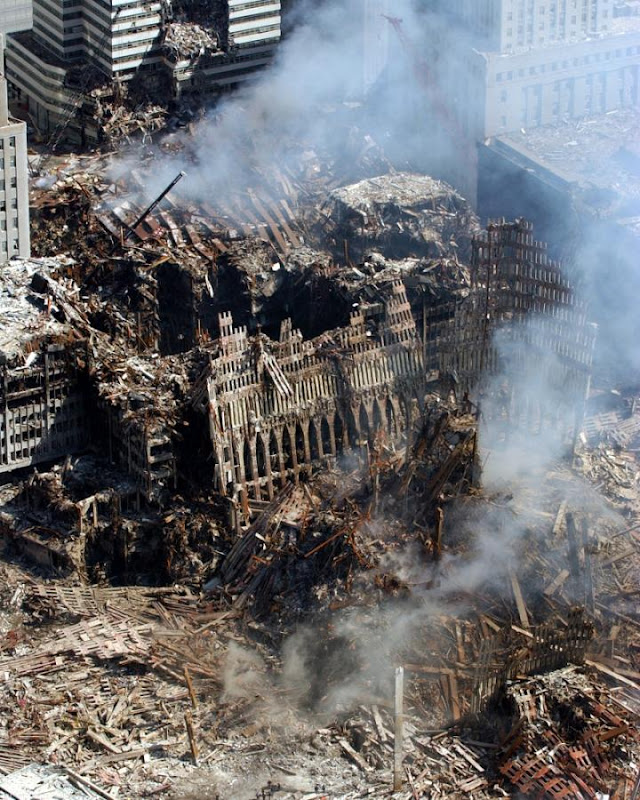
Genelle worked in the Tunnels, Bridges, and Terminals Department of the Port Authority of New York, her office on the 64th. floor of the North Tower at the World Trade Center. It was early on September 11. 2001 and she was making small talk with a co-worker, when she felt the building shake.


At first, she and the others in her office had no idea that an American Airlines passenger jet had just slammed into their building. After a time of indecision and panic, Genelle and the others with her on the 64th. floor, heard a roaring noise, not knowing that it was the sound of the South Tower collapsing.

But that sound was sufficiently terrifying to convince them all that they needed to get out of there. They made their way down the stairs, counting each flight aloud. Firefighters were ascending the stairs as they descended, assuring them that if they kept going down, they would be fine.

By the time the group reached the thirteenth floor, Genelle’s leather-heeled shoes were killing her. As she leaned over to take them off, everything around her seemed to explode in a massive boom!

All Genelle could see was blackness. She felt something hit her chest and then, she was pinned to the ground. As she put it, “One hundred ten floors were coming down around us. I knew I was being buried alive. The noise was deafening.”
Then, things became quiet and Genelle couldn’t believe that she was still alive. Listen to what Genelle says happened next: “I knew then I was going to die. Nobody was going to find me under all the steel and concrete. I started calling out for [my friend] Rosa, but there was no response. Then I heard a man saying, ‘Help, help, help.’ His voice grew fainter, and then there was nothing.

“There in the dark, my mind started racing. I thought of my children, my family, and my fiancé, Roger...More than anything I worried about what would happen to me after I died. I didn’t know how to ask for forgiveness. I was sure I was going to hell.”

Beneath the steel and concrete, Genelle begged for a second chance at life, a second chance to live life God’s way. She floated in and out of consciousness for hour after hour, each time she came to praying for forgiveness and a miracle to help her to deal with the pain.

The next day, still under the rubble of the North Tower, Genelle heard the beeping sound of a truck backing up. She called out and a rescue worker heard her. But even though they shone a light all around and Genelle waved one hand, the only part of her that was free, no one saw her.

Then, Genelle faded from consciousness again. When she awoke, she heard rescue workers somewhere overhead and she prayed, “Please help me now!” She yelled at the workers. Nobody heard her. She desperately waved her hand again and now, somebody grabbed it.

“Genelle,” she heard, “I’ve got you! You’re going to be all right. My name is Paul. I won’t let go of your hand until they get you out.”

Soon, two rescue workers pulled Genelle out and Paul let go of her hand. Genelle was the last survivor to be pulled from the World Trade Center.

She spent five weeks in Bellevue Hospital, amazing the staff with her serenity. More than two years later, when I first read her story, Genelle still hadn’t had a nightmare about those horrible events.

One thing that bothered her though was that she never got the chance to thank Paul for taking her hand and reassuring her there in the rubble. She learned that there was no Paul among the rescue workers who went to Genelle that day. Not one of the crew who took her from the rubble knew of a Paul. Genelle is convinced that God sent an angel at just the right time.

September 11, 2001 began a new life for Genelle. As she puts it, “My life was very different than it had been before. I was amazed by how much God loved me.” She saw herself as a child of God. For the first time in her life, she felt truly free to be the person God designed her to be, the kind of person each and every one of us is designed to be.

Not only had Genelle been rescued; more amazingly still, this young woman who had been totally caught up with herself, with doing things her way, turned from sin and turned to the God we know through Jesus Christ...and got a new life!


Our Gospel lesson for this morning tells us about the proclamation of John the Baptist. John described himself simply as a voice. His voice called people to repentance. To repent means to change our minds about who’s in charge of our lives, to change our minds about our priorities. It really means to change our minds about who our God is.

Genelle had gone through her life before September 11, 2001, with many gods. She had worshiped at the altars of pleasure, good times, and herself, among others.

Under the debris of the World Trade Center, she came face to face with the reality that these things could not bring life nor save her life nor give her life purpose or meaning.

Fortunately for all of us, God long ago sent a rescuer Whose life, death, and resurrection can bring new life and second chances (and third and, if you’re like me, three-hundred thousandth chances) to all who follow Him.

On the first Christmas day, God sent Jesus Christ. Anytime we take His hand and let Him be in control, whether our days bring us trials, triumphs, tedium, tragedies, crosses, or crowns, we have new life.

Many people have the mistaken notion that Christianity is about morality. People tell me, “I like to send my kid to church because he learns the right way to live.”

But the right way to live is no big mystery! Anybody who takes the time to look it up will find that every major religious system in the world says pretty much the same things about morality. They say that loving and living at peace with our neighbor is a good thing, that we shouldn’t steal or take our neighbor’s spouse, and so on.

The problem isn’t that we all don’t know the right way to live. The problem is that we don’t know how to do it.

The sin in our bones keeps us from doing the good we know we should do and that deep down, we want to do.

Jesus Christ came to earth and lived the perfect sinless life, offering Himself as the sacrifice for our sin so that you and I can have his power to do what we cannot do in our own power: Turn from sin and live with God in our lives today and always.

I’ve mentioned it before and I probably will again: Alcoholics Anonymous is one of the most powerful and important movements in our world today. AA and other movements patterned after it, uses a twelve-step process to help people get delivered from their addiction. The first step to freedom for the alcoholic or any other addicted person is the admission that he or she is powerless over the addiction.

Whether she had been rescued from the World Trade Center or not, Genelle Guzman-McMillan took her first step toward freedom when in a desperate and cataclysmic time, she finally told God that she knew she needed Him.

The acknowledgment of our helplessness and our desperate need of the God we meet in Jesus Christ can free us all for really living!

Jesus came into our world not as a great moral teacher, though He was a great moral teacher. Instead, Jesus came to be our God and Savior, the One to Whom we surrender even when we don’t understand, even when we would rather do anything but that which He calls us to do.

Jesus came to save us not only from future death, but also from the dead-end road of self-reliance.

That is a lonely road, something I have to keep learning all the time.

Once a few years ago, I was bellyaching about something to Ann. After listening to this for a while, she finally said, "Mark, ask someone to help you!"

Whether it's asking God for something or asking the people God brings into our lives to help us do the things we can't do on our own, we need to get over self-reliance and learn God-reliance!

When we follow Jesus, we not only walk with God, we also walk with that wonderful group of recovering sinners known as the Church, where God can provide us with the help we so often need in our lives and where we can be the means by which God helps not only other church members, but the whole desperate world.

In the days left until Christmas, as we deal with life’s stresses and the temptation to think that we’ve got to have everything in life under control, every t crossed, every I dotted, every package wrapped, I want to recommend a simple formula for repentance—a formula for turning things around in our lives in a positive way. It comes from Baptist pastor Gerald Mann, but it’s so good he could be a Lutheran. (Just joking!) Here it is:
I can’t. God can. I’ll let Him.
Indulge me and say those three simple phrases with me, won’t you?
I can’t. God can. I’ll let Him.
Jesus came to be our Savior. As we sing the carols and share our gifts this Christmas time, let’s remember, “We can’t. God can. We will let God—and no one and nothing else--be our God!”

[The true story of Genelle Guzman-McMillan is told in Jim Cymbala's book, Breakthrough Prayer.]

Saturday, December 05, 2009

About Those Google Ads

Readers of Better Living will notice that Google ads appear both near the top and at the bottom of each page to which you go here.

Some of the ads promote what I consider fairly "fringie" expressions of Christianity--speculators about the times and particulars of the apocalypse (something Jesus says we have no business doing), pseudo-theologians offering their own unbiblical theories on how Jesus saves us from sin and death, and so on.

I just wanted you to know that I have nothing to do with the advertisers that appear here and their appearance on this blog doesn't denote endorsement.

The ads appear as a result of my participation in the Google AdSense program. Through it, bloggers "earn" a few cents every time readers click on an advertiser's link appearing on their page. So far, as of November last year, after six years of blogging, I'd received $105.78 for the ad traffic generated from this blog. And I don't expect any more income to be generated here until about 2033. (Google only cuts checks once the clicking adds up to $100.)

Admittedly, this is the poor side of the Internet. That's OK.

But remember that just because someone's ad appears here doesn't mean I endorse what they're promoting.

Get Well, Evan Turner!

Here.

Buckeyes, without Turner, face Butler next Saturday. They barely lost to Clemson today.

Help Tim Vogel Climb Carew Tower

My friend and former parishioner, Tim Vogel, is climbing Carew Tower in Cincinnati once more this year to raise money for the Lung Association. Please pledge for Tim's climb for this important cause. Thanks!

God, Help Me to Desire YOU More Than Anything This Christmas

Good words from Julie Ackerman Link.

In reading Link's devotional piece, some will undoubtedly say--as I was inclined to say as I read it, "Hey, I'm not a kid. I don't want presents and candy for Christmas."

We might say, "I just want a safe gathering with my family." Or, "I want everybody to get along." Or, "I want the kids to have nice Christmases." (The latter sentiment often accompanied by the old saw, "After all, Christmas is for kids.")

But if our goals for this Christmas are safe, happy gatherings of family, conviviality, or happy children, we're aiming way too low!

(And if we think that "Christmas is for kids," we really don't get it at all.)

Christmas, that humanly created blip on the calendar, is meant to be a reminder of the thing we should most desire, not just at Christmas, but always. That's God.

On the first Christmas, whatever time of the year it actually happened, God entered into our world to give Himself to us. Jesus is not just truly human, but truly God. We Christians are remembered to how He gave Himself to us and for us every time we receive His body and blood in Holy Communion. ("This is My body, given for you...This is My blood, shed for you.")

We're called to desire the presence of God in our lives--in every part of our lives--not because God is some egomaniac. It's because without God, we are incomplete. It's because without God, we don't have God's life in us. It's because without God, we don't have the capacity to become the people God designed us to be and our relationships can't be powered by His self-giving love.

For Christmas this year, and for every day of my life, I'm asking God to help me to desire one thing above all else--more than comfort, ease, freedom from difficulties, or anything else. I want to be a person who desires God above all else.

Work in my desires, Lord Jesus, to make You and Your glory the object of all my desires. Amen

Wednesday, December 02, 2009

Mary, the Faithful Disciple

[This was shared during tonight's Midweek Advent Worship at Saint Matthew Lutheran Church in Logan, Ohio.]

Luke 1:26-38
Mary might well have wondered if she’d lost her mind. After all, how many times have you seen an angel? And how many virgins have babies?

She could be excused maybe, for writing off her entire experience with the angel Gabriel as a figment of her imagination. Or, to have treated the angel’s message with the kind of skepticism with which Zechariah, the husband of Mary’s relative, Elizabeth, treated Gabriel’s message to him that he and Elizabeth would have a son. Yet Mary believed.

She might also be excused for being more than a bit resentful. A young woman—a girl, really—who had not consummated her arranged marriage to Joseph, the Nazareth fix-it man, Mary knew that once her pregnancy became known, she would probably be dragged outside her small town and stoned to death. Yet Mary believed.


We know that Mary was not always the perfect disciple. As Jesus grew older, she allowed herself to forget that Jesus did not belong to her. No child really does belong to a parent, of course. Parents must grow to accept that. But for Mary, such acceptance must have been especially difficult. When he was twelve, Jesus became separated from the family during a trip to Jerusalem. Mary was frantic. But when she finally caught sight of Jesus in the temple and asked Him why He had so troubled Joseph and her, Jesus replied simply, “Didn’t you know that I would be here in my Father’s house?”

And later, when people were following Jesus, many of them whispering threats and calling Him blasphemous, Mary, in spite of what she knew about Jesus, tried to tell folks not to listen to Him. Jesus had lost His mind, Mary and her children told the crowd in a bid to spring Jesus loose and to bring Him back to safety in Nazareth. But Jesus said that His real family was anyone who believes in Him as God and Lord.

Of course, Mary knew that. And I have to say that for me personally, it’s Mary’s lapses in faith that make her so compelling, such a role model. I have lapses in faith, too, times when I say and do things that run contrary to the Lord I believe in, contrary to the life of faith He has called me to live.

But by God's grace, I'm thankful that God gives more credence to my faith than to my many lapses. Mary helps me to know that's true.

And it should be said that incidents like the ones I named from Mary's life were only lapses in her faith. From the moment she learned from Gabriel about the role she was to play in God’s plans for the world’s salvation, through witnessing her son’s death on a cross and His resurrection, despite the lapses, she remained faithful. Through joy and heartache, doubt and glorious affirmation, Mary was a faithful disciple.

The Eastern Orthodox and Eastern Catholic Christian traditions have a title for Mary. They call her theotokos, a Greek compound word that means literally, Bearer of God. Mary bore Jesus more than just in her womb for nine months.

She bore Him, the mark of Him, in some way her entire life. In this too, she is a model for each of us. We who, as baptized Christians have been sealed by the Holy Spirit and marked with the cross of Christ forever, bear the Name of Jesus. We carry Him into our everyday lives and relationships. That isn’t always an easy load, something Jesus recognizes when He tells us that we must take up our crosses and follow Him. But the Lord we carry with us also carries us, a far heavier burden that began when He went to the cross and bore all our sins. And those who dare to take Christ with them through their life’s journeys also receive guidance, peace, and an eternity of hope that nothing can destroy. Bearing Christ lightens the loads of life!

Whatever God may call you and me to be or do, I pray that we will be found as faithful as that young Judean girl was when met by the angel Gabriel. May we willingly say, “Here am I; the servant of the Lord; let it be with me according to your word.” Amen

The Evil One Cannot Overpower Us

The Christian can walk and live in the certainty that Christ is beside us and the Holy Spirit fills us with power to resist temptation and self-destruction. Every time I sin, it represents a failure on my part to place some aspect of my life under Christ's Lordship. Every time I resist temptation, it represents a triumph of Jesus Christ over all that would do me everlasting harm. This is why a commitment to living in "daily repentance and renewal" is central to the life of a Christian.

You might be interested...

if you're a member of the Evangelical Lutheran Church in America (ELCA) like me, in the online town hall that presiding bishop Mark Hanson has scheduled for December 6. It will be interesting to hear the questions raised by people from throughout the church body.

Tuesday, December 01, 2009

Right or Wrong, This is to Be Admired About Policy Obama Announces Tonight


In the epilogue to his book, Presidential Courage, Michael Beschloss recalls that five years before being elected President, John Kennedy lamented that US politics had become "so expensive, so mechanized and so dominated by professional politicians and public relations men...[And further, because of] the tremendous power of mass communications, any unpopular or unorthodox course [aroused] a storm of protest." These conditions, Kennedy suggested, put a higher price on political courage than at any time in our country's history, with the prospects of political annihilation for those who showed a willingness to stake out different points of view becoming almost prohibitively high.

Some would argue that Kennedy may have believed more in political courage than he practiced it, especially when it came to civil rights, a cause about which he was either indifferent or tepid through most of his political career. But the forces Kennedy saw diminishing a political actor's willingness to chart a course irrespective of what opinion polls, focus groups, radio call-in audiences, special interests, or political operatives may tell them have not diminished in power or influence in the past fifty-four years. (The Internet and cable news, among other things were not part of the stew identified by Kennedy. But they have made his insight even more acute.)

Truth be told, the US electorate has a schizophrenic attitude about political courage. We want, so we say, for our political leaders to have backbone and to not make decisions based on the latest public opinion surveys, but on what's "right." These are the kinds of things ordinary voters say all the time.

Yet we also seem to want our leaders to be milquetoasts or automatons who mechanistically reflect our opinions, well-informed and otherwise.

This leads to 1984-style characterizations of popular pols as courageous, although their actions rarely buck popular opinion, and of politicians who dare to do what they think right as being weak, vacillating, or indecisive. You can supply your own examples for each category and if you're fair, I think you'll concede that examples of both inaccurate assessments run the political gamut. Our schizophrenia is reliably non-partisan.

No wonder political courage is so rare. And its rarity is part of what makes President Barack Obama's speech on Afghanistan tonight so important.

Whatever one's take on the strategy he will unveil this evening--I offer no opinion on that, he is displaying remarkable political courage.


That may not ring true to some at first. After all, the strategy the President will unveil tonight is consistent with what he said he would do during last year's presidential campaign, a campaign he won resoundingly. Obama said he would wind things down in Iraq. The real fight against al-Qaeda, he also said, was on the border between Afghanistan and Pakistan, where the fight would need to be ramped up. With those pledges as part of his platform, Obama was given the presidency.

But in the intervening time, a core constituency of the President's own party, liberal Democrats, have become disenchanted with any US presence in Afghanistan. And the American people have grown more restless to leave the Afghans (and the Pakistanis) to fend for themselves.

Some Republicans have claimed that Obama has been "dithering" on Afghan policy and some in the opposition party have said that Obama should not cut down on General Stanley McCrystal's troop level request.

Tonight, Barack Obama is going to tell a nation weary of war that we must undertake an increased burden in a nation where US personnel have been fighting and dying for eight years.

Give the President his due. This isn't just a hard speech to make; it was preceded by a tough decision made in spite of a clear understanding that, because nothing is a given in this life, the war could turn out badly. And, less significantly, it could make Obama a one-term president. The policy Obama announces tonight could scuttle all his lofty aims.

Yet, in the face of the opposition and the odds, Barack Obama, based on his discussions with military and civilian advisers, is forging ahead with his proposed escalation of the war in Afghanistan.

Whether Obama's decision turns out to be right or wrong, a success or a failure, he is exhibiting political courage.

How history will remember Obama's courage depends on how things turn out. The second line in Beschloss' book hints at that:
...throughout our history, at times of crisis and urgent national need, it has been important for Presidents to summon the courage to dismiss what is merely popular--and the wisdom to do that for causes that later Americans will come to admire.

The only political courage subsequent generations will admire, Beschloss seems to say, is that which results in what is perceived as success. No points are given for being courageously wrong. I want to disagree with that; courage should be counted as courage irrespective of outcomes.

Yet this is the high stakes game which Barack Obama is knowingly playing. The politician submits her or his life not only to the judgment of contemporary electorates, but of history. My personal experience is that most politicians like--sometimes love, sometime crave--being liked, affirmed, appreciated, cheered.

Courage for politicians happens when they risk losing votes and the adulation of history to do what they think is right.*

The President has little to gain and much to lose from the policy he announces tonight. Right or wrong, that takes courage.

*Actually, this is true for any leader. After twenty-five years as a pastor, I can tell you that it takes more courage to take a stand you know some will repudiate than to do anything that gains universal applause. But I also can say that, for all the turmoil taking a stand may cause, there is more inner peace and clarity of action when you go the courageous route. I have to also say that, for me, courage is something I draw from God and not any intestinal fortitude I may (or may not) possess.

Monday, November 30, 2009

The only valid ticket...

to eternity and a knowledge of God. (Funny this piece talks about the same Scriptural passages I mentioned yesterday here. Coincidence? Nah, God-incidence.)

Sunday, November 29, 2009

Swiss Voters Ban Minarets: Not the Way to Go for Christians

Minarets, the tall spires which often top mosques, have been banned by Swiss voters.

Supporters of the ban say that minarets represent extremism. Opponents say that the ban is a violation of Muslims' freedom of religion.

As a Christian, I believe Jesus when He says, “I am the way, and the truth, and the life. No one comes to the Father except through me" (John 14:6).

I believe the apostle Peter when he says of Jesus, "There is salvation in no one else, for there is no other name under heaven given among mortals by which we must be saved" (Acts 4:12).

So, it distresses me every time I see a mosque or shrine of any other religion. I desperately yearn (and pray) that all people will come to know God through Jesus Christ, repent of sin, and believe in Him as God and Savior.

But banning minrets is no different from banning churches, synagogues, or temples. Unless all people are free to practice the religion of their choice, no choice they make will have any meaning. Banning public displays of religious belief drives it underground and can breed the resentment that leads to the kind of radicalism that the proponents of this ban claim to want to thwart.

At one level, as a Christian, distressed though I may be at the sight of minarets here in my country, I can also be somewhat heartened by them. They display an impulse or desire for God that, I believe, can lead to Jesus Christ and everlasting life.

For this sentiment, I take inspiration from the first-century preacher and evangelist, Paul. When he entered the city of Athens toward the middle of the first century, he saw a town that was, not Christian, but deeply religious. The New Testament book of Acts says that Paul "was deeply distressed to see that the city was full of idols." Idols, of course, are false gods. They're lifeless and incapable of giving the life that only the God revealed in Jesus Christ can give.

But, later when Paul spoke with the Athenians about Christ, he began by saying, "I see how extremely religious you are in every way. For as I went through the city and looked carefully at the objects of your worship, I found among them an altar with the inscription, 'To an unknown god.' What therefore you worship as unknown, this I proclaim to you. The God who made the world and everything in it, does not live in shrines made with human hands, as though he needed anything, since he himself gives to all mortals life and breath and all things..." Paul went on to explain to the Athenians who had an impulse to reach out to and be known by the transcendent, that in Jesus Christ the God of the universe had reached out to humanity, gone to a cross for our sins, and risen from the dead to give new and everlasting life with God to those who dare to trust in Jesus. (See Acts 17:16-34.)

Minarets distress me. As do the words of those who, as was once true of me, profess to be atheists. But denying people freedom of religion or freedom of speech is not the way to ensure the peaceful assimilation of peoples into societies.

Nor, from a Christian perspective, is it the way to turn people toward peace with God and peace with others through Christ, the desire of every Christian as well-expressed once by Paul when he stood before a king on the charge of being a Christian. When Paul used his appearance before the king as an occasion to share his faith in Christ, the king asked, "Are you so quickly persuading me to become a Christian?" I love Paul's answer, which I've referenced many times on this blog: "Whether quickly or not, I pray to God that not only you but also all who are listening to me today might become such as I am [a believer in Jesus Christ]-except for these chains." (Acts 26:28-29)

Christians should have no part in repressing people in any way. We want all people to be free to discover Jesus Christ through our faithful, peaceful, loving, and non-coercive witness for Him.

Banning minarets in Switzerland, or anywhere else, can never come to a good end.

Come, Lord Jesus: How to Face the End (Of the World or Your Earthly Life)


[This message was shared during worship with the people of Saint Matthew Lutheran Church in Logan, Ohio, this morning. Today is the First Sunday in Advent.]


Luke 21:25-36
I once read a news story about a young graduate assistant at MIT who was developing what he called, “memory glasses.” Richard W. DeVaul said that he himself could often work for long hours, forgetting to eat or keep appointments. His memory glasses, consisting of a small computer display clipped onto eyeglass frames and hooked up to a small computer, were designed to flash little reminders to the wearer. DeVaul’s “wearable computer” is intended to send subliminal messages or images to wearers, providing them with private reminders.*


Based on his personal experience, DeVaul apparently thinks that we all need help in remembering not to get so caught up in the urgent matters that scream for our attention that we forget what’s important. I think that he's right. A few signs–subliminal or otherwise–pointing us in the right direction each day would be really helpful!

In today’s Gospel lesson, an example of a type of Biblical literature which the Bible scholars call, apocalyptic, from the Greek verb, apocalupto, meaning I reveal, Jesus talks with us about signs, things going on around us that ought to live as His followers in everyday life.

Specifically, Jesus talks about the signs of the end of the world. He begins by telling us: “There will be signs in the sun, the moon, and the stars, and on the earth distress among nations confused by the roaring sea and the waves. People will faint from fear and foreboding of what is coming upon the world, for the power of the heavens will be shaken...”

When the world goes nuts,

When family incomes are drained and jobs are scarce,

When Army psychologists open fire on military personnel preparing to go overseas,

When terrorists perpetrate violence on innocent people,

When seemingly incurable diseases victimize family and friends,

When people are subjected to mistreatment or violence unjustly,

it’s easy to faint from fear and foreboding.

But Jesus warns us to be on our guards, "...so that your hearts are not weighed down with dissipation [that’s spending time on wasted, worthless efforts] and drunkenness and the worries of this life..."

Instead, Jesus says that we should regard all of the rotten, hard things that happen in this world as signs of His return at the end of the world.

For most people, talk about the end of the world or about the ends of our own lives on earth is frightening. In the face of life’s difficulties, as Jesus says, people faint from fear and foreboding or get caught up in meaningless activity, in anesthetizing themselves with dope or booze, or in allowing themselves to be overwhelmed with worry. They read the headlines or consider the adversities that they themselves face and hang their heads in despair.

We need not do that!

A few weeks ago, I read another full account of a dangerous secret trip taken by our president. Not even his wife or family knew that he was going away to a secret destination, right in the midst of dangerous enemies. You may think I’m talking about former President Bush’s trip to Baghdad on Thanksgiving Day several years ago. But I’m talking about an account of President Franklin Roosevelt’s secret trip to Newfoundland to meet with British prime minister Winston Churchill in the summer of 1941, which I read about again in Jean Edward Smith’s biography of Roosevelt.

Both Roosevelt and Churchill took voyages by sea in waters filled with menacing German submarines. The ship which Churchill took to their summit would, just a few months later, be sunk by the Germans.

The point is that the world was dangerous and prone to craziness sixty-five years ago. The world is dangerous and prone to craziness today. Nothing has changed.

In another place in the Bible, Jesus spoke of the signs of the end of life on this planet and of His return and said that each and every one of them had already happened. So, people who wring their hands and try to outguess God about when Jesus will return are wasting their time, wasting their lives!

Jesus says that the turmoil of the world presents us with signs that point to the inevitable fact that life on this planet will end and that our lives on this planet will end.

Jesus also says that we should see these signs as subliminal prompts, cuing us to adopt a different way of living.

Most of the human race will fall prey to worry or fear or drunkenness or dissipation. But Jesus tells those who trust in Him not to lose heart or hang our heads.

He says: "Now when these things begin to take place, stand up and raise your heads, because your redemption is drawing near."

When things look bleak or frightening, Jesus says, “Buck up. I’m right here! And no matter how things may look right now, I have everything under control!”

He had been standing for three hours in the frigid Michigan winter night, trying to hitch a ride home to his wife and kids in Royal Oak. The wind howled. Snow billowed around him. He was a service man. Originally tapped for Christmas leave, he’d gotten into a drunken brawl that got him confined to his base through the holidays.

Then a buddy’s parents surprised him, traveling to be nearby for Christmas. Since it was going to be easy for the buddy to see his folks, he went to their commanding officer and volunteered to take the Michigander’s place.

That raised a whole new problem. You see, the soldier from Michigan had spent all his savings on gifts for his wife and three children, having planned on shipping them north. He couldn’t afford bus or train fare. The only way he could get back home was to stuff the presents into a duffel bag and hitchhike. Everything had gone pretty well until that three hour wait in the snowstorm.

A single preacher in a Corvette was barreling along too quickly for the road conditions, heading home to see his parents and family, the car filled to near-capacity with goodies. He saw the forlorn soldier, looking like an abominable snowman in khaki green, hitching on the side of the road. He told himself that somebody else would pick the guy up and that if he turned around now, he’d find the soldier gone. But he felt as though God was telling him that at least on Christmas Eve, he should be willing to share Jesus’ love with a stranger.

So, begrudgingly, he turned around and though it required some packing and arranging, got the hitchhiking soldier and duffel bag into his car. After the soldier had thawed out a bit, he asked the preacher, “Didn’t I see you go by earlier?” “Yes.” Why, the soldier wondered then, had he turned back around?

The preacher explained that while he hadn’t wanted to turn around and come back “it’s Jesus Who makes me do things like that,” things that He was certain Jesus would do if He were faced with the same circumstances.

The soldier explained how convicted he felt by that. He then told the story of how he had come to be hitchhiking on that frozen stretch of road on Christmas Eve. He explained that he’d planned on surprising his family. He talked about what a wonderful woman his wife was, a devoted follower of Jesus who was brokenhearted over her husband’s unwillingness to let Christ into his life. He often poked fun at his wife’s faith and her church-going.

The longer he’d stood by the side of the road, the soldier said, the angrier he became at all the people who passed by. He became even angrier when he thought that a lot of the people zooming past were Christians. He thought of what hypocrites all Christians were, but also thought that if he were in their places, he’d probably drive on by too.

Then the soldier said: “Let me tell you something embarrassing—I got so cold, so lonely, and so desperate that I started to pray—honest to God I did—it was so humiliating. I told God that if He would help me, I’d do better. And you know what? About that time you showed up, and you told me that you came back because of Jesus—now what do you make of that?”

Thirty-five years later, John William Smith, the once-young pastor driving in the Corvette, wrote: "Jesus comes to us in many ways. He came to me in the form of a freezing soldier trying to get home for Christmas. He came to a freezing soldier in the form of a young minister trying to find his way to God. Either one of us could have missed Him."

Jesus says that even before the end of time--even before we die and pass into His presence, He wants to come to us. And He doesn’t want to come to us just at Christmas time, but every moment of our lives.

The turmoil of the world and the challenges of our lives can be reminders of our need to welcome Jesus to walk with us, to guide us, to be our God, to be our King.

I know that the next few weeks will be busy for us all. Last-minute shopping, visits with family and friends, extra social engagements. We all have them.

But these next weeks, with all their activity, are also a great time for you to do what that soldier did on that cold Christmas Eve—ask Jesus to help you and to be with you.

Let the signs of the times prompt you to enjoy a close relationship with the God we know through Jesus Christ.

When we let Christ into our daily lives, we’re prepared to handle all that life may bring.

We’re prepared for living.

We’re prepared for dying.

We’re prepared for the moments when we will come face to face with Christ.

And when we keep close to Christ, we’re also prepared to do something most of our frantic, fearful, feverish world can’t even imagine: With Jesus beside us, we’re prepared to have a truly joyous and merry Christmas.

*DeVaul and others at MIT are working on lots of other wearable computing devices, which you can read about here.

[Top picture: A CBS News photograph of Richard DeVaul and his memory glasses. Bottom picture: Cerezo Barredo's wonderfully hope-filled representation of Luke 21:25-36.]