This is going way back, Audio Adrenaline with 'Never Gonna Be As Big As Jesus.' Tough on the human ego, though without a Savior Who is also God, we'd have no hope!
Tuesday, August 12, 2014

For We Ordinary Folk, God Can Be 'Hard to Get'
Rich Mullins did this demo for a song he intended to include in what he was calling The Jesus Record. Tragically, he died in 1997, before undertaking the project. But I love this raw recording, just Rich and his guitar, made shortly before his death.
It expresses the questions every person of faith poses about why suffering comes to us, why seemingly harmless, wholesome desires go unmet, where God is when all is darkness.
Christians don't run from such questions, of course, and must seek the Holy Spirit's power to live each day with the mysteries, ambiguities, and tragedies of this life, trusting that the God Who stepped into our world and bore suffering and death on our behalf, will be with us through the darkness and one day share His resurrection light with us. It isn't easy and it truly can't be done without God's help.
I know that I've shared this song on the blog before. But I love it. And it just seems so right today.
It expresses the questions every person of faith poses about why suffering comes to us, why seemingly harmless, wholesome desires go unmet, where God is when all is darkness.
Christians don't run from such questions, of course, and must seek the Holy Spirit's power to live each day with the mysteries, ambiguities, and tragedies of this life, trusting that the God Who stepped into our world and bore suffering and death on our behalf, will be with us through the darkness and one day share His resurrection light with us. It isn't easy and it truly can't be done without God's help.
I know that I've shared this song on the blog before. But I love it. And it just seems so right today.
Sunday, August 10, 2014
What the Bible Is
The Bible is one long story of God meeting our rebellion with His rescue, our sin with His salvation, our guilt with His grace. #OneWayLove
— Tullian Tchividjian (@PastorTullian) August 10, 2014
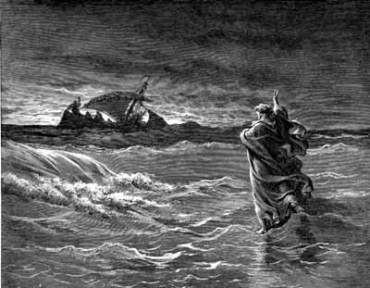
Jesus Walking on the Water...More Than a Neat Trick
[This was shared during worship with the people and guests of Living Water Lutheran Church in Springboro, Ohio, this morning.]
Matthew 14:22-33
The incident recounted in today’s gospel lesson, in which Jesus walks on water, is well known to Christians and non-Christians alike. Something about thinking of Jesus treading across the waves captures people’s imaginations. And in this lesson, we also identify with Jesus’ disciple, Peter, whose name, meaning Rock, never seemed more appropriate than the moment we read that, after taking a few steps on the water, he sank like a stone and had to be fished out by Jesus.
But as was true of last week’s gospel lesson, when we considered how Jesus fed more than 5000 people with a few fish and scraps of bread, as we read this lesson, we need to move beyond the superficial and seek some answers to some basic questions:
Jesus walking on the water is a neat trick, but what exactly does it mean for us today?
What truths for our lives can we garner from this incident?
There are, I think, at least four things to remember from today’s lesson that will help us today and beyond.
Take a look at the gospel lesson, Matthew 14:22-33, please.
It begins: “Immediately Jesus made the disciples get into the boat and go on ahead of him to the other side, while he dismissed the crowd.”
This happened right after the miraculous feeding. You’ll remember that that incident came about after Jesus had gone off to be by Himself to pray following the execution of His cousin, John the Baptist. Jesus had made Himself available to bring healing to those in need of it and, towards nightfall, to feed the hungry people.
But now, it seems, Jesus has completed His work for the day. He needs to spend time with His Father. Doing so will help Him to continue on the course He had come into the world to run, the course that would take Him, sinless God and man, to die on a cross, to bear our punishment for sin, then on to the resurrection so that all who turn from sin and believe in Him as their only God may have ever new, eternal life with God.
Matthew says that Jesus "made" the disciples get on a boat and go. The word translated as made is literally compelled. To be compelled is to be forced, as when my dad compelled me to go to bed at night. When one more powerful than you compels you to do something, there is no second guessing. There are no courts of appeals.
Just as forcefully, Jesus dismissed the crowd. Jesus has healed them. He has fed them. Now, even though the night is blacker than ink, it’s time for the crowd to go and for Jesus to face the next phase on His journey to cross and empty tomb.
So, from the beginning of the lesson, we see Jesus, the One Who by the touch of His hand was able to reverse the disease and death and deterioration that comes to us all in the fallen world and was able to spread a table for hungry thousands, as being totally in charge. That’s the first thing to remember in today’s lesson: Jesus is totally in charge. Even today, this moment.
Now, you might expect that this reality--the reality of Jesus being in charge in spite of all the grim and harsh challenges of this world--would have been permanently engraved on the consciousness of the disciples after they’d seen Jesus heal and feed all those people. But it turns out that those disciples are as thick-headed and unwilling to trust in God as I know I sometimes can be...and that you sometimes may be.
Take a look, please, at verses 23 and 24: “After he had dismissed them, he went up on a mountainside by himself to pray. Later that night, he was there alone, and the boat was already a considerable distance from land, buffeted by the waves because the wind was against it.”
Two scenes, one tranquil, one chaotic. Jesus praying alone to His Father. The disciples out riding the waves through a storm. And despite their expertise as fishermen who had plied these waters many times, they appear to be helpless before the buffeting wind.
A few weeks ago, I mentioned that in Matthew’s gospel, the word house often stands as a symbol for the Church. In this image, the Church is the household of God gathered for worship, gathered to receive God’s healing Word, and gathered to be fed on the body and blood of our Lord. The life of the gathered Church is sort of like what happened when Jesus gathered those thousands together to feed them on His grace and love and power.
But you should also know that Matthew often uses the term boat to symbolize the Church--ordinary believers like you and me--moving out into the world. The disciples riding in the boat with fear and trepidation are just like you when you're facing tough choices on Monday mornings, struggling to keep your lives and your finances together, struggling to maintain relationships, fighting almost to simply get through day to day life. It can be a stormy, rough ride out there outside the safe confines of the household of faith.
And, these two scenes--Jesus praying, the disciples struggling--serve as a good picture of how we may sometimes forget that even when we struggle, all who trust in Jesus Christ as their God and King have Someone Who, though we cannot see Him, is praying for us to His Father. That’s part of what it means for us to pray in Jesus‘ Name. We earnestly invoke the help of the One Who died and rose to set us free from sin and death. When we pray in Jesus' Name, He takes our case the Father and puts in a good word for us. Jesus had not forgotten the disciples and He never forgets you. That’s the second thing to remember from today’s lesson: Jesus will never forget you, no matter how rough the ride may get.
Look again at our lesson, starting at verse 25: “Shortly before dawn Jesus went out to them, walking on the lake. When the disciples saw him walking on the lake, they were terrified. ‘It’s a ghost,’ they said, and cried out in fear. But Jesus immediately said to them: ‘Take courage! It is I [literally, in the Greek in which the New Testament is written, Jesus says, “Ego eimi,” not “It is I,” but “I AM,” identifying Himself with the same name by which God identified Himself to Moses in the Old Testament, “Yahweh” in the Hebrew, “I AM.” “It is I.”] Don’t be afraid.’”
Now, what so interests me here is that Jesus didn’t stop the wind and the waves. Instead, He told the disciples not to be afraid of them. I often pray that the storms of my life will go away. And there’s nothing wrong with that. But some of the storms that come to us--and I said only some--are allowed to enter our lives by God. Other storms are the inevitable outcroppings of a planet writhing in sin and death. But whatever the source of my life's storms, maybe I ought to learn to pray not only that God will take away the storms, but also that God will give me strength to go through them.
On the night before His arrest, Jesus prayed that He wouldn’t have to go through suffering and death on the cross. An understandable prayer. Jesus didn't want to go through the storm! But Jesus also prayed, “Nonetheless, not My will, but Your will be done.” It was only through the storm of His cross that Jesus could fulfill His mission of bringing life to people like you and me who would otherwise stand naked in our sins on judgment day and be eternally separated from God.
God loved and appreciated a man named Job, whose story is told in the Old Testament. Yet God allowed Job to undergo a ferocious storm of grief and loss that is almost painful to read about. But from his storm, Job emerged with a stronger faith.
In a world groaning under the power of sin and death, storms are inevitable in this life. But--and this is the third big lesson I draw from this incident--Jesus, I AM, God enfleshed, can give us peace in the midst of the storms.
With Psalm 46:2-3, we can say that the God we know in Jesus Christ is our ever-present refuge, “...we will not fear, though the earth give way and the mountains fall into the heart of the sea, though its waters roar and foam and the mountains quake with their surging.”
Please look at what comes next, starting at verse 28: “Lord, if it’s you,’ Peter replied, ‘tell me to come to you on the water.’ ‘Come,’ he said. Then Peter got down out of the boat, walked on the water and came toward Jesus. But when he saw the wind, he was afraid and, beginning to sink, cried out, ‘Lord, save me!’ Immediately Jesus reached out his hand and caught him. ‘You of little faith,” he said, ‘why did you doubt?’”
I hope that we can be charitable to Peter. He sees Jesus walking on the water and He really believes that Jesus can empower him to do the same. He trusts. But His trust is weak. My guess is that many of us here this morning can say the same thing: "We trust; our trust is weak."
But, if in his falling into the water, Peter is a representative of us and our faulty faith, in what happens after he falls, Peter is a model for us and our faith. He cries out, “Lord, saves me.” Peter’s faith, like ours, may have been of the stumbling, imperfect variety. But he could say with another of the Old Testament songs of worship, Psalm 121:1-2: “I lift up my eyes to the mountains—where does my help come from? My help comes from the Lord, the Maker of heaven and earth.”
When we realize that our situation is hopeless--that we confront situations we can’t conquer or comprehend that our sins threaten to condemn us to hell and to separate us from God forever, we can cry out simply to God.
This was a lesson that Peter was to learn well. Fifty days after Jesus rose from the dead, Peter spoke to a crowd of thousands who realized that they had been trying to live their lives--in effect, trying to walk on water--without God, without the saving help that God the Father sent Jesus, God the Son, to bring to us.
They were drowning in sin and hopelessness.
But Peter tells the crowd in Acts 2:21: “Everyone who calls on the Name of the Lord will be saved.”
And that is the fourth major thing I want to hold up today. Whether it’s from eternal separation from God, a lifetime of purposelessness, or a gnawing sense of insecurity that keeps you feeling less than the child of God you are, you (and I) need to do the same thing: Call on the Lord and we will be saved.
No matter the storms that confront us in this life, Jesus is totally in charge.
Jesus will never forget you.
Jesus--and only Jesus--can give you peace even in the midst of storms.
And when we call out to Jesus, we are saved.
It’s these truths that might well cause us after Jesus has brought us through another storm to, like the first disciples, worship Jesus and say with them, “Truly, You are the Son of God.” Amen
Matthew 14:22-33
The incident recounted in today’s gospel lesson, in which Jesus walks on water, is well known to Christians and non-Christians alike. Something about thinking of Jesus treading across the waves captures people’s imaginations. And in this lesson, we also identify with Jesus’ disciple, Peter, whose name, meaning Rock, never seemed more appropriate than the moment we read that, after taking a few steps on the water, he sank like a stone and had to be fished out by Jesus.
But as was true of last week’s gospel lesson, when we considered how Jesus fed more than 5000 people with a few fish and scraps of bread, as we read this lesson, we need to move beyond the superficial and seek some answers to some basic questions:
Jesus walking on the water is a neat trick, but what exactly does it mean for us today?
What truths for our lives can we garner from this incident?
There are, I think, at least four things to remember from today’s lesson that will help us today and beyond.
Take a look at the gospel lesson, Matthew 14:22-33, please.
It begins: “Immediately Jesus made the disciples get into the boat and go on ahead of him to the other side, while he dismissed the crowd.”
This happened right after the miraculous feeding. You’ll remember that that incident came about after Jesus had gone off to be by Himself to pray following the execution of His cousin, John the Baptist. Jesus had made Himself available to bring healing to those in need of it and, towards nightfall, to feed the hungry people.
But now, it seems, Jesus has completed His work for the day. He needs to spend time with His Father. Doing so will help Him to continue on the course He had come into the world to run, the course that would take Him, sinless God and man, to die on a cross, to bear our punishment for sin, then on to the resurrection so that all who turn from sin and believe in Him as their only God may have ever new, eternal life with God.
Matthew says that Jesus "made" the disciples get on a boat and go. The word translated as made is literally compelled. To be compelled is to be forced, as when my dad compelled me to go to bed at night. When one more powerful than you compels you to do something, there is no second guessing. There are no courts of appeals.
Just as forcefully, Jesus dismissed the crowd. Jesus has healed them. He has fed them. Now, even though the night is blacker than ink, it’s time for the crowd to go and for Jesus to face the next phase on His journey to cross and empty tomb.
So, from the beginning of the lesson, we see Jesus, the One Who by the touch of His hand was able to reverse the disease and death and deterioration that comes to us all in the fallen world and was able to spread a table for hungry thousands, as being totally in charge. That’s the first thing to remember in today’s lesson: Jesus is totally in charge. Even today, this moment.
Now, you might expect that this reality--the reality of Jesus being in charge in spite of all the grim and harsh challenges of this world--would have been permanently engraved on the consciousness of the disciples after they’d seen Jesus heal and feed all those people. But it turns out that those disciples are as thick-headed and unwilling to trust in God as I know I sometimes can be...and that you sometimes may be.
Take a look, please, at verses 23 and 24: “After he had dismissed them, he went up on a mountainside by himself to pray. Later that night, he was there alone, and the boat was already a considerable distance from land, buffeted by the waves because the wind was against it.”
Two scenes, one tranquil, one chaotic. Jesus praying alone to His Father. The disciples out riding the waves through a storm. And despite their expertise as fishermen who had plied these waters many times, they appear to be helpless before the buffeting wind.
A few weeks ago, I mentioned that in Matthew’s gospel, the word house often stands as a symbol for the Church. In this image, the Church is the household of God gathered for worship, gathered to receive God’s healing Word, and gathered to be fed on the body and blood of our Lord. The life of the gathered Church is sort of like what happened when Jesus gathered those thousands together to feed them on His grace and love and power.
But you should also know that Matthew often uses the term boat to symbolize the Church--ordinary believers like you and me--moving out into the world. The disciples riding in the boat with fear and trepidation are just like you when you're facing tough choices on Monday mornings, struggling to keep your lives and your finances together, struggling to maintain relationships, fighting almost to simply get through day to day life. It can be a stormy, rough ride out there outside the safe confines of the household of faith.
And, these two scenes--Jesus praying, the disciples struggling--serve as a good picture of how we may sometimes forget that even when we struggle, all who trust in Jesus Christ as their God and King have Someone Who, though we cannot see Him, is praying for us to His Father. That’s part of what it means for us to pray in Jesus‘ Name. We earnestly invoke the help of the One Who died and rose to set us free from sin and death. When we pray in Jesus' Name, He takes our case the Father and puts in a good word for us. Jesus had not forgotten the disciples and He never forgets you. That’s the second thing to remember from today’s lesson: Jesus will never forget you, no matter how rough the ride may get.
Look again at our lesson, starting at verse 25: “Shortly before dawn Jesus went out to them, walking on the lake. When the disciples saw him walking on the lake, they were terrified. ‘It’s a ghost,’ they said, and cried out in fear. But Jesus immediately said to them: ‘Take courage! It is I [literally, in the Greek in which the New Testament is written, Jesus says, “Ego eimi,” not “It is I,” but “I AM,” identifying Himself with the same name by which God identified Himself to Moses in the Old Testament, “Yahweh” in the Hebrew, “I AM.” “It is I.”] Don’t be afraid.’”
Now, what so interests me here is that Jesus didn’t stop the wind and the waves. Instead, He told the disciples not to be afraid of them. I often pray that the storms of my life will go away. And there’s nothing wrong with that. But some of the storms that come to us--and I said only some--are allowed to enter our lives by God. Other storms are the inevitable outcroppings of a planet writhing in sin and death. But whatever the source of my life's storms, maybe I ought to learn to pray not only that God will take away the storms, but also that God will give me strength to go through them.
On the night before His arrest, Jesus prayed that He wouldn’t have to go through suffering and death on the cross. An understandable prayer. Jesus didn't want to go through the storm! But Jesus also prayed, “Nonetheless, not My will, but Your will be done.” It was only through the storm of His cross that Jesus could fulfill His mission of bringing life to people like you and me who would otherwise stand naked in our sins on judgment day and be eternally separated from God.
God loved and appreciated a man named Job, whose story is told in the Old Testament. Yet God allowed Job to undergo a ferocious storm of grief and loss that is almost painful to read about. But from his storm, Job emerged with a stronger faith.
In a world groaning under the power of sin and death, storms are inevitable in this life. But--and this is the third big lesson I draw from this incident--Jesus, I AM, God enfleshed, can give us peace in the midst of the storms.
With Psalm 46:2-3, we can say that the God we know in Jesus Christ is our ever-present refuge, “...we will not fear, though the earth give way and the mountains fall into the heart of the sea, though its waters roar and foam and the mountains quake with their surging.”
Please look at what comes next, starting at verse 28: “Lord, if it’s you,’ Peter replied, ‘tell me to come to you on the water.’ ‘Come,’ he said. Then Peter got down out of the boat, walked on the water and came toward Jesus. But when he saw the wind, he was afraid and, beginning to sink, cried out, ‘Lord, save me!’ Immediately Jesus reached out his hand and caught him. ‘You of little faith,” he said, ‘why did you doubt?’”
I hope that we can be charitable to Peter. He sees Jesus walking on the water and He really believes that Jesus can empower him to do the same. He trusts. But His trust is weak. My guess is that many of us here this morning can say the same thing: "We trust; our trust is weak."
But, if in his falling into the water, Peter is a representative of us and our faulty faith, in what happens after he falls, Peter is a model for us and our faith. He cries out, “Lord, saves me.” Peter’s faith, like ours, may have been of the stumbling, imperfect variety. But he could say with another of the Old Testament songs of worship, Psalm 121:1-2: “I lift up my eyes to the mountains—where does my help come from? My help comes from the Lord, the Maker of heaven and earth.”
When we realize that our situation is hopeless--that we confront situations we can’t conquer or comprehend that our sins threaten to condemn us to hell and to separate us from God forever, we can cry out simply to God.
This was a lesson that Peter was to learn well. Fifty days after Jesus rose from the dead, Peter spoke to a crowd of thousands who realized that they had been trying to live their lives--in effect, trying to walk on water--without God, without the saving help that God the Father sent Jesus, God the Son, to bring to us.
They were drowning in sin and hopelessness.
But Peter tells the crowd in Acts 2:21: “Everyone who calls on the Name of the Lord will be saved.”
And that is the fourth major thing I want to hold up today. Whether it’s from eternal separation from God, a lifetime of purposelessness, or a gnawing sense of insecurity that keeps you feeling less than the child of God you are, you (and I) need to do the same thing: Call on the Lord and we will be saved.
No matter the storms that confront us in this life, Jesus is totally in charge.
Jesus will never forget you.
Jesus--and only Jesus--can give you peace even in the midst of storms.
And when we call out to Jesus, we are saved.
It’s these truths that might well cause us after Jesus has brought us through another storm to, like the first disciples, worship Jesus and say with them, “Truly, You are the Son of God.” Amen
Saturday, August 09, 2014
Sunday, August 03, 2014
What's the Big Deal About Feeding 5000?
[This was shared during worship with the people and guests of Living Water Lutheran Church in Springboro, Ohio, earlier today.]
Matthew 14:13-21
Today’s Gospel lesson, Matthew 14:13-21, tells us about Jesus’ miraculous feeding of more than five-thousand people. This incident is recounted in all four gospels, not only in Matthew’s, but also those of Mark, Luke, and John. In addition to that, Matthew and Mark also tell us about a time when, similarly, Jesus fed more than 4000 people. The feeding miracles get more attention in the four gospels than does the history of Jesus' birth--the narrative of the first Christmas--which only appears in Matthew's and Luke's gospels.
But it’s fair to ask what exactly is so important about these miraculous feeding incidents that, under the inspiration of the Holy Spirit, the writers of the four gospels made certain to tell us about them?
What is the significance of the feeding of the 5000?
And, more to the point, what is the significance of this incident for people gathered for worship in 2014?
The first thing to be said is that Jesus Himself thought His miraculous meals were important and that the lessons they taught about Him and His kingdom needed to be remembered by disciples like us. In Matthew 16:9, He asks the disciples: “Do you still not understand? Don’t you remember the five loaves for the five thousand, and how many basketfuls you gathered?” But what are the lessons that the first disciples and that we twenty-first century disciples are supposed to take from the feeding miracles?
Take a look, please, at our lesson. It begins: “When Jesus heard what had happened, he withdrew by boat privately to a solitary place. Hearing of this, the crowds followed him on foot from the towns. When Jesus landed and saw a large crowd, he had compassion on them and healed their sick.”
The thing that Jesus heard had happened was the execution of His cousin, John the Baptizer.
Jesus was undoubtedly grief stricken.
On top of that, He had to know that now, both the crowds who had reposed so much hope in John and the authorities who had taken John’s life, would turn their focus, for good and ill, but mostly for ill, on Him.
Jesus came into our world to die for our sins and to rise to give new life to all who believe in Him. With John’s execution, Jesus’ own suffering and death drew closer.
So, Jesus, just as He had done when John had been arrested some time before withdrew to a solitary place.
To grieve.
To pray.
To prepare.
But when Jesus got off the boat meant to take Him to a place of peace and respite, He was met by an enormous crowd. We've all been there, haven't we? We're all set for downtime and suddenly, without warning, there's a party at our house.
But in this circumstance, Jesus, true man as well as true God didn’t vent His spleen. He didn't say, “Go away. I need time to myself.”
Instead, Matthew says that Jesus had compassion on the crowd and healed people. So we see the very first significant thing in this incident even before Jesus fed the crowd. It’s this: The God we know in Jesus Christ is available.
Jesus is interruptible.
He has time for us.
He’s anxious to listen to us.
He has compassion for us.
He has compassion for you.
A woman came to me for counseling years ago. She gave an impressive catalog of her sins. There were a boatload!
She wanted to be right with God. She wanted Jesus. But she was certain that Jesus would refuse to hear her, that God would never forgive her, and that God wouldn't even have the time for her.
I assured her that if we want Jesus, it’s evidence that His Holy Spirit has already been at work on our hearts for this simple reason: Jesus always wants us.
Even if we’ve made it a habit to violate every one of the ten commandments every day, Jesus is still available with forgiveness and new life.
He’s available to us too, when we’re hurting.
He’s available.
Next in our lesson, we read: “As evening approached, the disciples came to him and said, ‘This is a remote place, and it’s already getting late. Send the crowds away, so they can go to the villages and buy themselves some food.’ Jesus replied, ‘They do not need to go away. You give them something to eat.’ ‘We have here only five loaves of bread and two fish,’ they answered. ‘Bring them here to me,’ he said.”
The disciples weren't being ogres here. They were being completely sensible.
They were in a remote place. They didn’t have enough to feed this throng.
The disciples weren’t suffering from compassion fatigue. They simply saw no way to feed all those people.
And they were right. There was absolutely no way they could feed the 5000.
But Jesus told them, “Give me everything you have. I’ll make something of it.”
The second significant about this miracle: We can’t; God can.
Jesus says, “Go, make disciples.” We say, “We can’t.” Jesus says, “Go and I’ll make disciples through you.”
Jesus says, “Love your neighbor as you love yourself.” We say, “If you knew how annoying my neighbor is, you’d know I can’t do that.” Jesus says, “I know how annoying your neighbor is. Furthermore, I know how annoying you are. Make yourself available and I will love your neighbor through you.”
Jesus says, “Feed the hungry. Care for the poor. Give the hope of the gospel to those who aren’t even interested.” We say, “There’s no way we can do that, Lord.” Jesus says, “Depend on me and act; ready, fire, aim; I will make a way.”
In Mark 9:23, Jesus says, “Everything is possible for one who believes." Give Jesus your loaves and fishes; He will take care of the rest.
Let me point something out here. This entire incident happens wMithin the context of the disciples being together with Jesus. God, of course, can work in the lives of individuals. He does it all the time. But no one will remain long connected to Christ outside the fellowship of the Church. Or our connection will become self-directed. We’ll go off on our own tangents. In the fellowship of the Church and in the fellowship of small groups within the Church, we grow together, we keep each other on track, we encourage one another, we lovingly call each other to the carpet. The disciples never would have had the courage to give Jesus those five loaves and two fishes if they had stood alone with Him on that hillside. The Church is Christ’s creation. It is His very body in the world. Being a Christian is no solo operation.
Verse 19 says: “And he directed the people to sit down on the grass. Taking the five loaves and the two fish and looking up to heaven, he gave thanks and broke the loaves. Then he gave them to the disciples, and the disciples gave them to the people.”
This folks, is truly a foretaste of the feast to come. Believing Jews had for centuries looked forward to the time when the Messiah would invite all who believed in Him to His eternal table. And in Matthew 8:11, Jesus had said: “I say to you that many will come from the east and the west, and will take their places at the feast with Abraham, Isaac and Jacob in the kingdom of heaven.”
You and I are privileged to receive a foretaste of Jesus’ eternal table every time we receive the bread and wine of Holy Communion. We see the connection with Holy Communion (and the ultimate messianic feast to which it points) in the verbs describing Jesus’ actions as He fed the 5000, all of which appear in the New Testament accounts of the Last Supper, where Jesus instituted the Sacrament. Jesus takes the food. He gives thanks. He breaks the bread. He gives it to the disciples. And the disciples give it to the crowd.
From the time Israel wandered in the wilderness and fed on manna, God’s people have looked to God to feed them, to provide for them. Jesus teaches us to pray for “our daily bread.” We look forward to that day when “a great multitude that no one could count, from every nation, tribe, people and language [all who have turned from sin and trusted in Jesus Christ as their God and Savior and Lord over their lives], [stand] before the throne and before the Lamb” and partake of all the blessings God has in mind for His people.
Here, in our lesson, in the shadow of John’s execution, with His cross clearly ahead in Jesus’ sights, Jesus gives a clear sign that it is all true, that our hopes in Him are well founded.
The One Who could feed a multitude with a few scraps of food is good for all His promises.
He is the way and the truth and the life.
He is the only way to God. He is the way to new life, freed of sin and death.
He is our only hope.
The feeding of the 5000 is a sign that everything the apostles told us about Jesus, everything we confess about Him on Sunday mornings, is true.
The lesson ends: “They all ate and were satisfied, and the disciples picked up twelve basketfuls of broken pieces that were left over. The number of those who ate was about five thousand men, besides women and children.”
With our modern sensibilities, we may read that bit about “besides women and children” and think, “What a sexist, patriarchal thing for Matthew to write.” I can understand how some might think that.
But consider this for a moment: In first century Judea, women and children were supposed to be barely seen, never heard, and certainly not accounted for. But Matthew accounts for them! He makes a point of mentioning the women and children for the simple reason that in the eyes of Jesus Christ--in the eyes of God--every human life matters. Every man. Every woman. Every child. All are the objects of His love and compassion. All need Jesus. And Jesus wants to bring life to all who are willing enough to receive Him as their Savior and King.
There’s much more to this incident than we have time to talk about today. But remember, please, the four things that we've talked about today that give it significance, that make it important.
First, the God we know in Christ is always available. Call out to Him, as Martin Luther put it, “in every time of need.” He will hear.
Second, give yourself to Christ and He will take care of the rest. It won’t always be easy. There will be times you question His will and His wisdom. (I know that I sometimes do. "God," I ask, "do you really expect this of me?" And knowing from His Word, the Bible, that He does, I strive to accept His will.) Struggle to surrender and do God's will and, often even against your will, He will fulfill His purposes for your life.
Third, Jesus has prepared a feast for us, a celebration that will last eternally for those who trust in Him. Knowing that encourages us any time we’re laid low by life or just feeling, and this is a technical theological term, blah. Neither blah nor tears are the eternal destiny of those who follow Christ.
Fourth, in the eyes of Jesus Christ, everybody counts. He died for all. He rose for all. He offers everlasting life to all who believe in Him.
Now, if you can't remember those four things, then just remember Jesus. He is our God and our only hope. He's all you really need to remember. Amen!
Matthew 14:13-21
Today’s Gospel lesson, Matthew 14:13-21, tells us about Jesus’ miraculous feeding of more than five-thousand people. This incident is recounted in all four gospels, not only in Matthew’s, but also those of Mark, Luke, and John. In addition to that, Matthew and Mark also tell us about a time when, similarly, Jesus fed more than 4000 people. The feeding miracles get more attention in the four gospels than does the history of Jesus' birth--the narrative of the first Christmas--which only appears in Matthew's and Luke's gospels.
But it’s fair to ask what exactly is so important about these miraculous feeding incidents that, under the inspiration of the Holy Spirit, the writers of the four gospels made certain to tell us about them?
What is the significance of the feeding of the 5000?
And, more to the point, what is the significance of this incident for people gathered for worship in 2014?
The first thing to be said is that Jesus Himself thought His miraculous meals were important and that the lessons they taught about Him and His kingdom needed to be remembered by disciples like us. In Matthew 16:9, He asks the disciples: “Do you still not understand? Don’t you remember the five loaves for the five thousand, and how many basketfuls you gathered?” But what are the lessons that the first disciples and that we twenty-first century disciples are supposed to take from the feeding miracles?
Take a look, please, at our lesson. It begins: “When Jesus heard what had happened, he withdrew by boat privately to a solitary place. Hearing of this, the crowds followed him on foot from the towns. When Jesus landed and saw a large crowd, he had compassion on them and healed their sick.”
The thing that Jesus heard had happened was the execution of His cousin, John the Baptizer.
Jesus was undoubtedly grief stricken.
On top of that, He had to know that now, both the crowds who had reposed so much hope in John and the authorities who had taken John’s life, would turn their focus, for good and ill, but mostly for ill, on Him.
Jesus came into our world to die for our sins and to rise to give new life to all who believe in Him. With John’s execution, Jesus’ own suffering and death drew closer.
So, Jesus, just as He had done when John had been arrested some time before withdrew to a solitary place.
To grieve.
To pray.
To prepare.
But when Jesus got off the boat meant to take Him to a place of peace and respite, He was met by an enormous crowd. We've all been there, haven't we? We're all set for downtime and suddenly, without warning, there's a party at our house.
But in this circumstance, Jesus, true man as well as true God didn’t vent His spleen. He didn't say, “Go away. I need time to myself.”
Instead, Matthew says that Jesus had compassion on the crowd and healed people. So we see the very first significant thing in this incident even before Jesus fed the crowd. It’s this: The God we know in Jesus Christ is available.
Jesus is interruptible.
He has time for us.
He’s anxious to listen to us.
He has compassion for us.
He has compassion for you.
A woman came to me for counseling years ago. She gave an impressive catalog of her sins. There were a boatload!
She wanted to be right with God. She wanted Jesus. But she was certain that Jesus would refuse to hear her, that God would never forgive her, and that God wouldn't even have the time for her.
I assured her that if we want Jesus, it’s evidence that His Holy Spirit has already been at work on our hearts for this simple reason: Jesus always wants us.
Even if we’ve made it a habit to violate every one of the ten commandments every day, Jesus is still available with forgiveness and new life.
He’s available to us too, when we’re hurting.
He’s available.
Next in our lesson, we read: “As evening approached, the disciples came to him and said, ‘This is a remote place, and it’s already getting late. Send the crowds away, so they can go to the villages and buy themselves some food.’ Jesus replied, ‘They do not need to go away. You give them something to eat.’ ‘We have here only five loaves of bread and two fish,’ they answered. ‘Bring them here to me,’ he said.”
The disciples weren't being ogres here. They were being completely sensible.
They were in a remote place. They didn’t have enough to feed this throng.
The disciples weren’t suffering from compassion fatigue. They simply saw no way to feed all those people.
And they were right. There was absolutely no way they could feed the 5000.
But Jesus told them, “Give me everything you have. I’ll make something of it.”
The second significant about this miracle: We can’t; God can.
Jesus says, “Go, make disciples.” We say, “We can’t.” Jesus says, “Go and I’ll make disciples through you.”
Jesus says, “Love your neighbor as you love yourself.” We say, “If you knew how annoying my neighbor is, you’d know I can’t do that.” Jesus says, “I know how annoying your neighbor is. Furthermore, I know how annoying you are. Make yourself available and I will love your neighbor through you.”
Jesus says, “Feed the hungry. Care for the poor. Give the hope of the gospel to those who aren’t even interested.” We say, “There’s no way we can do that, Lord.” Jesus says, “Depend on me and act; ready, fire, aim; I will make a way.”
In Mark 9:23, Jesus says, “Everything is possible for one who believes." Give Jesus your loaves and fishes; He will take care of the rest.
Let me point something out here. This entire incident happens wMithin the context of the disciples being together with Jesus. God, of course, can work in the lives of individuals. He does it all the time. But no one will remain long connected to Christ outside the fellowship of the Church. Or our connection will become self-directed. We’ll go off on our own tangents. In the fellowship of the Church and in the fellowship of small groups within the Church, we grow together, we keep each other on track, we encourage one another, we lovingly call each other to the carpet. The disciples never would have had the courage to give Jesus those five loaves and two fishes if they had stood alone with Him on that hillside. The Church is Christ’s creation. It is His very body in the world. Being a Christian is no solo operation.
Verse 19 says: “And he directed the people to sit down on the grass. Taking the five loaves and the two fish and looking up to heaven, he gave thanks and broke the loaves. Then he gave them to the disciples, and the disciples gave them to the people.”
This folks, is truly a foretaste of the feast to come. Believing Jews had for centuries looked forward to the time when the Messiah would invite all who believed in Him to His eternal table. And in Matthew 8:11, Jesus had said: “I say to you that many will come from the east and the west, and will take their places at the feast with Abraham, Isaac and Jacob in the kingdom of heaven.”
You and I are privileged to receive a foretaste of Jesus’ eternal table every time we receive the bread and wine of Holy Communion. We see the connection with Holy Communion (and the ultimate messianic feast to which it points) in the verbs describing Jesus’ actions as He fed the 5000, all of which appear in the New Testament accounts of the Last Supper, where Jesus instituted the Sacrament. Jesus takes the food. He gives thanks. He breaks the bread. He gives it to the disciples. And the disciples give it to the crowd.
From the time Israel wandered in the wilderness and fed on manna, God’s people have looked to God to feed them, to provide for them. Jesus teaches us to pray for “our daily bread.” We look forward to that day when “a great multitude that no one could count, from every nation, tribe, people and language [all who have turned from sin and trusted in Jesus Christ as their God and Savior and Lord over their lives], [stand] before the throne and before the Lamb” and partake of all the blessings God has in mind for His people.
Here, in our lesson, in the shadow of John’s execution, with His cross clearly ahead in Jesus’ sights, Jesus gives a clear sign that it is all true, that our hopes in Him are well founded.
The One Who could feed a multitude with a few scraps of food is good for all His promises.
He is the way and the truth and the life.
He is the only way to God. He is the way to new life, freed of sin and death.
He is our only hope.
The feeding of the 5000 is a sign that everything the apostles told us about Jesus, everything we confess about Him on Sunday mornings, is true.
The lesson ends: “They all ate and were satisfied, and the disciples picked up twelve basketfuls of broken pieces that were left over. The number of those who ate was about five thousand men, besides women and children.”
With our modern sensibilities, we may read that bit about “besides women and children” and think, “What a sexist, patriarchal thing for Matthew to write.” I can understand how some might think that.
But consider this for a moment: In first century Judea, women and children were supposed to be barely seen, never heard, and certainly not accounted for. But Matthew accounts for them! He makes a point of mentioning the women and children for the simple reason that in the eyes of Jesus Christ--in the eyes of God--every human life matters. Every man. Every woman. Every child. All are the objects of His love and compassion. All need Jesus. And Jesus wants to bring life to all who are willing enough to receive Him as their Savior and King.
There’s much more to this incident than we have time to talk about today. But remember, please, the four things that we've talked about today that give it significance, that make it important.
First, the God we know in Christ is always available. Call out to Him, as Martin Luther put it, “in every time of need.” He will hear.
Second, give yourself to Christ and He will take care of the rest. It won’t always be easy. There will be times you question His will and His wisdom. (I know that I sometimes do. "God," I ask, "do you really expect this of me?" And knowing from His Word, the Bible, that He does, I strive to accept His will.) Struggle to surrender and do God's will and, often even against your will, He will fulfill His purposes for your life.
Third, Jesus has prepared a feast for us, a celebration that will last eternally for those who trust in Him. Knowing that encourages us any time we’re laid low by life or just feeling, and this is a technical theological term, blah. Neither blah nor tears are the eternal destiny of those who follow Christ.
Fourth, in the eyes of Jesus Christ, everybody counts. He died for all. He rose for all. He offers everlasting life to all who believe in Him.
Now, if you can't remember those four things, then just remember Jesus. He is our God and our only hope. He's all you really need to remember. Amen!
Thursday, July 31, 2014
Charleston by the Harbor
Our farewell look at Charleston, South Carolina, just before leaving. The Citadel there was the site for the 2014 North American Lutheran Church convocation. If you were standing where this pic was taken, Fort Sumter would be off to your right.
The college proved to be a very good host.
And the people of Saint Timothy Lutheran Church of Goose Creek, South Carolina, provided participants in all the Lutheran events happening on campus last week with shuttle service from the parking lots to the meeting venues.
Thanks to all!

The college proved to be a very good host.
And the people of Saint Timothy Lutheran Church of Goose Creek, South Carolina, provided participants in all the Lutheran events happening on campus last week with shuttle service from the parking lots to the meeting venues.
Thanks to all!
Wednesday, July 30, 2014
Ever Wonder Why People Are Prone to Buying Old Junk?
And why some firms market nostalgia?
This may be part of the explanation:

This may be part of the explanation:
July 29, 2014
Science Shows Why Marketers Are Right to Use Nostalgia
Nostalgia, by heightening feelings of connectedness, reduces
people’s desire for money, says a team led by Jannine D. Lasaleta of the
Grenoble School of Management in France. In one experiment, nostalgic
feelings increased people’s willingness to pay for desired objects. In
another, participants who were asked to draw pictures of coins drew them
10% smaller after writing about a nostalgic event.
Inducing warm feelings about a cherished past could bring big benefits
for those seeking to part consumers from their money, the researchers
say.
SOURCE:
Nostalgia Weakens the Desire for Money
Hell's Disruption of Marriage and Relationship
It's an alternative universe from the kingdom of God. That alternative universe appears very much to be the world in which we live today. From the informed imagination of C.S. Lewis, contained in the classic, The Screwtape Letters:
Compiled in A Year with C.S. Lewis
The Screwtape Letters. Copyright © 1942, C. S. Lewis Pte. Ltd. Copyright restored © 1996 C. S. Lewis Pte. Ltd. All rights reserved. Used with permission of HarperCollins Publishers. A Year With C.S. Lewis: Daily Readings from His Classic Works. Copyright © 2003 by C. S. Lewis Pte. Ltd. All rights reserved. Used with permission of HarperCollins Publishers.
Screwtape reveals Hell’s intentions for human marriage: The Enemy’s demand on humans takes the form of a dilemma; either complete abstinence or unmitigated monogamy. Ever since our Father’s first great victory, we have rendered the former very difficult to them. The latter, for the last few centuries, we have been closing up as a way of escape. We have done this through the poets and novelists by persuading the humans that a curious, and usually shortlived, experience which they call ‘being in love’ is the only respectable ground for marriage; that marriage can, and ought to, render this excitement permanent; and that a marriage which does not do so is no longer binding.From The Screwtape Letters
This idea is our parody of an idea that came from the Enemy. The whole philosophy of Hell rests on recognition of the axiom that one thing is not another thing, and, specially, that one self is not another self. My good is my good and your good is yours. What one gains another loses. Even an inanimate object is what it is by excluding all other objects from the space it occupies; if it expands, it does so by thrusting other objects aside or by absorbing them. A self does the same. With beasts the absorption takes the form of eating; for us, it means the sucking of will and freedom out of a weaker self into a stronger. ‘To be’ means ‘to be in competition’.
Compiled in A Year with C.S. Lewis
The Screwtape Letters. Copyright © 1942, C. S. Lewis Pte. Ltd. Copyright restored © 1996 C. S. Lewis Pte. Ltd. All rights reserved. Used with permission of HarperCollins Publishers. A Year With C.S. Lewis: Daily Readings from His Classic Works. Copyright © 2003 by C. S. Lewis Pte. Ltd. All rights reserved. Used with permission of HarperCollins Publishers.
Tuesday, July 29, 2014
O-H...
I-O! Do Ohioans have the most pride in their state? By one measurement, the answer is a decided, "Yes!"
Are Night Owls Smarter?
File this under "things that make you go, 'Hmmm'":
Two things keep me from saying that late-night people are more intelligent than younger people:
First, there's the fact that this research studied only younger people. What's the cumulative effect of all those sleep-deprived nights on one's intelligence? Not good, I would think.
Second, just anecdotally, taken as a whole, early risers I've known have seemed to be at least as intelligent as night owls.
Whatever...I'm hitting the sack soon.
An analysis of a large representative sample of young Americans confirms this prediction. Net of a large number of social and demographic factors, more intelligent children grow up to be more nocturnal as adults than less intelligent children. Compared to their less intelligent counterparts, more intelligent individuals go to bed later on weeknights (when they have to get up at a certain time the next day) and on weekends (when they don’t), and they wake up later on weekdays (but not on weekends, for which the positive effect of childhood intelligence on adult nocturnality is not statistically significant). For example, those with a childhood IQ of less than 75 ("very dull") go to bed around 23:41 on weeknights in early adulthood, whereas those with a childhood IQ of over 125 ("very bright") go to bed around 00:29.As the insomniac son of an insomniac father and the father of two night owl children, I have to say that the implications of this research appeal to my ego. Given the lost sleep I've experienced in sixty years, I must be a genius. (I'm definitely not!)
Two things keep me from saying that late-night people are more intelligent than younger people:
First, there's the fact that this research studied only younger people. What's the cumulative effect of all those sleep-deprived nights on one's intelligence? Not good, I would think.
Second, just anecdotally, taken as a whole, early risers I've known have seemed to be at least as intelligent as night owls.
Whatever...I'm hitting the sack soon.
"I'm spiritual, not religious"; not so much
On airplanes, Lillian Daniel, a pastor, says she dreads it when the passenger in the next seat learns what work she does. "I'm spiritual, not religious," the other passenger often says, in a line I myself have heard dozens of times from people explaining their spiritual disconnectedness.
It doesn't impress Daniel:
If you're not connected to a church community, there's little chance that you're spiritual. You're just someone with a few hobby horse ideas and nobody to tell you that you're full of it.
Read Daniel's short article.
[Thanks to Pastor Eric Swensson (@KinderEric) for turning me onto this article.]
It doesn't impress Daniel:
Being privately spiritual but not religious just doesn't interest me. There is nothing challenging about having deep thoughts all by oneself. What is interesting is doing this work in community, where other people might call you on stuff, or heaven forbid, disagree with you. Where life with God gets rich and provocative is when you dig deeply into a tradition that you did not invent all for yourself.Amen! As a Christian, I believe that Jesus Christ founded His Church as a community for those who follow Him not only to be comforted and reassured, but also challenged and set straight.
If you're not connected to a church community, there's little chance that you're spiritual. You're just someone with a few hobby horse ideas and nobody to tell you that you're full of it.
Read Daniel's short article.
[Thanks to Pastor Eric Swensson (@KinderEric) for turning me onto this article.]
Monday, July 28, 2014
Williams Extols "The Jesus Prayer"
Rowan Williams, one-time Archbishop of Canterbury, is extolling the virtues of The Jesus Prayer, a simple prayer that has its roots in the Orthodox Christian tradition.
I had been ignorant of the Jesus Prayer until fairly recently.
It will do nicely, I think, when we become aware of our need of God's help, but "do not know how to pray as we ought" (Romans 8:26).
I had been ignorant of the Jesus Prayer until fairly recently.
It will do nicely, I think, when we become aware of our need of God's help, but "do not know how to pray as we ought" (Romans 8:26).
A Prayer
God, make me courageous and consistent. You know how I have failed You. Help me turn to You and be the person You want me to be, moment to moment. In Jesus' Name.
Sunday, July 20, 2014
What About the Mouse in the Cookie Jar? Or the Weeds Amid the Wheat?
[This was shared during worship with the people and friends of Living Water Lutheran Church in Springboro, Ohio, this morning.]
Matthew 13:24-30, 36-43
A few years ago, a woman approached me with a concern. She told me that her father, by then in his seventies, was suing a woman whose car had brushed his in a mall parking lot, where he had been waiting for his wife. Even though both he and his car were fine, he claimed to have suffered physically.
The daughter said to me, “This is the last straw for me! My dad has always gone to church, been on the church council, gone to Sunday School. But he’s also always tried to shaft other people in order to get some advantage. He even pushes people out of the way in order to be first in the grocery check-out line. But I hadn’t realized how horrible he was until he sued this poor young woman who nicked his car. How can he call himself a Christian?”
When she asked me that, I remembered an old saying: Just because the mouse lives in the cookie jar doesn’t mean it’s a cookie.
But I held my tongue. You see, it can be a very dangerous thing to judge where other people are spiritually, where they may be headed, and, in the end, it’s God’s job, not ours! And God is supremely patient with us all, only casting judgment on a life when it's complete and "in the books."
In a way, this is one of Jesus’ points in today’s Gospel lesson.
He’s had another run-in with the Pharisees, those holier-than-thou religionists who may have secretly doubted that God was good enough for them. As you know, the Pharisees didn’t like it that Jesus hung out with well-known sinners or that He said that prostitutes, thieves, extortionists, and even Gentiles, non-Jews, could have places in His kingdom when they turned from their sins and followed Him. The Pharisees would have preferred for Jesus to renounce sinners and left it at that.
Instead, Jesus tells a parable to explain His actions and to guide all those who follow Him who might, like the Pharisees or that woman who approached me after worship one day, feel tempted to look down their noses at others.
The weeds planted by the farmer’s enemy in Jesus’ story, called darnel, are poisonous plants that look like wheat. The Romans had outlawed planting this weed because it had become the practice of some to do so as an act of revenge or hatred toward neighbors.
In His explanation of the parable, Jesus designates what each character or element represents. He is the farmer, the Son of Man. The good seeds are those who follow Him. The enemy is the devil. The bad seeds are those who follow evil. The harvest is the end of this world when Jesus will pronounce final judgment on us all and the place where the bundles are burned is, we can surmise, hell.
In today’s post-modern world, we may feel squeamish in asserting that God will one day condemn some people. Jesus feels no such hesitation.
According to Jesus, the Savior Who died and rose to set sinners like you and me free to live with God eternally, those who repent and believe in Him will be with Him in His kingdom.
Those who spurn Him will live with the separation from God which they daily chose in this world when they chose to be their own gods.
But Jesus today reminds us that only He will judge people’s fitness for His kingdom, not you or me. There may be mice in the cookie jar of Christ’s Church. Those imprisoned by things like selfishness, sexual addictions, egotism, materialism, the idolatry of self, greed, failing to worship God or honor parents, or other sins that diverge from the clear will of God, revealed in the Ten Commandments, may look no different from those set free by the grace, goodness, and love of Jesus Christ. There may be many people given over to evil in our world.
But until the day of judgment, the God we know in Christ is intent on letting His enemies and His friends live side-by-side, affording each equal opportunities to know and follow the Savior Who died and rose for us.
A man once asked me if the real point of Jesus’ words for us today isn’t, “Live and let live.” But that isn't the way of life to which we're called as Christians!
For example, Jesus has given His followers the great commission. We're called to not just let our neighbors die in their sins, ignorant of the possibility of forgiveness and new, everlasting life that can belong to all who repent and believe in Christ.
And we in the Church are directed by Jesus in many ways not to live by the "ethic" of "live and let live." In Matthew 18, for example, Jesus gives explicit instructions on what you and I are to do if we feel that a fellow church member has sinned against us. Ultimately, if the whole church affirms that we have been sinned against and the one who has harmed us refuses to repent, the Church is obligated to bar such a person from the fellowship of the Church until they do repent.
Live and let live isn’t what Jesus commends or commands. As every Lutheran Catechism student knows, Jesus has given to the Church “the keys of the kingdom.” That means that the Church has the responsibility to declare Christ’s forgiveness to the repentant and Christ’s condemnation to the unrepentant. But we are to exercise care in our judgments about others, especially toward those who aren't part of the fellowship of the Church.
In this, it’s instructive to note that Jesus was hardest not on the people everyone else thought were bad, but on those who thought themselves to be good but sinned unrepentantly, people like the Pharisees. Christ didn’t call the Church into being to act as God’s vigilantes, pointing out everyone’s else’ faults. He called us to make disciples.
Pastor Leith Anderson tells of calling ChemLawn to take care of his suburban lawn, infested with weeds. The yard was so bad that ChemLawn refused to work for him. One member of his church said that, if Anderson wanted him to, he would completely remove his old sod and start a new lawn. It was an offer Anderson was ready to accept when a one-time farmer offered some advice: Don't worry so much about getting rid of the weeds. Just grow the grass, and the grass will take care of the weeds. He took the farmer’s advice. After a couple of years, the lawn looked just as good as anyone else's in the neighborhood.
As the Church, we Christians are called by Christ to grow in our own faith and help others to experience Christ’s forgiveness and love through our words, actions, and lives. We grow in our faith when we seek each day to intentionally express thanks to Jesus Christ for dying and rising for us by seeking to do God’s will for our lives and not our own and by loving and serving in His Name. We motivate others to want to follow Christ and to follow Christ at deeper levels when they see us doing our best to love and serve in His Name, all the while admitting our faults and our need for Christ.
A friend of mine once invited some neighbors to attend worship with him. He was excited when, after several invitations, these neighbors, who had never been part of a church, showed up one Sunday morning. He was even more excited when they kept attending.
He thought that his heart would pound out of his chest the day the neighbors made public affirmation of their faith, the kids were baptized, and they joined the congregation. Two of the children were members of my friend’s Sunday School class and he was amazed to see how they took hold of the faith.
The family were members of that church for several years and then, for no apparent reason, they left. They weren’t in worship or Sunday School. They stopped being involved in service projects. My friend never felt that he could discuss things with this family. He would see them in the neighborhood and they would pleasantly say, “Hello” and talk about what their kids were doing at school or in athletics. That was it.
But then, a few years later, a pastor ran into my friend and said, “The Smith kids have started coming to our church. They both mention what an impact you had on them.” My friend was glad to hear it. A few years after that, my friend received an email from the youngest Smith child. He affirmed what that pastor had told him and went on to say, “By the way, I’m starting seminary in the fall. Thank you for introducing my family to Jesus. He is everything to me!”
For years, whenever my friend considered his neighbors, he may have been tempted to see them as weeds. lost to God forever. He was impatient to see them connected to God. God though, was patient. Blessedly, my friend didn’t have to wait until the judgment day to have Jesus’ message for us today boldly underscored: All those people you’re inclined to see as weeds may turn out to be wheat that will be gathered into God’s kingdom for all eternity.
God doesn't give up on anybody. As long as any human being has breath, there is hope that they will turn to Jesus Christ and live. I know that many of you have relatives and friends you want desperately to see come to Christ or return to Christ. Trust God. Be patient. Pray for those people. Ask for and look for opportunities to be light in their darkened lives.
And judge not: Christ can still turn weeds into wheat and mice into cookies. Don't lose sight of that truth!
After all, if the God Who sent His Son to die and rise for sinners like you and me--especially, I know because I know me so well, a sinner like me--God can do it with anybody! Amen
Matthew 13:24-30, 36-43
A few years ago, a woman approached me with a concern. She told me that her father, by then in his seventies, was suing a woman whose car had brushed his in a mall parking lot, where he had been waiting for his wife. Even though both he and his car were fine, he claimed to have suffered physically.
The daughter said to me, “This is the last straw for me! My dad has always gone to church, been on the church council, gone to Sunday School. But he’s also always tried to shaft other people in order to get some advantage. He even pushes people out of the way in order to be first in the grocery check-out line. But I hadn’t realized how horrible he was until he sued this poor young woman who nicked his car. How can he call himself a Christian?”
When she asked me that, I remembered an old saying: Just because the mouse lives in the cookie jar doesn’t mean it’s a cookie.
But I held my tongue. You see, it can be a very dangerous thing to judge where other people are spiritually, where they may be headed, and, in the end, it’s God’s job, not ours! And God is supremely patient with us all, only casting judgment on a life when it's complete and "in the books."
In a way, this is one of Jesus’ points in today’s Gospel lesson.
He’s had another run-in with the Pharisees, those holier-than-thou religionists who may have secretly doubted that God was good enough for them. As you know, the Pharisees didn’t like it that Jesus hung out with well-known sinners or that He said that prostitutes, thieves, extortionists, and even Gentiles, non-Jews, could have places in His kingdom when they turned from their sins and followed Him. The Pharisees would have preferred for Jesus to renounce sinners and left it at that.
Instead, Jesus tells a parable to explain His actions and to guide all those who follow Him who might, like the Pharisees or that woman who approached me after worship one day, feel tempted to look down their noses at others.
The weeds planted by the farmer’s enemy in Jesus’ story, called darnel, are poisonous plants that look like wheat. The Romans had outlawed planting this weed because it had become the practice of some to do so as an act of revenge or hatred toward neighbors.
In His explanation of the parable, Jesus designates what each character or element represents. He is the farmer, the Son of Man. The good seeds are those who follow Him. The enemy is the devil. The bad seeds are those who follow evil. The harvest is the end of this world when Jesus will pronounce final judgment on us all and the place where the bundles are burned is, we can surmise, hell.
In today’s post-modern world, we may feel squeamish in asserting that God will one day condemn some people. Jesus feels no such hesitation.
According to Jesus, the Savior Who died and rose to set sinners like you and me free to live with God eternally, those who repent and believe in Him will be with Him in His kingdom.
Those who spurn Him will live with the separation from God which they daily chose in this world when they chose to be their own gods.
But Jesus today reminds us that only He will judge people’s fitness for His kingdom, not you or me. There may be mice in the cookie jar of Christ’s Church. Those imprisoned by things like selfishness, sexual addictions, egotism, materialism, the idolatry of self, greed, failing to worship God or honor parents, or other sins that diverge from the clear will of God, revealed in the Ten Commandments, may look no different from those set free by the grace, goodness, and love of Jesus Christ. There may be many people given over to evil in our world.
But until the day of judgment, the God we know in Christ is intent on letting His enemies and His friends live side-by-side, affording each equal opportunities to know and follow the Savior Who died and rose for us.
A man once asked me if the real point of Jesus’ words for us today isn’t, “Live and let live.” But that isn't the way of life to which we're called as Christians!
For example, Jesus has given His followers the great commission. We're called to not just let our neighbors die in their sins, ignorant of the possibility of forgiveness and new, everlasting life that can belong to all who repent and believe in Christ.
And we in the Church are directed by Jesus in many ways not to live by the "ethic" of "live and let live." In Matthew 18, for example, Jesus gives explicit instructions on what you and I are to do if we feel that a fellow church member has sinned against us. Ultimately, if the whole church affirms that we have been sinned against and the one who has harmed us refuses to repent, the Church is obligated to bar such a person from the fellowship of the Church until they do repent.
Live and let live isn’t what Jesus commends or commands. As every Lutheran Catechism student knows, Jesus has given to the Church “the keys of the kingdom.” That means that the Church has the responsibility to declare Christ’s forgiveness to the repentant and Christ’s condemnation to the unrepentant. But we are to exercise care in our judgments about others, especially toward those who aren't part of the fellowship of the Church.
In this, it’s instructive to note that Jesus was hardest not on the people everyone else thought were bad, but on those who thought themselves to be good but sinned unrepentantly, people like the Pharisees. Christ didn’t call the Church into being to act as God’s vigilantes, pointing out everyone’s else’ faults. He called us to make disciples.
Pastor Leith Anderson tells of calling ChemLawn to take care of his suburban lawn, infested with weeds. The yard was so bad that ChemLawn refused to work for him. One member of his church said that, if Anderson wanted him to, he would completely remove his old sod and start a new lawn. It was an offer Anderson was ready to accept when a one-time farmer offered some advice: Don't worry so much about getting rid of the weeds. Just grow the grass, and the grass will take care of the weeds. He took the farmer’s advice. After a couple of years, the lawn looked just as good as anyone else's in the neighborhood.
As the Church, we Christians are called by Christ to grow in our own faith and help others to experience Christ’s forgiveness and love through our words, actions, and lives. We grow in our faith when we seek each day to intentionally express thanks to Jesus Christ for dying and rising for us by seeking to do God’s will for our lives and not our own and by loving and serving in His Name. We motivate others to want to follow Christ and to follow Christ at deeper levels when they see us doing our best to love and serve in His Name, all the while admitting our faults and our need for Christ.
A friend of mine once invited some neighbors to attend worship with him. He was excited when, after several invitations, these neighbors, who had never been part of a church, showed up one Sunday morning. He was even more excited when they kept attending.
He thought that his heart would pound out of his chest the day the neighbors made public affirmation of their faith, the kids were baptized, and they joined the congregation. Two of the children were members of my friend’s Sunday School class and he was amazed to see how they took hold of the faith.
The family were members of that church for several years and then, for no apparent reason, they left. They weren’t in worship or Sunday School. They stopped being involved in service projects. My friend never felt that he could discuss things with this family. He would see them in the neighborhood and they would pleasantly say, “Hello” and talk about what their kids were doing at school or in athletics. That was it.
But then, a few years later, a pastor ran into my friend and said, “The Smith kids have started coming to our church. They both mention what an impact you had on them.” My friend was glad to hear it. A few years after that, my friend received an email from the youngest Smith child. He affirmed what that pastor had told him and went on to say, “By the way, I’m starting seminary in the fall. Thank you for introducing my family to Jesus. He is everything to me!”
For years, whenever my friend considered his neighbors, he may have been tempted to see them as weeds. lost to God forever. He was impatient to see them connected to God. God though, was patient. Blessedly, my friend didn’t have to wait until the judgment day to have Jesus’ message for us today boldly underscored: All those people you’re inclined to see as weeds may turn out to be wheat that will be gathered into God’s kingdom for all eternity.
God doesn't give up on anybody. As long as any human being has breath, there is hope that they will turn to Jesus Christ and live. I know that many of you have relatives and friends you want desperately to see come to Christ or return to Christ. Trust God. Be patient. Pray for those people. Ask for and look for opportunities to be light in their darkened lives.
And judge not: Christ can still turn weeds into wheat and mice into cookies. Don't lose sight of that truth!
After all, if the God Who sent His Son to die and rise for sinners like you and me--especially, I know because I know me so well, a sinner like me--God can do it with anybody! Amen
Subscribe to:
Posts (Atom)