Friday, April 08, 2011

Now is the Time for the Church to Deal with the Ravages Caused by Divorce

As mentioned on this blog before, the New Testament indicates two circumstances under which divorce is legitimate:
  • When one of the partners has been engaged in an adulterous relationship
  • When one of the partners has spiritually abandoned the other
Otherwise, marriage, the covenant into which one woman and one man enter with God and one another for life is to be inviolable. In fact, the marriage partnership and the commitments of husbands and wives to the marriages are to be so strong, that even if either of the twin tragedies mentioned above happen, God will help the couple who "come to themselves" and prayerfully commit themselves to re-establishing the bonds of lifetime marriage.

For too long, we in mainline denominations and others in the evangelical wings of the Church have either winked at or simply accepted divorce. In doing so, we abandon a major teaching of Jesus and of the Bible about the utter sanctity of marriage. Our lukewarm discussion of the issue has given divorce a legitimacy which the Founder of the Church, Jesus Christ Himself, hasn't given authorized.

Our divergence from the will of God also undercuts our credibility when we tell couples that premarital sexual intimacy and homosexuality are also contrary to God's will as revealed in both Old and New Testaments.

But marriage and the tragic consequences of divorce are the issue that someone named David French deals with in this article, called Social Justice Begins at Home. A sampling:

For more than three decades, the American Christian Church has participated fully and completely in the institution of no-fault divorce. Sacred bonds formed before God -- bonds that take two to form and two to live -- can be severed at the whim of one. Even worse, they're often severed even when Christian spouses are living fully immersed in the church culture. I've been in "accountability groups" that offer more empathy than accountability. I've seen counselors become puppet-masters for their emotionally vulnerable clients, marching them out of marriages the counselor subjectively views as dysfunctional. And I've read fashionable Christian bestsellers that offer such sweeping indictments of "judgment" in the church that they blur the distinction between judgment and mere reading comprehension.

After all, it was God who said He hates divorce. It's His word that limits divorce to very narrow and explicit circumstances.

And yet, sadly, when Christians make this point (even lovingly and with full acknowledgment of our fallen natures), when they merely echo God's condemnation of a practice that we know -- beyond a shadow of a doubt -- takes a fearful toll on children's lives, they often face pure vitriol in response.

We're told to mind our own business, that we don't understand the complexities of the situation, that we can't possibly want the husband or wife to face the "hell" of life with their spouse.

But aren't we otherwise very eager to proclaim truth when lives are being destroyed? Does anyone doubt the evils of drug addiction despite the complexities of its origin? Don't we intervene dramatically to save friends who are alcoholics or addicts? We certainly and rightly condemn racism, knowing its horrific toll on our culture and on the individual human heart. But aren't the roots of racism also complex? Is it really the case that within every racist is the beating heart of pure evil?
I know nothing about David French except that my Presbyterian blogging colleague, John Schroeder, recommended French's piece. I recommend it too.

We all know that there are tragic circumstances under which divorce may be the only option for a spouse who no longer has a partner who will fulfill the marriage vows. Social inequalities and lack of opportunities befall the spouses and children of divorce.

Divorce should be counseled or pursued only with fear and trembling. And, during and after the process, even the violated party must come to terms with what sins they may have brought to the marriage that contributed to its demise. Real repentance and renewal must happen.

Long before marriages reach the point of divorce though, we in the Church need to offer help, from lay and clergy ranks alike, that will make divorce rare and something committed Christian spouses will work to avoid with every fiber of their beings!

The fact is that the God we know in Jesus Christ does not like divorce. He hates divorce, in fact. He likes the marriage of one man to one woman for life. Pray that God will help us to discover this important truth and why the security and well-being of children are among many very good reasons for married couples who have children to find the God-given and guts to make their marriages work.

Thursday, April 07, 2011

Snaps from Our Walk in Bexley


The tree in the picture below promises that spring will finally fully arrive!


[Click to enlarge any of the pictures here.]

Let's Go to the Short North!

No appointments, no obligations today! What should we do? Let's go to the Short North in Columbus, walk around, and find a nice place to eat. Sounds good!


Along the way, remember to share the road!


And be sure to admire the varied cityscape on North High Street.


Stop to learn a little about Alice Schille. (More here.)


Notice the randomly artistic display of merchandise in front of a little shop housed in the basement of the Greystone, an old apartment complex that at one point was quite seedy, but now, I think, is tony.


Wonder if anyone eats a falafel while getting a tattoo there?


Take a look at all the neat old stuff a person could buy at GrandView Mercantile. (See here.) Have you ever noticed how stores in re-gentrified areas never call themselves "stores"? They're always called things like "mercantile," or "emporium," or "bazaar." What's wrong with calling a store a store? Am I wrong, or do those other names sound pretentious? (Am I starting to write like Andy Rooney talks? I hope not, because honestly, when we watch '60 Minutes,' we always mute the sound. Or, we may hear the first few sentences of his spiel, turn to each other and say, "He's got a sweet gig," which is our way of saying, "For these inanities, Andy is paid a handsome salary." OK, I feel better now. Back to our tour.)


Be sure to admire some local graffiti.


Look south on High Street toward downtown. See the Nationwide Insurance office tower? It looks like a giant walkie-talkie. I don't know if it's still there or not, but when the Nationwide building was first opened back in the late-1970s, one of the upper floors incorporated the boyhood home of its one-time chief honcho, Dean Jeffers. I guess it was sort of the Nationwide Insurance version of a US presidential library. But to those on the outside, it always seemed a little odd. Nationwide used to be called the Farm Bureau. I don't know if they were on your side back then or not. (Help me, I am turning into Andy Rooney!)


Eat at a place called Rigsby's Kitchen. (I didn't take this picture, which you probably can tell, because it's in focus.) I'd never heard of Rigsby's before today, although it's been there since 1985, the year after we moved from Columbus to northwestern Ohio. My mother-in-law said it was a good place and she was right. I had something I'd never eaten before, Faro Risotto. It was excellent! You can read reviews of the place here.

Who's that at the next table? Oh, yeah, it's Yvette McGee Brown, who ran on Ted Strickland's ticket for Lieutenant Governor last year and now serves on the Ohio Supreme Court. I won't snap her picture, just let her eat her meal and converse with her luncheon companion in peace.

Leave the restaurant, having enjoyed the food and each other's company.

Oh look! Paul Palnik's shop is open. Let's go see if Paul is in. Ann and I got to know Paul thirty years ago when he worked in a program for the Greater Columbus Arts Council with which Ann worked in those days, the Artists-in-the-Schools program. Local artists of all sorts were booked into local schools for varying periods to provide young people with insight into what's really involved in creating art, whether painting, sculpture, dance, architecture, music, poetry, whatever. Paul is a great cartoonist!


While there, we listened to the latest CD by his son, Elijah Aaron. (You can find his music on iTunes.) "He's a good boy!" Paul told us proudly. We're the parents of a good boy and a good girl ourselves; so, we appreciate his pride. I bought a copy of Elijah's CD. I love it that the children of old friends are making wonderful music these days. (Tim Skipper, the son of high school friends, sings, plays, and composes in a great band called House of Heroes. That band is on iTuunes, too.)

Paul also paints, in vibrant colors. Wonderful stuff!

As we left, Paul told us, "May God bless you in every possible way He can bless you!" It was a beautiful benediction to our foray to the Short North.

[I didn't take this picture of Paul either.]


When Ann worked at the Arts Council, she saved some of the envelopes in which Paul sent the vouchers for his work with the Artists-in-the-Schools program. Later, she had them framed and we have them on display in our house.

Maybe if you go to the Short North, you can have a nice day too. And, may God bless you in every possible way He can bless you!"

[You can click enlarge any of the photographs here.]

Tuesday, April 05, 2011

Still Reasons for Hope!

[The funeral for my Uncle Jim happened yesterday. I was honored to be asked by my Aunt Marge, my father's older sister, to preside. This is the sermon I shared then.]

Isaiah 40:27-31
Romans 8:31-39
Psalm 23
John 11:21-27

Aunt Marge, Danny, Jennifer, Cindy, and all your family members: Alongside Uncle Jim, you’ve been through terribly hard times. In just a short while, you’ve suffered sudden multiple losses after long suffering on the parts of people you loved.

There will be, sadly, hard times yet ahead. The loss of loved ones isn’t something people can just “get over.” In a sense, losing Uncle Jim—who, along with Aunt Marge—presided over a “brood” that included eighteen great-grandchildren and one great-great-grandchild, is something none of you will ever “get over.”

And why should you? When the ties of love are strong, so is the sadness you feel when the familiar voice and the well-known heart are gone.

But, as the Bible says, we who believe in Jesus Christ, God’s only Son, don’t grieve as people without hope. We have hope. Even today there is hope!

There’s hope, first of all, because the moment Uncle Jim left this life, his suffering ended and he entered a new reality. The words of Isaiah, chapter 40, spoken by God to His chosen people, Israel, through the prophet hundreds of years before the birth of Jesus, are for you to hold onto today. "Those who wait for the Lord,” God says, “shall renew their strength, they shall mount up with wings like eagles, they shall run and not be weary, they shall walk and not faint.” Through trust in Jesus, we can know that Uncle Jim, denied his health and the ability to walk in this world, is not only walking again, but is running without weariness. He’s once again alive, living in the presence of God.

But this passage from Isaiah is also a promise to you. Uncle Jim’s long illness and the other adversities and tragedies faced by this family have left you depleted and tired. But God will give you strength! The God Who created the universe and died and rose for us, can give you rest and renewal! “Come to Me, all you that are weary and are carrying heavy burdens,” Jesus says, “and I will give you rest.”

Aunt Marge: When I read the passage from Romans 8 a few moments ago, Ann smiled because I've told her many times that if it isn't read at my own funeral, I'm getting up and reading it myself. I love it so much because it contains another amazing promise, one that underscores this hope that you can have as you move through day to day in the weeks and months to come. Those who trust in Jesus Christ as their God and Savior, it says, can live knowing that nothing “in all creation…will be able to separate us from the love of God in Christ Jesus our Lord.” 

God has not forgotten any of you or any of us this morning! That, God says in another place in Isaiah, is impossible: “I will not forget you…I have inscribed you on the palms of My hands.” Even now, God is...
  • as close as a prayer, 
  • as close as His Word in the Bible, 
  • as close as a church fellowship in which we can confess our sins, hear the Gospel, and receive Christ’s body and blood* along with others who, like us, need comfort and hope and strength, 
  • as close as a friend or a family member willing to listen, to help, and to pray with you.
But we have hope more than just for this life. In the lesson we read from the Gospel of John, Jesus has gone to a town called Bethany, where a friend of his, a man named Lazarus, had died four days earlier. His sisters, Martha and Mary are beside themselves with grief. When Martha first sees Jesus, she gives words to what many people think when a loved one dies. “Lord, if You had been here,” she says, “my brother would not have died.” Martha feels that Jesus had abandoned her.

Jesus doesn’t bother sparring with Martha; God is big enough to take our accusations and our sense of abandonment. After all, if we get upset with God, it only proves our belief in God because you don’t get upset with a God you don’t believe is there. (Jesus Himself would later have the same feelings as Martha had, when, as He was being executed on the cross, He cried out, “My God, My God, why have Your forsaken Me?”) Instead of being defensive, Jesus told Martha plainly, “Your brother will rise again” and “I am the resurrection and the life. Those who believe in Me, even though they die, will live and everyone who lives and believes in Me will never die.”

Then Jesus asks Martha a question that He asks us again this morning: “Do you believe this?” Martha said that she did. Without any evidence but the credibility and love she saw in Jesus, Martha said that she believed that all who trust in Christ will live again.

Shortly thereafter, Jesus gave a sign that He could be trusted to make good on this promise to those who turn from sin (repent) and believe in Him: He called Lazarus back to life.

Later still, Jesus gave the ultimate sign that we can place all our hope in this promise: He took our punishment for sin on the cross and then was raised from the dead. In Christ, we have the hope of everlasting life with God…alongside all who have trusted in Him.

Now, there’s one last hope that we have this morning. That’s the hope for this life we derive from a good example, like that given to us in so many ways by Uncle Jim.

It’s one of the indelible memories of my growing-up years. Somehow, Uncle Jim and I found ourselves alone in the living room of Pop’s and Grandma’s house in Bellefontaine. Marge and Jim had recently celebrated a wedding anniversary and out of the blue, Uncle Jim told me: “You know, Mark, a lot of people say bad things about marriage. But it is a wonderful thing, especially when you're married to the right person.”

Those words were as much a tribute to you, Aunt Marge, as they are in remembering them now, to Uncle Jim. I have to tell you that, along with the examples of good marriages I saw in my own Mom and Dad and those of other couples I got to see up close, it gave me hope that I too, could one day have a good and happy marriage, with which I am blessed today. I never forgot what Uncle Jim told me!

And today, in addition to the hope that comes from knowing that God is with you and the hope that comes from knowing that God has promised everlasting life to all who turn from sin and believe in Jesus, I want to suggest that you also latch onto the hope that belongs to those who have been inspired by a good example.

Uncle Jim was a good man who loved the Lord, loved his wife, and loved his family. May his example help give us all inspiration to live lives at the end of which people can say similar things about us. Amen

*Until illness and the closure of the congregation of which he and my aunt were long-time members, Uncle Jim regularly assisted the pastor in sharing Holy Communion during worship.

Uncle Jim Would Like This

Yesterday, near the beginning of the funeral for my Uncle Jim, I pointed out that the Cincinnati Reds were, at that point, 3-0 in this young season. That drew a laugh. Uncle Jim, like the rest of us in his extended family, was a big Reds fan. I said that I wondered whether, in his new place in eternity, he was putting in a good word for the Reds.

I was being silly, of course, touching on happy memories his family have of Uncle Jim following the Reds. But, he would be very happy with the Reds' start. They're now 4-0!

Monday, April 04, 2011

Fountain of Youth?

Saw this at a restaurant gift shop today and had to snap it.

Don't Judge a Book By Its Cover

[This was shared during worship with the people of Saint Matthew Lutheran Church in Logan, Ohio, on Sunday, April 3, 2011.]

John 9:1-41
“Don’t judge a book by its cover.” We’ve all heard that advice. It warns us to avoid making judgments based on outward appearances and to instead, see life and people at deeper levels.

This theme is seen in our first lesson for today, 1 Samuel 16:1-13, which tells the story of when a shepherd boy, David, was anointed to be king of Israel.

The theme is carried forward in the Gospel lesson. In it, we catch up with Jesus nearly midway through John’s gospel account of Jesus’ life, death, and resurrection. Already, by this point in John’s narrative, there have been groups of people laying in wait for the chance to have Jesus executed.

Then, on a Sabbath day, Jesus’ disciples make a mistake. They judge a book by its cover. They see a blind man and decide that somebody has to be to blame. “Rabbi,” they ask, “who sinned, this man or his parents, that he was born blind?” Jesus tells the disciples that they’re looking at things wrongly. The sins of neither this man nor his parents were responsible for the man’s blindness.

Aren’t we prone to think as superficially as the disciples, though? We look at the cover and don’t bother to take a look inside.

Jesus repeats something He’d already said. It's something that John wrote about at the beginning of his gospel. “I am the light of the world,” Jesus says. Jesus here is pointing to the fact that He’s not only about to help a blind man see, but also has the power to offer all who repent and believe in Him, new life.

Mixing His spittle with some dust from the ground, Jesus spread mud on the blind man’s eyes. He then told the blind man to wash his eyes in a nearby pool. The first miracle in our lesson took place: Jesus gave sight to the blind man.

But another miracle is in the offing.

Other people in the rest of our lesson will prove to be the real  blind ones. Not only don’t they see the blind man for who he is and the miracle of his recovered sight for what it is, they also, most tragically, can’t see Who Jesus is. They refuse to see Jesus for Who He is!

The reason for their blindness is that they’ve turned the faith revealed to Israel and chronicled in the Old Testament into a legal system they could control.

Those of you who have been participating in Read the Bible in a Year know that in Old Testament times, God laid down a lot of laws for His people. As I pointed out last week, only the moral law—or the Ten Commandments—and the laws that issue from them, like Jesus’ Sermon on the Mount or the apostle Paul’s explanation of the commandments in 1 Timothy 1:8-11, remains valid today.

But there are limits to what God’s moral law can do. In the book of Romans, Paul says, “The law is holy, and the commandment is holy and just and good” (Romans 7:12). But the most that God's holy, just, and good law can do is show us our need of the forgiveness and new life that comes only to those who repent (turn from sin) and believe in (that means, entrust their lives to) Jesus Christ. “There is therefore now no condemnation for those who are in Christ Jesus,” Paul writes later in Romans 8:1. No condemnation! That’s good news! When you and I surrender to Jesus Christ, our sins are covered over, Christ has paid our debt for sin, and we belong to God for all eternity!

But there are always people who want to turn the gospel of new life for those who rely completely on Christ into some religious or political system they can control. This was true of some of Jesus’ fellow Jews whose reaction to the blind man’s returned sight wasn’t happiness or celebration.

They became upset because Jesus, Who had restored the blind man’s sight, had, according to their rules, worked on the Sabbath day. Kneading (k-n-e-a-d-i-n-g), which Jesus had done when He mixed His saliva with dust, was one of thirty-nine activities which Pharisaic Jews saw as a violation of the Sabbath day.

Never mind that a man born blind could now see. Never mind that, as the newly-sighted man said, such a sign could only have been done by someone sent by God. Jesus wasn’t playing His culture’s religious games. That’s why His opponents couldn’t see Jesus for Who He was (and is) and why a blind man, open to the promptings of God could see Jesus for exactly Who He was (and is).

Toward the end of our lesson, Jesus asks the man to whom He'd given sight, “Do you believe in the Son of Man?” This is a consequential question, the most important question any of us will ever be asked.

The term “Son of Man,” first appears in the Old Testament book of Daniel. In Daniel 7:13-14, for example, Daniel records a vision he had of a Son of Man Who would one day come to set things right in the world:
I was watching in the night visions,
And behold, One like the Son of Man,
Coming with the clouds of heaven!
 He came to the Ancient of Days,
 And they brought Him near before Him.
 Then to Him was given dominion and glory and a kingdom,
 That all peoples, nations, and languages should serve Him.
 His dominion is an everlasting dominion,
 Which shall not pass away,
 And His kingdom the one
 Which shall not be destroyed.
Son of Man is a designation Jesus uses of Himself 84 times in the New Testament's four gospels: Matthew, Mark, Luke, and John. Jesus clearly saw Himself as the fulfillment of Daniel's vision of the Savior sent from God.

“Do you believe in Me?” Jesus is asking the man. “Do you entrust your whole life to Me: all your past sins, all your dreams for the future, your whole destiny in this life and in the next? Are you utterly surrendered to Me? Will you live each day in repentance and renewal as you follow Me to eternity? Will you let My Holy Spirit empower you to confess and live out your faith in Me? Do you believe in Me?”

Jesus had already made it abundantly clear in His conversation with Nicodemus, which we talked about a few weeks ago, just how much is at stake when anyone is asked if they believe in Jesus: “For God so loved the world,” Jesus said, “that he gave his only Son, so that everyone who believes in him may not perish but may have eternal life. Indeed, God did not send the Son into the world to condemn the world, but in order that the world might be saved through him. Those who believe in him are not condemned; but those who do not believe are condemned already, because they have not believed in the name of the only Son of God.”

When asked if he believed in Jesus, the newly-sighted man had just one question, “And who is he, sir?” That's when we read about the second miracle in our lesson. When Jesus said that the One he was looking at was the Son of Man, the blind man worshiped Jesus. He saw what others—what many today—refuse to see: that Jesus is God the Son, the only way to forgiveness and reconciliation with God, the only means by Whom you and I can become all that we were made to be by our loving God.

If we only look at the humanity of Jesus, we need to ask Him to open our eyes and see Him as the only God and Lord we need to believe in and worship. The miracle of faith in Christ can happen in us…and in anybody!

We who have been called and commanded by Jesus to share the Good News of new life for all who repent and believe in Him must ask God to use us as His agents in helping to dispel the blindness that keeps so many of our neighbors from knowing and following Jesus.

We must share Jesus’ call to repent and believe in Him lovingly and unapologetically. Otherwise, people with whom we live, work, and play—people we like and people we love—will be separated from the life Jesus so desperately wants to give to all people.

I’ve cited it often, but it’s worth mentioning again that Jesus has made it as clear as possible, when He said, “I am the way, and the truth, and the life. No one comes to the Father except through Me”  (John 14:6).

If our neighbors, family members, or friends see Jesus as anything less than the God Who has conquered sin and death for all who believe in Him, we must pray that God will help them see…and that the Lord Who gave sight to a blind man will use us to share a true vision of all that Jesus is and all He can be for those who call Him Lord and God.

But this means that we also must ask the God we know in Christ to help us see others not by their “covers,” but for who they are as children of God.

At the end of an Easter evening service at the Brooklyn Tabernacle in New York, Pastor Jim Cymbala sat exhausted close to the altar area. He wanted to relax and unwind a bit. But then he caught sight of a man dressed in shabby clothes. His hair was matted. He looked awful.

He stood about four rows from Cymbala, awaiting permission to approach. Cymbala nodded, but thought how horrible that this was how his festive, if tiring, Easter was going to end. “He’s going to hit me up for money,” Cymbala thought.

As the man approached, the odor—a mixture of alcohol, sweat, urine, and garbage—took Cymbala’s breath away. It was so bad that he instinctively turned his head to inhale while he spoke with the man.

"What’s your name?" Cymbala asked. “David,” he said. “How long have you been homeless?” “Six years.” “Where did you sleep last night?” “In an abandoned truck.”

Cymbala said that he’d heard this story many times before. He reached into his pocket for some money he could give to David and send him on his way.

“No, you don’t understand,” David said. “I don’t want your money. I want the Jesus that red-haired girl talked about [during the service].”

Cymbala says that he felt “soiled and cheap.” He silently asked for God’s forgiveness. “I had wanted…to get rid of [David],” Cymbala writes, “when he was crying out for the help of Christ I had just preached about. I swallowed hard as God’s love flooded my soul.”

David seemed to sense this change in Cymbala's view of him. He moved forward and fell on Cymbala’s chest, burying his grimy head against the repentant pastor's clean clothes.

Holding David close, Cymbala told him about Jesus’ love, how Jesus had died and risen to give David new life. “I felt love for this pitiful young man,” he says. And the foul odor? “I don’t know how to explain it,” Cymbala writes, “It had almost made me sick, but now it became the most beautiful fragrance to me.”

In this moment, he sensed Jesus telling him, “Jim, if you and your wife have any value to Me, if you have any purpose in My work—it has to do with this odor: This is the smell of the world I died for.”

When Jesus looks at us, He doesn’t see us as the world does. He sees prodigal children worthy of the sacrifice of Himself on the cross. 

May we see Jesus as our Lord and God and, seeing others with the same love, passion, and concern He has for us, may we tell the whole world about Jesus. Amen!

Saturday, April 02, 2011

The Grams Scam

Someone tried pulling this scam on my mother-in-law a few years ago. She didn't fall for it. But in this era when grandchildren are often raised in distant states and voices aren't so familiar, it's understandable how some grandparents might be victimized.

A few weeks ago, I got an message through the email account of a member of a former parish. It included her name and that of her husband in the body. It said that they were in England, where all their credit cards and cash had been stolen. The email went on to say that in order to get home, I needed to let them tap into my credit card to the tune of $6500.

The whole thing was absurd; there's no way this couple would have contacted me for money. Besides, I knew from Facebook that they had been in the US at the same time the bogus email claimed they were in England.

But I can see how this scam could be as convincing to some people as the grandson-on-the-telephone scam.

Like many other Christians, we Lutherans often confess to God that "we are in bondage to sin and cannot free ourselves." Christ does free repentant sinners of their slavery to sin, of course. But sin--the inborn impulse to treat God and others with contempt--is a strong force in the world. (To confirm, look at the home page of any online news source.) The Bible teaches this. So, honestly, I am never surprised by the wrong that people do.

But it does underscore the wisdom Jesus gives to those who follow Him: "Be wise as serpents and innocent as doves" (Matthew 10:16).

Tuesday, March 29, 2011

God is in Our Midst

"All Christian life is characterized by this overwhelming truth, the whole existence of the church is carried by this jubilant certainty: God is present here!" - Bo Giertz (Thanks to Donovan Riley for sharing this over on Facebook!) 
If you've never heard of Giertz, he was a writer most famous for the novel, The Hammer of God.

'The Power of a Whisper'

I picked up this book, which inspired my colleague Glen VanderKloot's current sermon series at Faith Lutheran Church in Springfield, Illinois, last Thursday.

I've found it so gripping, challenging, disturbing, joyful, and inspiring, that, careting my reading of it into a busy schedule, I'm about to plunge into the final chapter. (And I'm an extremely slow reader!)

The book is about paying attention to the "whispers" of guidance which followers of Jesus receive from God--whether from reading God's Word or knowing God through it, or the counsel of trusted Christian friends, or circumstances. I have long been convinced that God has never stopped communicating with His children. This is one of the Holy Spirit's prime activity among us, I think. But in our worlds crowded with noise and activity, even committed Christians have increasingly closed our minds to God.

If this book does nothing but incite you to carve time out of your daily schedule to read God's Word, pray in Jesus' Name, and listen for God's "still, small voice," it will have done a great thing in your life...and through you, in the lives of others.

I don't agree with everything in this book. But as usual, its author, Pastor Bill Hybels, has written a book worthy of consideration from every Christian wanting to live for Christ in the everyday places of life. The chapter on justice is especially challenging and worth the price of the book, whether you agree with everything he writes there or not.

Sunday, March 27, 2011

More on Hearing from God...

from Pastor Glen VanderKloot. Really good.

From This Evening's Youth Group...and Arena Baseball


The girls wanted me to make a video so that they could show off their new Arena Baseball uniforms.

Stephen (r) and friend Isaac (l) designated themselves as the Fire Extinguishers for tonight's Arena Baseball game. After winning 14-7, they presented themselves with an appropriate trophy. What the far-off gazes are about, I have no idea. We had a smaller group than usual this evening. [Click on pictures to enlarge.]

A still pic of the girls' in their new uniforms.

The boys striking a triumphant pose.

Called to Obedience...Even When It's Inconvenient

[This was shared during worship with the people of Saint Matthew Lutheran Church in Logan, Ohio, earlier today.]

Exodus 17:1-7
True story about a woman we’ll call Jill.

It all started after Jill’s marriage ended. There she was, a single mom with a mortgage. Shortly thereafter, she lost her business.

Fortunately, she was able to get another job. But it was100% commission and she wondered how she was going to make it as she built up clientele and referrals.

In the midst of this turmoil, it struck Jill that it had been awhile since she had given God much thought. She went to a worship service one Sunday and heard the preacher challenge the congregation to consider tithing. The Bible speaks of believers giving 10% from the tops of their paychecks. That’s a tithe.

The pastor challenged the congregation with God’s words to the people of Israel in the Old Testament book of Malachi: “Bring the full tithe into the storehouse, so that there may be food in my house, and thus put me to the test, says the Lord of hosts; see if I will not open the windows of heaven for you and pour down for you an overflowing blessing.”

Jill had no idea what sorts of blessings God might have in mind for her and her child, but as she prayerfully considered those words, she decided that this was as good a time as any to put God first.

She realized that the Christian isn’t required to give a specified amount in offering to God. Jesus wants our whole lives, not just 10%, after all. But Jill felt that her tithe would be one way she would keep the first commandment, “You shall have no other gods before me” and the first part of Jesus’ Great Commandment, “You shall love the Lord your God with your heart, and with all your soul, and with all your mind.”

Jill remembered God’s past blessings and above all, the blessing of new life that belongs to all who turn from sin and believe in Jesus Christ as God, Savior, and Lord over their lives. Jill felt that these past blessings were good reason to trust God now. The following Friday, Jill received her paycheck. It was next to nothing. But on Saturday, she wrote a check equaling 10% of her skimpy pay for her offering.

“The funny thing is,” Ann and I have heard her say, “after that I always had what I needed. God took care of 100% of our needs on 90% of my income.”

Over time, Jill’s financial situation improved. Eventually, she joined our former congregation. On the first Sunday that she visited with us, Jill heard me say during the service, “If you are a first-time visitor, you’re not expected to make an offering; it’s our privilege to worship with you today.” When Jill heard that, she later told us, she thought, “There is no way you can keep me from giving my tithe, buddy!” Jill remembered God’s past faithfulness, even in a hard time, and, determined to obey His call in her life, her relationship with God was strengthened and deepened.

This is not a sermon about money. It’s about something else.

We Lutherans believe that justification by grace through faith—the salvation of sinners from sin and death through what Christ has done for us and through our faith in Christ—is the central doctrine of Biblical faith. But we also believe that it’s not the only doctrine of our faith.

We also confess that all who believe in Jesus are called to obedience to the will of God the Father, Son, and Holy Spirit. That also is a doctrine of Biblical faith. Martin Luther wrote: “When our Lord Jesus Christ said, Repent!, he meant for the whole life of the believer to be one of repentance.”

Repentance, you know, is more than mere sorrow for sin, it’s a constant turning to God in faith and in obedience to God’s will. We are to always hold our lives up for examination in the light of the Ten Commandments and seek forgiveness and the amendment of our lives through Christ. Obedience to God, however imperfectly rendered by we human beings, is the proper response to a life transformed by the grace and goodness of God, given to us through Jesus Christ...even when it’s inconvenient.

The same God Who claims us in Holy Baptism had saved His ancient people, the Hebrews or Israelites, when He led them through the waters of the sea and sent those same waters to drown the armies of Egypt, their one-time captor nation. Our first lesson, from Exodus, finds the Hebrews in the midst of their forty-year journey through the wilderness, heading to the land God had promised to their ancestor Abraham.

God’s people often found their forty-year trek an inconvenient time to be obedient to God. But God expected them to be obedient nonetheless.

Please pull out the Celebrate insert and look at the first lesson. Read verse 1 with me silently, please:
From the wilderness of Sin the whole congregation of the Israelites journeyed by stages, as the Lord commanded. They camped at Rephidim, but there was no water for the people to drink.
Now, the wilderness of Sin has nothing to do with sinfulness. “Sin” here is just a word related to “Sinai, S-i-n-a-i,” a name for the entire region through which the Hebrews were traveling.

We’re told that the people were moving by stages, in the orderly fashion commanded by God. The place God commanded them to go had no drinking water.

Had they stopped and thought, they might have remembered...
But, like all of us sometimes facing life’s wilderness experiences, the Hebrews forgot God and His past help.

I once heard a speaker ask a group of us, “What was the thing you were most worried about one year ago? Five years ago? Ten years ago?” All of us were hard pressed to remember the answers to any of those questions. The point: The God Who has helped you through past difficulties is capable of doing the same thing for you in today’s wilderness. God is still in the blessing business; we shouldn’t allow panic, worry, or challenges cause us to forget that!

Read verse 2, please.
The people quarreled with Moses, and said, "Give us water to drink." Moses said to them, "Why do you quarrel with me? Why do you test the Lord?” 
The Hebrews seemed to operate under the assumption that God would only allow easy times to accompany them through the wilderness. They couldn't imagine now that God had delivered them from Egypt He would ever allow any bad or difficult times come to them.

We can entertain similar thoughts. But that’s “magical thinking,” not real life faith. If God the Father didn’t insulate God the Son from the cross, what makes us think that any of us will be insulated from the realities of life—from the wilderness—in a fallen world?

The good news though, is that the God Who has conquered sin and death through the cross and Christ’s empty tomb gives all who trust in Him strength for our journeys through life and the certain hope of eternity with God!

Read verses 3 and 4 silently, please.
But the people thirsted there for water; and the people complained against Moses and said, "Why did you bring us out of Egypt, to kill us and our children and livestock with thirst?" So Moses cried out to the Lord, "What shall I do with this people? They are almost ready to stone me.” 
Look at Moses’ prayer and see how self-absorbed it is: “What shall I do…?” “They are almost ready to stone me.”

Moses here seems to forget that it’s God Who has freed and provided for His people in the wilderness, not him.  God is the shepherd; Moses is only God's imperfect human underling.

Moses suffers from the common workaholic tendency to think that the fate of the entire universe depends on him. (Believe me, I know what I’m talking about!)

Moses forgot that God is God and that he wasn’t. This is why our psalm for today says that Moses and his generation weren’t allowed to enter the promised land. Disobedience has its consequences even when we are repentant and God forgives us our sins. (I know about this, too. Even though I know God loves me and in Christ my sins are forgiven, I suffered a heart attack last summer, caused by my making the same mistake that Moses made, forgetting that God is God and I'm not! Even forgiven sinners must sometimes wrestle with the consequences of their sin.)

Read verses 5 and 6 please:
The Lord said to Moses, "Go on ahead of the people, and take some of the elders of Israel with you; take in your hand the staff with which you struck the Nile, and go. I will be standing there in front of you on the rock at Horeb. Strike the rock, and water will come out of it, so that the people may drink." 
The message God gave by telling Moses to use his staff could not have been clearer. This was the same staff that God told Moses to use to turn the waters of Egypt blood red and undrinkable in one of the plagues God used to force Egypt’s king, the Pharaoh, to let His people go.

God was reminding Moses and the people of Israel that, no matter the crisis, His power was undiminished. He could provide for His people.

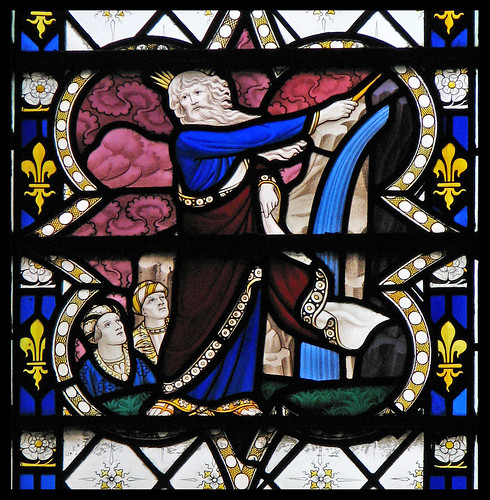
Water is still known to run through lime deposits in the Sinai Peninsula today. But in bringing water from this rock in Sinai, the Creator of the universe bent creation itself to His purposes for His people. The God Who raised His Son from the dead to give life to all who believe in Christ can do similar things for those who trust and obey Him today.

Read verse 7, please:
[Moses] called the place Massah and Meribah, because the Israelites quarreled and tested the Lord, saying, "Is the Lord among us or not?” 
Moses gave two names to the place. Massah means test. God had tested the Hebrews faith and the Hebrews had, contrary to God’s commandment, put God to the test. Meribah is translated as quarrel. But it has a more specific meaning; it’s the word used when a plaintiff sues someone else in court. The people thought they were bringing suit against Moses, but really their beef had been with God. Their question was, “Is the Lord among us or not?”

We may be tempted to ask that same question at times. I'll never forget a Saturday afternoon in my first parish when I was called to a hospital in Toledo, where a member of the congregation had been life-flighted. While using a torch to cut a barrel in half for some neighbor boys, the barrel had exploded and crashed into his skull. When I arrived at the ER, he looked like someone who had been through a battle. The doctors said that his prognosis was hopeless. His mother, a wonderfully faithful woman who had endured the deaths of her husband and a grown child already, kept asking of this calamity that had befallen this son, the father of small children, "How could God have let this happen?" Where had God been? she wondered. We've all been in that wilderness!*

But, as our Gospel lesson reminds us, the God Who caused water to spring from a rock in the wilderness has come in Jesus Christ, the Word made flesh, to be the living water from heaven!

Jesus refreshes and makes new the thirsty souls of all who trust in Him and live lives of repentance and obedience to Him.

May we turn each day to Jesus, even in the inconvenient wilderness times of our lives, and live! Amen

*I'm happy to report that the man in question not only survived, thanks to the prayers of many, but is strong and well to this day!

Friday, March 25, 2011

Only Sinners Need Apply

If you think a past sin disqualifies you from serving Christ, consider Peter. That's who Joe Stowell points to in this piece, which I recommend you read.

As Stowell points out, over a fire during a session of the kangaroo court that convicted Jesus of a capital crime, he reneged on his pledge of loyalty to Jesus and denied knowing Jesus three different times. Think of that: Peter denied any acquaintance with the One he had earlier confessed to be the Messiah, the Son (or the very image) of the Blessed, God.

Yet over another fire on the shore of the Sea of Tiberias, Jesus called on Peter to affirm his belief in Jesus--three times--and Peter knew that, leaning on Christ's grace, he could, imperfections notwithstanding, be used for good by Christ.

Some people refuse to worship or get involved in a local church because they feel that they're not good enough. Pay heed to the wisdom of Virgil M., a member of the first congregation I served as a pastor:
"If there weren't any sinners in the church, it would be an empty place."
He's right!

If you're a sinner who can acknowledge your dependence on the mercy God gives to all with faith in Jesus Christ, God has great plans for you!

Learning what they are begins, as it did for Peter, with confession, repentance, and belief in Christ. As with Peter, that happens within the fellowship of Christ's very body on earth, the Church.

If you're an imperfect sinner, I invite you to be in worship this weekend with Christ's fellowship of recovering imperfect sinners, the Church. The Word of God you encounter there can erase the power of sin to keep you from becoming all that God made you to be.

When it comes to church membership, only sinners need apply.

And only sinners who trust that Christ is greater than their sin can be used by God. If you doubt it, just consider Peter.