Sunday, April 08, 2007

How To Believe in Easter

[This message was shared during worship with the people of Friendship Lutheran Church, Amelia, Ohio, on April 8, 2007.]

Luke 24:1-12
You’ve heard me tell the story before of an expectant couple, anxious to confirm their suspicions about the gender of their baby. They arranged to have an ultrasound done at the doctor’s office. So, they arrived for the appointment, the pregnant mom got onto the table, and the doctor began the procedure. Suddenly, the doctor let out a, “Wow!” “What is it?,” the couple wondered, “Is it a boy?” “Well,” the doctor replied slowly, “the middle one is.”

Sometimes life surprises us and the only appropriate response from us, apart from fainting, is, “Wow!” Easter records the greatest event in human history. Jesus Christ, true God and true man, rose from the dead. And yet, we manage somehow not to be stunned or amazed by it. How is it that you and I can “acquire the fire,” gaining or regaining our sense of wonder at the most wonderful thing that has ever happened? Maybe the answer lies in going back to the original Easter and following what happened according to one of the Biblical writers on the first Easter Sunday. I want to do that by considering Luke’s telling of the Easter story, doing so from three different perspectives.

First, there is the perspective of the women who came to the tomb at sunrise that Sunday morning. They’d come to anoint Jesus’ body with spices, a task they’d been unable to do before it had been buried. But the women got a surprise. The stone was rolled away. Jesus’ body was gone. Luke says, with incredible understatement that they were “perplexed.”

You and I would be perplexed, too! We too would ask the questions that were undoubtedly swirling in the minds of the women at the tomb: If Jesus had such power over death, why would He have bothered dying for us? Has someone stolen His body and if so, why? Those would have been some of the women's questions, I suppose, because none of them had expected that even Jesus, as powerful and wonderful as He was, could beat death.

Most people have small expectations of life. But on Easter, God shouted that He reserves the right to surprise us! He reserves the right to replace our shortsightedness with an awareness of eternity! Easter is worth a WOW!

The second perspective on the first Easter is that of the other disciples, the other followers of Jesus with whom the women at the tomb shared the news of Jesus’ resurrection that day. In the midst of their perplexity at the tomb, the women had encountered two angels, who had reminded them that Jesus had said He had to die on a cross, bearing our punishment for sin although He didn’t deserve it, and that He would rise again, opening up eternity to all who follow Him. And so, they told the other disciples about Jesus’ resurrection. "Jesus is alive!" they said.

The other disciples didn’t believe them. Why? Some scholars think that the women were disbelieved because they were women. It may be. In those days, for example, a woman’s testimony was never deemed valid in a legal proceeding. That's because women were thought to be unreliable. But Jesus had never shared the sexist attitude of first-century Judean culture. Unlike other pious men of that time, He spoke with women in public. And I think it’s especially fun that God chose women to be the first to preach the Easter message!

But there may be another reason the disciples didn’t believe the women. A few years ago, a prominent preacher told the true story of a friend and his son when the boy was small. The little guy had two heroes: Captain Kangaroo and Mister Rogers, back when both of those children’s show hosts were on TV. The father and son would sit and watch these two stars every day. Then an announcement was made that one day, Mister Rogers was going to visit Captain Kangaroo’s show. The boy was so excited he could hardly stand it. Day in and day out, he would ask his father, “Is this the day? Is this the day?” Finally, the day came and the two of them sat in front of the TV to watch this magic. Captain Kangaroo’s show began and after a few moments, Mister Rogers was introduced. The boy watched this for a few moments and then, left the room. Mystified, his dad found him in another part of the house. “What’s wrong?” the dad asked.” The son replied, “It’s just too good. It’s just too good!”

The women’s story of Jesus’ resurrection may have been dismissed because it was simply too good to be true
.

The third perspective on the first Easter comes from Peter. Peter, you know sometimes gets a bad press because like us, he’s proud, impetuous, and prone to snap judgments. But when Peter heard the women’s story of Jesus’ resurrection, he reacted differently from the other disciples.

Maybe that’s because Peter had a track record with Jesus, memories that came flooding back to him now. Maybe he remembered the early morning when he and his crew returned from a night of futility when they’d been unable to catch any fish. They found the preacher Jesus, from landlocked Nazareth, waiting on the shore. He suggested that they put back out and lower the nets. You can almost hear the smirk in Peter’s voice when he tells Jesus that, like generations of Galilean fishermen, they’d been out trolling the waters all night long. He knew what he was doing, Peter seemed to say. He was a professional fisherman. But then, he said, as if to prove Jesus wrong, he would go out again. They’d gone just a few feet from shore and lowered the nets. They became so full that the catch nearly sank the boat. Peter was overwhelmed. He collapsed before Jesus and begged the Lord to go away. Peter was aware in a sudden, dramatic way of how great the distance between him and the sinless Lord Jesus.

He may have also remembered the events of just a few days before. Jesus had told Peter that when the going got rough and the world turned against Jesus, Peter would deny knowing Jesus three times. Peter told Jesus that would never happen. But it did.

Peter had been the first to confess that Jesus was the “son of the Blessed,” a Semitic phrase signaling Peter’s belief that Jesus was God Himself.

That flood of memories may have incited Peter to not walk, but run, to the tomb and investigate for himself. There, he saw all the evidence he needed: the tomb empty and the linen burial cloths, left behind. Our Bible lesson says that Peter went back home “amazed.”

Peter, I think, holds the key to our believing and greeting the good news of Easter with a Wow! And not just on Easter Day, but every day of our lives. For Easter to have meaning for us, it won’t be the result of our gaining knowledge through say, the reading of Scripture. (Although anyone who follows Jesus will want to read Scripture in order to know Him better!) And it won’t be the result of emotions. (Although the better we know Jesus, the more our emotions—like love and gratitude and even others like anger with injustice—will be roused.) The wonder of Easter will come to us in another way, Peter’s way.

Before he became a political bully, something I really regret, psychologist James Dobson offered meaningful help to Christian families. He once told the story of being alone with his then-toddler son, Ryan, shortly after they’d moved into a developing neighborhood. Dobson was busy preparing dinner when he became aware of silence in the house. He called for Ryan...no answer. He looked all over the house and couldn’t find him. He then ran outside and saw, to his horror, that, some distance away, Ryan had crawled into the back of a large dump truck. How this little guy had climbed up there, Dobson didn’t know. He wanted to avoid startling his son, so Dobson approached him quietly. The closer he got to Ryan, the more he could hear that Ryan was talking to himself. At one point, Ryan decided he wanted to get out of the dump truck bed. So, backing up toward the edge of the truck, he began to probe with his feet for a place where he could land. Try as he might though, he couldn’t find it. Dobson heard his son saying quietly, “Somebody help the boy.” Ryan finally decided that he would just back off the bed and see where he would land. He did so and fell...right into the waiting arms of his dad.

In the end, we will only know the truth and the life-changing power of Jesus’ resurrection when we stop trying to get through this life on our own steam. The WOW! of Easter will be ours when after remembering Jesus’ track record as Peter did, we surrender and simply fall into Jesus’ waiting arms. On this Easter Sunday, that’s what I invite you to do...today and every day!

Saturday, April 07, 2007

Anathema


That's the word of the day over at Conblogeration.

That triggered this memory:
I remember the first time I became aware of this word was when I was in high school.

I was reading Arthur S. Link's biography of Woodrow Wilson and Link quoted Wilson calling a position taken by an opponent as anathema to him.

It's the perfect Wilsonian word, when you think about it. Wilson always saw things in moral absolutes, even when the position he anathematized was one he himself adhered to just a few years before.

It isn't that Wilson was a flip-flopper. Rather, he converted, as when he moved from being a conservative Democrat to one of the progressive stripe. Once Wilson "converted," he couldn't understand why or how anyone could disagree with him and he viewed those who opposed him as reprehensible.

This accounts for why, as president of Princeton University, governor of New Jersey, and President of the United States, his initial successes were always followed by spectacular failures.

People who anathematize others almost always eventually become anathema themselves.
[For more on Woodrow Wilson, see here and here.]

What is It About Thugs?

Robert Mugabe, the president of Zimbabwe, is a thug. He has been for a long time. His allies, with his overt public approval, have recently undertaken a campaign of beatings and intimidations of those who oppose his dictatorship.

It's an old story, this use of force to quell dissent and maintain tyranny. Eventually, history shows, all tyrannies fall and tyrants almost always come to bad ends. If the original tyrants don't, their heirs do.

All of which raises some questions: Don't guys like Mugabe, Hitler, Mussolini, Saddam Hussein, and others read history? Don't they realize that eventually, the unjust use of force, intimidation, and thuggery eventually ticks people off and leaves tyrants in bunkers with cyanide tablets or on the ends of ropes? What is it about thugs that thinks that they can keep on getting away with murder?

I suppose that all tyrants, like all other sinners who refuse to subordinate themselves to God, figure that they're history's exceptions. They'll be the ones, they think, to get away with treating the rest of the human race like superfluous extras in the epic story of their own lives.

Some do get away with this during their lifetimes. There are dictators who die peacefully in their beds. But after death, the unrepentant face another Judge, one about whom the apostle Paul wrote in the New Testament:
Do not be deceived; God is not mocked, for you reap whatever you sow. (Galatians 6:7)
Pray for the oppressed people of Zimbabwe tonight, asking God to protect the innocent and to embolden the people to end their tyranny.

[For more on Zimbabwe, go here.]

An Easter Letter

[I wrote and posted this on April 13 of last year. But it seems worth re-running.]

Some people tell me, "If only I could see a miracle, I could believe."

Or, despondent over the fact that someone they care about refuses to believe in the risen Christ we proclaim this Easter Sunday, others say, "If only so and so could witness a miracle, they could believe."

Let me tell you a true story. When I was in junior high school, my mother was diagnosed with cancer. She was admitted to the hospital one day in order to undergo surgery the next day.

But on the morning of the scheduled procedure, the doctor came by her room. He was mystified. A final round of tests conducted the afternoon before showed no cancer. He didn't understand how this could have happened. But we all did: People had prayed and in the mysterious providence of God, my mother was healed.

I knew all about what had happened and yet within a few short years, I came to consider myself an atheist. I continued to say that there was no God for about eight more years after that.

That's the thing about miracles: They're as subject to questioning and rejection as the statements, "There is a God" or "Jesus is risen from the dead."

To believe in a God Who is bigger than us or in a God Who becomes human, offers Himself as the perfect sacrifice for our sin, and then rises from death to give everlasting life with God to all who believe in Him is not an easy thing. We human beings are such control freaks that even when we see the miraculous or inexplicable, we want to explain it away. We always want God to prove Himself with just one more piece of evidence.

Jesus once told the story of a man who had died and was burning in hell. In his life on earth, he had been an unjust man who ignored the needs of a poor man, Lazarus, who died at his gate and had gone to heaven. From hell, he called out to Abraham, the patriarch of Old Testament faith, begging him to send Lazarus back to earth to warn his brothers of the fate that awaited them if they didn't trust in God. Surely, the rich man reasoned, if they saw someone back from the dead, they would listen to God's Word and believe. Forget it, Abraham responds in Jesus' story, if they didn't pay attention to the ways in which God revealed Himself through Moses and all the prophets, there's no way they'll pay attention to someone resurrected from the dead.

Belief in God isn't antithetical to the life of the mind. We don't check our brains in at the church door. But faith isn't the byproduct of the smoking guns of miraculous evidence, either. "Have you believed because you have seen Me?" Jesus asked His once-skeptical disciple, Thomas. "Blessed are those who have not seen and yet have come to believe."

Some say Jesus rose from the dead. Others don't. And while those who say that He did rise can point to oodles of evidence to support their belief (see here and here, for example), no amount of evidence will convince those who have decided that they will not believe. The apostle Paul, writing in the New Testament says:
...I want you to understand that no one speaking by the Spirit of God ever says “Let Jesus be cursed!” and no one can say “Jesus is Lord” except by the Holy Spirit. (1 Corinthians 12:3)
God Himself makes it possible for us to believe...but only if we are willing to believe.

This is where the credibility of Christians becomes so important. Mahatma Gandhi was one of the greatest people in human history. He was once asked why he, who had closely studied the New Testament and whose tactics for bringing freedom to India came directly from Jesus, never became a Christian. He had, it turns out, been quite open to following Christ. But as a young lawyer in South Africa, he was subjected to ill-treatment by Christians. He concluded that if the people who bore Christ's Name were so un-Christian, it was pointless to follow Christ.

Christians, of course, are sinners just like the rest of the human race. We are imperfect. We do things that we have every reason to regret. But when others see the direction of our lives...when they can see that when we sin, we regret it and seek to move toward the love of God and neighbor to which Christ calls us...when they see in us a commitment to service..when they see the risen Jesus Christ evidenced in our living, these things are seen as greater indicators of the reality of God and the truth of the resurrection than any number of miracles.

God will never force us to believe in Him or follow Him. But if we are willing to believe, the Spirit of God will begin to fashion faith within us, making it possible for us to join those ancient confessions of the Church: I believe in God the Father! I believe in the risen Jesus Christ! I believe in God the Holy Spirit!

I urge Christians to pray for their skeptical friends and neighbors to move toward a willingness to faith and to ask God to help all of us become believable, loving, serving witnesses for our Savior.

And if you are among the skeptical or the scoffers like I once was, I hope that you can move toward the moment when you can tell God, "I'm not even sure you're there. But I want You to be and if You are, help me to know You and to follow You." Don't be surprised if from that tiny opening, the Holy Spirit lovingly nudges you toward faith in the risen Christ. That's exactly what happened to me...and that really is a miracle, when you think about it!

[You might be interested in this blog series on why I believe the Christian faith is true:
Why I Believe Christian Faith is True, Part 1
Why I Believe Christian Faith is True, Part 2
Why I Believe Christian Faith is True, Part 3
Why I Believe Christian Faith is True, Part 4
Why I Believe Christian Faith is True, Part 5
Why I Believe Christian Faith is True, Part 6]

[You might also want to read this series, which deals with a tough topic impeding some from belief in God:
When Tragedy Hits the Innocent, Part 1
When Tragedy Hits the Innocent, Part 2
When Tragedy Hits the Innocent, Part 3
When Tragedy Hits the Innocent, Part 4
The Light of the World!]

[THANKS TO: Brian, of the excellent new blog, Columbuser.com, for linking to this post.]

Christ is Calling Us Forward!

I was driving home from a grocery run last night and flipped on a CD, John Reuben's latest, which I love. But I've played it so much since buying it that I decided to look for something on the radio. I tuned in to one of our three local NPR stations, WVXU, which runs the series When Radio Was, featuring old radio series.

Last night, the show ran an episode from The Great Gildersleeve. It was an Easter episode, aired on April 17, 1957. In it, Throckmorton P. Gildersleeve, the Water Commissioner who was the series' main character, movingly tells the story of Christ's crucifixion and resurrection.

It's almost impossible to imagine an episode like it happening on a network TV sitcom today. But that isn't what stunned me most.

A commercial break came and then, on behalf of the NBC network, the announcer told listeners what good things came to the lives of individuals and families who became involved in the life of a local church. He then mentioned a long list of radio shows that NBC would be running the following Sunday, Easter. It included The Catholic Hour, The Hour of Decision with Billy Graham, and The Lutheran Hour. But, he went on, none of that could possibly replace the blessings that would come to those who celebrated Easter in a local church. And, he added, listeners should, "Take the whole family with you."

Now, if you think I'm about to bellyache or rant about a secular mainstream media that no longer gives Christianity a preferred position, you'd be wrong.

Of course, as a Christian, I'm anxious for everybody to know that Christ died and rose for them and that through faith in Him, we can have our sins forgiven and live with God forever. (See here, here, and here.) I really believe the proclamation of the early church, as given to them by Christ and the Holy Spirit:
There is salvation in no one else, for there is no other name under heaven given among mortals by which we must be saved. (Acts 4:12)
I also believe that we as Christians are called to share the good news of Jesus with others. Actually, Christians are commanded to do those thing. Jesus is cited giving this command--the Great Commission--in five different places in the New Testament. (See Matthew 28:19-20; Mark 16:15; Luke 24:47; John 20:21; and Acts 1:8.)

I'd be happy if major media outlets told the world about Christ and our need of Him. But those days are over.

Besides, I believe that something terrible happened to churches and Christians when the mainstream media promoted Christian faith: It got Christians off the hook when it came to sharing Christ or inviting folks to worship. Christian faith was "in the air." The culture could be counted on to carry the freight when it came to fulfilling Christ's command to make disciples. With that sort of "home court advantage," Christians became lazy about fulfilling Christ's Great Commission.

When, seventeen years ago, I was called to start the congregation I now serve as pastor, my then-bishop approached me during an informal get-together. He had been the founding pastor of a congregation in the Akron area back in the 1950s. "You know, Mark," he told me, "I had it a lot easier than you will have it. Back then, I just had to show up and announce that I was starting a new church. In no time, we had 500 members." Seventeen years later, our congregation has about one-third that number of members.

Personally appealing preachers and megachurches are able to attract vast throngs these days, it seems, and I don't begrudge them that. But their experience doesn't match that of most pastors and churches in what has been called a post-Christian era. Their experience certainly doesn't match my own. Christian faith no longer enjoys privileged status in Western culture, meaning that Christians intent on seeing the life-changing good news become part of their friends' and neighbors' lives must take on the responsibility of sharing Christ themselves.

In spite of the ascendance of the Religious Right, which I feel mostly distorts Christian faith and makes Christ onerous to a culture ignorant of what the Bible really shows us about Him, the position we Christians find ourselves in today is not entirely different from the position the early Christians were in fifty days after Jesus rose from the dead, the day of Pentecost.

Then, as now, Christians lived in a pluralistic world willing to latch onto all manner of gods, idols, good luck charms, and karma. It was a world, like today, where Christians had to, through their love and service in Christ's Name, earn the right to share Christ with others.

Then, as now, Christians have God's Holy Spirit to guide them as they live and share the love, the wisdom, and the hope we have through our faith in Christ.

It would be easy for Christians to listen to the episode of The Great Gildersleeve I heard last night and fall prey to a sort of mournful nostalgia, pining for the "good old days."

But Christian faith isn't about nostalgia. Christian faith doesn't pull us to the past, but to the future. On the first Easter, according to the Gospel of Mark, one of the angels told the women who had gone to anoint Jesus' body, "But go, tell his disciples and Peter that he is going ahead of you to Galilee; there you will see him, just as he told you.” (Mark 16:7) Jesus, described by the New Testament book of Hebrews, as "the pioneer and perfecter of our faith," is always ahead of us, always calling us forward, always making us new.

Jesus Christ calls us away from the comforts of the past, to dare to live today in complete dependence on Him, certain that we belong to Him forever.

That means we can be confident as we ask others to turn from sin and follow Christ. The voice of Gildersleeve is only on recordings now. NBC isn't going to recommend that people worship with us on Easter Sunday.
  • But Christ is still risen from the dead!
  • The Holy Spirit still lives within Christ's people!
  • The world still needs to know Christ!
  • And followers of Jesus still can use their lives, their service, and their voices to tell everybody about our Savior!
So, what's holding us back?

Thursday, April 05, 2007

Four Gifts

[This message was shared during the Maundy Thursday worship of Friendship Lutheran Church, Amelia, Ohio, on April 5, 2007.]

John 13:1-17, 31-35

On this Maundy Thursday, I want to talk with you about four gifts from God:
  • an example,
  • a Savior,
  • a command, and
  • a power.
But first, a story to explain why we need these gifts.

On Tuesday, I was in a hurry, yet stuck in checkout line 4 at Kroger Eastgate. I wondered if there really was a worldwide conspiracy designed to keep me from doing what I wanted to get done. Just then a clerk popped his head out from between two unused check out lines. “You can check out on three now,” he announced. A woman who’d just happened by when the clerk appeared, quickly slid into line 3 and I pushed my cart in behind her.

I was internally celebrating my good fortune when I looked back and saw the woman who had been standing in front of me in the congested line. It wasn’t until I left the store that I wondered--or maybe it was only then that I allowed myself to wonder--had I stormed ahead of her? I felt a pang of guilt. After all, she’d gotten into the longer line before I had. Hers was the right of first refusal on entry into the newer, quicker checkout line.

Bags stowed in my van, cart put into its corral, engine on, I briefly considered trying to find the woman to say, “I’m so sorry that I pushed ahead of you like that. I didn’t intend to.” But I realized that would have been a lie. Whether I actually had pushed ahead of her or not, the fact is that I'd intended to push ahead of whoever was in my way. I had been in a hurry and I thought the world owed me.

That’s your pastor, folks. Not a pretty sight, I'll admit. I had been guilty of me-first thinking. But the Bible has a more direct term for it: sin.

You and I are born with the condition of sin, a condition of alienation from God that predisposes us in big ways and small to push ourselves ahead of others, at the expense of others. To worship ourselves. To leave God and neighbor in the dust. It’s sin that makes our world such a mess. It's sin that messes up our individual lives.

So what’s to be done about it all? God has done something about it and that’s why we’re here tonight! And that leads me to discuss those four gifts.

On a Thursday night of a Passover week some two-thousand years ago, the sinless God-man, Jesus of Nazareth, defied propriety to wash the feet of His disciples. Our Bible lesson tells us:
“...during supper Jesus, knowing that the Father had given all things into his hands, and that he had come from God and was going to God, got up from the table, took off his outer robe, and tied a towel around himself. Then he poured water into a basin and began to wash the disciples’ feet and to wipe them with the towel that was tied around him.”
As I mentioned a few Sundays ago, washing the feet of another person was generally only done either by servants or by a loved one anointing the body of a deceased family member. (And sometimes, as a liturgical action in Jewish worship.) It wasn’t done by a lord. Or a king. Or an important person. But God-in-the-flesh, Jesus doesn’t care about usual human conventions. He breaks our rules in order to break us free from the grip that sin and death have over us. He breaks our rules in order to break the kingdom of heaven open to us.

After washing each disciples’ feet, Jesus explains, “Do you know what I have done to you? You call me Teacher and Lord—and you are right, for that is what I am. So if I, your Lord and Teacher, have washed your feet, you also ought to wash one another’s feet. For I have set you an example, that you also should do as I have done to you.”

Jesus deals with sin first of all, by giving us example. In Him, we see what a life free from the sinful impulse to push ahead of others was banished. That's the first of the four gifts I want to discuss tonight.

But, thank God, following Jesus Christ is about more than having an example. The condition of sin prevents us from living and acting like Jesus. No matter how much I may want to be like Jesus, I can’t use my will power to follow His example. At least not for long.

That’s where the next gift comes in. It was given, of course, less than twenty-four hours after Jesus washed the disciples’ feet. He went to the cross, becoming what John the Baptizer had said of Jesus on the banks of the Jordan, “the Lamb of God Who takes away the sin of the world.” There, Jesus entered into our alienation from God and accepted our sentence for sin, so that rising from the dead, He could offer new and everlasting life to all who believe in Him. Jesus saves sinners like me. Jesus isn’t just an example. He’s also a Savior. Thank God!

But the events of this night remind us that there’s more to being a Christian than having an example or being saved.

Every Christian should wonder, “Saved for what? What new life can God help us to live because Jesus is our Savior?”

This day is called Maundy Thursday, the word maundy coming to us from the Latin word mandatum, meaning mandate or command. That’s because after washing the disciples’ feet, Jesus gave a new command to all who make up His Church.

You and I are called not simply to love God and love neighbor. We’re also called to love each member of the Church, to respect one another, to build each other up, to help one another experience the grace and goodness of God, given as free gifts to all who believe in Christ. You can't be a Christian without being part of the Church, this family instituted by Christ. The Church is the living embodiment of Jesus in our world. The Church is the place where recovering sinners are made to feel safe and where in our fellowship with one another, we experience Jesus using us to love others. That’s our command!

Fortunately for us, our Savior Jesus doesn’t just give us an example, save us, or give us a command without also giving us the means to fulfill His call on our lives. That’s where a fourth gift of Maundy Thursday comes in. That gift is power. Jesus gives us the power to live as saved people, the power to follow His example even when we’ve failed, the power to recommit ourselves to doing as He commands despite our sinful natures.

A few days ago, I met with Tiffany and her mother, Paula. Tiffany will receive Holy Communion for the first time on Easter morning. One of the things we talked about was the old saying, “You are what you eat.” Eat lots of fatty or sugar-filled foods and you end up looking like I do around the middle. You are what you eat.

On the first Maundy Thursday, Jesus instituted Holy Communion. Through it, even tonight, Jesus hands us bread and says, “This is My body”; He gives us wine and tells us, “This is My blood.”

In a mysterious way we can’t understand or explain, Jesus literally enters into the bodies and the lives of those who renounce sin and entrust their lives to Him. We each come together in humble need of Christ and His forgiveness and He gives to each of us His very self. Christ uses this sacrament to help us, from the inside out, to follow His example and to fulfill His commandments. In the body and blood of Communion, He sets to work to transform the lives of those willing to follow Him. Through the Sacrament, Christ makes us more like Himself. Jesus gives us power to become Christlike. We are what we eat.

Among the many gifts God gives to us through Jesus Christ, four are good to remember tonight:
  • His example;
  • His salvation;
  • His command to live in a fellowship of love within the Church; and
  • the power to become more like our Savior by regularly receiving His body and blood in the Sacrament we’re about to receive again.
Speaking as one needy sinner to other needy sinners, I have to tell you how grateful I am that tonight, I have a Lord who loves me enough to give me these four gifts...and so much more!

Wednesday, April 04, 2007

'Regretting Bush'

That's the title of this post. The writer? A political conservative and an evangelical Christian, Will Hinton. Whether you agree with him or not, like everything Hinton writes, it's interesting.

Wish I Could Have Been There...

to thank them myself.

Tomorrow Brings Maundy Thursday

What's that? Here's a link to some past Maundy Thursday blogging that might help explain. Also see here for an understanding of where the day fits in with the overall church calendar.

[THANKS TO: Rhonda Clark, novelist, stay-at-home mom, and beachcomber, for linking to some of my Maundy Thursday thoughts.]

Tuesday, April 03, 2007

I'm Grateful

To be recognized for being thoughtful by someone who is always thoughtful is a huge honor. Thank you, Charlie!

Fred Thompson for President?

Former Tennessee Senator Bill Frist has been on the Fred Thompson bandwagon for several weeks now. See his post here and take a look at the massive number of comments in response to it.

Will this be the official audio symbol of a Thompson campaign? (By the way, did you know that was supposed to be the sound of a gavel? I didn't. I just always called it the between-scenes-broing-sound.)

The Dynasties Continue...Chelsea in 2016?

[Just my opinion, JUMP]

The ascendancy of dynasties as a feature of US presidential politics has been confirmed with reports on the first quarter fundraising efforts of major candidates for President.

That's an even bigger story, to my mind, than the sheer enormity of several campaigns' treasure chests.

The Clinton machine, intent on electing a second Clinton in sixteen years, raised $26-million in the quarter just past.

Meanwhile, the Bush machine, bowing to the fact that Jeb Bush can't succeed his brother to the Oval Office in the face of an unpopular war, is siding with another old Republican monied dynasty, the Romneys and their allies. Bush allies have fattened the presidential coffers of former Massachusetts governor Mitt Romney in his bid for the 2008 Republican presidential nomination. The Romney campaign raised $21-million in the same first quarter.

Clinton and Romney acquired that kind of money in spite of the fact that neither have much elective political experience--she's just begun her second term in the US Senate and he spent all of one term as governor.

Fund raising efforts for the 2008 campaign thus far confirm fears that the presidential contest may provide voters little opportunity to elect someone with new ideas. Instead, the election is likely to pit two dynastic families or their functionaries, people accustomed to wielding power, in a sort of War of the Roses. Clinton and Romney are different packaging for old brand names.

Increasingly, US politics at every level sees certain families with money and connections dominating government. It's a phenomenon that exists in both parties. Last year, for example, there were about ten races for the US House that pitted the children of former members of Congress against one another.

So, irrespective of how things turn out in 2008, you might want to start getting ready for 2016, when Chelsea Clinton, who turns 36 that year, will likely run against Jeb Bush, by then the beneficiary of Bush nostalgia, in another contest involving America's presidential royalty.

[Cross-posted at RedBlueChristian.com.]

[UPDATE: Per Mark Olson, in the comments below, I checked out Hugh Hewitt's explanations for Mitt Romney's first quarter success in campaign fund raising.]

Monday, April 02, 2007

THANK YOU, BUCKEYES, FOR A TREMENDOUS SEASON!

We've waited forty-seven years for a national championship. But with the thrills and greatness you've shown us this year, I believe that we'll only have to wait one more year.

Congratulations to the Florida Gators and their fans.

Letters to My Non-Churchgoing Friends (#10: Confusion About Sin)

[I'm writing a series of "letters" to non-churchgoing folks in my community through a column I write for the Community Press here in the Cincinnati area. To see the first nine, go here.]

Dear Friend,
One reason people give for not going to church is their mystification at two words--and their different forms--which Christians use a lot: sin and justification.

Non-churchgoing folks hear Christians say things using these terms in all manner of strange ways:
  • I’m a sinner.
  • All have sinned and fall short of God’s glory.
  • Christ justifies sinners.
I’m not sure that we Christians always know what we’re talking about when we say stuff like this. So, mystification on the parts of those who aren’t part of a church is understandable.

What is sin, from a Biblical perspective? And what does it mean to be justified? In this column, I’ll talk about sin. In the next, I’ll tackle justification.

I like to draw a distinction between Sin, capital s, and sin, lower case s. Sin, upper case, is the condition into which every person who comes into this world in the normal way is born. In the Old Testament, King David, a person so revered for his faith that the Bible calls him “a man after God’s own heart,” admits that he was born in sin. The only sinless person on this planet since Adam and Eve fell into sin has been Jesus Christ. The rest of us though, are born in this Sin condition.

Sin is alienation from God and other people. And it’s part of us from the beginning. We’re born addicted to ourselves, our desires, our wants, and our agendas.

If an infant takes a liking to an object which his or her parents know could cause injury or death, that baby will scream like mad when the object is taken from it. That’s because the condition of Sin drives us to think only of that which is pleasing to ourselves, without regard to what’s good for us or others.

The Bible teaches that, without help, our slavery to Sin will inevitably drive us to commit sins, small s. Those individual sins are summarized in the Ten Commandments and include:
  • putting anything in a more important position than God;
  • using God’s Name for anything other than prayer, praise, or thanksgiving; ignoring God’s Word, refusing to join others in worshiping God, and not resting once a week;
  • failing to respect our parents;
  • killing others in thought, word, or deed;
  • sexual intimacy outside of marriage;
  • taking anything belongs to others;
  • gossiping or telling untruths about others; and
  • craving the possessions or lifestyles of other people.
I don’t know about you, but when I look at this list, I recognize that whether in thought, word, or deed, I’ve violated each of God's commandments. I’ve allowed my Sin condition to lead me to commit sins.

Deep down, I don’t want to sin. I recognize how my sins hurt me, my life, others, and, I’ve learned, even God.

Each time I sin, I add another brick to the wall separating me from others, from the person I want to be, and from God and eternal life. This is true even when, with good intentions, I make resolutions to do better and fail to do so, repeatedly.

Like Paul, a writer in the New Testament, I want to say, “I've tried everything and nothing helps. I'm at the end of my rope. Is there no one who can do anything for me? Isn't that the real question?” (Romans 7:24)

Who, Paul asks and I ask, can make it possible for a born sinner like me to be freed from my slavery to sin so that I can live with God forever? That really is the question. And justification, which I’ll talk about next time, is the real answer. God’s answer.

On Seeing Three Penguins at Kroger

[File this one under, JUMP, just my opinion.]

I saw them, three young men struggling to make it across the parking lot of the Kroger I visited two nights ago. You could tell that each step they took was difficult as they waddled, rather than walked. Finally, they made it to their car. But I couldn't help wondering, "What's wrong with them?"

The source of their struggle? The three were part of that growing army of young men who apparently don't know how to wear pants.

Someone needs to tell them that a waist band is just that, a waist band, not a halfway-down-your-backside-band.

One of these kids, fresh from his shift at the grocery store continuously tugged at his pants to prevent them from completely sliding down to his ankles over the course of the fifty-yard trek. Repeatedly, he reached down to pull up his pants just enough to keep from falling headfirst onto the pavement.

A time-motion engineer would probably deliver a staggering calculation as to how much productivity this young man is losing each day as he's forced, stride by stride, to use one hand or the other to pull his pants up just slightly north of the knees.

It's ironic to me that a generation so intent on using its hands for things like text messaging and video game-playing can't see how the way it wears its pants keeps it from doing those and other things.

I wonder what these kids think the crotch of their pants is supposed to be, if it seems natural for the inseams to gather just above their shins? The design of a pair of pants signals that this sagging fashion is all wrong.

And do they think that the world is dying to see their boxers or briefs? Speaking humbly on behalf of the world I can confidently say, "We're not!"

Nor do we want to see the even worse sight to which we're often subjected by these young men unfamiliar with the proper use of waistbands, drawstrings, or belts. I refer specifically to the unsightly "cleavage" their fashion often forces us to witness!

Not long ago, I watched a toddler taking some of his first steps. At one point, he felt his pants slip ever so slightly down over the top of his bulging diaper. When that happened, he realized that continued slippage would prevent him from taking further steps. Who knows, he might have even been a little embarrassed at the prospect of having the whole world see his little baby undergarment? In the face of these facts, he did what any sensible person would do: He pulled up his pants.

One can only hope that the young men who sport their penguin-pants would learn from that toddler!

Please, young men: Pull up your pants. Tighten your belts. Tie your draw strings. Keep the undergarments under. Learn to walk again!

You'll like it, I guarantee.

Sunday, April 01, 2007

When Jesus Shows Up (Palm Sunday)

[This message was shared during worship celebrations with the people of Friendship Lutheran Church, Amelia, Ohio, on March 31 and April 1, 2007.]

Luke 19:28-40
Ronald Reagan--for you young people, he was our fortieth president and a one-time movie star--had a story he loved to tell. In an interview, one of his aides, Peter Robinson, retold it:
Worried that their son was too optimistic, the parents of a little boy took him to a psychiatrist. Trying to dampen the boy’s spirits, the psychiatrist showed him into a room piled high with nothing but horse manure. Yet instead of displaying distaste, the little boy clambered to the top of the pile, dropped to all fours, and began digging. “What do you think you’re doing?” the psychiatrist asked. “With all this manure,” the little boy replied, beaming, “there must be a pony in here somewhere.”
Of course, a little boy of a different nature might not have been so sure that there was a pony to be found. He may have decided that where there’s manure, there’s always...more manure.

The point is that two people may react to the same events, experiences, or people in completely different ways. Most people seem to love American Idol, for example. And while I get a charge out of hearing what my friends tell me about the latest episodes, I’ve never even seen it because it just doesn’t appeal to me. We all have different tastes and 99.9% of the time, our diverging views don’t really matter.

But sometimes, our varied reactions to life have deep significance. Back in early 1974, I had just started to date a girl I’d been wanting to take out for a long time. But she was going to be away one weekend. Another girl and I decided to go see a movie, just as friends, we thought. In January, 1974, I showed up at the other girl's apartment, taking my life in my hands in order to walk across her icy parking lot in my black high heel shoes, plaid bell bottoms, and blue velour shirt. The rest is history, as they say. But if I hadn’t reacted to Ann and the opportunity presented by the vacant weekend in the way that I did, I might have missed out on spending the last thirty-two-plus years with my wife!

There’s a reason I bring all of this up. And I'll explain it in just a moment.

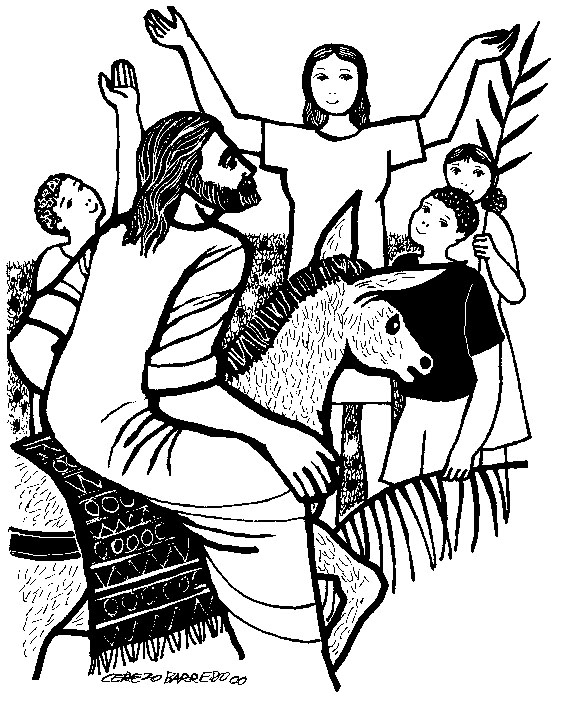
Whenever we think of Palm Sunday, I suspect that we conjure up thoughts of palm leaves waving, “Hosannas” being shouted, and vast throngs of people welcoming Jesus into Jerusalem on the Passover week that would bring His crucifixion. But if you look at our lesson from the Gospel of Luke today, you find none of those things.

We do see Jesus’ closest followers putting their cloaks on the animal He rides and onto the pathway He takes into Jerusalem. But we have no mention of what Mark calls “leaves from the field.” Or what Matthew describes as “branches from the trees.” In fact, of the four gospels in the New Testament, only John’s mentions “branches of palms.”

In Luke’s telling, Jesus’ disciples cry out, “Blessed is the king who comes in the Name of the Lord! [And, echoing the song of the angels on the night of Jesus’ birth] Peace in heaven, and glory in the highest heaven!” But not once do we hear the crowds yelling, “Hosanna!,” a word that essentially means “Save now!”

And, as to crowds, our lesson only speaks of “the whole multitude of disciples,” meaning the hundreds of people who were followers of Jesus. But Luke doesn’t mention the thousands who would have been in Jerusalem preparing to celebrate the Jewish Passover when Jesus arrives in the city.

What are we to make of these differences in the ways the four gospel writers tell the story of that first Palm Sunday? It all boils down, I think, to focus. Each of the gospels have different themes on which they focus, different aspects of Jesus’ story and of Christian faith.

And even more particular to today’s lesson, Luke’s account of the first Palm Sunday comes as part of a string of incidents in Jesus’ ministry and parables he tells that hammer away at a single theme.

We see this theme earlier Luke, chapter 19, where we read of Jesus' encounter with a man named Zacchaeus. You know the story of Zacchaeus, probably. "Zaccheaus was a wee little man, and a wee little man was he," many of us were taught to sing as we were growing up. Jesus was traveling through Zacchaeus' hometown. Being a person of short stature, Zacchaeus climbed into a sycamore tree in order to get a good look of this celebrated preacher from Nazareth. When Jesus saw Zacchaeus, He called him down from his perch, explaining that He intended to visit Zacchaeus' place right then and there. Zacchaeus climbed down out of his tree and welcomed Jesus. The problem, as some of the good people of that town saw it, was that Zacchaeus was a notorious extortionist. But it wasn't to those supposedly good people that Jesus said, "Today salvation has come to this house." It was to Zacchaeus. The difference between Zacchaeus and the good church people was that he welcomed Jesus, while they rejected Him.

Later in the chapter, just before Palm Sunday, Jesus tells a story that talks about a king who left his people for awhile, just as Jesus would do after dying, rising, and ascending back to heaven. Some of the king's subjects excitedly welcomed his return. Others didn't want him around.

As we come to his account of Jesus' entry into Jerusalem, Luke isn’t saying that there weren’t palm leaves, hosannas, or adoring crowds that first Palm Sunday. But, like a filmmaker showing us one or two people in a scene involving thousands of others, Luke wants to show us something very important, seen in the reactions to Jesus of two relatively small groups of people.

The first is Jesus’ disciples. You and I know that at this point, just days before Jesus was to die on a cross, the five-hundred or so people who followed Him still didn’t get Him. They thought that Jesus would be sort of king who would get rid of the Romans, lower the taxes, and be good to God’s people. But to the extent that they were able at the time, before the crucifixion and before Jesus’ resurrection, they hailed Jesus as their king. They laid down their cloaks as an act of deference and respect. They praised God for Jesus and spoke enthusiastically about all the godly miracles Jesus had performed. They welcomed Jesus into their capital city of Jerusalem and into their lives.

Then, there were some Pharisees. The Pharisees, you know, believed that they could earn salvation and forgiveness of sin, not accepting the teaching of the whole Bible that these things are gifts granted to those who turn from sin and trust in God. Appalled by the display of devotion put on by the disciples, they tell Jesus, “Teacher, order your disciples to stop!” They rejected Jesus as the king of either Jerusalem or their lives.

Two reactions...
Welcoming Jesus.
Rejecting Jesus.

Those who reject Jesus reject peace in their hearts, life with God, and eternity.

Those who welcome Him receive peace, life, and eternity.

Jesus can either be the rock on Whom we build our lives or the stone on which we crash and eternally self-destruct.

What will we choose to allow Him to be in our lives?

A couple from our congregation told me about something that happened when their granddaughter, then young, now a teen, burst from her bed room, where she had been reading the Bible. "I get to live forever!" she said. So do all who welcome Jesus into the center of their lives. And even if the rough and rugged times of life, we have the promise of a God Who loves, forgives, and gives us life forever!

As the disciples welcomed Jesus into Jerusalem on the first Palm Sunday, they had no idea what they were getting into.

They didn’t realize that their king would have to die and rise before He could claim His crown.

They had no idea that following Him meant turning their backs on their sins, even the ones they loved to commit, so that they could take hold of the forgiveness and new life only Jesus brings.

For some, following Jesus would mean death at the hands of their persecutors.

For most, it would mean being rejected by family, friends, and society for trusting in the Savior they saw dead and risen.

But each day for the rest of their lives, they chose to welcome Jesus. For them, accepting the brief and earthly complications associated with following Christ was a small price to pay compared to spending eternity at His side.

As we prepare to celebrate Maundy Thursday, Good Friday and Easter this week, may we commit ourselves to always welcoming Jesus!

Saturday, March 31, 2007

These Were My Boyhood Heroes


The 1960 national collegiate basketball champions from Ohio State. I hope that this weekend and on Monday night, Oden, Conley, Lewis, and others will prove to be successors Lucas, Havlicek, Siegfried, and all in every way, bringing the 2007 championship to Columbus.

Go, Buckeyes!

Friday, March 30, 2007

My Current Favorite Commercial

Click here. Then click on TV Spots and then, Cross Walk. The realism achieved by game developers like those with PlayStation on MLB 07: The Show amazes me. I don't own a system and wouldn't have the time to get caught up in the whole business anyway. But I am impressed.

Here in the real world, I've always considered this to be the best time of year, college basketball's March Madness reaches its climax and baseball season, with the promise of a World Series for my favorite team, hit at the same time. How great is that?

Thursday, March 29, 2007

O-H-I-O


I've written before about "Jesus Rising from the Swamp," an oversized and kitschy representation of Jesus that amuses or embarrasses motorists driving north on I-75 between Cincinnati and Dayton.

A member of my parish has sent a picture of what may be the best use to which I've seen the statue yet put: as the H gesture that's part of spelling O-H-I-O when Ohio State fans accompany our band in singing the official rock song of the state, Hang on Sloopy. (See and hear more here.)

As The Ohio State University men's basketball team prepares to play Georgetown in the Final Four, it's good to know that the Swamp Statue is rooting for the Buckeyes!

[Click on the image to enlarge it.]

Go, Buckeyes!


[THANKS TO: Althouse, Ironing Maiden, Holy Coast, Mondok Blog, Nasty, Brutish, & Short, and Buzz Tracker for linking to this post.]

[THANKS ALSO TO: Michael Meckler for linking to this post.]

Female Anger and Passive-Aggression

Dr. Helen Smith, a forensic psychologist, blogs about a study that says women are angrier than men and often express it in passive-aggressive ways.

That rings true to me.

My wife, who feels no hesitation about expressing anger in helpful ways, is a healthier, happier, and less angry person than many women--not to mention than most men, including me--because she doesn't feel the need to artificially bottle up her feelings. And she often laments the conditions the study identifies: that women are angry and that it's probably because they express their anger in passive-aggressive ways. Both she and my daughter are such open people. They get disgusted with women in the workplace who resort to passive-aggression and behind-the-back torpedoing, usually of other women, especially those in positions of authority.

Why is this so prevalent? Historically, our culture has put men in places of authority, whether at home, in the workplace, or in social settings. Women have basically been told to get with the male-set program. This incites understandable, justifiable anger within women with no productive ways to express it.

I don't subscribe to the "tea kettle" school of thought that tells us if we don't immediately vent our spleens, we'll implode. Venting everything we feel can be narcissistic and imprison us and our relationships to our fleeting feelings. There is more to us as human beings than our emotions. Or our thoughts. Or our biology.

But I do think that relationships in all contexts would be healthier if so many women didn't feel constrained to live in the manner described by the study.

The Bible has an interesting passage which I share with people--female or male--when they're thrashing over how to deal with a confrontation they need to have: "Be angry; but do not sin. Do not let the sun go down on your anger."

The point: It isn't "bad," as I think many women are taught, to feel anger. The question is what to do with our anger.
  • Do we use it to discuss things with the object of our anger, with the goal of finding a commonly-acceptable solution and of repairing the relationship?
  • Or do we allow it to live inside of us and make us hateful toward the other person, often expressing the anger and now the hatred, in passive-aggressive ways?
That passage from Ephesians, then, commends taking ownership of our feelings and finding productive, healthy ways to deal with them. In other words, we don't allow our feelings to micromanage our psyches and lives, programming us.

The most hate-filled person I know is an angry passive-aggressive woman who, when confronted with how hurtful her words are, claims that she's being misunderstood and implies that people who think otherwise must either be having bad days or losing their minds, literally. (More passive-aggressiveness.) This woman may even believe it when she makes these claims. But her family will tell you that her approach is very destructive to her, to their family, and to everybody's health.

I think that the insights in this study are right on!

(Smith links the study to some recent dust-ups in the blogging world, none of which really interests me here. I'm interested in the study at a more global level.)

(I was led to Smith's post through a link at Althouse.)

I Wish That James Dobson Would...

just be quiet! Then maybe he could read these posts.

Wednesday, March 28, 2007

Doing Their Best to Ruin a Good Thing

The blogging world can sometimes be ugly, as this post reminds us.

Legislation to 'Fix' Presidential Voting Process Would Make Things Worse

[Alert: What follows is just my opinion. I don't claim that, because I'm a pastor, any of my political opinions are somehow sanctified, touched by God's imprimatur. My opinions are just that, my opinions.]

Maryland legislators and evidently, its governor, are tired of seeing their state overlooked in presidential election years. They say that their ten electoral votes make them less important in electing Presidents than large states like California and New York or perennial swing states like Ohio and Florida.

But Maryland's legislature and governor appear poised to approve a plan which, in spite of their intentions, will, if adopted by other states, likely give their state even less say in who becomes President than they have now.

The proposal is being pushed nationally by an organization concerned that under the Constitution and its establishment of the electoral college, four presidential elections in all of US history have produced presidents who didn't receive popular vote majorities or pluralities. They want to have a popularly elected President, but daunted by the process involved in amending the Constitution, they've floated a bizarre proposal that's contained on the Maryland legislation.

Here's how The Washington Post explained it today:
The bill, which the [State] Senate approved 29 to 17 yesterday, would award the state's 10 electoral votes to the presidential candidate who wins the most votes nationwide -- not statewide.
It's easy to see a huge problem with this proposal right off the bat. Let's say that in 2008, Maryland voters cast 65% of their ballots for Hillary Clinton, the presumptive Democratic nominee. But assume that the overall national vote total is closer: Rudy Giuliani beats Clinton by a whisker, 50.1% to 49.9%. Wouldn't Maryland voters, who made their sentiments overwhelmingly known, feel disenfranchised when they see their state's electoral votes give the win to Rudy?

But the bigger problem with the proposal was raised by legislative opponents of the proposal. Says The Post story:
Sen. Michael G. Lenett (D-Montgomery) ...said the system proposed could just switch the target for candidates from closely divided states to large cities with many voters -- a scenario that would not necessarily empower Maryland.
Lennett is right. Under the Maryland bill, which wouldn't go into effect until states with a collective majority--270 votes--in the Electoral College adopted the same system, Presidential campaigns would likely be focused on vote-rich metropolitan areas only: New York, Los Angeles, Chicago, Philadelphia, Houston, Atlanta, and a handful of other places. Lost in the shuffle would be rural, small town, and suburban areas of all sorts.

In establishing the Electoral College, the Framers attempted to ensure that powerful larger states--like Virginia, New York, and Pennsylvania--didn't run roughshod over smaller ones. As in so many other places in the Constitution, they sought to prevent majorities from overwhelming minorities. As Christopher Collier and James Lincoln Collier write:
The system was worked out very carefully to strike a balance between the interests of big and small states. In a direct popular election the big states' votes would drown the votes of the small states, a situation the small states could hardly permit; but the big states could not allow the small states to have a disproportionate say in electing the chief executive...
Contrary to causing states like Maryland to have less importance in choosing our Presidents, the Electoral College makes it possible for it and other states more say in the process than they would in a process decided solely on the basis of the popular vote.

Maryland isn't ignored because its Electoral College delegation is paltry. The state's ten votes equal those of Wisconsin, Minnesota, and Arizona. It has more votes than Maine, New Hampshire, Vermont, Connecticut, Rhode Island, Delaware, West Virginia, South Carolina, Alabama, Mississippi, Lousiana, Arkansas, Kentucky, Iowa, Kansas, Oklahoma, Nebraska, North Dakota, South Dakota, Montana, Wyoming, Colorado, New Mexico, Utah, Nevada, Idaho, Oregon, Alaska, Hawaii, and the District of Columbia. Only eighteen states have more electoral votes than Maryland!

The real reason a state like Maryland might get ignored by presidential nominees is its predictability, not the size of its Electoral College delegation! The state's perennial habit of voting for Democrats for President means that Republicans skip the state and Democrats take it for granted.

Lest Marylanders view this assertion skeptically, consider California. Presumably, if the Republicans nominate Giuliani in 2008, that state would be in play for his party for the first time in many a presidential election cycle. In recent years, California has been regarded as being so likely to go for the Democratic candidate that Republicans have made little effort to win over voters there. This, in a state with 55 electoral votes, 20.3% of the total needed to get elected President! Predictability prevents Republicans from pitching their appeals to Californians and causes Democrats to take it for granted. If that's true for California, you can bet it's true for Maryland.

Proposals for converting to the popular election of Presidents may have merit. But since 1789, the Electoral College has been a hedge against disregarding the interests and concerns of smaller states (and communities). Before Maryland and other states throw away the College, they might want to consider what else they might be throwing away!

[Cross-posted at RedBlueChristian.com.]

[THANKS TO: Joe Gandelman of The Moderate Voice for linking to this post.]

Listen to Cloudchase

Here

Tuesday, March 27, 2007

Praying for Tony Snow

I hope that you will too.

Passing on Passes at Bible Lessons...for Now

Most weeks, I present as many updates on my reflections and study of the Biblical texts on which our weekend worship celebrations will be built as I can. The purpose is to help the people of the congregation I serve as pastor, Friendship Lutheran Church of Amelia, Ohio, get ready for worship. Hopefully, it's helpful to others as well, since our Bible lesson is usually one from the weekly lectionary, variations of which are used in most of the churches of the world.

However, I won't be presenting the passes over the next several weeks. They'll resume during the week of April 15.

Letters to My Non-Churchgoing Friends (#9: My Spouse Isn't Supportive)

Dear Friend,
In these letters, I’m addressing common reasons people give for not participating in a local church. Here’s one I often hear from married people: “I can’t get my spouse interested in church. With no support at home, it’s hard for me to motivate myself to even find a church home.”

Statements like these have, in the past, usually been made by wives about their husbands. I personally believe that the reason for this is that historically, in every culture, men have been taught that they don’t need others, not even God. For men who believe this, the idea that we need to admit our sins and surrender to a Savior is radical. I believe it even frightens them. Our bluster about not needing a church or our claim that we can just as effectively worship God on the fairway of Hole 13 often masks our fear. (I know. I’m a recovering control freak who used to like to keeping my life God-free.)

The New Testament portion of the Bible, both in its accounts of Jesus’ earthly ministry and in the letters written by some of His earliest followers, shows us that women have always been more open than men to Christ’s call to repentance and new life through faith in Him. This may partly be because in the cultures in which Christian faith first took hold, women occupied an inferior status. They didn’t suffer from the control freak hangups that so often prevent men from pursuing a life of faith.

But more importantly, through Christ, women saw that in God’s eyes, men and women, both made in God’s image, are equal.

In recent years though, I’ve met a number of married couples in which the traditional pattern has been reversed: the man has wanted a connection to Christ and the church, while the woman resists it. Whichever spouse disdains church involvement, it’s hard for the other spouse.

This is what I tell married people who want to be part of the church, yet are married to folks for whom that isn’t important:

1. Don’t let the objecting spouse keep you from being involved in a church. If you believe that the church is important for your spiritual well-being and growth--and I obviously believe that’s true, you should forge ahead with church involvement. Make it clear that weekly worship and pursuing your own personal area of Christian service are priorities in your life.

2. Don’t criticize your spouse when she or he refuses to go to worship or church functions with you. No one has ever been successfully harried or insulted into faith in Christ or church involvement.

3. Pray for your spouse. Ask God to open their will and heart to the possibility of church involvement.

4. Enlist the prayer support of Christian friends. Ask them to ask God to help you to maintain a strong connection with the church and to pray for that openness in your spouse I mentioned above.

5. Love your spouse.

I can’t guarantee that resistant spouses will join you in worship if you follow these steps. But I can guarantee that if you don’t follow them, they won’t be involved and it’s possible that you’ll lose your motivation, too. Don’t let anything keep you from being connected to Christ and His church!

Sincerely,
Mark

Monday, March 26, 2007

Now What?: In the Face of a Terrible Tragedy

[Today, a memorial celebration of the life of Eileen Murphy, the principal of Summerside Elementary School in our community was held. More than one-thousand people were in attendance, filling the Performing Arts Center of Glen Este High School. She was a beloved figure and the 600-children and staff of Summerside were just some of the people wrestling with the suicide of a beloved educator. Many more who are part of our West Clermont Local School District have been affected by this loss.

[The memorial was wonderful, including a moving and funny eulogy by our friend, Barb Dardy; a solo presentation of Turn Your Eyes Upon Jesus by our district superintendent, Gary Brooks; and a parent eloquently speaking of his appreciation of Miss Murphy, among other things. Below is a message I shared during the memorial.]


There are things that happen in this life that are so big and so sad and so horrible that we can’t explain them. As you think about the tragic death of a beloved family member, principal, and colleague, it’s natural to ask, “Why has this happened?”

I’m not sure there is an answer to that question.

More than that, I’m not sure that having an answer would help us very much.

I think that the far more important question for all who mourn Eileen Murphy to ask is this: “Now what?”

How do you--how do we all--proceed with the living of our lives knowing that there are things that happen in this life that are so big and so sad and so horrible that we can’t explain them? How do we live knowing that life is good, but life isn’t fair and life doesn't always make sense? Just a few thoughts.

First, and this is especially for the boys and girls: Listen to each other. Be kind to each other. Treat each other with respect. When we know that even this beautiful world full of wonders and laughter can be infected by sad things, we should all make it our goal to treat others with the same kindness and love with which we want them to treat us.

Second, boys and girls, when you have feelings of sadness or anger inside of you, tell a trusted grown-up like a parent, a teacher, a counselor, a pastor, or, for some of you, a Boys and Girls Club adult. When I was a little boy and I got frightened or sad, those bad feelings always got worse if I kept them to myself. But when I told my parents, grandparents, or some other grown-up I trusted, those feelings got smaller or went away. A trusted grown-up can help that happen for you too. And grown-ups, we never grow too old for this advice!

Third: The sixty-something year old woman who, when I was in my early twenties, helped me move from being an atheist to a believer in God used to tell me whenever something was bothering me, “You know, Mark, it’s not something you can’t pray about.” You can talk with God about anything! You can even tell Him when you’re angry with Him. The Bible tells us to cast all our cares on God because He cares for us. He cares for you. So, talk to God. Pray.

Fourth: Live in the assurance that your life matters to God. Every single second of it!

In the New Testament portion of the Bible, you can read the letters of a man named Paul. Once a hardboiled enemy of Christian faith, he became a follower of Christ and suffered beatings, imprisonment, shipwrecks, and all sorts of abuse because of his faith. He had every reason to ask, “Why?” But Paul kept following Christ.

He did this because he remembered, as many of us will do in just a few days, that Christ gave up His life on Good Friday and then rose to give new life to all who believe in Him on Easter Sunday.

Paul knew that no matter what happened, he was still loved. You should know that too. Toward the end of his life, Paul wrote some words to the band of Christians living in Rome that comfort me whenever I face the uncertainties and pain of life. I hope they will help you today too:
What then are we to say about these things? If God is for us, who is against us? He who did not withhold his own Son, but gave him up for all of us, will he not with him also give us everything else? Who will bring any charge against God’s elect? It is God who justifies. Who is to condemn? It is Christ Jesus, who died, yes, who was raised, who is at the right hand of God, who indeed intercedes for us. Who will separate us from the love of Christ? Will hardship, or distress, or persecution, or famine, or nakedness, or peril, or sword?...No, in all these things we are more than conquerors through him who loved us. For I am convinced that neither death, nor life, nor angels, nor rulers, nor things present, nor things to come, nor powers, nor height, nor depth, nor anything else in all creation, will be able to separate us from the love of God in Christ Jesus our Lord.
As you face a loss so big and so sad and so horrible that you can’t explain it, I hope you’ll remember that God is bigger than all our hurts and that today and every day, His arms are opened wide to you.

Sunday, March 25, 2007

Pols Are Human Beings

See here.

Faith v. Religion

[This message was shared during worship celebrations at Friendship Lutheran Church, Amelia, Ohio, on March 24 and 25, 2007.]

John 12:1-8
Less than a week before He will be crucified, Jesus is at dinner in the Bethany home of Mary, Martha, and Lazarus. Just a short time before, Jesus had raised Lazarus from the dead. It was this incident, proving Jesus’ dominion over death, that caused His enemies to hatch their conspiracy to kill Him. They couldn’t stand the thought of losing control of Israel’s religious life to this Savior of wildly unpredictable love and grace.

During the dinner, Mary of Bethany does something strange and extravagant. She breaks open an ointment imported from India, the cost of which is the equivalent of a year’s worth of wages. She pours the ointment on Jesus’ feet. In one way, the gesture is like that of a servant, similar to what Jesus Himself would do on the night of His arrest when He washed the feet of His disciples. In yet another way, Mary’s action is like that of a family member anointing a body for burial, the only other time it was deemed appropriate to touch another person’s feet. Mary seems to sense that in heading for Jerusalem to celebrate the Passover, Jesus is also heading toward certain death.John says the aroma filled the place. What a contrast it would have been to the stench of death that had, just a short time before, filled the tomb in which the body of her brother, Lazarus, had been lain days before Jesus called him back to life.

Mary’s gesture is wildly inappropriate. In those days, in that culture, no woman spoke with a man in public. No woman let her hair down for others to see. And no one but a slave washed the feet of travelers. Judas is appalled! “What a waste!” he says. “This nard could have been sold and the proceeds could have gone to the poor.”

Of course, within days, Judas will betray Jesus for one-tenth of the value of Mary’s nard! Like many religious traditionalists, Judas has a dark core of sin he tries to hide by pointing to the faults, real and imagined, of others. He wants to make everybody as miserable as he is by demanding that they conform to his ideas of religious propriety. When his darkness is bared for the world to see a few days later, Judas' religiosity keeps him from having faith in a gracious God Who forgives and so, embarrassed, he takes his own life. At the dinner in Bethany, Jesus tells Judas to back off: Mary, He says, is only honoring Him and preparing His body for burial when she could.

David Stark, director of a ministry at Prince of Peace Lutheran Church in Burnsville, Minnesota, identifies four ways in which faith, represented by Mary of Bethany, is contrasted with religion, represented by Judas, in this incident. I think that Stark is absolutely on the money here and I want to share these four contrasts between faith and religion with you.

First, Stark says, we see that “religion focuses on outward deeds for appearance sake...”; but faith focuses on our internal relationship with Christ. He tells about a time when actor Hal Holbrook did a workshop for pastors and laypeople on reading the Bible in compelling ways during public worship. One participant asked Holbrook to show them what he meant. So, the actor read Psalm 23. When he finished, the place erupted in applause. The man who’d requested the example then asked if he could try. Holbrook handed the man the Bible and he too, read the Psalm. People were now moved to tears by the same 23rd. Psalm. “I’m confused,” someone said to Holbrook. "Why did you get a standing ovation, but this man from the audience without the same skills you have as an actor moved us to weep?” “It’s very simple,” Holbrook replied. “I used my talent and skill as an actor. This gentleman obviously knows the Shepherd the Psalm talks about in a first-hand way.”

This congregation isn’t everybody’s cup of tea. I believe that one reason for that is that some people walk through our doors looking for religion, a set of rituals and time-worn habits. But other people come here looking for Jesus, looking for a faith relationship with the Savior-God Who died and rose for us. People see Jesus through our imperfections and our surrender to Him in ways they never could if we were a smells-and-bells outfit.

There's nothing wrong with a smells-and-bells approach to worship, as long as it's done out of a genuine faith in Jesus Christ. But such an approach is a hollow show if it's just a weekly religious exercise!

More than a year ago, a Roman Catholic priest was here with me for a time of Bible study. He’d never been in our building before and I wondered how he would react to our sanctuary. He stood in the back of this unadorned place, looking around. First, he saw the piano, guitars, and speakers. He looked at the screen. Then, the cross. Then, the altar on wheels and the chairs. At last, his eyes moved up to the arches and decking. He remained quiet for an excruciatingly long time. Then, softly but enthusiastically, he told me, “What an inviting space! A person could really worship God in here.”

I later told a member of Friendship about his comments and she said, “I think he’s right. You can feel Jesus in here because the people who worship here really love Jesus.”

Of all the compliments I’ve ever received about Friendship, the one I cherish most came from our dear friend Chris, who said, “When I worship at Friendship, I see Jesus!”

If we were into religion, our building and worship practices would be to Judas’ liking; since we’re into a living faith relationship with Christ, I think that we’re more like Mary of Bethany!

David Stark also says that in our lesson, we see that religion never breaks out of old boundaries and rules, but faith does extravagant things because of its love for Jesus. Mary did what Judas could never imagine doing. Faith gives away more love and devotion than it can really afford!

A few weeks ago, I told you about a man I know who periodically slips some money into the locker of a co-worker going through a tough time. He can’t afford to do that. But he would say, “I’ll give up a few soda pops. Bottom line: I can’t afford not to help my friend.” Faith says, “I can’t afford to not be extravagant in sharing Christ’s love for others. After all, He spent His life on a cross to save me from sin and death!”

Shortly after Easter, we’ll be convening a four-session class called ‘Witnesses for Christ.’ This is the most important thing we have ever done at Friendship. The Church Council hopes that every adult and junior and senior high member of Friendship will participate. “I don’t have the time,” you might say. Especially when there will also be some outside reading and assignments. Maybe you don’t have the time. Spend it anyway. Be extravagant. Spend time you don’t have and effort you can’t afford in order to become a more joyful, confident witness for the Savior Who died and rose for you!

Our Bible lesson also shows us that religion loves ruts of standards and habits; but faith jumps at the unexpected chances to live for Christ that everyday life brings. When Mary awoke on the day on which our lesson takes place, she may have had no idea that Jesus would show up. After all, there were no telephones, no email. She probably had no intention of breaking open the container of expensive ointment. Once she broke the glass of the sealed bottle, she would have to use every drop of the ointment; there was no way to re-seal it. Yet, she did break it open. She did so because Jesus was there in her home at a particular moment, a moment that would pass and then be gone. His death seemed imminent to her. She did for Him what she could while she could!

Faith is always on the lookout for ways to demonstrate the love of Christ when it can. I’ve told the story before of what happened when evangelist and social activist Tony Campolo went to Hawaii for a seminar. One evening before a presentation, he and a colleague walked into a diner that turned out to be the gathering place of prostitutes before and after they went out onto the streets. Campolo began to engage these women in conversation. When it was clear that he wasn’t interested in buying what they were selling, they asked questions about him and his work. He explained that he was a Christian and a pastor.

As they talked, Campolo learned that it was the birthday of one of the prostitutes. No one would send her a card or give her a cake and she would spend the evening in her humiliating trade. Campolo found out that this woman and the other prostitutes all would return to the diner at 3:00 in the morning. So, he and his friend went to a bakery to buy a cake. They bought streamers and hung them in the diner. When the prostitutes returned, they were stunned, especially the one whose birthday it was. "What kind of Christians are you?" she asked. Campolo answered: “The kind of God Who throws birthday parties for prostitutes at 3:00 in the morning.” What extravagant expression of Christ’s love will you allow your faith to manifest this week?

The fourth thing our lesson shows us is that religion always looks to others with criticism and judgment; faith moves toward others with love. Mary responded to Jesus’ love with an act of outrageous devotion. Judas condemned her for not looking and acting like all the other good folks down at Jerusalem Lutheran Church.

As some of your know, our daughter Sarah called me from Florida the other night. She was excited. "I was witnessing for Christ with a co-worker," she told me. This co-worker, who’s coarse and difficult and sometimes whiny, had turned a lot of people off. Sarah decided to try to befriend her.

Doing that has been tough. But the other evening, the young woman began to ask Sarah about why she was so friendly to her. Sarah was given the chance to speak with her about how Jesus died and rose for all people. This girl asked Sarah all sorts of questions. “It was so exciting, Dad!” she told me. “I was able to really witness for Christ!”

Here, Sarah’s story dovetails a bit with that of Tony Campolo. She learned that her co-worker’s birthday was the next day. So, before heading for work, Sarah went to the closest grocery story and bought a big birthday cake, along with some candles. It was an unnecessary thing for her to do, extravagant given the small income she and her husband are now bringing in. But it made Sarah feel good. It always feels good to follow faith’s call to move to others with love.

Mary had faith. Judas had religion.
  • Mary turned her heart toward Christ; Judas was worried whether others thought he looked religious.
  • Mary moved outside the boundaries of propriety to love Christ; Judas kept his religion within rigid lines.
  • Mary jumped at unexpected chances to live her faith; Judas wanted everything to be done according to some traditional form.
  • Mary moved out in love; Judas lashed out in judgment.
Which will it be for you: religion or faith in Jesus Christ?