Wednesday, September 03, 2014

Death: Weapon of Satan, Weapon of God

From today's C.S. Lewis Daily (I love the very last sentence.):


C.S. Lewis Daily


On death
On the one hand Death is the triumph of Satan, the punishment of the Fall, and the last enemy. Christ shed tears at the grave of Lazarus and sweated blood in Gethsemane: the Life of Lives that was in Him detested this penal obscenity not less than we do, but more. On the other hand, only he who loses his life will save it. We are baptised into the death of Christ, and it is the remedy for the Fall. Death is, in fact, what some modern people call “ambivalent.” It is Satan’s great weapon and also God’s great weapon: it is holy and unholy; our supreme disgrace and our only hope; the thing Christ came to conquer and the means by which He conquered.

Satan produced human Death. But when God created Man He gave him such a constitution that, if the highest part of it rebelled against Himself, it would be bound to lose control over the lower parts: i.e., in the long run to suffer Death. This provision may be regarded equally as a punitive sentence (“In the day ye eat of that fruit ye shall die”), as a mercy, and as a safety device. It is punishment because Death—that Death of which Martha says to Christ, “But . . . Sir . . . it’ll smell”—is horror and ignominy. (“I am not so much afraid of death as ashamed of it,” said Sir Thomas Browne.) It is mercy because by willing and humble surrender to it Man undoes his act of rebellion and makes even this depraved and monstrous mode of Death an instance of that higher and mystical Death which is eternally good and a necessary ingredient in the highest life. “The readiness is all”—not, of course, the merely heroic readiness but that of humility and self-renunciation. Our enemy, so welcomed, becomes our servant: bodily Death, the monster, becomes blessed spiritual Death to self, if the spirit so wills—or rather if it allows the Spirit of the willingly dying God so to will in it. It is a safety device because, once Man has fallen, natural immortality would be the one utterly hopeless destiny for him. Aided to the surrender that he must make by no external necessity of Death, free (if you call it freedom) to rivet faster and faster about himself through unending centuries the chains of his own pride and lust and of the nightmare civilisations which these build up in ever-increasing power and complication, he would progress from being merely a fallen man to being a fiend, possibly beyond all modes of redemption. This danger was averted. The sentence that those who ate of the forbidden fruit would be driven away from the Tree of Life was implicit in the composite nature with which Man was created. But to convert this penal death into the means of eternal life—to add to its negative and preventive function a positive and saving function—it was further necessary that death should be accepted. Humanity must embrace death freely, submit to it with total humility, drink it to the dregs, and so convert it into that mystical death which is the secret of life. But only a Man who did not need to have been a Man at all unless He had chosen, only one who served in our sad regiment as a volunteer, yet also one who was perfectly a Man, could perform this perfect dying; and thus (which way you put it is unimportant) either defeat Death or redeem it. He tasted death on behalf of all others. He is the representative “Die-er” of the universe: and for that very reason the Resurrection and the Life. Or conversely, because He truly lives, He truly dies, for that is the very pattern of reality. Because the higher can descend into the lower He who from all eternity has been incessantly plunging Himself in the blessed death of self-surrender to the Father can also most fully descend into the horrible and (for us) involuntary death of the body. Because Vicariousness is the very idiom of the reality He has created, His death can become ours. The whole Miracle, far from denying what we already know of reality, writes the comment which makes that crabbed text plain: or rather, proves itself to be the text on which Nature was only the commentary. In science we have been reading only the notes to a poem; in Christianity we find the poem itself.

From Miracles
Compiled in Words to Live By
Miracles: A Preliminary Study. Copyright 1947 C. S. Lewis Pte. Ltd. Copyright renewed © 1947 C. S. Lewis Pte. Ltd. Revised 1960, restored 1996 C. S. Lewis Pte. Ltd. All rights reserved. Used with permission of HarperCollins Publishers. Words to Live By: A Guide for the Merely Christian. Copyright © 2007 by C. S. Lewis Pte. Ltd. All rights reserved. Used with permission of HarperCollins Publishers.

Tuesday, September 02, 2014

Last Night's Amazing Sunset

Taken while walking with son Philip and his girlfriend in the James M. Cox Arboretum in Dayton. It's a beautiful place, an oasis--combining planned gardens with a largely untouched forest--in the midst of he city.

Last night, God was painting with light that Maxfield Parrish himself could never have duplicated on canvas.


Monday, September 01, 2014

When Does a Bad Video Nearly Ruin a Good Song?

Do I Wanna Know? is an infectious tune by the Arctic Monkeys. The lyrics well express the feelings of a person who's in love but uncertain of the other's feelings: They "wanna know," but they're afraid of what they'll learn.

Having said that, the official video looks like a sexist tire commercial. Thumbs down!

It must be true...

...it was cited in an amicus. That appears now to be the moral equivalent of, "It's a fact. I read it on the Internet."

Evidently, justices of the US Supreme Court have, on at least several occasions, buttressed their opinions with assertions passed off as facts in friend-of-the-court briefings. The problem is, no one seems to know where the supposed "facts" come from.

A few examples:
In a 2011 decision about the privacy rights of scientists who worked on government space programs, Justice Alito cited an amicus brief to show that more than 88 percent of American companies perform background checks on their workers.

“Where this number comes from is a mystery,” Professor Larsen wrote. “It is asserted in the brief without citation.”

In a 2012 decision allowing strip searches of people arrested for even minor offenses as they are admitted to jail, Justice Anthony M. Kennedy cited an amicus brief to show that there are “an increasing number of gang members” entering the nation’s prisons and jails. The brief itself did little more than assert that “there is no doubt” this was so.
And in a 2013 decision, Justice Stephen G. Breyer cited an amicus brief to establish that American libraries hold 200 million books that were published abroad, a point of some significance in the copyright dispute before the court. The figure in the brief came from a blog post. The blog has been discontinued.
Read the whole thing.

When Prayers Go Unanswered...and You Don't See What God Seems to See

Ever been here?:
...when days, weeks, or even months pass and our prayers seem to go unanswered, it’s easy to feel God has forgotten us. Perhaps we can struggle through the day with its distractions, but at night it’s doubly difficult to deal with our anxious thoughts. Worries loom large, and the dark hours seem endless. Utter weariness makes it look impossible to face the new day.
Yeah, me too. But we're not forgotten. Seeing that is often about asking God to help us see things as He does. And that's not easy either. Then, I'm left to consider God's gracious track record, His "unfailing love" as Psalm 13 puts it--including Christ's death on the cross for a sinner like me and of His resurrection from the dead to give me life with God.

Sometimes, living through the mystery of seemingly unanswered prayer is about praising God anyway. When I do, I often end up asking the same question with which Bono ends, When I Look at the World:
Tell me, tell me, what do you see?
Tell me, tell me, what's wrong with me?
Read the whole thing.


Psalm 13

For the director of music. A psalm of David.

How long, Lord? Will you forget me forever?
    How long will you hide your face from me?
How long must I wrestle with my thoughts
    and day after day have sorrow in my heart?
    How long will my enemy triumph over me?
Look on me and answer, Lord my God.
    Give light to my eyes, or I will sleep in death,
and my enemy will say, “I have overcome him,”
    and my foes will rejoice when I fall.
But I trust in your unfailing love;
    my heart rejoices in your salvation.
I will sing the Lord’s praise,
    for he has been good to me.

Labor Day Song #3: 'In a Little While' by U2

Sometimes even the dreams and the prayers that seem "out of this world" come true.

Labor Day Song #2: 'Better is One Day'

As recorded by Kutless.

"Better is one day in your courts than a thousand elsewhere; I would rather be a doorkeeper in the house of my God than dwell in the tents of the wicked." (Psalm 84:10)


Labor Day Song #1: 'My City Was Gone' by Chrissie Hynde and the Pretenders

Memories. They're tricky things.

But I do lament suburbanization, the destruction of good farmland, the abandonment of perfectly good housing stock in the pursuit of McMansions (often done by we middle class whites in a racist chase to avoid contact with the poor, the brown, the black, the red, and the yellow), and the destruction of community life around little and large downtowns replaced by discount box and online megastores. (Of course that doesn't stop me from living and buying in these ever "new" environments. So, I'm part of the problem.) Sigh...

Landscape as a Character in Fiction

One of the things that struck me when first reading the Sherlock Holmes stories by Arthur Conan Doyle is how nineteenth century London served as a character in most of them. The city, its traditions and sights, its size and its underbelly of criminality all loomed large.

The TV series rebooting the old stories, Sherlock, successfully duplicates that.

And the Law and Order TV franchise sees New York City appear as a "character" in each episode.

Landscape and locale are anchors that make works of fiction come alive.

In his latest Writerly Witterings video, crime fiction writer Michael Jecks talks about what he does to ensure that the fourteenth century Dartmoor landscapes of his novels are part of the story. Most of us aren't blessed with the many talents Jecks possesses--things like sketching and painting, which he uses to help him create the settings for his fiction. But it's interesting to learn about some of the work that goes into his writing.


Jecks' point about not getting too specific in the description of landscapes or other "props" is interesting, as most "how to" pieces about writing fiction seem to include the command to "be specific." Don't say that it was a hot day, the fiction gurus says, give the temperature and note its effect on people. Don't say it was evening, but give a sense of the darkness of it.

But Jecks, it seems to me, is onto something.

Best-selling crime novelist Agatha Christie was and still is often panned for what is seen as a lax and superficial approach to character development. But I've often found that Christie's refusal to dig too deeply into the characters that populate her stories allows me to imagine much more, like the radio shows Jecks refers to in the video. As her stories unfold, the reader becomes a collaborator with Christie in what Hunter S. Thompson, speaking of Bob Dylan's lyrics, once called "democratic art."

Anyway, enjoy Jecks's video.

[By the way, I love the way Brits say, "ennathing."]


Sunday, August 31, 2014

Billy Hamilton, Rookie Thief

The roster riddled by injuries all season long, it seems like the Cincinnati Reds have been stuck in the starting gate from the beginning. But center fielder Billy Hamilton has been revved up all along. Today, he set a new record for Reds rookies by stealing his 54th base of the season. Sweet!

Upside Down World

[This was shared during worship with the people of Living Water Lutheran Church in Springboro, Ohio earlier today.]

Matthew 16:21-28
In his book, Radical: Taking Back Your Faith from the American Dream, Pastor David Platt tells about several people from underground house churches in Asian countries where it’s illegal to worship or witness for Jesus Christ.

He mentions Jian, a “doctor who has left his successful health clinic and now risks his life and the lives of his wife and two kids in order to provide impoverished villages with medical care while secretly training [a] network of house-church leaders.”

There’s Lin, a woman who teaches at a university where it’s illegal to talk about Jesus. She secretly meets with students interested in knowing more about Him though, risking the loss of her job in the process.

People like these, who embrace living with the risk of suffering or death in order to glorify God and who share Christ with others, live in an upside-down world.

It’s a world in which living for Jesus, and not for comfort or status or material success, is the highest priority.

Death, sacrifice, and risk looms over their lives.

Yet the people I've met who live like this are more alive and more joyful than most of the people you and I know or know about.

Jesus talks about the strange alternative universe—the kingdom of heaven or the kingdom of God—in which people like Jian and Lin live, in today’s Gospel lesson. It’s the world in which He calls us all to live, too.

If that scares you, it should. I know that it scares me. Yet there is no other place where true life can be found than in Jesus’ kingdom.

Let’s learn more about it. Please turn to the lesson, Matthew 16:21-28 (page 687 in the sanctuary Bibles).

The lesson actually continues the incident that we looked at in last Sunday’s Gospel lesson, in which Peter confessed that Jesus is “the Messiah, the Son of the living God.” The first verse of today’s lesson follows: “From that time on Jesus began to explain to his disciples that he must go to Jerusalem and suffer many things at the hands of the elders, the chief priests and the teachers of the law, and that he must be killed and on the third day be raised to life.”

Now, Jesus had a typical way of “explaining” things He wanted them to know. Turn please, to Luke 24:27, as the risen Jesus spoke with two disciples on the way to Emmaus: “And beginning with Moses and all the Prophets [the phrase, Moses and the Prophets, like the Law and the Prophets, referred to what we call the Old Testament], he explained to them what was said in all the Scriptures concerning himself.”

Jesus always pointed to the God of the Old Testament to explain Who He was and what He was about. Jesus taught that everything that Christians confess about Him—from His virgin birth to His sacrificial death for our sin, from His kingship to His resurrection—was foretold in the Old Testament.

Peter though, wasn’t interested in what Jesus or the Old Testament had to say about the Messiah suffering, dying and rising. Peter wanted Jesus to be an earthly king who could produce results, like freeing him and his countrymen from Roman rule and their oppressive taxes. Peter wanted Jesus to make his life easy. That’s why, in verse 22, we read: “Peter took him aside and began to rebuke him. ‘Never, Lord!’ he said. ‘This shall never happen to you!’”

Peter wanted a king who would do things the way he thought that they should be done.

He wanted a God who would be complicit in his favorite sins, things like pride and the disdain of foreigners he presumed God didn’t care about.

Sometimes, I confess, I can be like Peter. I go to God in prayer and say, "Now, Lord, what you need to do is thus and so. That will cause such and such a person to do what you and I both know they need to do. Then, I can step in and do this."

I’ve got everything figured out for God. All He needs to do is sign off on my plan.

Do you know what God's reaction to a "prayer" like that is?

After He stops laughing, He treats my calling out to Him in Jesus’ Name as an invitation for Him to do what He thinks is best.

Peter thought he was going to tell Jesus how to be God and King. He soon found out how off-base he was. Look at verse 23: “Jesus turned and said to Peter, ‘Get behind me, Satan! You are a stumbling block to me; you do not have in mind the concerns of God, but merely human concerns.’”

The man Jesus had just called “the rock” is now “a stumbling block.”

The man who was commended for listening to God in order to know Who Jesus was, now is being condemned for listening to Satan!

Jesus uses the same word for Peter, the word Satan, which means accuser, that He used for the devil when the devil tempted Him in the wilderness.

Back then, Satan tried to tempt Jesus to avoid the cross and take the easy way to becoming a king. No suffering. No cross. All Jesus had to do was worship Satan and Jesus could have the world He had come to reclaim for God.

Jesus refused to take the easy way.

Like the devil, Peter wanted Jesus to take the easy way. The easy way, the way of going along with the world to get along with the world, the way of cutting corners on ethics and our characters in order to get what we want, is exactly what Jesus warned anyone who wanted to follow Him to avoid when He said, “The gate is narrow and the road is hard that leads to life.”

What path are you and I following in life: the Jesus way or the easy way? This is a question worthy of asking ourselves each day.

My mentor, Pastor Bruce Schein, used to tell us about counseling parents whose high school or college-age children were addicted to drugs. He told these parents that if they loved their children, they wouldn’t give the kids the money they knew the kids would just use to buy more dope. “But we can’t stand the thought of our kids hating us and thinking they can’t turn to us for help. We can’t see them in such agony either,” they would say. “It’s too painful.” “How painful will it be,” he would ask them, “if you give them what they want and you lose them forever?”

Peter, like Satan before him, confronted Jesus with the same sort of choice that confronted those parents. It would have been far easier for Jesus to give people what they wanted, to be a king who led a revolution and tossed out the Romans.

But if He had done that, His mission would have remained unfulfilled. You and I would be left hopelessly imprisoned to sin and death.

Jesus willingly endured the hatred of the whole human race and the punishment for sin we deserve so that He wouldn’t lose us forever.

He endured suffering and death on the cross so that on Easter Sunday, when the Father raised Jesus from the dead, He could give new life to all who repent for sin and believe in Him.

It was by the hard way of the cross that Jesus won life for all who trust in Him. God’s saving grace in Christ is free, but we must give up life as it’s usually lived in order to be free to grab hold of it!

In verse 24, Jesus amplifies this point, when He says in part, “Whoever wants to be my disciple must deny themselves and take up their cross and follow me.” To take up our cross has nothing to do with enduring the pains or inconveniences of life, no matter how severe they may be.

Rather, to take up our cross is to acknowledge that our sins put Jesus on the cross.

I love what Martin Luther says when, in The Small Catechism, he explains the meaning of Holy Baptism for our daily lives: “[Baptism] signifies that the old Adam in us, together with all sins and evil desires, should be drowned by daily sorrow for sin and repentance and be put to death, and that the new person should come forth every day and rise to live before God in righteousness and purity forever.”

Just as Christ’s crucifixion led to His resurrection, daily taking up our crosses, confessing our sins, and submitting to the death of our sinful selves brings us fresh new life every moment we walk with Jesus.

When we live in daily repentance and renewal, we can confess with Jeremiah, writing in the Old Testament book of Lamentations 3:22-23: “Because of the Lord’s great love we are not consumed, for his compassions never fail. They are new every morning; great is Your faithfulness.”

But what does it mean to deny ourselves? It means to ask God to help us to dare to trust God’s revealed word and will and not in our own reasoning or experiences.

Psalm 118:8 tells us: “It is better to take refuge in the Lord than to trust in humans.” That includes the humans you and I know best, ourselves.

Denying ourselves means admitting that we need God not as we want Him to be, but God as He is, the God Who can only save us from sin and death when we give Him our daily surrender and daily--moment by moment--sign over control over our lives to Jesus Christ.

In Philippians 1:21, the apostle Paul writes, “For to me, to live is Christ and to die is gain.” I pray each day to live with more of that risky, “upside down” attitude of faith, of trust in Christ.

Peter rebuked Jesus because he was concerned about living and organizing life as he wanted life to be. He wanted God to bend to his plans rather than submitting to whatever God had in mind for him. It seemed to risky for Jesus to submit to death on a cross (Jesus might stay dead), too risky to give up on His preferences and give God control of his life (that seemed to frighteningly uncertain). I confess, that following Jesus, even on this side of His cross and resurrection, seems awfully risky me today. And it is risky.

True living though, whether in this life or in eternity, doesn’t belong to those who play it safe, who take a pass on the risk of faith. It belongs to people who give control of their lives to Jesus—to people who deny themselves, who take up their crosses, and who follow Jesus.

After all, truly, this life, no matter how many years we live here, is simply a warm-up lap for the one to come.

Let Jesus take control of your life now.

Start living in Jesus’ alternative universe—the kingdom of heaven—today.

Let Jesus call the shots.

Let Jesus set your priorities.

Do everything you can to tell the world about the new life that only those with faith in Jesus have.

You may not win any popularity contests for living in Jesus’ kingdom. You may not gain power or wealth or ease. But you will live in the power of the only one who can give you life, the only One Who will be left standing when sin and death have done their worst to us.

And as you live with Jesus each day, you will, as Jesus promises at the end of our Gospel lesson, “not taste death before [you] see the Son of Man coming in his kingdom.” You will see the imprint of Jesus on every moment that you breathe. And you will be alive!

"Getting" Jesus

Here.

Wednesday, August 27, 2014

Monday Song #1: 'Come with Me Now' by Kongos

Have no idea what this song by the South African ensemble, Kongos, is about, but I enjoy it. A little accordion rock never hurt.

My favorite lines in the lyrics:
"I tried to sell my soul last night
"Funny, he wouldn't even take a bite"
The roaring lion who roams the world seeking souls to devour, wouldn't really pass on consuming any human being in his evil. But it's fun to think that we get so close to Christ, he might find us profoundly distasteful, even inedible.

(The video makes no sense, so far as I can tell. So, just close your eyes and listen to the song.)


Monday, August 25, 2014

Who is This Jesus?


[This was shared during worship with the people and guests of Living Water Lutheran Church in Springboro, Ohio, yesterday.]

Matthew 16:13-20
This morning’s Gospel lesson is so filled with good stuff that we need to dive into it right now, verse-by-verse. So, please turn to page 687 in the sanctuary Bibles and look at Matthew 16:13-20.

In verse 13, Jesus asks the disciples who people were saying He—the Son of Man—was. In the next verse the disciples give their answer: “Some say John the Baptist; others say Elijah; and still others, Jeremiah or one of the prophets.”

Apparently, the buzz was that Jesus was the reappearance of one of the prophets.

Elijah and Jeremiah, of course, were Old Testament figures, while John the Baptist, the last of the great prophets, had just died.

In seeing Jesus as a prophet, the people were onto something. A prophet, as the Bible understands it, isn’t primarily someone who foretells the future. Rather, a prophet is one who speaks the true word of God to a world that doesn’t want to hear it, calling people to repent (turn from sin), and trust in God alone.

Like all true prophets, Jesus calls us to live for God alone. Not for our own interests. Not for our own desires. Not for the validity of our own emotions or intellectual analyses. Not for our country or preferred political ideology. But for God alone.

Eventually, Christians would see Jesus as THE prophet, THE priest, and THE king, among other things. But Jesus is much more than is encompassed by any of these titles. That’s why He asks the disciples in verse 15, “But what about you?...Who do you say I am?”

As we said last Sunday, this is the most important question any of us will ever answer. And, at least according to the witness of the Bible and of Jesus Himself, there is really only one right answer.

Jesus is the Word, the very living power of God, made flesh.

He is the only way by which sinful human beings like you and me can be saved.

He is the embodiment of God’s love, given to be the perfect sacrificial lamb for our sin so that all who repent and trust in Him as God’s definitive self-disclosure, as our only hope and Savior and God, will have their sins forgiven and have life with God, beginning in this imperfect world and brought to incredible perfection when we see God face to face in eternity.

These truths, God’s truths, have no expiration dates. You can bank your life, your eternal life on them and on nothing else.

In verse 16, Peter answers Jesus' question to perfection: “You are the Messiah, the Son of the living God.”

The first thing to be said about Peter’s confession is that, given how Peter wanted Jesus to avoid the cross and be an earthly conqueror of the Romans, given how he denied knowing Jesus on the night of Jesus’ arrest, and given how hopeless Peter was after Jesus died on a cross, Peter probably had little idea of what he was saying at this moment.

We all know how that goes. Two people say, “I do,” with no idea of what the future holds in store. Husbands and wives agree to start a family without knowing what that decision will bring. Peter didn’t fully understand his own confession. But his answer was authentic and true, more than mere words.

The first title Peter uses for Jesus in his confession is Messiah. This is the English transliteration of the Hebrew word, mashiah. It means anointed one. It was a title given to all of Israel’s kings. The anointing of Israel’s kings was a sign of their selection by God. But the title came to be used of the special king God had promised through His prophets. THE Messiah would come set the world right with God and fully establish God’s justice. The New Testament Greek word for Messiah is Christos, or, as we know it in English, Christ. Peter confesses Jesus as the king of the world and the king of his life. So must we.

The second title Peter uses of Jesus is the Son of the living God. Israel’s kings were referred to as God’s sons. But here, Peter is saying more than he himself realizes.

Turn to page 821 of the sanctuary Bible and look at Colossians 1:15-16, please. The passage tells us what it means to call Jesus, “the Son of God.” (We looked at this passage this past week, Tuesday group.) It says of Jesus: “The Son is the image of the invisible God, the firstborn over all creation. For in him all things were created: things in heaven and on earth, visible and invisible, whether thrones or powers or rulers or authorities; all things have been created through him and for him.”

That’s what it means to call Jesus the Son of the living God.

It would be awhile before Peter’s faith caught up with his confession. But he had it right: Jesus is God.

If we see Jesus as anything less than the one true God and King of the universe, we have no part in Him, whatever words we may say.

Please go back to our Gospel lesson, verse 17: “Jesus replied, ‘Blessed are you, Simon son of Jonah, for this was not revealed to you by flesh and blood, but by my Father in heaven...’”

Peter’s confession about Jesus was pure miracle. His fledgling faith didn’t come from flesh and blood—not from a collection of human thought or the confluence of human emotions or human experiences. God Himself had revealed the truth about Who Jesus was to Peter.

The same is true for us whenever we confess faith in Jesus.

First Corinthians 12:3 tells us: “...no one who is speaking by the Spirit of God says, ‘Jesus be cursed,’ and no one can say, ‘Jesus is Lord,’ except by the Holy Spirit.”

My inborn sinful nature dictates that I trust no one but me, that I look out for me and my interests, and that I not believe in a God Who is greater or more important than myself.

Yet, by God’s power, it’s possible for a self-centered, self-driven, skeptical, untrusting person to trust the God revealed to us in Jesus of Nazareth. Only God can give me (and you) the ability to believe in Christ.

In verse 18, Jesus continues by explaining to Peter the meaning of the new name He had already given to him, Peter, Petros in the Greek of the New Testament. It means rock and never in history before this time had it been given to someone as a name. Jesus then says, “on this rock I will build my church, and the gates of Hades [the gates of hell, the gates of death] will not overcome it.”

Jesus builds His Church on the faith confessed by Peter.

The Church isn’t made up of bricks, mortar, carpeting, or sound systems, but of flesh and blood people who believe in Jesus. Without a faith in Jesus as God and the only Way to eternity with God, the Church doesn’t exist even if people sing hymns, light candles, recite creeds and prayers, play guitars, sing praise song, hold meetings, and listen to preachers.

Article 7 of The Augsburg Confession, one of the key confessional documents of Lutheranism, says that the Church exists wherever the Word of God is preached in its purity and the Sacraments of Holy Baptism and Holy Communion are administered rightly…in other words, wherever people meet Christ in faith.

In verse 19, Jesus says that to this flesh and blood people who believe in Him, He will give “the keys of the Kingdom.”

Filled with the Holy Spirit and taught by God’s Book, the Bible, you and I are given the responsibility to tell others about the will of God in His Law—the Ten Commandments—and the will of God in His promise that all who turn from sin and believe in Jesus will be saved.

We are to declare God’s condemnation for unrepentant sinners and to declare God’s forgiveness to repentant sinners.

The Office of the Keys is a scary responsibility for which none of us would be qualified were it not for the fact that, by grace through faith, Jesus lives in us.

Faith in Christ qualifies us for graces and responsibilities for which we, on our own merit, have no qualifications.

And using the keys of the kingdom can open up an eternity of hope and peace to the world.

Berhanu Ofga’a is a pastor of the Lutheran body, the Mekane Yesus Church, in Ethiopia. Once, during Ethiopia’s long civil war from 1974 to 1991, he was imprisoned. One night during his incarceration, he heard a man weeping and begging, “Does anyone here know Jesus Christ? Does anyone here believe in Jesus Christ?” Because Pastor Ofga’a was imprisoned for his confession of faith in Jesus, he was at first afraid to say anything. But finally he declared that he was a Christian. The voice then asked, “Please, how can I know Jesus?” From his prison cell, Ofga’a helped that man confess his sins and confess his faith in Jesus. And his own faith in Christ was deepened in that experience, sustaining him through a hellish time.

I first learned of Berhanu Ofga’a three years ago. At the time, he was the general secretary of his Lutheran body in Ethiopia. And even today, he and his fellow Lutherans are daily at risk of their lives for their faith in Jesus. Radical Jihadists destroyed dozens of their church buildings. Members were persecuted and subjected to violence. Yet, from 2009 to 2010, the Mekane Yesus Church grew from 5.3-million members to 5.6-million, an increase of nearly 1000 members each day.

There may be many different reasons for the explosive growth of the Lutheran church in Ethiopia. But the biggest reason no doubt is that our fellow Lutherans there are bold and unapologetic in confessing the same faith confessed by Peter in our Gospel lesson: Jesus is the Messiah and God!

Nothing—not prison cells, not hell, not death itself—can prevail against Christ’s Church. Those with faith in Christ are set free, today in this imperfect world and one day when we see God face to face, to live and speak for Jesus and to live lives of purpose that glorify Jesus for all eternity! We may as well get in the habit today, confessing and following Jesus, God and King.

Amen

Sunday, August 17, 2014

What the "Annoying" Woman Knew

[This was shared during worship with the people and guests of Living Water Lutheran Church in Springboro, Ohio, today.]

Matthew 15:21-28
A young woman visited me in the office of a former parish. I knew her to be a kindhearted person. She was then in her twenties. But during her teens, her mother died and a grandmother took her in. She had been close to her entire family, coming to be, despite her youth, someone everyone depended on. But when an uncle abused her and she felt that she could confide in no one, her life grew worse and worse. Feeling isolated and hopeless, she became promiscuous, then got involved with alcohol and hard drugs.

Not long after we talked, she checked herself into a hospital and later, a treatment program. The counselors and other patients urged her to rely on her “higher power.” For her that could only mean the God we meet in Jesus Christ. But that created an early and enormous snag in her treatment regimen: She couldn’t believe that God would care about her.

I visited her several times at the treatment facility. Along with many others, I urged her to read Scripture and to pray, talking with God just as she would with a good friend, and to be unafraid to ask God for help. Over time, that young woman gained the strength not only to deal with her addictions, but also to face life.

The last time I saw her was some years ago. But the last I heard of her, she was still doing well. And her real progress seemed to begin when she vetoed worrying about her own worthiness and asked God for help.

Over the years, I’ve met many people who wanted to have God’s help and guidance, but felt, like that young woman, that they didn’t dare turn to God.

They didn’t feel they were good enough or important enough for God to care for them.

Yet one of the consoling truths of Biblical is that while none of us is worthy of God’s help, God wants to help us anyway.

We see this truth in today’s Gospel lesson. In it, Jesus passes through the non-Jewish--a Gentile--region around the cities of Tyre and Sidon. The people who live there aren’t the targets of Jesus’ earthly mission. First, Israel’s Messiah must claim His kingship over the Jews, the people of God. Then, enthroned through cross and empty tomb, He would send His disciples into the world to share the good news--the gospel--that all who trust in Christ, Jews and Gentiles, would be saved from sin and death and live eternally with God. But during His earthly life, Jesus came to fulfill the Old Testament prophecy of a Messiah Who came to call God’s own people, the Jews, to follow God into His kingdom.

And yet, in today’s Gospel lesson from Matthew, for one of only two times that we know about in Jesus' life, we encounter Jesus as He chooses to travel outside His native country, beyond the boundaries of the promised land. He may have done this because the opposition against Him is increasing and in God’s plan, it isn’t yet time for His crucifixion. We don't know for certain.

While there though, a Canaanite woman shouts out to Him. The Canaanites, you’ll remember, were bitter enemies of God and of God’s people back in Old Testament times. Yet this woman cries out to Jesus for help. Why?

It appears to me that there were three things that this woman, confronted with an awful problem--the demon possession of her child--did know.

They’re three things that you and I need to know when we face our own awful problems.

First: She knew Who Jesus was. That’s clear from what she called Jesus. “Lord, Son of David, have mercy on me!” she says in verse 22. “My daughter is demon-possessed and suffering terribly.” Son of David was the title associated with the long-promised Savior, Messiah: the King of the Jews. Not even many of Jesus’ own disciples, like Him, Jews, had yet applied this title to Jesus. Yet this foreign woman did.

Who knows how the woman had come to know this about Jesus? Probably reports had come from Judea about Jesus. On hearing them, she may have resolved that even if there was a one-in-a-million chance that she would ever meet Jesus, if she did, she would go to Him and beg Him to help her daughter. She believed that Jesus was the Messiah and that He could help.

The most important question that Jesus asked during His earthly ministry was one He posed to His disciples and appears in Matthew 16:15: “Who do you say that I am?” Who we say Jesus is, is a question that we all must answer for ourselves.

Many in contemporary culture try cutting Jesus down to their own size, spinning Him down into nothing more than an affable preacher.

Others, even those who occupy seats in churches every week, don’t think much about who Jesus is, instead relying on their memorized creeds and liturgies and religious traditions to obscure the God-Man-Savior of cross and empty tomb.

But Jesus won’t let us cut Him down to anything less than “the way and the truth and the life.” And, as much as I love liturgies and the creeds, as helpful as they can be to our faith, unless we believe in Jesus, they don't mean much.

We must know Who is Jesus because we know Him personally. The Canaanite woman knew that Jesus was (and He remains) the Messiah Who came to show mercy and give life to all who believe in Him as their God and King.

The woman also knew that she didn’t deserve Jesus’ help. She would agree with Paul, who, in Romans 3:23, makes an honest confession for the whole human race: “All have sinned and fall short of the glory of God.”

The Canaanite woman doesn’t say, “Lord, take away the demon because I’m a good person.”

She doesn’t say, “Lord, help my daughter; she’s always been such a nice girl.”

She knew that nobody is good enough to deserve the help of God.

And so, she says simply to Jesus, “Have mercy on me, Lord.” She bases her request not on what she deserves, but solely on the infinite love and mercy that God bears for all people!

So, this woman knew who Jesus was and she knew that she didn’t deserve Jesus’ help. But she also knew that Jesus cared.

Of course, you and I have the advantage over those who, like the Canaanite woman and the first disciples, encountered Jesus during His earthly life. We live on this side of His crucifixion and resurrection.

Through His cross, we know the depths of His passion for us.

Through His resurrection, we know that He has power over our worst enemies: sin and death.

Jesus' care for us has been shown in His sacrificed flesh and blood and in His resilient love for us that will not die! As we follow Christ, we take comfort and strength from the truth underscored by Paul in Romans 8: "...nothing can separate us from the love of God in Christ Jesus our Lord."

But it’s amazing that the Canaanite woman knew how much Jesus cared, because not even His disciples appreciated this.

When the woman first approached Jesus, He paused. I think He did this in order to test the disciples. If so, they failed miserably. They didn’t urge Jesus to help this desperate woman as Jesus had helped them just a few days before when, during a storm, they thought they would drown at sea. Instead, they begged Him to send her away.

“Her shouting is really annoying us!” they tell Jesus.

The disciples remind me of the "good" members of some "good" churches. They want their churches to grow so long as the people who start coming look and act just like them and don't annoy them by bringing any problems to church with them.

Many of you know that my friend, Steve Sjogren, started a congregation in the Tri-County area of Cincinnati in the late-80s. Early in the life of the congregation, they began attracting all sorts of dysfunctional people (dysfunctional, by the way, is another word for ordinary) who felt the need for Christ in their lives. When they showed for worship and Bible study, they brought all their annoying problems with them.

One day, a couple got into a fierce fight on the church parking lot and the police had to be called.

At that point, the leadership of the church had to choose: Did they want to take the easy way, asking only "good" church-broken people to be part of their fellowship, people who knew how to hide their problems beneath a veneer of niceness? Or, did they want to take the harder route, inviting dysfunctional sinners into that fellowship? They took the harder route. Many have come to follow Christ because of that courageous decision.

After the disciples beg Jesus to send the Canaanite woman away, Jesus turns from them and toward the woman. He tells her in verse 24, “I was sent only to the lost sheep of Israel.” Then Matthew tells us, “The woman came and knelt before him. ‘Lord, help me!’ she said. He replied, ‘It is not right to take the children’s bread and toss it to the dogs.’”

Jesus’ response is part of a playful dialog between Him and the woman. While Jesus clearly had a mission to complete with His fellow Jews, He had already healed the servant of a Roman centurion, in response to a Gentile's request. And of that centurion, who had sought the healing, Jesus had said: “I have not found anyone in Israel with such great faith.”

Jesus is seeing the same kind of faith in this woman. But His disciples only see an annoying foreigner who threatens to take what they think belongs only to them and their fellow countrymen.

In those days, Jesus’ fellow Jews referred to non-Jews as wild dogs. Most scholars surmise that the twinkle in Jesus’ eye as He looked at this woman didn’t match the sternness of His words, which were a parody of the attitudes of His fellow Jews, including the disciples. She would never dream, the Canaanite woman seems to say, of taking anything from the children of Israel, “yet even dogs get to eat the crumbs that fall from their masters’ table.”

At this, Jesus lays aside the banter and declares, “Woman, you have great faith! Your request is granted.” Matthew tells us, “her daughter was healed instantly.” The woman had known that Jesus cared.

The Bible records only two of God’s saints--Enoch and Elijah--leaving this earth without going through death. Not even God in the flesh Himself, Jesus, escaped death.

And we know that one day, this demon-possessed girl who Jesus freed would, like the rest of the human race, die.

Nor did Jesus’ exorcism of her demon free her from the problems that go with life in this world.

But this act by Jesus, in response to a foreign woman’s faith, demonstrated that the things she knew about Jesus were (and still are) true:
  • One, Jesus is the king of all creation.
  • Two, none of us deserves Jesus’ help, but He wants to give it anyway. And the greatest help He gives comes to those who turn from sin and trust in Him as their King and Savior.
  • Three, because of His great mercy, Jesus cares for each of us.
By the power of the Holy Spirit, dare to trust that each day, calling out with the same helpless faith exhibited by the Canaanite woman. All who dare to call out to Christ in this way have life with God that never ends. Amen


Saturday, August 16, 2014

Saturday Song #3: 'Let the Day Begin' by The Call

While their sound was very different, the passion and sensibilities of The Call, formed in 1980, were similar to a band formed across the pond just four years earlier, U2. Like his Irish counterpart, Bono, Call lead singer and main composer Michael Been was a Christian who viewed the Church with a critical eye and had a commitment to justice.

As was true of U2, The Call excited me in the 80s because they weren't a Christian band; they were a band whose music was Christian. They never achieved the commercial success that U2 has enjoyed, probably justly. And they broke up, leaving one to wonder what they might have done together. But they made fantastic music.

Been died in 2010.

I love this song!


Here's to the babies in a brand new world
Here's to the beauty of the stars
Here's to the travelers on the open road
Here's to the dreamers in the bars

Here's to the teachers in the crowded rooms
Here's to the workers in the fields
Here's to the preachers of the sacred words
Here's to the drivers at the wheel

Here's to you my little loves with blessings from above
Now let the day begin
Here's to you my little loves with blessings from above
Now let the day begin, let the day begin

Here's to the winners of the human race
Here's to the losers in the game
Here's to the soldiers of the bitter war
Here's to the wall that bears their names

Here's to you my little loves with blessings from above
Now let the day begin
Here's to you my little loves with blessings from above
Let the day begin, let the day begin, let the day start

Here's to the doctors and their healing work
Here's to the loved ones in their care
Here's to the strangers on the streets tonight
Here's to the lonely everywhere

Here's to the wisdom from the mouths of babes

Here's to the lions in the cage
Here's to the struggles of the silent war
Here's to the closing of the age

Here's to you my little loves with blessings from above
Now let the day begin
Here's to you my little loves with blessings from above
Let the day begin
Here's to you my little loves with blessings from above
Let the day begin
Here's to you my little loves with blessings from above
Now let the day begin, let the day begin, let the day start

Songwriters MICHAEL KENNETH BEEN
Published by Lyrics © CHRYSALIS MUSIC GROUP

Saturday Song #2: 'Somewhere Over the Rainbow' by Israel Kamakawiwo'Ole

It's an infectious medley of the Harold Arlen tune sung by Judy Garland in The Wizard of Oz, and A Wonderful World, sung most famously by Louis Armstrong.

Saturday Song #1: 'Someone to Watch Over Me' by Willie Nelson

This great Gershwin tune gets a beautiful treatment by Willie. I love it!

I Have Seen the Future...

...and her name is Mo'ne Davis. Just ask Mamie Johnson.

Major league baseball is the pro sport most likely to see a woman enter the ranks alongside men, I've always felt. And pitcher is the most likely position where that will happen. Wouldn't it be great if the young Davis were the one to hurl through the glass ceiling and even sweeter if Johnson had a "behind-home-plate" seat to witness the event?

A Good Parent Caught in the Act

The good moms (and dads) never do for their kids what their kids can do for themselves.

And it would break their hearts to leave even one behind. (And it really breaks their hearts when tragedy intervenes and their children, despite all their good parenting and prayers, are taken from this world.)

Much of what animals do from instinct, we human beings can opt to do or not, which is why so many kids are hurting these days. Too many parents opt for what's convenient or easy, be it over-protectiveness, insensitivity, or both.

But the good parents choose day to day, moment to moment, to do what is best for their kids--from the womb to near-adulthood. It's dazzling to watch them do their parenting thing. They amaze me. They raise kids who are strong and kind, resourceful and at peace with themselves, able to reach for the achievement of all that their gifts will allow.

If you don't have such dazzling people in your lives and you want to be a good parent, watch this video. You could learn a lot from this mother duck.

PS: I don't draw the same exact lesson from this video as the person who posted it on Facebook. To me, it's the mother duck who's doing the hardest work in this video. Any parent, manager, volunteer coordinator, or leader of any kind knows that sometimes, it would be a lot easier to do things for the people they lead, but then those we parent or lead wouldn't learn or experience the sense of accomplishment that goes with completing a task, facing a problem, making a decision.


Friday, August 15, 2014

A Great Prayer...

...to offer for ourselves and for those we care about. Hold us, Jesus.

This is by the late Rich Mullins from his A Liturgy, a Legacy, and a Ragamuffin Band LP.


Thursday, August 14, 2014

Everybody Matters...

from the the tiniest embryo to the most decrepit elderly person, from the wealthiest person with the whitest skin to the poorest one with red or yellow or black or even white skin.

Incidentally, no political statement is being made by me here, although this powerful graphic was shared on Facebook by Democrats for Life of America.


Wednesday, August 13, 2014

Martin Luther on Suicide

This clip comes from the film, Luther, and portrays his courageous decision, early in his career, to defy the teaching of the Church of his day that suicide was a mortal sin. Because of that teaching, the victims of suicide, of what Luther called "despair," were not buried in church graveyards. But Luther said that God is a God of mercy and love Who is "friendly."

And yes, Luther called Satan a shit. Who better to wear that title?

Robin Williams and the Disease of Depression

Nearly a decade ago now, an elementary school principal in the community where I then lived left a successful faculty meeting, drove up I-71 north of Cincinnati, pulled her vehicle to the side of the road where that stretch of Interstate runs high over a river valley, and flung herself off the bridge to her death. An entire community was shocked, not the least because the meeting which she'd led just before her suicide had found her as her usual bright and funny self.

More than that though, this was a woman who, as an educator, had been passionately committed to doing what was best for the students of her school. She was an encouraging presence in the lives of those kids. She never would have willfully or knowingly done anything to mar their psyches, such as delivering to them the memory of her suicide.

Yet this beloved educator who knew the name of all the students in her building took her own life, an act that deeply risked harming the psyches of her students. But no one who knew her blamed her. It would have been barbaric to do so. People understood, as my thirty years in ministry have confirmed, that suicide is rarely the rational act of a willful, selfish human being. For every suicide bomber or kamikaze pilot who takes their own lives in what are obviously self-centered, hateful acts, there are thousands upon thousands of tenderhearted, loving, caring people who take their own lives. And they don't do so out of selfish rationality or willfulness.

They do it because of depression.

Depression is a disease that can be chronic and low-level. But it also can rage in the lives and psyches of its victims like Stage IV cancer and be every bit as destructive, taking the lives of those who are afflicted by it.

As a pastor, I have observed how the physical disease of depression can undermine the beliefs and values of its victims, leaving them susceptible to self-loathing and self-destruction which is from hell itself. Nobody rejoices over suicide more than Satan.

The death of Robin Williams gives rise to these thoughts, of course. I don't know where Williams was spiritually. But I do know that someone who so cared about people would never have willfully or knowingly committed an act with the potential for plunging so many who relied on him for laughter and uplifting entertainment, not to mention his family and friends, into depression and sadness themselves.

It was depression that killed Robin Williams. And it was Satan, using that depression as a contact gel to Williams' psyche, who overrode the comic actor's better judgment.

When considering his death, it's best of course not to elevate him beyond what he was in life, an imperfect man of massive talent and good will for others who struggled with addictions as well as with depression.

And it is even more important that we not elevate ourselves at Williams' expense by believing lies, such as, that his death was the result of some deficiency in his character. Or that it was the act of a selfish, self-absorbed willfulness. Or that it stemmed from a posited malaise felt by those of his political beliefs, as it least one media commentator has claimed. Such explanations may feed our egos, but they're precisely the kinds of lies that the devil wants us to believe in order to put us off his deadly scent.

Williams was felled by the disease of depression. Period.

Fortunately, we do have means of dealing with depression. There are medications for that depression which is physiologically based or that has become rooted in a person's physiology. There is quality counseling available. There are suicide hotlines.

But the first line of defense is the depressed person's family and friends. It's true that the depressed often become adept at hiding their depression--as was the case with that principal and apparently, with Robin Williams. But when deep depression in those we love becomes known to us, we can say something. We can do something: Talk with the depressed friend, recommend that they see their doctor. Above all, we can pray for them.

These are all the same things we would do for someone we suspect of suffering from other physical maladies--from pneumonia to cancer.

Depression should be thought of in the same way.


Tuesday, August 12, 2014

God, Help Me Always Remember This!

This is going way back, Audio Adrenaline with 'Never Gonna Be As Big As Jesus.' Tough on the human ego, though without a Savior Who is also God, we'd have no hope!

For We Ordinary Folk, God Can Be 'Hard to Get'

Rich Mullins did this demo for a song he intended to include in what he was calling The Jesus Record. Tragically, he died in 1997, before undertaking the project. But I love this raw recording, just Rich and his guitar, made shortly before his death.

It expresses the questions every person of faith poses about why suffering comes to us, why seemingly harmless, wholesome desires go unmet, where God is when all is darkness.

Christians don't run from such questions, of course, and must seek the Holy Spirit's power to live each day with the mysteries, ambiguities, and tragedies of this life, trusting that the God Who stepped into our world and bore suffering and death on our behalf, will be with us through the darkness and one day share His resurrection light with us. It isn't easy and it truly can't be done without God's help.

I know that I've shared this song on the blog before. But I love it. And it just seems so right today.


Sunday, August 10, 2014

Yeah, Prince Can Play Some Guitar

Bruce's Amazing Catch from Today

Mesoraco's Grand Salami from Today

What the Bible Is

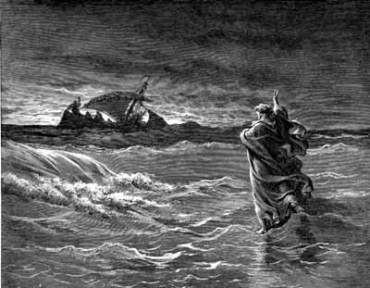
Jesus Walking on the Water...More Than a Neat Trick

[This was shared during worship with the people and guests of Living Water Lutheran Church in Springboro, Ohio, this morning.]

Matthew 14:22-33
The incident recounted in today’s gospel lesson, in which Jesus walks on water, is well known to Christians and non-Christians alike. Something about thinking of Jesus treading across the waves captures people’s imaginations. And in this lesson, we also identify with Jesus’ disciple, Peter, whose name, meaning Rock, never seemed more appropriate than the moment we read that, after taking a few steps on the water, he sank like a stone and had to be fished out by Jesus.

But as was true of last week’s gospel lesson, when we considered how Jesus fed more than 5000 people with a few fish and scraps of bread, as we read this lesson, we need to move beyond the superficial and seek some answers to some basic questions:

Jesus walking on the water is a neat trick, but what exactly does it mean for us today?

What truths for our lives can we garner from this incident?

There are, I think, at least four things to remember from today’s lesson that will help us today and beyond.

Take a look at the gospel lesson, Matthew 14:22-33, please.

It begins: “Immediately Jesus made the disciples get into the boat and go on ahead of him to the other side, while he dismissed the crowd.”

This happened right after the miraculous feeding. You’ll remember that that incident came about after Jesus had gone off to be by Himself to pray following the execution of His cousin, John the Baptist. Jesus had made Himself available to bring healing to those in need of it and, towards nightfall, to feed the hungry people.

But now, it seems, Jesus has completed His work for the day. He needs to spend time with His Father. Doing so will help Him to continue on the course He had come into the world to run, the course that would take Him, sinless God and man, to die on a cross, to bear our punishment for sin, then on to the resurrection so that all who turn from sin and believe in Him as their only God may have ever new, eternal life with God.

Matthew says that Jesus "made" the disciples get on a boat and go. The word translated as made is literally compelled. To be compelled is to be forced, as when my dad compelled me to go to bed at night. When one more powerful than you compels you to do something, there is no second guessing. There are no courts of appeals.

Just as forcefully, Jesus dismissed the crowd. Jesus has healed them. He has fed them. Now, even though the night is blacker than ink, it’s time for the crowd to go and for Jesus to face the next phase on His journey to cross and empty tomb.

So, from the beginning of the lesson, we see Jesus, the One Who by the touch of His hand was able to reverse the disease and death and deterioration that comes to us all in the fallen world and was able to spread a table for hungry thousands, as being totally in charge. That’s the first thing to remember in today’s lesson: Jesus is totally in charge. Even today, this moment.

Now, you might expect that this reality--the reality of Jesus being in charge in spite of all the grim and harsh challenges of this world--would have been permanently engraved on the consciousness of the disciples after they’d seen Jesus heal and feed all those people. But it turns out that those disciples are as thick-headed and unwilling to trust in God as I know I sometimes can be...and that you sometimes may be.

Take a look, please, at verses 23 and 24: “After he had dismissed them, he went up on a mountainside by himself to pray. Later that night, he was there alone, and the boat was already a considerable distance from land, buffeted by the waves because the wind was against it.”

Two scenes, one tranquil, one chaotic. Jesus praying alone to His Father. The disciples out riding the waves through a storm. And despite their expertise as fishermen who had plied these waters many times, they appear to be helpless before the buffeting wind.

A few weeks ago, I mentioned that in Matthew’s gospel, the word house often stands as a symbol for the Church. In this image, the Church is the household of God gathered for worship, gathered to receive God’s healing Word, and gathered to be fed on the body and blood of our Lord. The life of the gathered Church is sort of like what happened when Jesus gathered those thousands together to feed them on His grace and love and power.


But you should also know that Matthew often uses the term boat to symbolize the Church--ordinary believers like you and me--moving out into the world. The disciples riding in the boat with fear and trepidation are just like you when you're facing tough choices on Monday mornings, struggling to keep your lives and your finances together, struggling to maintain relationships, fighting almost to simply get through day to day life. It can be a stormy, rough ride out there outside the safe confines of the household of faith.

And, these two scenes--Jesus praying, the disciples struggling--serve as a good picture of how we may sometimes forget that even when we struggle, all who trust in Jesus Christ as their God and King have Someone Who, though we cannot see Him, is praying for us to His Father. That’s part of what it means for us to pray in Jesus‘ Name. We earnestly invoke the help of the One Who died and rose to set us free from sin and death. When we pray in Jesus' Name, He takes our case the Father and puts in a good word for us. Jesus had not forgotten the disciples and He never forgets you. That’s the second thing to remember from today’s lesson: Jesus will never forget you, no matter how rough the ride may get

Look again at our lesson, starting at verse 25: “Shortly before dawn Jesus went out to them, walking on the lake. When the disciples saw him walking on the lake, they were terrified. ‘It’s a ghost,’ they said, and cried out in fear. But Jesus immediately said to them: ‘Take courage! It is I [literally, in the Greek in which the New Testament is written, Jesus says, “Ego eimi,” not “It is I,” but “I AM,” identifying Himself with the same name by which God identified Himself to Moses in the Old Testament, “Yahweh” in the Hebrew, “I AM.” “It is I.”] Don’t be afraid.’”

Now, what so interests me here is that Jesus didn’t stop the wind and the waves. Instead, He told the disciples not to be afraid of them. I often pray that the storms of my life will go away. And there’s nothing wrong with that. But some of the storms that come to us--and I said only some--are allowed to enter our lives by God. Other storms are the inevitable outcroppings of a planet writhing in sin and death. But whatever the source of my life's storms, maybe I ought to learn to pray not only that God will take away the storms, but also that God will give me strength to go through them.

On the night before His arrest, Jesus prayed that He wouldn’t have to go through suffering and death on the cross. An understandable prayer. Jesus didn't want to go through the storm! But Jesus also prayed, “Nonetheless, not My will, but Your will be done.” It was only through the storm of His cross that Jesus could fulfill His mission of bringing life to people like you and me who would otherwise stand naked in our sins on judgment day and be eternally separated from God.

God loved and appreciated a man named Job, whose story is told in the Old Testament. Yet God allowed Job to undergo a ferocious storm of grief and loss that is almost painful to read about. But from his storm, Job emerged with a stronger faith.

In a world groaning under the power of sin and death, storms are inevitable in this life. But--and this is the third big lesson I draw from this incident--Jesus, I AM, God enfleshed, can give us peace in the midst of the storms.

With Psalm 46:2-3, we can say that the God we know in Jesus Christ is our ever-present refuge,  “...we will not fear, though the earth give way and the mountains fall into the heart of the sea, though its waters roar and foam and the mountains quake with their surging.”

Please look at what comes next, starting at verse 28: “Lord, if it’s you,’ Peter replied, ‘tell me to come to you on the water.’  ‘Come,’ he said. Then Peter got down out of the boat, walked on the water and came toward Jesus. But when he saw the wind, he was afraid and, beginning to sink, cried out, ‘Lord, save me!’ Immediately Jesus reached out his hand and caught him. ‘You of little faith,” he said, ‘why did you doubt?’”

I hope that we can be charitable to Peter. He sees Jesus walking on the water and He really believes that Jesus can empower him to do the same. He trusts. But His trust is weak. My guess is that many of us here this morning can say the same thing: "We trust; our trust is weak." 

But, if in his falling into the water, Peter is a representative of us and our faulty faith, in what happens after he falls, Peter is a model for us and our faith. He cries out, “Lord, saves me.” Peter’s faith, like ours, may have been of the stumbling, imperfect variety. But he could say with another of the Old Testament songs of worship, Psalm 121:1-2: “I lift up my eyes to the mountains—where does my help come from? My help comes from the Lord, the Maker of heaven and earth.”

When we realize that our situation is hopeless--that we confront situations we can’t conquer or comprehend that our sins threaten to condemn us to hell and to separate us from God forever, we can cry out simply to God.

This was a lesson that Peter was to learn well. Fifty days after Jesus rose from the dead, Peter spoke to a crowd of thousands who realized that they had been trying to live their lives--in effect, trying to walk on water--without God, without the saving help that God the Father sent Jesus, God the Son, to bring to us.

They were drowning in sin and hopelessness.

But Peter tells the crowd in Acts 2:21: “Everyone who calls on the Name of the Lord will be saved.”

And that is the fourth major thing I want to hold up today. Whether it’s from eternal separation from God, a lifetime of purposelessness, or a gnawing sense of insecurity that keeps you feeling less than the child of God you are, you (and I) need to do the same thing: Call on the Lord and we will be saved.

No matter the storms that confront us in this life, Jesus is totally in charge.

Jesus will never forget you.

Jesus--and only Jesus--can give you peace even in the midst of storms.

And when we call out to Jesus, we are saved.

It’s these truths that might well cause us after Jesus has brought us through another storm to, like the first disciples, worship Jesus and say with them, “Truly, You are the Son of God.” Amen


Sunday, August 03, 2014

What's the Big Deal About Feeding 5000?

[This was shared during worship with the people and guests of Living Water Lutheran Church in Springboro, Ohio, earlier today.]

Matthew 14:13-21
Today’s Gospel lesson, Matthew 14:13-21, tells us about Jesus’ miraculous feeding of more than five-thousand people. This incident is recounted in all four gospels, not only in Matthew’s, but also those of Mark, Luke, and John. In addition to that, Matthew and Mark also tell us about a time when, similarly, Jesus fed more than 4000 people. The feeding miracles get more attention in the four gospels than does the history of Jesus' birth--the narrative of the first Christmas--which only appears in Matthew's and Luke's gospels.

But it’s fair to ask what exactly is so important about these miraculous feeding incidents that, under the inspiration of the Holy Spirit, the writers of the four gospels made certain to tell us about them?

What is the significance of the feeding of the 5000?

And, more to the point, what is the significance of this incident for people gathered for worship in 2014?

The first thing to be said is that Jesus Himself thought His miraculous meals were important and that the lessons they taught about Him and His kingdom needed to be remembered by disciples like us.  In Matthew 16:9, He asks the disciples: “Do you still not understand? Don’t you remember the five loaves for the five thousand, and how many basketfuls you gathered?” But what are the lessons that the first disciples and that we twenty-first century disciples are supposed to take from the feeding miracles?

Take a look, please, at our lesson. It begins: “When Jesus heard what had happened, he withdrew by boat privately to a solitary place. Hearing of this, the crowds followed him on foot from the towns. When Jesus landed and saw a large crowd, he had compassion on them and healed their sick.”

The thing that Jesus heard had happened was the execution of His cousin, John the Baptizer.

Jesus was undoubtedly grief stricken.

On top of that, He had to know that now, both the crowds who had reposed so much hope in John and the authorities who had taken John’s life, would turn their focus, for good and ill, but mostly for ill, on Him.

Jesus came into our world to die for our sins and to rise to give new life to all who believe in Him. With John’s execution, Jesus’ own suffering and death drew closer.

So, Jesus, just as He had done when John had been arrested some time before withdrew to a solitary place.

To grieve.

To pray.

To prepare.

But when Jesus got off the boat meant to take Him to a place of peace and respite, He was met by an enormous crowd. We've all been there, haven't we? We're all set for downtime and suddenly, without warning, there's a party at our house.

But in this circumstance, Jesus, true man as well as true God didn’t vent His spleen. He didn't say, “Go away. I need time to myself.”

Instead, Matthew says that Jesus had compassion on the crowd and healed people. So we see the very first significant thing in this incident even before Jesus fed the crowd. It’s this: The God we know in Jesus Christ is available.

Jesus is interruptible.

He has time for us.

He’s anxious to listen to us.

He has compassion for us.

He has compassion for you.

A woman came to me for counseling years ago. She gave an impressive catalog of her sins. There were a boatload!

She wanted to be right with God. She wanted Jesus. But she was certain that Jesus would refuse to hear her, that God would never forgive her, and that God wouldn't even have the time for her.

I assured her that if we want Jesus, it’s evidence that His Holy Spirit has already been at work on our hearts for this simple reason: Jesus always wants us.

Even if we’ve made it a habit to violate every one of the ten commandments every day, Jesus is still available with forgiveness and new life.

He’s available to us too, when we’re hurting.

He’s available.

Next in our lesson, we read: “As evening approached, the disciples came to him and said, ‘This is a remote place, and it’s already getting late. Send the crowds away, so they can go to the villages and buy themselves some food.’ Jesus replied, ‘They do not need to go away. You give them something to eat.’ ‘We have here only five loaves of bread and two fish,’ they answered. ‘Bring them here to me,’ he said.”

The disciples weren't being ogres here. They were being completely sensible.

They were in a remote place. They didn’t have enough to feed this throng.

The disciples weren’t suffering from compassion fatigue. They simply saw no way to feed all those people.

And they were right. There was absolutely no way they could feed the 5000.

But Jesus told them, “Give me everything you have. I’ll make something of it.”

The second significant about this miracle: We can’t; God can.

Jesus says, “Go, make disciples.” We say, “We can’t.” Jesus says, “Go and I’ll make disciples through you.”

Jesus says, “Love your neighbor as you love yourself.” We say, “If you knew how annoying my neighbor is, you’d know I can’t do that.” Jesus says, “I know how annoying your neighbor is. Furthermore, I know how annoying you are. Make yourself available and I will love your neighbor through you.”

Jesus says, “Feed the hungry. Care for the poor. Give the hope of the gospel to those who aren’t even interested.” We say, “There’s no way we can do that, Lord.” Jesus says, “Depend on me and act; ready, fire, aim; I will make a way.”

In Mark 9:23, Jesus says, “Everything is possible for one who believes." Give Jesus your loaves and fishes; He will take care of the rest.

Let me point something out here. This entire incident happens wMithin the context of the disciples being together with Jesus. God, of course, can work in the lives of individuals. He does it all the time. But no one will remain long connected to Christ outside the fellowship of the Church. Or our connection will become self-directed. We’ll go off on our own tangents. In the fellowship of the Church and in the fellowship of small groups within the Church, we grow together, we keep each other on track, we encourage one another, we lovingly call each other to the carpet. The disciples never would have had the courage to give Jesus those five loaves and two fishes if they had stood alone with Him on that hillside. The Church is Christ’s creation. It is His very body in the world. Being a Christian is no solo operation.

Verse 19 says: “And he directed the people to sit down on the grass. Taking the five loaves and the two fish and looking up to heaven, he gave thanks and broke the loaves. Then he gave them to the disciples, and the disciples gave them to the people.”

This folks, is truly a foretaste of the feast to come. Believing Jews had for centuries looked forward to the time when the Messiah would invite all who believed in Him to His eternal table. And in Matthew 8:11, Jesus had said: “I say to you that many will come from the east and the west, and will take their places at the feast with Abraham, Isaac and Jacob in the kingdom of heaven.”

You and I are privileged to receive a foretaste of Jesus’ eternal table every time we receive the bread and wine of Holy Communion. We see the connection with Holy Communion (and the ultimate messianic feast to which it points) in the verbs describing Jesus’ actions as He fed the 5000, all of which appear in the New Testament accounts of the Last Supper, where Jesus instituted the Sacrament. Jesus takes the food. He gives thanks. He breaks the bread. He gives it to the disciples. And the disciples give it to the crowd.

From the time Israel wandered in the wilderness and fed on manna, God’s people have looked to God to feed them, to provide for them. Jesus teaches us to pray for “our daily bread.” We look forward to that day when “a great multitude that no one could count, from every nation, tribe, people and language [all who have turned from sin and trusted in Jesus Christ as their God and Savior and Lord over their lives], [stand] before the throne and before the Lamb” and partake of all the blessings God has in mind for His people.

Here, in our lesson, in the shadow of John’s execution, with His cross clearly ahead in Jesus’ sights, Jesus gives a clear sign that it is all true, that our hopes in Him are well founded.

The One Who could feed a multitude with a few scraps of food is good for all His promises.

He is the way and the truth and the life.

He is the only way to God. He is the way to new life, freed of sin and death.

He is our only hope.

The feeding of the 5000 is a sign that everything the apostles told us about Jesus, everything we confess about Him on Sunday mornings, is true.

The lesson ends: “They all ate and were satisfied, and the disciples picked up twelve basketfuls of broken pieces that were left over. The number of those who ate was about five thousand men, besides women and children.”

With our modern sensibilities, we may read that bit about “besides women and children” and think, “What a sexist, patriarchal thing for Matthew to write.” I can understand how some might think that.

But consider this for a moment: In first century Judea, women and children were supposed to be barely seen, never heard, and certainly not accounted for. But Matthew accounts for them! He makes a point of mentioning the women and children for the simple reason that in the eyes of Jesus Christ--in the eyes of God--every human life matters. Every man. Every woman. Every child. All are the objects of His love and compassion. All need Jesus. And Jesus wants to bring life to all who are willing enough to receive Him as their Savior and King.

There’s much more to this incident than we have time to talk about today. But remember, please, the four things that we've talked about today that give it significance, that make it important.

First, the God we know in Christ is always available. Call out to Him, as Martin Luther put it, “in every time of need.” He will hear.

Second, give yourself to Christ and He will take care of the rest. It won’t always be easy. There will be times you question His will and His wisdom. (I know that I sometimes do. "God," I ask, "do you really expect this of me?" And knowing from His Word, the Bible, that He does, I strive to accept His will.) Struggle to surrender and do God's will and, often even against your will, He will fulfill His purposes for your life.

Third, Jesus has prepared a feast for us, a celebration that will last eternally for those who trust in Him. Knowing that encourages us any time we’re laid low by life or just feeling, and this is a technical theological term, blah. Neither blah nor tears are the eternal destiny of those who follow Christ.

Fourth, in the eyes of Jesus Christ, everybody counts. He died for all. He rose for all. He offers everlasting life to all who believe in Him.

Now, if you can't remember those four things, then just remember Jesus. He is our God and our only hope. He's all you really need to remember. Amen!