Yesterday, my wife and I went to buy a few items at Giant Eagle. As we headed toward the self check, I spotted a display of DVDs. Among them were several titles by Leslie Sansone, the inventor of the simple walk at home workouts Ann and I really enjoy. One title looked especially good to us and the price was just $7.99.
We tossed the DVD into our cart and headed for the checkout. The last item I scanned was the Leslie Sansone DVD. As I did, the computer-generated voice said, "9.99." I touched the button on the computer screen for assistance and within seconds, a store manager appeared.
I explained what happened and she said, "Go ahead and complete your transaction, sir, and meet me at the register ahead." At the register, she hit some buttons and was handing my receipt to me when my wife, more alert than me, said, "You gave us the DVD for free?" "That's right!" she said, "have a nice evening and enjoy the workout."
Even if Ann and I didn't already love Giant Eagle, we would have become fans at that moment.
I've since learned that what the manager did is corporate policy.
But can you imagine what the world would be like if we did always did more than was expected of us?
What would happen in our families and marriages?
In our businesses and churches?
Based on what Ann and I felt as we left Giant Eagle yesterday, I can tell you there would be a lot more smiling faces. (The fun thing is the manager smiled too. It feels good when we go above and beyond people's expectations of us!)
Jesus once said that those who follow Him are to love even their enemies and to pray for the people who persecute them for their allegiance to Him.
At one level, that makes sense: The believer in Jesus knows that because of God's great charity, we're forgiven for our sins and Christ has given us a relationship with God that lasts eternally. We can afford to be loving and to pray for those who hate us. We know that nothing can separate us from the love of God given through Jesus!
Still, loving and praying for enemies is a countercultural and, really, who in this world would expect a person to do such crazy things?
But Jesus goes on to explain: "...if you love those who love you, what reward do you have?...And if you greet only your brothers and sisters, what more are you doing than others?..." When we fail to love our enemies and pray for those who give us a hard time in life, we're no different from everybody else. But, Jesus calls those who want to follow Him into eternity, to be different. In Matthew 5:48, He tells His followers to "be perfect...as your heavenly Father is perfect," meaning abandon the fractured, self-protecting ways of this world and embrace the wholeness and self-giving ways of God Himself.
Company policy at Giant Eagle set that manager free to be more considerate of two customers than we expected her to be.
Jesus Christ sets those who believe in Him free to be the people of love and consideration that we want to be, that God made us to be.
Loving enemies and praying for those who hate us way may not change the minds or hearts of those who experience our love. But then again it might.
And having permission to go above and beyond others' expectations like that is a wonderful thing!
If you confess that Jesus is your God and King, you are among the most free human beings on the planet. (Even when your enemies are powerful people who put you in jail for your faith in Christ!)
So, use your freedom!
Go ahead, right now: Do something loving for an enemy, pray for those who persecute or ridicule your faith. It will make you smile!
[Be sure to look at the passages from Scripture that you can click onto from the links above.]
Friday, May 18, 2012

Sunday, May 06, 2012
Life from the Vine
[This was shared during worship with the people of Saint Matthew Lutheran Church in Logan, Ohio, this morning.]
John 15:1-8
On the night of His arrest, in the room where He and the apostles had their Passover meal, Jesus tells them (and all who believe in Him) at the beginning of our lesson: “I am the true vine...”
What exactly does this mean and why should we spend the next few minutes of our lives trying to understand it?
In the Old Testament, God’s people Israel were pictured as a vine. For example, Psalm 80:8 says: “You have brought a vine out of Egypt. You have cast out the nations and planted it.” The mission of God’s people, Israel, was to be a light to the world, pointing others to the life that only God can give to those who turn from sin and believe in Him.
Israel's mission was later to be placed on the shoulders of one anointed king, a person described at least five centuries before the birth of Jesus in the book of Isaiah as the Servant. God speaks to this Servant in Isaiah 49:6: “I will...give You as a light to the gentiles, that You should be My salvation to the ends of the earth.”
In our gospel lesson, Jesus claims to be that Servant, the true Vine, Who is a light to all nations and Who offers salvation to all the world.
In that first verse, Jesus also says, “My Father is the vinedresser.”
Every vine needs pruning. Otherwise, it grows crazy and sprouts small, unhealthy, useless grapes. A vinedresser makes sure that his investment of time, energy, water, and fertilizer are maximized. He cuts off the branches that are likely to rob life from the other branches and not produce much themselves. Jesus evidently has branches that will be pruned away. We'll learn more about that as we dig further into this passage.
In verse 2, Jesus explains: “Every branch in Me that does not bear fruit He [God the Father] takes away; and every branch that bears fruit He prunes, that it may bear more fruit.”
Now, Jesus, like most Jewish teachers in the ancient world and like the Biblical writers, loved plays on word. They helped make teaching more memorable. The word that Jesus uses for prune in verse 2 is kathairei, a word that is similar to one He uses in verse 3, where He says: “You are already clean because of the word which I have spoken to you.” The word for clean in verse 3 is, in the original Greek, katharoi (we get the words like catharsis or cathartic, used of cleansing experiences, from it). Jesus is equating cleansing with pruning. “My word,” Jesus is saying, “the word that all who believe in Me will not perish but have everlasting life, has made you clean. I wash away the sins of all who believe in Me and am the way you to eternal life with God.”
Jesus makes those who believe in Him clean. Our sin is pruned away. But, Jesus says, God the Father also rids His vine of unproductive branches and rids even the productive branches of unproductive shoots.
This is important, because in verse 5, Jesus tells us: “I am the vine, you are the branches...”
Jesus says that those who are baptized and believe in Him are connected to Him, sort of like a lamp is connected to electric power through a wall outlet. A lamp that remains unplugged just sets and collects dust. It only serves a function and only "comes to life" when it's connected to its power source. Believers in Jesus draw their life from Jesus alone and as branches on the same Vine, Jesus, they are also connected to each other. You can't be a Christian on your own: You need both Jesus and His Church.
The apostle Paul says something similar to this in 1 Corinthians, where he writes that those of us who make up Christ’s Church “are the body of Christ and members individually.” So, we are branches who draw life from Jesus, we’re part of His body.
But that raises a problem. Jesus is sinless. The New Testament book of Hebrews says that Jesus “was in all points tempted as we are, yet without sin.” Now, if Jesus the Vine is going to thrive and give life to those who truly repent for sin and truly believe in Him, God cannot allow anything impure or sinful to be attached to Jesus. God must prune or cleanse Jesus the Vine of those branches that want to take life and blessings from Jesus without bearing fruit: without repentance for sin or trust in Jesus.
Unless the Father prunes the branches that are wasting God’s grace on the sins they want more than they want God, the whole vine, the entire body of Christ and God’s intention to create a new and everlasting kingdom for those who trust in Christ, is put in jeopardy.
This is why making our relationship with Christ and His Church the highest priority in our lives is so important. Jesus is saying that if we’re not all in with Him and His body, the Church, we’re really locking Him out of our lives.
This leads to what Jesus says in John 15:4. It’s both an order and a plea from the Savior Who loves us like no other: “Abide in Me...”
Abide means live, stay, or remain. Jesus is saying, “Stick with Me.”
Jesus goes on to say: “As the branch cannot bear fruit of itself, unless it abides in the vine, neither can you, unless you abide in me.” Then, at the end of verse 5, Jesus says something that sticks in the craw of any self-respecting, self-sufficient human being: “without Me you can do nothing.”
Who has the guts to admit that today: "Without Jesus, I can do nothing?" I learn it more every day! A few months ago, God impressed on me a simple message: “Don’t try to be creative with your sermons. Less of you; more of Me. Preach My Word and let the chips fall where they may.” It’s liberating to know that while I can’t, God always can!
Listen: Some of you may be trying to live a good, wholesome life on the strength of your own effort. If that’s what you’re doing, I’m telling you that you are bound to fail. We can never be as good as we were made to be or as we sometimes imagine ourselves to be. Jesus says we can do nothing without Him.
Others of you may think that you’re living a wholesome, godly life without paying much attention to God. As I’ve mentioned before, my grandmother used to say, “It’s easier to be good when you’re old than when you’re young.” What a stupid thing to say! That statement may be true only when you have one sin in mind.
But, I’ve found that the older I get, the easier it is for me to do just what I want to do. Society allows that as we age. “Age has its privileges,” we're told. Live enough years with that mentality and you start to believe it! You think that you’re entitled.
As the years go by--I’m talking to people in their teens as well as those in their 80s--maybe the best thing we could pray in the morning is, “God, what do you want me to do today that I don’t want to do?” I guarantee that if we will pray like that, we’ll be pushed so far out of our comfort zones we’ll have to remain connected to Christ for support and the sheer ability to get the thing done. We’ll know that we can’t, but God can.
In verse 6, Jesus says that if we refuse to be connected to Him, we will be cast out, thrown into the fire and burned. Lest we misunderstand Jesus' meaning here, He says something similar in Matthew's gospel: "So it will be at the end of the age. The angels will come out and separate the evil from the rightweous and throw them into the furnace of fire, where there will be weeping and gnashing of teeth" (Matthew 13:49-50). The difference between the good and evil people Jesus describes here is not that one group are sinners and the other is not; it's that one group of sinners places its confidence in its own capacity to be good, while the other group relies for its goodness on Christ, the true vine, alone.
Those who don’t believe in hell need to take the subject up with Jesus; He clearly did believe in hell. In fact, He died and rose to prevent any of us from experiencing it. All that is required of us is that we remain connected to Him, trusting in Him alone.
But verse 6 isn’t the most challenging verse in the lesson. Verse 7 is. Jesus says: “If you abide in Me and My words abide in you, you will ask what you desire, and it shall be done for you.”
A lot of games get played with this verse and others like it. “If you only had enough faith,” some people will say, “you would never get sick and everything you ever wanted would be there for you.” That’s not faith, but magical thinking.
So, let’s not play games and deal honestly with what Jesus says here, with what we can understand and what we can’t. Probably every person in this sanctuary has prayed for the earthly lives of loved ones or friends, the new job or career, good health for ourselves or other things, and not received the answers we desperately sought. I cannot and will not explain away all the pain you’ve gone through as a result. Nor do I know why God seems to say, “No” to the prayers of Christians.
But, just a few thoughts. Please look at Psalm 37:4. It says: “Delight yourself...in the Lord, and he shall give you the desires of your heart.”
Notice that the prerequisite for God giving us the desires of our hearts is that we delight in Lord. To delight in the Lord must mean, in part, putting God and God’s priorities first in our lives. We delight in God as we abide in Christ and remain connected to Him. As a result, what we desire changes because we delight in God. God's mind and our minds move more in sync. Some of what we pray for may change when delight in God. God may teach us to truly pray the hardest petition of the Lord’s Prayer: “Thy will be done.” Maybe this is why Jesus makes this promise to give us whatever we desire within the context of His plea and command to abide in Him.
When I first became a Christian, the passage of Scripture that bothered me the most was Genesis 3:24. It comes after Adam and Eve have fallen into sin. It says that God drove Adam and Eve out of the garden and kept the whole human race from getting to the tree of life. “Why did God do that?” I wondered. Doesn’t God want to give us life?
The answer, of course, is that God does want to give us life. But more than that, God wants to give us life with Him. Had the human race gotten access to the tree of life without the change in our relationship with God that comes to those who believe in Jesus Christ, it would have meant an eternity of suffering and separation from God. We would have gotten the desires of our hearts, but the desires of hearts darkened and perverted by sin. We would have been lost to God forever, still in our sins.
God’s ways may not lead us to the answers we seek. But God’s ways, when we persevere in abiding with Christ, always lead to life beyond the confines of this suffering, dying world. God's ways always lead to resurrection victory and eternal life in His kingdom when we stick with Jesus.
The crucified and risen Jesus is the only one with the credibility to ask us to believe that, to trust God even when tragedies we devoutly prayed would not come, come anyway.
That's because Jesus on the cross assures us that God understands our pain and because Jesus risen assures us that there will be a time beyond our earthly sadness when all that seems senseless and barren will be explained, when all the hurts and kills us today will be in the past.
The apostle Paul, who knew all about suffering and about God rebuffing him when he asked that suffering be removed from his life, could, because of his connection to Jesus, say in Romans 8:18: “I consider that the sufferings of this present time are not worthy to be compared with the glory which shall be revealed to us” when Jesus returns to bring His new creation in its fullness!
Until that day when Jesus returns, as we remain connected to Christ and our prayers move in sync with God, God will build up our faith, we will delight in God and desire the things God desires, and God will use us to share His love with and bring His kingdom to others. Like our Savior, we will share in others’ sorrows and joys and, in this way, bring the life of Christ to them. It is just this life--a life of deep connection with Christ and the needs of others--that Jesus calls “bearing fruit,” living the same faith Sunday afternoon through Saturday that we profess on Sunday mornings.
“By this [abiding in Him],” Jesus says in verse 8 of our gospel lesson, “My Father is glorified, that you bear much fruit. So [or, in this way] you will be My disciples.”
Stick with Jesus and His body, the Church.
That’s where life is.
That’s where, even in the midst of questions we can’t fully answer in this world, purpose can be found.
Amen
John 15:1-8
On the night of His arrest, in the room where He and the apostles had their Passover meal, Jesus tells them (and all who believe in Him) at the beginning of our lesson: “I am the true vine...”
What exactly does this mean and why should we spend the next few minutes of our lives trying to understand it?
In the Old Testament, God’s people Israel were pictured as a vine. For example, Psalm 80:8 says: “You have brought a vine out of Egypt. You have cast out the nations and planted it.” The mission of God’s people, Israel, was to be a light to the world, pointing others to the life that only God can give to those who turn from sin and believe in Him.
Israel's mission was later to be placed on the shoulders of one anointed king, a person described at least five centuries before the birth of Jesus in the book of Isaiah as the Servant. God speaks to this Servant in Isaiah 49:6: “I will...give You as a light to the gentiles, that You should be My salvation to the ends of the earth.”
In our gospel lesson, Jesus claims to be that Servant, the true Vine, Who is a light to all nations and Who offers salvation to all the world.
In that first verse, Jesus also says, “My Father is the vinedresser.”
Every vine needs pruning. Otherwise, it grows crazy and sprouts small, unhealthy, useless grapes. A vinedresser makes sure that his investment of time, energy, water, and fertilizer are maximized. He cuts off the branches that are likely to rob life from the other branches and not produce much themselves. Jesus evidently has branches that will be pruned away. We'll learn more about that as we dig further into this passage.
In verse 2, Jesus explains: “Every branch in Me that does not bear fruit He [God the Father] takes away; and every branch that bears fruit He prunes, that it may bear more fruit.”
Now, Jesus, like most Jewish teachers in the ancient world and like the Biblical writers, loved plays on word. They helped make teaching more memorable. The word that Jesus uses for prune in verse 2 is kathairei, a word that is similar to one He uses in verse 3, where He says: “You are already clean because of the word which I have spoken to you.” The word for clean in verse 3 is, in the original Greek, katharoi (we get the words like catharsis or cathartic, used of cleansing experiences, from it). Jesus is equating cleansing with pruning. “My word,” Jesus is saying, “the word that all who believe in Me will not perish but have everlasting life, has made you clean. I wash away the sins of all who believe in Me and am the way you to eternal life with God.”
Jesus makes those who believe in Him clean. Our sin is pruned away. But, Jesus says, God the Father also rids His vine of unproductive branches and rids even the productive branches of unproductive shoots.
This is important, because in verse 5, Jesus tells us: “I am the vine, you are the branches...”
Jesus says that those who are baptized and believe in Him are connected to Him, sort of like a lamp is connected to electric power through a wall outlet. A lamp that remains unplugged just sets and collects dust. It only serves a function and only "comes to life" when it's connected to its power source. Believers in Jesus draw their life from Jesus alone and as branches on the same Vine, Jesus, they are also connected to each other. You can't be a Christian on your own: You need both Jesus and His Church.
The apostle Paul says something similar to this in 1 Corinthians, where he writes that those of us who make up Christ’s Church “are the body of Christ and members individually.” So, we are branches who draw life from Jesus, we’re part of His body.
But that raises a problem. Jesus is sinless. The New Testament book of Hebrews says that Jesus “was in all points tempted as we are, yet without sin.” Now, if Jesus the Vine is going to thrive and give life to those who truly repent for sin and truly believe in Him, God cannot allow anything impure or sinful to be attached to Jesus. God must prune or cleanse Jesus the Vine of those branches that want to take life and blessings from Jesus without bearing fruit: without repentance for sin or trust in Jesus.
Unless the Father prunes the branches that are wasting God’s grace on the sins they want more than they want God, the whole vine, the entire body of Christ and God’s intention to create a new and everlasting kingdom for those who trust in Christ, is put in jeopardy.
This is why making our relationship with Christ and His Church the highest priority in our lives is so important. Jesus is saying that if we’re not all in with Him and His body, the Church, we’re really locking Him out of our lives.
This leads to what Jesus says in John 15:4. It’s both an order and a plea from the Savior Who loves us like no other: “Abide in Me...”
Abide means live, stay, or remain. Jesus is saying, “Stick with Me.”
Jesus goes on to say: “As the branch cannot bear fruit of itself, unless it abides in the vine, neither can you, unless you abide in me.” Then, at the end of verse 5, Jesus says something that sticks in the craw of any self-respecting, self-sufficient human being: “without Me you can do nothing.”
Who has the guts to admit that today: "Without Jesus, I can do nothing?" I learn it more every day! A few months ago, God impressed on me a simple message: “Don’t try to be creative with your sermons. Less of you; more of Me. Preach My Word and let the chips fall where they may.” It’s liberating to know that while I can’t, God always can!
Listen: Some of you may be trying to live a good, wholesome life on the strength of your own effort. If that’s what you’re doing, I’m telling you that you are bound to fail. We can never be as good as we were made to be or as we sometimes imagine ourselves to be. Jesus says we can do nothing without Him.
Others of you may think that you’re living a wholesome, godly life without paying much attention to God. As I’ve mentioned before, my grandmother used to say, “It’s easier to be good when you’re old than when you’re young.” What a stupid thing to say! That statement may be true only when you have one sin in mind.
But, I’ve found that the older I get, the easier it is for me to do just what I want to do. Society allows that as we age. “Age has its privileges,” we're told. Live enough years with that mentality and you start to believe it! You think that you’re entitled.
As the years go by--I’m talking to people in their teens as well as those in their 80s--maybe the best thing we could pray in the morning is, “God, what do you want me to do today that I don’t want to do?” I guarantee that if we will pray like that, we’ll be pushed so far out of our comfort zones we’ll have to remain connected to Christ for support and the sheer ability to get the thing done. We’ll know that we can’t, but God can.
In verse 6, Jesus says that if we refuse to be connected to Him, we will be cast out, thrown into the fire and burned. Lest we misunderstand Jesus' meaning here, He says something similar in Matthew's gospel: "So it will be at the end of the age. The angels will come out and separate the evil from the rightweous and throw them into the furnace of fire, where there will be weeping and gnashing of teeth" (Matthew 13:49-50). The difference between the good and evil people Jesus describes here is not that one group are sinners and the other is not; it's that one group of sinners places its confidence in its own capacity to be good, while the other group relies for its goodness on Christ, the true vine, alone.
Those who don’t believe in hell need to take the subject up with Jesus; He clearly did believe in hell. In fact, He died and rose to prevent any of us from experiencing it. All that is required of us is that we remain connected to Him, trusting in Him alone.
But verse 6 isn’t the most challenging verse in the lesson. Verse 7 is. Jesus says: “If you abide in Me and My words abide in you, you will ask what you desire, and it shall be done for you.”
A lot of games get played with this verse and others like it. “If you only had enough faith,” some people will say, “you would never get sick and everything you ever wanted would be there for you.” That’s not faith, but magical thinking.
So, let’s not play games and deal honestly with what Jesus says here, with what we can understand and what we can’t. Probably every person in this sanctuary has prayed for the earthly lives of loved ones or friends, the new job or career, good health for ourselves or other things, and not received the answers we desperately sought. I cannot and will not explain away all the pain you’ve gone through as a result. Nor do I know why God seems to say, “No” to the prayers of Christians.
But, just a few thoughts. Please look at Psalm 37:4. It says: “Delight yourself...in the Lord, and he shall give you the desires of your heart.”
Notice that the prerequisite for God giving us the desires of our hearts is that we delight in Lord. To delight in the Lord must mean, in part, putting God and God’s priorities first in our lives. We delight in God as we abide in Christ and remain connected to Him. As a result, what we desire changes because we delight in God. God's mind and our minds move more in sync. Some of what we pray for may change when delight in God. God may teach us to truly pray the hardest petition of the Lord’s Prayer: “Thy will be done.” Maybe this is why Jesus makes this promise to give us whatever we desire within the context of His plea and command to abide in Him.
When I first became a Christian, the passage of Scripture that bothered me the most was Genesis 3:24. It comes after Adam and Eve have fallen into sin. It says that God drove Adam and Eve out of the garden and kept the whole human race from getting to the tree of life. “Why did God do that?” I wondered. Doesn’t God want to give us life?
The answer, of course, is that God does want to give us life. But more than that, God wants to give us life with Him. Had the human race gotten access to the tree of life without the change in our relationship with God that comes to those who believe in Jesus Christ, it would have meant an eternity of suffering and separation from God. We would have gotten the desires of our hearts, but the desires of hearts darkened and perverted by sin. We would have been lost to God forever, still in our sins.
God’s ways may not lead us to the answers we seek. But God’s ways, when we persevere in abiding with Christ, always lead to life beyond the confines of this suffering, dying world. God's ways always lead to resurrection victory and eternal life in His kingdom when we stick with Jesus.
The crucified and risen Jesus is the only one with the credibility to ask us to believe that, to trust God even when tragedies we devoutly prayed would not come, come anyway.
That's because Jesus on the cross assures us that God understands our pain and because Jesus risen assures us that there will be a time beyond our earthly sadness when all that seems senseless and barren will be explained, when all the hurts and kills us today will be in the past.
The apostle Paul, who knew all about suffering and about God rebuffing him when he asked that suffering be removed from his life, could, because of his connection to Jesus, say in Romans 8:18: “I consider that the sufferings of this present time are not worthy to be compared with the glory which shall be revealed to us” when Jesus returns to bring His new creation in its fullness!
Until that day when Jesus returns, as we remain connected to Christ and our prayers move in sync with God, God will build up our faith, we will delight in God and desire the things God desires, and God will use us to share His love with and bring His kingdom to others. Like our Savior, we will share in others’ sorrows and joys and, in this way, bring the life of Christ to them. It is just this life--a life of deep connection with Christ and the needs of others--that Jesus calls “bearing fruit,” living the same faith Sunday afternoon through Saturday that we profess on Sunday mornings.
“By this [abiding in Him],” Jesus says in verse 8 of our gospel lesson, “My Father is glorified, that you bear much fruit. So [or, in this way] you will be My disciples.”
Stick with Jesus and His body, the Church.
That’s where life is.
That’s where, even in the midst of questions we can’t fully answer in this world, purpose can be found.
Amen
Monday, April 30, 2012
A Question of Authority
[This was shared during worship with the people of Saint Matthew Lutheran Church in Logan, Ohio, yesterday.]
Acts 4:5-12
True story about a family in one of the parishes I served as pastor: They were very devout. They showed up for worship every Sunday and saw to it that their children were not only in worship, but also in Sunday School, Catechism, and youth group. They had a daughter who, unlike so many, didn't treat Confirmation as though it were graduation from the church. She stayed involved, evidencing a real faith in Christ.
This young woman went off to college, where she did well. While there, her commitment to Christ only deepened. She got involved with a campus Bible study. She got active with a local congregation in the college town, even going on a few mission trips. In telephone calls to her folks, she gave every evidence of being on fire for Christ.
I was talking with her mom one day and I asked how things were going. "OK," she said, "but I'm really concerned about Mary." "What's wrong?" I asked. "She's really gotten into Church, really into the Bible, really into telling others about Jesus," she told me. I wondered what the problem was. Her mom explained: “We raised her to be a churchgoer, not a fanatic.”
You know, there are people in the Church who have just enough of Jesus to be inoculated against Him. They warm a pew. They go through the motions of being "church members." And most importantly (to them), they are rostered members of their congregations who put money in the plate. What more could any normal--non-fanatical--person expect of them?
I've actually had church members say to me, "You know, Pastor, that was a beautiful sermon. It's great that we're called to love God and trust in Jesus above all else. But it doesn't work in the real world." I ask them, "Have you tried?"
But the fact is, there are lots of people in the Church who don't want to try. They want to keep God at arm's length. That's why they can be so hostile to people like Mary, who take their faith seriously and who strive to keep Jesus as the center of their lives. Do we, in today's world, need the kind of fanaticism Mary evidenced? Desperately!
But you know what? The unwillingness to stand under the authority of Christ and of His Word that Mary's mother articulated can also be seen among so-called "leaders" of the Church, respected pastors and theologians.
About ten years ago, I attended a meeting with other clergy. We had a guest speaker, a New Testament scholar who participated in something called the Jesus Seminar. Basically, the Jesus Seminar is a group of New Testament scholars from established denominations and prestigious universities and seminaries. They get together, hear papers presented, have discussions, and then vote on which parts of the New Testament are true and which parts aren't true.
The Jesus Seminar scholar who spoke to us said, "I don't remember the exact tally, but we voted against the resurrection of Jesus. We're confident that it didn't happen."
One of the pastors screwed up his courage, raised his hand, and said, "I understand that the Biblical writers don't agree on every particular detail of things. And each of them--the gospel writers, Matthew, Mark, Luke, and John and the others like Peter, Paul, James, and the preacher in the book of Hebrews--have their own particular theological slants and emphases. But among the things that none of them disputed and on which they staked their lives is that Jesus died on a cross and was raised on the third day by God the Father. How can you take a vote and say that's not true?"
"Well," the theologian said, "have you ever met a person risen from the dead? It's not within the realm of the experiences of anyone else you might meet either. And if it can't happen today, it couldn't have happened then."
What he was doing was holding his experiences and his intellect as higher authorities than the Scriptures, the revealed Word of God. And whenever we do that, we're in trouble.
Now, people like these New Testament scholars or Mary's parents are what we might call nihilists. It's a term that comes from the Latin word, nihilo, meaning nothing. Nihilists, as I'm using the term here, are people who basically believe in nothing. If you can't see it, touch it, hold it, own it, buy it, sell it, or gain weight from it, it isn't true. To the nihilist, there's no heaven, no hell, no omnipotent, immortal God. Nothing.
There are a lot of their tribe these days, both inside and outside the Church. But the phenomenon is nothing new.
Turn to Acts 3, if you would. There, we're told that one day a few years after Jesus rose from the dead and ascended to heaven, the apostles Peter and John were entering the temple in Jerusalem. Like all the first Christians, these two were devout Jews and they maintained their religious practices even then, seeing Jesus as the fulfillment of God's promises to His people. As Peter and John were going into the temple, they met a man who had been lame--paralyzed--from birth. He was sitting there, hoping that people would give him some money. Peter looked at the man and the man thought that Peter was going to hand him a coin or two. Instead, look at what Peter says in Acts 3:6:
So, this crowd came rushing toward Peter and John. They're about to hail the two apostles as miracle workers. But look at what Peter says to them in Acts 3:12 and beyond:
The reason for that is simple. The bigger question in all of our lives--just as was true with this lame man--isn't whether we're healthy or not. The bigger question is whether--healthy or ill, weak or strong--you and I are reconciled with God. The miracles recorded in the New Testament are meant simply to point us to the only one who can overcome sin and death and decay and reconcile us to the God Who, alone, can give us new life: the risen Jesus!
And that's why Peter is so quick to say, "It isn't me who did this, but Jesus, the Lord of all...Jesus, the One you wanted out of your life and put on a cross Who is now risen and alive right now!" He then told them that they could be right with God and have life beyond the grave if they would turn from sin and give their lives to Christ.
After Peter made his proclamation about Jesus, the same leaders who, just a short while before, had petitioned Pilate to put Jesus on a cross, had Peter and John arrested. That's where the lesson for this morning, Acts 4:5-12, begins. Take a look at the opening verses:
In fact, this group of important priests, elders, and scribes had fallen prey to something that one of my professors in seminary, Pastor Bruce Schein, used to warn us against. Pastor Schein told us, "Be careful of handling the holy. Be careful in handling the Word of God. Be careful in handling the Sacraments. You might begin to think that they're nothing. You might begin to thing that they're not important and that you are the only thing that makes them worth anything."
For the priests and others who were part of the Saducees party, religious life was simply a set of motions you went through. Liturgy was something pretty that they did. Participating in worship didn't mean that you really believed in a God Who has control over life and death. They were in control and they didn't need any sign from God pointing people away from them.
So, they call Peter and John out of their jail cell to make an appearance before them. And then we read in verse 7 of our lesson what these religious leaders wanted to hear from Peter and John:
You meet a New Testament scholar who tells you that Jesus' resurrection never happened and the scholar asks you, "By what authority do you--a common layperson or a common pastor, who has never done graduate work or spent years studying the New Testament--have the temerity to tell us that this book is actually true, that Jesus really did die and rise."
The question of authority is what the religious leaders asked of Peter and John: "Who exactly do you think you are? Who told you that you could do and say these things?"
Look at how Peter answers the question in verse 9:
But the trouble was that Peter ascribed the miracle to Jesus. And the minute you give any credit to Jesus, you get yourself in trouble in this world.
Jesus once said that for those who follow Him, enemies will not be the outside world, but those of one's own household...one's own family...one's own church. They're the ones who ask, "Who said that you could get so high and mighty with this Jesus stuff?"
The Saducees and others wanted to knock Peter and John down a peg or two. Peter said, in effect, "That's OK. I'm not the One Who did this. It was done by the One Who was killed by our sins, the One God raised from the dead."
Now I ask myself, "Where is it that Peter got the stuff to do this?" Remember Peter on Maundy Thursday, when Jesus was bring tried and faced death on the cross? He denied even knowing Jesus three times. Where does this guy get his guts? Acts 4:8 answers that mystery:
I know all about that desperation. When I told my mother that I was going to seminary, she told me that she was apprehensive. "Mark," she said, "you've never dealt well with sickness or death. Are you sure you can be a pastor?" I said, "No." But here's how I've done it for twenty-seven years: In the car, on the way to the hospital, or the death bed, or the funeral home, I pray, "God, I can't. You can. Give me the right words. Give me the right silences. Send Your Spirit."
You know, that God has always answered that prayer? God has never failed once.
That's how Peter was able to share his faith in Christ.
And that's how you and I, in the face of a world that is increasingly indifferent or hostile toward the good news of new life for all who repent and believe in Jesus, can stand firm. We can stand firm, not out of egotism or an attitude of being holier or better than others, but simply because we love God and we love others and those "others" need Jesus as much as we do.
Look at what Peter says at the very end of our lesson, Acts 4:12:
Amen
Acts 4:5-12
True story about a family in one of the parishes I served as pastor: They were very devout. They showed up for worship every Sunday and saw to it that their children were not only in worship, but also in Sunday School, Catechism, and youth group. They had a daughter who, unlike so many, didn't treat Confirmation as though it were graduation from the church. She stayed involved, evidencing a real faith in Christ.
This young woman went off to college, where she did well. While there, her commitment to Christ only deepened. She got involved with a campus Bible study. She got active with a local congregation in the college town, even going on a few mission trips. In telephone calls to her folks, she gave every evidence of being on fire for Christ.
I was talking with her mom one day and I asked how things were going. "OK," she said, "but I'm really concerned about Mary." "What's wrong?" I asked. "She's really gotten into Church, really into the Bible, really into telling others about Jesus," she told me. I wondered what the problem was. Her mom explained: “We raised her to be a churchgoer, not a fanatic.”
You know, there are people in the Church who have just enough of Jesus to be inoculated against Him. They warm a pew. They go through the motions of being "church members." And most importantly (to them), they are rostered members of their congregations who put money in the plate. What more could any normal--non-fanatical--person expect of them?
I've actually had church members say to me, "You know, Pastor, that was a beautiful sermon. It's great that we're called to love God and trust in Jesus above all else. But it doesn't work in the real world." I ask them, "Have you tried?"
But the fact is, there are lots of people in the Church who don't want to try. They want to keep God at arm's length. That's why they can be so hostile to people like Mary, who take their faith seriously and who strive to keep Jesus as the center of their lives. Do we, in today's world, need the kind of fanaticism Mary evidenced? Desperately!
But you know what? The unwillingness to stand under the authority of Christ and of His Word that Mary's mother articulated can also be seen among so-called "leaders" of the Church, respected pastors and theologians.
About ten years ago, I attended a meeting with other clergy. We had a guest speaker, a New Testament scholar who participated in something called the Jesus Seminar. Basically, the Jesus Seminar is a group of New Testament scholars from established denominations and prestigious universities and seminaries. They get together, hear papers presented, have discussions, and then vote on which parts of the New Testament are true and which parts aren't true.
The Jesus Seminar scholar who spoke to us said, "I don't remember the exact tally, but we voted against the resurrection of Jesus. We're confident that it didn't happen."
One of the pastors screwed up his courage, raised his hand, and said, "I understand that the Biblical writers don't agree on every particular detail of things. And each of them--the gospel writers, Matthew, Mark, Luke, and John and the others like Peter, Paul, James, and the preacher in the book of Hebrews--have their own particular theological slants and emphases. But among the things that none of them disputed and on which they staked their lives is that Jesus died on a cross and was raised on the third day by God the Father. How can you take a vote and say that's not true?"
"Well," the theologian said, "have you ever met a person risen from the dead? It's not within the realm of the experiences of anyone else you might meet either. And if it can't happen today, it couldn't have happened then."
What he was doing was holding his experiences and his intellect as higher authorities than the Scriptures, the revealed Word of God. And whenever we do that, we're in trouble.
Now, people like these New Testament scholars or Mary's parents are what we might call nihilists. It's a term that comes from the Latin word, nihilo, meaning nothing. Nihilists, as I'm using the term here, are people who basically believe in nothing. If you can't see it, touch it, hold it, own it, buy it, sell it, or gain weight from it, it isn't true. To the nihilist, there's no heaven, no hell, no omnipotent, immortal God. Nothing.
There are a lot of their tribe these days, both inside and outside the Church. But the phenomenon is nothing new.
Turn to Acts 3, if you would. There, we're told that one day a few years after Jesus rose from the dead and ascended to heaven, the apostles Peter and John were entering the temple in Jerusalem. Like all the first Christians, these two were devout Jews and they maintained their religious practices even then, seeing Jesus as the fulfillment of God's promises to His people. As Peter and John were going into the temple, they met a man who had been lame--paralyzed--from birth. He was sitting there, hoping that people would give him some money. Peter looked at the man and the man thought that Peter was going to hand him a coin or two. Instead, look at what Peter says in Acts 3:6:
“Silver and gold I do not have, but what I do have I give you: In the name of Jesus Christ of Nazareth, rise up and walk.”This took place in a section of the temple known as Solomon's Portico or Solomon's Porch. It was teeming with people. You can bet that when this crowd saw this paralyzed man walking, leaping, and praising God, it got their attention!
So, this crowd came rushing toward Peter and John. They're about to hail the two apostles as miracle workers. But look at what Peter says to them in Acts 3:12 and beyond:
“[People] of Israel, why do you marvel at this? Or why look so intently at us, as though by our own power or godliness we had made this man walk? The God of Abraham, Isaac, and Jacob, the God of our fathers, glorified His Servant Jesus, whom you delivered up and denied in the presence of Pilate, when he was determined to let Him go. But you denied the Holy One and the Just, and asked for a murderer to be granted to you, and killed the Prince of life, whom God raised from the dead, of which we are witnesses. And His name, through faith in His name, has made this man strong, whom you see and know. Yes, the faith which comes through Him has given him this perfect soundness in the presence of you all."The typical term for miracle in the Greek in which the New Testament was written is semeia. It means sign. It's like the exit sign over there. The sign doesn't point to itself. It points to the place where we can exit from this room. The miracles of Jesus were never ends in themselves. They had a point. So does this miracle Jesus performed through Peter on Solomon's Porch. All of these miracles represent signs of the fact that Jesus has power over sin and death.
The reason for that is simple. The bigger question in all of our lives--just as was true with this lame man--isn't whether we're healthy or not. The bigger question is whether--healthy or ill, weak or strong--you and I are reconciled with God. The miracles recorded in the New Testament are meant simply to point us to the only one who can overcome sin and death and decay and reconcile us to the God Who, alone, can give us new life: the risen Jesus!
And that's why Peter is so quick to say, "It isn't me who did this, but Jesus, the Lord of all...Jesus, the One you wanted out of your life and put on a cross Who is now risen and alive right now!" He then told them that they could be right with God and have life beyond the grave if they would turn from sin and give their lives to Christ.
After Peter made his proclamation about Jesus, the same leaders who, just a short while before, had petitioned Pilate to put Jesus on a cross, had Peter and John arrested. That's where the lesson for this morning, Acts 4:5-12, begins. Take a look at the opening verses:
And it came to pass, on the next day, that their rulers, elders, and scribes, as well as Annas the high priest, Caiaphas, John, and Alexander, and as many as were of the family of the high priest, were gathered together at Jerusalem.Now, it's well-documented that among this crew, especially the priests, were people who were first-century nihilists. They called themselves Sadducees. The Saducees believed that the whole notion of a resurrection of the dead was crazy. They found it inconceivable that God could or would veto the power of death.
In fact, this group of important priests, elders, and scribes had fallen prey to something that one of my professors in seminary, Pastor Bruce Schein, used to warn us against. Pastor Schein told us, "Be careful of handling the holy. Be careful in handling the Word of God. Be careful in handling the Sacraments. You might begin to think that they're nothing. You might begin to thing that they're not important and that you are the only thing that makes them worth anything."
For the priests and others who were part of the Saducees party, religious life was simply a set of motions you went through. Liturgy was something pretty that they did. Participating in worship didn't mean that you really believed in a God Who has control over life and death. They were in control and they didn't need any sign from God pointing people away from them.
So, they call Peter and John out of their jail cell to make an appearance before them. And then we read in verse 7 of our lesson what these religious leaders wanted to hear from Peter and John:
“By what power or by what name have you done this?”You have a daughter who goes off to college and gets involved with her faith and, exercising your parental authority, you demand of her, "Whatever possessed you to think that Jesus really mattered? Didn't you know that we just took you to church so you could learn good morals and be a nice person?"
You meet a New Testament scholar who tells you that Jesus' resurrection never happened and the scholar asks you, "By what authority do you--a common layperson or a common pastor, who has never done graduate work or spent years studying the New Testament--have the temerity to tell us that this book is actually true, that Jesus really did die and rise."
The question of authority is what the religious leaders asked of Peter and John: "Who exactly do you think you are? Who told you that you could do and say these things?"
Look at how Peter answers the question in verse 9:
If we this day are judged for a good deed done to a helpless man, by what means he has been made well, let it be known to you all, and to all the people of Israel, that by the name of Jesus Christ of Nazareth, whom you crucified, whom God raised from the dead, by Him this man stands here before you whole.You know what? Peter wouldn't have been in trouble if he'd said something like, "Well, I picked up a little magic somewhere along the way and that's how I was able to make the man walk again." Or if he'd said, "I recognized that his paralysis was psychosomatic and that if I simply told the man to walk, he'd be able to do it." If Peter had taken the credit for himself, this healing wouldn't have been controversial. The leaders wouldn't have even arrested John and Peter in the first place!
But the trouble was that Peter ascribed the miracle to Jesus. And the minute you give any credit to Jesus, you get yourself in trouble in this world.
Jesus once said that for those who follow Him, enemies will not be the outside world, but those of one's own household...one's own family...one's own church. They're the ones who ask, "Who said that you could get so high and mighty with this Jesus stuff?"
The Saducees and others wanted to knock Peter and John down a peg or two. Peter said, in effect, "That's OK. I'm not the One Who did this. It was done by the One Who was killed by our sins, the One God raised from the dead."
Now I ask myself, "Where is it that Peter got the stuff to do this?" Remember Peter on Maundy Thursday, when Jesus was bring tried and faced death on the cross? He denied even knowing Jesus three times. Where does this guy get his guts? Acts 4:8 answers that mystery:
Then Peter, filled with the Holy Spirit...We can have the power to live by the faith in Christ we profess, not because we talk ourselves into it or because of some inspiration we pick up along the way, but because Jesus sends His Holy Spirit to those who are desperate enough to acknowledge their need of the Spirit, desperate enough to ask for the presence of the Spirit in their lives.
I know all about that desperation. When I told my mother that I was going to seminary, she told me that she was apprehensive. "Mark," she said, "you've never dealt well with sickness or death. Are you sure you can be a pastor?" I said, "No." But here's how I've done it for twenty-seven years: In the car, on the way to the hospital, or the death bed, or the funeral home, I pray, "God, I can't. You can. Give me the right words. Give me the right silences. Send Your Spirit."
You know, that God has always answered that prayer? God has never failed once.
That's how Peter was able to share his faith in Christ.
And that's how you and I, in the face of a world that is increasingly indifferent or hostile toward the good news of new life for all who repent and believe in Jesus, can stand firm. We can stand firm, not out of egotism or an attitude of being holier or better than others, but simply because we love God and we love others and those "others" need Jesus as much as we do.
Look at what Peter says at the very end of our lesson, Acts 4:12:
"Nor is there salvation in any other, for there is no other name under heaven given among men by which we must be saved.”Now, if we believe that--if we believe Jesus when He says that He is the way and the truth and the life and that no one can be reconciled with God the Father except through Him, we can't have it on our consciences that we have not shared Jesus with others. We can't settle for a hypocritical half-faith. And though we are unable to do it on our own, as weak, at least, as Peter, God can help us share Christ with others when we depend on His Spirit.
Amen
Friday, April 27, 2012
If You Want to Lead, You've Got to Care
|
Leaders who view people as game pieces to be manipulated delude themselves with the notion that by their depersonalizing "efficiences," they will accomplish more.
Impersonal or harsh leaders may score temporary spikes in measurable outputs--even when the leaders in question are pastors. But such "leadership" will never sustain positive results.
Good leadership entails viewing those being led as people with lives, families, dreams, and goals.
I recently read Ten Most Common Mistakes Made by Church Starts by Bill Easum and Jim Griffith. It was interesting for me to read because I was a church planter for seventeen years and believe me, to lesser or greater extents, consciously or unconsciously, I made every single one of the ten mistakes Easum and Griffith mention!
One of the mistakes mentioned though, is especially interesting: So focusing on Jesus' great commission--attracting new believers to Christ--that His great commandment--loving God and loving others--is forgotten.
Without a loving consideration of the people you seek to lead to Christ, you won't make any disciples, no matter how many people come to your church.
The number one fact every leader must remember is a principle I first heard enunciated by pastor and leadership guru John Maxwell: If nobody is following, you're not a leader. And I would add: You're not a leader if you haven't demonstrated concern about and a commitment to the people you would lead.
Wednesday, April 25, 2012
Jesus Gives Joy...and Reasons for Joyfulness All the Time!
"Faith grows best in the soil of a heart that rejoices in Jesus despite what’s going on around it."
(From: Cymbala, Jim (2012-02-21). Spirit Rising: Tapping into the Power of the Holy Spirit (Kindle Locations 1337-1338). Zondervan. Kindle Edition.)
Joy and happiness are two different things. Happiness is about what happens to you. Joy is what God gives to those who trust in Christ and know that through Christ, nothing can separate them from God, not even death.
I love these words, also from Cymbala's new book, reminding us not only that Christ gives joy, but also reason for rejoicing:
"Should we be depressed that Jesus died for our sins and rose from the grave and that all of our sins are forgiven? Should we lament the knowledge that one day we’re going to be with the Lord forever? Should the fact that our name is written in the Book of Life make us sad? No. Those things should give us great joy."
(From: Cymbala, Jim (2012-02-21). Spirit Rising: Tapping into the Power of the Holy Spirit (Kindle Locations 1213-1216). Zondervan. Kindle Edition.)
Below, a video for Audio Adrenaline's great Rejoice. AA was a great Christian rock band, but they didn't impose the Biblical understanding of how believers in Christ can rejoice no matter what their outer circumstances on those they asked from through the country what made them rejoice. Crank it up!
Here are the lyrics to Rejoice:
"Rejoice"
(From: Cymbala, Jim (2012-02-21). Spirit Rising: Tapping into the Power of the Holy Spirit (Kindle Locations 1337-1338). Zondervan. Kindle Edition.)
Joy and happiness are two different things. Happiness is about what happens to you. Joy is what God gives to those who trust in Christ and know that through Christ, nothing can separate them from God, not even death.
I love these words, also from Cymbala's new book, reminding us not only that Christ gives joy, but also reason for rejoicing:
"Should we be depressed that Jesus died for our sins and rose from the grave and that all of our sins are forgiven? Should we lament the knowledge that one day we’re going to be with the Lord forever? Should the fact that our name is written in the Book of Life make us sad? No. Those things should give us great joy."
(From: Cymbala, Jim (2012-02-21). Spirit Rising: Tapping into the Power of the Holy Spirit (Kindle Locations 1213-1216). Zondervan. Kindle Edition.)
Below, a video for Audio Adrenaline's great Rejoice. AA was a great Christian rock band, but they didn't impose the Biblical understanding of how believers in Christ can rejoice no matter what their outer circumstances on those they asked from through the country what made them rejoice. Crank it up!
Here are the lyrics to Rejoice:
"Rejoice"
I'll sing this song just as long as I'm breathing
I'm feeling good, I'm feeling right
Come sing a song a song of freedom
Sing every morning and into the night
[CHORUS]
You've got to tell everyone in the land
Come on, come on
Tell every girl, boy, woman, and man
Rejoice, rejoice
That god's been good yeah good to me
Come on, come on
I've been forgiven and it feels so free
It's a beautiful thing when I sing to you Jesus
The days are a joy
The nights are all bright
Even the rocks cry out your glory
Let everyone rejoice tonight
That God's been good yeah good to me
[REPEAT CHORUS]
Come on, come on
I've been forgiven and it feels so free
Rejoice
I'm feeling good, I'm feeling right
Come sing a song a song of freedom
Sing every morning and into the night
[CHORUS]
You've got to tell everyone in the land
Come on, come on
Tell every girl, boy, woman, and man
Rejoice, rejoice
That god's been good yeah good to me
Come on, come on
I've been forgiven and it feels so free
It's a beautiful thing when I sing to you Jesus
The days are a joy
The nights are all bright
Even the rocks cry out your glory
Let everyone rejoice tonight
That God's been good yeah good to me
[REPEAT CHORUS]
Come on, come on
I've been forgiven and it feels so free
Rejoice
Monday, April 23, 2012
From Harvard Business Review's 'Daily Stat'
|
What Do Christians Mean When Confessing "the Resurrection of the Dead"?
[This was shared during worship with the people of Saint Matthew Lutheran Church in Logan, Ohio, on April 22, 2012.]
Luke 24:36-49
To begin this morning, let’s look at two great verses about the greatest promise God gives to all who turn from sin and believe in Jesus Christ.
First, Romans 10:9: “...if you confess with your mouth the Lord Jesus and believe in your heart that God raised Him from the dead, you will be saved.”
Now, turn to one of my favorite passages, John 11:25-26. Jesus spoke these words to His friend, Martha, grieving over the loss of her brother, Lazarus: “I am the resurrection and the life. [All] who [believe] in Me, though [they] die, they shall live. And whoever lives and believes in Me shall never die.”
Both of these passages--and many more--tell us that Christ shares His Easter resurrection with all who entrust their lives to Him. They bring God's comfort and power into our lives!
But they can trouble and baffle us too.
A woman in my first parish had just lost her husband. “Pastor,” she said, “what exactly do we mean when we say that we believe in ‘the resurrection of the dead.’ I’ve said it all my life. But I’m not sure I understand it.”
Her confusion was understandable.
Ask the average Christian what happens to believers after they die and they may say something like: “Well, I guess that our immortal spirits go to live with God.” This is the kind of thing that the ancient Greeks and Romans said happened to people when they died. It’s not what the Bible teaches.
First of all, the Bible doesn’t say that we have immortal spirits. It says that we are mortal beings, completely dependent on the breath or the Spirit of God to live. Genesis says that when God created the first man, He did so by scooping dirt from the earth He had just created and exhaling life into it. We have no immortal spirit; either we have the breath or spirit of God within us and live or we don't have God's life within us and die. This is why we often say at grave sites, "Ashes to ashes; dust to dust."
And, according to the Bible, as believers in Christ, you and I are not destined to be airy murky ghosts.
When you and I, as believers in the promises of God recorded in both the Old and New Testaments, confess a belief in “the resurrection of the dead,” we’re saying something different from what any other religion or popular belief system has asserted.
Take a look at 1 Corinthians 15, starting at verse 51. These words written by the apostle Paul, inspired by the Holy Spirit in the first century and are addressed to believers in Christ: “We shall not all sleep, but we shall all be changed--in a moment, in the twinkling of an eye, at the last trumpet. For the trumpet will sound, and the dead will be raised incorruptible [this not only means they can no longer sin, but also that their bodies will no longer deteriorate, age, or decay], and we shall all be changed. For this corruptible [nature] must put on incorruption, and this mortal must put on immortality...”
When believers in Christ are resurrected, it will be the result of God making a brand new creation. It’ll be a new Genesis.
We will, in some sense, look the same as we do here and now and we will have the benefit of all the lessons this life has taught us, but we who were once simply people of earth will become people of both earth and heaven.
On a day known only to God the Father, Jesus will show up on this earth and bring His new, eternal creation to supplant the old, tottering, death- and sin-infested creation in which you and I now live and we will rise, not as wispy spirits, but as new human beings.
It may happen long centuries after we have died, our skin and bones already reduced to dust or ashes, but God can bring new life from ashes. And God will not forget us! He will raise up all who have believed in His Son.
This is not a new teaching. Job is probably the oldest book in the Old Testament. Yet Job expressed belief in the resurrection that would come to all who believed in the God Who would, in the fullness of time, come into the world to die and rise again. Look at what Job says in Job 19:25-26: “For I know that my Redeemer lives, and at the last He shall stand on the earth; and after my skin is destroyed, this I know: That in my flesh I shall see God.” In my flesh I will see God; not from the perspective of some ghostly phantom!
But how do we know that it’s true? In 1 Corinthians, Paul calls Jesus Christ “the firstfruits of the dead.” The resurrected Jesus is God’s prototype of what we will be like when those who follow Jesus are resurrected. 1 John 3:2 speaks to believers, “...it has not yet been revealed what we shall be, but we know that when [Jesus] is revealed [at His return to this world], we shall be like Him...” The risen Jesus is the new Adam and those who believe in Him are destined by God to be like Him!
Turn to our gospel lesson, Luke 24:36-49 to see what we will be like.
Let's set the scene: It’s later in the day on the first Easter Sunday. Just before the events of today's lesson, Cleopas and another disciple had walked with the risen Jesus on the road to Emmaus. But they only realized it was Jesus when Jesus, at the table with them, “took bread, blessed and broke it, and gave it to them.”
After Jesus disappeared, they tore back to Jerusalem to tell other followers of Jesus that the crazy story brought from the tomb by some of the women disciples was true. Jesus was risen from the dead. They had seen Him too! When they got back to Jerusalem, they were told that Peter too, had seen the risen Jesus.
While they were talking about all of this, Jesus suddenly appeared among them. Verse 37 says that all of the disciples--the eleven apostles plus other believers in Jesus--”were terrified and frightened, and supposed they had seen a spirit.” Other translations say they thought they were seeing a ghost.
Why would they have thought that? After all, they had it from multiple witnesses by then that Jesus was raised from the dead.
The answer is simple: People with physical bodies don’t just show up in the midst of a crowd of people. They walk through open doors or, at least, slink in through open windows. But there had been no walking or slinking. Jesus had just appeared. Clearly, the resurrected Jesus isn’t constrained by the things that ordinarily constrain us.
In the face of their doubts, Jesus issues a challenge to the disciples in verse 39: “Behold My hands and My feet, that it is I Myself. Handle Me and see, for a spirit does not have flesh and bones as you see I have.” Then, to underscore that He is no ghost, but a body of flesh and bone, in verse 41, Jesus looks around like a teenager at the end of a school day (or at the end of the 30 Hour Famine) and asks, “Got anything to eat?” (Actually, “Have you any food here?”) The disciples give Jesus boiled fish. Spirits don’t have bodies that can be touched. Ghosts don’t eat. Living bodies do.
So, what does all of this have to do with you and me?
First of all, it means that our bodies are important. As C.S. Lewis writes in Mere Christianity: "God likes matter. He invented it."
The fact is that Jesus died and rose not to bring us to some murky, spiritual half-life. Jesus died and rose so that God can recreate us as physical beings, just as He originally intended when He made Adam and Eve.
Paul says in 1 Corinthians 6:19, that the physical body of each believer in Jesus Christ is "a temple of the Holy Spirit." God cares about what we do to and how we care for our bodies.
Second, we can live each day in the confidence that whatever comes our ways in this life, we belong to a risen Lord Who has big plans for us. Romans 14:8-9 says: “For if we live, we live to the Lord; and if we die, we die to the Lord. Therefore, whether we live or die, we are the Lord’s. For to this end Christ died and rose and lived again that He might be Lord of both the living and the dead.” The risen Jesus can be with us, filling us with His life, all the time.
Third, we know that repentance and belief are more than nice ideas. In verse 47 of our lesson, Jesus says that the reason He calls the Church into existence is to tell the world about His suffering and resurrection and so that “repentance and remission [or forgiveness] of sins should be preached in [Jesus’] Name to all nations...” It’s those who repent and believe who will share in Jesus’ resurrection. That needs to be lived out in our daily lives...and shared with others!
Finally, we should know this: While all the mysteries about what will happen the moment after we breathe our last in this world haven’t disappeared, we can be certain that those who have died before Jesus’ returns are with Him. The New Testament does say that those who have died believing in Jesus have gone to sleep and from the perspective of this world made imperfect and time-bound by human sin, that’s true.
But the Bible teaches that there are two dimensions of reality. On the one hand, there is the earthly. In this dimension, we’re constrained by things like time and space and sin. The other dimension of reality is the heavenly. It’s the place where God reigns.
The heavenly dimension has invaded the earthly reality through Jesus and is being invaded still every time we read God’s Word, receive Holy Baptism and Holy Communion, or pray and serve in Jesus’ Name. We pray for the fullest possible invasion of the heavenly dimension into our lives and the life of the world every time we pray, “Thy kingdom come, Thy will be done, on earth as it is in heaven.”
One day, when Jesus returns to the world, that invasion will be complete. The old will pass away and the new will take control forever.
And what happens in the meantime? Look at Luke 23:42. Jesus is dying on the cross between two criminals. One joins the crowd in excoriating Jesus. The other though says to Jesus: “Lord, remember me when You come into Your kingdom.” Then Jesus makes a promise: “Assuredly, I say to you, today you will be with Me in paradise.”
Right now, this very moment, if you trust your past sins along with your present and future life to the control of Jesus, you are in His kingdom, though we do, in the Biblical phrase, see through a glass darkly.
And right now, those who have died believing in Jesus are with Him in paradise. We can’t see them now in their resurrected bodies and, from the perspective of this time-bound world, their resurrection has yet to happen. But in that other dimension--the heavenly dimension--they are with Jesus now in strong, youthful bodies.
They’re eating and drinking at the table of the Lord.
They’re laughing and rejoicing in a kingdom in which every tear has been wiped away, every physical ailment is banished, and sin is a forgotten affliction.
If, in the power of God, we will spend our lives turning from sin and entrusting our every moment to the risen Christ, the kingdom in which they live right now--the kingdom of Jesus--will be ours forever. The resurrection of Jesus shows us that it’s so.
Amen
Luke 24:36-49
To begin this morning, let’s look at two great verses about the greatest promise God gives to all who turn from sin and believe in Jesus Christ.
First, Romans 10:9: “...if you confess with your mouth the Lord Jesus and believe in your heart that God raised Him from the dead, you will be saved.”
Now, turn to one of my favorite passages, John 11:25-26. Jesus spoke these words to His friend, Martha, grieving over the loss of her brother, Lazarus: “I am the resurrection and the life. [All] who [believe] in Me, though [they] die, they shall live. And whoever lives and believes in Me shall never die.”
Both of these passages--and many more--tell us that Christ shares His Easter resurrection with all who entrust their lives to Him. They bring God's comfort and power into our lives!
But they can trouble and baffle us too.
A woman in my first parish had just lost her husband. “Pastor,” she said, “what exactly do we mean when we say that we believe in ‘the resurrection of the dead.’ I’ve said it all my life. But I’m not sure I understand it.”
Her confusion was understandable.
Ask the average Christian what happens to believers after they die and they may say something like: “Well, I guess that our immortal spirits go to live with God.” This is the kind of thing that the ancient Greeks and Romans said happened to people when they died. It’s not what the Bible teaches.
First of all, the Bible doesn’t say that we have immortal spirits. It says that we are mortal beings, completely dependent on the breath or the Spirit of God to live. Genesis says that when God created the first man, He did so by scooping dirt from the earth He had just created and exhaling life into it. We have no immortal spirit; either we have the breath or spirit of God within us and live or we don't have God's life within us and die. This is why we often say at grave sites, "Ashes to ashes; dust to dust."
And, according to the Bible, as believers in Christ, you and I are not destined to be airy murky ghosts.
When you and I, as believers in the promises of God recorded in both the Old and New Testaments, confess a belief in “the resurrection of the dead,” we’re saying something different from what any other religion or popular belief system has asserted.
Take a look at 1 Corinthians 15, starting at verse 51. These words written by the apostle Paul, inspired by the Holy Spirit in the first century and are addressed to believers in Christ: “We shall not all sleep, but we shall all be changed--in a moment, in the twinkling of an eye, at the last trumpet. For the trumpet will sound, and the dead will be raised incorruptible [this not only means they can no longer sin, but also that their bodies will no longer deteriorate, age, or decay], and we shall all be changed. For this corruptible [nature] must put on incorruption, and this mortal must put on immortality...”
When believers in Christ are resurrected, it will be the result of God making a brand new creation. It’ll be a new Genesis.
We will, in some sense, look the same as we do here and now and we will have the benefit of all the lessons this life has taught us, but we who were once simply people of earth will become people of both earth and heaven.
On a day known only to God the Father, Jesus will show up on this earth and bring His new, eternal creation to supplant the old, tottering, death- and sin-infested creation in which you and I now live and we will rise, not as wispy spirits, but as new human beings.
It may happen long centuries after we have died, our skin and bones already reduced to dust or ashes, but God can bring new life from ashes. And God will not forget us! He will raise up all who have believed in His Son.
This is not a new teaching. Job is probably the oldest book in the Old Testament. Yet Job expressed belief in the resurrection that would come to all who believed in the God Who would, in the fullness of time, come into the world to die and rise again. Look at what Job says in Job 19:25-26: “For I know that my Redeemer lives, and at the last He shall stand on the earth; and after my skin is destroyed, this I know: That in my flesh I shall see God.” In my flesh I will see God; not from the perspective of some ghostly phantom!
But how do we know that it’s true? In 1 Corinthians, Paul calls Jesus Christ “the firstfruits of the dead.” The resurrected Jesus is God’s prototype of what we will be like when those who follow Jesus are resurrected. 1 John 3:2 speaks to believers, “...it has not yet been revealed what we shall be, but we know that when [Jesus] is revealed [at His return to this world], we shall be like Him...” The risen Jesus is the new Adam and those who believe in Him are destined by God to be like Him!
Turn to our gospel lesson, Luke 24:36-49 to see what we will be like.
Let's set the scene: It’s later in the day on the first Easter Sunday. Just before the events of today's lesson, Cleopas and another disciple had walked with the risen Jesus on the road to Emmaus. But they only realized it was Jesus when Jesus, at the table with them, “took bread, blessed and broke it, and gave it to them.”
After Jesus disappeared, they tore back to Jerusalem to tell other followers of Jesus that the crazy story brought from the tomb by some of the women disciples was true. Jesus was risen from the dead. They had seen Him too! When they got back to Jerusalem, they were told that Peter too, had seen the risen Jesus.
While they were talking about all of this, Jesus suddenly appeared among them. Verse 37 says that all of the disciples--the eleven apostles plus other believers in Jesus--”were terrified and frightened, and supposed they had seen a spirit.” Other translations say they thought they were seeing a ghost.
Why would they have thought that? After all, they had it from multiple witnesses by then that Jesus was raised from the dead.
The answer is simple: People with physical bodies don’t just show up in the midst of a crowd of people. They walk through open doors or, at least, slink in through open windows. But there had been no walking or slinking. Jesus had just appeared. Clearly, the resurrected Jesus isn’t constrained by the things that ordinarily constrain us.
In the face of their doubts, Jesus issues a challenge to the disciples in verse 39: “Behold My hands and My feet, that it is I Myself. Handle Me and see, for a spirit does not have flesh and bones as you see I have.” Then, to underscore that He is no ghost, but a body of flesh and bone, in verse 41, Jesus looks around like a teenager at the end of a school day (or at the end of the 30 Hour Famine) and asks, “Got anything to eat?” (Actually, “Have you any food here?”) The disciples give Jesus boiled fish. Spirits don’t have bodies that can be touched. Ghosts don’t eat. Living bodies do.
So, what does all of this have to do with you and me?
First of all, it means that our bodies are important. As C.S. Lewis writes in Mere Christianity: "God likes matter. He invented it."
The fact is that Jesus died and rose not to bring us to some murky, spiritual half-life. Jesus died and rose so that God can recreate us as physical beings, just as He originally intended when He made Adam and Eve.
Paul says in 1 Corinthians 6:19, that the physical body of each believer in Jesus Christ is "a temple of the Holy Spirit." God cares about what we do to and how we care for our bodies.
Second, we can live each day in the confidence that whatever comes our ways in this life, we belong to a risen Lord Who has big plans for us. Romans 14:8-9 says: “For if we live, we live to the Lord; and if we die, we die to the Lord. Therefore, whether we live or die, we are the Lord’s. For to this end Christ died and rose and lived again that He might be Lord of both the living and the dead.” The risen Jesus can be with us, filling us with His life, all the time.
Third, we know that repentance and belief are more than nice ideas. In verse 47 of our lesson, Jesus says that the reason He calls the Church into existence is to tell the world about His suffering and resurrection and so that “repentance and remission [or forgiveness] of sins should be preached in [Jesus’] Name to all nations...” It’s those who repent and believe who will share in Jesus’ resurrection. That needs to be lived out in our daily lives...and shared with others!
Finally, we should know this: While all the mysteries about what will happen the moment after we breathe our last in this world haven’t disappeared, we can be certain that those who have died before Jesus’ returns are with Him. The New Testament does say that those who have died believing in Jesus have gone to sleep and from the perspective of this world made imperfect and time-bound by human sin, that’s true.
But the Bible teaches that there are two dimensions of reality. On the one hand, there is the earthly. In this dimension, we’re constrained by things like time and space and sin. The other dimension of reality is the heavenly. It’s the place where God reigns.
The heavenly dimension has invaded the earthly reality through Jesus and is being invaded still every time we read God’s Word, receive Holy Baptism and Holy Communion, or pray and serve in Jesus’ Name. We pray for the fullest possible invasion of the heavenly dimension into our lives and the life of the world every time we pray, “Thy kingdom come, Thy will be done, on earth as it is in heaven.”
One day, when Jesus returns to the world, that invasion will be complete. The old will pass away and the new will take control forever.
And what happens in the meantime? Look at Luke 23:42. Jesus is dying on the cross between two criminals. One joins the crowd in excoriating Jesus. The other though says to Jesus: “Lord, remember me when You come into Your kingdom.” Then Jesus makes a promise: “Assuredly, I say to you, today you will be with Me in paradise.”
Right now, this very moment, if you trust your past sins along with your present and future life to the control of Jesus, you are in His kingdom, though we do, in the Biblical phrase, see through a glass darkly.
And right now, those who have died believing in Jesus are with Him in paradise. We can’t see them now in their resurrected bodies and, from the perspective of this time-bound world, their resurrection has yet to happen. But in that other dimension--the heavenly dimension--they are with Jesus now in strong, youthful bodies.
They’re eating and drinking at the table of the Lord.
They’re laughing and rejoicing in a kingdom in which every tear has been wiped away, every physical ailment is banished, and sin is a forgotten affliction.
If, in the power of God, we will spend our lives turning from sin and entrusting our every moment to the risen Christ, the kingdom in which they live right now--the kingdom of Jesus--will be ours forever. The resurrection of Jesus shows us that it’s so.
Amen
Saturday, April 21, 2012
Share It, Don't Shove It
The #GOSPEL is an annoucement not an argument. You share it, not shove it.
— Rick Warren (@RickWarren) April 21, 2012
Wednesday, April 18, 2012
"Wait to Worry"
This from today's Harvard Business Review Daily Stat:
Jesus once said: "...do not worry about tomorrow, for tomorrow will bring worries of its own. Today's trouble is enough for today" (Matthew 6:34). In his book, When the Bad Times Are Over for Good, Pastor Gerald Mann restated Jesus' teaching memorably by saying, "Wait to worry."
When disasters like losing our jobs hit us, it's easy to go into panic mode, dreading the future. But it's a good procedure to wait to worry and instead, take the following steps:
Waiting to worry doesn't mean being passive. In fact, the opposite is the case.
The worrier is paralyzed by fear and does nothing.
When we put off worry and instead, put our needs in God's hands, God frees us to be creative, bold, and confident in the face of even daunting circumstances. We become less susceptible to expensive quick-fix schemes or to the temptations to anesthetize ourselves with unhealthy physical or psychological addictions.
What job seekers who have experienced rejection for a period of time understand is that rejection and failure are not fatal. When we put our faith in the God we know in Jesus Christ, we don't have to learn that truth after long periods of debilitating worry and heartache. We can know it all the time!
Through faith in Christ, our personal disasters and setbacks can be catalysts for giving our lives to Christ. And when we do that, disasters can even be conduits for the blessings of God!
|
Jesus once said: "...do not worry about tomorrow, for tomorrow will bring worries of its own. Today's trouble is enough for today" (Matthew 6:34). In his book, When the Bad Times Are Over for Good, Pastor Gerald Mann restated Jesus' teaching memorably by saying, "Wait to worry."
When disasters like losing our jobs hit us, it's easy to go into panic mode, dreading the future. But it's a good procedure to wait to worry and instead, take the following steps:
- Lay your situation before God, asking for His wisdom, intervention, and guidance.
- Stay connected with other people, especially ones who will be supportive to you, including those who will be lovingly honest with you about faults and failings.
- Live in the present, accept God's forgiveness for your past, offered through Jesus Christ, and ask God to secure your future.
- Wait to worry. Jesus says that without Him, we can do nothing (John 15:5). But when we trust in Him, we live in the same confidence enjoyed by the apostle Paul, who wrote that he could do all things through Christ, Who gives strength to believers (Philippians 4:13).
Waiting to worry doesn't mean being passive. In fact, the opposite is the case.
The worrier is paralyzed by fear and does nothing.
When we put off worry and instead, put our needs in God's hands, God frees us to be creative, bold, and confident in the face of even daunting circumstances. We become less susceptible to expensive quick-fix schemes or to the temptations to anesthetize ourselves with unhealthy physical or psychological addictions.
What job seekers who have experienced rejection for a period of time understand is that rejection and failure are not fatal. When we put our faith in the God we know in Jesus Christ, we don't have to learn that truth after long periods of debilitating worry and heartache. We can know it all the time!
Through faith in Christ, our personal disasters and setbacks can be catalysts for giving our lives to Christ. And when we do that, disasters can even be conduits for the blessings of God!
God's Holy Spirit Can Still Set Hearts on Fire for Christ
William Booth, founder of the Salvation Army, said, “We are not such fools as to refuse good bank notes because there are false ones in circulation; and although we see here and there manifestations of what appears to us to be nothing more than mere earthly fire, we none the less prize and value, and seek for the genuine fire which comes from the altar of the Lord.” 3
Cymbala, Jim (2012-02-21). Spirit Rising: Tapping into the Power of the Holy Spirit (Kindle Locations 435-438). Zondervan. Kindle Edition.
Cymbala, Jim (2012-02-21). Spirit Rising: Tapping into the Power of the Holy Spirit (Kindle Locations 435-438). Zondervan. Kindle Edition.
"The Cohabitation Effect"
Meg Jay is a clinical psychologist on the faculty at the University of Virginia. She wrote recently in The New York Times:
...Couples who cohabit before marriage (and especially before an engagement or an otherwise clear commitment) tend to be less satisfied with their marriages — and more likely to divorce — than couples who do not. These negative outcomes are called the cohabitation effect.
Researchers originally attributed the cohabitation effect to selection, or the idea that cohabitors were less conventional about marriage and thus more open to divorce. As cohabitation has become a norm, however, studies have shown that the effect is not entirely explained by individual characteristics like religion, education or politics. Research suggests that at least some of the risks may lie in cohabitation itself.
What is it "in cohabitation itself" that cause couples who have ostensibly taken each other out on test drives before saying, "I do," to be less satisfied in their marriages or more likely to divorce than couples that don't live together before marriage?
Jay doesn't approach the subject from a Christian perspective and I don't know what her religious affiliation, if any, may be. She suggests that one factor in the cohabitation effect is the casualness with which many couples decide to cohabit in the first place. They carry that casualness over into the subsequent marriage; they don't take their relationship as seriously as couples who wait to live together until after they've made their marriage vows.
That may be. And, if so, it dovetails with an observation made years ago by Pastor Arthur Rouner, also a counselor, in his book, Struggling with Sex.
A married couple came to Rouner saying that they were both deeply dissatisfied with their sex life. He learned that they had lived together before they got married. This, he concluded, was the source of their problem: They had robbed sexual intimacy of some of its meaning and power; it was not a sign of their commitment to one another, only a recreational activity.
From a biblical perspective, sexual intimacy is a gift from God to men and women in a lifelong marriage covenant. It appears to have three purposes:
- to bind wife and husband in an act of intense intimacy,
- to bring spouses mutual pleasure, and,
- sometimes, to bless the couple with children.
When couples choose to rob God of the gift of sexual intimacy in anything other than the marital relationship, the intimacy is also robbed of its significance and its fun.
Something similar happens, I believe, in every aspect of relationships when preceded by cohabitation.
Couples may believe that they're testing out their compatibility by living together. But cohabitation doesn't reliably prepare couples for marriage any more than watching episodes of PanAm prepares a people to be pilots.
When couples cohabit, everything about their relationship is contingent. "I can always bail" is the unspoken subtext of their every day together. Often, couples carry this mentality on into the marriage and the result is the dissatisfaction or even divorce that Jay writes about.
Just three additional points.
(1) It isn't about the marriage certificate. I'm a pastor and authorized by the State of Ohio to, as the law puts it, "solemnize" marriages. But to me, this is just an additional service I offer to couples, helping them with a legal hoop. What's more important to me is that couples make vows to God and to one another binding themselves together as husbands and wives. It's not about a paper issued by the local court, but a covenant and a commitment involving God and the couple.
(2) Jay notes evidence indicating that "cohabitation effect" may be diminishing. If so, there are all sorts of possible explanations to be considered. But those will have to await further data and a later post.
(3) Some of you reading this may say, "But I know couples who lived together before getting married and have been happily married for years." I do too. And some of them subsequently became committed Christians who would never recommend living together before marriage.
But Jay's article raised the question of why the marriages of those who cohabit before their wedding days, a step many take in order to vet the marriage-worthiness of their relationships, fail more often than other marriages. I've offered my view.
What do you think?
Be sure to check out Jay's article.
(3) Some of you reading this may say, "But I know couples who lived together before getting married and have been happily married for years." I do too. And some of them subsequently became committed Christians who would never recommend living together before marriage.
But Jay's article raised the question of why the marriages of those who cohabit before their wedding days, a step many take in order to vet the marriage-worthiness of their relationships, fail more often than other marriages. I've offered my view.
What do you think?
Be sure to check out Jay's article.
Monday, April 16, 2012
What is "the Word of God"?
Pastor Eric Waters presents the Lutheran understanding of that term. The twenty minutes it will take you to listen to Pastor Waters' sermon, based on John 1:1-17, will be time well invested.
"According to the Bible, the Word of God is, first and foremost, a Person."
"According to the Bible, the Word of God is, first and foremost, a Person."
No More Programs, Just Jesus
The world doesn't need more programs or glitzy, celebrity-driven presentations of information about the Christian faith. The world needs ordinary people reaching out to other ordinary people with the love that comes from the Savior of the world. The good news that saves human beings from sin, death, and futility and gives them life with God forever is centered in relationship with Jesus Christ. And Christ almost initiates the relationships with him into which people enter through the loving relationships they enjoy with those who already follow Jesus.
Here.
(Thanks to my blogging colleague, John Schroeder, for linking to this piece.)
Here.
(Thanks to my blogging colleague, John Schroeder, for linking to this piece.)
Sunday, April 15, 2012
Choosing Life
[This was shared during worship this morning with the people of Saint Matthew Lutheran Church in Logan, Ohio.]
Acts 4:32-5:11
The first lesson appointed for today, Acts 4:32-35, comes to us from the New Testament book of Acts.
It takes place not only after Jesus’ resurrection from the dead, but also some time after Pentecost, the day when the crucified and risen Jesus sent the Holy Spirit to the disciples.
At one level, the topic of today’s lesson is money, which seems an odd thing to be talking about on the Second Sunday of Easter.
But Jesus said more about money than He did about heaven and hell combined. And for good reason: As Quaker theologian Richard Foster has pointed out, money is a power in this world, an alternative god that many people follow and give their lives for.
Every day, you and I must decide whether we will control the money we have or whether money will control us.
If we repose our hope in money or in anything other than Jesus, we separate ourselves from the risen Jesus, the only One Who can give us a life worth living on this earth or a life with God beyond the grave.
Today's appointed lesson, Acts 4:32-35, is just the start of a slightly longer story that Luke, the author of Acts, wants to tell us. Today, I want to look not only at the beginning of the story, but also its completion in Acts 5.
So, please go to Acts 4:32. There, we’re told that the first Christians were united and “neither did anyone say that any of the things he [or she] possessed was [their] own, but they had all things in common...” Now, slip down to verse 34: “Nor was there anyone among them who lacked; for all who were possessors of lands or houses sold them, and brought the proceeds of the things that were sold, and laid them at the apostles‘ feet.”
Nobody told the first Christians that they had to share with each other or take care of poorer fellow Christians. Out of simple gratitude to Christ for dying and rising to give them forgiveness for their sins and everlasting life with God, they made the decision that they would all take care of one another. They responded to the radical act of God in Jesus with a radical commitment to His Lordship over their lives.
In 2 Corinthians 9:7-8, Paul writes: “Each of you must give as you have made up your mind [notice, he doesn’t say, “as someone tells you to give”], not reluctantly or under compulsion, for God loves a cheerful giver [the original Greek more literally says, “a hilarious giver”]. And God is able to provide you with every blessing in abundance, so that by always having enough of everything, you may share abundantly in every good work.” According to our lesson, the first Christians were living this way of life. Because of their belief in Jesus, no one among them went without anything they needed.
Now look at Acts 4:36: “And Joses, who was also named Barnabas by the apostles (which is translated Son of Encouragement) [it was his nickname], a Levite of the country of Cyprus, having land, sold it, and brought the money and laid it at the apostles‘ feet.”
This is faith in the risen Jesus! In those days, land equaled wealth, which equaled prosperity. As long as you had land, you could farm it, sell its produce, and eat the rest of the crops yourself. With land, you probably would never go hungry. And if you ever ran into a rough financial patch, you could sell off parcels of it and have enough money to float through until the good times returned. Land meant financial security.
Yet, here was Barnabas, selling off his land, selling off his financial security, because he believed in Jesus more than he believed in financial security.
The story of Barnabas is a positive, joyful expression of faith in Jesus.
Yet, even in a church in which there was so much faith, where believers voluntarily gave themselves to Christ and to one another, there was also unbelief.
That’s what we see in what Luke writes next in Acts, the second act in his narrative about the early Christians and their possessions. Look at Acts 5:1-2: “A certain man named Ananias, with Sapphira his wife, sold a possession. And he kept back part of the proceeds, his wife also being aware of it, and brought a certain part and laid it at the apostles’ feet.”
People like Barnabas gave all they had voluntarily. When they did so, obviously, the early Church was grateful, even though, we know from other things we learn about his life from Acts and from the writings of Paul that Barnabas did what he did to honor God, not to gain people’s gratitude.
Ananias and Sapphira wanted to be complimented and revered like Barnabas. And they wanted to do it on the cheap. They wanted the title of sacrificial, giving Christians without making the sacrifices or truly trusting that Jesus would take care of them.
They were like people who want...
Satan, Peter writes in the New Testament book of 1 Peter, is like a roaring and ravenous lion, looking for who to destroy, even among Christians who claim to follow Jesus, yet lack the self-discipline to seek God's help in resisting temptation.
Maybe Peter had the memory of Ananias in mind when he wrote those words. Ananias had listened to Satan telling him, “Better hold back some for yourself. Who do you trust: yourself and your own judgment or an unseen Holy Spirit you can’t see sent by Savior you can’t see?” Ananias caved. He believed more in himself and his money and craved the accolades of others more than he did believed in or craved Jesus.
In verse 5, we’re told that Ananias heard Peter’s words and fell down dead. Then it says, “So great fear came upon all those who heard these things.” I’ll bet!
The book of Hebrews says that it’s a fearful thing to fall into the hands of living God. The first Chritians saw just how fearful the moment that Ananias fell dead.
Through the years, some members in the churches I’ve served as pastor have used this passage as a reason for not estimating their giving for the coming year. “I don’t want to lie to God if my financial situation changes,” they tell me.
Listen: God will never hold us accountable for promises we can’t keep, only those we refuse to keep.
Ananias made a promise not commanded of him by God or the Church. But having made that promise, he deliberately broke it.
Could he have been forgiven? Of course he could have been, had he been repentant. But there’s no evidence of that. Nor was his wife Sapphira repentant. When confronted by Peter, she stuck with the same lie and met the same fate.
What are we to make of these events?
At the beginning today, I said that at one level, this lesson is about money. But it’s also about other things.
Look at Acts 5:11. Sapphira has just, like her husband, fallen over dead. We’re told: “So great fear came upon the church and all who heard these things.”
This is the first time in the book of Acts that Luke refers to the first Christians as “the church.” The word translated as church in the Greek language in which the New Testament was written is ekklesia, which literally means “called out ones.”
The church is the fellowship of believers in Jesus who have been called out of the world to stand under Jesus’ lordship, who claim Jesus as the center and the only hope of their lives.
When we submit to Jesus’ lordship, we also become part of a fellowship in which we are accountable to our fellow Christians.
The Church is that group of people who, in response to Christ’s promise of forgiveness and new life for all who repent and believe in Him, make promises of our own. Our promises may be to trust in Jesus, be faithful in our marriages, or to listen to the Holy Spirit when He tells us the truth about sin and about forgiveness. But when we make promises to God, the Church is there to remind us of those promises, help us keep them, show us when we have failed to keep them, and encourage us when we have kept them.
All of this is what Jesus calls, “the keys of the kingdom,” the power and responsibility to declare forgiveness to the repentant and condemnation to the unrepentant. We see Jesus giving this job to the Church in our Gospel lesson for this morning, on the evening of His resurrection: "Jesus said to them again, 'Peace be with you. As the Father has sent Me, so I send you.' When He had said this, He breathed on them and said to them, 'Receive the Holy Spirit. If you forgive the sins of any, they are forgiven them if you retain the sins of any, they are retained" (John 20:21-23).
Peter confronted Ananias and Sapphira not because he was a holier than thou busybody, but because he knew Satan was at work in their lives and wanted to give them a chance to repent and get back on track with God and because when we fail to challenge Satan’s attacks on believers, the witness of the Church for Christ is compromised. This is why Martin Luther said that in every sermon, a preacher must proclaim both God’s law and God’s promise or else the whole truth about God hasn’t been proclaimed.
But here, I think, we come to the deepest point of what Luke wants to show us in these verses of Acts 4 and 5.
Luke compares and contrasts belief and unbelief. It’s very easy to look like a Christian. And, unlike Ananias and Sapphira, we may get away with it until the days we die far less dramatically than they did.
But why settle for looking like Christians when we can actually be Christians? Authentic belief in Jesus may entail greater sacrifice and greater truthfulness before God than the fake Christianity it can be so easy for us to adopt.
But fake faith always ends in death.
True faith always ends in resurrected life with Jesus Christ!
Which do we prefer? That’s a question we need to answer with our lives every day.
We watched Bonhoeffer: Agent of Grace yesterday in Catechism class. Dietrich Bonhoeffer was a Lutheran pastor in Germany who opposed Hitler and his Nazi regime, not because he thought the Church or pastors should be involved in politics, but because the Nazis demanded that Hitler be worshiped alongside God.
In the movie’s closing scene, Bonhoeffer is about to be executed and someone says to him, “So now it ends?” Bonhoeffer replies quietly, “No.” Then, he stepped onto the scaffold to his death.
When you belong to the crucified and risen Jesus, when you’re repentant for your sins and believe that Jesus is your only hope, you know that the end of this life is not the end of your life.
Following Jesus frees us to make and keep outrageous promises, to hold Him first, last, and foremost in our lives even when Satan and things like materialism or the praise of others falsely gained, try luring us away from Christ.
Jesus frees us to be outrageously giving, believing, encouraging believers like Barnabas--to be part of Christ’s true and eternal church.
May the Holy Spirit empower all of us who are part of Saint Matthew to be outrageously believing followers of Jesus every day of our lives.
Acts 4:32-5:11
The first lesson appointed for today, Acts 4:32-35, comes to us from the New Testament book of Acts.
It takes place not only after Jesus’ resurrection from the dead, but also some time after Pentecost, the day when the crucified and risen Jesus sent the Holy Spirit to the disciples.
At one level, the topic of today’s lesson is money, which seems an odd thing to be talking about on the Second Sunday of Easter.
But Jesus said more about money than He did about heaven and hell combined. And for good reason: As Quaker theologian Richard Foster has pointed out, money is a power in this world, an alternative god that many people follow and give their lives for.
Every day, you and I must decide whether we will control the money we have or whether money will control us.
If we repose our hope in money or in anything other than Jesus, we separate ourselves from the risen Jesus, the only One Who can give us a life worth living on this earth or a life with God beyond the grave.
Today's appointed lesson, Acts 4:32-35, is just the start of a slightly longer story that Luke, the author of Acts, wants to tell us. Today, I want to look not only at the beginning of the story, but also its completion in Acts 5.
So, please go to Acts 4:32. There, we’re told that the first Christians were united and “neither did anyone say that any of the things he [or she] possessed was [their] own, but they had all things in common...” Now, slip down to verse 34: “Nor was there anyone among them who lacked; for all who were possessors of lands or houses sold them, and brought the proceeds of the things that were sold, and laid them at the apostles‘ feet.”
Nobody told the first Christians that they had to share with each other or take care of poorer fellow Christians. Out of simple gratitude to Christ for dying and rising to give them forgiveness for their sins and everlasting life with God, they made the decision that they would all take care of one another. They responded to the radical act of God in Jesus with a radical commitment to His Lordship over their lives.
In 2 Corinthians 9:7-8, Paul writes: “Each of you must give as you have made up your mind [notice, he doesn’t say, “as someone tells you to give”], not reluctantly or under compulsion, for God loves a cheerful giver [the original Greek more literally says, “a hilarious giver”]. And God is able to provide you with every blessing in abundance, so that by always having enough of everything, you may share abundantly in every good work.” According to our lesson, the first Christians were living this way of life. Because of their belief in Jesus, no one among them went without anything they needed.
Now look at Acts 4:36: “And Joses, who was also named Barnabas by the apostles (which is translated Son of Encouragement) [it was his nickname], a Levite of the country of Cyprus, having land, sold it, and brought the money and laid it at the apostles‘ feet.”
This is faith in the risen Jesus! In those days, land equaled wealth, which equaled prosperity. As long as you had land, you could farm it, sell its produce, and eat the rest of the crops yourself. With land, you probably would never go hungry. And if you ever ran into a rough financial patch, you could sell off parcels of it and have enough money to float through until the good times returned. Land meant financial security.
Yet, here was Barnabas, selling off his land, selling off his financial security, because he believed in Jesus more than he believed in financial security.
The story of Barnabas is a positive, joyful expression of faith in Jesus.
Yet, even in a church in which there was so much faith, where believers voluntarily gave themselves to Christ and to one another, there was also unbelief.
That’s what we see in what Luke writes next in Acts, the second act in his narrative about the early Christians and their possessions. Look at Acts 5:1-2: “A certain man named Ananias, with Sapphira his wife, sold a possession. And he kept back part of the proceeds, his wife also being aware of it, and brought a certain part and laid it at the apostles’ feet.”
People like Barnabas gave all they had voluntarily. When they did so, obviously, the early Church was grateful, even though, we know from other things we learn about his life from Acts and from the writings of Paul that Barnabas did what he did to honor God, not to gain people’s gratitude.
Ananias and Sapphira wanted to be complimented and revered like Barnabas. And they wanted to do it on the cheap. They wanted the title of sacrificial, giving Christians without making the sacrifices or truly trusting that Jesus would take care of them.
They were like people who want...
- Easter without Good Friday,
- forgiveness without repentance,
- the power of Jesus at work in their lives without surrendering to Jesus,
- Christianity without the stuff in God’s Word, the Bible, they don’t like.
Satan, Peter writes in the New Testament book of 1 Peter, is like a roaring and ravenous lion, looking for who to destroy, even among Christians who claim to follow Jesus, yet lack the self-discipline to seek God's help in resisting temptation.
Maybe Peter had the memory of Ananias in mind when he wrote those words. Ananias had listened to Satan telling him, “Better hold back some for yourself. Who do you trust: yourself and your own judgment or an unseen Holy Spirit you can’t see sent by Savior you can’t see?” Ananias caved. He believed more in himself and his money and craved the accolades of others more than he did believed in or craved Jesus.
In verse 5, we’re told that Ananias heard Peter’s words and fell down dead. Then it says, “So great fear came upon all those who heard these things.” I’ll bet!
The book of Hebrews says that it’s a fearful thing to fall into the hands of living God. The first Chritians saw just how fearful the moment that Ananias fell dead.
Through the years, some members in the churches I’ve served as pastor have used this passage as a reason for not estimating their giving for the coming year. “I don’t want to lie to God if my financial situation changes,” they tell me.
Listen: God will never hold us accountable for promises we can’t keep, only those we refuse to keep.
Ananias made a promise not commanded of him by God or the Church. But having made that promise, he deliberately broke it.
Could he have been forgiven? Of course he could have been, had he been repentant. But there’s no evidence of that. Nor was his wife Sapphira repentant. When confronted by Peter, she stuck with the same lie and met the same fate.
What are we to make of these events?
At the beginning today, I said that at one level, this lesson is about money. But it’s also about other things.
Look at Acts 5:11. Sapphira has just, like her husband, fallen over dead. We’re told: “So great fear came upon the church and all who heard these things.”
This is the first time in the book of Acts that Luke refers to the first Christians as “the church.” The word translated as church in the Greek language in which the New Testament was written is ekklesia, which literally means “called out ones.”
The church is the fellowship of believers in Jesus who have been called out of the world to stand under Jesus’ lordship, who claim Jesus as the center and the only hope of their lives.
When we submit to Jesus’ lordship, we also become part of a fellowship in which we are accountable to our fellow Christians.
The Church is that group of people who, in response to Christ’s promise of forgiveness and new life for all who repent and believe in Him, make promises of our own. Our promises may be to trust in Jesus, be faithful in our marriages, or to listen to the Holy Spirit when He tells us the truth about sin and about forgiveness. But when we make promises to God, the Church is there to remind us of those promises, help us keep them, show us when we have failed to keep them, and encourage us when we have kept them.
All of this is what Jesus calls, “the keys of the kingdom,” the power and responsibility to declare forgiveness to the repentant and condemnation to the unrepentant. We see Jesus giving this job to the Church in our Gospel lesson for this morning, on the evening of His resurrection: "Jesus said to them again, 'Peace be with you. As the Father has sent Me, so I send you.' When He had said this, He breathed on them and said to them, 'Receive the Holy Spirit. If you forgive the sins of any, they are forgiven them if you retain the sins of any, they are retained" (John 20:21-23).
Peter confronted Ananias and Sapphira not because he was a holier than thou busybody, but because he knew Satan was at work in their lives and wanted to give them a chance to repent and get back on track with God and because when we fail to challenge Satan’s attacks on believers, the witness of the Church for Christ is compromised. This is why Martin Luther said that in every sermon, a preacher must proclaim both God’s law and God’s promise or else the whole truth about God hasn’t been proclaimed.
But here, I think, we come to the deepest point of what Luke wants to show us in these verses of Acts 4 and 5.
Luke compares and contrasts belief and unbelief. It’s very easy to look like a Christian. And, unlike Ananias and Sapphira, we may get away with it until the days we die far less dramatically than they did.
But why settle for looking like Christians when we can actually be Christians? Authentic belief in Jesus may entail greater sacrifice and greater truthfulness before God than the fake Christianity it can be so easy for us to adopt.
But fake faith always ends in death.
True faith always ends in resurrected life with Jesus Christ!
Which do we prefer? That’s a question we need to answer with our lives every day.
We watched Bonhoeffer: Agent of Grace yesterday in Catechism class. Dietrich Bonhoeffer was a Lutheran pastor in Germany who opposed Hitler and his Nazi regime, not because he thought the Church or pastors should be involved in politics, but because the Nazis demanded that Hitler be worshiped alongside God.
In the movie’s closing scene, Bonhoeffer is about to be executed and someone says to him, “So now it ends?” Bonhoeffer replies quietly, “No.” Then, he stepped onto the scaffold to his death.
When you belong to the crucified and risen Jesus, when you’re repentant for your sins and believe that Jesus is your only hope, you know that the end of this life is not the end of your life.
Following Jesus frees us to make and keep outrageous promises, to hold Him first, last, and foremost in our lives even when Satan and things like materialism or the praise of others falsely gained, try luring us away from Christ.
Jesus frees us to be outrageously giving, believing, encouraging believers like Barnabas--to be part of Christ’s true and eternal church.
May the Holy Spirit empower all of us who are part of Saint Matthew to be outrageously believing followers of Jesus every day of our lives.
Thursday, April 12, 2012
Macca and Band Post Tribute to Man Who Made Rock and Roll Loud
Jim Marshall's amps allowed music to get loud...like I love it! Paul McCartney just posted this video tribute to Marshall, who died this past week.
Here's an obituary.
Here's an obituary.
Study Underscores That Whole Camel Through the Eye of a Needle Thing
The Daily Stat, an emailed publication I get from Harvard Business Review, today cited a recent study showing that the bigger the income of corporate executives, the more likely they are to be indicted than those making less.
I don't think that's because "the system" is out to get the wealthy.
Jesus once said, "It is easier for a camel to go through the eye of a needle than for someone who is rich to enter the kingdom of God" (Matthew 19:24).
Jesus wasn't condemning wealth itself. Some of the greats of Biblical faith were well-off.
But wealth allows people to erect a fantasy land of invincibility and self-sufficiency in which to live. They feel neither the need for God or others nor a sense of accountability to God or others.
Few human beings have the healthy equilibrium needed to keep the wealth and the power often experienced and wielded by upper echelon executives from eroding their sense of accountability, even their sense of reality.
When hundreds or even thousands of people cater to your every whim, you gain access to financial and political power, and it seems that the fates of people you've never met depend on the decisions you make, it's easy to think that you're "all that." It's easy to turn yourself into a little god or, like the main character in Tom Wolfe's sprawling novel, The Bonfire of the Vanities, a "master of the universe."
Be careful of making wealth or power goals for your life.
No matter how certain you are that you would use big money or big clout for good, unless you surrender your life and will to the God we meet in Jesus Christ, allowing Christ to live in you, you could be on the road to becoming a monster...or an inmate.
I don't think that's because "the system" is out to get the wealthy.
Jesus once said, "It is easier for a camel to go through the eye of a needle than for someone who is rich to enter the kingdom of God" (Matthew 19:24).
Jesus wasn't condemning wealth itself. Some of the greats of Biblical faith were well-off.
But wealth allows people to erect a fantasy land of invincibility and self-sufficiency in which to live. They feel neither the need for God or others nor a sense of accountability to God or others.
Few human beings have the healthy equilibrium needed to keep the wealth and the power often experienced and wielded by upper echelon executives from eroding their sense of accountability, even their sense of reality.
When hundreds or even thousands of people cater to your every whim, you gain access to financial and political power, and it seems that the fates of people you've never met depend on the decisions you make, it's easy to think that you're "all that." It's easy to turn yourself into a little god or, like the main character in Tom Wolfe's sprawling novel, The Bonfire of the Vanities, a "master of the universe."
Be careful of making wealth or power goals for your life.
No matter how certain you are that you would use big money or big clout for good, unless you surrender your life and will to the God we meet in Jesus Christ, allowing Christ to live in you, you could be on the road to becoming a monster...or an inmate.
How Reliable is the New Testament?
A prominent contemporary idea is that the New Testament represents the culmination of a mythologizing process in which its authors passed on fantastic reports of Jesus' virgin birth, miracles, crucifixion and resurrection.
Fact is, there was so little time between the events recorded by the New Testament's authors and the time that the authors set their accounts of those events down on paper that there was no opportunity for the full-blown mythologizing process the New Testament's detractors suggest.
In comparison to the events recorded in other ancient texts, the New Testament is the ancient world's equivalent of the text that just flashed across your cell. The same is true of the earliest known texts of documents attributed to far earlier authorship.
As you can see from the chart below, everything about Jesus was documented closer to the events recorded and more extensively reported than is true of documentation about other figures in the ancient world or the literature it's believed those figures produced.
There is more reason to believe the accuracy of the New Testament's accounts of Jesus' life, death, and resurrection than there is to accept other ancient documents' unquestioned accounts of Socrates, Aristotle, or Julius Caesar.

Fact is, there was so little time between the events recorded by the New Testament's authors and the time that the authors set their accounts of those events down on paper that there was no opportunity for the full-blown mythologizing process the New Testament's detractors suggest.
In comparison to the events recorded in other ancient texts, the New Testament is the ancient world's equivalent of the text that just flashed across your cell. The same is true of the earliest known texts of documents attributed to far earlier authorship.
As you can see from the chart below, everything about Jesus was documented closer to the events recorded and more extensively reported than is true of documentation about other figures in the ancient world or the literature it's believed those figures produced.
There is more reason to believe the accuracy of the New Testament's accounts of Jesus' life, death, and resurrection than there is to accept other ancient documents' unquestioned accounts of Socrates, Aristotle, or Julius Caesar.
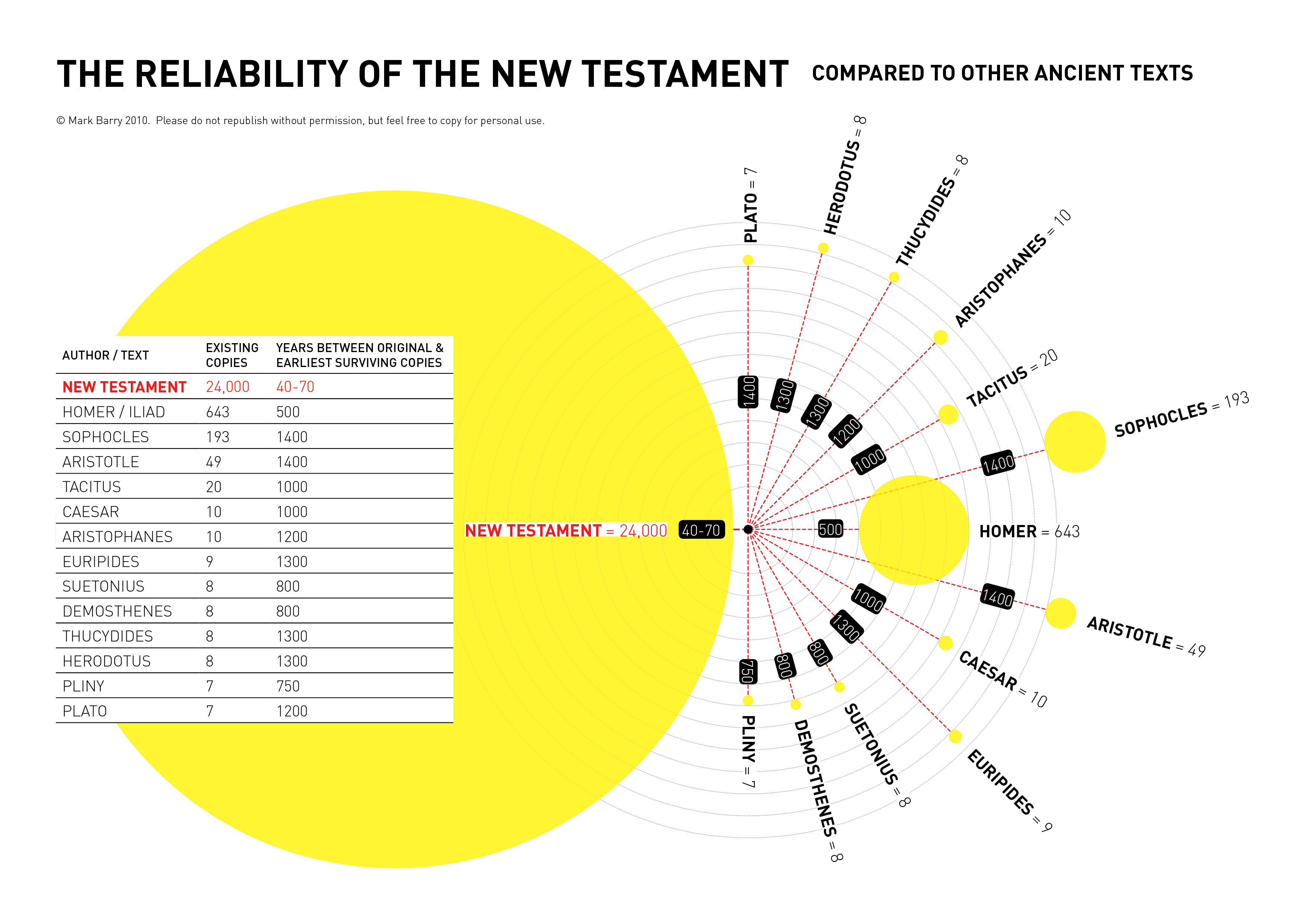
[Click to enlarge.]
Monday, April 09, 2012
Easter: God Makes a New Creation!
[This was shared during worship with the people and guests of Saint Matthew Lutheran Church in Logan, Ohio, yesterday.]
John 20:1-18
In the beginning, the Old Testament book of Genesis says, God’s Holy Spirit “swept over the waters” of chaos and, on the first day of the first week, God began to bring creation into being.
According to Genesis, God’s week of creativity culminated in the creation of human beings. God placed the first man and the first woman, Adam and Eve, in a garden. It was a place of perfect peace and fellowship with God.
You know what happened, though. Adam and Eve wanted to “be like God.” They caved into the egotistical notion that they could declare their independence from God without any consequences. Through their sin, the world was plunged into the dark chaos of selfishness, violence, injustice, and hopelessness we have to this day.
This garden, God’s perfect creation, has been groaning under the chaos and darkness of sin ever since.
But God hasn’t given up on us!
Long centuries after God’s creation fell under sin, on the Sunday after Jesus’ death, some of the female followers of Jesus went to Jesus’ tomb.
In our gospel lesson for this morning, John focuses on just one of the women who went to the tomb that day. Her name was Mary Magdalene.
We know little about Mary Magdalene. The gospels of Mark and Luke say that she was a woman from whom Jesus cast out demons. And the Gospel of John says that, at the time of Jesus’ crucifixion, she stood at the foot of the cross, among the few who were unafraid to admit that she was a believer in Jesus. But, while we may know little about Mary, she played a huge role in the event we celebrate today.
Turn to John 20:1 in your Bible. “Now on the first day of the week Mary Magdalene went to the tomb early, while it was still dark, and saw that the stone had been taken away from the tomb.” The first day of the week: Unbeknownst to Mary or anyone else for that matter, God was creating again. This day, begun in darkness, the pall of death and chaos hanging over it, was to be the first day of the first week of God’s new creation. But neither Mary nor any of the women with whom she went to Jesus’ tomb that day suspected it.
Go to verse 2: “Then she ran and came to Simon Peter, and to the other disciple, whom Jesus loved, and said to them, ‘They have taken away the Lord out of the tomb, and we [Mary mentions herself and the other women] do not know where they have laid Him.”
Mary had no notion that Jesus was anything but dead. She had watched Him die. She was simply outraged that the One Who had freed from slavery to demons, Who had been humiliated, beaten, and crucified, was now, in death, being further demeaned and desecrated.
Verses 3 and 4 tell us that Peter and the beloved disciple, the one to whom Jesus from the cross had entrusted the care of His mother and probably John, the author of this gospel, ran to the tomb to see for themselves. The beloved disciple, younger than Peter, made it to the tomb first.
Now, look at verses 5-7: “And he [John], stooping down and looking in, saw the linen cloths lying there yet he did not go in.” [Peter, ever impulsive, doesn’t show the same hesitation.] “Then Simon Peter came, following him, and went into the tomb; and he saw the linen clothes lying there and the handkerchief that had been around [Jesus’] head, not lying with the linen cloths, but folded together in a place by itself.”
The burial custom of those days was to wrap the deceased in linen cloths. They would roll the body in linen, so it wound around it in layers. The head would then be wrapped in a separate linen cloth.
Unraveling the linen after the wrapping took place would have been quite a process. If you were a grave robber, wanting to work fast and remain undetected, you wouldn’t take the time to peel the linen off of Jesus’ body. Yet, here were the linen cloths that had wrapped Jesus’ dead body lying there and the cloth that had wrapped His head, neatly folded in another spot.”
To John and Peter, the place would have looked less like a tomb from which a body had been stolen, than a guest bedroom in which the guest had considerately made his bed before leaving in the morning!
Look at verses 8 and 9: “Then the other disciple, who came to the tomb first, went in also; and he saw and believed. For as yet they did not know the Scripture [the Old Testament prophecies], that [Jesus] must rise again from the dead.”
The beloved disciple believed that Jesus had risen from the dead.
Listen: Faith understands things that the intellect strains to comprehend. Faith is the teacher of the mind, not the other way around.
John accepted the signs of Jesus’ resurrection before he actually saw the risen Jesus, before he knew it to be empirically true.
Believing--even the willingness to believe--is seeing. You cannot see God unless you are willing to see God. Faith is not imposed by God; it’s given to those who want to believe!
When I was an atheist exploring the faith of the dear people Ann had introduced me to in her home congregation, I found that as I opened myself to accepting what I could not understand, I began to believe in the God and in the risen Savior I could not see. I saw the risen and living Jesus working in the lives of people who believed in Him with every fiber of their beings.
Their faith pried open this heart and will that once were sealed as tightly as Jesus‘ tomb was.
I don’t know when I first believed. But I do know when I first knew that I believed.
I had been looking into this Christian faith, studying the Bible with a group of people at the Lutheran church of which Ann was a member. One night, I went to sleep and experienced something I rarely experience, a dream I could remember. In my dream, I was walking down a street. Ahead of me, I saw Jesus. I didn’t dare to be so presumptuous as to approach Him. But He came up to me. And when He did, He wrapped His arms around me. To this day, as I recall that moment, I can still feel the cloth of Jesus‘ robe touching me.
When I realized that I believed in the crucified and risen Jesus, I also knew that my life would never be the same again. I was no longer be in charge of my life, just as Mary Magdalene, John, Peter, and the other witnesses of Jesus’ resurrection knew that their lives could never be the same again.
And if you believe in Jesus, your life can never be the same again either.
Yet, at this point in John’s telling of the events of Easter, Mary is still unbelieving.
Maybe Mary had seen too much of life and death to believe that Jesus could be risen. Maybe you feel that way this morning; then what John says happened next is for you.
Slip down to verse 11: “But Mary stood outside by the tomb weeping, and as she wept, she stooped down and looked into the tomb. And she saw two angels in white sitting, one at the head and the other at the feet, where the body of Jesus had lain. They said to her, ‘Woman, why are you weeping?‘ She said to them, ‘Because they have taken away my Lord, and I do not know where they have laid Him.’”
Mary sill thinks that Jesus is dead. No other possibility has entered her mind. Sometimes, we can be so beaten down by life and death and grief that we feel nothing good can happen, that God is powerless, that the future holds no hope.
Don’t cave into those lies!
Verse 14: “Now when she had said this, she turned around and saw Jesus standing there, and did not know that it was Jesus.” When we allow our faith to be held hostage to grief and doubt, we cannot see or experience the blessings God wants to give to us.
But Jesus never gives up on trying to reach us! Look at verse 15: “Jesus said to her, ‘Woman, why are you weeping? Whom are you seeking?’ She, supposing Him to be the gardener, said to Him, ‘Sir, if You have carried Him away, tell me where You have laid Him, and I will take Him away.’ Jesus said to her, ‘Mary!’ She turned and said to Him, ‘Rabbouni!’ (which is to say, ‘Teacher’).”
Mary wanted to grasp hold of the risen Jesus. But in verse 17, Jesus tells her not to cling to Him. Both He and Mary have things to do: He must ascend to His Father and she must go tell others the good news.
Look at verse 18: “Mary Magdalene came and told the disciples that she had seen the Lord, and that He had spoken these things to her.”
If you need any more proof that Jesus really has risen from the dead and is alive this very moment, this verse should provide it!
First-century Judean culture believed, as centuries of their Hebrew ancestors had before them, that women were inferior and that their testimony could not be trusted. Yet Jesus chose Mary Magdalene to be the first preacher of this good news and, miracle of miracle, in spite of the messenger being a woman, those she told believed her; they believed that Jesus was risen from the dead. If Jesus’ resurrection were untrue, the originators of such a hoax would have come up with a more politically correct way of kicking off their campaign to convince people Jesus had risen from the dead than to make a woman the first Christian preacher!
So, what does Jesus’ resurrection mean?
First, it means that everything that Jesus ever said is validated. Jesus has conquered sin and death. He’s the Lord of everything. Nothing is beyond His authority. Nobody has sinned so horribly that God can't forgive them and give them eternity.
And we dare not call into question anything Jesus says about sin and repentance, forgiveness and new life, death and resurrection, heaven and hell, about money, or taxes, or work, or parenting, or marriage, or sex, or the Ten Commandments, or saving faith.
When Jesus says, “I am the way, and the truth, and the life. No one comes to the Father except through me,” we must believe it.
When He says, “Those who believe in Me, even though they die will live,” we can bank on it.
When He tells us, “Until heaven and earth pass away, not one letter...from [God’s] law” will be abolished, the Christian grateful for the undeserved love and forgiveness that comes to those who trust in Christ will do all they can to break away from the me-centered morality of the world and align their lives, however imperfectly, with the will of God.
When Jesus says, “For God so loved the world that He gave His only Son, so that everyone who believes in Him may not perish but may have eternal life” and “those who believe in [Jesus] are not condemned; but those who do not believe are condemned already...,” we should ask God to help us turn from sin and trust in Christ each day.
Jesus’ resurrection means that we need to take Jesus seriously as God and Lord and Savior and not see Him as just a nice teacher who did nice things.
And we certainly cannot take His words as advice that we can take or leave!
And here’s the second big thing that Jesus’ resurrection means: On the first day of a new week, in a garden, God burst through the chaos and sin of this old creation and began to bring His new creation into being. The fall into sin that happened in Eden and the chaos into which creation sank has been decisively undone by God’s creative act in Jesus!
Go to 2 Corinthians 5:17. It says: “Therefore, if anyone is in Christ, [she or] he is a new creation; old things have passed away; behold all things have become new.”
God hasn’t given up on you; so, don’t you give up on God!
All who turn from sin and entrust their lives to Christ are part of God’s new creation.
For the follower of Jesus, the past is dead and buried. It’s a new day!
God is making all who follow Jesus Christ new and one day like Mary, we too, will see the risen Jesus and He will call our names and we will fall at His feet, the beneficiaries of an eternity of second chances to be all we were meant to be, living forever in God’s new creation. Amen!
John 20:1-18
In the beginning, the Old Testament book of Genesis says, God’s Holy Spirit “swept over the waters” of chaos and, on the first day of the first week, God began to bring creation into being.
According to Genesis, God’s week of creativity culminated in the creation of human beings. God placed the first man and the first woman, Adam and Eve, in a garden. It was a place of perfect peace and fellowship with God.
You know what happened, though. Adam and Eve wanted to “be like God.” They caved into the egotistical notion that they could declare their independence from God without any consequences. Through their sin, the world was plunged into the dark chaos of selfishness, violence, injustice, and hopelessness we have to this day.
This garden, God’s perfect creation, has been groaning under the chaos and darkness of sin ever since.
But God hasn’t given up on us!
Long centuries after God’s creation fell under sin, on the Sunday after Jesus’ death, some of the female followers of Jesus went to Jesus’ tomb.
In our gospel lesson for this morning, John focuses on just one of the women who went to the tomb that day. Her name was Mary Magdalene.
We know little about Mary Magdalene. The gospels of Mark and Luke say that she was a woman from whom Jesus cast out demons. And the Gospel of John says that, at the time of Jesus’ crucifixion, she stood at the foot of the cross, among the few who were unafraid to admit that she was a believer in Jesus. But, while we may know little about Mary, she played a huge role in the event we celebrate today.
Turn to John 20:1 in your Bible. “Now on the first day of the week Mary Magdalene went to the tomb early, while it was still dark, and saw that the stone had been taken away from the tomb.” The first day of the week: Unbeknownst to Mary or anyone else for that matter, God was creating again. This day, begun in darkness, the pall of death and chaos hanging over it, was to be the first day of the first week of God’s new creation. But neither Mary nor any of the women with whom she went to Jesus’ tomb that day suspected it.
Go to verse 2: “Then she ran and came to Simon Peter, and to the other disciple, whom Jesus loved, and said to them, ‘They have taken away the Lord out of the tomb, and we [Mary mentions herself and the other women] do not know where they have laid Him.”
Mary had no notion that Jesus was anything but dead. She had watched Him die. She was simply outraged that the One Who had freed from slavery to demons, Who had been humiliated, beaten, and crucified, was now, in death, being further demeaned and desecrated.
Verses 3 and 4 tell us that Peter and the beloved disciple, the one to whom Jesus from the cross had entrusted the care of His mother and probably John, the author of this gospel, ran to the tomb to see for themselves. The beloved disciple, younger than Peter, made it to the tomb first.
Now, look at verses 5-7: “And he [John], stooping down and looking in, saw the linen cloths lying there yet he did not go in.” [Peter, ever impulsive, doesn’t show the same hesitation.] “Then Simon Peter came, following him, and went into the tomb; and he saw the linen clothes lying there and the handkerchief that had been around [Jesus’] head, not lying with the linen cloths, but folded together in a place by itself.”
The burial custom of those days was to wrap the deceased in linen cloths. They would roll the body in linen, so it wound around it in layers. The head would then be wrapped in a separate linen cloth.
Unraveling the linen after the wrapping took place would have been quite a process. If you were a grave robber, wanting to work fast and remain undetected, you wouldn’t take the time to peel the linen off of Jesus’ body. Yet, here were the linen cloths that had wrapped Jesus’ dead body lying there and the cloth that had wrapped His head, neatly folded in another spot.”
To John and Peter, the place would have looked less like a tomb from which a body had been stolen, than a guest bedroom in which the guest had considerately made his bed before leaving in the morning!
Look at verses 8 and 9: “Then the other disciple, who came to the tomb first, went in also; and he saw and believed. For as yet they did not know the Scripture [the Old Testament prophecies], that [Jesus] must rise again from the dead.”
The beloved disciple believed that Jesus had risen from the dead.
Listen: Faith understands things that the intellect strains to comprehend. Faith is the teacher of the mind, not the other way around.
John accepted the signs of Jesus’ resurrection before he actually saw the risen Jesus, before he knew it to be empirically true.
Believing--even the willingness to believe--is seeing. You cannot see God unless you are willing to see God. Faith is not imposed by God; it’s given to those who want to believe!
When I was an atheist exploring the faith of the dear people Ann had introduced me to in her home congregation, I found that as I opened myself to accepting what I could not understand, I began to believe in the God and in the risen Savior I could not see. I saw the risen and living Jesus working in the lives of people who believed in Him with every fiber of their beings.
Their faith pried open this heart and will that once were sealed as tightly as Jesus‘ tomb was.
I don’t know when I first believed. But I do know when I first knew that I believed.
I had been looking into this Christian faith, studying the Bible with a group of people at the Lutheran church of which Ann was a member. One night, I went to sleep and experienced something I rarely experience, a dream I could remember. In my dream, I was walking down a street. Ahead of me, I saw Jesus. I didn’t dare to be so presumptuous as to approach Him. But He came up to me. And when He did, He wrapped His arms around me. To this day, as I recall that moment, I can still feel the cloth of Jesus‘ robe touching me.
When I realized that I believed in the crucified and risen Jesus, I also knew that my life would never be the same again. I was no longer be in charge of my life, just as Mary Magdalene, John, Peter, and the other witnesses of Jesus’ resurrection knew that their lives could never be the same again.
And if you believe in Jesus, your life can never be the same again either.
Yet, at this point in John’s telling of the events of Easter, Mary is still unbelieving.
Maybe Mary had seen too much of life and death to believe that Jesus could be risen. Maybe you feel that way this morning; then what John says happened next is for you.
Slip down to verse 11: “But Mary stood outside by the tomb weeping, and as she wept, she stooped down and looked into the tomb. And she saw two angels in white sitting, one at the head and the other at the feet, where the body of Jesus had lain. They said to her, ‘Woman, why are you weeping?‘ She said to them, ‘Because they have taken away my Lord, and I do not know where they have laid Him.’”
Mary sill thinks that Jesus is dead. No other possibility has entered her mind. Sometimes, we can be so beaten down by life and death and grief that we feel nothing good can happen, that God is powerless, that the future holds no hope.
Don’t cave into those lies!
Verse 14: “Now when she had said this, she turned around and saw Jesus standing there, and did not know that it was Jesus.” When we allow our faith to be held hostage to grief and doubt, we cannot see or experience the blessings God wants to give to us.
But Jesus never gives up on trying to reach us! Look at verse 15: “Jesus said to her, ‘Woman, why are you weeping? Whom are you seeking?’ She, supposing Him to be the gardener, said to Him, ‘Sir, if You have carried Him away, tell me where You have laid Him, and I will take Him away.’ Jesus said to her, ‘Mary!’ She turned and said to Him, ‘Rabbouni!’ (which is to say, ‘Teacher’).”
Mary wanted to grasp hold of the risen Jesus. But in verse 17, Jesus tells her not to cling to Him. Both He and Mary have things to do: He must ascend to His Father and she must go tell others the good news.
Look at verse 18: “Mary Magdalene came and told the disciples that she had seen the Lord, and that He had spoken these things to her.”
If you need any more proof that Jesus really has risen from the dead and is alive this very moment, this verse should provide it!
First-century Judean culture believed, as centuries of their Hebrew ancestors had before them, that women were inferior and that their testimony could not be trusted. Yet Jesus chose Mary Magdalene to be the first preacher of this good news and, miracle of miracle, in spite of the messenger being a woman, those she told believed her; they believed that Jesus was risen from the dead. If Jesus’ resurrection were untrue, the originators of such a hoax would have come up with a more politically correct way of kicking off their campaign to convince people Jesus had risen from the dead than to make a woman the first Christian preacher!
So, what does Jesus’ resurrection mean?
First, it means that everything that Jesus ever said is validated. Jesus has conquered sin and death. He’s the Lord of everything. Nothing is beyond His authority. Nobody has sinned so horribly that God can't forgive them and give them eternity.
And we dare not call into question anything Jesus says about sin and repentance, forgiveness and new life, death and resurrection, heaven and hell, about money, or taxes, or work, or parenting, or marriage, or sex, or the Ten Commandments, or saving faith.
When Jesus says, “I am the way, and the truth, and the life. No one comes to the Father except through me,” we must believe it.
When He says, “Those who believe in Me, even though they die will live,” we can bank on it.
When He tells us, “Until heaven and earth pass away, not one letter...from [God’s] law” will be abolished, the Christian grateful for the undeserved love and forgiveness that comes to those who trust in Christ will do all they can to break away from the me-centered morality of the world and align their lives, however imperfectly, with the will of God.
When Jesus says, “For God so loved the world that He gave His only Son, so that everyone who believes in Him may not perish but may have eternal life” and “those who believe in [Jesus] are not condemned; but those who do not believe are condemned already...,” we should ask God to help us turn from sin and trust in Christ each day.
Jesus’ resurrection means that we need to take Jesus seriously as God and Lord and Savior and not see Him as just a nice teacher who did nice things.
And we certainly cannot take His words as advice that we can take or leave!
And here’s the second big thing that Jesus’ resurrection means: On the first day of a new week, in a garden, God burst through the chaos and sin of this old creation and began to bring His new creation into being. The fall into sin that happened in Eden and the chaos into which creation sank has been decisively undone by God’s creative act in Jesus!
Go to 2 Corinthians 5:17. It says: “Therefore, if anyone is in Christ, [she or] he is a new creation; old things have passed away; behold all things have become new.”
God hasn’t given up on you; so, don’t you give up on God!
All who turn from sin and entrust their lives to Christ are part of God’s new creation.
For the follower of Jesus, the past is dead and buried. It’s a new day!
God is making all who follow Jesus Christ new and one day like Mary, we too, will see the risen Jesus and He will call our names and we will fall at His feet, the beneficiaries of an eternity of second chances to be all we were meant to be, living forever in God’s new creation. Amen!
Subscribe to:
Posts (Atom)