[This sermon has been prepared for the opening worship of the biennial Lutheran Family Reunion, an event that brings together the congregations of the Southwest Ohio Mission District of the North American Lutheran Church. The theme of this year’s reunion is Lutherans in the Land of Liberty.]
Galatians 5:13-23
If you ask the average American to give you a definition of “liberty” or “freedom,” polling through the years says that among the first things they will cite is “personal autonomy.” We Americans tend to define liberty as the freedom to do what we want to do with our lives. And that’s a reasonable definition of one kind of freedom, anyway.
But this usual American definition of freedom has more to do with what Martin Luther called the outward man or woman, not the freedom (or the slavery) of the person on the inside, the inner man or the inner woman.
Under a Christian definition of freedom, a person can be outwardly free, someone enjoying things like freedom of speech, freedom of religion, freedom of association, the right to vote–all things we cherish–and still be a slave on the inside.
Conversely, a person may live in a place where such outward freedoms are limited or denied–places like China, Russia, Iran, Saudi Arabia, North Korea–and still be free, unshackled, and living in liberty with God and neighbor, on the inside.
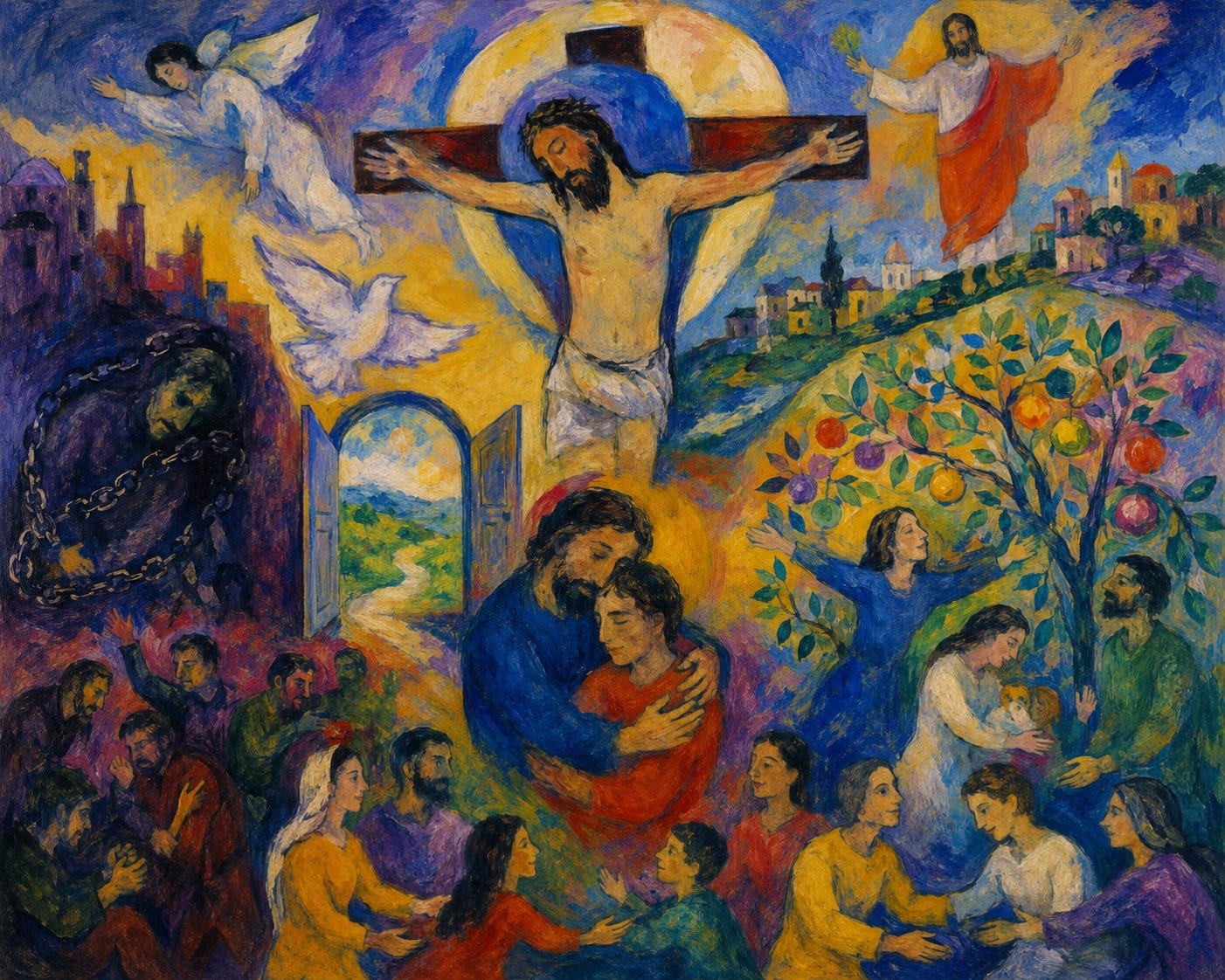
The ultimate example of this kind of inward freedom is Jesus. Even on the cross, no one was ever freer than Jesus, true God and true man. He refused to allow His freedom to be defined by the outward freedom the world confers.
Instead, acting on the inner freedom that God gives to all who live in His kingdom, Jesus offered up His sinless life for us so that all who receive His gifts of repentance and saving faith in Him might have forgiveness, justification, and eternal life with God.
This freedom of the inward person isn’t a freedom dependent on a fallen world.
And this freedom of the inner person isn’t a freedom that ends at the grave.
Our second Bible lesson for today comes to us from the New Testament book of Galatians. Galatia was a Roman colony in what is today Turkey. The apostle Paul had planted a number of churches there. In Word and Sacrament, Paul had given the Galatians the good news–the gospel–that in the crucified and risen Jesus, God freely forgives the sins and overcomes the death of all who, by the power of that Gospel Word, are turned to Jesus for the gifts of repentance and faith.
Today, as back then, Jesus Christ frees all of us inborn sinners, who are incapable of saving ourselves, from our bondage to sin.
I remember how, after a decade of atheism, I came to believe, by the power of God’s Word, not only that God is real, but that He has come into our world in Jesus to set all who believe in Him free from sin, death, and condemnation. I was overwhelmed by this gift of freedom! I was free to be the person God designed me to be, free to be a Jesus man even in the earthly arenas of my church life, my family life, and my life in the community and nation.
What I began to experience was joy. Joy isn’t mere happiness. Joy is the freedom of knowing we are eternally God’s children, a freedom that can never be taken from us, even when we die.
Christians are the only people in the world who have reason for joy in the face of grief. Jesus tells us, “I am the resurrection and the life. Whoever believes in me, though he die, yet shall he live, and everyone who lives and believes in me shall never die.” That promise is the source of our freedom…and of our joy!
The Galatians must have experienced this same joy when they received the Gospel of Jesus through Paul.
Yet not long after Paul left them, preachers we now call Judaizers came to them. Their message was basically this: “Jesus is your Lord. He did die and rise for you. But if you really want to be righteous and right with God, if you really want to be free from sin and death, you also need to observe the Old Testament laws. Your boys need to be circumcised. You have to eat kosher. You have to offer sacrifices. You have to keep sabbaths and holy days the way they were kept by the Jews. You have to work at it.”
At least some of the Galatians bought into this nonsense.
Because of our inward sinful impulse to be our own gods, you and I will always be susceptible to those who tell us, “Take charge of your own eternal destiny. Get busy being a good person who, by your outward acts, prove to God that you’re worthy of God. Make a decision to follow Jesus. Get to work.”
The problem with these false gospels is that if you and I were capable of making ourselves righteous or of improving our righteousness by our own outward deeds or actions, Jesus would never have needed to go to a cross.
Only Jesus can set us free from ourselves: from sin, death, condemnation, and fear of a dying, condemned world. Jesus is the Lamb of God Who takes away the sin of the world–your sin and mine–and there is nothing we can add to what He has done for us to make us more forgiven, favored, or righteous.
When Paul got wind of what was happening in Galatia, he wrote the letter from which our second lesson comes. In it, Paul makes three main points we need to surface and take to heart this morning.
First, Paul writes: “For you were called to freedom, brothers. Only do not use your freedom as an opportunity for the flesh, but through love serve one another. For the whole law is fulfilled in one word: ‘You shall love your neighbor as yourself.’ But if you bite and devour one another, watch out that you are not consumed by one another.”
God commands us to love our neighbors, no matter how annoying or even evil those neighbors may be. This command is beyond our ability to fulfill. Failure to obey it brings damnation. And, if you want to be even more depressed by God’s Law, 1 John 4:20 says, “If anyone says, ‘I love God,’ and hates his brother, he is a liar…” The bottom line is that God’s Law commands us to love others. But we don’t. God’s Law condemns our lovelessness.
Second, Paul says that Jesus Christ frees us to walk by the power of the Holy Spirit, not by our flesh, our sinful nature. Jesus forgives our failure to love others and gives us the Spirit to enable us to love them with Christ’s perfect love. This internal freedom from sin and God’s damnation means that our love for others isn’t a “have-to,” but a “get-to.”
In his treatise on Christian freedom, Luther famously says, “A Christian is a perfectly free lord of all, subject to none. A Christian is a perfectly dutiful servant of all, subject to all.”
Christ has set us free to love others, not as a means of winning God’s favor or gaining the approval of others, but simply as an expression of God’s love for us. An expression of Jesus Christ living in us. As Saint John also says, “In this is love, not that we have loved God but that he loved us and sent his Son to be the propitiation for our sins.”
Dear Friends: In Christ, your sins are forgiven, you are justified before God, and you have eternal life with God. This freedom also sets you free to dare to love others because you know that nothing in all creation can separate you from the love of God that is yours, friends, in Christ Jesus our Lord!
This leads to Paul’s third point: True liberty is the Holy Spirit-powered freedom to love others joyfully. As we follow Jesus in daily repentance and renewal, He will free us from the world’s idea of freedom that results in things like “sexual immorality, impurity, sensuality, idolatry, sorcery, enmity, strife, jealousy, fits of anger, rivalries, dissensions, divisions, envy, drunkenness, orgies, and things like these.” And living in us, as we daily turn to Jesus, the Holy Spirit will show up in our lives in things like “love, joy, peace, patience, kindness, goodness, faithfulness, gentleness, self-control…”
This isn’t a call to adopt certain behaviors. Paul isn’t laying down a new law, telling us we have to be loving, joyous, peaceful, and so on. These are the fruits of the Spirit that God manifests in those who turn to Jesus in repentance and faith. These are the fruits that appear in those who regularly worship, confess their sins in Jesus’ name, receive Christ’s Word of forgiveness, partake of His body and blood, and then go into the world with the power given to us every Sunday as we leave our times of worship together, the power to, “Go in peace. Serve the Lord.”
Our land of liberty, our communities, our families, and sometimes, our churches, can often be marked by deep divisions. Many of these divisions result from people seeing freedom as a license to act in selfish and ungodly ways. What a refreshing, renewing presence the Christian living in the freedom of Christ can be when we love our neighbors–even those with whom we disagree–with the love of Christ. It’s like the man to whom I handed a bottle of cold water on a hot summer’s day. “Why are you doing this?” he asked. “Because God loves you,” I said. I could have added, “And because he frees forgiven sinners like me to show you and tell you that’s true.”
Sisters and brothers in Christ: In Christ, you are free of sin, death, and condemnation. You are free to love as you have been loved. We value the freedoms we have as Americans. But that outward freedom pales in comparison with the eternal freedom we have in Christ. Follow Jesus. He alone can set you truly free. Amen