Showing posts with label John 1:29-42. Show all posts

Thursday, January 23, 2020

Seeing, Telling

[This message was shared with the people and friends of Living Water Lutheran Church in Centerville, Ohio, this past Sunday. I hope you find it helpful.]

John 1:29-42
You all know of my former atheism, which lasted from my mid-teens into my twenties, a period of about ten years. In those days, honestly, I thought that people who believed in God were superstitious, fanatical, and dim-witted. When I heard Christians talk about their faith, I thought that, as someone sufficiently smart and resourceful, I didn’t need the “crutch” of a Savior God. 

But in those ten or so years, there was one Person from Whom I tried to keep my distance. Someone I never wanted to see. That Person was Jesus. 


Occasionally, at a bookstore or a library, I would run across an article about Jesus; I would read with a mixture of interest and revulsion. 

Or a friend would talk to me about Jesus and I would, as a friend, listen dutifully, but disinterestedly. “Well,” I would think, “he or she is a weaker, dimmer person than I realized. They actually believe in Jesus.”

And yet. When I was away from the bookstores, libraries, and friends, when I lay in my bed at night in the darkness, the witness about Jesus I had heard or read or seen from people, movies, books, articles, and the Bible would come to mind. 


I felt two things in those moments. One was terror! A perfect, risen Savior terrified me. The other thing I felt was an attraction to Jesus. 

But I would shake off my thoughts of Jesus and avoid seeing Him as best I could.

Eventually, you know, Ann and I were married and I reluctantly began attending worship with her, then listening to the witness of members of the congregation, and studying the Scriptures with them and on my own. 


For the first time in my life, I began to see Jesus for Who He is. The Holy Spirit started both tearing down my walls of resistance and building faith in Jesus within me. 

The work of the Spirit continues in me. I still sometimes try to avoid seeing Jesus or, more significantly, avoid being seen by Him. 

But as the Word of God and the sacraments of Holy Baptism and Holy Communion are unleashed into my life, I understand the truth of what Peter once told Jesus after Jesus had suggested that the disciples might want to follow some other person or some other way rather than follow Him: “Lord, to whom shall we go? [Peter asked] You have the words of eternal life.” (John 6:68) [emphasis mine]

It was tempting when I first came to see and imperfectly follow Jesus to not say anything about it to people. I wanted to keep Jesus to myself for fear that people would view me in the way I’d once viewed Christians, as weak, dimwitted, fanatical, superstitious, in need of a crutch. 


But I’ve come to learn something. It’s pointless being a witness of what Jesus is--to see Jesus for Who He is and can be for all people--if we won’t testify about what we’ve seen to others who are in as much need of Jesus as we are

If you learned the cure for cancer, heart disease, depression, or AIDs but didn’t share the cure with others, you would be an inhumane monster. Just so, if you have seen Jesus as the Lamb of God Who takes away the sin of the world and with it, the death and purposelessness that afflicts the human race without Jesus, it would be inhumane and monstrous


In another part of the Bible, the apostle John writes: “We proclaim to you what we have seen and heard, so that you also may have fellowship with us. And our fellowship is with the Father and with his Son, Jesus Christ. We write this to make our joy complete.” (1 John 1:3-4) 

When you see Jesus--really see Him--your joy in knowing Him is only made complete when you share Him with others

To a great extent then, being a disciple of Jesus is all about seeing and telling.

We see this in today’s Gospel lesson, John 1:29-42. Here, four people see Jesus and at least two of them tell others about Him immediately. They don't wait to take a class or memorize the Old Testament Scripture that points to Jesus or go to seminary. They see Jesus, then tell others about Jesus.


The first person to see Jesus in our lesson is John the Baptist. Verse 29: “The next day John saw Jesus coming toward him and said, ‘Look, the Lamb of God, who takes away the sin of the world!' This is the one I meant when I said, “A man who comes after me has surpassed me because he was before me.” I myself did not know him, but the reason I came baptizing with water was that he might be revealed to Israel. Then John gave this testimony: ‘I saw the Spirit come down from heaven as a dove and remain on him. And I myself did not know him, but the one who sent me to baptize with water told me, “The man on whom you see the Spirit come down and remain is the one who will baptize with the Holy Spirit.” I have seen and I testify that this is God’s Chosen One.’”

In these few verses, John tells us Who he sees Jesus to be: 

  • the Lamb of God Who gives His perfect life in sacrifice for our sin so that all who believe in Him will have eternal life with God; 
  • God the Son, Who lived before anything was created; 
  • the Lord affirmed by the Holy Spirit; 
  • the One Who will give that same Spirit, the very breath and life of the ever-living God to all who follow Jesus. 
Oddly, though John was Jesus’ kinsman, he hadn’t really seen much of the truth about Jesus until that moment on the Jordan when Jesus was baptized. I’ve known many Christians who have been as blind to Jesus--to His lordship and His power over sin and death--as John apparently had apparently been. Pain, adversity, change, temptation, happiness, success, and life generally come to some Christians and they crumble because they’ve never really seen or followed Jesus. They can't handle life. Their so-called faith has been or has become a habit, nothing but happy banter with people they find convivial. I’ve also known Christians who run away from seeing or being seen by Jesus better than any overt atheist. They’re afraid that if they really see Jesus, they might have to come to terms with their own sin and admit that they’re nothing without the grace God gives in Jesus. But John the Baptist saw Jesus and told the world Who and what he saw.

John’s telling engendered the interest of two of his disciples and they went to observe and listen to Jesus. “Where are you staying?” they ask Jesus. He tells them, “Come and you will see.” (John 1:37-38) One of those two disciples--students, followers--of John the Baptist, Andrew, went to his brother. “We have found the Messiah (that is the Christ, [God’s anointed Savior King]),” he tells Peter. Andrew saw Jesus and told his brother what he saw. (John 1:41-42)

During a meeting this past week, a public school teacher spoke to a group of us with passion and tears about the teachers and students she encounters each day who don’t know Jesus. They’ve never seen that He is God, that He can free them from the power of sin and death, from slavery to the condemnations and harsh of a dog-eat-dog world, from despair and hopelessness. This teacher prays and she shares Jesus when she can. But still, she cries for those who don’t yet see or know the real Jesus.

Do you understand her tears? 


If you don’t, maybe you need to begin looking at Jesus again. Read and study and pray over His Word in Scripture and ask Him, “Jesus, help me to see you clearly as Savior, God, and Friend not only of me but of my neighbors, all of my neighbors the world over whatever their backgrounds, skin colors, nationalities, or present religion.” 

I guarantee that the more you see of Jesus, the more you will, like that teacher, seek to share Him with others. Jesus will fill you with the same passion for those who don’t know Him as He had for you when He went to the cross to take “away the sin of the world.” (John 1:29)

Friends: Don’t avoid Jesus. Don’t forget about Him when you leave here this morning. 


See Him. Every day. 

Know Him. Every day. Let His life fill you. 

Then make your joy complete: Share Him. Amen

[I'm the pastor of Living Water Lutheran Church in Centerville, Ohio.]


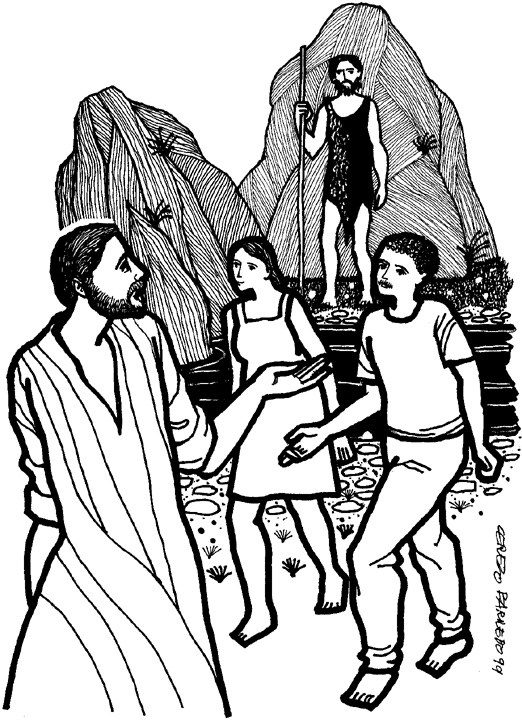
[Above is a drawing of John the Baptist pointing to Jesus as "the Lamb of God Who takes away the sin of the world." The artist is Cerezo Barredo, priest, painter, artist. He created drawings like these while living in Panama. Like the painters of the Renaissance, he contextualized Jesus to the time and place in which he was living, in this case among the poor of Latin America.]

Monday, January 23, 2017

Inviting All to Come and See (AUDIO)

Here.

Monday, January 16, 2017

Inviting All to 'Come and See'

John 1:29-42
Over the past week, I found myself in a discussion with a few atheists on Twitter. This particular group of atheists not only denies that God exists, they also claim that Jesus is a figment of Christian imagination, a myth. I pointed out to them that a New Testament scholar, Bart D. Ehrman, himself an atheist, has looked at the documentary evidence and told his fellow atheists: “Whether we like it or not, Jesus certainly existed.”

But my Twitter correspondents would have none of it. Like the members of the Flat Earth Society, these atheist tweeters would not be confused by the facts.

And there are a lot of verifiable facts about Jesus. In their book, Reinventing Jesus: How Contemporary Skeptics Miss the Real Jesus and Mislead Popular Culture, three New Testament scholars have a helpful chart comparing the documentation we have for the New Testament, containing our most complete and earliest accounts of Jesus, compared to documents recounting other ancient history.

[Click to enlarge.]

I’m not going to give all the details. I’ll just say that the facts speak for themselves. As you can see, we have much more documentation, extending back closer to the days when the events of the New Testament--when Jesus lived, died, and rose--took place than we have of other ancient historical events. The unflinching witness of the early Church for, not just the existence of Jesus, but also of His death, resurrection, and ascension, is more extensive than the evidence routinely cited to document the lives of ancient figures like Alexander the Great and Julius Caesar.

But when I pointed all of this out to those atheist tweeters, guess what? Not a single one of them told me that they were convinced. So far as I know, none of them, have come to faith in Jesus Christ. Yet.

And I may never know if they do. Sometimes as Christians, our job isn’t to “make the sale” of discipleship, it’s simply to plant the seed. Other Christians who come into those people’s lives may cultivate and water the seed. Still others may harvest it for God.

With the apostle Paul, we can say: “I planted the seed, Apollos watered it, but God has been making it grow.” (1 Corinthians 3:6) Our job as followers of Jesus is to keep on in the disciplemaking business.

One of the atheists, skeptical of my life history--of being someone who moved from atheism to faith--asked me how I came to believe in Christ. I told him: “I opened to faith when I saw the freedom & love in which Christians I knew lived.”

It was after repeated encounters with real people who authentically sought to live as disciples of Jesus that my iced-over heart, my resistant mind, and, toughest of all, my stubborn will began to be pried open to the grace of God and the new life that only comes to us through Jesus Christ.

It was the lives and witness of the people of Bethlehem Lutheran Church in Columbus, Ohio, whose humble commitment to Christ through the ups and downs of life and their acceptance of me caused me to want to know more about Jesus Christ and, eventually, in their fellowship, to give my life to Him.

This brings us to the central theme from today’s gospel lesson that I want us to focus in on this morning. Take a look at it, please, John 1:29-42.

We’ll start at verses 29-34: “The next day John [the Baptist] saw Jesus coming toward him and said, ‘Look, the Lamb of God, who takes away the sin of the world! This is the one I meant when I said, “A man who comes after me has surpassed me because he was before me.” I myself did not know him, but the reason I came baptizing with water was that he might be revealed to Israel.’ Then John gave this testimony: ‘I saw the Spirit come down from heaven as a dove and remain on him. And I myself did not know him, but the one who sent me to baptize with water told me, “The man on whom you see the Spirit come down and remain is the one who will baptize with the Holy Spirit.” I have seen and I testify that this is God’s Chosen One.’”

Often, people tell me, “I could never share my faith with someone else. I wouldn’t know what to say. I wouldn’t know how to answer people’s objections.”

John the Baptist’s witness for Jesus in these few verses should give us the confidence we need to be witnesses for Jesus ourselves. All John did was talk about the encounter he’d had with Jesus and how he had come to see Jesus as the perfect sacrificial lamb sent by God to erase the power of sin and death over our lives. He affirmed his own personal faith in Jesus Christ. From his own relationship with the God revealed in Jesus, John was able to point others toward Jesus.

Listen: If you have a relationship with Jesus--if you believe in Him, His Holy Spirit will empower you to tell others about what Jesus means to you.

And the deeper you go in that relationship with Jesus--through daily quiet times of prayer, confession, and Bible reading, regular worship, involvement with Bible studies and the mission efforts of the Church, and devotional times with your children--the more you will have to tell about Jesus.

A Christian disciple really can’t tell her or his life story without talking about the impact of Jesus Christ on their life story.

When we know Jesus, we’re able to share Jesus, whether it’s with family members, friends, classmates, or co-workers. And that’s how disciples are made.

This point is driven home in the balance of the gospel lesson. Verse 35: “The next day John was there again with two of his disciples. When he saw Jesus passing by, he said, ‘Look, the Lamb of God!’ When the two disciples heard him say this, they followed Jesus.”

What is it that caused those two disciples of John the Baptist to simply get up and follow Jesus? The same thing that will cause our friends, relatives, and acquaintances to follow Jesus when we point to Him.

John the Baptist had a relationship with those disciples. John had "street cred."

When people know you and trust you, they’ll be interested in your Savior. If people buy into you, they’re more likely to buy into the Lord you follow.

Discipleship is born in relationship, not salesmanship.

Discipleship is born in relationship, not programs.

As someone has said, “Passing our faith onto others is nothing more than one beggar telling another beggar where to find the bread of life, Jesus.” “Look!” John the Baptist said, “there’s the Lamb of God!”

The rest of the lesson goes on in the same vain. Verse 38: “Turning around, Jesus saw them following and asked, ‘What do you want?’ They said, ‘Rabbi’ (which means ‘Teacher’), ‘where are you staying?’ ‘Come,’ he replied, ‘and you will see.’ So they went and saw where he was staying, and they spent that day with him. It was about four in the afternoon. Andrew, Simon Peter’s brother, was one of the two who heard what John had said and who had followed Jesus. The first thing Andrew did was to find his brother Simon and tell him, “We have found the Messiah” (that is, the Christ). And he brought him to Jesus. Jesus looked at him and said, ‘You are Simon son of John. You will be called Cephas’ (which, when translated, is Peter).”


A few months ago, I read about a Lutheran congregation that made a decision: They were no longer going to be a welcoming church. They got rid of their designated greeters and said that everyone was going to be a greeter. (We have greeters at Living Water, but it seems like everyone is a greeter anyway.)

Being a welcoming church, you know, is all about how you welcome people once they enter your building. For we in the church, our buildings, our sanctuaries, our class rooms, our worship services,  our learning events, and our fellowship groups all unfold in our comfort zones, here among people we know. They happen on our home court or our home field. That’s nice. But being welcoming isn’t really how you fulfill Jesus’ great commission (Matthew 28:19-20).

In our lesson, Jesus invited the two disciples of John the Baptist to come and see.

Then Andrew invited his brother Simon Peter to check Jesus out.

Jesus didn’t wait to welcome people once they showed up; He invited them to know Him better.

Andrew didn’t hang around Jesus and wait for his brother to show up; Andrew went to his brother, then invited him to know Jesus for himself.

That’s why that Lutheran congregation decided not to be a welcoming church anymore; they decided to be an inviting church. They would grow as disciples themselves and then, instead of waiting for people to show up at their church, they would go out and invite others to know and follow Jesus.

Welcoming churches are passive; inviting churches are active.

Welcoming churches wait for the unchurched to come to them; inviting churches are empowered by the Holy Spirit to carry the good news of new and everlasting life through faith in Jesus into their communities.

Welcoming churches stay in their comfort zones; inviting churches “go in peace [and] share the good news” with the world beyond its doors.

Welcoming churches may reach up and sometimes reach in; inviting churches reach up to God, reach in to fellow disciples for growth and Christian fellowship, and reach out to the world beyond that fellowship so that all the world can know and follow Jesus, trust in Him and have His presence in their lives today, and live with God for eternity.

This past week we visited our son and daughter-in-law in Texas, where our son is a pastor. One day, he and I walked to a local bakery. While we were there, a young couple walked in and my son, temperamentally an introvert, struck up a conversation with them. In no time, he'd learned that they were new to the area and where they lived. A few moments later, the man had his cell phone out and was showing pictures to Philip. In a few brief moments, Phil introduced himself and who he was and where his church was. We checked out and there were friendly goodbyes. As Phil and I walked from the bakery, he said quietly, "And that's what I do."

That's what we're all called to do: To love our neighbor and invite them to come and see our Savior Jesus.

In 2017, as we move to more firmly establish a culture of discipleship at Living Water with our partners in the North American Lutheran Church and Navigators, I pray that we all will make the effort to grow in our relationship with Christ so that we become an inviting church, a fellowship of Christians who move into the world with boldness and humility to invite others to “come and see” the Savior Jesus: the way, and the truth, and the life.

Let’s not be just a welcoming church; let’s be an inviting church!

Let’s ask everyone we know, personally and lovingly, to “come and see” Jesus Christ.

Let’s make disciples! Amen

[Blogger Mark Daniels is pastor of Living Water Lutheran Church in Centerville, Ohio. This was the message during worship on January 15, 2017.]


Sunday, January 16, 2011

Share the Light!

[This was shared during worship with the people of Saint Matthew Lutheran Church in Logan, Ohio, this morning.]

Isaiah 49:1-7
John 1:29-42
One of the problems people living in 2011 have when we read the Old Testament book of Isaiah is something the literary critics call its richness. Unlike most of the things we read each day, in any given passage of Isaiah, there may be words about more than just one thing. Sometimes, a passage may be about three things at once. It confuses us. Let me explain.

Last Sunday, I mentioned that tucked among the promises Isaiah received from God about ancient Israel’s impending release from slavery to the Babylonian Empire, were promises about the Servant Who would be sent by God to free more than just Israel from humanity’s greatest enemies: sin, death, and futility. The Servant would come to set things right for all who would welcome His rule over their lives, including you and me.

There are four "Servant Songs" in Isaiah. Today’s first lesson is one of them. As we consider this passage, along with our Gospel lesson for today, I want you to keep the image of an hourglass in your mind. It may help us to understand some of that confusing richness we encounter in Isaiah this morning.

When you stand an hourglass on end, it’s wide at the top, tapers to a narrow shape in the middle, then widens out again at the bottom. If we mapped God’s mission to bring humanity new life, from say, the moment He delivered Israel from slavery in Egypt about 1000 years before Isaiah, followed it through Jesus some 600 years after Isaiah, and then to the Church today, our map would look like an hourglass. The top of the hourglass would be the descendants of Abraham, more numerous than the stars in the heavens, before the coming of the Servant. The bottom of the hourglass would be chock-full of those who are spiritual descendants of Abraham through their faith in the Servant foretold by Isaiah.


Both ancient Israel and the Church of Jesus Christ were called to be God’s “light to the nations.” But, in a phrase used by Lutheran theologian Carl Braaten, “the flaming center” of history, the One Whose life is the light of the world, the narrow center of the hourglass, is Jesus Christ.

All the voices that spoke for God before Christ was born pointed ultimately to Him as our only hope for forgiveness and life, the Messiah who would come into our world to set the lives of all who believe in Him aright.

“Long ago,” the preacher in Hebrews said to his fellow Jewish Christians sometime before 70AD, “God spoke to our ancestors in many and various ways by the prophets, but in these last days He has spoken to us by a Son…”

Jesus, the Servant Messiah, Who suffered and died to erase sin and death as powers over our lives and rose again to rend eternity open for all who believe in Him, is God’s ultimate self-expression, His Word of love and power and restoration for fallen people and our fallen universe.

The Church is commissioned to share Christ’s light, to make disciples of Jesus Christ, and to do so by being completely focused on Jesus, the Servant King. The Celebrate introduction to our lesson from Isaiah that Ann read a few moments ago is right as far as it goes. It identifies the Servant as Israel, saying that in the lesson “the Servant Israel speaks for herself.” But that’s only part of the story.

One of my favorite seminary professors, Tryg Skarsten, once recalled looking out onto a harbor at night. A large light, visible for miles, stood high over the harbor to guide ships coming in. Strung out into the harbor for thousands of yards were smaller lights. Each of them, Tryg said, were connected to the larger light from which they derived their power. Ancient Israel was God’s servant, of course, and it was a light to the nations. But it derived its capacity to be God’s servant and its power to be God’s light for the world from the true flaming center of life, “the Light of the world,” Jesus, to Whose coming Isaiah and other prophets pointed.

That’s why contemporary New Testament scholar Christine Roy Yoder writes that Christian readers cannot read our first lesson without seeing Jesus. Please pull out the Celebrate inserts. Read along with me silently:
Listen to me, O coastlands, pay attention, you peoples from far away! The Lord called me before I was born, while I was in my mother’s womb he named me. He made my mouth like a sharp sword, in the shadow of his hand he hid me; he made me a polished arrow, in his quiver he hid me away. 
Jesus, as the Gospel of John tells us, is “the Word of God.” He is God’s Word to you and me. The life, death, and resurrection of Jesus tell us that every one of our lives is of infinite value to God. God so loved you—you personally and individually—that He sent Jesus to take your punishment for sin so that all who turn from sin and take Him as the Lord and ruler over their lives, trusting their lives to Him, will have life forever with God.

If you’re anything like me, you don’t mind the message of the salvation Jesus brings, but you may not be so hot to make Him the ruler over your life. Jesus as Lord will sometimes tell us to do things we don't want to do. He'll sometimes tell us not to do things that we want to do. Let’s face it: Jesus can cramp our styles. When Jesus was eight days old, a man named Simeon spotted Him in the temple in Jerusalem, where Joseph and Mary had taken the baby to be presented to God. Simeon declared that Jesus was exactly Who Israel (and he himself) had been waiting for at the top of the hourglass. Simeon quoted verse 6 of our lesson from Isaiah, calling Jesus “a light” for the nations. But then, Simeon told Mary, Jesus’ mother, “This child is destined for the falling and rising of many in Israel, and to be a sign that will be opposed…”

Will we take Jesus as our King as well as our Savior or will we oppose Him?

Will we trust or selectively ignore the Word of God in the Bible and the Word of God enfleshed in Jesus?

Those aren’t abstract philosophical questions, but urgent ones on which our eternal destinies hang.

True story: Santosh was a blacksmith in India. He was part of the Dalit, the untouchables, the permanent underclass who are denied access to food, housing, clothing, education, or health care. Along with most of his people, Santosh worshiped his Biskarma (the tools he used in his work), thinking that it was them that gave him life. And Santosh led a miserable life, wasting what little money he had on getting drunk. When he came home, he beat his wife and children, who dreaded his very presence in their home.

One day, two missionaries who saw how troubled he was, invited Santosh to church. Surprisingly, the next Sunday, he took a place in the back of the sanctuary. The music was in his language and in a style he liked. Santosh kept coming back, intrigued by the word about Jesus sandwiched between this music he enjoyed.

Eventually, he gave his life to Christ and wanted to share the Good News about Him with his fellow untouchables. With the missionaries’ help, he got a scholarship to study at a Bible college. The day before he was to leave for college, a large group of villagers confronted Santosh. They threatened to beat him if he didn’t return to the worship of Biskarma and renounced his faith in Christ. Santosh didn't back down, knowing that Jesus had saved him not only from sin and death, but from the meaningless life that had driven him to drink.

After Santosh went to Bible college, the villagers threatened Santosh’s family and they eventually had to be moved to safety with him. Today, Santosh is the pastor of a thriving congregation that bravely (and joyfully) invites other untouchables to come and see and follow Jesus.

In the world and even in the Church, Jesus and His Word are signs that are spoken against. That’s no surprise. That’s because, as Hebrews 4:12, says, “…the word of God is living and active, sharper than any two-edged sword, piercing until it divides soul from spirit, joints from marrow; it is able to judge the thoughts and intentions of the heart. And before Him no creature is hidden, but all are naked and laid bare to the eyes of the One to Whom we must render an account.”

Jesus is the Lord Who said that while we are saved by grace, He had not removed a single one of the Ten Commandments. If we show contempt for the commands in God’s Word, we also show contempt for Him Who is God’s Word. We cannot take Jesus as Savior if we don’t also take Him as Lord. We cannot be free of what enslaves us until we surrender to Christ the way Santosh did. 

Now, look at Isaiah 49:6 on the Celebrate insert. These are words from God the Father:
It is too light a thing that you should be my servant to raise up the tribes of Jacob and to restore the survivors of Israel; I will give you as a light to the nations, that my salvation may reach to the end of the earth.
Israel was not the incubator for the Servant Jesus just for itself. Through Jesus Christ, the truth of God’s love for all humanity and His offer of eternal reconciliation with God, would go global. And that’s where you and I come in.

In our Gospel lesson today, when two disciples of John the Baptist, one of them Andrew, brother of Simon Peter, wanted to learn more about Jesus, Jesus issued a simple invitation, “Come and see.”

Later, a man named Philip told someone named Nathanael that he had found the long-awaited Servant-King. Nathanael was skeptical. Philip didn’t argue. He just said, “Come and see.”

Simon, Philip, you, and I are all at the bottom of the hourglass of God's salvation history. We are the small lights ignited by the cross and empty tomb of Jesus and by the Holy Spirit with whom baptized Christians are filled. Our power for living comes from Jesus. Jesus tells us to “let your light shine before others, so that they may see your good works and give glory to your Father in heaven,” words we use in our Baptismal service.

The Servant Jesus came to save a dying world from itself, to save us from ourselves. He invites all to follow Him, be reconciled to God, and live eternally.

This week, this month, this year, be a light that helps others to come and see Jesus. God wants to fill eternity with people who have turned from sin and death and turned to Jesus for life and eternity. You are the lights God wants to use to guide others to the true Light of the nations, Jesus Christ. Jesus wants to fill His kingdom with those who have come and seen and believed in Him.

So, this is my simple plea to you this morning:
  • Share Jesus. 
  • Share Jesus with words and actions. 
  • Share Jesus with honesty, not as self-righteous egotists, but as forgiven sinners grateful for the grace of God. 
  • Share Jesus so that all the world will come and see what a wonderful God we have! 
  • Share Jesus so that all the world will have peace with God and with themselves today and in eternity.
Amen!

Sunday, January 20, 2008

Come and See

[This was shared during worship at Saint Matthew Lutheran Church in Logan, Ohio this morning.]

John 1:29-42
I made a discovery about myself this morning. I was shaving and when I came to my neck, I noticed that as I looked into the mirror, I was squinting. Why was I squinting? It wasn't because my eyesight is that bad. Then, I realized what it was.

When I was a little boy, I sometimes watched my father as he shaved and sometimes, as he did so, he also smoked. (He quit smoking years ago, by the way.) But often, when he came to shaving his neck, dad squinted.

The things we see can have a powerful impact on us.

For example, all my life I heard people talk about how beautiful Colorado is. “You’ve got to go to Colorado,” they’d tell me. “You can’t express how gorgeous and breathtaking it is.” I wrote their words off as hyperbole. Then, about six years ago, friends of ours offered us the use of a house they’d built on top of a mountain outside of Durango. We drove out and guess what? You’ve got to go to Colorado. Even though I really love Ohio, Colorado is gorgeous and breathtaking. But until we went and saw Colorado for ourselves five years ago, I couldn’t have said that.

In today’s Gospel lesson, John the Baptist, gives witness to who Jesus is twice. He points his own disciples and whoever else will listen to Jesus and says, “Look! The Lamb of God Who takes away the sin of the world!”

Two of John’s disciples were curious enough to approach Jesus, Who asks them, “What are you looking for?” The response of John’s disciples to that question is, on first blush, strange. “Rabbi, where are you living?” The word we translate as living, in the original Greek of the New Testament can also be translated as, remaining, abiding, sticking with. "Teacher," these two curious men were saying, "give us the time to see that you’re not just some fly-by-night Savior, but that you’ve really come to be our Savior."

Now, if Jesus were a candidate as in the current presidential campaign, He might have spent some minutes trying to persuade the questioning disciples that He was really the Savior, that they really could entrust their lives to Him, that He really could bring forgiveness of sin and so, everlasting life, by transforming them from enemies of God to God’s friends. The Jesus campaign would release His answer on YouTube and CNN would have run the interchange time and again. But Jesus’ response is direct, almost curt. “Come and see,” He tells them. Hardly a worthy sound bite!

But we come to faith in Christ and come to deeper faith in Christ not through the compilation of evidence, though there is ample evidence that Jesus really is God and that He really did rise from the dead to bring everlasting life to sinners who repent and believe in Him.

Nor will our faith necessarily be strengthened through logical argument, though one can argue rationally for Jesus and His Lordship.

What really convinces us to follow and to keep following Jesus is when we experience Jesus. That’s why He told the disciples of John to “Come and see.”

There may be some here this morning who long for a real experience of Jesus, who want their faith to be more than just a habit. There may be some of our neighbors and friends who want to believe in Christ, but either find it difficult to believe in a Savior so wonderful and to believe that a Savior so wonderful could love or forgive them. What we all need to do is “come and see” Jesus. We need to experience Him and His goodness. Faith will take hold and faith will grow when we do.

But how do we see a Savior Who ascended into heaven two thousand years ago?

I used to love to play baseball and later, softball. I sometimes played in the outfield. There’s nothing that an outfielder can do about where a ball is hit. That really depends on the pitch selection and what the hitter does with the bat. But the fielder can get in a position to catch flies or cut off grounders. Similarly, we have no control over the God we meet in Jesus Christ. But we can position ourselves to meet Him, to see Him operating in our lives.

Several weeks ago, I mentioned a book on prayer written by Lutheran bishop Ole Hallesby that had a huge impact on my life. Rebutting a book by a prominent atheist, Hallesby wrote another book called, Why I Am a Christian. In it, he identifies five ways those who want to see Jesus Christ can do so.

First, we can read the New Testament. This past week, one of our shut-ins told me that years ago, she’d heard a TV preacher challenge his viewers to read a chapter of the Bible every day. “You know,” this Saint Matthew member told me, “that makes all the difference in my days.”

When we read the New Testament, especially the Gospels—Matthew, Mark, Luke, and John—we encounter Jesus Himself. As we submit to meeting Jesus in the New Testament, we find ourselves moving from doubt to faith.

Next, to see Jesus, we can pray. Even those who aren’t sure that they believe or whether they believe that God listens to prayers should start praying. A few weeks ago, I mentioned my own journey from atheism to faith. One of the things that helped me in this journey was my willingness, despite my unbelief, to begin praying. At first, to tell you the truth, I felt ridiculous talking to a God I wasn’t even certain was there. But as South Korean pastor Paul Yonggi Cho has observed, God is a gentleman. He will not go anywhere uninvited. In prayer, we invite the God we meet in Christ into our lives.

When we pray, we learn that God doesn’t expect perfection in our praying or in us. He takes our willingness to pray as affirmation that we want to “Come and see” Jesus.

One of my favorite incidents in the Bible involved the man who came imploring Jesus to heal his child. “If you can help, Lord, please do,” he prayed. Jesus said, “What do you mean ‘if’? If you have prayer as tiny as a mustard seed, you could move a mountain.” The man replied, “I do believe, Lord. Help my unbelief.” That man’s prayer was answered affirmatively. He believed to the extent that he could. He trusted as much as he could. Even doubters who want to believe in Jesus will, eventually, experience His presence and know that He is their Savior.

Another way for us to see Jesus is to take a good look at ourselves, asking God to show us ways in which we’ve failed to love God or love others. Sin can obscure our vision of God and sometimes, we fail to see our sin.

A young man came to see me years ago at my office in my first parish. He was frustrated because his wife, in spite of repeated promises, wouldn’t attend church with him. “Have I done anything particularly terrible recently?” she asked him. When he said, “No,” she said that she guessed she didn’t need God that week.

When we voluntarily ask God to show us the ways in which we’ve not loved Him or others, we remind ourselves both of our need of Him and of His willingness to forgive and be with us twenty-four hours a day. We invite Him into every part of our lives.

Another way to see Jesus is to receive the Sacrament of Holy Communion every time it’s offered. You know, we Lutherans are sometimes accused of fudging things when it comes to the witness of the Bible. But we have always taken Jesus' words about the bread and wine of Holy Communion completely literally. Jesus said, "This is My body...This is My blood." We believe Him. And we believe Him too, when He says that He gives us this Sacrament for the forgiveness of sin.

In the bread and the wine, Christ comes to us. Father Richard Farar Capon calls Communion, “the hat on the invisible man.” The “immortal, invisible, God only wise” of Whom we sing in one of our hymns becomes visible and touchable in the Sacrament.

Another way we can see Jesus is to spend time in the fellowship of people we believe are authentic followers of Jesus. Thirty-some years ago, a woman named Martha Schneider, then in her sixties, took me under her wing to teach me about what it means to have Jesus Christ in my life. Martha died this past summer, deep into her nineties.

As she fostered my growth as a Christian, Martha asked me if I would help her with a Good Friday prayer vigil, in which members of the congregation would come to pray for half-hour stints overnight. (Ann said that Martha is the only woman she'd ever let me stay out all night with.)

Speaking from personal experience, it was people like Martha--people who lived wholeheartedly with Christ--who finally tilted me from doubt to faith. They were ordinary, humble people who lived with the same daily struggles, hopes, challenges, and joys that are the common lot of the human race, who were nonetheless empowered to cope and hope because of their relationship with Jesus Christ, made me willing to let Jesus into my life. They also encouraged and supported me as I posed my questions, owned my struggles, and invited Jesus to be my God and Savior.

Most of you here this morning and maybe many listening on the radio today know that these are five good ways to come and see Jesus. You may even have found it good to be reminded of these ways that you can see Jesus. I hope so.

But, there’s another reason I talked about them with you this morning. Just a few verses beyond our lesson from the Gospel of John this morning, a follower of Jesus—Philip—seeks out a friend of his—Natahnael—and says, “We’ve found the Messiah: Jesus, from Nazaraeth.” “Nazareth,” Nathanael says, “Can anything good come from there?” Philip doesn’t argue the point with Nathanael. He just tells him, “Come and see.”

When I saw Colorado for myself, I knew that what people said about its beauty was true. Your friends, neighbors, and others may wonder why you bother going to church. They may wonder why you take the time for Sunday School, women’s group, Lenten services, or giving food to CHAP. You could tell them that it’s because of Jesus. You could tell them that Jesus is your Savior. And I hope that at the right moments, you will tell them just that.

But the best thing you can tell them is what Jesus told those curious disciples of John the Baptist and what Philip told Nathanael. Come and see!

Come and see Jesus in the New Testament, in time spent in prayer, in letting Christ convict us of sin and reveal His forgiveness, in the Sacrament of Holy Communion, and in the fellowship of Christians.

If our spiritually disconnected friends will only come and see Jesus in these places, they will see a new and everlasting way of life. They will believe. And their lives will be changed forever!

Thursday, January 17, 2008

My One and Only Pass at This Sunday's Bible Lessons (January 20, 2008)

[Each week, I try to preview the Bible lessons for the upcoming Sunday's worship celebration. I do this to help the people of Saint Matthew Lutheran Church in Logan, Ohio, where I'm the pastor, to prepare for worship. But because we use the lectionary texts for the Church Year, I hope that most Christians will find the passes helpful.]

The Bible Lessons:
Isaiah 49:1-7

Psalm 40:1-11

1 Corinthians 1:1-9

John 1:29-42


General Comments:

1. Epiphany is a rough season for we Lutherans. That's because historically, Lutherans have been good about doing acts of mercy and kindness, but reticent about verbally sharing their faith with others or inviting folks to worship. The Epiphany season of the Church Year, with its focus on the ways in which the identity of God has been revealed in Jesus Christ, also is a call to followers of Christ to share their faith in Christ, to be witnesses.

The lessons for this coming Sunday contain strong affirmations of the universal Lordship of the God first revealed to Israel and ultimately disclosed in the person of Jesus, along with calls to share that God with the whole world.

2. Isaiah 49:1-7: This passage presents us with the second "servant song" from the Old Testament book of Isaiah. The first one was our first lesson last Sunday.

3. In any book of Old Testament prophecy, texts usually deal with both immediate contexts and secondarily, more distant ones.

Some scholars claim that this passage deals most immediately with the Babylonian king, Darius, who God chose to help the Israelite exiles to rebuild their temple in Jerusalem. (Thanks to my colleague, Chris Adams, for pointing this out.)

4. Be that as it may, the passage is more significantly, a call to God's servant--Israel and ultimately, Jesus--to be "a light to the nations." What's striking is the counterintuitive call issued by God to His servants in verse 6. It basically says, "Because you failed to win My own people back, I'm now going to send you with a message of salvation to the whole world."

This is similar to the counterintuitive call Jesus issues to His disciples in Matthew 28:19-20. In it, He essentially says, "You scattered to the four winds when I was arrested and crucified. The only one who came close to being dependable was Peter. He stayed close to me...then denied me three times. Now that you've failed at that, I want you to go to all the world, making disciples of all nations."

In spite of their failings and with the empowerment of the Holy Spirit, Jesus' first witnesses fulfilled that mission. It remains the Christian mission today in spite of our failings.

5. Psalm 40:1-11: This is an exuberant affirmation of one who has given witness of the greatness and grace of God.

6. 1 Corinthians 1:1-9: Paul here opens his letter to the first century Greek church of Corinth. Some wonder if, given the overt sinning of the Corinthian church, Paul is being disingenuous in his opening affirmation of the congregation. He tells people who, in just a few verses, he will scorn for their selfishness, sexual immorality, and spiritual pride, "I give thanks to my God always for you because of the grace of God that has been given to you in Christ Jesus, for in every way you have been enriched in him..."

Is Paul just buttering up the Corinthian congregation? I don't think so. Two points...

(1) The Bible teaches that, so long as we live on this earth, believers in Jesus are simultaneously "saints and sinners." A saint is one who imperfectly turns from sin and believes in Jesus Christ as Lord and God. Although I'm a saint, I'm also a sinner. This was true of the members of the Corinthian church, as much as it is of me...and all believers.

(2) Notice that Paul doesn't laud the Corinthians here for any great works of love or faith. He's thankful that the grace of God, the force which turns sinners into sinners, has been given to them. Paul might like the church members that C.S. Lewis mentions in The Screwtape Letters--the fanatical bridge player, the vain person with the ridiculous hat, people whose sinful habits haven't gone away although they are believers in Jesus Christ. The Holy Spirit won't exorcise the last vestiges of sin from us on this side of the grave. The "old Adam" and the "old Eve" don't give up easily. But it's a testimony to God's grace--His charitable acceptance of repentant sinners--that even people like fanatical bridge players, vain egomaniacs, recovering alcoholics and junkies, and other sinners like me are nonetheless part of His kingdom. No doubt this is why Paul's expression of thankfulness for the grace that's come to the Corinthian Christians is genuine.

7. John 1:29-42: Twice in our lesson, John identifies Jesus as "the Lamb of God."

Those familiar with Old Testament sacrificial law will know that each year on Yom Kippur--the Day of Atonement--a pure, unblemished lamb was sacrificed at the temple in Jerusalem. That lamb bore the sins committed by God's people Israel in the preceding year.

But in Jesus, John identifies the Lamb Whose death on a cross will atone for the sins of the entire world. Jesus underscores the universality of His mission in John 3:16, of course. The New Testament book of Hebrews, written, or more accurately, preached, by a Jewish Christian to other Jewish Christians, asserts that Jesus' sacrificial death wiped out the power of sin and death over believers in Christ "once and for all."

8. Two mega-themes suggest themselves as one reads our Gospel lesson, each encapsulated in a word. The words are: abide or live (meno in the original Greek) and witness (martureo in the original Greek). (An allied word to the second is semeia, meaning sign. More on that momentarily.)

John is obsessed with the incarnation, the enfleshment of God in the person of Jesus. His prologue, for example, speaks of the Word made flesh who dwelt among us (John 1:14). Jesus is the active, life-giving Word of God. Once, in a particular place and time, He lived, remained, or dwelt among us. The word meno is used repeatedly in John's Gospel. It can be translated as lived, dwelt, abided, or remained. Jesus uses this verb repeatedly, for example, when He speaks of how He abides in the Father and we are to abide in Him (John 15).

In this Sunday's Gospel lesson, the question posed by John's disciples to Jesus is to be taken both literally and figuratively, I suppose. They want to know where Jesus is staying or living.

But, at another level, they want to know if Jesus is with them. Is He with the human race? Or is He just one more promising savior who lets us down in the end? We human beings, in spite of pretending to be world weary or cynical, are constantly looking for saviors, be they politicians, entertainment personalities, psychologists, financial gurus, generals, or preachers. All will disappoint, especially if they spend their time trying to prove themselves to us. Jesus has nothing to prove. He tells us, as He did John the Baptist's disciples, "Come and see."

9. John's Gospel is often referred to as "a book of signs." In John 20, the evangelist gives a mission statement for his Gospel:
Now Jesus did many other signs in the presence of his disciples, which are not written in this book. But these are written so that you may come to believe that Jesus is the Messiah, the Son of God, and that through believing you may have life in his name. (John 20:30-31)
The Gospel of John is designed to be a witness--or a sign--that points others to Jesus Christ as "the way, the truth, and the life" (John 14:6).

Throughout the Gospel, Jesus performs signs and a premium is put on witnessing. (The word for witness in the original Greek of the New Testament is martureo, from which our word, martyr comes. Witnesses don't always meet with happy endings here on earth, which may partly explain why we are sometimes hesitant to share our faith with others. I'm not throwing stones; I'm as hesitant as the next person.)

As Brian Stoffregen points out, Jesus Himself is a sign of a sort in John's Gospel. Here, He's called "the Word," a message from God pointing us to salvation and new life.