As a pastor, I visit with a lot of folks here in the reddest part of the red state of Ohio. I rarely bring up politics with people. But sometimes, as the news of the day comes up in conversation, my predominantly Republican neighbors share their opinions.
That's why I found this David Broder article so interesting. The sentiments it reports among long-time conservative Republican activists reflect many of the comments that my conservative Republican neighbors are making these days.
Most of the evidence is just anecdotal, of course. But it appears to me that the Republican coalition is at risk of cracking at its seams.
One bit of emprical evidence for this suspicion may be what's happening in Ohio's gubernatorial election. Republicans have enjoyed something like one-party rule in Ohio for nearly two decades. But polls show that Democratic guberatorial nominee Ted Strickland is up by twenty points over the Republican Ken Blackwell as we head for the November election.
There are no doubt many reasons behind this: Strickland's proven vote-getting ability among Republicans and independents, suspicions over Blackwell's handling of elections in his role as Secretary of State, and the single-digit approval rating for the current Republican Governor.
But down below the surface, one sees that it's because Blackwell hasn't won over his fellow Republicans that he's in trouble here. While Strickland enjoys support from 81% of his fellow Dems, Blackwell has 61% of Republicans in his corner.
One possible explanation for Blackwell's failure to excite his base is his close identification with the Religious Right. He's been known to carry Bibles to political rallies, he's countenanced questionable political fund-raising in churches, and he gives stump speeches during worship services.
Many Christians, including me, don't like the second or third activities enumerated above at all. No matter how authentic Blackwell's faith may be, using the church to advance one's political career leaves a bad taste in the mouths of even conservative Bible-believing Christians.
The winning Republican coalition knit together over the past twenty years and exploited most recently by George Bush and Karl Rove to gain squeaker wins in two consecutive presidential elections, has included classic conservatives and the Religious Right.
The conservatives could stand being with the RR so long as conservatism held sway in the resulting governmental policies. But now, it seems that the agenda of the Religious Right has overtaken the Republican Party and that leaves conservatives dismayed.
Of course, Democrats, being Democrats, are likely to find ways to muff the opportunities for midterm election gains that Republican divisions have given them in 2006.
And here in Ohio, the same poll showing Strickland's twenty-point lead over Blackwell also shows that 26% of the electorate remains undecided about the gubernatorial race.
Interestingly though, in this year when the tide seems to be running against Republicans, Senator Mike DeWine, a classic conservative, is only eight points behind his challenger, Sherrod Brown, with 18 percent of those polled undecided.
Nonetheless, it appears that the gulf between conventional conservative Republicans, with their beliefs in small government, frugal spending, unobtrusive policies, and foreign policy realism, on the one hand, and the allies of the Bush Administration, with its robust neoconservative policies, on the other, appears to be widening.
[Thanks to Ruminating Pilgrim for linking to this post.]
[My friend Rob Asghar has linked to this post, perhaps with a bit of relish.]
[Thanks to Article 6 Blog for linking to this post.]
Thursday, July 27, 2006

Wednesday, July 26, 2006
Putting 'Christian Faith: The Basics' on Ice for Now
I'm taking a hiatus from my Christian Faith: The Basics blog series for now.
I had to stop a series one other time. I was writing about servanthood and didn't feel quite ready to do the series the way I wanted to do it. Later, I was able to present 40-Days to Servanthood, one of the most widely-read and well-received sets of posts I've presented in four-plus years of blogging. So, I'll keep things percolating and keep on praying and have at the series again sometime soon.
There are twenty-five parts to the Christian Faith: The Basics series. You can use the Google This Blog function to find them.
Of course, I'm going to continue blogging here at Better Living!
I had to stop a series one other time. I was writing about servanthood and didn't feel quite ready to do the series the way I wanted to do it. Later, I was able to present 40-Days to Servanthood, one of the most widely-read and well-received sets of posts I've presented in four-plus years of blogging. So, I'll keep things percolating and keep on praying and have at the series again sometime soon.
There are twenty-five parts to the Christian Faith: The Basics series. You can use the Google This Blog function to find them.
Of course, I'm going to continue blogging here at Better Living!
Doomed To Be a Fine Character Actor
 Jack Warden died on July 19.
I first became aware of Jack Warden when he starred in the forgettable, Wackiest Ship in the Army, one of a spate of World War Two-related sitcoms that began with 1962's McHale's Navy and included Hogan's Heroes.
(Have you ever noticed how lamely uncreative network programmers are? When, by some miraculous, involuntary turn of events, a new idea makes it past their office transoms and onto the air and, with little thanks to them, becomes a hit, they suddenly order fifty clones into production. "You like 24? Okay, we'll give you fifteen more episodic adventure stories just like it." "You like news magazines like 60 Minutes? Here, have a 48-Hours, a 20/20, and, to prove that we're creative enough not to use a number in the name of our news magazine, a Dateline." "Reality shows? Try this one. We call it The Idol Survivor Dances with the Iron Chef on the Runway."
(McHale's Navy, I'm sure, was partly inspired by the stage and film success of Mr. Roberts. While that was a comedy, the reality of war was never ignored as it was in these 60s sitcoms. Indeed, the title character dies at the end of the production.)
Fortunately by the time the Wackiest Ship sailed onto and off of our TV screens, Jack Warden had already established himself as a fine character actor and a quick perusal of his filmography on imdb.com demonstrates that he maintained a full four-decade-plus run of film appearances.
I'm especially fond of three Warden performances. The first was as Juror #7 in the incredible Twelve Angry Men (1957). He's a creep whose primary concern isn't doing justice, but escaping the jury room in time to watch a ball game.
His elderly friend of the family in Sandra Bullock's While You Were Sleeping (1995) may have been a bit cliche, but Warden pulled it off well. The part showcases his ability to be tender as well as tough.
His portrayal of the wonderfully flustered Max Corkle in Heaven Can Wait (1978) was part of the glue holding that Warren Beatty vehicle together.
Warden made numerous guest appearances on various TV serials and starred in no fewer than three, each doomed to fail. He never made it as a TV headliner. Nor was he ever a movie star. He was doomed instead to be a fine film character actor. There's nothing wrong with being second fiddle.
(See here and here.)
A: Ken Jennings
Q: What Salt Lake software developer is so desperate to maintain his tenuous hold on near-celebrity status that, on his web site, he bites the hand that presented him with it?
Time to get a life, Ken.
Time to get a life, Ken.
Second Pass at This Weekend's Bible Lesson: Ephesians 3:14-21
Ephesians 3:14-21 is the lesson around which our worship at Friendship Lutheran Church will be built this weekend. You can find the first pass at the lesson, with general comments here.
14For this reason I bow my knees before the Father,
(1) The phrase, "for this reason" refers back to 3:1, in which we're told that Paul is imprisoned for the sake of preaching the Gospel about Jesus Christ to Gentiles.
(2) Although going to one's knees was not an unknown prayer posture in the Biblical tradition, it was not the most common stance for prayer. In the Bible, most instances of people being on their knees refer to subservience to some powerful earthly person. Given the Ephesian culture's penchant for sychophancy to Roman authority, this image of prayer may be a deliberate way of saying, "God is greater than all the Roman governors, emperors, or gods to which you give homage. It's to the living Father of the universe that I bow."
15from whom every family in heaven and on earth takes its name.
(1) There's a play on words here that isn't apparent in English. The Greek word for father is pater. The word translated as family is patria, which can be aptly translated as clan, race, nation, or patrimony. The sense of the two verses that begin the lesson is: "I bow down in prayer to the Father Who fathers every people." As one scholar notes of this passage, "God is the archetypal father."
16I pray that, according to the riches of his glory, he may grant that you may be strengthened in your inner being with power through his Spirit,
(1) Paul presents part one of his prayer for the Ephesian church. He asks that the Ephesian Christians be filled with strength in the power of God's Holy Spirit, the Spirit given to all believers in Jesus Christ.
If believers are filled with the Spirit, why do they need to be filled again? Billy Graham deals with this well in his fantastic book, The Holy Spirit. He says that out of the abundance of His life, God gives His Spirit to all when they come to believe in Christ. But those believers can also be filled again and again, for their consolation; for reminders of God's love, presence, and power in the midst of trying circumstances; and for sharing Christ with others by our words and actions.
(2) God has a storehouse of strength for us, drawn from "the riches of his glory." This is not the last time that God's glory will be mentioned in the passage.
17and that Christ may dwell in your hearts through faith, as you are being rooted and grounded in love.
(1) The notion of Christ dwelling in Christians is a theme of last week's lesson from Ephesians. (See here, here, and here.)
The idea of Christ living in believers in Him is consistent with Paul's view, as expressed to the Athenians, who were fond of erecting monuments to gods, when he said:
18I pray that you may have the power to comprehend, with all the saints, what is the breadth and length and height and depth,
(1) The knowledge that Paul prays the Ephesians will acquire is the capacity to comprehend how great the God we meet in Christ truly is. The grandeur of God and his appreciation of the uniqueness of Christ is what attracted scientist Francis Collins, head of the Human Genome Project, to faith in Christ.
(2) See here.
19and to know the love of Christ that surpasses knowledge, so that you may be filled with all the fullness of God.
(1) To know something that surpasses knowledge is to experience something beyond intellectual entrapment.
(2) The thing to be known is the love of Christ. Knowing that fills us with the fullness of God because, as John reminds us, "God is love."
20Now to him who by the power at work within us is able to accomplish abundantly far more than all we can ask or imagine, 21to him be glory in the church and in Christ Jesus to all generations, forever and ever. Amen.
(1) In the Church and in Christ, may God's glory be apparent for all coming generations. This is, as mentioned in my first pass at the passage, a doxology, a word of glory for God.
(2) Once again, the emphasis is on how God's glory comes to live in believers of Jesus.
14For this reason I bow my knees before the Father,
(1) The phrase, "for this reason" refers back to 3:1, in which we're told that Paul is imprisoned for the sake of preaching the Gospel about Jesus Christ to Gentiles.
(2) Although going to one's knees was not an unknown prayer posture in the Biblical tradition, it was not the most common stance for prayer. In the Bible, most instances of people being on their knees refer to subservience to some powerful earthly person. Given the Ephesian culture's penchant for sychophancy to Roman authority, this image of prayer may be a deliberate way of saying, "God is greater than all the Roman governors, emperors, or gods to which you give homage. It's to the living Father of the universe that I bow."
15from whom every family in heaven and on earth takes its name.
(1) There's a play on words here that isn't apparent in English. The Greek word for father is pater. The word translated as family is patria, which can be aptly translated as clan, race, nation, or patrimony. The sense of the two verses that begin the lesson is: "I bow down in prayer to the Father Who fathers every people." As one scholar notes of this passage, "God is the archetypal father."
16I pray that, according to the riches of his glory, he may grant that you may be strengthened in your inner being with power through his Spirit,
(1) Paul presents part one of his prayer for the Ephesian church. He asks that the Ephesian Christians be filled with strength in the power of God's Holy Spirit, the Spirit given to all believers in Jesus Christ.
If believers are filled with the Spirit, why do they need to be filled again? Billy Graham deals with this well in his fantastic book, The Holy Spirit. He says that out of the abundance of His life, God gives His Spirit to all when they come to believe in Christ. But those believers can also be filled again and again, for their consolation; for reminders of God's love, presence, and power in the midst of trying circumstances; and for sharing Christ with others by our words and actions.
(2) God has a storehouse of strength for us, drawn from "the riches of his glory." This is not the last time that God's glory will be mentioned in the passage.
17and that Christ may dwell in your hearts through faith, as you are being rooted and grounded in love.
(1) The notion of Christ dwelling in Christians is a theme of last week's lesson from Ephesians. (See here, here, and here.)
The idea of Christ living in believers in Him is consistent with Paul's view, as expressed to the Athenians, who were fond of erecting monuments to gods, when he said:
"The God who made the world and everything in it, he who is Lord of heaven and earth, does not live in shrines made by human hands..." (Acts 17:24)Jesus was getting at this same point when He told the Samaritan woman He met by the well at Sychar:
"...the hour is coming, and is now here, when the true worshipers will worship the Father in spirit and truth, for the Father seeks such as these to worship him. God is spirit, and those who worship him must worship in spirit and truth.” (John 4:23-24While things like altars, candles, and stained glass may help people to worship the God we meet in Jesus Christ, they aren't necessary. Christ doesn't dwell in things. He dwells in living people, who draw their life from Him alone.
18I pray that you may have the power to comprehend, with all the saints, what is the breadth and length and height and depth,
(1) The knowledge that Paul prays the Ephesians will acquire is the capacity to comprehend how great the God we meet in Christ truly is. The grandeur of God and his appreciation of the uniqueness of Christ is what attracted scientist Francis Collins, head of the Human Genome Project, to faith in Christ.
(2) See here.
19and to know the love of Christ that surpasses knowledge, so that you may be filled with all the fullness of God.
(1) To know something that surpasses knowledge is to experience something beyond intellectual entrapment.
(2) The thing to be known is the love of Christ. Knowing that fills us with the fullness of God because, as John reminds us, "God is love."
20Now to him who by the power at work within us is able to accomplish abundantly far more than all we can ask or imagine, 21to him be glory in the church and in Christ Jesus to all generations, forever and ever. Amen.
(1) In the Church and in Christ, may God's glory be apparent for all coming generations. This is, as mentioned in my first pass at the passage, a doxology, a word of glory for God.
(2) Once again, the emphasis is on how God's glory comes to live in believers of Jesus.
Tuesday, July 25, 2006
You Can't Use the Government to Bring in God's Kingdom
Read this insightful piece. This is a message that the folks of both the Christian Right and Left need to read.
First Pass at This Weekend's Bible Lesson: Ephesians 3:14-21
[Each week, I present as many updates on my reflections and study of the Biblical texts on which our weekend worship celebrations will be built as I can. The purpose is to help the people of the congregation I serve as pastor, Friendship Lutheran Church of Amelia, Ohio, get ready for worship. Hopefully, it's helpful to others as well, since most weekends, our Bible lesson is one from the weekly lectionary, variations of which are used in most of the churches of the world.]
The Bible Lesson: Ephesians 3:14-21
14For this reason I bow my knees before the Father, 15from whom every family in heaven and on earth takes its name. 16I pray that, according to the riches of his glory, he may grant that you may be strengthened in your inner being with power through his Spirit, 17and that Christ may dwell in your hearts through faith, as you are being rooted and grounded in love. 18I pray that you may have the power to comprehend, with all the saints, what is the breadth and length and height and depth, 19and to know the love of Christ that surpasses knowledge, so that you may be filled with all the fullness of God. 20Now to him who by the power at work within us is able to accomplish abundantly far more than all we can ask or imagine, 21to him be glory in the church and in Christ Jesus to all generations, forever and ever. Amen.
General Comments:
1. For background on the book of Ephesians, see here.
2. Paul (or whoever the writer of the letter is) has made a number of attempts to offer prayers for the Ephesian Christians. But each time, he's felt obliged to provide background explanations for the bases of the prayers. In our lesson, he gets down to brass tacks, finishing up the prayers and capping them off (in verses 20-21), with a doxology. (Doxology is a compound word from the New Testament Greek. Doxos means glory and logos means word. A doxology is a word of glory for God.)
3. The basic theme of the prayer petitions here is to ask God to help the Ephesian Christians experience the blessings of spiritual maturity. The first petition asks that God grant them strength to deal with life's inevitable difficulties. The second that they would know God's love.
4. The knowledge of God's love that's discussed here contrasts with the knowledge about God that the first-century gnostics claimed to have about God and Christ. For the gnostics, knowledge was an intellectual acquisition. It was head knowledge which allegedly gave one access to information shrouded in secrecy.
Orthodox Christianity has always held that God has revealed Himself first through Israel and ultimately, in the Person of Jesus Christ. The knowledge to which our passage refers is the knowledge that comes from experiencing a relationship with God as He has revealed Himself to us through Jesus Christ. It's the knowledge of closeness to God.
See here, here, and here.
The Bible Lesson: Ephesians 3:14-21
14For this reason I bow my knees before the Father, 15from whom every family in heaven and on earth takes its name. 16I pray that, according to the riches of his glory, he may grant that you may be strengthened in your inner being with power through his Spirit, 17and that Christ may dwell in your hearts through faith, as you are being rooted and grounded in love. 18I pray that you may have the power to comprehend, with all the saints, what is the breadth and length and height and depth, 19and to know the love of Christ that surpasses knowledge, so that you may be filled with all the fullness of God. 20Now to him who by the power at work within us is able to accomplish abundantly far more than all we can ask or imagine, 21to him be glory in the church and in Christ Jesus to all generations, forever and ever. Amen.
General Comments:
1. For background on the book of Ephesians, see here.
2. Paul (or whoever the writer of the letter is) has made a number of attempts to offer prayers for the Ephesian Christians. But each time, he's felt obliged to provide background explanations for the bases of the prayers. In our lesson, he gets down to brass tacks, finishing up the prayers and capping them off (in verses 20-21), with a doxology. (Doxology is a compound word from the New Testament Greek. Doxos means glory and logos means word. A doxology is a word of glory for God.)
3. The basic theme of the prayer petitions here is to ask God to help the Ephesian Christians experience the blessings of spiritual maturity. The first petition asks that God grant them strength to deal with life's inevitable difficulties. The second that they would know God's love.
4. The knowledge of God's love that's discussed here contrasts with the knowledge about God that the first-century gnostics claimed to have about God and Christ. For the gnostics, knowledge was an intellectual acquisition. It was head knowledge which allegedly gave one access to information shrouded in secrecy.
Orthodox Christianity has always held that God has revealed Himself first through Israel and ultimately, in the Person of Jesus Christ. The knowledge to which our passage refers is the knowledge that comes from experiencing a relationship with God as He has revealed Himself to us through Jesus Christ. It's the knowledge of closeness to God.
See here, here, and here.
Christian Faith: The Basics, Part 26
We've been considering what Jesus' parable of the Prodigal Son tells us about God the Father. So far, we've said that this story tells us that:
But to the first readers of Luke's Gospel, later in the first-century AD, there would have been another layer of meaning, rooted in an issue that occupied Luke, Paul, and Peter in much of their New Testament writings. It was this: Were Gentile Christians, these johnny-come-latelies to faith in the God first revealed to the people of Israel, as acceptable to God as the heirs of Abraham?
Some Jewish Christians, like the older son in Jesus' story, didn't want to accept the faith of the Gentiles either as being valid or as being equal with their own. Jesus' parable says that it is God's intention for there to be one people, beneficiaries of a new covenant and members of a new creation by virtue of Christ's death on the cross and their faith in Christ. (See here and here.)
A third layer of meaning in this part of the story is also apparent. It's this: Our relationship with God isn't a product of our performance, but a gift of His grace. The older son, like fatheaded legalists of every generation, was incensed by the welcome home the younger son was receiving. (He won't even deign to refer to him as his brother, but calls him "your son," when speaking of him to the father.)
In self-righteous tones, he recites to his father all the good things he has done, a model of obedience as a son. "But you never had a party for me and my friends!" he complains.
The older son sees his relationship with his father as something like a business transaction. If he behaves well, fulfills his responsibilities with diligence, and does his duty, then he figures that the father owes him. He forgets what the younger son has learned: that all the good things he's ever had have been made possible because of his father.
Many people have notions about God the Father similar to those the older son had for his dad. And, as was true of the older son, it strikes them as terribly unjust that God would offer forgiveness and reconciliation to the openly rebellious.
In his way, the older son was even more rebellious than the younger son had been. He went through the motions of love and respect for his father while really viewing him as someone to be contemptuously used for his own short-sighted ends. He could have had a party for his friends if he had only asked. But absent an appreciation of the love his father had for him, he never really enjoyed the relationship with his father that he could have had. This is like most of the people in our world.
The story ends on a disturbing note. The younger son and a large number of people are partying in the father's house. The house is, in essence, the kingdom of God, where there's an eternal celebration. The father comes outside to beg the older son to come in, too. But as Jesus finishes the story, he stubbornly clings to his self-righteousness and certitude. He repudiates grace, charitable forgiveness and reconciliation.
In our next installment, we'll begin discussing the means by which the Father's grace is made available to us, through God the Son, Jesus the Christ.
- God is unlike any earthly father Jesus' original hearers were likely to have known, willing to lavish blessings on all His children. He's lavish in blessing even those who have rebelled, yet turn back to Him.
- Although, we owe God complete respect, God Himself isn't overly concerned with His dignity.
- The Father throws a party every time a sinner turns away from sin and comes back to Him to receive life.
"All this time his older son was out in the field. When the day's work was done he came in. As he approached the house, he heard the music and dancing. Calling over one of the houseboys, he asked what was going on. He told him, 'Your brother came home. Your father has ordered a feast—barbecued beef!—because he has him home safe and sound.'When originally told by Jesus, this story no doubt caused great discomfort to His self-righteous accusers. Clearly, the younger son was akin to all those sinners to Whom Jesus was extending the possibility of forgiveness and new life. The older son were the holier-than-thou religious folk horrified by His announcement that rebel sinners, like the prodigal son, could return to the Father.
"The older brother stalked off in an angry sulk and refused to join in. His father came out and tried to talk to him, but he wouldn't listen. The son said, 'Look how many years I've stayed here serving you, never giving you one moment of grief, but have you ever thrown a party for me and my friends? Then this son of yours who has thrown away your money on whores shows up and you go all out with a feast!'
"His father said, 'Son, you don't understand. You're with me all the time, and everything that is mine is yours—but this is a wonderful time, and we had to celebrate. This brother of yours was dead, and he's alive! He was lost, and he's found!'"
But to the first readers of Luke's Gospel, later in the first-century AD, there would have been another layer of meaning, rooted in an issue that occupied Luke, Paul, and Peter in much of their New Testament writings. It was this: Were Gentile Christians, these johnny-come-latelies to faith in the God first revealed to the people of Israel, as acceptable to God as the heirs of Abraham?
Some Jewish Christians, like the older son in Jesus' story, didn't want to accept the faith of the Gentiles either as being valid or as being equal with their own. Jesus' parable says that it is God's intention for there to be one people, beneficiaries of a new covenant and members of a new creation by virtue of Christ's death on the cross and their faith in Christ. (See here and here.)
A third layer of meaning in this part of the story is also apparent. It's this: Our relationship with God isn't a product of our performance, but a gift of His grace. The older son, like fatheaded legalists of every generation, was incensed by the welcome home the younger son was receiving. (He won't even deign to refer to him as his brother, but calls him "your son," when speaking of him to the father.)
In self-righteous tones, he recites to his father all the good things he has done, a model of obedience as a son. "But you never had a party for me and my friends!" he complains.
The older son sees his relationship with his father as something like a business transaction. If he behaves well, fulfills his responsibilities with diligence, and does his duty, then he figures that the father owes him. He forgets what the younger son has learned: that all the good things he's ever had have been made possible because of his father.
Many people have notions about God the Father similar to those the older son had for his dad. And, as was true of the older son, it strikes them as terribly unjust that God would offer forgiveness and reconciliation to the openly rebellious.
In his way, the older son was even more rebellious than the younger son had been. He went through the motions of love and respect for his father while really viewing him as someone to be contemptuously used for his own short-sighted ends. He could have had a party for his friends if he had only asked. But absent an appreciation of the love his father had for him, he never really enjoyed the relationship with his father that he could have had. This is like most of the people in our world.
The story ends on a disturbing note. The younger son and a large number of people are partying in the father's house. The house is, in essence, the kingdom of God, where there's an eternal celebration. The father comes outside to beg the older son to come in, too. But as Jesus finishes the story, he stubbornly clings to his self-righteousness and certitude. He repudiates grace, charitable forgiveness and reconciliation.
In our next installment, we'll begin discussing the means by which the Father's grace is made available to us, through God the Son, Jesus the Christ.
Monday, July 24, 2006
Perfect Political Success...
for another movie star, Al Gore, might be to not be the top gun, but the supporting actor. So says Michael Grunwald. He believes that Gore ought to run in 2008...for Vice President. It sort of makes sense:
This is just the sort of oddball, somewhat plausible, bit of speculation that occupies political writers during the presidential offseasons. (Although it's difficult to know when those offseasons are any more!)
It is difficult to speculate about the politics of global warming without speculating about former vice president Al Gore. He says he's campaigning only against greenhouse gases these days, but as he basks in the success of his new movie, it's hard not to wonder whether the man who came so close to the presidency wants to take another shot.Gore, Grunwald argues, would be playing to his strengths should he seek the vice presidency again. Yes, but he would automatically be a lightning rod on a national ticket.
But there's a more logical job for Gore to pursue, a job that doesn't make any sense until you think about it. It's a job that would give him the power to do something about global warming, along with other major issues close to his heart, without highlighting his political deficiencies. It's a job where it helps to be wonkish, and doesn't really hurt to be wooden. And it's a job he knows how to do -- because he already did it for eight years.
Yes, Al Gore should run for vice president.
This is just the sort of oddball, somewhat plausible, bit of speculation that occupies political writers during the presidential offseasons. (Although it's difficult to know when those offseasons are any more!)
Perfect Movie Success...
 may be that so far enjoyed by John C. Reilly.
“I know you,’’ said a woman behind the counter at the Weiner’s Circle, a food stand here on the North Side, as Mr. Reilly ducked in recently for a Polish sausage. “You’re a musician.’’Reilly's face and performances are well-enough known to ensure that producers keep calling him. But he's not so celebrated that he's likely to be bothered by stalkers, papparazzi, or other leeches. Unless one is completely overtaken by narcissism, that has to be the perfect movie star success.
Later that day, under a drizzle inside Marquette Park, near the gritty South Side neighborhood where Mr. Reilly grew up, a city recreation worker elbowed a friend and exclaimed: “That guy looks like that guy. He was in ‘Boogie Nights’ with Markie Mark.’’ (Indeed he was.)
A few weeks earlier, at the counter of a greasy spoon called the Apple Pan in the Westwood section of Los Angeles, a woman interrupted Mr. Reilly’s cheeseburger to say, “My boyfriend thinks he’s seen you on TV.’’
Still, this New York Times piece suggests that with his co-starring role in a new Will Ferrell movie about two NASCAR drivers, Reilly's relative anonymity is about to end.
Ironically, last night over dinner, a friend of ours said, "I don't like Will Ferrell. He isn't funny." The other three of us at the table all agreed. So, maybe the stardom the NYT projects for Reilly won't happen and he can continue to enjoy the perfect sort of celebrity. I don't think he'd mind:
Mr. Reilly immediately swiveled around on his stool to sign an autograph. He then returned to an interviewer, a broad grin arching his pitted cheeks, and said: “I love that they can’t place me. They don’t know my name. That’s ‘mission accomplished’ in my world.’’Now that you're paying attention to him, what's your favorite John C. Reilly performance? I've seen him in two films: The Good Girl and Never Been Kissed. I hated the first film and liked the second. But within the contexts of each, I thought he gave good performances.
Is Bush 'The First Rino'?
That seems to be the opinion of the father of modern conservatism, William F. Buckley. See here.
Why de Tocqueville Said 'Democracy in America' Worked
I re-run a piece that originally ran on this blog over here.
Sunday, July 23, 2006
We Have Peace
 [This message was shared with the people of Friendship Lutheran Church during our worship celebration on July 23, 2006.]
Ephesians 2:11-22
Nearly two weeks ago, fighters from the Hezbollah terrorist group in Lebanon entered Israel, killed Israeli soldiers, kidnapped two, and then demanded that Israel submit to a prisoner swap. Israel responded with a major assault on Hezbollah which has also targeted Lebanese infrastructure like airports and power stations. The pictures of innocent children wounded and killed in the fighting, as well as those of fleeing people, have tugged at all our hearts.
While a recent report indicates that Year 2005 saw the fewest major armed conflicts worldwide since 1991, going from a high of 31 down to 17 last year, we in America have all been especially aware of war ever since September 11, 2001. Most of us probably have family members or friends who have served in Iraq and Afghanistan, for whom we’ve offered urgent prayers for protection. We yearn for peace. We crave peace not only among nations and religions, but between ourselves as individuals and within our own souls. Peace often proves to be elusive, though.
Our Bible lesson for today was written either by the apostle Paul or one of his early students to the Christian church in the city of Ephesus, located in what is now Turkey. This congregation was apparently in some conflict. It seems that some Jewish Christians there cast doubts on the relationship that the non-Jewish, or Gentile, Christians had with God. They pointed to the Jewish religious rituals, like circumcision, which they had undergone and claimed that without the Gentiles' submission to such rituals, their faith was incomplete. They weren’t really close to God, they were told.
It was to bring peace to troubled Christians in the congregation at Ephesus that this section of the letter that appears in our Bibles was written. It begins by addressing the Gentiles. Read the first segment of it with me:
So then, remember that at one time you Gentiles by birth, called “the uncircumcision” by those who are called “the circumcision” —a physical circumcision made in the flesh by human hands—remember that you were at that time without Christ, being aliens from the commonwealth of Israel, and strangers to the covenants of promise, having no hope and without God in the world. But now in Christ Jesus you who once were far off have been brought near by the blood of Christ.The writer of our lesson is inviting the Gentile Christians, now angry with the Jewish Christians and concerned that their relationship with God hung in the balance, to remember how their relationship with God began. It started not with them conforming to some religious ritual or with doing some good deed. It didn’t even start with them. Their relationships with God didn't start with them! Nor do our relationships start with us!
But we often get this wrong. A few years ago, an issue of Reader’s Digest told about a man, named Bill, who had donated more than 100 pints of blood through the years. There are undoubtedly many people who owe their lives to Bill’s kindness. But how do you think they’re viewed in heaven? Maybe he was joking, but this is what Bill had to say on the subject: “When that final whistle blows, and St. Peter asks, ‘What did you do?’ I’ll just say, ‘Well, I gave one hundred pints of blood. That ought to get me in.” If Bill really believed that, he was in for a big surprise. It’s only the blood of Jesus Christ that cleanses us of our sin and makes us acceptable to heaven!
Our peace with God has nothing to do with anything we do and everything to do with what Christ has already done for us on the cross! Everyone who believes in Jesus Christ and trusts that He shed His blood and rose from the dead for us has peace with God and with themselves...forever.
Our lesson makes another point. Now, read the next part of our lesson with me, please.
For he is our peace; in his flesh he has made both groups into one and has broken down the dividing wall, that is, the hostility between us. He has abolished the law with its commandments and ordinances, that he might create in himself one new humanity in place of the two, thus making peace, and might reconcile both groups to God in one body through the cross, thus putting to death that hostility through it. So he came and proclaimed peace to you who were far off and peace to those who were near; for through him both of us have access in one Spirit to the Father.These words were addressed to both the Gentile Christians and to the writer’s fellow Jewish Christians. By the giving of Himself and our faith in Him, Jesus establishes another sort of peace.
Two men had long been at odds with one another. Then, within months, each experienced tragedy in their lives. One man lost his wife in a terrible accident, the other his son to a sudden heart attack. Trying to deal with their grief, both made appointments to speak with the pastor who, unlike some pastors you could name, was a very smart person. She deliberately arranged for these two men to unavoidably meet one another as one appointment ended and the other began. Then, just to make sure they spoke, she announced that she needed to make a phone call before visiting with the second fellow.
As you might expect, the two found that they had several things in common. One, of course, was their grief. The other was that, as their appointments with the pastor demonstrated, they saw Jesus as the One Who could sustain and encourage them and give them hope.
You’ve often seen me during the children’s messages have the kids scatter throughout the sanctuary and then, from their varied starting points, step closer and closer to the cross here in the front. The point is that as Jesus draws us all to Him, we are also inevitably drawn closer to one another.
The Church is Jesus’ family and in it, we can experience peace with God and peace with each other. Jesus can knock down the walls that may exist between us, washing them out in the flood of His charitable love that accepts us and empowers us to accept and love each other. This is one of the things I love most about our congregation: When you folks to the part of our worship when we share the peace of God, you really do share the peace of God!
Read the last segment of our lesson with me now, please.
So then you are no longer strangers and aliens, but you are citizens with the saints and also members of the household of God, built upon the foundation of the apostles and prophets, with Christ Jesus himself as the cornerstone. In him the whole structure is joined together and grows into a holy temple in the Lord; in whom you also are built together spiritually into a dwelling place for God.All who believe in Jesus Christ, no matter what our backgrounds, no matter what our past sins, no matter what our faults, are the living bricks of a living building called the Church. Jesus Christ lives within us. Nobody but the members of Christ’s Church, our lesson tells us, is equipped to share and spread the peace of God with the world. Jesus lives within us!
That’s what makes the Church different from any other institution on the planet. The Rotarians, the Kiwanis, the Boys and Girls Club, the Chamber of Commerce. Those are all great organizations doing great things. But Jesus only lives in the Church!
Lutheran pastor Mike Foss tells the true story of attending a prayer breakfast in his community where he was seated next to an African-American pastor he only identifies as Bishop Collins, a man who has started four different churches in the rough inner city areas of Minneapolis. He’s done this in spite of the fact that he himself could play it safe by serving in churches close to his own home in the Twin Cities suburbs. Foss writes:
Bishop Collins turned to me and said, "It’s not hard to love our neighbors as ourselves. I am an African-American and you are white. Yet we are brothers in Jesus Christ—we don’t see color! Peace comes between us because our hearts have been changed by God. That’s why I plant congregations in the roughest parts of the city. Only Jesus Christ can bring individuals peace and, when the neighborhood sees and hears from individuals the love of Jesus Christ, they have hope… and the neighborhood changes.”Our neighborhoods, our homes, our families, our marriages, our schools, our places of work, and the entire global neighborhood can change when people are connected to Jesus Christ! He is our peace!
People lack peace the world over--from White Oak Road to Beirut.
- If you believe in Jesus Christ and know that He lives in you, don’t ever doubt that God has made peace with you.
- If you believe in Jesus Christ and know that He lives in you, don’t ever doubt that God can help you make peace with those from whom you may be alienated.
- And if you believe in Jesus Christ an know that He lives in you, don’t ever doubt what you can do to share the peace of God with others in this world that needs His peace.
We know that the world needs peace of Jesus Christ. You have it. Don’t be stingy with it: Share it this week!
- Tell a friend about Christ.
- Invite someone to worship.
- Take time to listen to someone’s hurts and promise to pray for them.
Saturday, July 22, 2006
Christian Faith: The Basics, Part 25
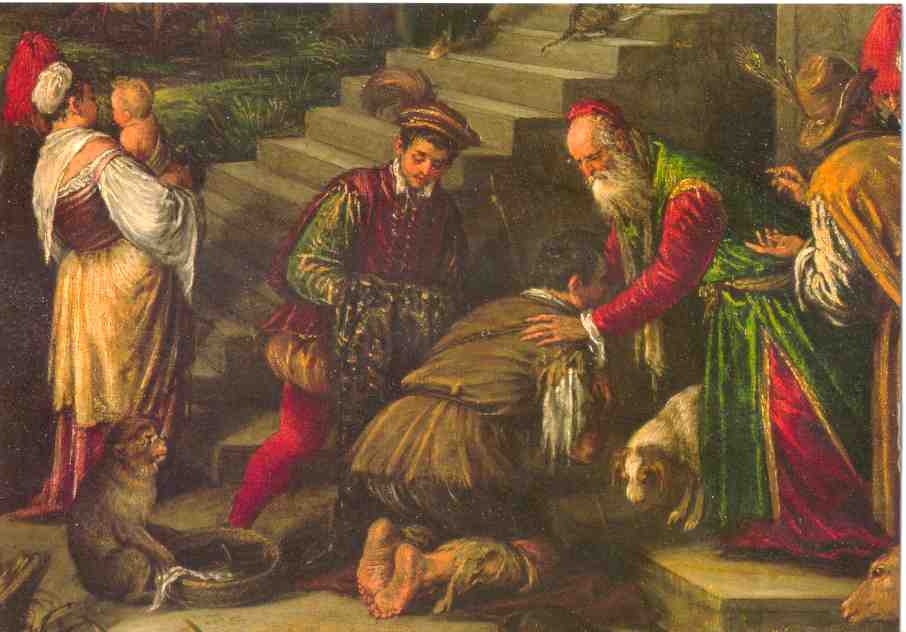
We've been exploring what Jesus' parable of the Prodigal Son tells us about God the Father.
Here's a third thing it tells us: The Father throws a party every time a sinner turns away from sin and comes back to Him to receive life.
This is a point Jesus drives home throughout Luke 15. The tale of the rebel son and his waiting father comes as part of a trio of stories told to the religious in-crowd of Jesus' day. They had asked, accusingly, why Jesus hung out with the ne'er-do-wells of society: extortionists and prostitutes and other unsavory characters. Jesus explained that these folks were lost, people who had wandered far from God, and He was in the business of going to them in order to bring them back to the God Who loved them and wanted to give them life. That was His job.
The first story in the trio is about a shepherd who has 100 sheep, loses one, and risks all just to get the one back. When he comes back, the once-lost sheep slung across his shoulders, he invites his friends to a celebration.
Next, Jesus talks about a woman who loses a single coin. She turns her house upside down to find it, checking between and beneath the sofa cushions where everything from popcorn to pocket combs always seem to go, until the coin is found. When she finds it, she too contacts the neighbors and invites them all over for a party.
In the story of the runaway son, the father kills the fatted calf--something saved for only the most special of occasions--and invites all the neighbors for a big blow-out.
"This is what happens," Jesus tells us, "whenever one of you turns away from sin and returns to God."
We've said that God our Father is nothing like the earthly fathers the people in Jesus' original audience would have experienced. We've also said that He's a Father Who cares little for His dignity when it comes to begging us to come back to Him. And He's a Father Who has a celebration when we, his lost and rebel kids, come back home to Him.
But we need to be careful that we don't take the Father for granted. He is still the King of the universe and not to be played for the chump!
Years ago, I remember a man telling me how he thought life worked. (Always beware of people who tell you how they think life works. They're almost always wrong. The only such statement you can trust comes from those who point to the Bible as the only reliable record of God's self-revelation and tell you, "This how God has revealed life works.") This guy told me: "I think all of us get to do whatever we want and then, on our deathbeds, we tell God we're sorry and He lets us into heaven."
This cynical approach reminds me of something George Bernard Shaw once said: "I love to sin. God loves to forgive. It's really an admirable system."
There are several things to be said about viewing God as some indulgent uncle.
First, the Father's desire to forgive sin, to be reconciled with us, doesn't make His a soft touch. We need to go back to Him. If the son hadn't turned back to the father, there would have been no forgiveness, no reconciliation, no party. This turning back is what the Bible calls repentance.
Second, we have no guarantees about the circumstances of our deaths. So, to bank on our being able to repent before drawing our last breaths is a the highest-risk gamble we can make.
Third, repentance of the kind this guy spoke to me about is, I think it's safe to say, less than authentic.
The gracious acceptance that God extends to the human race through Jesus Christ is free. But, as one great Christian thinker, Dietrich Bonhoeffer, put it, accepting the eternity of forgiveness and love God offers as a free gift will nonetheless cost us our lives. Repentance entails emptying our hands of all the little gods--including ourselves--on which we are prone to build our lives and to instead, rely on only one God, the God revealed as Father, Who sent the Son to call us back home.
Repentance is sort of like being thrown overboard while and holding onto an anchor that will surely drag us down until we let go of it and grab hold of the rope extended to us from the helicopter hovering over head. Repentance is more than grasping God's forgiveness then, it's also letting go of all that would otherwise kill us.
(The fellow who said he would put off repenting until he was on his deathbed also misunderstood what sin is. I'll address the nature of sin in a later installment of the series.)
In the next installment: What the older son in Jesus' story shows us about God the Father.
[Here is the link to the previous installment of the series.]
Friday, July 21, 2006
Ballew Reviews Criteria for Just War...
...and asks, "Is the Iraq war just, or Israel in Lebanon? Does our definition of a just war need to be re-defined in light of jihad and radical Islam?" Read the whole post, which also appears here.
By the way, a military chaplain I knew twenty-five years ago, who formerly worked at the Pentagon, and has an advanced degree on military strategy, wrote a provocative inquiry into whether the preemptive war in Iraq conformed to just war theory. It appeared in a military journal here. Agree with him or not, it's good for Christians to wrestle with such questions.
[Mark Congdon links to this post, quotes extensively from Franklin Wester's paper, and adds some interesting thoughts here. His particular focus is the relevance of the just war theory's principle of imminence as a reason for preemptive attack. It's interesting stuff.]
By the way, a military chaplain I knew twenty-five years ago, who formerly worked at the Pentagon, and has an advanced degree on military strategy, wrote a provocative inquiry into whether the preemptive war in Iraq conformed to just war theory. It appeared in a military journal here. Agree with him or not, it's good for Christians to wrestle with such questions.
[Mark Congdon links to this post, quotes extensively from Franklin Wester's paper, and adds some interesting thoughts here. His particular focus is the relevance of the just war theory's principle of imminence as a reason for preemptive attack. It's interesting stuff.]
Al-Jarallah Fixes Blame for Current Conflict on Syria and Iran
Ahmed Al-Jarallah is editor-in-chief of The Arab Times. He pours contempt on the proxy war against Israel, the US, and in effect, the rest of the Arab world by Syria and Iran:
PEOPLE of Arab countries, especially the Lebanese and Palestinians, have been held hostage for a long time in the name of “resisting Israel.” Arab governments have been caught between political obligations and public opinion leading to more corruption in politics and economics. Forgetting the interests of their own countries the Hamas Movement and Hezbollah have gone to the extent of representing the interests of Iran and Syrian in their countries. These organizations have become the representatives of Syria and Iran without worrying about the consequences of their action.Read the whole thing. (HT: All Things Beautiful)
Recently Hamas kidnapped an Israeli soldier and bombed Israeli settlements with locally manufactured missiles. Soon Hezbollah followed suit, kidnapping two Israeli soldiers. Both these organizations claimed they had kidnapped Israeli soldiers to exchange them for Arab prisoners who are being held in Israeli jails. The fact that Hamas and Hezbollah gave the same reason for kidnapping Israeli soldiers gives us a glimpse their agenda, which is similar to the one followed by Syria and Iran in their conflict with the United States.
While the people of Palestine and Lebanon are paying the price of this bloody conflict, the main players, who caused this conflict, are living in peace and asking for more oil from Arab countries to support the facade of resisting Israel...
"The observatory itself is wonderfully tacky..."
Terry Teachout talks about a trip to the Empire State Building with a niece. It's a beautiful piece of on-the-fly blogging that includes this paragraph:
I hadn’t been to the Empire State Building for a number of years, and I’d all but forgotten how charming it is. It opened its doors in 1930, and the streamlined décor is as redolent of the Thirties as a Pullman sleeper or a Jimmy Cagney movie. The observatory itself is wonderfully tacky—the only thing missing is a dirty-water hot-dog cart—and the view is as spectacular as advertised. I talked Lauren’s ear off, pointing out every landmark I could think of: Central Park, Radio City Music Hall, Wall Street, the Brooklyn Bridge, the UN, Macy’s, even the dear old Flatiron Building. I also showed her the hole in the skyline that was created by the destruction of the World Trade Center. It’s easy to miss, so much so that you wouldn’t know where the twin towers once stood if you didn’t know where to look. I overheard a father pointing out Ground Zero to his son, and remembered the night I brought Lauren’s parents to Windows on the World for a drink, long before the sunny morning when the face of New York was changed utterly by the hand of evil.New York has been changed by 9/11. But I can report after two recent trips there, it's still very much New York. I love the people and the city!
1984 Redux
Annie Gottlieb, Ambivablog, recounts a CNN interview with a woman in Tyre who blames Israel and the US for starting the current conflict in Lebanon. She goes on to claim that Hezbollah prevented Israel and the US from destroying Lebanon.
Asks Gottlieb:
Asks Gottlieb:
How do you make any headway against an a priori belief like that?Read the whole thing.
If Christians Are Isolated from the World...
how can we share the good news Jesus sent us to share? Check out this challenging post by Justin Taylor. Then read these words from the risen Jesus, delivered just before He ascended into heaven.
Historic Israel and the Modern State Bearing That Name Are Not the Same
Eric Williams presents two distinct Biblical Christian arguments meant to show that. For my money, the second is the most convincing one.
The modern state of Israel has every right to exist. But that right is not rooted in the Old Testament covenant, in my estimation.
Ironically, one of the Scripture lessons appointed for use in churches around the world this weekend includes verses cited by Williams: Ephesians 2:11-22.
The modern state of Israel has every right to exist. But that right is not rooted in the Old Testament covenant, in my estimation.
Ironically, one of the Scripture lessons appointed for use in churches around the world this weekend includes verses cited by Williams: Ephesians 2:11-22.
Proportionality, the Suffering of the Innocents in Lebanon, and Israel's Need to Destroy Hezbollah
[What I present here is a prayerful rumination and no program. More and more in my life, I find that I can pray about things much more effectively than I can offer solutions.
[I'm sure that people I respect of every opinion will find reason for taking offense at what I say here. So be it. I'm just asking God to reveal the truth to us all.]
Even if we don't agree with the poltical critque found in Robert Fisk's Independent column about the war being waged in Lebanon right now, he provides some sense of the agony being endured by the innocent Lebanese. Fisk, as you'll see if you read the whole thing, has been living in and reporting from Lebanon for thirty years.
I was particularly struck by a conversation he reported having with an Israeli woman:
I know that it haunts me, even as I think that those who are raising the question of proportionality about the current conflict are mostly getting it wrong.
I accept this tenet of proportionality. No nation should seek war and when war starts, its response should be proportionate to the attack precipitating that response.
But determining proportionality must surely entail more than toting up how many were killed or how much damage was done in the initial attack, as some--including Fisk--suggest. Certainly proportionality must entail understanding the level of threat intimated by the attack. The initial attacks by Hezbollah on Israel indicated an exponential growth in the group's capacity and will to menace the innocents of another country, those living in Israel.
A humanitarian crisis that will haunt the world for a long time to come is unfolding in Lebanon right now. The world community will have to respond.
In an imperfect world in which we are often given imperfect choices, I don't see how Israel can avoid waging war on Hezbollah.
But I wonder--prayerfully and with admittedly limited knowledge--whether the innocents in Lebanon can not be spared more of the suffering which has been their lot for so long.
I'm praying that terrorists will be stopped. I'm praying that the innocents will not suffer any more. I'm praying that these two prayers, seemingly mutually exclusive at this moment, will both prove acceptable to God.
(HT: Rambling Hal)
[I'm sure that people I respect of every opinion will find reason for taking offense at what I say here. So be it. I'm just asking God to reveal the truth to us all.]
Even if we don't agree with the poltical critque found in Robert Fisk's Independent column about the war being waged in Lebanon right now, he provides some sense of the agony being endured by the innocent Lebanese. Fisk, as you'll see if you read the whole thing, has been living in and reporting from Lebanon for thirty years.
I was particularly struck by a conversation he reported having with an Israeli woman:
I am back on the sea coast when my mobile phone rings. It is an Israeli woman calling me from the United States, the author of a fine novel about the Palestinians. "Robert, please take care," she says. "I am so, so sorry about what is being done to the Lebanese. It is unforgivable. I pray for the Lebanese people, and the Palestinians, and the Israelis." I thank her for her thoughtfulness and the graceful, generous way she condemned this slaughter.Civilian casualties, of course, result in part from trying to wage war on stateless enemies that blend in with a country whose government is either too weak (Lebanon) or too unprincipled (the Taliban regime in Afghanistan) to disgorge or destroy them. Hezbollah must be dealt with as surely as Bin Laden and his henchmen must be dealt with.
But how many innocents must die in the meantime?No matter what our position on this current war--or on any war--the first question I posed must haunt us: How many innocents must die?
How might their suffering be minimized?
How might the international community support and encourage the innocent?
How might the infrastructure of a nation infested with thuggery and terrorism be protected so that the innocent can build their fragile nation?
I know that it haunts me, even as I think that those who are raising the question of proportionality about the current conflict are mostly getting it wrong.
I accept this tenet of proportionality. No nation should seek war and when war starts, its response should be proportionate to the attack precipitating that response.
But determining proportionality must surely entail more than toting up how many were killed or how much damage was done in the initial attack, as some--including Fisk--suggest. Certainly proportionality must entail understanding the level of threat intimated by the attack. The initial attacks by Hezbollah on Israel indicated an exponential growth in the group's capacity and will to menace the innocents of another country, those living in Israel.
A humanitarian crisis that will haunt the world for a long time to come is unfolding in Lebanon right now. The world community will have to respond.
In an imperfect world in which we are often given imperfect choices, I don't see how Israel can avoid waging war on Hezbollah.
But I wonder--prayerfully and with admittedly limited knowledge--whether the innocents in Lebanon can not be spared more of the suffering which has been their lot for so long.
I'm praying that terrorists will be stopped. I'm praying that the innocents will not suffer any more. I'm praying that these two prayers, seemingly mutually exclusive at this moment, will both prove acceptable to God.
(HT: Rambling Hal)
Lebanese War Presents Twin Challenges to Bush Administration
In his Washington Post column today, David Ignatius well summarizes the twin challenges posed by the current war in Lebanon:
But their reactions range from agony for the Lebanese people and its fledgling renewed nationhood to fury with the Israelis for attacking the Lebanon, rather than Syria.
The complexity of those reactions conveys something of the complexity of the challenge before the Bush Administration right now, quite apart from the complicating factors of the global war on terrorism and the ongoing war in Iraq.
In an imperfect world where governments are necessary, innocent peoples and sovereign governments, like those in Israel, have the responsibility to defend their people from attack and terror.
And in that same imperfect world, innocent peoples and fragile democracies, like those in Lebanon, deserve the support and encouragement of the family of nations.
That's the tightrope between two imperatives which the Bush Administration is walking right now. I have little idea of how it best should do that. But I'm praying that it negotiates the rope in a way that supports both Israel and Lebanon in their critical times of need.
Read Ignatius' entire column.
The challenge for the Bush administration as the Lebanon war explodes into its second week is just that -- to keep faith with Siniora and his Cedar Revolution, even as it stands by its close ally Israel. This isn't simply a question of appearances and public diplomacy. Unless Siniora's government can be strengthened, there is little hope for achieving the U.S. and Israeli goal of bringing Hezbollah's guerrillas under lasting control.If you regularly read blogs from the Middle East as I do, you know that many pro-US Arab bloggers are furious with Hezbollah for initiating this conflict. (As well they should be.)
But their reactions range from agony for the Lebanese people and its fledgling renewed nationhood to fury with the Israelis for attacking the Lebanon, rather than Syria.
The complexity of those reactions conveys something of the complexity of the challenge before the Bush Administration right now, quite apart from the complicating factors of the global war on terrorism and the ongoing war in Iraq.
In an imperfect world where governments are necessary, innocent peoples and sovereign governments, like those in Israel, have the responsibility to defend their people from attack and terror.
And in that same imperfect world, innocent peoples and fragile democracies, like those in Lebanon, deserve the support and encouragement of the family of nations.
That's the tightrope between two imperatives which the Bush Administration is walking right now. I have little idea of how it best should do that. But I'm praying that it negotiates the rope in a way that supports both Israel and Lebanon in their critical times of need.
Read Ignatius' entire column.
The Need for Friendships

One reason I decided to name the congregation I serve as pastor Friendship Lutheran Church, was a conversation I had with a man shortly after I'd arrived to start the church. He was a personable guy, a deeply committed Christian, and someone who had served in churches in every place he'd lived. After I'd talked about how churches ought to be communities in which people discover relationships with Jesus Christ and with others, he turned to his wife and said, "You know, I really don't have any friends."
Recent news stories suggest that we all, on average, have fewer and fewer friends.
One reason for this sad state of things, Jan of The View from Her says, might be that we have so elevated the value of sexuality that friendship has become devalued. Jan writes of the recent rumors about talk show host Oprah Winfrey and her friend, Gayle King:
this sort of thing sends me from zero to infuriated in 2.5 seconds flat. We live in a culture that values and measures relationships only by their sexuality. In doing so, we've eliminated the many deep and nuanced meanings of the word "love"...Read the whole insightful thing.
...we've lost all knowledge or awareness of the "high" concept of love, or the classic idea of Love, or of Beauty. David loved Jonathan so much it says they were one in spirit. I presume this might mean they were completely single-minded in their thoughts and feelings and and in total agreement about things they liked to do. Men especially suffer in today's culture, as it seems a close, loving friendship will always be suspect.
I once knew a doctoral student in Psychology who was doing his thesis on where people turned for help and counsel when they hit snags in their lives. His research showed that those who had a strong network of friends to whom they could turn experienced far greater and more rapid "healing," as self-reported, than those who relied solely on professional counselors. This isn't to say that counselors aren't doing useful, even essential work. They are. But strong friendships act as strong preventative medicine, often negating the need for consulting counseling pros.
A few days ago, I was chatting with someone about my twenty-two years experience as a pastor. The first six were spent in a tight-knit farming community in northwestern Ohio, the last sixteen in a suburban Cincinnati community. One observation I made immediately about my current setting in contrast with the former, was that back there, even people who would be ignored and marginalized here, had caring friends whose love, concern, and acceptance wore the jagged edges off of what could only be described as weirdness.
In tight-knit communities, people who are ignored in our suburban or urban environments, feel included and are thereby less likely to develop emotional or psychological problems. When they do develop such problems, they're more likely to enjoy the support of a strong network of family and friends.
Jesus' command that we love God and love neighbor is an invitation to forge strong relationships and to even, dare I say it, love our friends. And when two women (or two men) love each other, it doesn't necessarily mean that they're gay, in spite of our hypersexualized society's inaccurate and relationship-killing assumptions. It may only mean that they're friends...and therefore, healthy.
[Read what Pastor Jeff at Conblogeration has to say about this same story here. Thanks also to XWL, whose comment led me to Jeff's excellent insights.]
Thursday, July 20, 2006
Model 28500
My wife and I are planning on having our master bathroom remodeled soon and so, we planned a rather strange family outing. We invited my expert fixer-upper brother-in-law to accompany us for dinner at Chipotle, followed by a cruise through potential bath fixtures at our local Lowe's. Our son and our daughter both decided to go with us, mostly I suppose, because my wife's brother is such fun company.
We'd finished the planned portion of the evening's festivities when my wife asked if anyone wanted to go to the Goodwill Industries store next door. Inwardly, I cringed a bit. I've never shopped at Goodwill before. But we were, outwardly at least, all amenable.
To my amazement, I found some treasures: a 1942-vintage hardbound version of Lloyd C. Douglas' The Robe for three bucks, a VHS edition of the Best Picture of 1966, A Man for All Seasons (for a buck), and a 1949-EP with eight Christmas songs by Bing Crosby, also a dollar.
But our most amazing acquisition may be this atomic clock, for six bucks.
My wife had been thinking about getting an atomic clock for awhile. Many of the teachers at the school where she works as the librarian have the clocks in their classrooms, allowing them to have the accurate time, something which school clocks, which are notorious for breaking down, can't provide.
When we got home, she stuck a battery in the clock and sure enough, it took off. But it wasn't showing the right time. "Maybe it takes awhile," she speculated. I looked the clock up on the web. The manual was there, pointing me to buttons for each of the major continental US time zones. The moment I hit it, the hands began whirring round and round until they stopped on the exact time as transmitted by satellite from the Atomic Clock of the US National Institute of Standards and Technology, Time and Frequency Division in Boulder, Colorado.
I had what I suppose can be characterized as a hayseed moment, one that will seem goofy to future generations who may blow the cyberdust off of this blog in say, two or three minutes from now. Remembering a line from an old Paul Simon song, I said, "We live in an age of miracles and wonders!"
Hayseed-like or not, it really is amazing when one considers it: A satellite hundreds of miles above the earth picks up a signal from Colorado and then sends it back down to receivers in clocks in elementary school classrooms and libraries here in the Midwest, making it possible for students (and teachers) to take their lunches and recesses at precisely the right times.
Thousands of such applications have come about from the human exploration of space, whether through manned or unmanned vehicles.
It was on this date in 1969 that Neil Armstrong and Buzz Aldrin became the first human beings to walk on the surface of the Moon, one of many astounding achievements since we first moved out into space. I hope we keep going into space. An infinite number of miracles and wonders no doubt awaits us if we do.
We'd finished the planned portion of the evening's festivities when my wife asked if anyone wanted to go to the Goodwill Industries store next door. Inwardly, I cringed a bit. I've never shopped at Goodwill before. But we were, outwardly at least, all amenable.
To my amazement, I found some treasures: a 1942-vintage hardbound version of Lloyd C. Douglas' The Robe for three bucks, a VHS edition of the Best Picture of 1966, A Man for All Seasons (for a buck), and a 1949-EP with eight Christmas songs by Bing Crosby, also a dollar.
But our most amazing acquisition may be this atomic clock, for six bucks.
My wife had been thinking about getting an atomic clock for awhile. Many of the teachers at the school where she works as the librarian have the clocks in their classrooms, allowing them to have the accurate time, something which school clocks, which are notorious for breaking down, can't provide.
When we got home, she stuck a battery in the clock and sure enough, it took off. But it wasn't showing the right time. "Maybe it takes awhile," she speculated. I looked the clock up on the web. The manual was there, pointing me to buttons for each of the major continental US time zones. The moment I hit it, the hands began whirring round and round until they stopped on the exact time as transmitted by satellite from the Atomic Clock of the US National Institute of Standards and Technology, Time and Frequency Division in Boulder, Colorado.
I had what I suppose can be characterized as a hayseed moment, one that will seem goofy to future generations who may blow the cyberdust off of this blog in say, two or three minutes from now. Remembering a line from an old Paul Simon song, I said, "We live in an age of miracles and wonders!"
Hayseed-like or not, it really is amazing when one considers it: A satellite hundreds of miles above the earth picks up a signal from Colorado and then sends it back down to receivers in clocks in elementary school classrooms and libraries here in the Midwest, making it possible for students (and teachers) to take their lunches and recesses at precisely the right times.
Thousands of such applications have come about from the human exploration of space, whether through manned or unmanned vehicles.
It was on this date in 1969 that Neil Armstrong and Buzz Aldrin became the first human beings to walk on the surface of the Moon, one of many astounding achievements since we first moved out into space. I hope we keep going into space. An infinite number of miracles and wonders no doubt awaits us if we do.
Second Pass at This Weekend's Bible Lesson: Ephesians 2:11-22
[Each week, I present as many updates on my reflections and study of the Biblical texts on which our weekend worship celebrations will be built as I can. The purpose is to help the people of the congregation I serve as pastor, Friendship Lutheran Church of Amelia, Ohio, get ready for worship. Hopefully, it's helpful to others as well, since most weekends, our Bible lesson is one from the weekly lectionary, variations of which are used in most of the churches of the world.]
For the first pass at this lesson, presented earlier in the week, see here. It provides a general overview.
Now, for some verse-by-verse comments...
11So then, remember that at one time you Gentiles by birth, called “the uncircumcision” by those who are called “the circumcision” —a physical circumcision made in the flesh by human hands—
(1) Circumcision, of course, was the entry rite for males into the Jewish faith. In ancient times, baby boys were circumcised eight days after their births. When the term uncircumcised was used by Jews, it had, at its worst, a derogatory tone. At best, it was a designation of not being in covenant with God and therefore, having no standing with God.
(2) The author of Ephesians, echoing words found in First Peter, calls on the Gentile Christians at Ephesus to remember that before they came to faith in Christ, they had no standing before God.
(3) Here, the writer seems to totally ignore that God had instituted circumcision among the Jews (Genesis 17:11-14). Instead, he sees it as a human action and thereby, inferior to the spiritual connection that Gentile believers have with God through faith in Christ. More on this later.
12remember that you were at that time without Christ, being aliens from the commonwealth of Israel, and strangers to the covenants of promise, having no hope and without God in the world.
(1) Because the Gentiles were formerly without Christ, they were alienated from the only way it had previously been possible for one to have a relationship with God: being part of the commonwealth of Israel.
(2) Those terms aliens and strangers were among the terms used by historic Israel about outsiders. Although aliens and strangers were, according to Old Testament law, to be treated with respect and neighborliness, Israelites understood that they weren't part of God's people. First Peter picks up on the aliens and strangers motif to describe the status of Christian believers in the world, out of place because our real home is with God. More on that later.
(3) The New Interpreter's Bible points out the connection between this passage and Romans 9:4-5, where Paul enumerates the privileges associated with being part of God's people. Here, the author is saying that because the Gentiles hadn't been Jewish believers, they enjoyed none of the privileges associated with being reconciled with and close to God.
(4) The concept of "commonwealth of Israel" is most clearly seen in Deuteronomy 5:1 and Isaiah 65:9.
13But now in Christ Jesus you who once were far off have been brought near by the blood of Christ.
(1) Only Jesus Christ affords the privileges that come with reconciliation and closeness to God that formerly only belonged to Jewish believers in God under the old Abrahamic and Mosaic covenants.
Bryan Findlayson puts it simply:
William Loader puts it this way:
(4) Unlike some similar passages in Paul's New Testament writings, no effort is made to analogize circumcision and baptism, even with the mention of circumcision that appears here. Instead, oneness with God happens by faith in Christ. There is no sacramental or ritual element to inclusion in the new family of God. In fact, the writer of Ephesians appears to disdain rites altogether.
14For he is our peace; in his flesh he has made both groups into one and has broken down the dividing wall, that is, the hostility between us.
(1) Christ effects reconciliation for those with faith in Him not only in our relationship with God, but with each other. Jew and Gentile Christians were, the writer of Ephesians was saying, reconciled to each other.
(2) Through Christ, Bryan Findlayson notes, God "has created...a new people of God."
15He has abolished the law with its commandments and ordinances, that he might create in himself one new humanity in place of the two, thus making peace,
(1) This is the most troubling verse in the entire lesson. As I pointed out in my first pass, Jesus Himself never claimed to have come to abolish the Old Testament law, but to have fulfilled it.
I wanted to fudge this point by putting words or thoughts in the mind of Ephesians' author, saying that he was referring to Israel's ritual law, rather than to the Ten Commandments. But several commentators assert that I don't have that luxury.
Yet Jesus' death on the cross and its atoning value, something asserted constantly in Ephesians, becomes meaningless apart from a sense of what C.S. Lewis called "the law of human nature," the notion that there is something wrong in the human race. That something is our inability to conform to the very notions of right and wrong to which all of us, to one degree or another, subscribe.
I doubt though, that the writer of Ephesians wanted to say that the Ten Commandments' prohibition of murder or idolatry, for example, were no longer valid.
My guess is that this verse should be read as refuting the assertions of some Jewish Christians that conformity to rituals given in the Old Testament had to be followed for salvation to be complete, even under the new covenant established by Jesus. Even in Old Testament times, after all, salvation only came by faith in a gracious God. The prophets kept calling ancient Israel to faith in God, claiming that they had wandered like sheep from their shepherd or like an adulterous lover from her husband, precisely because it was possible to get all the rituals right and not have faith. This was why Jesus called the Pharisees He encountered "whitewashed tombs," having the look of life with God about them, but being dead inside because they believed not in God, but in their laws or in themselves and their own rectitude.
But there were laws that existed for those who were part of God's family. In upholding salvation by grace, the writer of Ephesians may have given an exaggerated version of the significance of those laws. He wanted people to understand that conformity with laws, even those from God, can not bring us salvation. Only faith in Christ can do that.
Of course, in this interpretation I could be completely and totally wrong.
16and might reconcile both groups to God in one body through the cross, thus putting to death that hostility through it.
(1) Bryan Findlayson writes of this and verse 15:
(1) The entire human race is given a single access point to God: Jesus Christ. Notice here that we see the Son (he), the (Holy) Spirit, and the Father.
(2) The Spirit is the One Who makes faith in the unseen Christ possible. Paul writes:
(4) According to The New Interpreter's Bible, the phrase, have access, would have reminded the original recipients of this letter of efforts by many in Asia Minor, where they lived, to gain access to powerful imperial persons. But what these influence-seekers strove to gain with piddling public officials through their efforts, God gave for free to all with faith in Christ: access! And not access to some political honcho who would soon pass from the scene, dead or replaced, but access to the God of the universe Whose word stands forever and Who, in Christ, had conquered death!
19So then you are no longer strangers and aliens, but you are citizens with the saints and also members of the household of God,
(1) The New Interpreter's Bible also notes:
The thrust of the final verses of our lesson is:
20built upon the foundation of the apostles and prophets, with Christ Jesus himself as the cornerstone. 21In him the whole structure is joined together and grows into a holy temple in the Lord; 22in whom you also are built together spiritually into a dwelling place for God.
For the first pass at this lesson, presented earlier in the week, see here. It provides a general overview.
Now, for some verse-by-verse comments...
11So then, remember that at one time you Gentiles by birth, called “the uncircumcision” by those who are called “the circumcision” —a physical circumcision made in the flesh by human hands—
(1) Circumcision, of course, was the entry rite for males into the Jewish faith. In ancient times, baby boys were circumcised eight days after their births. When the term uncircumcised was used by Jews, it had, at its worst, a derogatory tone. At best, it was a designation of not being in covenant with God and therefore, having no standing with God.
(2) The author of Ephesians, echoing words found in First Peter, calls on the Gentile Christians at Ephesus to remember that before they came to faith in Christ, they had no standing before God.
(3) Here, the writer seems to totally ignore that God had instituted circumcision among the Jews (Genesis 17:11-14). Instead, he sees it as a human action and thereby, inferior to the spiritual connection that Gentile believers have with God through faith in Christ. More on this later.
12remember that you were at that time without Christ, being aliens from the commonwealth of Israel, and strangers to the covenants of promise, having no hope and without God in the world.
(1) Because the Gentiles were formerly without Christ, they were alienated from the only way it had previously been possible for one to have a relationship with God: being part of the commonwealth of Israel.
(2) Those terms aliens and strangers were among the terms used by historic Israel about outsiders. Although aliens and strangers were, according to Old Testament law, to be treated with respect and neighborliness, Israelites understood that they weren't part of God's people. First Peter picks up on the aliens and strangers motif to describe the status of Christian believers in the world, out of place because our real home is with God. More on that later.
(3) The New Interpreter's Bible points out the connection between this passage and Romans 9:4-5, where Paul enumerates the privileges associated with being part of God's people. Here, the author is saying that because the Gentiles hadn't been Jewish believers, they enjoyed none of the privileges associated with being reconciled with and close to God.
(4) The concept of "commonwealth of Israel" is most clearly seen in Deuteronomy 5:1 and Isaiah 65:9.
13But now in Christ Jesus you who once were far off have been brought near by the blood of Christ.
(1) Only Jesus Christ affords the privileges that come with reconciliation and closeness to God that formerly only belonged to Jewish believers in God under the old Abrahamic and Mosaic covenants.
Bryan Findlayson puts it simply:
Membership in God's eternal family is now [simply] a matter of grace through faith in Christ.(2) An important point made by several commentators and which is clear from a simple reading of it: Christians don't inherit these blessings by becoming part of the Jewish faith. If at former times, one way of living was with God as part of the family of Israel and another way was apart from God as a Gentile, in Christ, God has given a third way for all people. We become reconciled to God and to each other through the shed blood of Jesus Christ, Who died for the sins of all.
William Loader puts it this way:
This is not about incorporating Gentiles into Israel. It is about bringing both, together, to God. The reason why Gentiles now belong is not because they have been given something which the Jews already had; it is because God has done something for both which both needed. [italics added by me]...(3) The Old Testament idea of Gentiles being "far off" from God can be seen in many places, including: Deuteronomy 28:49; First Kings 8:41; and Jeremiah 5:15.
Both Jews and Gentiles are now members of something new. There is a new household of God, a new building, a new temple. So with imagery drawn from Jewish tradition the author nevertheless celebrates a third reality which is beyond Israel and beyond Gentiles. The author celebrates the church as a community of people who have new access to God. Christ is the cornerstone; the Christian apostles and prophets are the foundation stones. We are the building which is ever growing.
(4) Unlike some similar passages in Paul's New Testament writings, no effort is made to analogize circumcision and baptism, even with the mention of circumcision that appears here. Instead, oneness with God happens by faith in Christ. There is no sacramental or ritual element to inclusion in the new family of God. In fact, the writer of Ephesians appears to disdain rites altogether.
14For he is our peace; in his flesh he has made both groups into one and has broken down the dividing wall, that is, the hostility between us.
(1) Christ effects reconciliation for those with faith in Him not only in our relationship with God, but with each other. Jew and Gentile Christians were, the writer of Ephesians was saying, reconciled to each other.
(2) Through Christ, Bryan Findlayson notes, God "has created...a new people of God."
15He has abolished the law with its commandments and ordinances, that he might create in himself one new humanity in place of the two, thus making peace,
(1) This is the most troubling verse in the entire lesson. As I pointed out in my first pass, Jesus Himself never claimed to have come to abolish the Old Testament law, but to have fulfilled it.
I wanted to fudge this point by putting words or thoughts in the mind of Ephesians' author, saying that he was referring to Israel's ritual law, rather than to the Ten Commandments. But several commentators assert that I don't have that luxury.
Yet Jesus' death on the cross and its atoning value, something asserted constantly in Ephesians, becomes meaningless apart from a sense of what C.S. Lewis called "the law of human nature," the notion that there is something wrong in the human race. That something is our inability to conform to the very notions of right and wrong to which all of us, to one degree or another, subscribe.
I doubt though, that the writer of Ephesians wanted to say that the Ten Commandments' prohibition of murder or idolatry, for example, were no longer valid.
My guess is that this verse should be read as refuting the assertions of some Jewish Christians that conformity to rituals given in the Old Testament had to be followed for salvation to be complete, even under the new covenant established by Jesus. Even in Old Testament times, after all, salvation only came by faith in a gracious God. The prophets kept calling ancient Israel to faith in God, claiming that they had wandered like sheep from their shepherd or like an adulterous lover from her husband, precisely because it was possible to get all the rituals right and not have faith. This was why Jesus called the Pharisees He encountered "whitewashed tombs," having the look of life with God about them, but being dead inside because they believed not in God, but in their laws or in themselves and their own rectitude.
But there were laws that existed for those who were part of God's family. In upholding salvation by grace, the writer of Ephesians may have given an exaggerated version of the significance of those laws. He wanted people to understand that conformity with laws, even those from God, can not bring us salvation. Only faith in Christ can do that.
Of course, in this interpretation I could be completely and totally wrong.
16and might reconcile both groups to God in one body through the cross, thus putting to death that hostility through it.
(1) Bryan Findlayson writes of this and verse 15:
The purpose of Christ's work on the cross was to reconcile a family of believers with the living God. Christ's death on the cross serves to reconcile us with God and with each other, particularly, Jewish believers with Gentile believers.17So he came and proclaimed peace to you who were far off and peace to those who were near; 18for through him both of us have access in one Spirit to the Father.
(1) The entire human race is given a single access point to God: Jesus Christ. Notice here that we see the Son (he), the (Holy) Spirit, and the Father.
(2) The Spirit is the One Who makes faith in the unseen Christ possible. Paul writes:
Therefore I want you to understand that no one speaking by the Spirit of God ever says “Let Jesus be cursed!” and no one can say “Jesus is Lord” except by the Holy Spirit. (First Corinthians 12:3)(3) The Old Testament had always anticipated that what God started with the descendants of Abraham would eventually be taken to the whole world:
Peace, peace, to the far and the near, says the Lord; and I will heal them. (Isaiah 57:19)Martin Luther said that Israel was the cradle in which the Savior of the world was lain. When Jesus the Savior fulfilled His mission, all the world was given access to God and eternity.
(4) According to The New Interpreter's Bible, the phrase, have access, would have reminded the original recipients of this letter of efforts by many in Asia Minor, where they lived, to gain access to powerful imperial persons. But what these influence-seekers strove to gain with piddling public officials through their efforts, God gave for free to all with faith in Christ: access! And not access to some political honcho who would soon pass from the scene, dead or replaced, but access to the God of the universe Whose word stands forever and Who, in Christ, had conquered death!
19So then you are no longer strangers and aliens, but you are citizens with the saints and also members of the household of God,
(1) The New Interpreter's Bible also notes:
Access to a powerful person often implied entry into an impressive building.It also says that cities in Asia Minor sought Rome's favor by building temples Emperor Augustus. Others built temples in order to gain access to gods.
The thrust of the final verses of our lesson is:
- that we cannot gain access to the transcendent through temples built with hands (or the rituals of our hands, cf. v. 11), but only through Jesus Christ, and
- that God has made peace with us and among those who believe in Christ that destroys old walls of enmity and misunderstanding.
20built upon the foundation of the apostles and prophets, with Christ Jesus himself as the cornerstone. 21In him the whole structure is joined together and grows into a holy temple in the Lord; 22in whom you also are built together spiritually into a dwelling place for God.
RedBlueChristian.com Launches
Dr. Andrew Jackson has gathered a stable of twenty writers for the launch of a brand new blog, RedBlueChristian.com. As Andy explains in the launching post:
I may also occasionally contribute posts on the faith lives of past US presidents, an area I hope to one day explore in book form. Exploring this topic may help to inform some of our considerations of what role, if any, faith should have in the selection of our political leaders as well as in the policies they pursue.
The intent is for RedBlueChristian.com to continue through the 2008 campaign for the White House, providing a place where Christians can discuss their participation in politics throughout what promises to be a truly interesting presidential election year.
I'll continue to post here as well.
This group blog is primarily about the Kingdom of God and its relationship to American politics and public policy. We believe that our biblical faith should inform our political engagement, and not be artificially separated from it.I will be a contributor to the content of RedBlueChristian.com. My interest in this subject primarily revolves primarily around empowering Christians to make their own decisions and not in advancing a particular political agenda.
I may also occasionally contribute posts on the faith lives of past US presidents, an area I hope to one day explore in book form. Exploring this topic may help to inform some of our considerations of what role, if any, faith should have in the selection of our political leaders as well as in the policies they pursue.
The intent is for RedBlueChristian.com to continue through the 2008 campaign for the White House, providing a place where Christians can discuss their participation in politics throughout what promises to be a truly interesting presidential election year.
I'll continue to post here as well.
Wednesday, July 19, 2006
What Prospective Event Might Warrant "Moon Landing" Treatment Today?

Tomorrow brings the thirty-seventh anniversary of the Apollo 11 landing on the Moon. I may write more about this tonight or tomorrow.
July 20, 1969, saw another major event, though. Ironically, it involved the brother of the President who had, several years earlier, called the nation to send an American to the Moon and bring him back safely again. That other event was the accident on Chappaquiddick Island that saw a young woman, Mary Jo Kopechne, drown when she was the passenger in a car driven by Senator Edward M. Kennedy, youngest brother of President John Kennedy.
The nation was so understandably focused on the amazing feat of astronauts landing and then walking on the lunar surface that at first, little attention was paid to the Chappaquiddick tragedy. It was an under-the-fold front page story on the day after the landing, the latter event causing newspapers to use headlines the size of those that announced the end of World War Two in 1945.
Landing on the Moon certainly deserved that kind of attention and celebration. What events today would warrant similar treatment?
See these pieces:
An Anniversary That Can Fuel Our Dreams
Fame and the Man on the Moon
Elliptical Thoughts on Fear of the Crowd
I climb onto the elliptical machine at our local gym, set it on the Fat Burn mode, and start my workout. Moving my arms and legs, I watch the monitor display my rapidly increasing heart rate. But I don't really need the monitor to know that. I can feel my heart nearly bursting from my chest as its beating intensifies.
For some reason, at that moment, I recall an experiment that was done with Johnny Carson, late and long-time host of The Tonight Show. Backstage one night before he was introduced, Carson was linked to a heart monitor. I remember the results which, a later search of the Internet, confirmed, in a piece on public speaking written by author Ross Shafer and appearing on Chris Widener's web site:
One might be that even after all those years, he was still nervous standing before a crowd. I can identify with this. Even after twenty-two years as a pastor, there are times today when I become almost paralyzingly nervous before a worship celebration, a presentation, or a sermon.
To this day, I find it necessary to ask God to help me remember that what I'm about to do isn't about me, it's about Him and about the people He wants to touch with His grace. (I'm sure that if I didn't do this, all my sermons and presentations would be disasters.)
This leads to a second reason behind an explosion of jitters even in someone like Johnny Carson. We "performers"--comics, talk show hosts, singers, actors, politicians, lecturers, teachers, professors, preachers--all want to make good impressions on others. "Paul has always wanted people to like him and his music," Linda McCartney once told CBS News' Bernard Goldberg. This, after the former Beatle had already become the wealthiest and most successful entertainer of all time.
Insecurity may also set our hearts beating wildly before we stand before a crowd. We preachers like to tell our parishioners that we're interested only in an "audience of One," the God we commend to others. But the fact is that, at some level, we also want to be accepted by our hearers. Or at least by some of them. And truth be told, we want these things not just because we hope (and pray) that our hearers will accept our message. We too, like affirmation. (But woe to the preacher who becomes addicted to the approval of the crowd. The minute that happens, she or he is worthless as a communicator of the Gospel!)
I can also think of a third reason for communicators' jitters. A seminary classmate of mine, one of the most gifted preachers I have ever heard, once told me, "It's okay to be nervous. That's the Holy Spirit, don't you know?" Whether the Holy Spirit can be blamed for some instances of stage fright, I can't say. I'm certain though, that the nervousness that can strike even the most experienced of public communicators often stems from a passionate desire to do well...as well as a fear of doing poorly. (I've told the members of my parish, in all candor, that one prayer I occasionally offer is a simple one: "Lord, help me not to scew up!")
Last night, the New York Mets sent 22-year old Mike Pelfrey to the mound against my Cincinnati Reds. Pelfrey, considered one of the best young pitching prospects around, had a rocky first start. Although he won that game, he was a bit wild, a fact attributed by Mets manager Willie Randolph to nervousness over pitching in the bigs. He did well last night, beating the Reds, 8 to 3.
Chances are, Pelfrey was no less nervous for his second start than he was for his first. In fact, if Johnny Carson is any indication and Pelfrey has anything like a similar commitment to excellence, he'll have the jitters before every single start of what promises to be a long career. But, as someone has said, the key to excellence is learning not to try swatting your butterflies out of existence, but teaching them to fly in formation. That's a lesson good for more than just public speaking; it's good for all of life where fear and worrying can be one of our greatest enemies.
In my experience, it's only when we rely on the God Who's above and beyond us that we find the capacity to face our fears and, in spite of our beating hearts, reach toward being our best selves.
For some reason, at that moment, I recall an experiment that was done with Johnny Carson, late and long-time host of The Tonight Show. Backstage one night before he was introduced, Carson was linked to a heart monitor. I remember the results which, a later search of the Internet, confirmed, in a piece on public speaking written by author Ross Shafer and appearing on Chris Widener's web site:
In the late 80's, Johnny Carson had been on TV for 25 years. He played tennis several times a week and had a resting heartbeat of about 65 beats a minute. As a part of a routine physical exam, a doctor hooked Johnny up to a heart monitor; just prior to him going through that familiar Tonight Show curtain. Ed McMahon announced, "Heeerrres Johnny!" And Johnny's heart rate jumped to 160 beats a minute!What, I wonder, as I near my target heart rate on the elliptical, would have evoked such a response from a seasoned professional like Carson, the king of late night TV, who presumably could have phoned in his performance? Several things may explain it.
One might be that even after all those years, he was still nervous standing before a crowd. I can identify with this. Even after twenty-two years as a pastor, there are times today when I become almost paralyzingly nervous before a worship celebration, a presentation, or a sermon.
To this day, I find it necessary to ask God to help me remember that what I'm about to do isn't about me, it's about Him and about the people He wants to touch with His grace. (I'm sure that if I didn't do this, all my sermons and presentations would be disasters.)
This leads to a second reason behind an explosion of jitters even in someone like Johnny Carson. We "performers"--comics, talk show hosts, singers, actors, politicians, lecturers, teachers, professors, preachers--all want to make good impressions on others. "Paul has always wanted people to like him and his music," Linda McCartney once told CBS News' Bernard Goldberg. This, after the former Beatle had already become the wealthiest and most successful entertainer of all time.
Insecurity may also set our hearts beating wildly before we stand before a crowd. We preachers like to tell our parishioners that we're interested only in an "audience of One," the God we commend to others. But the fact is that, at some level, we also want to be accepted by our hearers. Or at least by some of them. And truth be told, we want these things not just because we hope (and pray) that our hearers will accept our message. We too, like affirmation. (But woe to the preacher who becomes addicted to the approval of the crowd. The minute that happens, she or he is worthless as a communicator of the Gospel!)
I can also think of a third reason for communicators' jitters. A seminary classmate of mine, one of the most gifted preachers I have ever heard, once told me, "It's okay to be nervous. That's the Holy Spirit, don't you know?" Whether the Holy Spirit can be blamed for some instances of stage fright, I can't say. I'm certain though, that the nervousness that can strike even the most experienced of public communicators often stems from a passionate desire to do well...as well as a fear of doing poorly. (I've told the members of my parish, in all candor, that one prayer I occasionally offer is a simple one: "Lord, help me not to scew up!")
Last night, the New York Mets sent 22-year old Mike Pelfrey to the mound against my Cincinnati Reds. Pelfrey, considered one of the best young pitching prospects around, had a rocky first start. Although he won that game, he was a bit wild, a fact attributed by Mets manager Willie Randolph to nervousness over pitching in the bigs. He did well last night, beating the Reds, 8 to 3.
Chances are, Pelfrey was no less nervous for his second start than he was for his first. In fact, if Johnny Carson is any indication and Pelfrey has anything like a similar commitment to excellence, he'll have the jitters before every single start of what promises to be a long career. But, as someone has said, the key to excellence is learning not to try swatting your butterflies out of existence, but teaching them to fly in formation. That's a lesson good for more than just public speaking; it's good for all of life where fear and worrying can be one of our greatest enemies.
In my experience, it's only when we rely on the God Who's above and beyond us that we find the capacity to face our fears and, in spite of our beating hearts, reach toward being our best selves.
Tuesday, July 18, 2006
Wow! What a Ride!
[This message was shared with those gathered at a memorial service for Sharry, who died this past week. She was the mother of a member of our congregation. The service happened earlier this evening.]
“Life is not a journey to the grave with the intention of arriving safely in a pretty and well preserved body, but rather to skid in broadside, thoroughly used up, totally worn out, and loudly proclaiming, ‘Wow! What a ride!’”
This anonymous saying was Sharry’s philosophy for living. And while God, of course, means for us to rest along life’s way, I think it’s a pretty good expression of what life with God is meant to be like.
Jesus once told the parable of a Master who went away on a business trip, leaving three different servants with three different amounts of money to manage. Putting it in our own terms, to one servant the Master gave $10,000.00 to manage, to the next: $5,000.00, and to the last: $1000.00. When he got back, this boss was glad to learn that the first two servants had doubled the funds he’d entrusted to them. He was displeased to find out that the third guy, concerned that the Master was harsh and exacting, played it safe. He buried the $1000.00 in the ground and then, when he saw that the Master was back at home, hurriedly dug it back up and handed it over to the boss.
One translation renders the last part of Jesus’ telling of the parable in this way:
God has a lot more than a measly thousand bucks invested in you and me. He has invested Himself in us.
He did that first when He made us. The Old Testament book of Genesis tells us that when God made our ancient ancestor, Adam, God breathed the breath of life into Him. Imagine that: We’re filled with the life of God! God has given some of Himself to us. That must be partly what the Bible means when it says that we were created “in the image of God.”
But even after it seemed that God’s investment had gone bad with sin, God didn’t give up on us. He came into our world in the Person of Jesus Christ to die and rise for us. Jesus invested His life on a cross in order to give us the forgiveness that brings all who follow Him new leases on this life and the certainty of eternity with God! It’s that certainty in which Sharry is living today in the very presence of the Savior Jesus in Whom she believed!
Jesus’ investment in us gives all who follow Him the freedom to live life to the max, to dance and revel in the joys of life, to bear the difficulties of life with faith and hope, and to dare to live and love no matter what our circumstances.
Today, as Sharry's family and friends celebrate her life and mourn her passing, there is no better piece of advice I can give you today than that which I derive from Jesus’ parable and Sharry’s faith and motto: Gratefully take the gifts of life, forgiveness, hope, love, and new life that Jesus Christ invests in those who believe in Him and live with God boldly, joyfully, and thankfully to the fullest!
Take the free gifts God has granted you in Christ and be the person God made you to be. If you and I will do that, I think we have every reason to expect that as we enter heaven, we will hear our Lord say, as I’m sure He said to Sharry a few days ago, “Well done, good and faithful servant!”
“Life is not a journey to the grave with the intention of arriving safely in a pretty and well preserved body, but rather to skid in broadside, thoroughly used up, totally worn out, and loudly proclaiming, ‘Wow! What a ride!’”
This anonymous saying was Sharry’s philosophy for living. And while God, of course, means for us to rest along life’s way, I think it’s a pretty good expression of what life with God is meant to be like.
Jesus once told the parable of a Master who went away on a business trip, leaving three different servants with three different amounts of money to manage. Putting it in our own terms, to one servant the Master gave $10,000.00 to manage, to the next: $5,000.00, and to the last: $1000.00. When he got back, this boss was glad to learn that the first two servants had doubled the funds he’d entrusted to them. He was displeased to find out that the third guy, concerned that the Master was harsh and exacting, played it safe. He buried the $1000.00 in the ground and then, when he saw that the Master was back at home, hurriedly dug it back up and handed it over to the boss.
One translation renders the last part of Jesus’ telling of the parable in this way:
"The master was furious. 'That's a terrible way to live! It's criminal to live cautiously like that! If you knew I was after the best, why did you do less than the least? The least you could have done would have been to invest the sum with the bankers, where at least I would have gotten a little interest.”This isn’t a story about playing the market or setting up savings accounts. (Although even our capacity for earning money is a gift from God which we're use wisely and well.) The topic of the story, though, is much broader than that. It's about living, a very good topic to consider as we celebrate Sharry’s life, mourn her passing, and celebrate her resurrection.
God has a lot more than a measly thousand bucks invested in you and me. He has invested Himself in us.
He did that first when He made us. The Old Testament book of Genesis tells us that when God made our ancient ancestor, Adam, God breathed the breath of life into Him. Imagine that: We’re filled with the life of God! God has given some of Himself to us. That must be partly what the Bible means when it says that we were created “in the image of God.”
But even after it seemed that God’s investment had gone bad with sin, God didn’t give up on us. He came into our world in the Person of Jesus Christ to die and rise for us. Jesus invested His life on a cross in order to give us the forgiveness that brings all who follow Him new leases on this life and the certainty of eternity with God! It’s that certainty in which Sharry is living today in the very presence of the Savior Jesus in Whom she believed!
Jesus’ investment in us gives all who follow Him the freedom to live life to the max, to dance and revel in the joys of life, to bear the difficulties of life with faith and hope, and to dare to live and love no matter what our circumstances.
Today, as Sharry's family and friends celebrate her life and mourn her passing, there is no better piece of advice I can give you today than that which I derive from Jesus’ parable and Sharry’s faith and motto: Gratefully take the gifts of life, forgiveness, hope, love, and new life that Jesus Christ invests in those who believe in Him and live with God boldly, joyfully, and thankfully to the fullest!
Take the free gifts God has granted you in Christ and be the person God made you to be. If you and I will do that, I think we have every reason to expect that as we enter heaven, we will hear our Lord say, as I’m sure He said to Sharry a few days ago, “Well done, good and faithful servant!”
Churches and Politicking
This Associated Press article reports:
Some churches and candidates try to fudge their violations of these laws by presenting the campaigners only in their present capacities as office-holders, not as candidates for office in a current election. That's happening here in Ohio again this year.
In my estimation, that's not only illegal, it's also ethically improper. As I wrote here, in response to the Texas governor signing two bills into law in a church gym:
I frankly have questions about whether churches should have non-profit status in the first place. Such status, administered by the wrong people, has the potential for being used as intimidating leverage on churches. However, under current law, it's clearly illegal for churches to endorse candidates or parties.
Even if it were legal, I don't think that it's Biblically defensible.
[Thanks to Andy Jackson for pointing to the AP story.]
The Internal Revenue Service has been warning churches and nonprofit organizations that improper campaigning in the upcoming political season could endanger their tax-exempt status.I'm glad that the IRS is cracking down on the political activities of churches. This has concerned me for more than thirty years, going back to when I was a young political activist and learned, to my dismay, that a pol in whose office I then worked was going to between three and five churches every Sunday morning in order to campaign. (I was a Democrat in those days and that was far more common practice by Democratic candidates than it was by Republicans. The opposite appears to be the case today.)
In notices to more than 15,000 tax-exempt organizations, numerous church denominations and tax preparers, the agency has detailed its new enforcement program, called the Political Activity Compliance Initiative, the Los Angeles Times reported Tuesday.
Under the initiative, the IRS plans to expedite investigations into claims of improper campaigning, no longer waiting for an annual tax return to be filed or the tax year to end before launching a probe. A three-member committee will make an initial review of complaints and then vote on whether to pursue the investigation in detail.
Some churches and candidates try to fudge their violations of these laws by presenting the campaigners only in their present capacities as office-holders, not as candidates for office in a current election. That's happening here in Ohio again this year.
In my estimation, that's not only illegal, it's also ethically improper. As I wrote here, in response to the Texas governor signing two bills into law in a church gym:
When I ran for the Ohio House of Representatives last year, I was careful that no reference to my campaign invaded the worship services of our congregation. (One well-meaning person brought it up during the announcements one Sunday morning and after I explained that I deemed that inappropriate, he never mentioned it again. A fund-raiser was also held there. But we open the facility to virtually all community groups and would allow any political candidate not advocating hate to use our facilities. We feel that God has given us our building and we want to share it with others. While the congregation does not charge for the use of its building, my campaign paid the congregation for the building use anyway.) I never would countenance a candidate for public office speaking during a worship celebration at our church or to in any way, use the church for political purposes. Not only is this illegal under federal law, it's inconsistent with the mission of the Church.There are times when the Church may feel called by God to make statements on public issues, when God's command to do justice, love kindness, and walk humbly with God will clearly mandate speaking out. It may also need to clarify relevant Biblical material in order to help Christians prayerfully consider public issues and the responsible exercise of their citizenship. (I tried to do something like this, for example, in my recent series on immigration.) But whether in its efforts to be either prophetic or informative, the Church should never back specific parties, candidates, or ideologies. Churches and pastors who do this risk putting Jesus Christ and His Gospel in a position of subordination to human philosophies.
I frankly have questions about whether churches should have non-profit status in the first place. Such status, administered by the wrong people, has the potential for being used as intimidating leverage on churches. However, under current law, it's clearly illegal for churches to endorse candidates or parties.
Even if it were legal, I don't think that it's Biblically defensible.
[Thanks to Andy Jackson for pointing to the AP story.]
Subscribe to:
Posts (Atom)