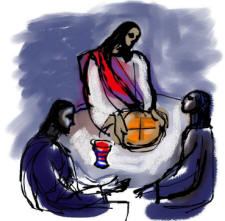
Sunday, April 06, 2008

Surprises from the Risen Savior

[This sermon was shared during worship at Saint Matthew Lutheran Church in Logan, Ohio, this morning.]

Luke 24:13-35
I love surprises! To me, as a kid, at least half the joy of getting to the tree on Christmas mornings was associated with not knowing exactly what I was going to get...and then being surprised!

For Jesus’ earliest followers, the first Easter was a bit like Christmas morning was for me while growing up. Every time they turned around, they were getting surprised, sometimes shocked. Our Gospel lesson for today, which takes places in the afternoon and the evening of the first Easter, documents several of the surprises God gave them...and us...on that day.

First, of course, was the surprising news they’d all received from some of the female disciples who had gone to the tomb to anoint Jesus’ dead body at dawn. They'd reported that Jesus’ body wasn’t there. That was curious enough to the rest of the group. But what really surprised them was the women’s claim that Jesus had risen from the dead. Luke says that Jesus’ other followers wrote this claim off as “an idle tale.”

But there were more surprises in store. In our lesson, two of Jesus’ disciples left Jerusalem, heading for the village of Emmaus, about seven miles away. Naturally, they talked about recent events, not just the report of Jesus’ missing body and of His resurrection, but the shocking surprise they’d gotten a few days before when the Teacher they thought would go to Jerusalem, overthrow the Roman government, and establish Himself as an earthly king had instead refused to fight and gone uncomplainingly to a terrible death on the cross. Not only did they grieve Jesus' loss, they also were grieved that all their hopes, things they’d hoped and worked for over a period of years, had been so violently and abruptly dashed on the previous Friday when Jesus died a humiliating death as a condemned criminal. Many of you here this morning know exactly what they felt as they mourned. You too, have had the hopes and dreams toward which you've worked suddenly destroyed by circumstances beyond your control. That's how these two disciples felt.

It's in the midst of their discussion that the two of them got their next surprise: A man suddenly started walking beside them and asked what exactly they were talking about. You and I know that this is Jesus. But the disciples, prevented, I think, by their unbelief, can’t recognize Him.

There are times in our lives too, when the risen Jesus is working in our lives and we don’t even know it. True story which I first read in Billy Graham’s book, Angels: Some years ago, a man woke up in the middle of the night, a feeling of terror overwhelming him and a strange word throbbing in his brain. Pray for this word, he sensed God telling him. The man prayed, with no idea why. After awhile, he sensed that his mysterious prayer assignment was completed and he went back to sleep. Months later at worship, he met a missionary who was at home on furlough. When he heard the name of the village in Africa where the missionary served, the man was dumbfounded. The village’s name was the word he was awakened to pray for that night! He later learned that at the very hour he had been praying, that village was under attack by a neighboring tribe. All the people had gathered in the village church and the missionary had urged them to pray that God would send help. Shortly thereafter, the hostile tribesmen simply walked away. Some time later, all the members of that hostile tribe came to faith in Christ and the missionary asked them why it was that on the night of the attack, they had simply left. “It was those men,” one of the tribesmen said. “What men?” “Those warriors who surrounded the church. We were afraid of them.” The missionary and the praying man from the States concluded that on the night of that attack, God had roused many to pray so that He would have the invitation He wanted to intervene, save that village, and even make it possible for those who’d had murder on their minds to receive forgiveness and new life through Jesus Christ. You never can tell when the God we know through Christ will, as was true on that road to Emmaus, walk beside us!

But the two disciples got another surprise. When this stranger seems ignorant of the events the disciples have been discussing, they can hardly believe it. After all, Jesus’ crucifixion hadn’t happened in some obscure corner. The Jewish historian Josephus, a Roman historian who lived from about 37 to 100AD mentioned it in his exhaustive history of the Jews. Anybody in Jerusalem that Passover week would have known about Jesus’ trial, suffering, and executtion. “We had hoped that he was the one to redeem Israel,” the two disciples tell Jesus, their grief and disappointment in evidence.

Jesus must have surprised them with what He said next: “Oh, how foolish you are, and how slow of heart to believe all that the prophets have declared! Was it not necessary that the Messiah should suffer these things and then enter into his glory?” And then this mysterious stranger explains how Jesus’ death and resurrection had always been the centerpiece of God’s big plan to make it possible for everyone in the whole world to turn from sin and believe in Jesus and so, live with God forever---all of it revealed in the Old Testament.

Jesus surprised them with the Word of God! Later, the disciples remarked to each other how their hearts were on fire when they listened to Jesus discuss God’s Word.

God’s Word still has that power! I used to get lunch at a deli in Cincinnati and got to know its owner, a man from Syria, a Muslim. We became friends. One day, I was in the deli and he told me that his brother-in-law had died, a victim of suicide. Would I come to the funeral visitation?, he asked me. I was honored and happy to do so.

I showed up several minutes before the visitation actually began and sat down to talk with my friend. "Mark," he said to me, "I'm a Muslim. What do you as a Christian believe happens to us when we die?" I began to talk about what the Bible teaches happens for all who believe in Christ, how we are saved from sin and death by the grace of God, given in Jesus Christ.

I went on for some time like that, stopped myself, and apologized for going on so long. He touched my arm and said, "No! Don't apologize. That made me feel good to hear."

That man felt good not because of me, folks; that was because of the power of God’s Word! In the Bible, God's Spirit touches our spirits, the life of the risen Jesus touches our lives. No other book on the face of the planet has the power of the Bible, because the Bible is the place where we come face-to-face with God!

The risen Jesus can pierce our thick-headedness and our slow-heartedness and surprise us with His love and power when we spend time reading and soaking up His Word each day.

But, if you’re as thick-headed and slow-hearted as me, compelling as God’s Word can be, sometimes it isn’t enough to pierce our sloughs of despair, our inability to believe, or our willful rebellion.

We've spoken of several surprises those two disciples got on the way to Emmaus: the surprise of this man--who we know was Jesus--walking beside them and the surprise of having the mysterious stranger sharing the Scriptures with them in a way that caused their hearts to passionately burn within them. But they got another surprise.

After the three of them had reached the two disciples’ destination in Emmaus, the still-unknown Jesus was going to forge on. But the two disciples insisted that it was too late to keep on, that He should at least stay for dinner. We're told that, “When he was at the table with them, he took bread, blessed and broke it, and gave it to them. Then their eyes were opened, and they recognized him.”

In the breaking of the bread, the two disciples now could see that it was true: The Lord Who had gone through the same ritual when He fed the 5000 and later in the Upper Room when He instituted the Lord’s Supper, enacted it again. There was no mistaking that Jesus had risen and was with them. The breaking of the bread made it unmistakably true.

As you know, I try to visit with our shut-ins each month. I enjoy those visits and we often have good conversations. But I tell you what I like most about my time with each of them: It’s when they receive Holy Communion. Whatever else may be going on in their lives, they know that Christ’s promise to be “in, with, and under” the bread and the wine, to be there body and blood, is true. “This is My body,” Christ says again. “This is My blood.”

Author Richard Farrar Capon talks about Holy Communion as “the hat on the invisible man.” We can’t see Jesus right now. But when the Word of God—God’s Word of promise to those willing to receive Jesus—meets the bread and the wine, Jesus will be among us and we will receive forgiveness in His Name.

When the Emmaus disciples finally recognized the risen Jesus, He vanished from their sight. But they knew for sure that they weren’t alone. So, these once forlorn figures who’d been so afraid of the dark that they’d convinced Jesus to stay with them for dinner, immediately traveled the 7-miles back to Jerusalem to tell the other disciples that it was true: Jesus was alive!

I love surprises! So here’s another one for you to consider. Do you know the holiest part of our worship together? It doesn’t happen at the altar, holy though what happens there is. It isn't in the reading of the Word or the singing of praises, though those are certainly holy moments.

The holiest moment happens at our church doors. It’s when, after we’ve received God’s Word and the Body and Blood of Jesus and go into the world to share the same message with our neighbors and friends that the two disciples from Emmaus shared that first Easter evening: Jesus is alive!

It’s still good news!

It’s still surprising!

And it’s still something everyone in your life needs to know!

So, my message to you this morning about that good news is quite simple: Spread it around.

Saturday, April 05, 2008

Is Wright Wrong? Part 4

I've generally made it my policy in the six years I have been doing this blog not to respond to anonymous comments. In fact, I usually delete such comments on the premise that if people are unwilling to publicly own what they say, what they say shouldn't be seen by the public. But I'm making an exception to that policy for this post.

A comment appeared on the third installment of this series, one which, to some extent provides a natural segue to the rest of this series. But that isn't the only reason for my decision to not only leave the anonymous commenter's words on this site, but to address the opinions expressed there.

Another big reason is that this commenter's words reflect such a misunderstanding of what I have been saying here, I can only conclude that I haven't been effectively communicating in the first three installments. In short, I have experienced no change of perspective on Jeremiah Wright's public pronouncements. My goal has been fairness throughout. More on that momentarily.

The commenter writes under the pseudonym of adept2u. Below are extracts from the comments, in green, followed by my responses:
Judge not lest ye be judged...
Good words! They're from Jesus, cited, among other places in Luke 6:37:
“Do not judge, and you will not be judged; do not condemn, and you will not be condemned. Forgive, and you will be forgiven..."
It is absolutely wrong for Christians to apply standards to other Christians they would not apply to themselves. We know that all people are sinners who fall short of the glory of God. Christians believe that we are saved by God's grace and not because of moral superiority. So far as I know, I have not violated Jesus' directive against judging in my words about Pastor Wright's public communications. I have attempted to be fair and gracious, striving to do unto Pastor Wright what I would hope that he would do unto me.

But we members of "the one holy, catholic, apostolic Church," the body of Christ, also are called upon to make judgments about what is right and wrong, what will advance and what will harm the witness of Christ and the Church each and every day.

Let me be honest: I am imperfect. I am a sinner. I do things that displease my Lord. Each day, I approach the Lord with a list of my most recent sins and I repent for them, seeking God's forgiveness and the capacity to love God and neighbor more faithfully each day.

But that doesn't mean that when another Christian leader or layperson create what I think is a misconception of Christian faith, I should keep silent. When people like Pat Robertson (also here) and James Dobson have given the general public wrong ideas about Christ or the Church, I have spoken up. I imagine that Pastor Wright has done this as well. That's not judging; that's witnessing. In some cases, it's leadership. As Pastor Gerald Mann has noted, sometimes it seems that the primary job of Christians is cleaning up the bad reputation given to God by Christians. That's one of the purposes of this series, to analyze some of Jeremiah Wright's public pronouncements from the perspective of Christian faith, and not just as political statements, the way the news media and many bloggers were analyzing them.

Next, adept2u writes:
I'm glad you finally had took the opportunity to view the Rev. Wright through your lens, but do you remember the charactherizaitons you made before you were so kind to actually listen to the mans words. I believe you called his expressions hateful, anti semetic as well as several other things.
Actually, I had listened to the post-9/11 sermon even before I wrote the first installment of this series. In the first installment, I alluded to several things that Pastor Wright had said or promoted and wrote:
Earlier this evening, CNN gave heavy coverage to articles by Wright and by a Hamas functionary which appeared last year in Trinity's bulletin. Some of the comments were antisemitic. Others were anti-Israel and some anti-Italian, replete with racial and ethnic slurs. Let me hasten to say that talk like this has no place in Christian discourse. In the most famous passage in the New Testament, Jesus told Nicodemus that God so "love the world," that's everybody.
I stand by what I wrote there. But I hope that what I have presented here thus far will contribute to a fuller picture of Reverend Wright. He appears to be one who strives to be faithful to Christ, but who has expressed some really hateful notions, notions contrary to the character and will of Christ. He appears to be, like me, saint and sinner. But he seems not to perceive the hatefulness or the prejudices of some of the ideas he embraces. (More on that in the next installment of this series, I hope.)

Skipping ahead, adept2u writes:
I hope you will now endeavor to correct people when the call the Rev. Wright hateful etc, and I believe you further owe him an apology.
I agree with Martin Luther's understanding of what we Lutherans render as the Eighth Commandment (You shall not bear false witness against your neighbor):
We should fear and love God that we may not deceitfully belie, betray, slander, or defame our neighbor, but defend him, [think and] speak well of him, and put the best construction on everything.
Part of what I have tried to do in this series is to fairly understand Jeremiah Wright. I do this in part, in response to Senator Obama's call for building bridges of understanding across the racial divide in this country. But mostly I do it out of simple Christian duty. It is my responsibility as a Christian to attempt to understand my neighbor and to put the most charitable construction on what my neighbor thinks, says, and does.

But I have a higher duty to Christ, the Lord Who saved me. I must speak the truth about Christ as a loving Savior Who doesn't like ethnic stereotyping, for example.

Near the end of adept2u's comments, we read:
I also feel I must let you know that no one and especially the Trinity UCC is going to cry one tear if you would not grace that church with your presense. The days of black people having to cow tow and beg for the acceptance of the likes of you is blessedly passed.
I don't know what my "likes" are, but I can assure you that nobody has to kowtow to me. I want no one to do so.

But I also hope that our churches can be places where all we recovering sinners come to wrestle with the reality of our own sin and be empowered to live with love, confidence, and hope because, through the Savior Jesus Christ, repentant sinners are transformed by God from His enemies to His friends. Based on what I have learned about Trinity United Church of Christ, I'm confident that I would receive a warm and loving welcome if I showed up for worship there.

Onto that analysis of some of Jeremiah Wright's more disturbing public communications in the next post, I hope.

[The first three installments of this series can be found here, here, and here.]

Pre-Order 'Mormonism Explained'

The newest book by my blogging friend and colleague Dr. Andrew Jackson, Mormonism Explained: What Latter-day Saints Teach and Practice, will be released on April 30. I had the privilege of reading an advance copy of Andy's thorough and readable survey and heartily recommend it. You can pre-order Mormonism Explained over at Amazon.com.

Friday, April 04, 2008

One and Only Pass at This Sunday's Bible Lessons (April 6, 2008)

[Each week, I present at least one of these "passes," designed to help the people of the congregation I serve as pastor, Saint Matthew Lutheran Church in Logan, Ohio, to prepare for worship. Because we use the Revised Common Lectionary (RCL) associated with the Church Year, most of the lessons addressed in these passes are the same ones most Christians read and consider on succeeding Sundays. So, I hope others will find these brief looks helpful, too.]

The Bible Lessons:
Acts 2:14a, 36-41
Psalm 116:1-4, 12-19
1 Peter 1:17-23
Luke 24:13-35

The Prayer of the Day:

O God, your Son makes himself known to all his disciples in the breaking of bread. Open the eyes of our faith, that we may see him in his redeeming work, who lives and reigns with you and the Holy Spirit, one God, now and forever.

General Comments:
1. This week we come to the Third Sunday in Easter. As I've pointed out before, every Sunday is a little Easter on which we celebrate the resurrection of Jesus from the dead. But this season remembers the forty days during which the risen Jesus appeared to believers before ascending to heaven. Ascension Day is followed, ten days later, by Pentecost.

2. Two of our texts for this week were written by Luke the evangelist, the lesson from Acts and the Gospel lesson from Luke. As I pointed out last week, all of the first lessons for the Season of Easter come from Acts, a Biblical book that records the history of the Church from Jesus' ascension until about 60AD.

3. A few common threads one can see in the appointed lessons, apart from the common authorship of two of them:
  • Both the concluding verses of Peter's sermon on first Pentecost, from Acts, and the Psalm emphasize the willingness of God to hear us when we call. In Acts, Peter, no doubt drawing on personal experience, tells a crowd of His fellow Jews the repentant can call on God and be saved from sin and death. The anonymous psalmist of Psalm 116 says that he will worship the God who hears when we call Him in our distress.
  • Both the psalmist and Peter in 1 Peter 1:17-23 address the question of where God is in our suffering.
  • Peter, of course, figures in three of the lessons: as preacher (Acts), author (1 Peter), and corroborating witness of the resurrection (Luke).
4. But the Gospel lesson also suggests that the God we know in Jesus Christ shows up in unbidden ways. There, the risen Jesus simply appears with the two grieving disciples heading for Emmaus.

5. Nonetheless, the lesson also shows us that there are certain reliable places where we can always count on meeting Jesus: in God's Word and in the breaking of the bread (Holy Communion). More on that later.

6. Acts 2:14a, 36-41: This concludes a sermon that will more fully absorb us on Pentecost Sunday. Peter's sermon presents both Law and Gospel: On the one hand, he indicts the crowd for its complicity in Jesus' crucifixion. On the other, he tells them that they can repent and, believing in Jesus, have a right, restored relationship with God.

7. Psalm 116: This psalm has given inspiration for many Christian songs, hymns, and liturgical pieces through the centuries. The psalmist concludes that the goodness of God and God's willingness to hear us when we call is one indication of why and how much we need to worship and praise God.

The word worship is the contraction of the Old English term, worth-ship. In worship, we declare the worthiness of God: worthy of our praise, glory, honor, and complete submission.

8. 1 Peter 1:17-23: An old hymn declares, "I am but a stranger here, heaven is my home." Followers of Jesus Christ see themselves as aliens and strangers to this world. Our real home is with God in eternity.

That means that we are to travel lightly, not putting too much stock in the stuff of this world. Despite its allurements, Peter says, we dare not be sidetracked. We need to live in awe of and trust in the God made known in Christ.

9. Why? Because, Peter says, we have been bought not with jewelry or gems, but with the blood of Christ, an unblemished Passover lamb sacrificed for all and Whose death and resurrection bring everlasting life to all who repudiate sin and follow Him.

10. What Peter demonstrates is that the life, death, and resurrection was not, after many divine failures, the culminating attempt by God to save humanity from sin and death. As Jesus taught the disciples on the road to Emmaus in our Gospel lesson, from the beginning it was always God's intent to save fallen humanity by means of Jesus' cross and resurrection. Jesus was always God's Plan A for redeeming sinners. All the law and the prophets pointed to this.

11. Luke 24:13-35: In discussing the Gospel lesson here, I'll just touch on a few questions it raises. The first, for me anyway, is why the two disciples--one of them, we learn later, is Cleopas--didn't recognize Jesus? Associated with this is the question, who or what "kept from recognizing" Jesus?

Explanations of this abound. I personally don't believe that it was God Who prevented recognition and that what primarily prevented that from happening was their own grief and disbelief. The disciples had seen Jesus die. Some of their number had lain His body in the tomb.

Repeatedly, we saw how the disciples placed their hope in Jesus based on what blessings they thought He could bring were He to bounce the Roman occupiers and the selfish local religious and political leaders out of power.

In spite of what Jesus had said repeatedly and in spite of all that the prophets had said, Jesus' first followers couldn't recognize Him in the resurrection.

12. How did they recognize Jesus? Interestingly, it didn't happen as He explicated the Word of God for them. It happened in the breaking of the bread, something He did in a characteristic way, as seen in the obvious parallels between Luke 9:16, 22:19, and 24:30 (Thanks, Brian Stoffregen).

In one of his books, The Third Peacock: The Problem of God and Evil, Richard Farrar Capon speaks of Holy Communion as "the hat on the invisible man." We can't see the risen Jesus today on earth, but, using Martin Luther's phrase, "in, with, and under" the bread and wine of Holy Communion, Christ has promised that we can "taste and see" the goodness of the Lord. Even when this world and our faint faith prevent us from seeing Christ, we can recognize Him in the Sacrament of Holy Communion.

This doesn't mean that the Word is inferior to the Sacrament. Far from it! In fact, the Sacrament is "the Word with skin on it," something we can actually see, the tangible presence of God in our midst. But, as was true of the disciples, we only know the God-Man Jesus when we see Him because of the Word about Him, from Genesis to Revelation.

In other words, it was after the two disciples heard the Word and experienced Jesus in the breaking of the bread that they recognized Him. (The word in Greek which we translate as recognize is epignoew, literally upon knowing. And, upon knowing Who this mysterious stranger who made their hearts burn with awe and wonder, the two disciples no longer see Him. But, certain that Jesus had, in fact, risen, they make the trip back to Jerusalem to tell the other disciples.)

With both the Word explicated by Jesus and the breaking of the bread, the disciples experienced God coming close to them and their hearts burned within them.

13.Why, if it was so dangerous to be out at night in first-century Judea, did the two disciples tear back to Jerusalem after they recognized Jesus? It's simple: Jesus' resurrection had changed everything! The risks that once would have seemed daunting, now seem worth taking. Jesus had confirmed what they never could have believed on their own steam: Jesus had conquered sin and death and was alive for all eternity! They needed to tell the others that the tale brought back from the tomb by the women was true: Jesus had risen and they had seen Him!

Besides, when you know the truth of Jesus' resurrection, you're inclined to do goofy things. In John's Gospel, we're told that the aimless disciples, led by Peter, decided to go out fishing one day. Stripped down to his altogether on what had been a futile venture, when Peter spotted the risen Jesus on the shore, he put on his clothes and jumped into the water. Who adds clothing to take a swim?

How many risky or goofy things might we do as Christians if we really believed that Jesus is risen and alive?

[UPDATE: One other thing that has struck me as I've continued to consider this passage is how much we don't know. According to John Pilch, for example, visitors to modern Israel will likely be told by tour guides, of six different locations for Emmaus. Fact is, we don't know where it was. The disciple called Cleopas in our text is mentioned in no other place. And we never do get a name for the other disciple Jesus encounters on the road to Emmaus.

I take some comfort from this. On the first Easter Sunday, Jesus did appear to disciples whose names we know: Mary Magdalene and Peter, for example. But he also appeared to these two anonymous disciples, two forlorn figures who found it hard to believe what the women of their company had told them about an empty tomb and a risen Savior. That tells me that the Risen Lord of all creation cares about anonymous people who live in anonymous places.]

Thursday, April 03, 2008

YES!

See here.

Is Wright Wrong? Part 3

For now at least, the mainstream media and the blogging world have, for the most part, left the Jeremiah Wright controversy behind. That's too bad in a way and it showcases the problem with what has become not a twenty-four hour news cycle, but a constant assault of headlines, sound bites, video clips, and rapid fire stereotyping often devoid of context or real analysis.

Before 1980, when TV network news was established as part of a pantheon of journalistic outlets, joining newspapers and radio, supplanting the latter and in some ways, supplementing the former, there was time to develop stories responsibly, covering multiple aspects. There was even a place for a dispassionate analyst to give nightly commentary, as was true of Eric Sevareid five nights a week on CBS News, his wise words treated almost like wisdom from Mount Sinai.

I'm grateful for the Internet. It allows for an increased public dialog and has made it possible for even someone like me, a preacher in a small Ohio town, to reach an audience I could not have otherwise reached. (And every writer wants people to read what they have written, no matter what other motives they may have.)

But the Internet of today is a bit like the media landscape of Europe in the 1500s, after Gutenberg's presses had started to make their presence and potential apparent, or of the young united colonies, then United States, immediately before and after the Revolution. In both contexts, pamphleteering, those eras' equivalents of blogs and YouTube videos, became major sources of information and ideas.

In the case of early-16th.-century Europe, the printing press and the wide distribution of his essays made Martin Luther, the Reformer of whose movement I am a part today, the very first media superstar, as others have pointed out. (That was also an era when copyright laws and royalties did not exist, proof that Luther cared not a fig about wealth, but simply wanted people to know that we are made right with God not by what we do, but by who we know.)

The Internet is a wild and woolly world. The conventional media, which includes the cable TV networks, feel a need to respond to and carry items making the news on the web in order to keep up.

But at times, this causes all of the media players--conventional and otherwise--to express opinions and pass judgments before facts have been established.

As I have delved into some of Jeremiah's Wright's thinking, my first impressions have been somewhat changed. I still think that Wright is a polarizing figure and that some of his opinions are indefensible. But, as I think my sharing of the actual content of his post-September 11, 2001 sermon demonstrates, that sermon, in any case, no matter what one thinks of the data he marshalls or the conclusions he draws, is well within the mainstream of Christian thinking, with no hint prejudices of any kind.

Even in saying that the 9/11 attacks exemplified our country's chickens coming home to roost, the military veteran who volunteered for several tours of duty in Vietnam, was not disparaging the United States, as he clearly was elsewhere.

In his comments on the first installment of this series, my colleague, Pastor Jeff, provides links to several communiques from Jeremiah Wright. They are disturbing and I will take a look at those in the next installment. As will become apparent, I abhor some of the things Wright said there and in other places. So much do I abhor them, in fact, that I cannot imagine being a member of any church pastored by Wright.

But I do hope that what I've written and will write about him, about preaching, and about the Biblical tradition of prophetic preaching, will serve as a reminder, at least to anyone who shows up here, that the best thing we can do when an Internet tempest cranks up, it's best to bide our time, bit our tongues, pray, research, and reflect.

The Internet gives us access to all sorts of information and ideas. It also gives an unprecedented capacity to put in our own two-cents' worth. But we shouldn't allow the low cost of admission to cheapen our discourse. Even Jeremiah Wright deserves a fair shake.

Wednesday, April 02, 2008

Go, Buckeyes!


One more. I know it's the NIT. But the performance of the Ohio State men's basketball team in this year's tourney bodes well for next year.

More here.

Monday, March 31, 2008

Is Wright Wrong? Part 2

In the first installment of this series, I dealt with antisemitic and hateful remarks made or supported by Jeremiah Wright, one-time pastor of Trinity United Church of Christ in Chicago, for twenty years the pastor of Senator Barack Obama. I said that antisemitism particularly, and any prejudicial slur invoked against ethnic or religious groups generally, is not Christian discourse.

But, based on the affirmations of at least some of Wright's ministry made by people I respect, I also wanted to examine other of his pronouncements. I specifically wanted to listen to or read his entire post-9/11 sermon. It has, ostensibly, been the objectof intense debate and, I would say, vilification of Wright. Many have pointed to that sermon and called him unpatriotic. (I say ostensibly, because on YouTube and in other media, some of his other pronouncements have been presented as though they were part of this particular sermon. He did not, for example, speak of the "US od KKK A" in the post-9/11 sermon. Nor did he speak of the crazy notion that the US government had infected African-Americans with the AIDS virus. Those suggestions from him came in other contexts.)

In short, as revolted as I am by the prejudices and the dangerous silliness Wright has uttered or to which he has given credence, I also wanted to be fair. Growing up, I had extended family members who said silly, stupid, prejudiced things. One relative was absolutely convinced, for example, that Franklin Roosevelt put a pistol to his own head at Warm Springs, rather than dying from a cerebral hemorrhage and palmed off this nutty theory as gospel truth. Some family members canceled reservations at a state park lodge in Ohio after they learned that an NAACP gathering was scheduled the week before their scheduled stay. One member of my extended family was convinced that some medical problems I experienced resulted from my being assaulted by some of my African-American friends, an assault that only happened in his bigoted imagination. Yet, for all their faults, prejudices, and lunacies, I experienced these family members as loving people, in much the same way that Senator Obama experienced Jeremiah Wright.

In my own theological tradition--I'm a Lutheran Christian, there is a heavy emphasis on the fact that sin is a condition, an inborn rebellion against God which causes even followers of the God of the Bible to sin. "In sin did my mother conceive me," Israel's greatest king, David, wrote in repenting for murder and adultery (Psalm 51). "Wretched man that I am!" Paul writes in the New Testament, "Who will rescue me from this body of death? Thanks be to God through Jesus Christ our Lord! So then, with my mind I am a slave to the law of God, but with my flesh I am a slave to the law of sin" (Romans 7:24-25) We Christians confess that we are sinners deserving of death, but saints because of what Christ has done for all who are willing to follow Him.

As a saint saved by God's grace, I have no bragging rights, no call for gloating or spiritual superiority. Jeremiah Wright's pronouncements are, at times, reprehensible. But they may not always be wrong or signify that he isn't part of the family of God. Indeed, there may be much that's commendable in him and in his ministry. I thank God every day that a preacher doesn't have to be morally perfect or devoid of blind spots to be accounted faithful. Truth to tell, I am deeply mindful of my sins, which is why one of the prayers I utter every single day is, "Thank You, God, for not killing me for my sins as I deserve!"

Nor does a preacher have to be an unblinking patriot. A story. Some months ago, I was in a meeting involving other clergy from my own faith tradition. We were talking about the war in Iraq and there were strong feelings around the table. The discussion widened beyond mere consideration of the war itself to the more general subject of patriotism.

Anybody who has read this blog very much knows that I am an unabashed patriot. I freely acknowledge the faults of this country and that things like slavery, racial prejudice, and the subjugation of Native Americans are sins, the effects of which continue to pollute our national soul.

But I also believe that there is something exceptional in the US character: the first nation to decide itself into being has, by fits, starts, and convulsions, been on a two-plus century-journey toward fulfilling the promise of its founding documents, to be a nation of liberty (as enunciated in the Declaration of Independence) and of mutual responsibility (embodied in the Constitution).

America does, in fact suffer, as Martin Luther King, Jr. said, from "a schizophrenic personality." But were it not for these public pronouncements about a very specific national identity, about the vision we are pursuing, that description would be inapt. We can be described as schizophrenic quite simply because we fail to meet the very standards to which we are supposedly committed.

In our conversation about patriotism, my colleague said, with an ironic laugh, "I used to be a patriot. I really did." He said it as though patriotism was unworthy of a Christian.

Other Christians I know put patriotic fervor for the United States on a par with faith in God.

I disagree with both camps.

I think that as a Christian, it's possible to love one's country. But the God we meet in Jesus Christ demands that we always put God first. Above personal desires. Above family and friends. Above career. Above country. Above everything.

The first commandment tells us, "You shall have no other gods before me." A god is whatever we give highest priority in our lives. If forced to choose between the God I love and the country I love, I hope that God will win every single time. It should really be no contest.

And sometimes, my faith in God and my love for my country will compel me to say things that are critical of my country. I feel no hesitation about condemning our materialism and our racism, for example. I am bothered by those whose patriotism is xenophobia, rather than an honest, historically-attuned appreciation for America, flaws and all.

For any preacher of the Gospel, be it Jeremiah Wright or Mark Daniels, there are two great strands that must appear in preaching: the pastoral and the prophetic. The pastoral declares the love of Jesus by pointing to His gracious handling of sinners. Jesus, God in the flesh, promises life to all who turn from sin and believe in Him.

The prophetic declares the love of Jesus by pointing to the sins that demonstrate our need of forgiveness, both as individuals and as societies. The prophet says, "You have wandered far from God and here are the ways that can be seen."

We tend to like preachers when they're speaking pastorally. But those who speak prophetically are, shall we say, less appreciated.

In his classic overview of the Old Testament portion of the Bible, Bernhard Anderson, onetime professor at Princeton University, calls his chapter on the Old Testament prophets, "Prophetic Troublers of Israel." Anderson explains that prophets believed that God had sent them to deliver messages to God's people, ancient Israel.

The prophets weren't sent by God to make predictions about the future, although that's how some stereotypically see them. Rather, they were sent to tell God's people, "This injustice, that sin, this forgetfulness of God...is not pleasing to God. You are severing your relationship with God and that has its consequences."

To put it in more modern terms, the prophets were sent to tell God's people that if they kept rebelling against God, those "chickens would come home to roost." God, they would tell Israel, is patient. He is slow to anger and abounding in steadfast love. But if you keep flouting the will of God--God's will that we love God and neighbor, there will be consequences. Paul talked about this in the New Testament. "Do not be deceived," Paul writes in Galatians 6:7, "God is not mocked, for you reap whatever you sow."

The preacher who isn't both pastoral and prophetic, who fails to display both sides of God's love, who fails to call people both to repentance for sin and to confidence in God's grace, and who doesn't preach both Law and Gospel fails to fulfill the preacher's call.

Now, with all of that in the background, take a listen to Jeremiah Wright's post-9/11 sermon. I'll come back in a day or two to give my reflections on it.

Wright's text is Psalm 137, here.


powered by ODEO

Sunday, March 30, 2008

"Hey, it's those guys!"

Here

What Happens When Doors Are Unlocked

[This sermon was shared during worship with the people of Saint Matthew Lutheran Church in Logan, Ohio, earlier today.]

John 20:19-31
When we lived in rural northwestern Ohio, we never locked the doors of our church or our house. Having been accustomed to always locking up, we fell into this habit slowly. But I remember the moment when I realized that the habit had fully taken hold. We were getting ready to take a vacation and thought it would be a good idea to lock up. I searched high and low though and couldn’t find the house key. What’s more, it dawned on me that it had been months since I’d even seen a house key, let alone used it!

Why do we lock our houses, cars, garages? That’s simple enough: We’re afraid. Afraid of intruders harming us. Afraid of having our belongings taken. Locked doors are prudent precautions for us all to take.

But, let me ask you this? Are there other doors we lock down tight, doors that maybe we should keep open?

He’d been hurt. Two wives had left him for other men. “Never again!” he vowed. “Never again will I let anyone get in.” So he shut down. He woke up, ate his daily meals, did his job. He socialized. But there was always a wall.

Somehow though, a thought penetrated his fog of fear and loneliness. “Maybe,” he thought, “I need God.” He met with a local pastor. “What can I do?” he asked. The pastor said there was no magic bullet, but he did have a suggestion.

“Start attending worship regularly," the pastor said. "It doesn’t have to be this church. Just go somewhere and really make an effort to get it. Get your brain off your own bellybutoon. Ask God to help you with that.” The pastor also suggested a few places in the Bible the guy could read and they could later discuss. “Do those things,” he told the man, “and come back here in six weeks.”

There were no lightning bolts, or, as one of our old hymns puts it, “no sudden rending of the veil of clay.” But when the man came to the pastor’s office six weeks later, something was different. Some of the doors had been unlocked and opened. God stepped in. Later in that man’s progress, friends walked in. Later still, a new wife walked in. They’re still married. Happily.

God can do wonderful things when we unlock the doors to our lives, wills, and hearts. The risks and the dangers won’t go away. But what that man would tell you—and yes, he really does exist—is that the payoffs--peace with God and others--are worth the risks and dangers.

Today’s Gospel lesson takes us to the Sunday after the first Easter. Huddled behind closed doors, Jesus’ first disciples are a pathetic group. Here they are, recipients of the best news that the world has ever heard—the news that God the Son has died and risen so that all who turn from their sins and believe in Him will live with God forever. It was news that Jesus had spent a considerable period of time preparing them to share this news and His ministry. Yet, they’re not telling anybody about Jesus. They’re not serving anybody in His Name or under His authority. They’re afraid, our translation says, “of the Jews.” But this is a poor rendering. The term in the original Greek of John is Iouadaion and it refers to the people living in and around Jerusalem, Jews like them, many of whom were likely among those who had called for Jesus’ crucifixion just ten days before. This fearful group behind closed doors—the first church—isn’t a lot different from many churches today. Fear keeps them locked behind doors of all kinds.

Bill was the part-time pastor of a multi-point parish, meaning that he did worship and provided some leadership in several small congregations.* This was in rural Suwaunee, Georgia.

“My first visit to one of the churches,” Bill writes, “I found a large chain and padlock on the front door, put there, I was told, by the local Sheriff. ‘The Sheriff, why?’ I asked. ‘Well, things got out of hand at the [council] meeting last month, folks started ripping up carpet, dragging out the pews they had given in memory of their mothers. It got bad. The Sheriff come out here and put that there lock on the door until our new preacher could come and settle things down.’”

That was pretty much the way things went for the rest of Bill’s time at that church. He writes, “The arguments, the pettiness, the fights in the parking lot after the [council] meeting were more than I could take. It was tough and I was glad to be leaving them behind. ‘You call yourself a church!’ I muttered as my tires kicked gravel up in the parking lot on my last Sunday among them.” Here was a church that, truth be told, had padlocked God and neighbor out of its life.

Our Gospel lesson shows us that when the first Christians, the first members of the first Church locked themselves behind closed doors on that first Sunday after the first Easter, something happened. Jesus showed up. “Peace I give to you,” He told them. “As the Father has sent Me, so I send you.” And a week later, Jesus showed up again, telling a disbelieving Thomas, “Look at My wounds, Thomas. It’s Me. Sin, death, and the devil couldn’t overcome Me and if you stick with Me, they can’t overcome you either.” When Thomas saw and heard Jesus, he issued the most emphatic confession of Jesus you’ll find in the Bible. “My Lord and my God,” he said of Jesus. “It’s good you believe in Me,” Jesus replied, “Blessed are those who have not seen and yet come to believe.”

In fact, as the man who’d been left by two different wives came to know, even those of us who have never seen the risen Jesus in bodily form can, through the eyes of faith, see Him. And when we do, it will change our lives!

“One day,” Pastor William Self writes, “a man came into my office and asked if I could spend some time with him.” The man showed up and “said he was losing his faith and wanted to leave the church because he was racked with doubts.” Pastor Self told him that he needed to go on a hospital visit and asked this modern day doubting Thomas to go with him. “We drove across town to a large hospital,” Self writes. “We walked through the corridors and found the room of the patient whom I was [visiting]…The patient was a young doctor in his late 30s who was dying…As we entered the room, we noticed all the medical equipment hooked up to his body, but he was very conscious of our presence and wanted to talk. We talked for a moment about life and death. I read Scripture, and we prayed together. My doubting friend was there with me and stood at the foot of the bed as I stood at the patient's side. The entire process in the room took about 15-20 minutes. There were tears in the eyes of the patient in the bed as we turned to leave. We went down the hall to the elevator and then out to the parking deck before either one of us said another word. Finally, on the way back to the church my doubting Thomas turned and said, ‘I see things entirely differently now. Eternity has broken into my life, and I want to start all over with Christ.’"

When we dare to unlock the doors of our lives, the risen Jesus can come in, and change us from fearful people worried about today and tomorrow--maybe yesterday--into confident believers who, like Thomas and the members of the early Church, go into the world with the love of Christ and the message of salvation in His Name.

That’s what happened in that once-padlocked church in Suwaunee, Georgia. A few years after Bill left the church, he met the twenty three year old pastor who was, by that time, serving there. Bill felt sorry for him. But the young pastor began talking about what a remarkable church it was. It was supporting about a dozen poor families in its county, ran a free day care center, and was a place where interracial families, snubbed elsewhere, found a welcoming home. What happened? “I tell you what I think happened,” writes Bill, now a bishop in the United Methodist Church. “I think that…someone greater than I knocked the lock off that door, kicked it open and offered them peace, the Holy Spirit, mission and forgiveness. And now” they can rightly be called a church.

Folks: I believe that the risen Jesus has plans for Saint Matthew Lutheran Church. In you, I see a people willing to open your lives to Jesus, to confess Him as your Lord and God not just with your mouths, but with your lives.

In a few weeks, on the Friday evening and Saturday morning before Pentecost, I want to invite you to participate in a prayer vigil here in Saint Matthew’s sanctuary. From 6:00 on Friday night until 7:00 on Saturday morning, I’ll ask individuals or families to be here for half-hour stints. Your goal?
  • To pray for this wonderful congregation and our ministry to the community and the world.
  • To pray that the Risen Lord, Who breathed onto that frightened band of disciples in a locked room in Jerusalem, will breathe on us, giving us renewed faith and boldness in sharing His love and inviting others to follow Christ with us here in Logan and Hocking County.
  • To pray that we will unlock the doors of our lives and let Jesus Christ into every part of our lives.
I plan on being here to pray that night, too. I’ll be around for. And there will be materials here to help you pray. We’ll have sign-up sheets in the fellowship hall next Sunday. I hope that every half-hour block will be filled with the names of at least two people who will pray. If you can’t drive at night, I ask you to indicate when you’ll pray for Saint Matthew at home during the vigil.

The risen Jesus came to the frightened disciples, gave them His peace, and that band of people then turned the world upside down in the Name of Jesus Christ. Jesus is still risen and still in business. He still has things He wants to do through you and me and through Saint Matthew. When we dare to unlock our wills, minds, and hearts to the risen Jesus, He will enter in. He will give us His peace and He will use us to do wonderful things in His Name!

*"Bill" is William Willimon, a fantastic preacher and able theologian, who told this story about his days as a student pastor here.

Friday, March 28, 2008

One and Only at This Sunday's Bible Lessons (March 30, 2008)

[These passes are designed to help all worshiping with us at Saint Matthew Lutheran Church in Logan, Ohio to prepare for Sunday worship. Because we use the Revised Common Lectionary, as slightly modified by Lutherans, I also hope that these brief ponderings will help others too.]

The Bible Lessons:
Acts 2:14a, 22-32
Psalm 16
1 Peter 1:3-9
John 20:19-31

The Prayer of the Day:
Almighty and eternal God, the strength of those who believe and the hope of those who doubt,
may we, who have not seen, have faith in you and receive the fullness of Christ's blessing,
who lives and reigns with you and the Holy Spirit, one God, now and forever.

General Comments:
1. Last Sunday was the first in the seven-Sunday Season of Easter. The risen Jesus, the New Testament tells us, walked among and taught His followers for forty days following His resurrection. (Paul says that more than five-hundred of Jesus' followers, or disciples, saw Hims after His resurrection.) The Easter season therefore, incorporates forty days plus ten days, recalling the time between Jesus' ascension into heaven and the sending of the Holy Spirit at Pentecost, traditionally described as the birthday of the Church.

2. This Sunday, as on all the Sundays of Easter, the only lesson from the Old Testament is the Psalms. Usually, the first lesson also comes from the Old Testament. But during Easter, the first lessons are drawn from the New Testament book of Acts. Acts is the second volume of Luke the Evangelist's two-volume work, the first being the Gospel that bears his name.

Acts gives the early history of the Church from the day of the resurrected Jesus' ascension through approximately 60-65AD. It recounts the tale of how a group of not especially reliable witnesses of Jesus' ministry, death, and resurrection carried the Good News that forgiveness of sin and new life belongs to all who believe in Christ first to their fellow Jews and then into the world beyond. Within thirty years of Christ's resurrection, the Church was becoming established and growing throughout the Mediterranean basin.

Acts says that this happened not because the first Christians were more able than others. Nor did they gain thousands of converts through power or coercion. The early Church knew the truth of Paul's affirmation that believers are their strongest and most convincing when they are weak, that is, dependent not on themselves, their own cleverness, or their native persuasiveness, but when they are utterly dependent on God's Spirit to give them strength and inspiration. This fact may explain why the Church of today is in the greatest risk of extinction in places where Christians are likelier to be more well-off and comfortable. Wealth and ease can delude us into believing that we are self-sufficient. In places like Africa and Asia, people know better. There, the growth of the Church makes Christianity, in 2008, the fastest-growing religion in the world.

The Lessons:
1. Acts 2:14a, 22-32: The first lesson is part of the sermon which the apostle Peter preached on the first Pentecost and that will be the first lesson on Pentecost Day in a few weeks.

In both of his New Testament writings, Luke, himself a Jew, perhaps writing to a predominantly Jewish audience, is at pains to emphasize the consistency between the Old Testament and the ways in which God revealed Himself to ancient Israel and the ministry of Jesus in New Testament times.

Foreign to Luke and the incidents he recounts both in his Gospel and in the ministry of the early Church is any notion that Jesus represents a "new covenant" (or a "new testament"). That's an idea gets more from reading John's Gospel.

In this lesson, as in Jesus' appearances to the two disciples on the road to Emmaus, the emphasis is to show how Jesus fulfilled what God always planned to do from Old Testament times.

2. Psalm 16: In his sermon recorded by Luke in Acts, Peter quotes from Psalm 16, although he takes some liberties with the passage, presumably because, as happens when I teach classes sometimes, he's citing it from memory.

3. The psalm is called, "A Miktam of David." As explained by a note in The Life Application Bible, "Miktam comes from a term that may mean 'to cover.' It could mean a covering of the lips, a silent prayer, or a prayer to be covered (a plea for protection)."

4. What so intrigues me about this psalm is its emphasis on human volition in choosing one's god. (Our "god" is whatever is of ultimate importance to us. The Bible emphasizes that there is really only one God and urges all people to choose Him as their ultimate foundation and allegiance.) In verse 4, we're told, "Those who choose another god multiply their sorrows..." In verse 5, the psalmist declares, "The Lord is my chosen portion..."

5. 1 Peter 1:3-9: First Peter, one of my favorite books of the Bible, is a letter meant to be circulated among Christians living in Asia Minor, located in what is today Turkey and part of the Roman Empire. Traditionally, it's been believed that this letter was written about 62AD to Christians facing persecution and marginalization for their faith in Christ.

6. Here, Peter calls attention to how God can use our trials of faith to strengthen our faith, increasing our dependence on the God we know through Jesus Christ.

7. Verses 8 and 9 anticipate our Gospel lesson and may reflect Peter's memory of the very incident involving Thomas and Jesus that makes up part of it. The "outcome of your faith" in Christ, Peter tells believers who never saw Jesus, is "the salvation of your souls." The same promise belongs to believers in Jesus today.

The Gospel Lesson: John 20:19-31
19When it was evening on that day, the first day of the week, and the doors of the house where the disciples had met were locked for fear of the Jews, Jesus came and stood among them and said, “Peace be with you.” 20After he said this, he showed them his hands and his side. Then the disciples rejoiced when they saw the Lord. 21Jesus said to them again, “Peace be with you. As the Father has sent me, so I send you.” 22When he had said this, he breathed on them and said to them, “Receive the Holy Spirit. 23If you forgive the sins of any, they are forgiven them; if you retain the sins of any, they are retained.” 24But Thomas (who was called the Twin), one of the twelve, was not with them when Jesus came. 25So the other disciples told him, “We have seen the Lord.” But he said to them, “Unless I see the mark of the nails in his hands, and put my finger in the mark of the nails and my hand in his side, I will not believe.”

26A week later his disciples were again in the house, and Thomas was with them. Although the doors were shut, Jesus came and stood among them and said, “Peace be with you.” 27Then he said to Thomas, “Put your finger here and see my hands. Reach out your hand and put it in my side. Do not doubt but believe.” 28Thomas answered him, “My Lord and my God!” 29Jesus said to him, “Have you believed because you have seen me? Blessed are those who have not seen and yet have come to believe.” 30Now Jesus did many other signs in the presence of his disciples, which are not written in this book. 31But these are written so that you may come to believe that Jesus is the Messiah, the Son of God, and that through believing you may have life in his name.

A Few General Comments:
1. This passage recounts the second and third appearances of the resurrected Jesus in John's Gospel. There is a fourth appearance to come, in John 21.

2. As Brian Stoffregen points out, in each of the resurrection appearances recorded by John:
...words and sight are important -- although neither Greek words: logos nor rhema are used. The first appearance ends with Mary announcing [aggello -- only occurrence in NT] to the disciples, "I have seen the Lord" and then telling them what Jesus had told to her (20:18).

The second appearance results in the disciples telling Thomas, "We have seen the Lord" (20:25) -- (the same words that Mary had used). The same word is used by Jesus to Thomas in v. 29: "Have you believed because you have seen me?" This suggests that believing involves more than just seeing the risen Lord. Each of these verbs is in the perfect tense, which implies a past action with continuing effect in the present. They saw something in the past and that seeing continues to affect their lives in the present.

The writer concludes the third appearance with his statement about the purpose of the declaration of his words in writing. The story does not end with "seeing the Lord," but by believing and sharing the message.
Verse-by-verse comments: v. 19: (1) The phrase "the first day of the week" is deliberate and significant. The creation motif is strong in the Gospel of John, starting with its opening echoes of Genesis' first creation account and the designation of Jesus as "the Word" who was both God and with God before the universe came into being. Jesus has come, according to both John's Gospel and the writings of Paul to usher in a new creation (Second Corinthians 5:17). The rabbis often taught that creation fell into sin on the seventh day and that God would renew His creation or create anew on a new first day, sometimes called the eighth day. (John also likes to speak of things happening on the eighth day or eight days later.)

(2) M. Craig Barnes, the wonderful preacher, suggests that disciples were afraid of their fellow Jews not just because of the possibility of their being killed, but also because they were ashamed for their disloyalty to Jesus.

(3) "Peace be with you" was a common greeting in Old and New Testament cultures. There is though, a particular irony in its use here and a particular need the disciples would have felt for God's peace.

v. 2o: (1) Jesus allows the disciples to see His wounds, confirming evidence that the full-embodied form before them is the Savior they had seen die.

(2) After satisfying themselves that this is Jesus and He is risen, the disciples rejoice. The only basis for joy that a Christian has--indeed, the only way people can call themselves Christian--is when they too, have their own satisfaction seen, for us through the eyes of faith, that Jesus is risen. Paul writes:
Now if Christ is proclaimed as raised from the dead, how can some of you say there is no resurrection of the dead? If there is no resurrection of the dead, then Christ has not been raised; and if Christ has not been raised, then our proclamation has been in vain and your faith has been in vain. We are even found to be misrepresenting God, because we testified of God that he raised Christ—whom he did not raise if it is true that the dead are not raised. For if the dead are not raised, then Christ has not been raised. If Christ has not been raised, your faith is futile and you are still in your sins. Then those also who have died in Christ have perished. If for this life only we have hoped in Christ, we are of all people most to be pitied. (First Corinthians 15:12-19)
v. 21: (1) Jesus underscores the peace that He gives by repeating this blessing to the disciples.

(2) Through Jesus, we're deputized and empowered to share the Good News as He had been. This echoes words from Jesus' high priestly prayer found in John 17.

v. 22: This is a sort of Pentecost, when you think of it. (Acts 2) The word spirit is pneuma in the Greek of the New Testament and ruach in the Hebrew of the Old Testament. Both words can mean wind, breath, and spirit.

In the second Genesis creation account, God breathes His ruach into inanimate dust and the first man comes to life.

In the first creation account, God's Spirit, like a mighty wind, bears down on the stormy waters of primeval chaos and life comes into being.

According to John's Gospel, when Jesus exhaled His final breath on the cross, He literally "gave up His spirit." (John 19:30)

Through the impartation of His Spirit, Jesus, God-enfleshed, creates the Church, the community of believers in Him who proclaim forgiveness of sin to all who repent and turn to Christ and the need for repentance and believe to all.

v. 23: "If you forgive the sins of any, they are forgiven them; if you retain the sins of any, they are retained.” Here, Jesus entrusts what's called "the Office of the Keys" to the Church.

Martin Luther explains this in The Small Catechism:
What is the Office of the Keys?
It is that authority which Christ gave to his church to forgive the sins of those who repent and declare to those who do not repent that their sins are not forgiven.
Christ not only conveys this frightening authority to the Church in John 20:23, but also in Matthew 18:18, where He says:
Truly I tell you, whatever you bind on earth will be bound in heaven, and whatever you loose on earth will be loosed in heaven.
v. 24: (1) Thomas' nickname, the Twin or Didymus, has often been seen as an indicator of "double-mindedness" on his part. This would fit well with James' New Testament admonition to believers who don't really believe:
Draw near to God, and he will draw near to you. Cleanse your hands, you sinners, and purify your hearts, you double-minded. (James 4:8)
That's because Thomas always struggled with unbelief.

In John 11, with word already having arrived that the Jewish authorities are intent on having their Roman overlords execute Jesus, Jesus announces that His friend Lazarus has died and He must go to him and wake him from death. Thomas says to the others, "Let us also go, that we may die with him.”

Given what we know about Thomas, this isn't piety, but sarcasm. It makes no sense to him for Jesus to get closer to those who conspire against him. Nor does it dawn on him, in spite of all that he's seen to this point, that Jesus can raise Lazarus from the dead.

(2) We often often call the Twin, Doubting Thomas. But as Brian Stoffregen points out, the text, in the original Greek, never speaks of Thomas as one having doubts. The battle raging inside of Thomas throughout is instead, between belief and unbelief.

v. 25: An interesting question to consider is where Thomas was when Jesus first appeared to the others? I don't know the answer to that.

v. 26: (1) A whole week has passed; it's another first day of the week. Once more, Jesus transgresses locked doors, indicating that He is no longer limited by time and space as He had been before His death and resurrection.

(2) Once again, Jesus greets the disciples with the words, "Peace be with you."

v. 27: (1) Jesus goes directly to Thomas with the evidence of His resurrection. I think that there's an important principle at play here: If we want to believe, Christ will help us to believe.

(2) Jesus doesn't tell Thomas, "don't doubt." (Although that's not a terrible translation.) He literally says, "Be not faithless; be faithful." The point is that we must make a decision whether to allow God to create faith in us or not. We must cease and desist from our resistance and ask God to do this. We must put our dukes down and let God be God.

v. 28: To me, Thomas' response is so ironic. The faithless, double-minded one issues the most emphatic and all-inclusive confession of Jesus to be found in the Gospels: "My Lord and my God!"

v. 29: These words are really about all of us who haven't seen the risen Jesus (YET) and still believe in Him.

vv. 30-31: (1) I've called this the mission statement of John's Gospel.

(2) The unspoken implication here is this: I've told you everything you need to know in order to believe in Jesus Christ. To come to faith in Christ, we don't need more evidence; we only need to surrender! This is the choice of faith that Psalm 16:4 and 5 mention.

Wednesday, March 26, 2008

We're Number 65?


It's derisively called the "Not Invited Tournament." Its winner is said to be the sixty-fifth best team in the country for its failure to make it into the NCAA tourney. But this Buckeye fan would be extremely pleased if Ohio State's young team with a great future won the National Invitational Tournament (NIT). The team took a step toward that goal with yet another win tonight.

Sunday, March 23, 2008

How Faith Comes

[This Easter sermon was shared during worship services with the people of Saint Matthew Lutheran Church in Logan, Ohio, today.]

Matthew 28:1-10
A young preacher was going through a crisis of faith. His ministry as an evangelist was growing, but he was beginning to have doubts about God’s existence, about the veracity of the Bible, about the reality of Jesus’ resurrection. It didn’t help that a friend of his, another young evangelist described by the first young man as “the best preacher I ever heard,” had lost his will to believe. A superficial reading of science had led the second young preacher to reject God. “Nobody believes what you believe any more,” he told the first young preacher.

It was a hard time for that young man. The beliefs on which he’d built his life seemed to be crumbling around him. Then, one night, on a walk through a field in southern California, he fell to his knees. He cried out to God as he clutched his Bible with desperate hands. Lord, he said, I don’t understand everything in this book. But with your help, I will trust the message on these pages. I will trust that there is a God Who so loved the human race that He entered our human story, died on a cross for our sin, and then rose from death so that all who believe in Him will never die, but be with you for all eternity.

That proved to be a turning point in the life of the young preacher. From that moment forward, Billy Graham's faith grew stronger.

Sometimes, I think, we have the wrong idea about faith in God. We think that we have to convince ourselves or get worked up with an ocean of goose bumps. But faith is not something we can manufacture. We can’t educate ourselves into it, like we do with the multiplication table or the conjugation of verbs. We can’t hold our own little pep rallies in order to create the feeling of faith within us. Faith--which is just another word for trust--isn’t something that comes naturally to we human beings.

Not even trust in God. Especially not trust in God. Ron Hals, one of my seminary professors, captured this human tendency to distrust God when he used to tell us, “You all say you would love to have been around when Jesus performed a miracle. But it’s just as likely that you would have watched Jesus turn water into wine or bring back a man from the dead and told him, ‘Do that again. Slower.’”

Faith in God, in the God of Easter, in the risen Savior Jesus, is God’s gift to those who are willing to believe. This may explain the really strange thing that happens in Matthew’s telling of the story of the first Easter morning.

Each of the four Gospel writers—Mark, Luke, John, and Matthew—tell us about what happened on the first Easter in their own ways. They differ on some of the specifics. That has never bothered me. If all four of them agreed on every single detail, I would smell a conspiracy. As it is, I smell the truth.

Be that as it may, one of the details that interests me in Matthew’s account is this. An angel tells Mary Magdalene and the other Mary, who have gone to the tomb on the first Easter, “Go quickly and tell the disciples He [Jesus] has been raised from the dead, and indeed he is going ahead of you to Galilee; there you will see Him.’ This is my message for you.”

At that point, the women hadn’t seen the risen Jesus. They were told that if they and Jesus' other folowers traveled the sixty miles to Galilee from Jerusalem, they would see Him for themselves. Granted, the earthquake they experienced at the tomb, the fainted guards, and the angel lighting on the stone that had been rolled away all were pretty impressive things, signs that could point them toward belief. But Jesus’ followers had seen and heard lots of impressive signs of Who Jesus was in the preceding three years. Still, they hadn’t really believed when Jesus told them He would die for the sins of the world and rise to give new life to all the repentant who believe in Him. When Jesus breathed His last on the cross, they were as hopeless as atheists, as forlorn and defeated as anyone who turns their back on God.

Who knows what the women actually believed at that moment? All we know for sure is this: They were willing to believe. They were willing to trust in the message given to them about the Lord they had seen murdered just days before. They were willing to believe that He was risen from the dead. We know this by their response to the angel’s message: “They left the tomb quickly with fear and great joy, and ran to tell [the] disciples.”

Someone has said that the mixture of emotions that the two women felt as they ran from the tomb—fear and great joy—is like that mixture of emotions felt by brides and grooms as they prepare, hearts pounding out of their chests, to walk into a church sanctuary on their wedding days. They have no idea what the next fifty or sixty years may bring. They have no certainty that they can trust either themselves or their beloved to be worthy partners in life. But they’re willing to trust that no matter what—in sickness or in health, in good times or in bad—that their marriages will work.

The women, like a couple about to be married, didn’t know what the future might bring. They had no more certainty than Billy Graham did that night he threw himself on God’s mercy, that Jesus had really conquered sin and death for all who dare to trust in Him. But they were willing to trust and so, their hearts pounding from their chests, they ran to tell the disciples that the angel had said that Jesus was alive.

But a funny thing happens in the lives of those who are willing to believe. They learn that the old saying is completely wrong. Seeing isn't believing. Believing is seeing!

The president of Trinity Lutheran Seminary during the years I attended there was Fred Meuser. Once, shortly after I started seminary, Dr. Meuser took six of us who had begun our training in the middle of an academic year, out for lunch. We asked him to tell us about himself, especially about how he came to faith in Christ. “There’s no drama in my faith story,” he told us. “I grew up in a Christian home. My father was a Lutheran pastor in churches all around Michigan.” At that, I thought I saw tears well in Fred's smiling eyes. “I don’t remember a time when I didn’t believe in Jesus,” he told us. Nurtured in faith from the time he was a baby, Fred had never rebelled. He had always wanted to believe in Jesus and he found that God builds faith in those who are willing to believe.

Many of you know something of my own faith story. In my teens and early twenties, I considered myself an atheist. Then, I married this Lutheran. The faith I saw in Ann and all the wonderful people of the congregation that became my home church made me want a piece of that action. I wanted to know and follow Jesus! I wanted to believe, but frankly, a part of my skeptical mind rebelled even after I'd made public professions of faith. I wanted to believe, but still didn't fully.

Then, one night a strange thing happened to me. I had a dream that I remembered. That almost never happens. I dreamed that I was walking down a street. Nobody else was there. Nobody, that is, except for one figure who kept walking closer and closer. Ultimately, he approached me and I could see that it was Jesus. No words were spoken. In my dream, Jesus simply reached out His arms and pulled me to Himself. That was it. I remember waking up with a smile on my face. My willingness to believe in Jesus had become faith.

When the women ran from Jesus’ tomb, the Lord they weren’t supposed to meet until they were in Galilee showed up. Matthew writes: “Suddenly Jesus met them and said ‘Greetings!’ And they came to Him, took hold of His feet, and worshiped Him…” God creates faith in those willing to put their dukes down and simply let God love them! When we allow ourselves to trust in Jesus that we see Him, see His grace, see His power, and see His love working in our lives. There are many people in this sanctuary this morning who can testify to that truth!

As a pastor for twenty-four years now, there is one single statement I’ve heard from people more than any other. It comes in various versions. But it’s the same statement nonetheless. Atheists will tell me, “I just can’t bring myself to believe.” Faithful Christians will tell me, “My faith isn’t strong enough.” Or, “I’m not close enough to God to be a witness for Christ.” These statements all betray a single, common, human, and very understandable misconception. They all see faith as something we do, as the product of our effort.

But the Good News of Easter is that Jesus has done everything necessary for our salvation. The Father sent the Son. The Son died and rose for us. The Spirit works in the wills of those who are willing to believe.

The women who ran from the tomb to share the message of the first Easter learned what every believer in Christ has learned these past two-thousand years: If we are willing to believe, God will build faith within us. God will help us live in the certainty that the risen Christ gives all who believe infinite, indestructible forgiveness, life, and hope. God will build certainty in us that a risen Savior is by our sides in all that comes to us in this life and He has the power to give us life beyond the grave.

If you and I are willing to believe—willing to meet the risen Jesus in worship, in the fellowship of believers, in the Sacrament, in the Bible, in prayer, in service in Jesus’ Name, our faith will grow. Our faith will invite others to follow. Our faith will show the world that there is a Savior Who died, but has risen. Risen indeed! Happy Easter, everyone.

Friday, March 21, 2008

Jesus' Seven Last Words

Mark Roberts is doing a series on the seven last words of Jesus recorded by the four Gospel writers. See here.

How Could I Have Missed Sweater Day?

See here.

"God wept and waited for Easter"

Charlie Lehardy has a typically thoughtful post, deeply moving and worth your time. A sampling:
All of these things [Christ] endured, for us.

He was crucified for my sins. He bled for my iniquity. The guilt and shame of my disobedience to God was laid heavily on his head. He was an innocent man burdened, crushed beneath a heap of wrongs that belonged to me, you, all of us.

Before Easter can come, the awful price of our disobedience against God must be paid in full.

And Jesus paid it, willingly. As his blood ran down that wooden cross, he gasped for his last breath and said, "It is finished. Father, I entrust my spirit into your hands."

His lifeless body was lovingly carried to a rock tomb where he was hastily bound in linen and burial spices and closed in behind a huge stone. Guards were posted to keep the body from being disturbed.

And God wept and waited for Easter.

Read the whole thing.

Lift High the Cross!


Read Pastor Jeff's thoughts here.

"The important thing is being remembered not by others, but by God"

See here, then here.

Q-and-A: Why Do We Call It 'Good' Friday?

This question was posed to me by an inquisitive second-grader a few weeks ago.

The question makes sense. The day we commemorate as Good Friday brought multiple tragedies.

Good Friday, which this year falls on March 21, is when Christians all over the world remember the day when Jesus of Nazareth, the One we believe was the Messiah (the Christ, God's Anointed King of kings) was crucified.

The Bible says that Jesus' death on a cross resulted from the rejection of the entire world, at least the entire world as known by Jesus' first-century followers: the people of God (the Judeans) and everybody else (the Gentiles), represented by the preeminent power of the day, the Roman Empire.

The prologue to the Gospel of John reminds us that Jesus was more than a human being. He was God enfleshed. Yet the whole world rejected Jesus. "He was in the world," John writes, "and the world came into being through him; yet the world did not know him. He came to what was his own [the world He made], and his own people did not accept him." (John 1:10-11)

The day we call Good Friday then, wasn't only tragic because the sinless God and Savior of the world died a horrible death, thoiugh. It was also tragic because a human race in need of salvation, rejected God's outstretched hand, spurned the love of God, turned away from God Himself.

But there is an even deeper layer of tragedy to the day. God the Father, the first Person of the Trinity, perfect and sinless was separated from Jesus in those horrible hours when Jesus hung on the cross. Why? Paul writes in the New Testament, "For our sake he [God the Father] made him [Jesus] to be sin who knew no sin..." (Second Corinthians 5:21). Jesus, in spite of His sinlessness, bore the weight of our sin. He embodied the sins of us all, taking our rightful punishment for sin. (Romans 6:23 tells us that "the wages of sin is death.")

There is a reason that Jesus did all this, which I'll address momentarily. But that reality can't in any way erase the awful agony Jesus endured of feeling utterly abandoned by the Father as He died on the cross. No more poignant words have ever been uttered on this planet than those Jesus cried out near the end of His earthly life, "My God, My God, why have You forsaken Me?" (Matthew 27:46)

So, if Good Friday remembers that Jesus was rejected by the whole world and abandoned by God the Father, what could possibly be good about it?

That goes back to the reason that Jesus had for going to the cross. You see, the world thought in killing off Jesus, it was done with Him. Some of the more perceptive people who wanted Jesus dead understood that He was God and so thought that in killing Him, they were getting rid of God and God's rightful authority over their lives (our lives, too).

In short, they thought that Good Friday was all about what they did to Jesus. The subject of their sentences about Jesus' crucifixion would have been themselves. "We crucified Jesus," they would claim. Herod, the puppet king of Judea, known to have been a particularly violent, sadistic, and loathsome character, might have said, "I ordered Jesus' abuse. He was under my control." Pilate, the Roman governor, would have told anyone who would listen, "I exercised my power and had Jesus crucified."

But, in fact, the events of Good Friday were precisely what God wanted to happen. Jesus came into the world to die for us.

This is something that the wise men from the East seemed to know even when Jesus was a baby. Among the gifts they brought was myrrh, an aromatic resin used to anoint the dead, hardly a fitting present for a baby when you think about it, a bit like giving a gift certificate from a casket factory at a baby shower.

After He began His ministry, Jesus made it clear that He was intent on going to a cross to His disciples. You may remember what happened the first time Jesus talked about this:
...Jesus began to show his disciples that he must go to Jerusalem and undergo great suffering at the hands of the elders and chief priests and scribes, and be killed, and on the third day be raised. And Peter took him aside and began to rebuke him, saying, “God forbid it, Lord! This must never happen to you.” But he turned and said to Peter, “Get behind me, Satan! You are a stumbling block to me; for you are setting your mind not on divine things but on human things.” (Matthew 16:21-23)
In the night before His crucifixion, Jesus was brought to Pilate for questioning. But Jesus refused to answer. That resulted in this exchange between the two of them:
Pilate therefore said to him, “Do you refuse to speak to me? Do you not know that I have power to release you, and power to crucify you?” Jesus answered him, “You would have no power over me unless it had been given you from above... (John 19:10-11)
Jesus says of His life:
No one takes it from me, but I lay it down of my own accord. (John 10:18)
We call it Good Friday because on the first one some two-thousand years ago, Jesus fulfilled God's plan. He took our punishment for sin and later, rose from death so that all who repent of sin and entrust their lives to Him will live forever.

So, the wages of sin is death, "but the free gift of God is eternal life in Christ Jesus our Lord." (Romans 6:23)

Good Friday is good because, just as it was the route through which Jesus moved to Easter, it's also the route through which all who believe in Him share in His Easter victory!

For THIS They Needed a Study?

See here.

It IS Better to Give Than to Receive

At least that's what the study cited here says. So does Jesus.