Sunday, December 26, 2010

Sweet Baby Jesus: The Biggest Threat in the World


[This was shared during worship with the people of Saint Matthew Lutheran Church in Logan, Ohio, earlier today.]

Matthew 2:13-23
Christmas was just yesterday. Yet our Gospel lesson for this morning fast forwards us to events that happened two years and more after the birth of Jesus. In spite of the confusion that it might cause us though, I think it’s good for us to come to this lesson immediately following Christmas day. Through the centuries, our Christmas celebrations have been loaded down with what I can only describe as sentimental lies or pleasant sounding truth-blockers. Jesus, when acknowledged at all in most contemporary celebrations, is turned into a harmless little baby.

But Jesus was not and is not harmless. Herod knew that. The wise men did too. They knew what we must know: Christmas is D-Day!

Christmas is God storming the beaches of our resistant lives and wills.

In the name of the same freedom the serpent told Eve she would have if she disobeyed God, a freedom that ends in slavery to sin and death and futility, we willingly buckle under the authority of an evil, morally compromising world. At Christmas, God entered our world to upend that reality.

Christmas is God coming to overthrow the illegitimate occupier of power in our world, the devil himself.

Christmas is a just God come to overturn the tables of extortionists, to strip the selfish of their power, to put the violent and unjust in their places, and to bring life to those who, contrary to what the world tells us to do, repent for our sin and surrender our whole lives only to Him.

The bottom line is that the sweet baby Jesus is a threat to the standard operating procedures of the world, maybe even of our own standard operating procedures.

In the New Testament book of Acts, it was said of the first Christians that they had turned the world upside down. Filled with faith in Christ and with God's Holy Spirit, they were empowered by God to continue the mission of Jesus, each believer in Jesus an outpost of the kingdom that destroys all the powers of this world.

Jesus Himself was such a threat to the king of Judea, that, to protect Jesus, He and His earthly parents became refugees in Egypt.

Keep in mind the threat that Jesus represents to all the selfishness and injustice that exists in our world as we delve into today’s Gospel lesson. Please pull the Celebrate inserts from your bulletins and find it on page three.

Read along silently with me as I read the first few verses:
Now after they [that’s the wise men] had left, an angel of the Lord appeared to Joseph in a dream and said, ‘Get up, take the child and his mother, and flee to Egypt, and remain there until I tell you; for Herod is about to search for the child, to destroy him.’ Then Joseph got up, took the child and his mother by night, and went to Egypt, and remained there until the death of Herod...
There are several things to notice here.

First: Herod, we’re told, wanted to “destroy” the child. The verb in the original Greek is part of the same verb family used much later in Matthew’s gospel to describe what the religious leaders in Jerusalem conspired to do to Jesus.

Herod loved power and personal comfort. Over his lifetime he had been willing to do anything to retain his power, including the killing of a wife whom he adored, but who, he was convinced, was plotting to take power from him. Herod was so selfish that, when he was dying, he ordered that the leading citizens of the town of Jericho be murdered to ensure that people would be crying during his funeral. The fact that the same word--destroy--was later used by Matthew to describe what the religious leaders—the priests and the levites—plotted to do to Jesus demonstrates what a threat Jesus can be not just to the rich or to those in government, but also to those who exercise religious power.

Jesus, in fact, is a threat to all who delude themselves with the idea that we human beings are self-sufficient and don’t need a Savior for a crutch. A woman in my former parish told me that she got angry with people who dismissed her faith in Christ as “a crutch.” Her anger wasn’t born of a belief in her ability to conquer any mountain in life. “Of course Christ is a crutch,” she said, “I need a crutch. That’s why I’m a Christian.” Jesus Christ, Who bore the weight of all our sin on the cross and then rose again to life, is the only crutch we can find that won’t buckle under the pressure of all our personal sins, our stresses, our difficulties, our daily challenges. I've often thought since that woman shared her insight with me that we Christians ought to wear lapel pins portraying a crutch in order to openly declare our total dependence on Christ!

Notice a second thing in these first verses of our lesson, something we see throughout the passage: Joseph did not hesitate. As soon as he was told to take the child and his mother to Egypt, he did so. He apparently took action on the very night he had his dream.

If I had been Joseph, I might have hesitated. I might even have simply ditched Jesus and Mary. After all, Joseph had no genetic connection to Jesus. Joseph could have turned Jesus and Mary over to the authorities and maybe lived a comfortable life in the employ of Herod and his descendants. He certainly could have spared himself the grief of being connected with a baby who was already a fugitive.

But Joseph opted to share the danger that the toddler Jesus faced. Joseph chose to obey God…immediately! Faith that doesn’t result in obedience to God, to the extent that you and I are able to understand God’s will and obey, isn’t faith; it’s just an idea. Wherever the call of the God we know in Jesus, sends us, that’s where we’re to go. That’s what faith does.

Back to the lesson:
When Herod saw that he had been tricked by the wise men [who had left Herod’s kingdom without telling Herod where they found the newborn King], he was infuriated, and he sent and killed all the children in and around Bethlehem who were two years old or under, according to the time that he had learned from the wise men…
Herod was taking no chances. He enjoyed his comforts and perks too much to allow a competitor for his throne to threaten him. This intolerance of other contenders for positions of privilege still goes on, and not just in the counsels of the national governments and big corporations. It even happens in churches.

I read once about a man who held a place of prominence in the church he attended, a large congregation in a small Texas town. People bowed and scraped to him and didn’t call him directly by his first name. He was Mister John. No decision was taken in that church without Mister John first giving his approval. A young pastor arrived, who, naïve enough to believe in the Bible's teaching that all believers are ministers, treated John with the same respect he showed all people, but not with deference. John wasn’t on the church council; so, the pastor didn’t know he was supposed to run things by John before bringing them before council. Mister John tried to correct the young pastor, but the pastor seemed insusceptible to any authority but God’s authority, as expressed in the Scriptures. No one knows how they got started for sure, but after awhile, rumors started being noised around the church and community: rumors about the pastor and his relationships with other people, rumors about church finances, rumors about the church’s decision making process, all false. Nonetheless, the pastor was forced from ministry altogether. Most people in the church had no idea what had happened. But Mister John did, which is why, to his credit, decades later, he found that pastor and his wife living in another town and apologized to the pastor. But much damage had been done, the same damage always done by those who are threatened by Jesus’ authority supplanting their own.

In the last verses of our lesson, Herod has died and Joseph, once again, is told in a dream to head out, this time away from Egypt and now, to Nazareth. To me, this may have been the hardest of all the orders Joseph received from God. By the time Joseph received it, he and his fledgling family had put roots down in Egypt. Anyone who has ever worked for a large corporation, been in the military, been in ministry, or grabbed a new opportunity in a different community, will know how hard it is for a young family to move to new places. The reasons for staying always seem to outweigh the reasons for leaving.

But Joseph took his family to Galilee immediately. The thought of keeping the life to which he’d grown accustomed seems never to have crossed his mind. For followers of Jesus, he status quo will never do; only Jesus will do!

And that brings us back to this. Christmas reminds us that Jesus and those who dare to follow Him are threats to this world. When you understand that Jesus is the way, and the truth, and the life, the only means of being reconciled to the only One Who can give us life, all other ways, all other supposed truths, and every other way of life must be abandoned. This is hard; but, God has revealed, it’s the only way to truly live.

When I was a senior in high school, I asked a girl out on a date. She said, “Yes,” but later backed out. I was baffled. (I mean, I was real charmer back then. Right, Ann?) During the rest of the school year, she would speak to me, but in little more than grunts. When our yearbooks were delivered, I emboldened myself to ask her to sign mine. “You really are a nice guy,” she wrote. “But you have to quit worrying about what people think of you.”  It took me years to figure out what she meant. And it took Jesus to begin to liberate me from the tyranny of other people’s opinions.

There is only one person Whose opinion of you and me matters, and that’s the God we know in Jesus Christ. He has expressed His opinion of us in the suffering, blood, and cross of Jesus.

This Christmas, let Jesus storm the beaches of your will and heart.

Let Him assault and destroy the sin in you through a life style of daily repentance and renewal in His Name.

Let Jesus be all that matters to you.

None of that is likely to win you a popularity contest. And letting Jesus be first in our lives won’t earn us places of comfort and ease.

But surrendering all to Jesus will allow us to be ushered into the presence of the One Who tells all who grow weary of the rat mazes of a sinful world, “Come to me, all you that are weary and are carrying heavy burdens, and I will give you rest.”

May we hear that call from Christ above all the sinful din of the world and of our own souls, and so, always live in faithful obedience to Him. Amen

Saturday, December 25, 2010

The Real King


[This was shared during worship with the people of Saint Matthew Lutheran Church in Logan, Ohio, on Christmas Eve.]

Luke 2:1-20
 On this holy night, I want to ask you to do something really revolutionary. In the racks in front of you, there’s a power plant with more energy in it—and certainly more truth and more life--than can be found in the whole physical universe combined. It’s called the Bible. I ask you to grab a Bible and turn to page 588. Go to Luke, chapter 2, verses 1 to 20. The translators who produced this edition of the Bible have titled the first seven of these verses, “Christ Born of Mary” and verses 8 through 20, “Glory to God in the Highest.” That little block of print is Luke’s entire God-inspired account of the first Christmas.

Isn’t that stunning? In those twenty verses, Luke tells the whole story of Christmas! I think that’s especially striking when you think of all the embellishments we’ve added to the true Christmas story. There are no drummer boys. No midwives. No oxen. No donkeys. And no grandmas run over by a reindeer.

There are a lot of details we might like included that Luke has left out. That could frustrate us. Instead of being frustrated, though, I want to suggest that, as we gather to celebrate the birth of God among us, we look at what the Luke does tell us about the first Christmas. Look again at what Luke writes:
And it came to pass in those days that a decree went out from Caesar Augustus that all the world should be registered. This census first took place while Quirinius was governing Syria. So all went to be registered, everyone to his own city. Joseph also went up from Galilee, out of the city of Nazareth, into Judea, to the city of David, which is called Bethlehem, because he was of the house and lineage of David, to be registered with Mary, his betrothed wife,[a who was with child. So it was, that while they were there, the days were completed for her to be delivered. And she brought forth her firstborn Son, and wrapped Him in swaddling cloths, and laid Him in a manger, because there was no room for them in the inn.
Caesar Augustus was the adopted son of Julius Caesar. He had fought a long civil war to take control of Rome and turned it from a republic, in which at least some of its residents voted, to an empire in which he was the undisputed despot. Like many dictators, Augustus strengthened his rule with propaganda that touted his greatness. He declared his adopted father a god, which, of course, made Augustus, in his telling, the son of a god. He also claimed to have brought eternal peace to the earth. He commissioned elaborate tales about his birth, including signs and wonders pointing to his greatness.

When this undisputed ruler of an enormous empire ordered a census, his kingdom hopped-to. In Judea, the land into which Jesus was to be born, thousands of people were forced to return to their ancestral homes in order to be counted.

All this movement of people at the command of one man might very well make you think that that one man, Augustus, was extremely important and powerful. But what Luke wants you to see in the story of the first Christmas is a clash of kingdoms. There is the visible kingdom of Augustus with his armies, his navies, his power to tax, his power to push people around like so many pieces on a Checker board. Power like that today is wielded, you and I can see, not just by governments, but by media conglomerates, corporations, cartels, the inheritors of wealth, superstar celebrities, and others.

But Luke wants us to understand that there is another, more powerful, kingdom at play in our world. It’s the invisible kingdom of God. Unlike the birth mythologies associated with the Roman emperor Augustus, when the kingdom of God entered our world, it was known only by a simple virgin girl, her carpenter husband, angels sent from heaven, and a few shepherds. Everybody else missed out!

Through Luke’s simple narrative, God wants you to see that while God is the indisputable Creator and King of the universe, He doesn’t use the usual tools of the powerful to leverage your allegiance to Him, your belief in Him. God doesn’t push you into welcoming Him into your life.

Instead, God gently woos those who are willing to lay down their trust in the visible things of this world, even in things like their own abilities, and instead, embrace faith in the one and only way to peace, joy, and life with God: Jesus Christ! The Christmas hymn has it exactly right when it says, “How silently, how silently, the wondrous gift is giv’n.” 

And the almost laugh-at-loud funny part of all this is that while Augustus ordered the census that put Mary and Joseph in Bethlehem in time for Jesus’ birth, it was God so silently, so silently, orchestrating events to cause Augustus to give those orders. It had to be that the Son of God would also be an earthly descendant of David, born in David’s home city of Bethlehem. It’s like I always tell my Catechism students, “Either God gets His way or God gets His way.”

There is something to be learned from this by all of us tonight. If you look only at the visible things of this life—the kingdoms of this world—things like salaries and pensions, guns, tanks, and armies, hobbies and friendships, good health and success—to give you the peace announced to the shepherds by the angels, you will miss God and His kingdom. You’ll miss Jesus. Many of the thing visible things we see each day have their places. God made many of them and, as the old saying reminded us, God doesn’t make junk. (And that includes you!) But none of the things you and I can see, not even the beautiful things we may see in this sanctuary tonight, can bring us the life, peace, and hope that only Jesus brings to those who dare to pay heed to Him, who dare to follow Him!

Luke tells us that on the night of Jesus’ birth, the only people willing to trust in Christ were some shepherds and two young people from a tiny town called Nazareth. To them, God’s kingdom and God’s Son were real. It’s to people like them—people willing to see and welcome Jesus—that faith still comes.

In his book, Finding God in Unexpected Places, journalist Philip Yancey, tells the true story of an incident that happened at the inner-city Chicago church to which he, his wife, and several other well-off suburban professionals belonged. The church’s pastor had left, attendance was down, and a community outreach program was in jeopardy. The lay leaders suggested an all-night prayer vigil.

There were questions, though. Would an all-night prayer vigil in one of Chicago’s roughest neighborhoods be safe? Would they have to hire armed escorts? And what would happen if nobody turned out? There were questions about just how practical a prayer vigil was in the face of a multiple real-life crises.

But the night of prayer was scheduled anyway. Yancey says that it was the poorest members of the congregation, senior citizens who lived in a housing project, who were most enthusiastic about the prayer vigil. “I could not help wondering,” Yancey writes, “how many of their prayers had gone unanswered over the years—they lived in the projects, after all, amid crime, poverty, and suffering—yet still they showed a childlike trust” in what God would do through their praying.

Along with other congregational leaders, Yancey asked these people how long they wanted to stay for the vigil, an hour or two, maybe? “Oh, we’ll stay all night,” they said. “One black woman in her nineties, who walk[ed] with a cane and [could] barely see,” Yancey says, “explained to a staff member why she wanted to spend the night sitting on the hard pews of a church in an unsafe neighborhood. ‘You see [she told them], there’s lots of things we can’t do in this church. We ain’t so educated, and we ain’t got as much energy as some of you younger folks. But we can pray. We got time, and we got faith. Some of us don’t sleep much anyway. We can pray all night if needs be.”

“And so they did,” Yancey concludes. “Meanwhile a bunch of [well-off professional people] learned anew a lesson of faith from the Gospels: Faith appears where least expected and falters where it should be thriving.”

As we celebrate the birth of Jesus this year, I pray that you are ready to see Jesus and His kingdom in a world that fools itself into believing in only what it can see, control, or manipulate. May your faith be strong! May you look at Christmas without the embellishments the world tries to add to it, instead simply seeing Jesus, the true Son of God and King of kings, and through Him, be filled with His peace.

Merry Christmas, everybody! God bless you!

Friday, December 24, 2010

Jesus is Peace, Not a Teacher of Peace

As regular readers of this blog know, I read Our Daily Bread as part of my daily devotion time. Most days, really great things appear there and I often share its insights here.

But I have to take major exception to today's piece written by Pastor Joe Stowell. He refers to the "peace on earth" proclaimed by the shepherds on the night of Jesus' birth (Luke 2:8-14) and concludes that, in His teaching, Jesus gave us the tools to make peace.

This, it seems to me, misses a big part of the New Testament's message. Ephesians 2:14 says of Jesus, "He is our peace." Jesus is the peace proclaimed by the angels that night. Nothing we add to the presence of Jesus in our lives will bring peace. Jesus is all we need for peace--with ourselves, with others, and most importantly, with the God Who made us.

All who, in the power of the Holy Spirit, dare to repent of sin and believe in Jesus are filled with God's peace. They are reconciled to God and to others and are called from that time forward to do the admittedly hard work of living in that peace.

Peace comes as a gift from God to all who believe in Jesus. Earlier in Ephesians, we're told, "For by grace you have been saved through faith, and this is not your own doing; it is the gift of God--not the result of works, so that no one may boast. For we are what He has made us, created in Christ Jesus for good works, which God prepared beforehand to be our way of life (Ephesians 2:9-10).

Peace on earth has come to us in Jesus. We don't manufacture it with the tools Jesus gives, as though Jesus were just another teacher of religion, guru of morality, or a pop psychologist or motivational speaker selling the latest metaphysical wares.

Jesus is the Savior, the King of all kings, and God in the flesh. He brings peace. The call of believers in Jesus is simply to walk in the peace God has already created to be our way of life!

May our walk with Jesus be filled with His peace, irrespective of the conflicts which may roil this world, and may God use us to bring the peace that comes from believing in and belonging to Jesus to all we meet!

Thursday, December 23, 2010

Did God Promise a Savior in Genesis 3:15?

Readers of today's Our Daily Bread devotional piece may have been confused by a Scriptural reference it included. Writer C.P. Hia claimed that Genesis 3:15, contains God's promise to Adam and Eve that He would send a Savior. In Genesis 3:15, God tells the serpent after he had tempted the pair into their disobedience of God:
I will put My enmity between you and the woman, and between your offspring and hers; he will strike your head, and you will strike his heel.
What, some folks might have wondered, was Hia talking about? Where is the promise of a Savior?

It turns out that Hia is not alone in his understanding of this passage. It has been a traditional teaching among Christians of all theological stripes for centuries.

The eminent nineteenth century preacher, C.H. Spurgeon has been among many evangelical Christians to find this promise in Genesis 3:15. On November 26, 1876, in a sermon titled, Christ, the Conqueror of Satan, based on this single verse, Spurgeon explains:
These words were not directly spoken to Adam and Eve, but they were directed distinctly to the serpent himself, and that by way of punishment to him for what he had done. It was a day of cruel triumph to him such joy as his dark mind is capable of had filled him, for had he indulged his malice, and gratified his spite. He had in the worst sense destroyed a part of God's works, he had introduce sin into the new world, he had stamped the human race with his own image, and gained new forces to promote rebellion and to multiply transgression, and therefore he felt that sort of gladness which a fiend can know who bears a hell within him. 

But now God comes in, takes up the quarrel personally, and causes him to be disgraced on the very battle-field upon which he had gained a temporary success. He tells the dragon that he will undertake to deal with him; this quarrel shall not be between the serpent and man, but between God and the serpent. God saith, in solemn words, "I will put enmity between thee and the woman, between thy seed and her seed," and he promised that there shall rise in fulness of time a champion, who, though he suffer, shall smite in a vital part the power of evil, and bruise the serpent's head. 

This was the more, it seems to me, a comfortable message of mercy to Adam and Eve, because they would feel sure that the tempter would be punished, and as that punishment would involve blessing for them, the vengeance due to the serpent would be the guarantee of mercy to themselves. Perhaps, however, by thus obliquely giving the promise, the Lord meant to say, "Not for your sakes do I this, O fallen man and woman, nor for the sake of your descendants; but for my own name and honour's sake, that it be not profaned and blasphemed amongst the fallen spirits. I undertake to repair the mischief which has been caused by the tempter, that my name and my glory may not be diminished among the immortal spirits who look down upon the scene." 

All this would be very humbling but yet consolatory to our parents if they thought of it, seeing that mercy given for God's sake is always to our troubled apprehension more sure than any favour which could be promised to us for our own sake. The divine sovereignty and glory afford us a stronger foundation of hope than merit, even if merit can be supposed to exist...

Nor, brethren, must you think it a slender revelation, for, if you attentively consider, it is wonderfully full of meaning. If it had been on my heart to handle it doctrinally this morning, I think I could have shown you that it contains all the gospel. There lie within it, as an oak lies within an acorn, all the great truths which make up the gospel of Christ. 

Observe that here is the grand mystery of incarnation. Christ is that seed of the woman who is here spoken of; and there is a hint not darkly given as to how that Incarnation would be effected. Jesus was not shadowed of the Holy Ghost, and "the holy thing" which was born of her was as to his humanity the seed of the woman only; as it is written, "Behold a virgin shall conceive and bear a son, and they shall call his name Immanuel." 

The promise plainly teaches that the deliverer would be born of a woman, and carefully viewed, it also foreshadows the divine method of the Redeemer's conception and birth. So also is the doctrine of the two seeds plainly taught here—"I will put enmity between thee and the woman, between thy seed and her seed." There was evidently to be in the world a seed of the woman on God's side against the serpent, and a seed of the serpent that should always be upon the evil side even as it is unto this day...We see an Abel and a Cain, an Isaac and an Ishmael, a Jacob and an Esau; those that are born after the flesh, being the children of their father the devil, for his works they do, but those that are born again—being born after the Spirit, after the power of the life of Christ, are thus in Christ Jesus the seed of the woman, and contend earnestly against the dragon and his seed. 

Here, too, the great fact of the sufferings of Christ is clearly foretold—"Thou shalt bruise his heel." Within the compass of those words we find the whole story of our Lord's sorrows from Bethlehem to Calvary. 

"It shall bruise thy head": there is the breaking of Satan's regal power, there is the clearing away of sin, there is the destruction of death by resurrection, there is the leading of captivity captive in the ascension, there is the victory of truth in the world through the descent of the Spirit, and there is the latter-day glory in which Satan shall be bound, and there is, lastly, the casting of the evil one and all his followers into the lake of fire. 

The conflict and the conquest are both in the compass of these few fruitful words. They may not have been fully understood by those who first heard them, but to us they are now full of light. The text at first looks like a flint, hard and cold; but sparks fly from it plentifully, for hidden fires of infinite love and grace lie concealed within. Over this promise of a gracious God we ought to rejoice exceedingly.
     
We do not know what our first parents understood by it, but we may be certain that they gathered a great amount of comfort from it They must have understood that they were not then and there to be destroyed, because the Lord had spoken of a "seed." They would argue that it must be needful that Eve should live if there should be a seed from her. They understood, too, that if that seed was to overcome the serpent and bruise his head, it must auger good to themselves: they could not fail to see that there was some great, some mysterious benefit to be conferred upon them by the victory which their seed would achieve over the instigator of their ruin. They went on in faith upon this, and were comforted in travail and in toil, and I doubt not both Adam and his wife in the faith thereof entered into everlasting rest.
Spurgeon, as I say, isn't alone in seeing the promise of a Savior in Genesis 3:15. The Orthodox Study Bible, produced by Biblical scholars from the Greek Orthodox Church, contains this note about the passage:
The woman's seed is first Christ, and second His Church (Gal 3:16, 26). The serpent's seed are those who reject Christ and follow the devil (1 Jn 3:8-10). Christ destroyed the devil through the cross (bruise your head). [Be sure to read the linked passages here.]
That last paragraph cited from Spurgeon's sermon, I think, is something that even post-modern believers in the Bible can agree on, whether they see the promise of a Savior in these words of God or not. God is, and always has been, a comforter to sinners like you and me. God has always offered what I call "in spite of" love and provision. God would not force a relationship with Him on Adam and Eve, but He would make it available in spite of their rebellion. In Christ, God offers this same blessing to the whole human race. We simply need to repent and believe in Christ. (Though, given our inborn sin, that isn't nearly as simple to live as it is to say!)

By the way, the cited paragraphs above are just a fraction of Spurgeon's sermon. People expected long sermons in the nineteenth century and, in Spurgeon's case, liked them that way. 

If you want to read his entire sermon on Genesis 3:15, go here. The transcribers of the sermon have made something of a mess of Spurgeon's grammar and spelling, but, as one of our contemporary eminent Lutheran preachers, Ed Markquart noted in his book, Quest for Better Preaching, reading Spurgeon is always worthwhile. 

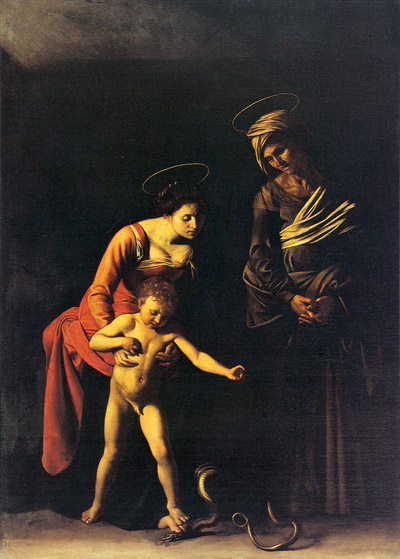
[This is a painting by Michelangelo Merisi da Caravaggio. It shows Christ crushing a serpent beneath his heel, as His mother, Mary, sits behind him. The woman on the right portrays Anna, the name in Christian legend given to Mary's mother, about whom there is no Biblical or other evidence at all.]

Sad Day for Ohio State Football

Finishing lunch, during which I watched the press conference with Ohio State athletic director Gene Smith and head football coach Jim Tressel. Five Ohio State players have been suspended from playing the first five games of next season by the NCAA. Smith indicated that Ohio State will appeal the penalties. (Another player has been suspended for one game of the 2011 season.)

As an Ohio State alum and fan, I hope that Smith will reconsider that move. The rules are clear: Players are not to exchange goods of any kind, including awards for athletic achievement, team garb, or signed memorabilia, for goods, services, or money. They're to be amateur athletes until, if they're good enough, the NFL drafts them or they're signed to play professional football elsewhere.

The suspensions meted out by the NCAA are light penalties, considering that such egregious violations could be seen as warranting revocations of the players' athletic scholarships.

One of the notions I've nurtured is that, with his emphasis on character development in his players, Jim Tressel is unique among big-time college coaches. I still think that's true, although like the rest of we members of the human race, he isn't perfect. And he certainly can't be expected to know what happens every moment of every day in the lives of his players.

But an appeal of the charitable penalties meted out by the NCAA runs counter to the tone I think Tressel has always worked to foster in the Buckeye football program.

I hope that Ohio State will refuse to compound the sadness of this day by appealing. I would expect such a move by USC, Auburn, and other schools, but not by Ohio State.

Having said all of that, I hope that these players will learn a lesson and be stronger, better people for the experience. (That's my daily project as I cope with the realities of my own sins and deficiencies. God help us all! And I mean that literally.)

Tuesday, December 21, 2010

Two Digital Age Re-Tellings of the Christmas Story

Fun!

A Social Network Christmas (Thanks to Barb)


The Digital Story of the Nativity (Thanks to Lori)

"Christmas...hints at the struggle involved when the Lord of both worlds descends to live by the rules of the one."

"What Jesus went on to accomplish on planet Earth made it possible for God someday to resolve all disharmonies in both worlds." Read the whole thing.

Monday, December 20, 2010

The "Shiver of Fear" That Should Come With the Glad Tidings

“We have become so accustomed to the idea of divine love and of God’s coming at Christmas that we no longer feel the shiver of fear that God’s coming should arouse in us. We are indifferent to the message, taking only the pleasant and agreeable out of it and forgetting the serious aspect, that the God of the world draws near to the people of our little earth and lays claim to us. The coming of God is truly not only glad tidings, but first of all frightening news for everyone who has a conscience.” (Dietrich Bonhoeffer, Lutheran Christian pastor martyred for his opposition to the Third Reich in Germany)

Wednesday, December 15, 2010

A Tough, But Liberating Word

Today's installment of Our Daily Bread is based on James 4:1-10:
Those conflicts and disputes among you, where do they come from? Do they not come from your cravings that are at war within you? You want something and do not have it; so you commit murder. And you covet something and cannot obtain it; so you engage in disputes and conflicts. You do not have, because you do not ask. You ask and do not receive, because you ask wrongly, in order to spend what you get on your pleasures. Adulterers! Do you not know that friendship with the world is enmity with God? Therefore whoever wishes to be a friend of the world becomes an enemy of God. Or do you suppose that it is for nothing that the scripture says,
 “God yearns jealously for the spirit that he has made to dwell in us”?
But he gives all the more grace; therefore it says, “God opposes the proud, but gives grace to the humble.” Submit yourselves therefore to God. Resist the devil, and he will flee from you. Draw near to God, and he will draw near to you. Cleanse your hands, you sinners, and purify your hearts, you double-minded. Lament and mourn and weep. Let your laughter be turned into mourning and your joy into dejection. Humble yourselves before the Lord, and he will exalt you.   
"Adulterers," I take to be addressed not only to those engaged in adultery, but in all activities that put the world, the self, and other pursuits or relationships ahead of God. Through the prophets in Old Testament times, God described Himself as husband to Israel, condemning His people's penchant for playing the adulteress by worshiping other gods.

The New Testament describes the Church as the bride of Christ. So, any time we Christians allow other things to take God's place of absolute ruler over our lives, we are engaging in idolatry--idol worship, or as the Old Testament puts it, adultery.

The passage from James ends with a tremendous promise: "Humble yourselves before the Lord, and he will exalt you." This is nothing other than a call to wake up and acknowledge reality:
  • God is bigger than you are. 
  • Only God can give you life. 
  • And unlike all the other things you might submit to in life, God will help you and love you even when you fall or fail. 
In Philippians 2:5-11, the apostle Paul gets at much the same message when he cites what most scholars agree must have been a hymn of the early church that reminds us that in calling us to submit to the will of God the Father, we're not being asked to do anything more than Christ did.

God "opposes the proud," not because God is an egotist, but because God wants us to live. As I mentioned in another post recently, if the only way for a drowning man to get to shore is to hold onto the lifeguard, you would hardly call the lifeguard arrogant for saying so to the thrashing victim. The God we know in Jesus Christ is that lifeguard. Take it from one willful thrasher to another: Submit to the Lifeguard and you will have real life!

Read the Our Daily Bread piece by Anne Cetas.

Tuesday, December 14, 2010

The Differences and Similarities Between the US of the Great Depression and the US of the Great Recession

In 1936-37, Americans were in more dire straits financially and for a longer period than Americans of 2008 to present, but they were also more optimistic about the future and, generally, supportive of more federal government intervention in the economy, not less. Both the similarities and differences in Americans' views of government and the economy, as shown in this article from the Pew Research Center, are interesting.

Monday, December 13, 2010

The Perfect Old Testament Book to Read in Advent

My son, Philip, on his blog, is doing a series of devotional comments on the Old Testament book of Isaiah for this Advent season. Here are links to the first three installments:
Reading Isaiah in Advent: An Introduction
Isaiah 1-3
Isaiah 4-6

Three Simple Equations

No time spent with Jesus=A no-impact life
Some time spent with Jesus=A moderate-impact life
Much time spent with Jesus=Greater impact life

What impact do we want our lives to have on others and on eternity?

See here.

See also here.

Sunday, December 12, 2010

When God Doesn't Meet Our Expectations

[This was shared during worship with the people of Saint Matthew Lutheran Church in Logan, Ohio, this morning.]

Matthew 11:2-11
If this morning’s Gospel lesson has given you a bad case of spiritual whiplash, it’s understandable.

Last week, on the Second Sunday of Advent, we heard John the Baptist’s confident proclamation of the impending appearance of God’s promised Anointed King—what the Hebrew of the Old Testament calls the Messiah and the Greek of the New Testament calls the Christ. In the coming Christ, John told the crowds who heard him preach in the wilderness, God was getting ready to re-establish His reign over a sinful, rebellious world.

When Jesus later showed up to be baptized by John, in a passage not a part of last Sunday’s lesson, John must have felt that all his preaching had been vindicated. Jesus was the Messiah for whom he had been waiting!

When we fast forward to the Gospel lesson for this Third Sunday of Advent, we come to a very different scene.

Now, if John was like most of the Jews of his day, his expectations would have been that the Messiah, the King of kings, was going to push the bloodthirsty, corrupt Judean kings—the Herodian line—off of their thrones, would save the people from their foreign overlords, the Romans, and would take away the power and prominence the vain and faithless rulers of Judea’s religious life—the priests and teachers of the law. John probably expected a clean sweep of what we would call church and state. And the Messiah, he undoubtedly thought, would make everything in society right.

Instead, since John's encounter with Jesus at the Jordan River, Jesus had undertaken a ministry of preaching, teaching, healing, and miracle working. Great stuff, but not exactly what John had expected! Herod, the Romans, the Sadducees, and the Pharisees were still in charge and, as we meet up with John the Baptist today, he’s in prison, wrestling with disappointment and doubt. With a probable death sentence hanging over him and with the reign of God—the kingdom of God—seeming no nearer than it had been when he first began his ministry, John sent some of his disciples to ask Jesus, “Are you the One Who is to come, or are we to wait for another?”

John wanted to hope in Jesus, but this King in Whom he had reposed so much hope didn’t seem to be meeting John’s expectations. John wondered, “Is Jesus the Savior?”

Have you ever been there?

Have the promises of Jesus to hear and answer your prayers sometimes mocked your faith?

Have your life circumstances cast your faith in a sovereign, loving God in doubt?

Have questions pressed on you as you’ve watched loved ones suffer or die, or you’ve struggled with health issues, financial issues, or when your sense of purpose in life has disappeared?

Have you played by God’s rules and watched people who ignore them seem to skate through life as you face troubles and difficulties?

The truth, if we’re honest I think, is that we have all been there in the prison of doubt and uncertainty John experienced in that prison cell.

And so, John did what millions of people have done through the centuries when wrestling with their questions and doubts. He turned to Jesus. He asked Jesus, in effect, “Are You the One in Whom I can place the full measure of my trust and hope? Or do I need to look elsewhere for hope?” (People do that, you know. God disappoints them or turns out to be different from what they expect and they turn from God, never to return. They turn to false gospels that promise them wealth or health or a free pass to perpetrate their favorite sins with the full favor of God.)

Jesus’ response to John’s question in today’s Gospel lesson is not just for John the Baptist, it’s for all of us who have ever doubted, who have wrestled to understand God’s plans in the midst of unbearable pain or indecipherable situations.

Please pull out the Celebrate insert and look at Matthew 11, verses 4 to 6, to see what Jesus said:
Go and tell John what you hear and see: the blind receive their sight, the lame walk, the lepers are cleansed, the deaf hear, the dead are raised, and the poor have good news brought to them. And blessed is anyone who takes no offense at me. 
Jesus didn’t deny that He was the King Who would bring judgment on the unbelieving world. And He would confirm His role as judge of the world many times. In answer to John’s question though, Jesus simply pointed John to all the signs that showed Him to be not just the Messiah, but the Lord of all creation, Who can speak a word and create life where there was death, wholeness where there was brokenness.

To John’s doubt and disappointment, Jesus says, “Consider the evidence. I’m doing the things that God told the prophets He would do when His kingdom came into this fallen world.”

There’s another message in Jesus’ words, though. It’s this: Change your expectations of the Messiah. Change your expectations of God.

I’m not for a moment suggesting that there is any limit to God’s power or to God’s willingness to hear prayers offered in Jesus’ Name. In Jesus, we meet the sovereign, almighty God of the universe Who made us, Who can violate the natural laws He Himself created by performing miracles (and does), Who is committed to bringing injustice to an end, Who will allow those who refuse to trust in Him to go their own ways for eternity, and Who, by His cross and resurrection, has destroyed the power of sin and death for all eternity for those who believe in Christ!

Everything that Jesus did, including His sinless life, His sacrificial death, and His rising from the dead, show us Who Jesus is and the good plans God has for those who repent and believe in Jesus.

But Jesus’ kingdom hasn’t come in its fullness yet.

Right now, you and l live in a world in which bad things happen to faithful people. It can cause us to question, just as it did John the Baptist.

The week before she died, Karen, a member of our former parish and a friend of Ann’s and mine, wrestling with her suffering, holding onto Jesus in the midst of it all, confided to me, “I keep wondering what it is God wants me to learn from all of this.” Though deeply faithful—I would say because she was so faithful, because she so believed in Jesus—Karen wondered, as John the Baptist had wondered, when Jesus was going to act decisively. When would God finally act to bring about the promise given by God through the prophet Isaiah and repeated in the New Testament book of Revelation: “He will wipe away every tear from their eyes. Death will be no more; mourning and crying and pain will be no more…”?

That promise will come to pass. The God Who has never broken a promise will make it happen. The God Who was born in a stable, lived among us, died for us, and rose to give us life can be counted on to make things right.

Until then, He gives us, He gives the Church, and He gives the world this current life in which, as Jesus says, God “makes his sun rise on the evil and on the good, and sends rain on the righteous and on the unrighteous.”

This life, with all its troubles, is God’s gift to us. But we know that God gives new life. So, why doesn’t God set things perfectly, totally, completely right for us now? Please turn to page 707 in the Bibles that are in the pew racks. There, you’ll find Second Peter, chapter 3, verse 9. Read that verse aloud with me, if you would,
The Lord is not slack concerning His promise, as some count slackness, but is longsuffering toward us, not willing that any should perish but that all should come to repentance. 
Every day we live in this world is an opportunity to do exactly what Jesus invited John to do: To look to Jesus; to see what He has done and understand the compassionate, powerful God Who has done incredible things for His people…Who is still doing them.

If we’re inclined to see Jesus as a hedge against the nasty realities of life, a cosmic Santa Claus who makes life just go away, we need to change our expectations. As was true for Jesus, before our resurrections, there will be challenges to face, hurdles to overcome, crosses to bear.

But God doesn’t let us have pain, hardship, or uncertainty because God is slow in acting or because God lacks the power to act. God is giving us the gift of time:
  • Time for us to repent and surrender to Him; 
  • Time for us to share the good news of the baby born in a manger who went to a cross and rose from the dead for all sinners; 
  • Time for us to serve others in Jesus’ Name; 
  • Time for us to grow as believers who are fit for eternity with God
Today, Jesus invites you and me to seize the days we have, one by one, and to live this life fully: to turn from sin, to live for Jesus, and, just like Jesus, to spread His love by what we do and who we are. And when, like John the Baptist, we wrestle with our questions, Jesus calls us to focus our hopes on Him, and not anyone or anything else.

Ann’s and my friend, Karen, who I mentioned earlier and of whom I’ve spoken before, left a note for me to read after her death. (She had written notes for many people to read after she died.) She said, in part, “Please help everyone to know that just because I have died doesn’t mean that their prayers did not ‘work.’ Healing is so much more than having a whole and perfect body…I’ll be seeing you again—then we can forget all of this sadness…”

While we await the return of the Messiah Who came to our world on the first Christmas, we can live in this uncertain and sometimes sad world with the absolute certainty that Jesus will make all His promises good for all who trust in Him. When we let that certainty fill us, we can face everything with joy and peace, the very blessings of which the angels sang on the night of Jesus’ birth.

May we join their song every day we live and on into eternity with God! Amen
*************************************************************************************
Here's a video featuring the incomparable Carolyn Arends, singing her song, 'Seize the Day.' Arends' music was important to Karen, the woman mentioned in the sermon. We played Arends' song, 'All is Well,' during Karen's funeral in 1999.

Saturday, December 11, 2010

Just This One Time in My Life

I'll say something I never thought I would say: Go, Blue! A great story from the school up north and the courageous journey of a young man from Wauseon, Ohio, just a few miles from where my family and I lived for six years. You will not regret watching this feature from the Big Ten Network.


You may also want to read this. (Go, Buckeyes, too!)

By the way, did you notice the passage of Scripture on the back of one of Brock's t-shirts?

Friday, December 10, 2010

"God is Love"

"God is love." God revealed this central truth about Himself in both Old and New Testament times. It's why 1 John 4:8 says, "Whoever does not love does not know God, for God is love."

So, would a loving God ever describe His human children with names like wicked, fools, or stupid?

As Dave Branon points out in this piece, the loving God of the universe Who ultimately disclosed Himself in the crucified and risen Jesus, has used these names for some people.

I hope that you'll read Branon's piece, especially if your notions about what the Bible means in saying that "God is love," has created a false image of God as an indulgent grandparent who doesn't care how we defile ourselves, hurt others, or dishonor Him.

Take it from someone who has done lots of wicked, stupid, and foolish things, for which God still calls me out each day, if God didn't love you, He wouldn't call you out for sins or willful ignorance of His will.

It's when God calls us out and we dare to hear what His Word tells us about His will for human beings, that we can exercise the gift of repentance and experience a fuller relationship with Christ.

Two other passages of Scripture come to mind as I think about the tough and tender love of God that loves you just as you are, but loves you too much to leave you there.

One comes from King David, the adulterer and murderer who the Bible describes as a "man after God's own heart." David knew all about having his deeds exposed for being wicked, foolish, and stupid. Remember that David had an affair with another man's wife and then arranged to have that man murdered. For two years, David went on merrily with his life before being confronted for his sins by the prophet Nathan. David repented. Psalm 51 is his song of repentance. But, here's something he wrote for the benefit of his fellow sinners who may be less than inclined to accept God's judgment of them for wickedness, foolishness, or stupidity:
Do not be like a horse or mule, without understanding, whose temper must be curbed with bit and bridle, else it will not stay near you.
And then there are these words, from the same New Testament book which reminds us that, "God is love." (Some of what's said in 1 John 1:8-10, will be familiar to most Lutherans, who hear words drawn from this section of Scripture regularly in our liturgy):
If we say we have no sin, we deceive ourselves and the truth is not in us. If we confess our sins, he who is faithful and just will forgive us our sins and cleanse us from all unrighteousness. If we say we have not sinned, we make him a liar, and his word is not in us.
God's enduring will for the human race is laid out clearly for us in what scholars call the Mosaic Law, the Ten Commandments, here. Unlike Old Testament ritual and civil laws, the Ten Commandments are valid for all time.

They're well interpreted for us in 1 Timothy 1:8-10.

It's wicked, foolish, and stupid for us to willfully flout the law of God because doing so separates us from Him and His desire to be with us forever.

But when we confess our sins--when we acknowledge that God is right in calling us out for our sin--and seek and accept the forgiveness God freely offers in Jesus Christ, God not only forgives us, God also gives us the power of the Holy Spirit to resist our inborn inclinations to sin.

God is love!

Wednesday, December 08, 2010

That's Why Luther Said Christians Are Saints and Sinners at the Same Time

"In every saint there is something reprehensible." (John Calvin)

Thank God that sinners are saved not by what they do, because we could never do enough to merit forgiveness or new life from God. We're saved only by what God has done for us in Christ and our God-created trust in Christ.

Iranian Pastor Sentenced to Death

The charge, apostasy, is not even a crime under the Iranian penal code. Pray that he will be set free.

For more information, go to the story of Pastor Nadarkhani on the site of the International Campaign for Human Rights in Iran.

Go here to contact the Iranian delegation to the United Nations in order to ask the Iranian government to encourage confidence in Iranian justice by releasing a man sentenced to death for something that isn't even illegal in Iran.

Concepcion Fails to Get Elected to Baseball Hall of Fame by Veterans Committee

Story here.

This guy, while also giving the reasons why Concepcion should not be a Hall of Famer, presents the most convincing arguments in Concepcion's favor that you'll find:
He was part of the best infield of all-time and one of the best Shortstops of all-time. The guy was money in the playoffs, batting a career .297, batting over .300 in 4 of his 9 series. Let’s look at his career numbers. 2326 hits (good enough for #130 on the all-time list). While that may not look so impressive, here’s some players he has more hits than: Jim Bottomley, Eddie Mathews, Bobby Wallace, Kirby Puckett, Kiki Culyer, Joe Cronin, Mike Schmidt, Willie Stargell, Joe DiMaggio and Willie McCovey. These aren’t cupcake, shrub-type names. These are ALL Hall-of-Famers, and some are recognizable household names. He has more hits than Joe DiMaggio, one of the most iconic figures in baseball history. When you compare him to similar players, www.baseball-reference.com lists Bobby Wallace, Pee Wee Reese & Luis Aparicio (all Hall-of-Famers), Alan Trammell (still on the ballot and should be a Hall-of-Famer), Edgar Renteria (a man who definitely has a case) & Tony Fernandez (one of the best Shortstops of his era).

9 All-Star Games. That is something only 92 people have ever achieved. He started 5. That’s one of 87. So who else has 9 appearances? Albert Pujols, Bobby Doerr, Don Drysdale, Joe Gordon, Jimmie Foxx, Bob Gibson & Goose Gossage. 5 starts? Roy Campanella, Lou Gehrig, Chipper Jones & Jackie freakin’ Robinson. (All those are Hall-of-Famers or sure future Hall-of-Famers.)

5 Gold Gloves at Shortstop. Only 68 people have won 5 or more Gold Gloves at the same position. People with more Gold Gloves than Concepcion at Short? Ozzie Smith (Hall-of-Famer), Omar Vizquel (hopefully future Hall-of-Famer), Luis Aparicio (Hall-of-Famer), Mark Belanger (offense not really strong enough to make the Hall-of-Fame) & Derek Jeter (future Hall-of-Famer).

And what does it say that a guy played in 2488 games, good enough for #54 on the All-Time list? What about 8723 At Bats (good enough for #85)? A guy showing up and doing his job? A guy like that screams Hall-of-Fame to me.
While it's not a no-brainer decision, I believe that Concepcion, who taught a generation of shortstops how to play their position on artificial turf and was certainly the best shortstop in the 1970s with the greatest National League team of all time, deserves to be in the Baseball Hall of Fame. 


Here are Concepcion's lifetime stats.

God Delays for Our Benefit

"If God delays the punishment of sinners, waiting for them to repent, it is not because his character has changed, so that now he loves sin. Rather he is giving them time to repent." (Cyril of Alexandria, 375-444)*

This quote is included in a wonderful book that I'm using both for my devotions and my weekly sermon prep.


*"The Lord is not slow about his promise, as some think of slowness, but is patient with you, not wanting any to perish, but all to come to repentance" (2 Peter 3:9)

Chuckle...Wince!

If you're like me, this short piece from Pastor Deb Grant will make you chuckle...then wince...in self-recognition.


Religious Leaders Affirm Marriage as "permanent...faithful union of one man and one woman"

Christian leaders, including the Bishop of the newly-formed North American Lutheran Church, the president of the Lutheran Church-Missouri Synod, and leaders of Roman Catholics, Orthodox and Anglican Christians, as well as of evangelical church bodies, have affirmed marriage as "the permanent and faithful union of one man and one woman."


There are also signatories from Mormonism, Judaism, and the Sikhs.


Here's the complete text of the letter, followed by a list of its signatories:

Dear Friends,

Marriage is the permanent and faithful union of one man and one woman. As such, marriage is the natural basis of the family. Marriage is an institution fundamental to the well-being of all of society, not just religious communities.

As religious leaders across different faith communities, we join together and affirm our shared commitment to promote and protect marriage as the union of one man and one woman. We honor the unique love between husbands and wives; the indispensible place of fathers and mothers; and the corresponding rights and dignity of all children.

Marriage thus defined is a great good in itself, and it also serves the good of others and society in innumerable ways. The preservation of the unique meaning of marriage is not a special or limited interest but serves the good of all. Therefore, we invite and encourage all people, both within and beyond our faith communities, to stand with us in promoting and protecting marriage as the union of one man and one woman.

Sincerely yours,

Leith Anderson
President
National Association of Evangelicals

Dr. Thomas E. Armiger
Dr. Jo Anne Lyon
Dr. Jerry G. Pence
The Board of General Superintendents
The Wesleyan Church

Dr. Gary M. Benedict
President
The Christian and Missionary Alliance

Glenn C. Burris Jr.
President
The Foursquare Church

Bishop H. David Burton
Presiding Bishop
The Church of Jesus Christ of Latter-day Saints

Dr. Ronald W. Carpenter, Sr.
Presiding Bishop
International Pentecostal Holiness Church Ministries

Nathan Diament
Director, Institute for Public Affairs
Union of Orthodox Jewish Congregations of America

Most Rev. Timothy M. Dolan
Archbishop of New York
President
United States Conference of Catholic Bishops


The Most Rev. Robert Duncan
Archbishop, Anglican Church in North America
Bishop, Anglican Diocese of Pittsburgh

Rev. Jim Eschenbrenner
Executive Pastor
Christian Union

Rev. Dr. Stephen A. Gammon
Conference Minister
Conservative Congregational Conference

Rev. Matthew C. Harrison
President
The Lutheran Church – Missouri Synod

John Hopler
Director
Great Commission Churches

Dr. Clyde M. Hughes
Bishop
International Pentecostal Church of Christ

Ken Hunn
Executive Director
The Brethren Church

Bishop Harry Jackson
Senior Pastor, Hope Christian Church
Bishop, Fellowship of International Churches

The Most Blessed Jonah
Archbishop of Washington
Metropolitan of All America and Canada
Orthodox Church in America


Dr. Richard Land
President
Southern Baptist Ethics & Religious Liberty Commission

Rev. Frederick J. Moury Jr.
National Conference Chair
Evangelical Congregational Church

Dr. James Murray
Interim Executive Director
General Association of General Baptists

Rev. Samuel Rodriguez
President
National Hispanic Christian Leadership Conference

Manmohan Singh
Secretary General
World Sikh Council – America Region

The Rev. Paull E. Spring
Bishop
North American Lutheran Church

Dr. Joseph Tkach
President
Grace Communion International

Rev. Phil Whipple
Bishop
Church of the United Brethren in Christ, USA

Dr. George O. Wood
General Superintendent
Assemblies of God

Tuesday, December 07, 2010

Facing Life's Uncertainties (Inspired by Wilma, Who Knew How)

[This morning, the funeral and graveside committal services for a member of our Saint Matthew family, Wilma, took place. Wilma was 92 and except for the final two months of her life, was in great physical health. She had some memory loss, but beyond that remained remarkably healthy. 
[The funeral service today had three purposes: to celebrate Wilma's life, to commit her to the hands of God, and most importantly, to proclaim the hope that all who turn from sin and death and turn to Jesus Christ are assured of life forever with God, the good news.]

The Message
This morning, I want to share a few thoughts with you based on what may seem like a strange Biblical text for Wilma’s funeral. But somehow, it seems appropriate to me. It’s Luke 12:16-21, which is Jesus’ famous parable of the rich young fool.
[Jesus says:] “The land of a rich man produced abundantly. And he thought to himself, ‘What should I do, for I have no place to store my crops?’ Then he said, ‘I will do this: I will pull down my barns and build larger ones, and there I will store all my grain and my goods. And I will say to my soul, ‘Soul, you have ample goods laid up for many years; relax, eat, drink, be merry.’ But God said to him, ‘You fool! This very night your life is being demanded of you. And the things you have prepared, whose will they be?’ So it is with those who store up treasures for themselves but are not rich toward God.”
Except for the past few months, when first, I had some health issues and then, Wilma became ill, I visited with Wilma every month in the past three years.

It took Wilma about a year for her to remember me from visit to visit. Once, she called the church office to say that the appointed time I was to be at her house conflicted with a doctor’s appointment and in talking with my secretary, she referred to me as “that guy.”

A couple of times, though she habitually wrote everything on her calendar, she was caught unaware when I arrived, sitting in her stocking feet, reading, and apologetic for her lack of preparation when I showed up to once more bring her Holy Communion.

Over time, she came to remember me and in fact, on one of our last visits, I was surprised and touched when she threw her arms around me to hug me.

I came to know Wilma as warm and friendly, with a great sense of humor. As I told my wife when I learned of Wilma’s passing, “I really liked her and I always looked forward to our appointments.”

I didn’t know Wilma when she was younger. But like anyone who knew her as an older person, in any given visit, I might have heard the same stories and comments about family and life experiences several times: about her two sons and where they lived; about her extended family in Elyria; about her growing up; about her niece Eloise, who looked after her and provided her with plenty to read; about the difficulty she had in finding people to mow her lawn; about planting her flower beds in the spring and cleaning them out in the fall; about her need to write everything down, including when to take her medicines.

Wilma, in fact, struck me as a disciplined person. I got the impression that even before her memory loss necessitated her taking extra care to keep her life organized, she was always organized. The neatness of her house and its lack of unnecessary furnishings and goo-gobs that most of us acquire in our lifetimes were testimony to this.

But something else struck me about her self-discipline. In Jesus’ parable of the rich young fool, a man thinks that if he disciplines his use of time and saves his money, he will get to a point when he’ll be in control, he will have conquered the world, and he can simply sit back and relax. In a way, this young man deludes himself into believing that he can be his own little god, self-sufficient and invulnerable. No obligations or responsibilities to anyone but himself. We have a term for people like this today: We call them control freaks.

Wilma was no control freak. She laboriously worked out her daily schedule because she didn’t want to be a burden to anyone!

“When I get to where I can’t take care of myself anymore, I’ll go to the Care Center,” she told me many times. And in the hospital little more than a month ago, she said, “I always said when I couldn’t take care of myself, I would go to the Care Center. They might as well send me there now.”

Wilma could be determined when she needed to be; she often talked about how she learned to drive after being widowed. But Wilma was also a realist. Though her willingness to go to the Care Center no doubt had something to do with losing one of her sons, Bob, exactly three months before she suffered a stroke, she also understood, unlike the rich young fool in Jesus’ parable, that we are not in control. We are vulnerable. Life does hit us with unexpected setbacks, even tragedies.

But that doesn’t mean that you stop living! Instead, like Wilma, you live the life that you have been given. You exercise appropriate self-discipline. You take care of the gifts God gives you—whether it’s your health or your house. You live in appreciation for the gifts of brothers and sisters, children, grandchildren, nieces, nephews, and extended family.

Rare people like Wilma, are ones who, I think, can only be described as ordinary people who, in quiet, unassuming ways, lead extraordinary lives.

That’s because Wilma had something that the rich young fool in Jesus’ parable didn’t have. I don’t mean to paint her as some stained glass saint. You all will know her faults more than I do. (Of course, we all have faults and if anyone thinks they don’t, that’s a big fault in itself!) But I got to know Wilma when life—and the God Who lovingly disciplines His children—had worn off her edges. Adversity has a way of showing the real person beneath the veneer. The masks come off the more vulnerable life renders us. And this is what I saw in Wilma: a person of humble faith in Jesus Christ.

She wasn’t the type to go around advertising her faith. (She wasn’t the type to go around advertising anything, as I experienced her.) But she was always anxious to receive the Body and Blood of our Lord, always anxious to join in with the Order for Confession and Forgiveness, every word of which she knew by heart and recited with me during our visits. In the sense of vulnerability that I know Wilma felt each day, in spite of the physical vigor she enjoyed until the very end, she knew that she needed the God revealed to all in the crucified and risen Jesus Christ. Not barns or baubles, just Jesus. She needed Jesus.

And so do you.

Wilma lived a long life. I think of one her life’s lessons is simple: There is nothing to a life like that of the rich young fool. Nothing in this world lasts. But there is everything to a life lived with Jesus Christ, Who has conquered sin and death and gives eternity with God to all who turn from their sin and entrust their lives to Him.

When you know Jesus Christ, you can face this life with all its uncertainties and unfair twists, you can look forward to the future Christ has secured for all who believe in Him, and you can do it all with a smile on your face, with hope in your heart, and with peace.

May you make knowing Jesus Christ the number one priority of your life so that the blessings of being part of Christ’s new creation can be yours here in this imperfect world and in the perfect world awaiting all who follow Jesus Christ. God bless you.
***********************************************************************************
The other Biblical texts shared at Wilma's funeral were: Proverbs 20:29; Isaiah 46:4; and John 11:17-27.
***********************************************************************************
This bit of doggerel, found among Wilma's papers, was read. The fact that she cut it out and kept it shows something of the humor and humility with which she approached life and fit in well with the Proverbs and Isaiah texts above, which in turn, remember the wisdom God grants to those with gray hair, who are attentive to life's lessons, and recall that God promises to save us even in our old age. The author is the ubiquitous, "Anonymous":
Thought I'd let my doctor check 'cause I didn't feel quite right,
All those aches and pains annoyed me, and I couldn't sleep at night.
He could find no real disorder, but he wouldn't let it rest,
What with Medicare and Blue Cross, it couldn't hurt to do some tests.
To the hospital he sent me, though I didn't feel that bad.
He arranged for them to give me every test that could be had.
I was flouroscoped and cystoscoped, my aging frame displayed,
Stripped upon an ice-cold table, while my gizzards were x-rayed.
I was checked for worms and parasites, for fungus and the crud,
While they pierced me with long needles, taking samples of my blood.
Doctors came to check me over, probed, and pushed, and poked around,
And to make sure that I was living, they wired me up for sound.
They have finally concluded (their results have filled a page),
What I have will some day kill me: My affliction is OLD AGE!
That's essentially what took Wilma's life in the end, old age, and we were blessed to have had her with us. As one of the prayers in our funeral liturgy puts it:
O God of grace and glory, we remember before You today, Wilma. We thank You for giving her to us to know and to love as a companion in our pilgrimage on earth. In Your boundless compassion, console those who mourn. Give them Your aid so that they may see in death the gate to eternal life, that they may continue in their course on earth in confidence until, by Your call, they are reunited with all who have gone before us trusting in Christ as God and Savior; through Your Son Jesus Christ our Lord. Amen

Who God Can Use...Not Only Who We Think

From R.T. Kendall's God Gives Second Chances, R.T. Kendall writes:
The best antidote I know for conquering a lust for power is to embrace the implications of John 5:44: "How can you believe if you accept the praise from one another, yet make no effort to obtain the praise that comes from the only God?"...

The problem is that we suppose that our ambition to succeed is a love for God. Because we believe the Bible and the basic truths of the Christian faith, we tell ourselves that our quest for more influence is for God's gory. This is how we deceive ourselves. We justify our drive to be more successful by saying we can "reach more people," "save more souls," "get our message to the world." Such rationales are nothing but a camouflage for the foolish ego trip we are on...

...making an effort to obtain the praise of God means seeking the lower seat (Luke 14:7-11), refusing to vindicate ourselves, choosing total forgivenes, and the sheer waiting on God's timing. In a word, it is the way of the cross, the life of self-denial, and the participation of the sufferings of Christ... 
I don't always agree with R.T. Kendall. I have major issues with the neo-Pentecostal or Chrismatic movement of which he is a part. I take issue with some of the things Kendall writes in this book.

But the observation above is, I believe, right on target! God does give second chances to those who learn to subordinate their egos and themselves to Christ and the Word of God. I've seen it countless times in the Bible, in Christian history, and people I've known. Repent for sin and surrender to Christ and I am sure that "by the power [the power of the Holy Spirit Who comes to every believer in Christ] at work within us is able to accomplish abundantly far more than all we can ask or imagine" (Ephesians 3:20).

But God can only do great and eternally lasting things in the lives of those who don't care how many great things the world may say about them. Their only concern is for what says about them. Today--and for a long time to come, I'll be asking God to help me ignore the approval of others and seek approval only from God!

Monday, December 06, 2010

The Right Way

Great thoughts from Pastor Deb Grant:
By following Christ, we are given a way to walk that protects us from our own wandering ways, nourishes us consistently and still gives us the freedom to move at our own pace. 
Read the whole thing. (It's not long!)

What Suffering Can Do for Us

"Your suffering doesn't make you clean before God. Yet it drives you to reach for God's Word and hold onto it more tightly and firmly. This is how God exercises your faith." (Martin Luther)

"Pray and Speak Up for Iraqi Christians"

That's the title of this post from John H. Armstrong.

It contains this observation by Joseph Kassab of the Chaldean Federation of America:
Iraqi Christians are being systematically murdered and driven from their homeland. This situation must, repeat must, be addressed by an international security coalition with members from Iraq, the U.S. and the U.N.
Please read John's entire blog post. Then, please pray for the safety of Iraqi Christians. Please also write to the White House and the State Department asking our government to press our Iraqi allies to put a stop to the persecution of Christians in their country.

That's it, three quick and simple action steps:

Sunday, December 05, 2010

Repentance: Orienting Our Lives to Christ

[This was shared during worship with the people of Saint Matthew Lutheran Church in Logan, Ohio.]

Matthew 3:1-12
As a seven year old who usually found worship less than exciting, young Jim Cymbala nonetheless found himself impressed by a preacher named Howard Goss. As Cymbala explains it, Goss, unlike many of the preachers who came to the Pentecostal church of his childhood, “didn’t rant and rave to make a point. Nor did he use emotional gimmicks as he delivered the Word of God. He simply explained the truths of Scripture in an easy, conversational tone.” Yet, something about Goss’ personal faith impressed the seven-year old Cymbala far more than anything Goss said.

Years later, himself by now a Pentecostal pastor, Cymbala met the son of Howard Goss. The younger man remembered “a big camp meeting” held in Canada when he was a kid. Every prominent preacher of their tradition was there and the event attracted huge numbers of people to the morning, afternoon, and evening preaching services.

As Goss’ son recollected, all the preachers jockeyed to be picked to preach at the evening events, when the crowds were bigger and the prestige greater. “Suddenly,” Howard Goss’ son remembered, “one of the leaders asked where my father was. He was…highly respected by everyone. They wanted to consult him [about the preaching schedule]…They finally heard that he was last seen in the kitchen and dining hall area, so [the son recalled] I went with them to find him. They could scarcely believe their eyes when they got to the kitchen. There was my dad on his hands and knees scrubbing the floor with some of the…workers!”

When told that the prominent preachers wanted to know what his preferences were on the preaching schedule, Goss demurred. “You don’t need to worry about me,” he told them, “But I found out that they’re short of help here in the kitchen so I thought I’d lend a hand.”

Here was a man, the direction of whose life was altogether different from what we see in the lives of most people in the world…maybe even in the Church. Most people allow the directions of their lives to be dictated by the sinful orientations with which each of us is born. As we cave in to these sinful orientations or impulses, we wander farther and farther from God, like the lost sheep that wander from the shepherd in Jesus’ famous parable. In these Advent and Christmas seasons, we remember that God has acted as a good shepherd seeking those who have wandered from Him and Who, through His death and resurrection, has done everything necessary to bring us back under the gracious rule of God, where we can experience life forever with God.

But, as I’ve said before, God does not force His eternal kingdom on anyone! Nor can it be earned by acts of religious piety. Nor can it be claimed simply because we were raised in the church, or held high offices—whether as clergy or laypeople—in the church, or because we were nice, polite people, or because we were in worship every single week. The people who enter God’s kingdom are like Howard Goss: They turn from the sin to which they are naturally oriented and they turn in faith to the God Who came into the world on the first Christmas in Jesus Christ!

Of course, when Jesus was born, few in the world took notice of it. He lived in obscurity until God the Father signaled that it was the right time for Him to begin a ministry that would culminate in His crucifixion and resurrection. Matthew 3:1-12. our Gospel lesson for today, the Second Sunday of Advent, finds John the Baptizer preparing the people of Judea and the world for the disclosure of the long-awaited Messiah. Today, John’s words can prepare us for the return of that Messiah, the crucified and risen Jesus, Who, at a time known only by God the Father, will come back to this world to fully establish His eternal kingdom. John was telling His original hearers and you and me to get ready to meet Jesus.


But how do we get ready? John says—in words similar to those Jesus Himself would later deliver in His own sermons: “Repent, for the kingdom of heaven has come near!” Turn from your sinful orientations and turn to God so that God transforms you from an enemy of God to a friend of God, John is saying.

It’s interesting, too, that the word, “Repent” in the original Greek of Matthew’s Gospel is in the present tense, meaning that repentance isn’t a one-and-done phenomenon. Repentance, constant reorientation to the rule and will of God, is to be part of the daily life style of a Jesus-Follower. This is no doubt why Martin Luther, who taught clearly that we cannot earn our salvation by obeying God’s commandments, nonetheless began The Small Catechism with a discussion of the Ten Commandments. Every grateful follower of Jesus will want to turn each day to God, asking God to show them where they have disobeyed God, so that they don’t, slowly and ignorantly, wander away from the gifts of God’s grace and salvation.

To repent then, is much more than to be sorry for one’s sins. In fact, it’s possible to feel sorry for a sin and not be repentant. Years ago, I met a woman in a nursing home. She was then in her eighties. But she had done something wrong when she was seventeen for which she still felt life-crushing shame. She refused to receive Holy Communion when it was offered to her because she was sure that God could not and would not forgive her. She acknowledged her guilt, but she would not reorient her life to the loving Lordship of Jesus over her life. She would not accept God's offer of forgiveness. It was incredibly sad! Repentance entails both the recognition of one's need of God's forgiveness AND the willingness to receive that forgiveness. For some reason, that woman saw her need of forgiveness, but couldn't accept it. She was like a person dying of thirst on the rim of an unseen oasis.

I sometimes try to explain what it is to repent in this way. In space, when a satellite wanders or gets knocked from its orbital path, the satellite must be re-oriented in order to avoid trouble, things like collisions with other objects or falling into the gravitational pull of the earth, resulting in a crash. But with a simple radio signal from ground control, the satellite can be re-oriented, put back into its orbit around the earth.

Each time we turn to God, asking God to show us our sins, to help us to turn from those sins, and to live differently, we’re responding to a signal from God’s Holy Spirit and, in repenting, God corrects the course of our lives, keeping us in orbit around Jesus Christ, “the way, and the truth, and the life,” the only pathway to God.  

Repentance then, is no small matter. Not to chase anyone away from the centrally important discipline of regular worship attendance, Mark Allan Powell, a professor of New Testament at Trinity Lutheran Seminary in Columbus, points out that repentance is even more important than worship. In a book on the subject of worship, he writes:
…if worship is an appropriate response, it is not the ideal one. [Through Matthew’s gospel, we see that] the ideal response to [all that God has done for us] is repentance…[In fact,] Jesus never upbraids people for failing to worship or give thanks in this gospel…but he does upbraid those who have witnessed his mighty works and not repented…We know from Jesus' teaching in Matthew that people can worship God with their lips even when their deeds demonstrate that their hearts are far from God…
That’s exactly what John the Baptizer seems to accuse the religious leaders, members of the Judean sects of Pharisees and Sadducees, of doing in our lesson as they join the crowds flocking to the Jordan River to undergo John’s baptism of repentance.

“You brood of vipers!” he says to them. “Who warned you to flee from the wrath to come? Bear fruit that is worthy of repentance.” When we orient our lives to the Lordship of Jesus and the will of God, rather than our own sinful desires, our lives will bear fruit. There will be something different about us. We’ll swim against the cultural tide. Our values won’t be the same as the surrounding world. We’ll be in Jesus’ orbit.

Sometimes, the world will count us as weird as John the Baptizer must have seemed to the people of his day, foraging for locusts and wild honey, living in the wilderness that ancient Israel once escaped by crossing the very river in which he baptized.

How weird are you willing to be for Jesus? In his wonderful book, Learn to Dance the Soul Salsa: 17 Surprising Steps for Godly Living in the 21st Century, theologian and historian Leonard Sweet writes that driving our cars has, for many, become war by other means. So, why not engage in spiritual warfare when you drive?

“Other people talk on their cell phones…” Sweet says, “I talk to God. I know people think I’m crazy: sometimes I’m crying, sometimes laughing, sometimes talking out loud, sometimes lavishing impassioned outbursts into empty space.”

“In spite of the double takes” we may get from others, Sweet urges, “make drive time devotion time.”

In the end, how high a price is it to be considered strange or undesirable by a world ticketed for destruction, while remaining in the hands of Lord Jesus Who has conquered sin and death for those who trust in Him?

A song many of us were taught as kids tells us, “If you’re happy and you know it, then your life will surely show it.” On the banks of the Jordan, John the Baptizer taught a similar lesson, “If you’re repentant and you know it, then your life will show it. You will bear the fruits of repentance.”

This doesn’t mean that you’ll be some holier-than-thou snob! It means that your humility before God, your surrender to Christ, and your submission to the Word of God and the will of God will show up in how you live.

It might find you on your hands and knees scrubbing the floor of someone else’s kitchen.

It might find you telling fellow sinners where forgiveness and life can be found.

And it most certainly will find you, each and every day, turning to the God we know in Christ, praying with the psalmist, “Search me, O God, and know my heart…See if there is any wicked way in me and lead me in the way everlasting.”

It’s those who daily and authentically ask God to orient their lives to Him who are truly prepared for the kingdom of heaven, truly ready to meet Jesus! May we be prepared. May we live in daily repentance!