"When the toast is burned and all the milk has turned
And Captain Crunch is waving farewell
When the big one finds you, may this song remind you
That they don't serve breakfast in hell."
Hilarious...and good reminder.
Oldie from the Newsboys, melody by Peter Furler, lyrics by Steve Taylor.
Saturday, May 24, 2014

Saturday Song #2: "Kiss Me"
Primarily known as a Christian band, Sixpence None the Richer took their turn at this sweet little love song. Leigh Nash's vocal is perfect.
Saturday Song #1: "Someone To Watch Over Me"
Like the Beatles' 'I Will,' this George and Ira Gershwin tune is a love song to some unknown love.
But this version by Frank Sinatra from the 1950s is so plaintive and emotional that Old Blue Eyes seems to turn the words into a plea to a very particular woman, someone he misses desperately. Or maybe he misses the chance at love with her he never had.
George Gershwin, of course, is one of the musical giants of the twentieth century. But the lyrics by his older brother, Ira, are always amazing too. After George's untimely death, Ira continued to his work as a lyricist with other composers.
But this version by Frank Sinatra from the 1950s is so plaintive and emotional that Old Blue Eyes seems to turn the words into a plea to a very particular woman, someone he misses desperately. Or maybe he misses the chance at love with her he never had.
George Gershwin, of course, is one of the musical giants of the twentieth century. But the lyrics by his older brother, Ira, are always amazing too. After George's untimely death, Ira continued to his work as a lyricist with other composers.
Friday, May 23, 2014
Friday Night Tune #2: 'I Will'
A McCartney song from the Beatle's "white album." It's a love song to one who isn't yet a love.
Frantic Sermon Friday Song #1: 'Dare I Say' by Peter Furler
As mentioned a few days back, you need to add Peter Furler's new CD, Sun and Shield, to your music collection. This is Track 3 of that set. Now, go to i Tunes or Amazon and have your faith and spirits boosted by getting this LP.
Wednesday, May 21, 2014
More on Heaven and Earth...This from C.S Lewis
"It is since Christians have largely ceased to think of the [heavenly, eternal] world that they have become so ineffective in this. Aim at Heaven and you will get earth 'thrown in': aim at earth and you will get neither...
"If you read history you will find that the Christians who did the most for the present world were just those who thought most of the next...
[With obvious reference to Hebrews 11 and to 1 Peter, among other passages of Scripture:] "[As a Christian,] I must keep alive in myself the desire for my true country, which I shall not find till after death; I must never let it get snowed under or turned aside; I must make it the main object of life to press onto that other country and help others do the same."
[C.S. Lewis, Mere Christianity]
"If you read history you will find that the Christians who did the most for the present world were just those who thought most of the next...
[With obvious reference to Hebrews 11 and to 1 Peter, among other passages of Scripture:] "[As a Christian,] I must keep alive in myself the desire for my true country, which I shall not find till after death; I must never let it get snowed under or turned aside; I must make it the main object of life to press onto that other country and help others do the same."
[C.S. Lewis, Mere Christianity]
Heaven and Earth
For the Christian, the hope of heaven isn't an escape from the realities
of this world; the hope of heaven gives believers the power of heaven to face life in
this world.
Monday, May 19, 2014
Sunday, May 18, 2014
Remember Who You Are
[This was prepared to be shared during worship with the people and friends of Living Water Lutheran Church in Springboro, Ohio, today.]
1 Peter 2:2-10
The story’s told of a young man who was settling into a dorm room for the first term of his freshman year of college. His parents had said their goodbyes. A bit later, he looked around his room and found a note on his bed. It was from his mom. “Dear Cameron,” it read, “Never forget who you are.”
Those few words weren’t meant to constrain a young man from growing and being transformed by his life and experiences and the things he would learn in college.
They were meant instead to remind him of his birthright, of the love of his family, and the character that had been forged within him in the first eighteen years of his life. "Don’t forget the person you have become before this day." "Don’t forget your identity when you face the disappointments, tests, and even temptations of adult life." "No matter the changes that lie ahead, keep drawing on the strength of who you are."
This, in a sense, is the message that the apostle Peter gives to the Christians living in first-century Asia Minor, which we find in today’s second lesson. “Never forget who you are as people saved by God’s charity--His grace--through your trust--your faith--in Jesus Christ,” Peter is saying.
The Christians to whom Peter wrote needed that reminder. They were facing some sort of persecution. What it was exactly, we can’t be sure. But whenever Christians face opposition in the world...whenever there are people telling us that faith in a risen Savior is foolish...or the world claims that living life God’s way, rather than the world’s way is naive...or when people tell us that when you’re dead, you’re dead, Christians desperately need to remember who they are and how they came to be who they are.
It’s in the remembering, that we can be re-membered to who Christ has made us to be.
Just before our lesson for this morning, Peter shared thoughts in a section that some label, a “call to holy living.” This, Peter was saying in that section, is how you live when you’re grateful that God doesn’t judge you on the basis of the good or bad you do or the good you don’t do, when you’re grateful for God’s undeserved grace. In the verse immediately before our lesson, he writes: “...rid yourselves of all malice and all deceit, hypocrisy, envy, and slander of every kind." In other words, get rid of your sin by confessing it and letting the Savior Jesus take it off of your shoulders and letting the Holy Spirit help you to avoid committing the same sins over and over again. (Although I must confess my own penchant for committing the same sins and having to repent for them repeatedly, a testimony to God's grace and patience!)
Let’s look at what Peter writes next in the words that make up our second lesson, 1 Peter 2:2-10 (pages 850-851 in the sanctuary Bible): “Like newborn babies, crave pure spiritual milk, so that by it you may grow up in your salvation, now that you have tasted that the Lord is good.”
Spiritual milk here is the word about Jesus, the word that God’s heart breaks at the thought of losing any one of us because of the sin we inherit at birth and so, He decided to become a human servant among us to die and to rise and to give a new and eternal relationship with God to all who repent and believe in Christ.
We never grow so old or advanced in our faith as to not need to keep craving the life-changing power of that word.
I once met a couple who had both grown up in Christian homes. In fact, both were preachers’ kids. But they’d forgotten who they were. They stopped feasting on the message of hope in Jesus. They’d both made a lot of mistakes. And, contrary to the will of God, they were living together without benefit of the marriage covenant.
I liked them and, as I sat in their living room, I worked up the courage to ask them: “How do you feel about God?”
“I love God,” the man replied with feeling. “But I don’t have much room for him right now.”
Listen: No matter how far you and I may wander from the God we know in Christ, no matter how little room you may think you have for God in your life, He always has room for you.
It’s a matter of remembering who we are as the result of our Baptism--children of God--and craving for the power of the Gospel to be at the center of our lives again.
And that's a power that can transform each day we live on this earth, as well as our eternities. “...I am not ashamed of the gospel,” Paul writes in Romans 1:16, “because it is the power of God that brings salvation to everyone who believes...”
Keep craving the spiritual milk of Jesus and His Gospel, Peter says. The message that changed you from God’s enemies to God’s friends will also keep your hope and confidence in God alive. Remember who you are.
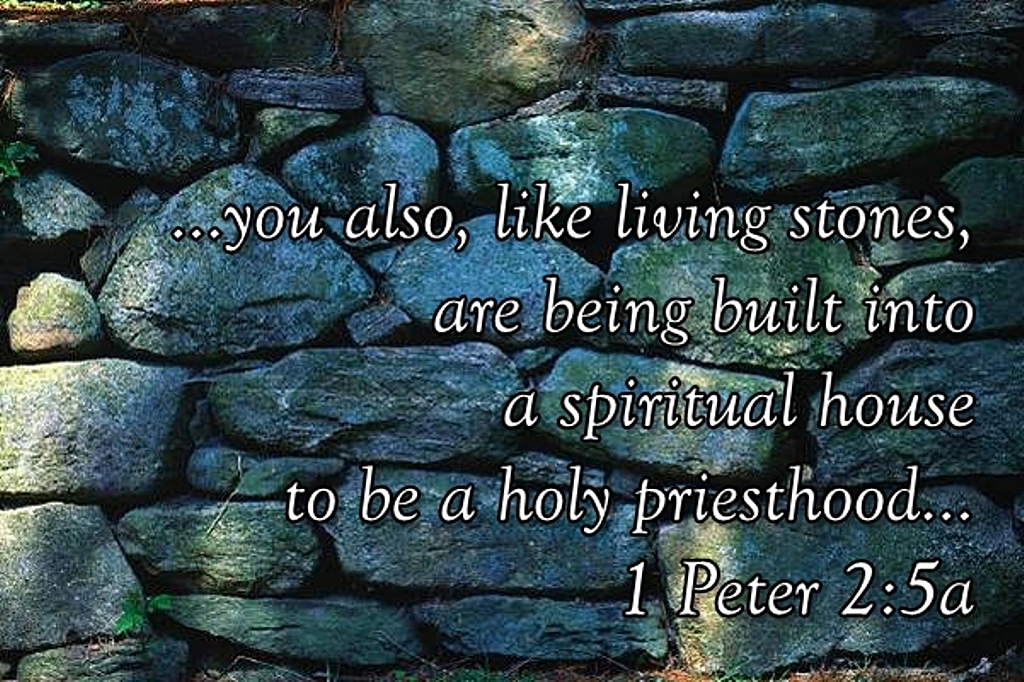
Peter goes on in verse 4: “As you come to him, the living Stone—rejected by humans but chosen by God and precious to him— you also, like living stones, are being built into a spiritual house to be a holy priesthood, offering spiritual sacrifices acceptable to God through Jesus Christ.”
In Jewish and Christian thought, “the Stone” was another title for the Messiah, the Christ, the anointed king and savior God promised hundreds of years before the birth of Jesus. Psalm 118:22-23 had predicted, in fact, that the world would reject the Stone, would reject Jesus.
The reasons people rejected Jesus then--the reasons that people reject Him today...the reasons I once rejected Him--boil down to really just one. As a friend once told me, explaining why he wasn’t a Christian: “I want to build my own life and I don’t think that Jesus can do that for me.” He might have said that he didn’t want Jesus to build his life because the moment you let Jesus take over building your life is the moment you cede control of the direction of your life to Him.
Jesus will take those who turn to Him away from death, toward life.
Away from separation from God, toward fellowship with God.
Away from futility, toward purpose, meaning, significance.
When, throughout our lives as followers of Christ, we lay down our sinful rebellion, remembering who who we are by God’s grace and surrendering to the truth that the One Who made us and bought us back from sin and death through the blood of His Son might have a better idea of how we tick, we experience peace.
When the life of the living Stone enters into us, we become living stones--or, as Martin Luther put it, we become little Christs--the life death, and resurrection are re-enacted within us.
And like Christ, Who offered Himself for us, we offer the only acceptable sacrifice to Him, ourselves...in humble acknowledgement of our need of Him. “My sacrifice, O God,” King David writes in Psalm 51:17, “is a broken spirit; a broken and contrite heart you, God, will not despise.”
In verses 6 through 8, Peter quotes several passages from the Old Testament about the Stone, the Messiah. The upshot is that those who obey the message of the Gospel--who believe in the the good news of Jesus Christ--live. But those who disobey it--who refuse to trust the God Who, in Christ, holds the outstretched hand of love, forgiveness, and new life to all who believe, stumble over the living Stone.
By the way, Peter isn’t saying in verse 8, that some people are destined to be saved, while others aren’t. He’s saying that those who refuse Jesus are destined for separation from God.
If you’re drowning in a flood and refuse the help of a rescuer, it isn’t the would-be rescuer who sealed your fate, your destiny.
Romans 8:1 reminds us: “...there is now no condemnation for those who are in Christ Jesus...” And, as we mentioned a few weeks ago, Jesus Himself said: “Whoever believes in him is not condemned, but whoever does not believe stands condemned already because they have not believed in the name of God’s one and only Son.”
Next in today’s second lesson, Peter wraps things up in a big bow, verses 9 and 10: “...you are a chosen people, a royal priesthood, a holy nation, God’s special possession, that you may declare the praises of him who called you out of darkness into his wonderful light. Once you were not a people, but now you are the people of God; once you had not received mercy, but now you have received mercy.”
When you get caught up in the problems and controversies, the tragedies and temptations of this life, when sin gets hold of you and threatens to pull you under, remember who you are: You are God’s people.
Christ died and rose to make it so.
And He’s given you a mission, a purpose for living: You’re to pass the message on about how God called you from the darkness of sin, death, and futility to live in the light of His love and power permeating even your darkest and most difficult moments.
Once, Peter says, we were not people, nobodies, phantoms roaming this earth without hope.
But now we are people, somebodies, children of God called by name by God.
Our names are written in the book of life for eternity.
And, by grace through faith in Christ, we are beneficiaries of the promise of Jesus...
That’s Jesus’ promise to you and me. And it’s worth remembering and worth re-membering ourselves to Christ and His body, the Church, every moment of every day.
Remember always who you are through Jesus Christ, children of God! Amen
1 Peter 2:2-10
The story’s told of a young man who was settling into a dorm room for the first term of his freshman year of college. His parents had said their goodbyes. A bit later, he looked around his room and found a note on his bed. It was from his mom. “Dear Cameron,” it read, “Never forget who you are.”
Those few words weren’t meant to constrain a young man from growing and being transformed by his life and experiences and the things he would learn in college.
They were meant instead to remind him of his birthright, of the love of his family, and the character that had been forged within him in the first eighteen years of his life. "Don’t forget the person you have become before this day." "Don’t forget your identity when you face the disappointments, tests, and even temptations of adult life." "No matter the changes that lie ahead, keep drawing on the strength of who you are."
This, in a sense, is the message that the apostle Peter gives to the Christians living in first-century Asia Minor, which we find in today’s second lesson. “Never forget who you are as people saved by God’s charity--His grace--through your trust--your faith--in Jesus Christ,” Peter is saying.
The Christians to whom Peter wrote needed that reminder. They were facing some sort of persecution. What it was exactly, we can’t be sure. But whenever Christians face opposition in the world...whenever there are people telling us that faith in a risen Savior is foolish...or the world claims that living life God’s way, rather than the world’s way is naive...or when people tell us that when you’re dead, you’re dead, Christians desperately need to remember who they are and how they came to be who they are.
It’s in the remembering, that we can be re-membered to who Christ has made us to be.
Just before our lesson for this morning, Peter shared thoughts in a section that some label, a “call to holy living.” This, Peter was saying in that section, is how you live when you’re grateful that God doesn’t judge you on the basis of the good or bad you do or the good you don’t do, when you’re grateful for God’s undeserved grace. In the verse immediately before our lesson, he writes: “...rid yourselves of all malice and all deceit, hypocrisy, envy, and slander of every kind." In other words, get rid of your sin by confessing it and letting the Savior Jesus take it off of your shoulders and letting the Holy Spirit help you to avoid committing the same sins over and over again. (Although I must confess my own penchant for committing the same sins and having to repent for them repeatedly, a testimony to God's grace and patience!)
Let’s look at what Peter writes next in the words that make up our second lesson, 1 Peter 2:2-10 (pages 850-851 in the sanctuary Bible): “Like newborn babies, crave pure spiritual milk, so that by it you may grow up in your salvation, now that you have tasted that the Lord is good.”
Spiritual milk here is the word about Jesus, the word that God’s heart breaks at the thought of losing any one of us because of the sin we inherit at birth and so, He decided to become a human servant among us to die and to rise and to give a new and eternal relationship with God to all who repent and believe in Christ.
We never grow so old or advanced in our faith as to not need to keep craving the life-changing power of that word.
I once met a couple who had both grown up in Christian homes. In fact, both were preachers’ kids. But they’d forgotten who they were. They stopped feasting on the message of hope in Jesus. They’d both made a lot of mistakes. And, contrary to the will of God, they were living together without benefit of the marriage covenant.
I liked them and, as I sat in their living room, I worked up the courage to ask them: “How do you feel about God?”
“I love God,” the man replied with feeling. “But I don’t have much room for him right now.”
Listen: No matter how far you and I may wander from the God we know in Christ, no matter how little room you may think you have for God in your life, He always has room for you.
It’s a matter of remembering who we are as the result of our Baptism--children of God--and craving for the power of the Gospel to be at the center of our lives again.
And that's a power that can transform each day we live on this earth, as well as our eternities. “...I am not ashamed of the gospel,” Paul writes in Romans 1:16, “because it is the power of God that brings salvation to everyone who believes...”
Keep craving the spiritual milk of Jesus and His Gospel, Peter says. The message that changed you from God’s enemies to God’s friends will also keep your hope and confidence in God alive. Remember who you are.
Peter goes on in verse 4: “As you come to him, the living Stone—rejected by humans but chosen by God and precious to him— you also, like living stones, are being built into a spiritual house to be a holy priesthood, offering spiritual sacrifices acceptable to God through Jesus Christ.”
In Jewish and Christian thought, “the Stone” was another title for the Messiah, the Christ, the anointed king and savior God promised hundreds of years before the birth of Jesus. Psalm 118:22-23 had predicted, in fact, that the world would reject the Stone, would reject Jesus.
The reasons people rejected Jesus then--the reasons that people reject Him today...the reasons I once rejected Him--boil down to really just one. As a friend once told me, explaining why he wasn’t a Christian: “I want to build my own life and I don’t think that Jesus can do that for me.” He might have said that he didn’t want Jesus to build his life because the moment you let Jesus take over building your life is the moment you cede control of the direction of your life to Him.
Jesus will take those who turn to Him away from death, toward life.
Away from separation from God, toward fellowship with God.
Away from futility, toward purpose, meaning, significance.
When, throughout our lives as followers of Christ, we lay down our sinful rebellion, remembering who who we are by God’s grace and surrendering to the truth that the One Who made us and bought us back from sin and death through the blood of His Son might have a better idea of how we tick, we experience peace.
When the life of the living Stone enters into us, we become living stones--or, as Martin Luther put it, we become little Christs--the life death, and resurrection are re-enacted within us.
And like Christ, Who offered Himself for us, we offer the only acceptable sacrifice to Him, ourselves...in humble acknowledgement of our need of Him. “My sacrifice, O God,” King David writes in Psalm 51:17, “is a broken spirit; a broken and contrite heart you, God, will not despise.”
In verses 6 through 8, Peter quotes several passages from the Old Testament about the Stone, the Messiah. The upshot is that those who obey the message of the Gospel--who believe in the the good news of Jesus Christ--live. But those who disobey it--who refuse to trust the God Who, in Christ, holds the outstretched hand of love, forgiveness, and new life to all who believe, stumble over the living Stone.
By the way, Peter isn’t saying in verse 8, that some people are destined to be saved, while others aren’t. He’s saying that those who refuse Jesus are destined for separation from God.
If you’re drowning in a flood and refuse the help of a rescuer, it isn’t the would-be rescuer who sealed your fate, your destiny.
Romans 8:1 reminds us: “...there is now no condemnation for those who are in Christ Jesus...” And, as we mentioned a few weeks ago, Jesus Himself said: “Whoever believes in him is not condemned, but whoever does not believe stands condemned already because they have not believed in the name of God’s one and only Son.”
Next in today’s second lesson, Peter wraps things up in a big bow, verses 9 and 10: “...you are a chosen people, a royal priesthood, a holy nation, God’s special possession, that you may declare the praises of him who called you out of darkness into his wonderful light. Once you were not a people, but now you are the people of God; once you had not received mercy, but now you have received mercy.”
When you get caught up in the problems and controversies, the tragedies and temptations of this life, when sin gets hold of you and threatens to pull you under, remember who you are: You are God’s people.
Christ died and rose to make it so.
And He’s given you a mission, a purpose for living: You’re to pass the message on about how God called you from the darkness of sin, death, and futility to live in the light of His love and power permeating even your darkest and most difficult moments.
Once, Peter says, we were not people, nobodies, phantoms roaming this earth without hope.
But now we are people, somebodies, children of God called by name by God.
Our names are written in the book of life for eternity.
And, by grace through faith in Christ, we are beneficiaries of the promise of Jesus...
- a promise good in classrooms and labs,
- office cubicles and construction sites,
- in funeral homes and intensive care units,
- in marriage beds and baby nurseries,
- on athletic fields and concert stages,
- anywhere we live...
That’s Jesus’ promise to you and me. And it’s worth remembering and worth re-membering ourselves to Christ and His body, the Church, every moment of every day.
Remember always who you are through Jesus Christ, children of God! Amen
Saturday, May 17, 2014
Serious Sermon Saturday Song #5: I Just Wanna Know
Steve Taylor, simply the best. Glad that he's back into the musical scene after a nearly twenty year absence. We needed him!
Serious Sermon Saturday #4: Sun and Shield
Serious Sermon Saturday Song #3: Pride (In the Name of Love)
Going into the wayback machine with U2...
Monday, May 12, 2014
The Only Shepherd, the Only Gate
[This was prepared to be shared during worship on Sunday, May 11, with the people and friends of Living Water Lutheran Church in Springboro, Ohio.]
John 10:1-10
I once saw video clips of a TV talk show host holding forth on spiritual issues. She assured people, for example, that sin doesn’t exist. She also claimed, several times in several ways, that all religions and spiritual quests may lead people to God. These are widespread beliefs today. But are they true? Well, not according to Jesus. And in today’s Gospel lesson, Jesus uses two illustrations to point us to Who He is and to the relationship with God that you and I…and every person on the planet…can have through Him. But only through Him. Jesus calls Himself a shepherd and a gate. More on that in a moment.
First though, we must establish the context for these illustrations. How is it that Jesus came to speak the words we find in John 10:1-10? It all started when Jesus gave sight to a blind man in John 9. It aroused controversy because Jesus had the temerity to do the loving will of God on a Sabbath day. The Pharisees accused Jesus of doing work when He shouldn’t have. It made them so angry when the blind man declared that Jesus, in spite of this Sabbath violation, must be from God, that they excommunicated the guy.
Now, at one level, the Pharisees were nothing like the contemporary talk show host. Unlike that host, who seems to say that any religious belief will get you to God, the Pharisees believed that only by abiding by their extensive lists of religious rules could one be right with God. They differed in other ways as well. But, based on both the Old and New Testaments, both the host and the Pharisees have one big thing in common. They are equally wrong.
Over the centuries, starting with a desert people to whom God gave a land and a promise that they would become a light to all the nations, through the birth, life, death, and resurrection of a Man Who showed Himself to be God in the flesh, God has revealed Himself and His plan for the human race. From the beginning, the plan for a right relationship with God and for a life with Him that lasts forever has been the same. We are simply to believe in Him and only in Him. Genesis says that Abraham, the patriarch of Biblical faith, believed in God and God’s promises and that God “reckoned it to him as righteousness.” Abraham was right with God through belief in God.
Now, the New Testament shows us that God has revealed Himself in Jesus Christ. Hebrews 1:1-2 tells us, for example: “In the past God spoke to our ancestors through the prophets at many times and in various ways, but in these last days he has spoken to us by his Son, whom he appointed heir of all things, and through whom also he made the universe.” All who turn from sin and believe in Jesus, God in the flesh, have the same blessings enjoyed by Abraham, rightness with God and life in His Name.
As we said when we were talking about the first building block of our discipleship, it isn’t because God is an egomaniac or because God wants to establish an exclusive club that the first commandment is, “You shall have no other gods.” It’s that God wants to give us life and only He can give it. All other roads are dead ends, literally. And we can only know God through Jesus Christ.
In today’s lesson, Jesus is trying to convey this truth to the Pharisees and others who may be listening to Him, the truth that salvation comes to those with faith in the God revealed to Israel and ultimately, in Him.
So, first He tells them that He is the shepherd. Only Jesus can lead us into God’s sheepfold. People who try to get into the kingdom of God by other means are, Jesus says, thieves and bandits. He says: “The one who enters by the gate is the shepherd of the sheep. The gatekeeper opens the gate for him, and the sheep listen to his voice. He calls his own sheep by name and leads them out. When he has brought out all his own, he goes on ahead of them, and his sheep follow him because they know his voice. But they will never follow a stranger; in fact, they will run away from him because they do not recognize a stranger’s voice.”
Sheep are pretty dumb creatures. But if a stranger comes among them, they will en masse, move away, alarmed. Once a person familiar to them shows up, they relax, knowing that this person won’t lead them astray. They respond to the voice of the shepherd who takes care of them. We may be brighter than sheep. But that’s not very different from us. Have you ever noticed how you can hear the voice of someone with whom you’re close even in a crowded, noisy place? Both of our kids were in a 100-plus-voice choir in high school. I can remember when we accompanied the kids on a concert tour in England. I particularly remember listening to them during a performance in the Milennium Dome in London. If I perked my ear just right, I could hear both of the kids’ voices in the midst of the others. You can dial into the voices of those you love and those you know love you.
When you allow the God we know in Jesus Christ to communicate with you through His Word, the Bible, through prayer, through the fellowship of other believers, and through Holy Communion, you begin to know His voice. You go to Him when He calls you. And when other voices call you to walk away from God’s will, you ignore them.
Jesus, our Gospel lesson tells us, called Himself the shepherd of God’s sheep. But his listeners “did not understand what he was telling them.” So, like many a frustrated communicator, Jesus tried another illustration to make His point. Now, He wasn’t a shepherd. “Very truly,” He says, “I am the gate for the sheep. All who have come before me are thieves and robbers, but the sheep have not listened to them. I am the gate; whoever enters through me will be saved. They will come in and go out, and find pasture. The thief [which can include perfectly nice people who follow some other path in life, like the misguided and misguiding talk show host] comes only to steal and kill and destroy; I have come that they may have life, and have it to the full.“
Jesus is the gate to eternity. Years ago, we got locked out of our house. I went to every single first floor window and door and couldn’t find a way to break into our own place. Finally, I came to the last possible window. I stretched up and could tell that this one, leading into the dining room, which set more than six feet off the ground, was slightly ajar. If I could hoist myself up, I might be able to slide the window open, throw myself into the house, and then let Ann in. The previous occupants had left behind half of an old pickle barrel they'd used as a planter. It wasn’t very big. But by standing on it and letting Ann push me from behind, I was able to throw myself through the window. I was halfway into the house, my legs still hanging outside, Ann no longer able to help me, when a thought crossed my mind: How would I explain this to a passing cop? You see, if you belong somewhere, you don’t have to break in. You go through the front door.
Some people think that getting to God happens as the result of a long spiritual quest. The Christian life does have its challenges. And growing in faith and just holding onto Christ in this life, requires us to adopt spiritual disciplines like prayer, study of Scripture, involvement in Christian service, mutual accountability to other Christian. On top of that, even if we’re growing spiritually, we know that belonging to Jesus doesn’t insulate us from the difficulties of this life. And sometimes, as our second lesson for today points out, we face rejection precisely because we follow Jesus.
But we know too, that Jesus is the front door, the only door—the only gate—to life with God, to the abundant, everlasting life that God wants to give to all people. The real quest of the Christian life is to get to know God, which isn’t an onerous task, but a joy as wonderful as falling in love.
Jesus once told Philip and the other disciples, “I am the Way, and the Truth, and the Life. No one comes to the Father except through Me. If you know Me, you will know the Father also…”
After mouthing the famous words of John 3:16, He told Nicodemus, “…God did not send the Son into the world to condemn the world, but in order that the world might be saved through Him. Those who believe in Him [that is, in Jesus] are not condemned; but those who do not believe are condemned already, because they have not believed in the Name of the only Son of God.”
And after Jesus became the only Savior in the history of the world to die and rise so that all who believe in Him will not suffer the consequences of our sin, eternal separation from God, His first followers proclaimed the same message about Jesus. When the religious authorities in Jerusalem arrested the apostles Peter and John for bringing healing to a man in Jesus’ Name, the two disciples told them, “There is salvation in no one else, for there is no other name under heaven given among mortals by which we must be saved.”
Jesus is the good shepherd and He is the gate—the front door—to eternity. Let yourself get to know Him better. As you do, you’ll hear His voice over the din of an often confusing world and He will lead you to a life prepared for you, a life that never ends, a life filled with the presence of God.
John 10:1-10
I once saw video clips of a TV talk show host holding forth on spiritual issues. She assured people, for example, that sin doesn’t exist. She also claimed, several times in several ways, that all religions and spiritual quests may lead people to God. These are widespread beliefs today. But are they true? Well, not according to Jesus. And in today’s Gospel lesson, Jesus uses two illustrations to point us to Who He is and to the relationship with God that you and I…and every person on the planet…can have through Him. But only through Him. Jesus calls Himself a shepherd and a gate. More on that in a moment.
First though, we must establish the context for these illustrations. How is it that Jesus came to speak the words we find in John 10:1-10? It all started when Jesus gave sight to a blind man in John 9. It aroused controversy because Jesus had the temerity to do the loving will of God on a Sabbath day. The Pharisees accused Jesus of doing work when He shouldn’t have. It made them so angry when the blind man declared that Jesus, in spite of this Sabbath violation, must be from God, that they excommunicated the guy.
Now, at one level, the Pharisees were nothing like the contemporary talk show host. Unlike that host, who seems to say that any religious belief will get you to God, the Pharisees believed that only by abiding by their extensive lists of religious rules could one be right with God. They differed in other ways as well. But, based on both the Old and New Testaments, both the host and the Pharisees have one big thing in common. They are equally wrong.
Over the centuries, starting with a desert people to whom God gave a land and a promise that they would become a light to all the nations, through the birth, life, death, and resurrection of a Man Who showed Himself to be God in the flesh, God has revealed Himself and His plan for the human race. From the beginning, the plan for a right relationship with God and for a life with Him that lasts forever has been the same. We are simply to believe in Him and only in Him. Genesis says that Abraham, the patriarch of Biblical faith, believed in God and God’s promises and that God “reckoned it to him as righteousness.” Abraham was right with God through belief in God.
Now, the New Testament shows us that God has revealed Himself in Jesus Christ. Hebrews 1:1-2 tells us, for example: “In the past God spoke to our ancestors through the prophets at many times and in various ways, but in these last days he has spoken to us by his Son, whom he appointed heir of all things, and through whom also he made the universe.” All who turn from sin and believe in Jesus, God in the flesh, have the same blessings enjoyed by Abraham, rightness with God and life in His Name.
As we said when we were talking about the first building block of our discipleship, it isn’t because God is an egomaniac or because God wants to establish an exclusive club that the first commandment is, “You shall have no other gods.” It’s that God wants to give us life and only He can give it. All other roads are dead ends, literally. And we can only know God through Jesus Christ.
In today’s lesson, Jesus is trying to convey this truth to the Pharisees and others who may be listening to Him, the truth that salvation comes to those with faith in the God revealed to Israel and ultimately, in Him.
So, first He tells them that He is the shepherd. Only Jesus can lead us into God’s sheepfold. People who try to get into the kingdom of God by other means are, Jesus says, thieves and bandits. He says: “The one who enters by the gate is the shepherd of the sheep. The gatekeeper opens the gate for him, and the sheep listen to his voice. He calls his own sheep by name and leads them out. When he has brought out all his own, he goes on ahead of them, and his sheep follow him because they know his voice. But they will never follow a stranger; in fact, they will run away from him because they do not recognize a stranger’s voice.”
Sheep are pretty dumb creatures. But if a stranger comes among them, they will en masse, move away, alarmed. Once a person familiar to them shows up, they relax, knowing that this person won’t lead them astray. They respond to the voice of the shepherd who takes care of them. We may be brighter than sheep. But that’s not very different from us. Have you ever noticed how you can hear the voice of someone with whom you’re close even in a crowded, noisy place? Both of our kids were in a 100-plus-voice choir in high school. I can remember when we accompanied the kids on a concert tour in England. I particularly remember listening to them during a performance in the Milennium Dome in London. If I perked my ear just right, I could hear both of the kids’ voices in the midst of the others. You can dial into the voices of those you love and those you know love you.
When you allow the God we know in Jesus Christ to communicate with you through His Word, the Bible, through prayer, through the fellowship of other believers, and through Holy Communion, you begin to know His voice. You go to Him when He calls you. And when other voices call you to walk away from God’s will, you ignore them.
Jesus, our Gospel lesson tells us, called Himself the shepherd of God’s sheep. But his listeners “did not understand what he was telling them.” So, like many a frustrated communicator, Jesus tried another illustration to make His point. Now, He wasn’t a shepherd. “Very truly,” He says, “I am the gate for the sheep. All who have come before me are thieves and robbers, but the sheep have not listened to them. I am the gate; whoever enters through me will be saved. They will come in and go out, and find pasture. The thief [which can include perfectly nice people who follow some other path in life, like the misguided and misguiding talk show host] comes only to steal and kill and destroy; I have come that they may have life, and have it to the full.“
Jesus is the gate to eternity. Years ago, we got locked out of our house. I went to every single first floor window and door and couldn’t find a way to break into our own place. Finally, I came to the last possible window. I stretched up and could tell that this one, leading into the dining room, which set more than six feet off the ground, was slightly ajar. If I could hoist myself up, I might be able to slide the window open, throw myself into the house, and then let Ann in. The previous occupants had left behind half of an old pickle barrel they'd used as a planter. It wasn’t very big. But by standing on it and letting Ann push me from behind, I was able to throw myself through the window. I was halfway into the house, my legs still hanging outside, Ann no longer able to help me, when a thought crossed my mind: How would I explain this to a passing cop? You see, if you belong somewhere, you don’t have to break in. You go through the front door.
Some people think that getting to God happens as the result of a long spiritual quest. The Christian life does have its challenges. And growing in faith and just holding onto Christ in this life, requires us to adopt spiritual disciplines like prayer, study of Scripture, involvement in Christian service, mutual accountability to other Christian. On top of that, even if we’re growing spiritually, we know that belonging to Jesus doesn’t insulate us from the difficulties of this life. And sometimes, as our second lesson for today points out, we face rejection precisely because we follow Jesus.
But we know too, that Jesus is the front door, the only door—the only gate—to life with God, to the abundant, everlasting life that God wants to give to all people. The real quest of the Christian life is to get to know God, which isn’t an onerous task, but a joy as wonderful as falling in love.
Jesus once told Philip and the other disciples, “I am the Way, and the Truth, and the Life. No one comes to the Father except through Me. If you know Me, you will know the Father also…”
After mouthing the famous words of John 3:16, He told Nicodemus, “…God did not send the Son into the world to condemn the world, but in order that the world might be saved through Him. Those who believe in Him [that is, in Jesus] are not condemned; but those who do not believe are condemned already, because they have not believed in the Name of the only Son of God.”
And after Jesus became the only Savior in the history of the world to die and rise so that all who believe in Him will not suffer the consequences of our sin, eternal separation from God, His first followers proclaimed the same message about Jesus. When the religious authorities in Jerusalem arrested the apostles Peter and John for bringing healing to a man in Jesus’ Name, the two disciples told them, “There is salvation in no one else, for there is no other name under heaven given among mortals by which we must be saved.”
Jesus is the good shepherd and He is the gate—the front door—to eternity. Let yourself get to know Him better. As you do, you’ll hear His voice over the din of an often confusing world and He will lead you to a life prepared for you, a life that never ends, a life filled with the presence of God.
Wednesday, May 07, 2014
Sunday, May 04, 2014
Fear God?
[This was prepared to be shared during worship with the people and friends of Living Water Lutheran Church in Springboro, Ohio, today.]
1 Peter 1:17-25
When I was a boy, up until I was about age thirteen, I was, in a phrase often used by members of my parent's generation, "a pistol." But by the time I turned thirteen, a change had come. I was obedient to my parents. I wasn’t perfect by any means. And I’m still not. But when I hit my teens, my parents weren’t always wondering whether they could trade me in for a new model.
The reason for this transformation, I think, was simple: I feared my father.
I don’t mean that I was afraid of how he might punish me. I was afraid of hurting him, of angering him, and of disappointing him because I knew how much he loved me. My fear was born of my gratitude to my father. My dad and I didn’t always see eye to eye and we still don’t and he was far from perfect, but I always knew that, at least in relationship with the world outside our doors, he had my back.
So that later, when at age 18, I went to work in the factory where he was a time study man, I tried to work hard and reflect well on dad.
And when I was a young man, borrowing the car to go out with a girl, I paid attention to dad when he would remind me, “Remember, she’s a person too.”
I grieve for those people who grew up without knowing that at least one of their parents always had their backs. I grieve because it’s a hard and hurtful way to be introduced to the world. And I grieve too, because it’s hard for a person to trust the One we Christians call “our Father in heaven,” when the only father they’ve ever had was so untrustworthy.
Now I’ve spent time painting this picture of my father because, I hope, it will help us all understand what the apostle Peter is getting at in today’s lesson.
Peter wrote this letter to churches in Asia Minor, a region of the world which today is basically Turkey. There’s some dispute among scholars as to the nature of the experiences which the Christians to whom Peter wrote were then undergoing. Some scholars say the Asia Minor Christians were suffering outright government persecution and the threat of death. Others insist that they were people--like Jews who had come to faith in Christ--who were undergoing pressure from their families and friends to renounce Christ.
Whatever opposition the Christians in Asia Minor were suffering--persecution, pressure from loved ones and friends, or the simple allure of conforming to their own desires rather than the will of God, Peter wanted to remind them of the faithfulness of the Father Who had sent His Son Jesus to die for them and their sins, then rose for them to open up forgiven, eternal life to those who trust in Christ.
And he also wanted them to see that trust in God is lived out each day in the decisions we make, the actions we take, and the things we’d like to do, but refuse to do or that, in moments of disconnectedness from God, we may do, for which we repent.
Peter’s encouragement to a group of first century Christians is something you and I need today. So, please go to our second lesson for today, 1 Peter 1:17-25 (page 850 in the sanctuary Bibles).
It begins: “Since you call on a Father who judges each person’s work impartially, live out your time as foreigners here in reverent fear.” This verse really is the whole ballgame in understanding today's lesson. So, we'll spend some time unpacking it.
First, Peter calls God the Father.
Now, God is called Father in only a few places in the Old Testament, although in the years before Jesus was born, some Jews had taken to referring to God in this way.
But when Jesus came along, He not only called God Father, He did so by using the most intimate term for Father in Aramaic, the language he used every day. He called the Father Abba, basically meaning daddy.
Even more stunningly, in the Lord’s Prayer, Jesus told all who believe in Him, to think of God the Father as their dad.
He’s the Dad Who’s got His children’s backs. Through Jesus, we know that our heavenly Father really is with us always!
Good dads and good moms, no matter how much they love us, are only a fraction as loving as our heavenly Father.
Second, in this one verse, Peter tells us that our Father will also judge each person’s work impartially.
Lutherans, your ears should perk up when you hear phrases like this. You may be thinking, we're saved by grace, not by our works.
But let’s be clear, Peter is not saying that we are saved by our works. The word Peter uses which is translated as work in our Bibles has the idea of the whole content, the whole flow of our life’s works and motives, not a single work or set of works.
Every one of us sins every day. God knows our imperfections. He understands that we never get this Christian thing completely right.
That's why God, our compassionate Father, judges those who trust in Christ, however imperfectly, by the intentions of our hearts. He judges us by that in which we repose our ultimate hope.
Christians know not to place their trust in themselves, or their money, or their accomplishments, or their religiosity, but in Jesus Christ alone.
When they do that...when we do that...it changes how we live our lives, it prompts us to lives and service rendered in Christ’s Name, no matter what pressures or temptations we may face.
Our work in this life is not to negotiate a set of religious requirements, but to trust in Christ, to follow Him always, and, whenever we lose our ways, to follow Him again. When we do that, God will show us the way.
Jesus was once asked: “What must we do to do the works God requires?" In John 6:29, Jesus answers: "The work of God is this: to believe in the one he has sent."
Trust the One Who has offered you eternity and peace with God through Me, Jesus is saying, and He will so infect your life with gratitude and holy fear, you will live this life and eternity differently.
Ephesians 2:8-10 tells believers in Christ: “For by grace you have been saved through faith; and that not of yourselves, it is the gift of God; not as a result of works, so that no one may boast. For we are His workmanship, created in Christ Jesus for good works, which God prepared beforehand so that we would walk in them.”
Trust the Father and keeping trusting the Father you know through Jesus and His love will change how you live, often without your even knowing it.
And the third major point I draw from this one verse in today's second lesson is this: We’re to live our lives as followers of Christ, knowing that we are foreigners to this world.
As we mentioned last Sunday, through our faith in Christ, we’ve been made new. We’re not a part of this dying world.
When the things of this world die, they die. When we who trust in Christ die, we rise.
Peter wants to remind us not to get too comfortable with this world...and not to pay too much attention to what a dying world thinks is important.
That sets the table for what Peter says in verses 18-21. They speak clearly to we Christians today in 2014: “For you know that it was not with perishable things such as silver or gold [things that the world values] that you were redeemed from the empty way of life handed down to you from your ancestors, but with the precious blood of Christ, a lamb without blemish or defect. [If you have your Bibles with you today, underline those words, please.] He was chosen before the creation of the world, but was revealed in these last times for your sake. Through him [that is, through Jesus] you believe in God, who raised him from the dead and glorified him, and so your faith and hope are in God.”
In John 14:9, Jesus tells the apostle Philip: “Anyone who has seen me has seen the Father.”
And in John 10:30, Jesus says: “I and the Father are one.”
Through Jesus, you and I know God the Father.
We know how much He loves us.
We know that we can trust Him.
And because of that love, we can have intimacy with God.
We know that God has our backs.
Throughout Martin Luther’s explanation of the Ten Commandments in The Small Catechism, he says of believers, “We are to fear and love God so that...”
Some people read those words and are disturbed. They think it means that God is cruel and capricious, that we have to try to please Him to prevent Him from sending us to fiery hell without access to air conditioning.
But this is what we know through Jesus: God isn’t out to get you. He hates your sin. He hates my sin. But He loves you and He loves me.
He sent Jesus to rescue us from ourselves and from the eternal condemnation we deserve. That rescue comes to us when we trust in Christ as our God and our only Savior.
To fear God is to be filled with gratitude for His love and grace, to fear nothing so much as hurting the feelings of the One Who has loved and still loves you and me more than any person we’ve ever known.
Through your faith in Christ, God has become your Father.
Our call is to follow and live for Him alone. May God help us to do that. Amen

1 Peter 1:17-25
When I was a boy, up until I was about age thirteen, I was, in a phrase often used by members of my parent's generation, "a pistol." But by the time I turned thirteen, a change had come. I was obedient to my parents. I wasn’t perfect by any means. And I’m still not. But when I hit my teens, my parents weren’t always wondering whether they could trade me in for a new model.
The reason for this transformation, I think, was simple: I feared my father.
I don’t mean that I was afraid of how he might punish me. I was afraid of hurting him, of angering him, and of disappointing him because I knew how much he loved me. My fear was born of my gratitude to my father. My dad and I didn’t always see eye to eye and we still don’t and he was far from perfect, but I always knew that, at least in relationship with the world outside our doors, he had my back.
So that later, when at age 18, I went to work in the factory where he was a time study man, I tried to work hard and reflect well on dad.
And when I was a young man, borrowing the car to go out with a girl, I paid attention to dad when he would remind me, “Remember, she’s a person too.”
I grieve for those people who grew up without knowing that at least one of their parents always had their backs. I grieve because it’s a hard and hurtful way to be introduced to the world. And I grieve too, because it’s hard for a person to trust the One we Christians call “our Father in heaven,” when the only father they’ve ever had was so untrustworthy.
Now I’ve spent time painting this picture of my father because, I hope, it will help us all understand what the apostle Peter is getting at in today’s lesson.
Peter wrote this letter to churches in Asia Minor, a region of the world which today is basically Turkey. There’s some dispute among scholars as to the nature of the experiences which the Christians to whom Peter wrote were then undergoing. Some scholars say the Asia Minor Christians were suffering outright government persecution and the threat of death. Others insist that they were people--like Jews who had come to faith in Christ--who were undergoing pressure from their families and friends to renounce Christ.
Whatever opposition the Christians in Asia Minor were suffering--persecution, pressure from loved ones and friends, or the simple allure of conforming to their own desires rather than the will of God, Peter wanted to remind them of the faithfulness of the Father Who had sent His Son Jesus to die for them and their sins, then rose for them to open up forgiven, eternal life to those who trust in Christ.
And he also wanted them to see that trust in God is lived out each day in the decisions we make, the actions we take, and the things we’d like to do, but refuse to do or that, in moments of disconnectedness from God, we may do, for which we repent.
Peter’s encouragement to a group of first century Christians is something you and I need today. So, please go to our second lesson for today, 1 Peter 1:17-25 (page 850 in the sanctuary Bibles).
It begins: “Since you call on a Father who judges each person’s work impartially, live out your time as foreigners here in reverent fear.” This verse really is the whole ballgame in understanding today's lesson. So, we'll spend some time unpacking it.
First, Peter calls God the Father.
Now, God is called Father in only a few places in the Old Testament, although in the years before Jesus was born, some Jews had taken to referring to God in this way.
But when Jesus came along, He not only called God Father, He did so by using the most intimate term for Father in Aramaic, the language he used every day. He called the Father Abba, basically meaning daddy.
Even more stunningly, in the Lord’s Prayer, Jesus told all who believe in Him, to think of God the Father as their dad.
He’s the Dad Who’s got His children’s backs. Through Jesus, we know that our heavenly Father really is with us always!
Good dads and good moms, no matter how much they love us, are only a fraction as loving as our heavenly Father.
Second, in this one verse, Peter tells us that our Father will also judge each person’s work impartially.
Lutherans, your ears should perk up when you hear phrases like this. You may be thinking, we're saved by grace, not by our works.
But let’s be clear, Peter is not saying that we are saved by our works. The word Peter uses which is translated as work in our Bibles has the idea of the whole content, the whole flow of our life’s works and motives, not a single work or set of works.
Every one of us sins every day. God knows our imperfections. He understands that we never get this Christian thing completely right.
That's why God, our compassionate Father, judges those who trust in Christ, however imperfectly, by the intentions of our hearts. He judges us by that in which we repose our ultimate hope.
Christians know not to place their trust in themselves, or their money, or their accomplishments, or their religiosity, but in Jesus Christ alone.
When they do that...when we do that...it changes how we live our lives, it prompts us to lives and service rendered in Christ’s Name, no matter what pressures or temptations we may face.
Our work in this life is not to negotiate a set of religious requirements, but to trust in Christ, to follow Him always, and, whenever we lose our ways, to follow Him again. When we do that, God will show us the way.
Jesus was once asked: “What must we do to do the works God requires?" In John 6:29, Jesus answers: "The work of God is this: to believe in the one he has sent."
Trust the One Who has offered you eternity and peace with God through Me, Jesus is saying, and He will so infect your life with gratitude and holy fear, you will live this life and eternity differently.
Ephesians 2:8-10 tells believers in Christ: “For by grace you have been saved through faith; and that not of yourselves, it is the gift of God; not as a result of works, so that no one may boast. For we are His workmanship, created in Christ Jesus for good works, which God prepared beforehand so that we would walk in them.”
Trust the Father and keeping trusting the Father you know through Jesus and His love will change how you live, often without your even knowing it.
And the third major point I draw from this one verse in today's second lesson is this: We’re to live our lives as followers of Christ, knowing that we are foreigners to this world.
As we mentioned last Sunday, through our faith in Christ, we’ve been made new. We’re not a part of this dying world.
When the things of this world die, they die. When we who trust in Christ die, we rise.
Peter wants to remind us not to get too comfortable with this world...and not to pay too much attention to what a dying world thinks is important.
That sets the table for what Peter says in verses 18-21. They speak clearly to we Christians today in 2014: “For you know that it was not with perishable things such as silver or gold [things that the world values] that you were redeemed from the empty way of life handed down to you from your ancestors, but with the precious blood of Christ, a lamb without blemish or defect. [If you have your Bibles with you today, underline those words, please.] He was chosen before the creation of the world, but was revealed in these last times for your sake. Through him [that is, through Jesus] you believe in God, who raised him from the dead and glorified him, and so your faith and hope are in God.”
In John 14:9, Jesus tells the apostle Philip: “Anyone who has seen me has seen the Father.”
And in John 10:30, Jesus says: “I and the Father are one.”
Through Jesus, you and I know God the Father.
We know how much He loves us.
We know that we can trust Him.
And because of that love, we can have intimacy with God.
We know that God has our backs.
Throughout Martin Luther’s explanation of the Ten Commandments in The Small Catechism, he says of believers, “We are to fear and love God so that...”
Some people read those words and are disturbed. They think it means that God is cruel and capricious, that we have to try to please Him to prevent Him from sending us to fiery hell without access to air conditioning.
But this is what we know through Jesus: God isn’t out to get you. He hates your sin. He hates my sin. But He loves you and He loves me.
He sent Jesus to rescue us from ourselves and from the eternal condemnation we deserve. That rescue comes to us when we trust in Christ as our God and our only Savior.
To fear God is to be filled with gratitude for His love and grace, to fear nothing so much as hurting the feelings of the One Who has loved and still loves you and me more than any person we’ve ever known.
Through your faith in Christ, God has become your Father.
Our call is to follow and live for Him alone. May God help us to do that. Amen
Thursday, May 01, 2014
"Please Use This Song in Your Commercial"
Four of us were talking the other day about how hard it is for new musical acts to break through to a mass audience these days. In the past, of course, there were a few media gatekeepers--big record companies, big broadcast networks, and such, who guarded access to audiences. But now, with Internet, satellite networks, and that so yesterday cable TV, there really aren't mass audiences, just narrow bands of small splinter groups of consumers.
The best way for musical artists to "hit paydirt" these days, it seems, isn't to get "airplay," but to get their songs into commercials. Even artists like Paul McCartney, who once made "principled stands" against having their songs featured in advertising, have long since relented. Jon Lajoie gets it and shows it in this funny music video.
The best way for musical artists to "hit paydirt" these days, it seems, isn't to get "airplay," but to get their songs into commercials. Even artists like Paul McCartney, who once made "principled stands" against having their songs featured in advertising, have long since relented. Jon Lajoie gets it and shows it in this funny music video.
Wednesday, April 30, 2014
What Will You Do with Your New Beginning?
[This was prepared to be shared during worship with the people and friends of Living Water Lutheran Church in Springboro, Ohio, last weekend.]
John 20:19-31
Everybody knows about the excitement that comes when you finally reach long-awaited new beginnings.
People count down the years, months, and days until high school, college, and graduate school graduations.
Couples and their families count down the moments until woman and man say, “I do.”
Expectant parents count down the passing months and days until the due dates.
Old friends keep track of the moments until they get to see each other again.
Job applicants are wracked with nervousness until they’re offered the perfect position for which they've been waiting.
In this time-bound world, it’s truly amazing when long-awaited, prayed-for, days come. When they do, there’s excitement, relief, celebration, jubilation...and apprehension, maybe even fear.
That’s because new beginnings always present us with a question: What now? What do we do with a life that’s been changed by the new degree, the new husband, the new wife, the new career, the new child, the new love?
We rightly feel that it would be contemptuous of a long-awaited gift to do nothing with it.
Imagine a couple saying, “I do” in a ceremony before God and human beings and then parting ways, going on with separate lives.
Or parents thrilled by the birth of a new baby deciding to walk away from the hospital without their child.
When new beginnings come our way, we may not be certain about what to do with them, but we know, deep in our souls, that doing nothing is not an option.
And, in that same place in our souls, we know that we want whatever we do with our new beginnings to be the right thing. We don’t want to mess it up.
Our Gospel lesson for this morning is John 20:19-31. We’re going to focus on verses 19-23. These verses reverberate with the echoes of the first three chapters of the Bible, Genesis 1 to 3, where we’re told about God’s creation of the universe, the very first new beginnings of the earth and the heavens.
There, God’s breath or Spirit moves over the deep and life comes into being. A new beginning.
There too, God’s breath or Spirit--it’s the same word in Hebrew, the language of the Old Testament and the same word in Greek, the language of the New Testament--God’s breath or Spirit are infused into an incipient man and Adam becomes a living being. A new beginning.
A wonderful beginning. But later, in Genesis 6:6, after Adam and Eve and their descendants fell into sin, we’re told that God regretted ever giving beginning to human beings.
Regretted, yes. But even then, God didn’t give up on the descendants of Adam and Eve. God hasn't given up on you and me. “For God so loved the world that he gave his one and only Son, that whoever believes in him shall not perish but have eternal life.” Jesus bore our death sentence for sin so that when He rose, those who dare to believe in Him will have new beginnings, life with God for eternity.
Look please at the opening verse of our lesson. It says: “On the evening of that first day of the week, when the disciples were together, with the doors locked for fear of the Jews, Jesus came and stood among them and said, ‘Peace be with you!’"
It’s the Easter Sunday of Jesus’ resurrection, an amazing event. But Jesus’ resurrection is more than a neat trick by God. Easter is more than just Jesus beating death for Himself. This is what John is emphasizing by calling the first Easter, “the first day of the week.” For the creation and for us all, God, through Jesus, has brought to a world that spent centuries waiting for it, a new beginning to those who will trust in Christ.
But if it’s a new beginning, the disciples, Jesus’ followers, didn’t know what to do with it. They’d gotten word from several people that Jesus had risen and was alive.
The day and its message should have changed everything for them. Yet here they were, gathered for fear of their country’s religious leaders, behind locked doors.
They belonged to a risen, living Savior. But they were acting like people without hope, without the help of a powerful, death-destroying God. They were intent on hiding, afraid to venture out into the world.
That's not very different from us in the modern Church, really: We sing “Jesus Christ is Risen Today,” "Here I am, Lord...I will go, Lord, where You send me," or “Forever, author of Salvation He rose and conquered the grave,” yet we remain ensconced in our Christian ghettos, our holy huddles, afraid to leave the comfort zones we enjoy in our liturgies and songs and in our small groups and fellowship meals.
It may be true that our world is going to hell in a hand-basket. But part of the reason for that is that many Christians, like the first disciples on the evening of the first Easter, stay scrummed in fear in their little locked lives.
Folks: This is not what God means for us to do with the new beginnings He gives us through the risen Jesus Christ.
We see that in what happens next in our lesson. Look at verse 20: “[After Jesus had declared His peace on them] he showed them his hands and side. The disciples were overjoyed when they saw the Lord. Again Jesus said, ‘Peace be with you! As the Father has sent me, I am sending you.’"
During the time He spent with the disciples before His crucifixion and resurrection, Jesus had spoken of being sent to the world by His Father. He was sent, He said in different places, to bear witness to God’s truth, sent to die and to rise.
This truth and Jesus’ death and resurrection were all about giving us new beginnings. “...if anyone is in Christ,” we’re told in 2 Corinthians 5:17, “the new creation has come: The old has gone, the new is here!”
It would be contemptuous of the new beginnings that Jesus expended His life, suffering, blood, and death to bring us not to do something with it.
And Jesus is clear about what He wants us to do with the gift of our new and eternal beginnings--with our lives as the new creations you and I have become through faith in Him: We’re to go where He sends us.
Out of our locked and self-protective rooms.
Out of the safety of the known and into the unknown world.
After all, if you know you belong to a living Lord Who has already given eternity to you, why should you be afraid of anything this world might do to you?
As David wrote in Psalm 27: “The LORD is my light and my salvation-- whom shall I fear? The LORD is the stronghold of my life-- of whom shall I be afraid?”
Actually, it would be a frightening thing to go into the world to tell others about Jesus, to personally witness to a friend, to get involved with a kindness outreach, to go on a mission trip, or to invite a friend to a Bible study, just to name a few examples, if Jesus expected us to do any of these things on our own. But wherever Jesus sends us, we never go alone.
Please look at verses 22 and 23: “And with that he breathed on them and said, ‘Receive the Holy Spirit. If you forgive anyone his sins, they are forgiven; if you do not forgive them, they are not forgiven.’"
The risen Jesus Christ, God in the flesh, breathes on His Church, on those who believe in Him, and they’re filled with the endless, infinite life of God, the same Spirit that brought the universe into being, that God breathed into Adam. And it’s the Spirit of the God Who has, for all who trust in Christ, put death in our rear-view mirrors.
God’s Spirit, the breath of God, comes to us when we are baptized, when we repent and confess our faith again, when we call out in helplessness to God in Jesus’ Name.
Because of the new beginnings Christ gives to us--beginnings that not even death can end, we can live this life with boldness and confidence and hope.
In the power of Jesus living in us, we can do something with our new beginnings.
We can live.
And we can share the precious message that has changed us forever with a world that needs the same liberation from fear Jesus has given to us. Amen
John 20:19-31
Everybody knows about the excitement that comes when you finally reach long-awaited new beginnings.
People count down the years, months, and days until high school, college, and graduate school graduations.
Couples and their families count down the moments until woman and man say, “I do.”
Expectant parents count down the passing months and days until the due dates.
Old friends keep track of the moments until they get to see each other again.
Job applicants are wracked with nervousness until they’re offered the perfect position for which they've been waiting.
In this time-bound world, it’s truly amazing when long-awaited, prayed-for, days come. When they do, there’s excitement, relief, celebration, jubilation...and apprehension, maybe even fear.
That’s because new beginnings always present us with a question: What now? What do we do with a life that’s been changed by the new degree, the new husband, the new wife, the new career, the new child, the new love?
We rightly feel that it would be contemptuous of a long-awaited gift to do nothing with it.
Imagine a couple saying, “I do” in a ceremony before God and human beings and then parting ways, going on with separate lives.
Or parents thrilled by the birth of a new baby deciding to walk away from the hospital without their child.
When new beginnings come our way, we may not be certain about what to do with them, but we know, deep in our souls, that doing nothing is not an option.
And, in that same place in our souls, we know that we want whatever we do with our new beginnings to be the right thing. We don’t want to mess it up.
Our Gospel lesson for this morning is John 20:19-31. We’re going to focus on verses 19-23. These verses reverberate with the echoes of the first three chapters of the Bible, Genesis 1 to 3, where we’re told about God’s creation of the universe, the very first new beginnings of the earth and the heavens.
There, God’s breath or Spirit moves over the deep and life comes into being. A new beginning.
There too, God’s breath or Spirit--it’s the same word in Hebrew, the language of the Old Testament and the same word in Greek, the language of the New Testament--God’s breath or Spirit are infused into an incipient man and Adam becomes a living being. A new beginning.
A wonderful beginning. But later, in Genesis 6:6, after Adam and Eve and their descendants fell into sin, we’re told that God regretted ever giving beginning to human beings.
Regretted, yes. But even then, God didn’t give up on the descendants of Adam and Eve. God hasn't given up on you and me. “For God so loved the world that he gave his one and only Son, that whoever believes in him shall not perish but have eternal life.” Jesus bore our death sentence for sin so that when He rose, those who dare to believe in Him will have new beginnings, life with God for eternity.
Look please at the opening verse of our lesson. It says: “On the evening of that first day of the week, when the disciples were together, with the doors locked for fear of the Jews, Jesus came and stood among them and said, ‘Peace be with you!’"
It’s the Easter Sunday of Jesus’ resurrection, an amazing event. But Jesus’ resurrection is more than a neat trick by God. Easter is more than just Jesus beating death for Himself. This is what John is emphasizing by calling the first Easter, “the first day of the week.” For the creation and for us all, God, through Jesus, has brought to a world that spent centuries waiting for it, a new beginning to those who will trust in Christ.
But if it’s a new beginning, the disciples, Jesus’ followers, didn’t know what to do with it. They’d gotten word from several people that Jesus had risen and was alive.
The day and its message should have changed everything for them. Yet here they were, gathered for fear of their country’s religious leaders, behind locked doors.
They belonged to a risen, living Savior. But they were acting like people without hope, without the help of a powerful, death-destroying God. They were intent on hiding, afraid to venture out into the world.
That's not very different from us in the modern Church, really: We sing “Jesus Christ is Risen Today,” "Here I am, Lord...I will go, Lord, where You send me," or “Forever, author of Salvation He rose and conquered the grave,” yet we remain ensconced in our Christian ghettos, our holy huddles, afraid to leave the comfort zones we enjoy in our liturgies and songs and in our small groups and fellowship meals.
It may be true that our world is going to hell in a hand-basket. But part of the reason for that is that many Christians, like the first disciples on the evening of the first Easter, stay scrummed in fear in their little locked lives.
Folks: This is not what God means for us to do with the new beginnings He gives us through the risen Jesus Christ.
We see that in what happens next in our lesson. Look at verse 20: “[After Jesus had declared His peace on them] he showed them his hands and side. The disciples were overjoyed when they saw the Lord. Again Jesus said, ‘Peace be with you! As the Father has sent me, I am sending you.’"
During the time He spent with the disciples before His crucifixion and resurrection, Jesus had spoken of being sent to the world by His Father. He was sent, He said in different places, to bear witness to God’s truth, sent to die and to rise.
This truth and Jesus’ death and resurrection were all about giving us new beginnings. “...if anyone is in Christ,” we’re told in 2 Corinthians 5:17, “the new creation has come: The old has gone, the new is here!”
It would be contemptuous of the new beginnings that Jesus expended His life, suffering, blood, and death to bring us not to do something with it.
And Jesus is clear about what He wants us to do with the gift of our new and eternal beginnings--with our lives as the new creations you and I have become through faith in Him: We’re to go where He sends us.
Out of our locked and self-protective rooms.
Out of the safety of the known and into the unknown world.
After all, if you know you belong to a living Lord Who has already given eternity to you, why should you be afraid of anything this world might do to you?
As David wrote in Psalm 27: “The LORD is my light and my salvation-- whom shall I fear? The LORD is the stronghold of my life-- of whom shall I be afraid?”
Actually, it would be a frightening thing to go into the world to tell others about Jesus, to personally witness to a friend, to get involved with a kindness outreach, to go on a mission trip, or to invite a friend to a Bible study, just to name a few examples, if Jesus expected us to do any of these things on our own. But wherever Jesus sends us, we never go alone.
Please look at verses 22 and 23: “And with that he breathed on them and said, ‘Receive the Holy Spirit. If you forgive anyone his sins, they are forgiven; if you do not forgive them, they are not forgiven.’"
The risen Jesus Christ, God in the flesh, breathes on His Church, on those who believe in Him, and they’re filled with the endless, infinite life of God, the same Spirit that brought the universe into being, that God breathed into Adam. And it’s the Spirit of the God Who has, for all who trust in Christ, put death in our rear-view mirrors.
God’s Spirit, the breath of God, comes to us when we are baptized, when we repent and confess our faith again, when we call out in helplessness to God in Jesus’ Name.
Because of the new beginnings Christ gives to us--beginnings that not even death can end, we can live this life with boldness and confidence and hope.
In the power of Jesus living in us, we can do something with our new beginnings.
We can live.
And we can share the precious message that has changed us forever with a world that needs the same liberation from fear Jesus has given to us. Amen
Subscribe to:
Posts (Atom)