Listening to one of my old Carolyn Arends LPs before hitting the sack for the night. This is a great song.
I've always loved how simple, honest, and yet literate and thoughtful Arends' songs are.
Forgive me, Lord, for worshiping at the altar of ego. Help me to remember that You are God and I'm not...and help me to worship You with every thing in me. In Jesus' name.
[Blogger Mark Daniels is pastor of Living Water Lutheran Church in Centerville, Ohio.]
Showing posts with label God. Show all posts
Showing posts with label God. Show all posts
Tuesday, December 13, 2016

Wednesday, July 20, 2016
Louie Giglio: Hope When Life Hurts Most
We watched this presentation from Louie Giglio this evening in Living Water Lutheran Church's sanctuary. It's worth the time and the time will go by quickly.
[I hope that posting this violates no copyright laws. If it does, I apologize and am willing to take the video down. I also urge you to buy the video series from which this presentation is taken.]
[I hope that posting this violates no copyright laws. If it does, I apologize and am willing to take the video down. I also urge you to buy the video series from which this presentation is taken.]
Friday, May 06, 2016
"You make me want to be a better man"
There are people who come into our lives who make us feel this way.
Sometimes, we are so confounding for them, so frustrating and infuriating, that we never get the chance to tell them how they make us want to be better people.
Nor do they see what effect they have on our characters, our actions, our thought processes.
I've had people like this in my life. They've never seen how God has used them to call me to repent and how, as the Holy Spirit sent by Christ uses them, calls my attention to the examples of their character, integrity, and honesty, and how God's Spirit is slowly changing me.
This is dedicated to people who have made me and make me want to be a better man.
[Blogger Mark Daniels is the pastor of Living Water Lutheran Church, Centerville, Ohio.]
Sometimes, we are so confounding for them, so frustrating and infuriating, that we never get the chance to tell them how they make us want to be better people.
Nor do they see what effect they have on our characters, our actions, our thought processes.
I've had people like this in my life. They've never seen how God has used them to call me to repent and how, as the Holy Spirit sent by Christ uses them, calls my attention to the examples of their character, integrity, and honesty, and how God's Spirit is slowly changing me.
This is dedicated to people who have made me and make me want to be a better man.
[Blogger Mark Daniels is the pastor of Living Water Lutheran Church, Centerville, Ohio.]
Friday, April 22, 2016
Earth Day
"The earth is the Lord’s, and everything in it, the world, and all who live in it" (Psalm 24). May we care for earth, God's gift to us, our home for now.
Saturday, May 16, 2015
'A 30 Second Argument for God'
Robin Schumacher makes a thirty-second argument for the existence of God:
- I exist.
- If I exist, something must have always existed because you don’t get something from nothing.
- There are only two choices for an eternal ‘something’: (a) The universe; (b) God.
- The universe is not eternal.
- Therefore, God exists.
Monday, March 30, 2015
If I'm Breathing, Everything Else is Gravy
If I were God, overseeing Mark Daniels' growth and development as a
disciple of Christ, one of the things that would frequently frustrate Me
is Mark's sense of entitlement.
Here's what God has been trying to teach this slow-learner: I'm not entitled to anything.
If I'm breathing, everything else is gravy.
God owes me nothing.
Life in this world owes me nothing.
God doesn't owe me the opportunity for new life through faith in His Son, though He gives that opportunity to all anyway.
He doesn't owe me realized dreams. Or brilliance. Or success. Or happiness.
God owes me nothing. He already gives me everything I need. And, I'm not even entitled to that.
He is gracious and good, holy and mighty, forgiving and the epitome and author of all love.
In return, I owe Him gratitude expressed in submission to Him and love for others. In return, I owe Him a sense of responsibility for my neighbors, wherever they live.
I'm asking God to make my life a "no entitlement zone."
God gives me life. Everything else, most especially life through Christ, is gravy.
Thank You, Lord.
Here's what God has been trying to teach this slow-learner: I'm not entitled to anything.
If I'm breathing, everything else is gravy.
God owes me nothing.
Life in this world owes me nothing.
God doesn't owe me the opportunity for new life through faith in His Son, though He gives that opportunity to all anyway.
He doesn't owe me realized dreams. Or brilliance. Or success. Or happiness.
God owes me nothing. He already gives me everything I need. And, I'm not even entitled to that.
He is gracious and good, holy and mighty, forgiving and the epitome and author of all love.
In return, I owe Him gratitude expressed in submission to Him and love for others. In return, I owe Him a sense of responsibility for my neighbors, wherever they live.
I'm asking God to make my life a "no entitlement zone."
God gives me life. Everything else, most especially life through Christ, is gravy.
Thank You, Lord.
Wednesday, January 07, 2015
Tuesday, December 30, 2014
Does Science Point to the Existence of God?
Carl Sagan, the entertaining popularizer of science and creator of the original Cosmos television series, once said that there were two conditions for the existence of life forms and with that proclamation, confidently predicted that we would eventually find more life in the universe. We might do just that.
But it turns out that Sagan was off wildly about the numbers of conditions needed for life. The two conditions he posited were:
But, Eric Metaxis says in article in The Wall Street Journal, there are even more mind-blowing results and implications from years of scientific inquiry:
Read the whole thing.
But it turns out that Sagan was off wildly about the numbers of conditions needed for life. The two conditions he posited were:
...the right kind of star, and a planet the right distance from that star. Given the roughly octillion—1 followed by 27 zeros—planets in the universe, there should have been about septillion—1 followed by 24 zeros—planets capable of supporting life.After decades of probing by science and the space program, it now appears that there are more than 200 factors identified as necessary for life to exist and, as a result, a shrinking number of candidates on which such conditions might exist.
But, Eric Metaxis says in article in The Wall Street Journal, there are even more mind-blowing results and implications from years of scientific inquiry:
The fine-tuning necessary for life to exist on a planet is nothing compared with the fine-tuning required for the universe to exist at all. For example, astrophysicists now know that the values of the four fundamental forces—gravity, the electromagnetic force, and the “strong” and “weak” nuclear forces—were determined less than one millionth of a second after the big bang. Alter any one value and the universe could not exist. For instance, if the ratio between the nuclear strong force and the electromagnetic force had been off by the tiniest fraction of the tiniest fraction—by even one part in 100,000,000,000,000,000—then no stars could have ever formed at all. Feel free to gulp.
Multiply that single parameter by all the other necessary conditions, and the odds against the universe existing are so heart-stoppingly astronomical that the notion that it all “just happened” defies common sense. It would be like tossing a coin and having it come up heads 10 quintillion times in a row.Science seems to be suggesting that the universe didn't just happen from some underived vacuum.
Read the whole thing.
Tuesday, October 21, 2014
Ocean by Ten Shekel Shirt
A love song to God inspired by the awe we feel when we observe this universe God has made.
Saturday, October 18, 2014
The Power of Weakness...and the Delusion of Strength
When everything is going well and there's no trial, this is the most
dangerous trial of all; for then we are tempted to forget God." Martin
Luther
I pray always that God will keep me conscious of my weakness. I do this because it's only when I'm honest about my limitations that I'm open to God pouring His strength into me and making of my willingness to show up wherever He sends me something that's good and useful. As the apostle Paul writes, "When I am weak, then I am strong" and "God's power is perfected in (our) weakness."
I pray always that God will keep me conscious of my weakness. I do this because it's only when I'm honest about my limitations that I'm open to God pouring His strength into me and making of my willingness to show up wherever He sends me something that's good and useful. As the apostle Paul writes, "When I am weak, then I am strong" and "God's power is perfected in (our) weakness."
Wednesday, September 03, 2014
Death: Weapon of Satan, Weapon of God
From today's C.S. Lewis Daily (I love the very last sentence.):

On death
On the one hand Death is the triumph of Satan, the punishment of the Fall, and the last enemy. Christ shed tears at the grave of Lazarus and sweated blood in Gethsemane: the Life of Lives that was in Him detested this penal obscenity not less than we do, but more. On the other hand, only he who loses his life will save it. We are baptised into the death of Christ, and it is the remedy for the Fall. Death is, in fact, what some modern people call “ambivalent.” It is Satan’s great weapon and also God’s great weapon: it is holy and unholy; our supreme disgrace and our only hope; the thing Christ came to conquer and the means by which He conquered.
Satan produced human Death. But when God created Man He gave him such a constitution that, if the highest part of it rebelled against Himself, it would be bound to lose control over the lower parts: i.e., in the long run to suffer Death. This provision may be regarded equally as a punitive sentence (“In the day ye eat of that fruit ye shall die”), as a mercy, and as a safety device. It is punishment because Death—that Death of which Martha says to Christ, “But . . . Sir . . . it’ll smell”—is horror and ignominy. (“I am not so much afraid of death as ashamed of it,” said Sir Thomas Browne.) It is mercy because by willing and humble surrender to it Man undoes his act of rebellion and makes even this depraved and monstrous mode of Death an instance of that higher and mystical Death which is eternally good and a necessary ingredient in the highest life. “The readiness is all”—not, of course, the merely heroic readiness but that of humility and self-renunciation. Our enemy, so welcomed, becomes our servant: bodily Death, the monster, becomes blessed spiritual Death to self, if the spirit so wills—or rather if it allows the Spirit of the willingly dying God so to will in it. It is a safety device because, once Man has fallen, natural immortality would be the one utterly hopeless destiny for him. Aided to the surrender that he must make by no external necessity of Death, free (if you call it freedom) to rivet faster and faster about himself through unending centuries the chains of his own pride and lust and of the nightmare civilisations which these build up in ever-increasing power and complication, he would progress from being merely a fallen man to being a fiend, possibly beyond all modes of redemption. This danger was averted. The sentence that those who ate of the forbidden fruit would be driven away from the Tree of Life was implicit in the composite nature with which Man was created. But to convert this penal death into the means of eternal life—to add to its negative and preventive function a positive and saving function—it was further necessary that death should be accepted. Humanity must embrace death freely, submit to it with total humility, drink it to the dregs, and so convert it into that mystical death which is the secret of life. But only a Man who did not need to have been a Man at all unless He had chosen, only one who served in our sad regiment as a volunteer, yet also one who was perfectly a Man, could perform this perfect dying; and thus (which way you put it is unimportant) either defeat Death or redeem it. He tasted death on behalf of all others. He is the representative “Die-er” of the universe: and for that very reason the Resurrection and the Life. Or conversely, because He truly lives, He truly dies, for that is the very pattern of reality. Because the higher can descend into the lower He who from all eternity has been incessantly plunging Himself in the blessed death of self-surrender to the Father can also most fully descend into the horrible and (for us) involuntary death of the body. Because Vicariousness is the very idiom of the reality He has created, His death can become ours. The whole Miracle, far from denying what we already know of reality, writes the comment which makes that crabbed text plain: or rather, proves itself to be the text on which Nature was only the commentary. In science we have been reading only the notes to a poem; in Christianity we find the poem itself.
From Miracles
Compiled in Words to Live By
Miracles: A Preliminary Study. Copyright 1947 C. S. Lewis Pte. Ltd. Copyright renewed © 1947 C. S. Lewis Pte. Ltd. Revised 1960, restored 1996 C. S. Lewis Pte. Ltd. All rights reserved. Used with permission of HarperCollins Publishers. Words to Live By: A Guide for the Merely Christian. Copyright © 2007 by C. S. Lewis Pte. Ltd. All rights reserved. Used with permission of HarperCollins Publishers.
On death
On the one hand Death is the triumph of Satan, the punishment of the Fall, and the last enemy. Christ shed tears at the grave of Lazarus and sweated blood in Gethsemane: the Life of Lives that was in Him detested this penal obscenity not less than we do, but more. On the other hand, only he who loses his life will save it. We are baptised into the death of Christ, and it is the remedy for the Fall. Death is, in fact, what some modern people call “ambivalent.” It is Satan’s great weapon and also God’s great weapon: it is holy and unholy; our supreme disgrace and our only hope; the thing Christ came to conquer and the means by which He conquered.
Satan produced human Death. But when God created Man He gave him such a constitution that, if the highest part of it rebelled against Himself, it would be bound to lose control over the lower parts: i.e., in the long run to suffer Death. This provision may be regarded equally as a punitive sentence (“In the day ye eat of that fruit ye shall die”), as a mercy, and as a safety device. It is punishment because Death—that Death of which Martha says to Christ, “But . . . Sir . . . it’ll smell”—is horror and ignominy. (“I am not so much afraid of death as ashamed of it,” said Sir Thomas Browne.) It is mercy because by willing and humble surrender to it Man undoes his act of rebellion and makes even this depraved and monstrous mode of Death an instance of that higher and mystical Death which is eternally good and a necessary ingredient in the highest life. “The readiness is all”—not, of course, the merely heroic readiness but that of humility and self-renunciation. Our enemy, so welcomed, becomes our servant: bodily Death, the monster, becomes blessed spiritual Death to self, if the spirit so wills—or rather if it allows the Spirit of the willingly dying God so to will in it. It is a safety device because, once Man has fallen, natural immortality would be the one utterly hopeless destiny for him. Aided to the surrender that he must make by no external necessity of Death, free (if you call it freedom) to rivet faster and faster about himself through unending centuries the chains of his own pride and lust and of the nightmare civilisations which these build up in ever-increasing power and complication, he would progress from being merely a fallen man to being a fiend, possibly beyond all modes of redemption. This danger was averted. The sentence that those who ate of the forbidden fruit would be driven away from the Tree of Life was implicit in the composite nature with which Man was created. But to convert this penal death into the means of eternal life—to add to its negative and preventive function a positive and saving function—it was further necessary that death should be accepted. Humanity must embrace death freely, submit to it with total humility, drink it to the dregs, and so convert it into that mystical death which is the secret of life. But only a Man who did not need to have been a Man at all unless He had chosen, only one who served in our sad regiment as a volunteer, yet also one who was perfectly a Man, could perform this perfect dying; and thus (which way you put it is unimportant) either defeat Death or redeem it. He tasted death on behalf of all others. He is the representative “Die-er” of the universe: and for that very reason the Resurrection and the Life. Or conversely, because He truly lives, He truly dies, for that is the very pattern of reality. Because the higher can descend into the lower He who from all eternity has been incessantly plunging Himself in the blessed death of self-surrender to the Father can also most fully descend into the horrible and (for us) involuntary death of the body. Because Vicariousness is the very idiom of the reality He has created, His death can become ours. The whole Miracle, far from denying what we already know of reality, writes the comment which makes that crabbed text plain: or rather, proves itself to be the text on which Nature was only the commentary. In science we have been reading only the notes to a poem; in Christianity we find the poem itself.
From Miracles
Compiled in Words to Live By
Miracles: A Preliminary Study. Copyright 1947 C. S. Lewis Pte. Ltd. Copyright renewed © 1947 C. S. Lewis Pte. Ltd. Revised 1960, restored 1996 C. S. Lewis Pte. Ltd. All rights reserved. Used with permission of HarperCollins Publishers. Words to Live By: A Guide for the Merely Christian. Copyright © 2007 by C. S. Lewis Pte. Ltd. All rights reserved. Used with permission of HarperCollins Publishers.
Saturday, July 12, 2014
Miracle at a Speedway Station
Today, several members of Living Water Lutheran Church in Springboro, Ohio, hit the bricks to share God's love in a practical way, giving away 168 bottles of cold water to total strangers in less than an hour.
One member brought her grandsons. When one of the boys saw an elderly man filling up his gas tank at a Speedway station, he asked his grandma if they could share a water with the man. I'm convinced that the young man was responding to a prompt from God's Holy Spirit, because when he and his grandmother had given the water to the man, he was deeply touched.
"Are you the kind of church that prays for sick people," he asked. "Every week," he was told.
He then asked if they could pray for his wife, suffering from a terminal illness, and who he hoped to bring home before she passed. The group of three began to pray, right there by the pump at the Speedway station.
As it happened, a veterinarian, whose office is near the station, saw the praying group, walked over from his office, and asked if he could pray with them.
It's been my experience that when we dare to reach out to others with the love God has given to all the world through the death and resurrection of Jesus, scenes like this happen. Just think what happened in that short interchange of strangers, a miracle at a Speedway station:
One member brought her grandsons. When one of the boys saw an elderly man filling up his gas tank at a Speedway station, he asked his grandma if they could share a water with the man. I'm convinced that the young man was responding to a prompt from God's Holy Spirit, because when he and his grandmother had given the water to the man, he was deeply touched.
"Are you the kind of church that prays for sick people," he asked. "Every week," he was told.
He then asked if they could pray for his wife, suffering from a terminal illness, and who he hoped to bring home before she passed. The group of three began to pray, right there by the pump at the Speedway station.
As it happened, a veterinarian, whose office is near the station, saw the praying group, walked over from his office, and asked if he could pray with them.
It's been my experience that when we dare to reach out to others with the love God has given to all the world through the death and resurrection of Jesus, scenes like this happen. Just think what happened in that short interchange of strangers, a miracle at a Speedway station:
- The comfort of God came to a man carrying a world of hurt and grief.
- A little boy learned to respond to Jesus' call to love others as we love ourselves.
- The group of us on this outreach learned again that God uses those willing to follow His lead to spread the message of His love in our communities and in our world.
Tuesday, November 05, 2013
God is Neither Terrorist Nor Teddy Bear
I like this quote from Brendan Manning posted by our son last night:
“I want neither a terrorist spirituality that keeps me in a perpetual state of fright about being in right relationship with my heavenly Father nor a sappy spirituality that portrays God as such a benign teddy bear that there is no aberrant behavior or desire of mine that he will not condone. I want a relationship with the Abba of Jesus, who is infinitely compassionate with my brokenness and at the same time an awesome, incomprehensible, and unwieldy Mystery. ”
― Brennan Manning
Friday, March 22, 2013
Saturday, January 16, 2010
Acquainted with Our True Desires?
"Well, I'm scufflin' and I'm shufflin' and I'm walkin' on briars/I'm not even acquainted with my own desires" (Bob Dylan, Bye and Bye, 2001)
These words, I think, reflect the experiences of so many people today. We labor under such a load of cultural accretions that we're unacquainted with our own true desires.
With the glut of options we have today for how to spend our lives and a whole industry--advertising--more than happy to establish normative desires for us, not to mention our natural predisposition for denying our need for what other mortals need, we're insulated from what we truly crave: relationship with God and with others.
So, we keep searching for the next thing to scratch our itches. (U2 sang about this some years ago.)
The first thing the Church must do in this generation is reacquaint people with their own real desires, not the ones a befuddled world says we should have. We must go down in the gut and show people how much they want and need relationship with the One Who made them and then, to restore relationship, died and rose for them. And we must show how much we want to be pulled out of our selfish isolation, into relationship with one another. The God of love in Christ "satisfies our longing, like nothing else will do."

These words, I think, reflect the experiences of so many people today. We labor under such a load of cultural accretions that we're unacquainted with our own true desires.
With the glut of options we have today for how to spend our lives and a whole industry--advertising--more than happy to establish normative desires for us, not to mention our natural predisposition for denying our need for what other mortals need, we're insulated from what we truly crave: relationship with God and with others.
So, we keep searching for the next thing to scratch our itches. (U2 sang about this some years ago.)
The first thing the Church must do in this generation is reacquaint people with their own real desires, not the ones a befuddled world says we should have. We must go down in the gut and show people how much they want and need relationship with the One Who made them and then, to restore relationship, died and rose for them. And we must show how much we want to be pulled out of our selfish isolation, into relationship with one another. The God of love in Christ "satisfies our longing, like nothing else will do."

Wednesday, August 19, 2009
The God Who Is
This is from the daily emailed inspiration sent by my friend and colleague, Pastor Glen VanderKloot of Faith Lutheran Church in Springfield, Illinois, earlier today:
+ + + + + + + + + + + + + + +
Thought for the Day
There is a God we want.
There is a God who is.
They are not the same God.
Patrick Morley
Scripture
Hosea 10:12 NIV
It is time to seek the LORD, until he comes and showers righteousness on you.
Prayer
Lord, help me to recognize who you are and to seek you.
Amen
*************************************************
+ + + + + + + + + + + + + + +
Thought for the Day
There is a God we want.
There is a God who is.
They are not the same God.
Patrick Morley
Scripture
Hosea 10:12 NIV
It is time to seek the LORD, until he comes and showers righteousness on you.
Prayer
Lord, help me to recognize who you are and to seek you.
Amen
*************************************************
Saturday, July 04, 2009
A Jealous God
Good thoughts from Patrick Oden:
God is holy. God is love. These aren’t two sides, these are the same thing, expressed in relational pursuits. He is whole. He wants our wholeness. He’s jealous if we seek that elsewhere. Because there’s no where elsewhere it can be wholly found.Amen!
Thursday, March 26, 2009
"New" Music from Half Price Books: Some Half Price Music
My wife and I hit Half Price Books today. I didn't look at books. Instead, I spent most of my time going through music.
What did I get?
First, I picked up a 2002 release from the Elms called The Chess Hotel. I love the Elms. I saw them after they'd released an EP, before their first LP came out. They were young and friendly and so happy to be able to play their music. The Beatles were a huge influence on them, clearly, and like them, lead singer and composer, Owen Thomas, has a great sense of melody. [Click on all the images below to see them in full.]

I also got two by Dylan. Blonde on Blonde, which I think, my friend Richard has said is his favorite Dylan release. It came out in '66 and the CD I picked up is digitally remastered.

I also got a remastered version of Infidels. It came out in 1983, ostensibly after Dylan's "Christian phase," though frankly I believe that he's always been, again as Richard puts it, a Jewish Christian...even before the Christian phase.
You hear that in a lot of his stuff. The very title of Infidels evokes Old and New Testament themes---you might want to check out the entire Old Testament as well as the New Testament book of First Peter to see if I'm leading you astray or not. It can refer to the faithlessness of the faithful, of which I have firsthand knowledge as a sinner saved by grace...to the exile of Israel and Judah...Or maybe to believers being, in First Peter's phrase, "aliens and strangers" in the world. (An old hymn, picking up on this theme, said, "I'm but a stranger here, heaven is my home.")
Historian and bishop N.T. Wright points out that from the earliest days of the Church, the Jews who followed Jesus made a claim that would have horrified them just a few years earlier: That Jesus and Yahweh--God--were one and the same. Dylan, as Richard pointed out to me a few weeks ago, seemed to make a similar claim in the title track of his 1967 release, John Wesley Harding, one of my favorite Dylan LPs. Richard points out that the initials of Dylan's criminal-hero, JWH, are a rough transliteration for the vowel-less Hebrew word for God's Name, Yahweh (I AM). Richard also pointed to some of the lyrics Dylan used to describe the fictional Harding, which might as readily describe Jesus:
John Wesley Harding
Was a friend to the poor...
...he was always known
To lend a helping hand...
[and most evocatively of all:]
All across the telegraph
His name it did resound,
But no charge held against him
Could they prove...
Richard's hypothesis holds up for me when one considers the name Dylan gave his hero. Jesus, in spite of no charge that could be proven against Him, was subjected to the form of execution reserved for the worst criminals. John Wesley Hardin was an outlaw and all-around bad guy.
Why do you suppose Dylan added a "g" to the last name of his crook? Do you suppose it was because he saw the One convicted as a criminal as being one and the same as somebody we call by a word starting with "g"? Hmmm.

(Infidels was produced by Mark Knopfler, who also played guitar on it. The first time I ever heard Dire Straits, Mark Knopfler's band, I thought it was a new Dylan track. Dylan claims not to hear any similarity between his and Knopfler's voice. I often wonder why most of us can't hear what other people deem so obvious.)
I also got a copy of James Taylor's Mud Slide Slim and the Blue Horizon. I owned this on vinyl right after it was released in 1971. It was the first thing I bought by Taylor. I so fell in love with Mud Slide then, that I bought Sweet Baby James, which had been released earlier. I love the home cooked feel of this LP, although Peter Asher, formerly of Peter and Gordon and brother of one time Paul McCartney girlfriend Jane Asher, doesn't allow the LP, as so many it its ilk do, to fall into sloppiness. (Think Wildlife by McCartney.)
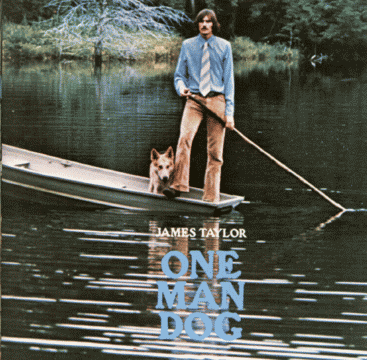
I saw Taylor in concert in Columbus back in 1972, right after the release of One Man Dog and his marriage to Carly Simon. I took a girl named Lisa with me. I'd had a crush on her when we first met at freshman orientation together at Ohio State. I got over that and we became good friends.
I knew that Lisa did some drugs--grass and the then-popular qualuudes, known as sopors because they made people soporific--and I was death on drugs. (Still am, for that matter.) But I liked Lisa. I liked James Taylor and I knew that she did too. So I asked if she'd like to go to the concert with me.
The first thing she said when she got into my car that night was, "I know that you don't do drugs. But I've got one sopor in my purse and we can split it if you want to."
I wasn't sure what the etiquette was for turning down a date's offer of an illegal substance. So, I just said, "No, thank you," although I wanted to add, "I'd prefer to actually take in and remember the concert."
She deferred to my preferences and so far as I know, she didn't drop the sopor. Taylor was wonderful...too wonderful to put behind a drug-induced fog.

Here's what One Man Dog and John Wesley Harding looked like.


[UPDATE: Richard also pointed out the second track of Infidels to me a few weeks ago. It's called 'Sweetheart Like You' and it's definitely about Christ. Check out the lyrics here.]
[ANOTHER UPDATE: Richard and I have dialogued about Dylan before.]
What did I get?
First, I picked up a 2002 release from the Elms called The Chess Hotel. I love the Elms. I saw them after they'd released an EP, before their first LP came out. They were young and friendly and so happy to be able to play their music. The Beatles were a huge influence on them, clearly, and like them, lead singer and composer, Owen Thomas, has a great sense of melody. [Click on all the images below to see them in full.]

I also got two by Dylan. Blonde on Blonde, which I think, my friend Richard has said is his favorite Dylan release. It came out in '66 and the CD I picked up is digitally remastered.
I also got a remastered version of Infidels. It came out in 1983, ostensibly after Dylan's "Christian phase," though frankly I believe that he's always been, again as Richard puts it, a Jewish Christian...even before the Christian phase.
You hear that in a lot of his stuff. The very title of Infidels evokes Old and New Testament themes---you might want to check out the entire Old Testament as well as the New Testament book of First Peter to see if I'm leading you astray or not. It can refer to the faithlessness of the faithful, of which I have firsthand knowledge as a sinner saved by grace...to the exile of Israel and Judah...Or maybe to believers being, in First Peter's phrase, "aliens and strangers" in the world. (An old hymn, picking up on this theme, said, "I'm but a stranger here, heaven is my home.")
Historian and bishop N.T. Wright points out that from the earliest days of the Church, the Jews who followed Jesus made a claim that would have horrified them just a few years earlier: That Jesus and Yahweh--God--were one and the same. Dylan, as Richard pointed out to me a few weeks ago, seemed to make a similar claim in the title track of his 1967 release, John Wesley Harding, one of my favorite Dylan LPs. Richard points out that the initials of Dylan's criminal-hero, JWH, are a rough transliteration for the vowel-less Hebrew word for God's Name, Yahweh (I AM). Richard also pointed to some of the lyrics Dylan used to describe the fictional Harding, which might as readily describe Jesus:
John Wesley Harding
Was a friend to the poor...
...he was always known
To lend a helping hand...
[and most evocatively of all:]
All across the telegraph
His name it did resound,
But no charge held against him
Could they prove...
Richard's hypothesis holds up for me when one considers the name Dylan gave his hero. Jesus, in spite of no charge that could be proven against Him, was subjected to the form of execution reserved for the worst criminals. John Wesley Hardin was an outlaw and all-around bad guy.
Why do you suppose Dylan added a "g" to the last name of his crook? Do you suppose it was because he saw the One convicted as a criminal as being one and the same as somebody we call by a word starting with "g"? Hmmm.

(Infidels was produced by Mark Knopfler, who also played guitar on it. The first time I ever heard Dire Straits, Mark Knopfler's band, I thought it was a new Dylan track. Dylan claims not to hear any similarity between his and Knopfler's voice. I often wonder why most of us can't hear what other people deem so obvious.)
I also got a copy of James Taylor's Mud Slide Slim and the Blue Horizon. I owned this on vinyl right after it was released in 1971. It was the first thing I bought by Taylor. I so fell in love with Mud Slide then, that I bought Sweet Baby James, which had been released earlier. I love the home cooked feel of this LP, although Peter Asher, formerly of Peter and Gordon and brother of one time Paul McCartney girlfriend Jane Asher, doesn't allow the LP, as so many it its ilk do, to fall into sloppiness. (Think Wildlife by McCartney.)
I saw Taylor in concert in Columbus back in 1972, right after the release of One Man Dog and his marriage to Carly Simon. I took a girl named Lisa with me. I'd had a crush on her when we first met at freshman orientation together at Ohio State. I got over that and we became good friends.
I knew that Lisa did some drugs--grass and the then-popular qualuudes, known as sopors because they made people soporific--and I was death on drugs. (Still am, for that matter.) But I liked Lisa. I liked James Taylor and I knew that she did too. So I asked if she'd like to go to the concert with me.
The first thing she said when she got into my car that night was, "I know that you don't do drugs. But I've got one sopor in my purse and we can split it if you want to."
I wasn't sure what the etiquette was for turning down a date's offer of an illegal substance. So, I just said, "No, thank you," although I wanted to add, "I'd prefer to actually take in and remember the concert."
She deferred to my preferences and so far as I know, she didn't drop the sopor. Taylor was wonderful...too wonderful to put behind a drug-induced fog.

Here's what One Man Dog and John Wesley Harding looked like.

[UPDATE: Richard also pointed out the second track of Infidels to me a few weeks ago. It's called 'Sweetheart Like You' and it's definitely about Christ. Check out the lyrics here.]
[ANOTHER UPDATE: Richard and I have dialogued about Dylan before.]
Thursday, August 21, 2008
"The idea that the universe has no origin is a counterintuitive faith assumption"
"Is it inconsistent, as Richard Dawkins claims, for believers in God to look for scientific explanations of natural things, if they don’t think it is necessary to seek scientific proof of God’s existence?" A good answer.
Subscribe to:
Posts (Atom)