Showing posts with label Hebrews 11:1. Show all posts

Saturday, February 16, 2019

How to Claim Your Gift

[These are some thoughts shared with parents, grandparents, and family members of Upward basketball participants during halftimes of games today. What follows isn't exact because I simply jot down note for myself for these presentations; but this is what I intended to say anyway.]

The theme passage of Scripture the young people in Upward are focusing on right now is Hebrews 11:1, which says:
Faith is being sure of what we hope for. It is being sure of what we do not see. (NIRV)
Some of you may have read or heard about the TV personality who claimed, maybe half-jokingly, this past week that he hadn't washed his hands in ten years. He said that he didn't believe in things he couldn't see and he couldn't see germs.

But there are lots of things that we believe in that we can't see. I can't see oxygen. But I believe that exists.

And although God has revealed Himself in Jesus Christ, we can't see Him right now. Yet many people believe in Him.

I may have mentioned to some of you that for ten years of my life, I considered myself to be an atheist. But I married a Christian and just to get her off my back, I started going to worship with her on Sunday mornings. Something strange started happening to me after I did this: I started to believe that God saves from sin and death those who have faith in Jesus, Who died and rose for people like me...and you. I received faith in Christ.

When I think of faith, I don't think of it as a virtue. The Bible says that faith is a gift from God (Ephesians 2:8-9). Faith in Jesus that saves us from sin and death and gives us life with God isn't something we can earn, work for, manufacture, or achieve in our own effort. And God wants to give faith in Jesus to everyone.

What I've learned is that there are several reliable places where God will meet us and present us with the gift of faith or the gift of deepened faith in Jesus.

First, God will give us faith in Christ through the Church. Some people say the Church is full of hypocrites. They're right...and I'm one of them! A hypocrite is anyone who at any time claims to be one way, but acts, or thinks, or lives in another. We hypocrites need the Church. I always say that the Church is God's hospital for hypocrites and there's always room for one more. The Bible says that the Church is "the body of Christ." In the fellowship of imperfect Christians, we can receive faith.

Second, God will give us faith in Christ through the Bible. When we call the Bible, "the Word of God," we mean that unlike other books we might read--instruction manuals, novels, biographies, whatever, the Bible is filled with the living power of God that will help me do what I can't do on my own: Have faith in the good news of new life for all who turn from sin and have faith in Jesus.

Third, God will give us faith in Christ through Holy Baptism. Holy Baptism isn't something we do; it's something God does. When we're baptized in the name of God the Father, God the Son, and God the Holy Spirit, God claims us as His own. We may choose to walk away from God, but in baptism, God commits Himself to never giving up on us. I know that I can turn back to Him for forgiveness, new life, strength, hope, peace, encouragement, and whatever else I need.

Fourth, God will give us faith in Christ through Holy Communion. In Communion, God gives Himself to us and fills us with His life and forgiveness.

Fifth, God will give us faith in Christ through prayer. Jesus tells us to pray to God the Father in Jesus' name. When I feel crummy because I know that I've committed a sin, failing to love God or love other people, God still lets me come to Him. Covered with the goodness and perfection of Jesus, I can ask for forgiveness, seek guidance, gain strength. I can ask for the faith to trust that Jesus is with me always and that, because of Jesus and my faith in Him--however weak my faith may be at the moment, nothing can separate me from God!

My faith isn't always strong. But I'm grateful that God is willing to renew the gift of faith within me as I meet God in the Church, in the Bible, in Holy Baptism, in Holy Communion, and in prayer in Jesus' name.

Let's pray. Heavenly Father, thank You for the gift of faith, which helps to trust in You even though, right now, we can't see You. When our faith wanes, when we sin, when we face discouragement or important decisions, helps us to turn to You and receive the gift of renewed faith. In Jesus' name. Amen

[I'm the pastor of Living Water Lutheran Church in Centerville, Ohio.]

Friday, August 02, 2013

Bessie: Joy from Jesus!

[This was shared during the funeral of Bessie, a member of Saint Matthew Lutheran Church in Logan, Ohio, the congregation I serve as pastor.]

Job 19:23-27a
1 Corinthians 15:1-7
Matthew 26:26-29
Luke 12:35-40

For some of us, myself included, there’s a disappointment that, though she had a full life, Bessie didn’t make it to her one-hundredth birthday. But Bessie, I can assure you, does not share in that disappointment. She took a dim view of having a fuss made over her if she turned 100 and besides, she told me, “One-hundred seems so old.”

But there are other reasons that Bessie wouldn’t share our disappointment.

One is that she may have been the most upbeat, positive, joyful person I ever met in my life! She had pain and griefs in her life, of course. And she acknowledged them. But she wasn’t defined by them. She wasn’t laid low by them.

I told her about a year ago, “You know, Bessie, when your circumstances dictated that you move out of your home and into the Carlin House, I never heard you complain.” “Well,” she said, “there were two ways I could have reacted. I could have been unhappy or I could have been happy. I chose to be happy.”

I chose to be happy. Now, it’s true that some people are able, by nature, to more easily make the decision to be happy and make it stick. And Bessie understood this. When she consider people who suffered from depression, she clearly understood that depression is a disease that sometimes happens to people. “It must be awful,” she told me, with empathy. And I saw her display her empathy toward people who were depressed. She was a comforting presence to them.

But the big reason, I believe, that Bessie was able to choose to be happy was that she had a rock solid faith in Jesus Christ. And hers wasn’t the superficial faith of someone who had a passing acquaintance with the teachings of the Church. She had a relationship with Jesus Christ.

That was so clear every time I visited with her over the past nearly six years. I took Holy Communion when I visited Bessie, whether at her home on Culver, or later at Carlin. Every time she received the Sacrament, she expressed gratitude that Christ had come to her and offered her forgiveness and His presence and His promise of eternity once more. “Oh, thank you,” she would say, sometimes with tears, “It’s such a gift!”

And the last time I was able to take Communion to her, Bessie told me, “You know, I don’t think some people realize what a blessing this is!” She knew that in the Sacrament, the God of all creation was coming to her and she was grateful!

No one needs to be reminded, but it should also be pointed out that Bessie had a lot of oomph! (Someone said earlier that she had a lot of spunk!) She had energy and joy to the end of her days.

I told her once, “I used to visit you thinking that I was going to inspire you. But I always leave here inspired by you.” She looked at me quizzically. She couldn’t understand what a special person she really was.

And maybe that was part of what made Bessie so special. She lived. She loved God. She loved others. She didn’t try to impress anybody. She didn’t know how impressive it was that someone legally blind would take the time and the effort to send birthday greetings, notes of encouragement, or thanks to people. (Every time I saw one of those notes, I was struck by the effort it required to do that!)

Bessie lived in the freedom of being a child of God, a living, loving member of the Body of Christ, the Church. That was inspiring!

Bessie remained special to the end. Deprived of much of her sight, she was also deprived of pursuing her lifelong passion for reading. Even big print books wouldn’t have been big enough for her to read. Undeterred, she ordered cassettes and later, CDs, of books and was always ready to recount the plot of the latest book she’d “read” in this new way.

She was part of the garden club at Carlin. (She told me once, “Some people just stand around at garden club, but I like to get my hands dirty.”)

Though she couldn’t see, she still helped out with the crossword puzzles the residents did together at Carlin.

She was always in Bible study and the weekly devotional worship there.

She went out on shopping forays whenever she could.

She made the best of challenging situations, like when Carlin was without power and she and the other residents had to be moved to the high school, where they slept on cots. Interviewed by the newspaper about it, Bessie, in typical fashion, talked about what a good job the Red Cross was doing.

She was always ready to talk about the Cincinnati Reds!

And, she seemed to pray for everyone!

Sometimes, she could give me the devil. When I forgot appointments with her or my commitment to do worship at Carlin, she let me know about it. I would get a phone call and a little lecture the next time I saw her. But she was quick to forgive and could tease me about the incidents later. And she was always after me to take better care of myself.

As was true of her attitude, Bessie’s oomph too came, I am convinced, not just from her nature or her upbringing, but from her faith in Christ. This is a person who truly lived in daily repentance and renewal. She used a scanner connected to her TV set to read the daily Bible readings and devotions and she regularly prayed for everyone on our congregation’s prayer list.

Bessie had no fear of death nor of dying. She knew that the crucified and risen Savior Jesus in Whom she believed had destroyed the power of sin, death, and futility over the lives of those who turn from sin and follow Him.

Bessie didn’t see Jesus as a rabbit’s foot who would make the bad things of this life go away. She agreed heartily with the words of Paul in 1 Corinthians 15:19: “If for this life only we have hoped in Christ, we are of all people most to be pitied.”

In the time I knew Bessie, her life demonstrated the truth that while Jesus doesn’t insulate us from life’s difficulties or from death, knowing that we have eternity with God, we are set free to live this life with joy, hope, a love for others, and a positive attitude. These attributes were all ones that Bessie lived out.

Especially, I think, joy. Joy is the word that springs immediately to my mind when I think of Bessie.

Now, I know for a certainty that there was nothing that Bessie more passionately desired nor more fervently prayed for than this: That all her friends and family would entrust their lives to Jesus Christ. She often spoke with me about this. She often asked me to join in praying with her about it. She believed in Jesus’ words in John 3:16: “For God so loved the world that He gave His only Son, so that everyone who believed in Him may not perish, but may have eternal life.”

The Bible tells us that the capacity for faith in an unseen God Who has conquered sin and death through His crucifixion and resurrection--the ability to believe in such overwhelmingly good news in a bad news world--is the proof of this unseen, loving, compassionate, powerful God.*

Let Bessie’s faith in Christ be exhibit one for any who may doubt this God in Whom she believed.

Let her life of joy, hope, love for others, and incredible positive attitude in the face of life’s challenges be exhibit two.

And may we all learn to believe in and follow Christ as Bessie did and so, live this life to the fullest, and one day, enjoy a reunion with our Lord and with all the saints who have believed in Him, including Bessie, that will last for eternity. Amen

*Hebrews 11:1 says: "Now faith is the assurance of things hoped for, the conviction of things not seen."

Saturday, June 08, 2013

Want Faith? Let Yourself Catch Grace

The Bible teaches that we come to a saving faith in the God revealed through Jesus Christ only by the power of the Holy Spirit. "No one can say, 'Jesus is Lord' except by the Holy Spirit," Paul writes in 1 Corinthians 12:3.

Faith in anyone but ourselves or in what we can control is foreign to human nature. And belief in the witness given by the apostles and other first Christians that, despite their own doubts, they could vouch with their lives that Jesus Christ, sinless God-in-the-flesh, not only died an undeserved death on a cross, but also rose from the dead, is also foreign to our natures.

Unless we're open to the ministry of the Holy Spirit--Who uses the witnesses of ordinary human beings to convict us of sin and convince us of the grace available to all sinners who turn from sin and believe in Christ as their only God and hope--the Spirit cannot create faith within us.

The refusal to even be willing in our imperfect human ways to believe in the Holy Spirit's proclamation of the God Who made us, Who hates sin, and Who, because He loves sinners, gives us a way to escape the consequences of sin--death and eternal separation from God--is epidemic in the Church and in society.

Bishop John Bradosky of the North American Lutheran Church (NALC) recently wrote insightfully:

In the Atlantic Monthly, columnist Jonathan Rauch writes that America has made “a major civilization advance” in recent years. Rauch, an atheist, is thrilled about a phenomenon he calls apatheism (“apathetic theism”). “It’s not that people don’t believe in God anymore,” Rauch writes, “the majority will still say they believe. ... The faithful in America haven’t been putting much thought or effort into their faith. They’re looking for comfort and reassurance, not for a God who asks anything of them. Apathetic theists don’t care about their own religion and care even less about the faith of others.”
New York Times columnist David Brooks noticed a trend a few years ago and coined the term flexidoxy (“flexible beliefs”).
“Flexidoxy describes the form of religion practiced by many educated young Americans, as opposed to orthodoxy. Basically, it means that people have become flexible in their belief system and look at religion as a giant smorgasbord from which they can pick and choose the beliefs that most suit them. They become the center of their own faith and adapt it to what they see as important.”
Both apathetic theism and flexidoxy may well be the consequence and by-product of the church when it avoids the Holy Spirit, on one hand, or abuses it on the other. Apathetic theism and flexidoxy are grounded in the power of popularity and political correctness but not the power of the Holy Spirit.
Into this world, the Church must bring to bear what it alone possesses and is called to proclaim, the Gospel of Jesus Christ through the power and work of the Holy Spirit.
Nobody can "prove" the truth of the Christian proclamation: 
  • the truth that human beings are born in a condition of separation from God called sin; 
  • the truth that, imprisoned by this condition, we inevitably commit sins and just as inevitably, even what seems like altruistic acts on our parts are tinged with selfishness and self-will; 
  • the truth that God is unwilling to let us to go to hell, the fate we deserve, without a fight; 
  • the truth that because of God's love for us, He sent Jesus into the world; 
  • the truth that Jesus died, taking our punishment for sin, and rose from the dead to offer new life that begins here and now even as we remain imperfect and extends into eternity where we will live in perfect fellowship with God and others saved by the grace given to all who believe in Christ.
No argument for these truths will convince anyone. But when we leave ourselves open to the witness the Bible offers about God and what God has done in Jesus Christ, something happens to us that subordinates (but does not eliminate) our intellects, our wills, and our emotions.

Put simply, we come to believe in Jesus Christ. Hebrews 11:1, in the New Testament, says: "...Faith is the assurance of things hoped for, the conviction of things not seen

I once was an atheist. I thought the Bible was a book written by human beings with their ideas about God, not, as I've come to believe that the Bible was inspired by God presented to human beings to save us. I thought that faith in Christ was for the pathetic. I thought that the message about Jesus, the gospel, was implausible.

But when I allowed myself to be open to Christ and to the ministry of the Holy Spirit operating in the Bible, in the fellowship of the Church, in the sermons of pastors, in the writings of Christians over the past twenty centuries, and in Holy Communion, even though I couldn't understand how Jesus' body and blood could be present in the bread and the wine or how a sinner like me could be forgiven by Christ, something happened to me. I came to believe in Jesus.

In the intervening thirty-seven years, my faith has been strong some times, weak at others. But the Holy Spirit has used means like those I mentioned above to shore up my faith, convict me of sins and so, convict me of my need for Christ, to convince me that Christ's death and resurrection were done for all sinners, including me, and that through Jesus, I really am forgiven and saved to live with and to live for God for eternity. 

Whether you're an atheist who stands outside the Church, as I once did, or a non-believing churchgoer like so many are today, if you want to have a faith that can change and shape your life and if you want the capacity to leave behind the delusion that you as a created being don't need your creator, I can assure you that you can have faith that changes this life and the one to come!

Let the Holy Spirit speak to you:
  • In the Bible
  • In the fellowship of Christians who honestly admit their own imperfections and relish the perfection and grace of God revealed in Jesus Christ
  • In the prayers you offer to God in Jesus' Name, prayers in which you should honestly share your doubts, but also your desire to believe
  • In listening to the preached Word
  • In joining convicted and convinced Christians in serving others in Jesus' Name
  • In being connected with a Church whose pastor (or pastors) and members evidence true belief in the God of the Bible, who reverence the Bible as God's perfect, inspired Word for the human race
  • In the Sacrament of Holy Communion, during the receiving of which you earnestly pray, "I don't know how Your body and blood and Your forgiveness can be in bread and wine, Lord, but I ask you to help me to trust that that is so"
None of the items in that list are good religious works. They will not earn salvation for you. And if you approach them as though they will, you will miss their point and miss out on faith. They are what the Reformation theologians called "means of grace," holes through which eternity bursts through to us, openings through which the arms of God can enfold you.
I've used the analogy before, but they're like a batted ball to which an outfielder goes to make a catch. The fielder has no control over the speed of the pitch made by the person on the mound. The fielder can't control what kind of charge the hitter puts into the ball once he's swung. All the fielder can do is position herself or himself to make the catch. 

God is using these means to "bat" faith our way. The question is are we willing to be where we need to be to "catch" the faith the Holy Spirit wants to hit our way?

The faith you catch won't make sense to you at first. There's so much about the Christian Gospel that doesn't make sense. That may, in your mind, make a case against surrendering faith in Christ at first. But, as C.S. Lewis points out in Mere Christianity, isn't also characteristic of the biggest facts in life to be not what you'd have anticipated at all? 
I met an elderly woman at a church where I was preaching one Sunday. She was matronly, having spent years as an elementary teacher and being something of a second mother to her students. This doughty little woman, I learned, had one something like $50-million dollars in the Ohio Lottery just the day before. I couldn't believe it. But it was true. The truest truths are often like that, beyond your capacity to imagine. That's the way it is with the message of the Bible about Jesus.
No matter how hard it is to believe in Jesus, it is absolutely true and it becomes more plausible as you allow yourself each day to more and more walk in Christ's orbit. And before you know it, if you're not careful, the Holy Spirit will have you saying and meaning things like this:
I believe in God, the Father Almighty, creator of heaven and earth.
  
I believe in Jesus Christ, His only Son, our Lord.  He was conceived by the power of the Holy Spirit and born of the virgin Mary.  He suffered under Pontius Pilate, was crucified, died and was buried.  He descended into hell.  On the third day He rose again.  He ascended into heaven, and is seated at the right hand of the Father.  He will come again to judge the living and the dead. 
 
I believe in the Holy Spirit, the holy catholic Church, the communion of saints, the forgiveness of sins, the resurrection of the body and the life everlasting.  Amen.
Are you willing to have faith like that expressed in the Apostles' Creed? 
If so, position yourself for it. Go to the places where the Holy Spirit can be counted on to be present. Then just tell God, "I'm willing to believe in Christ, Lord. I'm willing to doubt by doubts and worship You as my only God. Work the miracle of faith in me."

Guess what? I've seen that miracle take hold in the lives of hundreds of people during my twenty-nine years as a pastor and during thirty seven years as a Christian, including in my own life.

What have you got to lose? Shall I name what you've go to lose? You can lose sin and death and the hounding of the devil. Those are great things to lose!
Turn to Christ. Let the Spirit have access to your will and your life.

Then let the Spirit give you a faith in Christ that is more than Sunday morning propriety, but week-in and week-out trust in Christ that's so big you don't care who thinks you're crazy.

You'll want the whole world to know that the crucified and risen Jesus is alive and ready to change anyone's life. By your words and your life of (however imperfect) commitment to Christ, you'll unleash the Spirit that's changing you to change others. 

Changing may scare you. You may feel quite comfortable in your favorite sins or in your letting God do His thing while you do yours. But Jesus says, "Everyone...who acknowledges Me before others, I also will acknowledge before My Father in heaven; but whoever denies Me before others, I also will deny before My Father in heaven" (Matthew 10:32).

The Holy Spirit stands ready to help you get to know the truth about Jesus Christ and to learn how to publically acknowledge Jesus every day. 
Are you ready to let Him? Even if your answer is only, "Maybe," charge ahead! Position yourself to receive God's grace and the Lord Jesus at the center of your life!

Monday, April 01, 2013

Easter Faith

[This was shared during Easter worship with the people of Saint Matthew Lutheran Church in Logan, Ohio, yesterday.]

Luke 24:1-12
Easter: When God in the flesh, Jesus of Nazareth, having been executed on a cross, though He was sinless and without fault, rose from the dead.

Strange things happen in the wills, minds, and hearts of people who realize that Christ accepted the punishment for sin that we deserve, then took back His life again in order to offer forgiveness of sin, everlasting life with God, and a purpose for living we could never manufacture through owning, knowing, controlling, or entertaining ourselves.

If people aren’t careful, in spite of the doubts every human being experiences, in spite of being unable to prove anything about Easter, in spite of wanting to keep charge of our own lives and not giving control to God, the message of Easter--the message that God the Father so loved this world that He gave God the Son so that all who believe in Him may not perish, but may have eternal life--makes people do crazy things.

Things like:
  • giving as God has given to us,
  • forgiving as God forgives us,
  • living voluntarily under the will of God and not our own desires,
  • telling others that their lives can be changed forever if they trust in Christ and not themselves, or their looks, or their 401(k)s, or their brains, or their brawn, or their work ethic.
Those are things of the world that either die, or give out, or from which you and I will be separated when we draw our last earthly breaths.

Easter says that the God we meet in Jesus Christ has overcome death, will never give out, and can be with us always.

In the eyes of a world turned in on itself, that sees life on this earth as nothing more than an extended effort to make ourselves comfortable before we die, faith in the Jesus of Easter is a crazy thing. The risen Jesus, now enthroned in heaven, isn’t as tangible as a 70-inch HDTV, a well-appointed man cave, or the illusion of the perfect life. Faith in the risen Jesus doesn’t dismiss any of those things. But it challenges us to live for different ends.

Hebrews 11:1, in the New Testament, teaches us: “Now faith is the substance of things hoped for, the evidence of things not seen.”

For the Christian of today, faith is trust in a God we’ve never seen, faith in a resurrected Savior we’ve never seen. Having faith isn’t easy. “It’s harder to believe than not to.”

But here’s how faith in Christ works: If you refuse to believe, you will never believe. But if you confess to God how hard you find it to believe in Christ, how hard it is to surrender to a Savior you’ve never seen, but that you want to believe, God will use the Word and the Sacraments (Holy Baptism and Holy Communion), to build faith within you.

Sometimes our faith is minuscule. But if we will keep listening to the words of new life, forgiveness, and call to surrender that comes from Jesus through the Bible, the words of other Christians about Jesus, and the Sacraments, faith will come to us and even sustain us in the darkest times of our lives. “I don’t know how I could have gotten through without Jesus to lean on,” a widow whose joy of life had returned to her several years after the death of her husband, even though her grief would never completely go away.

Luke’s account of the first Easter begins: “Now on the first day of the week, very early in the morning, they, and certain other women with them, came to the tomb bringing spices which they had prepared. But they found the stone rolled away from the tomb. Then they went in and did not find the body of the Lord Jesus.”

The women went to the tomb without faith. They loved Jesus. They revered Him. But for all their devotion to Jesus, all they expected to find on that first Easter Sunday was His battered, wounded corpse. They had seen Him die. They had helped take His body to the tomb. They weren’t expecting their worlds to be turned upside down. But something crazy was about to happen to them!

Luke continues: “And it happened, as they were greatly perplexed about this, that behold, two men stood by them in shining garments [angels]. Then, as [the women] were afraid [understandably, since angels reflect the brightness and perfection of God Himself] and bowed their faces to the earth, [the angels] said to [the women], ‘Why do you seek the living among the dead? He is not here, but is risen! Remember how He spoke to you when He was still alive in Galilee, saying, ‘The Son of Man must be delivered into the hands of sinful men, and be crucified, and the third day rise again.‘ And they remembered His words. [Here’s where it gets crazy.] Then they returned from the tomb and told all these things to the eleven [the eleven surviving apostles] and to all the rest [the hundreds of other disciples of Jesus grieving in Jerusalem].”

At this point in Luke’s account of Easter, the women at the tomb are just like you and me: They had never seen the risen Jesus. But hearing again Jesus’ words of promise created faith within them.

Listen: The Word of God has power.

It doesn’t matter if the person speaking it is a butcher, computer programmer, retiree, housewife, basketball star, preacher, or angel. When the simple truth about Jesus’ death and resurrection is shared, it can create faith.

It may require years of hearing and reading the Word about Jesus for a person to have faith. I was in this category. I was thick of head and hard of heart. It took time for the good news about the crucified and risen Jesus to penetrate and give me faith.

Others are fortunate in that they hear the Word from their moms and dads as children and always have faith. I remember the president of the seminary, Fred Meuser saying, "I never remember a time when I didn't believe." Fred's father was a pastor, his mother a woman of God, and they imparted faith to Fred, a faith he received.

But whether in a short time or a long time, it's the Word of God that creates faith in Jesus Christ within us. Romans 10:17 says: “So then faith comes by hearing, and hearing by the Word of God.”

Another part of the Bible, Romans 1:16-17, says that the Gospel about Jesus “is the power of God for salvation to everyone who has faith..For in it the righteousness of God is revealed through faith for faith; as it is written, ‘The one who is righteous [the one who is right before God because their sins are forgiven and they know to go to God for forgiveness and direction]...The one who is righteous will live by faith.’”

There’s nothing you and I can do to convince ourselves that Jesus rose from the dead and will give new and everlasting lives to all who believe in Him. No recitation of convincing facts, not even the overwhelming evidence from the changed lives of once frightened disciples who willingly gave their lives to bear witness to Who Jesus was and what He has done.

Faith comes by hearing a Word you may not have expected or wanted to hear and your ability to hear it comes from the power of the Word about Jesus, what we call the Gospel, the good news.

When people come to faith in Christ or to the daily renewal of their faith that God gives to those who daily repent and daily entrust their lives to Jesus, they can’t  explain it. They know that faith is a gift and are gratified to have it because they know that only those with faith in Christ live with God.

Like anything that’s given to you, you can open it up or push it away. Luke writes in our lesson starting at verse 10: “It was Mary Magdalene, Joanna, Mary the mother of James, and the other women with them, who told these things to the apostles. And their words seemed like idle tales, and they did not believe them.”

The apostles should have believed, shouldn’t they? After all, they knew Jesus’ promises. In Luke 9:22, among other places, Jesus said: “The Son of Man must undergo great suffering, and be rejected by the elders, chief priests, and scribes, and be killed, and on the third day be raised.” But here were the apostles pushing the gift of faith in the risen Jesus preached by the women, away.

This was a perilous moment for the apostles. They had to make what Dietrich Bonhoeffer, the Lutheran pastor and theologian executed by the Nazis in the waning days of World War II, called “the decision.” We have to make the same decision every day. Bonhoeffer writes:
The time [on earth] is short. Eternity is long. [This life] is the time of decision. Those who are true to the word and confession [about the crucified and risen Jesus] on earth will find Jesus Christ standing by their side in the hour [when our lives are judged]. He will acknowledge them and come to their aid when the accuser [the devil] demands his rights [to take sinners with him into hell]. All the world will be called to witness as Jesus pronounces our name before his heavenly Father. If we have been true to Jesus in this life, he will be true to us in eternity. But if we have been ashamed of our Lord and of his name, he will likewise be ashamed of us and deny us. The final decision must be made while we are still on earth.
You don’t have to work to believe in the risen Jesus. But if you and I will not push Him away when He comes to us in His Word, the Bible, in the fellowship of believers, in His call to repent for sin, in His call to receive forgiveness, and in Holy Baptism and Holy Communion, we can have life-changing faith in Jesus Christ.

We can know the peace that passes all understanding.

We can live knowing that while without Christ, we can do nothing of importance, we can do all things through Christ Who strengthens us.

We can know that Christ is with us to the close of the age.

We can live with the purpose that belongs to the children of God, who without faith in Jesus, were no people, but with faith in Jesus become God’s people, people who once lived apart from the mercy and power of Jesus in their lives, but now have received and live in that mercy and power.

We can know that our sins are forgiven and our names are written in the book of life! [See Luke 10:20; Revelation 13:8; 20:12]

But when we embrace the gift of faith in the risen Jesus, we dare not keep it to ourselves! When the women received the angels word and faith that Jesus is our everliving advocate, friend, and Savior had come to them, they ran back to tell all the others who had followed Jesus during His earthly ministry.

This is the real test of whether our faith in Jesus is real or just a hobby on Sunday mornings. Lutheran pastor Brian Stoffregen asks, “Can we say that we really believe in the resurrection of the Lord if we aren't willing to tell others about it?”

Jesus is risen from the dead!

Turn from sin each day and entrust your life to Him. He will give you life that begins with Him at your side in this dying world and life that lasts forever in the perfect eternal world to come.

That’s the good news of Easter!

Don’t push it away.

Take it into your life every day.

Dare to believe.

Dare to ask for the power to believe that comes from God only to believers in God in the flesh, Jesus Christ.

Tell others.

Then watch your faith grow!

Sunday, January 20, 2013

The Son of God (Augsburg Confession, Part 3)

We’re involved in a sermon series that seeks to answer the question, “What is a Lutheran Christian?” We’re using one of the basic confessional documents of Lutheranism, The Augsburg Confession, which presents the Lutheran understanding of Biblical Christian faith, to help us answer that question.

Before launching into an exploration of the Confession's Article 3, “The Son of God,” I want you to know something: The devil worked hard to prevent this sermon from being studied for, written, and delivered. This past week, I have learned anew the truth of the words of Ephesians 6:12: “...our struggle [as followers of Jesus Christ] is not against enemies of blood and flesh, but against the rulers, against the authorities, against the cosmic powers of this present darkness, against the spiritual forces of evil...” The devil has fought with me every step of the way. I have been in the midst of the very kind of spiritual warfare that Martin Luther wrote about in A Mighty Fortress is Our God. And it is only by the grace of God, given to those who cling to Jesus Christ, that I've been able to push through.

This is a sermon then, that the devil does not want you to hear. So, I ask you all to pray that the Holy Spirit will work powerfully in this moment to open our minds, hearts, and wills to the only Truth we can reliably build our lives upon.

Now, there’s a reason the devil doesn’t want this sermon to be given today. It’s because the truths The Augsburg Confession’s Article 3 asserts about Who Jesus is, about what Jesus has done, and about what Jesus will do in the future, contradict the lies about Jesus that are gaining increasing currency in our time.

And Satan, the one Jesus calls “the father of lies” is behind every one of the lies told about Jesus today. You can’t go through a week without encountering these lies on the Internet, on TV, or in newspapers and magazines. Supposedly knowledgeable people say that Jesus wasn’t God in the flesh, wasn’t born of a virgin, didn’t rise physically from the dead, and isn’t the only pathway to God.

They ignore the testimony of reliable witnesses as to Jesus being the Son of God and Savior of the world.

They also ignore the fact that the ancient documentation for the understanding of Jesus they denigrate came earlier and from more different sources than any of the documentation that exists in relationship to other figures of the ancient world.

For example, Colossians 1:15-20, written by Paul in about 60 AD, is composed of material reflecting the confession of faith that all scholars, conservative and liberal, agree Christians were using to give witness about Jesus almost immediately following Jesus' death and resurrection.

The confession of faith found in these verses came together so close to the days of Jesus' time on earth that to read it is almost like reading an email about an event that happened yesterday. Take a look:
[Jesus] is the image of the invisible God, the firstborn of all creation; for in him all things in heaven and on earth were created, things visible and invisible, whether thrones or dominions or rulers or powers—all things have been created through him and for him. He himself is before all things, and in him all things hold together. He is the head of the body, the church; he is the beginning, the firstborn from the dead, so that he might come to have first place in everything. For in him all the fullness of God was pleased to dwell, and through him God was pleased to reconcile to himself all things, whether on earth or in heaven, by making peace through the blood of his cross. [Emphasis is mine.]
It’s bad enough that these lies are being foisted on the world at large. But what’s worse is that these revisionist views, held by people who want to revise God’s truth, have taken root in our own Evangelical Lutheran Church in America (ELCA).

For example, recently an assistant to the bishop of the Texas-Louisiana Gulf Coast Synod of our ELCA, Don Carlson, writing a guest post on his bishop’s web site, wrote of Jesus’ virgin birth: “I think that the [Christmas] stories are made up...”

In 2009, our ELCA publishing house issued a version of the Bible they called Lutheran Study Bible. It had footnotes written by ELCA scholars ostensibly designed to help readers better understand the Bible. Now, one of the most important passages in Scripture is Matthew 28:19-20, in which the risen Jesus, just before ascending into heaven, gives what we call “the great commission” to His Church, commanding us to make disciples of all nations, baptizing and teaching people to obey all that He commands.” But Dr. Duane Priebe, professor of systematic theology at another ELCA seminary, Wartburg in Iowa, wrote this in his footnote on Matthew 28:19-20: “[Jesus] does not mean make everyone disciples...Jesus includes in salvation people who do not believe in Him.”* While the New Testament intimates that people who have not heard the good news of Jesus’s life, death, and resurrection and seek to live in accordance with the law that God has written on every human heart (see Romans 2:14-16), will be treated with mercy by God, those who have heard the good news of Jesus and have not believed, according to Jesus, will be eternally separated from God (see John 3:16-18; Mark 16:16; John 8:24).

These incidents of revisionism aren’t isolated. Increasingly, revisionist theology is favored by the hierarchy, clergy, and publications of our denomination.

The reason for revisionism’s popularity is no mystery.  According to Genesis 3:5, Adam and Eve, responding to the temptations of the serpent in the Garden of Eden, wanted to “be like God” and so do we. Deny the revealed truths about Jesus, the Son of God, and you can be a god yourself, the ultimate authority over your life. But, folks, lose these truths about Jesus in order to act as our own gods, and we lose life, hope, peace, our humanity, and our salvation!


Please pull a copy of The Augsburg Confession from the pew racks and turn to Article 3, on page 12. It says:
Our churches teach that the Word, that is, the Son of God..., assumed the human nature in the womb of the blessed Virgin Mary. So there are two natures--the divine and the human--inseparably joined in one person. There is one Christ, true God and true man, who was born of the virgin Mary, truly suffered, was crucified, died, and was buried. He did this to reconcile the Father to us and to be a sacrifice, not only for original guilt [which we talked about last Sunday], but also for the actual sins of [humankind].

He also descended into hell, and truly rose again in the third day. Afterward, He ascended into heaven to sit at the right hand of the Father. There He forever reigns and has dominion over all creatures. He sanctifies [meaning, He makes holy or sets apart for God] those who believe in Him, by sending the Holy Spirit into their hearts to rule, comfort, and make them alive. He defends them against the devil and the power of sin.

The same Christ will openly come again to judge the living and the dead, and so forth, according to the Apostles’ Creed.
Every word of this article is rooted in the witness of Scripture. Every word lifts up Jesus as the Son of God. And it stands as a condemnation of the lies a revisionist world tells about Jesus.

But how can we know that the revisionists are wrong?

How can you and I know that Jesus is the Son of God Who can fill both dead consciences and dead bodies with new life?
 
Let me lay before you one rational, empirical reason for believing that Jesus is the Son of God.

And then let me tell how I believe you can personally know that what the Bible and The Augsburg Confession teach about Jesus is true.

The revisionists say that the first Christians didn’t really meet the resurrected Jesus. They say that after Jesus’ death on the cross, the first Christians thought back on Him and had good feelings. These good feelings, the revisionists claim, caused the first Christians to think of Jesus as being with them in some way. Then, they claim, the Christians made up the stories of Jesus’ resurrection to convince others that they could have good feelings too.

Please pull out the pew Bibles and turn to 1 Corinthians 15:3-8.

First Corinthians was written by the apostle Paul in about 55 AD to the church at Corinth, which he had founded. Here, he reminds them, of the most basic evidence that Jesus is Lord. He says:
...I delivered to you first of all that which I also received: that Christ died for our sins according to the Scriptures, and that He was buried, and that He rose again the third day according to the Scriptures, and that He was seen by Cephas [Cephas is the Latin version of the apostle Peter’s name], then by the twelve [apostles, including  Matthias, who took the place of Judas after Judas betrayed Jesus and took his own life]. After that He was seen by over five hundred [believers in Jesus] at once, of whom the greater part remain to the present, but some have fallen asleep [some had died by 55 AD]. After that [the risen Jesus] was seen by James [this is one of physical sons of Mary and Joseph and Jesus grew up in the same household with James], then by all the apostles. Then last of all He was seen by me also...
Paul claims that more than 500 people had seen the risen Jesus!

He was no figment of their good feelings.

He was real.

He was true God and true man, born of a virgin, the only way to peace with God, Who died and rose to give us a life with that not even death can destroy.

The first Christians never wavered in affirming the reality of Who Jesus was, of His physical resurrection, or of His promise to return one day to fully establish His kingdom.

They staked their lives on these truths, hard as nails people who had drunk deeply of life and of sin, but who had been given new life through Christ.

And many of these tough people--fishermen, tax collectors, former prostitutes, soldiers, manual laborers, scholars, rich, poor, men, and women would, like Paul and Peter, accept execution a punishment for their belief in the Son of God, rather than turning their backs on Jesus!

The first followers of Jesus weren't firebrands. They weren't kooks. They weren't desperate. They had everything to lose and nothing to gain from sticking with their story about Jesus. Yet they did stick with it!

When you see rational people staking their lives on the veracity of a truth they claim to have experienced--John says that he and the other first Christians had heard, seen, and touched with their hands the crucified and risen Son of God (see 1 John 1:1-3)--that’s an empirical reason for believing that Jesus is the Son of God.

But trusting in Jesus--having faith in Jesus--isn’t the result of believing in empirical evidence.

I have known people and you have too, who believed that Jesus is the Son of God, that He was born of a virgin, and that after suffering for us, He rose from the dead. Yet they still don't believe in Jesus. They don't trust Him. They trust themselves. Or they put their trust in things of the world, every one of which will die.

The simple truth is that we can’t be forced into believing in Jesus by trotting out facts. Nor can we be said to believe in Jesus just because we accept the veracity of the New Testament's claims about Jesus. According to 1 Corinthians 12:3, faith in Jesus is a gift that God’s Holy Spirit creates only in those who are willing to believe in Jesus.

And this leads us to how, finally, you and I can know that Jesus, the Son of God, is, has done, and will do all the things claimed by Article 3 of the Confession.

Turn please to Hebrews 11:1. It says:
Now faith is the substance of things hoped for, the evidence of things not seen. 
You’ve heard me tell many times of my experience as an atheist who came to faith in Jesus Christ.  Intrigued by the Lutheran Christians of Ann’s home church, I attended a 16-week class called, Life with God.

I read the book we used for the class.

I read and wrote down all the Bible verses to which it referred.

I asked questions.

I listened.

The more I heard and read about Jesus, the more I wanted Him as my Lord!

I was still resistant. I had my own plans. I really wanted to be my own god.

But, in the midst of all this, even when I still thought of myself as an atheist, I found myself praying to the God revealed to the whole world in Jesus.

There wasn’t a lightning flash moment when faith came to me. I simply had been open to believing and the closer I got to Jesus, the more firmly the Holy Spirit created faith in Jesus within me.

I believed in the Son of God.

As the passage from Hebrews tells us, my faith became the evidence of things unseen.

Among the people I've meet on this earth, I’ve never known a person born of a virgin.

Or a sinless human being.

Or someone who rose from the dead days after their death.

And neither have you.

But by faith I came to know and I still know such a person, the God-man Jesus.

And if we will open ourselves to Him, all of us can, by faith, know Him.

We can experience His presence with us as a constant companion who will usher us into the presence and love of God.

And as we hold onto that faith, as we cling to Jesus, we can be assured that one day we will see Him face to face.

This is a sermon the devil didn’t want you to hear, which only proves how important it is to know, follow, and surrender to Jesus, the Son of God. Amen!

[This was shared during both worship services with the people of Saint Matthew Lutheran Church in Logan, Ohio today.]

*After numerous protests, Priebe's comments were excised from the next edition of Lutheran Study Bible. However, he never recanted for the position he took on Matthew 28:19-20. Nor, apparently, was there ever any attempt on the part of the ELCA or the synod to correct him or the church's publishing house for his original comments.

Wednesday, December 16, 2009

Faith to See The Other World in This World

[This was shared tonight during midweek Advent worship with the people of Saint Matthew Lutheran Church in Logan, Ohio.]


Matthew 1:18-24
The German poet Rainer Maria Rilke wrote, “There is another world, the same as this one.” A Christian ethics professor, Stanley Hauerwas, quotes Rilke and says, “We simply must learn to see the world in which we live as the world that the Father created and redeemed through the Son.”

Often, you know, some Christians get caught up in a sort of other-worldliness, acting as though they're just skimming along this world's surface, too holy to be bothered with the things that mere mortals care about.

They're like the fellow whose boss grew so frustrated with his employee's constant preaching and failure to get his job done that the boss finally had to fire him. He was, the employer said, so heavenly-minded that he was no earthly good.

That happens to people who mistakenly see Christian faith as being all about the sweet by-and-by.

But the call of a Christian is not to bide our time with sweet talk until we die and go to heaven.

Our call is to follow Jesus Christ in the rough and tumble of the here and now, even when it's hard.

We’re called to understand that though this world has fallen into sin, it is still the world God created. And though, because of all that the condition of sin has unleashed—a penchant for personal sin, a susceptibility to illness, a victimization by death--this is still the world to which Jesus came on the first Christmas in order that its people might be saved from eternal separation from God. It’s this world into which Jesus sends us to love and serve others and to make disciples.

Through the eyes of Christian faith, you and I are called to see this world as one worthy of our making the very same sacrifice Jesus Christ made when He went to the cross. Right now, we're called to live in this world. Jesus calls us to see in every person on this planet someone He loves, someone for Whom He died and rose.

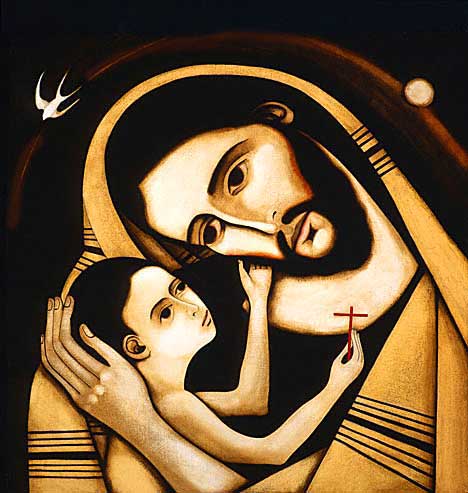
I thought about all of this last night when I once again considered Joseph, the man God chose to be the earthly father for God the Son, Jesus.

In some ways, God asked more of Joseph and of Joseph’s faith in God than God even asked of Mary, about whom we spoke two weeks ago. I’m not belittling what God asked of Mary at all, as you well know. Mary, the Bearer of God, risked all—reputation, marriage, and life itself—when she trustingly accepted the message from the angel and said, “Let it be to me according to your word.”

But, as changes came over Mary’s body, as the baby in her womb began to move and then kick, and as she could know as nobody else could that the baby she bore wasn’t conceived in the usual way, she carried and lived with tangible proof of what she accepted. He body told her day in and day out that she really was carrying God-in-the-flesh within her.

Joseph though, had to believe without such knowing. The New Testament book of Hebrews says, “Now faith is the assurance of things hoped for, the conviction of things not seen” (Hebrews 11:1). In his acceptance of the message God delivered to him in a dream and of the assertions of Mary, Joseph confirmed his belief that there is another world: It's the same as this one, unfolding here and now, but happening at another level from what most people dare to see.

Through the eyes of faith, Joseph was able to see more deeply, more clearly, truer. His wife was pregnant, yes; but she hadn’t been unfaithful. She bore a child, yes; but not just any child.

Today, some will look at Jesus on the cross and see defeat. But we can see victory: God conquering the power of sin and death over our lives.

Some will look at sinners thriving and take it as confirmation that there is no God and that anything goes. But we can see the patience of God with sinners and the time God is giving those of us in the Church to fulfill our mission of sharing the possibility of forgiveness and new life through faith in Christ with others.

Some see death, tragedy, and fatal diseases and blame God or call God impotent. But even amid the ashes and tears of this world, we see that God is making a new world beyond tragedy and tears, a new world where all believers in Christ will one day live with God in, using Luther’s words from The Small Catechism, everlasting “righteous, innocence, and blessedness.”

My family and I attended a memorial service for an old family friend from our home church on Monday night. Bill died down in South Carolina, where he and his wife had made their home over the twenty-six years since his retirement. Pastor Phillips, once the pastor of our home church gave the message and reminded us that after losing a loved one, we may feel orphaned. But he also reminded us of the promise Jesus gave to His heavy-hearted disciples on the night before His arrest. Jesus said that He would soon be leaving them. But then Jesus promised, “I will not leave you orphaned. I am coming to you;. In a little while the world will no longer see Me, but you will see Me.” (John 14:18-19)

Joseph is a model of Christian faith because, by faith, he saw what others couldn't see and what few would have even been willing to see.

He saw the Child in Mary’s womb as the world’s God and Savior.

He saw God working in a world that was often unspeakably hard and unforgiving.

How did Joseph do that?

The Bible reveals no secret formula for having that kind of faith. Joseph’s faith was built just as ours must be built.

Joseph was able to trust in God because Joseph was willing to trust in God. God took that willingness and built a faith out of it.

Just as God builds redwoods from tiny seeds, God builds faith from the seeds of our willingness to follow, even though we only see God’s promises through a glass darkly.

By faith, Joseph came to know that God was not leaving him orphaned.

By faith, Joseph gained the assurance of things hoped for.

By faith, he could see what others couldn’t see.

May this Advent and Christmas season find us willing to trust God.

May God help us to see through the eyes of faith the new world that He is already creating through His Son right now in the midst of this world.

May we see in the Christ Child not just a pleasant story in the midst of a humdrum and difficult world, but the One Who turns this humdrum and difficult our world—and our lives—around for all eternity. Amen

[Painting above: Saint Joseph and the Christ Child by Michael D. O'Brien.]