Showing posts with label Luke 19:28-40. Show all posts

Monday, March 21, 2016

Welcoming the One Who Can Change Everything

[This was shared during the morning's two Palm Sunday worship services with the people and friends of Living Water Lutheran Church, Centerville, Ohio.]

Just before today’s gospel lesson containing Luke’s account of Palm Sunday, we read about Jesus meeting a man named Zacchaeus. Jesus was passing through the city of Jericho, heading for Jerusalem. Zacchaeus climbed into a tree to get a glimpse of Jesus as Jesus walked by.

Zacchaeus, you know, had gained his riches by extorting more taxes from people than they actually owed. He wasn’t popular in Jericho. But Jesus invited Himself to Zacchaeus’ house.

It helps us to understand Luke's account of Palm Sunday if we first understand what happened between Jesus and Zacchaeus.

Let’s take a look at Luke 19, starting at verse 5. It says that Jesus saw Zacchaeus and, “When Jesus reached the spot, he looked up and said to him, ‘Zacchaeus, come down immediately. I must stay at your house today.”

You might think that Zacchaeus’ first impulse would be to tell Jesus to find somewhere else to stay. He had only climbed the tree to see what all the fuss was about. Besides, he could see by Jesus’ attire that Jesus was just a poor Galilean, while Zacchaeus was filthy rich.

Yet Zacchaeus doesn't react as you'd expect!

All of us have the same choice in this life that Zacchaeus had to make at that moment. We can choose to receive Jesus trustingly or not.

“Here I am!” the risen and ascended Jesus is recorded as saying in Revelation 3:20, “I stand at the door and knock. If anyone hears my voice and opens the door, I will come in and eat with that person, and they with me.” He does so because He wants to come into our lives, be our Savior, our best friend, and our King.

The question before everyone who hears of Jesus is the same, “Will we let Him into our lives to reign over us as God and Lord?” Zacchaeus' answer was, “Yes!”

Luke 19:6 says that Zacchaeus hurried down and received Jesus “gladly.”

In Luke 19:9, Jesus, considering how Zacchaeus had received Jesus by faith, declares: “Today salvation has come to this house, because this man, too, is a son of Abraham. For the Son of Man came to seek and to save the lost.”

Whenever you and I get lost, wandering far from God by engaging in unrepentant sin, God can find us again! Through Jesus, God can find any willing to be found by grace!

Not everyone was happy about the change that had come to Zacchaeus’ life. Not surprising. The moment you feel that you’ve been made clean by the forgiveness and grace God gives through Jesus, that's when the devil, the world, and your sinful self will start grumbling. Bet on it! "Who are you to receive God’s forgiveness?" the grumblers inside and outside of us demand.

The grumbling that day in Jericho came from some of the crowd. Look at Luke 19:7. “All the people saw this and began to mutter, ‘He has gone to be the guest of a sinner.’”

They evidently didn’t know that sinners are the only kinds of people to whom the God we know in Jesus Christ goes. And it’s only when you’re a sinner and you know it that you’re ready to welcome Jesus and His grace for you!

It’s interesting that, as we come to our gospel lesson, Jesus was walking from Jericho to the Mount of Olives, moving toward Jerusalem. About 1200 years before the birth of Jesus, God’s people entered the Promised Land from the east, crossing the Jordan to face the walled city of Jericho. Jericho had to be conquered so that God’s people could take the land. The leader of the Hebrews was Moses’ successor, Joshua. His name in the Hebrew language was Yeshua, meaning God saves. It is the same name as that of Jesus. In the Hebrew language, Jesus’ name was also Yeshua.

When the Joshua of the Old Testament prepared to enter the promised land, you’ll remember that he sent two spies into Jericho. Twelve-hundred years later, Jesus needed no spies. He knew everything that was going to happen. He knew where His enemies were.

But Jesus did send two disciples ahead of him. He instructs the two disciples to find a colt in a nearby village, presumably Bethany. It would, Jesus tells them, be tied, and would be an animal on which nobody had previously ridden.

That last bit of information is important: Jesus, God in the flesh would be the colt's first rider. This is part of a pattern in Jesus’ life on earth.

When Jesus was born, He came from a womb that had never known sexual intimacy.

When Jesus died, His body was “in a tomb cut in the rock, one in which no one had yet been laid.”

The things of God must always be first, holy, and set apart.

Jesus is, as the New Testament book of Hebrews calls Him, our pioneer. Jesus writes new histories for those who repent and believe in Him, making of each us a new creation.

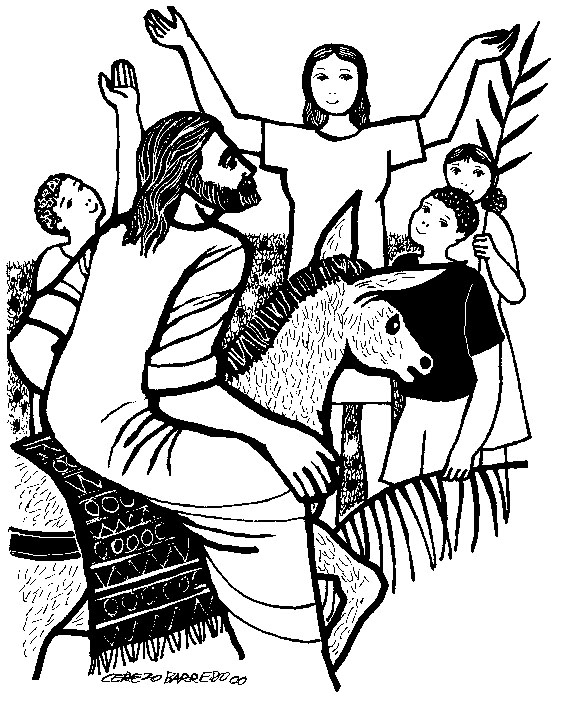
The two disciples find everything as Jesus has told them. They bring the animal back, throw their clothes on it, and set Jesus on it. This is how royalty and revered priests rode into Jerusalem.

As Jesus entered Jerusalem, He no doubt thought of all that lay ahead of Him on Maundy Thursday and Good Friday. Verse 37: “When he came near the place where the road goes down the Mount of Olives,the whole crowd of disciples began joyfully to praise God in loud voices for all the miracles they had seen: ‘Blessed is the king who comes in the name of the Lord!’ ‘Peace in heaven and glory in the highest!’”

It’s important to point out a couple of things that are unique about Luke’s telling of Palm Sunday. First, there’s no mention of palms. Second, he doesn’t mention the crowds shouting, “Hosanna.” And third, in Luke’s telling, only the disciples welcome Jesus, not the crowds.

That doesn’t mean that there weren’t palms, hosannas, or welcoming crowds. It does mean that Luke wants to focus on other things about Palm Sunday, things that he foreshadowed in the events in Jericho surrounding Zacchaeus.

Using the words of Psalm 118, the disciples welcomed Jesus to the holy city.

As subsequent events would prove, they didn’t totally understand what was going on. Some thought that Jesus was going to start a revolution and throw out the Romans. None would have predicted Good Friday or Easter.

At that moment, they knew very little. But they knew enough to praise Jesus.

We don’t know what lies in our immediate futures either. We don't know what God has in mind for us. We don't know what valleys or Good Fridays this fallen, sinful world may mete out to us. For all we don’t know though, we should know enough to praise Jesus! We should know enough to welcome Him into every part of our lives.

But don’t expect the devil, the world, or even our inner sinful rebels to take the suggestion of welcoming Jesus as Lord and King over our lives very readily! We want to be kings of our own lives, which is why around this time every four years, most presidential candidates fall all over ourselves stroking our egos instead of telling us the whole truth.

Verse 39: “Some of the Pharisees in the crowd said to Jesus, ‘Teacher, rebuke your disciples!’” There will always be people who grumble about the joy Christians know in Christ. Fact is, we all can be grumblers, at least some of the time.

The reason for that is simple: If you dare as a Christian to live in daily repentance and renewal, you can count on God to confront you for your sins, even as He embraces you in His grace and love.

God loves sinners, but God still hates sin and always will. By His grace, through Jesus Christ, God is committed to removing sin from our lives.

But none of us likes being separated from our sins. We get comfortable with them, you know. They become part of us, if we’re not careful: the compromise in business ethics; the stolen lustful glance; the indifference to the state of our own souls; the failure to pray for or help those in need.

We resist parting with our sins. Of course, we’ll never be completely free of sin this side of heaven. But the Christian tells Jesus, “Let the old self be crucified, so that the new self can rise with You today and every day. Help me to be more like my Lord! Fit me for eternity in the midst of my time on earth.

Jesus, of course, wouldn’t make His disciples stop welcoming and praising Him. In verse 40, Jesus tells the Pharisees, “I tell you...if they keep quiet, the stones will cry out.”

In Romans 8, the apostle Paul says that the whole creation--even, I suppose, the rocks--groans under the weight of human sin and waits eagerly for the children of God to be revealed clearly on the day of Jesus’ return to this world. So rocks that cry out aren’t so far-fetched after all!

Please, though: Don’t let inanimate stones take your job!

It’s our job and our joy to welcome Jesus into our lives and, like Zacchaeus to tell others of our thankfulness that Jesus--God in human flesh--went to Jerusalem, to suffering and a cross, to hell itself, and then rose from death to set us free from sin and death.

This week, I invite you to focus especially on welcoming Jesus into your life. I ask you to do that in a few simple ways.
  • First, I hope that you will be at both the Maundy Thursday and Good Friday services. The two days mark different events and have different themes. Both can deepen your walk with Christ.
  • Second, ask Jesus to show Himself to you in people in need. Jesus says that whatever we do to the least, we do to Him.
  • Third, ask Jesus to show you those places in your character where You need to welcome Him as Lord. Maybe there’s a sin of which you need to let go, a lack of compassion for those who differ from you, an indifference to the people you meet in life’s everyday places, or simply not spending time with God in His Word and prayer. Welcome Jesus’ correction.
  • Finally, if there's a hurt that won't go away, a broken heart that it seems will never heal, welcome Jesus into that hurt. Let Him love you. Let Him heal your broken heart.
Welcome Jesus to reign over you this coming week and see what He does.

Welcoming Jesus into the center of our lives: That’s what Palm Sunday is all about. Amen!


Sunday, March 24, 2013

Palm Sunday: Welcome Jesus, Welcome Others to Know Jesus

Luke 19:28-40
“Zacchaeus was a wee little man,
And a wee little man was he.
He climbed up in a sycamore tree
For the Lord he wanted to see;
And as the Savior passed that way,
He looked up in the tree,
(Spoken) And he said, ‘Zacchaeus you come down
For I'm going to your house today.
For I'm going to your house today.’”

That's a simple little Bible song about an incident in Jesus’ earthly ministry. Jesus was passing through the city of Jericho, which sets at the lowest point on earth, heading for Jerusalem. A short man named Zacchaeus, climbs into a tree to catch a glimpse of Jesus as Jesus walks by. Zacchaeus had gained his riches by extorting more taxes from people than they owed. He wasn’t popular in Jericho. But Jesus invites Himself to Zacchaeus’ house.

I bring this up because we it helps us to understand Luke's account of Palm Sunday if we first understand what happened between Jesus and Zacchaeus just before Jesus entered Jerusalem on that first Palm Sunday.

Let’s take a look at Luke 19, starting at verse 5. It says that Jesus saw Zacchaeus and said, “Zacchaeus, make haste and come down, for today I must stay at your house.” There's a lot of irony here. A sinner looks down on God in the flesh, Who has come into the world as a servant to all humankind. Yet the scene doesn't play out like that at all. You might think that Zacchaeus’ first impulse would be to tell Jesus to find somewhere else to stay. After all, he had only climbed the tree to see what all the fuss was about. He could see by Jesus’ attire that Jesus was just more Galileean riff-raff. Yet Zacchaeus doesn't react as you'd expect!

All of us have the same choice in this life that Zacchaeus had to make at that moment. We can choose to receive the gift of faith in Jesus or not.

“Listen!” the risen and ascended Jesus is recorded as saying in Revelation 3, “I am standing at the door, knocking; if you hear My voice and open the door, I will come into you and eat with you, and you with me.”

Jesus Christ wants to come into your life, be your Savior, be your best friend.

Jesus, Who died and rose to set you free from sin, death, and a pointless life, is knocking at the door of your will, life, and heart each day? Will you let him in?

Zacchaeus' answer was, “Yes!”

Luke 19:6 says that Zacchaeus hurried down and received Jesus “joyfully.”

When, after a decade of atheism, I received Jesus into my life, I knew a joy I had never experienced. I still had no clear idea of what God wanted to do with my life. Jesus didn’t offer me a life free of adversity or difficulty or death. But I didn’t care because Jesus was in my life and I knew that He was all I needed! I knew that Jesus Christ had saved me, a sinner who had once despised Him!

Sometimes, amid the routines and challenges of life, I forget that. But I have learned the truth of the Christmas hymn by Phillips Brooks: "Where meek souls will receive Him still, the dear Christ enters in." That's true no matter how many times we fall, no matter how far we've fallen!

In Luke 19:9, Jesus, considering how Zacchaeus had received Jesus by faith, declares: “Today [now, this moment] salvation has come to this house, because [Zacchaeus] also is a son of Abraham; for the Son of Man [Jesus refers to Himself in this way] has come to seek and to save that which is lost.”

Whenever you and I get lost, wandering far from God by engaging in unrepentant sin--be it thievery, gossip, fornication, adultery, worshiping other gods, dishonoring our parents, or some other way--God can find us again!

Not everyone was happy about the change that had come to Zacchaeus’ life. Listen: The moment you feel that you’ve been made clean by the forgiveness and grace God gives through Jesus, that's when the devil, the world, and your sinful self will begin grumbling. Bet on it!

"Who are you to receive God’s forgiveness?" the grumblers inside and outside of you will demand. "Who are you to be called one of God’s righteous saints?"

The grumbling that day in Jericho came from some of the crowd who had been shouting for Jesus. Look at Luke 19:7. “But when they saw [Jesus going to Zacchaeus’ house], they all complained [or grumbled], saying, ‘He [Jesus] has gone to be a guest with a man who is sinner.’”

I wonder how we would react if today, we saw Jesus enter the home of a drug dealer? Or an adulterer? Or an extortionist? Or any other sinner, like you or me?

But Jesus will enter any home and any heart that welcomes Him.

The grumblers that tell you that someone doesn’t deserve the forgiveness of God Jesus brings, the grumblers that tell you that you don't deserve the forgiveness that comes from Jesus Christ, completely miss the point.

Here's why: None of us deserves God’s forgiveness. We are all sinners who deserve condemnation and hell. But Jesus died and rose so that we can be with and enjoy God for all eternity! These gifts come to those who gladly receive Jesus.

It’s interesting that Jesus was walking from Jericho to the Mount of Olives as our Gospel lesson begins.

About 1200 years before the birth of Jesus, God’s people entered the Promised Land from the east, crossing the Jordan to face the walled city of Jericho. Jericho had to be conquered so that God’s people could take the land.

The leader of the Hebrews was Moses’ successor, Joshua. His name in the Hebrew language was Yeshua, meaning God saves. It is the same name as that of Jesus. In the Hebrew language, Jesus’ name was also Yeshua. But because the New Testament is written in Greek, where Yeshua becomes Yesus, we call him Jesus.

When the Joshua of the Old Testament prepared to enter the promised land, you’ll remember that he sent two spies into Jericho. Twelve-hundred years later, Jesus needed no spies. He knew everything that was going to happen. He knew where His enemies were.

But Jesus did send two disciples ahead of him. Jesus instructs the two disciples to find a colt in a nearby village, presumably Bethany, where Jesus raised Lazarus from the dead. It would, Jesus tells them, be tied, and would be an animal on which nobody had previously ridden.

That last bit of information is far more important than it may seem: God in the flesh would be the colt's first rider.

This is part of a pattern in Jesus’ life and ministry.
  • When Jesus was born, He came from a womb that had never known sexual intimacy. Jesus was the first born of a virgin’s womb. [See Luke 1:26-35; Matthew 1:18-25.]
  • When Jesus died, His body was “laid...in a rock-hewn tomb where no one had ever been laid.”  [See Luke 23:53.]
The things of God must always be first, holy, and set apart. Jesus is, as the New Testament book of Hebrews calls Him, our pioneer. He always writes new histories for those who repent and believe in Him on clean sheet of paper. He starts creation over again!

The two disciples find everything as Jesus has told them. They bring the animal back, throw their clothes on it, and set Jesus on it. Jesus begins to ride into Jerusalem. From the depths of Jericho, Jesus and the disciples ascend to the Mount of Olives. One New Testament scholar has written that even today, when you go by car, the culmination of the ascent from earth's lowest depth, Jericho, to the Mount of Olives, brings a sense of relief, the drive up is so steep. And the view, when one arrives, he says, is breathtaking: From the Mount of Olives, you look down into the Kidron Valley, and look across to see Jerusalem.

Jesus no doubt took in this sight, thinking of all that lay ahead of Him. Who can imagine what pangs Jesus felt as He kept His face set toward Jerusalem and the suffering and dying He would undergo for you and me? How alone He must have felt at that moment!

“Then,” verse 37 says, “as He was drawing near the descent of the Mount of Olives, the whole multitude of the disciples began to rejoice and praise God with a loud voice for all the mighty works they had seen, saying, ‘Blessed is the King who comes in the name of the Lord! Peace in heaven and glory in the highest!’”

It’s important to point out a couple of things that are unique about Luke’s account of Palm Sunday.
  • First, there’s no mention of palms. Those are in John’s gospel. Branches are mentioned in Matthew's and Mark's accounts of Jesus' entry into Jerusalem on this day. But no palms in Luke.
  • Second, he doesn’t mention the crowds shouting, “Hosanna,” an Aramaic prayer meaning, “Save us, pray.” 
  • And third, in Luke’s telling, only the disciples welcome Jesus, not the crowds. 
Now, does that mean that there weren’t palms, hosannas, or welcoming crowds? Of course not! It simply means that Luke has some things he wants you and I to notice about the first Palm Sunday, things that he foreshadowed in the events in Jericho surrounding Zacchaeus.

Using the words of Psalm 118, which some New Testament scholars say, was a hymn sung by worshippers as they headed for Jerusalem for festivals like the Passover, the disciples welcomed Jesus to the holy city.

Did the disciples fully understand what was going on? No.

Did some of them think that Jesus was going to start a revolution and set up an earthly kingdom to replace their Roman overlords? Probably.

Did any of them believe that Good Friday and Easter were going to happen? At that moment, I’m sure they didn’t know.

But they knew enough to welcome Jesus. We don’t know what lies in our immediate futures either. We don't know what God has in mind for us. We don't know what valleys or Good Fridays this fallen, sinful world may mete out to us.

Yet if we will welcome Jesus as our God and King, we do know that we have an eternity of Easter Sundays to look forward to!

And we do know that Jesus, Who was tempted, tested, suffered, died, and then rose, will be with us every step of the way!

But don’t expect the devil, the world, or even our inner sinful rebels to take our welcoming of Jesus lying down! Look at Luke 19:39, please. “...some of the Phairsees called to [Jesus] from the crowd, ‘Teacher, rebuke Your disciples.’” “Tell those people to be quiet! They need to can their faith in You!” they were telling Jesus.

There will always be people who grumble about the joy Christians know in Christ.

“Tell my daughter to quit reading the Bible so much, pastor” a mom once said to me. “Why?” I asked. “Religion has its place,” the mom asserted, “but we have to be practical.” Like Mary, the sister of Martha, that woman’s daughter had chosen the better part that could never be taken away from her. That's the part we must choose, too, if we are to have life with God!

The things of this world will die, damned to hell for eternity. As a design engineer who built great buildings and bridges once told his colleagues over dinner, “One day, all of this will burn.” But those who trust in Jesus Christ have life with God, now and forever! They welcome Jesus into their lives. The grumblers, even those who go to church on Sundays but forget about Jesus on Mondays, block Jesus from their lives by refusing to welcome him into every portion of their lives.

Fact is, we all can be grumblers, at least some of the time. The reason for that is simple: If you dare as a Christian to live in daily repentance and renewal, you can count on God to confront you for your sins, even as He embraces you in His grace and love. God loves sinners, but God still hates sin and always will. By His grace, through Jesus Christ, God is committed to removing sin from our lives. But it's a painful truth that none of us likes being separated from our sins. We get comfortable with them. They start to define us. We feel a natural resistance to God's intention to make us new by removing our dependence on our sins from us!

We’ll never be completely free of sin this side of heaven. But the Christian tells Jesus, “Let the old self be crucified, so that the new self can rise today and every day.”

Jesus, of course, refused the Pharisees request. He wouldn’t let His disciples stop welcoming and praising Him. In verse 40, Jesus tells them, “I tell you that if these should keep silent, the stones would immediately cry out.”

I've shared with some of you before that when our son was about eight years old, he said, "Hey, dad, you know how Jesus said that if people stopped worshiping Him, the stones would start worshiping Him instead?" "Yeah," I said. "Well, I know it would be bad if nobody was worshiping Jesus. But it would be kind of cool to hear how stones worshiped."

Listen: Don’t let inanimate stones take your job!

It’s the job and the joy of every Christians to shout and sing and live the praises of the God Who died and rose to set us and all of creation free from sin and death and futility.

It’s our job and our joy to welcome Jesus into our lives and, like Zacchaeus to tell others of our thankfulness that Jesus--God in human flesh--went to Jerusalem, to suffering, to a cross, to hell itself, and than rose from death to set us eternally free.

Welcome Jesus into your life!

Then welcome others to know Jesus!

That’s what Palm Sunday is all about.

Amen!
Sunday, March 28, 2010

How Will You React to Jesus? (Palm Sunday)

[This was shared during worship with the people of Saint Matthew Lutheran Church in Logan, Ohio, earlier today. Today is Palm Sunday.]

Luke 19:28-40
Ronald Reagan--for you young people, he was our fortieth president and a one-time movie star--had a story he loved to tell. It went like this: “Worried that their son was too optimistic, the parents of a little boy took him to a psychiatrist. Trying to dampen the boy’s spirits, the psychiatrist showed him into a room piled high with nothing but horse manure. Yet instead of displaying distaste, the little boy clambered to the top of the pile, dropped to all fours, and began digging. ‘What do you think you’re doing?’ the psychiatrist asked. ‘With all this manure,’ the little boy replied, beaming,’there must be a pony in here somewhere.’”

Of course, a little boy of a different nature might not have been so sure that there was a pony to be found. He may have decided that where there’s manure, there’s always...more manure.

The point is that two people may react to the same events, experiences, or people in completely different ways. And that’s fine. One of the things I’ve learned in life is that we all have different tastes and 99.9% of the time, our diverging views don’t really matter one way or the other.

But at other times, how we react may mean the difference between life and death, even eternal life and death.

Whenever we think of Palm Sunday, I suspect that we conjure up images of palm leaves waving, “Hosannas” being shouted, and vast throngs of people welcoming Jesus into Jerusalem on the Sunday five days before His crucifixion. But if you look at our lesson from the Gospel of Luke today, you find none of those things.

We do see Jesus’ closest followers putting their cloaks on the animal He rides and onto the pathway He takes into Jerusalem. But we have no mention of what Mark calls “leaves from the field.” Or what Matthew describes as “branches from the trees.” In fact, of the four gospels in the New Testament, only John’s mentions “branches of palms.”

In Luke’s telling, Jesus’ disciples cry out, “Blessed is the king who comes in the Name of the Lord! [And, echoing the song of the angels on the night of Jesus’ birth] Peace in heaven, and glory in the highest heaven!” But not once do we hear the crowds yelling, “Hosanna!,” a word that essentially means “Save now!”

And, as to crowds, our lesson only speaks of “the whole multitude of disciples,” meaning the hundreds of people who were followers of Jesus. But Luke doesn’t mention the thousands more who would have been in Jerusalem preparing to celebrate the Jewish Passover when Jesus arrives in the city.

What are we to make of these differences in the ways the four gospel writers tell the story of that first Palm Sunday? It all boils down, I think, to focus. Each of the gospel writers have different themes on which they focus, different aspects of Jesus’ story and of Christian faith.

And even more particular to today’s lesson, Luke’s account of the first Palm Sunday comes as part of a string of incidents in Jesus’ ministry and the parables he tells that hammer away at a single theme.

We see this theme earlier Luke, chapter 19, where we read of Jesus' encounter with a man named Zacchaeus. You know the story of Zacchaeus, probably. "Zaccheaus was a wee little man, and a wee little man was he...”

Jesus was traveling through Zacchaeus' hometown. Being a person of short stature, Zacchaeus climbed into a sycamore tree in order to get a good look at the celebrated preacher from Nazareth. When Jesus saw Zacchaeus, He called him down from his perch, explaining that He intended to visit Zacchaeus' place right then and there. Zacchaeus climbed down out of his tree and welcomed Jesus. The problem, as some of the good people of that town saw it, was that Zacchaeus was a notorious extortionist. But it wasn't to those supposedly good people that Jesus said, "Today salvation has come to this house." It was to Zacchaeus. The difference between Zacchaeus and the good "church people" (or the first century Judean versions of good church people was that he welcomed Jesus, while they rejected or ignored Jesus. (By the way, from the Bible’s perspective, ignoring Jesus is exactly the same as rejecting Jesus.)

Later in the chapter, just before Palm Sunday, Jesus tells a story about a king who left his people for awhile, just as Jesus would do after dying, rising, and ascending to heaven. Some of the king's subjects excitedly welcomed his return. Others didn't want him around.

As we come to his account of Jesus' entry into Jerusalem, Luke isn’t saying that there weren’t palm leaves, hosannas, or adoring crowds that first Palm Sunday. But, like a filmmaker showing us one or two people in a scene surrounded by thousands of extras, Luke wants to show us something very important, seen in the reactions to Jesus of two relatively small groups of people.

The first group is Jesus’ disciples. You and I know that at this point, just days before Jesus was to die on a cross, the five-hundred or so people who followed Jesus still didn’t get Him.* They thought that Jesus would be the sort of king who would get rid of the Romans, lower the taxes, and be good to God’s people…or at least, good to them according to how they saw things. But to the extent that they were able at the time, before the crucifixion and before Jesus’ resurrection, the disciples hailed Jesus as their king. They laid down their cloaks as an act of deference and respect. They praised God for Jesus and spoke enthusiastically about all the godly miracles Jesus had performed. They welcomed Jesus into their capital city of Jerusalem and into their lives.

Then, there were some Pharisees. The Pharisees, you know, believed that they could earn salvation and forgiveness of sin. They didn’t pay attention to the teaching of the whole Bible that salvation and forgiveness are gifts granted to those who turn from sin and trust in God. Appalled by the display of devotion to Jesus put on by the disciples, they tell Jesus, “Teacher, order your disciples to stop!” They rejected Jesus as the king of either Jerusalem or their lives.

Two reactions: Welcoming Jesus. Rejecting Jesus.

Those who reject Jesus reject peace in their hearts, life with God, and eternity.

Those who welcome Him receive peace, life, and eternity.

Jesus can either be the rock on Whom we build our lives or the stone on which we crash and eternally self-destruct. What will we choose to allow Him to be in our lives?

A couple I know told me about something that happened when their young granddaughter burst from her bed room, where she had been reading the Bible. "I get to live forever!" she said. So do all who welcome Jesus into the center of their lives. And even in the rough and rugged times of life, we have the promise of a God Who loves, forgives, and gives us life forever!

When the disciples welcomed Jesus into Jerusalem on the first Palm Sunday, they had no idea what they were getting into. They didn’t realize that their king would have to die and rise before He could claim His crown. They had no idea that following Him meant turning their backs on their sins, even the ones they enjoyed, so that they could take hold of the forgiveness and new life only Jesus brings.

For some, welcoming Jesus would mean death at the hands of their persecutors. For many, it would mean being rejected by family, friends, and society for trusting in the Savior they had seen dead and risen. But each day for the rest of their lives, they chose to welcome Jesus. For them, accepting the brief and earthly complications associated with following Christ was a small price to pay compared to spending eternity at His side. It still is!

As we prepare to celebrate Maundy Thursday, Good Friday and Easter this week, may we commit ourselves to always welcoming Jesus!

*The risen Jesus revealed Himself only to those who had believed in Him during His earthly ministry.

Sunday, April 01, 2007

When Jesus Shows Up (Palm Sunday)

[This message was shared during worship celebrations with the people of Friendship Lutheran Church, Amelia, Ohio, on March 31 and April 1, 2007.]

Luke 19:28-40
Ronald Reagan--for you young people, he was our fortieth president and a one-time movie star--had a story he loved to tell. In an interview, one of his aides, Peter Robinson, retold it:
Worried that their son was too optimistic, the parents of a little boy took him to a psychiatrist. Trying to dampen the boy’s spirits, the psychiatrist showed him into a room piled high with nothing but horse manure. Yet instead of displaying distaste, the little boy clambered to the top of the pile, dropped to all fours, and began digging. “What do you think you’re doing?” the psychiatrist asked. “With all this manure,” the little boy replied, beaming, “there must be a pony in here somewhere.”
Of course, a little boy of a different nature might not have been so sure that there was a pony to be found. He may have decided that where there’s manure, there’s always...more manure.

The point is that two people may react to the same events, experiences, or people in completely different ways. Most people seem to love American Idol, for example. And while I get a charge out of hearing what my friends tell me about the latest episodes, I’ve never even seen it because it just doesn’t appeal to me. We all have different tastes and 99.9% of the time, our diverging views don’t really matter.

But sometimes, our varied reactions to life have deep significance. Back in early 1974, I had just started to date a girl I’d been wanting to take out for a long time. But she was going to be away one weekend. Another girl and I decided to go see a movie, just as friends, we thought. In January, 1974, I showed up at the other girl's apartment, taking my life in my hands in order to walk across her icy parking lot in my black high heel shoes, plaid bell bottoms, and blue velour shirt. The rest is history, as they say. But if I hadn’t reacted to Ann and the opportunity presented by the vacant weekend in the way that I did, I might have missed out on spending the last thirty-two-plus years with my wife!

There’s a reason I bring all of this up. And I'll explain it in just a moment.

Whenever we think of Palm Sunday, I suspect that we conjure up thoughts of palm leaves waving, “Hosannas” being shouted, and vast throngs of people welcoming Jesus into Jerusalem on the Passover week that would bring His crucifixion. But if you look at our lesson from the Gospel of Luke today, you find none of those things.

We do see Jesus’ closest followers putting their cloaks on the animal He rides and onto the pathway He takes into Jerusalem. But we have no mention of what Mark calls “leaves from the field.” Or what Matthew describes as “branches from the trees.” In fact, of the four gospels in the New Testament, only John’s mentions “branches of palms.”

In Luke’s telling, Jesus’ disciples cry out, “Blessed is the king who comes in the Name of the Lord! [And, echoing the song of the angels on the night of Jesus’ birth] Peace in heaven, and glory in the highest heaven!” But not once do we hear the crowds yelling, “Hosanna!,” a word that essentially means “Save now!”

And, as to crowds, our lesson only speaks of “the whole multitude of disciples,” meaning the hundreds of people who were followers of Jesus. But Luke doesn’t mention the thousands who would have been in Jerusalem preparing to celebrate the Jewish Passover when Jesus arrives in the city.

What are we to make of these differences in the ways the four gospel writers tell the story of that first Palm Sunday? It all boils down, I think, to focus. Each of the gospels have different themes on which they focus, different aspects of Jesus’ story and of Christian faith.

And even more particular to today’s lesson, Luke’s account of the first Palm Sunday comes as part of a string of incidents in Jesus’ ministry and parables he tells that hammer away at a single theme.

We see this theme earlier Luke, chapter 19, where we read of Jesus' encounter with a man named Zacchaeus. You know the story of Zacchaeus, probably. "Zaccheaus was a wee little man, and a wee little man was he," many of us were taught to sing as we were growing up. Jesus was traveling through Zacchaeus' hometown. Being a person of short stature, Zacchaeus climbed into a sycamore tree in order to get a good look of this celebrated preacher from Nazareth. When Jesus saw Zacchaeus, He called him down from his perch, explaining that He intended to visit Zacchaeus' place right then and there. Zacchaeus climbed down out of his tree and welcomed Jesus. The problem, as some of the good people of that town saw it, was that Zacchaeus was a notorious extortionist. But it wasn't to those supposedly good people that Jesus said, "Today salvation has come to this house." It was to Zacchaeus. The difference between Zacchaeus and the good church people was that he welcomed Jesus, while they rejected Him.

Later in the chapter, just before Palm Sunday, Jesus tells a story that talks about a king who left his people for awhile, just as Jesus would do after dying, rising, and ascending back to heaven. Some of the king's subjects excitedly welcomed his return. Others didn't want him around.

As we come to his account of Jesus' entry into Jerusalem, Luke isn’t saying that there weren’t palm leaves, hosannas, or adoring crowds that first Palm Sunday. But, like a filmmaker showing us one or two people in a scene involving thousands of others, Luke wants to show us something very important, seen in the reactions to Jesus of two relatively small groups of people.

The first is Jesus’ disciples. You and I know that at this point, just days before Jesus was to die on a cross, the five-hundred or so people who followed Him still didn’t get Him. They thought that Jesus would be sort of king who would get rid of the Romans, lower the taxes, and be good to God’s people. But to the extent that they were able at the time, before the crucifixion and before Jesus’ resurrection, they hailed Jesus as their king. They laid down their cloaks as an act of deference and respect. They praised God for Jesus and spoke enthusiastically about all the godly miracles Jesus had performed. They welcomed Jesus into their capital city of Jerusalem and into their lives.

Then, there were some Pharisees. The Pharisees, you know, believed that they could earn salvation and forgiveness of sin, not accepting the teaching of the whole Bible that these things are gifts granted to those who turn from sin and trust in God. Appalled by the display of devotion put on by the disciples, they tell Jesus, “Teacher, order your disciples to stop!” They rejected Jesus as the king of either Jerusalem or their lives.

Two reactions...
Welcoming Jesus.
Rejecting Jesus.

Those who reject Jesus reject peace in their hearts, life with God, and eternity.

Those who welcome Him receive peace, life, and eternity.

Jesus can either be the rock on Whom we build our lives or the stone on which we crash and eternally self-destruct.

What will we choose to allow Him to be in our lives?

A couple from our congregation told me about something that happened when their granddaughter, then young, now a teen, burst from her bed room, where she had been reading the Bible. "I get to live forever!" she said. So do all who welcome Jesus into the center of their lives. And even if the rough and rugged times of life, we have the promise of a God Who loves, forgives, and gives us life forever!

As the disciples welcomed Jesus into Jerusalem on the first Palm Sunday, they had no idea what they were getting into.

They didn’t realize that their king would have to die and rise before He could claim His crown.

They had no idea that following Him meant turning their backs on their sins, even the ones they loved to commit, so that they could take hold of the forgiveness and new life only Jesus brings.

For some, following Jesus would mean death at the hands of their persecutors.

For most, it would mean being rejected by family, friends, and society for trusting in the Savior they saw dead and risen.

But each day for the rest of their lives, they chose to welcome Jesus. For them, accepting the brief and earthly complications associated with following Christ was a small price to pay compared to spending eternity at His side.

As we prepare to celebrate Maundy Thursday, Good Friday and Easter this week, may we commit ourselves to always welcoming Jesus!