This 1967 message, delivered at Stanford University by Dr. Martin Luther King, Jr., is sadly as relevant today as it was when he first made it.
Showing posts with label Martin Luther King Jr.. Show all posts
Showing posts with label Martin Luther King Jr.. Show all posts
Saturday, June 06, 2020

Monday, May 18, 2020
Friday, May 15, 2020
As I Went Out One Morning
Today, while preparing both for this evening's class on Romans 12 and the Sunday message, I've kept unaccountably hearing Bob Dylan's As I Went Out One Morning in my head.
The song appears on his 1967 LP, John Wesley Harding. (Dylan, who loves to riff off of and distort popular culture even as he remakes it, took the name from the Old West bad guy John Wesley Hardin. In his ode to a fictional Harding, Dylan sings of a kind of saintly Robin Hood "never known to kill an honest man.")
As I Went Out One Morning is a ballad. It has a fetching folk melody and is written in iambic pentameter, using the quatrain form. Simply put, each verse is composed of eight lines, each syllable having alternating accentuation. It fairly mimics the 1937/40 poem by W.H. Auden, As I Walked Out One Evening. Dylan's rhyme scheme is A-B-C-B-D-E-F-E for all three verses, each composed of two quatrains. It's a lyrical form that's particularly suitable to music.
But in listening to As I Went Out One Morning a few moments ago, I realized again that Dylan may have had more in mind than just creating a song or mimicking Auden.
Dylan presents us with three characters: the narrator, a damsel in chains, and Tom Paine. Paine, of course, was the famous writer whose pamphlet, Common Sense, George Washington ordered read to the suffering American troops at Valley Forge during the Revolutionary War.
According to Wikipedia, Dylan received the Thomas Paine Award from something called the National Emergency Civil Liberties Committee in 1963. When, in his acceptance speech, Dylan said that he could understand the complaints about American society that JFK assassin Lee Harvey Oswald had voiced, he was booed off the stage. The Wikipedia article suggests that As I Went Out One Morning is Dylan's response to that incident, apparently resenting what he saw as an infringement on his free speech by an organization that celebrated free speech.
That may be.
But Dylan isn't always that straightforward in what he writes and I wonder if there isn't another layer of meaning here, no matter what experience may have immediately triggered the writing of the song.
Auden's poem was spoken by three voices: that of a man; that of a woman, his love; and a clock. The poem is about the impact and inevitability of time and what it brings.
The narrator in Dylan's song is undoubtedly Dylan himself, still smarting from the controversy he created at the awards ceremony. I take "...the fairest damsel that ever did walk in chains" to be America. Dylan sees this damsel as he is out walking "to breathe the air around Tom Paine's."
Paine's Common Sense was an important and inspirational document for the American Revolution. It portrayed the Revolution as a war for liberty. Freedom would then be "the air around" Tom Paine.
But in 1775, Paine wrote another important essay in which he called for the abolition of slavery. He would become more vocal on this as time went on. The failure of the United States to see that the principle of freedom should necessarily mean the abolition of slavery embittered and angered him. The damsel in chains then is the United States, imprisoned by its failure to abide by its own founding principle.
As in 1963, America still bears the chains of its slave past. The chains still wrap us tightly with the continued existence of racial injustice.
At the end of the song, Dylan sings:
But, if what I think Dylan is saying in this song is accurate, I believe that he's right. We will never breathe the air around Tom Paine's--the air of true freedom, if we don't finally and fully divest ourselves of racism. Otherwise the damsel in chains will keep imprisoning us all. Slavery and racial injustice are the things done by the damsel for which Tom Paine apologizes in the song.
Dr. King was right when he said, "Injustice anywhere is a threat to justice everywhere.”
Bob Dylan - As I Went Out One Morning from Rufus Corleone on Vimeo.
[According to Wikipedia, Dylan has performed this song only once since he recorded. For a guy who performs constantly, that's remarkable.]
The song appears on his 1967 LP, John Wesley Harding. (Dylan, who loves to riff off of and distort popular culture even as he remakes it, took the name from the Old West bad guy John Wesley Hardin. In his ode to a fictional Harding, Dylan sings of a kind of saintly Robin Hood "never known to kill an honest man.")
As I Went Out One Morning is a ballad. It has a fetching folk melody and is written in iambic pentameter, using the quatrain form. Simply put, each verse is composed of eight lines, each syllable having alternating accentuation. It fairly mimics the 1937/40 poem by W.H. Auden, As I Walked Out One Evening. Dylan's rhyme scheme is A-B-C-B-D-E-F-E for all three verses, each composed of two quatrains. It's a lyrical form that's particularly suitable to music.
But in listening to As I Went Out One Morning a few moments ago, I realized again that Dylan may have had more in mind than just creating a song or mimicking Auden.
Dylan presents us with three characters: the narrator, a damsel in chains, and Tom Paine. Paine, of course, was the famous writer whose pamphlet, Common Sense, George Washington ordered read to the suffering American troops at Valley Forge during the Revolutionary War.
According to Wikipedia, Dylan received the Thomas Paine Award from something called the National Emergency Civil Liberties Committee in 1963. When, in his acceptance speech, Dylan said that he could understand the complaints about American society that JFK assassin Lee Harvey Oswald had voiced, he was booed off the stage. The Wikipedia article suggests that As I Went Out One Morning is Dylan's response to that incident, apparently resenting what he saw as an infringement on his free speech by an organization that celebrated free speech.
That may be.
But Dylan isn't always that straightforward in what he writes and I wonder if there isn't another layer of meaning here, no matter what experience may have immediately triggered the writing of the song.
Auden's poem was spoken by three voices: that of a man; that of a woman, his love; and a clock. The poem is about the impact and inevitability of time and what it brings.
The narrator in Dylan's song is undoubtedly Dylan himself, still smarting from the controversy he created at the awards ceremony. I take "...the fairest damsel that ever did walk in chains" to be America. Dylan sees this damsel as he is out walking "to breathe the air around Tom Paine's."
Paine's Common Sense was an important and inspirational document for the American Revolution. It portrayed the Revolution as a war for liberty. Freedom would then be "the air around" Tom Paine.
But in 1775, Paine wrote another important essay in which he called for the abolition of slavery. He would become more vocal on this as time went on. The failure of the United States to see that the principle of freedom should necessarily mean the abolition of slavery embittered and angered him. The damsel in chains then is the United States, imprisoned by its failure to abide by its own founding principle.
As in 1963, America still bears the chains of its slave past. The chains still wrap us tightly with the continued existence of racial injustice.
At the end of the song, Dylan sings:
Just then Tom Paine, himselfI'm not a huge fan of Thomas Paine. He correctly enunciated the principle of liberty as foundational for the United States. But he failed to learn, as Washington, Hamilton, Jay, and others did, that liberty can't be maintained if there isn't mutual accountability. That's why after the United States tried to walk on the single leg of freedom as an operating principle under the disastrous Articles of Confederation, the Founding Generation (without Thomas Jefferson, who was in France) wrote the Constitution. That completed the American Revolution and ratified its principles, freedom and mutual accountability, the latter of which many seem to forget about today. The two together are needed to avoid the tyranny of the mob on the one hand and the tyranny of elites on the other.
Came running from across the field
Shouting at this lovely girl
And commanding her to yield
And as she was letting go her grip
Up Tom Paine did run,
“I’m sorry, sir,” he said to me
“I’m sorry for what she’s done”
But, if what I think Dylan is saying in this song is accurate, I believe that he's right. We will never breathe the air around Tom Paine's--the air of true freedom, if we don't finally and fully divest ourselves of racism. Otherwise the damsel in chains will keep imprisoning us all. Slavery and racial injustice are the things done by the damsel for which Tom Paine apologizes in the song.
Dr. King was right when he said, "Injustice anywhere is a threat to justice everywhere.”
Bob Dylan - As I Went Out One Morning from Rufus Corleone on Vimeo.
[According to Wikipedia, Dylan has performed this song only once since he recorded. For a guy who performs constantly, that's remarkable.]
Wednesday, April 04, 2018
Martin Luther King, Jr.
I vividly remember the night of April 4, 1968.
I was fourteen and watching TV when a special bulletin interrupted the programming to say that Martin Luther King, Jr. had been assassinated in Memphis.
1968 was a year haunted by violence that started in January with the bloody Tet offensive in Vietnam, resulting in the deaths of thousands, including Americans engaged in a war that not even its chief prosecutor, President Johnson, thought could be won.
Two months after King's death, Senator Robert Kennedy, an opponent of the war trying to regain political ascendancy after Senator Eugene McCarthy's performance against the incumbent president in the New Hampshire primary hinted that the Democratic nomination could be wrested from the Johnson, would be gunned down in a Los Angeles hotel.
Throughout the year, tensions over civil rights and the war led to sometimes violent confrontations between demonstrators and the police on American streets. The Kerner Commission, appointed by Johnson to look into what led to the bloodshed in Chicago during the 1968 Democratic National Convention, concluded it was the result of "a police riot," the first time I remember ever hearing that term.
It seemed to me sometimes in 1968, that America was losing its mind.
But towering above that bloody year, despite the imperfections he shared with the rest of the human race and that had cut him down in the spring, stood Martin Luther King, Jr.
Historically, King was the descendant of Abraham Lincoln, Frederick Douglass, and the Union Armies of the Civil War. Like them, he insisted that the American compact, embodied in the Declaration of Independence and the Constitution, distantly descended from the truths of the Bible, was built on a simple principle. That principle King summarized in a single sentence: "No man is free until all men are free."
True freedom is built on reciprocity with and mutual accountability to my neighbor. When I enslave others--physically, spiritually, economically, or in any other way, I also enslave myself. When I set others free, I am free myself. When I voluntarily cede my "right" to hold others down, I lift them and myself up.
If I insist on enslaving my neighbor, treating him as my inferior, or being indifferent to his yearning for freedom from fear, discrimination, or violence, I am enslaving myself...to ways of life that retain my status at the expense of others, to moral putrefaction, to constant fear that my sins will catch up with me, knowing, deep in my soul, that there must be a reckoning, to the disintegration of the lives of each and every one of us.
King called whites and blacks and all Americans away from the selfishness that would enslave all so long as they failed to recognize and pursue this foundational tenet of the American creed that King had crystallized:
No man is free until all men are free.
No citizen is free until all citizens are free.
No human being is free until all human beings are free.
Over the past several weeks, my wife and I have re-watched Ken Burns' beautiful documentary on the Civil War and, last night, Stephen Spielberg's Lincoln. It struck me as I watched these two works that America's Civil War has never ended.
After Appomattox, the war has taken its casualties and deaths: Lincoln, King, the thousands lynched in the South while the North turned the other way, and countless others.
The war is no longer regional and not just racial. You will find whites and blacks and others in all regions of the country anxious to keep faith with America's freedom creed. You will find others in all regions of the country rebelling against that creed.
There still are the haves and the have-nots, the marginalized and the beautiful people, the accepted and the disdained. We are still, in this great American experiment, finding out whether any nation "conceived in Liberty, and dedicated to the proposition that all men are created equal" "can long endure."
Much of what is happening in America today--the fissures, the overt hatred, the refusal to be confused by facts--is an extension of the Civil War, battles to be added to the bloody list of Antietam, Gettysburg, Ford's Theatre, and the streets of Charlottesville in 2017. Each stand as witness to the very treason against the American compact exhibited when the first Rebel cannonball was shot at Fort Sumter. And it was this same treason, embedded deeply in the American soul, that caused James Earl Ray to murder Martin Luther King, Jr.
As a Christian, I have no illusions that the Kingdom of God in which there is perfect harmony between God, the human race made in His image, and God's creation, can be ushered in through political activism, laws, or wars.
The Kingdom of God is only experienced when sinners (like me), daily turn from sin and daily entrust their lives to Jesus Christ. As the man for whom King was named, Martin Luther writes in The Small Catechism of the petition of the Lord's Prayer taught by Jesus--"Thy kingdom come":
But God doesn't leave us stranded in complete chaos. God's Word is clear that God establishes governments in this fallen world awaiting the final consummation of God's Kingdom given through Christ. God does this because it's inborn to we human beings to only refrain from self-worshiping violence when there is a coercive force to rein in human thuggery.
Governments are meant to ensure simple justice. This is what King called the government and the society of his day to do. That call cost him his life. It's a call that still needs to be heard and heeded.

[I'm the pastor of Living Water Lutheran Church in Centerville, Ohio.]
I was fourteen and watching TV when a special bulletin interrupted the programming to say that Martin Luther King, Jr. had been assassinated in Memphis.
1968 was a year haunted by violence that started in January with the bloody Tet offensive in Vietnam, resulting in the deaths of thousands, including Americans engaged in a war that not even its chief prosecutor, President Johnson, thought could be won.
Two months after King's death, Senator Robert Kennedy, an opponent of the war trying to regain political ascendancy after Senator Eugene McCarthy's performance against the incumbent president in the New Hampshire primary hinted that the Democratic nomination could be wrested from the Johnson, would be gunned down in a Los Angeles hotel.
Throughout the year, tensions over civil rights and the war led to sometimes violent confrontations between demonstrators and the police on American streets. The Kerner Commission, appointed by Johnson to look into what led to the bloodshed in Chicago during the 1968 Democratic National Convention, concluded it was the result of "a police riot," the first time I remember ever hearing that term.
It seemed to me sometimes in 1968, that America was losing its mind.
But towering above that bloody year, despite the imperfections he shared with the rest of the human race and that had cut him down in the spring, stood Martin Luther King, Jr.
Historically, King was the descendant of Abraham Lincoln, Frederick Douglass, and the Union Armies of the Civil War. Like them, he insisted that the American compact, embodied in the Declaration of Independence and the Constitution, distantly descended from the truths of the Bible, was built on a simple principle. That principle King summarized in a single sentence: "No man is free until all men are free."
True freedom is built on reciprocity with and mutual accountability to my neighbor. When I enslave others--physically, spiritually, economically, or in any other way, I also enslave myself. When I set others free, I am free myself. When I voluntarily cede my "right" to hold others down, I lift them and myself up.
If I insist on enslaving my neighbor, treating him as my inferior, or being indifferent to his yearning for freedom from fear, discrimination, or violence, I am enslaving myself...to ways of life that retain my status at the expense of others, to moral putrefaction, to constant fear that my sins will catch up with me, knowing, deep in my soul, that there must be a reckoning, to the disintegration of the lives of each and every one of us.
King called whites and blacks and all Americans away from the selfishness that would enslave all so long as they failed to recognize and pursue this foundational tenet of the American creed that King had crystallized:
No man is free until all men are free.
No citizen is free until all citizens are free.
No human being is free until all human beings are free.
Over the past several weeks, my wife and I have re-watched Ken Burns' beautiful documentary on the Civil War and, last night, Stephen Spielberg's Lincoln. It struck me as I watched these two works that America's Civil War has never ended.
After Appomattox, the war has taken its casualties and deaths: Lincoln, King, the thousands lynched in the South while the North turned the other way, and countless others.
The war is no longer regional and not just racial. You will find whites and blacks and others in all regions of the country anxious to keep faith with America's freedom creed. You will find others in all regions of the country rebelling against that creed.
There still are the haves and the have-nots, the marginalized and the beautiful people, the accepted and the disdained. We are still, in this great American experiment, finding out whether any nation "conceived in Liberty, and dedicated to the proposition that all men are created equal" "can long endure."
Much of what is happening in America today--the fissures, the overt hatred, the refusal to be confused by facts--is an extension of the Civil War, battles to be added to the bloody list of Antietam, Gettysburg, Ford's Theatre, and the streets of Charlottesville in 2017. Each stand as witness to the very treason against the American compact exhibited when the first Rebel cannonball was shot at Fort Sumter. And it was this same treason, embedded deeply in the American soul, that caused James Earl Ray to murder Martin Luther King, Jr.
As a Christian, I have no illusions that the Kingdom of God in which there is perfect harmony between God, the human race made in His image, and God's creation, can be ushered in through political activism, laws, or wars.
The Kingdom of God is only experienced when sinners (like me), daily turn from sin and daily entrust their lives to Jesus Christ. As the man for whom King was named, Martin Luther writes in The Small Catechism of the petition of the Lord's Prayer taught by Jesus--"Thy kingdom come":
The kingdom of God comes indeed by itself, without our prayer, but we pray in this petition that it may also come to us.And:
God's kingdom comes when our heavenly Father gives us his Holy Spirit, so that by his grace we believe his holy Word and live a godly life now and in eternity.It's Jesus and only Jesus Who can bring the Kingdom of God into this world, in the hearts and lives of His disciples, even as the world swirls madly in violence and hatred around us. We know this from Jesus Himself: "No one comes to the Father except through me" (John 14:6). Even if we don't accept Jesus' Word for it, history and human experience make clear that all human attempts to establish a kingdom of harmony between God, humanity, and the Creation fail. Only God can bring His kingdom to us.
But God doesn't leave us stranded in complete chaos. God's Word is clear that God establishes governments in this fallen world awaiting the final consummation of God's Kingdom given through Christ. God does this because it's inborn to we human beings to only refrain from self-worshiping violence when there is a coercive force to rein in human thuggery.
Governments are meant to ensure simple justice. This is what King called the government and the society of his day to do. That call cost him his life. It's a call that still needs to be heard and heeded.

[I'm the pastor of Living Water Lutheran Church in Centerville, Ohio.]
Saturday, February 03, 2018
People with Purpose

"And whatever you do, in word or deed, do everything in the name of the Lord Jesus, giving thanks to God the Father through him." (Colossians 3:17)
Saturday, March 12, 2016
On the Escalating Violence at One Candidate's Campaign Rallies
[I hope that this won't be construed as a "political" post. I am not here advocating any policy position. I am talking about leadership and civility. And I feel that because the candidate in question has said he is a Christian, it's fair to point out how that should impact his approach to things.]
On April 4, 1968, Martin Luther King, Jr. was gunned down by an assassin.
The streets of America's cities were restive.
Bobby Kennedy was campaigning in Indiana's Democratic primary and was in Indianapolis on the night of King's death.
Kennedy, who was highly popular among African-Americans, was in an African-American community and broke the news to a crowd to which he was speaking.
He reminded people that King had been an advocate of peaceful change and that, while understanding their rage, because he had lost his own brother to an assassin's bullet and had felt rage, he insisted that they must follow King's example.
He urged the crowd to remain at peace and to keep working for change politically.
While violence erupted in other American cities that night, Indianapolis remained peaceful.
I've always remembered that story because it's a vivid example of the impact that leaders can have on those they lead.
I think of that story again tonight. Kennedy risked a lot in asking the aggrieved to refrain from the kind of violence to which King and their people had long been subjected.
But in America, leaders, even as they often reflect and amplify the grievances of those they lead and represent, are bound by love of their country and its Constitution (and if they are, as they profess, Christians, by love of God and neighbor) to peacefully represent those grievances in the political process, not legitimize punching opponents in the face.
Every individual is responsible for their own actions, of course.
But when political leaders observe that their rhetoric seems to give their followers permission to be violent, they need to lead by pointing out that the political process isn't about violence. It's about persuasion, debate, and the vote.
On April 4, 1968, Martin Luther King, Jr. was gunned down by an assassin.
The streets of America's cities were restive.
Bobby Kennedy was campaigning in Indiana's Democratic primary and was in Indianapolis on the night of King's death.
Kennedy, who was highly popular among African-Americans, was in an African-American community and broke the news to a crowd to which he was speaking.
He reminded people that King had been an advocate of peaceful change and that, while understanding their rage, because he had lost his own brother to an assassin's bullet and had felt rage, he insisted that they must follow King's example.
He urged the crowd to remain at peace and to keep working for change politically.
While violence erupted in other American cities that night, Indianapolis remained peaceful.
I've always remembered that story because it's a vivid example of the impact that leaders can have on those they lead.
I think of that story again tonight. Kennedy risked a lot in asking the aggrieved to refrain from the kind of violence to which King and their people had long been subjected.
But in America, leaders, even as they often reflect and amplify the grievances of those they lead and represent, are bound by love of their country and its Constitution (and if they are, as they profess, Christians, by love of God and neighbor) to peacefully represent those grievances in the political process, not legitimize punching opponents in the face.
Every individual is responsible for their own actions, of course.
But when political leaders observe that their rhetoric seems to give their followers permission to be violent, they need to lead by pointing out that the political process isn't about violence. It's about persuasion, debate, and the vote.
Tuesday, January 12, 2016
"...one of the most segregated hours...in America"
Martin Luther King, Jr.'s observation about 11:00am on Sunday mornings, when Christians of different colors worship the same God revealed in Jesus Christ, is about as true today as the day he first made this observation. It was on April 17, 1960, Easter Sunday, on NBC's Meet the Press that King made this famous pronouncement.*
The reasons for this persistent segregation are many: the momentum of history, the locations where worship happens (often influenced, even mandated, by race), differences in comfort zones, and, yes, sometimes, racism.
But I pray that one day Christian congregations will mirror heaven and the words of a song many of us learned as children in Sunday School:
*The day was also the birthdate of one of my kid sisters.
The reasons for this persistent segregation are many: the momentum of history, the locations where worship happens (often influenced, even mandated, by race), differences in comfort zones, and, yes, sometimes, racism.
But I pray that one day Christian congregations will mirror heaven and the words of a song many of us learned as children in Sunday School:
Jesus loves the little childrenEven now, Lord Jesus, "Thy kingdom com, Thy will be done on earth as it is in heaven." Amen
All the children of the world
Red and yellow, black and white,
All are precious in His sight
Jesus loves the little children of the world!
*The day was also the birthdate of one of my kid sisters.
Wednesday, January 14, 2015
Martin Luther King, Jr.
Sad and amazing to remember that he was only 27 when this picture was taken and would only live another twelve years. He accomplished a lot in a few years and still inspires millions.
Martin Luther King, Jr., was born January 15, 1929—here after arrest, Montgomery Bus Boycott (1956): pic.twitter.com/19SVx0eFDO
— Michael Beschloss (@BeschlossDC) January 15, 2015
Sunday, January 20, 2013
A Prayer for President Obama As He's Inaugurated This Martin Luther King, Jr. Weekend
Here is one of the petitions we offered up during the Prayers of Intercession during the 10:15 worship service this morning at Saint Matthew Lutheran Church in Logan, Ohio.
Gracious, mighty King, today in a private ceremony and tomorrow during the traditional public celebration, President Obama will be sworn in to a second term as our president.
These events will come during the Martin Luther King. Jr. holiday, in which we remember the Christian leader who challenged Christians, white and black, and all Americans to stand against public policies which demanded Christians and others to worship false deities like racism and the lie of white racial superiority.
Although bigotry still rears its ugly, sinful head among us in our culture all the time, we pray that, using Christians who follow King’s example, You will crush racism out of existence.
As Americans who love our country, the Constitution, the freedom to worship that we enjoy, and the peaceful transition of power which is part of our national life, we pray your blessings on President Obama.
As he is inaugurated, we pray that Your Spirit would give him your wisdom, that he will be open to your wisdom, that you will protect him and his family from all danger and harm, and that throughout his tenure, as we individual Americans live in daily repentance and renewal, moved by the witness for Christ they hear from individual Christians like us, will come to follow Christ and so have peace with God, now and in eternity. Lord, in Your mercy, hear our prayer.
Monday, January 17, 2011
What Gave the Life of Martin Luther King Jr. So Much Power?
This was his power source:

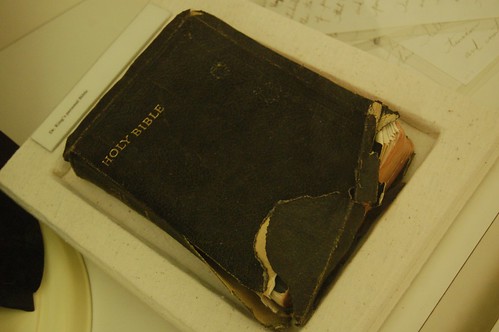
MLKJr.'s Bible
"12Indeed, the word of God is living and active, sharper than any two-edged sword, piercing until it divides soul from spirit, joints from marrow; it is able to judge the thoughts and intentions of the heart" (Hebrews 4:12).
Thursday, January 22, 2009
Breathing for the Christian
[This is my friend Glen VanderKloot's daily emailed inspiration for today.]
To be a Christian without prayer is no more possible than to be alive without breathing. (Martin Luther King Jr.)
Scripture: Romans 12:12 NCV
“Be joyful because you have hope. Be patient when trouble comes, and pray at all times.”
Prayer:
Lord, help me to make prayer a priority in my life. Amen
Thought for the Day
To be a Christian without prayer is no more possible than to be alive without breathing. (Martin Luther King Jr.)
Scripture: Romans 12:12 NCV
“Be joyful because you have hope. Be patient when trouble comes, and pray at all times.”
Prayer:
Lord, help me to make prayer a priority in my life. Amen
Monday, January 19, 2009
Monday, January 15, 2007
It doesn't surprise me...
 that so many children are ignorant of Martin Luther King, Jr. and the Civil Rights movement. A recent survey indicates that a huge percentage of students think that King was fighting against slavery.
Much of what passes for Social Studies Education today is a joke, superficial topical surveys. Few parents attempt to pass on any appreciation of this country's or the world's past to their kids. (I'm grateful that my own parents did have this commitment, for example first taking me to Washington, D.C. when I was five years old, a trip I still recall vividly, forty-eight years later.)
On top of that, the adolenticization of our society, a phenomenon that Christopher Lasch first identified in The Culture of Narcissism, has filled post-modern America with a general ahistorical view of life, devoid of any appreciation or understanding of the past.
We have a culture so "in the moment" that it's literally hell-bent on learning history's lessons. Another figure who was assassinated in the 1960s, John Kennedy, wrote these words which I committed to memory as a child: "A knowledge of the past prepares us for the crisis of the present and the challenge of the future."
King's birthday, Presidents' Day, and other national holidays should be more than just days off. An informed patriotism can be an antidote to things like militant nationalism and hedonistic cynicism, both of which can kill the American Dream, King's dream: freedom within a community of mutual accountability and concern.
[THANK YOU TO: Charlie Lehardy of AnotherThink, who links to this post in a wonderful tribute to Dr. King. Charlie's post, introducing excerpts from King's letter from the Birmingham jail reminds us "of the Christian faith that was the foundation of his beliefs and actions." Those tempted to ignore the facts by dismissing all religious belief as inherently superstitious and dangerous would do well to contemplate people like King, Desmond Tutu, Mother Teresa, Albert Schweitzer, C.S. Lewis, and the billions of ordinary Christians who have fought slavery, poverty, injustice, prejudice, and disease down through the centuries and continue to do so today. The good infection of Jesus Christ continues to bring healing and hope even though there have been and are people who misuse and pervert the faith.]
[THANKS TO: Andrew Jackson of SmartChristian.com for linking to this post.]
Subscribe to:
Posts (Atom)