I don't care about the politics of this exchange...I don't get into endorsing or bashing candidates. But I dislike the dismissal of New York City and its people, implying that anyone who lives in New York isn't patriotic.
New York is the cultural and financial capital of the United States. It's the place where, under George Washington, while he was president and New York served as the nation's political capital, Alexander Hamilton created this country's economic and financial system, the most enduring and strong engine for prosperity in the history of the world. On its streets, the world's greatest sport, baseball, was invented and refined. Baseball is about as American as it gets!
And, it was the patriotism, resilience, and courage of New Yorkers that inspired the rest of America after September 11, 2001.
I'm a lifelong Ohioan. I love New York.
Showing posts with label September 11. Show all posts
Showing posts with label September 11. Show all posts
Friday, January 15, 2016

Thursday, September 11, 2014
A Prayer for September 11
Prepared this for the electronic version of the church newsletter going out today:
Almighty God, on this anniversary of the September 11 attacks, we ask You to help us remember the sense of vulnerability and desperation for You with which many reacted on that day and to live all our days similarly. Teach us what it means to trust in You, knowing that neither perfect safety nor perfect ease are promised to us in this world. But in Christ, You promise to be with all who trust in Him until the close of this age and that, through His resurrection, You have totally and eternally conquered sin, death, and darkness. We pray Your continuing comfort for those who lost loved ones on that grim September morning, as well as for the families whose loved ones have died in battle since. We ask that You would give Your Church--all of us who trust in Jesus Christ as God and Savior--a renewed and constantly renewing passion for sharing the good news of new and everlasting life for all who turn from sin and believe in Christ. Christ and His Gospel are the only antidote to human sin, including our own sin; by Your Holy Spirit, empower us to humbly and boldly share Christ in our words and through our lives. In the Name of Christ we pray. Amen
Saturday, September 11, 2010
Bless those who persecute you...Do not be overcome by evil, but overcome evil with good
From Romans 12:14-21, in the New Testament:
Bless those who persecute you; bless and do not curse them. 15Rejoice with those who rejoice, weep with those who weep. 16Live in harmony with one another; do not be haughty, but associate with the lowly; do not claim to be wiser than you are. 17Do not repay anyone evil for evil, but take thought for what is noble in the sight of all. 18If it is possible, so far as it depends on you, live peaceably with all. 19Beloved, never avenge yourselves, but leave room for the wrath of God; for it is written, “Vengeance is mine, I will repay, says the Lord.” 20No, “if your enemies are hungry, feed them; if they are thirsty, give them something to drink; for by doing this you will heap burning coals on their heads.” 21Do not be overcome by evil, but overcome evil with good.Read Julie Ackerman Link's outstanding reflections on these words, today's installment of Our Daily Bread.
Friday, September 10, 2010
September 11 Prayer
Tomorrow, I'm scheduled be one of a number of local clergy offering prayers during a September 11 commemorative prayer service happening in our community. I've been assigned praying for our government. Here's the prayer I plan on offering (unless God has other plans):
Gracious God: Your Word tells us that there is no authority on earth that does not come from You. And so, we pray for the leaders of governments throughout the world, especially for those in our own country. To our president provide Your protection and Your wisdom. Grant these same blessings to all federal, state, and local officials, so that they will be guided by Your will. Grant that we, as citizens of this republic, even if we disagree with those who govern, will remain respectful of them. We pray guidance and protection for all in government service—from first responders to Peace Corps volunteers, from those in diplomatic service to those who regulate industries and ensure our safety, from cabinet secretaries to those in our Armed Forces. Mindful of the fleeting nature of life on this earth, aware that we are sinners by nature in need of our Savior, and knowing that we have nothing for which we can boast, we cling to Jesus Christ as our hope for this life and the one to come. We pray these things in Jesus’ holy and mighty Name. Amen
Forgiving the 9/11 Perpetrators?
A commenter on a friend's Facebook page said that, irrespective of what Christians are called to do, she would never forgive the perpetrators of the 9/11 attacks. Another commenter suggested that if a person can forgive the terrorists, "then you need to check yourself."
I understand their sentiments, of course. In the days following the 9/11 attacks, my wife and I were fond of the political cartoon showing an American eagle sharpening its talons preparing to respond. We liked it so much that we posted it on our refrigerator. Without getting into the specifics of endorsing or condemning any particular policies, my wife and I, like hundreds of millions of others thought that some response to the September 11 outrages had to come.

But I didn't agree with the commenters at my friend's site today when it came to this business of forgiveness. This is what I wrote:
I understand their sentiments, of course. In the days following the 9/11 attacks, my wife and I were fond of the political cartoon showing an American eagle sharpening its talons preparing to respond. We liked it so much that we posted it on our refrigerator. Without getting into the specifics of endorsing or condemning any particular policies, my wife and I, like hundreds of millions of others thought that some response to the September 11 outrages had to come.

But I didn't agree with the commenters at my friend's site today when it came to this business of forgiveness. This is what I wrote:
There's a difference between forgiveness and heedlessness. In an imperfect world where people do evil things, God has provided for the establishment of governments in part to pursue justice--whether through domestic police powers, economic sanctions, diplomatic pressure, imprisonment, or armies. The government that is heedless of injustices like the September 11 attacks would not be doing its job.[Similarly, the woman, for example, who fails to get out of an abusive relationship or fails to take the necessary legal steps to keep an abuser from continuing to harm her, is not doing the right thing. She will be right to forgive, but she will be reckless to take no action, to be heedless of the threat her abuser poses in her life. She must do something to stop her abuser!]
But Jesus leaves no question as to whether we should forgive. Not forgiving will, if allowed to prevail in our lives, make us monsters who also commit injustices against others.
Forgiveness is hard to do. It requires supernatural power given to us only by God, which is why Jesus taught us to pray, "Forgive us our trespasses as we forgive those who trespass against us."
Vengeance is not the same thing as justice.Forgiveness is not the same thing as excusing.Release (aphiemi is the word in the Greek in which the New Testament was written) is one word for forgiveness used in the New Testament. [When we forgive,] we not only release others from their indebtedness to us, we release ourselves from the corrosive, hellish feelings that accompanying holding onto hatred, vengeful sentiments, and putting ourselves on God's throne of judgment.[Government leaders can only think clearly about how best to mete out justice, including the possibility of waging war, by getting all notions of revenge out of their minds. When armies wreak vengeance, they violate one of the most important principles of Christian belief on what constitutes a just war: proportionality.[We similarly escalate relational discord in our own lives when we seek revenge rather than justice.]
I'm only a student of the lessons God wants us to learn, by the way.
What I try to do when faced with my inability to forgive or love others is to ask God to forgive or love them through me, in spite of my feelings. [Imperfectly,] I try to follow as Savior Who, as He died at the hands of hateful, violent people, against all common sense and evidence to the contrary, put the most charitable construction on his murderers' actions and prayed, "Father, forgive them; for they know not what they do!"
If Jesus can do that in His own power, maybe He can do it through [me in spite of] my weakness.
Tuesday, September 07, 2010
Burn Korans? Not If You Want to Do Christ's Will
It's hard to fathom the motives of the Gainseville, Florida pastor and his 50-member flock who plan on holding what they call an "International Burn the Koran Day," this coming Saturday, the ninth anniversary of the September 11 attacks.
I can't help suspecting that a big motivator on the part of the pastor, Terry Jones, is to gain attention for himself and his struggling church.
He has certainly gotten that. Newspapers, TV news shows, and Internet web sites are filled with stories about the planned event. There have been protest demonstrations in the Islamic world, where pictures of Jones have been set afire. A U.S. State Department spokesperson and the White House press secretary have condemned the planned Koran-burning. General David Petraeus has taken time from his combat duties in Afghanistan to warn that the Jones event would endanger U.S. combat forces and every American by inciting Jihadists and confirming the Muslim world's worst misapprehensions about Americans. (And about Christians too, I would add.)
It's difficult to see what good that Jones and his flock think all this attention will produce. It certainly won't advance the cause to which every follower of Jesus Christ should be committed.
That cause, which we Christians believe the risen Jesus gave to us just before He ascended to heaven, is called, the Great Commission. Forms of it appear in all four of the New Testament gospels and in Luke's history of the early Church, the Book of Acts. The most famous version is in the Gospel of Matthew. There, Jesus commissions Christians to:
But none of this should lead a Christian to burn Islam's book, even if we don't believe that the Koran came from God.
In fact, it should lead us away from such off-putting actions. If we want all people to come to faith in Christ, we should be looking for ways to build bridges, not burn them down.
Mr. Jones and his congregation might want to turn to the apostle Paul for an example of how to approach Muslims, a small fraction of whom act as the seedbed from which Jihadists grow terrorists.
Paul was the greatest of the early Church's preachers, a devout Jew who once persecuted believers in Christ, then became a great champion of Christian faith, and who spent most of his adult life traveling the Mediterranean basin, starting churches, winning converts, and encouraging believers. Ultimately, he was martyred for his faith in Christ.
Sometime around 50-52AD, Paul spent time in Athens awaiting the arrival of friends. The Book of Acts in the Bible's New Testament says that Paul was "distressed to see the city was full of idols." For a Jewish Christian like Paul, steeped in the Old Testament's teaching (and what would also be the New Testament's teaching) that there is just one God, the many statues depicting false gods was undoubtedly disgusting. The temptation to throw a fit and pour condemnations on the Athenians would have been huge for a man like Paul, passionate, sharp-tongued, and devout. He might have felt that he had good warrant to do just that.
But Paul had a higher call, a great commission! A rhetorical assault on the Athenians and their worship of many Gods would have been the first-century equivalent of burning a Koran, momentarily satisfying to the one with the torch, maybe, but ultimately useless to the cause of Christ.
Instead, we're told that Paul went to the synagogues there to tell his fellow Jews about Jesus and also to the Athenian marketplaces where learned people discussed life issues. He debated, but he didn't attack.
Then, one day, Stoic and Epicurean philosophers, curious about, if disdainful of, Paul's message about Christ took him to a place called the Areopagus, a low Athenian hill. With the city's multiple idols visible to everyone, Paul didn't attack.
“Athenians," he began, "I see how extremely religious you are in every way. 23For as I went through the city and looked carefully at the objects of your worship, I found among them an altar with the inscription, ‘To an unknown god.’ What therefore you worship as unknown, this I proclaim to you." Paul, starting with where the Athenians were, told them about the one God of the universe he believed was first revealed to God's people, Israel, and was ultimately revealed in the crucified and risen Jesus. He even quoted one of their poets as he talked with them.
After Paul finished speaking, some simply wrote him off. Others said that they wanted to hear more. Still others became followers of Christ. Paul wouldn't have seen these results if he had decided to scold and excoriate the Athenians for their evil beliefs. Instead, Christians believe that God's Holy Spirit used Paul's approach to make disciples of some.
Abraham Lincoln is widely reported to have been asked once by partisans why, instead of attempting reconciliation with his enemies, he didn't try destroying them instead. Lincoln replied, "Am I not destroying my enemies when I make friends of them?"
In an imperfect world in which violent people pose threats to others, there is a place for military, police, jails, prisons, and aggressive government action.
But the Bible I read and the Savior I follow gives Christians no encouragement and no warrant to burn Korans. Doing so will not only endanger the lives of many Americans who want no part of what Terry Jones and his Gainesville congregation are planning to do, it will also hurt the cause we Christians are commissioned to pursue: Making new friends and followers of Jesus.
I can't help suspecting that a big motivator on the part of the pastor, Terry Jones, is to gain attention for himself and his struggling church.
He has certainly gotten that. Newspapers, TV news shows, and Internet web sites are filled with stories about the planned event. There have been protest demonstrations in the Islamic world, where pictures of Jones have been set afire. A U.S. State Department spokesperson and the White House press secretary have condemned the planned Koran-burning. General David Petraeus has taken time from his combat duties in Afghanistan to warn that the Jones event would endanger U.S. combat forces and every American by inciting Jihadists and confirming the Muslim world's worst misapprehensions about Americans. (And about Christians too, I would add.)
It's difficult to see what good that Jones and his flock think all this attention will produce. It certainly won't advance the cause to which every follower of Jesus Christ should be committed.
That cause, which we Christians believe the risen Jesus gave to us just before He ascended to heaven, is called, the Great Commission. Forms of it appear in all four of the New Testament gospels and in Luke's history of the early Church, the Book of Acts. The most famous version is in the Gospel of Matthew. There, Jesus commissions Christians to:
"19Go therefore and make disciples of all nations, baptizing them in the name of the Father and of the Son and of the Holy Spirit, 20and teaching them to obey everything that I have commanded you.”As an evangelical Christian, I take this commission seriously. Jesus claims that He is God in the flesh and that repentance for sin and belief in Him is the only means by which human beings can grasp the grace of God and be reconciled with God. I pray every day that God will use me, inadequacies, faults, sins, and all, to share with everyone I contact, the good news of new and everlasting life from God that, as I believe the Bible teaches, only comes through Christ. I want all people to know the joy and the peace that comes from Christ, even in the midst of life's challenges.
But none of this should lead a Christian to burn Islam's book, even if we don't believe that the Koran came from God.
In fact, it should lead us away from such off-putting actions. If we want all people to come to faith in Christ, we should be looking for ways to build bridges, not burn them down.
Mr. Jones and his congregation might want to turn to the apostle Paul for an example of how to approach Muslims, a small fraction of whom act as the seedbed from which Jihadists grow terrorists.
Paul was the greatest of the early Church's preachers, a devout Jew who once persecuted believers in Christ, then became a great champion of Christian faith, and who spent most of his adult life traveling the Mediterranean basin, starting churches, winning converts, and encouraging believers. Ultimately, he was martyred for his faith in Christ.
Sometime around 50-52AD, Paul spent time in Athens awaiting the arrival of friends. The Book of Acts in the Bible's New Testament says that Paul was "distressed to see the city was full of idols." For a Jewish Christian like Paul, steeped in the Old Testament's teaching (and what would also be the New Testament's teaching) that there is just one God, the many statues depicting false gods was undoubtedly disgusting. The temptation to throw a fit and pour condemnations on the Athenians would have been huge for a man like Paul, passionate, sharp-tongued, and devout. He might have felt that he had good warrant to do just that.
But Paul had a higher call, a great commission! A rhetorical assault on the Athenians and their worship of many Gods would have been the first-century equivalent of burning a Koran, momentarily satisfying to the one with the torch, maybe, but ultimately useless to the cause of Christ.
Instead, we're told that Paul went to the synagogues there to tell his fellow Jews about Jesus and also to the Athenian marketplaces where learned people discussed life issues. He debated, but he didn't attack.
Then, one day, Stoic and Epicurean philosophers, curious about, if disdainful of, Paul's message about Christ took him to a place called the Areopagus, a low Athenian hill. With the city's multiple idols visible to everyone, Paul didn't attack.
“Athenians," he began, "I see how extremely religious you are in every way. 23For as I went through the city and looked carefully at the objects of your worship, I found among them an altar with the inscription, ‘To an unknown god.’ What therefore you worship as unknown, this I proclaim to you." Paul, starting with where the Athenians were, told them about the one God of the universe he believed was first revealed to God's people, Israel, and was ultimately revealed in the crucified and risen Jesus. He even quoted one of their poets as he talked with them.
After Paul finished speaking, some simply wrote him off. Others said that they wanted to hear more. Still others became followers of Christ. Paul wouldn't have seen these results if he had decided to scold and excoriate the Athenians for their evil beliefs. Instead, Christians believe that God's Holy Spirit used Paul's approach to make disciples of some.
Abraham Lincoln is widely reported to have been asked once by partisans why, instead of attempting reconciliation with his enemies, he didn't try destroying them instead. Lincoln replied, "Am I not destroying my enemies when I make friends of them?"
In an imperfect world in which violent people pose threats to others, there is a place for military, police, jails, prisons, and aggressive government action.
But the Bible I read and the Savior I follow gives Christians no encouragement and no warrant to burn Korans. Doing so will not only endanger the lives of many Americans who want no part of what Terry Jones and his Gainesville congregation are planning to do, it will also hurt the cause we Christians are commissioned to pursue: Making new friends and followers of Jesus.
Sunday, December 06, 2009
I Can't, But...
[This was shared during worship with the people of Saint Matthew Lutheran Church in Logan, Ohio, earlier today.]
Luke 3:1-6
Genelle Guzman-McMillan was the second of thirteen children and grew up on the Carribean Island of Trinidad. Genelle’s mother was a devoted Christian. But Genelle didn’t like church, thinking it was a waste of time. In fact, she thought that anything that cramped her style was a waste of time.
At age nineteen, expecting her first child, she moved in with her boyfriend. Six years later, the two of them split up and Genelle felt free to hit the club and party scene for which she’d always hankered. Somehow, in spite of now having two children, she made it through college, still managing to party most of the time.
Genelle seemed to have broken free from the old restrictions of her life and, depending on herself and her own wits. She was, as it’s said, “living large.”
In 1998, she moved to New York City where family and friends told her, she would find greater opportunity. She decided to leave her kids in Trinidad until she got settled in. After she came to New York, her ex-boyfriend informed Genelle that he was unwilling to let their kids come to America with her. That was okay with Genelle; by now, she was enjoying the party scene in the Big Apple. She quickly accepted being able to do more of it without having her children around.
By then, Genelle was living with another man, Roger McMillan. Like Genelle, he loved to spend his spare time partying. They were on top of the world until, Genelle says, there came “a remarkable turn."
Genelle worked in the Tunnels, Bridges, and Terminals Department of the Port Authority of New York, her office on the 64th. floor of the North Tower at the World Trade Center. It was early on September 11. 2001 and she was making small talk with a co-worker, when she felt the building shake.

At first, she and the others in her office had no idea that an American Airlines passenger jet had just slammed into their building. After a time of indecision and panic, Genelle and the others with her on the 64th. floor, heard a roaring noise, not knowing that it was the sound of the South Tower collapsing.
But that sound was sufficiently terrifying to convince them all that they needed to get out of there. They made their way down the stairs, counting each flight aloud. Firefighters were ascending the stairs as they descended, assuring them that if they kept going down, they would be fine.
By the time the group reached the thirteenth floor, Genelle’s leather-heeled shoes were killing her. As she leaned over to take them off, everything around her seemed to explode in a massive boom!
All Genelle could see was blackness. She felt something hit her chest and then, she was pinned to the ground. As she put it, “One hundred ten floors were coming down around us. I knew I was being buried alive. The noise was deafening.”
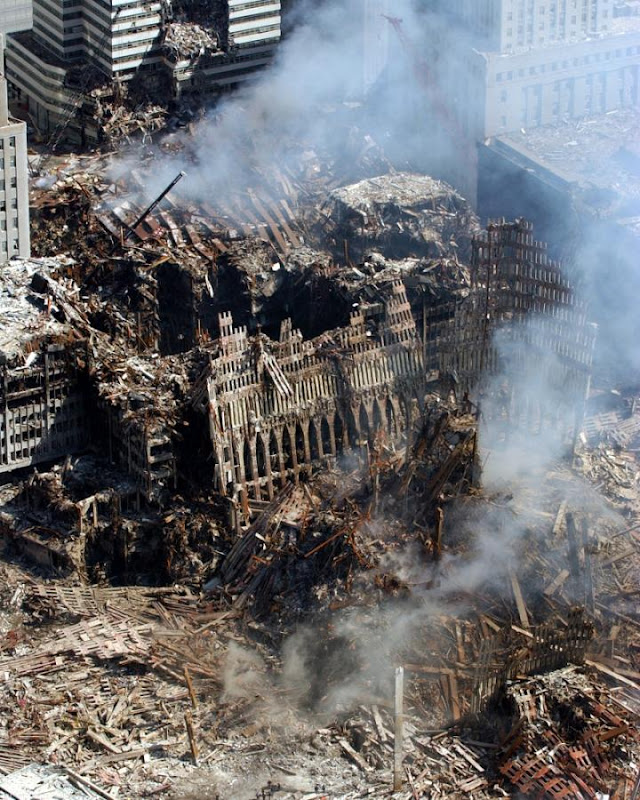 Then, things became quiet and Genelle couldn’t believe that she was still alive. Listen to what Genelle says happened next: “I knew then I was going to die. Nobody was going to find me under all the steel and concrete. I started calling out for [my friend] Rosa, but there was no response. Then I heard a man saying, ‘Help, help, help.’ His voice grew fainter, and then there was nothing.
“There in the dark, my mind started racing. I thought of my children, my family, and my fiancé, Roger...More than anything I worried about what would happen to me after I died. I didn’t know how to ask for forgiveness. I was sure I was going to hell.”
Beneath the steel and concrete, Genelle begged for a second chance at life, a second chance to live life God’s way. She floated in and out of consciousness for hour after hour, each time she came to praying for forgiveness and a miracle to help her to deal with the pain.
The next day, still under the rubble of the North Tower, Genelle heard the beeping sound of a truck backing up. She called out and a rescue worker heard her. But even though they shone a light all around and Genelle waved one hand, the only part of her that was free, no one saw her.
Then, Genelle faded from consciousness again. When she awoke, she heard rescue workers somewhere overhead and she prayed, “Please help me now!” She yelled at the workers. Nobody heard her. She desperately waved her hand again and now, somebody grabbed it.
“Genelle,” she heard, “I’ve got you! You’re going to be all right. My name is Paul. I won’t let go of your hand until they get you out.”
Soon, two rescue workers pulled Genelle out and Paul let go of her hand. Genelle was the last survivor to be pulled from the World Trade Center.
She spent five weeks in Bellevue Hospital, amazing the staff with her serenity. More than two years later, when I first read her story, Genelle still hadn’t had a nightmare about those horrible events.
One thing that bothered her though was that she never got the chance to thank Paul for taking her hand and reassuring her there in the rubble. She learned that there was no Paul among the rescue workers who went to Genelle that day. Not one of the crew who took her from the rubble knew of a Paul. Genelle is convinced that God sent an angel at just the right time.
September 11, 2001 began a new life for Genelle. As she puts it, “My life was very different than it had been before. I was amazed by how much God loved me.” She saw herself as a child of God. For the first time in her life, she felt truly free to be the person God designed her to be, the kind of person each and every one of us is designed to be.
Not only had Genelle been rescued; more amazingly still, this young woman who had been totally caught up with herself, with doing things her way, turned from sin and turned to the God we know through Jesus Christ...and got a new life!

Our Gospel lesson for this morning tells us about the proclamation of John the Baptist. John described himself simply as a voice. His voice called people to repentance. To repent means to change our minds about who’s in charge of our lives, to change our minds about our priorities. It really means to change our minds about who our God is.
Genelle had gone through her life before September 11, 2001, with many gods. She had worshiped at the altars of pleasure, good times, and herself, among others.
Under the debris of the World Trade Center, she came face to face with the reality that these things could not bring life nor save her life nor give her life purpose or meaning.
Fortunately for all of us, God long ago sent a rescuer Whose life, death, and resurrection can bring new life and second chances (and third and, if you’re like me, three-hundred thousandth chances) to all who follow Him.
On the first Christmas day, God sent Jesus Christ. Anytime we take His hand and let Him be in control, whether our days bring us trials, triumphs, tedium, tragedies, crosses, or crowns, we have new life.
 Many people have the mistaken notion that Christianity is about morality. People tell me, “I like to send my kid to church because he learns the right way to live.”
But the right way to live is no big mystery! Anybody who takes the time to look it up will find that every major religious system in the world says pretty much the same things about morality. They say that loving and living at peace with our neighbor is a good thing, that we shouldn’t steal or take our neighbor’s spouse, and so on.
The problem isn’t that we all don’t know the right way to live. The problem is that we don’t know how to do it.
The sin in our bones keeps us from doing the good we know we should do and that deep down, we want to do.
Jesus Christ came to earth and lived the perfect sinless life, offering Himself as the sacrifice for our sin so that you and I can have his power to do what we cannot do in our own power: Turn from sin and live with God in our lives today and always.
I’ve mentioned it before and I probably will again: Alcoholics Anonymous is one of the most powerful and important movements in our world today. AA and other movements patterned after it, uses a twelve-step process to help people get delivered from their addiction. The first step to freedom for the alcoholic or any other addicted person is the admission that he or she is powerless over the addiction.
Whether she had been rescued from the World Trade Center or not, Genelle Guzman-McMillan took her first step toward freedom when in a desperate and cataclysmic time, she finally told God that she knew she needed Him.
The acknowledgment of our helplessness and our desperate need of the God we meet in Jesus Christ can free us all for really living!
Jesus came into our world not as a great moral teacher, though He was a great moral teacher. Instead, Jesus came to be our God and Savior, the One to Whom we surrender even when we don’t understand, even when we would rather do anything but that which He calls us to do.
Jesus came to save us not only from future death, but also from the dead-end road of self-reliance.
That is a lonely road, something I have to keep learning all the time.
Once a few years ago, I was bellyaching about something to Ann. After listening to this for a while, she finally said, "Mark, ask someone to help you!"
Whether it's asking God for something or asking the people God brings into our lives to help us do the things we can't do on our own, we need to get over self-reliance and learn God-reliance!
When we follow Jesus, we not only walk with God, we also walk with that wonderful group of recovering sinners known as the Church, where God can provide us with the help we so often need in our lives and where we can be the means by which God helps not only other church members, but the whole desperate world.
In the days left until Christmas, as we deal with life’s stresses and the temptation to think that we’ve got to have everything in life under control, every t crossed, every I dotted, every package wrapped, I want to recommend a simple formula for repentance—a formula for turning things around in our lives in a positive way. It comes from Baptist pastor Gerald Mann, but it’s so good he could be a Lutheran. (Just joking!) Here it is:
[The true story of Genelle Guzman-McMillan is told in Jim Cymbala's book, Breakthrough Prayer.]
Luke 3:1-6
Genelle Guzman-McMillan was the second of thirteen children and grew up on the Carribean Island of Trinidad. Genelle’s mother was a devoted Christian. But Genelle didn’t like church, thinking it was a waste of time. In fact, she thought that anything that cramped her style was a waste of time.
At age nineteen, expecting her first child, she moved in with her boyfriend. Six years later, the two of them split up and Genelle felt free to hit the club and party scene for which she’d always hankered. Somehow, in spite of now having two children, she made it through college, still managing to party most of the time.
Genelle seemed to have broken free from the old restrictions of her life and, depending on herself and her own wits. She was, as it’s said, “living large.”
In 1998, she moved to New York City where family and friends told her, she would find greater opportunity. She decided to leave her kids in Trinidad until she got settled in. After she came to New York, her ex-boyfriend informed Genelle that he was unwilling to let their kids come to America with her. That was okay with Genelle; by now, she was enjoying the party scene in the Big Apple. She quickly accepted being able to do more of it without having her children around.
By then, Genelle was living with another man, Roger McMillan. Like Genelle, he loved to spend his spare time partying. They were on top of the world until, Genelle says, there came “a remarkable turn."
Genelle worked in the Tunnels, Bridges, and Terminals Department of the Port Authority of New York, her office on the 64th. floor of the North Tower at the World Trade Center. It was early on September 11. 2001 and she was making small talk with a co-worker, when she felt the building shake.

At first, she and the others in her office had no idea that an American Airlines passenger jet had just slammed into their building. After a time of indecision and panic, Genelle and the others with her on the 64th. floor, heard a roaring noise, not knowing that it was the sound of the South Tower collapsing.
But that sound was sufficiently terrifying to convince them all that they needed to get out of there. They made their way down the stairs, counting each flight aloud. Firefighters were ascending the stairs as they descended, assuring them that if they kept going down, they would be fine.
By the time the group reached the thirteenth floor, Genelle’s leather-heeled shoes were killing her. As she leaned over to take them off, everything around her seemed to explode in a massive boom!
All Genelle could see was blackness. She felt something hit her chest and then, she was pinned to the ground. As she put it, “One hundred ten floors were coming down around us. I knew I was being buried alive. The noise was deafening.”
 Then, things became quiet and Genelle couldn’t believe that she was still alive. Listen to what Genelle says happened next: “I knew then I was going to die. Nobody was going to find me under all the steel and concrete. I started calling out for [my friend] Rosa, but there was no response. Then I heard a man saying, ‘Help, help, help.’ His voice grew fainter, and then there was nothing.
“There in the dark, my mind started racing. I thought of my children, my family, and my fiancé, Roger...More than anything I worried about what would happen to me after I died. I didn’t know how to ask for forgiveness. I was sure I was going to hell.”
Beneath the steel and concrete, Genelle begged for a second chance at life, a second chance to live life God’s way. She floated in and out of consciousness for hour after hour, each time she came to praying for forgiveness and a miracle to help her to deal with the pain.
The next day, still under the rubble of the North Tower, Genelle heard the beeping sound of a truck backing up. She called out and a rescue worker heard her. But even though they shone a light all around and Genelle waved one hand, the only part of her that was free, no one saw her.
Then, Genelle faded from consciousness again. When she awoke, she heard rescue workers somewhere overhead and she prayed, “Please help me now!” She yelled at the workers. Nobody heard her. She desperately waved her hand again and now, somebody grabbed it.
“Genelle,” she heard, “I’ve got you! You’re going to be all right. My name is Paul. I won’t let go of your hand until they get you out.”
Soon, two rescue workers pulled Genelle out and Paul let go of her hand. Genelle was the last survivor to be pulled from the World Trade Center.
She spent five weeks in Bellevue Hospital, amazing the staff with her serenity. More than two years later, when I first read her story, Genelle still hadn’t had a nightmare about those horrible events.
One thing that bothered her though was that she never got the chance to thank Paul for taking her hand and reassuring her there in the rubble. She learned that there was no Paul among the rescue workers who went to Genelle that day. Not one of the crew who took her from the rubble knew of a Paul. Genelle is convinced that God sent an angel at just the right time.
September 11, 2001 began a new life for Genelle. As she puts it, “My life was very different than it had been before. I was amazed by how much God loved me.” She saw herself as a child of God. For the first time in her life, she felt truly free to be the person God designed her to be, the kind of person each and every one of us is designed to be.
Not only had Genelle been rescued; more amazingly still, this young woman who had been totally caught up with herself, with doing things her way, turned from sin and turned to the God we know through Jesus Christ...and got a new life!

Our Gospel lesson for this morning tells us about the proclamation of John the Baptist. John described himself simply as a voice. His voice called people to repentance. To repent means to change our minds about who’s in charge of our lives, to change our minds about our priorities. It really means to change our minds about who our God is.
Genelle had gone through her life before September 11, 2001, with many gods. She had worshiped at the altars of pleasure, good times, and herself, among others.
Under the debris of the World Trade Center, she came face to face with the reality that these things could not bring life nor save her life nor give her life purpose or meaning.
Fortunately for all of us, God long ago sent a rescuer Whose life, death, and resurrection can bring new life and second chances (and third and, if you’re like me, three-hundred thousandth chances) to all who follow Him.
On the first Christmas day, God sent Jesus Christ. Anytime we take His hand and let Him be in control, whether our days bring us trials, triumphs, tedium, tragedies, crosses, or crowns, we have new life.
 Many people have the mistaken notion that Christianity is about morality. People tell me, “I like to send my kid to church because he learns the right way to live.”
But the right way to live is no big mystery! Anybody who takes the time to look it up will find that every major religious system in the world says pretty much the same things about morality. They say that loving and living at peace with our neighbor is a good thing, that we shouldn’t steal or take our neighbor’s spouse, and so on.
The problem isn’t that we all don’t know the right way to live. The problem is that we don’t know how to do it.
The sin in our bones keeps us from doing the good we know we should do and that deep down, we want to do.
Jesus Christ came to earth and lived the perfect sinless life, offering Himself as the sacrifice for our sin so that you and I can have his power to do what we cannot do in our own power: Turn from sin and live with God in our lives today and always.
I’ve mentioned it before and I probably will again: Alcoholics Anonymous is one of the most powerful and important movements in our world today. AA and other movements patterned after it, uses a twelve-step process to help people get delivered from their addiction. The first step to freedom for the alcoholic or any other addicted person is the admission that he or she is powerless over the addiction.
Whether she had been rescued from the World Trade Center or not, Genelle Guzman-McMillan took her first step toward freedom when in a desperate and cataclysmic time, she finally told God that she knew she needed Him.
The acknowledgment of our helplessness and our desperate need of the God we meet in Jesus Christ can free us all for really living!
Jesus came into our world not as a great moral teacher, though He was a great moral teacher. Instead, Jesus came to be our God and Savior, the One to Whom we surrender even when we don’t understand, even when we would rather do anything but that which He calls us to do.
Jesus came to save us not only from future death, but also from the dead-end road of self-reliance.
That is a lonely road, something I have to keep learning all the time.
Once a few years ago, I was bellyaching about something to Ann. After listening to this for a while, she finally said, "Mark, ask someone to help you!"
Whether it's asking God for something or asking the people God brings into our lives to help us do the things we can't do on our own, we need to get over self-reliance and learn God-reliance!
When we follow Jesus, we not only walk with God, we also walk with that wonderful group of recovering sinners known as the Church, where God can provide us with the help we so often need in our lives and where we can be the means by which God helps not only other church members, but the whole desperate world.
In the days left until Christmas, as we deal with life’s stresses and the temptation to think that we’ve got to have everything in life under control, every t crossed, every I dotted, every package wrapped, I want to recommend a simple formula for repentance—a formula for turning things around in our lives in a positive way. It comes from Baptist pastor Gerald Mann, but it’s so good he could be a Lutheran. (Just joking!) Here it is:
I can’t. God can. I’ll let Him.
Indulge me and say those three simple phrases with me, won’t you?I can’t. God can. I’ll let Him.
Jesus came to be our Savior. As we sing the carols and share our gifts this Christmas time, let’s remember, “We can’t. God can. We will let God—and no one and nothing else--be our God!”[The true story of Genelle Guzman-McMillan is told in Jim Cymbala's book, Breakthrough Prayer.]
Tuesday, September 11, 2007
Thoughts on 9/11
[I originally wrote this post two years ago and have simply updated it here.]
It's one measure of the degree to which the events of six years ago today are seared on our memories that when speaking of them, all we have to say is, "9/11."
No one wonders whether we're referring to a date or an emergency number.
And nobody asks the year.
But I worry about what we're doing with this day. It's being called Patriot's Day by some, celebrated with national songs, speeches, and red, white, and blue bunting.
Don't get me wrong: I believe in patriotism. I love this country and its history and the privilege of being an American citizen.
Somehow though, Patriot's Day doesn't fit with 9/11 for me.
The event most like 9/11 in previous US history was the attack on Pearl Harbor, December 7, 1941. On every December 7, when I was growing up, then as now, the media had small remembrances of the attack and if you prompted them, people who'd been alive then would tell you what they were doing when they got the news. A man of my acquaintance had been stationed at Pearl in December, 1941, and because of my questions and interest in history, told me about his experience of the attack.
But the notion of turning December 7 into a kind of Patriot's Day seems never to have occurred to members of "the greatest generation."
Why has it occurred to us to give such treatment to 9/11?
I suspect it has to do with what we're like in the America of the early-twenty-first-century. We are the generation lurching through life in the throes of attenuated Freudianism, a therapeutic culture of popularized, mischaracterized, and ill-informed psychobabble. We spend lots of time on self-indulgent navel-gazing, asking ourselves whether we're happy and when we discover that we're not, looking for people to blame.
There's nothing wrong with good psychological or psychiatric care. Countless numbers of people have been helped by these disciplines.
But there's something very wrong with the popularization of them that has resulted in a culture that glories in victimization.
This is seen in today's litigiousness in which millions of people, feeling slighted, hurt, or damaged, are suing others in unprecedented numbers.
We see it in juries in civil cases awarding enormous judgments, seemingly out of all proportion to the violations of the victimizers.
We see it too, in the constantly shifting standards of political correctness that have the media trolling for new ogres, people who in the eyes of today's white hat-black hat journalism, deserve to be villified.
If ever there was a person clearly suited to the role of villain, it's Osama bin Laden. He is a genuinely evil man, living a life given over to the devil's work. The movement which he encourages, has financed, and has inspired is one of the most notoriously demonic in world history.
It's true that on 9/11 six years ago, al-Qaeda victimized America and Americans and it will always live in our memories.
But I for one, don't fancy being a victim for the rest of my life. That's why on the evening of September 11, 2001, while most were canceling foreign trips, my daughter and I were among the few that a Delta reservation clerk talked to that day who made reservations for an overseas trek.
You go to the analyst so that one day, you'll no longer need to be under her or his treatment and you can live as a healthy grown-up person.
The alcoholic doesn't celebrate the day he took his first drink, but the day when he took his last.
No person who has been victimized by violence or prejudice commemorates the days of their violation, but the days of their psychological and physical liberation, the moments when hope entered their lives.
This day should be an occasion neither for whining or warmongering.
Leave the raucous flag-waving to other days. Bag the "world is against us" rhetoric altogether. I think that we ought to take our cue from the greatest generation: 9/11 should simply be a day of quiet remembrance.
[THANKS TO: Pastor Jeff for linking to this post. Pastor Jeff's Conblogeration is one of the best blogs around!]
[THANKS ALSO TO: Reader_iam at Done With Mirrors for linking to this post.]
It's one measure of the degree to which the events of six years ago today are seared on our memories that when speaking of them, all we have to say is, "9/11."
No one wonders whether we're referring to a date or an emergency number.
And nobody asks the year.
But I worry about what we're doing with this day. It's being called Patriot's Day by some, celebrated with national songs, speeches, and red, white, and blue bunting.
Don't get me wrong: I believe in patriotism. I love this country and its history and the privilege of being an American citizen.
Somehow though, Patriot's Day doesn't fit with 9/11 for me.
The event most like 9/11 in previous US history was the attack on Pearl Harbor, December 7, 1941. On every December 7, when I was growing up, then as now, the media had small remembrances of the attack and if you prompted them, people who'd been alive then would tell you what they were doing when they got the news. A man of my acquaintance had been stationed at Pearl in December, 1941, and because of my questions and interest in history, told me about his experience of the attack.
But the notion of turning December 7 into a kind of Patriot's Day seems never to have occurred to members of "the greatest generation."
Why has it occurred to us to give such treatment to 9/11?
I suspect it has to do with what we're like in the America of the early-twenty-first-century. We are the generation lurching through life in the throes of attenuated Freudianism, a therapeutic culture of popularized, mischaracterized, and ill-informed psychobabble. We spend lots of time on self-indulgent navel-gazing, asking ourselves whether we're happy and when we discover that we're not, looking for people to blame.
There's nothing wrong with good psychological or psychiatric care. Countless numbers of people have been helped by these disciplines.
But there's something very wrong with the popularization of them that has resulted in a culture that glories in victimization.
This is seen in today's litigiousness in which millions of people, feeling slighted, hurt, or damaged, are suing others in unprecedented numbers.
We see it in juries in civil cases awarding enormous judgments, seemingly out of all proportion to the violations of the victimizers.
We see it too, in the constantly shifting standards of political correctness that have the media trolling for new ogres, people who in the eyes of today's white hat-black hat journalism, deserve to be villified.
If ever there was a person clearly suited to the role of villain, it's Osama bin Laden. He is a genuinely evil man, living a life given over to the devil's work. The movement which he encourages, has financed, and has inspired is one of the most notoriously demonic in world history.
It's true that on 9/11 six years ago, al-Qaeda victimized America and Americans and it will always live in our memories.
But I for one, don't fancy being a victim for the rest of my life. That's why on the evening of September 11, 2001, while most were canceling foreign trips, my daughter and I were among the few that a Delta reservation clerk talked to that day who made reservations for an overseas trek.
You go to the analyst so that one day, you'll no longer need to be under her or his treatment and you can live as a healthy grown-up person.
The alcoholic doesn't celebrate the day he took his first drink, but the day when he took his last.
No person who has been victimized by violence or prejudice commemorates the days of their violation, but the days of their psychological and physical liberation, the moments when hope entered their lives.
This day should be an occasion neither for whining or warmongering.
Leave the raucous flag-waving to other days. Bag the "world is against us" rhetoric altogether. I think that we ought to take our cue from the greatest generation: 9/11 should simply be a day of quiet remembrance.
[THANKS TO: Pastor Jeff for linking to this post. Pastor Jeff's Conblogeration is one of the best blogs around!]
[THANKS ALSO TO: Reader_iam at Done With Mirrors for linking to this post.]
Subscribe to:
Posts (Atom)