Showing posts with label wilderness temptations. Show all posts

Sunday, March 01, 2009

The Wilderness Scenario

[This was shared with the people of Saint Matthew Lutheran Church in Logan, Ohio during worship this morning.]

Mark 1:9-15
One of the factory jobs I worked as a young man was on the DMS 350 production line at Lennox Industries in Columbus. We made the largest whole building air conditioning and heating unit Lennox manufactured at the time.

On this line, at another station, was a guy named Paul. To eat our lunches or take our breaks, just about all of us on the line, including Paul, would sit together, squatting close to the floor on the conveyor tracks on which we moved the sections of our HVAC units from workstation to workstation. Paul would mostly listen to the conversations that happened then and whenever a lull hit, take a drag on his cigarette and say knowingly, “Yeah. Live in hope. Die in despair.” (He was real ray of sunshine!)

Paul must have said that thirty times a day. He said it so many times that I came to think that he actually believed that that was the human story. He thought that all of us are condemned to live in hope and die in despair.

But our Gospel lesson for today assures us that you and I can live our lives by a different scenario. Instead of “live in hope, die in despair,” the scenario for the life of a Jesus Follower goes this way:
  • live in the confidence that comes from God,
  • face the wilderness with God’s help,
  • emerge alive and whole for eternity.
I want to talk about each of those pieces of the Christian's life scenario.

First: Live in the confidence that comes from God.

Our Gospel begins with Jesus’ baptism by John the Baptizer. As a I pointed out a few weeks ago, John’s baptism at the Jordan River is different from the baptism that we undergo. John’s baptism was a symbol of repentance. The thousands who came to the Jordan to be baptized by John were symbolizing their intent to live repentantly, a life toward God and away from sin. It was an action done by the baptized.

But in the baptism instituted by Jesus, it’s God, not us, who is the primary actor. In our Baptism, God claims us as His own children for all eternity, end of story. We may choose to walk away from God, but God, on His part, will never revoke His claim of us as His children.

This, when you think of it, is foreshadowed in what happens at Jesus’ baptism by John. Unlike what happened with all the other people who came to the Jordan to declare their intention to live for God, God acts. Just as Jesus is emerging from the water, a voice booms out from heaven, “You are My Son, the Beloved; with you, I am well-pleased.”

At your baptism and to you, today, God says much the same thing: "You are My beloved child; with you, I am well pleased!"

When I was a college freshman, I asked to borrow my dad’s car so that I could go out on a date. Dad tossed the keys my way and as he did said, “Remember just one thing, Bub. She’s a person, too, Treat her with respect.”

Now, my dad had no idea who the girl was that I was going to take out. But he knew me. In that action and in those words, he reminded me that I was his son and no matter what temptations or tests might come my way, I could draw on that relationship and all that it entailed to be the person I had been nurtured and raised to be.

As Jesus was driven by the Spirit into the wilderness, He must have felt something like I felt as I slid in behind the wheel of my day’s car. He must have felt empowered by His Father’s love, ready to deal with the uncertainties of life, to do so with integrity, and to know that no matter what, He was still His Father’s Son. All who have been baptized in Jesus Christ can live in the confidence that comes from belonging to God!

Second: We can face the wilderness with the help of God.

It’s interesting to me that in our lesson, Mark says that after Jesus was baptized, “the Spirit [God the Holy Spirit, third person of the one God] drove [Jesus] into the wilderness” and that there, Jesus was tempted by Satan.

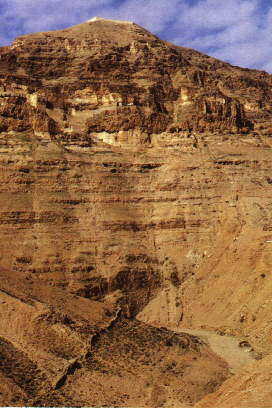
After reading about Jesus receiving the ringing affirmation of heaven while being baptized in the Jordan, you might expect to read next that people threw a ticker tape parade for Jesus and made Him king. Instead, Jesus goes into the wilderness. The word in the New Testament Greek for that place is eremos, literally, desert. Jesus went into a barren desert, surrounded, Mark says, by wild beasts. And He did that not necessarily because that was where He chose to go. Who, after all, would choose to go to a place like that? He was driven there by the Holy Spirit so that He could be tempted by Satan.

It hardly seems an honor befitting Someone just described by heaven as “[the] Son…the Beloved.” Jesus would have every reason to feel like the man in one of Abraham Lincoln’s jokes who had been tarred and feathered. Asked how it had felt, the man replied that if it weren’t for the honor of the thing, he would have been just as happy not to experience it.

From The Small Catechism, we good Lutherans have learned that God indeed tempts no one. But God will allow us to be subjected to temptation in order to test us.

Every time the devil, the world, or our sinful flesh tempts us to do anything that harms God, our neighbor, or the minds and bodies God has given to us, our faith is also tested and tempered. And every time we resist temptation, our faith is made stronger.

And, make no mistake about it, resisting temptaion isn’t a matter of willpower. Take a toy from a baby you need to bathe and you will see that we all are born with strong wills. We cave into temptation not because we lack willpower. Instead, we lack what someone has called “won’t power”: "Won't power is the capacity to say things like:
"I won’t eat that second piece of chocolate"
"I won’t gossip about my co-worker"
"I won’t be so critical of my child"
"I won’t cheat on the test"
"I won’t have sex with that person to whom I’m not married"
"I won’t laugh at someone’s bigoted joke"
...and then to make those resolutions stick!

But where does the power to do that come from? I once read the memoir of a pastor who, in his younger years, had a terrible weight problem. “I couldn’t stop eating,” he confesses. He felt horrible about it. "Here I was a pastor," he said, "telling people to treat their bodies as God’s temples. I told them to rely on God for their sense of self-worth and yet I was so wracked by self-doubt and self-pity that I used food to make me feel good, at least until I caught sight of myself in the mirror or stood on the scales." Then one night, this pastor was praying and crumpled on the floor in tears, telling God that he didn’t know what to do and that he needed God's help.

Within days, a caring parishioner showed up for a heart-to-heart talk with that young pastor. He taught him about nutrition and exercise. He got the medical attention he needed. Today, that pastor is in his eighties and you would never guess from looking at him that he had ever struggled with overeating. He took his first step to recovery when he admitted that he couldn’t control his own will and needed God's help.

Jesus survived the temptations and tests He endured in the wilderness because He knew how to do something we don't do very well in the United States. Jesus knew how to surrender. He relied on God and, our text tells us, “the angels waited on him.”

Whatever test and whatever temptation you face in life, God can and will send his angels to wait on you, to care for you, and to help your test become a testimony to God’s faithfulness.

Finally: Followers of Jesus can emerge from their tests more alive and more whole for eternity.

When Jesus came out of the wilderness, fortified by the help of God, strengthened in His dependence on the Father, He was ready to begin His ministry. Whatever tests or temptations you face, whatever wilderness you may be enduring, God stands ready to help you to say no to sin and say yes to the good news that Jesus has for us all, the good news that those who turn from sin and trust in Him have life with God forever.

Back when I worked in the factory, I wasn’t a Christian. I wish that I had been and that I could have developed a friendship with Paul and shared with him the good news that we have as followers of Jesus Christ. I would love to communicate to him today that as a Christian, I’m living a life scenario that includes the confidence that comes from knowing that I belong to Jesus Christ today and always, the awareness that Christ’s followers can face the wilderness no matter what, and the certainty that when we repent and trust in Christ, we look forward to eternity with God.

May you always remember that this is God’s scenario for your life!

Sunday, February 10, 2008

How to Beat the Devil

[This sermon was shared during worship today with the people of Saint Matthew Lutheran Church in Logan, Ohio.]

Matthew 4:1-11
Although thankfully, it’s happening with less frequency these days, even now the television and newspapers bring reports that some US soldier or Marine in Iraq has been wounded or killed by an IED, an improvised explosive device. A concealed device goes off just as US personnel approach it. The enemy, in the tradition of guerilla warfare, is unseen and blends in with his surroundings, only occasionally being exposed. Guerilla warfare is an example of what the tacticians call asymmetrical war because it’s typically used by those whose army or firepower can’t match a heavily-armed conventional foe.

All believers in Jesus Christ are engaged in a war far deadlier and far more destructive than the terrible conflict going on in Iraq these days. Unlike human guerilla warriors, the enemy we fight is never seen. The explosions he sets off in our lives may seem harmless or, to the unwary, non-existent; but unlike the guerilla warriror’s bombs that can only take away our earthly lives, this enemy’s weapons can, if we aren’t careful, lead to eternal separation from God. And though our common enemy is more powerful than any of us, separately or together, he nonetheless engages in asymmetrical warfare, luring us, under the cloak of anonymity, just as he lured Adam and Eve to rebel against God in the garden. Our enemy, the devil, is a vicious, heartless, miserable creature who thinks he can bring God down by destroying us, the children for whom Jesus Christ died and rose.

I know that saying this may cause some to tune me out. People may think that the very idea of the devil is an outmoded one, akin to believing that the earth is flat or that Pluto is a planet. Years ago, the Oxford University professor, expert on world cultures, and novelist, C.S. Lewis, gave a series of radio talks that became my favorite book other than the Bible, Mere Christianity. In one of his talks, Lewis told his listeners:
...someone will ask me, "Do you really mean, at this time of day [in other words, at this supposedly advanced stage of human development], to reintroduce our old friend the devil-hoofs and horns and all?" Well, what the time of day has to do with it, I do not know. And I am not particular about the hoofs and horns. But in other respects my answer is, Yes, I do..."
And so do I. I’m convinced that there is a devil and I’m not alone in that belief. According to the Bible, the devil was, originally an angel. That word, angel, angelos in the Greek of the New Testament, means messenger. Angels are messengers, wordsmiths, great communicators meant to be God’s letter-carriers. The devil, resentful of the station God gave to His highest creatures, rebelled against God.

Ever since then, the devil—along with our fallen world and the sin inside of us--has engaged in a propaganda campaign designed to sow discouragement, division, selfishness, and death among us, hoping perhaps, that by bringing us down, he can bring God down. It’s the devil’s aim to lure us to hopelessness, to indifference to God and neighbor, and to self-absorption. It’s in that very state of isolation that he wants to keep us forever, never to experience the love of Christ or the touch of others.

Hell isn’t a party where people do naughty things for eternity. It’s a place where those who have allowed themselves to be lured away from God live in a perpetual state of absolute aloneness and constant regret. We would be fools to think that we can face such evil on our own. As Martin Luther writes in A Mighty Fortress is Our God:
No strength of ours can match his might! [That is, the devil’s might.] We would be lost, rejected.
So, what can we do in the face of this evil? Jesus shows us what to do in today’s Gospel lesson. Three times, the devil tempts Jesus to diverge from the Father’s will for His life.

First, knowing that Jesus is hungry, the devil tries to convince Jesus to whip up instant bread from the stones available in the wilderness. Food is a good thing. And God the Father certainly doesn’t want Jesus to starve. But Jesus didn’t come into our world to make Himself comfortable. He came to share our discomforts and our whole lives. He came to die for us and to rise for us so that all who repudiate their sin and follow Him will live forever.

Next, the devil set Jesus up on the pinnacle of the temple and said, “If you are God’s Son, God will surely take care of you. So, take a dive, so that God can make good on His promises to you—and to all believers—to catch us. But Jesus didn’t come into the world to do pointless parlor tricks.

Finally, the devil tempted Jesus by offering Jesus exactly what He wanted—the world and all its kingdoms. The price: Jesus would have to worship the devil.

In each instance, the devil’s temptations were perfectly reasonable things, good things that Jesus wanted. The devil was offering them to Jesus without struggle, with no need to be obedient to God, and of course, on the condition that Jesus—and all of us--would forever be his slave. His come-ons were a little like what those check-cashing services offer people these days, instant gratification with a long-term price to be paid.

Jesus met each temptation not only by reciting the Word of God, but also by knowing the character, the grace, and the will of the Father Who sent Him to us. So, how do we meet our temptations?

Martin Luther said, “When [the devil] comes knocking upon the door of my heart and asks, ‘Who lives here?’ the dear Lord Jesus goes to the door and says, ‘Martin Luther used to live here but he has moved out. Now I live here.’ The devil, seeing the nail prints in His hands, and the pierced side, takes flight immediately.” The Bible says that Christ lives in those who let Him in. It’s only when we let Christ in that the devil can be turned away.

The devil, you know, wants to discourage you, sow discord in your marriage, cause you to hold grudges, foster disunity and dissension in Christ’s Church, consider violence as an answer to life’s problems, and make us all think that we are left to live life in our own power, with no one to care for us.

But those are all lies! Jesus Christ, God in the flesh, died and rose for us and He’s living now, just waiting for you to invite Him to help you, help your family and friends, help our Church, and help our world. Jesus promises His followers, “I am with you always!” The only way you and I can face down evil are to rely completely on the God Whose love and grace for us are chronicled in the Word Jesus used against the devil in the wilderness!

In 1861, a Shenandoah Valley farmer named Wilmer McLean saw one of the bloodiest engagements of the Civil War, the Battle of Bull Run, fought on his property. McLean cared little about the reasons for the war. He just wanted to get away from it. So, he sold his property and moved to a place he was sure the war could never find him. Four years later, General Ulysses S. Grant chased Confederate General Robert E. Lee throughout Virginia. In Appomattox County, Grant sent a message to Lee, asking the rebel general to meet and sign a truce. The place where they met to end the Civil War was an old house in Appomattox Court House, Virginia. The owner was Wilmer McLean. No matter how much McLean tried, the war that he wanted to avoid found him.

You may not think that you are a party to the war that the devil is waging for your soul, or against his greatest enemy on earth, the Church of Jesus Christ. You may think that sort of thing may have happened back in the day, but not today. Christians often think that. But that’s dangerous thinking!

One day, seminary professor Howard Hendricks was approached by a smiling student who announced, “Dr. Hendricks, it’s been at least three years since I can remember the devil tempting me to sin.” Hendricks replied, “That’s about the worst thing I can imagine hearing from a Christian.” It either meant, you see, that that student was so far from God that the devil wasn’t bothering with him or that he was so insensitive to the reality of evil that he had been sidelined as a Christian.

Followers of Jesus Christ have an enemy sworn to kill us. But we have a Savior, a God Who is greater than all our sin and death. When evil assails us, no matter what its form, we need to put on the power of God so that we can withstand all that the devil throws our way and like Jesus, at the end of our Gospel lesson, let God care for us.

And this is how we do it: We let Jesus Christ into our lives. And then...
  • We pray for each other.
  • We worship together.
  • We take the Sacrament together.
  • We read God’s Word.
  • We pray for help.
Against these weapons, our enemy the devil has no power. When we use them, we can be certain that He cannot defeat us...ever!

Saturday, February 09, 2008

Second Pass at This Sunday's Bible Lesson (February 10, 2008)

[The first pass, containing an explanation of what these passes are about, can be found here.]

[General Comments, continued]
14. Romans 5:12-19: Here, I present the brief comments of Chris Haslam, an Anglican priest from Montreal:
Paul has said that Christians, reconciled to God, will be saved, sharing in the risen life of Christ. Two notions are important here:
  • the punishment for Adam’s sin was to die both physically and spiritually (“death came through sin”); and
  • we both sin ourselves and share in his sin (“spread to all”).
Paul contrasts Adam and Christ, both inaugurators of eras. Adam foreshadowed Christ as head of humanity (“type”, v. 14, precursor). Adam disobeyed God’s direct command (“the transgression”, v. 14, “the trespass”, v. 15). The “free gift”, i.e. Christ, is unlike Adam’s sin:
  • “many died” before Christ’s coming but even more so are “many” (indeed all) saved through Christ;
  • Adam was condemned to separation from God but Christ brings union with God (vv. 16, 18);
  • Adam’s sin allowed “death” (v. 17) to rule through the Devil (“that one”) but we let good rule our hearts (“dominion in life”); and
  • Adam’s action led to the sin of many but Christ’s will lead many to godliness (v. 19), to “eternal life” (v. 21).
(Vv. 13-14b are an aside: before God gave Moses the Law, humans were not held accountable for their sins; even so they died.)
Verse-by-Verse Comments, Matthew 4:1-11:
1Then Jesus was led up by the Spirit into the wilderness to be tempted by the devil.
(1) It's interesting that the Spirit led Jesus into the wilderness to be tempted by the devil. In his explanation of the Sixth Petition of the Lord's Prayer, Martin Luther writes in his famous Small Catechism, "God, indeed, tempts no one..." Was Luther wrong?

Notice what Matthew writes here, though. He says that "that the Spirit led Jesus into the wilderness to be tempted by the devil." Is it splitting hairs here to say that God the Spirit didn't tempt Jesus, but pushed Jesus where the devil could do the tempting?

Maybe. But I think that this is a more complicated subject than our desire for facile answers will allow.

The New Testament Greek terms peirazo and ekpeirazo can be translated as either tempt or test. Sometimes we read of God testing people. At other times we read of people being tempted.

I think it's safe to say that if God lures us to sin, then God is a monster and not the "lover of our souls" we see in Jesus Christ.

But I do think it's possible for God to use an event to test us while the devil, the world, or our sinful selves will use the same event to tempt us away from God. God allows certain tests to come our way, tests that may tempt us to walk away from God. God does this to strengthen our faith by increasing our dependence on Him.

God the Spirit apparently believed that, to fortify Jesus for what lay ahead, Jesus needed the test of being tempted by the devil. I don't believe that this is the sort of thing that God does with spiritual lightweights, like me, by the way. In fact, it's been my observation that the closer we get to God, the more our spiritual torments and often, it seems, the likelier our physical suffering. Discipleship isn't for sissies. But it is for those who want to live with God forever.

2He fasted forty days and forty nights, and afterwards he was famished.
(1) Talk about understatement. I'd be hungry too, after forty days without food. By the way, some scholars teach that "forty days" may have been a Biblical way of saying, "a long time," like more contemporary phrases such as "a month of Sundays."(I know, it's not that contemporary.)

(2) This makes me think of the Gospel lesson for Ash Wednesday. Jesus assumed that believers would, at tmes when they wanted to clear away the obstructions that get in the way of their relationship with God, would fast. He says there, "Whenever you fast..."

One can fast in many ways. We might want to stop watching TV at night, or spend less time on the computer. The possibilities are endless. But the purpose of fasting isn't to gain bragging rights as a super-Christian. It is, rather, like tuning out the static and allowing ourselves to hear God loud and clear.

3The tempter came and said to him, “If you are the Son of God, command these stones to become loaves of bread.”
(1) Notice that the tempter's temptation isn't inherently bad. Food when you're hungry is a good thing. God made food. God made our bellies. The craftiness of the tempter is that he strives to lure us to take good things and use them in wrong ways. Jesus refuses to be beholden to the tempter even for a few scraps of bread. He will, instead, be totally dependent on God the Father.

(2) One of the ways in which we commonly put God to the test is to challenge Him with prayers like, "If you're really there, then do this..."

God has already done everything He needs to do to warrant our trust.

4But he answered, “It is written, ‘One does not live by bread alone, but by every word that comes from the mouth of God.’”
(1) There's no way we can face down the temptations presented by the devil, the world, or our sinful selves is to be steeped in the Word of God, the Bible, which reveals God's will for us all. Jesus called on that Word here.

5Then the devil took him to the holy city and placed him on the pinnacle of the temple, 6saying to him, “If you are the Son of God, throw yourself down; for it is written, ‘He will command his angels concerning you,’ and ‘On their hands they will bear you up, so that you will not dash your foot against a stone.’”
(1) The devil knows the Bible too. For the Christian, knowing the Bible isn't necessarily about memorizing Scripture passages, it's allowing the Word of God to inform our understanding of the God behind it. The Bible reveals God's character.

(2) This is the second time that the devil has said, "If you are the Son of God..." The devil is suggesting that this throwing Himself off of the top of the temple would be a memorable way for Jesus to prove Himself. And Jesus does want us to know that He is the Son of God. But, though capable of the miraculous, He never performed signs at the command of the skeptical or hostile. That's probably because for those who are hostile or indifferent to Jesus, no sign would ever be sufficient to win them over. And besides, if God takes orders from us, who really is God? Unless we see the miracles as signs pointing to Jesus as the Son of God, they're merely parlor tricks.

7Jesus said to him, “Again it is written, ‘Do not put the Lord your God to the test.’”
(1) "Stupid is stupid," Jesus tells the devil. "God will protect His children for all eternity. But they can't expect to be protected when they take unnecessary risks."

(2) Notice that Jesus once more resorts to Scripture.

8Again, the devil took him to a very high mountain and showed him all the kingdoms of the world and their splendor; 9and he said to him, “All these I will give you, if you will fall down and worship me.”
(1) The term "high mountain" is also used of the setting of Jesus' transfiguration in Matthew's Gospel. Brian Stoffregen suggests that this may be no coincidence. When you think of it, the high mountain on which Jesus' transfiguration must have also been a setting of deep temptation. It would have been tempting for Jesus to remain on the mountaintop in His glory. It certainly tempted Peter, who wanted to erect those monuments to Jesus, Moses, and Elijah. But the voice from heaven and Jesus Himself directed Peter, James, and John, back down the mountain.

(2) Jesus clearly wants the kingdoms of the world. But He won't take them on the cheap. Without His death and resurrection, those kingdoms would always remain under evil's sway, far from God.

10Jesus said to him, “Away with you, Satan! for it is written, ‘Worship the Lord your God, and serve only him.’”
(1) In the final analysis, every sin we commit is a violation of the First Commandment, "You shall have no other gods." To worship God is to put God first in our lives.

11Then the devil left him, and suddenly angels came and waited on him.

Friday, February 08, 2008

First Pass at This Sunday's Bible Lessons (February 10, 2008)

[This may be the only "pass" at the Bible lessons for this week. If so, I apologize in advance. These passes are designed to help the people of Saint Matthew Lutheran Church in Logan, Ohio, where I am pastor, and me to prepare for worship on Sunday mornings. Because we Lutherans use a version of the Revised Common Lectionary, I also hope that these looks at the Bible lessons will help other Christians to get ready for worship when these lessons will be the focus for most of the Christians in the world.]

The Bible Lessons:
Genesis 2:15-17; 3:1-7
Psalm 32
Romans 5:12-19
Matthew 4:1-11

The Prayer of the Day:
Lord God, our strength, the struggle between good and evil rages within and around us, and the devil and all the forces that defy you tempt us with empty promises. Keep us steadfast in your word, and when we fall, raise us again and restore us through your Son, Jesus Christ, our Savior and Lord, who lives and reigns with you and the Holy Spirit, one God, now and forever. Amen

Some General Comments:
1. The season of the Church Year called Lent began this past week with Ash Wednesday.

2. The forty days of Lent do not include the Sundays. That's because Sundays are always "little Easters," times when we always celebrate the resurrection of Jesus. That's why this will be the First Sunday in Lent. Sundays in Lent then, are outposts of resurrection celebration within a period in which we remember Christ's call to repentance and His death for our sin. Nonetheless, the Lenten movement toward Christ's cross (and resurrection) are marked even on the Sundays of this season.

3. The Gospel lessons for the First Sunday in Lent always revolve around Jesus' being tempted in the wilderness by the devil. (In this year's Gospel lesson, taken from Matthew's Gospel, the tempting power is referred to as the tempter, the devil, and Satan. More on the meanings of those three terms later, I hope.)

4. The other appointed lessons deal with temptation, sin, fall, deliverance, and redemption, hugely important themes. each text worthy of their own full exploration. That won't be possible here.

5. Genesis 2:15-17; 3:1-7: This lesson recounting the temptation of the first man and woman presents an interesting counterpoint to the Gospel account of Jesus' temptation.

For example, this temptation happens in the comfort of a lush garden in which easy provision is available for the first couple's every need. Jesus was driven by the Spirit into the barren wilderness. (The word eremos in the original Greek of the Matthew text can be translated as wilderness or desert.)

In addition, neither Eve nor Adam evidence any struggle against the temptations of the serpent. Jesus' entire encounter with the devil involves struggle.

In both cases, the temptations involve ignoring the intentions of God the Father.

There are more parallels and contrasts. But those will be addressed later.

6. 2:15: In this verse we see that work was never meant to be seen as a punishment. Only after the fall into sin would futility become part of the human experience of work. But work, in itself, is a good thing. Our capacity to work is part of what demonstrates that we have been made in the image of God, Who worked to create our universe.

7. 3:1: The serpent isn't specifically identified as the devil, although Jesus makes that connection in John 8:44.

Part of the craftiness of the devil, an attribute attributed to him here, is that he doesn't make the mistake of overtly attacking God. He attacks by indirection, asking questions until the time is ripe for making assertions.

(By the way, Jesus also uses indirection to woo people into God's kingdom. His parables are gentle ways of moving beyond our resistance to God's grace and love, engaging us in stories that make us feel what the kingdom of God is like, rather than forcing us on the defensive with religious propositions. That Jesus should employ such methods shouldn't surprise us. After all, in calling His followers to share His call to repentance and new life, He said that they should be as wise as serpents and as innocent as doves.)

8. Vv. 2-3: The woman accurately reflects God's will. There is no ambiguity about God's will.

9. The perennial question about this tree is, if God was anxious for humans to live in fellowship with Him, why was the tree of the knowledge of good and evil in the garden?

Let's do something scientists call a "thought experiment" for a moment. Imagine that you are God. Imagine that as God, you are brimming over with love, so much love in fact that you feel the desire to create living beings to love. But you decide that one being in particular will be sentient, aware of themselves as living creatures and--this is the really important point--capable of loving back.

The only way this ability to return your love will have any meaning is that if your special creatures have the ability not to love you back. Love that is instinctive is, in effect, coerced or forced. But if your creature is free not to love you, their choice to return your love and to live in a fellowship of love with you will be marked with the joy that comes with love that is voluntary.

God allowed the tree of the knowledge of good and evil to sprout in the perfect garden wasn't to tempt Adam and Eve to sin, but to make it possible for them to respond to God's love freely and authentically.

9. Vv. 4-5: The truth told in a deceitful way is still a lie. The man and woman didn't die immediately and by eating the fruit, they did see good and evil, as opposed to having only seen good previously. But, of course, being able to see good and evil without the discernment of God is to fall prey to evil's power. The serpent left that part out.

10. V. 6: What tempted the woman was good. The fruit was good. We're never tempted by bad or unattractive things. Sin happens when we take what's good at the wrong time, in the wrong way, for the wrong reason, or in the wrong amount.

11. To merely be tempted isn't a sin. Caving into temptation, even within our minds, is when sin happens.

12. Psalm 32: The first seven verses are addressed to God. Verses 8-11 are addressed to other people. The narrator is one who has sinned, confessed, and experienced God's forgiveness.

13. Sometimes, a good way to try to understand a passage of Scripture is to put it into our own words. Here's a paraphrase of Psalm 32 I wrote earlier today:
My life was hard when my sin went unconfessed, Lord. But when I owned up to my wrongs, You forgave me.

When times are hard, help us find refuge in You. Give us shelter even when times are tough!

I know that even when the flood waters rise, we God-followers won't be swept away. All around me are the glad shouts of people rescued from all that would take us from You and the life You give!

[Looking to our neighbors...]

Having experienced God's charity and care, I will turn to you, my friends, and point out the way of God to you. Don't be stubborn in your egotism, thinking you can get by on your own! Place yourself under God's control.

In the end, things don't go well for those who remain rebels against God. But the endless love of God envelops those who throw the whole weight of their lives--the good, the bad, the ugly, the frightening, the past, present and future--on God's shoulders.

Laugh and fill up with joy, you who trust in God! Give a shout out, all made right with God by the power of His forgiving grace!
This is an exercise you might want to try.

[More tomorrow, I hope.]

Sunday, February 25, 2007

Passing the Tests

[This message was shared during worship celebrations at Friendship Lutheran Church of Amelia, Ohio on February 24 and 25, 2007. If you're in or just visiting the Cincinnati area, feel free to worship with us for our Saturday services, which happen at 5:30PM, or our Sunday gatherings, held at 10:00AM. Friendship's worship happens in our building facilities, 1300 White Oak Road, Amelia, Ohio 45102.]

Luke 4:1-13
A local sheriff was in need of a new deputy and the only applicant was a guy who might be charitably described as not the brightest bulb in the pack. But, in fairness, the sheriff decided to interview the guy. He began by asking, “What’s 1 plus 1?” The applicant said, “Eleven.” It wasn’t the answer the sheriff was looking for, of course, but was right in its way.

So, he asked another question: “What are the two days of the week that begin with the letter T?” Without hesitation, the applicant said, “Today and tomorrow.” Again, not what the sheriff was looking for, but accurate.

The sheriff then asked, “Who killed Abraham Lincoln.” The applicant was stumped. The sheriff told him, “Why don’t you go home and see if you can find the answer?” The fellow left the sheriff’s office and was met by some friends. “How did the interview go?” they wondered. “Great!” the applicant replied. “It’s my first day on the job and I’m already working on a homicide.”

In today’s Bible lesson, Jesus has just come from being baptized, where God the Father triumphantly declared Him to be the Son--the very presence of God--and the Messiah, when the Holy Spirit drives Him into the wilderness--the desert--to be tempted by the devil. It's Jesus’ first day on the job and already, He’s in a contest to decide whether He’ll be faithful to the Father’s will for go another way.

Each day of our lives, we confront the same choices Jesus faced in the wilderness: whether we’ll follow God’s will for our lives or we’ll walk away from God.

Interestingly, the words used in the Greek of the New Testament--peirazo or ekpeirazo--can be equally well translated as test or temptation. Every temptation that comes from the devil, the world, or our sinful selves is also a test from God.

One of the most famous stories of the Old Testament begins with God bragging of the faithfulness of a man named Job. But the devil challenges God. “Of course, Job is faithful,” he says. “He has a beautiful wife, wonderful children, lots of land, and all sorts of cattle and livestock. What would happen if these things were taken from Job? Would he be so faithful?” God tells the devil to do his worst.

The devil’s subsequent temptations were simultaneously God’s tests of Job’s faith. The same thing happened to Jesus in the wilderness. The devil, our common adversary, tempted Jesus. But in the midst of the tempting, the Father tested Jesus.

With each passed test, Jesus was strengthened and prepared to keep focused on the Father’s will for His life. The same can be true for us.

There were three major temptations and tests that came to Jesus during His forty days in the wilderness. Each echo the experiences of ancient Israel when they wandered in the wilderness between Egypt and the promised land God was giving them. And, more importantly, each one reflects the major temptations that you and I face as we wander through the wilderness of this life heading for our promised eternal home with God.

First: Knowing that Jesus was hungry from His fasting, the devil said, “Turn a stone into bread.” Out in the Old Testament wilderness, the Hebrew people had doubted that God would provide for them when they were hungry. Jesus has no such doubts. Quoting from the Old Testament, he tells the devil, “One does not live by bread alone.”

It’s been my observation that every human being has what I call a “sin of specialization.” The sins that hold no interest for one person can be the overwhelming, gnawing hunger of another. The devil and the evil that resides within us and around us, will seek out these hungers in us to try to pull us away from God.

I read about a man who was consumed with becoming wealthy, so much so that he created an elaborate investment scheme in which he convinced his friends and acquaintances to invest hundreds of thousands of dollars. The friends grew suspicious when the quarterly performance reports stopped. They learned that the man had for several years been using their money t live it up with his friends' money in Vegas and Palm Springs. That man fell prey to his hungers.

The things for which we really hunger are God and the infinite blessings only He can give. But temptation can lead us to try to feed those hungers with other things. That’s why Jesus told the devil, “One does not live by bread alone.” We must instead rely on God's Word for life!

In the second temptation, the devil challenged Jesus to worship him. If Jesus would worship him, the devil lied, Jesus could have all the kingdoms of the world.

During the wilderness wanderings of God’s people in the Old Testament, they came to want a god that they could see and touch and control. So, they melted down the gold in all the jewelry given to them by their Egyptian slave masters and fashioned it all into a golden calf. They bowed down and worshiped it.

We may laugh at the stupidity of worshiping a hunk of metal. But the same impulse to put our focus on things and people we can see, touch, and control, rather than on God, exists within us.

We may get sidetracked into sin by the attractive person in the hotel lounge open to a one-night stand; the promise of a good grade to be had simply by copying from the A+-student in the next seat; the commission to be gotten by hacking into a co-worker’s sales reports and changing a few small facts; or other temptations.

Truth be told, we all want to reign over our own little kingdoms. Jesus, in fact, had come into the world to take the very kingdoms that the devil offered Him in the wilderness. But He came to take them through a cross and an empty tomb for God, not through bowing down to evil and so separating you and me from God and life forever. Jesus hung tough, telling the devil, “It is written, ‘Worship the Lord your God, and serve only him.’”

The third temptation from the devil took place on the pinnacle of the temple in Jerusalem, where he told Jesus to jump.

He twisted words from the Psalms to try to prove to Jesus that it was okay: If--or since--you’re God’s Son, the devil said, throw yourself to the ground. After all, God promises that his angels will spare you from splatting on the pavement below. But Jesus quoted Old Testament words in which God warns us not to put God to the test. It’s one thing to be pushed from great heights; it’s another to throw ourselves from them and then expect God to rescind the law of gravity to protect us from the consequences of our own stupidity.

A pastor friend of mine once lamented the size of his mortgage. With a sigh he said, “My life would be so much easier if I just remembered what Saint Paul says in the Bible, ‘Owe no one anything.” In the world of 2007, of course, it’s tough to own a home and not have a mortgage. But I know people who pile up massive mountains of debt and then say cheerily that they’re sure God will take care of their finances.

People make the same mistake with all sorts of sins. They like to sow their wild oats and then count on God to bring a crop failure. Jesus knew that to depend on God and His grace is not the same as expecting Him to wink at our sin.

So, what does Jesus’ encounter with the devil in the wilderness teach us? Three main things, I think.

The first is captured in a real incident that happened a few years ago at an Oregon middle school. Some girls there thought it was fun to put on lipstick in the rest rooms and then press their lips against the mirrors, leaving little kisses all over them.

This went on for several weeks when the principal called together groups of girls in one of the rest rooms. There, she explained that the lip prints caused the custodian major problems. She then asked the custodian, who was with them, to show the girls what she meant. So, he dipped a long-handled brush into a toilet and scrubbed the lip prints away.

Temptation makes sin look attractive. But if we could just understand that when we cave into sin, we're kissing filth, we might not surrender to it so easily. Jesus knew that caving into sin would lead to an ugly alienation from God. We need to know that too.

The second thing that Jesus’ temptations in the wilderness tell us is that being tempted isn’t the same thing as sinning. Even Jesus was tempted and because He walked away from sin, going through cross and grave, the New Testament book of Hebrews tells us that we have an advocate, “who in every respect has been tested as we are, yet without sin.”

When you young people are tempted to go against the directions of your parents, when you older folks are tempted to fudge a little when working on your TurboTax, when any of us are tempted to berate someone, remember these temptations to violate God’s law of love for Him and love for neighbor aren’t sins until we wimp out and cave into the temptations.

And thank God, when we do sin, because of Jesus Christ, the truly repentant can receive forgiveness and the power to resist temptation in the future.

The third and most important lesson we can learn from Jesus’ being tempted in the wilderness is this: At every turn, Jesus was able to resist the devil by knowing what God says in His Word, the Bible. Jesus knew not just what the words of the Bible said. He also knew what the words of the Bible were about. That was because He spent time in God’s Word every day. It was His bread and water!

As Martin Luther wrote in A Mighty Fortress is Our God, the Christian has the confidence that as the devil tempts us, “one little word”--one word from God--”subdues him.”

Fiery coach Greg Schiano has taken the Rutgers University football program from nowhere to its first bowl game in more than two decades. He’s tough, competitive, and one of the best. He’s also a deeply committed Christian. He says in a recent Sports Spectrum article, “When I’m doing well [as a Christian and a person], it’s getting in the Word in the morning and constant prayer. When I’m not doing well, it’s ‘I’m too busy to get in the Word’ in the morning, and I go to bed at night and I haven’t talked to God all day.”

This isn’t rocket science, folks. If we’re intent on having an authentic, meaningful life with God and be prepared to resist the temptation to walk away from God, we need to read His Word every day. When we’re focused on Jesus Christ, we’re empowered to live life as it’s meant to be lived!

Dig into God’s Word and you’ll build up a tower of faith in Christ and an ability to really live life that no one and nothing can tear down!

[The painting above is by an artist named Chris Cook. If you click on the image, you'll be led to his site. I hope that I'm not violating copyright by including the painting here. But I note from the site that the painting and others are all available for sale.]

Saturday, February 24, 2007

Second Pass at This Weekend's Bible Lesson: Luke 4:1-13

[To see the first pass and what these passes are all about, see here. Of necessity, these comments will have to be, quick, down, and dirty.]

Verse-by-Verse Comments:
1Jesus, full of the Holy Spirit, returned from the Jordan and was led by the Spirit in the wilderness,
(1) Jesus is here returning from His Baptism at the Jordan River. (See here and here.)

(2) As much as Luke emphasizes the importance of prayer in Jesus' ministry, he gives as much attention to the presence of the Holy Spirit in it. The Spirit leads Jesus into the wilderness.

(3) The wilderness, of course, was the place in which God's ancient people wandered for forty years after God freed them from slavery in Egypt and to the promised land. (A trip that should have taken eleven days.) This story is told in the book of Exodus.

2where for forty days he was tempted by the devil. He ate nothing at all during those days, and when they were over, he was famished.
(1) The words translated as tempted in this text are peirazo and ekpeirazo may, with equal warrant, be translated either as tempt or test. I'll give some consideration to this fact in my message, which I hope, will appear here tomorrow.

(2) The ancient Israelites (or Hebrews) were in the wilderness forty years and largely failed in being faithful to God. Only two of the generation who originally left Egypt survived the trip to the promised land. One of them was Joshua, Yeshua in the Hebrew, the same name given to that of the Savior of the world, Jesus (Yeshua). In the Old Testament story, God chose the man named Joshua to take over leadership from Moses on the latter's death. Having refused to rebel against God, the Old Testament Joshua led God's people into that promised land. Jesus leads all who turn from sin (repent) and entrust their lives to Him (believe in Him) into an eternal relationship with God.

(3) Tonight, during the Questions and Blessings portion of our Saturday GoDeep worship celebration, one person very sensibly asked if the devil knew that Jesus was God, why did he bother tempting Jesus. The Bible affirms that Jesus was true God and true man. He had to be human as well as God in order to become the human sacrifice for sin on the cross. Jesus' humanity represented His soft underbelly, if you will. His deity allowed Jesus to foresee with perfect clarity what would suffering He would undergo should He remain steadfast in His life mission of suffering and dying for us. His humanity wished to avoid this. The devil's temptations were designed to keep Jesus from fulfilling this mission. The devil wanted Jesus--and wants us--to take the easy path. So long as Jesus stayed away from His cross, the devil could continue to have some hope that his rebellion would hold fast and he could continue to be a sort of tinhorn deity. But Jesus ignored the devil's allurements, pressing on to Jerusalem and the cross.

3The devil said to him, “If you are the Son of God, command this stone to become a loaf of bread.”
(1) The word translated as if renders a word from the original Greek text, ei, which can mean either if or since. I agree with those scholars that the devil likely didn't contest Jesus' sonship here. He's not likely saying, "If you are the Son of God..." as though to taunt Jesus. Such a rendering overlooks what the Bible often tells us, that the devil is subtle. His stock in trade is to play up to our egos, telling us what he thinks that we might like to hear as a way of winning us over.

Instead, I think that the devil tells Jesus, "Since you are the Son of God, tell this stone to become food." The temptation here, of course, is for Jesus to use His capacity to countermand the usual laws of nature for selfish reasons rather than to create signs that point others to an awareness of Who He is.

(2) In the message, to be posted tomorrow, I'll mention to what in the Exodus experience this temptation relates.

4Jesus answered him, “It is written, ‘One does not live by bread alone.’”
(1) Jesus quotes words spoken by Moses in his farewell discourse to the people of Israel, in which he recalls lessons taught them during the wilderness wanderings.

5Then the devil led him up and showed him in an instant all the kingdoms of the world. 6And the devil said to him, “To you I will give their glory and all this authority; for it has been given over to me, and I give it to anyone I please. 7If you, then, will worship me, it will all be yours.”
(1) This temptation also relates to an Exodus experience and I'll mention that in my message.

(2) Notice that the devil is asking Jesus to violate the First Commandment: "You shall have no gods before Me."

8Jesus answered him, “It is written, ‘Worship the Lord your God, and serve only him.’”
(1) For the second time, Jesus responds to the devil's temptation by recalling God's Word. Paul says in the New Testament:
All scripture is inspired by God and is useful for teaching, for reproof, for correction, and for training in righteousness, so that everyone who belongs to God may be proficient, equipped for every good work. (Second Timothy 3:16-17)
9Then the devil took him to Jerusalem, and placed him on the pinnacle of the temple, saying to him, “If you are the Son of God, throw yourself down from here, 10for it is written, ‘He will command his angels concerning you, to protect you,’ 11and ‘On their hands they will bear you up, so that you will not dash your foot against a stone.’”
(1) The devil now uses Scripture to tempt Jesus. Don't be surprised by this. You can bet that the devil knows the Bible better than any of us do. But the one Jesus calls "the father of lies" always tells it with his own particular spin. The devil has perfected the craft of telling the truth in a lying way.

12Jesus answered him, “It is said, ‘Do not put the Lord your God to the test.’”
(1) Jesus not only knows the Scriptures. He knows the God behind the Scriptures. He understands God's character and God's will. I will talk about this a bit in my message as well.

13When the devil had finished every test, he departed from him until an opportune time.
(1) I believe that the "opportune time" came when Jesus was on the cross and the taunting soldiers and one of the criminals between whom He was crucified challenged Jesus to quit His mission of dying for us:
The soldiers also mocked him, coming up and offering him sour wine, and saying, “If you are the King of the Jews, save yourself!” There was also an inscription over him, “This is the King of the Jews.” One of the criminals who were hanged there kept deriding him and saying, “Are you not the Messiah? Save yourself and us!” (Luke 23:36-39)

Thursday, February 22, 2007

First Pass at This Weekend's Bible Lesson: Luke 4:1-13

[Most weeks, I present as many updates on my reflections and study of the Biblical texts on which our weekend worship celebrations will be built as I can. The purpose is to help the people of the congregation I serve as pastor, Friendship Lutheran Church of Amelia, Ohio, get ready for worship. Hopefully, it's helpful to others as well, since our Bible lesson is usually one from the weekly lectionary, variations of which are used in most of the churches of the world.]

The Bible Lesson: Luke 4:1-13
1Jesus, full of the Holy Spirit, returned from the Jordan and was led by the Spirit in the wilderness, 2where for forty days he was tempted by the devil. He ate nothing at all during those days, and when they were over, he was famished. 3The devil said to him, “If you are the Son of God, command this stone to become a loaf of bread.” 4Jesus answered him, “It is written, ‘One does not live by bread alone.’” 5Then the devil led him up and showed him in an instant all the kingdoms of the world. 6And the devil said to him, “To you I will give their glory and all this authority; for it has been given over to me, and I give it to anyone I please. 7If you, then, will worship me, it will all be yours.” 8Jesus answered him, “It is written, ‘Worship the Lord your God, and serve only him.’” 9Then the devil took him to Jerusalem, and placed him on the pinnacle of the temple, saying to him, “If you are the Son of God, throw yourself down from here, 10for it is written, ‘He will command his angels concerning you, to protect you,’ 11and ‘On their hands they will bear you up, so that you will not dash your foot against a stone.’” 12Jesus answered him, “It is said, ‘Do not put the Lord your God to the test.’” 13When the devil had finished every test, he departed from him until an opportune time.

General Comments
1. Having gone through the Epiphany season, in which the Gospel lessons are composed of incidents from Jesus' earthly ministry that demonstrated Him to be not just a human being, but also the long-promised Messiah and God-in-the-flesh, we entered the season of Lent with Ash Wednesday just yesterday. For a discussion of the history and meaning of Lent, go here.

2. Just a reminder: The lessons appointed for the Sundays of the Lenten season are always referred to as the Sundays in Lent, rather than of Lent. It's a bit of a fine point, but the idea is that no matter what season of the year, Sundays are always celebrations of Jesus' resurrection from the dead, "little Easters."

3. If among the themes of Epiphany is the reminder that God Almighty has entered our world in the person of Jesus Christ, one of them for Lent is that this mighty God also voluntarily accepted the limitations and pains of our humanity. In Christ, God experiences want, hunger, thirst, rejection, suffering, and death. Just like us.

In doing so, God expresses His solidarity with His children, gives an example of what true, God-dependent humanity looks like, and most importantly, becomes the perfect sin-sacrifice for the entire human race.

The New Testament book of Hebrews says of Jesus:
For we do not have a high priest who is unable to sympathize with our weaknesses, but we have one who in every respect has been tested as we are, yet without sin. (Hebrews 4:15)
Jesus' pain and His voluntary subjection to the death sentence we deserve--as well as an explanation of why Jesus suffered and died--are described eloquently by Paul in Second Corinthians:
For our sake he [God] made him [Christ] to be sin who knew no sin, so that in him we might become the righteousness of God. (Second Corinthians 5:21-22)
4. Lent is a call to respond to the undeserved grace and favor of God by allowing God to crucify our self-will and sin so that we can live in utter dependence on Christ, the only Savior Who can give us life with God that lasts forever.

5. The appointed Gospel lesson for the first Sunday in Lent is always one of the three accounts of Jesus being tempted/tested in the wilderness. The accounts are found in Matthew, Mark, and Luke.

Mark, whose book I've often described as that of a journalist, written in a breathless, Wolf Blitzer-style, has the shortest account of Jesus in the wilderness. He tells the story in just two verses. He also seems to say that Jesus was tempted during His forty days in the wilderness. Matthew and Luke both tell of Jesus being tempted after He had fasted in the wilderness for forty days.

Matthew and Luke also reverse the order of the second and third temptations. This may reflect their varied theological emphases, something I may go into in the verse-by-verse comments.

It's been and will continue to be a busy week. So, I have to cut this short and hope to present the verse-by-verse comments tomorrow.