[Each week, I present as many updates on my reflections and study of the Biblical texts on which our weekend worship celebrations will be built as I can. The purpose is to help the people of the congregation I serve as pastor, Friendship Lutheran Church of Amelia, Ohio, get ready for worship. Hopefully, it's helpful to others as well, since most weekends, our Bible lesson is one from the weekly lectionary, variations of which are used in most of the churches of the world.]
The Bible Lesson: Ephesians 2:11-22
11So then, remember that at one time you Gentiles by birth, called “the uncircumcision” by those who are called “the circumcision” —a physical circumcision made in the flesh by human hands— 12remember that you were at that time without Christ, being aliens from the commonwealth of Israel, and strangers to the covenants of promise, having no hope and without God in the world. 13But now in Christ Jesus you who once were far off have been brought near by the blood of Christ.
14For he is our peace; in his flesh he has made both groups into one and has broken down the dividing wall, that is, the hostility between us. 15He has abolished the law with its commandments and ordinances, that he might create in himself one new humanity in place of the two, thus making peace, 16and might reconcile both groups to God in one body through the cross, thus putting to death that hostility through it. 17So he came and proclaimed peace to you who were far off and peace to those who were near; 18for through him both of us have access in one Spirit to the Father. 19So then you are no longer strangers and aliens, but you are citizens with the saints and also members of the household of God, 20built upon the foundation of the apostles and prophets, with Christ Jesus himself as the cornerstone. 21In him the whole structure is joined together and grows into a holy temple in the Lord; 22in whom you also are built together spiritually into a dwelling place for God.
General Comments:
1. For general introductory comments on the book of Ephesians, look here.
2. The specific issue being addressed here is one which dogged the early church. It was this: How were Gentile believers in Jesus Christ to be viewed by Jewish Christians?
The Council at Jerusalem had long ago agreed that in order to become Christians, Gentiles didn't have to first become Jews. The notion that this might be required of new Gentile believers in Christ may seem bizarre to us today. But in fact, it would have been an almost natural assumption for the Jewish Christians to have made. After all, no one had ever really known the God of the universe apart from the laws and rites of the Jewish faith.
What the first Christians--Jews and Gentiles--came to see was that it had always been God's purpose to cultivate the Jewish people as His own witnesses in the world in order to cast a light on the nations. When Jesus, the light of the world, came and died and rose, historic Israel achieved the zenith of its purpose. The early Church came slowly to understand the task to which the risen Jesus called them: To move out into all the world and share the good news that all people--Jew and Gentile--may be eternally reconciled with God by faith in Jesus Christ.
One of the perennial arguments made against any new initiative in churches today is found in what are often referred to as the seven last words of any church meeting: We never did it that way before. For the early Jewish Christians, even those who could accept the decision of the Council at Jerusalem that Gentiles didn't have to go through the hoops of Old Testament ritual in order to be welcomed into the Christian family, there was another issue. How could they keep from treating these Gentiles as johnny-come-latelies, as spiritual also-rans, as second class citizens?
3. The author of Ephesians began giving his answer to this question in what was last weekend's Bible lesson: Ephesians 1:3-14. In the opening verses of chapter 2, he also says that "once" the Jewish and Gentile Christians were all in the same spiritual boat, even those who may have observed Jewish ritual. They all had lived "in the passions of [their] flesh."
We read a phrase like that today and because of our contemporary obsessions, assume that the author is saying that the Ephesian Christians were once sexually promiscuous. While that may have been part of what happened in their former lives and such behavior may have resulted from their one-time "passions of the flesh," much more is meant by the phrase.
In Paul's writings (and Paul-influenced writings, as some scholars believe this book to be), the flesh refers to the entire short-sighted world view that craves immediate gratification of my own personal desires, God and other people be hanged.
The Jewish and Gentile Christians of Ephesus alike had lived in the Kingdom of Me, our lesson says.
4. Unwilling to see us eternally separated from Him, the inevitable consequence of living in that Kingdom of Me, God created a new access point to Him, a single means of reconciliation with Him: Jesus Christ.
5. The words of our lesson are meant to remind all the Christians at Ephesus of their common dependence on the charitable love of God (what the Bible calls grace) through which sinners, Jewish and Gentile, are able to turn from their sin, believe in Jesus, and so be given life.
6. All of this is not dependent on obedience of law, but on Christ and our faith in Him.
If that were all the author of this passage said, all his Christian readers, ancient and modern, could nod their heads in agreement as though they were listening to some self-evident platitude. (Even though salvation by faith in a gracious God is absolutely revolutionary and life-changing!) The problem is that he asserts that God has utterly abolished the Old Testament law.
In his commonly acknowledged writings, Paul never made such a claim and was, in fact, an observant Jew his whole life. (A fact that argues against Paul being the actual author of Ephesians and in favor of it being authored by a later disciple of the apostle.)
Jesus explicitly says that He hadn't come to abolish the law, but to fulfill it.
Can the assertion of this weekend's Bible lesson be reconciled with this statement by Jesus?
I think it can be when one considers the principle to which I've returned again and again in these "passes" at Bible lessons: One can best understand content when one considers context.
Evidently, by the time Ephesians was written, the Church had moved beyond the core issue of whether Gentiles could be Christians or whether they needed to become Jews first. But it's equally evident that some of the Jewish believers regarded the Gentile Christians as being not quite up-to-snuff because they didn't circumcise their males or follow other Jewish ritual law. Some may have, in fact, attached significance to obeying these laws--keeping a kosher table, sacrificing a lamb on Yom Kippur, and so on--in the whole economy of salvation.
In that sense, the writer of Ephesians was right. In Christ, as the New Testament book of Hebrews eloquently affirms, God had abolished the old ways. Christ makes it possible for all who believe in Him to live in the assurance that He has fulfilled the law and paid the price for our sin for all eternity. While every Christian is called to live in obedient response to the gift of new life they have through Christ and therefore, is called to both avoid deliberate sin and to live in an attitude of "daily repentance and renewal," no one should lay new laws or guilt trips on the believer in Jesus Christ. We are free!
7. Finally, one of the great overarching themes of this passage is reconciliation. Jews and Gentiles are, in common, reconciled to God by one means alone, Jesus Christ. Since we are all commonly dependent on God's charity (grace) in Christ, there's no room for arrogance or condescencion. In Christ, believers in Him are reconciled to one another.
The Church then, is much more than a human organization. It's a people once enslaved to the passions of their flesh, now free to be who God made them to be, reconciled in Christ to God and to each other, each individual a brick laid on the strong foundation of Jesus Christ and the proclamation of Him given by the prophets and the apostles.
Oneness with God and oneness in Christ are what the book of Ephesians wants all Christians to acknowledge and experience.
More on this passage later in the week, I hope.
Tuesday, July 18, 2006

Steve Taylor's 'Smug'
Now we go out to the desert for a great oldie from the 90s by one of my faves, Steve Taylor. You may have to crank this one up! Favorite line: "We love to be politically Koreshed."
Keane's 'Atlantic'
This is a weird video that makes no sense to me. It's filled with the obligatory bleakness that some, maybe even Keane themselves, associate with being "artistic." But I nonetheless love the sound of the song.
By the way, have you noticed the nautical theme of the videos I've linked to here lately? And I'm not really nautical by nature...actually have an irrational fear of water so "deep" that I've never even learned how to swim.
By the way, have you noticed the nautical theme of the videos I've linked to here lately? And I'm not really nautical by nature...actually have an irrational fear of water so "deep" that I've never even learned how to swim.
Christian Faith: The Basics, Part 24
We've been talking about what it means to speak of "God the Father" and have been taking cues from what is probably Jesus' most famous parable, that of the Prodigal Son.
In yesterday's post, we said that the father in Jesus' story, representative of God the Father, lavishes blessings on his undeserving children. The parable tells us that this is what God does for us through Christ.
Here's a second thing that Jesus' story tells us: God the Father isn't overly concerned with His dignity.
Yes, God is to be reverenced above everything and anything. But God isn't afraid to cast aside propriety in order to pursue His passionate mission.
That mission, quite simply, is to woo His rebel children back into a relationship with Him. In Jesus' parable, the father, grateful for the return of his formerly rebellious boy, is then upbraided by the older son. How could he be so forgiving? the older son wonders. Undaunted, the father literally begs this son to join the party going on inside.
I'll have more to say on the significance of the older brother in a later post. The point to focus on at this point, though, is how heedless the father, our Father, is of things like dignity or of what the others might think. He's bound to love and welcome his children no matter what! So long as we're willing to turn away from sin (repent) and turn to Him, He is always ready to receive us.
No self-respecting Semitic father would have done what the father in Jesus' tale does. Lets' consider briefly what he does.
In fact, many people recoil in horror at such a picture of God. My late seminary mentor, Bruce Schein, served for twelve years as pastor of Lutheran Church of the Redeemer in Jerusalem. Some of the members of his congregation were Palestinians and often, he said, when those Palestinian-Christians tried to tell their Muslim friends and family about Christ, they couldn't get past their revulsion against a God Who would willingly and voluntarily make Himself weak to win us.
But it isn't just Muslims who obsess on this business of dignity and God. A man I know used to deride his daughter's faith, particularly whenever she wore a chain around her neck with a cross attached to it. "Don't you know what that means?" he would ask her. "It's the symbol of a God Who refused to be strong." The cross does symbolize a God Who refuses to force faith upon us, but lovingly woos us back to Him, even begging us to be with Him.
The God proclaimed by the Bible always arouses mixed reactions and it always will. Speaking of the reactions of many of his fellow Jews and of many non-Jews (referred to as Greeks or Gentiles) to Jesus' cross, the instrument by which God wins those with faith in Christ back to Him, the first-century preacher Paul writes:
In yesterday's post, we said that the father in Jesus' story, representative of God the Father, lavishes blessings on his undeserving children. The parable tells us that this is what God does for us through Christ.
Here's a second thing that Jesus' story tells us: God the Father isn't overly concerned with His dignity.
Yes, God is to be reverenced above everything and anything. But God isn't afraid to cast aside propriety in order to pursue His passionate mission.
That mission, quite simply, is to woo His rebel children back into a relationship with Him. In Jesus' parable, the father, grateful for the return of his formerly rebellious boy, is then upbraided by the older son. How could he be so forgiving? the older son wonders. Undaunted, the father literally begs this son to join the party going on inside.
I'll have more to say on the significance of the older brother in a later post. The point to focus on at this point, though, is how heedless the father, our Father, is of things like dignity or of what the others might think. He's bound to love and welcome his children no matter what! So long as we're willing to turn away from sin (repent) and turn to Him, He is always ready to receive us.
No self-respecting Semitic father would have done what the father in Jesus' tale does. Lets' consider briefly what he does.
- First, contrary to the customs of first-century Judea where Jesus tells this story for the first time, he gives the younger son an inheritance.
- Next, he gives the inheritance even though this kid is unworthy of it.
- Then, after he's gotten reports that the son has wasted everything on prostitutes and loose living, he still yearns for the son's return. One can picture him anxiously scanning the horizon all the time for any sign of the boy's return.
- When the younger boy does return, the father lays all thoughts of dignity aside. He runs out to greet the boy and squeeze him in a bear hug long before the boy can even apologize.
- Then the father throws a party for the boy!
- And when the older son, filled with rectitude and indignation, learns that his father is throwing a party for the younger son, who he refuses to acknowledge as "my brother," he stands outside his father's house. But unwilling to give up on this goodie two-shoes, the father comes out and begs the older boy to come inside too.
In fact, many people recoil in horror at such a picture of God. My late seminary mentor, Bruce Schein, served for twelve years as pastor of Lutheran Church of the Redeemer in Jerusalem. Some of the members of his congregation were Palestinians and often, he said, when those Palestinian-Christians tried to tell their Muslim friends and family about Christ, they couldn't get past their revulsion against a God Who would willingly and voluntarily make Himself weak to win us.
But it isn't just Muslims who obsess on this business of dignity and God. A man I know used to deride his daughter's faith, particularly whenever she wore a chain around her neck with a cross attached to it. "Don't you know what that means?" he would ask her. "It's the symbol of a God Who refused to be strong." The cross does symbolize a God Who refuses to force faith upon us, but lovingly woos us back to Him, even begging us to be with Him.
The God proclaimed by the Bible always arouses mixed reactions and it always will. Speaking of the reactions of many of his fellow Jews and of many non-Jews (referred to as Greeks or Gentiles) to Jesus' cross, the instrument by which God wins those with faith in Christ back to Him, the first-century preacher Paul writes:
...the message about the cross is foolishness to those who are perishing, but to us who are being saved it is the power of God. (First Corinthians 1:18)God the Father lays what we call dignity aside and begs to surrender to the Savior Who died on a cross. He will not force us to follow. But when we do follow Christ, a celebration will begin that lasts for all eternity!
Monday, July 17, 2006
Christian Faith: The Basics, Part 23

One of the things Christians mean when they describe the First Person of the Trinity as Father, of course, is that God is the Creator of the universe.
But something more of what we mean by the term is conveyed by Jesus in His parable (or story) about a runaway son, his obedient brother, and the father who loves them both. In it, the father is a metaphoric stand-in for God the Father. I'm going to spend a few days "unpacking" this story to show what kind of Father God is.
The story is found in the New Testament book of Luke, chapter 15, verses 11 to 32. Here's the story in its entirety, as rendered by Eugene Peterson in his masterful translation/paraphrase, The Message:
11-12Then he said, "There was once a man who had two sons. The younger said to his father, 'Father, I want right now what's coming to me.'So, what does this story tell us about God, the Father?
12-16"So the father divided the property between them. It wasn't long before the younger son packed his bags and left for a distant country. There, undisciplined and dissipated, he wasted everything he had. After he had gone through all his money, there was a bad famine all through that country and he began to hurt. He signed on with a citizen there who assigned him to his fields to slop the pigs. He was so hungry he would have eaten the corncobs in the pig slop, but no one would give him any.
17-20"That brought him to his senses. He said, 'All those farmhands working for my father sit down to three meals a day, and here I am starving to death. I'm going back to my father. I'll say to him, Father, I've sinned against God, I've sinned before you; I don't deserve to be called your son. Take me on as a hired hand.' He got right up and went home to his father.
20-21"When he was still a long way off, his father saw him. His heart pounding, he ran out, embraced him, and kissed him. The son started his speech: 'Father, I've sinned against God, I've sinned before you; I don't deserve to be called your son ever again.'
22-24"But the father wasn't listening. He was calling to the servants, 'Quick. Bring a clean set of clothes and dress him. Put the family ring on his finger and sandals on his feet. Then get a grain-fed heifer and roast it. We're going to feast! We're going to have a wonderful time! My son is here—given up for dead and now alive! Given up for lost and now found!' And they began to have a wonderful time.
25-27"All this time his older son was out in the field. When the day's work was done he came in. As he approached the house, he heard the music and dancing. Calling over one of the houseboys, he asked what was going on. He told him, 'Your brother came home. Your father has ordered a feast—barbecued beef!—because he has him home safe and sound.'
28-30"The older brother stalked off in an angry sulk and refused to join in. His father came out and tried to talk to him, but he wouldn't listen. The son said, 'Look how many years I've stayed here serving you, never giving you one moment of grief, but have you ever thrown a party for me and my friends? Then this son of yours who has thrown away your money on whores shows up and you go all out with a feast!'
31-32"His father said, 'Son, you don't understand. You're with me all the time, and everything that is mine is yours—but this is a wonderful time, and we had to celebrate. This brother of yours was dead, and he's alive! He was lost, and he's found!'"
It tells us, first of all, that He's a very different sort of Father than existed in first-century Judea where Jesus first told this story.
In those days, fathers passed their property onto only one son, the oldest. The father in Jesus' tale had a different plan. Both of his sons were to receive an inheritance. Presumably, if he'd had twenty sons, each would have received an inheritance. And if he'd had daughters, they too could have received a piece of the lavish pie.
God the Father, Jesus is saying, has an inheritance He wants to give to all His children, to the whole human race. The apostle Paul talks about this inheritance repeatedly in his New Testament letters. It refers to the blessings of forgiveness, of life with God now, and of new, everlasting life which all with faith in Jesus Christ are given.
God the Father is lavish in blessing those who turn to Christ with a spiritual inheritance that never ends.
As we consider the charitable, forgiving love extended by the father in Jesus' parable, a very different picture of God from that of the always-angry judge begins to emerge for us. No wonder theologian Helmut Thielicke disdained the traditional title for this parable, the Prodigal Son. He thought, quite rightly I think, that a better title is the parable of the Waiting Father. God, wanting to lavish blessings on the repentant, is the key to anybody's life being turned from rebellion against God's rule of love to embracing it...and Him.
More on this parable in the next installment of the series.
Sunday, July 16, 2006
Audio Adrenaline's 'Ocean Floor'
And now, for your further listening and viewing pleasure, one of my favorite songs by Audio Adrenaline, 'Ocean Floor.' AA is now on its farewell tour, owing to the need for lead singer Mark Stuart to hang it up before losing his voice completely. This is an awesome track.
I've seen this band in concert four times through the years. They continuously got better and better, musically, lyrically, and as performers.
The last time we saw them was especially memorable. They asked everybody fifty or older to join them onstage as they sang the classic tune, Free Ride. At the time, my wife was fifty and I wasn't yet. But she told me that there was no way she was going onstage without me. AA were the headliners of a big show at King's Island Amusement Park which we attended with out church's youth group. The crowd amounted to about 3000 and it was a real rush to be up on stage singing with a rock band!
I've seen this band in concert four times through the years. They continuously got better and better, musically, lyrically, and as performers.
The last time we saw them was especially memorable. They asked everybody fifty or older to join them onstage as they sang the classic tune, Free Ride. At the time, my wife was fifty and I wasn't yet. But she told me that there was no way she was going onstage without me. AA were the headliners of a big show at King's Island Amusement Park which we attended with out church's youth group. The crowd amounted to about 3000 and it was a real rush to be up on stage singing with a rock band!
'Valerie' by the Zutons
Okay, the lyrics are really dumb. But the song is great!
Isn't the Z-shaped prison a cool touch?
Isn't the Z-shaped prison a cool touch?
Macca's 'No Other Baby' Video
It wasn't until a few months ago, during a trip through Half Price Books, that I picked up Paul McCartney's Run, Devil, Run. That 2002 release initially didn't attract me because it was made up of oldies the young Macca enjoyed during his musically formative years in the 1950s along with faux-50s tunes of his own composition.
That is the project's make-up. But it works fantastically. McCartney loves the 50s music and pours the sort of passion into their performance here often thought lacking in his own original material through the years. This music is his first love and it shows.
Joined on a number of tracks by one of his favorite lead guitarists, David Gilmour of Pink Floyd fame, and a sterling band, virtually every track is a gem.
Surprisingly though, one of the two tracks I enjoy most is an old skiffle tune, 'No Other Baby.' In the liner notes, we're told:
A funny thing about this video is that it seems to confirm McCartney's love of being photographed or filmed shaving. You see him doing this in pics that appear in the largely-forgettable Red Rose Speedway (1973). He shaves in the Say, Say, Say video with Michael Jackson. He shaves here.
Maybe Macca sees shaving as a decidedly masculine thing to do. Or, maybe he secretly wishes that he and not George Harrison, had been given the shaving seen in A Hard Day's Night.
Anyway, tell me what you think of the song.
That is the project's make-up. But it works fantastically. McCartney loves the 50s music and pours the sort of passion into their performance here often thought lacking in his own original material through the years. This music is his first love and it shows.
Joined on a number of tracks by one of his favorite lead guitarists, David Gilmour of Pink Floyd fame, and a sterling band, virtually every track is a gem.
Surprisingly though, one of the two tracks I enjoy most is an old skiffle tune, 'No Other Baby.' In the liner notes, we're told:
The most obscure song on the album. It was released as a single in 1958 by a British skiffle group The Vipers. "I've no idea how this one got so embedded in my memory..." [McCartney says] "I never had the record, still haven't.Here's the video. See if you don't find the tune as infectious as I do.
A funny thing about this video is that it seems to confirm McCartney's love of being photographed or filmed shaving. You see him doing this in pics that appear in the largely-forgettable Red Rose Speedway (1973). He shaves in the Say, Say, Say video with Michael Jackson. He shaves here.
Maybe Macca sees shaving as a decidedly masculine thing to do. Or, maybe he secretly wishes that he and not George Harrison, had been given the shaving seen in A Hard Day's Night.
Anyway, tell me what you think of the song.
'Honor Suicides' Prevent Turkish Integration Into EU
Turkey, home of a largely secular democratic state since the 1920s, stands as Exhibit A for those who believe that nations can be both predominantly Muslim and democratic. That may be. But Turkey also proves the difficulty associated with that happening.
Turkey still deals, for example, with a conservative form of Islam that mandates the murder of young girls for manifesting natural and innocent interest in the opposite sex.
Now, the potential prison sentences for would-be murderers have become so daunting that parents are actually encouraging their daughters to commit suicide. "Honor suicides," they call them.
Turkey, which has been seeking membership in the European Union for some time, is being told by the EU that such practices must be brought to an end first. The Turkish government is trying, apparently, but these barbaric traditions are proving stubbornly resistant to change.
Annie Gottlieb has excerpts from a disturbing article and adds a few comments of her own.
Turkey still deals, for example, with a conservative form of Islam that mandates the murder of young girls for manifesting natural and innocent interest in the opposite sex.
Now, the potential prison sentences for would-be murderers have become so daunting that parents are actually encouraging their daughters to commit suicide. "Honor suicides," they call them.
Turkey, which has been seeking membership in the European Union for some time, is being told by the EU that such practices must be brought to an end first. The Turkish government is trying, apparently, but these barbaric traditions are proving stubbornly resistant to change.
Annie Gottlieb has excerpts from a disturbing article and adds a few comments of her own.
Big Pharaoh's Thoughts on Latest Appearance of Hezbollah Leader

In a post called The New Nasrallah, he writes:
Nasrallah's voice tone was the first thing I noticed when he appeared on TV today. I didn't pay much attention to what he was saying, I was only attracted to his tone of voice and his composure. I was seeing a new Nasrallah. The Hizbollah leader was speaking in an unusually soft voice that was mixed with exhaustion and bewilderment. Yes he was issuing threats and promising more surprises, but the Nasrallah I saw today was very different from the one I know. Gone was the powerful voice, the machismo, and the wide eyes. Today's Nasrallah was confused, soft, and vulnerable.One can only hope that Nasrallah, all Islamofascists, and most importantly, their potential adherents are coming to realize that they are on the wrong side of history.
I believe the new Nasrallah is not just the result of the Israeli bombardment, but of the fact that he finally realized he dragged Lebanon to a terrible war and many Lebanese, as well as almost all Arab governments, won't forgive him for that.
I know Hassan Nasrallah, and he wasn't the same man I saw today.
The Big Pharaoh is one of several blogs I read in order to get a feel for varied opinion in the Middle East. Another one I visit daily is Rambling Hal.
Aiming for God's Aims for Our Lives
[This message was shared with the people of Friendship Lutheran Church during worship on July 16, 2006.]
Ephesians 1:3-14
We were talking after dinner at the home of friends recently. “I realized that I was really aging,” the woman who was hosting us said, “when I looked at my hands and thought, ‘Those are my mother’s hands!’” I was a bit surprised to hear this because I’d had a similar experience a few years back. Looking at my own hands, I saw those of my father.
Even if we wanted to, it would be tough for us to run away from our heritage. Genes are perseverant things!
This was driven home for me back when my Grandfather Daniels died. My wife, who had never met him, went with me to Bellefontaine for the funeral viewing. We walked into the old Kennedy Funeral Home there and discovered that several other viewings were happening at the same time. The place was packed and there were no signs indicating whose viewing was where.
So, I went in one direction and my wife went in another as we tried to find the right place. A short while later, my wife beckoned me to come to where she’d gone. I walked over to her, where she was pointing into a crowded room. “This is it,” she said. I looked around and told her that I didn’t recognize anybody there.
“Mark,” she told me. “Look around. Most of the men are about 5-8, 5-9. They have prominent brow ridges and they all stand talking with their arms folded over their chests, their upper bodies tilted to one side. If that isn’t a bunch of Daniels men, I don’t know what is.”
Sure enough, she was right. Others might not have seen it. But anybody familiar with the Daniels family could pick it out as my wife had. Each of us has the marks of our family relationships.
This is no less true when it comes to our relationship with God. When we have a close relationship with the God we meet in Jesus Christ, there will be certain marks that will show us and others that this is so.
Today’s Bible lesson tells us that those who follow Jesus Christ are, “blessed in Christ with every spiritual blessing.” Jesus enters the lives and characters of those who surrender to Him and their lives, sometimes faintly, sometimes stongly, bear His marks.
The most distinguishing characteristic of those who surrender themselves to Christ is that they, more and more, live for God's purposes.
And what are God's purposes for us? As I pointed out in the first reading of our 40-Days to Servanthood emphasis during this past Lenten season:
But you can’t hope to do this if you resolve to do it under your own power. Jesus was the perfect, sinless coming of God into our world. And unless I miss my bet, there isn’t a single perfect, sinless God in this whole room today! We only start to look like Jesus when we claim the spiritual inheritance that our Bible lesson for today talks about. We’re told:
In Christ, we have also obtained an inheritance, having been destined according to the purpose of Him Who accomplishes all things according to His counsel and will, so that we, who were the first to set our hope on Christ, might live to the praise of His glory.
God’s aim is to help us become like Christ, to bear the marks of our closeness to Him. Our aim is to use the blessings God gives those who believe in Christ to glorify God.
Years ago, I heard a preacher talking about his young daughter. From her earliest years, she was smitten with acting on a stage. At first, he thought this was just a passing phase, something she’d get over once she’d grown older. But the realization hit him that she was wired for a career on the stage when, one night, after they had prayed together, she began to tell her father about rehearsals for the school play. “You know, Dad,” she told him with unvarnished enthusiasm, “when I’m up there, that’s when I feel the most alive!” She’s an actress today, letting Christ live through her and glorifying God in the way she uses her talents.
Pastor Mike Foss talks about two people from the twentieth century, one of whom sought significance in the eyes of the world and came up empty, the other who sought to glorify God, focusing on Christ, and found significance. He says, “Few of us recall the name, let alone the accomplishments and wealth of Howard Hughes. Here was a man at the epicenter of his generation. He dated movie stars and hobnobbed with presidents and earth shakers. He became one of the wealthiest men in the world...and is forgotten. On the other hand, many of us still know the name and can picture the face of Mother Teresa. She renounced wealth and human achievement for the sake of caring for the poorest of the poor. Yet, God raised her up to travel the globe and meet with presidents, prime ministers and earth shakers. All because she lived for eternity.”
God wants all of us to make similar discoveries about ourselves. This is the pathway to real significance. The only people who find significance and fulfillment in their daily lives are those who have their minds fixed on eternity, whose lives are focused on the God we meet in Jesus Christ!
Mother Teresas are one in a million, for sure. But each of us can live each day for God’s purposes. I often think of we Christians as God’s insurgents, sent by God to give people glimpses of the power and eternal destiny God gives to all with faith in Christ. But unlike those other insurgents, our weapons aren't bombs or force. Our weapons are things like prayer, worship, reading Scripture, service, acts of kindness, love of enemies, and forgiveness. As we use these tools, we become more like Christ, God is glorified, and the one Martin Luther identified as “our old satanic foe” is undermined and destroyed.
A young woman was soaking some rays on the beach one day when a little boy in his swimming trunks, carrying a towel, came up to her and asked, “Are you a Christian?” She was surprised by the question, but answered, “Yes, I am.” Then he asked her: “Do you go to church every Sunday?” Again, her answer was “Yes!” “Do you read your Bible and pray every day?” “Yes!” At last the boy sighed with relief and said, “That’s great! Since you are a Christian, will you hold my 50 cents while I go swimming?”
I’ve shared with you before that back in the days when most of our friends weren’t believers in Christ, my wife and I were usually the first people they called when they got into scrapes in their lives. It wasn’t because we necessarily had any answers; we usually didn’t. (We still don't!) It was because whenever we run into scrapes in our everyday worlds, we have a natural inclination to try to get in touch with eternity...or with those who try to keep in touch with eternity themselves. We know, deep in our hearts, that to make it through everyday life, we need an eternal God! We know that life is best when we live for God's aims and not our own.
And living for God's aims, glorifying Him through our lives, can be such a simple thing. This past week, I met a guy with the office supply firm from which we lease our copier. The old lease was up and I needed to sign a new contract. We had a full, if rather brief, chat, Jeremy and I. I learned about where he grew up, where he played college football, how he met his wife, where they live, and that they have two little boys, aged two years and eleven months. Before he left, I said, "Since you live close-by, I would be remiss not to tell you that if you and your family don't have a church home, you're always welcome here!" He thanked me, but said that they were part of another congregation, up in Milford.
Years ago, I might not have felt comfortable doing asking someone I hardly knew to worship with me. And I can also tell you lots of stories of times when I failed to invite people in this way. But the point is that if we make ourselves available to Him, God will give us ways, small and big, to glorify Him. And nothing glorifies God more than inviting our friends, neighbors, classmates, and co-workers to follow Jesus with us!
By faith in Jesus Christ, you are part of God’s family. Today and every day, ask God to help you to aim your life toward His aims, to let Christ live in you and so be empowered, in your own unique way, to give glory to the God Who made you and promises you eternity. It’s when we aim our lives Christ-ward that we start to look Christ. It’s then that our lives take on real meaning. Amen!
[Thanks to John Schroeder for linking to this post.]
Ephesians 1:3-14
We were talking after dinner at the home of friends recently. “I realized that I was really aging,” the woman who was hosting us said, “when I looked at my hands and thought, ‘Those are my mother’s hands!’” I was a bit surprised to hear this because I’d had a similar experience a few years back. Looking at my own hands, I saw those of my father.
Even if we wanted to, it would be tough for us to run away from our heritage. Genes are perseverant things!
This was driven home for me back when my Grandfather Daniels died. My wife, who had never met him, went with me to Bellefontaine for the funeral viewing. We walked into the old Kennedy Funeral Home there and discovered that several other viewings were happening at the same time. The place was packed and there were no signs indicating whose viewing was where.
So, I went in one direction and my wife went in another as we tried to find the right place. A short while later, my wife beckoned me to come to where she’d gone. I walked over to her, where she was pointing into a crowded room. “This is it,” she said. I looked around and told her that I didn’t recognize anybody there.
“Mark,” she told me. “Look around. Most of the men are about 5-8, 5-9. They have prominent brow ridges and they all stand talking with their arms folded over their chests, their upper bodies tilted to one side. If that isn’t a bunch of Daniels men, I don’t know what is.”
Sure enough, she was right. Others might not have seen it. But anybody familiar with the Daniels family could pick it out as my wife had. Each of us has the marks of our family relationships.
This is no less true when it comes to our relationship with God. When we have a close relationship with the God we meet in Jesus Christ, there will be certain marks that will show us and others that this is so.
Today’s Bible lesson tells us that those who follow Jesus Christ are, “blessed in Christ with every spiritual blessing.” Jesus enters the lives and characters of those who surrender to Him and their lives, sometimes faintly, sometimes stongly, bear His marks.
The most distinguishing characteristic of those who surrender themselves to Christ is that they, more and more, live for God's purposes.
And what are God's purposes for us? As I pointed out in the first reading of our 40-Days to Servanthood emphasis during this past Lenten season:
God’s goal for your life is for you to be like Jesus. God has set apart every person He’s called to follow Jesus Christ, in the words of the New Testament book of Romans, "to become like his Son, so that the Son would be the first among many brothers.”This doesn’t mean that God wants you and me to become mindless clones of a first-century Judean carpenter. It means that He wants us to manifest the character traits of Jesus through the prisms of our own personalities, abilities, experiences, and relationships. If you’re a teacher or a parent, your call is to strive being the kind of teacher or parent Jesus would be. If you’re a bricklayer or an engineer, an accountant or a janitor, your call is to let the likeness of Jesus permeate how you do your work and live your life.
But you can’t hope to do this if you resolve to do it under your own power. Jesus was the perfect, sinless coming of God into our world. And unless I miss my bet, there isn’t a single perfect, sinless God in this whole room today! We only start to look like Jesus when we claim the spiritual inheritance that our Bible lesson for today talks about. We’re told:
In Christ, we have also obtained an inheritance, having been destined according to the purpose of Him Who accomplishes all things according to His counsel and will, so that we, who were the first to set our hope on Christ, might live to the praise of His glory.
God’s aim is to help us become like Christ, to bear the marks of our closeness to Him. Our aim is to use the blessings God gives those who believe in Christ to glorify God.
Years ago, I heard a preacher talking about his young daughter. From her earliest years, she was smitten with acting on a stage. At first, he thought this was just a passing phase, something she’d get over once she’d grown older. But the realization hit him that she was wired for a career on the stage when, one night, after they had prayed together, she began to tell her father about rehearsals for the school play. “You know, Dad,” she told him with unvarnished enthusiasm, “when I’m up there, that’s when I feel the most alive!” She’s an actress today, letting Christ live through her and glorifying God in the way she uses her talents.
Pastor Mike Foss talks about two people from the twentieth century, one of whom sought significance in the eyes of the world and came up empty, the other who sought to glorify God, focusing on Christ, and found significance. He says, “Few of us recall the name, let alone the accomplishments and wealth of Howard Hughes. Here was a man at the epicenter of his generation. He dated movie stars and hobnobbed with presidents and earth shakers. He became one of the wealthiest men in the world...and is forgotten. On the other hand, many of us still know the name and can picture the face of Mother Teresa. She renounced wealth and human achievement for the sake of caring for the poorest of the poor. Yet, God raised her up to travel the globe and meet with presidents, prime ministers and earth shakers. All because she lived for eternity.”
God wants all of us to make similar discoveries about ourselves. This is the pathway to real significance. The only people who find significance and fulfillment in their daily lives are those who have their minds fixed on eternity, whose lives are focused on the God we meet in Jesus Christ!
Mother Teresas are one in a million, for sure. But each of us can live each day for God’s purposes. I often think of we Christians as God’s insurgents, sent by God to give people glimpses of the power and eternal destiny God gives to all with faith in Christ. But unlike those other insurgents, our weapons aren't bombs or force. Our weapons are things like prayer, worship, reading Scripture, service, acts of kindness, love of enemies, and forgiveness. As we use these tools, we become more like Christ, God is glorified, and the one Martin Luther identified as “our old satanic foe” is undermined and destroyed.
A young woman was soaking some rays on the beach one day when a little boy in his swimming trunks, carrying a towel, came up to her and asked, “Are you a Christian?” She was surprised by the question, but answered, “Yes, I am.” Then he asked her: “Do you go to church every Sunday?” Again, her answer was “Yes!” “Do you read your Bible and pray every day?” “Yes!” At last the boy sighed with relief and said, “That’s great! Since you are a Christian, will you hold my 50 cents while I go swimming?”
I’ve shared with you before that back in the days when most of our friends weren’t believers in Christ, my wife and I were usually the first people they called when they got into scrapes in their lives. It wasn’t because we necessarily had any answers; we usually didn’t. (We still don't!) It was because whenever we run into scrapes in our everyday worlds, we have a natural inclination to try to get in touch with eternity...or with those who try to keep in touch with eternity themselves. We know, deep in our hearts, that to make it through everyday life, we need an eternal God! We know that life is best when we live for God's aims and not our own.
And living for God's aims, glorifying Him through our lives, can be such a simple thing. This past week, I met a guy with the office supply firm from which we lease our copier. The old lease was up and I needed to sign a new contract. We had a full, if rather brief, chat, Jeremy and I. I learned about where he grew up, where he played college football, how he met his wife, where they live, and that they have two little boys, aged two years and eleven months. Before he left, I said, "Since you live close-by, I would be remiss not to tell you that if you and your family don't have a church home, you're always welcome here!" He thanked me, but said that they were part of another congregation, up in Milford.
Years ago, I might not have felt comfortable doing asking someone I hardly knew to worship with me. And I can also tell you lots of stories of times when I failed to invite people in this way. But the point is that if we make ourselves available to Him, God will give us ways, small and big, to glorify Him. And nothing glorifies God more than inviting our friends, neighbors, classmates, and co-workers to follow Jesus with us!
By faith in Jesus Christ, you are part of God’s family. Today and every day, ask God to help you to aim your life toward His aims, to let Christ live in you and so be empowered, in your own unique way, to give glory to the God Who made you and promises you eternity. It’s when we aim our lives Christ-ward that we start to look Christ. It’s then that our lives take on real meaning. Amen!
[Thanks to John Schroeder for linking to this post.]
Does This Guy Violate Lawn Mowing Etiquette or What?
Right now, it's 7:37, Sunday morning. I'm finishing up my breakfast, getting ready to head over to our church's building for worship. For the past ten minutes, I've been listening to a neighbor mowing his lawn!
Apart from qualms that some might have about laboring on the Sabbath, what is this guy thinking? (By the way, I labor on the Sabbath each week.) After all, some people--even Christian people who've attended Saturday afternoon or evening worship celebrations--might like to sleep in on Sunday mornings. That's tough to do once a 6.5-horsepower Briggs and Stratton has started grinding outside your window!
And it isn't like this is a special case. This guy mows his lawn every Sunday morning that the grass is growing, always about this time.
Granted, most of us in hyper-humid Cincinnati are ensconced in our houses, windows shut tight, air conditioners purring. And, obviously, he doesn't really bother me personally. But the people who live directly beside this guy must have the most un-Christian thoughts when he revs up his mower.
Does this guy violate lawn mowing etiquette? Or am I overreacting?
Apart from qualms that some might have about laboring on the Sabbath, what is this guy thinking? (By the way, I labor on the Sabbath each week.) After all, some people--even Christian people who've attended Saturday afternoon or evening worship celebrations--might like to sleep in on Sunday mornings. That's tough to do once a 6.5-horsepower Briggs and Stratton has started grinding outside your window!
And it isn't like this is a special case. This guy mows his lawn every Sunday morning that the grass is growing, always about this time.
Granted, most of us in hyper-humid Cincinnati are ensconced in our houses, windows shut tight, air conditioners purring. And, obviously, he doesn't really bother me personally. But the people who live directly beside this guy must have the most un-Christian thoughts when he revs up his mower.
Does this guy violate lawn mowing etiquette? Or am I overreacting?
Saturday, July 15, 2006
What's To Be Done When You're Not Into It?

This past week, I heard Terri Gross' interview with Radiohead lead singer, Thom Yorke.
Gross asked Yorke about a famous "crackup" her guest experienced during a tour with his band. Yorke apparently told an audience one night that he just wasn't into being there and proceeded to turn in a performance that reflected his boredom. To have denied it, Yorke said, would have been dishonest.
I suppose that Yorke's feelings are understandable. I once heard Eagles drummer Don Henley say that anyone intent on making a life in music needed to be prepared for long stretches of boredom. Yorke would seem to agree. By the time you finish an album, Yorke told Gross, you're sick of the songs and then you have to hit the road with them for a year-and-a-half. For artists who, like Yorke, tilt toward the right sides of their brains, long stretches of playing and singing the same songs over and over again must feel like consignment to the most unpleasant reaches of hell. (No doubt exacerbating Yorke's issues with the grey redundancy of touring is his lifelong battle with depression, something that must surely arouse anybody's sympathy.)
But, in the end, I'm little moved by Yorke's honesty. The fact is that whenever he and his band tour, they go to venues filled with people who have done day-in and day-out slog-it-out left-brain jobs to make livings, portions of which they set aside to buy Radiohead CDs and Radiohead concert seats. And if the concertgoers themselves aren't the ones who do their daily work to make the attendance of Radiohead fans possible, there are parents, grandparents, uncles, aunts, or friends who pay for those tickets. Each concert ticket is a trust and the shifting moods of the artist are irrelevant.
About five years ago, my family and I attended a concert by a Christian rock band which, for the most part, went unnoticed by the public. That's sad, because The Waiting, which experienced early success, was a fantastic band combining great musicianship--one of the best lead guitarists I've ever heard--and terrific songs. They were at an outdoor venue in rural southern Ohio. We had traveled about two hours to hear them play. Shortly after we arrived, something like a monsoon kicked up. The show was delayed for over an hour. After the storm passed, we returned to the concert site. There were only about thirty of us still on hand for a fantastic show that lasted about an hour-and-a-half.
That night, I sent an email to The Waiting, applauding them for continuing with their show in spite of everything. Had they decided to cancel, I told them, nobody would have blamed them. After the band had gotten off the road, one of the members wrote back. We decided a long time ago, he said, that we would put the same intensity into every show, no matter how big--or small--the crowd.
Martin Luther once was asked how one could discern the will of God. First, he said, consider the question, "What is my duty?" When we do our duties, whether it's in our work or our relationships, we fulfill God's will for us. We also define our places in life which, even in the boring patches, can be fulfilling.
Yorke and Radiohead have proven to be extremely innovative and interesting. But life isn't always drama and the excitement of creation. As a right-brain person myself, that's been a hard lesson for me to learn. Yet, the people who swallow the fleeting mood swings that can derail them from doing our duties, build something even more valuable than a new song, a new column, or a new experiential high. They build characters.
Truth Laid Bear Aggregates Middle East Blog News of War
Click here for updates from on the ground, real live people on the ground, dealing with the current conflict, all from varied perspectives.
Friday, July 14, 2006
Are Germans Happy with Their Pessimism?
Apparently, according to Hermann the German. (See here for more.)
Maybe while they're looking for the Ninki-nanka...
they'll also find a liger. It's a cross between a lion and a tiger and it's pretty much my favorite animal. (Thanks to Ann Althouse.)(Click on the title of this post to learn about the Ninki-nanka.)
First Pass at This Weekend's Bible Lesson: Ephesians 1:3-14
[Each week, I present as many updates on my reflections and study of the Biblical texts on which our weekend worship celebrations will be built as I can. The purpose is to help the people of the congregation I serve as pastor, Friendship Lutheran Church of Amelia, Ohio, get ready for worship. Hopefully, it's helpful to others as well, since most weekends, our Bible lesson is one from the weekly lectionary, variations of which are used in most of the churches of the world.]
The Lesson: Ephesians 1:3-14
3Blessed be the God and Father of our Lord Jesus Christ, who has blessed us in Christ with every spiritual blessing in the heavenly places, 4just as he chose us in Christ before the foundation of the world to be holy and blameless before him in love. 5He destined us for adoption as his children through Jesus Christ, according to the good pleasure of his will, 6to the praise of his glorious grace that he freely bestowed on us in the Beloved. 7In him we have redemption through his blood, the forgiveness of our trespasses, according to the riches of his grace 8that he lavished on us. With all wisdom and insight 9he has made known to us the mystery of his will, according to his good pleasure that he set forth in Christ, 10as a plan for the fullness of time, to gather up all things in him, things in heaven and things on earth. 11In Christ we have also obtained an inheritance, having been destined according to the purpose of him who accomplishes all things according to his counsel and will, 12so that we, who were the first to set our hope on Christ, might live for the praise of his glory. 13In him you also, when you had heard the word of truth, the gospel of your salvation, and had believed in him, were marked with the seal of the promised Holy Spirit; 14this is the pledge of our inheritance toward redemption as God’s own people, to the praise of his glory.
General Comments:
1. Authorship of Ephesians is disputed. Traditionally, it has been attributed to Paul. However, the vocabulary and theological categories used in Ephesians are sufficiently different from those used in the acknowledged writings of Paul (what's called the Pauline corpus) that many scholars dispute this. Furthermore, in the ancient world it was deemed legitimate for the followers of teachers or those schooled in their ways of thinking to write as though they were that teacher.
On the other hand, many argue that distinctions in style, vocabulary, terminology, and theology between this letter and other writings of Paul can simply be attributed to his growth and maturation as a Christian.
2. This entire passage is one sentence, arguing--as another passage from Ephesians explored here--that the book was authored by Paul. He tends to dictate long, run-on sentences like this. English translations of the passage break it up into multiple sentences.
3. A major theme of Ephesians is spiritual warfare. Christians are in the midst of it, as contestants (but only with God's help) and as objects.
4. These past messages from Ephesians help flesh out some of its themes:
Changing Your World: Through Amazing Grace
Changing Your World: By Being a Disciple
Changing Your World: Through Prayer
The Lesson: Ephesians 1:3-14
3Blessed be the God and Father of our Lord Jesus Christ, who has blessed us in Christ with every spiritual blessing in the heavenly places, 4just as he chose us in Christ before the foundation of the world to be holy and blameless before him in love. 5He destined us for adoption as his children through Jesus Christ, according to the good pleasure of his will, 6to the praise of his glorious grace that he freely bestowed on us in the Beloved. 7In him we have redemption through his blood, the forgiveness of our trespasses, according to the riches of his grace 8that he lavished on us. With all wisdom and insight 9he has made known to us the mystery of his will, according to his good pleasure that he set forth in Christ, 10as a plan for the fullness of time, to gather up all things in him, things in heaven and things on earth. 11In Christ we have also obtained an inheritance, having been destined according to the purpose of him who accomplishes all things according to his counsel and will, 12so that we, who were the first to set our hope on Christ, might live for the praise of his glory. 13In him you also, when you had heard the word of truth, the gospel of your salvation, and had believed in him, were marked with the seal of the promised Holy Spirit; 14this is the pledge of our inheritance toward redemption as God’s own people, to the praise of his glory.
General Comments:
1. Authorship of Ephesians is disputed. Traditionally, it has been attributed to Paul. However, the vocabulary and theological categories used in Ephesians are sufficiently different from those used in the acknowledged writings of Paul (what's called the Pauline corpus) that many scholars dispute this. Furthermore, in the ancient world it was deemed legitimate for the followers of teachers or those schooled in their ways of thinking to write as though they were that teacher.
On the other hand, many argue that distinctions in style, vocabulary, terminology, and theology between this letter and other writings of Paul can simply be attributed to his growth and maturation as a Christian.
2. This entire passage is one sentence, arguing--as another passage from Ephesians explored here--that the book was authored by Paul. He tends to dictate long, run-on sentences like this. English translations of the passage break it up into multiple sentences.
3. A major theme of Ephesians is spiritual warfare. Christians are in the midst of it, as contestants (but only with God's help) and as objects.
4. These past messages from Ephesians help flesh out some of its themes:
Changing Your World: Through Amazing Grace
Changing Your World: By Being a Disciple
Changing Your World: Through Prayer
Glenn's and Helen's Podcast Interview with John McCain
It's sort of an important moment, no matter what one's politics. McCain is interviewed by Glenn Reynolds, uberblogger of Instapundit fame, and his wife, Helen Smith, who blogs at Dr. Helen. McCain is running for the 2008 GOP presidential nomination and obviously believes that blogging and podcasting have become important enough for him to use it to reach voters.
Thursday, July 13, 2006
Several Past Blog Series in Which You Might Be Interested
Newer readers of the blog might be interested in several past series I've presented here.
When Tragedy Hits the Innocent
When Tragedy Hits the Innocent, Part 1
When Tragedy Hits the Innocent, Part 2
When Tragedy Hits the Innocent, Part 3
When Tragedy Hits the Innocent, Part 4
The Light of the World!
40-Days to Servanthood
Day 1
Day 2
Day 3
Day 4
Day 5
Day 6
Day 7
Day 8
Day 9
Day 10
Day 11
Day 12
Day 13
Day 14
Day 15
Day 16
Day 17
Day 18
Day 19
Day 20
Day 21
Day 22
Day 23
Day 24
Day 25
Day 26
Day 27
Day 28
Day 29
Day 30
Day 31
Day 32
Day 33
Day 34
Day 35
Day 36
Day 37
Day 38
Day 39
Day 40
The Promise and the Perils of Democracy
Part One
Part Two
Part Three
Why I Believe Christian Faith is True
Part One
Part Two
Part Three
Part Four
Part Five
Part Six
Prayer: The Essential Conversation
Part One
Part Two
Part Three
Part Four
Part Five
Part Six
Part Seven
Habits of the Heart
Part One
Part Two
Part Three
Part Four
Part Five
Random Stuff from Our Genesis Study
Part 1
Part 2
Part 3
Part 4
Part 5
Part 6
Part 7
Part 8
Part 9
Part 10
Part 11
Part 12
Part 13
Part 14
Part 15
Part 16
Part 17
Part 18
Part 19
Part 20
Part 21
Part 22
Part 23
Part 24
When Tragedy Hits the Innocent
When Tragedy Hits the Innocent, Part 1
When Tragedy Hits the Innocent, Part 2
When Tragedy Hits the Innocent, Part 3
When Tragedy Hits the Innocent, Part 4
The Light of the World!
40-Days to Servanthood
Day 1
Day 2
Day 3
Day 4
Day 5
Day 6
Day 7
Day 8
Day 9
Day 10
Day 11
Day 12
Day 13
Day 14
Day 15
Day 16
Day 17
Day 18
Day 19
Day 20
Day 21
Day 22
Day 23
Day 24
Day 25
Day 26
Day 27
Day 28
Day 29
Day 30
Day 31
Day 32
Day 33
Day 34
Day 35
Day 36
Day 37
Day 38
Day 39
Day 40
The Promise and the Perils of Democracy
Part One
Part Two
Part Three
Why I Believe Christian Faith is True
Part One
Part Two
Part Three
Part Four
Part Five
Part Six
Prayer: The Essential Conversation
Part One
Part Two
Part Three
Part Four
Part Five
Part Six
Part Seven
Habits of the Heart
Part One
Part Two
Part Three
Part Four
Part Five
Random Stuff from Our Genesis Study
Part 1
Part 2
Part 3
Part 4
Part 5
Part 6
Part 7
Part 8
Part 9
Part 10
Part 11
Part 12
Part 13
Part 14
Part 15
Part 16
Part 17
Part 18
Part 19
Part 20
Part 21
Part 22
Part 23
Part 24
Interpreting Lincoln's Second Inaugural Sermon, Part 7
Most of what I've wanted to say about Lincoln's Second Inaugural Address, I've already said. But, it seems appropriate to close with a few points:
1. Just because war is the consequence of human sin doesn't mean that nations are always wrong in pursuing war. That seems to be a subtext of Lincoln's address.
As we've noted, he accepted blame for the Civil War for the South, the North, and himself. The ultimate cause, "somehow" was the sin of slavery. But, in considering the possibility that the war may continue, Lincoln was unflinching. Once the first cannonballs hit Fort Sumter in 1861, the Union had little choice but to fight back. Had the North simply allowed the South to leave the Union, carrying with it its "peculiar institution," the whole country would have failed in the pursuit of the promise of its birth, the promise based on the belief that all are created equal.
On the Fourth of July this year, a local radio station replayed comments I made years ago which were used as part of another station's musical and narrative accompaniment with Cincinnati's Independence Day fireworks. I recalled the veterans of World War 2 I had known. "Not one of them wanted to go to war," I remembered. "But each did what they had to do."
As I've discussed here, governments became necessary when humanity fell into sin. Sin means that not all members of the human race are willing to live in peace with their neighbors. That means that good behavior must sometimes be coerced. That was what Lincoln said needed to happen once the Civil War began. It's difficult to argue with him.
2. Lincoln seems to say that God is a God of both grace and justice. (This is what the Bible tells us as well.) We like the former attribute and, so long as we think God is on our sides, we like the latter as well.
But, Lincoln seems to assert, while God will remember that human beings are dust and therefore be charitable to the repentant, God nonetheless saw both the North and the South as being complicit in the war. Nations and individuals may be forgiven their sins, yet still have to deal with the consequences of them.
I hope that readers have found this series helpful.
1. Just because war is the consequence of human sin doesn't mean that nations are always wrong in pursuing war. That seems to be a subtext of Lincoln's address.
As we've noted, he accepted blame for the Civil War for the South, the North, and himself. The ultimate cause, "somehow" was the sin of slavery. But, in considering the possibility that the war may continue, Lincoln was unflinching. Once the first cannonballs hit Fort Sumter in 1861, the Union had little choice but to fight back. Had the North simply allowed the South to leave the Union, carrying with it its "peculiar institution," the whole country would have failed in the pursuit of the promise of its birth, the promise based on the belief that all are created equal.
On the Fourth of July this year, a local radio station replayed comments I made years ago which were used as part of another station's musical and narrative accompaniment with Cincinnati's Independence Day fireworks. I recalled the veterans of World War 2 I had known. "Not one of them wanted to go to war," I remembered. "But each did what they had to do."
As I've discussed here, governments became necessary when humanity fell into sin. Sin means that not all members of the human race are willing to live in peace with their neighbors. That means that good behavior must sometimes be coerced. That was what Lincoln said needed to happen once the Civil War began. It's difficult to argue with him.
2. Lincoln seems to say that God is a God of both grace and justice. (This is what the Bible tells us as well.) We like the former attribute and, so long as we think God is on our sides, we like the latter as well.
But, Lincoln seems to assert, while God will remember that human beings are dust and therefore be charitable to the repentant, God nonetheless saw both the North and the South as being complicit in the war. Nations and individuals may be forgiven their sins, yet still have to deal with the consequences of them.
I hope that readers have found this series helpful.
Wednesday, July 12, 2006
Interpreting Lincoln's Second Inaugural Sermon, Part 6
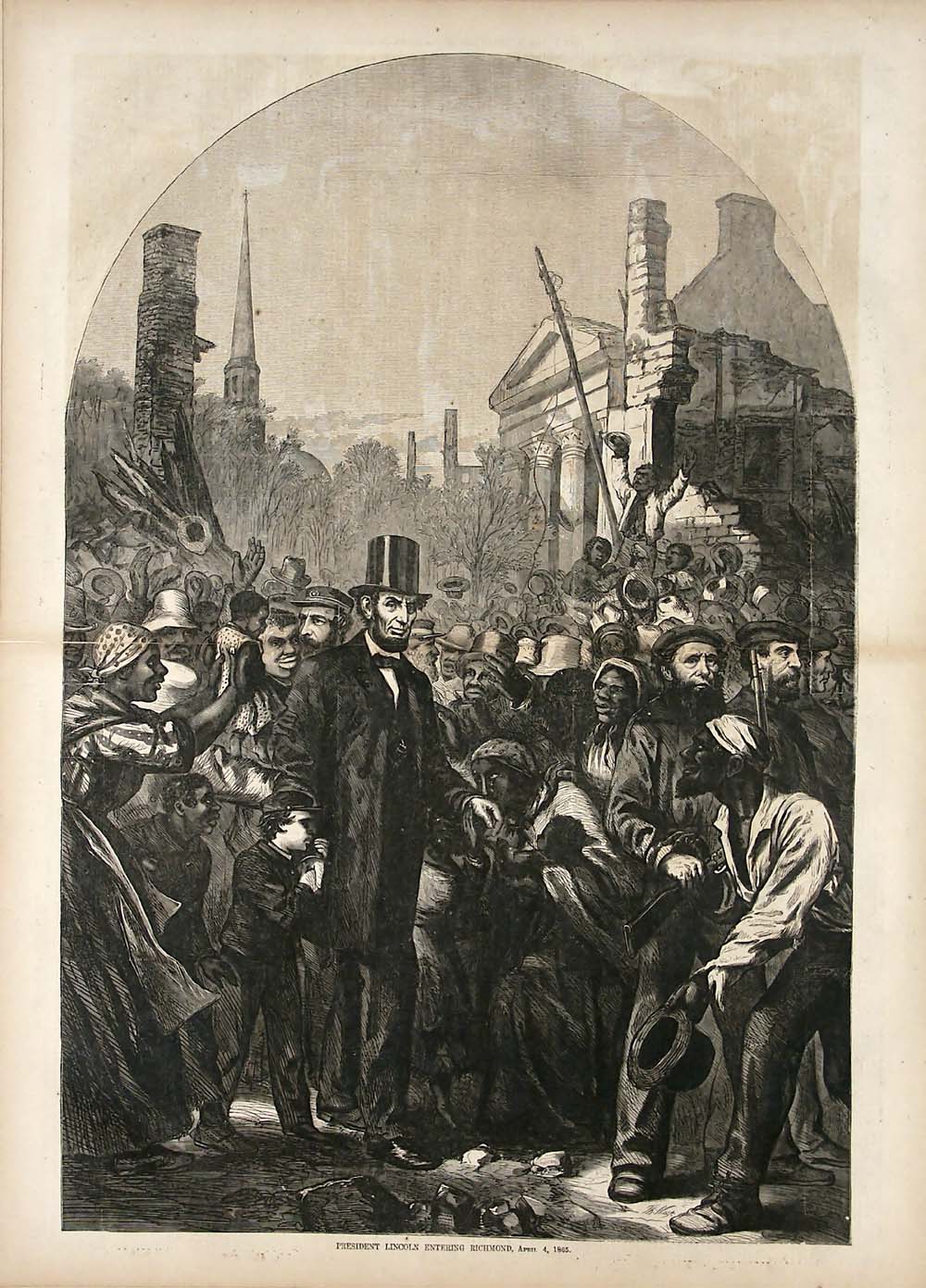
Now, we come to the fourth and final paragraph of Abraham Lincoln's second Inaugural Address:
With malice toward none, with charity for all, with firmness in the right as God gives us to see the right, let us strive on to finish the work we are in, to bind up the nation's wounds, to care for him who shall have borne the battle and for his widow and his orphan, to do all which may achieve and cherish a just and lasting peace among ourselves and with all nations.1. Before interpreting one of the most sublime sentences ever composed in the English language--because the entire fourth paragraph is one sentence, it's important to understand what Lincoln did not say in the three paragraphs leading to it.
First and foremost, Lincoln did not suggest that the war, with all its death and destruction, was an atoning sacrifice for past sins. Were he to have done so would have required him to totally ignore the teachings of the Bible, from which he drew inspiration for this speech. As a student of the Bible, Lincoln was familiar with passages of the New Testament that tell us that there has been one perfect atoning sacrifice in the history of the world, the death of the sinless Savior, Jesus Christ, Who gave His life for all people.
The New Testament book of Hebrews, for example, asserts that the Old Testament system of sacrificing unblemished lambs on Yom Kippur--the Day of Atonement--was a limited foreshadowing of what would be accomplished when the One John the Baptist called "the lamb of God Who takes away the sin of the world," yielded up His life on the cross:
Since the law has only a shadow of the good things to come and not the true form of these realities, it can never, by the same sacrifices that are continually offered year after year, make perfect those who approach. Otherwise, would they not have ceased being offered, since the worshipers, cleansed once for all, would no longer have any consciousness of sin? But in these sacrifices there is a reminder of sin year after year. For it is impossible for the blood of bulls and goats to take away sins. Consequently, when Christ came into the world, he said, “Sacrifices and offerings you have not desired, but a body you have prepared for me; in burnt offerings and sin offerings you have taken no pleasure.
Then I said, ‘See, God, I have come to do your will, O God’ (in the scroll of the book it is written of me).” When he said above, “You have neither desired nor taken pleasure in sacrifices and offerings and burnt offerings and sin offerings” (these are offered according to the law), then he added, “See, I have come to do your will.” He abolishes the first in order to establish the second. And it is by God’s will that we [that is, believers in Jesus Christ] have been sanctified through the offering of the body of Jesus Christ once for all. [Hebrews 10:1-10]Lincoln didn't see the Civil War as either punishment or atoning sacrifice. He saw it as a consequence of both Southern sin and Northern complicity in the sin. The sin was slavery.
There is a Biblical phrase, often misunderstood: wrath of God. It refers less to the active anger of God, although both the Old and New Testament confirm that God does become angry, than it does to the way God has structured the universe.
Here's how I often explain the wrath of God to my Catechism students. "What would you do," I ask them, "if I told you to dip one of your hands in a pan filled with water and to stick the finger of your other hand into of the light socket on a lampstand that's plugged in? Would you do it?"
"No," they tell me.
"Why?"
"Because I might get shocked."
"Is that because the electricity is angry with you?"
"No."
By the same token, if one repeatedly violates the will of God, as the United States had in accepting the cancerous sin of slavery to infect its soul for long years, in violation of its own principles, there was bound to be a consequence.
We see this exemplified at a personal level in the Old Testament's story of King David. David knew that he had a relationship with God because he was better than anybody else. It was based, as a relationship with God is always based in both the Old and New Testaments, on the gracious willingness of God to receive those who repent for their sins and believe in Him. But David also knew that one can walk away from a relationship with God by allowing sin to take control of one's life.
That happened during one season of David's life when, at a time of spiritual heedlessness, he took another man's wife, got her pregnant, and then, thinking he could use his position to cover up his wrong, he had the woman's husband murdered.
Ultimately, David repented for his sins and I agree with those Bible scholars who say that God not only forgave David, He also restored David's greatness. Nonetheless, there were consequences to David's foray into unrepentant sin. Things didn't go well for him for a period.
Was this God punishing David? No. It was David suffering the consequences inbuilt in God's universe.
One of the most famous conversations Jesus ever had was with a teacher of Israel named Nicodemus. It's recorded in the Gospel of John in the New Testament. Even those who have never read the Bible are likely to be familiar with some of what Jesus said. But check out three key verses from that interchange (the speaker is Jesus):
“For God so loved the world that he gave his only Son, so that everyone who believes in him may not perish but may have eternal life. Indeed, God did not send the Son into the world to condemn the world, but in order that the world might be saved through him. Those who believe in him are not condemned; but those who do not believe are condemned already, because they have not believed in the name of the only Son of God." [John 3:16-18]When people spurn the new life God has in mind for us and freely offers to us through Christ, they experience the wrath of God. It isn't that God is lashing out at them. On the contrary, people effectively lash out at themselves by refusing to repent or to believe in Christ. Lincoln clearly understood all this.
2. In this address, Lincoln has led the people of the nation over which he presides through a kind of liturgy of confession. What follows is a kind of "go and sin no more" statement.
He charges his countrymen to embrace the lifestyle every sinner who has experienced God's forgiveness has ever been charged to embrace. "With malice toward none..." They are to forgive, be reconciled with, and to actively love those they had called enemies. Many passages of Scripture speak to this:
Jesus taught His disciples to pray, "Forgive us our sins, for we also forgive everyone who sins against us" (Luke 11:4)
[Jesus]...told them a parable: “Can a blind person guide a blind person? Will not both fall into a pit? A disciple is not above the teacher, but everyone who is fully qualified will be like the teacher. Why do you see the speck in your neighbor’s eye, but do not notice the log in your own eye? Or how can you say to your neighbor, ‘Friend, let me take out the speck in your eye,’ when you yourself do not see the log in your own eye? You hypocrite, first take the log out of your own eye, and then you will see clearly to take the speck out of your neighbor’s eye. (Luke 6:39-42)
"We love because he first loved us." (First John 4:19)
The wages of sin, the appropriate payment for our sin, the New Testament asserts, is death. But, "the free gift of God is eternal life in Christ Jesus our Lord." (Romans 6:23)
In the midst of the grim and slowly-dying Civil War, Lincoln saw a glimmer of hopefulness. The nation had experienced the horrible consequences of its sin and now repented. It turned its back on slavery, although the unfolding of history would demonstrate that the old sins of bondage and racism could not be easily or quickly exorcised. Slavery and racism, like all human sins, are addictions, from which we're usually detoxified slowly and painfully.
Grateful that America was still alive, that God had not erased this land of promise, which he had celebrated at Gettysburg, Lincoln called his countrymen to demonstrate their gratitude by forgiving each other and by caring for those who had borne the battle and for their widows and orphans.
3. It's interesting that in this paragraph about charity and reconciliation, Lincoln sounds a note of toughness. This shouldn't surprise us. I often tell people that love isn't always how we feel, it's the good for others we sometimes do in spite of how we feel. Love, as the Bible understands it, isn't primarily about emotion. It's a conscious decision to do the right thing, even though that's often the hard thing. What hard things does Lincoln speak of here?:
- Firmly pursuing "the right," even if that entails danger, sacrifice, and continued war. Although he clearly sees the war being the fault of both North and South, the South must be defeated in the hostilities which that region began.
- Binding up the national wounds.
- Caring for the victims of war.
- Working for a just and lasting peace.
In this final paragraph, Lincoln signaled, as he had in conversations with Cabinet members, his intention to depart from the precedents of history. He would pursue a Reconstruction policy that would rapidly incorporate the once-rebellious South into America's national life.
Lincoln, with his winsome personal ways and his extraordinary abilities as a communicator, might have had a better chance of selling a conciliatory Reconstruction approach to the Congress and the North than did his rigid, humorless successor, Andrew Johnson.
Yet, history has confirmed the wisdom of Lincoln's intended policy toward the Union's vanquished enemy as surely as the Bible affirms its rightness. In short, policies of reconciliation work; policies of retribution don't.
At the end of World War 1, for example, then-President Woodrow Wilson, who had grown up in the post-Civil War South hating Abraham Lincoln, nonetheless proposed a Lincolnian policy of reconciliation toward vanquished Germany and its allies. Wilson was overruled by the leaders of France, Britain, and Italy, all of whom sought revenge. The result was a festering and resentful Germany that eventually produced Adolf Hitler.
At the end of World War 2, however, the United States, with Britain and France, was able, in western Europe, to enact a Lincoln-like policy of reconciliation, buttressed by the Marshall Plan. The result: a democratic western Europe that remains strong and free today. The US also successfully enacted such a policy in Japan, with equally spectacular results.
The fourth paragraph of Lincoln's address envisioned a wise Reconstruction policy that did more than speak of charity and forgiveness. It commended the living of these things as essential behaviors for the functioning of democracy.
I hope to wrap this series up in the next installment.
[Rob Asghar of America Bug links to this post while saying that Hugh Hewitt, in citing earlier installments of this series, has missed one of my points. I appreciate Rob's link. But I don't think that his and Hewitt's understandings of what I've been writing here are mutually exclusive. In a world of moral ambiguities, it's possible to see war as the consequence of human sin and believe that sometimes, governments and nations have no choice but to wage war. I suspect that I'll address that more in the final installment of the series. Anyway, thanks, Rob!]
Tuesday, July 11, 2006
You're Wrong, Mr. Cowherd, Again!

Except for an occasional involuntary drive-time scan-through, I hadn't listened to ESPN radio host Colin Cowherd since late January. But, while driving today, the ninety-three or so radio shows I listen to before I even consider listening to him were all either doing commercials or something else boring. So, being in a charitable mood, I turned Cowherd on.
Big mistake! I tuned in just in time to hear him complain that a network TV newscast spent three whole minutes profiling film star June Allyson, who died on Monday. Cowherd couldn't understand why so much time would be spent on somebody that neither he or his wife, both evidently fortysomethings, had ever heard of.
I'm fifty-two. When I was growing up, it was nigh-on impossible not to see June Allyson movies on television. (She also hosted a weekly anthology TV series.) But even granting the possibility that Cowherd either lived under a rock or missed all of Allyson's films when they were shown on the small screen during his growing-up years, I couldn't believe his insensitivity.
Believe it or not, Colin, not everyone is forty or below. There are millions of people who remember June Allyson's film performances. For many, including me, although I missed her prime as a film star, she was the embodiment of the American girl-next-door.
Although perhaps not a great actress, her performances in any number of memorable movies in the 1940s and 1950s reflect an important element of the American experience. In that sense, she was historically important.
That's probably insignificant to Colin Cowherd, though. Whether the persona he projects on his radio show is anything like the real person, I have no way of knowing. But in addition to being crass, boorish, sexist, materialistic, hedonistic, and shallow, the Cowherd-on-the-Radio persona also has a sense of history akin to that of the common housefly. Anything that happened before yesterday is deemed insignificant, to hear Cowherd tell it. (Or, as I used to hear him tell it, back when I was trying to give his show a fair shot.)
Cowherd is no doubt trying to play up to an audience schooled to be ignoramuses when it comes to an appreciation or understanding of our nation's history. Yet an appreciation of our history is a foundation for responsible citizenship. That includes an appreciation of our cultural history and June Allyson, like Jimmy Stewart, her frequent co-star, is an important part of it.
Although he seems to give lessons in anti-civics with great frequency, I don't expect Colin Cowherd to do a civics class on his radio show. But I would hope that the next time he ponders saying something about the passing of a cultural icon or about an American historical event and he really doesn't know what he's talking about, he would just clamp his jaw shut tight until he can think of something to say about the Boston Red Sox or the Tampa Bay Buccaneers.
Want a Case of the Blahs? Go to the Local 'Family Christian Store'
After a doctor's visit yesterday, I went to get a prescription filled and because I had twenty minutes to kill before it was ready, I walked over to my local Family Book Store. What a depressing experience!
First, I went through the CDs. At one time, I was an aficionado of Christian contemporary music. There were musicians actually doing stuff that was both faithful to Christ and artistically interesting. You could hear edgy sounds and clever, meaningful lyrics in a variety of genres: rock, altrock, rap, ska. It was fun!
But now the whole thing has gotten homogenized. It probably started a few years ago, when someone had the idea of issuing a "praise and worship" CD. It was successful and after that, it seems everybody in the industry was doing the same thing. Most of the music referred to as "praise and worship" these days can be boiled down to variations of, "I love You, Jesus" repeated twenty-seven million times. "Just check your brain in at the church door," this music seems to tell us. "Let's all get goosebumps." This stuff is less adoration than it is addiction.
This play-it-safe approach has become so endemic to Christian music that you see the same 50 to 100 praise and worship tunes being covered over and over again. It's something that the Gospel should never be: Boring!
A quick survey of what music was being made available to the public at the store I visited yesterday revealed two sparsely-stocked racks of rock, another two equally-sparsely-stocked racks of rap, four jam-packed racks of Southern Gospel, two well-stocked racks of "Gaither," something like six racks full of Contemporary Pop, and about twelve plentiful racks of Praise and Worship.
I suppose the argument can be made that as good businesspeople, the folks in the Christian music industry know what sells and are simply feeding their primary market. But where is the passion to reach beyond the Christian ghetto? Not to mention to reach those young people raised in the Church who see Christianity receding into irrelevance because, unlike Jesus or Paul, we've forgotten how to convey the Bible's good news in the languages and cultural idioms of the world?
After taking a grim saunter through the music section, I moved on to the books. The first depressing note there was struck when I saw, prominently displayed, a book by Joel Osteen. "I thought that this was a Christian book store!" I wanted to scream. Osteen's got no cross, no repentance, and really, no Jesus.
And while one could find some really solid Christian material in the book section, you could also spot lots of things meant only to justify a domesticated, materialistic Christianity...and they were the best-sellers.
There were many books that hawked a prescriptive, proscriptive version of Christianity that seemed less about Jesus than about various human-invented agendas.
I couldn't help wondering how many tables Jesus would overturn there if He showed up at the store...and how I could explain my presence there to Him.
Yesterday, Jan at TheViewfromHer, talked about a new book from an evangelical Christian publishing house. In it, a married woman "makes a case against singleness, calling it unbiblical." As Jan points out, this would come as a surprise to Jesus and Paul.
But the deeper point is that a book like this bespeaks a grave problem in Christian media: It's the mouthpiece for an increasingly legalistic form of evangelical Christianity that seeks to defend its preferred status quo.
Paul talked about the importance of being all things to all people with the goal of reaching some with Christ. Much of evangelical Christianity seems to have forgotten all about the mission of reaching, fostering, and accepting a diverse community of believers. That's depressing.
[Thanks to Rick Moore of Holy Coast for linking to this post. I really appreciate it!]
First, I went through the CDs. At one time, I was an aficionado of Christian contemporary music. There were musicians actually doing stuff that was both faithful to Christ and artistically interesting. You could hear edgy sounds and clever, meaningful lyrics in a variety of genres: rock, altrock, rap, ska. It was fun!
But now the whole thing has gotten homogenized. It probably started a few years ago, when someone had the idea of issuing a "praise and worship" CD. It was successful and after that, it seems everybody in the industry was doing the same thing. Most of the music referred to as "praise and worship" these days can be boiled down to variations of, "I love You, Jesus" repeated twenty-seven million times. "Just check your brain in at the church door," this music seems to tell us. "Let's all get goosebumps." This stuff is less adoration than it is addiction.
This play-it-safe approach has become so endemic to Christian music that you see the same 50 to 100 praise and worship tunes being covered over and over again. It's something that the Gospel should never be: Boring!
A quick survey of what music was being made available to the public at the store I visited yesterday revealed two sparsely-stocked racks of rock, another two equally-sparsely-stocked racks of rap, four jam-packed racks of Southern Gospel, two well-stocked racks of "Gaither," something like six racks full of Contemporary Pop, and about twelve plentiful racks of Praise and Worship.
I suppose the argument can be made that as good businesspeople, the folks in the Christian music industry know what sells and are simply feeding their primary market. But where is the passion to reach beyond the Christian ghetto? Not to mention to reach those young people raised in the Church who see Christianity receding into irrelevance because, unlike Jesus or Paul, we've forgotten how to convey the Bible's good news in the languages and cultural idioms of the world?
After taking a grim saunter through the music section, I moved on to the books. The first depressing note there was struck when I saw, prominently displayed, a book by Joel Osteen. "I thought that this was a Christian book store!" I wanted to scream. Osteen's got no cross, no repentance, and really, no Jesus.
And while one could find some really solid Christian material in the book section, you could also spot lots of things meant only to justify a domesticated, materialistic Christianity...and they were the best-sellers.
There were many books that hawked a prescriptive, proscriptive version of Christianity that seemed less about Jesus than about various human-invented agendas.
I couldn't help wondering how many tables Jesus would overturn there if He showed up at the store...and how I could explain my presence there to Him.
Yesterday, Jan at TheViewfromHer, talked about a new book from an evangelical Christian publishing house. In it, a married woman "makes a case against singleness, calling it unbiblical." As Jan points out, this would come as a surprise to Jesus and Paul.
But the deeper point is that a book like this bespeaks a grave problem in Christian media: It's the mouthpiece for an increasingly legalistic form of evangelical Christianity that seeks to defend its preferred status quo.
Paul talked about the importance of being all things to all people with the goal of reaching some with Christ. Much of evangelical Christianity seems to have forgotten all about the mission of reaching, fostering, and accepting a diverse community of believers. That's depressing.
[Thanks to Rick Moore of Holy Coast for linking to this post. I really appreciate it!]
One Explanation of Why Mainline Denominations--Like My Own--Are Declining
Here. A recent issue of The Lutheran magazine, official publication of my beloved Evangelical Lutheran Church in America, sold the false comforting line that the decline in mainline Christianity and the relative increase in so-called evangelical or free churches is primarily demographics. Our birth rates have been declining, the article argued. Theirs have been increasing.
That's only a fraction of the story. While many of us in mainline churches continue to fight the good fight for the authority of Scripture and the centrality of sharing the Good News of Jesus, that isn't the direction in which our denominations appear to be heading. We're paying the price.
(Thanks to Good Brownie for pointing to the LATimes article.)
(Thanks also to Mark D. Roberts, whose blog is among the best around, for linking to this post.)
That's only a fraction of the story. While many of us in mainline churches continue to fight the good fight for the authority of Scripture and the centrality of sharing the Good News of Jesus, that isn't the direction in which our denominations appear to be heading. We're paying the price.
(Thanks to Good Brownie for pointing to the LATimes article.)
(Thanks also to Mark D. Roberts, whose blog is among the best around, for linking to this post.)
Monday, July 10, 2006
Reflections on a Death
Philip writes about the death of a college classmate...and the meaning of that young man's life. (I tell Phil all the time that he's a great writer who needs a good editor.)
Interpreting Lincoln's Second Inaugural Sermon, Part 5

[We continue to analyze Lincoln's Second Inaugural Address.]
Fondly do we hope--fervently do we pray--that this mighty scourge of war may speedily pass away.
Here, Lincoln returns to the underlying theme of the entire address: God's will be done.
Yet, if God wills that it continue, until all the wealth piled by the bond-man's two hundred and fifty years of unrequited toil shall be sunk, and until every drop of blood drawn with the lash, shall be paid by another drawn with the sword, as was said three thousand years ago, so still it must be said "The judgments of the Lord, are true and righteous altogether."
1. Lincoln jarringly re-asserts, in imagery that is both direct and vivid, that God has every right, within the bounds of human history, to exact a terrible price for man's inhumanity to man. The Bible affirms that while God is gracious and patiently endures our rebellion in hopes that His kindness will lead us to repentantly walk with Him, there are nonetheless times when God may choose to exact consequences for repeated, unrepentant sin. In commanding ancient Israel not to engage in idolatry, for example, God said:
I the Lord your God am a jealous God, punishing children for the iniquity of parents, to the third and the fourth generation of those who reject me, but showing steadfast love to the thousandth generation of those who love me and keep my commandments. [Exodus 20:5-6]Lincoln assumes, along with the Bible, that none of us may defend our silent complicity with sin with such excuses as, "I was just following orders," or, "I had nothing to do with it," or, "It was the big shots who did that." Especially in a democracy, we each bear responsibility for what is done and what is countenanced in our names. Lincoln appreciated this. Whether president or pauper, we're called to respond to the undeserved favor and blessings of God in a lifestyle enunciated by the Old Testament prophet, Micah:
He has told you, O mortal, what is good; and what does the Lord require of you but to do justice, and to love kindness, and to walk humbly with your God? (Micah 6:8)2. James Tackach points out that Lincoln's more Biblical idea that both North and South were being subjected to the horrible consequences of the sin of slavery is very different from the triumphalism of Julia Ward Howe's Battle Hymn of the Republic. Citing two other scholars, Tackach writes:
...Lincoln, in the Second Inaugural, avoided the self-righteous crusading of Northerners like Julia Ward Howe, whose great anthem...assured the North that God was on its side. Howe's God "hath loosed the fateful lightning of his terrible swift sword" against the South; his face appeared in the watch-fires of the Union military camps. But Lincoln's God,...the living God who monitored the actions of nations and peoples, had unleashed his sword upon the whole nation...3. Lincoln quotes Psalm 19:7-9, which in its entirety reads:
The law of the Lord is perfect,Traditionally ascribed to David, Psalm 19 is composed of three sections, each dealing with ways in which God reveals Himself to us. In 19:1-6, we remember that God reveals Himself in the intricate beauty of creation. In 19:7-11, God reveals Himself through the Scriptures, most specifically His Law. Finally, in 19:12-14, God reveals Himself in daily living as a God of grace and forgiveness.
reviving the soul;
the decrees of the Lord are sure,
making wise the simple;
the precepts of the Lord are right,
rejoicing the heart;
the commandment of the Lord is clear,
enlightening the eyes;
the fear of the Lord is pure,
enduring for ever;
the ordinances of the Lord are true
and righteous altogether.
The verses cited by Lincoln come from this second section, which seems entirely appropriate in light of the cataclysmic circumstances then engulfing the United States.
We'll move onto the fourth paragraph of Lincoln's address in the next installment of the series.
[Thanks to Hugh Hewitt for his generous comments about this series.]
Sunday, July 09, 2006
All Star Game on Tuesday

I always excitedly look forward to Major League Baseball's annual All Star game. It's fun seeing some of the game's most talented players showcased in a single contest each year!
The All Star Game is also traditionally seen as the mid-point of the season, a time for fans to evaluate the performances of their favorite squads since opening day as well as their prospects for World Series appearances.
My beloved Cincinnati Reds have been on a skid lately, losing eight of their past nine outings. Reds deficiencies are obvious: a porous bullpen, inexplicable defensive problems, and in spite of featuring some of the most potent bats in baseball, occasional offensive lapses.
Nonetheless, I'm optimistic for how the Reds will do during the rest of the 2006 season. The team is 3-1/2-games out of first in the National League Central Division and a mere 1-1/2 games out of the top slot in the NL Wild Card race.
With the recent acquisition of reliever Eddie Guardado, the Reds front office has signaled that they regard the current season as more than a rebuilding year. If Guardado performs as he is capable of doing, starters Brandon Arroyo and Aaron Harang have second halves anything like their first halves, and one additional solid reliever can be found, the Reds could well be playing in October.
Those are a lot of "ifs," of course. None of them is bigger than the quest for additional bullpen help, a crying need among many franchises still in the post-season running. But the new owner group, led by Bob Castellini, and Reds GM Wayne Krivsky have already shown themselves capable of acquisition wizardry. They've made it exciting to be a Reds fan again!
I'm looking forward to the All Star Game. But I'm looking forward even more to the rest of the 2006 season!
Turning Facts Upside Down

Have you seen the silly new series of commercials for Just for Men hair coloring? It features one image after another of men who have supposedly colored their hair accompanied by the song, "Ain't Nothin' Like the Real Thing, Baby."
I guess the idea behind this stupid campaign is that grey hair is some unnatural invasion and that coloring one's hair makes a person "real." Aging, apparently, is unnatural.
Oh, and if you buy that, try these maxims on for size:
- War is Peace
- Freedom is Slavery
- Ignorance is Strength
God's Grace Really is Sufficient!

[This message was shared with the people of Friendship Lutheran Church during worship celebrations on July 8 and 9, 2006.]
Second Corinthians 12:2-10
You probably saw the video clip on the news some ten days ago: President Bush jogging on the South Lawn of the White House with Army Sergeant Christian Bagge. If you didn’t see the story, you should know that there were two remarkable things about the incident. First, was the fact that the President was jogging, something that bad knees have pretty much caused him to give up, in favor of mountain biking. (My exercise of choice is watching Monk on Friday nights.) But even more remarkable is the fact that Bagge was jogging...on two prosthetic legs!
He is the victim of a roadside bomb planted by insurgents in Iraq last year. In January, the young man was in an Army hospital when the President visited his bedside. It was then that Bagge told the President that he wanted to jog with him. One article tells the rest of the story in this way:
“After a roadside explosion tore apart his humvee, Sergeant Bagge's left leg was amputated just above the ankle, and his right leg ends just above the knee.I don’t know what sustains Christian Bagge in the face of his unimaginable suffering. But I do know this: Like him, every human being faces the possibility and often, the reality of suffering. It may be physical, emotional, psychological, social, or spiritual.
"’I was praying that God would stop the pain,’ Bagge said...
“Sergeant Bagge has been through 11 surgeries this year alone. He says it is not easy, but he is determined to keep moving forward.
"’There's a lot of days when I don't want to do it anymore,’ he said. ‘But I can't call in sick. I can't quit.’"
But whatever form our suffering may take, it leaves us with a simple choice, one I’ve described before, borrowing phrasing from Robert Schuller: We will either become bitter or better. As Bagge’s honest comments indicate, he is struggling through his suffering to get better. When I re-read his story this past week, I stopped what I was doing to pray that God would help him to do just that.
Our Bible lesson comes today, as our lessons have over the past several weeks, from the New Testament book of Second Corinthians. There, as you’ll remember, the first-century preacher Paul is writing to what was probably the church he loved more than any of the others he founded, the church in the Greek city of Corinth.
But at least as much as he loved the Corinthian Christians, Paul was exasperated by them. Second Corinthians, of course, was a letter that he wrote to the church. The overarching issue is the popularity of these success preachers who had swept into the church there, telling people that if they really believed in Jesus Christ, they’d have lots of strength, money, power, and perfect health.
They also pointed to Paul, who was weak, poor, powerless, and often suffered from health issues and said that he must not have been a very good Christian. In the past several weeks, we’ve mentioned some of what Paul said to refute the stupidity of these false preachers' assertions. In today’s lesson, he deals with something else they said.
One of the claims to fame made by these success preachers is that God gave them all sorts of visions and revelations. Like those perfectly-coiffed televangelists who clutter our cable TV choices today, these preachers loved to regale the Corinthians with tales of dramatic dreams and messages they claimed they’d received from God. “These visions prove how close we are to God,” they’d say. “And by the way, Paul never mentioned having any visions, did he?”
Starting in the eleventh chapter of Second Corinthians, Paul says it’s the height of foolishness for preachers to boast about their heavenly visions. When God gives someone a vision of heaven, it’s never a reason to become a braggart. Sometimes, such phenomenon are meant only to give the person who receives it comfort and motivation as they keep on faithfully following Christ. At other times, as in the cases of the Old Testament prophets, the visions God gave them weren't a reason for boastful self-aggrandizement. Their messages from God were usually calls to repentance and renewal that nobody wanted to hear, which is why people would kill them or tell them things like, "Speak to us of smooth things."
As Paul continues to dictate his message to the Corinthians, you can sense him becoming more agitated. Just before our lesson begins, he says, “It is necessary to boast; nothing is to be gained by it, but I will go on to visions and revelations of the Lord!”
"You want visions?" Paul asks. "I’ll give you visions!" Still uncomfortable with what seems like bragging, Paul tells his personal experience in the third person, a common ancient way for orators and writers to tell personal stories, the telling of which they fear might cause them to be seen as egotistical or self-absorbed.
Paul describes himself once being deep in heaven, whether bodily or spiritually, he never could decide. He saw things and heard things which he couldn’t repeat.
Paul says that he could go around bragging about this amazing experience. But he had decided instead, to boast of his weaknesses. Otherwise, Paul seems to feel that he would be too proud, too full of himself. In fact, he says, God had allowed something to happen to him to keep him from getting too carried away with himself and his spiritual power. Paul puts it this way: “Therefore, to keep me from being too elated, a thorn was given me in the flesh, a messenger of Satan to torment me, to keep me from being too elated.”
There are three things to notice in that short sentence. First: This thorn in the flesh came from Satan, not from God. Martin Luther reminds us that there are three major sources of suffering in life: the devil, the world, and our sinful selves. Paul was certain that his suffering had come from Satan.
The second thing to notice is this: God can use our suffering. He can use it to teach us what’s really important in life, especially to learn to rely on Him and not ourselves, or money, or power, or ingenuity, or good luck. As Paul develops this story, he tells the Corinthians that on three different occasions, he had begged God to remove this thorn from his flesh. But each time, God seemed to tell him, “No. I won’t do it. My gracious acceptance of you is all you need in life. In fact, it’s only when you give up on being in the driver seat of your life, that My power can really do all I want to do in your life and character.”
The third thing to notice is that thing Paul calls “a thorn in the flesh.” We have little idea what Paul is talking about here. It’s some sort of affliction from which he suffers, maybe a chronic disease which, in spite of all his praying, hasn’t gone away.
The term Paul uses for his affliction is interesting. We translate it as thorn. But that may be a bit too dainty. The word in the Greek of the New Testament is skolops. A skolops, more than a few people have observed, was the roadside bomb of the first-century world in which Paul lived. It was a large stake carved at one end to a sharp point. A series of them would often be placed pointed-side-up at the bottoms of pits dug into roadways. They were then covered with branches or grass in the hope that enemy soldiers would fall into the pits and be impaled by the stakes.
Every time the devil, the world, or even our sinful selves bring adversity or even suffering to us, it's like a wounding skolips that has the potential of driving us away from God, or making us cynical, or simply to quit living. Suffering can make us bitter.
Or, like Paul, we can make the choice that will make us better.
A man slid his car off a road and veered into a ditch. A farmhouse was nearby. So, he asked the owner if he had a tractor he could borrow to get his truck back onto the road. “Nope, but I got my mule, Blue,” said the farmer. “I doubt a mule is strong enough to pull my truck out.” “You don’t know Blue,” said the mule’s owner.
So Blue was hitched to the truck. “Pull, Blue!” The truck didn’t budge. Undeterred, the farmer called out, “Pull, Elmer!” The truck moved slightly. Then the farmer yelled, “Pull, Biscuit,” and, all of a sudden, the truck was free. “Thank you so much,” said the truck owner. “But why did you call your mule by three different names?” “Simple,” said the farmer. “Blue is blind. And if he thought he was the only one pulling, your truck would still be in the ditch!”
How do we cope with life’s challenges and suffering? We realize that we don’t face any of it alone. God’s grace is sufficient to help us handle whatever comes our ways and it’s sufficient as our only hope for this life and the next.
Paul was able to handle the skolops, the roadside bomb that threatened to destroy his relationship with God and his hope in Christ, by relying completely on Christ. He didn’t pretend to be personally powerful. In our lesson he writes, “So, I will boast all the more gladly of my weaknesses, so that the power of Christ may dwell in me. Therefore I am content with weaknesses, insults, hardships, persecutions, and calamities for the sake of Christ; for whenever I am weak, then I am strong.”
In His Word, God promises those who trust in Him, “I will never leave your or forsake you.” Before ascending to heaven, the risen Jesus tells us, “I will be with you always, even to the close of the age.” Those promises are like blank checks God has written to us, just waiting for us to cash. They’re promises good only for those strong enough to admit their weakness and their need of God.
We’re never so weak as when we pretend to be in control.
We’re never so strong as when we let God be in control and let His power fill our lives!
Subscribe to:
Posts (Atom)