Go, Buckeyes!
Saturday, December 06, 2008
Yeah!
For the second time this week, the unranked and rebuilding Ohio State men's basketball club faced a ranked team away from Columbus. And for the second time this week, the Buckeyes won, beating Notre Dame 67-62 today. I am psyched!

Friday, December 05, 2008
"People Get Ready": A Look at This Sunday's Gospel Lesson (December 7, 2008)
[This week, to help people prepare for worship at Saint Matthew Lutheran Church in Logan, Ohio, the congregation I serve as pastor, and at other churches that use the lectionary associated with the Church Year, I'm not going to discuss all the appointed lessons. You might want to read all of them, linked below. But my focus here will be on the Gospel lesson only. I hope that you find it helpful.]
Bible Lessons for the First Sunday in Advent (Year B):
Isaiah 40:1-11
Psalm 85:1-2, 8-13
2 Peter 3:8-15a
Mark 1:1-8
The Prayer of the Day:
Stir up our hearts, Lord God, to prepare the way of your only Son. By his coming strengthen us to serve you with purified lives; through Jesus Christ, our Savior and Lord, who lives and reigns with you and the Holy Spirit, one God, now and forever. Amen
A Few Comments:
1. For background on the Gospel of Mark, go here. For background on the Season of Advent, go here.
2. The first lesson, from Isaiah, was likely written by the person scholars refer to as "Second Isaiah" (or "Deutero-Isaiah), a prophet schooled in the teachings of the original Isaiah. Second Isaiah, the scholars tell us, began committing his prophecies to paper just before Cyrus of Persia conquered Babylon. The Babylonian empire had earlier conquered God's people, taking many of them into slavery. For more, go here, looking under the section dealing with last Sunday's lesson from Isaiah.
3. Advent is not just a season anticipating Christmas, of course. In fact, it originally had nothing to do with Christmas. The season mainly anticipates that the God Who entered our world in Jesus Christ has said that He will come back. The question is, "How do we wait?"
Last Sunday's lessons dealt with one aspect of how we should wait for Christ's return. The lessons for this week further address that question, pointing to repentance.
The earliest Christians, as evidenced by the writings of Paul and Peter in the New Testament letters, had expected Jesus' quick return. In last Sunday's Gospel lesson, Jesus said that all of the world conditions requisite for His return already existed during His earthly ministry. We need look for no further signs for the Second Coming. The perception of a delayed parousia was a source of consternation to the first Christians. It broke the faith of some. Others saw it as license to commit sin. Still others either claimed that Jesus wasn't returning or that His return would be symbolic rather than actual.
In our second lesson, Peter says that the perception of delay was based on impatient human measurement, not the timetable of God. He says, in fact, that God's supposed slowness gives more people time to repent, that is, turn from sin and turn to God. (By the way, it also affords Christians more opportunity to spread the Good News about Jesus.)
This all dovetails nicely with this Sunday's Gospel lesson.
Verse-by-Verse Comments on Mark 1:1-8
v.1: "The beginning of the good news of Jesus Christ, the Son of God": Mark's Gospel begins with a sentence fragment, which I believe, serves as a title for the entire book. The account of Jesus' life, death, and the report of His resurrection--more on that phrasing in a moment--which Mark presents is just "the beginning of the good news of Jesus Christ." This is so in two ways.
First: Mark, and the other Gospel writers, Matthew, Luke, and John, aren't just telling a story. They're telling the true story of what happened when God came to the earth in Jesus Christ. (By the way, contrary to one of the popular urban legends going around today, Jesus' life is more well attested by more disparate sources than were the lives of many ancient figures whose existences are not questioned. The assertion that Jesus never existed may be around because Jesus is a greater threat to our self-driven life styles, including my own, than someone like Alexander the Great. We can look at someone like Alexander and keep him safely in the vaults of history. But Jesus, the Savior Who wouldn't stay dead, will change us from the inside out if we give Him access to our lives, psyches, and thinking.)
The story of Jesus will, if we let it, change our lives for eternity. His time on earth is only the beginning of Jesus' story. It can continue in us and can continue forever.
Second: Many modern scholars believe that Mark originally ended his Gospel account of Jesus with Mark 16:8. There, we're told simply that on the first Easter, the women to whom Jesus' resurrection was announced fled from the tomb in terror and amazement, saying nothing to anybody because fear overcame them.
That would seem, from Mark's vantage point, to be a good coda for his writing. Mark's first readers, like you and me, were people who hadn't seen a dead man rise to life. Their call, like ours, was to step into this mystery, letting it take hold of them while the Holy Spirit built faith in them.
The sentence fragment in verse 1 immerses us in the mystery of Jesus. Mark doesn't try to win you over with factoids. Instead, in rapid succession, he gives you vignettes from Jesus' earthly ministry and the report of His resurrection to nudge you toward faith, rather than bludgeoning you to it.*
"good news": The word is a Greek compound, euaggelion (pronounced you-ahn-gay-lee-own). The eu- prefix means good. Aggelion means message. (It's related to the Greek word for messenger, angelos, in English rendered as angel.)
In ordinary Greek usage, the singular form of this word, as it shows up in our lesson, never appeared. It was always used in a way that seems awkward in the English language, a plural that, if translated literally, would mean "good newses."
It was a term used of the victories achieved by great kings. The Romans, who it should be pointed out, regarded their emperors as gods or sons of gods, hailed the good newses of their victorious god-kings.
You can see how, first of all, Mark's use of the singular of this word would have been jarring to those who hadn't really heard the word in that way before. More than that, it would have been a gauntlet thrown down at the worship of emperors, military heroes, or little deities. There is really only one thing that we can speak of as good news, of true victory, Mark was saying, and that's the story of Jesus' life, death, and resurrection.
"Son of God": This also would have been a provocative designation. The emperors were called "sons of gods." Mark is saying that Jesus is the Son of the God.
In using these terms for Jesus though, Mark was, in essence, setting his audience up. Jesus wouldn't be a king who conquered through military, economic, or political muscle, but as a suffering servant who dealt with the real problems of the human race, sin and death, by sharing our deaths and rising to give new lives to those who surrender to Him.
vv.2-3: Mark wastes no time in telling his story. He dives in.
He also claims that the whole of what he cites from the Old Testament comes from Isaiah. Actually, only v. 3 does, specifically Isaiah 40:3. V. 2 actually references Exodus 23:20 and the similar Malachi 3:1. The Exodus passage, from the Old Testament account of the Hebrews' journey from Egypt, where they had been slaves, to their promised land, finds God promising "an angel," a messenger, would guard them on their way in order to take them to the place God had prepared for them.
Malachi may have been a title, rather than the name of the writer of the Old Testament book that bears that name. It's the Hebrew word for messenger. Malachi says that a messenger is coming from God and it has been seen by some to refer to both John the Baptizer and Jesus.
Mark's use of the Exodus passage is particularly interesting. John's ministry happened at the Jordan River, which the Exodus people crossed to get to the promised land. Without a relationship with God, without forgiveness of sin, we wander in the wilderness, far from God.
"the wilderness": Interestingly, as pointed out by Pastor Ed Markquart, wilderness was always a place of promise, a place through which God's people travel to be shaped by God and ushered into his presence. John the Baptizer's place of ministry was fraught with promise.
v.4: "John the Baptizer": It's better to refer to John in this way. "Baptist" as in "John the Baptist" creates confusion. John the Baptizer had nothing to do with the Baptist movement within Christianity, which started in the 16th.-century.
"a baptism of repentance": This contrasts with the baptism instituted by Jesus. John's baptism was a rite of commitment to repentance on the part of the person who came forward to be baptized. In the baptism of Jesus, a sacrament, God acts; the baptized is the passive recipient of God's act of grace and salvation in Christ.
The word in the New Testament Greek for repentance is metanoia, meaning change of mind. Repentance, turning away from sin, is an essential response to the grace God offers in Christ. God will not force Himself on us. God will act when we turn to Him, willing to be changed from an enemy to a friend of God.
The Biblical teaching on repentance flies in the face of the pop psychology of our day that claims that people can't change, that they're the hapless victims of genes and experience, nature and nurture. The Bible says that in fact, people can change, and a rich history of thousands of years' worth of changed lives supports the teaching.
In Christ, God calls us to live in what Martin Luther called, "daily repentance and renewal," daily submission to God's power to change us. If we're willing to change for the better, away from self-centered and destructive behaviors toward lives of love for God and neighbor, we can become what Luther also called, "the Holy Spirit's workshop."
This process of gratifying change, which the New Testament calls sanctification, isn't easy and none of us will be fully reformed this side of the grave. But repentant people can be changed by the grace of God.
"sins": The word is the plural form of the Greek word, 'amartia. It has the idea of "missing the mark," of failing to be what God has made us to be and which, when we are honest, we want to be. This is what Paul spoke about in Romans 7:15.
"forgiveness": The word in Greek is a form of the verb, aphiemi, meaning release. When we repent, turning to the God we know in Christ, He lifts the oppressing load of sin off of our shoulders. We're freed to be God's people again, entering "the promised land" of God's eternal reign.
v.5: "confessing their sins": This is how we prepare for Christ coming into our lives, not just at the end of history, but every day we confess our sins to God.
"baptized": There were baptisms practiced as religious rites of purification by some Jews and by people of other faiths. But those rites were self-administered, particularly among the Qumran community who produced the Dead Sea Scrolls. John's baptism was unique in that it was administered by someone else and was a public act of repentance and commitment.
v.6: "Now John was clothed...he ate locusts and wild honey": God often uses people the world considers weird and marginal to proclaim His message. Maybe weird and marginal people are the best candidates for this because they're not concerned about what the neighbors think. They only care about what God thinks.
John's attire was similar to that of the Old Testament prophet, Elijah, who it was thought, might come back to be the forerunning announcer of the Messiah.
v.7: "more power than I...I am not worthy to stoop down and untie the thongs of his sandals": John emphasizes the surpassing greatness of the one "coming after" him.
v.8: "I have baptized you with water; but he will baptize you with the Holy Spirit": John again underscores the contrast between his baptism and the one to be instituted by Christ. John's baptism is water only, a symbol of repentance. Jesus' baptism brings the Holy Spirit's power into the life of the baptized. Just as Jesus came into the world at Bethlehem, in Holy Baptism, the Holy Spirit comes into our lives. Every time Holy Baptism happens, another advent, a coming of God into our world, happens.
[For more, see here. You might also like N.T. Wright's readable, insightful, and fun commentary.]
*Most scholars today believe that the accounts of Jesus' resurrection appearances that make up the rest of Mark 16, were added later. That doesn't mean that they're inauthentic though.
[Background on the Church Year and the three years of the lectionary cycle can be found here.]
Bible Lessons for the First Sunday in Advent (Year B):
Isaiah 40:1-11
Psalm 85:1-2, 8-13
2 Peter 3:8-15a
Mark 1:1-8
The Prayer of the Day:
Stir up our hearts, Lord God, to prepare the way of your only Son. By his coming strengthen us to serve you with purified lives; through Jesus Christ, our Savior and Lord, who lives and reigns with you and the Holy Spirit, one God, now and forever. Amen
A Few Comments:
1. For background on the Gospel of Mark, go here. For background on the Season of Advent, go here.
2. The first lesson, from Isaiah, was likely written by the person scholars refer to as "Second Isaiah" (or "Deutero-Isaiah), a prophet schooled in the teachings of the original Isaiah. Second Isaiah, the scholars tell us, began committing his prophecies to paper just before Cyrus of Persia conquered Babylon. The Babylonian empire had earlier conquered God's people, taking many of them into slavery. For more, go here, looking under the section dealing with last Sunday's lesson from Isaiah.
3. Advent is not just a season anticipating Christmas, of course. In fact, it originally had nothing to do with Christmas. The season mainly anticipates that the God Who entered our world in Jesus Christ has said that He will come back. The question is, "How do we wait?"
Last Sunday's lessons dealt with one aspect of how we should wait for Christ's return. The lessons for this week further address that question, pointing to repentance.
The earliest Christians, as evidenced by the writings of Paul and Peter in the New Testament letters, had expected Jesus' quick return. In last Sunday's Gospel lesson, Jesus said that all of the world conditions requisite for His return already existed during His earthly ministry. We need look for no further signs for the Second Coming. The perception of a delayed parousia was a source of consternation to the first Christians. It broke the faith of some. Others saw it as license to commit sin. Still others either claimed that Jesus wasn't returning or that His return would be symbolic rather than actual.
In our second lesson, Peter says that the perception of delay was based on impatient human measurement, not the timetable of God. He says, in fact, that God's supposed slowness gives more people time to repent, that is, turn from sin and turn to God. (By the way, it also affords Christians more opportunity to spread the Good News about Jesus.)
This all dovetails nicely with this Sunday's Gospel lesson.
Verse-by-Verse Comments on Mark 1:1-8
v.1: "The beginning of the good news of Jesus Christ, the Son of God": Mark's Gospel begins with a sentence fragment, which I believe, serves as a title for the entire book. The account of Jesus' life, death, and the report of His resurrection--more on that phrasing in a moment--which Mark presents is just "the beginning of the good news of Jesus Christ." This is so in two ways.
First: Mark, and the other Gospel writers, Matthew, Luke, and John, aren't just telling a story. They're telling the true story of what happened when God came to the earth in Jesus Christ. (By the way, contrary to one of the popular urban legends going around today, Jesus' life is more well attested by more disparate sources than were the lives of many ancient figures whose existences are not questioned. The assertion that Jesus never existed may be around because Jesus is a greater threat to our self-driven life styles, including my own, than someone like Alexander the Great. We can look at someone like Alexander and keep him safely in the vaults of history. But Jesus, the Savior Who wouldn't stay dead, will change us from the inside out if we give Him access to our lives, psyches, and thinking.)
The story of Jesus will, if we let it, change our lives for eternity. His time on earth is only the beginning of Jesus' story. It can continue in us and can continue forever.
Second: Many modern scholars believe that Mark originally ended his Gospel account of Jesus with Mark 16:8. There, we're told simply that on the first Easter, the women to whom Jesus' resurrection was announced fled from the tomb in terror and amazement, saying nothing to anybody because fear overcame them.
That would seem, from Mark's vantage point, to be a good coda for his writing. Mark's first readers, like you and me, were people who hadn't seen a dead man rise to life. Their call, like ours, was to step into this mystery, letting it take hold of them while the Holy Spirit built faith in them.
The sentence fragment in verse 1 immerses us in the mystery of Jesus. Mark doesn't try to win you over with factoids. Instead, in rapid succession, he gives you vignettes from Jesus' earthly ministry and the report of His resurrection to nudge you toward faith, rather than bludgeoning you to it.*
"good news": The word is a Greek compound, euaggelion (pronounced you-ahn-gay-lee-own). The eu- prefix means good. Aggelion means message. (It's related to the Greek word for messenger, angelos, in English rendered as angel.)
In ordinary Greek usage, the singular form of this word, as it shows up in our lesson, never appeared. It was always used in a way that seems awkward in the English language, a plural that, if translated literally, would mean "good newses."
It was a term used of the victories achieved by great kings. The Romans, who it should be pointed out, regarded their emperors as gods or sons of gods, hailed the good newses of their victorious god-kings.
You can see how, first of all, Mark's use of the singular of this word would have been jarring to those who hadn't really heard the word in that way before. More than that, it would have been a gauntlet thrown down at the worship of emperors, military heroes, or little deities. There is really only one thing that we can speak of as good news, of true victory, Mark was saying, and that's the story of Jesus' life, death, and resurrection.
"Son of God": This also would have been a provocative designation. The emperors were called "sons of gods." Mark is saying that Jesus is the Son of the God.
In using these terms for Jesus though, Mark was, in essence, setting his audience up. Jesus wouldn't be a king who conquered through military, economic, or political muscle, but as a suffering servant who dealt with the real problems of the human race, sin and death, by sharing our deaths and rising to give new lives to those who surrender to Him.
vv.2-3: Mark wastes no time in telling his story. He dives in.
He also claims that the whole of what he cites from the Old Testament comes from Isaiah. Actually, only v. 3 does, specifically Isaiah 40:3. V. 2 actually references Exodus 23:20 and the similar Malachi 3:1. The Exodus passage, from the Old Testament account of the Hebrews' journey from Egypt, where they had been slaves, to their promised land, finds God promising "an angel," a messenger, would guard them on their way in order to take them to the place God had prepared for them.
Malachi may have been a title, rather than the name of the writer of the Old Testament book that bears that name. It's the Hebrew word for messenger. Malachi says that a messenger is coming from God and it has been seen by some to refer to both John the Baptizer and Jesus.
Mark's use of the Exodus passage is particularly interesting. John's ministry happened at the Jordan River, which the Exodus people crossed to get to the promised land. Without a relationship with God, without forgiveness of sin, we wander in the wilderness, far from God.
"the wilderness": Interestingly, as pointed out by Pastor Ed Markquart, wilderness was always a place of promise, a place through which God's people travel to be shaped by God and ushered into his presence. John the Baptizer's place of ministry was fraught with promise.
v.4: "John the Baptizer": It's better to refer to John in this way. "Baptist" as in "John the Baptist" creates confusion. John the Baptizer had nothing to do with the Baptist movement within Christianity, which started in the 16th.-century.
"a baptism of repentance": This contrasts with the baptism instituted by Jesus. John's baptism was a rite of commitment to repentance on the part of the person who came forward to be baptized. In the baptism of Jesus, a sacrament, God acts; the baptized is the passive recipient of God's act of grace and salvation in Christ.
The word in the New Testament Greek for repentance is metanoia, meaning change of mind. Repentance, turning away from sin, is an essential response to the grace God offers in Christ. God will not force Himself on us. God will act when we turn to Him, willing to be changed from an enemy to a friend of God.
The Biblical teaching on repentance flies in the face of the pop psychology of our day that claims that people can't change, that they're the hapless victims of genes and experience, nature and nurture. The Bible says that in fact, people can change, and a rich history of thousands of years' worth of changed lives supports the teaching.
In Christ, God calls us to live in what Martin Luther called, "daily repentance and renewal," daily submission to God's power to change us. If we're willing to change for the better, away from self-centered and destructive behaviors toward lives of love for God and neighbor, we can become what Luther also called, "the Holy Spirit's workshop."
This process of gratifying change, which the New Testament calls sanctification, isn't easy and none of us will be fully reformed this side of the grave. But repentant people can be changed by the grace of God.
"sins": The word is the plural form of the Greek word, 'amartia. It has the idea of "missing the mark," of failing to be what God has made us to be and which, when we are honest, we want to be. This is what Paul spoke about in Romans 7:15.
"forgiveness": The word in Greek is a form of the verb, aphiemi, meaning release. When we repent, turning to the God we know in Christ, He lifts the oppressing load of sin off of our shoulders. We're freed to be God's people again, entering "the promised land" of God's eternal reign.
v.5: "confessing their sins": This is how we prepare for Christ coming into our lives, not just at the end of history, but every day we confess our sins to God.
"baptized": There were baptisms practiced as religious rites of purification by some Jews and by people of other faiths. But those rites were self-administered, particularly among the Qumran community who produced the Dead Sea Scrolls. John's baptism was unique in that it was administered by someone else and was a public act of repentance and commitment.
v.6: "Now John was clothed...he ate locusts and wild honey": God often uses people the world considers weird and marginal to proclaim His message. Maybe weird and marginal people are the best candidates for this because they're not concerned about what the neighbors think. They only care about what God thinks.
John's attire was similar to that of the Old Testament prophet, Elijah, who it was thought, might come back to be the forerunning announcer of the Messiah.
v.7: "more power than I...I am not worthy to stoop down and untie the thongs of his sandals": John emphasizes the surpassing greatness of the one "coming after" him.
v.8: "I have baptized you with water; but he will baptize you with the Holy Spirit": John again underscores the contrast between his baptism and the one to be instituted by Christ. John's baptism is water only, a symbol of repentance. Jesus' baptism brings the Holy Spirit's power into the life of the baptized. Just as Jesus came into the world at Bethlehem, in Holy Baptism, the Holy Spirit comes into our lives. Every time Holy Baptism happens, another advent, a coming of God into our world, happens.
[For more, see here. You might also like N.T. Wright's readable, insightful, and fun commentary.]
*Most scholars today believe that the accounts of Jesus' resurrection appearances that make up the rest of Mark 16, were added later. That doesn't mean that they're inauthentic though.
[Background on the Church Year and the three years of the lectionary cycle can be found here.]
Thursday, December 04, 2008
LP Cover Parodies and Self-Deprecation
I was in a Virgin Records Store earlier this week. (It's a place through which I sometimes peruse, although I can't remember ever buying anything there.) As I looked around, this CD cover caught my eye:

Imitation is, of course, if not the highest, one of the highest forms of flattery and obviously, this LP cover art from Def Leppard, a band I have managed to totally avoid through the years, pays homage to the Beatles. The Sparkle Lounge, I've since learned, was released in April of this year.
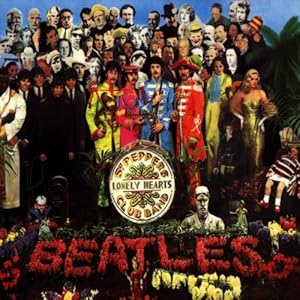
In case you don't know which Beatles LP it mimics (How have you managed to avoid the Beatles all these years and why would you want to?), here's the cover for their 1967 release, Sergeant Pepper's Lonely Hearts Club Band:

One of my favorite knock-offs of this landmark LP's cover was on the 1973 release by Beatle Ringo Starr. It looks like this:
 The Beatles always had a healthy sense of humor, concealing pride in their musical legacy beneath a willingness--most of the time--to deprecate and parody themselves. This was true of them from the beginning of their careers, when the Four Moptops appeared on a British variety show mocking their own then-signature, "Wooh!" while singing Moonlight Bay:
In later years, George Harrison appeared in the Eric Idle-created mockumentary, The Rutles.
But when it comes to LP covers, one of my favorite Beatles send-ups came from Beatle Paul McCartney. It mimics the cover that may be even more famous than that of Sergeant Pepper's: Abbey Road. Again, for those who've been living under large geological formations for all or parts of the last forty-five years, the original looks like this:
 And here's Macca's send-up, a concert LP released in 1993, called Paul is Live:

The Paul is Live cover manages also to allude to at least two tidbits of Beatles lore. First, it hearkens back to the resilient rumor, which started in 1966 and was still going strong in some circles as late as 1970, that said that McCartney was dead. The Abbey Road cover was introduced as evidence for this assertion. (One probably believed by the same folks who think that UFOs are here from other planets, the Cubans or the Mafia killed Kennedy, and Milli Vanilli were talented.) The four Beatles crossing the street by the EMI studios where they'd recorded from the beginnings of their careers, were said to be forming an Indian funeral procession with Lennon as priest and Starr as undertaker. The bodies of the dead in India, we were told ominously, were always left shoeless in such processions. Note: Paul is barefooted! Harrison, in his jeans, was also said to represent lower-caste mourners for the departed. No, in fact, Macca was saying in 1993, "Paul is [a]live and performing live." (As he told Chris Farley in one of those wonderful faux talk shows Farley used to do on Saturday Night Live, "I wasn't really dead.")
On the 1993 cover, McCartney is being pulled along by an English sheep dog like the one he owned in the 1960s, a dog named Martha. Martha gave its name to the Beatles' 1968 tune, Martha My Dear.
Self-parody is the best way for celebs to inoculate themselves against others' putdowns and from the usually-plausible charge of taking themselves too seriously. (This was something George Harrison tried, to no avail, to teach Madonna and Sean Penn when he produced a movie in which the then-married couple starred for him.) JFK was a master of self-deprecating humor and the Beatles, who conquered America five months after Kennedy's assassination and who were not short on ego, have been as well.
Here and here are sites that display LP covers imitating Sergeant Pepper's and Abbey Road.
I suppose that the real question about these and other parodies or all artistic imitation, for that matter, is why it happens. There are probably several reasons. One is that some works of art, whatever the idiom, are touchstones. They grab us by the lapels--assuming we have lapels--and won't let go. Musically, Sergeant Pepper's and Abbey Road did that, as did their cover art. Both were celebrated and are viewed as iconic.
Secondly, not everybody is as creative as the Beatles or the LP cover artists with whom they closely worked once Beatlemania hit. The Beatles' monstrous success allowed them to roam like kids in the candy shop through the entire musical process--production, arrangements, packaging. Before Beatles LPs like Revolver or Rubber Soul, album covers were fairly boring and predictable. The Beatles changed that.
But, of course, few can match the Beatles for creativity or the freedom accorded them by the suits. For four-and-a-half decades now the Fab Four have been imitated and parodied, but never matched.
[Also see here.]
[UPDATE: Go here to see something totally unnecessary: a live webcam transmission from the Abbey Road studios, now seventy-seven years old and still a site that attracts artists from around the world.]

Imitation is, of course, if not the highest, one of the highest forms of flattery and obviously, this LP cover art from Def Leppard, a band I have managed to totally avoid through the years, pays homage to the Beatles. The Sparkle Lounge, I've since learned, was released in April of this year.
In case you don't know which Beatles LP it mimics (How have you managed to avoid the Beatles all these years and why would you want to?), here's the cover for their 1967 release, Sergeant Pepper's Lonely Hearts Club Band:
One of my favorite knock-offs of this landmark LP's cover was on the 1973 release by Beatle Ringo Starr. It looks like this:

In later years, George Harrison appeared in the Eric Idle-created mockumentary, The Rutles.
But when it comes to LP covers, one of my favorite Beatles send-ups came from Beatle Paul McCartney. It mimics the cover that may be even more famous than that of Sergeant Pepper's: Abbey Road. Again, for those who've been living under large geological formations for all or parts of the last forty-five years, the original looks like this:


The Paul is Live cover manages also to allude to at least two tidbits of Beatles lore. First, it hearkens back to the resilient rumor, which started in 1966 and was still going strong in some circles as late as 1970, that said that McCartney was dead. The Abbey Road cover was introduced as evidence for this assertion. (One probably believed by the same folks who think that UFOs are here from other planets, the Cubans or the Mafia killed Kennedy, and Milli Vanilli were talented.) The four Beatles crossing the street by the EMI studios where they'd recorded from the beginnings of their careers, were said to be forming an Indian funeral procession with Lennon as priest and Starr as undertaker. The bodies of the dead in India, we were told ominously, were always left shoeless in such processions. Note: Paul is barefooted! Harrison, in his jeans, was also said to represent lower-caste mourners for the departed. No, in fact, Macca was saying in 1993, "Paul is [a]live and performing live." (As he told Chris Farley in one of those wonderful faux talk shows Farley used to do on Saturday Night Live, "I wasn't really dead.")
On the 1993 cover, McCartney is being pulled along by an English sheep dog like the one he owned in the 1960s, a dog named Martha. Martha gave its name to the Beatles' 1968 tune, Martha My Dear.
Self-parody is the best way for celebs to inoculate themselves against others' putdowns and from the usually-plausible charge of taking themselves too seriously. (This was something George Harrison tried, to no avail, to teach Madonna and Sean Penn when he produced a movie in which the then-married couple starred for him.) JFK was a master of self-deprecating humor and the Beatles, who conquered America five months after Kennedy's assassination and who were not short on ego, have been as well.
Here and here are sites that display LP covers imitating Sergeant Pepper's and Abbey Road.
I suppose that the real question about these and other parodies or all artistic imitation, for that matter, is why it happens. There are probably several reasons. One is that some works of art, whatever the idiom, are touchstones. They grab us by the lapels--assuming we have lapels--and won't let go. Musically, Sergeant Pepper's and Abbey Road did that, as did their cover art. Both were celebrated and are viewed as iconic.
Secondly, not everybody is as creative as the Beatles or the LP cover artists with whom they closely worked once Beatlemania hit. The Beatles' monstrous success allowed them to roam like kids in the candy shop through the entire musical process--production, arrangements, packaging. Before Beatles LPs like Revolver or Rubber Soul, album covers were fairly boring and predictable. The Beatles changed that.
But, of course, few can match the Beatles for creativity or the freedom accorded them by the suits. For four-and-a-half decades now the Fab Four have been imitated and parodied, but never matched.
[Also see here.]
[UPDATE: Go here to see something totally unnecessary: a live webcam transmission from the Abbey Road studios, now seventy-seven years old and still a site that attracts artists from around the world.]
Wednesday, December 03, 2008
Making Our Relationships Work: Covenant
[This was shared during the first Midweek Advent Worship of Saint Matthew Lutheran Church in Logan, Ohio, earlier tonight. It was inspired by a sermon from Reverend Roger R. Sonnenberg, although it bears no resemblance to his work. So, don't blame him!]
Jeremiah 33:14-16
A woman told me, during a conversation several years ago, about her marriage, then entering its fourth decade. With humor, she recounted some of the trials she and her husband had weathered, including some that might have torpedoed other relationships.
Seeing an unspoken question on my face, she asked me, “Do you want to know how we’ve made it this long?” “Sure,” I told her. “It’s simple,” she said, “Before we even said, ‘I do,’ we made a promise to each other. No matter what, we would stay together.” She laughed and went on. “I also promised my husband that if he ever made me miserable, because of my commitment to him, I’d spend a lifetime making him miserable in return.”
She meant that last part as a joke, you should know. But the takeaway from my conversation with that woman was that the commitments, the promises, she and her husband made at the beginning of their relationship is part of why they remained together.
Now, we all know that not all marriages stay together. Things like infidelity, abuse, or other things can tear marriages apart. But in an age when people end their marriages on the flimsiest of pretexts, that woman’s words to me were telling. This couple decided at the outset that no matter how rocky things got, divorce was not an option.
Whether stated explicitly or simply believed internally, all relationships—marriages, friendships, or those between parents and children—are built on commitments or promises to hang in there together. Those two words—commitment, promise—really help to define the word that is the focal point of tonight’s worship, the first essential ingredient in good relationships: covenant
Covenant isn’t often included in the lexicon of the world outside the Church. (Sometimes, I think that we ought to hand visitors to our churches dictionaries so that they can understand the strange words we Christians use.) But covenant is a fundamental concept for we Christians…and for anyone who wants to have healthy relationships.
It won’t surprise you that as we develop a few thoughts about covenants and the part they can play in keeping our relationships together and strong, we have to start with God.
One reason for that is that God is the inventor of covenants. The God you and I know in Jesus Christ makes and keeps promises. A few examples:
In the resilient toughness of God’s covenant promises to the human race, we see an important key to making all of our relationships work, making promises, making commitments to tough it out no matter what.
But, of course, there’s a problem with promises. I once read the story of a young man living in 19th-century England. As you know, that was what's called the Victorian Era. It was a time when young men were expected to write love poems or flowery letters to their girlfriends. So, this young man tried to write a love letter to his fiancé.
“I would cross the widest ocean for you,” he told her, “I would climb the highest mountain, walk through the greatest desert. I would do anything for you.” After that set of commitments, he added a PS: “I’ll be over tonight, if it doesn’t rain.”
Our promises are only as good as our willingness or our ability to follow through on them. And follow through on our good intentions isn’t generally a strong suit of we human beings. I don’t know about you, but I can so identify with the apostle Paul, when he writes in Romans: “I do not understand my own actions. For I do not do what I want, but I do the very thing I hate.“
Among the things I’ve done that I hate, more often than I care to remember, is hurt my relationships with friends, colleagues, neighbors, and others by my failure to love others as God has loved me, to forgive others as God has forgiven me.
I should know better. More importantly, I should live better, in part because I’ve been the beneficiary of such great examples of people who live out their covenants, their promises, of love and concern for others.
Back in 1984, I graduated from seminary in May and still didn’t have a call to my first parish by August 11, the date on which Ann (then expecting our daughter, Sarah), Philip, and I had to be out of seminary housing.
My folks still had two teenagers living at home. Ann’s mother had just been through a divorce and was living in a tiny apartment. We couldn’t move in with family, then.
On top of that, my only financial contribution to our family came from what I made working part-time as a janitor. Ann, who I had torn away from a decent-paying position with the Greater Columbus Arts Council, so that I could do my seminary internship in Michigan, was working as a low-level coordinator with the special events office of Lazarus Department Store. We couldn’t even afford an apartment.
That’s when my friend Tom called me. Tom had just been through a divorce himself. It was a time when it would have been easy and understandable for Tom to be turned in on himself, licking his wounds. But Tom knew the jam I was in and asked if Ann, Phil, and I would like to move into his house with him.
Over a decade before, Tom and I had become friends. But then, he lived out the promise of friendship in a way that I could hardly fathom.
If you asked Tom how he was able to do that, you would eventually come to the real reason for his tough covenant love: Jesus Christ is his Lord and Savior. When Christ lives in you, you find it possible to walk the talk of loving relationships.
Of course, it isn’t just with friends that we’re called to love as we’ve been loved. For several decades now, Pastor Mike Slaughter has challenged the people of Ginghamsburg United Methodist Church, located near Tipp City, Ohio, to adopt an impoverished family, usually from inner city Dayton. “Whatever you spend at your house for birthdays and Christmases,” he tells them, “spend the same amount on your adopted family.”
I’ve heard Slaughter talk about how hard that was for him initially, even after he'd convinced people in his church that it was the thing to do. But for decades now, the church’s members have been adopting families. The congregation has swollen to thousands of members precisely because of its commitment to living out covenants of love in Christ's Name.
The other day, Ann pointed me to an article in the most recent issue of Woman’s Day that, in part, profiled a woman who had been among the church's adoptees a few years back. She was a single mom finding it tough to make ends meet. But a giving family from her church helped get her through, and more than materially. Today, she’s an active member of the congregation herself. A few Christmases back, she heard Pastor Slaughter say that the congregation should send a million-dollars to help the refugees from the genocide in the Darfur region of the African nation of Sudan. He suggested that each household add to what they were already giving to attain the goal. “I could never do that,” this woman told herself. But at that moment, her young son leaned over and whispered to her, “We ought to do that.” And that’s exactly what they did!
God's #1 ingredient for relationships is covenant, giving and living the promise to love as we’ve been loved and not only our friends, neighbors, co-workers, spouses, children, parents, and classmates, but also all of the people Jesus was born to save: the whole world.
During this Advent season, let’s pray that the God Who long ago made a covenant to send a Savior, a branch of David Who would give His righteousness to all who turn from sin and follow Him, will give us the courage, tenacity, and openness to make and keep our own covenants of love for others.
Jeremiah 33:14-16
A woman told me, during a conversation several years ago, about her marriage, then entering its fourth decade. With humor, she recounted some of the trials she and her husband had weathered, including some that might have torpedoed other relationships.
Seeing an unspoken question on my face, she asked me, “Do you want to know how we’ve made it this long?” “Sure,” I told her. “It’s simple,” she said, “Before we even said, ‘I do,’ we made a promise to each other. No matter what, we would stay together.” She laughed and went on. “I also promised my husband that if he ever made me miserable, because of my commitment to him, I’d spend a lifetime making him miserable in return.”
She meant that last part as a joke, you should know. But the takeaway from my conversation with that woman was that the commitments, the promises, she and her husband made at the beginning of their relationship is part of why they remained together.
Now, we all know that not all marriages stay together. Things like infidelity, abuse, or other things can tear marriages apart. But in an age when people end their marriages on the flimsiest of pretexts, that woman’s words to me were telling. This couple decided at the outset that no matter how rocky things got, divorce was not an option.
Whether stated explicitly or simply believed internally, all relationships—marriages, friendships, or those between parents and children—are built on commitments or promises to hang in there together. Those two words—commitment, promise—really help to define the word that is the focal point of tonight’s worship, the first essential ingredient in good relationships: covenant
Covenant isn’t often included in the lexicon of the world outside the Church. (Sometimes, I think that we ought to hand visitors to our churches dictionaries so that they can understand the strange words we Christians use.) But covenant is a fundamental concept for we Christians…and for anyone who wants to have healthy relationships.
It won’t surprise you that as we develop a few thoughts about covenants and the part they can play in keeping our relationships together and strong, we have to start with God.
One reason for that is that God is the inventor of covenants. The God you and I know in Jesus Christ makes and keeps promises. A few examples:
- God promised Adam and Eve promised protection from the elements after they fell into sin.
- God promised to protect Cain from murder after Cain killed his own brother, Abel.
- God promised never to destroy the earth by water after He sent the great flood in response to human sin.
- God promised to make a great nation from the descendants of a couple who shouldn’t have even been able to produce children, Abraham and Sarah.
- The Ten Commandments begin, as all you good Catechism students will no doubt remember, not with God’s commands of His people, Israel, but with a promise: “I am the Lord, your God!”
- God promised that one day, He would send a Savior Who would give His life on a cross and rise from the dead in order to offer forgiveness and everlasting life to all with faith in Him.
- After this Savior rose from the dead and before He ascended into heaven, He made another promise: “I am with you always…I will never leave you or forsake you…”
“The days are surely coming, says the LORD, when I will fulfill the promise I made to the house of Israel and the house of Judah. In those days and at that time I will cause a righteous Branch to spring up for David; and he shall execute justice and righteousness in the land. In those days Judah will be saved and Jerusalem will live in safety. And this is the name by which it will be called: ‘The LORD is our righteousness.’"In Jesus Christ, the baby born at Bethlehem, we see in flesh and blood, evidence that God keeps the promises God makes! “No matter what,” God tells us in His promises—His covenants for both His Old and New Testament peoples, “divorce is not an option. You may choose to walk away from Me. But I will never walk away from you!”
In the resilient toughness of God’s covenant promises to the human race, we see an important key to making all of our relationships work, making promises, making commitments to tough it out no matter what.
But, of course, there’s a problem with promises. I once read the story of a young man living in 19th-century England. As you know, that was what's called the Victorian Era. It was a time when young men were expected to write love poems or flowery letters to their girlfriends. So, this young man tried to write a love letter to his fiancé.
“I would cross the widest ocean for you,” he told her, “I would climb the highest mountain, walk through the greatest desert. I would do anything for you.” After that set of commitments, he added a PS: “I’ll be over tonight, if it doesn’t rain.”
Our promises are only as good as our willingness or our ability to follow through on them. And follow through on our good intentions isn’t generally a strong suit of we human beings. I don’t know about you, but I can so identify with the apostle Paul, when he writes in Romans: “I do not understand my own actions. For I do not do what I want, but I do the very thing I hate.“
Among the things I’ve done that I hate, more often than I care to remember, is hurt my relationships with friends, colleagues, neighbors, and others by my failure to love others as God has loved me, to forgive others as God has forgiven me.
I should know better. More importantly, I should live better, in part because I’ve been the beneficiary of such great examples of people who live out their covenants, their promises, of love and concern for others.
Back in 1984, I graduated from seminary in May and still didn’t have a call to my first parish by August 11, the date on which Ann (then expecting our daughter, Sarah), Philip, and I had to be out of seminary housing.
My folks still had two teenagers living at home. Ann’s mother had just been through a divorce and was living in a tiny apartment. We couldn’t move in with family, then.
On top of that, my only financial contribution to our family came from what I made working part-time as a janitor. Ann, who I had torn away from a decent-paying position with the Greater Columbus Arts Council, so that I could do my seminary internship in Michigan, was working as a low-level coordinator with the special events office of Lazarus Department Store. We couldn’t even afford an apartment.
That’s when my friend Tom called me. Tom had just been through a divorce himself. It was a time when it would have been easy and understandable for Tom to be turned in on himself, licking his wounds. But Tom knew the jam I was in and asked if Ann, Phil, and I would like to move into his house with him.
Over a decade before, Tom and I had become friends. But then, he lived out the promise of friendship in a way that I could hardly fathom.
If you asked Tom how he was able to do that, you would eventually come to the real reason for his tough covenant love: Jesus Christ is his Lord and Savior. When Christ lives in you, you find it possible to walk the talk of loving relationships.
Of course, it isn’t just with friends that we’re called to love as we’ve been loved. For several decades now, Pastor Mike Slaughter has challenged the people of Ginghamsburg United Methodist Church, located near Tipp City, Ohio, to adopt an impoverished family, usually from inner city Dayton. “Whatever you spend at your house for birthdays and Christmases,” he tells them, “spend the same amount on your adopted family.”
I’ve heard Slaughter talk about how hard that was for him initially, even after he'd convinced people in his church that it was the thing to do. But for decades now, the church’s members have been adopting families. The congregation has swollen to thousands of members precisely because of its commitment to living out covenants of love in Christ's Name.
The other day, Ann pointed me to an article in the most recent issue of Woman’s Day that, in part, profiled a woman who had been among the church's adoptees a few years back. She was a single mom finding it tough to make ends meet. But a giving family from her church helped get her through, and more than materially. Today, she’s an active member of the congregation herself. A few Christmases back, she heard Pastor Slaughter say that the congregation should send a million-dollars to help the refugees from the genocide in the Darfur region of the African nation of Sudan. He suggested that each household add to what they were already giving to attain the goal. “I could never do that,” this woman told herself. But at that moment, her young son leaned over and whispered to her, “We ought to do that.” And that’s exactly what they did!
God's #1 ingredient for relationships is covenant, giving and living the promise to love as we’ve been loved and not only our friends, neighbors, co-workers, spouses, children, parents, and classmates, but also all of the people Jesus was born to save: the whole world.
During this Advent season, let’s pray that the God Who long ago made a covenant to send a Savior, a branch of David Who would give His righteousness to all who turn from sin and follow Him, will give us the courage, tenacity, and openness to make and keep our own covenants of love for others.
How to Wait
[This was shared during worship with the people of Saint Matthew Lutheran Church in Logan, Ohio, on Sunday, November 30, the First Sunday in Advent.]
Mark 13:24-37
Near the beginning of C.S. Lewis' classic The Lion, the Witch, and the Wardrobe, four children from our world enter, by way of a wardrobe, into another world. They find themselves in a place called Narnia, then living under the spell of a White Witch who has made it “always winter, always winter and never Christmas.”
But the hope of spring comes into Narnia when Aslan, the Great Lion, the son of the Emperor-over-the-Sea, returns to Narnia. I’ll say no more for those who haven’t yet read the book, but this: I suspect that the moods of many people in our world today can be described as Narnia is described at the beginning of The Lion, the Witch, and the Wardrobe. For them, life is “always winter and never Christmas”: drudgery without joy, longing without fulfillment, fear without encouragement, and for some, sorrow without hope.
Each of us know what it is like to yearn, as Lewis puts it in another book, for "another country," a better place. I imagine that at their root, every longing you and I have ever known, goes back to our desire for something better, which we’re all prone to mistakenly imagine can be fulfilled by some one or some thing here on earth: a new love, a new car, a new job or career, a new baby, a new house, a new drug, a new exercise, a new buzz.
When I was a boy, this time of year seemed to drag on endlessly. The sun sank early, the nights lasted forever, and it felt like Christmas would never arrive. And while I was usually quite happy with my gifts, they didn't give me a joy that endured.
But the wintry state of our souls can be seen in more than little children with their Christmas lists. I spoke once with a man who told me that his teenage son, formerly an honors student and a great athlete, had gotten involved with sex outside of marriage and with drugs and destructive patterns of behavior. When a psychologist asked the young man why he had taken his life in this direction, he said, “Look, either the terrorists, or global warming, or some natural disaster is going to get me anyway. We’re all going to die soon. So, I just want to live while I can.” For this young man, it was always winter and never Christmas.
But it doesn’t have to be that way for any of us! We can live with joy, even in the midst of the humdrum. We can have our deepest yearnings for wholeness met. We can face each day with a hope that knows that one day all our sorrow will be turned into laughter and dancing!
Today is the first Sunday in Advent, the beginning of a new Church Year. Advent is a season of anticipation, of waiting. It coincides with the ebbing days of fall and the first stirrings of winter. But unlike that Narnian winter, our winter of waiting looks forward with the confident assurance that Christmas will come.
And it’s more than the celebration of Christmas, that day long ago when God came into the world in the person of the baby Jesus, that makes our Advent winter waiting bearable. In Advent, we also remember that one day, Jesus, the Lion of Judah, the King of kings, the Son of God the Father, is coming back. He, Who once died and then sprang to life again, will return. All the dead who have hoped in Him will rise again and all still living who have followed Him will be with Him in a kingdom that lasts forever. In Advent, we remember that the sins of Jesus’ followers are forgiven and so, have a hope that not even death can destroy. That’s why the color of this season is blue, the color of a bright spring sky, when life is new and the possibilities are endless.
In our Gospel lesson for this morning, Jesus addresses people to whom He has revealed that the massive, sumptuous stones of the temple in Jerusalem will one day crumble and disappear. His fellow Jews can hardly believe it! Like us, the ancient people of God built monuments of faith to God which also, in their way, served as monuments to their own egos. The ancient Hebrew and Judean peoples thought that the Temple would stand forever. If it were to crumble, Jesus' disciples seem to think, then surely the end of the world must be close at hand. It depresses them. They wonder about the signs that will take place before the end.
Jesus goes on to describe events like earthquakes and persecutions of believers, things that are going on today...and that have gone on for thousands of years.
What Jesus is saying is that the end, which will be followed by His reappearance and the establishment of His eternal kingdom could come at any time. All the signs pointing to Jesus’ return and the end of this world had already taken place twenty-one centuries ago. But that shouldn’t depress us. Nor should it be the subject of speculations. Instead, we need to be prepared for His return. Jesus puts it this way:
But what exactly does that mean? Above all, I think that it means being about the business that Jesus gives us to do, the business of loving God and loving neighbor, even when we feel inadequate to the task.
It seems to me that we can be about that business in two major ways.
The saying is true, “If you feel a long way from God, you can be sure it isn’t because God moved.” God is as close as your Bible, as close as a prayer.
As hard as it may be in the busy-ness of this time of year, I challenge you if it isn’t part of your daily routine to take time each day to turn off the radio during the morning drive or to turn off the TV or computer fifteen minutes before you go to bed at night and spend the time created asking that the dear Christ will enter into your life in fresh ways to guide you and fill you with hope. In the stillness, He will come to you. I promise.
When you spend time with Christ in stillness though, don’t be surprised if He then calls you to act in ways you may not want to act.
That’s what happened to Ed Rowell. While working his way through school, Rowell drove a school bus. Among his passengers was a five year old named Ryan. Ryan seemed to warm to Ed right away. One day, as Ryan got off the bus he told Ed that he’d like for Ed to meet his mom. “She’s pretty,” Ryan said. “I’m sure she is, Ryan,” Ed responded, “but I’ve got a pretty wife at home.”
Some days later, his run completed, Ed noticed that Ryan had fallen asleep and missed getting off at his stop. As Ed turned the bus around to take Ryan to his house, he asked when Ryan had discovered he’d missed the stop. "Back at Kim's house," Ryan said. Why hadn’t he told him then? Ed wondered. Because, Ryan told him, “I didn’t want to bother you.”
Soon thereafter, Halloween came and Ed, suffering from a headache, wanted just to get the kids delivered to their stops, his bus parked, and go home to get a good night’s sleep. He scanned the bus for any sleeping kids and took off.
Ed slept in the next morning, a Saturday, and had just settled in for a cup of coffee, when an item in the newspaper caught his eye. At the local YMCA Halloween party, there had been an accident. A five year old boy was crushed to death by some overturned gymnastic equipment. It was Ryan.
He didn’t want to, but Ed went to Ryan’s funeral visitation. “I’m so scared,” Ed thought. His greatest fear was that he would say something wrong, that he would add to the grief of Ryan’s family with an ill-chosen word.
When Ed arrived, he found Ryan’s “pretty” mom. As Ed saw Ryan’s body in his half-sized casket, he thought he detected a little bit of Halloween make-up on his left ear. “Don’t cry, you idiot,” Ed told himself. In a moment, Ed was standing in front of Ryan’s mother.
“I was Ryan’s bus driver,” he said. Her eyes began to mist and Ed was fearful that he was making things worse. Ryan’s mother then grabbed Ed and began to sob, which in turn set him to sobbing. Ed writes, “I held this young mother I'd never met before, and wished I had something to say that would turn…attention away from my tears and runny nose.” Ed thought he should say something. He didn’t know what it would be, so he just blurted out the first thing that crossed his mind: “Just remember, God knows the pain of losing a son, too." That made the crying worse and Ed got out of the funeral home as fast as possible.
A few months later, Ed’s wife took him to the hospital ER. He was experiencing an appendicitis. As he lay there on a gurney, a pretty woman walked in. It was Ryan’s mother. It turned out that she was an ER nurse.
"Hello, bus driver," she said with a smile. "I want to thank you for being there that night,” she said, as she gave Ed a shot. "I can't tell you how much your words about God understanding have helped me over these past few months. But the fact that you cared enough to cry with us meant more than anything."
This Advent, let God teach you how to wait God’s way.
We wait by taking time to spend with God so that He can forgive us and fortify us for whatever life brings our ways.
And we wait too, by reaching out to others, however unqualified we may feel, with the love, comfort, hope, and peace of God.
For the Christian, filled with God’s Spirit, even in the midst of the challenges of daily living, whether winter, spring, summer, or fall, it can always be Christmas, always a celebration that the Savior born in Bethlehem has died and risen and is always with us. Amen
Mark 13:24-37
Near the beginning of C.S. Lewis' classic The Lion, the Witch, and the Wardrobe, four children from our world enter, by way of a wardrobe, into another world. They find themselves in a place called Narnia, then living under the spell of a White Witch who has made it “always winter, always winter and never Christmas.”
But the hope of spring comes into Narnia when Aslan, the Great Lion, the son of the Emperor-over-the-Sea, returns to Narnia. I’ll say no more for those who haven’t yet read the book, but this: I suspect that the moods of many people in our world today can be described as Narnia is described at the beginning of The Lion, the Witch, and the Wardrobe. For them, life is “always winter and never Christmas”: drudgery without joy, longing without fulfillment, fear without encouragement, and for some, sorrow without hope.
Each of us know what it is like to yearn, as Lewis puts it in another book, for "another country," a better place. I imagine that at their root, every longing you and I have ever known, goes back to our desire for something better, which we’re all prone to mistakenly imagine can be fulfilled by some one or some thing here on earth: a new love, a new car, a new job or career, a new baby, a new house, a new drug, a new exercise, a new buzz.
When I was a boy, this time of year seemed to drag on endlessly. The sun sank early, the nights lasted forever, and it felt like Christmas would never arrive. And while I was usually quite happy with my gifts, they didn't give me a joy that endured.
But the wintry state of our souls can be seen in more than little children with their Christmas lists. I spoke once with a man who told me that his teenage son, formerly an honors student and a great athlete, had gotten involved with sex outside of marriage and with drugs and destructive patterns of behavior. When a psychologist asked the young man why he had taken his life in this direction, he said, “Look, either the terrorists, or global warming, or some natural disaster is going to get me anyway. We’re all going to die soon. So, I just want to live while I can.” For this young man, it was always winter and never Christmas.
But it doesn’t have to be that way for any of us! We can live with joy, even in the midst of the humdrum. We can have our deepest yearnings for wholeness met. We can face each day with a hope that knows that one day all our sorrow will be turned into laughter and dancing!
Today is the first Sunday in Advent, the beginning of a new Church Year. Advent is a season of anticipation, of waiting. It coincides with the ebbing days of fall and the first stirrings of winter. But unlike that Narnian winter, our winter of waiting looks forward with the confident assurance that Christmas will come.
And it’s more than the celebration of Christmas, that day long ago when God came into the world in the person of the baby Jesus, that makes our Advent winter waiting bearable. In Advent, we also remember that one day, Jesus, the Lion of Judah, the King of kings, the Son of God the Father, is coming back. He, Who once died and then sprang to life again, will return. All the dead who have hoped in Him will rise again and all still living who have followed Him will be with Him in a kingdom that lasts forever. In Advent, we remember that the sins of Jesus’ followers are forgiven and so, have a hope that not even death can destroy. That’s why the color of this season is blue, the color of a bright spring sky, when life is new and the possibilities are endless.
In our Gospel lesson for this morning, Jesus addresses people to whom He has revealed that the massive, sumptuous stones of the temple in Jerusalem will one day crumble and disappear. His fellow Jews can hardly believe it! Like us, the ancient people of God built monuments of faith to God which also, in their way, served as monuments to their own egos. The ancient Hebrew and Judean peoples thought that the Temple would stand forever. If it were to crumble, Jesus' disciples seem to think, then surely the end of the world must be close at hand. It depresses them. They wonder about the signs that will take place before the end.
Jesus goes on to describe events like earthquakes and persecutions of believers, things that are going on today...and that have gone on for thousands of years.
What Jesus is saying is that the end, which will be followed by His reappearance and the establishment of His eternal kingdom could come at any time. All the signs pointing to Jesus’ return and the end of this world had already taken place twenty-one centuries ago. But that shouldn’t depress us. Nor should it be the subject of speculations. Instead, we need to be prepared for His return. Jesus puts it this way:
"But about that day or hour no one knows, neither the angels in heaven, nor the Son, but only the Father. Beware, keep alert… Keep awake."During our season of waiting, of longing for Christ to act in our lives, we’re called to remain awake, alive, tuned in to God, ready for Jesus’ appearance.
But what exactly does that mean? Above all, I think that it means being about the business that Jesus gives us to do, the business of loving God and loving neighbor, even when we feel inadequate to the task.
It seems to me that we can be about that business in two major ways.
- First, we intentionally spend time with God, seeking God's forgiveness, listening for God’s direction and correction.
- Second, in looking for ways to share Christ’s love in our everyday lives.
The saying is true, “If you feel a long way from God, you can be sure it isn’t because God moved.” God is as close as your Bible, as close as a prayer.
As hard as it may be in the busy-ness of this time of year, I challenge you if it isn’t part of your daily routine to take time each day to turn off the radio during the morning drive or to turn off the TV or computer fifteen minutes before you go to bed at night and spend the time created asking that the dear Christ will enter into your life in fresh ways to guide you and fill you with hope. In the stillness, He will come to you. I promise.
When you spend time with Christ in stillness though, don’t be surprised if He then calls you to act in ways you may not want to act.
That’s what happened to Ed Rowell. While working his way through school, Rowell drove a school bus. Among his passengers was a five year old named Ryan. Ryan seemed to warm to Ed right away. One day, as Ryan got off the bus he told Ed that he’d like for Ed to meet his mom. “She’s pretty,” Ryan said. “I’m sure she is, Ryan,” Ed responded, “but I’ve got a pretty wife at home.”
Some days later, his run completed, Ed noticed that Ryan had fallen asleep and missed getting off at his stop. As Ed turned the bus around to take Ryan to his house, he asked when Ryan had discovered he’d missed the stop. "Back at Kim's house," Ryan said. Why hadn’t he told him then? Ed wondered. Because, Ryan told him, “I didn’t want to bother you.”
Soon thereafter, Halloween came and Ed, suffering from a headache, wanted just to get the kids delivered to their stops, his bus parked, and go home to get a good night’s sleep. He scanned the bus for any sleeping kids and took off.
Ed slept in the next morning, a Saturday, and had just settled in for a cup of coffee, when an item in the newspaper caught his eye. At the local YMCA Halloween party, there had been an accident. A five year old boy was crushed to death by some overturned gymnastic equipment. It was Ryan.
He didn’t want to, but Ed went to Ryan’s funeral visitation. “I’m so scared,” Ed thought. His greatest fear was that he would say something wrong, that he would add to the grief of Ryan’s family with an ill-chosen word.
When Ed arrived, he found Ryan’s “pretty” mom. As Ed saw Ryan’s body in his half-sized casket, he thought he detected a little bit of Halloween make-up on his left ear. “Don’t cry, you idiot,” Ed told himself. In a moment, Ed was standing in front of Ryan’s mother.
“I was Ryan’s bus driver,” he said. Her eyes began to mist and Ed was fearful that he was making things worse. Ryan’s mother then grabbed Ed and began to sob, which in turn set him to sobbing. Ed writes, “I held this young mother I'd never met before, and wished I had something to say that would turn…attention away from my tears and runny nose.” Ed thought he should say something. He didn’t know what it would be, so he just blurted out the first thing that crossed his mind: “Just remember, God knows the pain of losing a son, too." That made the crying worse and Ed got out of the funeral home as fast as possible.
A few months later, Ed’s wife took him to the hospital ER. He was experiencing an appendicitis. As he lay there on a gurney, a pretty woman walked in. It was Ryan’s mother. It turned out that she was an ER nurse.
"Hello, bus driver," she said with a smile. "I want to thank you for being there that night,” she said, as she gave Ed a shot. "I can't tell you how much your words about God understanding have helped me over these past few months. But the fact that you cared enough to cry with us meant more than anything."
This Advent, let God teach you how to wait God’s way.
We wait by taking time to spend with God so that He can forgive us and fortify us for whatever life brings our ways.
And we wait too, by reaching out to others, however unqualified we may feel, with the love, comfort, hope, and peace of God.
For the Christian, filled with God’s Spirit, even in the midst of the challenges of daily living, whether winter, spring, summer, or fall, it can always be Christmas, always a celebration that the Savior born in Bethlehem has died and risen and is always with us. Amen
WOW!
I've been out of state for several days and more or less, insulated from the world. Yeah, I heard that someone named Clinton will be nominated by President Obama for Secretary of State. And, yes, I heard that the Big Three automakers have presented new business plans, along with a request for loans totaling $34-billion for the lot of them. And, yeah, I know that recession has been officially declared as the condition of the economy since last November.
But having gotten home just a few moments ago, THIS was the item about which I hadn't heard and which, in the past half hour, has ROCKED MY WORLD.
Now, it's back to work.
But having gotten home just a few moments ago, THIS was the item about which I hadn't heard and which, in the past half hour, has ROCKED MY WORLD.
Now, it's back to work.
YES!
Sunday, November 30, 2008
A Simple Question for Big 12 Fans
I don't ask this impudently. My favorite conference, the Big 10, has its problems. I'm willing, in fact, to admit that the Big 10 is down this year.
But really, how do fans Big 12 teams expect their favorites to do in the post-season BCS bowl games? This weekend's five matchups in the Big 12 saw a total of 371 points scored, 102 of those in what was supposedly the elite game of the day, Oklahoma at Oklahoma State. What do you make of a conference where the average total points per game was 74? Or how do you explain that one Big 12 team, Oklahoma's Sooners, supposedly the third best in the country, gave up 41 points to the 12th-ranked Oklahoma State Cowboys in a winning match with no overtimes?
I tell you what I made of it as I watched about a quarter of the Sooners and the Cowboys. "Where are their defenses?" I wondered. The two teams' offensive squads moved up and down the field for scores, with the Cowboys showing greater talent on offense. But watching them, I was reminded of nothing so much as one of those unrealistic football video games.
Can teams from the vaunted Big 12 South win against elite competition from other conferences?
I don't know.
But based on the points that teams like Oklahoma State and Oklahoma give up, if I were a betting person---and I'm not---I wouldn't be inclined to bet more than a couple of bucks on them.
I'm probably missing something.
Someone show me what it is.
But really, how do fans Big 12 teams expect their favorites to do in the post-season BCS bowl games? This weekend's five matchups in the Big 12 saw a total of 371 points scored, 102 of those in what was supposedly the elite game of the day, Oklahoma at Oklahoma State. What do you make of a conference where the average total points per game was 74? Or how do you explain that one Big 12 team, Oklahoma's Sooners, supposedly the third best in the country, gave up 41 points to the 12th-ranked Oklahoma State Cowboys in a winning match with no overtimes?
I tell you what I made of it as I watched about a quarter of the Sooners and the Cowboys. "Where are their defenses?" I wondered. The two teams' offensive squads moved up and down the field for scores, with the Cowboys showing greater talent on offense. But watching them, I was reminded of nothing so much as one of those unrealistic football video games.
Can teams from the vaunted Big 12 South win against elite competition from other conferences?
I don't know.
But based on the points that teams like Oklahoma State and Oklahoma give up, if I were a betting person---and I'm not---I wouldn't be inclined to bet more than a couple of bucks on them.
I'm probably missing something.
Someone show me what it is.
Saturday, November 29, 2008
Advent Devotions from Trinity Alum
Members of the Alumni Council of Trinity Lutheran Seminary in Columbus are presenting solid, short devotional pieces for the Advent Season. They actually "jumped the gun," with the first piece having been written for Thanksgiving day.
The first four pieces, excellent all, are based on the Psalm lesson for tomorrow, Psalm 80:1-7, 17-19.
The devotions appear on the Trinity Lutheran Seminary web site. They can be found here.
I received my Master of Divinity degree from Trinity in 1984, nine years after graduating from Ohio State with a Bachelor's in Social Studies Education. I'm glad to see the Alumni Council share these Advent devotions with the world!
The first four pieces, excellent all, are based on the Psalm lesson for tomorrow, Psalm 80:1-7, 17-19.
The devotions appear on the Trinity Lutheran Seminary web site. They can be found here.
I received my Master of Divinity degree from Trinity in 1984, nine years after graduating from Ohio State with a Bachelor's in Social Studies Education. I'm glad to see the Alumni Council share these Advent devotions with the world!
Friday, November 28, 2008
The Waiting Game: Additional Thoughts on This Sunday's Bible Lessons (November 30, 2008)
I've already shared a few items meant to help the people of the congregation I serve as pastor, Saint Matthew Lutheran Church in Logan, Ohio, and any other folks who use the Revised Common Lectionary plan of Bible lessons, to get ready for worship this coming Sunday. You can see those posts here, here, and here. But below are a few more helps and reflections.
The Bible Lessons:
Isaiah 64:1-9
Psalm 80:1-7, 17-19
1 Corinthians 1:3-9
Mark 13:24-37
Prayer of the Day:
Stir up your power, Lord Christ, and come. By your merciful protection awaken us to the threatening dangers of our sins, and keep us blameless until the coming of your new day, for you live and reign with the Father and the Holy Spirit, one God, now and forever.
Some Thoughts...
Isaiah 64:1-9
Most contemporary Old Testament scholars believe that Isaiah was written by two (or three) different prophets writing in different times. Chapters 1-39, were authored by Isaiah, the son of Amoz. He prophesied between 742 and 687 BC. The Northern Kingdom*, what was called Israel and would later be referred to as Samaria, had been conquered by the Assyrian Empire. Isaiah warned the Southern Kingdom, what was called Judah or Judea, its faithlessness could result in the only reliable power they possessed, the power of God, to disappear from the national life, leading to the same fate Israel had suffered. About the balance of the book, the editors of The New Oxford Annotated Bible (Revised Standard Version) have this to say:
The heavens were torn open at Jesus' Baptism, according to the Gospel accounts, God the Father affirming Jesus as beloved Son to Whom all should pay attention. The heavens were torn open again when, accompanied by Peter, James, and John, Jesus' appearance was "transfigured" and God the Father affirmed Jesus again. Another tearing took place immediately after Jesus died on the cross. At that moment, the curtain in the temple, which had formerly concealed the Holy of Holies, the place where the presence of God rested on earth, was torn, indicating that through Christ all that the power of all that had once separated us from God--our sin--had been destroyed and we gain access to God, forgiveness, and life.
v.2: The blazing presence of God causes people to tremble. That happened on the first Pentecost (Acts 2).
v.3: Here begins a reminiscence about God's saving acts during ancient Israel's exodus journey from Egypt to the promised land.
v.4: Here, we have an important theme of Advent mentioned: waiting on God. To wait on God isn't to be passive. But it does mean that we're unwilling to act on our own power or in our own wisdom. I'm just beginning to learn what this means.
v. 5: Isaiah confesses that the sin of his people was responsible for the wall between God and them.
v.6: We're all unclean and insubstantial, nothing without God.
v.7: People don't call on God, Isaiah says, and God lets them go their own way.
v.8: "Still," Isaiah says to God, "we do belong to You. You made us. We bear the stamp of Your authorship and You've gone to a lot of trouble to make us Your own people."
v.9: "Don't hold our sins against us," Isaiah goes on to plead, "Think about the fact that we are Your people."
Psalm 80:1-7, 17-19
This psalm was traditionally attributed to Asaph, one of his descendants, or members of a group of poets and singers who saw him as their master or teacher. It was most likely written after the Northern Kingdom had fallen to Assyria, its people deported to there as slaves.*** The impatient waiting of a captive people can be seen in this psalm.
v.1: God is portrayed as both Shepherd, a common way of referring to ancient kings, and as King, enthroned on the cherubim.
v.2: "Stir up": God is asked to stir Himself to action on behalf of His people. One of my seminary professors, Ron Hals, used to refer to the Prayers of the Day appointed for the Advent season as the "stirrup prayers"; they all begin with the phrase, "Stir up." Human impatience, as well as weariness with suffering and adversity, is reflected in this phrase, no doubt. We don't wait well.
But the phrase also recognizes that only God's power can make a difference in what would otherwise be pointless living.
"save us": This is the bottom line in our prayers, no matter what our immediate desires. We need God to save us from sin, death, and futility.
v.3: "Restore us": This petition appears like a refrain at three different places in the psalm. Israel is displaced; Asaph is asking for restoration. For us, the prayer means a restoration of our fellowship with God, a restoration accomplished through Christ.
"let us see your face shine...saved": When God shows up, we are saved.
v.4: "How long...?": This plea often shows up in our prayers. But I can personally testify that God is faithful. One petition I prayed repeatedly for thirteen years suddenly, unexpectedly, and miraculously, was answered...and more incredibly and wonderfully than I'd ever imagined it would be.
v.5: The tearful bread and drink, born of sin and separation from God, is set in contrast to the bread and water God provided the ancient Hebrews in the wilderness. There, God gave them manna and water from a rock. Both were happy events. But now, captive Israel is experiencing "the bread of tears" and "tears to drink." The psalmist is asking God to miraculously provide for His people again.
v.6: God, it's said, has made Israel a laughingstock among neighboring nations. Without the strength of God, Israel is seen for what it is: weak. Jesus, God in the flesh, tells us today that without Him, we can do nothing.
v.7: "Restore us": The refrain appears again.
v.17: "right hand": the power of God.
The plea here is that the line of Davidic kings will be restored. "Shore up the power of the king, the anointed one." the psalmist asks."
v.18: This reads like deal-making (i.e., "If you'll empower us and give us life, we'll 'call on Your Name.") Maybe it's just a pledge, "We promise to call on You and not to forget You again, God." Whatever, it was a pledge that Israel could make apart from the power of God. The same is true for us today.
v.19: "Restore us": There's that refrain again.
Line B is also a repetition of sentiments expressed earlier in the psalm.
1 Corinthians 1:3-9
This letter was written by the apostle Paul to the first-century church at Corinth. The Corinthian church had truly taken the fun out of dysfunctional. The spiritual issues were many: there were people having sexual relations with their step-mothers; wealthy Christians weren't sharing their food with poorer Christians as they celebrated Holy Communion together; many in the church identified more with Christian preachers and leaders rather than with Jesus Himself; some felt that they had no reason to concern themselves with obeying God's will as embodied in the Ten Commandments; some asserted that Jesus hadn't really risen from the dead; and some who had or claimed to have the spiritual gift of tongues looked down their noses on those not possessing this gift.
On this last matter, Paul wrote a good deal in this letter, at one point telling the Corinthians:
1819I thank God that I speak in tongues more than all of you; nevertheless, in church I would rather speak five words with my mind, in order to instruct others also, than ten thousand words in a tongue. (1 Corinthians 14:18-19)
In chapter 12, Paul spends a long time discussing the fact that spiritual gifts are given by God for the purpose of building up the whole church and its ministry and to show how they're to be used.
The most famous chapter of this letter, chapter 13, referred to as "the love chapter," wasn't written for weddings, although its use then is fine. It was written to remind the Corinthians to be humble about the gifts, spiritual and otherwise, that have come from God. You may be able to make a lot of noise with your gift of tongues, Paul is saying, but if the love of Christ isn't inform you, you're just noise.
All of this lay in the background of our lesson from 1 Corinthians. It reads like a commendation of the Corinthian church, like that he gives at the beginnings of other New Testament readers. See what he says here, here, here, here, and here. But there is no such commendation for the Corinthians. Instead, Paul here seems to thank God for the grace that saves even the dysfunctional bunch at Corinth and then foreshadows some of the hard things he's going to broach with them in the letter.
v.3: Like a good pastor, Paul invokes the peace of God on the Corinthians.
v.4: Paul thanks God for how the Corinthians have been blessed by "the grace of God...given you in Christ Jesus."
vv.5-6: In Christ, the Corinthian church has been "enriched." This may be an ironic reference to the treatment given by the wealthy church members to the poorer ones.
Paul says that the Corinthian Christians have been enriched in "speech," possibly more irony in light of the chastising he's about to administer for the spiritual pride of those who think that God's gift of tongues signifies their spiritual superiority.
This interpretation of the passage is supported by Paul's reference also to the gift of knowledge. In the letter, Paul will later say that people with the gift of tongues should never exercise it publicly unless another person, with a gift of discernment or knowledge, can interpret the tongue. This is meant to ensure accountability and humility.
v.7: The complementarity of spiritual gifts exists so that the life of the Corinthian church--or of any church--can fully reflect God and God's grace. No congregation, no matter how small, need lack the spiritual and other gifts needed to fulfill the mission to which God has called it.
v.8: This passage links the lesson thematically with the other Bible lessons assigned for this Sunday.
Christ will help us to be faithful, as we live in daily repentance and renewal, until that indeterminate time of Christ's return or, as Paul puts it, "revelation." Until then, we're to wait patiently, again not passively, but, as we're shown in the Gospel lesson, in faithful attentiveness to Christ's call to love and serve each day.
v.9: God is faithful, even if the Corinthian Christians aren't. As Paul puts it elsewhere, "If we are faithless, he remains faithful— for he cannot deny himself" (2 Timothy 2:13).
Lest we become spiritually proud, tending to think that the righteousness that God confers on us through Christ has to do with our goodness rather than God's, Paul reminds us that it's God Who makes it possible for us to have fellowship with Jesus Christ. This too, is a point that he'll make again later in the letter: "I want you to understand that no one speaking by the Spirit of God ever says “Let Jesus be cursed!” and no one can say “Jesus is Lord” except by the Holy Spirit" (1 Corinthians 12:3).
Mark 13:24-37
Go here to see some general comments on Mark and this passage.
v.24: "those days": When the stones of the temple are thrown down (Mark 13:2-3). As the allusions to Old Testament passages that referred to judgment by God, it also references the end of the world.
"sun will be darkened...moon will not give its light": The description is akin to an eclipse, it seems. Jesus' words appear to allude to several prophetic passages from the Old Testament:
v.26: "Son of man": Jesus' most characteristic way of referring to Himself, the phrase comes from the Old Testament apocalyptic book, Daniel.
"with great power and glory": This won't be the "Christmas Jesus," or the "Crucifixion Jesus." Of course, it will be the same Jesus. But Jesus will no longer restrain Himself. All people, even those who have never believed in Him or surrendered to Him, will know exactly Who Jesus is. But by then, it will be too late to "call on the Name of the Lord and be saved." The time for surrender will have ended. Now people will be forced to live with the judgments they Himself have rendered on their eternal destinies. See here.
v.27: Christ's dispersed peoples will be brought together, no longer forced into dispersion by persecution. It will be safe to believe.
vv.28-29: Jesus uses the fig tree as a metaphor. Everyone in first century Judea knew the signs of the seasons given by changes in a fig tree's appearance. Similarly, when we see the things to which Jesus refers here, we know that the Son of Man is "at the gates." In the next verse, Jesus tells us that all the signs of His return had already been fulfilled. So, the life of the world should tell us both that His return is impending and that He is present with those who trust in Him right now.
By the way, the ancient rabbis believed that Adam and Eve ate of the fruit of a fig, not an apple, tree. Jesus would have, of course, been familiar with this speculation. That makes His use of the fig tree in this metaphor all the more pointed, signifying judgment and God's decisive action.
v.30: All is already "ripe" for the return of the Son of Man.
v.31: Jesus' words, conveying His will and authority, will outlast a creation brought into being by that word and ticketed for destruction.
v.32: Speculation about when the end will come is not just futile, it's faithless. This doesn't preclude scientific speculation or human efforts to forestall natural or human-made disasters that could hasten mass destruction. As an example, this doesn't mean we shouldn't try to reverse global warming or halt the proliferation of nuclear arms. But it does mean that we shouldn't try to play a guessing game about God's timetable for intervention, the day of Jesus' return.
v.33: Our call is simply to be spiritually ready, believing in Jesus Christ and seeking to follow Him.
v.34: This passage reminds me of two parables from Matthew 25, both of which were Gospel lessons in recent weeks: the parable of the talents and the parable of the wise and foolish bridesmaids.
We are given our tasks in life and we're to be vigilant in our faith; that's how we watch and wait for Jesus's return.
v.35: The Master Jesus could come back any time.
v.36: "asleep": To be asleep, in this sense, is to spiritually insensible to the temptations and pitfalls around us, the things in everyday life that work incessantly to tear us away from God. The sources of these things were identified by Martin Luther as "the devil, the world, and our sinful selves." The disciples fell asleep in the Garden of Gethsemane, even after Jesus pleaded with them to pray to avoid falling into temptation and sin.
v.37: Jesus emphatically underscores the importance for us, as we await His return, to "keep awake!"
*These two kingdoms were the result of the breakup of ancient Israel after the reign of Solomon. For more on the divided kingdoms, see here.
**Babylon, like Assyria before it, had conquered God's people and taken many of its people captive. Cyrus, a Persian king, even though he wasn't a believer in the God of Israel, was referred to in the Old Testament as "God's anointed." God, the prophet believed, was appointed by God to liberate God's people. The Hebrew word translated as "anointed [one]" is Messiah. In Greek, the term is Messiah. This isn't to say that Cyrus was "the Christ." That role uniquely belongs to God-enfleshed, Jesus. But all the rulers of God's people were actually anointed on the days of their enthronements and were referred to as God's anointed ones.
***According to The Oxford Illustrated Companion to the Bible, Assyria was "located in what ix now northeastern Iraq."
****Isaiah, chapters 1-6, render judgments against Judah, the Southern Kingdom, the nation that Isaiah was from and from which Jesus would later come. Isaiah, chapters 7-12, give judgments against Samaria, the Northern Kingdom. Isaiah, chapters 13 to 23, render judgments against the nations.
The Bible Lessons:
Isaiah 64:1-9
Psalm 80:1-7, 17-19
1 Corinthians 1:3-9
Mark 13:24-37
Prayer of the Day:
Stir up your power, Lord Christ, and come. By your merciful protection awaken us to the threatening dangers of our sins, and keep us blameless until the coming of your new day, for you live and reign with the Father and the Holy Spirit, one God, now and forever.
Some Thoughts...
Isaiah 64:1-9
Most contemporary Old Testament scholars believe that Isaiah was written by two (or three) different prophets writing in different times. Chapters 1-39, were authored by Isaiah, the son of Amoz. He prophesied between 742 and 687 BC. The Northern Kingdom*, what was called Israel and would later be referred to as Samaria, had been conquered by the Assyrian Empire. Isaiah warned the Southern Kingdom, what was called Judah or Judea, its faithlessness could result in the only reliable power they possessed, the power of God, to disappear from the national life, leading to the same fate Israel had suffered. About the balance of the book, the editors of The New Oxford Annotated Bible (Revised Standard Version) have this to say:
Chapters 40-66, commonly called Second Isaiah (or Second and Third Isaiah), originated immediately before the fall of Babylon (October 29, 539 B.C.) to the armies of Cyrus, king of Persia, and during the generation following.**The anonymous author of the first bipartite section (chs. 40-55...) exults in joyful anticipation of exiled Judah's restoration to Palestine, for which Cyrus is God's participating agent (44:28). Second Isaiah emphasizes the significance of historical events in God's plan, a plan which extends from creation to redemption--and beyond. Blindness to God's way is a cardinal sin in Second Isaiah. The author's interest in was unique to his time; it is used to emphasize the concept of God as exclusive creator and lord of all, whose ultimate glorious manifestation will be accompanied by a new creation.v.1: The tearing up of the heavens called for is a desire for God to manifest Himself and help His captive people.
The heavens were torn open at Jesus' Baptism, according to the Gospel accounts, God the Father affirming Jesus as beloved Son to Whom all should pay attention. The heavens were torn open again when, accompanied by Peter, James, and John, Jesus' appearance was "transfigured" and God the Father affirmed Jesus again. Another tearing took place immediately after Jesus died on the cross. At that moment, the curtain in the temple, which had formerly concealed the Holy of Holies, the place where the presence of God rested on earth, was torn, indicating that through Christ all that the power of all that had once separated us from God--our sin--had been destroyed and we gain access to God, forgiveness, and life.
v.2: The blazing presence of God causes people to tremble. That happened on the first Pentecost (Acts 2).
v.3: Here begins a reminiscence about God's saving acts during ancient Israel's exodus journey from Egypt to the promised land.
v.4: Here, we have an important theme of Advent mentioned: waiting on God. To wait on God isn't to be passive. But it does mean that we're unwilling to act on our own power or in our own wisdom. I'm just beginning to learn what this means.
v. 5: Isaiah confesses that the sin of his people was responsible for the wall between God and them.
v.6: We're all unclean and insubstantial, nothing without God.
v.7: People don't call on God, Isaiah says, and God lets them go their own way.
v.8: "Still," Isaiah says to God, "we do belong to You. You made us. We bear the stamp of Your authorship and You've gone to a lot of trouble to make us Your own people."
v.9: "Don't hold our sins against us," Isaiah goes on to plead, "Think about the fact that we are Your people."
Psalm 80:1-7, 17-19
This psalm was traditionally attributed to Asaph, one of his descendants, or members of a group of poets and singers who saw him as their master or teacher. It was most likely written after the Northern Kingdom had fallen to Assyria, its people deported to there as slaves.*** The impatient waiting of a captive people can be seen in this psalm.
v.1: God is portrayed as both Shepherd, a common way of referring to ancient kings, and as King, enthroned on the cherubim.
v.2: "Stir up": God is asked to stir Himself to action on behalf of His people. One of my seminary professors, Ron Hals, used to refer to the Prayers of the Day appointed for the Advent season as the "stirrup prayers"; they all begin with the phrase, "Stir up." Human impatience, as well as weariness with suffering and adversity, is reflected in this phrase, no doubt. We don't wait well.
But the phrase also recognizes that only God's power can make a difference in what would otherwise be pointless living.
"save us": This is the bottom line in our prayers, no matter what our immediate desires. We need God to save us from sin, death, and futility.
v.3: "Restore us": This petition appears like a refrain at three different places in the psalm. Israel is displaced; Asaph is asking for restoration. For us, the prayer means a restoration of our fellowship with God, a restoration accomplished through Christ.
"let us see your face shine...saved": When God shows up, we are saved.
v.4: "How long...?": This plea often shows up in our prayers. But I can personally testify that God is faithful. One petition I prayed repeatedly for thirteen years suddenly, unexpectedly, and miraculously, was answered...and more incredibly and wonderfully than I'd ever imagined it would be.
v.5: The tearful bread and drink, born of sin and separation from God, is set in contrast to the bread and water God provided the ancient Hebrews in the wilderness. There, God gave them manna and water from a rock. Both were happy events. But now, captive Israel is experiencing "the bread of tears" and "tears to drink." The psalmist is asking God to miraculously provide for His people again.
v.6: God, it's said, has made Israel a laughingstock among neighboring nations. Without the strength of God, Israel is seen for what it is: weak. Jesus, God in the flesh, tells us today that without Him, we can do nothing.
v.7: "Restore us": The refrain appears again.
v.17: "right hand": the power of God.
The plea here is that the line of Davidic kings will be restored. "Shore up the power of the king, the anointed one." the psalmist asks."
v.18: This reads like deal-making (i.e., "If you'll empower us and give us life, we'll 'call on Your Name.") Maybe it's just a pledge, "We promise to call on You and not to forget You again, God." Whatever, it was a pledge that Israel could make apart from the power of God. The same is true for us today.
v.19: "Restore us": There's that refrain again.
Line B is also a repetition of sentiments expressed earlier in the psalm.
1 Corinthians 1:3-9
This letter was written by the apostle Paul to the first-century church at Corinth. The Corinthian church had truly taken the fun out of dysfunctional. The spiritual issues were many: there were people having sexual relations with their step-mothers; wealthy Christians weren't sharing their food with poorer Christians as they celebrated Holy Communion together; many in the church identified more with Christian preachers and leaders rather than with Jesus Himself; some felt that they had no reason to concern themselves with obeying God's will as embodied in the Ten Commandments; some asserted that Jesus hadn't really risen from the dead; and some who had or claimed to have the spiritual gift of tongues looked down their noses on those not possessing this gift.
On this last matter, Paul wrote a good deal in this letter, at one point telling the Corinthians:
1819I thank God that I speak in tongues more than all of you; nevertheless, in church I would rather speak five words with my mind, in order to instruct others also, than ten thousand words in a tongue. (1 Corinthians 14:18-19)
In chapter 12, Paul spends a long time discussing the fact that spiritual gifts are given by God for the purpose of building up the whole church and its ministry and to show how they're to be used.
The most famous chapter of this letter, chapter 13, referred to as "the love chapter," wasn't written for weddings, although its use then is fine. It was written to remind the Corinthians to be humble about the gifts, spiritual and otherwise, that have come from God. You may be able to make a lot of noise with your gift of tongues, Paul is saying, but if the love of Christ isn't inform you, you're just noise.
All of this lay in the background of our lesson from 1 Corinthians. It reads like a commendation of the Corinthian church, like that he gives at the beginnings of other New Testament readers. See what he says here, here, here, here, and here. But there is no such commendation for the Corinthians. Instead, Paul here seems to thank God for the grace that saves even the dysfunctional bunch at Corinth and then foreshadows some of the hard things he's going to broach with them in the letter.
v.3: Like a good pastor, Paul invokes the peace of God on the Corinthians.
v.4: Paul thanks God for how the Corinthians have been blessed by "the grace of God...given you in Christ Jesus."
vv.5-6: In Christ, the Corinthian church has been "enriched." This may be an ironic reference to the treatment given by the wealthy church members to the poorer ones.
Paul says that the Corinthian Christians have been enriched in "speech," possibly more irony in light of the chastising he's about to administer for the spiritual pride of those who think that God's gift of tongues signifies their spiritual superiority.
This interpretation of the passage is supported by Paul's reference also to the gift of knowledge. In the letter, Paul will later say that people with the gift of tongues should never exercise it publicly unless another person, with a gift of discernment or knowledge, can interpret the tongue. This is meant to ensure accountability and humility.
v.7: The complementarity of spiritual gifts exists so that the life of the Corinthian church--or of any church--can fully reflect God and God's grace. No congregation, no matter how small, need lack the spiritual and other gifts needed to fulfill the mission to which God has called it.
v.8: This passage links the lesson thematically with the other Bible lessons assigned for this Sunday.
Christ will help us to be faithful, as we live in daily repentance and renewal, until that indeterminate time of Christ's return or, as Paul puts it, "revelation." Until then, we're to wait patiently, again not passively, but, as we're shown in the Gospel lesson, in faithful attentiveness to Christ's call to love and serve each day.
v.9: God is faithful, even if the Corinthian Christians aren't. As Paul puts it elsewhere, "If we are faithless, he remains faithful— for he cannot deny himself" (2 Timothy 2:13).
Lest we become spiritually proud, tending to think that the righteousness that God confers on us through Christ has to do with our goodness rather than God's, Paul reminds us that it's God Who makes it possible for us to have fellowship with Jesus Christ. This too, is a point that he'll make again later in the letter: "I want you to understand that no one speaking by the Spirit of God ever says “Let Jesus be cursed!” and no one can say “Jesus is Lord” except by the Holy Spirit" (1 Corinthians 12:3).
Mark 13:24-37
Go here to see some general comments on Mark and this passage.
v.24: "those days": When the stones of the temple are thrown down (Mark 13:2-3). As the allusions to Old Testament passages that referred to judgment by God, it also references the end of the world.
"sun will be darkened...moon will not give its light": The description is akin to an eclipse, it seems. Jesus' words appear to allude to several prophetic passages from the Old Testament:
a. Isaiah 13:10: This is part of a section of Isaiah that foretells God's judgment against nations outside of Israel.****v.25: "powers in heaven": What Jesus talks about here fits the description of Jesus' crucifixion as summarized by another of my seminary professors, Bruce Schein, "the cosmos in convulsion."
b. Ezekiel 32:7-8: Judgments on Israel's enemies. Ezekiel was originally addressed to Judeans in captivity in Babylon, c.571 B.C.
c. Joel 2:31, 3:15: This discusses "the day of the Lord." The language here was cited by Peter in his Pentecost sermon, found in Acts 2. More cosmogony here.
v.26: "Son of man": Jesus' most characteristic way of referring to Himself, the phrase comes from the Old Testament apocalyptic book, Daniel.
"with great power and glory": This won't be the "Christmas Jesus," or the "Crucifixion Jesus." Of course, it will be the same Jesus. But Jesus will no longer restrain Himself. All people, even those who have never believed in Him or surrendered to Him, will know exactly Who Jesus is. But by then, it will be too late to "call on the Name of the Lord and be saved." The time for surrender will have ended. Now people will be forced to live with the judgments they Himself have rendered on their eternal destinies. See here.
v.27: Christ's dispersed peoples will be brought together, no longer forced into dispersion by persecution. It will be safe to believe.
vv.28-29: Jesus uses the fig tree as a metaphor. Everyone in first century Judea knew the signs of the seasons given by changes in a fig tree's appearance. Similarly, when we see the things to which Jesus refers here, we know that the Son of Man is "at the gates." In the next verse, Jesus tells us that all the signs of His return had already been fulfilled. So, the life of the world should tell us both that His return is impending and that He is present with those who trust in Him right now.
By the way, the ancient rabbis believed that Adam and Eve ate of the fruit of a fig, not an apple, tree. Jesus would have, of course, been familiar with this speculation. That makes His use of the fig tree in this metaphor all the more pointed, signifying judgment and God's decisive action.
v.30: All is already "ripe" for the return of the Son of Man.
v.31: Jesus' words, conveying His will and authority, will outlast a creation brought into being by that word and ticketed for destruction.
v.32: Speculation about when the end will come is not just futile, it's faithless. This doesn't preclude scientific speculation or human efforts to forestall natural or human-made disasters that could hasten mass destruction. As an example, this doesn't mean we shouldn't try to reverse global warming or halt the proliferation of nuclear arms. But it does mean that we shouldn't try to play a guessing game about God's timetable for intervention, the day of Jesus' return.
v.33: Our call is simply to be spiritually ready, believing in Jesus Christ and seeking to follow Him.
v.34: This passage reminds me of two parables from Matthew 25, both of which were Gospel lessons in recent weeks: the parable of the talents and the parable of the wise and foolish bridesmaids.
We are given our tasks in life and we're to be vigilant in our faith; that's how we watch and wait for Jesus's return.
v.35: The Master Jesus could come back any time.
v.36: "asleep": To be asleep, in this sense, is to spiritually insensible to the temptations and pitfalls around us, the things in everyday life that work incessantly to tear us away from God. The sources of these things were identified by Martin Luther as "the devil, the world, and our sinful selves." The disciples fell asleep in the Garden of Gethsemane, even after Jesus pleaded with them to pray to avoid falling into temptation and sin.
v.37: Jesus emphatically underscores the importance for us, as we await His return, to "keep awake!"
*These two kingdoms were the result of the breakup of ancient Israel after the reign of Solomon. For more on the divided kingdoms, see here.
**Babylon, like Assyria before it, had conquered God's people and taken many of its people captive. Cyrus, a Persian king, even though he wasn't a believer in the God of Israel, was referred to in the Old Testament as "God's anointed." God, the prophet believed, was appointed by God to liberate God's people. The Hebrew word translated as "anointed [one]" is Messiah. In Greek, the term is Messiah. This isn't to say that Cyrus was "the Christ." That role uniquely belongs to God-enfleshed, Jesus. But all the rulers of God's people were actually anointed on the days of their enthronements and were referred to as God's anointed ones.
***According to The Oxford Illustrated Companion to the Bible, Assyria was "located in what ix now northeastern Iraq."
****Isaiah, chapters 1-6, render judgments against Judah, the Southern Kingdom, the nation that Isaiah was from and from which Jesus would later come. Isaiah, chapters 7-12, give judgments against Samaria, the Northern Kingdom. Isaiah, chapters 13 to 23, render judgments against the nations.
Thursday, November 27, 2008
Lincoln's 1863 Thanksgiving Proclamation
It was drafted by former Lincoln rival, Secretary of State William Seward. See here.
Inspired by the Lincoln proclamation, my friend and colleague, Pastor Glen VanderKloot, who serves at Faith Lutheran Church in Springfield, Illinois, presented this Biblical passage and a prayer in daily emailed inspirations:
Scripture
Psalm 69:30 (New International Version)
"I will praise God's name in song and glorify him with thanksgiving.
Prayer
Lord, help us to recognize that everything good in life is a gift from you. For all this we give you our thanks and praise. Forgive us for not always caring about those less fortunate. Forgive our disobedience and stubborn unreasonableness. Help us to live as you would have us live. Amen
[Glen, I've been meaning to mention, was the pastor who offered the invocation prayer Barack Obama's and Joe Biden's appearance at the Old Illinois State Capitol the day after Biden was announced as Obama's running mate.]
Inspired by the Lincoln proclamation, my friend and colleague, Pastor Glen VanderKloot, who serves at Faith Lutheran Church in Springfield, Illinois, presented this Biblical passage and a prayer in daily emailed inspirations:
Scripture
Psalm 69:30 (New International Version)
"I will praise God's name in song and glorify him with thanksgiving.
Prayer
Lord, help us to recognize that everything good in life is a gift from you. For all this we give you our thanks and praise. Forgive us for not always caring about those less fortunate. Forgive our disobedience and stubborn unreasonableness. Help us to live as you would have us live. Amen
[Glen, I've been meaning to mention, was the pastor who offered the invocation prayer Barack Obama's and Joe Biden's appearance at the Old Illinois State Capitol the day after Biden was announced as Obama's running mate.]
How Ike Saved Europe a Second Time at Thanksgiving, 1945
The war against Nazi aggression in Europe was over and the Allied commander, General Dwight (Ike) Eisenhower, was extremely ill, at home on leave. Doctors had ordered him to rest. But, in the face of an enormous humanitarian crisis that threatened millions in Europe with starvation, the leader of Europe's liberation Hitler's tyranny, testified about the need of relief from a war-weary United States. Read the story here.
The account, written by William Lambers, ends this way:
In the midst of the anxieties we're feeling in this country over the recession and our renewed awareness of terrorism, I hope that we'll remember two things, as individuals and as a nation:
First, that in serving and caring for the needs of our neighbors--locally and globally, we're also serving and worshiping God. Jesus says that whenever we care for the hungry, thirsty, naked, homeless, or imprisoned, we really serve Him, God incarnate.
Second, as a nation, through the agency of our government and our personal contributions to organizations like Catholic Relief Services, World Vision, and Lutheran World Relief, it's wise to remember that it's in our national security and economic interests to contribute to the prosperity and security of destitute national populations. US public and private help to Europe after World War 2, as advocated by Eisenhower, helped establish a peaceful, prosperous, and free Europe. A stable, prosperous world ensures peace for our country, not to mention open markets for US goods and services.
One scandal of contemporary America is that we spend so little on foreign aid, less than one percent of our federal budget outlays most years. We spend less on this than the Netherlands.
Some might think that in saying these things, I'm becoming political, something I steadfastly refuse to do even when commenting on political events. But I've always said that when Biblical mandates are clear, then the Church and clergy should speak out. It's right to help our neighbor. The Bible is clear that those with wealth, whether nations or individuals, have it as a gift from God and it's not to be used selfishly.
On this, as on so many things, Ike was right and wise.
[Also see here.]
The account, written by William Lambers, ends this way:
We didn't forget about Europe after World War II, and today we cannot forget the hunger that afflicts over 900 million people throughout the globe. Whether it's in Afghanistan, Sudan, Nepal or Iraq, it is vital that hunger and poverty are defeated if we hope to have peace.Amen to that! Last night, we had a Thanksgiving Eve Worship at the parish I'm honored to serve as pastor, Saint Matthew Lutheran Church in Logan, Ohio. The offering was designated for the hunger relief efforts of our Evangelical Lutheran Church in America.
In the midst of the anxieties we're feeling in this country over the recession and our renewed awareness of terrorism, I hope that we'll remember two things, as individuals and as a nation:
First, that in serving and caring for the needs of our neighbors--locally and globally, we're also serving and worshiping God. Jesus says that whenever we care for the hungry, thirsty, naked, homeless, or imprisoned, we really serve Him, God incarnate.
Second, as a nation, through the agency of our government and our personal contributions to organizations like Catholic Relief Services, World Vision, and Lutheran World Relief, it's wise to remember that it's in our national security and economic interests to contribute to the prosperity and security of destitute national populations. US public and private help to Europe after World War 2, as advocated by Eisenhower, helped establish a peaceful, prosperous, and free Europe. A stable, prosperous world ensures peace for our country, not to mention open markets for US goods and services.
One scandal of contemporary America is that we spend so little on foreign aid, less than one percent of our federal budget outlays most years. We spend less on this than the Netherlands.
Some might think that in saying these things, I'm becoming political, something I steadfastly refuse to do even when commenting on political events. But I've always said that when Biblical mandates are clear, then the Church and clergy should speak out. It's right to help our neighbor. The Bible is clear that those with wealth, whether nations or individuals, have it as a gift from God and it's not to be used selfishly.
On this, as on so many things, Ike was right and wise.
[Also see here.]
Wednesday, November 26, 2008
Tuesday, November 25, 2008
Is There Any Chance That Obama Won't Be TIME's 'Person of the Year'?
There must be some years when being part of the editorial crowd charged with selecting the "person of the year" at TIME magazine live in happy confusion: a lack of clarity created by a swirl of candidates for being named the person (or planet, or group of people, or machine) which "for better or for worse...has done the most to influence the events of the year."
In some years, TIME's editors have used the choice to highlight trends that weren't led or catalyzed by a single individual. That was true in 1950, when undoubtedly unimpressed with the commander-in-chief, TIME's "man" of the year was The American Fighting Man. Also selected through the years have been: Hungarian Freedom Fighter (1956), US Scientists (1960), The Generation Twenty-Five and Under (1966), The Middle Americans, to whom then-President Richard Nixon pitched his "Silent Majority" appeals (1969), American Women (1975), The Computer (1982), The Endangered Earth (1988), The Whistleblowers (2002), The American Soldier (2003), and The Good Samaritans (2005).
Interestingly, only named people received the honor from 1927, its inaugural year, to 1955. The fact that groups of people, a planet, and a machine have been named so frequently in the past fifty-one years is probably, in part, the journalistic reflection of a recent trend in the teaching, writing, and presentation of History: a move away from the once-prevalent "great man" (or great person) theory that held that all history is really told in the biographies of great leaders toward a greater interest in the lives of ordinary people throughout history. Yet, it's undeniable that some people both lead and reflect their times and really do come close to approximating that person who, for better or worse, has most influenced events in a given year.
It's that "or worse" part that has often brought TIME criticism. Adolf Hitler, Joseph Stalin (twice), Nikita Krushchev, Deng Xiaoping (also twice), Ayatollah Khomeini, and Yuri Andropov, each despots, have received the recognition. But TIME has never claimed that all of their selectees were good people, just significant people.
Winning presidential candidates have often been selected by TIME. That makes sense and never more so than this year. President-elect Barack Obama seemed to capture imaginations with his call for "change" and his status as the country's first African-American president signifies that the sin of racial prejudice is being, at long last and still slowly, exorcised from our country.
So, is there any chance that Barack Obama won't be TIME's Person of the Year?
Only if TIME is anxious to prove that the media isn't "in the tank" with Obama, an allegation which even ardent Obama supporters among my acquaintance believes is true.
Still, who else has as clear a claim to the recognition than Obama?
Had she been part of a winning ticket, Sarah Palin would have been hailed as the savior of neoconservatism. But she and John McCain lost. She wasn't a big influence on events.
Ben Bernanke and Henry Paulson played huge roles in securing the $700-billion bailout package from Congress, but its effects are as yet unknown. Who knows what influence their leadership in the face of the financial crisis will provide?
What about the big mortgage lenders, some of whom went down the tubes in 2008? Well, an argument can be made that they have had the biggest influence (for the worst) on events this past year. (Along with a federal government that, for years, refused to regulate subprime loans or the bundling of same for share-sales on Wall Street.)
You could also make a case for last year's winner, Vladimir Putin. He got his handpicked successor elected as president of Russia and installed himself as prime minister. He's still leading his country in fact, if not in title, pushed a war in Georgia, and has signaled his desire to cause continued mischief in the coming year.
But, unless they're feeling curmudgeonly, TIME's editors will pick Obama as Person of the Year.
Come January 20, Obama may not think too highly of the honor, though. He's apt to feel like the man in one of Lincoln's stories. "You have heard the story, haven't you," Lincoln asked, "about the man who was tarred and feathered and carried out of town on a rail? A man in the crowd asked him how he liked it. His reply was that if it was not for the honor of the thing, he would much rather walk."
(See here and here.)
In some years, TIME's editors have used the choice to highlight trends that weren't led or catalyzed by a single individual. That was true in 1950, when undoubtedly unimpressed with the commander-in-chief, TIME's "man" of the year was The American Fighting Man. Also selected through the years have been: Hungarian Freedom Fighter (1956), US Scientists (1960), The Generation Twenty-Five and Under (1966), The Middle Americans, to whom then-President Richard Nixon pitched his "Silent Majority" appeals (1969), American Women (1975), The Computer (1982), The Endangered Earth (1988), The Whistleblowers (2002), The American Soldier (2003), and The Good Samaritans (2005).
Interestingly, only named people received the honor from 1927, its inaugural year, to 1955. The fact that groups of people, a planet, and a machine have been named so frequently in the past fifty-one years is probably, in part, the journalistic reflection of a recent trend in the teaching, writing, and presentation of History: a move away from the once-prevalent "great man" (or great person) theory that held that all history is really told in the biographies of great leaders toward a greater interest in the lives of ordinary people throughout history. Yet, it's undeniable that some people both lead and reflect their times and really do come close to approximating that person who, for better or worse, has most influenced events in a given year.
It's that "or worse" part that has often brought TIME criticism. Adolf Hitler, Joseph Stalin (twice), Nikita Krushchev, Deng Xiaoping (also twice), Ayatollah Khomeini, and Yuri Andropov, each despots, have received the recognition. But TIME has never claimed that all of their selectees were good people, just significant people.
Winning presidential candidates have often been selected by TIME. That makes sense and never more so than this year. President-elect Barack Obama seemed to capture imaginations with his call for "change" and his status as the country's first African-American president signifies that the sin of racial prejudice is being, at long last and still slowly, exorcised from our country.
So, is there any chance that Barack Obama won't be TIME's Person of the Year?
Only if TIME is anxious to prove that the media isn't "in the tank" with Obama, an allegation which even ardent Obama supporters among my acquaintance believes is true.
Still, who else has as clear a claim to the recognition than Obama?
Had she been part of a winning ticket, Sarah Palin would have been hailed as the savior of neoconservatism. But she and John McCain lost. She wasn't a big influence on events.
Ben Bernanke and Henry Paulson played huge roles in securing the $700-billion bailout package from Congress, but its effects are as yet unknown. Who knows what influence their leadership in the face of the financial crisis will provide?
What about the big mortgage lenders, some of whom went down the tubes in 2008? Well, an argument can be made that they have had the biggest influence (for the worst) on events this past year. (Along with a federal government that, for years, refused to regulate subprime loans or the bundling of same for share-sales on Wall Street.)
You could also make a case for last year's winner, Vladimir Putin. He got his handpicked successor elected as president of Russia and installed himself as prime minister. He's still leading his country in fact, if not in title, pushed a war in Georgia, and has signaled his desire to cause continued mischief in the coming year.
But, unless they're feeling curmudgeonly, TIME's editors will pick Obama as Person of the Year.
Come January 20, Obama may not think too highly of the honor, though. He's apt to feel like the man in one of Lincoln's stories. "You have heard the story, haven't you," Lincoln asked, "about the man who was tarred and feathered and carried out of town on a rail? A man in the crowd asked him how he liked it. His reply was that if it was not for the honor of the thing, he would much rather walk."
(See here and here.)
To Help You Prepare for Worship This Sunday (November 30, 2008)
This Sunday, we begin a new Church Year, the first week in that season called Advent. (For more on Advent, see here.)
This Sunday's Gospel lesson is Mark 13:24-37.
Mark is the shortest of the four New Testament books called gospels. The word gospel descends from an Old English compound word, God's or good (the word good comes from the word God) news or message. This directly translates the word in the original Greek of the New Testament, euangelion, the good news that all with faith in Jesus Christ have eternal life (John 3:16). In the strictest sense, Jesus is our good news. Christian faith is about a person, more specifically a relationship with a person, God in the flesh, Jesus of Nazareth.
As a genre of Biblical literature, the four New Testament books called gospels tell the story of Jesus' life, death, and resurrection. But they're not really biographies. Their interest is limited to Jesus as the bringer of the good news. They tell us that He lived and ministered, did signs verifying Himself to be humanity's Savior and God-enfleshed, refrained from sin, voluntarily took death on a cross as the perfect sacrifice for our sin, and rose from the dead. Only two of the gospel books--Matthew and Luke--tell of Jesus' birth. Only one--Luke--mentions His boyhood.
Each of the four Gospels have their own characteristics and emphases.
Matthew is often seen as a Christian version of the ancient scribes. Some even see his book as being divisible into five "books," echoing the first five books of the Old Testament, referred to as the Pentateuch.
Luke uses more sophisticated Greek, sometimes even creating his own compound words in the language. Luke can best be described as an historian, quick to show the specific places in history when Jesus acted. His book includes the greatest number of parables, including the Good Samaritan and the most exquisite portrayal of God's grace, the Prodigal Son. In both his gospel and in the other New Testament book he wrote, Acts, Luke shows the link between prayer and events on earth.
John is the artist and the philosopher, an evangelist--a good newser--who most clearly originally addressed a mixed Hebrew and Gentile audience. He was steeped not only in Hebrew Biblical faith, but also Greek philosophy. John most clearly emphasizes the God-ness of Jesus. He is an exquisite writer and in any given section of John's Gospel, there are between three and ten themes running at the same time.
If Matthew is the scribe, Luke is the historian, and John is the artist, I would say that Mark is the reporter. He tells the story of Jesus with the same sort of breathlessness you can hear from CNN's Wolf Blitzer. (I often wonder when Blitzer is going to come up for air.) Emblematic of Mark's rapid-fire style is his frequent use of the word immediately (eggus or engus in Greek). The point of this word is twofold: It demonstrates the action of God in Jesus Christ and the immediacy of God's presence through the Savior.
Scholars often describe the four Gospels as "extended passion narratives," passion being the word for Jesus' sacrifice of Himself on the cross. (The word passion, also from the Greek, originally referred to a person loving another so desperately that they're willing to die for them.) "Extended passion narrative" is especially descriptive of the Gospel of Mark, which tells the story of Jesus so quickly.
For a good discussion of this Sunday's Gospel lesson, check out this overview by Pastor Ed Markquart.
This Sunday's Gospel lesson is Mark 13:24-37.
Mark is the shortest of the four New Testament books called gospels. The word gospel descends from an Old English compound word, God's or good (the word good comes from the word God) news or message. This directly translates the word in the original Greek of the New Testament, euangelion, the good news that all with faith in Jesus Christ have eternal life (John 3:16). In the strictest sense, Jesus is our good news. Christian faith is about a person, more specifically a relationship with a person, God in the flesh, Jesus of Nazareth.
As a genre of Biblical literature, the four New Testament books called gospels tell the story of Jesus' life, death, and resurrection. But they're not really biographies. Their interest is limited to Jesus as the bringer of the good news. They tell us that He lived and ministered, did signs verifying Himself to be humanity's Savior and God-enfleshed, refrained from sin, voluntarily took death on a cross as the perfect sacrifice for our sin, and rose from the dead. Only two of the gospel books--Matthew and Luke--tell of Jesus' birth. Only one--Luke--mentions His boyhood.
Each of the four Gospels have their own characteristics and emphases.
Matthew is often seen as a Christian version of the ancient scribes. Some even see his book as being divisible into five "books," echoing the first five books of the Old Testament, referred to as the Pentateuch.
Luke uses more sophisticated Greek, sometimes even creating his own compound words in the language. Luke can best be described as an historian, quick to show the specific places in history when Jesus acted. His book includes the greatest number of parables, including the Good Samaritan and the most exquisite portrayal of God's grace, the Prodigal Son. In both his gospel and in the other New Testament book he wrote, Acts, Luke shows the link between prayer and events on earth.
John is the artist and the philosopher, an evangelist--a good newser--who most clearly originally addressed a mixed Hebrew and Gentile audience. He was steeped not only in Hebrew Biblical faith, but also Greek philosophy. John most clearly emphasizes the God-ness of Jesus. He is an exquisite writer and in any given section of John's Gospel, there are between three and ten themes running at the same time.
If Matthew is the scribe, Luke is the historian, and John is the artist, I would say that Mark is the reporter. He tells the story of Jesus with the same sort of breathlessness you can hear from CNN's Wolf Blitzer. (I often wonder when Blitzer is going to come up for air.) Emblematic of Mark's rapid-fire style is his frequent use of the word immediately (eggus or engus in Greek). The point of this word is twofold: It demonstrates the action of God in Jesus Christ and the immediacy of God's presence through the Savior.
Scholars often describe the four Gospels as "extended passion narratives," passion being the word for Jesus' sacrifice of Himself on the cross. (The word passion, also from the Greek, originally referred to a person loving another so desperately that they're willing to die for them.) "Extended passion narrative" is especially descriptive of the Gospel of Mark, which tells the story of Jesus so quickly.
For a good discussion of this Sunday's Gospel lesson, check out this overview by Pastor Ed Markquart.
What is the Church Year? (A Re-Run...also with modifications)
 [Three years ago, as we were beginning a new season of Advent, I presented this explanation of the Church Year. It remains one of the most popular posts I've written for this blog. As we prepare, this Sunday, November 30, to begin another Advent season, I thought people might find it helpful.]
The Church Year is a human invention. Observing it won't make us better than anybody else. Nor does keeping it "save" a person from sin and death.
But the Church Year is one of those customs or traditions designed to help people know the God we meet in Jesus and also help believers to grow in their faith.
The Church Year is built around three great festivals: Christmas, Easter, and Pentecost.
Christmas, of course, is the celebration of Jesus' birth.
Easter is the day remembering Jesus' resurrection from the dead.
Pentecost remembers the occasion fifty days after Jesus' resurrection and ten days after His ascension into heaven when the Holy Spirit came to Jesus' praying disciples and gave birth to the Church.
Historically, Easter was the first holy day that Christians began to celebrate. This only makes sense, as it's Jesus' resurrection that gives Christians hope for this life and the one to come. While early Christians did seem to remember Easter on a Sunday falling at the beginning of the Jewish Passover, the practice of the first Christians, all of whom were Jews like Jesus, was to worship on the traditional Jewish Sabbath--from sundown Friday to sundown Saturday--and to celebrate every Sunday as a little Easter. (Some echo of this can be found in the Gospel of John's occasional references to an "eighth day," a new beginning in a new week.)
Over time, a Church Year developed which allowed for the retelling of Jesus' life, death, resurrection, and ascension, followed by Pentecost. The Church Year, in order, moves through these seasons:
- Advent
- Christmas
- Epiphany
- Lent
- Easter
- Pentecost
Christmas begins on December 25 and ends on January 6, with Epiphany Day. (That's why people sing, The Twelve Days of Christmas.) We don't know the exact date of Jesus' birth. Our current date was long ago selected to be a Christian alternative to a pagan Roman festival, Saturnalia. Christmas has a short season of two Sundays associated with it, running right up to the season of Epiphany. The color of the Christmas season and of Easter, because they are both festivals of Jesus, the sinless Savior, is white.
The word epiphany comes from a Greek compound word meaning to shine upon. The Epiphany Season begins with January 6, the day we commemorate the arrival of wise men from foreign lands who followed a star to the baby Jesus to a house in Bethlehem. It was there that Mary and Joseph lived with their Child for several years after the Savior's birth. January 6, in fact, is called Epiphany Day. (Because the wise men brought gifts, Epiphany was historically the day on which Christians gave one another presents.) The Epiphany Season is composed of between four and nine Sundays after January 6. The season is bracketed by a first Sunday, that always remembers Jesus' Baptism, and a Sunday at the end that remembers Jesus' Transfiguration. At the Transfiguration, top of a mountain, accompanied by three of His disciples, Jesus' image transfigured in the luminescence of heaven and God spoke, confirming Jesus' identity and mission. On the two bracketing Sundays of the Epiphany Season, the color is white. During the season in between, the color is green.
During the Epiphany season, Christians look at the early signs that pointed to Jesus being more than just a human being, but also God in the flesh, the Light of the world. The emphasis of the Epiphany season is usually on sharing the good news of Christ with others, shining the light of Christ on those around us.
After Epiphany comes Lent, a word which in the Old English, meant spring. Lent is a time for spiritual renewal and precedes the holiest days of the Church Year, including Maundy Thursday, Good Friday, and Easter Sunday. Lent is referred to as a season of forty days, which it is if you know how to count the days. Because Sundays are always "little Easters," the Sundays in Lent (not of Lent), are not counted as part of those forty days.
The color associated with Lent is purple, the color of royalty because in ancient times, purple dyes were so rare and expensive that only royalty could afford cloth of that color. Historically, the season of Lent was a time of preparation for adult converts to the faith to prepare for their initiation into Christianity at Easter.
There are several key days on the Lenten calendar. The season begins with Ash Wednesday. This is a day of repentance, that is, of turning away from sin and turning to Christ for forgiveness. Of course, as Martin Luther phrased it, "daily repentance and renewal" are meant to be an ongoing element of the Christian's life as we routinely strive to orient ourselves to God and His will for us. But Ash Wednesday is a time when all are especially reminded of it.
Near the end of the season comes Passion Sunday (also known as Palm Sunday). On this day, we're called to remember both Jesus' seemingly triumphal entry into Jerusalem on the Sunday before His execution and Christ's passion, as well as its foreshadowing of Easter. Passion, a word that is really misused today, really means to be so committed to the well-being of another that we're willing to die for them. Christ had that kind of commitment to us and so, went to a cross. Passion Sunday begins that portion of Lent called Holy Week.
The next major day on the Holy Week calendar is Maundy Thursday. Maundy is rooted in the Latin word mandatum, from which we get our word mandate, related to the word commandment. That's because on the Thursday night before He was to be executed, during the Passover celebration at which He instituted Holy Communion, Jesus also gave His disciples "a new commandment": that they love one another. Many churches have foot-washing rites during their special gatherings on this day. Jesus washed the feet of His disciples before they ate together on that first Maundy Thursday and also commanded all of His followers to be servants like Him.
Good Friday, which comes on the next night, is a solemn remembrance of Jesus' death on the cross. For me, this is one of the most moving worship services of the year. At our congregation, as is true of many churches, we have a service called Tenebrae. This word comes from the Latin and means darkness. The service remembers the darkness that engulfed the world at Jesus' execution as well as our need of Him as the light in our darkness. The service ends in silence as all contemplate Jesus' sacrifice of Himself for us.
Easter Sunday brings the celebration of Jesus' resurrection in a special way and continues throughout the Easter season. This is usually the high point of the year, even in churches that don't use the Church Year. The Easter Season lasts about seven weeks. The Gospel lessons incorporate accounts of the resurrected Jesus' appearances. Tucked in the midst of the season, on a Thursday, is Ascension Day. This comes forty days after Easter. More on that below.
Pentecost Day, as I mentioned, is the celebration of the Church's birthday, when the Holy Spirit, Who hovered over the waters of primordial chaos to bring life into being back in the Old Testament book of Genesis, once again creates. This time, He creates new life by bringing Christ's Church, His body in the world, into being. The color of this day is red.
There follows after that a season that lasts from twenty-three to twenty-eight weeks. It's referred to simply as the Pentecost Season. The color is green because the emphasis here is on growing in our faith, learning to be Jesus' disciples or followers at ever-deepening levels of maturity.
The very first Sunday after Pentecost is Holy Trinity Sunday. This focuses on the great mystery of the God we meet in the Bible: One God in three Persons made up of the Father, the Son, and the Holy Spirit.
The whole Church Year comes to a close, on the Sunday closest to November 30, with Christ the King Sunday.
Associated with each of the Sundays and many of the festivals of the Church Year are three cycles of appointed Biblical lessons. These cycles, referred to as Years A, B, and C, are called lectionaries. There are several sets of lectionaries, the the most well-known being those associated with the Roman Catholics, another with Lutherans, and another with a consortium of several Protestant denominations. The lectionaries are fairly similar, but do diverge occasionally.
Each Sunday and special festival day of the Church Year has appointed lessons from the Old Testament, the Psalms, the New Testament (either Acts, Revelation, or the letters), and a Gospel lesson. Generally speaking, the Old Testament, Psalm, and Gospel readings are thematically linked. The New Testament lessons are designed to make it possible over a three year period, to have almost all the letters, Revelation, and Acts read in public worship.
The three different cycles are built on the three synoptic Gospels: Matthew, Mark, and Luke. (Synoptic is a word that means to see together. These three Gospels are quite similar to one another--they see things similarly, while the Gospel of John has the most unique material.) Because Mark, with only sixteen chapters, is so short, the appointed Gospel lessons during its year are often taken from John.
I feel free to spring loose from what one of our former Lutheran bishops, David Preus, called "the tyranny of the lectionary," looking at Biblical texts not appointed in the lectionary, in order to address issues that seem to be important in our community or world. But the lectionary does provide a well-rounded diet of Biblical material which, when looked at in a disciplined and devoted way, can help Christians develop a deeper faith.
[The image above, showing the cycle of the Church Year, comes from Augsburg Fortress, the publishing house of the Evangelical Lutheran Church in America.]
Subscribe to:
Posts (Atom)