Showing posts with label Deuteronomy 6:4-9. Show all posts

Monday, September 23, 2019

The Little Church

[This message was shared during worship with the people and friends of Living Water Lutheran Church in Centerville, Ohio, yesterday morning, September 22.]

Deuteronomy 6:4-9
Colossians 2:11-12
One thing that people taking lifesaving training are taught is that if a person you’re trying to save from drowning fights against you by thrashing and flailing to save themselves, you must not allow two people to drown. Sometimes, no matter how perfectly a lifesaver does her or his job, drowning people, by their actions, will choose not to be saved.

As we come to part three of our series, Living Out Our Baptism, I offer this as an incomplete illustration of Holy Baptism. 

God is our Lifesaver. He has sent His Son into this world to die and to rise so that we can be saved from sin, death, darkness, and separation from God. The Holy Spirit gives us an undeserved share in Christ’s victory over these things, accomplished on the cross and confirmed by the empty tomb when the Word about Christ meets water. In the name of the Father, Son, and Holy Spirit, God claims us as His own. 

But just as the drowning person must stop thrashing and trust the lifesaver, we too must trust the One Who has claimed us as His own. 

We need to trust in the One Who died and rose for us. 

Jesus puts it succinctly: “Whoever believes and is baptized,” Jesus says, “will be saved, but whoever does not believe will be condemned.” (Mark 16:16) 

In Holy Baptism, God saves us; but unless we trust in the Savior, if we insist on thrashing around, intent on being gods unto ourselves who try to save ourselves, we will be condemned

The work of God is this,” Jesus says elsewhere, “to believe in the one he has sent.” (John 6:29) 

Faith is jettisoning all attempts to save ourselves--through good deeds, high achievements, sterling relationships--and clinging only to the God we know in Christ.

Holy Baptism is usually the beginning of our lives with God. Whether we’re baptized as infants or adults, our call will be the same: to live out our baptisms by doing the work of God, believing in Jesus

Baptism plays the same role today in the lives of all believers in Jesus as circumcision once played in the lives of male believers in Yahweh in Old Testament times. 

In circumcision, God called Israel to faith in Him, not to thrash around, seeking after other gods or going their own ways. And every circumcised boy was called, usually at about fourteen years of age, to make a confession of their own faith in God. 

Today, a person is baptized, then called to confirm their faith at a point when they’ve been instructed and are able to confess for themselves their belief that, “Jesus us Lord.” We call the rite in which a person confesses Christ as their Lord for their own lives, Affirmation of Baptism or Confirmation.

The apostle Paul shows us how Baptism has replaced circumcision and brings even greater blessings in Colossians 2:11-12: “ In [Christ] you were also circumcised with a circumcision not performed by human hands. Your whole self ruled by the flesh was put off when you were circumcised by Christ, having been buried with him in baptism, in which you were also raised with him through your faith in the working of God, who raised him from the dead.”

Last Sunday, we talked about the importance of the Church in helping the baptized to believe in Jesus. But for children, especially, there’s a more intimate community that God has given to help the baptized to trust their lives to Jesus. It’s the family
Martin Luther called the family the little Church

Through the years, I’ve asked Christians who most influenced them to believe in Jesus. Sometimes, but rarely, they tell me it was a pastor. Far more often they say things like “my father,” “my mother,” “my grandmother,” “my grandfather,” “my brother.” “my sister,” "my husband," "my wife."

Families can be places where the baptized are instructed or catechized in the faith. To catechize someone is, according to the dictionary, to “instruct…[them] in the principles of Christian religion…”  People who are catechized are people who learn the basics of Christian faith. And no matter how advanced any Christian disciple may appear, no Christian disciple ever advances so far as to not need daily refamiliarization with the basics of our faith, things like salvation by grace through faith in Jesus Christ alone, the Ten Commandments, the Apostles' Creed (which faithfully summarizes the Bible's teaching about Who God is), the Lord's Prayer, Holy Baptism, and Holy Communion. Luther spoke of the importance of Christians reconnecting to the Catechism, by which he didn't mean the Small and Large Catechisms that he wrote, but the basic truths of Christian faith.

But Luther did write his Catechisms to help Christians do this. In fact, he wrote them in response to what he saw as an urgent need. Not long after those who adhered to the principles of the Reformation were excommunicated from the Roman Catholic Church, it was decided that in Saxony, where Luther lived, theologians would be sent out into the congregations to determine how well the Reformation was being instituted. Luther himself visited some churches and was appalled by what he saw.

In the preface to The Small Catechism, written for use by families in their homes, Luther minced no words:
The deplorable, miserable conditions which I recently observed when visiting the parishes have constrained and pressed me to put this catechism of Christian doctrine into this brief, plain, and simple form. How pitiable, so help me God, were the things I saw: the common man, especially in the villages, knows practically nothing of Christian doctrine, and many of the pastors are almost entirely incompetent and unable to teach. Yet all the people are supposed to be Christians, have been baptized, and receive the Holy Sacrament even though they do not know the Lord’s Prayer, the Creed, or the Ten Commandments and live like poor animals of the barnyard and pigpen. What these people have mastered, however, is the fine art of tearing all Christian liberty to shreds.
In our baptismal liturgy, there’s a point in which parents bringing their children to the font are asked to make certain commitments. The pastor tells them: 
In Christian love you have presented this child for Holy Baptism. You should, therefore, faithfully bring her to the services of God’s house, and teach her the Lord’s Prayer, the Creed, and the Ten Commandments. As she grows in years, you should place in her hands the Holy Scriptures and provide for her instruction in the Christian faith, that, living in the covenant of her Baptism and communion with the Church, she may lead a godly life until the day of Jesus. 
The pastor then asks, 
Do you promise to fulfill these obligations? 
And the parents are called to respond, 
I do. 
The parents are asked to make these commitments for their baptized child so that, when she or he has received some basic instruction in the faith, they will be able to say, for themselves, “I believe!”

God has always intended for children to receive their most influential instruction in discipleship in the home

This pattern--God claiming children as His own and calling their families to teach them the faith so that, like their parents, the children can believe in God and be saved from sin and death--goes all the way back to the Old Testament. Take a look with me, please, at Deuteronomy 6:4-9. Deuteronomy is an address by Moses given to the people of Israel just before their entrance into the land God had promised them. In this passage, Moses begins, 
Hear, O Israel: The Lord our God, the Lord is one. Love the Lord your God with all your heart and with all your soul and with all your strength. These commandments that I give you today are to be on your hearts. 
Now, the word translated here as commandments is, in the Hebrew in which the Old Testament was written, haddebarim, from the root word, dabar. That literally means not so much commandments, as words

Moses is telling Israel to remember the words of God, God’s commands and promises, Law and Gospel. Israel was to keep at the center of their beings the Word of God, which is filled with God’s life. (As Hebrews 4:12 reminds us, "...the word of God is living and active...")

Moses goes on: 
Impress [God’s words] on your children. Talk about them when you sit at home and when you walk along the road, when you lie down and when you get up. Tie them as symbols on your hands and bind them on your foreheads. Write them on the doorframes of your houses and on your gates. 
God’s Word needs to be at the center of not only our own lives, but of the lives of our families

Without attending to God’s Word, without commending this saving Word that points us to repentance and faith in Jesus, it’s too easy for us and our loved ones to thrash around without hope or peace in the dark waters of a world fallen into sin and death.

Some of you have heard me speak of the time when, after a spring rain, my great-grandmother and I walked out into her front yard. I was about six years old. In the sky to the southeast, there was a rainbow. My great-grandmother told me that because of God’s love for us, He made rainbows a sign of His promise to never destroy the human race in waters and to save all who believe in Him. She catechized me and obviously, her words had an impact because I still remember them some fifty-nine years later!

Parents, grandparents, aunts, uncles, and other family members: You have an important role in ensuring that the other baptized people in your families know to take hold of the lifesaving Jesus

He has done everything needed to save us. 

But unless we impress God’s Word on our families, talking about it when we travel, when we lie down at night, when we rise in the mornings, those precious baptized people in our lives may not remember that Christ’s outstretched hands are there to be grasped, that Christ’s gospel, His promise to never leave us, and His promise to give us eternal life with God can be trusted, are free to all who will let go of saving themselves and trust in Him to save them. 

Jesus gives us a great commission to make disciples around the world. That disciple-making starts in our own families, in our own homes, among the baptized people under our own roofs. 

May we fulfill this part of Christ’s great commission. 


Tuesday, December 09, 2014

Christians: Ebenezer Scrooge, George Bailey, and the Grinch Can't Do What Only You Can Do

It's that time of year again. The time when one of Christians' favorite indoor sports is lamenting how advertisers, retailers, and the big bad media have taken Christ out of Christmas. These lamentations are often accompanied by references to how different things were "back in the day."

Really?

Think of the Christmas classics that have warmed our hearts for decades.

How much of Christ is there in It's a Wonderful Life? It's my favorite movie. But there's no mention of Jesus' birth in it, except for the incessant rehearsal of Hark! The Herald Angels Sing by one of George Bailey's daughters.

The only mention of Jesus in The Bishop's Wife comes at the end, during the bishop's Christmas Eve sermon, when he holds Jesus up, not as the Savior of the world, but as an example of good living.

Most of the Christmas Classics--from How the Grinch Stole Christmas to The Polar Express, from A Christmas Carol to Christmas in Connecticut--have nothing to do with Christmas.

They're wonderful, heart-warming stories. But they're not about Christ at all.

The media, advertisers, and the retailers have always loved turning the Feast of Christ's Nativity into a festival of winter sentimentality and materialism. It sells. And it's less controversial. (The rare exception being, A Charlie Brown Christmas, among others.)

So, why the laments? The culture's Christ-less Christmas is nothing new. We Christians need to get over it.

Many of the Christian laments and groanings are rooted in a more basic problem: We Christians are terrible about passing our faith along to others in our personal relationships. For decades, Christians have relied on the culture (or the preacher or the Sunday School class) to pass along the truth that God came into the world in the Person of Jesus Christ, took our rightful death sentence for sin, and rose from the dead so that all who turn from sin (repent) and believe in Him as their only God and King, have life with God, imperfectly in this imperfect world and perfectly in the perfect world to come.

We can't trust the culture to share that message. It's not the job of moviemakers, toy manufacturers, or Macy's. It's someone else's job altogether.

In today's installment of Our Daily Bread, we're reminded of God's instructions to His people, Israel, delivered through Moses, just before Israel entered the Promised Land. God gave His people what's become know as the Shema:
Hear, O Israel: The Lord our God, the Lord is one. Love the Lord your God with all your heart and with all your soul and with all your strength. These commandments that I give you today are to be on your hearts. Impress them on your children. Talk about them when you sit at home and when you walk along the road, when you lie down and when you get up. Tie them as symbols on your hands and bind them on your foreheads. Write them on the doorframes of your houses and on your gates. (Deuteronomy 6:4-9)
A relationship with God is passed on person to person: parent to child, child to parent, friend to friend, co-worker to co-worker, neighbor to neighbor, classmate to classmate.

We can't rely on a culture that isn't so much antagonistic to Christian faith as it is, as it always has been, indifferent to Christian faith, to pass it on to our neighbors and friends.

People do not come to faith in Christ by cultural osmosis. It's passed on from one flesh and blood human being who believes in Christ to another flesh and blood human being.

That's why, writing decades after Jesus' resurrection, the apostle Peter told Christians living in what is today called Turkey:
...be prepared to give an answer to everyone who asks you to give the reason for the hope that you have. But do this with gentleness and respect,  keeping a clear conscience, so that those who speak maliciously against your good behavior in Christ may be ashamed of their slander. (1 Peter 3:15-16)
As a Christian, I believe that everyone who calls out in faith to the God revealed in Jesus Christ will be saved. But, as Paul writes at another place in the New Testament:
How, then, can they call on the one they have not believed in? And how can they believe in the one of whom they have not heard? And how can they hear without someone preaching to them? (Romans 10:14)
Paul wasn't talking about professional preachers proclaiming the Good News of new and everlasting life for all who repent and believe in Jesus Christ.

He was talking about every Christian, in their sitting at home, in their walking along the road, in the morning and in the evening, being ready to do things like...

  • offer to pray for others to the God with whom they have intimacy through Christ;
  • offer to help them when they need child care or a lift to work;
  • serve meals to homeless people; 
  • be considerate of those others disrespect;
and, in a thousand other ways, earn the right to tell others about the eternity of hope through Christ that causes us to gratefully love God and love the people for whom Jesus Christ died and rose...everybody.

You might earn that right with something as simple as telling the clerk at the store, "Merry Christmas" or "God bless you" during this Advent season.

Jesus isn't relying on the culture to share His gospel with the world. He's relying on people who follow Him to do that.

Christians, that's us. Will we do it? 


Sunday, July 22, 2007

Positive Parenting: The Most Important Thing

[This message was shared with the people of Friendship Lutheran Church, Amelia, Ohio, during the worship celebration on July 22, 2007. If you live in or are visiting in the Cincinnati area, feel free to worship with us.]

Deuteronomy 6:4-9
Writer Bill Hulme writes about what happened when he was working in his garden one day. He bumped the trunk of a small tree and heard a fluttering noise.

Looking up, he saw a small dove fly to the ground from that tree and then, start to shuffle across his lawn. Hulme thought that the bird couldn’t fly and was concerned that his cat, a hunter, would go after it.

Soon, Hulme says, another dove swooped down and began, as he puts it, to “’dialog’ physically” with the other bird, “doing what looked like a dance.”

In short order, both birds flew off. It was then that Hulme understood that the second bird was the mother. “The smaller dove could fly,” Hulme writes, “but needed the mother’s encouragement, instruction, and whatever was happening in that dance. The mother knew this and rescued her small one from its potentially fatal predicament.”

Now what’s so interesting in this little incident, both to Hulme and to me, is that the mother dove did by instinct what we human parents are called to do with our children. But we have to think about it.

And what did the mother dove do? Well, she didn’t pick her little one up with her beak and fly away. She didn’t coddle her offspring. She didn’t paralyze the little one by doing everything for it. Instead...
She nagged.
She prodded.
She taught.
She commanded.
She encouraged.
She cheerled.
She did all of this until the little one decided to take off under his own power.

This nicely pictures the role of parents, as described to us in the Bible. From the moment children come to them, parents are called to prepare their children to make responsible adult decisions.

No child is fully capable of doing this until they’re 18 or so. (At least that's what the law says. But it usually takes us longer to grow up than that!)

As a result, most parents will do some version of that mother dove’s dance with their kids... prodding,
nagging,
loving,
cheerleading,
scolding, and
encouraging them
to take and be capable of handling responsibility for their own lives, until the kids finally grow up.

Parenting is the most difficult, frustrating, rewarding, enjoyable, gut-wrenching, heart-pounding, satisfying thing a human being can do.

Martin Luther wrote that what he described as “the office of parent” is the most important job in all creation.

The proof of his assertion can be seen in the Ten Commandments. As some of you will remember from your days in Catechism, the first table of the Commandments--the first three commands--talk about our relationship with God. The latter seven discuss our relationships with others.

And the very first relationship God talks about, the one foundational to every other human relationship, is the one between parents and children. “Honor your father and your mother,” God says.

My wife and I have finished raising our kids, of course. We’re basically empty nesters, although our son is rooming with us for awhile.

But all of us--empty nesters, singles, those who have never had children--have a stake in parenting. So, as I talk about four basic Biblical guidelines for parents--one today and three next week, I hope that all of us will derive something from the discussion. I especially hope that our teens will gain some empathy for the hard job your parents are trying to do. At the very least, those of us not in the midst of raising children can pray for those who are, asking God to help them rise to the challenge of raising their kids God’s way.

The first Biblical guideline for positive parenting, preparing children for adulthood, is this: Parents need to let their children know about the God we meet in Jesus Christ. Kids need to know...
that their lives have meaning,
that they’re children of a heavenly father,
that their sins can be forgiven,
that God will walk with them in good and bad times, and
that Jesus Christ died and rose for them.

Our Bible lesson for today comes from Deuteronomy, a lengthy farewell address presented by the Old Testament leader Moses to his fellow Jews. Moses was used by God to get God's people out of slavery in Egypt. Moses knew that he wasn’t going to the promised land, that he soon would die. And so, he reminded the people of what was important.

Most especially, Moses reminded parents of their duty to tell their children about God and God’s will for their lives:
Hear, O Israel: The Lord is our God, the Lord alone. You shall love the Lord your God with all your heart, and with all your soul, and with all your might. Keep these words that I am commanding you today in your heart. Recite them to your children and talk about them when you are at home and when you are away, when you lie down and when you rise. Bind them as a sign on your hand, fix them as an emblem on your forehead, and write them on the doorposts of your house and on your gates.
Make sure, Moses was saying, that you constantly remind yourself and your children of the presence, the power, the accessibility, and the goodness of God. Talk about God. Live for God. Turn to God when you go wrong. Admit your wrongs to God. Receive the forgiveness God grants to the repentant. Worship God with your life. And let your kids see you doing these things.

Among the most ridiculous things some young parents say is, “We’ve decided to let our kids decide for themselves whether they want to go to church. Or read the Bible. Or learn about God in Sunday School.”

Do you know what those parents are really saying?

They’re either saying, “We don’t want to give God priority in our own lives” or, “We’re too lazy to teach our kids about God.”

Whatever their reasoning may be, the upshot is the same: Their children grow up without God in their lives. And no one who goes through life on this planet without God is really prepared for living, whether it’s here or in eternity.

And I mean that literally. Through the years, I’ve been asked to do funerals for families that have no connection to God. Of course, all of us, believers or not, grieve for loved ones who’ve died. It hurts. But I can tell you that the grief felt by those without faith in the God we know in Jesus Christ, have an inconsolable grief. Their lives are devoid of purpose or hope or joy.

What parent would want to deprive their child of these gifts?

Now, I must tell you that there are no guarantees that if parents share their faith in Christ with their kids, the kids will embrace that faith. God gives each of us the ability to say, "No" to Him and His promises. But I can guarantee that if parents don't share their faith in Christ with their kids, the chances of those kids following Christ in their adult years is severely diminished. That's what all the studies show us.

But the best indicator of whether children will embrace God and the eternity of hope that He gives to all who believe in Him is if parents impart the Good News of Jesus Christ to their children.

Moses’ words in today’s lesson tell us, faith is both taught and caught.
  • Children learn faith when parents deliberately set aside time to pray and have devotions that include Bible reading with their children. When parents see that their children are in Sunday School and Catechism and youth group.
  • They also learn faith when they catch parents leaning on Christ without the parents being aware of their observing eyes.
Years ago, when our daughter, now 22, was in the third grade, out of the blue she told me, “I know what you do after we go to bed at night, Daddy.”

I wracked my brain, trying to think of what she might have caught me doing. “What do I do, sweetheart?” I asked her.

“You pray,” she said.

“How do you know that?” I asked.

“Because one time I came downstairs and saw you kneeling by the chair, talking to God.”

Kids need to know that before the Almighty and Everliving God, their parents are little children, too and that just as we rely on God, they can do the same thing.

Kids also need to know that through Jesus Christ, they can relate to a God Who loves them as they are, forgives them their sin, and strengthens them when they feel weak or scared.

They need to know that God understands and loves imperfect people like their parents...and them.

When our kids were young, I told them what Martin Luther said about people who didn’t thank God for their food before diving into their meals. Luther said that such people were no better than pigs.

I remember during one meal, we were in a hurry and we started eating without offering thanks. Philip threw up his hands and with a laugh said, “Oops! We’re pigs.”

We all laughed. Then we stopped to offer a prayer. In one quick slice of life, our kids saw that God wouldn’t zap us if we forgot to pray, but that, grateful for the love and blessings He gives us, we wanted to take the time to thank Him! They saw God’s grace and they saw faith in God.

The earlier you can begin talking with your kids and showing them the truth about God, the better.

When I was a little boy, my teachers taught us how to write and do math. They did a good job.

But it wasn’t just my teachers who taught me.

If I hadn’t gotten other help, I couldn’t have learned to do those things.

I remember that my mother sat with me and guided my hand across the page as I learned the magic art of writing.

I remember, too, sitting on the front porch of my early boyhood home on Thomas Avenue in Columbus as, between swigs of lemonade, my father and grandfather drilled me on my multiplication tables.

My parents (and grandparents) spent time in the everyday places of life, teaching me practical life skills.

The most practical thing for any child hurtling toward adulthood to know is the Good News of Jesus Christ: the news about God’s desire to forgive every sinner, His promise to help us face anything that this life brings, and His passionate desire to give everlasting life to all who turn from sin and follow Him.

It isn’t just Sunday School, Vacation Bible School, and Catechism teachers or Sunday morning preachers who need to impart these life-changing facts to kids. So do their parents, on the front porch, at the kitchen table, on vacation, or, as Moses puts it, “when you are at home and when you are away, when you lie down and when you rise,” all the time.

Few parents are indifferent to the God-given mission of preparing their children for responsible, fulfilling adult lives. Nothing a parent does will more empower their children for adult living than introducing them to a relationship with the God we meet in Jesus Christ.
  • Pray with your kids.
  • Pray for your kids.
  • Read the Bible with them.
  • Get involved in service in Jesus’ Name with them.
  • Apply the truth about God You learn from Scripture, from Bible study, and from worship to your everyday life.
  • Seek out God’s counsel when you make decisions.
  • Give to the poor.
  • Speak up for the despised.
In short, put God at the center of your lives, parents. Not just for you, but also because your kids are watching you. Even if they sometimes feign indifference to what you think or they rebel, your example will speak volumes to them.

More on positive parenting next week.

Saturday, July 21, 2007

Brief Look at Tomorrow's Bible Lesson

Tomorrow, at Friendship Lutheran Church, where I pastor, we begin a two-part series called Positive Parenting. Ordinarily, as regular readers of Better Living know, we use an appointed Bible reading as our lesson. But in the Sundays after Pentecost, I like to explore important topics. The idea is to help the people of the congregation--and me--to look at how we can live out our faith in life's everyday places. Last week, I finished a four-part series on relationships. (See here, here, here, and here.)

The Bible lesson for tomorrow is Deuteronomy 6:4-9:
4Hear, O Israel: The Lord is our God, the Lord alone. 5You shall love the Lord your God with all your heart, and with all your soul, and with all your might. 6Keep these words that I am commanding you today in your heart. 7Recite them to your children and talk about them when you are at home and when you are away, when you lie down and when you rise. 8Bind them as a sign on your hand, fix them as an emblem on your forehead, 9and write them on the doorposts of your house and on your gates.
A Few Comments:
1. Deuteronomy--the name is Greek for Second Law, is a kind of farewell address from Moses to the Hebrew people, God's chosen people.

After forty years of wandering in the wilderness, the people--actually the descendants of the adults who had been freed from slavery in Egypt by God--are about to enter the "promised land." Because of his apparent rebellion against God, Moses knows that he won't be making that journey with them. (The only members of that original generation allowed to enter that land, in fact, would be Joshua and Caleb. They alone remained faithful to God throughout the trials of faith that came during the wilderness wanderings.)

2. The main purpose of Moses' discourse is to remind the people of God's past faithfulness and to call them to respond to God's gracious deliverance of His people with faithfulness to God. Repeatedly, Moses reminds the people of how God freed them from slavery and how He protected them and even forgave them in the wilderness.

3. The Passover and Exodus, when God freed His people from death and slavery, are, taken together, the central event of the Old Testament. They are the defining moments of Old Testament faith.

A similar event, one which we Christians see as the fulfillment of Old Testament law, prophecy, and history, plays a similarly defining role in New Testament faith. That event is the death and resurrection of Jesus.

Unlike Moses, Jesus, Whose Name in Hebrew is Yeshua--Joshua did not rebel against the Father in His wilderness experience. (The name Joshua means God Saves.) Like His Old Testament antecedent, Joshua, who succeeded Moses as leader of the Hebrew people, Jesus of Nazareth remained firmly fixed on doing the Father's will. This remained true of Jesus even when He was driven into the wilderness by the Holy Spirit in order to be tempted by the devil. (Of course, unlike the Old Testament Joshua, the New Testament teaches that Jesus was completely sinless.)

The result of the Passover and the Exodus in the Old Testament is that the people were freed from slavery in Egypt and they could develop their nation which, Martin Luther said, became the crib for the Savior of the world.

The result of Jesus' exodus is that all who turn from sin (repent) and follow Him are freed forever from sin, death, and futility.

4. These verses of Deuteronomy are referred to by Jews as the Shema. The name is for the Hebrew word that comes at the beginning of the passage: Hear.

5. In the Shema, Moses tells the people to love God completely. Then, he urges the people to use all manner of methods to remember the faithfulness of God and their allegiance to Him. The bitter experiences of the wilderness, when the people often forgot God and chased after idols, would have given Moses plenty of motivation for underscoring the importance remembering God!

6. In verse 8, Moses says, "Bind them as a sign on your hand, fix them as an emblem on your forehead..." Many Jews have taken these words literally, wearing what are called phylacteries on their foreheads or their arms.

Dictionary.com has a great explanation of what a phylactery is:
[E]ither of two small, black, leather cubes containing a piece of parchment inscribed with verses 4–9 of Deut. 6, 13–21 of Deut. 11, and 1–16 of Ex. 13: one is attached with straps to the left arm and the other to the forehead during weekday morning prayers by Orthodox and Conservative Jewish men.
Phylacteries worn on the forehead are usually divided into four compartments, each containing parchments of a different Biblical passage. Those worn on the arm have one compartment containing a single parchment with the three passages mentioned above.

Here's an illustration showing a boy wearing a forehead phylactery:


Here's a photograph showing singer/composer Bob Dylan wearing a forehead phylactery:

This man is wearing a forearm phylactery:


This is a closer view of how a phylactery is worn, taken from an online encyclopedia of the Jewish faith:

The Archaeological Study Bible says:
It is unclear whether or not the Exodus and Deuteronomy texts were meant to be taken literally, since the commands about binding found in Proverbs 6:20-21 and 7:1-3 are not considered to be literal.
Whether to be taken literally or figuratively, I think that the intent of Moses' command is clear. While Moses doesn't want the people to hide their faith (any more than Jesus minds it), the phylacteries aren't meant to be ostentatious shows of piety for the world. Rather, he's commending the phylacteries--literal or figurative--as means by which the Jewish people themselves would remember their God and His faithfulness.

7. In verse 9, Moses says: "...and write them [God's commands] on the doorposts of your house and on your gates."

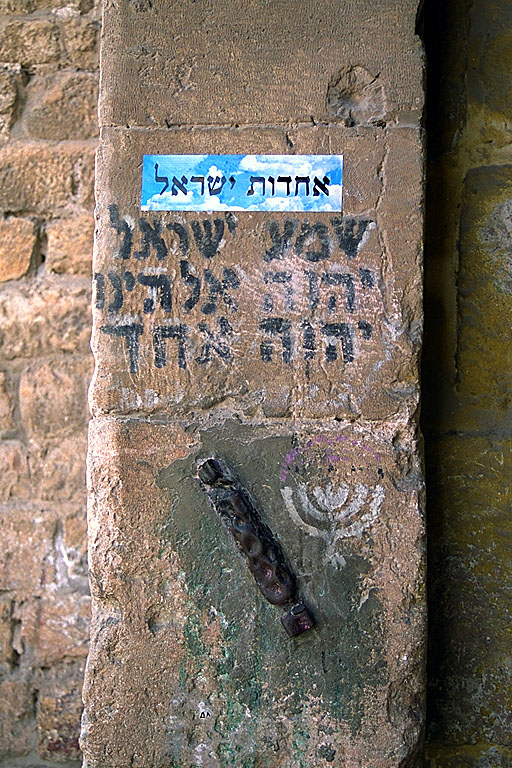
Most people walk through the doors of their homes each day, making the doorframe an ideal place for a regular reminder of God's faithfulness. Mezuzot, small containers made of wood or metal and containing passages of Scripture, are often used by faithful Jews today in response to Moses' words in the Shema.

Today, many Christians choose to put a cross by their front doors, as much to remind themselves of what Christ has done for them on the cross as a witness for the world.

Below are images of a mezuzot (or mezuzah) in Israel; a collection of mezuzot from a catalog; and an interesting one that can be found on Main Street at Disneyland in California.