On Wednesday night, during one of our weekly Read the Bible in a Year discussion groups, a great question was asked about the prophets Elijah and Elisha, whose stories are told in the Old Testament books of 1 and 2 Kings.*
God empowered both of them to perform miracles, including bringing several dead persons back to life. The question raised was why neither Elijah or Elisha were hailed as the Savior of the world the way Jesus would be by some people about nine centuries later.
Here are a few possible answers that cross my mind.
First: Both Elijah and Elisha lived before anyone really considered the possibility of a Messiah. The two prophets lived in the northern kingdom of an Israel that had fractured in two after the death of King Solomon. The north, which took for itself the name of Israel, was mired in idolatry and arrogance while enjoying relative prosperity and stability. They weren't looking for redemption from Israel's God.
Second: Even if the people of the northern kingdom had had hopes for a Messiah, chances are that they would have been just as wary to see Elijah or Elisha in that role as the people of Judea (and their Roman overlords) were to see Jesus as Messiah eight centuries later. A Messiah/Savior rightly demands on our lives that we, as self-centered people, prefer not to meet. That's one big reason that many people spurn Jesus to this day.
Third: Neither Elijah nor Elisha ever made the same claims for themselves that Jesus made for Himself.
In John 10:30, for example, Jesus flat out says, "The Father and I are one."
Earlier in John's gospel, He tells some of His fellow Jews in a grammatically awkward phrase, "Before the Father was, I AM." "I AM," ego eimi in the Greek of the New Testament, translates the Hebrew noun and verb that Israel's God gave to Moses as His Name at the burning bush, Yahweh.
Jesus claims to be God in human flesh. From any other person, even miracle workers like Elijah and Elisha, this claim would be blasphemous. And it was on the charge of being a blasphemer that the Jewish religious leaders of His day sought Jesus' execution.
But Elijah and Elisha claimed simply to be prophets, people who go before others to tell them (and show them) the Word of God.
*Go here and type in 1 Kings, chapter 1 [1 Kings 1], if you want to see what we've been reading lately. Then, keep following the arrows leading you to the next chapters.
Showing posts with label Jesus as Messiah. Show all posts
Showing posts with label Jesus as Messiah. Show all posts
Saturday, June 25, 2011

Saturday, December 20, 2008
Sunday, August 31, 2008
The Cross: The Only Way to Life
 [I shared this during worship with the people of Saint Matthew Lutheran Church in Logan, Ohio this morning.]
Matthew 16:21-28
As if it hasn’t lasted long enough already, we now have about nine weeks left in the US presidential election. Throughout this period, the candidates of both parties will tell us a lot of things, much of it things we want to hear designed to win us over.
Today’s Gospel lesson shows us that Jesus never took the advice of political “handlers.” Otherwise, He wouldn’t have said any of what He says to us today.
Let’s set the scene. Our lesson is a continuation of an incident that made up last Sunday’s Gospel lesson. In it, Jesus applauds the confession of one of his disciples. The man whose parents named him Simon confessed that Jesus was the Messiah, the Savior King for whom the Jews had been waiting for centuries. Jesus applauded the disciple’s confession, noting that the man had reached this conclusion about Jesus not through intellectual analysis or his emotions, but as a result of that truth being revealed by God to Simon’s open mind. And then, Jesus gave Simon a new name: Peter, a word meaning rock. On the rock of Simon’s confession, Jesus would build his church. Not even death would destroy His Church, Jesus says.
Immediately after this, Jesus tells Simon and the other disciples what would happen to Him as the Messiah: “I’m going to Jerusalem to be spurned by the leaders of our people, to suffer at their hands, to be executed at their prompting, and on the third day following my death, rise again.”
This isn’t what Simon the Rock of faith or the other disciples had in mind at all.
And it isn’t the sort of thing designed to win people over.
Nobody wants a Savor King, a Christ, Who suffers and dies, even if death is followed by resurrection.
Whether from love and loyalty for Jesus, or from fear that his dreams for peace and prosperity are being threatened, or from a combination of both fears, Peter's reaction to Jesus is immediate and forceful.
“God forbid, Lord” Peter tells Jesus, “this will never happen to you!” Then Jesus gives Simon a new name. Thundering with anger, Jesus says, “Get behind me, Satan.” Jesus goes on: “You are a stumbling block to me; for you are setting your mind not on divine things, but on human things.”
Jesus was saying that the problem with the man who he’d just designated as the stand-in for the whole Church--for you and me--was being satanic, opposing the plans of God, because he spent too much time thinking like everybody else. Jesus drives His point home when He says, “If any want to become my followers, let them deny themselves and take up their cross and follow me. For those who want to save their life will lose it, and those who lose their life for my sake will find it.”
What exactly did Jesus have in mind when He told us to take up our crosses and follow Him?
Father Andrew Greeley tells the fictional story of a family packing up to return home after a long summer vacation. The family’s oldest child is to be a senior in high school and the parents are dreading going back. They wish somehow they could freeze time and have their lives remain as they are. They feel so in control and so happy. But the high school senior finally talks sense to his parents. “We have to move on. We can’t live in the past without taking away the present and the future.” Wise words!
They remind me of the lyrics from the bridge of a song by the late Christian music pioneer Larry Norman: “It all comes down to who you crucify/You either kiss the future or the past goodbye.”
The cross that Jesus was calling Simon Peter and the other disciples to bear represented their very human dreams of comfort and ease, of vindication and revenge, of prosperity and power. They were the dreams that we all entertain.
Understandably, Peter and the overwhelming majority of those in first-century Judea held onto stubborn dreams that their country would be freed of the Romans when the Messiah came and that the Messiah would bring them endless prosperity. They would be control. That’s really what all of we earth-bound thinkers want when we’re completely honest.
But Jesus points out that’s faulty thinking. What good is it to have all the money and all the power we want in this life if their our real and most basic needs aren’t met? Or, as Jesus put it: “For what will it profit them if they gain the whole world but forfeit their life?”
The real problem of Simon and his people, is our sin. That's our real problem too, our inborn alienation from God that causes us to turn away from God and that gives rise to all the stupid, tragic, horrible things we do to ourselves and to each other.
Taking up the cross means renouncing short-term gain in favor of living under the reign of the God we know in Jesus Christ.
The way of the cross isn’t the path we would choose if we were looking for self-preservation as the world sees self-preservation. But it’s the only way to the future that God wants to give to us, to eternity with God.
I’m terrified of water. It’s irrational, but because of my fear, I’ve never learned to swim. That’s why I could identify with the person I read about who was learning to swim.* He wanted to keep his foot on the bottom of the pool. But the instructor pointed out that there are no half measures in learning to swim. “If you keep yourself anchored there, you’ll never get the hang of it,” he said. In just the same way, if you and I are going to get the new life that Jesus wants to give us, we have to let go of the old life that’s pulling us down.
This call of Jesus to take up our cross and follow Him causes people to do strange things.
A couple I once knew joined a congregation that was struggling and had little to offer their family. Why had they done that when there were larger congregations with lots of programs and plenty of money just down the street? “Because,” the woman said, “we were looking for a place where we could serve. This congregation needed us more.” It was a strange thing to do, but that couple took up their cross to follow Jesus.
The pastor of a wealthy suburban church once shocked us by taking a call to a congregation that was in an impoverished area. “Why did you do that?” a colleague had asked. “Well,” he said, “this was the last place on earth we would have chosen to go. We figured that when God called us here, it was where we were supposed to be.” That pastor and his family bore the cross and followed Jesus.
A few weeks ago, Ann was visiting with old friends from Cincinnati when one of them made a racist joke about Senator Obama. Now, it doesn’t matter what your opinion of Obama or whether you intend to vote for him or not, racial prejudice is sin. Ann turned to her friend and said, “Vicky, I love you. But that isn’t funny.” Ann bore the cross, risking tearing up the moorings of acceptance from a friend, to follow Jesus in loving God and loving neighbor. I don’t know whether I would have chosen Christ or to protect myself at that moment. But I am proud and inspired by the choice Ann made!**
A man had been a quiet drunk for years. Although he made it to work each day and even rose within his company, his addiction to alcohol had frozen him emotionally and spiritually. At home, he had few real connections with his family. He drank because he couldn’t or didn’t want to deal with the messiness of life. He walled himself off beneath a veneer of booze and false optimism. It was too painful to him. One day though, he confided to a doctor friend that he had a problem. From then, he began a detox program and started the painful work of rebuilding his life. Why had he done that? He could have gone on and nobody would have been the wiser. He did it, he said, because he’d come to believe that exposing himself to the realities of life sober was better than anesthetizing himself from them with drink. He bore his cross. He committed himself to living life, to loving God and neighbor, no matter what pain and difficulty it might bring. The old self began to die so the new self, the self turned to God, could live.
And what about you? Are you protecting yourself from life, looking out for number one and so denying yourself the life with God that belongs to those who follow Jesus Christ?
It’s a life filled with challenges, to be sure. It’s not an easy way. But it is the way to eternity, the way to peace with God and peace with ourselves. The only way.
I pray that you—and I—will let God give us the faith and the courage to follow Jesus and so become the people and the church God calls us to be.
Take some time this week to do an inventory of your life. Is there anything in your life to which you’re clinging, even otherwise innocent things, that are preventing you from following Jesus. They may be as innocuous as spending too much time watching TV or as serious as withholding forgiveness or being abusive toward a family member. Whatever prevents you from following Jesus, take up the cross. Admit the problem to God. Enlist the help you need. And commit yourself to following Christ in every facet of your life. Amen
*This represents my own slight reworking of an illustration used by N.T. Wright in explaining this passage of the Bible.
**In the coming weeks of this campaign, you and I may face many such calls to carry the cross and follow Jesus when we're subjected to other bigoted jokes about senior citizens directed at John McCain and women directed at Sarah Palin. Those bigoted jokes will also be expressions of sin and as Christians, we can't allow ourselves to be party to them!
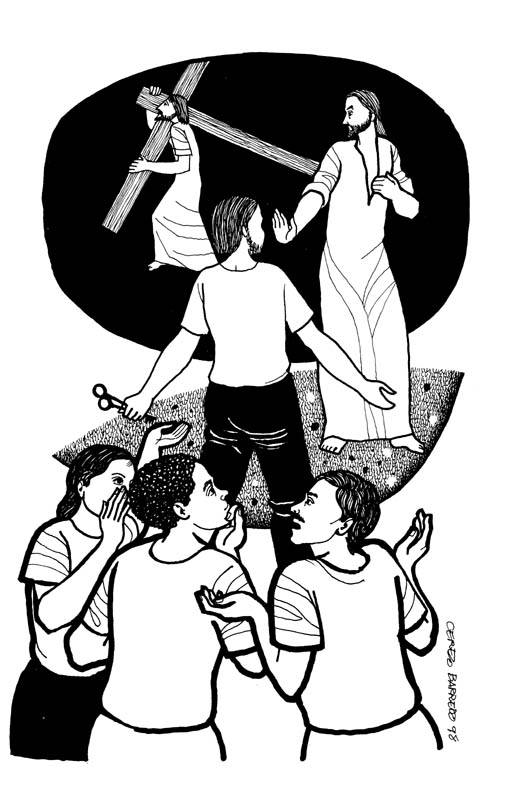
ABOUT THE ILLUSTRATION: I love the pen and ink representation of this passage created by Cerezo Barredo. Notice that Peter holds keys in his hands. Peter, the stand-in for the Church, holds the keys to the kingdom which Jesus entrusts to the Church: the power to declare or withhold the forgiveness of God, to repentant or unrepentant sinners, respectively. This is a great way of conveying the truth that the Church, composed of finite, sinful human beings, is both divine and human. Similarly, individual Christians are saints and sinners.
[This is an unadorned acoustic version of 'The Weight of the World' performed by the song's composer, the late Larry Norman. Throughout his life, Norman wrestled with his demons, but seemed always to come back to Christ. The performance here was originally part of a medley that cuts off the song abruptly. But it's a great song that has been covered by such diverse artists as Lost and Found and Ringo Starr.]
[You can donate to this site. See here for more information.]
Sunday, January 28, 2007
The Messiah We Want?
[This message was shared with the people of Friendship Lutheran Church during worship celebrations on January 27 and 28, 2007.]
Luke 4:21-30
Former Secretary of Defense Donald Rumsfeld got himself into hot water a few years back when he said to soldiers during a Q-and-A session: "As you know, you have to go to war with the Army you have, not the Army you want."
What he said was seen by some as an insult to our nation’s soldiers, although I think he was really referring to how the military was supplied at the beginning of the war in Iraq. Be that as it may, the phrase stuck, “You have to go to war with the Army you have, not the Army you want." I kept thinking of it this past week as I was preparing for this message.
For centuries, God’s people had waited for the Messiah, the anointed King Who would vindicate His people’s trust in Him. But when He showed up after years of waiting, would the Messiah they had turn out to be the Messiah that they wanted?
It’s too bad that we got snowed out last Sunday. That means that most of you didn’t hear it as we read and considered last weekend’s Bible lesson, which recounted the first part of the incident completed in today’s lesson. Jesus, already being celebrated for His teaching and miracles in other parts of the region of Galilee where He grew up, returns to his hometown, Nazareth. As He and His townspeople go to worship in the synagogue that sabbath, the people of Nazareth are excited to hear what this hometown hero has to say. They’re bursting with pride and certain that Jesus is going to rouse them with affirmations of their favored status with God, of their goodness, and of the evil of the non-Jews, the Gentiles, people they were sure God hated.
At first, all goes well. Just like us here at Friendship, first century Judean synagogues had their typical worship liturgy, an arrangement of the worship order. It was probably optional for them to read a lesson from one of the Old Testament prophets. It was also customary to ask a visitor, which Jesus now was, to read a lesson and to expound on it.
And so, during the worship, Jesus stands and takes the scroll with the prophecies of Isaiah printed on it and picks two passages to read, one from chapter 61, the other from chapter 58. After reading, He hands the scroll back to the attendant and sits down. All eyes are on Jesus, everyone excitedly anticipating what He will say. “Today” He finally tells them, “this scripture has been fulfilled in your hearing.”
The synagogue must have been filled with electricity!
And self-congratulation.
The people probably thought: “Our homeboy, our Nazareth native, is the Messiah. This is good for us!”
This was the moment at which Jesus decided to show them that the Messiah that they had might not be the Messiah they wanted.
Luke tells us, “He said to them, ‘Doubtless you will quote to me this proverb, “Doctor, cure yourself!” And you will say, “Do here also in your hometown the things that we have heard you did at Capernaum.”’”
Jesus knew what the people of Nazareth were looking for: a show of miraculous signs like they’d heard of Him doing elsewhere. But there was a reason Jesus couldn’t and wouldn’t comply with their desires, two reasons in fact:
“There were many widows in Israel in the time of Elijah," Jesus reminds them, "when the heaven was shut up three years and six months, and there was a severe famine over all the land; yet Elijah was sent to none of them except to a widow at Zarephath in Sidon.” Elijah was sent by God to bless not a widow in Israel, but one in the hated city of Sidon, Jesus remembers.
Then, Jesus says: “There were also many lepers in Israel in the time of the prophet Elisha, and none of them was cleansed except Naaman the Syrian.” A commander of a foreign army had complied with the word of God to receive healing.
Jesus really knew how to end a celebration! His words came at the worshipers in Nazareth like a roadside bomb. By recalling how God, centuries before, had ignored the people who claimed to be His own, the Israelites, the Jews, and had instead gone to foreigners to bless them, Jesus was confronting His townspeople’s sin and condemning them for the way of life they refused to embrace. I find that Jesus’ words confront and condemn me too.
The sin of the people of Nazareth was pride, what we might call arrogance.
They thought that they had a monopoly on God and a corner on the righteousness market simply because they had inherited the physical DNA of the very first Hebrews, Abraham and Sarah.
Yet Jesus was telling them that He had been sent to be the One Who could save all people who trusted in Him from sin and death.
My great-grandmother learned that the love and lordship of God is an expansive thing, able to include all people, in a very vivid way. She was an active member of Glenwood Methodist Church in Columbus, starting with her move to the west side of town in the 1920s. One day, a group from her white church accepted the invitation of an African-American congregation in Columbus for a program. Forty years later, my great-grandmother told me how people greeted her group at the door: "Welcome, white brother. Welcome, white sister." She was struck tto, when a young girl who couldn't read recited Scriptures to her. My great-grandmother saw the kingdom of God can live in the hearts and lives of all who believe in Jesus, no matter their race or station.
The sin of which the people of Nazareth refused to let go was the arrogance that said they alone were worthy of God.
And that leads us to the way of life that Nazareth refused to embrace, the way of faith, of trust in the God we meet in Jesus Christ.
They didn’t trust in God, but trusted in other things: their heritage as Jews, their obedience to religious rules, their performance of certain rituals in worship.
This was the very fake faith that John the Baptist was lashing out at in His ministry on the Jordan River near Jerusalem (as paraphrased by Eugene Peterson in The Message), “Don't think you can pull rank by claiming Abraham as 'father.' Being a child of Abraham is neither here nor there—children of Abraham are a dime a dozen. God can make children from stones if he wants. What counts is your life. Is it green and blossoming? Because if it's deadwood, it goes on the fire."
Jesus’ message at Nazareth is the same as John’s message was on the Jordan: It makes no difference if Abraham’s blood is flowing through your vains, if God’s grace isn’t coursing through your life. And it makes no difference if you were baptized, confirmed, and occupy a place on the worship roster of a Lutheran church, if you don't trust in God!
Believe me, I know how hard it can be to trust God. This past week, I went to Bethesda North Hospital for a stress test. My heart checked out okay. But now, I’m going to get some ultrasounds done of my stomach and digestive tract. Lately, my body has been sending me some unwanted signals. My wife and I are convinced that it’s finally reacting to some of the stresses we experienced in 2006. I’ve been depending too much on myself and on my own capacity to cope. I need to learn again the words of Proverbs that I mentioned a few weeks ago, “Trust in the Lord with all your heart, and do not rely on your own insight.”
The good news is that through Jesus Christ, we can depend on God. We don’t have to depend on ourselves. Forgiveness and life with God that lasts forever are free gifts to all who trust in Him!
Are you willing to trust in God completely?
Are you willing to rely on Him?
I ask you only if you are willing because I’ve learned that we can’t talk ourselves into trusting God.
We can only be willing to let Him build faith in us. We can only ask Christ to come into our lives and rebuild us every day. We walk where He seems to lead us.
“Trudi Hellstrom was orphaned at the age of four and adopted by her aunt and uncle in St. Augustine (FL). She knew firsthand, from an early age, what it is to struggle in life...In 1989, when Hurricane Hugo ripped the city of Charleston apart, Trudi and her husband Lars knew immediately that they had to do something to assist their neighbors to the north. Trudi decided to organize her own rescue mission of water, food items, and clothing to truck to Charleston. She rented a Hertz truck to carry suppplies to those in need.”
One woman with faith not in herself, but in God. One woman who thought that people she’d never seen before mattered to God. One woman grateful for the free gifts of new life that Jesus came to bring all willing to trust in Him, willing to rely on Him.
Late last June, when the Servanthood Team decided to set what they considered a modest goal--500 outside-the-congregation service hours by Friendship folks before the end of the year, I went along with them. But I wondered if we could make the goal. The fact is, you smashed that goal.
Now, we face another daunting task: Joining other Lutheran churches and others in the community with the construction of a new Habitat for Humanity home in New Richmond. I want you all to know right now: We can’t do it. But through us, the God we meet in Jesus Christ, can! Are you willing to believe in Him? Willing to rely on Him? Then, be at the Welcome the Higginses potluck tonight as we begin this new venture. While we build the house, Jesus Christ will build in us a sturdy, loving faith that reaches out to others. Jesus is the Savior Who turns our missions impossible into missions accomplished!
The people of Nazareth were dismayed. Jesus wasn’t the Messiah they wanted. But thank God, He’s the Messiah we have, the one we need.
Luke 4:21-30
Former Secretary of Defense Donald Rumsfeld got himself into hot water a few years back when he said to soldiers during a Q-and-A session: "As you know, you have to go to war with the Army you have, not the Army you want."
What he said was seen by some as an insult to our nation’s soldiers, although I think he was really referring to how the military was supplied at the beginning of the war in Iraq. Be that as it may, the phrase stuck, “You have to go to war with the Army you have, not the Army you want." I kept thinking of it this past week as I was preparing for this message.
For centuries, God’s people had waited for the Messiah, the anointed King Who would vindicate His people’s trust in Him. But when He showed up after years of waiting, would the Messiah they had turn out to be the Messiah that they wanted?
It’s too bad that we got snowed out last Sunday. That means that most of you didn’t hear it as we read and considered last weekend’s Bible lesson, which recounted the first part of the incident completed in today’s lesson. Jesus, already being celebrated for His teaching and miracles in other parts of the region of Galilee where He grew up, returns to his hometown, Nazareth. As He and His townspeople go to worship in the synagogue that sabbath, the people of Nazareth are excited to hear what this hometown hero has to say. They’re bursting with pride and certain that Jesus is going to rouse them with affirmations of their favored status with God, of their goodness, and of the evil of the non-Jews, the Gentiles, people they were sure God hated.
At first, all goes well. Just like us here at Friendship, first century Judean synagogues had their typical worship liturgy, an arrangement of the worship order. It was probably optional for them to read a lesson from one of the Old Testament prophets. It was also customary to ask a visitor, which Jesus now was, to read a lesson and to expound on it.
And so, during the worship, Jesus stands and takes the scroll with the prophecies of Isaiah printed on it and picks two passages to read, one from chapter 61, the other from chapter 58. After reading, He hands the scroll back to the attendant and sits down. All eyes are on Jesus, everyone excitedly anticipating what He will say. “Today” He finally tells them, “this scripture has been fulfilled in your hearing.”
The synagogue must have been filled with electricity!
And self-congratulation.
The people probably thought: “Our homeboy, our Nazareth native, is the Messiah. This is good for us!”
This was the moment at which Jesus decided to show them that the Messiah that they had might not be the Messiah they wanted.
Luke tells us, “He said to them, ‘Doubtless you will quote to me this proverb, “Doctor, cure yourself!” And you will say, “Do here also in your hometown the things that we have heard you did at Capernaum.”’”
Jesus knew what the people of Nazareth were looking for: a show of miraculous signs like they’d heard of Him doing elsewhere. But there was a reason Jesus couldn’t and wouldn’t comply with their desires, two reasons in fact:
- There was a sin of which they refused to let go.
- There was a way of life they refused to take up.
“There were many widows in Israel in the time of Elijah," Jesus reminds them, "when the heaven was shut up three years and six months, and there was a severe famine over all the land; yet Elijah was sent to none of them except to a widow at Zarephath in Sidon.” Elijah was sent by God to bless not a widow in Israel, but one in the hated city of Sidon, Jesus remembers.
Then, Jesus says: “There were also many lepers in Israel in the time of the prophet Elisha, and none of them was cleansed except Naaman the Syrian.” A commander of a foreign army had complied with the word of God to receive healing.
Jesus really knew how to end a celebration! His words came at the worshipers in Nazareth like a roadside bomb. By recalling how God, centuries before, had ignored the people who claimed to be His own, the Israelites, the Jews, and had instead gone to foreigners to bless them, Jesus was confronting His townspeople’s sin and condemning them for the way of life they refused to embrace. I find that Jesus’ words confront and condemn me too.
The sin of the people of Nazareth was pride, what we might call arrogance.
They thought that they had a monopoly on God and a corner on the righteousness market simply because they had inherited the physical DNA of the very first Hebrews, Abraham and Sarah.
Yet Jesus was telling them that He had been sent to be the One Who could save all people who trusted in Him from sin and death.
My great-grandmother learned that the love and lordship of God is an expansive thing, able to include all people, in a very vivid way. She was an active member of Glenwood Methodist Church in Columbus, starting with her move to the west side of town in the 1920s. One day, a group from her white church accepted the invitation of an African-American congregation in Columbus for a program. Forty years later, my great-grandmother told me how people greeted her group at the door: "Welcome, white brother. Welcome, white sister." She was struck tto, when a young girl who couldn't read recited Scriptures to her. My great-grandmother saw the kingdom of God can live in the hearts and lives of all who believe in Jesus, no matter their race or station.
The sin of which the people of Nazareth refused to let go was the arrogance that said they alone were worthy of God.
And that leads us to the way of life that Nazareth refused to embrace, the way of faith, of trust in the God we meet in Jesus Christ.
They didn’t trust in God, but trusted in other things: their heritage as Jews, their obedience to religious rules, their performance of certain rituals in worship.
This was the very fake faith that John the Baptist was lashing out at in His ministry on the Jordan River near Jerusalem (as paraphrased by Eugene Peterson in The Message), “Don't think you can pull rank by claiming Abraham as 'father.' Being a child of Abraham is neither here nor there—children of Abraham are a dime a dozen. God can make children from stones if he wants. What counts is your life. Is it green and blossoming? Because if it's deadwood, it goes on the fire."
Jesus’ message at Nazareth is the same as John’s message was on the Jordan: It makes no difference if Abraham’s blood is flowing through your vains, if God’s grace isn’t coursing through your life. And it makes no difference if you were baptized, confirmed, and occupy a place on the worship roster of a Lutheran church, if you don't trust in God!
Believe me, I know how hard it can be to trust God. This past week, I went to Bethesda North Hospital for a stress test. My heart checked out okay. But now, I’m going to get some ultrasounds done of my stomach and digestive tract. Lately, my body has been sending me some unwanted signals. My wife and I are convinced that it’s finally reacting to some of the stresses we experienced in 2006. I’ve been depending too much on myself and on my own capacity to cope. I need to learn again the words of Proverbs that I mentioned a few weeks ago, “Trust in the Lord with all your heart, and do not rely on your own insight.”
The good news is that through Jesus Christ, we can depend on God. We don’t have to depend on ourselves. Forgiveness and life with God that lasts forever are free gifts to all who trust in Him!
Are you willing to trust in God completely?
Are you willing to rely on Him?
I ask you only if you are willing because I’ve learned that we can’t talk ourselves into trusting God.
We can only be willing to let Him build faith in us. We can only ask Christ to come into our lives and rebuild us every day. We walk where He seems to lead us.
“Trudi Hellstrom was orphaned at the age of four and adopted by her aunt and uncle in St. Augustine (FL). She knew firsthand, from an early age, what it is to struggle in life...In 1989, when Hurricane Hugo ripped the city of Charleston apart, Trudi and her husband Lars knew immediately that they had to do something to assist their neighbors to the north. Trudi decided to organize her own rescue mission of water, food items, and clothing to truck to Charleston. She rented a Hertz truck to carry suppplies to those in need.”
One woman with faith not in herself, but in God. One woman who thought that people she’d never seen before mattered to God. One woman grateful for the free gifts of new life that Jesus came to bring all willing to trust in Him, willing to rely on Him.
Late last June, when the Servanthood Team decided to set what they considered a modest goal--500 outside-the-congregation service hours by Friendship folks before the end of the year, I went along with them. But I wondered if we could make the goal. The fact is, you smashed that goal.
Now, we face another daunting task: Joining other Lutheran churches and others in the community with the construction of a new Habitat for Humanity home in New Richmond. I want you all to know right now: We can’t do it. But through us, the God we meet in Jesus Christ, can! Are you willing to believe in Him? Willing to rely on Him? Then, be at the Welcome the Higginses potluck tonight as we begin this new venture. While we build the house, Jesus Christ will build in us a sturdy, loving faith that reaches out to others. Jesus is the Savior Who turns our missions impossible into missions accomplished!
The people of Nazareth were dismayed. Jesus wasn’t the Messiah they wanted. But thank God, He’s the Messiah we have, the one we need.
Subscribe to:
Posts (Atom)