Thursday, April 07, 2011

Let's Go to the Short North!

No appointments, no obligations today! What should we do? Let's go to the Short North in Columbus, walk around, and find a nice place to eat. Sounds good!


Along the way, remember to share the road!


And be sure to admire the varied cityscape on North High Street.


Stop to learn a little about Alice Schille. (More here.)


Notice the randomly artistic display of merchandise in front of a little shop housed in the basement of the Greystone, an old apartment complex that at one point was quite seedy, but now, I think, is tony.


Wonder if anyone eats a falafel while getting a tattoo there?


Take a look at all the neat old stuff a person could buy at GrandView Mercantile. (See here.) Have you ever noticed how stores in re-gentrified areas never call themselves "stores"? They're always called things like "mercantile," or "emporium," or "bazaar." What's wrong with calling a store a store? Am I wrong, or do those other names sound pretentious? (Am I starting to write like Andy Rooney talks? I hope not, because honestly, when we watch '60 Minutes,' we always mute the sound. Or, we may hear the first few sentences of his spiel, turn to each other and say, "He's got a sweet gig," which is our way of saying, "For these inanities, Andy is paid a handsome salary." OK, I feel better now. Back to our tour.)


Be sure to admire some local graffiti.


Look south on High Street toward downtown. See the Nationwide Insurance office tower? It looks like a giant walkie-talkie. I don't know if it's still there or not, but when the Nationwide building was first opened back in the late-1970s, one of the upper floors incorporated the boyhood home of its one-time chief honcho, Dean Jeffers. I guess it was sort of the Nationwide Insurance version of a US presidential library. But to those on the outside, it always seemed a little odd. Nationwide used to be called the Farm Bureau. I don't know if they were on your side back then or not. (Help me, I am turning into Andy Rooney!)


Eat at a place called Rigsby's Kitchen. (I didn't take this picture, which you probably can tell, because it's in focus.) I'd never heard of Rigsby's before today, although it's been there since 1985, the year after we moved from Columbus to northwestern Ohio. My mother-in-law said it was a good place and she was right. I had something I'd never eaten before, Faro Risotto. It was excellent! You can read reviews of the place here.

Who's that at the next table? Oh, yeah, it's Yvette McGee Brown, who ran on Ted Strickland's ticket for Lieutenant Governor last year and now serves on the Ohio Supreme Court. I won't snap her picture, just let her eat her meal and converse with her luncheon companion in peace.

Leave the restaurant, having enjoyed the food and each other's company.

Oh look! Paul Palnik's shop is open. Let's go see if Paul is in. Ann and I got to know Paul thirty years ago when he worked in a program for the Greater Columbus Arts Council with which Ann worked in those days, the Artists-in-the-Schools program. Local artists of all sorts were booked into local schools for varying periods to provide young people with insight into what's really involved in creating art, whether painting, sculpture, dance, architecture, music, poetry, whatever. Paul is a great cartoonist!


While there, we listened to the latest CD by his son, Elijah Aaron. (You can find his music on iTunes.) "He's a good boy!" Paul told us proudly. We're the parents of a good boy and a good girl ourselves; so, we appreciate his pride. I bought a copy of Elijah's CD. I love it that the children of old friends are making wonderful music these days. (Tim Skipper, the son of high school friends, sings, plays, and composes in a great band called House of Heroes. That band is on iTuunes, too.)

Paul also paints, in vibrant colors. Wonderful stuff!

As we left, Paul told us, "May God bless you in every possible way He can bless you!" It was a beautiful benediction to our foray to the Short North.

[I didn't take this picture of Paul either.]


When Ann worked at the Arts Council, she saved some of the envelopes in which Paul sent the vouchers for his work with the Artists-in-the-Schools program. Later, she had them framed and we have them on display in our house.

Maybe if you go to the Short North, you can have a nice day too. And, may God bless you in every possible way He can bless you!"

[You can click enlarge any of the photographs here.]

Tuesday, April 05, 2011

Still Reasons for Hope!

[The funeral for my Uncle Jim happened yesterday. I was honored to be asked by my Aunt Marge, my father's older sister, to preside. This is the sermon I shared then.]

Isaiah 40:27-31
Romans 8:31-39
Psalm 23
John 11:21-27

Aunt Marge, Danny, Jennifer, Cindy, and all your family members: Alongside Uncle Jim, you’ve been through terribly hard times. In just a short while, you’ve suffered sudden multiple losses after long suffering on the parts of people you loved.

There will be, sadly, hard times yet ahead. The loss of loved ones isn’t something people can just “get over.” In a sense, losing Uncle Jim—who, along with Aunt Marge—presided over a “brood” that included eighteen great-grandchildren and one great-great-grandchild, is something none of you will ever “get over.”

And why should you? When the ties of love are strong, so is the sadness you feel when the familiar voice and the well-known heart are gone.

But, as the Bible says, we who believe in Jesus Christ, God’s only Son, don’t grieve as people without hope. We have hope. Even today there is hope!

There’s hope, first of all, because the moment Uncle Jim left this life, his suffering ended and he entered a new reality. The words of Isaiah, chapter 40, spoken by God to His chosen people, Israel, through the prophet hundreds of years before the birth of Jesus, are for you to hold onto today. "Those who wait for the Lord,” God says, “shall renew their strength, they shall mount up with wings like eagles, they shall run and not be weary, they shall walk and not faint.” Through trust in Jesus, we can know that Uncle Jim, denied his health and the ability to walk in this world, is not only walking again, but is running without weariness. He’s once again alive, living in the presence of God.

But this passage from Isaiah is also a promise to you. Uncle Jim’s long illness and the other adversities and tragedies faced by this family have left you depleted and tired. But God will give you strength! The God Who created the universe and died and rose for us, can give you rest and renewal! “Come to Me, all you that are weary and are carrying heavy burdens,” Jesus says, “and I will give you rest.”

Aunt Marge: When I read the passage from Romans 8 a few moments ago, Ann smiled because I've told her many times that if it isn't read at my own funeral, I'm getting up and reading it myself. I love it so much because it contains another amazing promise, one that underscores this hope that you can have as you move through day to day in the weeks and months to come. Those who trust in Jesus Christ as their God and Savior, it says, can live knowing that nothing “in all creation…will be able to separate us from the love of God in Christ Jesus our Lord.” 

God has not forgotten any of you or any of us this morning! That, God says in another place in Isaiah, is impossible: “I will not forget you…I have inscribed you on the palms of My hands.” Even now, God is...
  • as close as a prayer, 
  • as close as His Word in the Bible, 
  • as close as a church fellowship in which we can confess our sins, hear the Gospel, and receive Christ’s body and blood* along with others who, like us, need comfort and hope and strength, 
  • as close as a friend or a family member willing to listen, to help, and to pray with you.
But we have hope more than just for this life. In the lesson we read from the Gospel of John, Jesus has gone to a town called Bethany, where a friend of his, a man named Lazarus, had died four days earlier. His sisters, Martha and Mary are beside themselves with grief. When Martha first sees Jesus, she gives words to what many people think when a loved one dies. “Lord, if You had been here,” she says, “my brother would not have died.” Martha feels that Jesus had abandoned her.

Jesus doesn’t bother sparring with Martha; God is big enough to take our accusations and our sense of abandonment. After all, if we get upset with God, it only proves our belief in God because you don’t get upset with a God you don’t believe is there. (Jesus Himself would later have the same feelings as Martha had, when, as He was being executed on the cross, He cried out, “My God, My God, why have Your forsaken Me?”) Instead of being defensive, Jesus told Martha plainly, “Your brother will rise again” and “I am the resurrection and the life. Those who believe in Me, even though they die, will live and everyone who lives and believes in Me will never die.”

Then Jesus asks Martha a question that He asks us again this morning: “Do you believe this?” Martha said that she did. Without any evidence but the credibility and love she saw in Jesus, Martha said that she believed that all who trust in Christ will live again.

Shortly thereafter, Jesus gave a sign that He could be trusted to make good on this promise to those who turn from sin (repent) and believe in Him: He called Lazarus back to life.

Later still, Jesus gave the ultimate sign that we can place all our hope in this promise: He took our punishment for sin on the cross and then was raised from the dead. In Christ, we have the hope of everlasting life with God…alongside all who have trusted in Him.

Now, there’s one last hope that we have this morning. That’s the hope for this life we derive from a good example, like that given to us in so many ways by Uncle Jim.

It’s one of the indelible memories of my growing-up years. Somehow, Uncle Jim and I found ourselves alone in the living room of Pop’s and Grandma’s house in Bellefontaine. Marge and Jim had recently celebrated a wedding anniversary and out of the blue, Uncle Jim told me: “You know, Mark, a lot of people say bad things about marriage. But it is a wonderful thing, especially when you're married to the right person.”

Those words were as much a tribute to you, Aunt Marge, as they are in remembering them now, to Uncle Jim. I have to tell you that, along with the examples of good marriages I saw in my own Mom and Dad and those of other couples I got to see up close, it gave me hope that I too, could one day have a good and happy marriage, with which I am blessed today. I never forgot what Uncle Jim told me!

And today, in addition to the hope that comes from knowing that God is with you and the hope that comes from knowing that God has promised everlasting life to all who turn from sin and believe in Jesus, I want to suggest that you also latch onto the hope that belongs to those who have been inspired by a good example.

Uncle Jim was a good man who loved the Lord, loved his wife, and loved his family. May his example help give us all inspiration to live lives at the end of which people can say similar things about us. Amen

*Until illness and the closure of the congregation of which he and my aunt were long-time members, Uncle Jim regularly assisted the pastor in sharing Holy Communion during worship.

Uncle Jim Would Like This

Yesterday, near the beginning of the funeral for my Uncle Jim, I pointed out that the Cincinnati Reds were, at that point, 3-0 in this young season. That drew a laugh. Uncle Jim, like the rest of us in his extended family, was a big Reds fan. I said that I wondered whether, in his new place in eternity, he was putting in a good word for the Reds.

I was being silly, of course, touching on happy memories his family have of Uncle Jim following the Reds. But, he would be very happy with the Reds' start. They're now 4-0!

Monday, April 04, 2011

Fountain of Youth?

Saw this at a restaurant gift shop today and had to snap it.

Don't Judge a Book By Its Cover

[This was shared during worship with the people of Saint Matthew Lutheran Church in Logan, Ohio, on Sunday, April 3, 2011.]

John 9:1-41
“Don’t judge a book by its cover.” We’ve all heard that advice. It warns us to avoid making judgments based on outward appearances and to instead, see life and people at deeper levels.

This theme is seen in our first lesson for today, 1 Samuel 16:1-13, which tells the story of when a shepherd boy, David, was anointed to be king of Israel.

The theme is carried forward in the Gospel lesson. In it, we catch up with Jesus nearly midway through John’s gospel account of Jesus’ life, death, and resurrection. Already, by this point in John’s narrative, there have been groups of people laying in wait for the chance to have Jesus executed.

Then, on a Sabbath day, Jesus’ disciples make a mistake. They judge a book by its cover. They see a blind man and decide that somebody has to be to blame. “Rabbi,” they ask, “who sinned, this man or his parents, that he was born blind?” Jesus tells the disciples that they’re looking at things wrongly. The sins of neither this man nor his parents were responsible for the man’s blindness.

Aren’t we prone to think as superficially as the disciples, though? We look at the cover and don’t bother to take a look inside.

Jesus repeats something He’d already said. It's something that John wrote about at the beginning of his gospel. “I am the light of the world,” Jesus says. Jesus here is pointing to the fact that He’s not only about to help a blind man see, but also has the power to offer all who repent and believe in Him, new life.

Mixing His spittle with some dust from the ground, Jesus spread mud on the blind man’s eyes. He then told the blind man to wash his eyes in a nearby pool. The first miracle in our lesson took place: Jesus gave sight to the blind man.

But another miracle is in the offing.

Other people in the rest of our lesson will prove to be the real  blind ones. Not only don’t they see the blind man for who he is and the miracle of his recovered sight for what it is, they also, most tragically, can’t see Who Jesus is. They refuse to see Jesus for Who He is!

The reason for their blindness is that they’ve turned the faith revealed to Israel and chronicled in the Old Testament into a legal system they could control.

Those of you who have been participating in Read the Bible in a Year know that in Old Testament times, God laid down a lot of laws for His people. As I pointed out last week, only the moral law—or the Ten Commandments—and the laws that issue from them, like Jesus’ Sermon on the Mount or the apostle Paul’s explanation of the commandments in 1 Timothy 1:8-11, remains valid today.

But there are limits to what God’s moral law can do. In the book of Romans, Paul says, “The law is holy, and the commandment is holy and just and good” (Romans 7:12). But the most that God's holy, just, and good law can do is show us our need of the forgiveness and new life that comes only to those who repent (turn from sin) and believe in (that means, entrust their lives to) Jesus Christ. “There is therefore now no condemnation for those who are in Christ Jesus,” Paul writes later in Romans 8:1. No condemnation! That’s good news! When you and I surrender to Jesus Christ, our sins are covered over, Christ has paid our debt for sin, and we belong to God for all eternity!

But there are always people who want to turn the gospel of new life for those who rely completely on Christ into some religious or political system they can control. This was true of some of Jesus’ fellow Jews whose reaction to the blind man’s returned sight wasn’t happiness or celebration.

They became upset because Jesus, Who had restored the blind man’s sight, had, according to their rules, worked on the Sabbath day. Kneading (k-n-e-a-d-i-n-g), which Jesus had done when He mixed His saliva with dust, was one of thirty-nine activities which Pharisaic Jews saw as a violation of the Sabbath day.

Never mind that a man born blind could now see. Never mind that, as the newly-sighted man said, such a sign could only have been done by someone sent by God. Jesus wasn’t playing His culture’s religious games. That’s why His opponents couldn’t see Jesus for Who He was (and is) and why a blind man, open to the promptings of God could see Jesus for exactly Who He was (and is).

Toward the end of our lesson, Jesus asks the man to whom He'd given sight, “Do you believe in the Son of Man?” This is a consequential question, the most important question any of us will ever be asked.

The term “Son of Man,” first appears in the Old Testament book of Daniel. In Daniel 7:13-14, for example, Daniel records a vision he had of a Son of Man Who would one day come to set things right in the world:
I was watching in the night visions,
And behold, One like the Son of Man,
Coming with the clouds of heaven!
 He came to the Ancient of Days,
 And they brought Him near before Him.
 Then to Him was given dominion and glory and a kingdom,
 That all peoples, nations, and languages should serve Him.
 His dominion is an everlasting dominion,
 Which shall not pass away,
 And His kingdom the one
 Which shall not be destroyed.
Son of Man is a designation Jesus uses of Himself 84 times in the New Testament's four gospels: Matthew, Mark, Luke, and John. Jesus clearly saw Himself as the fulfillment of Daniel's vision of the Savior sent from God.

“Do you believe in Me?” Jesus is asking the man. “Do you entrust your whole life to Me: all your past sins, all your dreams for the future, your whole destiny in this life and in the next? Are you utterly surrendered to Me? Will you live each day in repentance and renewal as you follow Me to eternity? Will you let My Holy Spirit empower you to confess and live out your faith in Me? Do you believe in Me?”

Jesus had already made it abundantly clear in His conversation with Nicodemus, which we talked about a few weeks ago, just how much is at stake when anyone is asked if they believe in Jesus: “For God so loved the world,” Jesus said, “that he gave his only Son, so that everyone who believes in him may not perish but may have eternal life. Indeed, God did not send the Son into the world to condemn the world, but in order that the world might be saved through him. Those who believe in him are not condemned; but those who do not believe are condemned already, because they have not believed in the name of the only Son of God.”

When asked if he believed in Jesus, the newly-sighted man had just one question, “And who is he, sir?” That's when we read about the second miracle in our lesson. When Jesus said that the One he was looking at was the Son of Man, the blind man worshiped Jesus. He saw what others—what many today—refuse to see: that Jesus is God the Son, the only way to forgiveness and reconciliation with God, the only means by Whom you and I can become all that we were made to be by our loving God.

If we only look at the humanity of Jesus, we need to ask Him to open our eyes and see Him as the only God and Lord we need to believe in and worship. The miracle of faith in Christ can happen in us…and in anybody!

We who have been called and commanded by Jesus to share the Good News of new life for all who repent and believe in Him must ask God to use us as His agents in helping to dispel the blindness that keeps so many of our neighbors from knowing and following Jesus.

We must share Jesus’ call to repent and believe in Him lovingly and unapologetically. Otherwise, people with whom we live, work, and play—people we like and people we love—will be separated from the life Jesus so desperately wants to give to all people.

I’ve cited it often, but it’s worth mentioning again that Jesus has made it as clear as possible, when He said, “I am the way, and the truth, and the life. No one comes to the Father except through Me”  (John 14:6).

If our neighbors, family members, or friends see Jesus as anything less than the God Who has conquered sin and death for all who believe in Him, we must pray that God will help them see…and that the Lord Who gave sight to a blind man will use us to share a true vision of all that Jesus is and all He can be for those who call Him Lord and God.

But this means that we also must ask the God we know in Christ to help us see others not by their “covers,” but for who they are as children of God.

At the end of an Easter evening service at the Brooklyn Tabernacle in New York, Pastor Jim Cymbala sat exhausted close to the altar area. He wanted to relax and unwind a bit. But then he caught sight of a man dressed in shabby clothes. His hair was matted. He looked awful.

He stood about four rows from Cymbala, awaiting permission to approach. Cymbala nodded, but thought how horrible that this was how his festive, if tiring, Easter was going to end. “He’s going to hit me up for money,” Cymbala thought.

As the man approached, the odor—a mixture of alcohol, sweat, urine, and garbage—took Cymbala’s breath away. It was so bad that he instinctively turned his head to inhale while he spoke with the man.

"What’s your name?" Cymbala asked. “David,” he said. “How long have you been homeless?” “Six years.” “Where did you sleep last night?” “In an abandoned truck.”

Cymbala said that he’d heard this story many times before. He reached into his pocket for some money he could give to David and send him on his way.

“No, you don’t understand,” David said. “I don’t want your money. I want the Jesus that red-haired girl talked about [during the service].”

Cymbala says that he felt “soiled and cheap.” He silently asked for God’s forgiveness. “I had wanted…to get rid of [David],” Cymbala writes, “when he was crying out for the help of Christ I had just preached about. I swallowed hard as God’s love flooded my soul.”

David seemed to sense this change in Cymbala's view of him. He moved forward and fell on Cymbala’s chest, burying his grimy head against the repentant pastor's clean clothes.

Holding David close, Cymbala told him about Jesus’ love, how Jesus had died and risen to give David new life. “I felt love for this pitiful young man,” he says. And the foul odor? “I don’t know how to explain it,” Cymbala writes, “It had almost made me sick, but now it became the most beautiful fragrance to me.”

In this moment, he sensed Jesus telling him, “Jim, if you and your wife have any value to Me, if you have any purpose in My work—it has to do with this odor: This is the smell of the world I died for.”

When Jesus looks at us, He doesn’t see us as the world does. He sees prodigal children worthy of the sacrifice of Himself on the cross. 

May we see Jesus as our Lord and God and, seeing others with the same love, passion, and concern He has for us, may we tell the whole world about Jesus. Amen!

Saturday, April 02, 2011

The Grams Scam

Someone tried pulling this scam on my mother-in-law a few years ago. She didn't fall for it. But in this era when grandchildren are often raised in distant states and voices aren't so familiar, it's understandable how some grandparents might be victimized.

A few weeks ago, I got an message through the email account of a member of a former parish. It included her name and that of her husband in the body. It said that they were in England, where all their credit cards and cash had been stolen. The email went on to say that in order to get home, I needed to let them tap into my credit card to the tune of $6500.

The whole thing was absurd; there's no way this couple would have contacted me for money. Besides, I knew from Facebook that they had been in the US at the same time the bogus email claimed they were in England.

But I can see how this scam could be as convincing to some people as the grandson-on-the-telephone scam.

Like many other Christians, we Lutherans often confess to God that "we are in bondage to sin and cannot free ourselves." Christ does free repentant sinners of their slavery to sin, of course. But sin--the inborn impulse to treat God and others with contempt--is a strong force in the world. (To confirm, look at the home page of any online news source.) The Bible teaches this. So, honestly, I am never surprised by the wrong that people do.

But it does underscore the wisdom Jesus gives to those who follow Him: "Be wise as serpents and innocent as doves" (Matthew 10:16).

Tuesday, March 29, 2011

God is in Our Midst

"All Christian life is characterized by this overwhelming truth, the whole existence of the church is carried by this jubilant certainty: God is present here!" - Bo Giertz (Thanks to Donovan Riley for sharing this over on Facebook!) 
If you've never heard of Giertz, he was a writer most famous for the novel, The Hammer of God.

'The Power of a Whisper'

I picked up this book, which inspired my colleague Glen VanderKloot's current sermon series at Faith Lutheran Church in Springfield, Illinois, last Thursday.

I've found it so gripping, challenging, disturbing, joyful, and inspiring, that, careting my reading of it into a busy schedule, I'm about to plunge into the final chapter. (And I'm an extremely slow reader!)

The book is about paying attention to the "whispers" of guidance which followers of Jesus receive from God--whether from reading God's Word or knowing God through it, or the counsel of trusted Christian friends, or circumstances. I have long been convinced that God has never stopped communicating with His children. This is one of the Holy Spirit's prime activity among us, I think. But in our worlds crowded with noise and activity, even committed Christians have increasingly closed our minds to God.

If this book does nothing but incite you to carve time out of your daily schedule to read God's Word, pray in Jesus' Name, and listen for God's "still, small voice," it will have done a great thing in your life...and through you, in the lives of others.

I don't agree with everything in this book. But as usual, its author, Pastor Bill Hybels, has written a book worthy of consideration from every Christian wanting to live for Christ in the everyday places of life. The chapter on justice is especially challenging and worth the price of the book, whether you agree with everything he writes there or not.

Sunday, March 27, 2011

More on Hearing from God...

from Pastor Glen VanderKloot. Really good.

From This Evening's Youth Group...and Arena Baseball


The girls wanted me to make a video so that they could show off their new Arena Baseball uniforms.

Stephen (r) and friend Isaac (l) designated themselves as the Fire Extinguishers for tonight's Arena Baseball game. After winning 14-7, they presented themselves with an appropriate trophy. What the far-off gazes are about, I have no idea. We had a smaller group than usual this evening. [Click on pictures to enlarge.]

A still pic of the girls' in their new uniforms.

The boys striking a triumphant pose.

Called to Obedience...Even When It's Inconvenient

[This was shared during worship with the people of Saint Matthew Lutheran Church in Logan, Ohio, earlier today.]

Exodus 17:1-7
True story about a woman we’ll call Jill.

It all started after Jill’s marriage ended. There she was, a single mom with a mortgage. Shortly thereafter, she lost her business.

Fortunately, she was able to get another job. But it was100% commission and she wondered how she was going to make it as she built up clientele and referrals.

In the midst of this turmoil, it struck Jill that it had been awhile since she had given God much thought. She went to a worship service one Sunday and heard the preacher challenge the congregation to consider tithing. The Bible speaks of believers giving 10% from the tops of their paychecks. That’s a tithe.

The pastor challenged the congregation with God’s words to the people of Israel in the Old Testament book of Malachi: “Bring the full tithe into the storehouse, so that there may be food in my house, and thus put me to the test, says the Lord of hosts; see if I will not open the windows of heaven for you and pour down for you an overflowing blessing.”

Jill had no idea what sorts of blessings God might have in mind for her and her child, but as she prayerfully considered those words, she decided that this was as good a time as any to put God first.

She realized that the Christian isn’t required to give a specified amount in offering to God. Jesus wants our whole lives, not just 10%, after all. But Jill felt that her tithe would be one way she would keep the first commandment, “You shall have no other gods before me” and the first part of Jesus’ Great Commandment, “You shall love the Lord your God with your heart, and with all your soul, and with all your mind.”

Jill remembered God’s past blessings and above all, the blessing of new life that belongs to all who turn from sin and believe in Jesus Christ as God, Savior, and Lord over their lives. Jill felt that these past blessings were good reason to trust God now. The following Friday, Jill received her paycheck. It was next to nothing. But on Saturday, she wrote a check equaling 10% of her skimpy pay for her offering.

“The funny thing is,” Ann and I have heard her say, “after that I always had what I needed. God took care of 100% of our needs on 90% of my income.”

Over time, Jill’s financial situation improved. Eventually, she joined our former congregation. On the first Sunday that she visited with us, Jill heard me say during the service, “If you are a first-time visitor, you’re not expected to make an offering; it’s our privilege to worship with you today.” When Jill heard that, she later told us, she thought, “There is no way you can keep me from giving my tithe, buddy!” Jill remembered God’s past faithfulness, even in a hard time, and, determined to obey His call in her life, her relationship with God was strengthened and deepened.

This is not a sermon about money. It’s about something else.

We Lutherans believe that justification by grace through faith—the salvation of sinners from sin and death through what Christ has done for us and through our faith in Christ—is the central doctrine of Biblical faith. But we also believe that it’s not the only doctrine of our faith.

We also confess that all who believe in Jesus are called to obedience to the will of God the Father, Son, and Holy Spirit. That also is a doctrine of Biblical faith. Martin Luther wrote: “When our Lord Jesus Christ said, Repent!, he meant for the whole life of the believer to be one of repentance.”

Repentance, you know, is more than mere sorrow for sin, it’s a constant turning to God in faith and in obedience to God’s will. We are to always hold our lives up for examination in the light of the Ten Commandments and seek forgiveness and the amendment of our lives through Christ. Obedience to God, however imperfectly rendered by we human beings, is the proper response to a life transformed by the grace and goodness of God, given to us through Jesus Christ...even when it’s inconvenient.

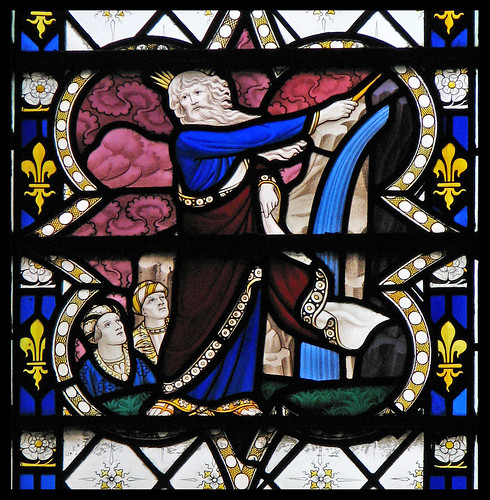
The same God Who claims us in Holy Baptism had saved His ancient people, the Hebrews or Israelites, when He led them through the waters of the sea and sent those same waters to drown the armies of Egypt, their one-time captor nation. Our first lesson, from Exodus, finds the Hebrews in the midst of their forty-year journey through the wilderness, heading to the land God had promised to their ancestor Abraham.

God’s people often found their forty-year trek an inconvenient time to be obedient to God. But God expected them to be obedient nonetheless.

Please pull out the Celebrate insert and look at the first lesson. Read verse 1 with me silently, please:
From the wilderness of Sin the whole congregation of the Israelites journeyed by stages, as the Lord commanded. They camped at Rephidim, but there was no water for the people to drink.
Now, the wilderness of Sin has nothing to do with sinfulness. “Sin” here is just a word related to “Sinai, S-i-n-a-i,” a name for the entire region through which the Hebrews were traveling.

We’re told that the people were moving by stages, in the orderly fashion commanded by God. The place God commanded them to go had no drinking water.

Had they stopped and thought, they might have remembered...
But, like all of us sometimes facing life’s wilderness experiences, the Hebrews forgot God and His past help.

I once heard a speaker ask a group of us, “What was the thing you were most worried about one year ago? Five years ago? Ten years ago?” All of us were hard pressed to remember the answers to any of those questions. The point: The God Who has helped you through past difficulties is capable of doing the same thing for you in today’s wilderness. God is still in the blessing business; we shouldn’t allow panic, worry, or challenges cause us to forget that!

Read verse 2, please.
The people quarreled with Moses, and said, "Give us water to drink." Moses said to them, "Why do you quarrel with me? Why do you test the Lord?” 
The Hebrews seemed to operate under the assumption that God would only allow easy times to accompany them through the wilderness. They couldn't imagine now that God had delivered them from Egypt He would ever allow any bad or difficult times come to them.

We can entertain similar thoughts. But that’s “magical thinking,” not real life faith. If God the Father didn’t insulate God the Son from the cross, what makes us think that any of us will be insulated from the realities of life—from the wilderness—in a fallen world?

The good news though, is that the God Who has conquered sin and death through the cross and Christ’s empty tomb gives all who trust in Him strength for our journeys through life and the certain hope of eternity with God!

Read verses 3 and 4 silently, please.
But the people thirsted there for water; and the people complained against Moses and said, "Why did you bring us out of Egypt, to kill us and our children and livestock with thirst?" So Moses cried out to the Lord, "What shall I do with this people? They are almost ready to stone me.” 
Look at Moses’ prayer and see how self-absorbed it is: “What shall I do…?” “They are almost ready to stone me.”

Moses here seems to forget that it’s God Who has freed and provided for His people in the wilderness, not him.  God is the shepherd; Moses is only God's imperfect human underling.

Moses suffers from the common workaholic tendency to think that the fate of the entire universe depends on him. (Believe me, I know what I’m talking about!)

Moses forgot that God is God and that he wasn’t. This is why our psalm for today says that Moses and his generation weren’t allowed to enter the promised land. Disobedience has its consequences even when we are repentant and God forgives us our sins. (I know about this, too. Even though I know God loves me and in Christ my sins are forgiven, I suffered a heart attack last summer, caused by my making the same mistake that Moses made, forgetting that God is God and I'm not! Even forgiven sinners must sometimes wrestle with the consequences of their sin.)

Read verses 5 and 6 please:
The Lord said to Moses, "Go on ahead of the people, and take some of the elders of Israel with you; take in your hand the staff with which you struck the Nile, and go. I will be standing there in front of you on the rock at Horeb. Strike the rock, and water will come out of it, so that the people may drink." 
The message God gave by telling Moses to use his staff could not have been clearer. This was the same staff that God told Moses to use to turn the waters of Egypt blood red and undrinkable in one of the plagues God used to force Egypt’s king, the Pharaoh, to let His people go.

God was reminding Moses and the people of Israel that, no matter the crisis, His power was undiminished. He could provide for His people.

Water is still known to run through lime deposits in the Sinai Peninsula today. But in bringing water from this rock in Sinai, the Creator of the universe bent creation itself to His purposes for His people. The God Who raised His Son from the dead to give life to all who believe in Christ can do similar things for those who trust and obey Him today.

Read verse 7, please:
[Moses] called the place Massah and Meribah, because the Israelites quarreled and tested the Lord, saying, "Is the Lord among us or not?” 
Moses gave two names to the place. Massah means test. God had tested the Hebrews faith and the Hebrews had, contrary to God’s commandment, put God to the test. Meribah is translated as quarrel. But it has a more specific meaning; it’s the word used when a plaintiff sues someone else in court. The people thought they were bringing suit against Moses, but really their beef had been with God. Their question was, “Is the Lord among us or not?”

We may be tempted to ask that same question at times. I'll never forget a Saturday afternoon in my first parish when I was called to a hospital in Toledo, where a member of the congregation had been life-flighted. While using a torch to cut a barrel in half for some neighbor boys, the barrel had exploded and crashed into his skull. When I arrived at the ER, he looked like someone who had been through a battle. The doctors said that his prognosis was hopeless. His mother, a wonderfully faithful woman who had endured the deaths of her husband and a grown child already, kept asking of this calamity that had befallen this son, the father of small children, "How could God have let this happen?" Where had God been? she wondered. We've all been in that wilderness!*

But, as our Gospel lesson reminds us, the God Who caused water to spring from a rock in the wilderness has come in Jesus Christ, the Word made flesh, to be the living water from heaven!

Jesus refreshes and makes new the thirsty souls of all who trust in Him and live lives of repentance and obedience to Him.

May we turn each day to Jesus, even in the inconvenient wilderness times of our lives, and live! Amen

*I'm happy to report that the man in question not only survived, thanks to the prayers of many, but is strong and well to this day!

Friday, March 25, 2011

Only Sinners Need Apply

If you think a past sin disqualifies you from serving Christ, consider Peter. That's who Joe Stowell points to in this piece, which I recommend you read.

As Stowell points out, over a fire during a session of the kangaroo court that convicted Jesus of a capital crime, he reneged on his pledge of loyalty to Jesus and denied knowing Jesus three different times. Think of that: Peter denied any acquaintance with the One he had earlier confessed to be the Messiah, the Son (or the very image) of the Blessed, God.

Yet over another fire on the shore of the Sea of Tiberias, Jesus called on Peter to affirm his belief in Jesus--three times--and Peter knew that, leaning on Christ's grace, he could, imperfections notwithstanding, be used for good by Christ.

Some people refuse to worship or get involved in a local church because they feel that they're not good enough. Pay heed to the wisdom of Virgil M., a member of the first congregation I served as a pastor:
"If there weren't any sinners in the church, it would be an empty place."
He's right!

If you're a sinner who can acknowledge your dependence on the mercy God gives to all with faith in Jesus Christ, God has great plans for you!

Learning what they are begins, as it did for Peter, with confession, repentance, and belief in Christ. As with Peter, that happens within the fellowship of Christ's very body on earth, the Church.

If you're an imperfect sinner, I invite you to be in worship this weekend with Christ's fellowship of recovering imperfect sinners, the Church. The Word of God you encounter there can erase the power of sin to keep you from becoming all that God made you to be.

When it comes to church membership, only sinners need apply.

And only sinners who trust that Christ is greater than their sin can be used by God. If you doubt it, just consider Peter.

Thursday, March 24, 2011

More on "the Law"

"The law always accuses, but it does not only accuse, nor does it only accuse and restrain. It instructs. If that is not Lutheran, then Lutheranism is not biblical." (Michael Root)

“The effects we found in these experiments were quite large, which suggests that prayer may really be an effective way to calm anger and aggression."

A study shows that, apart from its effects on those for whom we pray, the act of praying for someone else can bring calm to the person praying.

You might be inclined to say, "Duh" to that. But I find the amount of research being done on prayer by social science and medical researchers these days interesting. Both Dale Matthews and Larry Dossey, themselves physicians, have written extensively on research into the connections between prayer and healing.

Presumably any quiet activity that takes a person's mind off of whatever has been frustrating or angering them would bring a degree of calm, including prayer.

But it's interesting that the calming activity in question isn't prayer for one's self, but prayer for others.

At the beginning of his best-selling book, The Purpose Driven Life, Rick Warren hits readers with a bracing assertion, rooted in the teaching of the Bible: "It's not about you."

Prayer for others--what Christians call intercessory prayer--is one way people can embrace the fact that they as individuals aren't centers of the universe and that instead of praying to complain about others--a legitimate Biblical form of prayer known as imprecatory prayer and found in the Psalms, by the way--peace comes when we choose to allow God, through out prayers, to use us as channels of grace and help to others. It's not about us!

So, I would theorize that one reason those, in this study who prayed for others were calmed is that  intercessory prayer moves toward the kind of compassionate regard for others that Jesus commands in the great commandment. I hope that more research is done along these specific lines.


Wednesday, March 23, 2011

What Are the Uses of God's Law Today?

This question was also addressed during our weekly Read the Bible in a Year discussion group today. To see what the Bible means by "the Law," go here.

God's moral law cannot save us from sin and death.

Yet God's demand that we obey the Law stands.

These two facts would otherwise leave us eternally condemned and without hope. But as Saint Paul wrote to the first century church at Rome:
There is therefore now no condemnation for those who are in Christ Jesus. For the law of the Spirit of life in Christ Jesus has set you free from the law of sin and of death. For God has done what the law, weakened by the flesh, could not do: by sending his own Son in the likeness of sinful flesh, and to deal with sin, he condemned sin in the flesh, so that the just requirement of the law might be fulfilled in us, who walk not according to the flesh but according to the Spirit. (Romans 8:1-4)
Jesus calls us to repent and believe in Him and the "good news" He brings. (Believing in Jesus isn't just affirming His Lordship. Even Satan can vouch for that. To believe in Jesus is to entrust our lives--past, present, and future--to Him and to Him alone.) Jesus says that all who believe in Him are saved from sin and death and live with God eternally.

So, what are the uses of God's Law today? Lutheran theology identifies three.

First: God's moral law acts as a hedge, protecting human beings, even those who refuse to acknowledge God's existence, from themselves and from one another. Human beings have an understanding of what is right and wrong. As C.S. Lewis points out in the opening chapter of Mere Christianity, the reason that human beings "quarrel," attempting to prove each other wrong and themselves right, is that, without even articulating it, they each believe in some baseline understanding of what is moral and what is immoral. Good governments and despotic ones alike, explain and justify their laws based on this moral law, encompassed in the Ten Commandments, whether they know the commandments or God or not.

Paul talks about this in Romans 2:14-16:
When Gentiles [non-Jews and particularly, Paul refers to Gentiles who have no awareness of God's moral law], who do not possess the law, do instinctively what the law requires, these, though not having the law, are a law to themselves. They show that what the law requires is written on their hearts, to which their own conscience also bears witness; and their conflicting thoughts will accuse or perhaps excuse them on the day when, according to my gospel, God, through Jesus Christ, will judge the secret thoughts of all. 
Without the law written on our hearts, the world would be in an even bigger mess than it is. Nothing would act as a hedge or curb against our inborn sin turning every piece of this planet into total anarchy. Luther said that were it not for the law curbing human impulses, believers in Christ would be like "lambs among ravenous wolves."

The second use of the moral law is to act as a mirror. God's moral law shows us how far we are from God's expectations for human beings. We see ourselves as we are and know that we are condemned to death by our sin.

Paul says, "All have sinned and fall short of the glory of God" (Romans 3:23).

Another New Testament writer, James, says, "Whoever keeps the whole law but fails in one point has become accountable for all of it" (James 2:10).

The proper "wages" for sin, Paul also writes, is death. And the absolute most the moral law can do for us is show us that we are sinners alienated from God and life.

Passages like that should give us pause, helping us to see ourselves truthfully and driving us to the God revealed in Jesus Christ for mercy and forgiveness.

Jesus' parable about the son who "came to himself," recognizing how he had sinned against God and against his father, and returned to his father, willing to be a slave and not a son, is a great picture of how the moral law acts as a mirror, turning us to the God we meet in Christ for forgiveness. By God's grace--His charitable, forgiving love for sinners, all who repent and believe in Jesus are saved from sin and death. The mirror of the Law shows us that, without this grace we're lost to God forever and sends us to Christ in desperation.

The third use of the moral law is to act as a guide for those who already are living in relationship with Jesus Christ. This is the use the psalmist had in mind when he wrote:
Search me, O God, and know my heart;
test me and know my thoughts.
See if there is any wicked way in me,
and lead me to the way everlasting. (Psalm 139:23-24)
This side of our own death and resurrection, believers who have been made into Christ's new creation must nonetheless live with our old sinful selves. Without attention to God's commandments and submission to Christ's authority over our lives, it becomes easy to slide into sinful patterns which, if left unchecked, could take us into unbelief or willful sin. The third use of God's moral law helps believers face the truth about themselves and to keep turning to Christ for forgiveness and new life.

What is "the Law"?

A few weeks ago, our congregation began reading the Bible together, three chapters or so every day. In this way, we'll read all sixty-six books in a year's time. Each Wednesday at two different times, one in the morning and the other in the evening, we get together to discuss the readings from the previous week. We had our second morning session earlier today. The discussion was animated and interesting.

One person asked what was meant by "the Law" when speaking of the Bible.

This was a great question since in the early books of the Old Testament, there are all sorts of laws or commandments laid down by God for the descendants of Abraham, God's chosen people, the Israelites. (AKA: Hebrews)

In the Old Testament, three kinds of laws can be identified:
(1) Civic or civil law
(2) Ritual law
(3) Moral law
The first category refers to what we usually mean when we talk about the law in everyday conversation. Civic or civil law governs how society functions socially and politically. The civic or civil law of Old Testament times is no longer relevant because we don't live in a theocratic society as the ancient Hebrews did.

Ritual law or sacrificial law dealt with all the regulations surrounding the offering of sacrifices for reconciliation with God which ultimately was centered on the Temple in Jerusalem. It incorporated dietary rules and things like circumcision, all designed simply to set apart the Hebrews behaviorally and physically from those who did not follow Yahweh, their Lord. (The term holy means set apart.)

These laws are no longer needed because, as the New Testament book of Hebrews reminds us, "it is by God’s will that we have been sanctified through the offering of the body of Jesus Christ once for all" (Hebrews 10:10). This is what John the Baptist was talking about when He saw Jesus and said, “Here is the Lamb of God who takes away the sin of the world!" (John 1:29). The ultimate sacrifice for sin has been made in Jesus Christ, Who took all of humanity's sins to the cross. His sacrifice renders further sacrifice unnecessary, along with all ritual laws associated with ritual sacrifice. God confirmed this for Peter when He revealed that, after Jesus' death and resurrection, all foods are clean.

The moral law encompasses the Ten Commandments and the explications and explanations of it found in both the Old and New Testaments. The moral law tells us God's will for human beings for all time. It's what Jesus referred to when He said, “Do not think that I have come to abolish the law or the prophets; I have come not to abolish but to fulfill. For truly I tell you, until heaven and earth pass away, not one letter, not one stroke of a letter, will pass from the law until all is accomplished. Therefore, whoever breaks one of the least of these commandments, and teaches others to do the same, will be called least in the kingdom of heaven; but whoever does them and teaches them will be called great in the kingdom of heaven" (Matthew 5:17-19).

God's law cannot save us from sin and death above all, because none of us is capable of keeping it perfectly. Salvation from sin and death only comes to those who repent (turn from sin and turn to Christ) and believe in Christ.

But the law reflects God's will for us, shows us our need for repentance, and reveals why Jesus, Himself innocent of sin, had to become the perfect sacrifice for our sin. (If a sinless man dies because of our sin, it shows you what a serious matter sin really is.)

The uses of the Law will be the subject of another post.

Tuesday, March 22, 2011

"How to Be a Smashing Success"

I love this.

"Those who bless God in their trials will be blessed by God through their trials."

Here.
"Blessed be the God and Father of our Lord Jesus Christ! By his great mercy he has given us a new birth into a living hope through the resurrection of Jesus Christ from the dead, and into an inheritance that is imperishable, undefiled, and unfading, kept in heaven for you, who are being protected by the power of God through faith for a salvation ready to be revealed in the last time.

"In this you rejoice, even if now for a little while you have had to suffer various trials, so that the genuineness of your faith—being more precious than gold that, though perishable, is tested by fire—may be found to result in praise and glory and honor when Jesus Christ is revealed." (1 Peter 1:3-7)

Monday, March 21, 2011

What's Your Idol of Choice?

In the First Commandment, God says, "You shall have no other gods before Me."

All of us are enticed to give our ultimate allegiance to other gods, whether money, success, sex, family, sports, comfort, or a whole bunch of other godlets that constantly bray for our attention. Martin Luther said that whatever is most important to us is our god.

What does God have in mind when He commands and invites us to keep Him as our only God? Here's my working definition:
We keep the first commandment when the God revealed in the Old Testament to the people of Israel as Yahweh and to the world, through Jesus, as Father, Son, and Holy Spirit, is the only source of our identity, hope, and strength for this life and the next.
Luther puts it better in The Small Catechism:
We are fear, love, and trust God above anything else.
Why does God take such a hard line?

Why can't God share us with our gods of choice?

Why is the prohibition of false god-worship so important that it shows up first in God's moral law?

Well, it isn't because God is an egomaniac or because God is a despot. The God revealed ultimately to the world in Jesus Christ has said that He is "the way, and the truth, and the life" (John 14:6). Among other things, this statement is a reminder that the God to Whom the Bible witnesses is a dispenser of life. Check that, this God is THE exclusive dispenser of life. The God ultimately revealed in Jesus is the only one Who can give life and the only one Who can give new life--a life free of sin, death, and futility--to us. (See here, here, and here.)

God loves every member of the human race and wants to have an everlasting relationship with each of us.

But God will not force Himself on us.

God leaves us free to choose whether we'll take Him up on the new life He offers in Jesus Christ.

He leaves us free to choose other gods.

The fact is that, in this lifetime, when the sin in and around us keeps dogging us, we never get over being tempted to allow our particular "gods of choice" hold sway over our decision-making, priorities, and living. This is why it's so important to keep reading God's Word, praying, worshiping each week with a church family, receiving Christ's body and blood, and listening to the counsel of seasoned Christian friends. These are means by which God, among other things, will set off alarm bells in the consciences and minds of those who really seek Him alerting them to the ways in which they're wandering from God and life. We need to pray as David did in one of the psalms, that God will show us where we have moved away from Him, seek forgiveness, and receive the power to keep on the path of life.

I'm a little wary of checklists and grids. Life is messier than checklists and grids...and a lot more mysterious and beautiful.

Be that as it may, a fellow named Jared Wilson presents a checklist from author David Powlison that you might find helpful in identifying your idols. I found the questions on the list incisive and good food for thought and prayer. They might even set off alarm bells for you, pointing you to the idols that vie for supremacy in your life, helping you to have a good conversation with God, including confession and a prayer for the empowerment to keep God first in your life. Here they are:
1. What do I worry about most?

2. What, if I failed or lost it, would cause me to feel that I did not even want to live?

3. What do I use to comfort myself when things go bad or get difficult?

4. What do I do to cope? What are my release valves? What do I do to feel better?

5. What preoccupies me? What do I daydream about?

6. What makes me feel the most self-worth? Of what am I the proudest? For what do I want to be known?

7. What do I lead with in conversations?

8. Early on what do I want to make sure that people know about me?

9. What prayer, unanswered, would make me seriously think about turning away from God?

10. What do I really want and expect out of life? What would really make me happy?

11. What is my hope for the future?
Life comes from the God we know in Jesus only. Maybe honest wrestling with these questions can help us to follow God, not because it's a commandment, but because the God we know in Jesus is the life-dispenser...and because we want God to remove every impediment from our relationship with Him and so, fully enjoy being His people!

God bless you!

Weekly Worship: Part of the "Privilege of Belonging"

Rev. Larry Peters, senior pastor of Lutheran Church-Missouri Synod congregation in Tennessee, reminds believers that Christianity is not worship-optional:
The first job of members is to go to Church.  Barring death or illness unto death, members are in Church on Sunday morning.  Barring work during the worship hour or another obligation which we cannot avoid, we are there each Sunday morning.  We do not wake up on Sunday morning and see how we feel.  We do not ask our kids if they want to go to Church.  We do not wait for a Sunday when we feel right, when we feel good, when the weather is halfway decent (but not too good to distract us by other things)...  We do not let perceived or real slights from other members or a problem with the Pastor or somebody else on staff to keep us from the place where Christ is -- in His Word and Sacrament.  We do not look to see what else we might be doing if we did not go to Church nor do we plan things for Sunday morning...

Nobody in Seminary taught me this.  I learned this from my parents.  (And my parents are not "professional church workers" - whatever that category means).  They were faithful people who knew that come hell or high water, death or dismemberment, disaster or disability, Christians went to Church on Sunday morning and Lutheran Christians even more so...

So if you are listening, go to Church.  Get up and go.  Sunday morning cannot be replaced by two minutes of prayer and a quick trip to the convenience store to pick up the Sunday paper.  Come on.  You know that Christians ought to be in Church on Sunday morning.  Period.  This is not for me or for your Pastor, but for the Lord.  This is not a human rule but the privilege of belonging.  This is no extra law placed upon us but the very practice that flows from our baptismal identity and our confession of faith...
If you're a Christian, worship God with your fellow Christians every week! It's simply part of who you are as a baptized, believing follower of Jesus Christ! (Read Pastor Peters' entire blog post here.)

Sunday, March 20, 2011

"The Power of a Whisper"

Pastor Glen VanderKloot of Faith Lutheran Church in Springfield, Illinois, is preaching a series, The Power of a Whisper, in which he shares on how we can get better at hearing God's voice and get better at having the faith and courage to respond. As Glen explains:

There are crazy people out there who will tell you that
God told them to do all sorts of things, often horrible
things.  Every dream, thought, idea is not from God. 
It is essential that we learn to test each whisper we
receive to discern whether it is from God or not.
So far in this season of Lent, Pastor VanderKloot has presented two sermons. As always with his sermons, they're great! Here are links to the first two:
The Whisper-Led Life
Divine Input for the Day to Day

A Conversation in the Night

[This was shared during worship with the people of Saint Matthew Lutheran Church in Logan, Ohio, earlier today.]

John 3:1-21

Father: When we gather for worship each week, of course, Your Holy Spirit speaks Your Word of Law and Gospel to us. But, in the tradition of the Old Testament psalms and worship as Jesus knew it, we also speak words inspired by Your Spirit: Words of praise and supplication to You and Words of challenge and encouragement to one another. In an old hymn that helps us to speak both to You and to each other, we find these words, “Come home! Come home! You who are weary come home. Earnestly, tenderly, Jesus is calling, calling, 'O sinner, come home.'” Use the words of this sermon today to call not only sinners who feel they’ve wandered from You, their home, but also to encourage we forgiven sinners—the people Your Word calls saints—to call others from the darkness of life without Jesus into the eternal light of heaven. In Jesus’ Name we pray. Amen

Today we’ll move, verse by verse, through our Gospel lesson. It records a conversation that took place one night between Jesus and Nicodemus. Hopefully, speaking their words aloud together this morning will help bring their conversation to life for us.

Please pull out the special insert and read verse 1 aloud with me:
Now there was a Pharisee named Nicodemus, a leader of the Jews. 
Nicodemus was an important man. If Jesus had been politically correct, He would have buttered Nicodemus up. But Jesus had no interest in being politically correct. Instead, as we read here, His interest in Nicodemus is the same as His interest in all of us: Whether Nicodemus would spend eternity with God or be separated from God in hell. That was the issue that concerned Jesus most!

Let’s read verse 2:
He came to Jesus by night and said to him, "Rabbi, we know that you are a teacher who has come from God; for no one can do these signs that you do apart from the presence of God.” 
It was risky for Nicodemus to be seen with Jesus. That’s why He came at night. Nicodemus didn’t believe that Jesus was the Word made flesh—God with us. But he did see God working in Jesus and so had gone to see Jesus.

Verse 3
Jesus answered him, "Very truly, I tell you, no one can see the kingdom of God without being born from above.” 
Here we see that Nicodemus has an agenda. But Jesus has His own agenda! He wants to help Nicodemus (and all of us) to be born into a new life from God.

Verses 4 through 8, please:
Nicodemus said to him, "How can anyone be born after having grown old? Can one enter a second time into the mother’s womb and be born?" Jesus answered, "Very truly, I tell you, no one can enter the kingdom of God without being born of water and Spirit. What is born of the flesh is flesh, and what is born of the Spirit is spirit. Do not be astonished that I said to you, ‘You must be born from above.’ The wind blows where it chooses, and you hear the sound of it, but you do not know where it comes from or where it goes. So it is with everyone who is born of the Spirit.” 
Nicodemus is confused by Jesus’ saying that Nicodemus will remain in the dark, unable to see the kingdom of God, unless He is reborn. Jesus explains that just as fleshy human beings give birth to other fleshy human beings, God’s Holy Spirit can re-create us spiritually.

Jesus then speaks of the wind blowing where it will. What's that all about?

As you know from our Read the Bible in a Year readings of this past week, in Genesis 1:2, we’re told that, in the beginning, a mighty wind or the Spirit of God (depending on your translation of the Bible) moved over chaotic waters and brought life and order and peace into being.

Later, the verb form of the word translated as either wind or Spirit describes the breath of God that entered inanimate dust to make the first human being, Adam. The Hebrew root word in each case is ruach.

Jesus uses a similar word when He talks about wind here. The word in the Greek of the New Testament is pneuma. (Which is the root for common English words like pneumonia or pneumatic brakes.) The same word, pneuma, is used when the New Testament tells us about how God’s Holy Spirit came to bring Christ’s Church to life on Pentecost through a violent wind.

It’s God’s Holy Spirit, bringing the Good News of new life for all who believe in Jesus, blowing where it will, that brings life to us. It happens at the Baptismal font.

We can’t control or direct the Holy Spirit. God the Holy Spirit, Third Person of the Trinity, goes where He will.

This past week, I was talking with a member of the congregation who said that he used to be stymied by people who asked him, “When were you saved?,” expecting him to name a specific time and place when he came to believe in Jesus. “I don’t ever remember not believing in Jesus,” he told me. A friend told him how to answer that question, “When were you saved?” “On a cross outside Jerusalem two thousand years ago. That's when I was saved!"

Our relationship with Jesus Christ is not limited by our experiences. The Wind—the Holy Spirit—blows where He will and if the Spirit makes it possible for you to truthfully believe what we confess in the Apostles’ or Nicene Creeds, then you can be sure you are saved even if you can’t remember your baptism or the hour you first believed!

Now read verses 9 and 10:
Nicodemus said to him, "How can these things be?" Jesus answered him, Are you a teacher of Israel, and yet you do not understand these things?” 
Nicodemus wonders if the things Jesus speaks of are possible.

Faith entails believing that God can and does and will do what is otherwise impossible.

Some four thousand years before Jesus was born, God spoke to a man named Abraham. Abraham was old, his wife was old, and they were childless. But God challenged Abraham to imagine by faith that he would become the father of nations. The Old Testament says that Abraham believed and God counted Abraham righteous for his belief in the same God you and I know through Jesus Christ.

In our Gospel lesson, Jesus is frustrated that Nicodemus, a teacher of Israel, can’t believe that God does things that Nicodemus thinks impossible.

Listen, folks: If Christian preachers and teachers cannot affirm...
  • that Jesus was born of a virgin, 
  • that Jesus led a sinless life, 
  • that He physically rose from the dead, 
  • that He ascended into heaven and will one day return to this earth to judge the living and the dead, and 
  • that believers will rise bodily to live with God forever, 
then those preachers and teachers aren’t from God.

You can bet that teachers and preachers like this are as frustrating to Jesus now as they were on the night Nicodemus came to see Him.

Please read verses 11 through 15 with me:
“Very truly, I tell you, we speak of what we know and testify to what we have seen; yet you do not receive our testimony. If I have told you about earthly things and you do not believe, how can you believe if I tell you about heavenly things? No one has ascended into heaven except the one who descended from heaven, the Son of Man. And just as Moses lifted up the serpent in the wilderness, so must the Son of Man be lifted up, that whoever believes in him may have eternal life.” 
In verses 14 and 15, Jesus refers to a famous incident in the Old Testament, when, during their wilderness wanderings, the people of Israel were punished by God. Poisonous snakes bit them. Many died. God told Moses to forge a bronze serpent, put it on a pole, hold it aloft, and tell the people to look at it. The serpent, reminiscent of the serpent in the Garden of Eden, reminded the people of their sin. Looking at it represented their confession. Those bitten who looked at the serpent were healed by God.

Jesus tells Nicodemus that, like the bronze serpent, He too will be lifted up—on a cross bearing our sins—and that all who look to Him—believe in Him—will be saved.

Please read verses 16 and 17:
“For God so loved the world that he gave his only Son, so that everyone who believes in him may not perish but may have eternal life. Indeed, God did not send the Son into the world to condemn the world, but in order that the world might be saved through him.” 
Martin Luther called Jesus' words in John 3:16, “the Gospel in a nutshell.” After humanity fell into sin through Adam and Eve, God didn’t give up on us. He refuses to let any human being go to hell without a fight! He waged that fight—a fight for you and me--ultimately through Jesus Christ.

All who entrust their lives to Christ will have eternal life with God! This is the best news anyone will ever hear!

Let’s read verses 18 through 21:
“Those who believe in him are not condemned; but those who do not believe are condemned already, because they have not believed in the name of the only Son of God. And this is the judgment, that the light has come into the world, and people loved darkness rather than light because their deeds were evil. For all who do evil hate the light and do not come to the light, so that their deeds may not be exposed. But those who do what is true come to the light, so that it may be clearly seen that their deeds have been done in God.” 
This is the politically incorrect Jesus, the Jesus the first century world crucified, the Jesus that the twenty-first century world, including much of what calls itself His Church, wants to ignore.

Jesus insists that in order for us to be beneficiaries of His sacrificial death on the cross and His resurrection from the dead, we must believe in Him.

He must be the sole foundation on which we build our lives.

We condemn ourselves if we refuse to believe in Him.

Jesus says that those who forthrightly come to Him, who—unlike Nicodemus—refuse to skulk in the dark and instead acknowledge their sin and their need of Him for life will live with God forever!

This past week, I met several Lutheran colleagues who just returned from Ethiopia, for a conference attended by 20,000 Ethiopian Lutherans.

The Lutheran Church there—the Mekane Yesus Church—is experiencing incredible growth.

At the same time, it’s experiencing persecution.

There have recently been 57 Lutheran churches or mission stations burned to the ground by radical Jihadists. Thousands of Christians have been displaced or lost their lives.

Yet, the Church still grows.

In fact, one colleague reported walking down a street and seeing 200 people waiting under a tree by a church to be baptized.

They wanted Jesus.

They wanted the life that only Jesus can give.

How does this happen?

Why aren’t 200 previously unchurched people waiting outside of Saint Matthew’s building on Sunday mornings, desperate for the new life that comes from Jesus Christ?

It’s not for a lack of people who need Christ. There are thousands in Hocking County mired in futile lifestyles who don’t know Jesus and who need Him.

Another colleague helped me to see one reason the unchurched and spiritually disconnected aren't waiting by our doors for Baptism and spiritual nourishment: Every member of the Mekane Yesus Church sees the great commission—Jesus’ command that we make disciples—as their own person responsibility.

The Lutherans there are desperate to share Jesus. I can’t always say that’s true of this Lutheran. Maybe you can say the same thing about yourself.

The Ethiopian Lutherans are like Jesus. He looked at Nicodemus, and didn’t see a prominent person to be buttered up (or an unimportant person to be ignored), but a lost soul who, without faith in Him, would go to hell.

Each of us must see the personal responsibility we bear for sharing the Good News with those with whom we work, study, party, play, and live.

God doesn’t want to condemn anyone.

Through Jesus Christ, He wants to save them.

Ask God what you can do to help those around you who live in darkness to see how much they need a Savior and how Jesus and Jesus alone is the Savior they need. Then tell them about Jesus. Remember: Jesus loves them too. Amen

Friday, March 18, 2011

Don't Let the Nasty Bring You Down!

I love today's installment of Our Daily Bread.

When we "go after" those who hate or hurt us, we're engaging in the very behaviors we find so offensive; it doesn't help anything good happen.

Besides that, by patiently enduring the nastiness others throw our way, we may actually learn how we have been wrong as well as wronged.

If we have attempted reconciliation and understanding to no avail, it's better to simply place the offending party in God's hands and move on with our lives.

I'd advise reading all of Psalm 37. It's a treasure trove of insight and inspiration!
1Do not fret because of the wicked; do not be envious of wrongdoers,
2for they will soon fade like the grass, and wither like the green herb.
3Trust in the Lord, and do good; so you will live in the land, and enjoy security.
4Take delight in the Lord, and he will give you the desires of your heart.
5Commit your way to the Lord; trust in him, and he will act.
6He will make your vindication shine like the light, and the justice of your cause like the noonday.
7Be still before the Lord, and wait patiently for him; do not fret over those who prosper in their way, over those who carry out evil devices.
8Refrain from anger, and forsake wrath. Do not fret—it leads only to evil.
9For the wicked shall be cut off, but those who wait for the Lord shall inherit the land.
10Yet a little while, and the wicked will be no more; though you look diligently for their place, they will not be there.
11But the meek shall inherit the land, and delight themselves in abundant prosperity.
12The wicked plot against the righteous, and gnash their teeth at them;
13but the Lord laughs at the wicked, for he sees that their day is coming.
14The wicked draw the sword and bend their bows to bring down the poor and needy, to kill those who walk uprightly;
15their sword shall enter their own heart, and their bows shall be broken.
16Better is a little that the righteous person has than the abundance of many wicked.
17For the arms of the wicked shall be broken, but the Lord upholds the righteous.
18The Lord knows the days of the blameless, and their heritage will abide forever;
19they are not put to shame in evil times, in the days of famine they have abundance.
20But the wicked perish, and the enemies of the Lord are like the glory of the pastures; they vanish—like smoke they vanish away.
21The wicked borrow, and do not pay back, but the righteous are generous and keep giving;
22for those blessed by the Lord shall inherit the land, but those cursed by him shall be cut off.
23Our steps are made firm by the Lord, when he delights in our way;
24though we stumble, we shall not fall headlong, for the Lord holds us by the hand.
25I have been young, and now am old, yet I have not seen the righteous forsaken or their children begging bread.
26They are ever giving liberally and lending, and their children become a blessing.
27Depart from evil, and do good; so you shall abide forever.
28For the Lord loves justice; he will not forsake his faithful ones. The righteous shall be kept safe forever, but the children of the wicked shall be cut off.
29The righteous shall inherit the land, and live in it forever.
30The mouths of the righteous utter wisdom, and their tongues speak justice.
31The law of their God is in their hearts; their steps do not slip.
32The wicked watch for the righteous, and seek to kill them.
33The Lord will not abandon them to their power, or let them be condemned when they are brought to trial.
34Wait for the Lord, and keep to his way, and he will exalt you to inherit the land; you will look on the destruction of the wicked.
35I have seen the wicked oppressing, and towering like a cedar of Lebanon.
36Again I passed by, and they were no more; though I sought them, they could not be found.
37Mark the blameless, and behold the upright, for there is posterity for the peaceable.
38But transgressors shall be altogether destroyed; the posterity of the wicked shall be cut off.
39The salvation of the righteous is from the Lord; he is their refuge in the time of trouble.
40The Lord helps them and rescues them; he rescues them from the wicked, and saves them, because they take refuge in him.

Tuesday, March 15, 2011

As Christians, We Always Have a Call

This was shared today by Pastor Glen VanderKloot. Glen is a fellow ELCA pastor. He serves a congregation in Springfield, Illinois.

Help Needed for the Journey

Read this from Pastor Deb Grant. Grant is a fellow ELCA pastor. She serves a congregation in Texas.